Bruce Damer - Elves, Egos And Avatars

Bruce Damer's talk explores three meta-characters that shape consciousness: the ego, avatars inhabiting digital worlds, and the machine elves encountered on high-dose DMT. Drawing on his personal experience with ego death and his collaboration with the late Terence McKenna, Damer traces parallels between Eckhart Tolle's teachings on spiritual dissolution and McKenna's descriptions of non-corporeal entities in psychedelic space. He argues that modern technology and culture have induced widespread emotional neutrality by fragmenting attention and disconnecting us from feeling, a condition that undermines both spiritual development and social cohesion. Damer emphasizes that reclaiming emotional depth requires conscious practice and cultural transformation, beginning with how we raise children and relate to ego pathology in institutions and media. The talk is essential for anyone seeking to understand how spiritual dissolution, technological transformation, and ego dynamics intersect in shaping contemporary consciousness.
transcriptmachine-transcribed, unedited
Greetings from Cyberdelic Space.
This is Lorenzo and I'm your host here in the Psychedelic Salon.
And I want to begin this podcast today by thanking some of our fellow salonners who
made donations to help offset the expenses associated with these podcasts.
And those people are Toby M, Carl K, or should I call you Buck?
And we also received a donation from David K, just as I was posting my last podcast.
So, David, I'm sorry for being so long and thanking you.
And thank you as well, Toby and Buck.
We wouldn't be here without you and the help of all of our other supporters over the years.
Thank you all very much.
Now, this past summer, Bruce Dahmer gave a couple of talks while he was in the UK where
he was working on his EvoGrid project.
And the first of those talks was given at the October Gallery and was recently recorded and
then played by Opaque Lens.
And it's now available on his podcast number 70 on the Shamanic Freedom Radio channel, which
I'll link to on the program notes for this podcast.
And by the way, Simon, I got the disc that you gave to Bruce to get to me, and I plan
on listening to it this week.
So, hey, thanks for thinking of me.
Now, after the October Gallery talk, Bruce gave a second version of it at the Buddha Field
Festival.
And that's the one I'll be playing today.
As you know, Bruce titled this talk, Elves, Egos, and Avatars.
And if you've been following any of the threads about ego death over on the GrowReport.com forums,
I think you maybe will enjoy his personal experience of a full-blown ego death.
Now, not long after Bruce gave this talk, one of our fellow salonners sent me a message
saying that he had been just kind of roaming through the festival grounds at the Buddha Field
Festival, when he heard a voice that sounded vaguely familiar coming from a nearby tent.
So he went in and discovered Bruce Dahmer giving the talk that we're about to hear right
now.
And so that's the image I'd like to hold on to.
You and I have just walked into the big tent where Bruce is beginning to speak.
So let's hear what he has on his mind today.
What I wanted to talk to you about, how many people were in the first session?
Pretty lively, wasn't it?
There was a young lady who I think has gone off now, and she asked the question,
why do you need to take these hard, heavy drugs to grow in your life when there's so many
other ways?
And she has a very good point.
I brought up a point that I was very much a hardhead, very much a guy in my head.
In my teenage years, I was into computers and things like this.
So for me to access deeper emotional states was really a challenge.
So I kind of needed to be hit on the head by a number of things.
But if you look at the world today, it seems to me that the number one, at least, public
spiritual teacher seems to be Eckhart Tolle.
Is that a fair assessment?
I mean, if you go to the bookshops, there's a huge rack of Tolle, there's whole shelves with
stands where the books are presented and the DVD sets are presented.
So Eckhart Tolle is there.
Well, why is he there?
Well, do you know this?
Does anybody know the story of who Eckhart Tolle is?
Eckhart, you may have heard me in the first session talk about Eckhart Tolle, but he's a curious
character.
This is a talk about three curious characters, Eckhart Tolle, Terence McKenna, and Bruce Dahmer,
i.e.
myself.
I'm a Canadian raised in the mountains, the Rocky Mountains of Canada, and exported myself
to the United States in the mid-80s to discover technology, but also the California alternative
thinking scene.
So that's just a brief background.
I do work for NASA designing space missions, doing simulation and 3D modeling of space missions.
I have a project, a very nerdy project, to catalog the history of personal computing, and
I've collected hundreds of personal computers from people all over the world, and they fill
our barn in Northern California, a barn which also has three pot-bellied cakes.
So I'm trying to figure out where this digital technology came from by collecting and getting
working all these machines from the early 60s up, and you can see that at digibarn.com.
I've got another project in virtual worlds where for 15 years I've been doing avatar stuff when
it really first began on the internet.
It's a new medium of communication.
Most of the stuff on the internet is just old stuff recycled.
So for example, Skype is just a phone call, text chat is teletype, email is sending a letter, but when
virtual worlds first came into being on the internet, and this was in 1995, this was before online gaming even, there were chess pieces moving around a virtual space station.
And I realized when I saw that, because I was hoping that this would come, and I set up whole
organizations to help this be born, this is a brand new medium of communication that isn't
something of the 20th century or the 19th century, and these multi-user virtual worlds are going
to have a huge impact on the 21st century.
So I set up a whole series of Project Hell conferences, wrote a book about avatars, and avatars are...
It's not just James Cameron's movie, which actually depicts an avatar very well.
If you've seen the film and didn't get sick like Gail and my wife got sick in the theater, it depicts the idea of an
avatar extremely well. Did you all see the film? Did everybody see the film?
Yeah.
So avatars online are much more simple than cartoony, but they're getting more and more high resolution.
And in 10 years, there's going to be something that is... I like to call the epiphany system.
And I call it the epiphany system because a science fiction writer, Werner Vinge, wrote a book about it called
Rainbow's End. And the epiphany system is literally... I mean, now when you hold up your mobile or your iPad,
it knows where you are in terms of the world and what you're facing, so it will show you the Yelp reviews of the
restaurants on the street that you're looking through this portal down the street. And that's called augmented reality.
Now, you've always seen films where people have glasses and fighter pilots have heads-up displays in cockpits
where they look out and there's symbols moving around. And so data is mapped onto the world.
Well, the epiphany system in the 2020s likely will show you three-dimensional objects and game characters
and other people represented as avatars by projecting it directly on your cornea, possibly from a direct implant
on the back side of your eye. Now, this is a science fiction idea. I know everyone grimaces if it's alive now.
But kids in the 2020s and 2030s are going to think you're completely illiterate if you're not wearing.
This will be called wearing, according to Werner Vinge. It's a great novel to read.
I mean, science fiction writers, because the future's coming faster and faster, they set their novels in the near future now.
Because they can figure out if they were right and then pick up some credit down the road.
So I'm also working on a project to simulate the origin of life, and more about that in another talk.
But it's all very nerdy stuff. But I met a guy named Terence McKenna in the mid to late 90s.
And the reason I met him is he was... I didn't know anything really about psychedelics and machine elves and things you hear about.
But I knew a lot about avatars and virtual worlds and stuff like that. And he wanted to know about that.
So we made this deal. He came to my house as a farm in Northern California.
And I stuck him in to Avatar World. I sat in front of a great big CRT monitor and said,
Talk into this microphone and there's a head that will lip sync. It will lip sync your voice.
And there are other heads floating around that will hear you in a kind of a cocktail lounge way.
Not typing, but voice. It was a virtual world called Traveler, which we bought later when it went into bankruptcy,
as all good technologies do. So Terence experienced the virtual worlds.
We then went to Hawaii. A friend of mine and I took his house where we set up.
And he had a dish that pointed at Kona, South Kona on the Hawaiian Island,
a while of Hawaii. And this dish carried this 40 megabit stream through the air.
And he found it very funny that this is a military technology.
Here's this mushroom guy, this guy that promotes the use of psychedelics,
using Pentagon technology to connect to the world on a generator.
And then we set him up and we put him, his son, Finn, built a virtual world.
And we had this experience where he met people in world, in a strange looking world
that someone made up to be like a DMT world. And at the time, I didn't really know much about DMT worlds.
But we concluded with all my conversations about, is virtual reality,
does there a connection? Are the elves that he sees in virtual reality
ever going to connect with the avatars of virtual reality?
So the psychedelic reality is a virtual reality.
Then a few years later after that, I actually had an experience on a, I call it a dream,
in which my ego came into the room as a separate being and spoke to me.
And I spoke to it because I was in a very kind of extreme state.
And the ego had somehow at some point during this state left my body.
I was simply dealing with the extreme state.
And then the ego came into the room and looked up and saw it walking in as an entity.
And I said, you don't want to be here. You know, this is not safe for you.
Are you sure you want to do this? And the ego came up to me and said, you are dying.
Or actually the exact words were, it is dying. I mean, the system is dying.
And I had decided in going into this extreme state to never let fear come into the picture.
You know, it just seemed to be a bad idea.
In life, if you let yourself be ruled by fear, life becomes a fearful experience.
So I put that out. I'm a nerd. I can like flip a switch and turn off a console and then stuff doesn't come in.
And the ego didn't like this. The ego was dissolving. The ego's in trouble.
And so it showed up to try to get control back.
And the way it did that was to say, it is dying. The system is dying.
So I was in that state to experience whatever came.
So I said, you know what? Let's do it. Let's do the it is dying thing. Come on in.
So the ego came back into my body. We became this howling wolf.
This thing with a windpipe shooting to the skies.
And we're going to do the it is dying thing. We're going to howl it too.
It wasn't an open starry night. It would have been better.
But it was at least a ceiling somewhere. And we together howl.
It is dying. You know, the ego was in earnest about this.
And I was just sort of going along for the ride. And the ego blew out the top.
It blew out the airlock. It's sort of a good NASA metaphor. It was gone.
Like, oh, it's gone. And then I went through the rest of the evening with this experience.
Well, something weird happened to me at the airport the next day.
I was just traveling on a flight. And I was walking into the airport.
And as a nerd, and as a kind of slightly Asperger's nerd, maybe you might say more than slight,
I had trouble with eye contact. And this may have gone back to being adopted when I was 11 days old.
I never had the mother's eye contact. The mother, I was given up.
Put in a crib and probably swaddling clothes and given up.
So it was really tough for me to make eye contact.
And if you know autism and Asperger's, it's one of the triggers or one of the early indications is the baby doesn't look at me.
So my mother always said, my adoptive mother said, his own is in his own world.
You know, that was the 1960s way of saying it.
So I went on and I developed virtual worlds. I did the things you would do if you were in your own world.
But when I contacted, when I had this extreme experience and I went to that airport, I was looking at all the people's eyes.
I was like, everybody I was making eye contact with. And I said, this is weird.
I'm making eye contact with the Homeland Security guy in the security line.
And I'm not afraid of that. And he's not beaming something back to me of, you know, you are a criminal and we know it.
You know, we're going to be taking you on an all expenses paid trip to Cuba.
You know, you'll be boarding the Havana flight instead of your regular flight.
I was afraid of that. No one and no one's expression back to me because they're all neutral.
The little kids were nice expressions. And I said, you know what? Something happened last night.
OK, the drumming is picking up their pace. So something happened to me.
On that experience. And then I didn't think much more of it. I was just enjoying making more contact with humanity.
Things seem to be softer. They seem to be. I wasn't as worried about stuff anymore.
I wasn't. I was unfazed. I was like, this is better. I'll take this. I'll really take this.
I'm almost 50. And this is what's supposed to happen when you get older.
Your ego kind of, as Eckhart Tolle says, expands you out and fills your life.
And you start companies, do all this stuff. And then around 50 or so, you should start the return.
Where you're like, OK, Mr. Ego, you've got me a long way, but I'm going to start crumbling.
My body's going to start falling apart. And my friends are going to start dying.
And I'm going to get no respect after a while when there's no one around who remembers me.
So when I'm 90, I better not have the ego thing. I better be more of a spiritual being.
So Tolle talks about going out and coming back.
And one of the things that Tolle says is, the sooner you start your return,
probably the better for you and those around you, especially if you have an expansive ego.
So you know what happens to Muhammad Ali?
Muhammad Ali, he was great. He was a real performer and everything.
He certainly had an ego to do what he did. He needed to have that.
But when he got Parkinson's, look what happened.
So he got the big sick and a huge shock and decided,
ego and bravado is not where it's at anymore. I'm starting my return.
And he led a beautiful life, a beautiful rest of his life.
So he got the big sick. Some people can get the big God, where they turned away from that life.
There's many spiritual writings about it.
And for me, it was potentially, it was the big trip that did it. At least it started the process.
So it's this starting of the return. And for the planet, what Tolle says,
and if I get round to it, I've got a bunch of excerpts on this infernal new machine.
And what Tolle says is that egoic structures that are in human minds go into organizations.
And organizations become fearful. They can become competitive.
And organizations like a corporation is stupider than the average person.
It just moves. It's like an entity without a whole lot of direction.
But when you look at British Petroleum, you know, the response to the oil well,
well, the blowout, there's like 15 different responses.
There's no coordinated brain. And then people get upset and et cetera, et cetera.
And it's a big dumb thing.
But if, yeah, exactly. So corporations have this priority.
But what Tolle says is that the corporations are tearing the planet apart,
and we don't know how to stop them, right?
Because we inhabit the corporations. We drive them. We buy from them.
How do you stop them?
So Tolle had been thinking about this for a long time.
Tolle had this experience of the big sad, or the big doom,
where he was a scholar at UCL in London, and he was miserable.
He had a promising career. He moved to the west coast of North America.
If you shake the earth, all of the loose objects end in the west coast of North America.
So Tolle moved to the west coast of North America, maybe about 10, 15 years ago,
and then gets so depressed that one night he's thinking of taking his life.
I'm probably paraphrasing this tremendously, but at one point Tolle says to himself,
what am I doing to myself? What am I doing to myself? I'm so upset.
You know, certainly I'm out of money, but this is not any reason to be doing this to myself.
And then the great yawning revelation opened up for this man, which was,
wait a minute, if I'm doing something to myself, there must be two of me, not just one.
And the voice came, yeah, there's you and then there's this ego thing that's miserable and is fighting, fighting with you.
And he peeled away, he delaminated himself from ego and experienced bliss sitting on a park bench in Vancouver for months,
just completely in a state of shock that he had separated from that thing that had haunted him his whole life.
And then subsequently bits and pieces have started to reformulate back inside of him.
And it's very much like in the Lord of the Rings, you know, when Sauron has been defeated,
but there's the Seeing Stone and the Palantir, as it's called, and there's a little light inside of him.
You know, Sauron is getting stronger back in that little stone and eventually comes to terrorize Middle-earth again.
I mean, that's what happened, and that's the wonderful mythology of Middle-earth.
And perhaps Sauron is the ego. Anyway, so then, of course, Gandalf battling the Balrog is the gray, incomplete human battling his own ego,
his greatest fear, and coming out as the white wizard. You know, there's beautiful metaphors here.
So Tolle, being a scholar and being a methodical German guy, decided to write notes to keep notes on what is going on when this ego return occurs.
Because I'm still in my 30s, and I have had ambitions in the past, and I've been miserable.
So the ego's finding its way back in. He would literally carefully take notes about changes.
And as each change occurred, like when he would use the word I, I want this, I'm buying this, whatever,
it would be filled and infused with more and more ego each time as the ego returned to him.
And he'd write these notes, and that became the basis of his entire thinking.
And also that the ego takes you out of the current moment.
It has repeating thoughts going in your head over and over again.
If you have repeating thoughts over and over and over again.
In programming, we call this no ops, no operations.
Like, there's nothing useful about thinking about the same task 50 times.
There really isn't. It's the ego filling the space, according to Tolle.
So Eckhart Tolle, so here we have the three things then.
Avatars, which are actually other people inhabiting a digital form on the internet that looks out at you and talks to you.
Or it could be an artificial form made by software that's tricked you into thinking that it's a thing.
You've got elves, and I'll run this little piece from Terence McKenna will explain what elves are.
And you have egos.
Now, what all these three things are is non-corporeal entities.
They are characters.
They're meta-characters in the universe with which you have contact.
They can transform your life.
Certainly, ego is of you.
It's maybe peeled off from you and seen as a separate thing under certain circumstances.
And you have a dialogue with it.
You can give it love.
You can tell it to stay away.
You can say no, that it's not speaking for you.
The elves that Terence described are another thing.
They're something you see on high-dose psychedelics.
In this case, diamethyltryptamine.
They're entities that have a message for you.
And so you've got these three meta-characters.
And how do they interact?
Meta-characters are really important in our lives, especially powerful ones.
These are like spirits.
They're almost like the 21st century spirits, the primal troika of 21st century spirits.
But let's actually run...
Let's try to give you a bit of Terence McKenna on elves.
On DMT, they come bounding out of the woodwork.
The strangest things happen on DMT, the most intense, and you can remember them.
DMT is not like a psychedelic drug in the sense that you're getting into the contents of your hopes, memories, fears, and dreams.
It's much more like a parallel continuum.
It's much more as though you've broken through to some alien data space.
One of the most puzzling things about DMT is it does not affect your mind.
You know?
It simply replaces the world 100% with something completely unexpected.
But your relationship to that unexpected thing is not one of exaggerated fear or exaggerated acceptance.
As in, oh great, the world has just been replaced by elf machinery.
Your reaction is exactly what it would be if it happened to you without DMT.
You're appalled.
Say, you know, what happened?
Because you don't feel your mind moving.
You just see that the world has been replaced by something that you could not have even conceived of or imagined before.
And these entities, these things which look like dribbling, you know, self-dribbling jeweled basketballs,
somebody, something that the NBA might take an interest in, they, you see them.
And they present themselves to you.
They use language to condense visible objects out of the air.
Now, I don't know why they're doing that.
I mean, perhaps on one level I assume that they're trying to teach you to do that.
On another level, they seem to be giving a demonstration of the fact that reality is made of language.
They're saying, you know, if you don't believe reality is made of language, here, I'll make you one.
And then blibbledy, blibbledy, blip, and there it is.
And they hand it to you to be passed around in, you know, slack-jawed amazement among the human beings.
This technology that they possess of these objects made of gold and emerald and chalcedony and agate that are morphing themselves,
even as you look at them, are, you know, technological dream come true.
I mean, the lapis as elf excrescence or something like that.
And why they're there?
I don't know.
And, you know, many, many questions.
Where are they when you're not stoned?
You know, do they have an autonomous existence somewhere?
Or do they spring into existence a microsecond before you encounter them?
Are they rooted in the dynamics of your psyche?
Or are they no more rooted in the dynamics of your psyche than the World Trade Center?
It's not clear.
I mean, I think I mentioned at some point, just briefly, that the archetype of DMT is the circus.
These things are clowns at one level.
They're clowns.
I mean, when you think of the circus, it's a very complex archetype.
The circus is for children.
It's a delight.
But then, you know, and you take a child to a circus and there are three rings and absurd clown antics going on.
But then you lift your eyes up to the top of the tent and there the lady in the tiny spangled costume is hanging by her teeth working without nets.
It's about eros and death.
I think my first awareness of eros was being three or four and these women in these tiny costumes spinning around and realizing, you know, if she falls, she dies.
And then away from the center ring and all this action, there are the side shows, the goat-faced boy, the thing in the bottle, the Siamese twins and Fuzzy Charlie.
All of that is also very DMT-like.
It really is the archetype of the circus.
So the circus metaphor, well, it turns out, you know, I'm not a proponent or a non-proponent of psychedelic drugs.
I'm just kind of reporting a more scholarly journey through this space.
Well, it turns out that the pineal gland generates DMT in your brain.
The pineal gland is not even part of your brain.
It's this fold of skin that goes from the upper part of your nasal cavity up in the very center of your brain.
And it's non-symmetrical. There aren't two pineal glands.
And everything else in the brain is paired.
And it just sticks up there.
And it could be what one might call the philosopher's stone.
It's something really important, this pineal gland.
And it turns out that the pineal gland produces, secretes chemicals.
Well, one of them it secretes is dimethyltryptamine.
Now, it has been proposed by people like Rick Strassman and others.
And I don't know how much more research has been done since the 90s.
But the pineal gland DMT, the natural endogenous DMT, is for special events in your life.
So, for example, birth, going down the birth canal, the sparking in of consciousness itself for high-stress times when you don't have to run away from the cheetah.
Because you don't want to be in this state of reverie as the cheetah is bearing down on you.
And evolution wouldn't be too kind on you.
So, incredible stress.
So maybe the death of a loved one or a near-death experience.
Because people report going down tunnels.
And Strassman did studies, controlled studies of DMT, where people reported very, very similar experience on injected DMT or administered DMT versus near-death experiences.
That's what got them into the whole thing.
And maybe, so then DMT is what takes you out of this life.
So perhaps, and this is why Strassman calls it...
that the spirit molecule takes you in and out.
But why does it bring you into this elf machinery?
Are these elves only in Terence McKenna's mind
because, one, he's Irish.
You've got to be Irish to do it.
You've got to have the gift of the Blarney.
He's always talking about language-making the world.
Language is everything to the Irish.
Or is it because he saw the circus come to town
when he was four years old in Colorado
when it became this powerful metaphor?
Because this guy was in search of weird.
And that probably, when he mentioned I was four
and I saw the lady hanging by her teeth
and then the fuzzy Charlie, that probably
was the igniting moment for Terence McKenna
to go on a quest for weird for the next 49 years
till his death when he was 53.
And from that point, he was onto weird.
He wanted to understand weird and experience weird.
And that's what he devoted his life to.
So the ultimate weird for him was this DMT five-minute trips,
the DMT flash, where he would tunnel through into this reality.
And there would be this domed room.
And there would be the elves saying, you're back.
You haven't been here for a while.
And convincing him to start doing this strange glossolalia,
this strange language, to make shapes in space like we do.
You can do it, too.
Now, this is all happening in a 20-second time span.
It's vastly sped up.
Now, let's switch over to the science part of things for a while.
So are these trips real at all?
Well, because people like Terence or others
who've been on these experiences would say,
they have to be from another universe.
Because I don't have the stock photo library in my head
necessary to put together that production that I just saw.
It is just too weird.
Well, you could say, well, they're from the morphogenic field.
They're the galactic civilization figuring out
how to communicate to us in these states,
and then putting in the movie, shunting it in over the wire.
But science now has got to the point where, at the MAPS conference,
and I promised I would tell you a bit about that,
MAPS stands for Multidisciplinary Association
for Psychedelic Science.
And it's been around for 25 years.
And they've been trying to restart research into these medicines,
drugs, et cetera, and especially for clinical use.
So returning veterans from Afghanistan and Iraq
who would take MDMA and in one or two sessions
not go through the 30 years of nightmares
that their Vietnam buddies or Vietnam forebears did.
You know, this is really valuable stuff.
So they're taking the safe course of getting legal use
of this for scientific research, and more power to them.
Leary and others did quite a bit of damage
to the science side of things.
I'm doing a project with Timothy Leary's papers.
So actually, it includes his papers and his ashes.
Not much you can learn from Leary's ashes,
although I have a friend, Alex Gray,
who wants a bone, a particular bone from the ashes,
because he used to work in the morgue.
And he said he wants to ID which bone this is, you know,
and use it for display purposes.
But the Leary archives is crammed with a lot of goodies.
But what Leary had, the legacy that Leary left
in the overenthusiasm of those days
is that scientific research got shut down.
Well, it's back, and sort of back with a theory.
There's interest at Johns Hopkins.
You know, you can list the universities, their major school,
like Johns Hopkins University.
Well, one of the researchers that came gave a talk
that just blew my mind, literally,
without taking anything except being at the talk.
He said that they had put patients
into some kind of live brain scan.
I think it was an fMRI system.
And you can call them patients,
but the volunteers were taking ayahuasca.
And so their brains were scanned.
And what they saw was the visual system,
which normally is pulsing.
It's taking in frame after frame after frame,
so you don't see jitter when you do this.
And it's sending it back in a raw pixel thing.
It's very much like a computer.
And then it's doing something magical,
associating with shapes.
Oh, there's faces here.
I'll go to the face processor.
And there's a tiger jumping here.
I'll go to the adrenaline unit, you know,
that kind of thing.
It's integrating.
Well, his studies showed that this rate of taking in
was slowing down.
So that fewer and fewer frames were coming in.
Now, people seem to experience this
as they're on some kind of substance.
And they look around, and it goes blip, blip, blip, blip,
like blibbley, blibbley, blip, like parents.
And one of the things that struck me about that
is fewer frames are coming in.
And there's a whole lot more activity in the brain.
So the brain is slowing down the visual system.
And we are primates.
We use most of what we do is visual.
We are just visually driven.
We have pot-bellied pigs.
I know their world's olfactory.
Their world is smell.
Their visual, they've got the visual,
but they smell a thousand times more powerful than us.
So a pig on LSD would be having chemicals all around them.
And they would be having a chemical trip of some kind,
a smell trip, if they could be on LSD.
So you slow the frames as they're coming in.
Well, what does that allow the mind to do?
I'm a software guy, and I said, well, you know what?
If there's less processing power needed for one thing,
the brain can engage in all kinds of tricks.
And what they do see in the fMRIs is all kinds of other
activity around the visual cortex that can't happen before
because there's all these frames.
So the frames slow down, and there's a smearing out of time.
There's a loss of an understanding of time
because perhaps the clock that runs your mind
is tied to the pace of the images coming in.
You're watching a real clock.
It's going tick, tick, tick.
And it's corresponding to how many frames are coming in.
So fewer frames seem slower time.
Then the brain is grabbing these images.
And for now, it's in the buffer for longer.
And it's doing weird stuff with them.
So instead of saying, quick, I've
got to figure out where all the faces are in the room,
and if any of them are friend or foe,
it's going, hey, you know, there's a lot more processing power.
And I've got a still picture in a frame,
like a Leonardo painting, and we can spend some time on this.
So it decomposes that picture, and it
makes all kinds of things up, like you're a dragon,
and you're a plant, and let's play with this,
and this willy-nilly activity going on with this one frame.
And it's long enough that it creates
the psychedelic experience.
So in that one session, it was like, wow, you know,
science is back to looking at this.
Now, it doesn't answer the question, do the DMTLs come
from other star systems or not?
But for the first time, they're looking in
and seeing that mechanism.
Now, it turns out that in the big sad,
or the near-death experience, or et cetera, et cetera, et cetera,
perhaps this is happening again.
Perhaps the brain, the pineal gland,
is releasing a psychedelic to do the same thing,
to slow you down.
Also something to note, if you're in a car accident,
or you have a physical accident, what happens?
Time slows down.
The brain is in hyperdrive.
The brain is able to switch its time frame,
and you'll see things happen very slowly.
And you'll be able to react faster.
The brain has gone into hyperdrive to respond to an emergency,
like you're falling off a building or something.
And you remember it in slow-mo.
So the brain can do this.
So perhaps these, you know, if we take something
like DMT from the outside, we experience
what we have the potential of generating from the inside.
But it's very hard to get to.
And perhaps people who do alternative practices
and train themselves for years, they get there.
You know, they get there through incredible discipline.
You know, what do the Buddhists do?
They seem to sort of say, you know, be still and be empty.
Let the ego go.
Let the voice in the head go.
And it's a very gradual training discipline to do this.
The voice in the head is gone, and other things flood in.
Right?
And perhaps the yogis are triggering the pineal gland.
They're to that incredible core of the brain where they have reached it.
They have stilled the mind such that they have stilled the visual cortex.
They've stilled everything.
They've stilled their breath.
And what do they get in the end?
The pineal gland now can release, and it can release vision.
And this is all just willy-nilly theories put together.
And it all seems to come down to the ego is taking up its cycles,
and the visual cortex, and the brain.
And if you can go down to your essence, what you end up with is a trip,
either produced by your own mind or something that comes from within,
that you're taking barriers away from it, and then it's flowing in.
Now, this goes to the other question, which was earlier in today's talk,
which is, do you need to take these hard, heavy chemicals?
In a sense, Terence talks about, and I won't play you the audio
unless you're really dying to hear more Terence.
Are you dying to hear more Terence?
You are.
Well, here's Terence on this topic.
Psychedelic experience, in the best sense of the word, a religious activity.
And the intellect, or whatever it is that lies behind it,
is very sensitive to your needs and your limits.
And unless you approach it with a cavalier attitude,
we'll usually be very gentle with you.
Now, this fear of death thing, though, is a hard thing to come to terms with
because, you know, we are going to die.
It's scripted into the human experience.
Culturally, there's a great deal of anxiety around this.
And basically, I think what one has to do is simply ride it out
in terms of advice as to what you do once you are in the middle of an unpleasant revelation.
You can sing your way through that.
You can smoke cannabis to shake up the pieces on the board.
And you can just wait and put up with it.
The real issue you see around fear on psychedelics is a surrender issue.
The ego plays a trick on you
because the ego begins to dissolve under the influence of the psychedelic.
And the ego sends you the message,
You are dying.
This is its last most desperate ploy to halt what is happening
because the ego is dying.
And to the degree that you identify with the ego,
you'll be driven into a state of panic.
So there you have the full circle.
You have Eckhart Tolle on his park bench experience
thinking, why am I doing this to myself?
Why am I killing myself?
Coming to that split off of the ego.
And McKenna, who's been gone now these past 11 years or so,
the same words, different techniques.
But in a sense, maybe these two very strange guys have gotten it right.
They're saying, you can't attack the corporations
and do battle with them
and try to convince the media to tone it down a bit.
You can't try to really reform the education system the way it is.
You can't try to reform the political system
and the payola like we have in the U.S.
Everything that you do at that level
is downstream from the source root cause
that has already exploded out.
And that is the explosion of pathological ego
into people and organizations.
So, for example, I was on the DLR
going past a pathologically egoistic part of London
called Canary Wharf.
And right there was a poster.
And it showed a lady in a shop.
And she was looking at one pair of boots or another.
And there was a Nokia, it was like Vodafone or Nokia.
I was saying, she's on her phone talking to one of her friends
and saying, Nokia, for the most important decisions of your life.
Right?
So in one fell swoop, you know,
they're completely denigrating all of human existence,
female existence.
And they're convincing us, you know, this is advertising.
Advertising is heavily ego-driven.
My wife comes from a dual Madison Avenue advertising family.
And I can tell you, I went to the Cooper Union.
This is an ironic thing.
I went to the Cooper Union with my wife's father-in-law
for a funeral of the founder of advertising at CBS
who founded Print Advertising in 1946.
And you went into this room and you immediately recoil.
Because there were people in this room whose egos had never retreated.
They were angry men.
And they were angry at death.
The daughter of this fellow who had died,
like Lou somebody or other, you know, they're all Lou,
you know, or something.
She, in the middle of the eulogy,
after one of the guys had spoken,
hammered out at these guys and said,
you're a bastard, you're a bastard,
you're a fucking bastard.
Right in the middle of it.
And that these people had action faces even before.
I mean, and you realize,
this is, these are the founders of television.
These are the founders of media in the United States.
And they're really unhappy, ego-filled.
They're nasty dudes.
Like maybe the mad men stuff.
I haven't seen the show.
But, you know, why do we have them creating our thoughts,
creating our vision of ourselves?
Why do we nominate them?
Well, we do because the niche of advertising
is best served by people like them.
Because they get you to buy those pair of boots
or that Nokia phone.
And then it makes them more powerful.
So you can't fight nature.
And in a sense, you're fighting evolution.
Because nature said, oh, goody,
we've got culture to work with.
Let's evolve niches.
The mad man, you know, the advertising person,
and then people are coming up to fill those niches.
And those niches are super powerful.
They're hard to remove.
The military man, the military thinker,
you know, they're hard to remove.
You can't fight the niches.
I'm convinced of that.
You can't change IBM from within
or British Petroleum from within.
You just can't do it.
You'll never do it.
The only way to solve this thing is to go back,
you know, a person by person,
like it's done here at Buddhafield,
or we as a society decide,
we're our children,
that we teach them about ego.
So when there's a school,
I remember going to my first day of first grade
in elementary school, totally terrified.
And the terror did not come from the other kids.
It came from the mean kids.
The kids that arrived fresh-faced
at that elementary school,
and of course you're overwhelmed
as an eight-year-old or nine-year-old,
however old you are,
by the sheer number of kids.
But it's the mean kids,
the kids slightly older than you,
the stares from these mean kids
that just shock and terrorize those incoming kids.
And that's where it begins.
It may begin earlier,
because those mean kids became mean for a reason.
Or it's the crumpled-up little shy kid like me
that is now traumatized in the opposite direction
by that kind of experience.
And that is where it begins.
And so then the ego is growing,
especially in young males,
from that point on.
And you get advertising men,
you get military men,
you get George W. Bush,
and you're going to get them,
because you didn't get to them early enough to say,
you know, we've got to control this entity that grows.
It's a useful entity.
Everyone needs to have ego,
but we've got to control pathology in our society.
And with technology,
pathology is having a heyday.
For the first time in human history,
you know, when I have my Facebook page,
it's an expression of my ego to some extent.
You know, what is going on with that?
I'll tell you one more thing,
and then we'll open it for questions.
Why is technology so lethal?
It's the final lethal piece in the ego game,
because where does ego get dangerous?
It gets dangerous when there's no conscience,
when there's no, you know,
when somebody can go out and be a mass murderer
and not think any of it.
Well, when does that happen to a human being?
Usually, when there's no,
nothing from here down.
There's no remorse.
There's no emotion.
And serial killers block that out.
They make up a story.
They make a reality in their heads,
and then they go off,
and they do their thing,
and they don't feel it.
The fellow who trapped his daughter
and the children that were raised
in the basement in Austria,
remember Fritzl.
He was operating in that fix.
He didn't feel any of it,
but he eventually broke down
and said,
I did all these terrible things.
And he had a flood of emotion
came into that man,
and he said,
I am guilty.
I committed these crimes.
And there was enough of him left,
enough empathy,
enough emotional stuff in that man
that he said,
I don't want to trial.
I did these things.
And so then the media had ended.
You know,
he's where he is,
and they're trying to reconstruct
this family's traumatized people.
Fritzl is a metaphor for humanity,
actually, this fellow.
So how does technology play into this?
Well, here's an example.
If you're sitting there online on Facebook,
Twittering, et cetera, et cetera,
something starts to happen to you.
If you get lots of messages
and lots of tweets and everything,
you're on your mobile,
you get a cortisol squirt.
Because why?
This is the strangest thing.
It goes back to the cheetah.
Because if you're darting your eyes
around the screen and looking,
in nature,
back half a million years ago
on the plains of Africa,
if we were out there walking along,
darting our eyes around,
that's the signal to the brain
to be highly alert and ready for anything.
Because that means there could be prey
or predators out there.
So darting around means heightened level.
If you're sitting at home online darting around,
you're actually, over time,
generating a cortisol squirt
because of an adrenaline.
And over the day,
the course of the day,
you get wired.
This is what wired means.
It's this type of thing.
You feel it.
Then you have the crash in the afternoon
because you're in an adrenaline shock situation,
so you've got to go for the double latte
to just boost yourself up.
And clinical people are treating people now,
thousands or hundreds of thousands,
with adrenal fatigue syndrome or whatever.
People have continually gone on this thing
over and over again.
And now they're so super tired all the time,
and it's not other conditions.
It's just from shocking the system.
So here's the second thing it does.
It cuts you off from feeling.
So it creates a condition called emotional neutrality.
So this goes back to the clinical research
of Antonio Damasio,
University of Southern California,
where he showed that the brain operates at two speeds.
The high speed can remember phone numbers.
It can drive cars.
It does all these cognitive things.
The somatic brain is the low speed brain
that creates memory.
It creates feeling.
It drives the retrieving of feeling,
artistic expression,
things that take a long time to create
and a relatively long time to retrieve.
If you're in this high speed brain all the time,
you start to lose the ability
to store and retrieve emotional memory.
And in clinical circles,
it's called emotional neutrality.
Now, I'll tell you one more little side story,
which is a totally direct illustration of this.
A friend of my wife and I
who runs one of the first acupuncture studios
that was using Eastern acupuncture in China,
introduced to the West.
It's in New York City.
And one day he came into work
and there was an Orthodox Hasidic Rebbe
sitting in the receiving room.
And the Rebbe is not like a rabbi.
They're a patriarch.
They're a father figure for an entire community.
And most of these folks live in Brooklyn,
although now they're trying to move elsewhere.
And they're from Russian villages
and they wear a specific garb.
And the Rebbe is,
they have different hats
depending on the village they're from.
So big furry ones
and little bowler hats and everything.
And Mark said,
excuse me,
what's a Rebbe doing
sitting in my receiving office?
And the Rebbe said,
I have a problem.
I need to talk to you.
He'd never met this man before.
So they came in
and Mark was like,
this is going to be something
because these people are really unique.
And the Rebbe said,
something is going on with my community.
People aren't feeling anymore.
They're feeling less and less.
And you understand,
I have to resolve the marital disputes.
I have to resolve the consequences
of someone saying,
you're not feeling me or hearing me.
And it's getting harder and harder.
My job is getting harder.
And I was thinking,
what is going on?
I've been the Rebbe for 45 years.
I know everyone from birth.
And I see a change in the last five years.
And then one day he was watching
in H&R Electronics,
which is the electronics store
they run in Manhattan.
It's like, ah, look at all the mobile phones.
Look at, that guy is concentrating on texting.
And that woman over there,
she's like been online
since 8 o'clock in the morning
when there's no customers.
They're doing other things.
It's the technology.
Oh boy.
And so he was on a search
to figure out how to reboot people
back into feeling.
You know, heavy duty stuff.
And he came,
he was desperate.
He said,
I can't do the coffee thing.
It only seems to make them worse.
You know,
various pills and everything
we can't do religiously.
Maybe, you know,
I thought of sending them
to Niagara Falls.
Maybe sending them,
you know,
this is a New York way of,
that will get them back
and it didn't work.
So what do I do?
He'd heard about acupuncture
because directly in the nervous system
can really release a lot of emotion.
And here he was,
I want to experience acupuncture.
So he strips down.
This is a man
who's never been
in an alternative healing
in his life.
He's desperate.
He gets on the table,
needles are put in,
the special ones
at the ankle
and everything
that completely release emotion.
And he starts to sob.
And, you know,
the man's caring a lot,
the lifetime of being
the counselor for these people.
And he's beaming.
He's at the end.
He says,
this is working.
You'll be getting
a lot of my community
as customers.
Can we block time?
I want to negotiate
the lowest price.
Because we're going
to be sending everyone.
They are going to come here
to get rebooted.
We're going to figure out
scientifically
how many times a month.
And I will identify
the people who need
to go for a reboot.
Otherwise,
we're going to dissipate
as a community.
We're going to.
No one's going to have
any feelings.
And so this is another metaphor.
Fritzl's a metaphor
for humanity,
but so is the Rebbe.
But they're lucky.
They have somebody
watching over them
who's almost scientific,
saying before and after,
before and after,
saying,
I need to stop this trend now
because I can't manage this.
We don't have a Rebbe
for humanity.
We're in this blind,
giant, unplanned experiment
on humanity
where a billion people
or two billion
or three billion
are wired in
all the time.
Emotional neutrality,
adrenal shock.
It's profoundly huge.
But what comes out of this?
So the ego is scratching its head.
And you remember Terry Gilliam's
film Time Bandits?
Did anyone see Time Bandits?
Remember the devil
loved technology, right?
The devil had all these
calculators and computers
and was totally excited
about technology.
Well, the ego is going,
oh, the whole landscape
is changing down there.
That person has become
emotionally neutral.
His name is George W. Bush.
Let me track.
He's a chronic addict, right?
Let me track this guy.
Oh, he's just become
governor of Texas.
Let's see what can we do.
Oh, he's now becoming
the leader of this
great superpower,
which is a huge egoic entity,
which is unconstrained
at this point.
So if you were Mr. Ego
wanting to have a good time,
you'd say,
I've got to get into this guy
because this guy has no emotional,
he is totally emotionally neutral.
That's why he was called
the decider,
the great decider,
because he could do something
without feeling any consequence.
Why?
Because of addiction,
because of going through AA.
Everybody I know
who had gone through AA
looked at Dubby
and said,
oh, my God,
we've got someone in recovery
in the White House.
What that means is
this guy can't allow
disturbing things to come in,
like non-black and white things
to come into his psyche
because it always meant
in the past on the bottle,
right, go back to the bottle.
And so the ego playing,
he was a brilliant communicator.
He really sold people
because he was so sure of himself
because he had no tools
and mechanisms
to deal with gray areas.
So people were enamored
of his great,
you know,
he won the election
in good form
and, well,
they pushed around a bit.
But he really sold people.
People were really sold
on this guy.
But this guy
was emotionally neutral.
He was clinically
emotionally neutral.
Everybody that I know
who watched him
and said,
yeah,
this is guy in recovery
and emotionally neutral.
He wasn't technology.
But you meet people
in technology
that are emotionally neutral
nowadays,
more and more and more.
And if you start as a kid,
if you're two years old,
you're using all these gadgets.
No wonder kids
are getting obese.
You know,
they're, you know,
attention deficit disorders.
They're watching television
that flashes stuff
every second and a half
that seems to be
inducing this intention problem.
So it's this gigantic
unplanned experiment.
But what it leads you up to
in the end,
to finish with this,
is the ego can have
a field day
because it's got
all these people
to play with now
who will do stuff
because they saw it
on the net.
They'll believe in a religion
or a conspiracy theory
or something
because their head
is the great,
they're the great society
and their head saw it
and now it believes it.
But they can't feel
the consequences
of their actions.
So humanity is,
the stakes are even higher
than when Terence died.
And I had conversations
with Terence
on other things
but none of us
could see
the last 10 years
since 1999.
The stakes have gotten
even higher.
You come to Buddhafield
to reboot into feeling,
right,
into emotional fullness.
But you go out
into the world
and go to get
on the London tube
and go to your job
and in front of that screen
and then you're booting
back into less emotional fullness.
So this is why
we're here at Buddhafield
and we have our practices.
But we're ever running
that line
that the whole of humanity
is becoming subject
to large ego.
Some crazy future religion,
some crazy advertising,
paranoia, anxiety,
and we have to do
something about it.
And from this point
I think I've talked myself out
and want to open up
the questions.
Oh, the thing we would do
about is it comes back
to childhood
and how do we raise children.
I have a question.
You said that we were
missing the Rebbe
in our society,
the way to rebuild,
to reboot.
I think that...
So perhaps that's what we should be thinking about, how do you think we can go about creating scenarios and situations where people can find a way to do this?
You know, actually create it.
If we make, if we change the world, it's not what we are that counts, we're always going to be diverse with many, many different kinds of people, with many different attendees.
But on the bottom line, we can change a raison d'etre, the actual bottom line philosophy of what we're doing.
You know, instead of it being about what we get, it could be about what we create, what we give, and be much larger than it.
So there we can create the kind of ready, maybe, where we can find places where people can add their creativity and grow their wealth in the world around them rather than within them.
And this can actually eat up the thing that we'll find ourselves being drawn down by, and re-empower us with all of us and all our diversity.
I think we need to find a way to do this. Many, many ways to do it, maybe.
And just the way you do things, I think, is you picture a future society, and you imagine it out in its fullest.
I mean, that's kind of, in a way, what's here, and this is temporary. You know, this will go away in a few days.
But we're kind of living the world we would rather live in more often, right, in this world.
But if you pictured a society, and you could describe it out, not in a kind of sense, sort of sugary terms, but in real terms, where you say,
imagine a society in which there's this Rebbe figure, and he's not a religious figure, but he watches over individuals for the following thing,
and counsels them, counsels young boys who may become bullies, for example.
And we all try to do this informally in our school programs, or there's programs and schemes set up to do this.
But if you imagine such a world, does it have to be a commune of the 21st century, where there's walls around it, and you're controlling access to your children,
and you're growing all your own food? Well, if you do it that way, the bubble will pop one day, and that community will probably disappear.
That was the lesson of the 60s and 70s. So those communities have to be interwoven within.
The homeschooling in the U.S. is kind of an attempt by parents to keep their kids out of very toxic environments in school, which are very toxic in the U.S.
There's Christian homeschooling. There's kind of Blue State New Age homeschooling. It's huge.
And those parents are exercising choices. They don't want the 13-year-old girl to come home after being an excitable, thinking being,
and come home at age 13 with a case of bulimia, because she's been so toxified by advertising and other girls and the whole culture,
that now she's going to be sick for about 20 years and then pop back into consciousness.
So parents are taking control of that. But I think, in a sense, it will come down to enlightened parents saying,
we want to raise the next generation of enlightened, powerful beings without the ego problems, without all the...
And understanding fully the toxic nature of what parents call the dominator culture or the ego-driven world,
and where these kids come into the world like Benny Gesserit, which is fully cognizant of,
okay, that's what the ad at Canary Wharf that shows the woman holding the shoes and saying the big decisions of your life,
that's part of that toxic culture. And I can look at it, but I don't take that internally and say,
I'm not cool if I don't have the coolest boots. I'm worth more than that. And you separate yourself from that egoistic culture that is all around you.
It's real hard. But if the parents, if we train kids to be aware of that, and also say,
look, look kids, it feels good to be online and be doing 50 texts and having 10,000 Facebook members, but your brain is going to be mush.
How do you explain to them, let's tone it down and watch the dosage level of technology?
How do we create aware beings in our young people that don't take too much of that stuff?
Or, hey, that Facebook page anyway is about trying to sell me advertising. So it's got a toxic element to it, and you walk around it.
But the more beings that we birth into the world that are able to be this aware of what's going on
and see a spade for a spade all around them, the better shot we've got, especially if we undergo a crash.
If we undergo a crash, which we're headed toward, where the ecosystem, Mother Earth just says,
all right, you put enough gases into the atmosphere, you get a big weather change.
Surprise at the end of the thing. Thank you for the carbon dioxide. Here's your surprise weather change.
This happened before in the oxygen holocaust of two billion years ago when life was pumping oxygen in the atmosphere.
And the atmosphere finally said, congratulations, you now have enough oxygen in the atmosphere that I will diffuse it into the oceans.
And all the little life forms that couldn't handle the oxygen went extinct.
Now that was a nice surprise. We may be heading toward a dislocation.
If the dislocation does happen suddenly, you have mayhem and confusion in what Hollywood shows, it may happen in staircases.
As it happens in a staircase fashion, in Africa, a friend of mine works in Ghana, and he said, look, this is happening in sub-Saharan Africa.
There's a crisis every five years of massive proportions and populations die off and whole areas become arid.
It is happening. You see it in certain zones.
So if instead of we don't have the day after, you know, after Tuesday, you know, three quarters of humanity have died off, we probably won't have that.
But we're going to have these disjoining staircases. And as each staircase we drop down, and this last financial staircase was kind of stupid.
And it didn't kill 100 million people. But for the staircases that kill 50 million people, that's a learning event.
That's a learning event. But who's going to be there to learn? Not the old culture that was driving consume, consume, consume.
We need more and more growth. Because those guys didn't learn from the last financial crash. Not at all.
They're trying to return to growth. Well, growth was wrong. Sorry. Less consumption is what we need. They did not learn.
So you have a disjunction, and a bunch of people, unfortunately, are victims. They fall off. They will perish.
But the ones that are left are going to be, in the learning experience, the ones that do not learn, probably will have a chance to fall off on the next disjunction.
And this is the kind of, unfortunately, we've left it so long that this may be one of the only scenarios to build a new Earth,
where you can't change the minds of the people who are in the old mindset. They're in a mindset that created a disaster.
Some of us will go with it, but they will go with it. It's the strength of the survivors that's always going to get you through.
So how do we create a critical mass of people ready for the next phase, ready to build that new Earth?
How do you do it? So, to you, the audience. Oh, there's one right there.
Someone else? Hello. Hello.
I was just very interested in elves.
I went to my ayahuasca and met some very strange rainforest elves.
And lately I've been reading about the old ways of these lands and the fairy beings, the fawns and the satires and others.
When you talk about consumption and growth and what's gone wrong with our society here is, according to the Mayans and people who still live in a way very close to the other side,
and the beings that live on the other side of the veil or whatever you call it.
They say that what we're lacking here is the feeding. We're so busy consuming that we don't feed back.
We don't make offerings and gifts to the beings on the other side.
And that in the old stories here, when we had wealth, the other beings had poverty.
And when they had poverty, we had wealth.
And the question was always to maintain a balance between those who are living now and those who have gone already, our ancestors,
or those who are yet to be born, who are going to be our children, our descendants, as well as the various beings of all different kinds.
I mean, every tradition you look at has completely different ones and then some other ones come out of the blue when you take your GMT or whatever.
But it's a question about, well, one, whether or not you believe in them or experience them or whatever,
because if you don't, then you would never even think about the need to accede and relate to and connect with them.
But then even when you do have some experience with them, I think most people have not really got much idea of what they need,
what they give us and what we are able to give back to them if we make that decision.
And that may be an interesting direction to go in, in terms of recognising they're there and relating to them in a more meaningful manner,
and therefore being able to relate to each other in this dimension in more healthy ways,
and helping them to relate to each other more helpfully, because some say that any war here comes initially from a war on the other side.
You're making a beautiful point, which is, back in the old days when we believed that spirits inhabited nature,
there was a spirit of the tree and spirit of rivers, it really grounded us in nature.
It made nature into a character, just like we're talking about elves.
Maybe elves represent all of the spirits of nature just crammed into one little dome in the room.
And if we revivify the spirits in nature, it isn't that we're believing that the tree can talk to us,
but we're believing the metacharacter.
So are you going to cut that tree down as quickly as far?
Are you going to do something with respect?
Because, you know, ancient civilizations blessed the soul of the calf before they slaughtered it for the meal.
They respected that. We don't.
You know, and of course we can slaughter a whole planet.
We don't respect individual chickens that are being killed to go, you know, to Tesco.
We don't have any connection with that. So you're absolutely right.
And the elves are for their metaphor for a colleague of mine was a plant biologist,
and he took some kind of trip to mean or and or LSD.
I can't remember what, probably the former.
And he understood the process of photosynthesis, mostly from a kind of two dimensional diagrams,
chemical diagrams perspective.
Well, a plant revealed itself to him and a plant leaf.
And he dove down into this plant leaf in full 3D with all the molecules moving
and into the photosynthetic collector molecule.
And the plant said to him, I will show you how we feed you.
And then a photon came in, and he was the photon.
And the photon ricocheted around, and it created various things like ATP and other things.
And he said, all my life I've studied this process, and I've memorized the chemical diagrams.
I have never seen it like this. Never.
It changed his whole approach to photosynthesis.
He said, I got the whole picture.
And the plants had said during this experience, no, this is how we feed you.
And then the only other thing was, think about that.
Think about that.
So a spirit, an elf of a sort, was talking to him.
I mean, if a high-tech people like us, the only way that nature can get at us is either by creating a 30% die-off and saying,
did you hear that?
Or through these really hefty chemical sledgehammers in the brain.
You can see them as not sledgehammers, but as a door opening.
Nature is trying to get a message through.
And maybe we're generating the message, because deep down we know we're doing bad stuff.
We know we're destroying it.
With every growing second a rainforest tree goes crash, and a species goes away, and this stuff is just going on all the time.
And deep down we know we're perpetrators of mass murder.
But the murdered are gracious enough to keep saying, hello, this is what you're doing.
If you stop now, it'll be a little less hard for you later.
We forgive you.
We forgive you right away.
We've been through this.
We've had asteroids come in, and they weren't anyone's fault, and we got through that.
So you're just another asteroid impact, but you're, you know, hello, you're going to go.
And what Terence said was right, the impoverishment, the fall of civilization into scarcity.
If we go down, we've pumped all the oil out down to, you know, the reason that there's this blowout in the Gulf of Mexico
is because they're drilling a mile down, because there's no reservoirs that are any closer to the surface.
So they have to take all these high risks to get those reservoirs out.
And the pressures are terrible, and they've never done any repairs, robotic repairs, at a mile down.
And so we're taking higher and higher risks to get this stuff out.
So surface minerals gone, petroleum gone, easy access to cheap free energy sources is gone.
Forest denuded animal populations that will need a half a million years to recover are gone.
You're going to be wandering around, not exactly on the world of Wall-E that's covered in trash from the hypermark,
but you're going to be in a world where it's going to be very hard to restart a technological civilization like this from scratch.
It's going to be tough, it's going to be very genuded.
You're listening to the Psychedelic Salon, where people are changing their lives one thought at a time.
And so, what do you think?
Is that the kind of world we are heading towards?
Even on my more optimistic days, I sometimes think it is.
And the problems that Bruce just outlined seem almost too huge to even think about, let alone overcome.
However, we humans have bounced back from many other adversities in the past few millennia,
and I have no doubt but what, at least in some form, we will continue as a species for as far ahead as we can see.
The question is, of course, what form our civilization will take as we move into this new world.
My desire is that we evolve our culture into something along the lines of what may be experienced on the West Coast Festival circuit,
which is only something that can be experienced to be understood, but hey, you already know that.
There is just one thing, though, that I would like to add to this discussion right now,
and that is to once again remind you of one of the ways in which Terence sometimes defined the ego.
He said that ego is a process, a process that we use to gain advantage over others.
And while you may not agree with that definition, you might want to try it on for size the next time you are talking about ego dissolution,
and think of a process you control that is dissolving, and it isn't the basic you that is going away.
In fact, my experience has been that, under the influence of psychedelic medicines, when my ego fades away,
I am finally left with the core of my being, shed of all that baggage that has been slowing me down.
So, give it a try, time or two, and see what you think.
Now, I'm going to end this podcast a little differently today, and since Bruce is a close friend of mine,
I'm sure that he won't be upset that I'm going to close today on a somewhat sad note.
A little over a week ago today, my brother died, and so I want to close this podcast with a brief remembrance of him.
To his students, where he was professor at the University of Granada in southern Spain, he was known as Dr. Miguel Jose Hagerty Fox,
and he was a distinguished member of the Faculty of Translation and Interpretation.
Miguel was an extremely talented linguist, and he specialized in Arabic to Spanish translations,
and published a number of important books on Arabic and Andalithian themes, as well as a large number of articles in his field as well,
which, I'm told, focus primarily on the linguistic and sociological aspects of multiculturalism and social integration in Andalithia,
all of which is way over my head, I must admit.
He was the scholar, and I'm the carnival barker.
And Miguel was a scholar extraordinaire, and not only in Spain, but he was also quite well known in many of the leading academic circles throughout the Middle East.
And from what I gathered on my visits with him in Granada, he was also well known in and around that ancient city as what I can only call a character.
In professional circles, Miguel was at the top of his field.
But his main focus in life, and the deepest joy in his life, came from his wife and children,
who provided him with the love and caring that ultimately is the highest honor any of us can achieve.
They were the icing on the cake of life that was quite exceptional.
Miguel was many things to many people, but to me, he'll always be my little brother, Mike.
And as brothers often do after long separations, they tell stories of some of their grandest adventures that took place during their years apart.
My favorite Miguel story is one that he told me late one night while we were sharing a bowl together at his home in Granada.
And it's the picture of him that I would like to leave you with, just to give you a little idea of how large he lived.
It was during the time, shortly before he received his PhD, sometime in the early 1970s, I think, when he was working in some capacity at the Alhambra.
A huge private event was scheduled one evening on the grounds of that magnificent fortress.
It was to be a concert by the world's greatest guitarist, Andre Segovia.
Everyone in the city who was anyone was there. All of the important politicians, business people, and society matrons had already assembled when they received word that the bus carrying Segovia and his backup musicians had broken down several hours away.
And so the concert was canceled.
Somehow, Miguel was delegated to take another bus to pick up the musicians.
Now, I don't want to claim that I can remember exactly what he told me about that trip back to Granada after he picked up Segovia and his musicians in a new bus.
But I am quite positive that there were very large amounts of wine and hash involved along the way.
Although I'm equally sure that Segovia himself didn't partake in the party at all on their three-hour journey back, and I'll tell you why.
When they finally arrived in Granada, Segovia insisted that they go directly to the Alhambra.
He intended to proceed with the concert in that magical, mystical place that night, no matter what.
When they arrived, only the mayor and a few others were still there, just in case that that was where Miguel would bring them.
Remember, this was long before the age of cell phones.
Well, they all got off the bus and went directly to the area where the performance was to take place.
The musicians in Segovia set up their instruments and proceeded to play a two-hour concert for about a half a dozen people, including my brother Miguel, who was sitting just a few feet away from the maestro himself.
What a marvelous experience that must have been.
The Alhambra, the late-night sky, and a private concert by the great Segovia.
So, I'm going to close today by playing a recording, obviously from vinyl, which I actually think is perfect for this moment, since Miguel and I grew up hearing our music on Scratchy Vinyl Records.
It's a recording that I found on YouTube of Segovia playing a piece that's titled, Memories of the Alhambra.
And I'd like to think that, as he was recording this piece, he was remembering that magical night in the Alhambra when he played a private concert for my beloved brother Miguel.
There's an old Irish blessing that ends, and when you come to die, may the only sorrow you leave behind be the weeping of the poor.
And so I gently weep as I remember a great soul who touched my life deeply.
For now, this is Lorenzo signing off from Cyberdelic Space.
Safe journey, little brother.

terence mckenna on ayahuasca preparation and shamanic phenomenology. drawing from ethnographic research in the Amazon, a discussion of brewing techniques, sound-driven visions, and

bruce damer and terence mckenna in conversation about virtual worlds in the late 1990s. they discuss the medium's potential for consciousness exploration and reaching audiences.
terence mckenna explores the origin of consciousness and why humans emerged from millions of years of simpler biology
terence mckenna presents his theory that psilocybin mushrooms catalyzed human evolution by enhancing visual acuity for hunting, increasing sexual arousal to boost reproduction, and
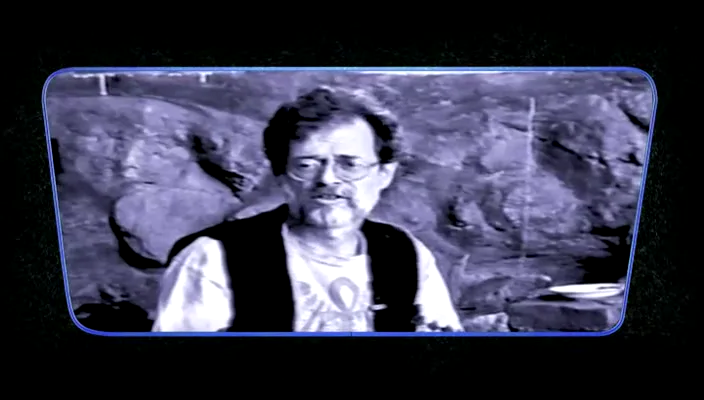
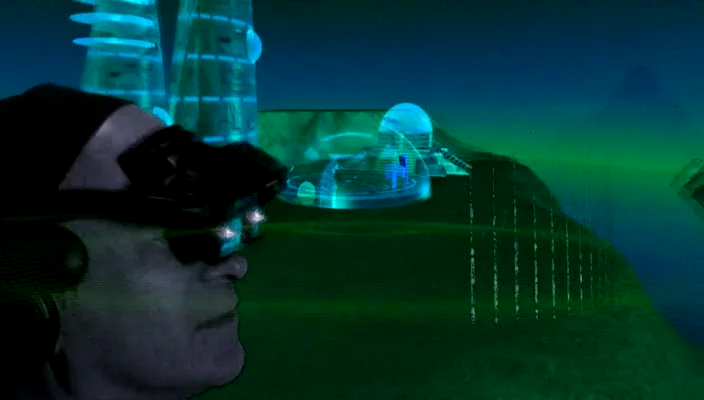
mike kawitzky's 2009 documentary. some twenty thinkers, framed by terence mckenna's archive recordings, on five questions about evolution, consciousness, god, science and death.