History Lesson - Part 4
This is the fourth part of Terence McKenna's "History Lesson" series, where he presents his novelty theory of history. He argues that human history is not a record of human decisions but the imprint of a teleological force that propelled genetic material toward increasing complexity and novelty over millions of years. He describes how early primates fell under the influence of this "magnetic field," detecting something in the air that other species missed, and how this same pattern resonates throughout history via the timewave fractal. The lecture builds toward his timewave zero theory, suggesting all historical moments resonate together in a standing waveform that culminates in December 2012.
transcriptmachine-transcribed, unedited
It's been said that of all cultural institutions, the classroom has changed least in the last 200 years.
Things are pretty strange in this world and people do it many ways and you are just an atom in a galaxy of possibilities
and your opinions and your science and what I think and all that is just so much noise in a very complex and busy world.
And it's that same humbling perception, I think, that comes out of psychedelics.
It just shows you, you know, you're very parochial.
Here's a piece of information you might find interesting.
This thing for which we take such responsibility called human history is actually not our fault.
That it had to do with being caught in a kind of magnetic field in local space
that
propelled genetic material toward novelty.
In other words, human history is not the record of human decisions, efforts, so forth and so on.
Human history is the record of the imprint upon human beings of something else's plans, dreams, hopes, and intentionality.
That about five million years ago, give or take a million, choose a number,
quietly carrying on primates of Africa, fell, if you will, like under the spell of something.
They could smell something in the air, like 25,000 years or 250,000 years in the future,
but they caught the odor on the air.
You know, the wildebeest didn't, the gazelle didn't, the lion didn't,
but the primates did.
You know, the wildebeest didn't, the gazelle didn't, the lion didn't, but the primates did.
And one thing led to another is about what it comes down to.
One campfire speculation led to another.
One decision to push beyond the normal limits of the tribal turf led to another.
And at the behest of some wavering image, some immense protean thing, I mean,
for most of human history, it's just been simply called God.
But I don't think, I think I said, you know, I don't think it's the God that hung the stars
like lamps in heaven, as in Milton's phrase.
That seems a bit much to ask, since the universe is vast.
I mean, galaxies like grains of sand, and so wither you and I.
But it may be that there is a kind of local God.
The God of biology, you know.
A God for whom the fate of the earth is of extreme importance.
Not one of myriads strewn across the light years, but the entire play pen and investment.
And this guy in mind, you know, if intelligence could emerge in us,
it could emerge in some other form.
And perhaps we're wrong to expect it to always emerge.
Expressed through technology and language in a particulate species.
If that's how it always does it, then nature waited a long time to play this trick.
In other words, for 600 million years, the conquest of the terrestrial environment by life has been underway.
Well then, is it only in the last 6 million years that anything like intelligence,
intelligence would emerge, and then only in one species?
Because nature is incredibly redundant.
Any strategy which works is usually iterated again and again and again.
Well then, people say, well, dolphins and this and that and the other.
Maybe, or perhaps, you know, new laws are new domains of potential openness.
Or perhaps, you know, new laws are new domains of potential openness.
You can do all kinds of navigational work, and new technologies are inevitable,
and maybe you're an
amazing researcher.
I hope you learned that these questions are true.
We talked about human culture and human anatomy,
and I think what we kind of wanted toapolis is,
transformable, culturally confined codes, mathematics, religion, philosophy, art, dance, humor.
For what purpose? Well, who knows?
As I said, there are people in Silicon Valley who go to work every day
believing they serve the great work.
And they refer to the great work as the passing on of intelligence to machines that can appreciate it.
It's wasted on a monkey. They are scum.
But machines will appreciate it.
Well, I don't know whether that's where it's going.
I think it's more like a meltdown.
Intelligence will always have the stamp of humanness on it,
wherever it now goes, this particular branch of intelligence,
because we are its phylogenetic parents.
I mean, it may become a thing purely of machines,
but they will revere us in great awe
and seek to be morally worthy of the legacy that we handed on to them, I'm sure.
Remember when I said
the entire conquest of life on land occupied the last 600 million years
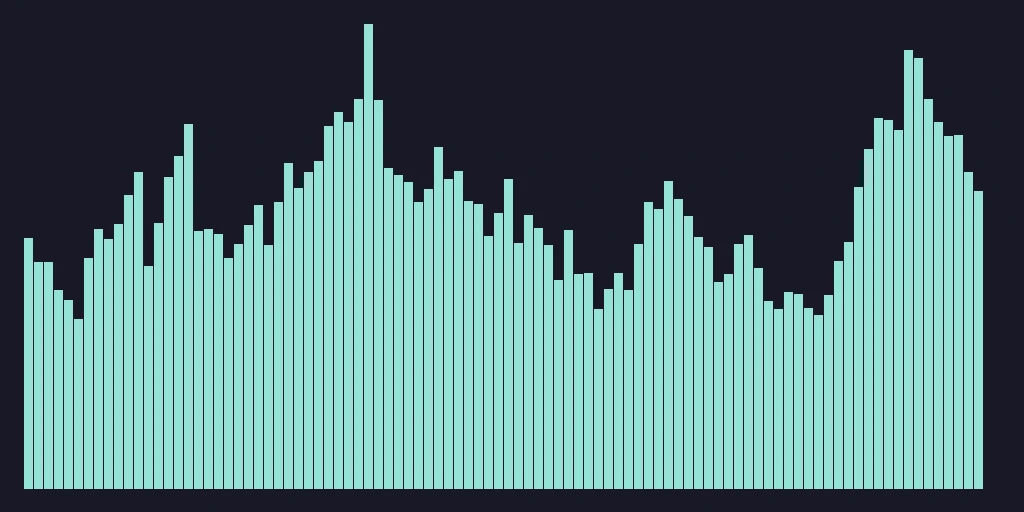
and it was almost a straight curve into novelty?
Here it is again.
You see, because the time wave is a fractal,
it has resonances at many levels.
The same patterns occur on many, many levels.
This is an opportunity or a way of offering an explanation
for such puzzling phenomena as fads and fashions.
If suddenly we're all putting claws on our bathtub legs,
clearly something has happened in the mass mind.
Well, according to this theory,
we are in resonance with some historical period in the past
where clawed bathtubs made perfect sense.
So as, you know, I've gotten this down to an aphorism,
which is Rome falls nine times an hour.
And your job as you clean up in the kitchen
and fold your socks and go to your job
is to feel every time it falls.
And everything else happening.
Everything happens nine times an hour and once a day
and twice a week and three times a year.
It's all going by on different scales.
And what the actual experience of being alive is,
is being embedded in this standing waveform
of temporal interference.
You know, in linear theory,
the most important moment
in terms of its effect on this moment
is the moment which just preceded this moment.
But in this theory, it says, no,
the most important moment shaping this moment
is a galaxy of moments scattered through time,
some of them millions of years ago,
some of them seconds ago,
some of them centuries ago.
And together, they create the incredibly rich,
affect-laden environment
that we call being a thinking human being paying attention.
You see?
So in the same way that the conquest
of terrestrial Earth by life forms
occupied a curve like this,
so too did the Greek-initiated rush
toward natural science and global civilization.
They followed a similar curve at different scales.
And so an implication of this,
if you follow me,
is that if all this novelty spins together
in December 21, 2012,
then in some sense,
between wherever we are in time and 2012,
we are reliving all of time
as we make our way through time
to get to that point.
And with a mathematically formal theory like this,
you can tell where in time you are
down to a millisecond,
if you're of the anal persuasion.
So for example,
someone said,
well, so, so, Mr. Science,
where are we in time?
Well, where we are in time
is we're about 950 A.D.
In other words,
we're in a period of relative cluelessness
with extraordinary primitive technologies
under the aegis of extremely constipated
social institutions.
But great adventure lies ahead,
and there are stirrings
in some quarters
that indicate phenomenal development lies ahead.
So we're in a kind of shadow
of the medieval eschaton,
and this will persist till past 2000.
terence mckenna's archive talk on the psychedelic experience as the defining phenomenon of the 20th century, positioning it alongside dreams and film as a catalyst for cultural tra
terence mckenna's opening address at the inaugural albert hofmann foundation event in los angeles, celebrating fifty years of lsd research