Mckenna & Sasha Shulgin

Terence McKenna discusses his years studying shamanism and hallucinogenic substances in Nepal, Indonesia, and the Amazon, focusing on psilocybin's remarkable effects including its intense visuality and what he calls the Logos, an inner voice that seems to operate independently of the self. He traces how this phenomenon, central to ancient Greek philosophy and religious practice, was eclipsed by Christianity and scientific rationalism but re-emerges under the influence of psychedelics. McKenna argues that recovering access to these states is not a cultural indulgence but a necessity, as consciousness-expanding substances offer a vocabulary for human understanding and survival at a critical historical moment. The audio includes extended dialogue with Sasha Shulgin, who brings a chemist's precision to these same philosophical questions. Two visionary minds converging on how consciousness itself might evolve.
transcriptmachine-transcribed, unedited
I'll have to begin by correcting Rob.
Actually, Jonathan Ott wrote
Halicinogens of North America.
I wrote Psilocybin, the Magic Mushroom Growers Guide
in corroboration with my brother.
I was originally going to call this talk
Monkeys Discover Hyperspace,
but I decided that that was a little outrageous
and I settled on Halicinogens to be Foreign Actors
of Psychology.
So before I dig into that subject,
I'll say a bit about how I come to have an interest
in these substances and their very peculiar effects.
Years and years ago, after an LSD trip,
I imagined that I perceived a relationship
between the LSD experience
and the motifs of Tibetan religious art.
And accordingly, I went to Nepal
and took up residence in a village of Tibetan refugees
and I quickly learned that the shamanism
that I wanted to study
was inaccessible for reasons of language,
for reasons such as that the Buddhists
who were teaching me Tibetan
looked askance at the shaman
that I wanted to associate with.
And I realized then that the association
between shamanism and halicinogens is such
that both, in a way, are taboo.
And when you deal with pre-literate cultures,
you discover that the shaman is a very peculiar figure.
He is critical to the functioning of the psychological and social life of his community,
but in a way, he's always peripheral to us.
He lives at the edge of the village.
He is only called upon in matters of great social crisis.
He is feared and respected.
And this might be a description of these halicinogenic substances.
They are feared and respected.
They are misunderstood.
They are only called upon often in moments of great crisis.
And they are a persistent but always peripheral part of the community.
And I saw this in Nepal, among Tungpo Tibetan shamanism,
which is a non-halicinogen-based shamanism.
I saw it in Indonesia, where techniques had been developed to induce trance
that were non-chemical techniques, specifically dance,
in the case of Bali and Lompoc.
And I saw it, finally, in the Amazon, where I think I contacted the primal shamanism.
As you know, there's a division of opinion on the matter of whether narcotic,
or as I call it, hallucinogenic shamanism, is decadent or, in fact, primary.
And Miss Deliade took the position that hallucinogenic shamanism was decadent.
And Gordon Wasson, very rightly, I believe, contravened its view and held that actually
it was very probably the presence of the hallucinogenic drug experience in the life of early man
that lay the very basis for the idea of the spirit.
Well, as I made my way through these various cultures and various hallucinogenic substances,
it came to my attention that, in my opinion, and I believe in the opinion of Gordon Wasson
and other scholars, Henry Munn comes to mind.
He wrote a marvelous essay called The Mushrooms of Language.
But in the minds of those who associated themselves with the mushroom, there were certain assumptions
about psilocybin that were different from the mythos that was arising around some of the
other hallucinogens.
Psilocybin, I think, of the more commonly available hallucinogens, is the most visual.
And it is certainly visual if it is done in the traditional manner.
And I'm always amazed at how little understood or practiced the traditional manner is, so I'll
sketch it for you.
The traditional manner of taking psilocybin is to take a very healthy, effective dose in
the vicinity of 15 milligrams, on an empty stomach, in total darkness.
You've been there.
And in that situation, which is, in a sense, a situation of sensory deprivation, the psilocybin
is able to exfoliate itself to the fullest degree and to show you what it is, not against the
background of the reality that ordinarily surrounds us, but against the background of
darkness, so that the pure essence of the thing can be shown.
And it is extraordinarily bizarre, extraordinarily difficult, I believe, to assimilate into your
worldview.
And this is whether you're a Bora youth undergoing initiation, or whether you're a college student
or a research chemist.
These things do not lend themselves well to integration into language.
If they did, they wouldn't occupy this peripheral position after 10,000 years of human culture.
But above and beyond the visual intensity of psilocybin, the thing that sets it apart, I believe, is
a phenomenon that might be described as an induction of audio hallucination, but in fact, to describe
it that way is to fall back on a kind of medical jargon reductionism, because what it really is,
is a voice in the head that is separate from the perceived ego function.
In other words, a voice speaks.
You hear it, and it seems to be operating independent of the ego.
It operates in a psychopompic role, as a teacher, as the narrator of the vision which is revealed,
much in the same way that Virgil led Dante through the circles of hell.
And the modern intellectual equipage is not capable of assimilating this.
This is the sort of thing that we associate with psychopathology.
We can hardly imagine anything more alien to modern consciousness than a disembodied voice
in the head.
However, if you familiarize yourself with Western thought on a scale of millennia, you discover
that not only is this not an alien phenomenon, but for much of human history, it has been
inimical to the human experience.
And it is called, relying on the Greek, the Logos.
The Logos is a voice heard in the head, and the Logos was the hand on the rudder of human civilization
for centuries, up until, in fact, the collapse of the ancient mystery religions and the ascendancy
of Christianity to the status of a world religion.
I'm sure many of you are familiar with the story in Petarch of the fisherman who heard
a great noise and saw something fall into the sea and heard a voice in the sky saying that
Great Pan was dead, that, in other words, the ancient gods had been eclipsed, and, in fact,
in Jungian terms, the ancient god, by falling into the sea, had been submerged in the fawnic unconscious
and disappeared from the experience of ordinary people.
From that period on, it was 15 to 17 centuries, while Christianity worked out the implications
of its message, how science spun away from Christianity and created its own set of modes, the new world
world was discovered, reason was enthroned, scientific method was enthroned, and the civilization
that we know arose around us, but then, in 1953, Valentina and Gordon Watson went to Guadalupe de
Jimenez in the Sierra Mazatez of Oaxaca, and they discovered this mushroom cult.
And it's my belief that, to this day, we do not know what exactly it was that they stumbled upon
mushroom, drug, cult, all of these ideas about what it was rest on the assumption that we know what we're
talking about when we talk about mind. And, in fact, everything that has been said at this conference has
rested on the assumption that we know what we're talking about when we invoke a concept like mind.
But the truth of the matter is, ladies and gentlemen, that after 2,000 years of grappling with the problem,
scientists cannot even tell you how you can form the conception that you will change your open hand
into a closed fist, and it will happen. This is an intervention of mind into the world of matter,
that no philosopher has been able to give a satisfactory account of. Now, with the hallucinogens,
this intervention of one realm into another, of mind into matter, or matter into mind,
is raised to a pitch of excruciating intensity. And it's my belief that one of the unconscious reasons
which underlies the odd attitude of the establishment toward hallucinogens is the fact that they
bring the mystery to the surface as an individual experience. In other words, you do not understand
the psychedelic experience by getting a report from Time Magazine or even The Economist. You only understand
the psychedelic experience by having it. And therefore, to understand it is to embark on a course of action
of self-education outside the context of your culture, because your culture has no answers about what this
thing might be. Okay, so much to that. But psilocybin and BMT to a lesser extent, although it is so brief and so
intense that it's sometimes hard to sort these things out, invokes the logo or reintroduces the phenomenon
of the logo into the experience of modern people. So what can we make of this? I think we have to take it very seriously.
I think that the culture crisis that we are involved in has to do, and by that I mean the entire global
cultural crisis leading possibly to the extinction of the species, has to do with the fact that our models
developed over the last 500 to 1,000 years have played us fault. They aren't working. And the cultures that we have
have conquered with capitalism and technology, we have repressed their connection into these intuitive realms.
We have established one method for the arbitration of truth, and everything that does not pass through that
narrow gate is relegated to the realm of mythology or worse, cultural immaturity. And yet we are the culture
that is in crisis. When you go to the rainforest, you don't find cultures in crisis, except to the degree
that they are being impacted by us. So I believe that it is no coincidence that in this moment of maximum
cultural crisis, which we call the 20th century, the hallucinogens, the entheogens, have emerged in Western culture.
It is no accident that Watson made his trip to Central Mexico and contacted the mushrooms. What he discovered
in the mountains of Mexico was nothing less than Eros, sleeping but alive, the body of Osiris preserved over
an entire astrological age, metaphorically speaking. In other words, that to take the mushroom was to transcend
the cultural momentum of the past couple of millennia and return to a world where the Logos was a realized phenomenon.
And we heard from Carl Ruck last night about the Ellicinian mystery. This was not a minor phenomenon. Over a period
of 2,000 years, everyone who was anyone made the pilgrimage to Erosis and had the experience. And it put the stamp
on Greek drama, Greek philosophy, later Roman politics. All of these things were influenced by the hallucinogenic
experience. So our culture, spiritually, has played the role of the prodigal son. We, for reasons of ideology,
botanical geography, other factors, have not had visionary ecstatic hallucinogens installed in our culture,
as we perhaps could have over the last several hundred years. Now that is changing. And in order to understand
what the change means, you have to look further back in time, in fact, past history to prehistory, again
to the model of the shaman. Not the shaman as anthropologists describe him, but the shaman as shaman
dean him. Because every shaman looks back toward an archetypal first shaman who was superhuman, who did go to the stars,
who could go to the bottom of the ocean, who could move through the gates of death and return with a lost soul.
Now it seems to me, when you pull back to the perspective of several thousand years, all of history can be seen as an
adumbration on this wish, expectation, hope for a superhuman condition, for a transcending of the laws of gravity,
of the laws of life and death, into a superhuman condition that was solitary for mankind as a whole. In other words, the shaman
of the archetypal perfected man. Now, this afternoon you heard Messner refer to alchemy as one of the
reflections of this concern with the perfection of the spirit. It is about the projecting of a perfect substance,
which is the self, purified, but it also led to the rise of modern science, basically through a misunderstanding.
Now, it seems to me, what's happening now, is that what Massiliad calls the human desire for self-transcendence, expressed through
the motif of magical flight, has been taken up by the technological society as the idea of space flight. And I'm sure if Tim Leary
were here, he could speak to this more eloquently than I can. Space flight is nothing less than the exterior metaphor for the
shamanic voyage. In other words, in our terms, for the hallucinogenic drug experience. This is the way that
engineers get high. They go to the moon. What we need to do to transcend our cultural schizophrenia,
and to heal the risk between spirit and soul, or world and self, is to realize something which we all pay lip service
to, at least I'm sure all the people in this room pay lip service to, which is the idea that the inside and
the outside are really the same thing. But I don't think the cultural implications of that have been clearly drawn.
What it means, really, is that all our dreams of transformation have to be realized at the same time. And that we cannot go to space
with our feet with our feet in the mud. Nor can we, in fact, turn ourselves into an echo-sensitive, hallucinogenic-based culture on Earth, unless we
see these dichotomous opposites. It is only in a coincidencia positorum, a union of opposites, that does not strive for closure, that we are going to find cultural sanity. And this is a
thing that the infeogenes, the hallucinogens deliver with such clarity and regularity. They raise paradox to a level of intensity that no one can evade. And in doing that, they set the stage for putting yourself into the kind of person who does not insist on having it either or by
black or white. And a culture composed of those kinds of people will be a culture more civilized than any that we have seen so far.
If I can paraphrase Teilhard de Chardin for a moment, he said, or I will paraphrase in this way,
when the human race understands the potential of the hallucinogenic drug experience, it will have discovered fire for the second time.
And this is what we are waiting for. We are waiting for the discovery of fire so that we can transcend the monkey business and get on with the great business of inhabiting our own imagination.
And it's impossible to take that position without someone saying, Manichean, dualist, enemy of the body.
Perhaps, but since the very beginning of culture, what we seem to be are animals which take in raw material and excuse it, imprinted with ideas.
And we do this on a larger and larger scale, looking toward the day when all physical constraints can be lifted off of us as they are in our imagination.
And we can erect the kind of civilization that we want to erect.
And this vision was anticipated by no less a seer than James Joyce.
He said, If you want to be phoenix, come and be polished.
Up in the end, prospector...
Here in Moitaine, we flop on the phoenix side.
Moitaine is the red-light district of Dublin.
But up in the end, prospector, you sprout all your worth and whiff your wings.
This was part of his program.
He hoped that man would become dirigible, as he put it.
And he didn't live to see the revolution of the hallucinogens.
But I think, had he, he would have felt that man was well on his way to becoming dirigible.
And it seems to me that we stand at an enormous threshold.
The future of the human mind must loom large in the future of the human species.
If it doesn't loom large in the, in the future of the human species, then we are in very big trouble.
Now, a term that has been applied, or was early on applied, though I haven't heard it used at this conference, to hallucinogens, was consciousness-expanding drugs.
And this may not be automataic, but it's certainly phenomenologically accurate and neutral.
They are consciousness-expanding drugs.
And the question, what is consciousness, cannot be divided away from the question, is man good?
And this is a question that we have to answer for ourselves, because I believe that we are not going to extinguish ourselves.
That we are going to evade the, uh, the manic obstacles that are so obviously ahead of us in the next few years.
We are going to reach the threshold of the galaxy, but in what form?
And in order for the form in which we reach the edge of the galaxy and present ourselves to the hegemony of organized intelligence that must exist there,
in order for that form to be worthy, we are going to have to go with our minds fully illuminated in front of us.
And that means that we can have no more trust with the idea of an unconscious,
of an inaccessible and dark part of the human psyche that cannot be controlled.
That is obviously a description of the childhood of an intelligent species.
And I believe that these hallucinogens signal the end of that childhood.
There have always been individual shamans who have made that transition.
And in that sense, the taking of hallucinogens is an unhistorical phenomenon.
It has always been going on.
But the idea of psychedelic societies is something new.
And it doesn't necessarily mean that everyone takes the drug.
It merely means that the complexities and the mysteriousness of mind are centered in the consciousness of the civilization
as the mystery which it comes from and which it must relate to in order to be relevant.
So I'll take a couple of questions.
...of the utilization of material that would allow you to hang on to whatever perceptions I may have triggered in you.
I wouldn't presume to answer that question, but I'll answer another one that might relate to it.
Because I think that when you take hallucinogens, you should take an effective dose.
And I can't stress enough the importance of lying down and being still in darkness on an empty stomach.
I mean, if you want an oral empowerment, that's it.
Nothing could be simpler.
And yet you would be amazed at the number of people who, when you mention psilocybin,
the first question that occurs to them is, will I be able to drive?
This is one more.
And with regard to what?
Well, MBA, the word impasthenogen or impasthenogen seems to me very appropriate.
It is not a powerful visual hallucinogen.
I'm very interested in the visual hallucinogens because it seems to me they pose certain fundamental questions about information theory and that kind of thing.
For instance, you know, where do these hallucinations come from?
These extremely intricate, far more intricate than any visual scene that your eye falls upon in ordinary reality.
These interesting, shifting information patterns.
I don't believe that they can be reduced to spirals, lines and dots.
What I see isn't like that.
It's more as though you had a holographic hyperspatial radio and you just tune down the dial.
And here's a desert world in a triple star system.
And here is a city somewhere inhabited by insectile creatures with a machine symbiosis.
Here is something else.
And it's just flipping by.
I would prefer to believe that the human imagination is the holographic organ of the human body and that we don't imagine anything.
We simply see things so far away that there is no possibility of validating or invalidating their existence.
These short-acting drugs have a profound lasting effect.
No, I think it certainly has a profound and lasting effect.
The very brevity of it serves to convince you that it isn't a drug at all, but that it's carried you into another dimension and back again.
And that alone is something to ponder.
Well, I thank you for your attention.
I was at the meeting last year when Dr. Hoffman came and his opening sentence was,
You expected the shame and you're going to get a chemist.
When I actually, when I was first asked by Dr. Robert Gordon McCutcheon to come here tonight and talk about whatever I wanted to do,
My first impression, as long as I allowed my first impression, was to decline.
I had, after all, I am a student of chemistry and of pharmacology and not really a student of philosophy and religion.
And I felt I had probably contributed as much as I could last year when I took chalk to blackboard and do hexagons and tryptamine rings and gave my impression of what on a molecule caused it to do what.
But my wife intervened. Why not tell them just why you do what you do?
Well, it got me lost into an interesting question.
I never had actually spoken to myself and said, you know, why do you do what you do?
The flippant answer is always at hand.
Well, one does it because it's there to be done.
The Mount Everest routine.
I climb the mountain because it's there to be climbed.
But that is, of course, not the reason I do the research I do.
Whenever this question would come up in a seminar or during a panel discussion,
I'd place special emphasis on the word psychotomimetic.
The word has been used quite a bit today.
A term that is usually used by the scientific community when they wish to speak about the psychedelic drugs.
The term psychedelic does not find a good audience in the psychiatric or in the chemical or in the medical literature.
It carries a metamessage of drug use, drug encouragement, drug proselytizing.
And as a result, the word is not often encountered.
In its origin, as was pointed out, it comes from psychoto, meaning in essence psychosis,
and minutus, meaning the imitation of.
And this, indeed, is a term that very early in the work in this area,
there had been given these materials because they had been cast in the role of causing syndrome,
causing symptoms that would reflect the character of mental illness.
And as felt by studying the effects of these materials in normal subjects,
you might be able to glean some insight as to the mechanisms or at least the descriptions
and definitions of this syndrome when seen in people who are spontaneously ill.
This explanation, the search for new psychotomimetics for materials that would be more exact in the definition of psychosis,
is completely logical in that most of the hallucinogenics, the psychedelics that are known,
can be classified into materials that are indoles, and there are many in this area,
the tryptamines, the more convoluted carbolines, LSD as an ergot-type indole,
or it can be classified as phenethylamines.
And there are perhaps some three or four scores that are in this classification.
The analogs of mesclin compounds have been mentioned several times,
or the substitution of variants of mesclin,
or the alpha-methyl compounds that have given rise to the materials that are lumped chemically together as the amphetamines.
And there are two principal neurotransmitters in the brain.
One is an indole, and this is serotonin.
One is a phenethylamine, namely dopamine.
And it's very desirable from the point of the neurochemist to find pigeonholes that can classify things.
Here we have a group of psychedelics that are all indoles,
and we have a neurotransmitter that's indolic, serotonin.
Here's a group that are all phenethylamines,
and we have a neurotransmitter that's phenethylamine.
All we have to do is understand why all of these work here, and all of those work there,
and we still now know how the neurotransmitters work in the brain.
Unless we know that, we'll be able to cure mental illness.
Well, it's an appealing, and it has not been a particularly rewarding classification.
And the explanation, besides being logical, is quite safe,
because it's an unthreatening explanation.
It's easily accepted by the academic and administrative community.
But the explanation is still not the explanation of why I do what I do.
My work is indeed dedicated to the development of tools, but tools for quite a different purpose.
And here is where I want to get quite a way from chemistry and into some of my own personal thoughts.
I'd like to lay a little background to establish a framework for these tools,
and in part to define them, and in part to give emphasis to an urgency
that I really feel associated with them.
First, I am a very firm believer in the reality of a balance in all aspects of the human theater.
When there seems to be a development of move that-a-way,
somehow, very shortly, or almost in concert, there is a move this-a-way
that keeps things in some delicate balance.
If there must be a dichotomization of concepts into good and evil,
then all good seems to contain its unexpressed evil,
and all evil is unexpressed good.
Within the human mind, there coexists the eros,
the life-loving, the self-perpetrating force,
with the thanatos, the self-destructive death wish.
Both are present in each of us,
but are usually separated by a very difficult wall,
a very difficult-to-penetrate wall of the unconscious.
One definition of the tools I seek is that they may allow words of a vocabulary,
a vocabulary which might allow each human being to more consciously and more clearly
communicate with the interior of his own mind and psyche.
This may be called a vocabulary of awareness.
A person who becomes increasingly aware of, and so begins to acknowledge,
the existence of the two opposite contributors to his motives and decisions
may begin to make choices which are knowledgeable.
And the learning process that follows such choices, the path that leads to wisdom.
But just as there is a balance within the mind that needs establishment,
there is an interesting record of balances of the same sort in society.
Let's look for a few minutes at some of the coincidences
that have kept our human race in a rather precarious balance.
Throughout the early centuries of the current millennium,
there were carried out some of the most viciously inhuman wars that were known to man,
all in the name of the forces of religion,
and the horrors of the Inquisition, with its lethal intolerance of heresy.
And yet, it was during these dark years that the structure of alchemy was established.
Not to change base metals into noble ones, as it was often thought,
but to acquire knowledge through the study of matter.
The work of the alchemists extended up to the age of enlightenment,
with the urges of rationalism and of skepticism.
And it was always directed toward the learning process.
The reward of alchemistic effort has been simply stated
as the effort to achieve the transmutation of base metals into gold.
But as Ralph pointed out just a bit ago,
this is not the actual reward.
The value was the doing and the redoing and the redoing of the process of distillation,
of sublimation, of condensation, of precipitation.
It was a continual, ever more exact effort to understand these processes,
that from the learning of the process,
one would be able to find a unity between the physical and the spiritual world.
It was the doing and the redoing itself that was the reward.
In the last hundred years or so,
this learning process has evolved into what we call science.
However, there has been a subtle shift in the goal,
from the process itself to the results of the process.
In this age of science, it is only the end result, the gold, that really matters.
It is not the act of achieving, but the achievement itself that brings one the acknowledgement of his peers,
that brings recognition from the outside world,
that results in wealth and influence and in power.
And these end achievements, these results,
show the same dichotomy of directions which was so evident in the previous centuries.
For years, there had been no separation of values.
Neither direction had taken the colors of good, or for evil.
But still, there were incredible coincidences of timing.
For example, in 1895,
Wilhelm Conrad von Lincoln observed that when electricity was applied to an evacuated tube
containing certain gases,
a nearby plate covered with barium,
platinocyanide, emitted a visible glow.
And the next year, in 1896,
Antoine-Henri Becquerel
found that these same metal-producing emanations
were being emitted from uranium,
where your activity had been discovered.
But it was just in the following year,
at 11.45 a.m. on the 23rd of November of 1897,
that Arthur Hefter consumed an alkaloid
that he had isolated from the peyote, dumping cactus,
brought to the Western world by the irrepressible pharmacologist,
Louis Levine.
As Hefter wrote in his notes,
and this is a quotation following 150 milligrams,
of mescaline.
From time to time,
dots with the most brilliant colors
floated across the field of vision.
Later on, landscapes,
halls,
architectural scenes also appeared.
Mescaline had also been discovered.
During the 1920s and 1930s, both worlds,
that of the physical sciences involving radiation
and that of the psychopharmacological sciences involving psychotropic materials,
continued to develop without any clear sense of polarity,
without the mine is good and yours is evil duality that was soon to come.
Radioactivity and radiation were becoming the mainstays of medicine.
X-ray photography was invaluable in diagnosis,
and radium therapy was broadly used in treatment.
Controlled and localized radiation could destroy malignant tissue,
prospering the host.
And in the area of psychology,
there were parallel developments.
The theories of Freud and Jung were being developed
into increasingly useful clinical tools and approaches to mental illness.
And on the basis of experimental psychology,
it was laid in the pioneering studies of Pavlov.
Another coincidence in timing,
which in retrospect started a dividing of science
on a separate path,
occurred during World War II.
In the late 1942,
Enrico Fermi and several other scientists
at the University of Chicago
demonstrated for the first time ever
that nuclear fission could be achieved
and could be controlled by man.
The age of unlimited power and freedom
from dependency upon our dwindling fossil reserves
had begun.
Just the next year,
at 4.20 p.m. on the 19th of April,
Albert Hoffman consumed a measured amount of a compound
which he had first synthesized some five years earlier.
As Hoffman subsequently reported,
as a quotation following 250 micrograms,
after the crisis of confusion and despair,
I began to enjoy the unprecedented colors
and plays of shapes that persisted.
Kaleidoscopic, fantastic images surged in on me,
alternating, variegated,
opening and closing themselves
in circles and spirals.
LSB has also been discovered.
But then, still,
and up until the last decade,
it was the rich promise of the nuclear age,
first with the power and potential of fission,
and later with the virtually limitless potential
of fusion energy
that carried the banner and the hopes of man.
And the area of the hallucinogenics was categorized as negative,
psychosis-imitating,
psychotomimetic.
It was not until someone in the 1970s,
sometime in the 1970s,
that a strange and a fascinating
and a rather frightening reversal of roles
took place.
The knowledge of nuclear fission and fusion
took on a death-loving aspect,
with country after country joining the fraternity
of those skilled in the capacity
for the eradication of the human experiment.
And to have such power
leads to the threat to use such power,
which in time will actually lead to its use.
But, as I said earlier,
when one thing develops,
there seems to spring forth
the balancing of compensatory counterpart.
This balance can be realized
with the psychedelic drugs.
What had been simply tools
for the study of psychosis, at best,
or for escapist self-gratification, at worst,
suddenly assumed the character
of tools of enlightenment
and of some form of transcendental communication.
If man's alter ego, his thanakos,
had been entrusted with imperpetual knowledge
of how he can completely destroy himself
and this extraordinary experiment,
then some development will,
must occur at the eros side of his psyche
that will and must afford
the learning of how to live
with his professional knowledge.
It is a communication
between these two sides of the mind
that requires an extraordinary vocabulary.
Where do these words come from?
The words of this vocabulary.
All depend upon an intimate insight
into the working of the human mind.
But this can be approached in many ways.
The study of religion,
of meditation,
of self-yielding,
provides a peace.
But in my mind,
also tends toward a retreat
and hence a capitulation.
The efforts to amalgamate
the two sides of the mind
as seen in the Tao of physics
and the rich findings of parallelisms
between the Eastern and Western philosophies
may eventually explain all
and allow some unification
for the human purpose.
But I feel,
along with many others,
that the efforts
being invested
in the technology of destruction
does not allow sufficient time.
It is possibly only
with the psychedelic drugs
that words of vocabulary
can be established
which might tunnel through
the subconscious
between the conflicting aspects
of the mind and psyche.
It is here that I feel
my skill lies.
And this is exactly
why I do what I do.
Where do we stand
as of today?
In the last handful of years,
the forces of government
and nationalism
have amassed
an unprecedented arsenal
of destructive power.
The power is in the current arsenals
of the world
if restructured
into Hiroshima-strength weapons
to detonate one bomb
every minute
on the minute
for the next two years.
And the rationalization,
the rationalized need
to do so
is becoming manifest
at a frightening pace.
But in the last handful of years,
a number of tools
of communication
have increased
at a like rate.
There are currently
nearly 200 psychedelic drugs
known and described
some touching at one,
some at another
of the fibers
that unify our minds.
By learning
each of the structures
of sensory communication
in turn,
we might find
a form of communication
that would disarm
our destructive compulsion.
And indeed,
what form of tools
are now available to us?
Some of the tools
that are available
or rather
that have been available
are the widely publicized
drugs of psychopharmacology
such as mesclate,
psilocybin,
DOM,
LSD,
these drugs
played a role
in defining
the transition
between drugs
as entertainment,
escape,
turn-on,
and drugs
as instructive vehicles
for learning,
enlightenment,
and insight,
but at quite a price.
They had a high profile
at the time
that the scheduled
drug laws were written
and thus
were made illegal
and are not available.
However,
in their place
there are now
many, many other materials,
some more limited
in their instructive capacity
and some perhaps
even richer.
And for everyone today
there will be
ten tomorrow.
Let me describe
a small sampling
of the recently born materials
a bit more in detail.
These are examples
with some quotations
in some instances
of experiments
in which there have been
actually definitions
of some aspect
of sensory teasing apart
of the complex
sensorim attack
and effects
that these materials
can have.
DIPT
is an abbreviation
of NN-diastropropylcryptamine,
a drug unique
among the psychedelics
in that it expresses
a distortion in
or to an extent
a synthesis
with the process
of auditory interview.
It is perhaps
one of the less
available senses
to be teased apart
for special studies.
Many of the close relatives
as you well know
deal with the audit
with the visual process
and in some way
will change
or synthesize
or modify
the visual integrity
but a rather
interesting distinction
between the drug
induced psychosis
and endogenous
schizophrenia
is that very often
in the latter
the primary
sensory
character
that is affected
is the auditory
influence.
A quotation
following 20 milligrams
of DIPT
The telephone sounds
partly underwater
Here are signs
of a pitch change
on radio
The absolute pitch
down a major third
Chord on the piano
sounds out of tune
quite flat
Music terrible
unlistenable
The other senses
seem to know
if I were deaf
I would have thought
this an inactive drug
Several hours
after ingestion
of the material
this note
Hearing normal
piano back in tune
MDMA
or MDA
is abbreviation
for 3,4-methalindoxy
methamphetamine
It's a tool
of communication
that has shown
in recent years
an extraordinary
utility in opening
communication
between individuals
This has promoted
its use in psychotherapy
but has given
promise as well
as a vehicle
for interpersonal
intrapersonal
communication
This particular drug
has been used
clinically
in many applications
and these today
in probably a number
in the thousands
and it has commanded
a remarkably good
record of positive results
A quotation
following 120 milligrams
We kept up
a lively conversation
covering many
interesting aspects
of our various
family relationships
The conversation
was unusually insightful
and free of defensiveness
And following
a 40 milligram
supplement
at the two hour point
Gene glowed
with energy
became very beautiful
We talked freely
and openly
Every bush and plant
looks utterly alive
I am entranced
by a large rock
As I look
at its surface
I see the surface
of a planet
with mountains
and valleys
Little crystals
of mica
are like jewels
Another material
2CB
is the abbreviation
for 2,5-dimethoxy
4-bromophenethalimine
A tool
and a word
of vocabulary
which ties
the mental process
directly and constructively
into the physical soma
The analgesic effects
experienced with many
if not most
of the psychedelic drugs
are not present
with 2CB
On the contrary
there is an increased
body awareness
of every kind
including skin sensitivity
heightened responsiveness
to smells
tastes
to sexual stimulation
When experiences
increased consciousness
of physical health
and energy
on the other hand
sharpened awareness
of any body
imbalance
or discomfort
2CB
allows rich visual imagery
and intense
eyes closed fantasy
without cluttering up
of the metal field
of too many elaborations
A quotation
following 20 milligrams
Along with the awareness
of the body
and the ability
to deeply enjoy
the fact
that one is a physical
as well as a spiritual being
the experience
of 2CB
allows exploration
as far
as one needs
to go
There is at all times
full connection
with all parts
of oneself
the emotional
and the intellectual
the intuitive
and the instinctual
It is a superb tool
for learning
and for growth
and 2CB
allows one
to recover baseline
within 6 to 8 hours
using a maximum dosage
of 25 milligrams
usually lower
in the area
of 18 to 20
Another drug
mentioned earlier
ketamine
is abbreviation
for 2-orthochlorophenyl
2-methylaminocyclohexanone
the antithesis
of 2CB
in that it effectively
separates the mind
and the body
This allows the mind
a separate
and constructive state
apart from the
physical groundings
of the body
Although the primary
clinical application
of ketamine
is as a dissociative
anesthetic
an increasingly important
direction of study
the logical loosening
that it allows
MAL and CPM
are abbreviations
of the compounds
that are fascinating
analogs of mescaline
namely 4-methyl-3-5-dimethoxyfenethylamine
and 4-cyclopropyl-methyl-3-5-dimethoxyfenethylamine
two compounds
that activate
opposite sides
of the sensorium
The former
provokes
an intense visual distortion
at the retinal level
with consequential
bizarre interpretations
The latter
displays its effectiveness
in the fantasy
counterpart
seen only
with the eyes closed
Following
65 milligrams
of MAL
A quotation
Within 2 hours
intense effect
Beautiful
diuretic
Good connections
between parts
of myself
Continual fantasy
and imagery
Lovely experience
of the erotic
with husband
Around 12 hours
Excellent solid sleep
with clear
balanced dreams
Following
70 milligrams
of CPM
A 2 hours
strong effect
but no visual
Wonderful
locking into music
Deep loving
Erotic
Very good
With eyes closed
Intense
colorful fantasy
Much like LSD
at times
No sleep
before 18 hours
Lest anyone
should have the impression
by the way
that research
in this area
leads always
to God
and to insight
and to deeper
experiences
and loving
Let me mention
an example
of a compound
called 4-TASB
which is
4-thioethyl-3-ethoxy-5-methoxyfinethylamine
following 100 milligram
exposure
at about 2 hours
pleasant and positive
peaceful feelings
very good humored
Later
sleep impossible
until early morning
and then only
about 2 hours
All next day
could not rest
or sleep
feeling of nerve endings
raw and active
anxiety over heartbeat
frightening effects
on nervous system
depression
back of neck
sore from tension
my first experience
of being able
to detect
what felt
like continual
electrical impulses
between nerve endings
had the impression
that if I allowed
the wrong sequence
of images
to flow in my mind
I might experience
some sort of convulsion
or might at least
a kind
or at least
a kind of mental shock
or shorting out
When I tried to sleep
eyes closed
fantasies became
intensely negative
and threatening
I could not smooth
out the nervous system
felt very vulnerable
do not repeat
Alpha-O-DMS
is an abbreviation
of 5-methoxy
alpha-methylcryptamine
an analog of
a neurotransmitter
serotonin
that has been
tailored chemically
to allow it
to enter into the
CNS
into the brain
There is a very
potent endo
psychedelic
that touches
closely on those
areas involved
with primal energies
Several researchers
experienced dreams
of catastrophic
events
after exploring
this material
One researcher
however
had a dream
which involved
as a complete
science fiction
scenario
he found it
absolutely enjoyable
and is still
thinking of
writing it up
and sending it
into a publisher
These are only
about a half
a dozen or so
of many scores
of fascinating
compounds
that are now
available for the
study of this
developing vocabulary
This is where
we are at the
moment
Some materials
show incredible
promise
and some
suggest caution
science fiction
But what might
we expect to
emerge in the
future
Let's look at
the past history
of other areas
of psychotropic
chemistry
A few decades
ago it was
marveled at
that drugs
such as the
opiates
including morphine
and heroin
and meperidine
could have such
an exacting
influence on the
brain's integrity
Then it became
known that there
were natural
factors in the
brain that had
these actions
and that there
were specific
sites in the
brain that were
pre-designed to
respond to them
There were the
encephalins and
their fragmented
portions known as
the endorphins
which were derived
from the cephalic
process and related
to morphine
These met a
person's need for
the suppression of
pain
Perhaps there are
encephalins from
the psychedelics
and specific
enescalins from
mescaline yet to
be discovered
that might relate
to these
communicative
factors which
might be the
natural
which might be
connected and
eventually
related to the
natural receptor
sites in the
brain for
transcendental
communication
Their structures
may someday be
known, their
functions may
someday be
understood
There are a
multitude of
tenuous threads
that tie together
the fragile
structure of the
human spirit
The life-giving
with the death
demanding side
The exalted
voice with the
mundane
The strongly
centered self
with the drive
toward dispersion
and loss of
center
These all
coexist in all of
us but there
is an essential
blockade between
these inner worlds
which I truly feel
can be penetrated
only with the
words and the
tools and the
understanding that
may be most easily
obtained through the
area of psychedelic
experiences
William Blake said
in the marriage of
heaven and hell
Man has no body
distinct from the
soul
for that called
body is a
portion of soul
discerned by the
five senses
The chief inlets of
soul in this age
energy is the only
life and is from
the body and
reason is the
bound or outward
circumference of
energy energy is
eternal delight
These are responses
to a heartfelt need
for some vocabulary
to allow the
establishment of a
dialogue that might
diffuse the
accelerating mad
moves toward
extinction
My personal
philosophy might
well be lifted
directly from
Blake I must
create a system
or be slaved
by another man
I may be wrong
but I must do
what I'm doing
and I will do
what I can
stop
that
time

terence mckenna and ethnographer nicole maxwell in conversation at an ojai foundation workshop. four talks on amazon medicine, shamanism, and indigenous consciousness systems.

terence mckenna describing the phenomenology of DMT, its appearance, the method of ingestion, the rapid onset, and the linguistic quality of the hallucinogenic state.

terence mckenna explores the origin of consciousness and why humans emerged from millions of years of simpler biology
terence mckenna presents his theory that psilocybin mushrooms catalyzed human evolution by enhancing visual acuity for hunting, increasing sexual arousal to boost reproduction, and

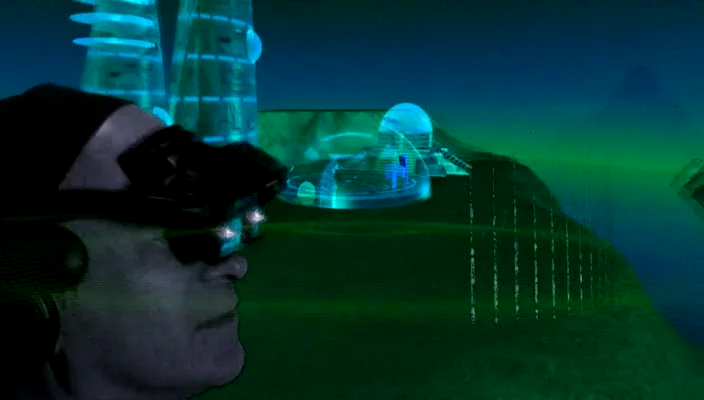

mike kawitzky's 2009 documentary. some twenty thinkers, framed by terence mckenna's archive recordings, on five questions about evolution, consciousness, god, science and death.