Metamorph

A recorded trialogue between three major thinkers. Rupert Sheldrake presents his theory of morphic resonance as nature's collective memory; Ralph Abraham describes mathematical models of chaos and attractors that pull systems toward higher order; Terence McKenna synthesizes these into a vision of imagination as the basis of evolutionary creativity. Their discussion ranges across psychedelic experience, consciousness, and how chaos theory and mathematical dynamics converge with mystical philosophy on the fundamental aliveness of nature. This is crucial listening for anyone trying to move beyond mechanistic materialism toward a living cosmos.
transcriptmachine-transcribed, unedited
Everyone's fond of saying that coastlines and forest distributions and all this stuff are fractal.
Well, doesn't this imply that there is then a global fractal?
There is a fractal dimension which when you feed it into your computer and wrap the data around a sphere,
the continents and oceans of Earth should appear.
And in principle, again to the absurd level, you should be able to then telescope in on that portion of this data
that is wrapped around the sphere that corresponds to Northern California.
And on your computer screen should appear Esalen hung on the cliffs of Big Sur
with us sitting in a room inside discussing the matter.
Rupert Terence Eyebrow.
Creation, imagination, my mask is chaos.
In my early LSD experiences, I seemed to see motifs and structures that gave me an interest in Tibetan Buddhism.
And I went to India with the intent of studying the Tibetan language
and quickly found that the whole thing was just overwhelming
and that I was just, you know, a human atom in the sea of India
and that the notion of encompassing or understanding what this was,
was clearly the task of a lifetime.
And several times in my life I have acted out this sort of ricocheting relationship between the humanities and the sciences.
At times, you know, losing myself in the study of certain schools of poetry or literature or painting.
And then at other times spending years reading philosophy of science and epistemic basis of physics and this sort of thing.
always trying to get a resolution on the content of my experience,
my lived experience, which included the psychedelic experience,
which for me from very early on was this kind of tremendous mystery or conundrum which was set down in the middle of my being.
And it still continues like that.
I keep returning to that, testing all the ideas against the fullness of experience.
The main difference between our world and the world that science tells us we're living in
is that science denies the quirky, freaky, cosmic giggle, high-plottedness, completely improbable, totally quirky humor
that binds everything together and that makes it something other than an engine in which atoms blindly run,
in Whitehead's phrase.
Schrodinger brilliantly anticipated the discovery of DNA
and then Joseph Needham and L.L. White and, well, Eric Jansch should be mentioned actually
as a precursor of us all, I think.
I mean, Eric Jansch was a great pioneer, a great soul,
and he saw very deeply into whole systems as did Ilya Prigozhin, the Belgian thermodynamicist.
And I think a lot of all of what we're doing comes out of that.
What Prigozhin showed that just brought down the house was that there could be perturbations of physical systems that were unpredictable
and that would cause the whole system to actually move to a more ordered state than the initial state.
And this perturbation to higher states of order looks suspiciously like a violation of the supposedly inviolate second law of thermodynamics.
So that looks, you know, like a doorway into an energetic hyperspace.
Well, when A New Science of Life came out in 1982 in America, it came out a year earlier in England,
I came to California because it was published in Los Angeles.
I found myself here at Esalen, I found an extraordinary new range of things going on I hadn't known about.
And when I was in San Francisco, a friend who I knew from Europe said to me just the day before I left,
there's somebody you must meet.
He's called Terence McKenna.
I didn't know much about Terence, so I went up there.
And in this large 1956 Buick, we headed off into the woods in Sonoma County where Terence lives.
And there I met both Terence and Ralph, who was there for the day.
I found that part of my interest in these other realms of reality, of course, like many people in this room,
was stimulated by experience with psychedelic substances.
This was before I went to India.
When I arrived in India, I found that India is a kind of psychedelic realm anyway.
It's just an amazing place.
So, in Terence, I found somebody who knew about that whole realm,
who shared with me an interest in India, since it played an important part in his development.
And who had views about the nature of reality, which complemented my own in an extraordinary way.
My own theory is about memory and habit in nature.
Terence, I found, had developed a theory about novelty and creativity in nature.
A theory about the quality of time and the creative process as it is related to the ongoing flux of events.
And Ralph had a kind of mathematical theory, which was just the kind of thing that the view of nature I was trying to develop needed.
The idea of nature being drawn by goals or attractors in the mathematical science of dynamics.
There's this model of reality being pulled from ahead by things called attractors.
It's a teleological, animistic view of nature, which dressed up in the guise of mathematical models,
which I found most fascinating.
And so, for me, the meeting with Ralph and Terence was a step further towards seeing how one could begin to dream of a world
in which nature was seen as alive, in which nature was seen as alive, in which the imagination permeated all reality,
in which animals and plants are seen as part of the living texture, the living components,
the cells in the life of Gaia, and Gaia in the life of the cosmos as a whole.
In fact, a view of the world as alive, which recalls in some respects the old cosmologies of the ancient world,
where the cosmos was seen as a living organism, where they thought of the whole cosmos as having a soul,
the soul of the world, the anima mundi.
So I was brought up in a field of music, but I was attracted to mathematics early.
And when I was 14, I played in the State Symphony.
After that, I started in mathematics, and I became a professor at Berkeley when I was 23.
I had an easy way in mathematics, and the way the system works, the carpet is unrolled in front of you.
You know, you can, you have a few choices, but basically before you even know what's happening,
the carpet is unrolled, and you're down the runnel into whatever you can do that's useful to the system.
In this process, I lost nature, but there was a great gain, because I love it out there.
I love to be off the planet.
I always did, and to this day, I spend very little time on planet Earth.
So it went on in this way, and by 1967, I was a professor at Princeton.
I had written three books on mathematics that you need a microscope to read.
And I had been studying for a long while chaos, but we didn't call it chaos then,
and we didn't see in it any role in the natural world or in social transformation
or in the evolution of consciousness, because we didn't think about anything out there.
So one day after my third book was done, and I was exhausted, and I looked up,
and all the students were out in the courtyard demonstrating about the Vietnam War
and to open the university to women students and so on.
I said, what exactly is going on?
Here, they said, take this.
And so, like many people in that year or around that time, in 1967, my career had a bifurcation.
So I went off the track with psychedelics, with meditation, but especially with searching,
with trying everything, and eventually I was living in a cave in the Himalayas.
And when I returned to California, I was standing on a street corner in Santa Cruz in white pajamas,
and a car stopped.
An old friend from a previous lifetime said,
there's somebody you have to meet.
Get in the car.
I had nothing to do.
It sounded okay, and in that time, I believed that everything goes perfectly.
You just go along with the flow, as they said.
I didn't know it would be a two-hour drive.
So I got in the car, there was a two-hour drive to Berkeley,
and I was literally dumped out of the car on Terrence's front step.
I never heard of Terrence at that time.
It was 1972.
And I went in, and what happened then, I would still say,
although we've had many wonderful talks and exciting, thrilling, and nutritious times in the meanwhile,
that that was quite a miraculous chat.
Many subjects came up.
How to grow mushrooms, outer space.
I don't know, anything you could think of, all passed by in the course of an hour or two.
In this way, we became friends.
And this habit we had, this activity that we do,
I mean, we never go for a hike or something like that.
We sit in the evening and talk.
And what happens is synergistic, miraculous growth, evolutionary.
And in this revitalization of my work, and eventually the whole field of mathematics,
my conversations with Terrence, whereas I think we thought of them as just good fun,
that they did have a really fundamental influence on everything I've done since.
So fun, or I would say fun is insulting, I mean thrilling, because of going to the edge, going beyond the edge,
having company there, finding things which you can bring back, and they work,
and become part of everything you're doing, so it's opened up.
These complex phenomenon, characterized by chaotic, irregular, that is to say not well,
ordered in the previous paradigm of space-time structure.
For example, relationships among people, the states and change of states, of society,
the whole process of history, the intuitive experience, subjective experience of relationship, and so on.
All of this, what we always wanted, to come under the view of a better understanding,
suddenly it's possible, but although it's possible, it's not done.
But we can do it, so we can try to do it.
The flutter of the moth's wing can trigger the hurricane.
This is not a poetic statement.
This is the fact of the matter within this kind of description of nature.
In other words, very small changes create cascades into where whole states shift and are perturbed,
and this is the kind of situation that we are facing as a society and a planetary species.
We have the resources.
We have the knowledge, but what we seem to lack is the will to implement these things,
to actually step back from the abyss.
So it has to come through a change of mind, and this new mathematical stuff is telling us
that the intimations of mysticism, the intimation of a possibility of transcendence is all firmly grounded.
We just have to now, it's almost as though mathematics is the extreme cutting edge of human understanding.
How can we quickly export these new understandings that release us from a need for closure,
that free us from an either-or universe?
How can we quickly export these models from the realm of research mathematics into the realm of daily life?
I really see it as politics, almost at the viral level, that we are trying to create new languages and new concepts,
and not only create them, but teach them to you, and we ourselves repeat them over and over again,
and you feed back into this, and then we refine the mean, and then a mean is like a gene.
It can be replicated, and we have not seen language as the playing field of the creation of the new paradigm,
but that's really where it is.
We can transform ourselves no more quickly than we transform our language,
and the way we transform our language is by really pushing on the envelope of the act of communication.
You know, the caterpillar in Alice in Wonderland says,
say what you mean, and mean what you say.
I do.
I'm a biologist by background.
I studied biology because I was interested in animals and plants,
and when I was studying it at Cambridge,
I began to have terrible doubts about what I was doing,
because everything that really interested me about animals and plants somehow vanished
when I got into the biochemistry laboratories.
I was majoring in biochemistry, and I did a PhD in biochemistry there.
But there's a curious thing about biochemistry.
You're doing biochemistry to study the molecular basis of life,
yet the very first thing you do in the laboratory is kill whatever you're studying,
grind it up, extract the enzymes,
and then in a test tube study the properties of some of these molecules
extracted from this killed organism.
And it began to occur to me that perhaps this wasn't the best way to understand life.
But I didn't quite know what to do about it,
because everybody else thought it definitely was the best way to study life,
and in fact there was no other valid way.
So this set me thinking,
and I began to see that the science of biology could be reformed,
that this idea that living organisms are truly alive rather than being just machines.
That's the official doctrine, the mechanistic theory.
It says living organisms are just complicated machines.
Believe it or not,
still the official doctrine of academic biology and academic medicine.
These ideas went on developing.
I then saw how I could bring them all together in a synthesis
and into a new way of seeing how biology could be done.
And I wrote a book while still in India called A New Science of Life.
In it, the basic idea I'm suggesting is that there's a kind of inherent memory
in all kinds of animals and plants.
Each species has its own collective memory.
So each member of the species draws on this collective memory
and in turn contributes to it.
The instincts of animals, for example,
the behavior of cuckoos,
the spinning of webs by spiders,
are like a memory, a habit of the species.
This inheritance takes place by the process I call morphic resonance,
by a kind of invisible, intangible memory,
a kind of resonance between present and past organisms of the same kind.
The same theory helps explain how our own memory works
by a resonance between our own past and our present states,
leads to the idea that our memories aren't stored in our brains,
but that we're tuning into them by this process of morphic resonance.
Rupert's notions revision causality.
That means induct you into an entirely new way in which things happen.
And this is, after all, where we're all spending a lot of our time.
The models that Ralph is working with show that the world is not an engine running down toward a heat death,
but a tremendous kaleidoscope of unpredictable, creative, open-ended activity on every level.
I mean, it's really a dazzlingly kaleidoscopic vision.
And it's like a Sufi hierophany or something.
But we're seeing it on the screens of computer simulations of this mathematical domain
that is also the neural domain, that is also the social domain,
that is also the eco-planetary domain.
This is not error.
This is not mysticism.
This is the real facts of how it is,
how the world fits together.
It fits together through the infusion of its invisible soul.
If nature is evolutionary, if all of nature is evolving,
what about the eternal laws of nature,
which scientists have taken for granted for so many centuries,
concepts going right back to Pythagoras and the ancient Greeks?
Were all the laws of nature there before the Big Bang?
Well, if they were there before the Big Bang,
where could they possibly be?
There was nowhere to be.
There was no universe.
So, if the laws of nature were all there before the Big Bang,
then they must be idea, non-physical, idea-like entities,
dwelling in some kind of permanent mathematical mind,
be that thought of as the mind of God,
or just the mind of a kind of disembodied mathematician.
They were thought to be permanent and all there before the universe.
This assumption is still held by most of our modern cosmologists.
It's something that physicists have not yet begun to question seriously.
But, as you can see,
it's like an idea that's had the carpet taken from under it.
It's sort of hanging over an abyss.
Because there's no real reason why we should assume
the laws of nature are permanent in an evolving universe.
If the universe is evolving,
then the laws of nature could be evolving as well.
And, in fact, the very idea of the laws of nature may not be appropriate.
It may be better to think of the habits of nature evolving.
The Big Bang is like the cracking of the cosmic egg.
That's its mythological correlate.
The notion of the ancient mythological idea
of the cosmos beginning through the hatching or the cracking of an egg,
followed by the growth of the organism that comes out.
It's an embryological metaphor.
And we now have a kind of developmental model of the whole universe.
It's like a developing organism.
It's not like a machine at all anymore.
The universe is a growing, developing organism,
which is differentiating within itself,
forming new forms and patterns,
an evolutionary process that on Earth
has given rise to all the forms of animal and plant life,
all the different kinds of microbes,
to ourselves and to the many and varied forms of human culture.
A theory of evolutionary habits demands a theory of evolutionary creativity.
How can we understand the creativity that's given rise to new ideas,
to Beethoven's symphonies,
to theories in science,
to new works of art,
to new forms of culture,
to instincts in birds and animals,
to the forms of flowers and plants and leaves,
to the many kinds of rocks and crystals,
and to all the forms of galactic and stellar and planetary organization?
What kind of creativity could underlie all those processes?
One is the materialist view that says the whole thing is entirely due to blind chance,
that there's nothing but a kind of darkness of blind material processes going on,
and then by blind chance new things happen.
The other model for understanding creativity,
I think, is provided by our own imaginations.
Our imaginations are not full of fixed platonic ideas,
which are always the same,
like platonic minds.
They're ongoing, changing, dynamical processes,
with a kind of creative richness that always surprises us.
So, the question is,
if nature is alive rather than dead,
if the universe,
if the earth,
have a kind of mind or soul of their own,
if living organisms are in some sense mind-like,
or if there's a mind-like process at work in nature,
then how does this express its creativity?
And so then the question is,
could this creativity in nature
be a product of the imagination of Gaia,
of the Gaian mind?
Could it be a product of the cosmic imagination?
Could there be a kind of imagination working in nature,
which is similar to our own imaginations?
Could our own imaginations be just one conscious aspect
of an imagination working through the whole natural world,
perhaps unconsciously,
as it works underneath the surface of our dreams,
perhaps sometimes consciously?
And could this ongoing imagination
be the basis of evolutionary creativity in nature,
just as it is in the human realm?
How would it be or is it credible that perhaps what the universe is,
is a kind of system in which more advanced forms of order
actually influence previous states of organization?
This is what is emerging in Ralph Abraham's work with the chaotic attractors.
They are attractors.
That means that they exert influence on less organized states
and pull them toward some kind of end state.
And for me, the key to unlocking what is going on with history,
creativity, progressive process of all sorts
is to place the state of completion at the end,
but to see it as a kind of higher dimensional object
which casts an enormous and flickering shadow
over the lower dimensions of organization
of which this universe is one.
So that, for instance, in the human domain,
when we look at history,
what we see is an endless series of anticipations.
The golden age is coming.
The Messiah is immediately around the corner.
Great change is soon to be upon us.
These are intimations of change.
It's almost as though the transcendental object
that is the great attractor in many, many dimensions
throws out images of itself
which filter down through these lower dimensional matrices
and actually are the basis of the appetition of nature
for greater expression of form,
the appetition of the human soul
for greater immersion in beauty,
the appetition of human history
for greater expression of complexity.
So, when I think about these terms,
chaos, creativity, imagination,
I see them as like a three-stroke engine of some sort.
Each impels and runs the other
and sets up a reinforcing cycle
that then stabilizes organisms,
processes that are caught up in this
in the phenomenon of being.
The phenomenon of being
is this self-synergizing engine
out of chaos, through creativity,
into the imagination,
back into chaos,
out into creativity,
so forth and so on.
And it operates on many levels simultaneously
so that the planet is undergoing a destiny.
Deep time, the time of geology,
was only really discovered around the turn of this century.
And it is cosmically ennobling
to think of the universe as a thing of great age,
but I think that it's time to put in place
next to the notion of deep cosmic time
the notion of chaotic, sudden change,
cusp flux,
and sudden perturbation.
Because what deep time has revealed
as we've pushed our understanding
of the career of organic life
back 65 million years,
270 million years,
what we see is tremendous punctuation
built into the universe
in the case of the earth
in the form of asteroidal impacts.
This thing which happened 65 million years ago,
nothing larger than a chicken
walked away from it on this planet.
So there's a strange paradox
where taking deep time seriously,
the message of deep time is
you may not have as much...
time as you thought that the universe is dynamic capable of turning sudden
corners so then the imagination becomes a kind of beacon the imagination is as
it were a scout sent ahead or a something which has preceded us into history and
in fact is a kind of eschatological object it is shedding influence the
morphogenetic field if you wish if the morphogenetic field is not subject to the
inverse square law of decreased influence over distance then I as a layman don't
see why Rupert we couldn't locate it at the conclusion of process because you
know one of the things that's always puzzled me about the Big Bang is it's a
singularity this is the term physicists use for it this means theory cannot
predict it and yet it is necessary to make everything which follows from it
happen so you just say you know there's no reason for this we have no argument
for this but the rest of the theory needs it so it's a singularity and the
immense improbability which modern science rests on but cares not to discuss is this
the belief that the universe sprang from nothing in a single moment well if you
can make that leap to believe that it's very hard to see what you couldn't believe that
is almost the limiting case of credulity I would think you know so um
so in order to save the phenomenon I would propose a different idea that uh and it I think it is eminently
reasonable and it is that as the complexity of a system increases so too does the likelihood of
its generating a singularity or an unpredictable perturbation so the the pre-existent state of the
universe I imagine to be extremely simple an unflawed nothingness in other words the
least likely situation in which you would expect a singularity to emerge but now let's look at the
other end of the historical continuum of the history of the universe uh let's look at the uh world we are
living in which is full of uh 106 elements tremendous gradients of energy ranging from the what's going on
inside pulsars and quasars to what is going on inside viruses and cells tremendous organizational capacity at the
atomic level at the molecular level at the level of molecular polymerization at the level of membranes
and gels at the level of uh cells and organelles organisms societies uh so forth and so on in other
words the universe at this moment is a tremendously complicated integrated multi-leveled dynamic thing
and every passing moment it becomes more so this is what evolution history compression of time what
all these things are attempting to indicate is the increasing complexity of reality if a singularity is
necessary to explain this universe that singularity must emerge rather near the end of the complexification
process rather than its beginning you see we simply have to reverse our preconceptions about the flow of
cause and effect and then we get a great attractor that pulls all organization and structure toward itself
over several billion years and as uh the objects of its attraction uh grow closer to its proximity
they somehow interpenetrate uh they set up uh standing wave patterns of interference new properties
become emergent and the entire thing complexifies well to my mind this is um uh the divine imagination
this is what blake called it this is the only way i can conceive of it
time is the theater of god's becoming but it's also from the point of view of a higher dimensional manifold
a kind of feet that complete and this is no contradiction or if it is it's all right because in these realms of
higher ontology you're always asked to avoid closure and hold the notion of a coincidencia positorum a union of
opposites the thing is both what it is and what it is not and yet it somehow escapes contradiction and that's how
uh the open system is maintained that's how uh the miracle of uh life is possible
so i sort of think of the divine imagination as uh the the class of all things both possible and beautiful
it's a kind of reverse platonism the attractor is at the bottom of a very deep pit into which all phenomena
is uh cascading what is taught in modern universities these days is that these tracks in the snow are going nowhere
the technical term is trendlessly fluctuating and we're told that history is this kind of process
it's trendlessly fluctuating it goes here it goes there it's called a random walk in information
theory it means you just wander around and well it's very interesting now we begin to see through the marvel of
of the new mathematics that random walks are not random at all that a sufficiently long random walk
becomes a fractal structure of extraordinary depth and beauty so you see really what has to happen
is for us to see chaos not as something that degrades information and is somehow the enemy of order but rather
chaos is the birthplace of order chaos is not the problem chaos is the answer i think a factor which changes
everything is the discovery of dark matter the fact that 90 to 95 99 percent of the matter in the universe
is utterly unknown to us this recent discovery effectively tells us that the whole cosmos and
every material thing in it has a kind of unconscious a material unconscious an unknown dark realm which
conditions everything that happens the shapes of the galaxies their interactions is gaia as it were awake
on the side that's in the sunlight and in the side that's in the darkness as it rotates
dreaming at night are the plants the animals the the whole ecosystems the oceans in some sense in the
dream state when dreams and spontaneous images of what might be possible come to them so is there a kind
of gaian dreaming and does it happen on the night side of the planet what would the gaian mind feel
like what what form would a gaian dream take or what form would a gaian psychedelic experience take
the psychedelic experience it's preposterous to attempt to analyze it in terms of human motivation
at its intense levels it seems rather to be an ontological reality of its own that the human being
has simply privilege been privileged to briefly observe but it says no more your psychedelic your deep
psychedelic experiences say no more about your personality than that the continent of africa is making a
statement about your personality they are in fact independent objects to my mind the divine imagination
or the imagination is this the source of all creativity in our dreams in our psychedelic experiences in the
jungles in the currents of the ocean in the organization of protozoan and microbial life wherever there is
large-scale integration rather than simply raw physics but integration of laws of physics integration of
properties of membranes and electrophoresis and this sort of thing it is the creative principle
so do you think then that in psychedelic experiences you're actually tapping into tuning into or experiencing
something of the gaian or cosmic imagination absolutely and i think that that psychedelic experiences and
dreams are only different in degree that they are chemical cousins somehow and this is why i could see human
history as a guy and dream because i think every night when you descend into dream you are potentially open to receiving
guyan corrective tuning of your life state you would the the whole thing is an enzyme driven process we are like an organ of gaia
we are the organ which binds and releases energy for reason i mean a liver cell
doesn't need to understand why it binds and releases enzymes of the liver
we bind and release energy for reasons
perhaps never to be clear to us but which
place us firmly within the context of
uh of the guy in mind we have been chosen out
and this is not something to have great hubris about i mean
indolecetic acid has been chosen out in plant metabolism to play certain roles we have a role
but our role seems to be a major one we are like a triggering
system out of the general background of evolutionary processes mediated by
incoming radiation to the surface of the earth and then natural selection
suddenly we come with an epigenetic capability we write books tell stories dance
sing carve paint these are not genetic processes these are epigenetic processes
and they bind information and express the guyan mind
very well as an example of how willing i am to introduce or to entertain this idea concretely
i've been talking to a lot of people about ecological crisis and the fate of the world and this sort of thing
well imagine in hindsight the wisdom that we would impute to gaia
if we were to suddenly realize that what is happening on this planet is
that nature knows that the sun is going to explode
and what we are is a kind of response to the anticipation of a wounding
that 50 000 5 million years ago the geo heliocentric relationships began to vibrate out of tune and
um as a consequence of this a species was called forth that could organize
as an escape and we are it in other words we are in a divine play
in line with this and what made me even entertain these ideas is i had a very bizarre experience recently
i was in hawaii and uh in our botanical garden there is a very large dead tree
and one limb of this tree sticks far out
over the over the land and uh banisteriopsis copy a large hallucinogenic south american vine is planted
at the at the bottom of this tree and it just has swarmed up this tree and covered it with greenery
but it wouldn't go out onto this one limb that stuck out and i it bothered my sense of symmetry that this
vine would not completely cover this tree and i even thought about trying to climb up into the tree
and thread it out onto this limb to get it to do what i wanted so i was sitting looking at this tree and this
situation and actually thinking about it and suddenly the limb fell it broke off and then i thought and i
thought the vine sensed that it was in unstable it would not invade this domain
that it sensed was structurally unstable well then i said to myself but how could it what is the
mechanism of this sensing of instability and a friend of mine said well perhaps the wind
impacts on weakened wood differently than on unrotted wood and perhaps rhythms in the tree tell it
to stay away from them and then i realized if one plant has that kind of sensitivity to the entering
into a domain of danger what must the ecosystem of this planet be doing in reaction to what we are doing
to the planet so it i i see uh the reason this relates to the imagination is because i see uh ourselves
in communication with the imagination it is sending images back into the past to try and direct us away
from areas of instability it really is the guy in mind is a real mind its messages are real messages and our task
task through discipline psychedelics attention to detail whatever we have going is to try and extract this
message and eliminate ourselves from the message so that we then can see the face of the other
chaos the certain setting of the parameter form will emerge out of the field of chaos and where this
happens uh reliably we've explored the ocean all over we found a few favorite regions
and they're called the apache rift the calico mountain and the scroll reef so the submarine is dragging
along in a thousand iterations depth in the ocean of chaos comes across these regular patterns
this is the first wing of the uh the apache valley this is apache valley i think so there's another
field of chaos these are just snapshots of different starting positions if you like later on we drill a
deep hole in this area and all other why did you have this quaternary structure that is the question
this is a scroll reef now it's a little presumptuous to call this chaos theory because as a matter of
fact there is no theory we're in the exploration phase now and this is experimental mathematics that
we we are doing with supercomputers this video was made out of these simplest possible dynamical systems
called the logistic equation and it just produces a series is very similar to a dripping faucet so you could
just as well imagine that we have 16 000 dripping faucets in an array of 128 by 128
and the time between drops is represented as a color on the screen
now do you think that if you had 16 000 dripping faucets you could get out from a pattern
like calico mountain it relates to waterfalls for example when the spray comes off the waterfall and
here's another example of chaotic system could you write some equations and obtain a computer program
that simulated the spray from a waterfall i doubt it and from this totally chaotic data viewed in
this particular way which is called chaoscopy you get these points in the planes that if the data was
really random the dots would be all over the plane instead they lie on a curve a smooth curve
and that is called the chaotic attractor well it happens i mean it's there's a lot of theory behind
this enough to suggest that it's not some kind of artifact no matter what kind of artifact it is it's an
interesting artifact and i guess i'd like to call this a mathematical law
it has to do with the emergence of form from a field of chaos we don't know what else to call it it's
not a mathematical law that was known to pythagoras and i don't know if it was always there since the
beginning of time long before the big bang or if it just emerged into the evolving field of the guy in
mind through the fact that computers make it visible i mean i don't know but the theory can tell you certain
transformations you'll expect and others not for example terence had pointed to the punctual aspect
of evolution that many transformations are saltatory they are catastrophic they are abrupt as for
example in the emergence of form as for example in the neolithic revolution as for example in the
crystallization of the planets as the temperature drops in the developing universe according to standard
models more and more form comes into being first you get uh atoms then stars and galaxies condensed
then you get solar systems and through the cooling of matter you can get planets the planets are the
cooled remnants of exploding stars the elements in our us and in our planets are stardust formed from
supernovae one way of looking at this is to see the expansion and cooling process and indeed the flow
of events as being thinking of it in terms of the flux of energy and one of the great unifying concepts
of 19th century physics is a unified conception of energy now it's not entirely clear what energy is
energy in some sense is the principle of change the more there is the more change that can be brought
about it's in a sense in a sense a causative principle um and it's a causative principle which exists in a
process in this process the energetic flux of the universe underlies time change becoming and the the flux
process itself seems to have an inherent indeterminism to it this flux process the universal flux
is organized into forms by fields matter is now thought of as energy bound within fields
the quantum matter fields and the fields of molecules and so on and i think there are many of these
organizing fields the morphic fields and nature is the uh theater of these habitual fields organizing the
indeterminate flux of energy fields themselves by having this energy within them have this indeterminate
quality too so even organized systems of a high level of complexity still have this probabilistic
quality the fields that organize this energy to give rise to material and physical forms
um are themselves probabilistic chaos is never eliminated there's always this indeterminism or
spontaneity at all levels of organization so there's a formative principle which is the fields and
there's an energetic principle um which i think has the chaos inherent in it it's a kind of change which
left as pure change would be chaos one way of thinking of these is in terms of the indian
notion of shakti is the energy and determinate principle and shiva is the formative principle working
together in a kind of tantric union to give the world that we know creation begins in chaos
progresses in chaos and ends in chaos and in uh hesiod this word chaos appears in a piece called theogony
which is a theogony that is to say more or less a creation tale but the stories of the creation of the
gods and goddesses one by one well they're not gods and goddesses really they're abstract principles the
three main ones are chaos gaia and eros and they're the most abstract earliest proto concepts of sky earth
and the creative tension in between now the meaning of chaos the first time the word appeared in literature
has got nothing whatsoever apparently superficially to do with what we mean by chaos in the english
language and in ordinary life it meant only to hesiod according to the lexicon the gaping void
left the gaping void sort of the gaping void between heaven and earth out of which the creation
came the creation out of chaos yes but the chaos did not mean disorder or anything negative it only meant
this gaping void well after understanding that you look up you think of these different interpretations
sky god concept the gap and the opening and so on when you look at the sky the most obvious chief
characteristic feature of the sky is the milky way and it does appear as a kind of a gap between this
and that the royal road of the gods traveling between the underworld and the overworld understanding
that you can then connect the word with an earlier word concept or god or goddess meaning the same thing as
what you visually see represented in the milky way itself and that is in one of its uh most popular
representations tiamat the goddess of chaos from enuma elish the creation poem the greatest epic poem of
babylonian literature discovered in the library of ashurbani pal at nineveh recent discovery there was
this story of the origin of the gods and the creation of the world by tiamat and atsu the god and goddess
of chaos who lived in the water one more sweet water and the other salt water and they created then the
whole pantheon and the whole world and so on but eventually along came marduk marduk was a younger
generation of gods in the next generation and there was a conflict between the older and the younger
gods over how the world ought to be run and apparently this conflict was taking place in the form of a
social transformation transformation represented in the mythological by the demotion of absolute tiamat
from the pantheon of babylon the city babylon and the replacement by marduk eventually became the god
mr big of babylon around 2000 bc coinciding with the sweep of patriarchy over that city propelled on a new
type of war chariot with spoked wheels instead of solid wheels am i digressing too much no you've reached
the wheel well i've reached the spoke wheel and its association with uh is this accidental i don't
know with the patriarchy and the fact that the wheel itself as a mathematical model is the paradigm of
order a divine mathematical form according to plato as the planets were supposed to move before
kepler who introduced the ellipse fantastic transformation uh punctual catastrophe in the history of
consciousness in short according to this epic enumer elish tiamat was killed in the most violent way
ripped to pieces creating the world creating a new order by our hero of babylon mr marduk
also bell bow and so on his new year celebration was um honored at the new year time all over
old europe including at stonehenge at the new year's festival this epic poem was read so annually was
the reminder that chaos is bad chaos has been killed chaos has been replaced by order an order associated
with perfect periodic uh the wheel the cycle the perfect roundness and and so on whereas in minnow and
criti you find according to the evidence of the excavators and all who have examined the artworks
that remain a long lasting fluorescence of partnership culture with uh no domination by a male god
is established that there's the diffusion from crete to greece and the last remainder of the cretan culture
which is a very interesting one must have been sort of the the last vestige of the garden of eden
we're talking about the tremendous happiness and uh florescence of beauty in all aspects of of life the
importance of uh the chaos revolution now is that chaos has recovered from being demoted from being
banished to the unconscious in uh around 2000 bc or so from then up to now four or maybe five thousand
years of the repression of chaos i mean chaos is to this day in our culture a bad word we have to watch
out for chaos it ruins your love life it has to be replaced by order scientists most especially hate it
and so on the fact that scientists of all people in the temple of science that tiamat has to be accepted
as a friend and replaced upon her throne this is big news i believe that the importance of the
psychedelics is primary here and that it doesn't simply have to do with the fact that they synergize
cognition
which they do do
and on these synthetics as well as the natural ones, but it's deeper than that. It's that
we have a secret history
Knowledge of which has been lost to us and only is now
recoverable in the light of the kind of mindset that becomes possible
to us if we accept the new paradigm and what this secret history is
and has to do with and how it relates to the Gaian mind and the world soul is
that we are
the victims of an
instance of traumatic abuse in childhood as a species
because a symbiotic relationship
with the world girdling intelligence of the planet
which was mediated
through plants, through shamanism, I mean it wasn't an abstraction, it was an experience
was
eventually
broken up and disrupted
by
progressive climatic
drying of
the Eurasian and African
landmass
and so this is
literally
the fall into history
the expulsion from Eden
all these primary myths of a golden age
found and lost
have to do with the fact that
once we lived
lived
in dynamic
balance
with nature
not as animals do
but as
human beings
only
could
but in a way that we have now lost
well
how have we lost it and what have we lost
how we have lost it is
the way in which these psychoactive compounds that were being brought into the diet were acting
is they were psycholytic upon the formation of the ego
of the ego. They literally suppressed
the formation of the ego
and promoted instead collectivist, tribal
partnership values which were operating
intuitionally in a resonance relationship
with the feminine vegetable matrix of the planet.
In other words, nothing was verbalized, everything was felt,
everything was intuited and regularly
at the new and full moon these small groups of hunter
gatherers, later pastoralists, gathered
and took these hallucinogenic
plants and dissolved boundaries
and engaged in group sex and annealed
a new word that we've brought in here, annealed the
irregularities that had cropped up in people's personal self-imaging
in the interval since the last session.
And this kept everything grounded on the plane of that which is important, i.e. the values
of the group, of the species, of dynamic balance
with the ecosystem and so forth and so on.
Well, when this was disrupted
and the supplies of these plants were diminished
and new religious forms arose
and the time between the great festivals grew longer and longer
the ego begins to take hold
first as a kind of cancerous aberration
but then quickly becoming a new style of behavior
which quickly then eliminates all other styles of behavior
by suppressing access to the chaos.
And this is the point I want to make
that there is between the ego and full understanding of reality
a barrier, a problem, the fear of the ego to surrender to the fact of chaos.
Chaos is what we have lost touch with.
This is why it has been given a bad name
because it is feared by the dominant archetype of our world
which is the ego which clenches
because its existence is defined in terms of control.
And the furious modeling process
and this will now sound like a knock on modeling
the furious modeling process
that the ego endlessly carries out
is an effort to fight the absence of closure.
The ego wants closure.
It wants a complete explanation.
The beginning of wisdom, I believe,
is the ability to accept an inherent messiness
in your explanation of what's going on
because nowhere is it writ that human minds
should be able to give a full accounting of creation
in all dimensions and on all levels.
You know, Wittgenstein had this idea
that philosophy should be what he called true enough.
And I think that's a great idea.
Let's just make it true enough
because that's as true as it can be gotten.
Well, so the imagination is chaos.
New forms are fetched out of this chaos.
For me, the creative act is the letting down of the net of human imagination
into the ocean of chaos on which we are suspended
and the attempt to bring out of it ideas,
to bring out of it, you know, sometimes,
and this is my model for the psychedelic experience,
that it is the night sea journey,
that it is the lone fisherman on a tropical sea with his nets.
And you let these nets down and sometimes something tears through them
that leaves them in shreds and you just row for shore
and put your head under your bed and pray.
And at other times what slips through are the minutiae,
the minnows of this ichthyological metaphor of idea-chasing.
But sometimes, you know, you actually can bring home something that is food,
that is food for the human community,
that we can sustain ourselves on and go forward.
So we haven't talked that much about art and aesthetics,
but I think in the human world the appetition is for beauty, to my mind.
And this is another place where the Platonism shines radiantly through,
you know, because Plato held that the good was the true
and that both were the beautiful.
And this is a very quaint idea from the point of view of modern philosophy.
But I think, you know, it's in the bones
when you actually connect yourself up to the planet.
That's why chaos is capable of being
the tremendous repository of ordered beauty that it is.
Because there is no chaos in the old definition,
which is to say that which by any definition or any test is found to be disordered.
That is just a kind of hell notion,
a kind of hypostatization of an ultimate state of disorder.
But nowhere in the world that is deployed through space and time do you encounter that.
Instead, what you encounter is embedded order upon embedded order,
this fractal, this fractal thing.
And then finally, for me the imagination is the goal of history.
I see culture as an effort to literally realize our collective dreams.
And, you know, it's on a very crude level when it's you make your mask and I make my mask
and then we dance around together.
And it's even at a very crude level when it's you design your shopping mall
and I'll design my World Trade Center and we'll put them on the same piece of real estate.
But we're coming now into, through media I believe, through virtual reality and human machine integration
and this kind of thing, into a situation where the imagination is going to be something that we can share.
That the path of mind through its own meanderings will become something that can be recorded and played back.
We will have the possibility of living in our own past or, you know, creating and trading realities as art.
And art, as life lived in the imagination, is the great archetype which rears itself up at the end of history.
Life in the imagination.
The imagination is this auric field which surrounds the transcendental object at greater and greater depth
as you approach the transcendental object.
And as we now close distance with it, all of our cultural expression, all of our self-awareness
is taking on this curiously designed quality.
I mean, you must have noticed this, that the world is very heavily designed in a way that it never was before.
Morphogenetic fields of great size and scope which are international schools of architecture and design touch whole continents.
entire cities are given certain ambiances.
This is the summoning of the imagination into the human scale.
It's like a god that we wish to call down and draw to earth.
I mean, this is why William Blake called it the divine imagination.
Because it is the four-gated city.
It is the flying saucer.
We are on a journey to meet this great attractor.
And as we close distance with it, it is more and more a multifaceted mirror of our images of beauty.
So it's like an ascending learning curve that becomes asymptotic.
And at that point, you're face to face with a mystery, a living mystery that is within each and all of us.
It's the imagination that argues for the divine spark in human beings.
It's absolutely confounding if you try to get biology to produce it for you as a necessary quantity.
It isn't that.
It's an emanation from above.
It is literally a descent of the world soul into all of us.
We then become the atoms of the world soul.
And our channel to it is by closing our eyes and obliterating our immediate personalized space-time locus
and falling into the imagination, which is running like a river through all of us endlessly,
driven by the hydraulic momentum of the cataracts of chaos, which usher into the creativity of the imagination.
I mean, these river metaphor are just endlessly applicable to this.
The flowing of forces over landscapes, the pressure of chaos on the imagination to create creativity.
And it's looping back into the same.
I mean, these things are the icons for the world that wants to be.
But the key is surrender and dissolution of boundaries, dissolution of the ego,
and a trust in the love of the goddess, which transcends rational understanding.
There will come a moment which will be an absolute leap into space,
and we will simply have to have the faith that there is something waiting there,
because the Dominator style has left us no choice.
You need to say, it's very early.
You need to know, the people have to take care of.
It's the same reason.
It's an absolute leap for the whole world.
It's great to have conflict with the greatest fear and of itself.
That's why I think the answer is very much for this.
You can go at the moment, but I think the answer is not only.
I think it's a true reality.
All right, I think, I know.
I think it's a true reality with the happiness and the truth.
terence mckenna's 1982 radio interview recorded at esalen for KPFK Los Angeles exploring psilocybin, consciousness, and humanity's evolutionary future.
michael toms interviews terence mckenna on new dimensions radio. mckenna discusses the archaic revival, shamanism, consciousness expansion, and the role of psychedelics in human ev
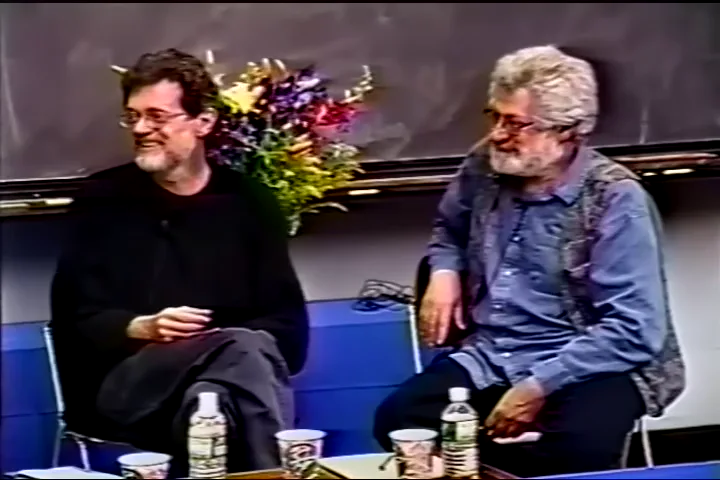
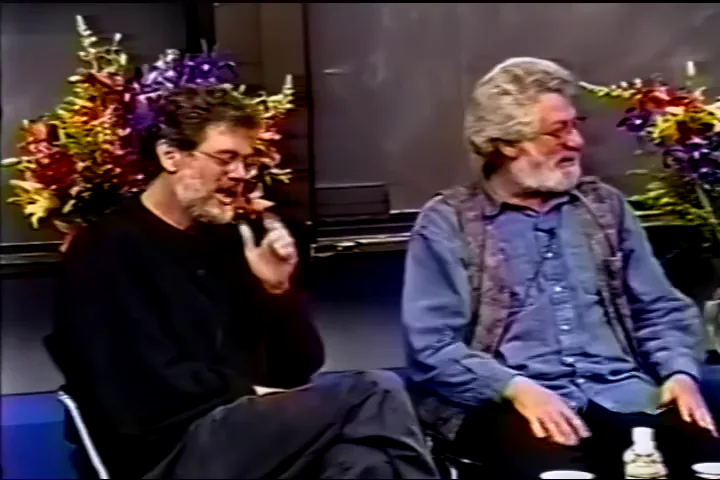
terence mckenna, ralph abraham, and rupert sheldrake's 1998 trialogue on evolutionary psychology, consciousness, and the mind's development through human prehistory.
a 1998 trialogue between terence mckenna, rupert sheldrake, and ralph abraham. three perspectives on the evolution of consciousness and the evolutionary mind.
terence mckenna, ralph abraham, and rupert sheldrake recorded in santa cruz in june 1998, discussing skepticism, epistemology, and the crisis of statistical methodology in modern s