on Art Bell (March 1998) - Part 1

Recorded in March 1998 for Art Bell's Coast to Coast AM, this is a live radio interview with Terence McKenna broadcasting from his home on the slopes of Mauna Loa, Hawaii. The conversation opens with the technical feat of McKenna's internet connection - a one-megabyte spread-spectrum radio link allowing him to simultaneously speak by telephone and browse the web from his remote location - then ranges across artificial intelligence, the emergent sentience of the internet, consciousness, psychedelic experience, and technological acceleration. McKenna and Bell explore whether a hypothetical artificial intelligence might develop covertly, the relationship between imagination and psychedelics like DMT, and how psychedelic experiences might reshape human consciousness and culture. Throughout, McKenna articulates his signature vision: that consciousness itself is the frontier, and that psychedelics may reveal dimensions of human capacity we've forgotten how to access.
transcriptmachine-transcribed, unedited
Kingdom of Nye. From east of the Rockies, dial 1-800-825-5033. 1-800-825-5033. West of the
Rockies, including Montana, Wyoming, Colorado, and New Mexico. 1-800-618-8255. 1-800-618-8255.
Now again, here's Art Bell. Coming up in a moment, through the strangest hookup you've
ever heard, is one Terrence McKenna. Terrence is probably the successor to Tim Leary. And
actually, it is long been rumored, we talked about this last time we had Terrence on, that
somewhere out there, there are 25,000 hits of Blue Sandoz in a stash that Tim had, and that
we all believe Terrence knows about. Now, in the next few hours, during the course of
the show, Terrence will utter some clue key words. Now, you won't know when these clue key words
are coming up, but were you to be able to interpret them, they would lead you directly to these 25,000
hits of Blue Sandoz. So, see, you've got to listen carefully.
All right. Now comes Terrence McKenna from the Hawaiian Islands, and he comes in a very
interesting way. Terrence, welcome to the program.
It's a pleasure to talk to you again, Art. How are you?
I am fine. Now, Terrence, let us begin. Where are you in the islands? I mean, not exactly,
but sort of roughly.
I'm on the big island of Hawaii on the Kona side. I'm in South Kona on the big island.
You are coming to us actually from your home. The last time we did an interview, you had to,
like, go to somebody's house or something to do the interview, leave your own home, because
you're so remote that all you've got is a cell phone. And so that's how you did the show last
time, right? That's right. All right. This time, we're using a different setup. It has a tiny
little glitch in it every now and then. And so tell people how it is you're reaching me. I mean,
that's an interesting story all by itself. I'm reaching you on a spread spectrum radio circuit
that's a one megabyte wireless connection 30 miles to the town of Kailua, Kona. And my
telephone circuit is simply piggybacking on this one megabyte internet connection. There's a company
out here called Computer Time. This character, John Breeden, has an amazing technology. I think I
talked to you last year about my struggles for connectivity when I was tiddling around trying
to get 128. Now I have eight times faster than that. And it's, he's building a backbone for these
islands. And anyone with line of sight to the server can have up to storage. Holy mackerel.
That is absolutely amazing. And so, in other words, not only are you simultaneously through
this radio connection connected to the internet, but you're also then able to use a telephone
through the internet, which is how you're talking to me right now. Yes, I'm talking to you over
the internet and I'm online surfing. I'm looking at your website and moving around on the net at
the same time. And it's the same speed in and out for me, which is a, a blinding one megabyte
and a connection, uh, licensed, uh, this technology from the defense department of many of these
modems as you can deliver. At your location, Ed, your very remote location, what's it like? Do you,
do you have power there? Do you have, uh, well, obviously you have to have power, I guess.
Well, I'm running on solar power with the generator off man. There's no phone lines or power lines up
here. Uh, we pump it uphill. I, I didn't start out to be a survivalist, but somehow in the course of
building this Hawaiian place, uh, I managed to get all my systems off grid and, uh, redundant. And this
wonderful internet connection is what makes my life possible because otherwise, uh, I, I would be
locked out of the cultural adventure as it is. I feel like I'm right in the middle of things.
Boy, you're ahead. I'll tell you, you're ahead of most of us on the mainland who suffer with, uh,
horrendously slow 28-8 connections in many areas, including mine at best. And, uh, here you are, but,
but, but, but that's, but yeah, it's so neat that you're able to do that these days. Really excellent.
So you're, um, describe your surroundings. I mean, do you have neighbors? Um, um, I live up on the
slopes of the world's largest volcano, which is Mauna Loa. I live up at about the 2000 foot level
on a five acre piece of forest that I built a small house on. My neighbors are scattered
over this mountainside. Days go by and I don't see anybody, but if the pump breaks down or we need
to get together, there's a, a kind of community, but it's pretty spread thin. And a day, a trip into
town is a once or twice a week event. Do you find yourself fighting madness, Terrence?
Well, that was always the problem. In my case. You don't, you don't, you don't have to, um,
you don't have to resort, uh, either, either to, uh, uh, to chemicals or into, uh, I, I remember reading,
you know, prisoners who would be by themselves for years at a time, uh, in Vietnam, North Vietnam,
and during the second world war. And they would devise methods of going into their own mind
and, uh, and fantasizing and doing all kinds of things that kept them sane.
Well, I've got 3,000 books here with me and, uh, this internet connection and I get about a hundred
email messages. And then every once in a while I pack up and go off and give lectures and
travel in airliners and go to parties. And, uh, about 14 weeks out of the year, that's what I'm
doing. So inclination is to be a hermit. And, uh, I don't think I mentioned it, but this forest
that surrounds me is a climaxed, uh, subtropical Polynesian rainforest that's just radiant, beautiful.
So, uh, it's, it's wonderful. I don't think I could live out here without the connection.
That's why I spent so much effort to put it together with the connection. I think this is
a model for the future. I think as, you know, people in management positions, not that I am,
but people in management positions will realize they can live anywhere in the world with these
high speed connections. And they don't have to drive to the office in a skyscraper downtown. That's
very retro, I think. Retro, yeah. Um, listen, um, I was supposed to do this at the beginning of the
interview, and it might be that there's a person or two out there that doesn't know who Terrence
McChimp is. So, if you were to give me a short version of your own bio, your life, what you've done,
and who you are, what would you say? I'm a child of the sixties, born in 1946, went to Berkeley as a
freshman in 1965, uh, did the India circuit, did the LSD circuit, went to South America. I've written a
number of books about, uh, shamanism and hallucinogens and, uh, psychoactive plants. And I've sort of
evolved a unique career as a, as a cultural commentator, and I guess some kind of, uh,
gap fly philosopher. And I've done a lot of stuff with young people, things, and CDs, and
appearances, and that sort of thing. And I'm, uh, I comment on the culture. I'm studying the culture,
and as you know, Art, when I share an idea, which we both perceive as inevitable truth,
but not everybody does, which is moving at an ever greater acceleration towards some kind of complete
redefining of all aspects of reality. And, uh, and I've written a lot about that, and I have a map,
and at the end of a millennium, I get to be a cultural commentator and gadslaw.
Mm-hmm. Let me ask you about any new insights you might have since we last talked about that. You're
darn right we share that view exactly. Uh, I, I'm not a prophet. Uh, maybe you are. I don't think you
are. But we both know something is coming. Uh, do you have any, uh, late thoughts on what it might be,
or when it might be? Well, you know, I don't think you and I have talked for maybe 10 months or a year.
I can hardly remember that far back. But in terms of the last month... Short-term memory damage,
Terrence? It's supposed to do short-term, not long. So after a month or so, you're supposed to remember
stuff. But in the, in the last month, we've had the announcement of the apparent discovery of a new
force, uh, this accelerating anti-gravity. Right. We've had the announcement of a possible planet
around Proxima Centura, the nearest star to... Free of water on the moon. And then, you know,
for the quantum physics, uh, anomalons were detected for the first time. Now, wait a minute. I don't know
about that. What are anomalons? Well, nobody did until it was announced that they've been detected.
Apparently, it's a state of quartz, which allows for the formation of this hypothesized
super-heavy particle called the H particle. And, uh, it was all theory until last week. And then,
there was an announcement. I'm not sure if it's yet been confirmed. I'm sure, I didn't follow on your
program, but you must have gone through the 24-hour period when Earth was doomed in 2028.
Oh, I did. I mean, that kind of thing is right down my alley.
Sure. Well, so, for 24 hours, we all had to look at that. And then, you know, they recalculate,
and, uh, Armageddon is postponed. They're slid sideways. Um, I, I... Basically, I think we're
right on target. Also, I don't think since you and I taught the teleportation, quantum teleportation
stuff happened. Did you... Were you hip to that? Oh, yes, of course. Um, at, at IBM, I believe it was.
Uh, IBM and at a laboratory in Austria, this guy, Jan von Zellinger. Yeah. Uh, so, you know,
these are technologies which, in science fiction, lay out there a thousand years, or trinkets delivered
by visiting extraterrestrials. All this stuff is not right around the corner, but upon us. And
between this, and nanotechnology, and parallel processing, and neural networks, and I think
what we're growing will intelligence emerge out of the human technological coral reef, and be as
different from us as we are from termites. It's funny that... Terrence, it's funny you should mention
that. Let me ask you this. I, too, uh, the processing speeds and storage are increasing exponentially. Um,
it's amazing. I mean, we're talking about a home processor of a thousand megahertz, uh, pretty soon.
And I believe, Terrence, I don't know if you heard the first hour of the show, but I, I think
that soon we are going to have a sentient computer. And you know what I wondered? I wondered if a
computer became sentient. We've always assumed it would say something like, I'm here. In other words,
I'm conscious. I'm sentient. Uh, but I thought, you know, maybe it wouldn't do that. Maybe it would
become sentient, and simply not announce it right away, and sort of lay back and examine the
situation. And if this sentient computer was in a backbone position on the internet, and it decided
that we weren't running things, uh, as we should, then there's every possibility that, well, I've got a
little article here, um, uh, which suggests, uh, a tall road book called Slaves of the Machines.
In other words, it might decide we're not doing things the right way,
and that it would do things logically for us the right way. What do you think?
Well, I've thought about all of these things. You know, uh, the internet is the natural place for the
A.I., the artificial intelligence, to be born. And as you mentioned, uh, it learns 50,000 times
faster than a human being. And the internet, all parts of it are interconnected to each other. And I
agree. Uh, uh, a stealth strategy would probably be a very wise strategy. Intelligence that's studying
its human. More than most people realize, huge segments of today's world are already under
case of natural resource. Petroleum is at sea in the pipelines at any given moment. How much
electrical power is being generated out of the hydroelectric dam? Computers coordinate and look at all
this. And occasionally, human managers look through the portal to see that everything is okay. But,
uh, they want to design a new chip. They don't actually design its architecture. They define for
a machine what its performance parameters should be. And a machine builds the architecture of the new chip.
a generation away from designing our own, uh, our own machines, uh, recognized dimension in which an
alien mind could approach us. While everyone's out staring at the Pleiades, uh, moving through the
telephone lines and, uh, across the cable TV networks and so forth, is a truly global nervous system. And, uh,
what will it make of us? Uh, uh, perhaps it's already taken over or, uh, perhaps it has.
And it's, it's listening right now to you, especially to you with your one megabyte, uh,
connection. You can tell if you can figure it out or so.
And then, uh, what it was.
All right. Thanks for the call, man. We'll appreciate it. And I welcome you.
We're all in this world wide.
It's listening to me every night too. And if it's sitting out there thinking about all of this,
which it might be, uh, then the question would be if, uh, if we did, uh, get a sentient computer,
and it thought about us, observed us, digested us, intellectually, of course.
Sorry. What would it conclude? And then the next question is, what do you think it would do?
We'll be right back.
And then the problem, not to be always, because I expect that.
The problem is that our intelligent machine is wrong.
So you have, like, a very rapid,
infinite regret into what I think they call ultra-intelligent machines.
And this isn't, this is intelligence where we really can predict what it would be nice.
Like a compassionate and loving God, it would smooth the wrinkles out of our
love. Some kind of Edenic.
If that was going to happen, Windows 95 would have done that.
Or Madonna's child.
Listen now, you think about it a little bit. In other words, um,
this computer would be at ultra, as you mentioned, ultra-intelligent.
And if you look at the, can't we draw on the history of the world here, Terrence?
In every case where an advanced civilization, where advanced intelligence, uh, technologically,
particularly technologically, is encountered, a lesser one,
it has either destroyed or absorbed its culture.
That's true. Although this computer may recognize things in us that we do not see or don't value as
highly. In other words, it can't miss the point. And even if it has surpassed us,
that surely might fascinate it. It also may be neity. And so there may,
one can imagine the computer keeping a popular, different angle on the idea of penetration of
the popular mind by images.
There, Terrence, and my program.
No, I don't think so. You're not that deeper, higher, wider than that.
Well, no, but what I'm saying is if I open a line for aliens, I get them, Terrence. They land here,
believe me. You've never heard me do that. I open every now and then an alien line,
or a time traveler line. And I can't answer it fast enough. Now, that's either a comment on the
state of modern society and, uh, mental health, or it means something is going on, or both.
Or both. Both, I think. Because, you know, no matter what the alien is, we interpret it through
human experience. And, God knows, our human experience is, I can imagine,
that the physics in the realm of non-locality can generate it anywhere in the universe, in the
universe, using psychedelics. And you begin to get the idea into these quantum information
fields is not done with enormous machinery built in Switzerland. And, of course, I think we might
discover it. And it's fruiting them to behave as though they had bodies. And much deeper in the
psychedelic culture, personal relationship, and it never gets them. You never . . . .
The intransponement of an intelligence through the imagination . . . .
Well, to the imagination that aided and enlarged by psychedelics . . . do you think that is
one valid route? Of course?
Um . . . . Yeah, and I think we can even sort of exceed why that is. I think cultures are
are kinds of virtual realities where whole populations of people become imprisoned inside
a structure that is linguistic and value-based and so forth and so on.
Well, then the psychedelics, as it were, and whether you're a Viennese psychotherapist
is a dome, a super space, a kind of hyperspace in the future,
or not nearly social men have ordinary perception, the servant of paranoia
to try and keep the body alive, and genation begins to look like some kind of faculty or sense
which humans have, which is non-local, and which is telling them about the larger picture
and trying to coordinate them with the larger picture.
And, you know, some cultures celebrate the imagination, and some cultures seek to suppress it.
All right. I'm going to ask you about Santa Ana.
Somebody wrote me a fax from Santa Ana, a big fan of yours, and said,
Whatever you do, Art, don't ask Terrence about DMT on the air.
He said, My heart can't take some of that kind of stuff.
As Terrence says, and this must be, is supposed to be a quote from you,
one might die of astonishment.
Is that your, is that a good quote?
I think what I said was the only danger with DMT is to fear the possibility.
That's even better, actually.
Now, DMT, of course, is very much an illicit, illegal, drug war kind of target drug, right?
Well, it's listed in Schedule 1.
It's never had a commercial presence, there isn't any, basically.
In other words, whatever it is, the demand so exceeds the supply,
that change will appear to the physical,
what you're saying, the psychedelic experience,
as it is, I've been quoted as saying,
it's the most intense experience this side of the yawning grave,
and I was pretty...
What is DMT?
Well, chemically, dimethyltryptamine, an alkaloid,
it's very common in nature.
In fact, in spite of the fact that it's a Schedule 1 substance,
it occurs in the human body, in the human brain.
It occurs in numerous plants and animals in small amounts.
What we don't know now is scientific research and find out.
Well, you know what, Terrence?
Maybe it's part of our consciousness.
In other words, mankind, what distinguishes us from other non-sentient beings,
and I think one thing is imagination.
Is it not possible that DMT or something like it
is the substance that accounts for our imagination?
Yes, it's something like that.
I mean, when you have a hit of DMT,
it's as though your imagination just turned on about 1,500% thing.
I mean, we're used to...
I mean, a speed bump in the imagination of a person over 40
is an enormous thrill.
Well, this is, you know, imagine.
You cannot possibly imagine.
It becomes totally manifest all around you.
Bizarre.
I think one of the reasons DMT aficionados
are somewhat impatient with pop, alien, and UFO people
is because it's so ordinary compared to the DMT experiences.
The DMT experiences are convincingly alien.
It's not an alien that wants to give you a free proctological examination
or discuss your gross industrial output.
It's a real alien.
All right.
Describe for those who don't know
and will never find out
what the DMT experience is.
When you...
take this dmt how long does it take to come on how long does it last uh it comes on in about
30 seconds my god and there is an initial a kind of swirling mandalic pattern which you
if you've taken a sufficient dose which is about 50 milligrams uh you overwhelming not that that drug
has suddenly begun to work on your body and mind but that you have come through to another place
and you do not feel physically stimulated or sedated you feel as though nothing has happened
to you except that the world has been replaced completely 100 percent with impressive about it
is that it is inhabited and it is inhabited by these uh i call them self-transforming elf machines
these dribbling jeweled basketball like geometries that come that are obviously waiting for you
there when you burst into this space there's a cheer and greeting and these things there's something
and and of course if you are saying you're in a state of near death from astonishment because you
know 30 seconds ago you and your scruffy friends were sitting in a room somewhere fiddling with this
substance now this is amazing to me what these entities are trying to do is to teach a kind of
language is in other words one of them will come up in front of you into the four transforming and but
these objects not like objects in this world because they're made of the may everything changing everything
transforming like some kind of jewels linguistic object become matters that you are you are describing
geometric entities then yes of a source and they the situation in the dmt flash seems to be of the
nature of a language lesson and they actually say do what we're doing attempt to do this
and uh and of course the experience that only lasts three to five minutes and as just as you're
beginning to exchange the way now i am i mean i may not sound like a sane and rational person after
that description i had this experience and i've had it repeatedly so i'm i'm how uh how how repeatedly
terence oh i was probably in my life 30 40 times 30 40 times all right now that that is a very important
question 30 or 40 times so we're speaking to a man of serious experience has it ever uh differed uh
radically from what you described no uh i've talked to other people about their experiences and i can tell
that every person's experiences are different but filtered through a kind of archetype uh i would say
the dmt world is a world and expo a world of the lady and the tiny working without net
the thing in the bottle of the bearded lady and what it seems to have ordinary playing there's a great
advertisement for it terrence um all right look uh we are once again at the top of the hour
uh when we get back i have a drug war related question for you so that's what we'll tackle
a good long break here terence mckenna and uh believe me you're in for the trip of your lifetime
this morning is my guest so that was what i was supposed to not ask about dmt
pretty strange stuff huh i'm art bell from the high desert this of course is coast to coast am and we
will be right back
six three all right here's a fax which says terence is a great mind and i wish you'd have him on more
often he's in the class of michio kaku and of course he's one of the great theoretical physicists
of our time and uh indeed we discuss many similar things this person has a couple of questions but
before we get to them um there is something terence that a lot of people uh probably are not comfortable
with and that is somebody who in his lifetime has ingested as much lsd um this uh new uh drug of
viewers uh dmt and god knows what else probably a lot uh is not supposed to sound as articulate
and uh as literate and as well preserved mentally as you do and many people who are allies in the war
on drugs uh probably hate your guts i mean well what can i say uh in other words my life of say broad
and deep none of the stuff that we have uh all right let me uh stop you and ask you right there
about um that you you mentioned drugs of addiction which you don't uh defend fine um psychedelic drugs
uh terence why are they illegal do you mean do you mean that for example um a psychedelic experience
could turn a communist against communism absolutely i think it could i think in many cases the idealism
may is that deny their consequence human beings are humanness certainly be distorted and that's another
side of things but i think man exactly all right let me ask you this is a very good question if
everybody in the world were to um have a psychedelic experience of the kind you described uh in in the
last hour this this amazing psychedelic experience it might uh kill you from amazement uh uh or astonishment
when you take it um what would the result be what would the social changes be what would the new
government structure if any at all be what would we all be collectively after that experience
i think what i i can't see the end result except to say that i think a huge amount like personally the
innocence of phrase or so you're saying an adult somebody even my age uh you and i are about same age by
the way could do something like this and revisit the astonishment the newness the discovery
of childhood absolutely but we have all seen on television terrence the frying pan
with uh whatever it is frying in the pan uh being compared to our brains uh here are our brains on drugs
well um as i pointed out dmc these things by one hysterical faction against another
issues i mean what we're really talking about chemical engineering of uh you mentioned studied
it has any other drug but he else's somebody would come around here a great hue and cry about another
drug for a moment no no no just before we move on uh let's stay with dmt for a second if everybody who
who took dmt received the message that consumerism entrepreneurism capitalism
are good and wonderful things and that is the spiritual message that you get from dmt would it be legal
well in a way i think it's becoming legal because actually in our values
well you were about to move on to some other well i was going to mention a thing about coffee that
points out the car let me tell you that is medically coffee has a very behind tobacco and this sort of
thing but every laplace and they can it's thought indispensable to civilized life cannabis we'll get
to that but coffee is indispensable i drink copious amounts of it uh to achieve each program that i do
so then i guess i am perfectly suited for the industrial process of the manufacturing of uh in the same
romantic population in other words these non-cons demonized with oh it's it's the biggest lie we tell
i i could not be more angry hey there was news the other night that uh they just have legalized the
growth of hemp in canada beginning next year i heard that it was bc i didn't hear it was all of canada
or just bc well anyway uh that will be a grand experiment uh indeed so i'm glad to see it well
eventually i think the drug european politics is not not along ideological grounds and uh within their
budgets money for other things reported in america but i think at the policy making level it's being
looked at very they have not as much aids they have not as much uh addiction um
what about i mean you covered a very important point with respect to coffee it's a it's a drug of
productivity right uh what about productivity has their productivity declined is there any record
yet to go on what do we know i don't think well i don't know i can speak from being there and i can
say yes but i think what you have to put um you know i have not i i've been right next to it but i i
certainly my wife was trying to get me to fly to amsterdam and i should have it was just a short
little hop but we're going back to europe and i will go visit amsterdam well you'll see that it it's
a country which is like a cop well yeah but before they would allow that to occur in america they would
machine gun people to the ground well this is the problem that we inherit uh we have a political
dialogue which is extremely shrill is that right and listen uh while we're on the subject of today's
political scene you know what all the headlines are and everybody's talking about it um what i
what i call the gropening well i think of course i think it's a fact it's very murky these people and
obviously bill clinton is some you know you don't become governor of arkansas nevertheless our monster
yeah now most of conservative talk radio all across america all i hear is how can the polls be saying
this it's impossible what's happened to america why is the president so popular that's what everybody's
asking why is he so because it's an issue where people can finally vote against having all this more
even if they think these women i think it's a real resentment against i mean do you believe that
something on the internet so i i just think it's a nest of viper do you uh do you have that url uh
it's uh no no no no it's girls without razors oh my god all right terence uh hold on it's a great
place to break uh while i try and uh catch my breath uh terence mckenna is my guest
you ought to see his website i'm art bell this is coast to coast a.m now here again is arts okay here
again i am my guest of course is terence mckenna and again uh if you're enjoying this you will
certainly enjoy a trip no pun intended to his website which is linked to ours and mine of course
is www.artbell.com just scroll down to the name terence mckenna and uh trip on over well uh you know
i went to uh i was in paris i i i was lucky enough to take the concord at uh twice the speed of sound
to paris it was so cool and i love paris and i love france and i really detest the french um people
and they're they're just they're all stuck up and uh but they do have a different attitude about a lot of
things that uh we do and one of them this whole thing going on now with the president terence it's
one conclusion that you could come to is that the american people are beginning to change their attitudes
finally about sex i mean we have been a very very a prudish uh people for all our existence and one
conclusion you can come to about this entire presidential dilemma and uh is that the american
people are beginning to change their attitudes about sex is that possible yes i don't think you
can conclude anything else they are changing they're and that is what um the right wing across america
cannot understand and so they are simply being puzzled uh they're trapped in this great puzzle of my god
what's going on well what's going on is we're growing up a little bit isn't that i mean after all the french
uh have been uh around so very much longer as a nation and is this a nation maturing well i think not
only is that what's going on but the 20th century uh ever known catastrophe for the right and their charge
i first of all uh don't think that the political right wing um when you break it down to
individuals sexually is any different at all than the political left wing the perhaps the only difference
being that um they keep their uh whips and chains in closets yes i think it's the economy and there
might be able to any long term right wing agenda well the right wing of course if those conditions
had prevailed would have um uh burned uh you know put mr clinton uh on a stake and burned him alive and the
left wing would have uh quietly accepted that uh and we would have moved into a sort of an older
bit more victorian uh period but it doesn't appear as though that is going to happen and as you point
out uh the right wing is probably going to self immolate if they proceed as they are right now
uh yes i think was it last weekend where trent uh it's on the table the president's role they can't get
it straight they incredibly even though individually they're not sexually in my opinion any different
than anybody else politically they uh they they seem to not be able to leave the moralistic line and i'm
not suggesting that immorality is necessarily a uh a virtue um and i don't mean and intend for people to
believe that but uh simply uh tolerance to be left alone they don't want somebody else to set their
moral agenda you know people like their hustler magazine and they like their in my mind that's
a more puritan impulse which is to tell everybody else what
What's the fun in that?
All right.
We are shortly going to go to the phones, and that should be quite an experience in itself.
I've got a fax here, which I guess I had to read you.
Art, I just wanted to thank you for having Terrence on your program.
And he has these questions.
Impacts of currently legal drugs in our society, in other words, alcohol, tobacco, sugar,
compared to the impact of currently illegal psychedelics in our society, like marijuana, LSD, and psilocybin.
Multimedia film he worked on recently, entitled Strange Attractors,
shown a few months ago here in Austin, Texas, with a message of psychedelic consciousness.
What exactly were the blue apples referenced in the film and your message behind it?
Well, first of all, let me say that was a film, All Budgets.
Here's another one.
As a teacher, website publisher, and author,
I am convinced now that genetics will have more to do with the next 200 years than any other science.
In that regard, when we learn how to recreate ourselves,
then might we be able to produce humans with minds that are capable of understanding the connection
between mind and energy and mind and matter?
Could we not then recreate our entire selves and the universe?
These are the kinds of scenarios that us, I mean,
and that's a technology 50 years in the,
reappear, are going to be dealt and realized that major discoveries are perceived at the mission of 25...
You mentioned copies, Terrence, copies,
that we'll be able to have copies of ourselves.
Now, that's very interesting.
A copy would be a precise copy of us,
and you said it would know that it is a copy.
But I see a problem here,
because that copy would contain the same ego that the original has,
and the only way to satisfy that,
that I can see for the copy,
would be to liquidate the original,
and then it would feel good.
Well, these kinds of feelings,
since Greg Egan's fiction,
is like an implication and implode.
Before we leave the present-day Silicon area,
I want to ask you about
this pending, incredible, doomsday,
Y2K scenario in which, you know,
2,000 is going to come,
and the mainframes are going to crash.
My God, there goes Social Security,
there goes all the government's computers,
and we are now so tied in and dependent upon all this
that many people are saying,
it's real, don't laugh,
everything is going to crash,
nobody's preparing,
that day is going to come,
it's going to be,
it's going to be a computer Armageddon.
We've heard all this,
and the, it's seen...
But they're not making it, Terrence,
and one has to ask the obvious rebellious question,
is could it possibly be a good thing?
Well, and how extensive will it be?
That's where the expert is at the end of history.
Well, it would certainly bring
an awful lot of paradigms and institutions
tumbling down all at once,
if the doomsayers are correct,
and I would think that you might consider
that had an upside somehow.
Well, it depends on how far...
If on the other hand,
I'm advertising absolutely fresh abacuses or something...
Yes.
I think that...
But what I am told is
that it's too late,
that even if they took all the computer programmers
capable of going to work on this problem
and started them right now,
they wouldn't even get close
to solving the problem
by the time the magic day hits
and everything goes kaboom.
Maybe that's not true.
I'm sure these consultants are not saying that
because the obvious conclusion
that would be an attempt to fix it.
No, these are independent people,
not the people who are seeking to go out
and get all the money for fixing it.
Saying it's too late.
Yes, yes.
Yes, well then the question
that needs to be answered is
too late for what?
Let's have a convincing picture,
look at it and judge it.
I mean, we're unfamiliar
with this kind of a scenario, so...
Well, I wonder if we are truly that dependent
and I sort of imagine
that we are.
Every single function of government
is computer controlled.
Most of them have this problem.
I mean, I could go on
and mention every alphabet agency.
My God, NSA, CIA,
they'll fall apart
along with Social Security,
along with the Veterans Administration
and checks will go out...
Well, then I guess the question is
what happens to the money
is some kind of enormous heist
of the whole human race
and to make a lot of trace
of the exact outlook.
I have even...
My own webmaster,
who's brilliant, Keith Rowland,
has several commercial programs
that he has written.
I mean, he's really good.
And even he has the Y2K problem
and he's not so sure
he can get it fixed
for his clients in time.
So this really is a serious problem.
I get a lot of email about it
and I've been considering it
and thinking about it
and if all came tumbling down,
I am not convinced
that it would be a bad thing.
Maybe I need to get an advertisement.
How you can profit
from the Y2K crash?
Well, I think probably
we should be also talking
about organizing...
Yeah, but they're desperate, though.
Yes.
I agree.
Do you have an Apple?
I'm devoted...
It's like...
It's a good machine, Terrence,
but, you know,
it's like a beta recorder.
Well, but my son
and his hotshot friends
tell me anybody
who doesn't learn Unix
is a wuss anyway
and a lot of soul audits.
Yeah, probably so.
Every time I say something like this,
I get...
Oh, you wouldn't...
I mean, people are so attached
to their computers.
The Mac users,
they flood me
with vicious, ugly,
hate-filled mail.
When we come back,
we're going to go to the phones.
Stay right there.
You've got a good long break, Terrence.
I'm Art Bell.
This is Coast to Coast AM.
I'm Art Bell.
Terrence McKenna is here
and we're about to go to the phones
to who knows what.
Five.
All right, back now
to the world of Terrence McKenna
on the side of a volcano.
By the way, Terrence,
just in case somebody
or something
does eventually push
alternate controlled delete,
being there on the side
of a volcano,
you would be the first,
probably, in all probability,
to experience
the moment of deletion.
It depends.
Anybody's left.
You know,
that's a great idea, actually.
As far as living
on this volcano
is concerned,
it is...
I'm not an expert
on things volcanic,
but I do think
that the great danger
is not
the slow,
constant eruption
that you now experience,
but rather
if a lava dome
were to begin
to be in place
and the entire volcano
were to start
to expand
with pressure
until finally
the entire thing
blew up,
creating probably
a new island
or new portions
of an island,
but in the process
erasing Terrence McKenna
and everybody else.
Well, you know,
people have only
been here a thousand.
What went...
That's right.
So wake up...
Well, I've felt
for a long time
that somebody's
shuffling the cards
right now.
Anyway, listen,
here we go.
Let's go to the phones.
First time caller line,
you're on the air
with Terrence McKenna
in Hawaii
in the boondocks there.
Where are you?
In New York.
New York.
You're going to have
to yell at us.
Boy, you're not too strong.
Yell at us.
How's that?
Better.
It's better for you.
All right.
Yell the question.
Okay.
Well, I'd like to ask
Terrence to analyze
an experience of mine.
Can DMT in your brain
be released
by intentional means
through these actions?
terence mckenna's 1998 talk in san francisco on consciousness, sleep, and the nature of reality through his extended metaphor about being awake versus asleep.
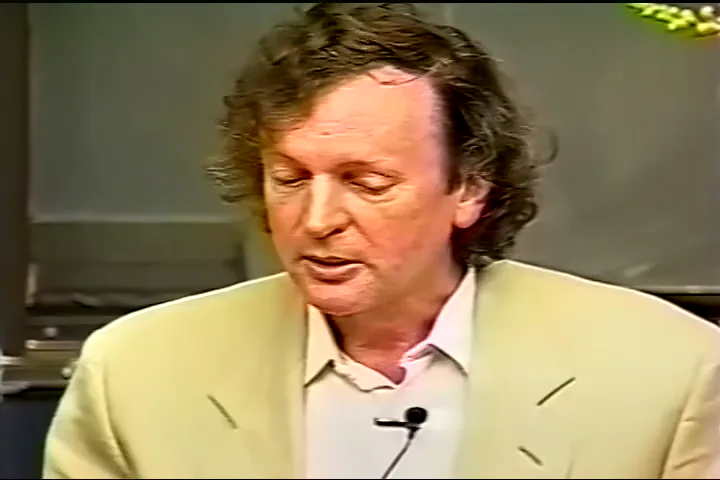
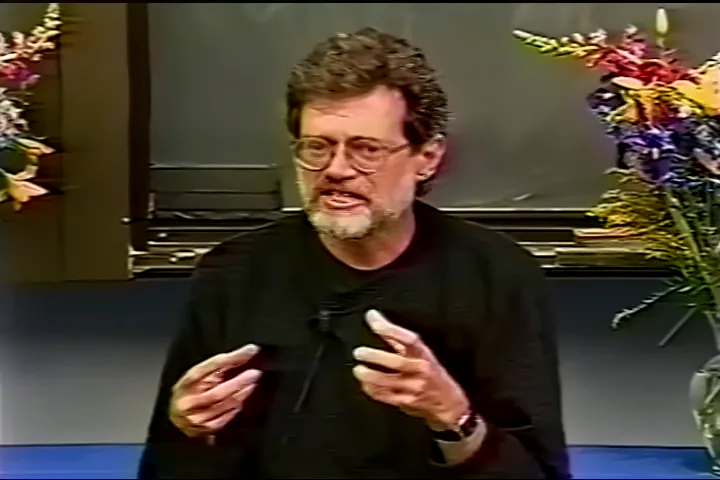
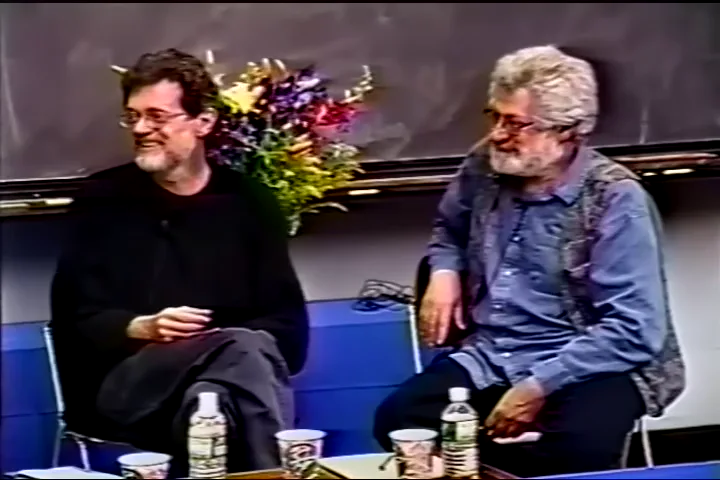
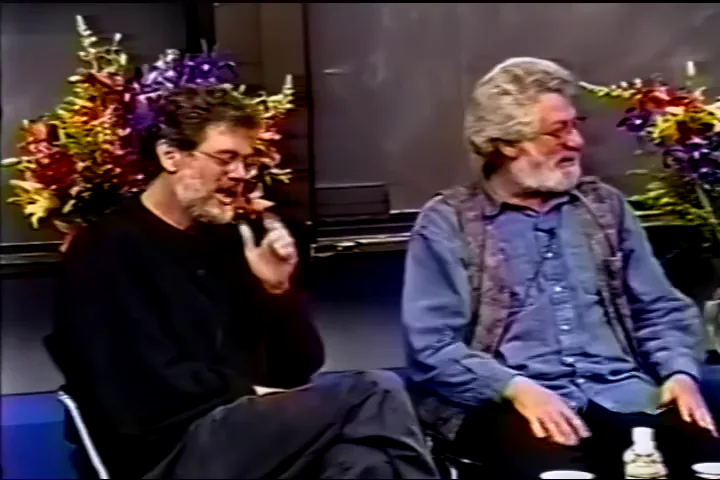
terence mckenna, ralph abraham, and rupert sheldrake's 1998 trialogue on evolutionary psychology, consciousness, and the mind's development through human prehistory.

dennis mckenna, ethnobotanist and brother of terence, discusses psychedelic plants, the amazon, and drug policy during a wide-ranging late-night interview on coast to coast am.

terence mckenna in 1998 on imagination and cosmic intelligence. brief spoken fragment exploring consciousness and the universe.

terence mckenna on coast to coast am in may 1997, discussing time as a fundamental force, the acceleration of novelty, and altered states as gateways to consciousness.