Dreaming Awake at the End of Time
A 1998 talk recorded in San Francisco where McKenna explores consciousness through an extended metaphor about sleep and awakening. He draws on Gurdjieff's observation that people are asleep but adds a counterintuitive twist: that contact with the cosmic giggle and synchronistic flow often comes through a kind of unconsciousness rather than heightened awareness. The discussion moves through hypnagogic states, the collective consciousness of humanity, and his own experiences in the Amazon that shaped his understanding of reality.
transcriptmachine-transcribed, unedited
Can you hear in the back? Good, I assume so. Yes? Good.
I'm here to be in San Francisco. This is sort of a hometown of mine, one of my hometowns.
I've been on a tour or a rave, spoken three times and raved twice in the past five or seven days.
This is the end, so if I'm comfortable with this stuff at all, I must be comfortable with it this evening.
And it's nice to see a small, full house. That's the most exciting kind of audience to talk to, I think.
So thank you all for turning out on a rainy night.
Before I get into the main body of tonight's...
...entertainment, I want to call your attention to the propaganda for an event in Mexico and another event in Hawaii.
These events, in the case of the Mexico event, you get a major slice of the psychedelic community.
You get Robert Montgomery, Jonathan Ott, Ann and Sasha Shulgin, Manolo Torres...
...and others who unfortunately slipped my mind, at the ceremonial center of Palenque in Chiapas.
We've been doing these events somewhere in Mayan Mexico for the past 10 or 12 years.
Many of you are graduates, which doesn't mean you can't come again.
But I want to invite all of you there, if you're interested in ethnobotany, shamanism...
...ethnopharmacology, altered states of consciousness, the politics of all of this.
This is as intense and information-packed an exposure as you can have.
And it's straight from the mouths of the scholars and scientists and writers...
...who have spent a great deal of time in that area.
So I just want to invite you to that. It's also a great party.
It's the height of mushroom season.
There's nothing we could do about that.
So you just are on your own.
So when I start out on these tours, I usually have an agenda and prepared remarks.
And then as I make my way through my venues and I hear the feedback...
...and I feel the ambiance of the people and the throb of the zeitgeist...
...it all sort of just simply dissolves into an ongoing commentary on our moment in space and time...
...and the various dimensions, adumbrations and opportunities of our dilemma.
But I want tonight to couch it for you in the context of, I guess, an extended metaphor.
We could talk about these things many ways.
But I find this particular extended metaphor...
...illuminating.
And I start by recalling an observation from someone whose name rarely falls from my lips.
And that would be Gurdjieff.
And Gurdjieff said at one point, or was known to comment, that people are asleep.
He said.
And he, by implication, suggested people awaken.
I'm not sure if he fully grasped the implication for his own product line, had that occurred.
But in any case, you're on it, you're with me, yes.
It's very hard to give these lectures in such a way so that every person hears something different.
Which is what is supposed to be going on, you know.
Well, so thinking about this comment that people are asleep...
...I see several implications.
I asked myself, what is awake in my own notion?
And I thought to myself, awake is, for me, awake is where the laws of physics are fully operable.
You know, hurled objects shatter, electricity shocks.
I cannot fly.
The laws of physics are in operation.
In that domain, I consider myself to be fully awake.
Now, in terms of occult and spiritual traditions, the admonition to awaken always seems to imply that higher consciousness is approached through an expansion of clarity and awareness.
And that seems obvious.
I don't argue with it as a rationalist.
But as somebody who has run the edges, I've noticed something somewhat counterintuitive to that teaching.
And it's this.
It's that to contact the cosmic giggle, to have the flow of casuistry begin to give off synchronistic ripples...
...white caps in the billows of the coincidental ether, if you will.
To achieve that requires...
A precondition is a kind of unconsciousness.
A kind of drifting.
A certain taking your eye off the ball.
A certain assumption that things are simpler than they are.
Almost always precedes what Mircea Leal says.
There's a term that God called the rupture of plane that indicates that there is an archetypal world.
An archetypal power behind profane appearances.
And in my own life, for those of you who are conversant with my output, when I went to the Amazon in 1971...
...and had the experiences that are described in true hallucinations...
...I had been, for many months before that, in Asia, smuggling, hanging out.
And I had taken my eye off the ball.
I had become very gentle, very relativistic in my approach to other people's opinions and behaviors.
I was easygoing, is what I'm trying to say.
Too easygoing.
Uh...
And in that situation of semi-unconsciousness and openness, the cosmic giggle approaches.
And I compare this...
This is closing of a theme.
I compare this to sleep.
Or to states that lie between waking and sleeping.
And so, again, an odd take on this remark of Gurdjieff's.
I remember someone, many years ago, said to me...
They evoked the symbol of the yin and the yang.
The two tiers folded against each other within a circle.
And this person, who was no rishi, roshi, geisha, or guru, but simply observant, said...
Uh...
It's not the black side.
It's not the white side.
It's the interface.
It's the edge.
And I found, by observing sleep...
And some of you may recall the motto in Athanasius Kircher's Amphiatrium Sapientium,
that's chiseled over the alchemist's doorway.
I can't do it in Latin, but it says,
While sleeping, watch.
And I've noticed that while going to sleep,
there is a barrier, a place in the process of going to sleep,
that is like a mercurial edge.
It's a river.
It's a zone of hypnagogia.
You often pass through it post-orgasm.
It's a place of drifting amoeboid colored afterimage lights.
True hallucination.
Images, strange, transcendental or transpersonal images.
Well, so then, so far in the context of pursuing this extended metaphor about sleep,
I've talked basically, essentially about the individual's relationship
to the concept, to the fact.
But there's also a sort of...
But there's also a social or a political, a species-wide implication.
It occurs to me that at any given moment,
because of the way the planet is as a thing,
some considerable percentage of human beings are asleep.
Always.
And many are awake.
And so if the world soul is made of the collective consciousness
of human beings, then it is never entirely awake.
It is never entirely asleep.
It exists in...
I guess you can hear me.
It exists in some kind of indeterminate zone.
And this to me is the clue to understanding something
that is personally fascinating to me.
And it revolves around why people believe such weird things.
And why, either as a consequence of the approach of the millennium
or the breakdown of traditional values
or the density of electromagnetic radiation
or for some reason,
a balkanization of epistemology is taking place.
And what I mean by that is
there is no longer a commonality of understanding.
I mean, for some people, quantum physics provides the answers.
Their next-door neighbor may look to the channeling of archangels
with equal fervor.
I mean, if this is not a balkanization of epistemology,
I don't know what it is.
It is accompanied by a related phenomenon
which is technology or the historical momentum of things
is creating such a bewildering social milieu
that the monkey mind cannot find a simple story,
a simple creation myth or redemption myth
to lay over the crazy contradictory patchwork
of profane technology.
There is no consumerist, post-McLuhanist,
electronic pre-apocalyptic existence.
And so into that dimension of anxiety
created by this inability to parse reality
rushes a bewildering variety of squirrely notions.
Epistemological cartoons,
if you will.
And conspiracy theory, in my humble opinion,
I'm somewhat immune to paranoia,
so those of you who aren't,
you know, gaze in wonder.
Conspiracy theory is a kind of epistemological cartoon about reality.
I mean, isn't it so simple to believe that things are run by the greys,
and that all we have to do is trade sufficient fetal tissue to them
and we can solve our technological problems?
Or isn't it comforting to believe that the Jews are behind everything?
Or the Communist Party?
Or the Catholic Church?
Or the Masons?
Well, these are epistemological cartoons.
It's, you know, kindergarten stuff in the art of amateur historiography.
I believe that the truth of the matter is far more terrifying.
That the real truth that dare not speak itself
is that no one is in control.
Absolutely no one.
You know, you don't understand Monica.
You don't understand Netanyahu.
It's because nobody is in control.
This stuff is ruled by the equations of dynamics and chaos.
Now, there may be entities seeking control.
The World Bank, the Communist Party, the rich, the somebody others.
But to seek control is to take enormous aggravation upon yourself.
Because this process that is underway,
will take the control freak by the short and curly
and throw them against the wall.
It's like trying to control a dream, you see.
The global destiny of the species
is somehow unfolding with the logic of a dream.
Well, now a Jungian would say, no surprise here,
history is the collective dream of humanity.
It is run by archetypal energies.
It is downloaded by the zeitgeist
into the various milieus and epochs of which it is composed.
This seems reasonable to me.
I don't want to give you the impression it's too linear
to understand that what I am saying is that
awake is good,
asleep is bad.
What I would rather do is explain this whole gradient
of possible positioning vis-a-vis your life and your destiny,
these choices that you have,
and then have people understand that they choose,
you choose to be asleep or partially asleep or fully awake
or to be one part of the time and in some situations
and one part of the time.
And in other situations.
Now, if in fact we exist inside some kind of morphogenetic field
that is created by the sum total of human minds on the planet,
and if in fact in half or more of those minds at any given moment
the rules of the dream hold sway,
then it is no surprise that when we make our way into society
or just when we live our lives,
there's an eeriness to it.
There's a fatedness to it.
There's a plottedness to it.
You know, we are inside some kind of engine of narrative,
I believe.
You know, some science fiction writers such as Greg Egan
and others have suggested that this could even be a form of recorded medium.
You can see the thumb prints of editors on our reality
if you are truly paying attention.
I mean, if you're a devotee of the theory of stochastic
and random unfolding of events,
then you have to look very carefully
at how unrandom and how mythical
and archetypal most people's lives are.
You know, if you take psychedelics and hurl yourself to the edge
and spend time with strange aboriginal people
in remote parts of the world,
the cosmic giggle becomes your friend.
But in fact, ordinary people's lives,
everyone's lives,
are touched by deep magic.
And I've, you know, again,
the primary datum is experience
and then the models are built backward from the primary data
without prejudice
and in an attempt to transcend historical momentum.
And when I do that, what I see is that the carrier,
of the field of the cosmic giggle in most people's lives,
is love.
Love is some kind of output
which messes with the
entropic tendency toward probabilistic behavior
in nature.
What do I mean by that?
I mean, you can be the janitor at Microsoft
and the vice president and chief of operations,
his daughter can bring him lunch one day
and you can, from a distance,
have your eye fall upon her
and fall in love with her.
And, you know, from that point
to having the five children she bears you
go off to Harvard and the Sorbonne,
it's just a matter of running the clock forward.
I mean, these things have,
I mean, to you it may seem like a miracle,
but to those of us who are students of human happenstance,
it's inevitable.
I mean, you can launch your story.
And I've, you know,
in the course of taking psychedelics
and looking at my life and other people's lives
and narrative,
I think that the,
the secret of,
I don't want to say anything as pretentious
as transcendence or enlightenment,
but the secret of taking hold
of one's destiny
is to understand that one is a character.
A character is a different thing
than this model you inherit
out of the idea that you're a three-dimensional animal
inside a democracy with a Christian heritage
and, you know,
a Dewey Decimal cataloging system or whatever.
Anyway, these are some of the notions
that occur to me in the context of,
of comparing dream
on many scales.
It's, you have to
really struggle, I think,
to believe that you actually live
inside the model of reality
that science
and Newtonian physics
and the mathematical analysis of nature
have given us.
You know, not to get too philosophical here,
but for positivist philosophers,
everything that is important,
color,
feeling,
taste,
tone,
ambition,
apprehension,
appetition,
these things are called secondary qualities.
In other words, they're peripheral.
They arise at a lower level of understanding.
They are somehow determined
by the presence of the animal body
and hence dismissible
by a theory of perception.
It's an absolutely pure abstraction,
which says, you know,
what is real is spin,
charge, angular momentum.
None of these things are very rich concepts
for a living human being.
Who knows what any of these things are?
You know?
So, one, I mean, there,
we don't have time in a situation like this
to explore all the implications
of this dream analogy that I'm pursuing.
But one that interests me
is the plasticity of time
in the dream.
And I think I would argue,
as the devil's advocate,
that it is the plasticity of historical time
and the acceleration,
the sense of an out-of-control spin-up,
or spin-down,
into new domains of possibility
that is the strongest evidence present at hand
that we are in some kind of dream.
I've struggled my whole life with,
I've always believed,
or I've always felt the power
of the statement,
the world is made of language.
But, of course,
you think about this proposition
for 30 seconds,
and the question that arises then is,
if the world is made of language,
then why isn't it the way I want it to be?
You know?
Why does it have this prepotent momentum
for its own,
it has its own raison d'être,
even if it is language?
Well, I think,
and it's appropriate to speak of this
to an audience as digitally sophisticated
as I assume you must be,
I think the primary insight
that has been secured
here at the end of the 20th century,
the primary contribution
of 20th century thinking,
if you will,
is to have understood, finally,
that information is primary.
That this world,
this cosmos,
this universe,
this body and soul,
are all made of information.
Information is a deeper
and more primary concept
than space,
time,
matter,
energy,
charge,
spin,
angular momentum.
The world is made of language.
The implication
for the digerati
is that reality can therefore be hacked.
If
reality is made of language,
then what we're saying is
that it's code.
And if it's code,
then it is far
more deeply open
to manipulation
than we ever dared dream.
I mean, we've been messing around
on the desktop
opening files
with religions
and political systems
and xenophobic theories
of racial superiority,
all this crap
that haunts
the human historical adventure.
It means we have not addressed
the deeper levels.
And in thinking about this
and the relationship to dream
and human culture,
I have realized
that cultures
are like operating systems.
We are like hardware.
The human animal
is a piece of
biological
wetware
slash
hardware.
And
it has been,
we know,
pretty much
as we confront it today,
for at least 140,000 years.
At Klasus River cave mouth
in South Africa,
they have excavated
homo sapiens,
sapien skeletons,
100,000 years old.
And that person could have sat
in the front row
here tonight
and nobody would have
batted an eyebrow.
So the human hardware
has been in place
for a while.
What has changed
rapidly in comparison
to the rates
of biological evolution
is
are the operating systems.
The people who excavated Ur,
which was
at that time
thought to be
the world's first city,
and in any case
is a city
seven millennia old.
When they excavated
the central plaza at Ur,
they discovered
that a black basaltic slab
had been set up there
by the earliest kings of Ur.
And that was the cultural operating system.
And if in a deal
trading goats for olives,
a dispute arose,
people had reference
to the central operating system
and these things were determined.
Well now,
Ur 101 was fine
for olives and goat trading,
but it didn't support
higher mathematics.
It didn't support
rational exploration of nature.
It didn't support
astrological knowledge
about the movement of the stars.
As we have gone forward,
through culture,
we have swapped out
these operating systems.
And at each swap out,
there has been a lot
of hair pulling
and cussing
and screaming.
Anyone who has installed
a new operating system
is completely familiar
with that sickening
from the bowels
kind of coldness
as you realize
it all hangs by
a thread.
Now, this situation
or this operating system metaphor
I think is a useful one
for understanding
and again,
a circle closes,
the balkanization of epistemology
that causes me such anxiety.
If you meet
an aboriginal person
from the Amazon,
for example,
they may be running
Witoto 3.0
as their operating system.
Nicely supports
animistic magic.
Huge capacity
when it comes to making
fish traps
and bird traps.
Witoto is a powerful
operating system
for a rainforest aboriginal.
In our culture,
you know,
there are,
I have no idea,
at least 10 or 20
operating systems
all going at the same time
some will run
Mormonism.
Some will support
Catholicism.
Others,
Kabbalah goes
at the speed of light.
Others support
quantum physics.
Some support econometrics.
Others support
political correctness.
And these things
are mutually exclusive.
And so,
looking at this
and looking at this
clash of operating systems,
I've come to the conclusion,
and some of you
may have heard me
say this before,
that culture
is not your friend.
That's the final conclusion.
You see,
well,
this came to me
a few months ago
when I had
my yearly physical.
And as I was buttoning up,
my doctor said to me,
he said,
in the 19th century,
most people your age
were dead.
And I realized
that this was true.
And that one of the,
among all the revolutions
that we are enduring,
one of them is that we live
nearly twice as long
as people lived
very recently in the past.
Well,
culture
is a kind of
neoteny.
And I don't want to belabor that
at great length,
but for those of you
who are not biologists,
neoteny is
the retention of
juvenile characteristics
into adulthood.
It's used to describe
animal behavior.
For instance,
I'll give the most spectacular
example of neoteny.
There is a kind of animal
which lives in ponds
in Africa,
and it reproduces
like a fish.
It lays eggs
on the bottom of these ponds.
More fish-like animals
come from these eggs
and so forth.
However,
if the pond dries up,
the creature undergoes
metamorphosis
and becomes an animal
somewhat like a gecko
and lays eggs,
and from these eggs
come creatures
that are like geckos.
In other words,
this is an animal
which actually
achieves sexual maturity
in two forms,
depending on environmental stress.
Spectacular example of neoteny.
Turning to human beings,
a less spectacular example,
but relevant to us,
is our hairless,
our general body hairlessness
compared to other primates.
We look like fetal apes.
Human beings look like fetal apes.
Why?
What is neoteny?
Well, this is hotly debated
among evolutionary biologists,
but the point I want to make
is a socio-political comment,
which is culture itself
is some kind of neotenizing force
because what culture provides
is a bunch of rules,
so you don't have to think,
and a bunch of myths,
so you don't have to think again.
Culture has all the answers, you know.
You want to know
where people came from?
Well, when the sky god
got out of his canoe
at first waterfall
and took a leak,
then we, the true people,
appeared like ants,
and we've been living here ever since.
Oh.
Gee, thanks.
I'm glad I asked.
You know, this is what culture does for you.
So, but now technology throws a curve,
and the curve is that we live so long
that we figure out what a scam this is.
We figure out that what you're supposed to work for
isn't worth having.
We figure out that our politicians are buffoons.
We figure out that professional scientists
are reputation-building, grab-tailing weasels.
We discover that all organizations
are corrupted by ambition.
You know, you get the picture.
We figure it out.
Well, then, as intellectuals,
and anybody who figures it out
is an intellectual, believe me,
because they're slinging the programming
to push you the other way.
So then intellectuals,
defined as people who figure it out,
discover that you are alienated.
That's what figuring it out means.
It means you understand that the BMW,
the Harvard degree,
whatever it is,
that this is all baloney and manipulated and hyped,
and that mostly you have a bunch of clueless people
who are figuring out which fork they should use.
But this position is presented as alienation
and therefore somehow tinged
with the potential for pathology.
You know, it's a bad thing to be alienated.
Now let's speak for a moment
in order to fulfill the promise
read in the introduction
about psychedelics
and what are they doing in this fine situation.
Well, what they're doing is forcing
this maturation process
by dissolving boundaries,
which is what they do.
They are exposing the cultural operating system
for what it is,
which is just a bunch of hacked together rules
that evolved over time.
They weren't sent from God,
from Mount Sinai.
It's just a bunch of hacked together rules.
So psychedelics in that sense spread alienation.
But what they alienate us from
is preposterous,
earth-murding,
sexist,
consumerist,
shallow,
trivial,
inane,
insane,
and dangerous.
And that's what they alienate us from.
So again, this neotenizing thing
is like the condition of unconsciousness
that I described as the precondition
for the cosmic giga.
Glamour,
acts of magical conjuration,
hypnotic delusion and illusion,
hysterias,
fads,
pseudo-revelations,
strange truths
whispered in every quarter.
This is the character
of our time.
And people have seemed to believe
that they were fulfilling
their responsibilities intellectually.
People seem to feel they are doing that
when they reject the past.
Say, well,
that was all screwed up,
but since I got with Master Shuggie,
I've understood
the way it really is supposed to be.
No, this is just trading one set of
neotenizing operating systems
for another.
The real hard choice
that you're being pushed toward
and that you might consider making
before the yawning grave
rings down the curtain
on this cosmic drama
is actually intellectual responsibility,
freedom,
and a devotion to
what scientists call
elegance of thought.
You know, people say,
well, how can you tell one theory from another
and is science better than religion
and this and that?
After a lot of arm waving,
it should be conceded
that the final call is aesthetic.
That because we are monkeys,
because we are so far from God,
we cannot set knowing the truth
as the standard
for choosing among the models
we can produce.
We must set our aesthetic compass
towards the more true,
what Wittgenstein called the true enough.
And then the question is,
well, how do you recognize that?
Well, this is a rich field of human study
called philosophy.
Philosophy of science or theory,
epistemology and ontology.
How do we know what is real?
But Plato,
who all the rest of philosophy
is a footnote up on,
Plato said, you know,
that the key lay in the concepts
the good, the true,
and the beautiful.
The good, what is it?
Tricky, tricky, tricky.
The true, what is it?
Trickier, even trickier.
The beautiful, what is it?
Easy to discern.
The beautiful is easy to discern.
You are going to be condemned
to live out the consequences
of your taste.
Really, really.
And if you have no taste,
you know, God help you.
Because you are self-condemned
to an appalling nightmare.
You won't be getting it.
All the subtle stuff will go by you
while your head is filled with
can't, nonsense, foolishness.
So again,
the metaphor of the dream
and of making choices based on beauty.
And beauty is downloaded
into the human cultural milieu
largely through dreams.
Other ideas may also come in dreams,
but I think studies have shown
that architects, designers,
people who are actually,
at the top of the pyramid
in any design process,
are very aware of their dreams,
their reveries, their insights.
So that's the way to set the compass,
not toward truth,
not toward the good,
not because these aren't fine things,
but because they're so slippery,
but toward beauty.
And with that in place,
to my mind,
life, hope follows
as a natural consequence.
You know, we talk a lot,
and I'm sure there are people in this room
who are well versed and connected
into the world of virtual reality,
which is a very hot topic
and may have all kinds of implications
for our future
and the evolution of consciousness.
But it's worth pointing out
that we have been making virtual realities
for a very, very long time.
That language, spoken language,
is the original code
for hacking virtual reality.
And when you sit the children
down around the fire
and begin to tell the old, old stories
and the pictures rise out of the flames,
that is virtual reality.
And so is,
and this is the point I want to make,
so are all the artifacts,
all the impedimentia
of human existence.
I mean, a virtual reality
built in aluminum, stucco, steel, and glass
is not immediately erased
the way you clear a screen.
And the cost of making it is great.
But Ur was a virtual reality.
The Agora at Athens,
ancient Rome,
Canterbury Cathedral,
these are virtual realities.
Men and women have toiled
at agriculture,
at warfare,
at child rearing,
at many, many activities
in the long march towards self-definition.
But more and more we have,
and this is true even of societies
that are aboriginal
and without economy,
when we free ourselves,
we are not freed into a void.
When we free ourselves,
we are freed into the dimension
in which art is an obligation.
And this is the great turning point.
I mean, I think that the design process,
whatever that means,
must become conscious,
global,
integrated.
The entire human domain,
which means the entire planet
and its surrounding near space,
should be enclosed and included
in a coherent plan
driven by human values
and a thirst for transformational beauty.
And I mention this because I believe
that many of the people capable
of making major contributions to that
are in this room
or within 100 miles of this room tonight.
And we are people of immense privilege.
By any way of slicing the planetary demographic,
even the poorest among us
who wheedled their way in here this evening
are in the top 1%
of the planetary social pyramid
on a planet where hundreds of millions
of people are starving.
The obligation
upon the conscious people
near the control surfaces,
near the levers
of the human machine
is immense.
So with freedom,
and I know this is a cliché,
but hopefully not in this context,
with freedom of that sort
comes enormous responsibility.
And it's paradoxical.
Responsibility to dream
and coexisting and simultaneous with that,
an obligation to awaken.
In other words, an obligation to make sense,
be non-trivial,
not to squander resources in foolishness.
An obligation to awaken
and an obligation to,
at the same time, dream.
And then, you know,
the rational mind screams out,
but this is impossible.
This is paradox.
But the subtle mind
understands that
we have now reached square one
by openly confronting
the necessity for paradox.
And by openly confronting
the fact that
we can only
enclose our dilemma
by speaking
in at least two modes at once,
we begin to actually honour
the complexity
of the situation.
And so tonight,
the thought I want to leave
with you
is
the simultaneous project
of awakening
and the simultaneous
project of entering
deeper into the dream
for the purpose of
cultivating,
evoking,
experiencing,
remembering,
transmitting
and communicating beauty
which feeds back into
the awakening process.
Otherwise, the awakening
will be traumatic
and demoralizing.
We will awaken
to an AIDS-ravaged Earth,
to ecotastrophe,
planetary warming,
complete collapse
of any concern
for the destiny
of future generations.
This awakening
must not be disempowering.
And the mantle
that can be spread
over the awakening
to counteract
the possibility
of disempowerment
is this wish
to evoke,
realize,
and serve
the project
of bringing ever greater
amounts of beauty
into the world.
I think that's the end
of the formal lecture
here this evening.
Thank you very much.
I didn't say,
we will have an intermission
of about 20 minutes
so you can
what do you say?
What do you say?
And then we will get back together
and undergo
the more creative process
and the more organic part
of the evening
which is Q&A.
And for those of you
who can't stay for that,
I appreciate your attention
and your concern.
And thank you all very much
and we'll assemble here
in 20 minutes.
You have shamanic use
in the Andes of South America.
People take,
you can be a strict constructionist
in the matter of psychedelics
or you can cast your net
widely.
There are many substances
in nature
which alter consciousness,
either stimulate or sedate
or create more ambiguous
and spectacular effects.
I would describe
the effects of detour
as a delirium.
Now, the shamans
who use these things
have special techniques
both of preparation
and of training
that allow them to control
or navigate around
the more unpleasant aspects
of detour.
It tends to provoke memory loss,
shall we say,
bizarre behavior
such as taking your clothes off
in public and so on.
And it creates a general ambiance
of uncertainty
about the nature of reality.
And what I mean by that is
you talk to people
who aren't there.
You smoke cigarettes
that aren't there.
You answer phone calls
when you're standing in the woods.
From the outside,
it looks pretty
fucked up, you know.
But some aboriginal
and native traditions
have managed to tame this,
at least in the shamanic context.
I guess in this matter
I'm a kind of strict constructionist
in that
when I say psychedelic,
I have something very specific
in mind that a substance
or a plant should do.
It should not inhibit clarity.
In other words,
not episodes of forgetfulness,
lack of memory,
passing out or confusion.
It shouldn't interfere with that
and it should transform thought
and it should be accompanied
by visual hallucinations
with eyes closed.
That's what I love.
That's what I live for.
People have said to me,
you're some kind of a vision show.
It's true.
And usually the people
who are saying this
were people who were great
enthusiasts of LSD.
LSD, I would never argue,
is not a psychedelic,
but you have to take massive amounts
and usually in combination
with some other substance
like hashish or mescaline
in order to elicit from LSD
what I'm after,
which is cascades of Niagara's,
of visual beauty in darkness
with eyes closed.
I have had deep psychological insights
on LSD.
I have had creative breakthroughs.
I have had bonding experiences.
But I found it difficult
to get the visions like I wanted them.
And the best I worked out with LSD
was I would smoke as much
Afghani hash as I could
at the top of the trip.
And then it would do the thing,
in fact.
It would do it.
The thing that led me to psilocybin
or to grow mushrooms
and explore that
was the descriptions of Wasson
and the early workers
that it was easy to visually hallucinate.
And I had read the earlier accounts
of Havelock Ellis
and people like that.
And it was about,
if you've ever read,
and I think it's The Dance of Life,
Havelock Ellis' description of mescaline.
He talks about alien buildings,
jeweled ruins,
fantastically efflorescent rainforests
growing and transforming before his eyes.
That's what I was after.
I wanted not a disturbance
in the optic nerve,
like on LSD you get those little things
that look sort of like fans
that creep across the walls.
That's more like something
in the visual cortex
than something in the mind,
it seems to me.
And I was fascinated,
and who isn't?
I mean, I never hear this question discussed,
but to me it was the obvious question
about these visions was,
where do they come from?
You know, how can I be astonished
by the contents of my own mind?
And astonished over and over again.
Where is this stuff coming from?
And I looked at Jung,
and I entertained the fantasy
of extraterrestrial contact,
and I still haven't answered this question.
But I think it's a question
which the critics
of the psychedelic experience
haven't wanted to deal with.
You know, if you read
the psychedelic literature,
you can tell what psilocybin does
to heart beat, sperm count,
to perception of tone, on and on.
They never talk about
the real content, you know,
because it's always individual.
And they say,
well, science can't handle
individual phenomena.
We measure the properties
of large numbers of people.
Well, that hopelessly
flattens the thing.
I know this is a long answer
to this question,
but it's worth laying all this out
because the lady's question
raises issues of
how do you categorize psychedelics,
which are, which aren't?
Are some dangerous?
And to what degree?
Certainly, detour is dangerous,
not only because of its delirium quality,
which makes you irresponsible,
but also,
because it dilates your pupils
and you can't, you stumble around.
And at higher doses,
it can cause convulsion and death,
which is a rare thing
from what I consider
the true psychedelics.
There is, if we want to take
an excursion here for a moment
and learn a little pharmacology,
there is, if you're going to talk
about pharmacology,
there's one concept
that you should get straight,
and that's called LD50.
It means lethal dose 50.
What does this mean?
Well, you have 20 rats
and you give them a certain amount of,
let's say, mescaline.
When half the rats die,
that dose,
expressed as milligrams per kilogram
of body weight,
is called the LD50.
And when pharmacologists assess
the danger in a drug,
they ask the following question.
What is the ratio of the LD50
to the effective dose?
And if the LD50 of a drug
is only 20 times
the effective dose,
that's considered an incredibly toxic,
dangerous,
and dubious drug.
A good drug is a drug
where the LD50 is 200 times
more than the effective dose.
In the case of LSD,
the LD50 for man
has never been determined.
That's how safe LSD is.
And we're talking about lethality here,
not, you know.
But so it's,
and so people say,
well, are there unsafe psychedelics?
And yes, you just look up the LD50s,
line them up,
and see which has the,
which have the better ratios.
By that measurement,
by that standard,
LSD is the most desirable.
But there's,
the LD50 of psilocybin
is very impressive.
You know, you can take
100 times the effective dose
of psilocybin and expect to live.
Mescaline, not.
Mescaline has a bad profile.
As an amphetamine,
if you took 20 times
the effective dose of mescaline,
you would probably die.
Of course,
an effective dose of mescaline
is nearly a gram of pure material.
700 milligrams.
If you took 20 times 700 milligrams,
you would be taking almost a complete,
you know, nearly two-thirds of an ounce
of mescaline,
and why should you survive?
After all,
stupidity does have consequences.
But really,
people always ask the question,
are psychedelics dangerous?
You know,
and they mean physically dangerous.
What should be said,
and it's recently been pointed out to me
that I don't say it very often,
is that the biggest danger
with psychedelics
is that while you are in that open state,
some moron
will mess with you
and either lay a suggestion
or plant an idea
or manipulate you
or scare you
or turn you in a way
that you wouldn't ordinarily go,
and this is why psychedelic etiquette
means knowing your tripping partners.
People who take psychedelics
with strangers at high dose
do come back with wild tales to tell
but I don't think you can do that
over and over again
without having some horrible thing befall you.
My mind is not,
I mean some people seem more resilient.
I am not.
You know,
people often ask me to trip them,
and I won't,
and it's not because of concern
for the legal system
or the fact that I am not licensed
for psychotherapy or any of that.
It's because I can't stand
it when people come apart
on psychedelics.
I am,
you know,
if you're interested in this subject
or if you share my sensitivity,
read Carl Jung's little book
called
On the Psychology of the Transference
and then you will understand.
In fact,
that should be a standard tome
for trippers.
Understand the transference.
Understand what it is,
how to fight it,
and you,
this is psychic martial arts.
Your psychic health
will be immeasurably improved
by understanding the dynamics
of the transference,
which is quite simple.
The book is not that thick.
Now to answer the lady's question.
When I took detour,
I had realities
of somebody distorting strange
and if I had been a personality
of a different sort,
I might have followed it deeper
but appeared to me
to be ambiguous and evil.
Not evil,
maybe evil.
What happened to me was
this was in Nepal years and years ago.
Nepali shamanism is based in part
on detour,
the taking of the seed capsules.
An English friend of mine
who had the room next to mine took it
and I took it in my room
and it was a situation
where to get to the facilities
I had to walk through his room
and he and I were friends
but we had a very slight rivalry going
for the attention of a woman
and I think this woman was not aware
that either of us was interested in her
but we were both aware
that the other one was aware
and midway through my trip
I decided I had to go to the bathroom
and so I stepped through
into this guy's room
and they were in bed together
having sex
and I guess I went outside
and then I,
the next morning
after sleeping many hours
I,
I encountered the guy
and I said how was your trip
and he said
it was wonderful
and I said yes
well I saw
and he said what did you see
and I said well I saw
that you were with Julieta
and he said
I thought so too
but she wasn't there
and so
you know
what conclusion do we draw from this
that this stuff is
well I'll tell you what took me off it finally
was about a week later
there seemed to be a rash of this detour taking
moving through the traveler community there
in this little Nepali village where I live
and about a week later
I was buying tomatoes in the market
and I encountered a different person
but this English friend of mine
and
he told me he'd been taking a lot of detour
and I said oh well that's interesting
I took it
I don't think I'll be taking it again
and as the conversation developed
I realized
he thought we were in his apartment
and
we were not
we were in the market
and
you know this tells you
it's time to dry out
anyway I used that as a springboard
to different subjects
you were very patient
next question
I hope I can remember what my question is
it's a test
I agree that
there's something
sort of mysterious about where
these psychedelic effects come from
and I refer again to the sort of classic psychedelic
psilocybin LSD
but
the fact that you
generally need to take
a substance or a drug
it's a material thing
does in some sense
sort of go in a strange way to reinforcing
a pretty basic scientific
almost mechanistic view of the universe
and
I just wondered if you had thought about that
or have any comments
well let me try to convince you otherwise
I mean I see what you're saying
you're saying that because this
transformative
possibly spiritual experience
is causally
connected to the act of taking
a
matter of a certain type
into your body
that it seems to argue for the
materialist proposition that
mind is an epiphenomenon
of the functioning of brain
and so forth
am I restating it right
what did you say
oh I see what you're saying
well
yes I mean
this relates to what I was saying
about the balkanization of epistemology
it's really strange to me
that science is in the act
of flinging open
the curtains
on a staggering vision
of what it is to be alive
in this cosmos
I mean we now can look back
through the Hubble and other telescopes
you know 13 billion years
to within 600 million years
of the primary explosion
that presumptively created
this universe
meanwhile we're tearing open
the nature of the human genome
the nature of the heart of the atom
science
this is the great great
age for the expansion
of the scientific vision
but the population
is somehow
incapable of staying up
with what's going on
and so
we have the greatest proliferation
of occultism in all forms
since the 16th century
it's almost as though
there's a bifurcation of the culture
the
the scientific
the makers of new science
are going deeper and deeper
in a direction that the rest of the public
not only cannot follow them into
but is actually
headed the other way
and it's a
it's a condemnation of our
educational system
that people have not understood
that science for all its flaws
is
the only tool
for understanding
the nature of reality
that has any kind of track record
whatsoever
the others just have a story to tell
you know
the Buddha story
the Jesus story
fine stories
but that's all they have is a rap
the amazing
you see
why is science different
somebody could just say
well but isn't it just a rap
well it's
it's
it is
but
it plays by slightly different rules
than these other
explanatory systems
science
is the only explanatory system
where you get points
for proving you're wrong
you know
I mean you form a hypothesis
you publish a paper
then you do further experiments
you discover your conclusions in paper A
were completely wrong
you retract paper A
and issue paper B
and your fellow scientists say
this guy does very good work
these are careful thinkers
you can bank on these people
they're not flaky
what religion operates like that
you know
can you imagine coming out of the ashram
and saying
having the guru say to his students
well we managed to
reduce that hypothesis to rubble
in morning meditation
didn't we
so
you know
it's
I
and then let me return
to answer that question
based on my original misunderstanding of it
and I would say this
you cannot
it is no reduction
of the psychedelic
experience
to say that it is caused
by drugs
because they are material
atomic systems
and therefore
we know all about them
every
electron
is the yawning mouth
of a wormhole
that leads to quadrillions
of higher dimensional universes
that are completely beyond
rational apprehension
matter is not lacking in magic
matter is magic
I mean
so when you hear these people
like David Dennett
and all these talk show materialists
running around
these people haven't gotten the news
that's coming out of quantum physics
I mean
you see there's a
there's a problem
or let me describe to you
the state of play here
the way science works
is science
respects
fidelity of theory
to experimental results
what really thrills a scientist
is when you have a theory
that makes a prediction
down to five or six decimal points
and then you perform an experiment
and it's spot on
down to five or six decimal points
and then everybody involved in what's going on
has extremely high confidence
that they're on the right track
well now only one science
is ever that good
physics
macro physics
by chemistry
it's good
but it's not that good
ecology
biology
demography
these are pretty loose
they play with numbers
but it's too high
it's a fig leaf
and by the time you get to
sociology or something like that
I mean these clowns
have just snuck under the tent
and should actually
be shown the door
and put back outside
with the card readers
so
so for several hundred years
you know
since let's say
Galileo
and serious physics
this is how
science has been
it's been a pyramid of envy
directed toward
the paradigmatic
the paradigmatic science
which was physics
and which could produce
this incredible
congruence of theory
and experimental data
well so then physics of course
charges forward
deeper into matter
asking deeper questions
well once you pass
below the level of the electron
it's like suddenly
it's like smoking DMT
or something
absolute madness
breaks out
where before you had
these wonderful theories
and they were feeding back
this data
now suddenly you have
backward flowing time
you have particles
which appear magically
on one side of an energy barrier
without apparently
crossing through it
you have non-locality
which seems to imply
that every particle
that exists
is somehow magically connected
with every other particle
we now have quantum
teleportation
we have black holes
we have singularities
and don't be fooled folks
what is a singularity?
it's just a place
where you agree
that the rules are cancelled
because you don't know
what the hell else to do
and it's fine you know
it used to be in physics
that they had one singularity
it was called the big bang
and so you say
well one singularity
essentially what science is saying
is give us one free miracle
and then we can
we can run it from there
but the theory of special relativity
then introduced the concept
of black holes
and of course black holes
are enormous gravitational masses
so massive that neither light
nor information can leave them
and what do black holes have
at the center of them?
well a singularity
well how many black holes
are there in the universe?
10 high 14?
that's a lot of singularities
if you're trying to produce
a theory without singularities
I mean essentially that's an admission
of total intellectual defeat
my god if there are 10 high 14 singularities
you're not even doing science
you just might as well be
you know channeling
Atlantis or something
so it troubles me
because I think this stuff is rich
that physics is feeding back
and that ultimately
a model of consciousness
will come out of studying
the deeper levels
of the behavior of matter
but the conclusions
are all going to support
the non-scientific
non-rational factions
in other words
Bell non-locality is real
all matter in the universe
is in contact
with all other matter
through some kind of higher space
based on their original connectivity
quantum teleportation
is a possibility
these violations
backward flowing time
and violations of rational casuistry
are all real
in other words
science meaning physics
at this point
prosecuted its agenda
of deconstructing nature
to the point where
it let loose the elves
of madness paradox
contradiction and peculiarity
and that can now
never be put back
I mean the dirty little secret is
that at bedrock
the universe is more like a DMT flash
than it is like an 18th century garden party
as we were previously assured
by the practitioners of science
I think that's enough ranting
on that subject
if you want to
excuse me
if you want to ask a question
I guess
what the consensus of the group is
is to go and stand
or I'll point to you
the reason we didn't
originally say
go and stand
is because
if you get a nut in the line
there's a certain fatedness
to their eventually getting
to the microphone
which is
to the microphone
which is
to the microphone
which is
to the microphone
which is
to the microphone
which is
to the microphone
which is
to the microphone
and if I am sensitive enough
in the pointing out process
could never happen
so this is that
we're trusting that you're saying
that's why I got up here early
yeah good
thanks for being patient
thanks Terence
I have a technical question
but I think it's an interesting one
and maybe important
your name has become
identified with the date 2012
because you have said that
at a certain
moment in the year 2012, an event will take place of tremendous or even
infinite novelty. And this is based on your work on what you call the time
wave and novelty theory and so on, which seems to indicate that around that date
something extraordinary will happen. And you confirm this by saying
that, interestingly and synchronistically perhaps, I'm not sure
whether that's what you appeal to, but you say that the Mayan calendar also
points to precisely the same date, and number three you say that at that time
also an astronomical event will take place,
namely, the conjunction of the winter solstice with the Galactic Center, an
event, which I've done a lot of research on. Right? The world is going to
only happens every 25,000 years, roughly 26,000 years.
So the last time that happened, our ancestors
were painting bison on the walls of caves.
It's a long, long cycle, this precession of the equinoxes
that brings the winter solstice around the circle
of the zodiac every 26,000 years.
And you say that this is going to happen
again in the year 2012.
What my question is concerned with is that third element,
namely this precession of the equinoxes in the year 2012.
As you know, the galactic center is not on the ecliptic,
is not on the zodiac, but is a bit above it.
And so the sun on the winter solstice will never be
in conjunction with the galactic center.
But an event that is linked with that,
and I think far more precise and significant,
is the fact that not in the year 2012,
but right now as we sit here, the winter solstice
is moving into conjunction with the place
where the galactic equator crosses the zodiac.
This is happening now, 1998, 1999.
And I'm wondering why you look to this year 2012
and the imprecise conjunction with the galactic center
rather than the precise and remarkable return
of the winter solstice to the galactic equator
where it was again 25,000 years ago when the cave paintings,
when the first bursts of self-consciousness were occurring
in our species.
And I raise this not because I think or know
that there's any truth to the meaning of this,
but I do find it exquisitely beautiful
that this is happening right now.
I'm wondering what you think about that.
Well, thank you for framing and imparting
an extremely intelligent question.
I mean, you got it almost all right and all the details
are right.
And for those of you who have no idea what that was all about.
I'm not, I'm not sure I can help you,
but for those of you who do know what that was all about.
Here's my response.
First of all, your statement
that the galactic center is now transiting the Solsticeal node
rather than in 2012, that's the only part of,
of, of the thing, you, of the twelfth century
you laid out that I would, yeah, that I would disagree with and here's why.
When we say the galactic center, it turns out when you turn the lights on on that concept
that it's extremely slippery.
The galaxy is not a basketball.
It has a center of mass which we can't determine from where we are because we're out on one
limb edge of it.
It has a center of luminosity.
It has a volumetric center.
I mean how do you in fact even define what the galaxy is because at its outer edges it
feathers out into extra galactic space.
Now what we're.
What we're arguing over here is a difference of 12 years if we accept the premise that
we're trying to locate a point in time where this conjunction of the galactic center and
the heliacal rising of the solsticeal sun occurs.
Now if you run out and buy a program to run on your PC like Voyager and you look at these
solsticeal sunrises.
Over the next 14 or 15 years it actually depends on the program you buy what the contention
is that is supported.
This is a deep subject very interesting raises issues of bio astronomy archaeo astronomy
galactic dynamics complicated issues.
I mean.
Because this is a very complex issue.
Now a book has come out in the last six months called Maya Cosmo Genesis 2012 by John Major
Jenkins.
He's a fine scholar.
I wrote an introduction to the book but he over hundreds of pages can educate you and
bring you up to speed about these issues.
If the Maya had never existed.
Wow.
We would still be looking at the end.
Of a new world.
a millennium based on the Gregorian calendar. Now, we tend to say, well, the Gregorian calendar
is out of sync with the Maya, that if there is a collective unconscious, then the European
mind somehow made a sloppy download of it because the Gregorian calendar is off-keyed
the Mayan by 12 years. But on a scale of a thousand years, that's a difference of 0.12%
or something. And on a scale of a billion years, what is being off by 12 years? On the
scale of a million years, what is being off by 12 years? So it seems crazy to me to have
violent factions.
I mean, the point is that something, the galactic mind, the intelligence of the species,
the integrated Gaian and galactic entelechy, something is trying to deliver a message.
And it is writ large, this message, in our largest systems of defining and understanding
time.
We are at the end of a cosmic cycle. You can say a thousand years if you're a Gregorianist,
or you can say a 5,300 and X year cycle if you're a Mayanist, or you can say a 26,000
year cycle if you're a processionist. But the point is, we are there.
We are there. We are in parking orbit around the eschaton. And it permeates our lives.
All you have to do is sit down, smoke a bomber, and look, and it's there. It is pregnant.
We are pregnant with this eschatological breakthrough. And people want it to arrive in the form
of ships the size of Manitoba hovering over the surface of the ocean. And they want it
to arrive in the form of ships the size of Manitoba hovering over the surface of the
ocean. And they want it to arrive in the form of ships the size of Manitoba hovering
over the oval office, perhaps offering oral sex. I'm not sure.
But you see, we are such ephemeral creatures in time. We're like mayflies or something.
Mayflies who only live for seven days. In other words, our temporal window perception
is so extreme. People say, well, nothing much ever seems to happen. Well, 100 years
A hundred years ago, there were no movies, automobiles,
airplanes, telephones, internet, atom bombs,
antibiotics, DNA, it's endless.
So in the space of, and yet people say,
nothing much ever seems to happen.
An incredible ability to not register radical change
seems to be a precondition of existing
in the presence of radical change.
Now, for those of you who care about my theories
in this area of mathematics and deconstruction
of the I Ching and analogizing to the Mayan calendar,
it is a mathematical game, it is an intellectual game.
I discern patterns in nature that cause me
to believe that science, which I recently praised,
has overlooked very important aspects of reality
that you don't need an atom smasher, or a DNA sequencer,
or a probe to Ganymede to register.
And what do I mean by that?
Science has overlooked two aspects,
aspects of nature that as you sit here,
I believe you can hear my case
and that you will find in my favor.
Here is what it is.
The first thing which science has not taken on board
is the fact that as you get nearer and nearer
the moment in time that we call the present,
things become more and more complicated.
Now that may seem like a trivial statement,
but there's no reason for the universe to work like that.
Why does the universe go from simple to complicated?
Why do you get, at first, moments after the big bang,
an ocean of free electrons
at such a state of temperature and energy
that no molecular bonds can form,
atomic systems can't even form,
because the, the-
bond strength is overwhelmed by the thermal energy in the system. Then it
cools down and atoms condense, a more complicated thing than electrons, by
orders of magnitude. Further cooling, further nuclear cooking of the most
primitive elements, hydrogen and helium, in gravitationally aggregated masses
called stars, cooks out the heavier elements. They emerge. They were never
seen before until fusion began to occur in these hydrogen masses. And these
fusion processes cook out iron, sulfur, carbon. Bingo! Carbon molecules! Now an
order of magnitude in their complexity,
greater
than atoms as atoms are compared to electrons and then you know and i'm compressing 13 billion years
of emergence here into 30 seconds then out of the molecular soup you get long chain polymers
out of the long chain polymers you get molecular transcription systems i.e prebiotic stuff
out of that you get non-nucleated dna out of that nucleated dna out of that membranes organelles
organisms higher organisms differentiation of tissue our dear selves culture language technology
and the eschaton now why this is so obvious i mean leaving out the eschaton if you like
but all the rest of it is self is totally self-apparent
why doesn't science take that on board as a major problem in the description of nature
the emergence of complexity will you ask a scientist they say well you see
these are separate domains of nature how atoms become molecules has nothing to do with how
animals become human beings this is this is just some kind of compartmentalized
thinking where you don't want to come to grips with the overarching metaphors that are working
on various levels the advent of the understanding of the fractal ordering of nature now makes it
clear that voting patterns in orange county distribution of anemones on the great barrier
reef and the cratering of europa all follow the same power laws so that's the first thing
which science has staring in its in the face and has never taken on board
now i said there were two things the second thing is related to the first
a double shot of espresso you're really getting your money's worth here
uh the second thing which science has taken on board has refused to take on board is that this
process of complexification that i just described to you as you approach the place in time called
the present happens faster and faster that was not necessarily implied by the first observation
the first observation was simply that there was a process which was moving from simple
to complex now we have the concept of a process which is ever accelerating
as it moves from the simple to the complex so uh more and more happens
as you approach the present and since these processes have been running since the big bang
there is no argument to be entertained that they will reverse themselves
suddenly no they're not going to reverse themselves after 13 billion years duh so
so then but the implication of that carried to its ultimate extreme leads to a conclusion most
people find too wild to entertain if the universe is evolving deeper and deeper into complexity
faster and faster and if now in a human lifetime we can see a small portion of this curve it's no
longer appears flat to us because of our nearness in relation you understand I'm
saying and that we can actually discern the curve and so that means I believe
that by extrapolating this process we should then logically conclude that we
are very near relative to the life of the universe we are very near to the
place where this ramping up of complexity will become so excruciatingly
rapid that more change will happen in a single week than happened in the
previous 13 billion years and that then there will come a moment where more will
happen in a single minute than happened in the previous 13 billion and then a
moment will come when more will happen in us in six point five five times ten to
the
you
I 23rd and erg seconds more will happen than has happened people say well but
that's crazy I mean how what kind of universe is that that ramp that mmm well
wait a minute what's so crazy about this let's look at what the competition is
peddling what the competition would have you believe is that the universe
sprang from nothing in a single
moment for no reason well now whatever you think about that theory in the
interests of being awake please notice that that is the limit case for
credulity you know what I mean by that I mean that if you can believe that you
can believe anything that is the most improbable proposition the human mind can
conceive of I challenge you to top it you know
I mean I know the Scientologists think God is a clam on another planet but I
don't think that tops this idea that the universe sprang from nothing in a
single moment for no reason that is the art that's article-of-faith number one I
say no no this is if we're talking about universes that spring from nothing right
I'm really thinking that it is we are talking about interactions like if there's no knew Church that does not have a story
universes that spring from nothing, if we're going to talk like that, then surely such
universes occur in a situation of great complexity. In other words, if we're going to look for
an enormous eruption of emergent phenomena, an enormous sudden unexpected download of novelty,
we shouldn't look in a domain of zero space, zero time, zero energy, zero anti-entropic
organization. That's the worst place to look. That's the least likely place where such a
singularity would spring out. Where should you look if you believe in this jabberwock,
this chimera, this particular beast? Where should you hunt this snark?
You should hunt it in domains of immense complexity, where you have matter, energy,
light, chemistry, language, machines, people, cultures, intentionality, minds, minds, minds.
And if you throw all that stuff together and shake it up, it's maybe not a sure thing that you will
get a singularity, but you're certainly betting right. Now you've figured it out. So I'm
going to go back to the idea that science is extremely hostile to the idea that the
universe is complexifying and complexifying more and more rapidly. Why? It's just a matter,
it's just a historical issue. It has to do with the fact that 19th century English biology
was extremely hostile to what it called deism. Deism was the reigning religious paradigm
of the 19th century.
And it's the idea that science is extremely hostile to the idea that the universe is
complex. It's the idea that God is a clockmaker, and that God made the universe and wound
it up like a clock and went away. And what irked those, what irked Darwin and Lyle and
those people was the idea that the universe has a purpose. You see, they thought that
if it has a purpose, this somehow means there is a God. And they weren't up for that. They
were trying to build rational science into a…
Into a tool for understanding nature. I think we have grown beyond that. And that's a, it's
foolish to wear those tight 19th century high-button shoes. We can believe that the universe is
following an organizational vector. We can believe that the universe is under the influence
of a strange attractor. We can believe that the universe is pulled toward a future denouement,
was pushed by the unfolding of causal necessity. We can believe all of that without evoking
the 19th century concept of God. Now, why do I spend so much time on this? And what's
so great about all this? Here's what's so great about all this. If you will join me
in this belief that the universe works as I have described, it's an engine for the generation
of complexity.
And it preserves complexity. And it builds on complexity to ever higher levels. If you
entertain this, guess what happens? It's like a light comes on on the human condition.
Who are we in my story? Well, first let me tell you who are we in science's story. We
are nobody.
We are lucky to be here. We are a cosmic accident. We exist on an ordinary star at
the edge of a typical galaxy in an ordinary part of space and time. And essentially our
existence is without meaning or you have to perform one of those existential pas-de-douxs
where you confirm meaning or, you know, one of these postmodern.
soft shoes. But if I'm right, that the universe has an appetite for novelty, then we are the
apple of its eye. Suddenly, cosmic purpose is restored to us. We left the center of the
cosmic stage in the 13th century and haven't been back since. But this idea says, no, people
matter. You are the cutting edge of a 13 billion year old process of defining novelty. Your acts
matter. Your thoughts matter. Your purpose, to add to the complexity. Your enemy, disorder,
entropy, stupidity, and tastelessness. And so suddenly then, you have a morality,
you have an ethical arrow, you have contextualization,
and the processes of nature. You have meaning. You have authenticity. You have hope. You have the
cancellation of existentialism and positivism and all that late 20th century crapola that people used
to entertain back in the old days. So that's why I am so keen for the idea of novelty, because it
seems self-evident.
And, you know, we can argue about whether the eschaton will arrive in 2000 or 2012 or 3000, but I cannot believe that there is anybody in this room tonight who can, that the hardest thing to imagine is human history going on for hundreds and hundreds and hundreds and hundreds of more years.
That's impossible.
We have, we see around us the processes that make of history a self-limited game. The clock's ticking, folks. You think we can do gene splicing and internet and psychedelic drugs and manipulation of our genetic material and star flight and atom anti-matter and quantum teleportation and all these things? You can extrapolate that 500 years into the future? Don't be ridiculous.
No, history is some kind of a phase transition. It only lasts about 25 000 years. Some people think that's a long time. Some people think it's a short time. It depends on where you stand. I think of it as snap. You know? One moment you're hunting ungulates on the plains of Africa and the next moment you're hurling a gold eternally.
superconducting extra stellar device toward Alpha Centauri with all of
mankind aboard in virtual space being run as a simulation in circuitry you
know it's just first the one thing then the other thing but now history which
lasts 25,000 years is this weird period where you're neither fish nor fowl you
know you're not the hunting ape anymore but you are not yet the 16 dimensional
digital god you know and and in that transition phase there is confusion
there is angst but now we're at the end we have no I
I know
maintain anybody who's peddling angst and peddling pessimism and peddling all
this stuff is just that so two minutes ago question I I heard you on the radio
being interviewed a while back talking about its DMT is that the that is and that
got me really interested and you you said
that it was basically unavailable from me well is that your question yeah
Hardman no I I was really wondering
yeah I I had interpreted it would said it was pretty much unavailable period
and I was wondering if in fact was available and i'm if not i mean that
just sort of renewed my interest in psychedelic Glitch now you think is the
second best choice well first let me say because it's an and I'd like to hear
maybe just a little more about my DMT okay well first thing let me say which
is a piece of practical advice the psychedelic community is is cleverly
invisible because our choices in gender expression fashions over and so on have
by crypto osmosis come to dominate the values of the culture we can no longer
tell ourselves from from straight people so the only opportunity where we really
come out of the woodwork is a thing like this and but then of course there's a
tendency to fall into old think and everybody focus on the alpha male spiel
my
I stir at the front of the room so let me point out to you I'm leaving I'm going
home to Hawaii tomorrow morning but this is your community this is your community
and whatever it is that you think you need there are a dozen people in this
room who can help you out and I am not one of them
because I have a different assignment but look around and and of course be
careful but after all this is about consciousness right I mean if you're not
conscious enough to conduct that social transaction without flubbing it up
that's probably God's way of telling you you shouldn't be proceeding toward high
doses anyway
Yeah. Oh, you wanted me to say more about it.
The black and red poncho.
The man in the black and red poncho.
Yeah, I mean, in a way it's impossible to talk about DMT,
but on the other hand it's fun to try to talk about it
because it pushes the horse of language into a lather.
Basically, when you smoke DMT, what happens is pure confoundment.
And, you know, I'm trying to speak generally here
in the sense that different people are confounded by different things.
So, of course, it addresses you personally.
Your level and tolerance for confoundment is a very personal thing.
People have asked me about DMT.
Is it dangerous?
And the real answer is only if you fear death by astonishment.
You know, and you deliver that line and then people laugh,
except the people who've done DMT don't laugh
because they understand, you know, death by astonishment
is no remote possibility.
Death by astonishment is right there.
You know, when was the last time you were,
you know, astonished?
Unless I smoke DMT, it doesn't happen to me.
Amazed occasionally.
Astonished never.
Astonishment is when your jaw hangs for a long time, you know.
And DMT is simply confounding.
Now, how could something be that confounding?
I mean, you can imagine taking a drug and realizing that you should
treat your partner better or realizing that God really exists
or realizing that you should exercise more
or realizing that the planet is an organized intelligence.
But how could something be as confounding as DMT is?
Well, I think the answer to that,
and it took me a while to get to this,
is that the reason it's so confounding is because
its impact is on the language-forming capacity itself.
So the reason it's so confounding is because the thing which is trying
to look at the DMT is infected by it,
by the process of inspection.
So DMT does not provide an experience
which you analyze.
Nothing so tidy goes on.
The syntactical machinery of description
undergoes some kind of hyperdimensional inflation instantly.
And then, you know, you cannot tell yourself
what it is that you understand.
In other words, what DMT does can't be downloaded
into as low-dimensional a language.
It can't be translated into language as English.
And so you're like...
I remember a bee movie I saw when I was a kid,
and it was set somewhere in Mexico,
and there was a big swamp,
and there was a dinosaur in the swamp.
And at one point, this campesino comes,
who encounters the dinosaur,
comes rushing out of the swamp,
and the patron of the ranch is there,
and this terrified guy is there in this serape.
He can only point to the forest
and sort of make a croaking sound.
And that's what English allows you to do
with the experience of DMT.
You just come down a sputtering mess,
if it works.
You just come down saying, you know,
my God, you know, it's not what I thought it was.
And this is after you've done it 20 times.
It's not what I thought it was.
It's not what I can think it is.
It's something...
And I...
My intellectual arrow
and how I brought myself up
in terms of all these things was,
I am a rationalist,
and I am interested in testing and verifying
and proceeding to define truth
by non-exotic means.
In other words,
no archangels, no none of that.
And as I matured intellectually,
I began to eliminate mystery from the world.
You know, I'd look into some spiritual discipline,
conclude, no, that's a bunch of crap.
I'd go to some teacher,
conclude, no, this guy is a weasel.
I tested...
I sought the weird,
but with an attitude of critical skepticism.
And I assumed blithely
that with this flashlight,
I would soon prove there were no elves
out there in the darkness.
Turns out, no, no.
This is the way to proceed.
Because stuff which is malarkey
will be exposed as malarkey instantly.
You know, you just go to the guru and say,
what can you show me?
And if the guy wants you to sweep up
around the ashram for a dozen years or so,
you say, no, I'm out of here.
But when you get to DMT, it delivers.
It delivers.
It is as strange as anything can be.
It is...
It is not only stranger than you suppose
as you sit here,
it is stranger than you can suppose.
And what makes me wild about this is
we're not talking about something
that you have to go 500 miles up a jungle river
and live with primitive people
and study techniques for 30 years.
We're talking about something
which if I had,
a pipe loaded with it in my hand,
each one of you would be 30 seconds away
from what I'm talking about.
Well, you know, you've tripped
and yeah, you lived in Paris
and you went to Trebizond and all these things,
but nothing like this ever descended.
It's not...
It's so near.
It's not attained by practicing tantric techniques
or building up...
It's none of that.
It's just near, very near.
One toke away is this absolutely reality-dissolving,
category-reconstructing, mind-boggling possibility.
And I feel like this is a truth that has to be told.
I'm like the campesino
running out of the swamp
and saying, you know, over here,
you know, the orange thing.
Oh, do that.
All right, that's enough about DMT.
You've got to take hold here.
Thank you very, very much.
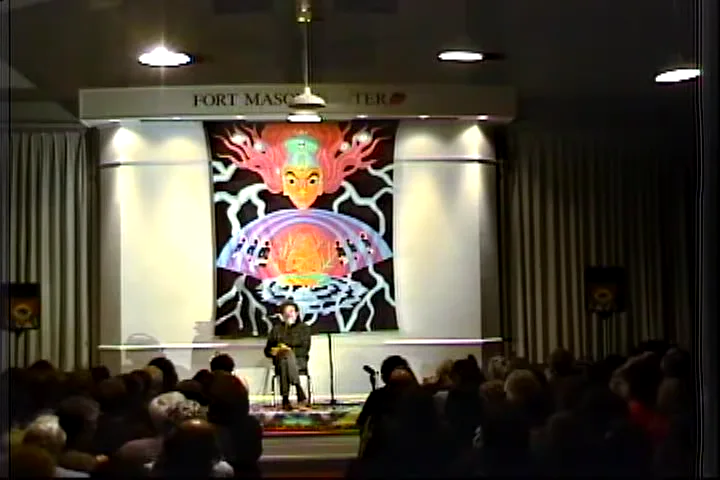

terence mckenna in 1998 on imagination and cosmic intelligence. brief spoken fragment exploring consciousness and the universe.

terence mckenna on art bell's coast to coast am, march 1998. they discuss artificial intelligence, consciousness, psychedelic experience, and the acceleration of technological chan
terence mckenna explores the origin of consciousness and why humans emerged from millions of years of simpler biology
terence mckenna presents his theory that psilocybin mushrooms catalyzed human evolution by enhancing visual acuity for hunting, increasing sexual arousal to boost reproduction, and
mike kawitzky's 2009 documentary. some twenty thinkers, framed by terence mckenna's archive recordings, on five questions about evolution, consciousness, god, science and death.