Plantsofpower 1 Rc

This radio program was written and presented by Nick Rankin as the first installment of a series on plants of power and mind-altering substances. Rankin guides the listener through the neurochemistry of consciousness, exploring how the brain's neurotransmitters govern mood, thought, and perception, and how naturally occurring compounds can alter these systems. The program features interviews with leading neuroscientists and pharmacologists including Dr. Clive Cohen of King's College London, David Pierce of BLTC Research, and Susan Greenfield of Oxford University. Through their explanations of serotonin, dopamine, and the lock-and-key mechanism of receptor binding, the episode reveals how our subjective experience of reality is fundamentally chemical. This foundation makes clear why plants that produce psychoactive compounds have played such a central role in human culture and exploration of consciousness.
transcriptmachine-transcribed, unedited
Part radio series about mind-altering drugs in nature and culture.
Written and presented by Nick Rankin.
Plants of Power.
Program 1. Brain Power.
Hello. People and plants go back a long way together.
And this series is about our chemical connection.
A story of dangers and delights.
Plants make chemicals to protect themselves.
Some of them are poisons.
And we people need chemicals to live.
The human brain works on chemicals.
Your moods, thoughts and feelings are governed by drugs manufactured naturally in your body.
This series argues that drugs are part of our nature.
Common to all human cultures.
Plants of power trace our secret history.
And help to reveal our inner selves.
Plants produce phenomenally complex compounds.
Plants that are probably to do with attracting or repelling other life forms.
By chance, those products have equally remarkable effects on the human nervous system and the brain, which is the most complex organ in the known universe.
Plants are unimaginably powerful.
Dr. Clive Cohen.
I'm from King's College, London.
Dr. Clive Cohen.
and my main interest is in neuroscience.
Neuroscience is the science of the brain.
Science of the brain and the spinal cord and the peripheral nervous system.
Now the brain is sort of wetware sloshing around in our skull.
It is chemical. It's a chemical system, isn't it?
It's an immensely complicated universe of cells
that are speaking to each other
and somehow promoting vast numbers of functions,
many of which have nothing to do with thinking.
The man in the street may think the brain is largely to do with emotions and thinking.
It's certainly subserving those functions,
but it's maintaining temperature regulation, water balance,
reproductive hormones, biological rhythms,
countless hosts of functions.
And at this moment, at the end of the 20th century,
we don't fully understand the full potential of the brain.
We understand practically nothing, to be honest.
We know quite a lot of the phenomena
and they're being studied with great diligence and great accuracy.
But it's a science still in its infancy.
It's really only a few decades old.
Any drug or agent that affects your mental state
must get through to your brain.
Now your brain works by electricity and chemistry.
The chemicals in your brain that signal to each other
are called neurotransmitters
and they lock on to the receptors of other cells to do their business.
David Pierce runs BLTC Research.
That stands for Better Living Through Chemistry.
And he wants to make people happier by modifying the brain balance.
Basically, the mind-brain is a community of perhaps thousands of millions of nerve cells
and somehow they have to talk to each other
because for the most part they're not directly connected
and they do so by these little chemicals
and the terminals from one cell release these chemicals
and these chemicals lock on to receptors
which is rather like locks and keys on, let's say, a nearby cell.
And this triggers off a whole cascade of events inside the cell.
And by changing the way our cells talk to each other
it's possible to alter mood, it's possible to alter thought.
It can be done in an uncontrolled and dangerous way
as in many of our street drugs
or it can be done in a much more controlled and precision-engineered way.
One of the problems with the mind-brain
is that it's got a whole host of mutually inhibitory feedback mechanisms
and let's say by boosting one particular neurotransmitter subtype
you actually inhibit the function of another transmitter.
Hence, in many cases, drugs that boost serotonin function
impair dopamine function
and dopamine is very important.
A neurotransmitter, it's involved in willpower, euphoria, well-being, drive
and so you really need to have a twin-track approach.
Hang on to two words there, serotonin and dopamine.
They're two important chemicals in the brain
that all the mind and mood-altering drugs seem to do things to
blocking them, freeing them, mimicking them in some way.
Serotonin is linked to the sleeping-waking cycle,
to dreaming, to temperature regulation,
to moods and the fine-tuning of how you see reality.
Dopamine is involved in all the pleasures that we feel,
to euphoria and to control of sex hormones.
And it's on these and on other neurotransmitters
that leading-edge brain scientists are now focusing.
My name is Susan Greenfield.
I'm a university professor in pharmacology at Oxford.
What is pharmacology, actually?
Well, people think that pharmacology is all about drugs
because that comes from the Greek word for drugs, pharmakos.
But really, what we like to think of it as in Oxford
is more the study of what we say chemically sensitive sites.
We're more concerned with how chemicals working in the body
can be modified by agents that some people will regard as drugs.
So it's not necessarily all about drugs and just drugs on their own,
but rather how they work in the body.
Let's go back to these receptors, these locks and keys
that a drug or an agent introduced will somehow trigger the chemical
or fool the brain into thinking that this is the right key for this lock.
What I want to ask is, how come our brain has got these locks
that match so many cannabis, tobacco, opiates
that there are, apparently, I've been told, receptors in the brain that match these?
That's a fascinating question, and perhaps the best example of that
and the most established now comes from findings in the 1970s
that, to my mind, represented one of the biggest advances in brain research
of this century, and was discovered in Aberdeen.
And what it was found was that we have naturally occurring opiates,
morphine, in our brain.
And so at that time, people knew that morphine was one of the most powerful drugs,
both in terms of abuse and in terms of analgesia, in terms of therapy.
It's one of the oldest and most powerful drugs that we know of, is opium,
of which morphine is a derivative and heroin a derivative of that.
In the 1970s, it was discovered that we had in our body special receptors
that the opium, or the morphine, or the heroin could work on.
It was then discovered that there was in our bodies a naturally occurring agent,
a transmitter, that was just like the morphine.
That's called enkephalins, literally meaning in the head.
And this was held with great excitement, and now we know a lot more
that the body does have a mechanism that can be involved in the control of pain, for example.
It's also the same agent believed to be released during something called jogger's high.
That's to say when people do a lot of long-distance running.
After about half an hour, they feel euphoric.
And that's now associated with increased levels of this enkephalins.
Is there a way one can trigger one's own enkephalins naturally?
Then you need any drugs at all.
Exactly, and this is one of the reasons people try and get people who are depressed
to engage in lots more activity.
It's undeniable that if you take exercise, you do feel a lot better.
And another way we know that you can release endorphins is with laughter,
and again, a marvellous way.
If you could get people to laugh, then doing that rather than taking drugs would be marvellous.
There'd be no side effects, it'd be cheap, you wouldn't need a medical practitioner,
you couldn't overdose on it.
It wouldn't matter what culture or age you were, anyone could do it.
With me now is Dr. Andrew Weil, well-known author.
His latest book is called Eight Weeks to Optimum Health.
He's also the author of Natural Health, Natural Medicine, Spontaneous Healing,
and also two books on the subject of plants and drugs,
From Chocolate to Morphine, Everything You Need to Know About Mind-Altering Drugs,
and a famous book from the 1970s, The Natural Mind,
A New Way of Looking at Drugs and the Higher Consciousness.
Dr. Weil, can you tell me why are human beings, this species,
so interested in intoxication, in altering their moods and their minds?
In The Natural Mind, which was published in 1972,
I postulated that human beings are born with an innate drive to alter consciousness,
and this is based on observation.
Now, I don't say they're a drive to get intoxicated,
because I think that's one variety of consciousness alteration.
My sense is that what we find most aversive is boredom,
and what we find most reinforcing is change in the area of consciousness.
And I think as you go up the phylogenetic scale,
you find this desire to alter consciousness becomes more and more prominent,
and it reaches its peak in human beings.
I also think that human beings in most cultures quickly discover
that drugs are one way of satisfying this need.
But I think unless society acknowledges that need and addresses it,
we have no hope of coming to any terms with intoxicants in our midst.
If we take it back in human history, back into evolutionary history,
I mean, how far back does this start, do you think?
I think it's there from the beginning,
and even if you look at drugs,
which most people early on were using in plant form,
the only culture that I know of that was not heavily invested
in growing, distributing, using drug plants
were traditional Eskimos who had the misfortune not to be able to grow things
and had to wait for us to bring them alcohol,
which they quickly learned to abuse.
One reason why we've evolved a brain at all
comes from the fact that we are animals.
And if you're an animal, unlike a plant, you're animated.
Now, I know that plants in certain cases can turn to the light and so on,
but they can't translocate unless you believe in the day of the triffids
or something going in, or red shakes, there were burn and wood.
Most usually, plants are fixed to one spot,
whereas animals, the hallmark of animals is that they are moved, they're animated.
And there's a very interesting little story
of a tunicator, a sea squirt, a little marine creature,
that spends its immature part of its life swimming around
and it has a very primitive brain.
And then it fastens to a rock
and lives out its adult life by filtering seawater
so it doesn't have to move.
And once it becomes immobile like this,
it consumes its own brain.
So it doesn't need a brain once it becomes stationary.
So the idea is that we've evolved a brain
because it enables us to have a rapid interaction with the environment.
A plant doesn't need that
because things for plants don't change very quickly.
The light changes slowly.
It doesn't have to make very rapid adjustments to survive,
whereas we do, which is why we're equipped effectively
with a very quick sensory input of things coming in
so through our five senses we can know what's going on in the world
and, of course, we can react quickly, we can move,
we can run, we can chase, we can hunt.
So the brain has evolved as such to enable you, we think,
to interact rapidly with the environment.
The most fundamental thing is that as animals,
any animal is by definition dependent on plants.
There are no animals that aren't dependent on plants,
either directly or indirectly.
And therefore our evolutionary history has been tied in with plants
from the very, very beginning.
The artist and zoologist Jonathan Kingdon,
whose latest authoritative book is
The Kingdon Field Guide to African Mammals.
We, animals, have been eating plants from the beginning
and that has meant that plants have had to contend with this
as a major force as they've evolved.
I think the most obvious aspect of it is that the plant is trying to protect itself
and producing chemicals which are often highly specific to the particular creature
that is its prime enemy.
But very often, if it's having a strong effect,
it may be right on the edge of being a poison.
And we do know that a lot of drugs, a lot of plant compounds,
which are taken by animals, by wild mammals, and by human beings,
if you take too much of them, of course you die.
If you are a particular type of individual,
you also die anyway, even if you take a very tiny quantity of it.
But if you've got a genetic resistance to it,
then you may be able to take it in quite large quantities
without it doing you any harm.
It may indeed even give you pressure.
And the chemistry of plants is such that it can affect so many different...
We're a web of systems.
I mean, we've got a blood system, a nerve system,
we're coping with air, we're coping with temperature,
we're coping with so many different environmental pressures.
And for all of those, there are chemical balances that are just right
and we can push one way or the other.
And we may actually enjoy getting rather hot or rather cold
as a result of taking some kind of spice,
which has that physiological effect on us.
Now, for somebody else or for another animal,
just making you feel hot or making you feel cold
may be the thing that tips them towards death, if you like.
And so it is a definite deterrent to another animal.
So we're actually latching onto the plant's strategy
against other animals to a great degree
because the vast majority of the plants that we do use as drugs
and that we do use as compounds to stimulate ourselves or whatever,
none of them were designed for us
because most of them are not African
and we are African apes by origin.
And so all our sort of highly refined relationships with plants
are all restricted to the plants of the African forests
and the African savannas.
Spain.
Christian Rech.
My basic professional field is ethno-pharmacology
and I'm specialized in the use of plants by indigenous people
and also specialized on shamanism.
And I do a lot of traveling and researching,
trying them out, taking pictures, writing books, articles,
do some lecturing here and there.
And I've been almost in every place on this planet.
You're the author as well of a dictionary of sacred and magical plants.
You're an ethno-pharmacologist.
You study how native people use these plants.
How far back does human interaction with plants go?
Well, to the beginning.
I mean, it's very difficult to estimate how long people use plants,
but they use them since earliest times.
And there is also some evidence that plants were already used
for magical purposes or for healing or for rituals in Paleolithic times.
And we have some evidence that Neanderthal man already used some bioactive
and even psychoactive plants as offerings to the dead or something like that.
And from the earliest beginning of writing,
we have records of the use of plants for healing, for magic,
for offerings to the gods and goddesses,
and the use of incense and plant materials had been used as incense almost everywhere.
And from all the written sources,
we have records that this is part of human culture since culture is formed.
Smoke is something right at the root of our distinctness that is homo,
as distinct from, you know, gorillas and chimpanzees.
Smoke is one of the things that defines us.
Because when we built fires and we sat either in caves or in shelters over a fire,
we would have exposed ourselves to an enormous amount of smoke.
And probably any individuals that were hypersensitive to smoke
were eliminated through natural selection at a very early stage in our ancestry.
And this is pure guesswork,
but I would be very surprised if there weren't particular woods
that people say, ooh, lovely, I really like that smell.
And they would have selectively collected those woods
when they wanted a kick out of it.
But they would have just been put into the fire
for maybe a million years that might have occurred.
And they would have just kept them and stuck them in the thing.
And eventually, then it would begin to be controlled.
I think this is confirmed by early archaeology.
There are a lot of censors, they call them,
either for burning opium or for burning cannabis,
that are seeds or leaves are put on and the smoke comes off.
And that could be, in a way, the first step towards having a pipe.
I think you have to find the roots of nearly all these things
in hunting people much more than in agricultural people.
Hunting people would have known so much more about animals and plants
than any agricultural people.
Agricultural people, by definition,
have narrowed their relationships with animals and plants
to a minuscule degree.
And foragers really know an enormous amount about their environment.
They may clothe it with lots of mythology,
but even the mythology generally has some sort of strand
that links it in a functional way with the organism's real biology.
To me, one of the most interesting findings is that
the human brain has receptors that fit molecules produced by plants.
And that's very curious.
Now, why does the brain have receptors
that fit molecules produced by the opium plant?
I mean, that certainly suggests that there is a link
between human beings and human consciousness and plants
that extends very far back in time.
Some would say this is purely an accident,
but are you saying, suggesting that there is a co-evolution here?
Yeah.
You know, even another one,
we find the neurotransmitter molecules,
molecules like serotonin, for example,
in one-celled organisms.
Now, so these seem to be molecules
that are very conserved in evolution.
To me, it suggests that there is linkage.
Andrew Weil.
Now, one man who's spent much of his life
exploring that linkage between plants and people
is the writer Terence McKenna,
the impish guru of natural psychedelics.
I first came across Terence McKenna
when he co-edited with Howard Rheingold
the fall 1989 issue
of that always interesting California-based magazine,
Whole Earth Review,
a remarkable issue whose cover story was
The Alien Intelligence of Plants.
Terence McKenna.
Plants represent an order of existence
that is completely alien to most people,
and yet all around us.
Plants cannot move away from their toxic by-products.
Consequently, they have a great stake in recycling
and keeping the atmosphere and the environment
clean and uncontaminated.
Plants have a wonderful integrated passivity
that makes them a model
for certain aspects of human consciousness.
So, basically, we just wanted to call attention
to this alien life form in our midst,
often as saturated with neurotransmitters
as our own brains are,
and then to discuss the ways in which human beings
can contact or participate
in this kind of consciousness.
One of the things you suggest in your article,
the keynote article of this Whole Earth Review,
plan, plant, planet,
is that you could see the green world
as having influenced us enormously.
Not us in control,
but the plant world has been controlling the mammal life.
Well, an evolutionary biologist
once remarked somewhat facetiously
that animals are something invented by plants
to move seeds around.
And if you stand back and look at it,
that's not far wrong.
Plant life dominated the planet
long before the rise of higher animals.
And plants continue to be
the major life form on the planet.
The atmosphere is controlled
by the gaseous intake and outtake of plants.
Many plants live in the sea
and establish the environment of the oceans.
This is really a plant planet,
and animal life is only an incidental
and late addition to biology here.
The issue also points out
that plants can defend themselves
and work through chemicals,
and immensely subtle chemicals.
And is it your case
that in fact it is those chemical messages
that have helped human beings?
Well, it's a great mystery
why plants would produce
and sequester compounds
that have no apparent role
in their own metabolism.
And I think once you entertain the idea
that these so-called tertiary compounds
are messenger molecules,
pheromones, if you will,
then what emerges
is the picture of biology
united into a seamless web
by the exchange of message-bearing chemicals
in the environment.
We communicate with spoken language,
but insect societies are run by pheromones,
and it now appears
that many plant activities
are mediated by these same messenger chemicals.
Essentially, chemicals lie beneath
the surface of language and communication
in plants and animals.
Nature is trying to communicate
with human beings.
With almost all of these drugs,
I mean, same with cannabis,
although we didn't discover this
quite recently,
there's a receptor in the brain
for THC.
So there is a fit between our brains
and these substances produced by plants.
Now, what does this tell us then?
I mean, what is the...
Well, you know,
many scientists and medical scientists
get very upset
if you try to read meaning
into all of this,
but I've never hesitated to do that.
To me, it suggests
that there is a logic
in our wanting to go around
and experiment with plants
and see what they do to us.
My sense,
and this again was a major point
of the natural mind,
is that the reason
that there is this evolutionary drive
to alter consciousness
is that these experiences
potentially are doorways
through which we can discover
expanded potentials
of the human mind
and human consciousness.
The potential benefits
to be gained
through this kind of experimentation
are probably great
for us as a species,
and that's why this drive
is so present.
So in fact,
legislating about it,
if it is such a primary
evolutionary drive,
legislating...
is futile.
I mean,
it's that simple.
And furthermore,
there is not a shred
of evidence
from anthropology
or history
to suggest
that it is possible
to get human beings
to live without
mind-altering substances.
As I said,
the only culture
that's out there
that I know
that has done that
were Eskimos.
But every other human culture
that I've ever looked at
has been heavily involved
with the production,
distribution,
and consumption
of mind-altering substances.
And then you start
from there
and see,
well,
what can we do about it?
How can we reduce
the potential for harm?
How can we encourage people
if they're going to use
these things
to use them
in responsible ways
and so forth?
But I think
any social program
that begins
from the assumption
that you can make
these substances disappear
or stop people
from using them
is doomed to failure.
...of Power,
a six-part radio series
about mind-altering drugs
in nature
and culture.
Written and presented
by Nick Rankin.
Plants of Power.
Program 2.
Spirit Power.
Well, history shows
that we have always
used drugs.
In every age
and every part
of this planet,
people have pursued
intoxication
with plant drugs,
with fermented fruits,
and other types
of chemical substances.
Psychopharmacologist
Ron Siegel,
author of
Intoxication
and Fire in the Brain.
And surprisingly,
we're not the only animals
that do that.
Our research teams
have found
many examples
of other animals
that pursue
intoxication
with plant drugs
and fermented fruits.
and this drive
to intoxication
is so strong,
it's so persistent,
that it functions
very much like
the drives
of sex,
hunger,
and thirst
that motivate us,
that motivate our lives,
and that drive
our behavior.
There's no region
of the world,
really,
where plants grow
that people haven't
used them,
not only for medical
reasons and for food,
but also for their
psychoactive properties.
Richard Rudgley
is an anthropologist.
He's the author
of Alchemy of Culture
in Toxicants in Society
and a forthcoming
encyclopedia
of psychoactive substances.
So what do
the plants of power do?
Basically,
you can divide them
simply into
a few categories.
You have plants
which are called
stimulants,
obvious ones
being the coffee
and tea plants,
but those cultures
have their equivalents,
which...
basically help you when you're feeling tired or to give you extra energy for some mental
or physical task. Then you have hallucinogenic plants which cause visionary or auditory hallucinations.
Then you have what are called hypnotic plants, a lot of which, such as opium, cause states
where basically they're the opposite of stimulants. They make people relax, they relieve mental
or psychological pain, or physical pain obviously, where they interface with medical use. And
finally you have the inebriants, which is the most classic one of course being alcohol.
Now there's a stream of intoxicants that flow through our lives today. It doesn't matter
whether we wake up with a cup of coffee or a line of cocaine, or we take a break from our
work with a cigarette or a beer, or we relax after work with a cocktail or a joint of marijuana,
or we try to get to sleep at night with something we bought at the pharmacy, or something we bought
from our street corner dealer. People use drugs to change the way in which they feel.
We are chemical organisms. Our brain is a three pound sack of chemicals. Of course we're more than that,
but we are that too. And our brain manufactures lots of natural chemicals. We manufacture opiates,
which are as strong as any kind of heroin or morphine. Our brain manufactures dot-methyltryptamine,
a hallucinogen that is stronger than LSD. Our brain and our nervous system manufactures adrenaline,
which is a stimulant that's as strong as any crack or an amphetamine. So it's natural that in
forging around in our environment on this planet, we will find other chemical substances that we have
affinity to, that hit our receptors and strike us as being pleasant. And it's also being natural that
we're going to find chemicals that we don't like, that we respond to with aversion. So we are just
responding to these chemicals. But how people respond to chemicals depends, we're told, on the set and the
setting. That's the set of ideas or expectations someone has about the substance. And the setting
is the place and time and the other people around you when you take it. It does matter whether this is
a sacred ceremony or a casual habit. Richard Rudgley thinks that for the earliest people,
the astonishing chemical reactions of certain plants had spiritual consequences. There is no question
when you look at the archaeological literature, the literature of the ancient world, and also the
experiences of contemporary tribal peoples, particularly Shaan's, that psychoactive plants have had a central
role in the religious history of mankind. Now you used the word shaman there. Can you explain to me what a
shaman is and the origin of this word? Well the word itself comes from a Siberian tribe and then it was used
by the Russians and from there it reached the western world. And now it generally means people who are living
in tribal societies who have what in other areas are called medicine men, but they go specifically
into trance states in which they perceive the origin of diseases and then by medical practices they seek
to cure their patients. Often, and this is where it is rather different from western medicine, by them
taking the drugs rather than administering them to their patients. Saman or shaman is the Tungus word from
from one of the tribes of Siberia? That's right, yes. Are plants in any way psychoactive plants, mind-altering
plants involved in shamanism in its original place of origin? Well in Siberia there are certain peoples who
use the flygaric mushroom in shamanism, the famous flygaric mushroom which is the well-known mushroom of
fairy tale illustration with the red and white cap. It's one of the naturally occurring
hallucinogenic substances. For the tribal hunter-gatherer, living embedded in nature and instinct and
surviving by skill with animals and plants, the mental world is the spiritual world. A mind-altering plant,
changing the nature of reality when ingested, would for our prehistoric ancestors have been a sacred
plant. For who could doubt this fruit of Eden's stunning power of ecstasy and trance? And who could
not respect the strange person, the shaman or shaman, possessed by that power or somehow channeling its
impulses and insights? I think that, yes, shamans are very interesting because they they clearly belong to
the hunter-food-gatherer phase. Artist and zoologist of Africa, Jonathan Kingdom. Anybody who could
actually invoke hidden powers to provide fruit, the person would have been almost turned into a shaman
anyway. And that does seem to have been one of the roles of shamans, that they they actually interceded
with the hidden powers to provide or to create the harmonious situation in which there would be plenty
of food. And I think that there again this mystery, the mystery of how you could starve sometimes and
you could be full of plenty at another. The food was very, very abundant and then suddenly it would
be withheld. It was so easy for people to actually see this as the result of a malevolent power, which
was a projection of, of a, if you like a, a senior person. So a senior person then became the agent in
a sense for this hidden power. And that I, I think would have been the sort of sequence that would have
led to shamans. But this is purely speculation obviously. And I don't think there's any evidence
anywhere for the, the real origins of shamanism. I definitely think that the origin of shamanism was
the human encounter with psychoactive plants. Because these plants are still the most important tool in
shamanism to enter the other realities. Ethnopharmacologist Christian Rech, author of another forthcoming
encyclopedia of psychoactive plants in German. We have now so much evidence for the worldwide use of
psychoactive plants as the main tools of shamanism that we can really suppose that this is the
original method and that it, it's very old and that the plants actually produced shamanism. And
they also produced what we might call religion or mysticism or something like that. That is an idea
that Weston Labar, the, uh, anthropologist author of the famous book, The Paity Cult, proposed an essay,
that in fact the origins of the sacred and of religion at all is in consciousness changing
plants. Do you hold to that? Of course. I mean, definitely. I mean, it's really easy to understand.
If, uh, you take a psychoactive plant by yourself, you're just thrown into another world, into another
reality. And there you see unbelievable things. You meet, uh, incredible creatures and, uh, all kinds of
stuff is happening. And, uh, stuff is happening. And, uh, uh, if, uh, uh, you experience this by yourself,
then you, uh, can feel that, uh, there is another reality and that this reality is very important to know
and to interact with because, uh, this other reality is not, uh, separated from our visible world. It's
like immanent. It's in this world. Professor Susan Greenfield of Oxford University. We've been talking
about religion here and, and drugs. People want to change their consciousness. You could have an
ecstatic vision. Perhaps you could have an experience of God in some way. It would change your life. Now,
consciousness, our, our sense of knowing ourselves, what is, here's the most simple question of all,
what is the relationship between our brain, the physical wetware in our skull and our consciousness?
Well, if I could answer that, I think, by now. You'd have the Nobel Prize. Well, at the very least,
the Nobel Prize. That'd be, uh, that, of course, is the one of the biggest challenges in biology today
and one that fascinates me. I find it the most exciting question one can ask. Now, that doesn't
mean to say one can answer it. I think one must, first of all, draw a distinction between consciousness
and self-consciousness and that most other animals and indeed very young children are not
self-conscious and that you don't have a rat looking at itself in the mirror. God, I'm a rat,
I don't think. But consciousness, leaving aside self-consciousness, consciousness itself
is a fascinating issue and one that I think actually to come full circle, drugs will offer us the most
progress in understanding for the following reason. If you just look at properties of the brain
as people that are building computers do, or indeed like many neuroscientists do when they're
looking at the electrical signals, then you never know how those electrical signals will match up or
cause you enjoying the sun on your face or the feel of fresh grass on your bare feet. You'll never
know those things. Philosophers, on the other hand, say that what's important is the subjective
experience of consciousness, the feel of my headache to me. Now, until recently, it's been very hard to
bring those two worlds together to understand subjective feelings, sort of feelings that,
let's say, a drug will give you, with what happens in the brain. But it strikes me that drugs are
indeed the bridge, the kind of bilingual link, if you like, because we can talk about how the drug
works in physical terms, how it affects the transmitters and the receptors and the neurons,
and of course you can have someone saying how they feel when they take a drug or reporting their
experiences. So as long as you don't mind having a second-hand insight into someone's consciousness,
that is to say, as long as you don't mind having to rely on what they report, their subjective reports,
you can start to match up subjective sensations with what we know they're doing to chemicals in
the brain, the more we might start to have some insight into how those reactions relate to those
chemicals in the brain. One kind of drug that we haven't talked about are the hallucinogens.
Now, this is an interesting mental experience. What is happening if people are hallucinating?
Okay, well, it's not just people that take hallucinogenic drugs that can hallucinate. We
know that certain types of schizophrenia can lead to the illusion that you're hearing voices,
or that there's cameras hidden in the light bulbs that are watching you.
Fever can do it.
Yes, indeed. So we know that it's not just drug-induced. One could argue almost that when you
dream, you're hallucinating, because you're certainly not registering simply what is out
there in the environment, because nothing is there. So I wouldn't like to think of just the LSP
taker as the only person that's hallucinating, although they are a good example of it. Now,
this is one example of when I said drugs can be used as a bridge to understanding
what people feel and what's happening in their brain. Hallucinogens offer a very exciting bridge
between those two worlds, if you like. The fact that you can see something glowing colors,
or you can see something that's not there at all, raises the question of the brain not just as
some passive sponge that is taking in the inputs from the outside world, but is actually doing
something, generating something in its own right that gives you that illusion.
I use a very useful analogy which helps simplify and explain what goes on inside the brain when
someone is having an hallucination. Think of a man sitting in a study and he's looking out the window
and he sees the people walking out on the street and the traffic moving by. And as night falls and
he looks out the window, he can no longer see out because it's completely dark. But let's say he has
a fireplace behind him and he stokes the fire and the fire burns brightly and he turns around to look
out the window. He still can't see out because it's dark, but he sees a reflection of himself in the
glass and the furniture reflected as if it came from the outside. The analogy is that the window is
the window of our eyes, our ears and our senses to the real world. And the fire is the degree of
electrical expectation that many drugs can produce in the brain. So when it's dark at night, not much is
happening. And the fire roars brightly. You have a lot of LSD in your brain. Let's say you may no longer
see the real world, but you see the furniture of your own mind, memories, your images, your fantasies
reflected as if they came from the outside. And some people become like Alice going through the
looking glass. They believe all of this stuff is really there. The good news is that as soon as the
fire dies down and the drug wears off or is counteracted by another drug, perception returns to normal and
you begin to see your own reflection again and you begin to see the room. John Siegel's clear example
is the materialist scientific way to see this brain event, but it's not how the old ecstatic shamans
think. They do step through that window or penetrate the membrane to the other side.
The hallucination is true, says Christian Wrench. For me, it's so clear and obvious that
the plants contain something which might be called a spirit or a soul or some consciousness. And when I
ingest such a plant, I have the feeling that this part of the plant uses my own consciousness to express
itself for me. What you've just been saying confirms exactly what Terence McKenna was saying to me,
in that in evolutionary terms, the plants need animals not only to propagate their seeds, but to
communicate. Because animals can move and plants can't. So are you saying that part of the story of
the shaman is that the plant is teaching the shaman? Of course, and the shamans view plants as teachers,
as masters, and as allies. And they say, if I take a plant, the spirit of the plant will talk to me and I can
ask the spirit, hey, what are you for? What is your purpose? What can you do? Can I use you for healing?
Or can I use you for something else? Or how to prepare the plant and all this stuff? And so there is a
dialogue between the shaman and the shaman learns from the plant. And then he later can use this knowledge
to use the plant wisely. And I think that is the best view for understanding psychoactive
psychoactive substances and plants, that they are teachers. And we learn from them. And what we learn
from them is very important for ourselves, for our community, for the earth, and maybe for the whole
universe. We never know. Not all shamans use mind altering plants, but all shamans use music and trance
to achieve ecstasy. Shamanism is found in all continents, often hidden and out of the way.
Shamanism is still strong in South Korea. The shaman there, man or woman, is called Mudang. And the
symbol is a tree between earth and sky, and two dancing figures. My name is Cho. Cho Hung.
Eh? Similar name is Cho. And I am professor of cultural anthropology at Hanyang University,
specialized in religious anthropology. What is the history of shamanism in Korea? When does it begin?
You know, from the beginning of the Korean history. It is well known that the founder of a Korea
Dangun was shaman. You know, at that time, the religion and politics is not separated, you know.
So Dangun was the shaman. And then the kings, till the beginning of the so-called three kingdoms,
say, third, fourth centuries, they were shamans. It is so affected in Korean history.
What is the connection between shamanism in South Korea and shamanism in, say,
Central Asia and Mongolia? Is there a connection?
Yes. The Korean shamanism has, in many elements, something to do with the Central Asian or Siberian
shamanism. An example, you know, the dance and the ecstasy or the crown, you know.
The well-known Korean, the so-called national treasure, the kumwan, the golden crown,
as the typical shamanistic head covering, as the Siberian tradition.
This is the Gyeongju National Museum in the southeast of Korea. And right in front of me,
behind a glass cabinet is one of the headdresses that the professor is talking about. These are the
headdresses, the golden headdresses of the original shamanic kings of Sila. And there's a
circlet of gold that goes around the temple. But above them, sticking up like trees, are these
towering gold ornaments. They look exactly like trees, or they could be horns. And they're hung with
coins of gold, beaten coins of gold, and cashew nut-shaped pale jade jewelry. And it's like a
forest of trees above the shaman's head. The shaman then was a king as well as a priest. On his
head, he wore the great symbols, the power plants of his religious and political power.
The American Indians originated out of Central Asia and came across the Bering Strait. And yet the new
world seems to have more mind-altering plants than the old, at least that were discovered and used by
people. Why is this? Richard Shelters, who's the the world's leading expert on the botany of
Hallucigenic Plants, has said that this isn't down to natural factors. In other words, it's not
because the plants aren't there. He's been seeking a cultural explanation. And in conjunction with the
theories of Western Lava you've already mentioned, what we're looking at is the survival of shamanic
cultures much longer in the new world than in many parts of the old world.
Now, if we look at shamanism, shamanism has a direct contact with the world of the spirits or the world of
the divine. Are you saying that the cultural explanation is that the people who came from Asia,
who had, I don't know, vision quests or wanted altered states, were therefore actively looking for
plants that would help them do this? Well, this is the suggestion of Lava and I think it makes a lot of
sense because if you go back way back, basically when societies were much simpler, generally speaking,
amended the hunting and the women gathered the plants. So we would suspect that they were the ones perhaps
who discovered many of these plants. I think they obviously, they were looking for food plants,
we know that they were looking for medical plants. And really in a lot of native cultures, the difference
between medical use and what we would call drug use is not so clearly defined as in our own culture.
So a homosogenic plant would be considered purely on that criteria alone to have medical properties.
So they would have valued it and so they would have been looking for it as they pushed into new environments.
And they certainly discovered them because the new world has, I believe Schultes has said,
over a hundred plants that are used for their psychoactive properties.
Whereas in the old world, with the rise of the world religions, for example, Christianity, Islam,
and also with the Judaic tradition, these religions, although of course we have wine as a sacrament and so on,
they don't, well, they in fact actively resist the idea of using hallucinogenic plants obviously
in part of their religious quest. So they have tended to suppress or to simply wipe out these earlier
religious traits. Professor Cho, you're an expert on Korean shamanism. Now, can we not say that shamanism
is in fact the first religion, the primal religion of the earliest peoples? Yes, you're right.
You know, according to the religious evolutionism, the shamanism was always a first place of the
history of the religion. Well, it's good, but in interpretation of this evolutionism, we have
regarded the shamanism as a, you know, the primitive, as nonsense.
Typical ethnocentrism, you know, the western civilization, or the christian civilization, or
the mechanistic civilization, have ruined so much the environment or the beautiful nature of the world,
and shamanism. You know, such kind of a religion is very important for the aboriginal people.
They have their own philosophy and their own, their wonderful, I would say, harmonious world, you know,
and they've lost in Korean shamanism. You know, they always think that we are persecuted, etc.
The shamans cannot say openly that we are shamans, they lie, you know. No, I'm, I believe in Buddhism,
etc. So, it's a repressed belief system. It is important, but it runs like, like a river
underground. You may not see it, but the river is still running.
Not underground. Yeah, underground, you're right. And I would say the shadow,
or in, in, in night, at night, you know. The Korean shamanism is believed at night,
very strong still, but at days, you know, they must hide themselves, you know.
In the daylight, the world of Hyundai and Samsung and Daewoo, is it? Different gods.
And we'll be looking at how industry and empire profaned the sacred plants next week. Till then,
goodbye.
you

terence mckenna's workshop on plants and consciousness. a two-day lecture series exploring the psychological and mental interpenetration of plants and human beings.

part of the plants of power radio series on mind-altering plants, tracing how industrial societies transformed sacred botanical medicines into addictive drugs through extraction an

terence mckenna explores the origin of consciousness and why humans emerged from millions of years of simpler biology


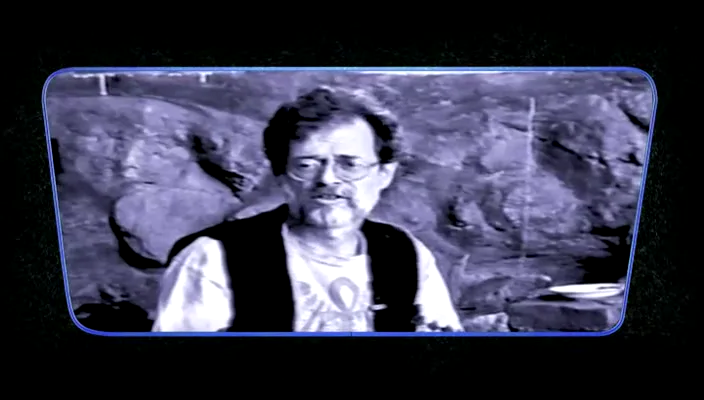
terence mckenna presents his theory that psilocybin mushrooms catalyzed human evolution by enhancing visual acuity for hunting, increasing sexual arousal to boost reproduction, and


mike kawitzky's 2009 documentary. some twenty thinkers, framed by terence mckenna's archive recordings, on five questions about evolution, consciousness, god, science and death.