Some Notes On Planetary Intelligence

This is a talk by Terence McKenna on planetary intelligence and his insight that everything in reality operates as code, from language and DNA to human consciousness and cosmic systems. He explores how hallucinations during psychedelic states may not be random neural noise but legitimate perceptions of non-local, quantum-accessible information existing elsewhere in the universe. McKenna discusses the brain as an evolutionary instrument, using the Hubble telescope as a metaphor for the mind's capacity to gather vast amounts of non-local data. He proposes that planets themselves are alive and conscious, using the species that evolve on them as technologies for communication within a larger cosmic ecology. The talk challenges fundamental assumptions about consciousness, perception, and the structure of reality itself.
transcriptmachine-transcribed, unedited
Let me see here. Is there a flashlight? I have a page full of notes. I needn't be so, uh, if there's anything here that wasn't touched on. Well, some notes about, um, the, this, this planetary intelligence. Thank you, June.
Uh, and how all that works. Um, one of the insights that, I've been reading different people this year, maybe you can tell, and one of the people I've been reading is, uh, Greg Egan, who I talked about last year.
But now I've read more. Now I've read diaspora and the ones where he makes no effort whatsoever to explain it to you unless you've already done your homework. And, uh, what I, and then Jonathan today in his lecture talked about DNA a little bit and frame slippage and all of that.
And it reminded me of it. The thing that I'm coming to from my psychedelic, uh, experience and my life experience and the whole ball of wax is, uh, I, I've said for many, many years that the world is made of language.
That was just sort of one of my bumper stickers. But I think that there's a, uh, that that carries some of the flavor of what I want to say there. But that there's more to it than that.
It's, it's, it's that, uh, everything is code. Everything is code in the sense that hackers mean when they say they write code. When Sasha stands up and waves his arms and draws what he calls the dirty pictures, he initiates you into a code, a vocabulary with very, uh, defined rules and quick to learn.
And then they're like tinker toys. Once you know the rules of the connectivity, then you can sit down like a child and begin to stick these things together and say, well, what would this be like? And what would this be like? And does God allow this? Or does this break the rules? And so forth.
The DNA is like that. Human language is like that. Uh, human body language is like that. Machines communicate like this. In fact, uh, this is the, uh, a bridge which connects us. This is the great overarching bridge which will connect us to the machines that they like us are, uh, commanded by language.
And so, uh, this realization that everything is code and code moving on many levels is, I think, a further, it's more primary than the perception, for example, that things are made of space, time, matter, and energy.
That's one level below codes. The code codes for space, time, matter, and energy. It's much more like we're in a simulacrum, some kind of machine environment. And in fact, I like that idea because I've always sensed, and psychedelics have always intensified this intuition in me, that the universe is a puzzle.
Life is a puzzle. Life is a, is a problem to be solved. It's a conundrum. It's not what it appears to be. There is a, there are doors. There are locks and keys. There are levels.
Uh, and if you, if you, if you get it right, somehow, it will give way to something extremely unexpected. DMT is a perfect example of that. And of course, at the molecular level, it literalizes that metaphor.
I mean, the DMT is the molecular key, the extraneous object introduced into the front door of the synaptic receptor. And then, you know, you can plunder the palace for five minutes.
Well, if, if, if the, if the, if the world is, uh, if the world is code, then, um, it can be hacked. In other words, it won't, it needn't stand still in quite the same way that it stands still in your mind if you believe in something called the laws of physics.
Uh, it permits magic. Uh, it permits magic. Because it says, behind the laws of physics is a deeper level. And if you can reach that deeper level, you can make, uh, you can make changes there.
Now, and this leads on to something that I wanted to say about an earlier theme where I was talking about the legitimation of the, of the community's intuitions.
There's something that we always kick around at these things, or I always bring it up in some form, is where do the hallucinations come from?
Uh, we arrived late last night after a 24 hour trip from Hawaii that was just hell, or as much hell as modern airlines can legally inflict upon anybody.
And, and, and, and, uh, you know, got stoned, and then we, so we were laying there, and, uh, the, it always happens when, you know, you're cut off from cannabis for long periods like that.
You know, you know, you turn to it, it's 10 times as strong. And the hallucinations were exquisite. And, you know, I've been looking at hallucinations now for 30 some years.
And, and, and I looked at these last night, and I thought, if someone would ask me what were they like, what would I have to say?
And I said, indescribable. Indescribable.
And I looked and looked, and I could look to my heart's content, and they were, uh, indescribable.
So, we always come around to this question, uh, where do the hallucinations come from?
And I suppose the unconscious reductionists among us, and I don't mean that they're unconscious.
I mean that they unconsciously use reductionism, uh, probably assume that it's some kind of, like, iteration thing,
that bits and pieces of everything you've ever seen are rolling in some kind of neurological kaleidoscope
that can run forever, and just produce this endless download of drifting imagery.
But there's a problem with that, because this stuff is too coherent, it means too much, it's too emotionally charged.
Well, we have never really rallied as a group to try and locate, in our, in our combined opinions, the one or several sources of these images.
And, uh, I think that, uh, and I talked a bit about this last year, but I think this is legitimate perception of, of, uh, thoughts, places, things, times, and objects
that either have existed somewhere in the universe, or do exist, or have existed in the minds of beings, somewhere, sometime, in the universe.
In other words, that we have to begin to take seriously the consequences of generalizations like quantum connectivity.
In other words, it's one thing to bask in the light of the overarching metaphor, which says everything is connected to everything else.
It's quite another thing to say, and so then what are the consequences for me of this?
And the answer seems to me to be that ins-, that the imagination, the inside of our heads, really is the most vast frontier imaginable.
And we must leave it for future generations, or maybe not generations, but future evolutionary biologists,
to figure out why an animal nervous system would evolve a propensity for accessing bell non-local data.
In other words, quantum mechanically, uh, accessible data at a different level of the physics of things.
There must be a reason, and in the same way that the problem of speciation posed a problem for 19th century biology,
this can pose a problem to our thinking without its thinking our intellectual enterprise.
It is for some more sophisticated future group of thinkers to understand why this is so.
What we have to grapple with is that it is so. That it is so.
That, uh, you know, you have the Hubble telescope inside of you.
Uh, you have inside of you an informational gathering instrument that can give you good intelligence about things so immeasurably distant from this point that to state it in numbers and units is meaningless.
It's just elsewhere, the elsewhere of the absolute infinity of the, of the plenum of imagination in which apparently beings rise and fall like plankton in the sea.
Um, and of course the psychedelics are the naturally evolved nano machinery of the Gaian matrix that knits together this cosmic, um, ecology, this system of living relationships.
I, I, I have, I'm not impatient with the idea of extraterrestrial life or intelligence, just its pop regurgitation, but I think probably planets like the earth are alive and conscious.
And they use the technologies that the species native to them evolve to cast images out into the larger universe.
That the dialogue among cosmic minds is a dialogue among entire planetary ecosystems.
It's not, it's not, it can't be trivialized into some take me to your leader scenario.
Still less can it validate, uh, the unscheduled visit of pro bono proctologists from nearby stars.
I think you have to get a grip.
Well so let's see.
What, uh, is anything else here?
Can I have the light, please?
Sure.
Jumping water.
No way.



jan irvin's documentary about returning to ecuador to meet amazon shamans and experience ayahuasca, featuring terence mckenna on plant-based shamanism

terence mckenna on novelty theory, the acceleration of complexity through cosmic history, and psychedelics as catalysts for the next phase of human evolution

terence mckenna explores the origin of consciousness and why humans emerged from millions of years of simpler biology
terence mckenna presents his theory that psilocybin mushrooms catalyzed human evolution by enhancing visual acuity for hunting, increasing sexual arousal to boost reproduction, and
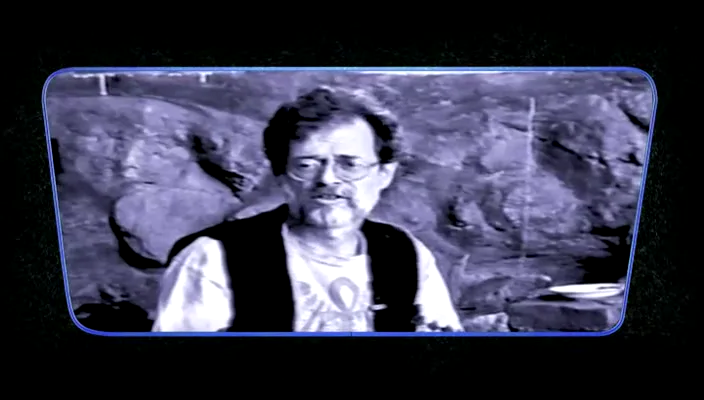

mike kawitzky's 2009 documentary. some twenty thinkers, framed by terence mckenna's archive recordings, on five questions about evolution, consciousness, god, science and death.