Taxonomy of Illusion
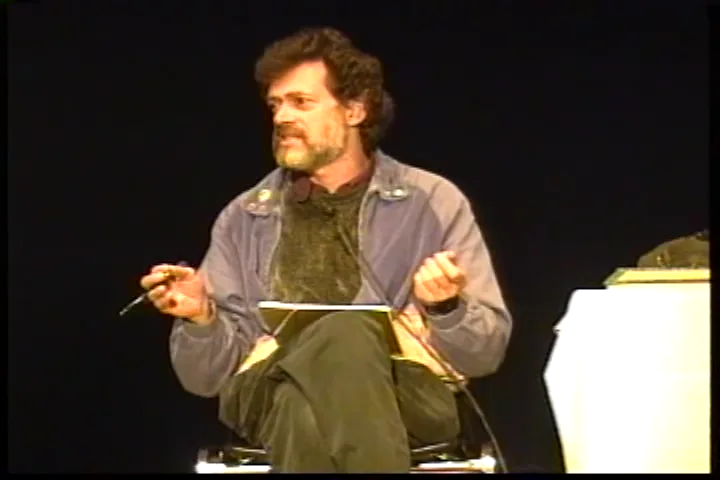
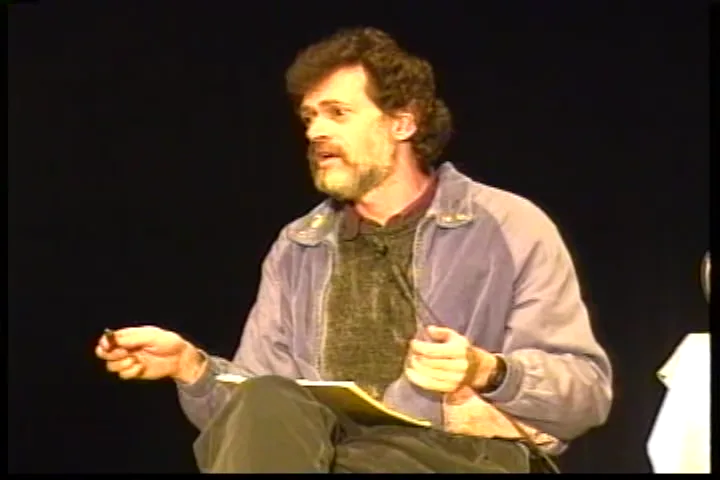
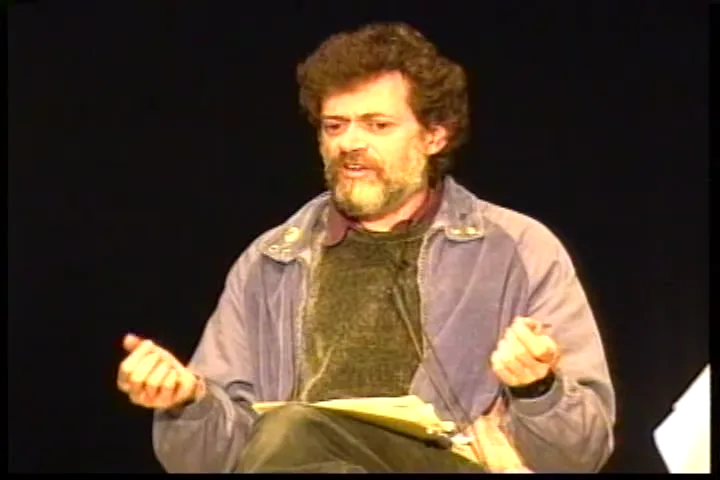
This is McKenna's 1993 return to UC Berkeley where he presents a framework for categorizing different types of illusions. He explores the relationship between the self and reality, drawing on Nabokov's Pale Fire and discussing how psychedelics might pierce cultural and linguistic illusions. The talk builds toward a taxonomy of illusion styles including hyperseeing, non-seeing and mis-seeing to examine the foundations of Western ontological thinking. Attachments below.
transcriptmachine-transcribed, unedited
So in the 1960s, our speaker, Terrence, was a student, like many of you, at UC Berkeley,
and he left in the middle of things to go on a tour around the world for seven years
that ended in the deepest Amazon basin,
where he had an experience that has determined his life in the 20 years following,
and which is the subject of his latest book, True Hallucinations.
So now in this historic moment, after all this time,
Terrence will ascend the platform of the University of California for the first time.
What I thought I would talk about when I was approached to do this,
the pressure was to say something new, which is a heart-sinking pressure.
To a warhorse of the lecture circuit, I started out thinking I would never repeat myself
and sometimes wonder if I'll ever have a new idea again.
But what I wanted to talk about this evening was illusions,
and I called the lecture The Taxonomy of Illusion,
because I think it's interesting to attempt to classify,
and relate, the various kinds of illusions that stand between us
and that presupposed, naked, radiant truth
that has more or less driven the engines of Western philosophy since Plato.
Of course, the great victory of modernity is to disabuse ourselves of such naive notions,
but...
they die hard, I think.
Ralph mentioned my latest book,
and I didn't... I don't intend to talk about the book particularly,
but in the book I quote
the only piece of poetry in the whole thing,
not written by me.
I now see that I seem to have lost it.
Oh, no, here it comes up.
But it relates to...
It relates to this on many, many levels,
this question of illusion,
and the relationship of the self to the real,
and where the world falls in that equation,
and the limits of knowledge,
and all that other good psychedelic stuff
that needs to be considered.
The quote is From Pale Fire by Vladimir Nabokov,
and if you don't know this book,
you should.
It is without doubt one of the funniest books
in the English language,
and it takes the form of a very long poem,
and then the commentary upon this poem.
The poem is written by a character
that Nabokov creates named John Shade,
and the part that I wanted to call to your attention
this evening runs like this.
That rare phenomenon,
the iridule,
when beautiful and strange
in a bright sky above a mountain range,
one opal cloudlet in an oval form
reflects the rainbow of a thunderstorm
which in a distant valley has been staged,
for we are most artistically caged.
Now, this is a very strange piece of poetry,
this is not like even Wallace Stevens at his most obscure.
In the first place, this word, the iridule,
you won't find this word in any dictionary,
and yet I sensed that this is obviously the word
for this phenomenon.
I know what he's talking about.
I have seen this,
this opal cloudlet in an oval form,
which reflects the rainbow of a thunderstorm
in a distant place.
We're here, we're in the realm of mirage,
and nature as mirage,
and nature as mirrored labyrinth.
And then the final point,
and I'll go through all this in the course of talking to you,
but the final line about being, our time is now,
being artistically caged.
This is, I think,
where the psychedelics come in,
because psychedelics allow one to pierce
beyond the veil of cultural illusion,
beyond the linguistic momentum of what has been handed on,
what has been handed on.
And the faith of Tantra and magic and psychedelics
is that the apparent intransigent appearance of the world
can somehow be overcome by an act of magic.
I used to collect Tibetan tankas,
and the texts which go with some of these tankas,
I remember one in particular, which, coming out of, you know,
coming out of the Tibetan,
the translation was, all things being reversed,
the great Hla, the great God, appears instantly.
You see, the precondition for magic
is the reversal of causality somehow.
And as moderns, we have grown
to give great credence, I think, to the idea that the world is,
largely a linguistic structure,
largely created through the participation of the observer.
But we have not been able to take that perception
and turn it into a technology.
Instead, we are still driven by the blind momentum
of atomic structure.
Who was it who said the atoms blindly run?
And then I think it was Whitehead who said,
yes, but within the body,
they blindly run according to the body's plan.
You see, what I think we're dealing with are patterns,
and then the indeterminate dimensions between patterns.
And it's in those indeterminate places,
within the interstices of reality,
that the observer is able to establish him or herself,
and then model back the world.
The reason I wanted to talk about a taxonomy of illusion
was because I thought it was important to relate
the various styles of hyperseeing, non-seeing,
and mis-seeing together.
Because I think that the heuristic consequences
of doing that are to realize just how shifting the sands are
upon which the ontological edifice of Western thinking rests.
I mean, that's always the point, you see,
to deconstruct Western civilization,
because Western civilization,
the toxic consequences are now clear for everyone to see.
So the first, the first category or grand family of illusions,
which we would put into our taxonomic key,
would be social illusions.
And when I, and you know, later we can argue this,
but at this point in the, in the discussion,
illusion is slash delusion.
So the great social illusions, delusions,
and consumerism as my clinical framework,
other than orderly expectations,
and sense of должен of the spatial sense,
that's why we're called Targeting despair.
People resist this citation of trust,
and when they're Probably timestassed aboutN
they call them these Irakles' throughbecue delusions.
Well understood.
are sexism, racism, xenophobia, egoism, classism.
The world is riddled and ruled by these social illusions,
and no one is free of them.
And so they constitute one broad category.
I might just mention as an aside
a book which was very influential on me,
and I never heard anybody else ever mention it,
was a book by Rockcliffe called
Illusions and Delusions of the Supernatural and the Occult.
This was a 19th century book which I, as a kid, got in a Dover reprint.
And it was in a wonderful era where the study of anomalies was still young,
and so this book had everything poured in together,
from mesmerism, ectoplasm, to people who had tumors that they carried around in wheelbarrows,
to birds that did advanced arithmetic, so forth and so on.
And it was a very, very much from the point of view of Victorian rationalism.
And it also mentioned psychedelics.
It was what it really was, was a category of edges.
And,
or a catalogue of edges, I'm sorry.
And it's only then in the subsequent 40, 35 years
that that Wunderkammerer approach to illusion,
and I assume you all know what I mean by that.
I mean, I'm referring to the era before the rise of Linnaean natural science,
when naturalists would simply fill cabinets,
with anomalous, fascinating, and strange objects.
So the tarantulas might be mixed in with the chambered nautiluses,
which might be stirred into the Zuni fetishes,
which might be next to the something else.
Then later, these Wunderkammerers,
these curiosity cabinets, as we would call them in English,
gave way to Linnaean taxonomy.
In the same way, over the past hundred years,
I think the study of illusion and anomaly
has attempted to rationalize itself.
Spatial illusions are an entirely different family
of illusory phenomena.
And we all have encountered at some level, I imagine,
the specially constructed environments that occur
in behavioral,
psychological psychology labs,
that trick you into thinking that the person in the foreground
is smaller than the person in the background,
and so forth and so on.
These kinds of illusions are probably fairly trivial,
except that they address perception.
And when we get to psychedelics as a source of illusion,
this is more important.
Another of the great family of illusions are,
in thinking about them, I call them ontological illusions,
illusions of states of being,
which may or may not, in fact, be reflected in reality.
UFOs, Bigfoot, crop circles,
the entire panoply of poltergeist,
and this sort of thing.
Ontological illusions.
And these are very interesting.
I mean, one could give time to this alone,
because there are persistent ontological illusions
in the human sensorium,
such as angels, elves, demons,
jinns, aphrites, nixies, and sprites, that crowd.
And there are ontological illusions,
such as angels, elves, demons, jinns, aphrites, nixies, and sprites, that crowd.
And there are ontological illusions
that seem somehow tied to the evolving modalities
of the group mind.
UFOs are an obvious example.
I mean, aside from the fact that people
have occasionally seen strange things in the sky,
the UFO archetype really emerges in the late 40s
with the Rainier lights.
And then a whole set,
a whole set of taxonomic features
of this particular brand of illusion coalesce.
The silvery discs, the alien denizens with the cat eyes
and the rubbery flesh,
those same guys who give you
unscheduled proctological examinations
in the middle of the night.
But notice that,
that particular taxonomic feature
has been added recently
through the assiduously careful scientific research
of Streber and company.
So these things are in a,
well, a cattle mutilation is an interesting one,
very confined in time and space.
The crop circle thing similarly.
It's not that,
there aren't crop circles,
but that what we have is essentially a pattern
in an English wheat field,
but then radiating out from that are the illusions
of those who cast their gaze upon it.
Those who proclaim it,
telluric communication or particle beam research
carried on by the air force,
version it was supposed it was supposed that a particular crop circle had been
decoded found to be a lost Sumerian language which when decoded said
basically don't stop here it was essentially a no parking zone for time
machines they were saying you know this entire century just to maintain speed
and you know do not. Psychedelic illusions again this is a related
category but different from these ontological illusions by illusion I mean
that these are confrontations with phenomena and apparently subjective
things that the world is manifesting.ings with phenomena and apparently subjective
ground and an assumed rational observer, where then there is a more than ordinary amount of
ambiguity. I mean, most of reality is illusory. It's just that we do each other the courtesy
of not pointing this out. Actually, you trace a very thin data path through the world, and
most of what we assume without question, we have very little evidence for. I mean, something as
simple as, well, like that Mount Everest is the highest mountain in the world. Well, first of all,
very few people have ever seen it. I saw it, and because I saw it from a distance of about 500
miles, it looked quite small. And my own testimony as to whether it was the highest
mountain in the world or not, I don't know. I don't know. I don't know. I don't know.
It would be fairly unreliable. And besides, what does that mean anyhow, and how the hell do you
figure it out? I mean, here we have one mountain in the Himalayas and another in Bolivia,
and you're telling me you know which is the higher mountain? It must rest on a whole bunch
of weird and fishy assumptions resting on even shakier data. And that's just the question of
the highest mountain in the world, give or leave.
Leave alone the state of your lover's heart, or your banker's for that matter. What's important
about the psychedelic family of illusions is that they propel the entire issue of illusion
to center stage, because they demonstrate that the assumed bedrock of quote-unquote ordinary
perception is in fact...
No bedrock at all. It's simply a very soft dwell point somewhere in the mysteries of
metabolism. And the consciousness, whatever its relationship to the brain, is spectacularly
affected by the perturbation of the physical brain by endogenously introduced...
pseudo-neurotransmitters of some sort. And to my mind, this is very interesting. Alexander Shulgin
has secured in his work that you can take a molecule that is completely inactive, and by
moving one atom to a different place on the ring, you can change this into an active compound. Now,
it seems to me you could hardly...
have a neater demonstration of the quantum mechanical foundation of consciousness, because you've
moved one atom, and you've moved the mountains of mind 500 miles from where they were resting when
last you looked. It's quite spectacular. And it argues then that mind...
Which, strangely enough, the materialists always claimed this. They just put different
emphasis on the words. Mind is a kind of iridescence upon metabolism. For the materialists,
that was a dismissal, because to them, what iridescence meant was a tertiary phenomenon, not
inimical to the structure of matter, but necessarily perceived only through the intercession of an
observer. See, that's what iridescence is. It's somehow...
A more fragile part of nature than the rocks, the trees, and the waters, because it's a play between
light and mind. Again, a kind of illusion, a mirage. Now, in a very different category of illusion,
and this is one worth considering, because it's the one we tend not to place in this category, and that is the
illusion of materialism. This has broken down completely. The idea that the material world was real sustained
the investigation of nature from Parmenides to the early years of the 20th century. Virtually the entire history of
human engagement in the abstract intellectual modeling of matter, the idea that the material world was real,
matter was assumed to be pretty much as presented in perception. Solid, enduring, having simple location,
meaning it stays where you put it, and when you look there again, it's there, that sort of thing.
Now, one of the best kept dirty secrets of western civilization is that the cause of the
core science, which is physics, the science which was always the envy of all the other sciences
for its mathematical formalism and its incredible predictive ability, because it's not unusual in
physics to predict from theory an experimental result to the third or fourth decimal. This is
spectacular congruence between theory and experiment. You don't get that in the social
sciences, or even in physical, need I mention, even in physical chemistry. However, the investigation
of matter has now been pushed to such extremes that matter has shed its easily recognized,
and familiar face, and has become something much slipperier, much more dependent on the presence of
the observer, much less easily located in space and time, something much more of the nature of
thought than of the familiar conception of matter. This word has not reached even as far as biology,
yet. The biologists are still laboring under the notion of the reality of physical material. If any of you
read this book that was published last year with much to do called Consciousness Explained, actually it
should have been called Consciousness Explained Away, here was an effort to drag out all the old material
of science and explain away consciousness. The problem is, matter itself has taken on the qualities of mind,
and as this realization relativizes the life sciences, I think there is going to be a new interest in the
potential for psychedelics to elucidate the potential for psychedelics to elucidate the potential for psychedelics to elucidate
mental functioning, because what will become respectable, you see, is talk of the observer. This is what has invaded
physics, the most rarefied and formal of all the sciences, had in order to make sense of its enterprise, allow the
observer a kind of primacy with the thing observed. As this seeps into the life sciences and psychology,
hopefully, it will be possible to make sense of the thing observed. If any of you read this book, I think there is going to be a
the phobia of actually involving yourself in your field of study that informs all these reductionist
ratomorphic types in the schools of psychology will be overturned. Well, having flayed that dead horse
sufficiently, another category of illusion that needs to be
addressed, I think, is
How would one call it? Well, basically a
philosophical
illusion or
philosophical slash religious
illusion. This is the idea
that by a direct appeal to intuition, we can somehow gain a
foothold on truth. I think this is as specious as
the notion that we can gain a foothold on truth
through reason or experiment.
This foothold on truth idea may have to be given up.
I'm sure some of you have heard me recall
the situation where Wittgenstein was raving about something
and one of his students said, but is it the truth? And he said, well, it's true enough.
And this really means a great divide has been crossed when you can say that because it means you
understand now that you are no longer a
fairy in a platonic
super world, but that you are actually a monkey with a brain full of mush trying to sort out
you know, what's right in front of you. True enough
is what we should probably rest with.
And
you know,
illusions abound.
One, for instance, I was speaking of these religious
ontologies. I was talking to someone recently who
amazed me because I've always thought of them as a person of great intelligence, but who would never be
acclaimed from the arms of Mother Church.
And we had dinner last week and he said, I realized it finally comes down to
do you believe the universe is being run by the ghost of a Galilean
politician? And he said, you know, put that way, I realized that it wasn't.
Other
religious myths are less easily undone, I think.
Monotheism has an appealing
philosophical neatness, but it leads
apparently to
coliterectomy. So, you know, you want to watch that.
This
search for philosophical neatness may make for strange bedfellows.
And of course, Buddhism. I love the illusion of Buddhism.
It's the illusion that illusion can be transcended.
And
again,
not really doing
genuflection to the animal nature.
It's amazing to me. I mean, if you were to meet a termite
who stated that his or her
goal in life was the perfect modeling of the cosmos, you would think it was quite a comic,
a comic undertaking, and yet how different are we that we should presume
to more than a shadow of
a shadow of the truth. Well then, finally, or I don't know finally, but completing my laundry list here,
linguistic truth or the truth of
language and the illusions that language weaves. Because
someone quite intelligent said
language was invented so that people could lie.
In other words, it gives you that fudge factor of
obfuscation, where someone says,
you know, why did you do that?
Well, the best approach is, I didn't do that.
You know, you thought I did that. What you thought you saw, you didn't see. In other words, I suppose that
lawyers are probably the people who have done the finest work with language, and
behind them
politicians, and the true
potential for language to elevate and to unite
the community was early on betrayed into the production of
illusory ideological goods, which could then be marketed among the people and
to spread confusion.
Psychedelics reflect on this because psychedelics stretch and pull and melt and
and recast the illusion-producing machinery of language.
I mean, I think that if you had to say the one thing
that psychedelics do for everyone,
whether they have a good trip or a bad trip,
because it's up to them to interpret what they make of this,
is it shows you the relativity of your cultural viewpoint.
You know, that it's just your point of view.
You inherited it from a geographical area,
a culture, a set of parents.
It has no relationship whatsoever to anything anchored
in some kind of metaphysical super space.
It's just your cultural point of view.
And travel actually does the same thing.
And I've always felt there was a weird affinity
between psychedelics and travel.
And I suppose,
many people have,
or we wouldn't call it a trip,
and we wouldn't call it a journey.
But travel shows you the relativity of culture.
And what's really happening when you travel, you see,
is you're moving from one language domain to another.
We don't think of it that way,
but that is in fact what is happening.
You can never see the Amazon jungle
if you
keep intact
the bubble of linguistic assumptions
of the place you started out from.
Every place will withhold its secrets from you.
I learned this in the Amazon
because the first time I went,
I had virtually no botany.
And to me, the jungle was green.
That's what it was.
And it was many shades of green,
and it was beautiful,
and it was this and that,
but it was basically green.
The second time I went,
I was with a lot of botanists,
and within days, you know,
you learn the families.
That's how they do it.
With the same taxonomy I'm here applying to illusion
was really developed to describe plants and animals.
So you learn the families,
the plants with square stems,
the plants with the opposed leaves,
the plants with the particular flower structure.
Once you know families, then you have a linguistic wedge in.
But the corrupting or curious thing about language
is that like all tools, it shapes its user
in ways that are not suspected until it's too late.
So for instance, the way in which Western civilization
is totally obsessed with the subject-object relationship,
you know, and it's the basis of our science,
our polity, our relations to commerce,
the concept of product, all of these things
come out of the subject-object relationship,
which is an aspect of language.
So I point all this out because
in talking about my new book,
somebody said that I had gone too far.
And I was amused because it implied from what, you know?
It's not like there is a King's X
where gray beards in white coats tend
the sacred vestal fire.
They're like the fires of reality.
There is no reality.
There are only people who know this
and people who don't know this
and are therefore being manipulated
by the people who do know it.
This is true, or true enough.
And, you know, one of the things
that has amazed me with my own personal career,
because I started out basically shoveling snow
in a cow town in Colorado,
and by fate or who knows what,
come to the present position,
and what I notice as I traverse levels
on a supposed ladder of success,
where you would expect there to be more and more competition
and people and activity,
actually it gets emptier and emptier.
There is nobody minding the store as far as I can tell.
This is why I'm so unsympathetic to conspiracy theory.
We could use a few conspiracies.
Nobody is minding the store.
Everybody is getting rich.
Personally rich.
And so they don't have time to advance the Aryan race
or the Council of Zion or any of this fantasy
and illusion that haunts the world of conspiracy theory.
Rather it seems everything is being left
pretty much to develop on its own,
because people are afraid to grab or touch
the levers and buttons in the control room
of the historical vehicle.
And what that means then,
is that people who can cut through
these many, many illusions,
the illusion of materialism,
the illusion of business as usual,
the illusion of benevolent institutions carefully guiding us
to reasonable destinies.
If you cut through all that,
if you disabuse yourself of all that,
you will empower yourself to eventually be able to stand up
in delicate social and political situations
and just say, bullshit.
That's bullshit.
And this is worth considering doing,
simply because we have an imperiled planet
on our hands.
We have been, for a long, long time,
the victims of illusion.
Western civilization, Stefan Daedalus was right.
History is a nightmare from which one must awaken.
Quite literally.
I mean, we have been blind to what we have been doing.
We are blind at this moment to what we are doing.
If in a single moment the actual nature of our predictions
were to fully make itself felt in the mind of any one of us,
I think it would be paralyzing.
It would be horrifying.
We have waited until the last moment of the last hour.
The house is burning down around us,
and we rouse ourselves from the stupor of materialism,
the stupor of Christianity and scientism,
the stupor of male dominance, sexism and racism.
If we don't rouse ourselves from this stupor,
the momentum toward extinction is now practically irreversible.
You know, the Grateful Dead like to sing that song,
we need a miracle every day.
We certainly do.
And so then that brings me back to my original point.
That outside the then of culture lies an unmapped terra incognito,
as vast as the new world was to the old in the 15th century,
as vast as outer space appears to us now.
The new world outside of culture
is a world that can be conquered through vision and language.
And, you know, many of you have sat through my recitations
of what it's like to smoke DMT.
Many of you I'm sure are familiar with the medieval woodcut
of the guy sticking his head through the cogs and wheels
of the cosmic machinery to observe a new world outside.
The message here is,
and it's more than a message,
it's a message if you just come to events like this
and then go back to studying cost accounting,
it's an experience, if you will,
but avail yourselves of these tools,
the experiences of the discovery of a new world.
A new world as real as any world that we know.
It's not going to come from Time magazine
or the Secretary General of the United Nations
or anybody like that.
It isn't that the world is tired and played out
and that all frontiers have been explored.
Every culture could support that viewpoint
within certain classes and in certain situations.
But, in fact, it has never been true
and it isn't true now.
We are monkeys
and monkeys love a hell of a good fight
and we have a hell of a fight bearing down on us
because we have to clean up the mess.
We're not going to go silently
into the gentle night of extinction.
It's just not going to happen that way.
Creativity,
creativity is going to be unleashed.
Struggle is going to be an unavoidable part
of trying to steer this battleship away
from the cataracts of history
in which we are now caught.
I believe that there is a tremendous obligation
upon the privileged classes
of the high-tech industrial democracies,
and I dare say that includes everyone in this room,
a tremendous obligation
to attempt to deconstruct the bomb
that we have inherited.
That is literally our situation.
The gift from the past,
from the 19th century,
from the 1940s,
from the psychology of Nixon and Johnson and that crowd
is a ticking bomb.
Except that it's a planet.
And it's the greatest challenge to intelligence
that intelligence has ever faced.
And yet it's precisely the kind of challenge
that intelligence should be able to meet.
Because what it requires is
large-scale strategic planning,
implementation of visionary responses.
It is not
it is not incremental.
It's sudden,
complete,
and dramatic.
And I really believe
that there will only be one chance.
You know?
It's, we are circling the runway of post-history.
And the engines are running low.
And there is one approach.
And then, you know, if you miss that approach,
you're into the drink.
Now we can use,
we have the great good fortune
to be approaching the end of a millennium.
Would it be redundant to say
this only happens once in a thousand years?
Yes.
And it's extraordinarily fortunate.
Once I was in England
and I ran into somebody I hadn't seen for 20 years.
And I was amazed.
And I said to Rupert,
how often does one get a chance
to meet someone one hasn't seen for 20 years?
And he said,
well, I dare say,
I suppose every 20 years.
We can use the millennium,
this apparent coincidence of our dilemma
and a calendrical turning point
to create awareness of opportunity.
And we can use the psychedelics
to dissolve boundaries between ourselves,
and other people,
between institutions that govern,
and the governed.
And basically,
we have to insist
on the seriousness of the situation
and the potential for solutions.
And what it means
is a much more radical break
with American society
than we've been willing to contemplate
in the last 20 years.
We went through this thing
with the two-term governor of Arkansas.
And it took a year and a half
to play that all out
and to see what it comes to.
And what it comes to
is Washington is convulsed
over the possibility of closing an air base
near Sacramento.
So how can we even conceive
of this government
making an impact
on the real problems?
It is still government by flim-flam.
And that would be all very well
if we had 500 years
to dig ourselves out of this dilemma.
But if a radical political alternative
is not opened up in this country,
then we are essentially,
I think, going to amuse
and entertain ourselves
into extinction.
The ordinary orthodox system
has failed.
What Bill Clinton exists to prove
at best
is that people of good will
make no difference
in those institutions
because they are compromised
and corrupted
from the very beginning.
It's just the way it is.
Those institutions are set up
for business as usual.
Business as usual at this point
is a death sentence
on the human race.
What has to be done
is a tribalizing of culture,
an ecstaticizing of culture,
a dissolving of hierarchy.
That means self-empowerment
through claiming
the new information technologies,
through deconditioning
from propaganda,
through deconditioning
from the pharma-phobia
that holds everyone
within the pre-programmed molds
that are being handed down
from Madison Avenue in Hollywood.
It means actually realizing
that your life is your own.
Your destiny is your own.
It isn't within the confines
of the culture
because the culture is dissolving.
And to the degree
that the word is put out,
that phenomenon will accelerate.
We are in an extraordinary transition.
Everything that has worked
now doesn't,
meaning global economic systems,
control of the spread
of epidemic disease,
so forth and so on.
All these systems
are breaking down.
And yet the new systems
are not yet in place.
So this is a situation
of extraordinary malleability
and a situation in which
people of great vision
and great ego
can make tremendous impact.
So it's a very dangerous situation.
We saw this
in the 1930s in Germany
and in Europe
where there were all kinds
of potentials,
all kinds of possibilities.
We forget how powerful
a visionary Marxism was
before the rise of fascism.
Movements like Bauhaus
and Dada and Surrealism
all had agendas
which disappeared then
under the rise of fascism.
This must not happen again.
And what it has to do with
is resisting images
that are coming
from the reality studio,
resisting the images
that are coming off the tube,
coming through the newspapers,
and creating a community
based on psychedelics,
sexuality,
sensitivity,
and good sense.
Cultural value
and what good sense will mean
in this situation
is the preservation
of the earth,
the preservation of diversity,
deconditioning from product fetishism,
deconditioning from
energy overconsumption.
All these things we understand,
but we seem to lack
the power to change our minds
or if we have that power,
then the power to change
other people's minds.
And I am into psychedelics
not because I think it's a sure thing,
but because I think it is
the only game in town.
In other words,
it's the only thing I've ever seen
change an individual
on a time scale
similar to the time scale
that we have
if we're going to make a difference.
I've seen over and over again,
I'm sure many of you have,
people go into a psychedelic jerks
and come out halfway decent human beings,
you know,
eight hours later.
If we had 500 years
to steer global society
into safe harbor,
it might be possible to do that,
but we don't.
I mean, I really believe
that we are being asked
to participate
in the birthing
of a new order of being
and that there is reason
for great optimism
and hope
because
it looks like we're just boring in
to solid rock,
but in fact,
there's somebody else boring
through that solid rock
and they have triangulated
our approach
and they are hurrying
to meet us.
I don't think we fell into this situation
because of bad fate
or bad destiny.
This is part of the process.
History is what happens
when an animal species,
an advanced animal,
falls under the influence
of a transformative attractor
of some sort.
History is only about 25,000 years
in duration.
The interesting part
in the last 5,000 years,
what has happened
is that something confounding
has entered the local situation
or was always dormant there
but has stirred to wakefulness
and it is not God,
not the God
that in Milton's wonderful phrase
hung the lamps like stars in heaven.
It isn't that God.
Maybe it's the God of biology,
but whatever it is,
it is to us
as we are to the termite
and what it is doing
is it is casting
an enormous transcendental shadow
back through time
over the epigenetic landscape
of biological becoming
and in our species
for reasons
mysterious to me,
we mirror this thing
and it has swung our compass
away from the forward flow
of genetic theme and variation
and in a course orthogonal
to biology,
a course set
on the transcendental
and it is pulling us
toward it
through the medium
of transforming our languages
through the medium
of the imagination
which is after all
this mysterious mental domain
in which we are whispered to
by angels, demons, gods, ancestors, aliens
and out of that intercourse
culture, self-transforming
shedding its face every hundred years
building on novelty
is ascending toward
a reaching out
toward the unspeakable.
This has been going on
I think
for billions of years.
It has obviously
and incontrovertibly
been going on
since the advent of consciousness
in the human species
and now we're there.
We're in the final domain
of the confrontation
with the secret.
It is impossible to conceive
of history going on
for hundreds of years.
The planet cannot sustain it.
All of these social structures
and institutions
that we have surrounded ourselves with
are obviously lifeboats.
They are not made to last.
They are made to carry us
to a certain point
in the life of
the earth
and we are now there
or we are within
20, 30, 40, 50 years
of confronting
the transcendental object
at the end of time
that drew us out
of the animal body.
History is the proof
and the shockwave
of the eschaton.
This is a hard thing
for secular audiences
to wrap their minds around
because they're familiar
with hearing this
from rattlesnake-handling christers.
But that's simply because
religion has always been
the repository
of the irrational intuition.
It never said
that the irrational intuition
is ipso facto false.
It becomes a travesty
when hung with the trappings
of dogma
derived through the scholarly
revelation of weasels.
But the intuition,
the intuition is pristine
and the intuition of
Islam, Judaism, Christianity
and cults innumerable
is that there is a finiteness
to the historical experience.
And then the more staid
the ontology,
the further into the future
they put it,
so they can continue
trading real estate
for the next little while.
I think that it is now possible
to extrapolate the curves
that describe our degradation
of the planet,
the spread of epidemic diseases,
the ozone hole,
the extraction of metals,
the clearing of the rainforest,
the rise of population,
the spread of toxic compounds,
so forth,
to see,
to convince yourself
even from a rational point of view,
that history is a self-limiting process.
Well, if you're a rationalist,
then you must conclude
we're just headed for extinction.
I would think then
the rational response
to that logical process
would be to get your ass in gear
and try and avert the extinction.
And if you're not a rationalist,
then the conclusion you draw
from all that is
that we are within striking distance
of merging
with the mysterious hyperspatial source
of our intelligence,
and that somehow this is
a planetary birthing,
something as scripted
as the breakup of Pangea
or the movement of glaciers
south from the pole.
It's just part of the process.
Culture exists
to transform mind
out of the domain of matter.
We are rising toward
the rarefaction of ourselves
into the transcendental plasmid body
of alchemical and Buddhist preoccupation.
This is what is calling us
out of matter.
It's what called
the monkeys out of animal organization.
It's what calls technology
out of the restless hands
of the hominids.
And it is what is calling all of us
toward a kind of fusion
with the community,
with the psychedelic totality
of the species,
and with the larger Gaian totality
of the planet.
This is what it all went for.
This is the promise
and the redemption of history.
Without this redemption,
then history becomes
the abortion
that materialists fear it is.
This is why the legitimate path
to the transcendental,
the linking of the individual
with the transcendental
through psychedelics,
now becomes
the most important political work
that can be done
in the light
of the rising awareness
of the end of history.
Thank you very much.
All of you who stayed
the intrepid core.
I'll just go through these.
I've not had any chance
to look at them,
and handwriting is also degraded
here at the end of the world,
so it's a little hard
to sort out some of this.
What role does an individual
psychedelic experience play
in the massive changes
that you're anticipating?
It would seem to me,
well, my model
for the psychedelic experience,
there have been a number of them.
The idea that it mimics madness,
that was one idea.
That it takes you into the Jungian unconscious,
that was one notion.
That it somehow illuminates
the concepts of Indian yoga
or after-death models,
such as the Tibetan Book of the Dead.
All of these have been tried.
My assumption
has been a mathematical one.
That what psychedelics are about
is that mind,
under the pressure
of evolutionary constraints,
turns itself into a threat detection device.
And that's how we use it
in three-dimensional space,
to anticipate threat
and to meet it.
But that is, as it were,
a lower-order application of mind,
and that in silent darkness,
what happens on psychedelics
is that the mind unfolds
literally into a kind of super space
or a higher dimension
in the mathematical sense.
Because I take seriously
the claims made
in all times and places
for millennia
that shamans can locate lost objects,
predict weather,
see where the game has gone,
and predict the outcome
of disease situations.
In all cases,
what is involved
is a higher-dimensional relationship
to the manifold of history.
So I think that,
you know, you all understand
that a locked box,
if we had a padlocked box here on stage,
a locked box is not locked in hyperspace.
It has a,
a dimension in hyperspace
from which the contents of the locked box
are easily removed,
taken out,
and put back.
In our world,
this looks like magic.
Shamanism is like this.
And so,
to answer the question,
what role does an individual psychedelic experience play
in the massive changes anticipated?
The role is
that the individual gets in on the joke.
At this stage in history,
to be a shaman
is to have seen the end.
And if you've seen the end,
it's like, you know,
taking Anna Karenina
and reading the last five pages.
And then as you make your way
through this bewildering morass of material,
you do have the faith
that it's all going to end up
as you discerned.
So that's the political act.
You see,
terror of the future
is one of the weapons
by which the rationalists
are holding everybody in line.
Terror of the future
can be put out to pasture
through psychedelic shamanism.
Okay.
It seems mushrooms for the masses
is not really what you advocate.
Mushrooms for the masses
doesn't sound like such a terrible idea.
I mean,
I always equivocate by saying,
you know,
if your problem
is maintaining boundaries,
then you probably shouldn't take any psychedelics.
But in a mature civilization,
you know,
you don't define opportunities
based on what will be detrimental
to a small minority.
Mushrooms for the masses
seems to me
a fine idea.
I just don't see
how it can ever come about
because I believe
that the society-shaping effects
of these things
are so powerful
that they will never be tolerated.
Just to go off on a tangent for a moment,
this is why I am an incredibly pessimistic person
about getting pot legalized.
Because as far as I can tell,
the argument now
in favor of legalizing cannabis
is that it ain't no big deal.
So why not legalize it?
The problem is it is a big deal.
You know,
you just have to bake it into some banana bread
and you'll find out what a deal it is.
So,
you know,
and if you read the 19th century accounts
like Fitzhugh Ludlow,
the hashish eater,
people like that,
it's perfectly clear
that it can reach
LSD levels of intensity
if you eat it.
And the question,
you know,
if pot were judged
on its social impact
or, you know,
its lack of addiction,
its lack of detriment to health,
it would have been legal
a long time ago.
But it subtly erodes
commitment to dominator values
in ways that are absolutely intolerable
to dominator institutions.
I mean, they'll let gays in the military
before they'll legalize pot.
That's how threatened they are by pot.
Well, let's see here.
Recently you appeared on talk radio
with L.A. police chief Daryl Gates.
What was the inside story
and do you feel you were heard by him?
Well, yes,
I won't give this too much time.
He did appear with Daryl Gates
on his radio show.
Clearly, they're desperate
to raise ratings.
They'll do almost anything
at this point.
And Daryl Gates was a pussycat,
very easily intimidated by,
I mean, I make no great claims
in this area,
but intelligence.
He completely folded
in the presence of, you know,
academic calm, big words,
citation, that sort of thing.
What is the difference
between your vision
of the end of history
and the Christian belief in a savior?
This is a great question.
My, well, it's complicated.
The way I think
of this transcendental object
at the end of time
is on this level,
for purposes of metaphor,
it's like those mirrored ball bars
that they hang in discos,
you know,
that spins and sends out scintillations
of light all over the walls,
ceiling, and floor of the room.
The transcendental object
at the end of time,
and I like that image
because alchemists used to tell me
to talk about
what they called the scintilla,
which is simply Latin for spark.
So the transcendental object
at the end of time
sends off scintillas,
sparks which are like reflections
of its essence,
but necessarily distorted.
Well, then ranged all around
this transcendental object
and at greater and lesser distances
are all the people
who have ever lived.
And if you are a Buddha,
a Christ, a Mohammed,
a guru, somebody or other,
and you are,
what that means is
that you have been struck
by a scintilla of reflection
from the transcendental object.
And so you, as it were,
have assimilated its essence
into your being,
and now you must act it out.
And I would bet you
that if you could step into the mind
of a Christ on the road to Calvary
or a Buddha preaching at Sarnath,
what you would discover going on
in the personal part of the mind
is the question,
why me?
Why me?
And the answer is,
you just are dumb lucky,
that's all.
You know, you just happen to be standing
in the right place at the right time,
and there is nothing special about you.
You just have a hit of the stuff.
And then the other part of the question,
the problem with all these religions,
and it affects flying saucer cults,
and it affects occult schools of magic,
and everywhere,
is people claim to know too much.
They are not willing to live
in the light of ignorance
and in the absence of closure.
So, you know, my God,
you go to these UFO conferences,
and, you know, you've got the people
talking to the Polybians
in booth one.
Next to them, people are talking
to Commander Zamo
of the Antares system.
And then number three,
something else.
No cognitive dissonance
between these groups.
They all have coffee together
and are dating heavily,
and it doesn't ever seem
to enter anybody's mind
that this is a little odd.
In occult stuff, you know,
you say, what's that?
And they say, well,
that's the 11th amethystine ray
that was brought by the great white fathers
of the 11th lodge
who came from the galactic center
at the fall of Atlantis
and established the...
You say, how the hell
do you know all this stuff?
You know?
I mean, nobody knows anything.
And Christianity,
the anticipation of the end of the world
and the exegesis of revelations
that has been worked out
based on the visions of John of Athos,
you know, it's a good try,
but it's not a paint-by-numbers script
for the unfolding of the world by any means.
When the transcendental object
at the end of time finally reveals
its quintessence among us,
all prophecies will be fulfilled.
All religious ontologies
will find themselves somehow vindicated
and somehow humbled in the same moment
because they were, in fact,
in Wordsworth's wonderful phrase,
intimations of immortality.
But you don't need to rely
on these sanctioned intimations of immortality.
You can have your own
simply by taking five grams
in silent darkness on an empty stomach
after you've unplugged the phones
on a Saturday night in your apartment.
The real research into the nature of the eschaton
is done one-on-one
above five grams.
See here.
I once heard you talk about an experiment
your brother undertook
where he was raving for three weeks,
but you never explained what the experiment involved.
What was it?
Well, what a wonderful opportunity.
True hallucinations.
I never talked about this,
even often to very dear friends of mine.
I mean, there are people who've known me for 20 years
who I never told this story to
because I think it takes as long to tell
as it takes to read this book.
You know, that wonderful scene
in Wells' Time Machine
when he comes back to his gentleman's club
and he says,
gentlemen, this is no tale to be told
over greasy plates.
Well, similarly with this.
So I didn't also want to make it the basis
for my public career
because this is real...
I almost said nutty stuff.
It's...
I generally disbelieve
in violations of physical law
and miracles.
But I did actually,
in the course, I'm 46,
I have seen three or four
in my lifetime.
And each time it's absolutely
astonishing.
Whole worlds of possible questions
are instantly answered.
And I wrote this book
to inspire people
to follow our method.
Which is, our method is
the rational but stoned mind
in confrontation with the obscure.
Seek ye the obscure.
You know?
If a book is not at least 100 years old,
don't read it.
If a country has more than one international airport,
don't visit it.
If a village has more than one outboard motor,
don't stay.
And just keep pushing and pushing and pushing
because out there at the edges
are the edges.
There are edges because nobody goes there.
Because the unsanctioned is hidden there.
You know?
That's where the shamans are.
And the mad people.
And the sexual experimentalists.
And the aesthetic experimentalists.
That really is the method.
Not belief.
Belief is a toxic and dangerous attitude
toward reality, I think.
After all, if it's there,
it doesn't require your belief.
And if it's not there,
why should you believe in it?
It doesn't make a whole lot of sense.
By eliminating money
and the separateness that it causes,
could the world be saved
by sharing the resources and the work
and eliminating all the unnecessary waste of energy
and needless competition and consumption?
Well, I'm not sure how money could be eliminated.
See, I'm a funny person.
I vacillate between...
I have a very strong impulse
toward political action
and save the world
and round up the miscreants
and set things right.
That's part of my thing.
But I also have this incredibly evolved sense
that it's a done deal.
That it's okay.
That the main task is a certain alertness
and attention to one's comrades
and that it will all unfold
through the intercession
of the transcendental object at the end of time.
People say this is a contradiction.
Fine, it's a contradiction.
I mean, what are we doing here anyway?
Is life supposed to be simple?
But I preface that by saying
one time somebody in a group like this
challenged me and said,
you're always talking about the peril of the planet
and one thing and another.
Why don't you ask the mushroom
how to save the planet?
And so then I thought that was kind of a facetious
and challenging thing to propose.
But the next time I found myself
capable of asking the question,
I did.
And the mushroom hesitated
and now I pass this on to you
as pure fungal hearsay
on the networks.
I said to the mushroom,
so how can we save the world?
And it hesitated roughly a third of a second
and said every woman should bear
only one natural child.
I thought about this for a long time
before I ever publicly mentioned it to anyone.
And I realized, you see,
I think that what is destroying us
are two things.
Number one,
an uncontrolled rise in population
that wipes out every good intention,
every social program,
every expansion of agriculture
succumbs to expanded population.
This is destroying us.
The other thing that is destroying us
is that we are not properly utilizing
the intelligence, talent,
and so forth of half of our population.
The female half
of the population.
Now, people say
that we must, you know,
women must be promoted
to professional positions
and power positions
and of course this is true
and I agree,
but what is really holding women back
is that they spend a staggering amount
of their creative life span
raising children.
And
if every woman were to bear
only one natural child,
the population of the planet
would fall by 50%
in 40 years
without wars,
epidemic diseases,
it would just naturally fall in half.
Now, I don't think very many people
have ever considered
this possibility.
We tend to think that our problems
are insoluble.
They are not insoluble.
Furthermore,
it turns out,
and here's news nobody likes to hear,
a woman who,
a child born to a woman
in Santa Cruz
compared to a child born to a woman
in Bangladesh,
that child will use between
800 and a thousand times
more resources
than the Bangladeshi child
in its lifetime.
So, where do we preach population control?
The third world.
Because that's where all the people are.
But that's not the problem.
People are not the problem.
Incredible consumption
by some people
is the problem.
It would be possible
to imagine a world
where governmental institutions
or whoever's running things
could go to women
and say,
how would you like to have
vastly increased leisure time?
How would you like to have
an increased expendable
income?
And how would you like to have
genuine status
as a hero
in the struggle
to save the planet?
If women were to have
only one natural child,
women would very naturally
come into an enormous
empowerment.
No one,
no institution
could deny it to them.
And interestingly enough,
this is not a plan
where men,
who have always been
the planners
and the managers of plans,
play much of a role at all.
Well, I just pass that off
in case you don't want
to put your trust
in the transcendental object
at the end of the world,
then the most politically
conscious thing
apparently from the mushroom's
point of view
that you could do
is encourage
those kinds of policies
and that kind of attitude.
Are there unnatural children?
Oh dear,
still carrying a grudge?
Leave it.
Leave it to Saddam.
No,
that is not true.
That's what I've always put out.
The fact of the matter is
in 1800,
the average American woman
gave birth
times
in the course of her lifetime.
The two-child family
is a genuflection
to the industrial revolution.
No traditional culture
on this planet
ever advocated
the two-child family.
It's a convenience
that allows factories to run
and jobs to be filled
and in fact,
as the father
of two children,
I would argue
that the two-child family,
what happens
is the children mirror
the tension
between the parents
in a way that happens
in no other configuration
of parent-child relationship.
So I would actually argue
that the so-called family values
that these right-wingers
are constantly
dinging us to preserve
are in fact
values created
to support the agenda
of the industrial revolution,
which means global capitalism.
And they have nothing to do
with archaic values,
which are enormous families,
not nuclear families,
but extended families
living communally.
That's the traditional model
and if you're not ready
to go back to that,
then one woman, one child
is as good as anything else
in my humble opinion.
Let's see here.
You mentioned earlier this evening
that psychedelics played a role
in human evolution.
How so?
Thank you for not groaning,
those of you who have heard me
explain this 18 times.
Because it may be my only crack
at getting into the history books,
it seems to me clear,
well, it seems to everybody
who looks at the question clear,
that the theory of evolution
is handed a tremendous dilemma
when it comes to human evolution.
A planet of groundhogs,
hummingbirds, and slime molds
poses no problem
to Darwinian evolution
as modified by molecular genetics.
We pose a problem,
specifically our brain,
and it's doubling in size
in less than two days.
It's very difficult
for the theory of evolution
to explain,
and it's a particular embarrassment
because that's the organ
which generated
the theory of evolution.
So it's like a real rip
in the sail
of the galleon of evolution.
I believe, and everyone believes,
that there must have been
extraordinary selective pressures
of a unique sort
upon our own
early ancestors
to have produced the human brain
in such a short amount of time.
And I think that the answer,
and I don't want to go into it
in detail tonight,
but briefly here's what it is,
and it explains a lot about
our sexuality and our politics
and so forth.
All primates,
clear back to squirrel monkeys
and like that,
have what are called
dominance hierarchies.
We all know what this means.
It means that the hard-muscled,
long-fanged young males
run roughshod over everybody else.
The women, the children,
homosexuals, the old,
everybody gets their marching orders
from the dominant males.
This is true throughout the primates,
and it is true of us
as we sit here this evening.
That's what's screwing up
our politics and making us,
you know, the situation
with women and so forth and so on,
and it can be argued
to other social problems as well.
I believe that psilocybin,
because it dissolves boundaries,
is uniquely positioned
to mitigate against this tendency
toward male dominance
for a number of reasons.
And when our remote ancestors
moved out of the trees
and into the grasslands,
they encountered these mushrooms.
And I think the great undiscussed frontier
of evolutionary theory
is the effect of mutagens
in foods on human evolution.
We, most animals maintain
a very narrow food menu
to avoid contact with mutagens.
We, when we were forced out
of the arboreal camps,
we became omnivores.
We came under nutritional pressure
and for a long time
we were testing all kinds of foods,
and that would have meant
a very high rate of mutation
through that period
and an acceleration
in natural selection.
And I think that psilocybin,
because it improves visual acuity,
would have given a leg up
to predators and hunter-gathering,
proto-hominids.
And so, in a sense,
there was a period of time,
perhaps as short as 100,000 years,
perhaps as long as a million
or more years,
when male dominance
in our species
was suppressed chemically
by psilocybin in the diet.
It was still there,
hard-wired in the genes,
but chemically suppressed
by an orgiastic religious style
that had everybody taking mushrooms
at the new and full moon
and then having sex in a heap, basically.
This made it impossible for men
to trace lines of male paternity.
That's a consequence
of an orgiastic society.
And a kind of paradise evolved,
and it was during that paradisical interlude
that language, theatre,
altruism, metaphysics,
poetry, dance, religion,
all of the functions
that we equate with unique humanness
evolved under the aegis
of a near symbiosis
with psilocybin, mushrooms.
And then,
and this all was happening in Africa,
then through climatic upheaval,
drying of the African continent,
the mushrooms disappeared
and, God forbid,
the old wiring
reasserted itself.
It must have been hell on earth.
It must have been similar
to what we're living through.
It must have been an era
of incredible brutalization
when people stopped caring
for each other,
people stopped having group sex,
they started fighting over women,
fighting over territory,
bashing each other's brains out,
appointing leaders,
developing weapons.
The entire sick set
of pathological institutions
that leads to our dilemma
was evolved
in the wake of the invention
of agriculture
and the abandonment of nomadism
and so forth and so on.
And this is why I think
we're so funny
on the subject of drugs
because we are literally
the children of a drug.
There wouldn't be human beings
on this planet
had there not been
this hominid mushroom interaction
over a very, very long period of time.
The reason we addict so easily
to so many substances
and the reason people destroy their lives
with various addictions
is we have an itch
that we just can't scratch
and we try everything.
And I maintain
that you'll keep itching
and you'll keep scratching
till you come to this very narrow family
of hallucinogens,
the tryptamine hallucinogens.
Then the itch stops
because you are restored
to the archaic dynamic
in which we created
the most noble social system
that we have ever lived under,
the archaic, nomadic, shamanic,
goddess-worshiping world
of the dawn time.
And history is a fall away from that
exactly as these monotheistic religions insist,
the fall into history.
And I see then
this emergent end of the world
post-history millenarian culture
as an attempt to reconnect
with that archaic,
archaic authenticity
that was the birthplace
of intellect, of poetry,
of beauty, of love,
and of altruism.
Okay.
These are great questions.
I wish I had more time.
Here's one.
Please define intelligence.
Strangely enough,
I was thinking about this today
as I can't even remember why,
but I produced a definition
and it's a kind of a cribbing
from Whitehead.
Whitehead defined understanding
in the following way.
He said understanding
is the apperception of pattern
as such.
That's all.
For instance, in this room
there are many patterns.
Where the men are,
where the women are.
Where the over 40s are,
where the under 40s are.
Where the wealthy and the poor are.
Each of these patterns,
if you can see it,
tells you more about the situation.
And presumably there are
an infinite number
of these informative patterns.
So I would define intelligence
as Whitehead defined understanding.
Intelligence is the apperception
of pattern as such.
And the more of pattern,
of the pattern,
and the more patterns
that you perceive,
the more intelligent you are.
Of course, these patterns
must actually be there.
Otherwise you're delusory
and that's a different issue.
And then I'll do,
I'll do one more here.
Aww.
You don't want,
go fast through them.
What do you think about meditation
as a path to other levels
of consciousness
and understanding so-called reality
as illusion?
I think meditation is a fine thing.
I do it.
I'm not sure what its relation
to the psychedelic experience is.
The best,
this is essentially part
of a larger question,
which is can you get there
on the natch?
And, you know,
the short answer is no.
The fair answer is maybe
in exceptional cases.
Cases so exceptional
that the answer is no.
And the perils I submit to you
are much greater
because what is so wonderful
about the psychedelics
is how democratic they are.
You know,
you don't have to
have enslaved yourself
into some beady-eyed weasel
and his set of precepts,
dietary strictures,
and mantric formulas.
It doesn't work like that.
It isn't handed down
through a human lineage.
I asked the mushroom about this.
I said,
can, you know,
what's the deal
with these other paths
to enlightenment?
And you've got to understand,
this is the mushroom speaking.
But it said,
for one human being
to seek enlightenment
from another
is like one grain of sand
to seek enlightenment
from another.
It is preposterous.
And I like that
because I've never met
anybody whose intelligence
seemed so intimidating
that they deserved
to be followed.
And I dare say
you probably haven't either.
If you've been paying attention.
I mean,
how many,
how many philandering zenies
have to parade before us?
How many cog-youps
with a Budweiser welded
to their good right hand
do we have to encounter
before you get the message?
You know,
these guys are just slime balls
at worst
and lost souls at best.
And you're smarter than they are
by an order of magnitude anyway.
So why waste your time?
Now,
if you want to follow,
if you just can't
tear yourself away
from the concept of following,
then,
you know,
how about Plato,
Heraclitus,
Parmenides,
Plotinus,
Proclus,
you know,
dead guys.
They're much safer.
You know,
they're not going to try
and climb into your wallet
or some delicate porcelain.
of your anatomy.
Plus,
they've been use-tested
in the historical arena
and have been found
to be generally
at least harmless
at worst
and in some cases
actually to be recommended.
So I would say,
you know,
the whole message
of psychedelics
is self-empowerment.
Trust yourself.
Seize the tiller
of your destiny.
It is your life.
It is your body.
It is your mind.
And it's your world
to remake
as you choose
to reshape it.
History has failed.
The past is no guide.
The immediate generations
preceding us
have dealt themselves
into bankruptcy.
Their object fetishism,
their immorality
their ideological excesses,
their tendency
to resort to brutality
and the solution
of every problem
has essentially ruled them
out of play.
They are no longer operable.
And psychedelics,
because they do,
in fact,
enhance, accelerate,
and promote consciousness,
must,
it's not a debate,
must loom large
in the future history
of our species.
Because if consciousness
is not a major part
of the human future,
it is not a human future.
Thank you very, very much.
a 1993 live performance film by terence mckenna with space time continuum on sound, stephen kent on didgeridoo, and rose x on visuals

a 1992 trialogue from the psychedelic salon, with terence mckenna and ralph abraham exploring psychedelics and mathematical vision.