Time and the I Ching
This is a 1988 Thinking Allowed interview where Terence McKenna joins Jeffrey Mishlove to examine the nature of time and its relationship to human consciousness. They discuss divination systems across cultures, Jung's concept of synchronicity, and McKenna's mathematical analysis of the I Ching's King Wen sequence. The conversation explores how the ancient Chinese may have developed a sophisticated theory of time that rivals modern physics.
transcriptmachine-transcribed, unedited
Welcome. I'm Jeffrey Mishlove. Today we're going to examine the nature of time and the
relationship between time and the human mind. With me in the studio is Terence McKenna,
a specialist in shamanistic traditions and also hallucinogens. Terence is the co-author
with his brother Dennis of Psilocybin, the Magic Mushroom Grower's Guide, and also the
Invisible Landscape, Time, Hallucinogens, and the I Ching. In addition, he is the developer
of a computer software program called Time Wave Zero and is the founder of Botanical Dimensions,
a non-profit organization devoted to preserving hallucinogenic plants as used by native peoples
throughout the world. Welcome, Terence. It's a pleasure to be here. It's a pleasure to be with
you again. You know, shamanistic peoples and early peoples throughout the entire world have
all been involved in systems of what we call divination. It could be throwing bones or using
the E.T.
Ching or looking at the entrails of animals or clouds of smoke, but each system seemed
to involve some sort of a unique way of linking the human mind with the very nature of time
itself in order to understand cycles of time and understand perhaps even to predict the
future. Yes, well, it's certainly true that preliterate and aboriginal peoples have had
an obsession with time. However, it's an obsession shared.
By the historical societies as well, time seems to be the dimension about which we have
the greatest anxiety, perhaps because it's the dimension into which we see with the least
clarity. Numerous peoples throughout the world have dealt with this lack of clarity
as far as time is concerned by developing various methods of divination or sortilage, as it's
called.
The Maya, to this day, practice sortilage of a very complicated sort in the highlands
of Guatemala. African peoples have complex divinatory systems.
We don't have to even mention the enormous sales of the E. Ching and pterodacts and astrology
products here in the United States.
Yes, the E. Ching is the divinatory system, ni plus ultra. It seems to very
early have captured the imagination of Western orientalists, James Legge and Richard Wilhelm.
Their translations made it available to the Western world, and the psychologist Carl
Jung, in inventing and discussing the phenomenon that he called synchronicity, popularized
the E. Ching by using it as an example of this particular phenomenon.
And I know in the literature today, especially in transpersonal psychology, there's a lot
of psychotherapists who use the E. Ching as a regular part of their practice.
And parapsychologists have found striking evidence that the coincidences of tossing
the coins in the E. Ching do have psychological validity.
Yes, well, the thing which amazed me about the E. Ching and caused me to become
so deeply involved with it is this fact that it seems to work against all rational expectation
and the carrying out of this random ritualistic activity seems then to give a reading which
is in fact applicable to the unique situation.
Now Jung's explanation of this was what he called acausal connectedness or synchronicity.
This was simply the idea that it was possible for there to be a coincidence of congruence
between an internal state, a psychological state, and an exterior event.
An obvious example of this would be you think of someone you haven't thought of for years
and an hour later in the mail a letter arrives from them.
And Jung was fascinated by these kinds of apparent coordinations of the interiorized
psychic sphere and the exterior three-dimensional objective.
Yeah.
It's a very subjective world.
My approach was, went somewhat deeper than Jung's in that I felt that I had looked at
many divinatory systems with the notion that I was looking at artifacts of culture, productions
of the human mind that were to a large degree arbitrary. My involvement with the E. Ching
led me very slowly.
very slowly and reluctantly to the conclusion
that this was not simply a product of a cultural mentality
or the stance of a particular people in a time and a place,
but rather that the ancient Chinese had somehow
gotten a leg up even on modern physics
and had produced a theory about time
that was in fact objectively possible to correlate
with our own experience.
In other words, a theory of time much more akin
to a physicist's description of it
than a shaman's description of it.
And you mentioned in your introduction
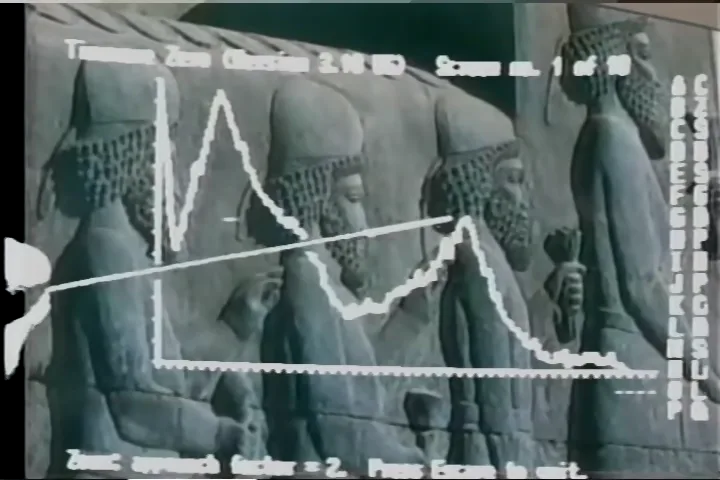
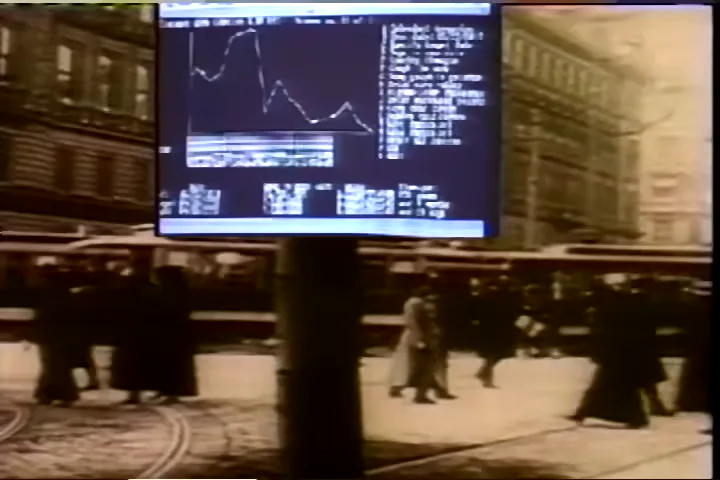
this time wave zero software that we've developed.
What we've done is simply to formalize
the notion of the Tao.
To make a deep study of the mathematics inherent
in the structure of the sequence of the I Ching.
See, most people are quite familiar with the fact
that the I Ching is composed of hexagrams.
Hexagrams have six lines.
They may be broken, they may be unbroken.
Less well known is the fact that there is
a very ancient tradition, even before the Han Dynasty,
of a particular,
a particular sequence being the correct sequence.
It's called the King Wen sequence.
And while it has been agreed upon
by all scholars commenting on the matter
that the King Wen sequence is somehow primary,
no one had ever explained how it was ordered.
You mean the order of hexagrams from one to 64?
That's correct.
Why is the first one the hexagram with all solid lines?
Why is the second one the hexagram with all broken lines?
And so forth and so on.
I carried out an exhaustive mathematical analysis
of the properties of the King Wen sequence
and reached a number of conclusions,
such as it is not a random sequence.
It was very, very carefully constructed
to conserve certain mathematics.
It was very, very carefully constructed to conserve certain mathematical goals.
For instance, the number of lines that break
as you transit from one hexagram to another
is arranged and controlled in such a way
that when you're all done,
you have a ratio of even to odd of three to four.
Yet this is achieved without any breakages,
first order of different breakages of magnitude five.
Yet this is achieved without any breakages, first order of different breakages of magnitude five.
Now you're beginning to lose me a little bit.
Yes, well, what this all means very simply
is that the King Wen sequence
was constructed by minds the equal
of research mathematicians working in the world today.
It sort of reminds me of the builders
of the great Greek temples
who used the mystical rectangle.
Proportion and symmetry seems to be the central concern here.
You see, we have inherited from our fascination
with Eastern philosophy the idea of Dao,
and Dao in the East is a concept
which antedates the introduction of Buddhism into China
by many, many centuries.
Dao is the notion of a flux
which comes and goes,
a transient medium which builds structures up
and pulls them apart
according to its internal dynamic.
Now, because these notions were introduced to the West
by mystics and philosophers
and people with an interest in metaphysics,
it wasn't immediately grasped
that a philosophy of this sort
could be a mathematical formalism,
that if we're talking about a medium
which comes and goes,
we're talking about a wave mechanical phenomenon.
Well, science in the West for the past 150 years
has developed a powerful set of techniques
for dealing with wave phenomena.
And you seem to be suggesting then
that the 64 hexagrams of the I Ching
in their mathematical relationship one to the other
as you go through the sequence describes a wave form.
A wave form which is experienced in the world
by human beings as time and history.
You see, it's almost as though,
in Western science we're pretty confident
that there are approximately 100 elements,
physical elements to matter.
That's right, different atoms.
That's right, that are incommensurable.
They are somehow primary.
The Chinese looked not at the world of matter,
energy and space, but the world of time
and carried out a very rigorous analysis.
Of their own perception and discovered to their amazement
that time is actually composed of elements.
And as we have then, if I can extrapolate
from what you're saying, the periodic table of elements
in Western chemistry which defines not just 100 elements,
but a relationship between them, cycles and patterns.
Bonding relationships, that's right.
Families of chemicals.
So we have, in other words, families of ways of life,
ways of looking at time.
Well, the hexagrams are the elements
in the Chinese physics of time.
They created a science that reinforces primary perceptions
that we all have, but for which we have no science.
For instance, I'm sure you've noticed
that every day is rather like every other day.
Nevertheless, I'm sure you've also noticed
that some days are radically different
than others.
Well, this sameness but different rule
applies on all levels in a temporal hierarchy.
Centuries are rather like each other,
and yet occasionally a century will come along
that is quite anomalous.
We call this sameness and difference nesting fractal.
This is a new branch of mathematics.
And quite simply, what the Chinese discovered,
Mm-hmm.
circa 3000 B.C. was the fractal nature of time,
that the rules of expression of temporal elements
which govern the rise and fall of dynasties
also govern the rise and fall of love affairs and moods.
Now, you're describing this in mathematical terms,
and I'd like to come back and ask you
to define the term fractal in a moment,
but I'm also curious about how you seem
to be going back and forth
between something purely quantitative
and something qualitative.
Well, that's the interesting thing, you see.
The Chinese understood that these temporal elements
were, in a sense, creating interference patterns
with each other, much in the way that pure tones
struck out on a keyboard will, through their interference
with each other, create a melody so that, for instance,
if I find myself sitting in Hadrian's hamburger joint
enjoying a burger, by this theory,
there would actually be a relationship between
that act and the emperor Hadrian's campaigns
in Britain before the fall of the Roman Empire.
This is the amazing thing which James Joyce used
and understood in the construction of his literary works,
that a man leaving his home,
in Dublin on a day in 1905 to buy kidneys to fry for breakfast is in some
mysterious way actually repeating the peregrinations of the hero Odysseus
around the Mediterranean in his campaign to destroy Troy and return to his
faithful wife allegory is what we're talking about but allegory has never
been taken seriously by science analogical reasoning is definitely
de classe in the better laboratories but in this ancient Chinese way of looking
at things everything was caused by its analogical resonances with past and
future events which had the same temporal elements embedded in them now
it's difficult to go into this without resorting
to the theory of the ancient Chinese way of looking at things now it's difficult to go into this without resorting to
at least charts and diagrams if not puzzling equations with sigmas embedded
in them let me step back for a moment because we've been talking very
intensively about the I Ching which is one system a very popular and profound
and highly respected system of this type but there are other comparable systems
for example there's astrology that's right astrology is another one of these
systems that seeks to define pre potent relationships in
nature that can be known by man in order to ease movement into the future the
success of astrology I think is borne out by its persistence it is after all
one of the most persistent of human intellectual tools it was developed four
or five thousand years ago but it I think what troubles modern human
beings about astrology is that it is a mechanistic system it's like a group of
cogs and wheels which all can turn at given rates and therefore their end
states can be predicted but then we're dealing again with the nature of nested
cycles well we have a strong intuition of free will and this is why I think
quantum physics with its probabilistic notion of determinists
has been so attractive to the modern mind my conclusions looking at the Ching
have been that it is not possible to know the future for if it were possible
to know it life would be a determinism and thinking would be divorced from
meaning and we would be out of business but what is possible to know about the
future is levels of knowledge
novelty which future states will fulfill by the happenstance of unpredictable
events now this is a formal way of saying we know where the road goes but
we don't know what the scenery looks like I think where the future is
concerned we can know where the road goes but we cannot know what the what
the scenery will look like people who have looked at my theory have said well
these time maps that your computer draws you're trying to get rid of the
future and as a matter of fact a map of time no more eliminates the future than
a map of South America eliminates the need to go there it simply gives one a
better handle on one's destination now you mentioned quantum physics a moment
ago yes in quantum physics there there are a number of different notions
related to the future one is a notion of multiple universes
another yes and another is a notion of everything is probabilistic and while we
can't know with any certainty what will happen we can state with various
probabilities what what the possibilities are how does this relate
to to your view of the time in the future well I think that at the
macro physical level things are rather rigidly determined with the exception of
living organisms so my interpretation of quantum physics is that the future is
a physical thing the future is simply a
physical thing and not something that doesn't exist and the future is something
that exists and so what it shows us with any kind of a characterization of
what biology is and how it relates to quantum physics and time is really
biological systems are amplifiers of quantum mechanical indeterminacy they are
a way of taking the
is life consciousness and self-reflection.
And you see this described in the I Ching.
Yes, I think the I Ching is an abstract modeling system
for breaking this down to its simplest elements
and then seeing how it works.
Now, we're accustomed to thinking of science
as linear progress from the distant past to the present.
What I'm suggesting is that at least in the matter of time,
the Chinese of the pre-Han period had a much more true
and formally applicable notion of time than we ourselves do.
We have failed in our effort to assimilate time
into our physics because of our obsession with matter
and the release of energy.
Now, there's some scholars who suggest
that the African Yoruba people with their system
of divination called Ifa,
which has a cycle of time,
a cycle, I think, of 244 or 264 various myths and stories,
is even more sophisticated than the I Ching,
which has only 64.
Have you looked into that?
I have looked into it.
What makes the I Ching so powerful in my mind
is that it appears to be an exact analogy
to the mechanism of DNA.
There are 64 codons which code for amino acids.
There are 64 divinations in DNA.
There are 64 hexagrams.
There are 8 primary hexagrams.
There are 8 indispensable amino acids.
I felt that really the I Ching is
like mankind's best shot at this
because it has this reflection in the biological matrix
out of which consciousness emerged.
In other words, the various ancient divinations,
in other words, the various ancient divinations,
In other words, the various ancient divinations,
systems may all reflect a striving of human beings towards this intuitive understanding
of the cyclical nature of time and the relationship between mind and the flow of time, and yet
the I Ching may have just sort of hit the nail on the head better than the others.
Well, it's like looking at a 17th century description of the motion of the planets or
a 20th century description. These are basically refinements. But yes, I think that the I Ching
represents a primary perception of the organization of mind, time, and matter. And I'll even tell
you how I think they got a leg up. I think basically there is a tradition in Central
Asia of the so-called stilling the heart techniques vis-à-vis yoga. These are techniques where
vital functions are suppressed, breathing becomes very minimal, all exterior inputs
are suspended, and eventually I think the Chinese sages who practiced this form of meditation
noticed a flux at the center of the stillness which they called Dao and which they set out
to phenomenologically describe, not knowing whether it was physics or whether it was the
organism or deity? And they did not prejudge this question. They simply gave a phenomenological
description of the transcendental flux that they encountered in states of deep yogic ecstasy.
And lo and behold, it turns out that this is the perfect technique for studying time. Time is not
a phenomenon where you build machines with eight-kilometer diameters that cost trillions
of dollars. Time is a phenomenon to be studied by attending dinner parties, perhaps, or pursuing
love affairs, or watching the passing of the seasons, activities much more commiserate with
our vision of the Taoist sage than the white-coated scientist of the present world religion of science.
So, I think that this is a phenomenon that we need to study.
So, really, I think it was an involvement in organism and in the human experience.
In other words, the laboratory for studying time would not so much be our observatories or our systems of
quartz clocks, but rather looking inside of ourselves, observing our own organism.
That's exactly precise, and the workings of our own psychology. To my mind, the greatest commentator
on time in the 20th century, after Albert Einstein,
would certainly have to be Marcel Proust. Proust understood more about the time we experience
and was able to communicate it than any person who has ever lived. And that's within the
confines of what most people consider a fairly effete, highbrow literary project.
Swan's Way.
Well, the entirety of Remembrance of Things.
Yes.
Well, I haven't read that, so you've got me a bit in the dark.
We have about five minutes left, so could you summarize that point or amplify it a bit?
Well, I think the point we're trying to make here, that I have been involved with over the past few years,
is that a revisioning of time would assuage much of what is called modern anxiety.
And that we have limited the categories we were willing to entertain in dealing with this problem.
And that we must genuflect to the ancient Chinese and take a page from their notebook in this matter.
The I Ching, as a divinatory system of great age, reflecting the dynamics of our own genetic material,
and also, though I didn't mention this this evening, it also has deep calendrical properties,
can be used to keep track of time, lays a basis for an understanding of this
curious phenomenon called synchronicity, the coincidental meshing of interior psychic events and exterior events in the real world.
It lays a basis for us to understand the unity of ourselves with the real world that our present approach makes difficult to discern.
So, whereas Carl Jung, the great Swiss psychiatrist who wrote, incidentally, the preface to Richard Wilhelm's book of the I Ching,
and postulated this theory of synchronicity, well, Jung didn't really provide any mechanism for synchronicity.
He simply said it works this way, that the mind seems to be related to these events,
and he found an enormous therapeutic benefit from that understanding.
What you're suggesting is that the potential mechanism behind the Jungian notion of synchronicity
has to do with the structure of time itself.
That's right.
And you must be suggesting, therefore,
that the human mind has to do with the structure of time itself.
That's right. And you must be suggesting, therefore, that the human mind has to do with the structure of time itself.
And you must be suggesting, therefore, that the human mind has to do with the structure of time itself.
At this very deep level that the sages discovered from stilling their organism,
that the mind has a parallel structure, an isomorphic structure.
That's exactly the central point.
The mind arises out of matter.
This is why the I Ching works in both worlds.
One is the reflection of the other.
The key to healing the apparent dualism lies in studying the temporal mechanics indicated by the I Ching.
And I believe we've done this formally, mathematically.
Terence McKenna, you're taking the provocative position that the I Ching,
which some people view as religion and other people dismiss as superstition,
is actually a science.
And I gather that your computer software package, Time Wave Zero,
proposes to be the demonstration of that.
We believe it does demonstrate it.
Of course, ultimately, it will be up to our colleagues to judge the worth of our case.
Terence, it's been a pleasure.
Thank you very much for being with me.
Well, it's been a pleasure to be here, Geoffrey, and discuss this with you.
It's not an easy subject, believe me.
And thank you very much for being with us.
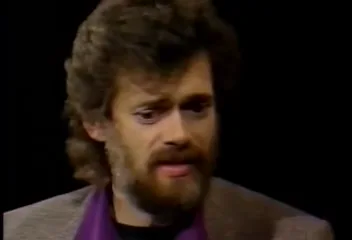
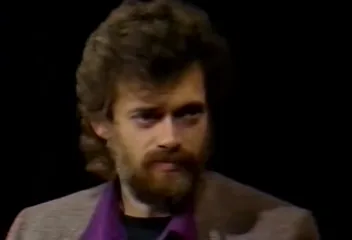
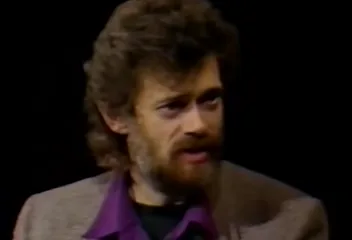
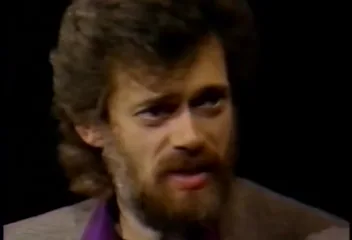
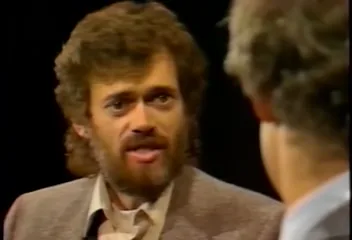
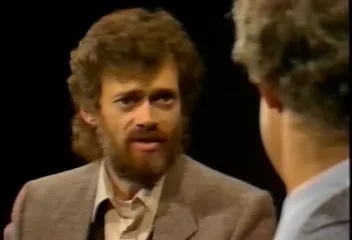
a 1988 episode of Thinking Allowed, interview with Terence McKenna on hallucinogens and their role in human culture.
terence mckenna's 1987 talk proposes ufo phenomena as a psychedelic monitoring mechanism arising from the collective human psyche when society develops in pathological directions
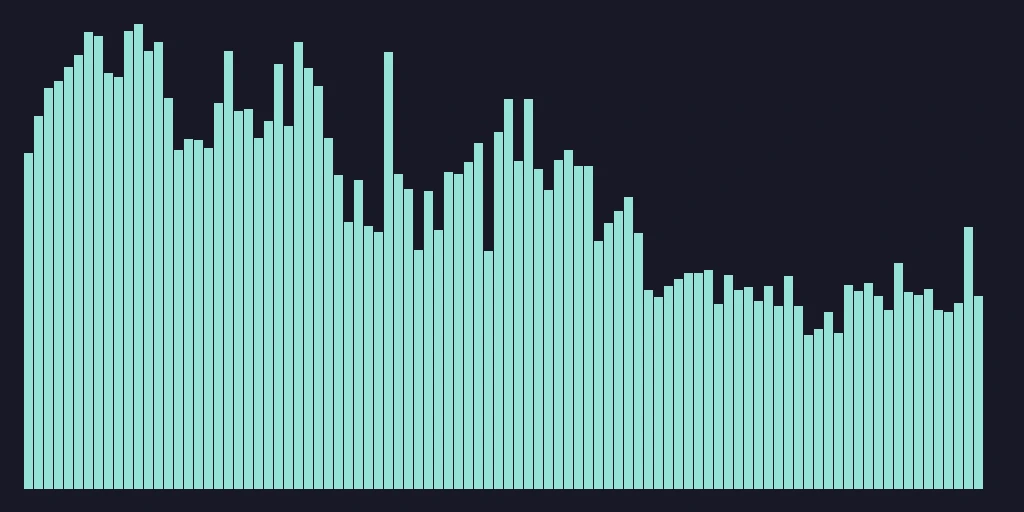
terence mckenna explains his timewave zero theory derived from the king wen sequence of the i ching proposing that time has a fractal structure with novelty increasing toward 2012
john hazard interviews terence mckenna in hawaii in october 1998, an hour on novelty theory, the omega point, and the i ching as a map of dna
terence mckenna at ojai foundation in april 1985. three recorded sessions presenting his research into the i ching's mathematical structure and his theory of accelerating novelty t