Trialogue 1989

Recorded at Esalen in September 1989, these conversations bring together Terence McKenna, Rupert Sheldrake, and Ralph Abraham in a systematic exploration of fundamental questions about nature and consciousness. Sheldrake initiates the dialogue by proposing that if the universe itself is evolving, then the laws of nature must evolve as well, challenging the assumption of eternal mathematical laws inherited from Newton. The discussion unfolds across the central paradox of modern science: the conflict between a worldview of permanence (static matter and unchanging laws) and an evolutionary cosmology (the Big Bang and developing life). Rather than treating these as incompatible, the three thinkers explore whether nature might operate through evolving habits or principles, and what this means for consciousness, creation, and our understanding of reality. The series captures the birth of conversations that would reshape each participant's later contributions to philosophy of science and consciousness studies.
transcriptmachine-transcribed, unedited
Greetings from Cyberdelic Space.
This is Lorenzo, and I'm your host here in the Psychedelic Salon.
I know some of you who've been with us here in the salon for a while are probably shocked
that I actually am getting my third podcast out this week, particularly since I've been
saying for months that I was going to attempt to be more regular and frequent with these
programs.
But since coming into all of this new material that Ralph Abraham gave me, I feel obligated
to get it all online as soon as I can.
At the end of this program, I'll tell you what's in store for next week, but first I
know you're probably as anxious as I am to hear today's show.
In the last podcast, you heard Terence McKenna, Ralph Abraham, and Rupert Sheldrake introduce
themselves and explain their concept for these trilogues.
In today's program, I'm going to play the first side of the first tape in the series of
conversations that took place at Esalen beginning in September 1989.
And as near as I can tell, this series of ten cassette tapes that I'm going to be playing
are in the order in which the trilogues were actually held, first over several days in 1989
and then again in September of 1990.
And since each tape is about 90 minutes long, so I'm going to present one side of a tape
per podcast.
And that should be just about the right length for those of you who are listening to these
programs during your daily commute to work.
I like the idea of you guys listening to these programs on your way to work, by the way.
Who knows what kind of subversive thoughts we'll be riding around with you during the
day when one of these talks really resonates with you.
So, let's get on with today's mind candy.
Today's trilogues begins with Rupert Sheldrake speculating that if the universe is evolving,
then the laws of nature are evolving as well, which leads Terence McKenna to ask where these
laws of nature were before the Big Bang.
And as you can tell, these guys aren't afraid to take on a few of the big questions that
us lesser mortals sometimes shy away from.
So, let's join them now, shall we?
We decided that Rupert would kick off this morning, and so he shall.
So, Terence, I want to start by explaining what I think the problem is that we're discussing,
because I think if we try and summarize it and get it clearer, it should be easier to see
how we're trying to bring together the idea of creation and imagination.
So, let me explain to everybody what I think the problem is as well.
Well, there's a crisis in science at the moment, a profound crisis, which is going to change
science as we know it.
And the reason why the crisis is so profound is that two of the most fundamental models of
reality that the West has ever known, these two fundamental models are both within science
and they're now in tremendous conflict.
They've come into head-on collision.
And this means that shockwaves are going through the world of science.
The existing worldview of science is an unstable combination of two great plates of theory,
like continental plates crashing into each other.
And where they meet, there are going to be major theoretical earthquakes and disruptions
and volcanoes of speculation.
The two models are concerned with the very basic nature of reality.
One of these says that the basic nature of reality is permanent, that there's an unchanging
permanence underlying everything that we know, see, experience, feel, and so on.
And in classical mechanistic physics, Newtonian physics, that permanence is seen as a
two-fold.
First of all, there's the permanence of the laws of nature, the eternal mathematical laws
of nature, considered by Newton and Descartes to be ideas in the mind of God, God being a
mathematician.
This is a very popular and recurrently popular idea among mathematicians, the idea that God
is a mathematician.
And it was a view that strongly appealed to them, and their image of God was as a kind
of a Christian God, but with a kind of Platonic or Pythagorean mind, containing essentially
the mathematical laws of nature.
So that was one source of permanence, permanent mathematical laws.
The other source of permanence were the permanent atoms of which matter was supposed to be composed.
All material objects were supposed to be made of atoms which were permanent.
And these atoms were in movement.
They combined and permutated.
And our own bodies and everything we see around us would be permutations and movements of those
atoms.
Those were permanent too.
And the movement that they were taking part in was also permanent, a constant amount of
motion.
And these permanences were summed up in the principles of conservation of matter and energy.
The total amount of matter is always the same.
Total amount of energy is always the same.
Nothing really changes in the realm of matter and energy at the most fundamental level.
Nor do the laws of nature change.
Well, that's the permanent view of nature, which has been the basis of physics and of chemistry.
And to a large extent, it still is the basis of physical and chemical thinking.
The other view is the evolutionary view, which comes to us from the Judeo-Christian part
of our cultural heritage.
And in that view, the original part in the Bible is there's one thing that does change
in time, in history, and that's humanity.
According to the biblical account, human beings are undergoing a kind of evolutionary process
from Adam through the patriarchs, well, first Noah, then the patriarchs, then the history
of the people of Israel, then the movement from Egypt through the wilderness to the promised land,
then the subsequent history of the prophets and the kings, then the coming of the Messiah.
This was a process in history which showed a kind of progressive unfolding development,
but it was confined to the human spiritual realm.
In the 17th century, this idea was secularized in the notion of progress through science and
technology.
By the end of the 18th century, the idea of human progress was a dominant idea in Europe.
By the 19th century, human progressive evolution or development was now seen as part of a progressive
evolution of all life, through the theory of biological evolution.
And right up in this century, only in 1966, did physicists finally abandon their eternal
or static cosmology and come to an evolutionary conception of the universe.
So with the Big Bang, the whole universe is now seen to be evolutionary.
This is a very recent revolution in science, and it totally changes our worldview, because
the most fundamental thing in science is its cosmology, its basic model of the cosmos.
And our cosmology has changed now from the static, permanent, or cyclical view of the universe
to one which is evolutionary.
Now, if nature is evolutionary, if all of nature is evolving, what about the eternal laws of nature,
which scientists have taken for granted for so many centuries, concepts going right back
to Pythagoras and the ancient Greeks?
Were all the laws of nature there before the Big Bang?
Well, if they were there before the Big Bang, where could they possibly be?
There was nowhere to be.
There was no universe.
So if the laws of nature were all there before the Big Bang, then they must be idea, non-physical,
idea-like entities dwelling in some kind of permanent mathematical mind, be that thought of
as the mind of God or just the mind of a kind of disembodied mathematician, they were thought
to be permanent and all there before the universe.
This assumption is still held by most of our modern cosmologists.
It's something that physicists have not yet begun to question seriously.
But as you can see, it's like an idea that's had the carpet taken from under it.
It's sort of hanging over an abyss.
Because there's no real reason why we should assume the laws of nature are permanent in an evolving universe.
If the universe is evolving, then the laws of nature could be evolving as well.
And in fact, the very idea of the laws of nature may not be appropriate.
It may be better to think of the habits of nature evolving.
The Big Bang is like the cracking of the cosmic egg.
That's its mythological correlate.
The notion of the ancient mythological idea of the cosmos beginning through the hatching or the cracking of an egg,
followed by the growth of the organism that comes out.
It's an embryological metaphor.
And we now have a kind of developmental model of the whole universe.
It's like a developing organism.
It's not like a machine at all anymore.
The universe is a growing, developing organism,
which is differentiating within itself, forming new forms and patterns.
An evolutionary process that on Earth has given rise to all the forms of animal and plant life,
all the different kinds of microbes, to ourselves,
and to the many and varied forms of human culture.
So the question arises, how does this process happen?
I myself have been working on a theory which I put forward in my two books,
A New Science of Life and The Presence of the Past,
which tries to understand these habits and how the habits of nature can evolve.
What I'm suggesting is that there's a kind of memory inherent in each kind of thing
through what I call its morphic field.
And that this, as time goes on, each kind of thing has a kind of collective memory
of everything that's happened to all previous similar things.
So, for example, when a crystal crystallizes,
the form its crystal takes depends on the way similar crystals have formed in the past.
Things are as they are because they were as they were,
to use Terence's felicitous summary of this theory.
In the realm of animal behavior, the theory says that if animals like rats learn a new trick in one place,
then just because they've learned it, rats of the same breed should be able to learn the same thing more quickly everywhere else.
So you train rats to do something in San Francisco,
and all over the world, rats of that breed should subsequently be able to do it more easily
through a kind of invisible influence, like a collective mind of the rats that's changing or developing.
There's already evidence that these effects actually occur,
and this evidence is summarized in my books.
It leads to the idea also that in human learning,
we all benefit from what other people have learned before.
There's a kind of collective human memory,
an idea very like Jung's idea of the collective unconscious.
So, habits build up,
and what I'm suggesting is that the regularities of nature are habitual.
They develop as habits.
Nature goes along habitually.
New patterns come into being,
but through repetition they become habitual.
The universe is an evolving system of habits.
But obviously, this is only part of the story.
If the universe is an evolving system of habits,
how do new things ever come into being in the first place?
What is the basis of creativity?
Evolution must involve an interplay on this view between habit and creativity,
just as our own lives involve an interplay between habit and creativity.
So, habit, a theory of evolutionary habits,
demands a theory of evolutionary creativity.
And how can we understand the creativity that's given rise to new ideas,
to Beethoven's symphonies,
to theories in science,
to new works of art,
to new forms of culture,
to instincts in birds and animals,
to the forms of flowers and plants and leaves,
to the many kinds of rocks and crystals,
and to all the forms of galactic and stellar and planetary organization?
What kind of creativity could underlie all those processes?
Well, there seem to be two basic answers on the market
within the conventional world views.
One is the materialist view that says
the whole thing is entirely due to blind chance,
that there's nothing but a kind of darkness
of blind material processes going on,
and then by blind chance new things happen.
That's the materialist theory.
And it really says, by saying it's blind chance,
it basically says, don't think about it.
You know, it's chance, there's nothing more that you can say,
so just forget it, you know, take it for granted.
Because there's no reason,
or there's nothing intelligible about it.
It just happens, and there's nothing more you can say.
The other theory is derived from the Platonic traditions
of the Platonic theology,
and says that it all happens because, in a sense,
it was all made up in the mind of God.
Everything that happens, every new form that appears,
corresponds to an eternal archetype,
a kind of eternal idea in the mind of God.
But evolutionary creativity is creativity that keeps on happening.
It goes on as the world goes on.
It's going on now.
It's not something that happened once
in an act of creation at the beginning.
If it's going on now, it may be entirely blind,
but there may be another model for understanding creativity.
The other model for understanding creativity,
I think, is provided by our own imaginations.
Our imaginations are not full of fixed Platonic ideas,
which are always the same, like Platonic minds.
They're ongoing, changing, dynamical processes
with a kind of creative richness that always surprises us.
So, the question is,
if nature is alive rather than dead,
if the universe, if the earth,
have a kind of mind or soul of their own,
if living organisms are, in some sense, mind-like,
or if there's a mind-like process at work in nature,
then, how does this express its creativity?
And so, then the question is,
could this creativity in nature
be a product of the imagination of Gaia,
of the Gaian mind?
Could it be a product of the cosmic imagination?
Could there be a kind of imagination working in nature,
which is similar to our own imaginations?
Could our own imaginations be just one conscious aspect
of an imagination working through the whole natural world,
perhaps unconsciously,
as it works underneath the surface of our dreams,
perhaps sometimes consciously?
And could this ongoing imagination
be the basis of evolutionary creativity in nature,
just as it is in the human realm?
So, those are the questions that I wanted to raise
and ask Terence to follow through on,
because Terence has studied the imagination
more than most of us.
And, in a sense, I regard him as somebody
who has a deep understanding
of the dynamics of the human imagination
and of its wider importance.
Well, certainly I think that the relationship
between creativity and imagination
is the place to focus
if you want to understand
the emergence of form out of chaos.
Of all the arguments that you make
in favor of the theory of morphic resonance,
I think the most powerful one
is this question,
if the laws of nature are eternal,
where were they before the Big Bang?
It seems to me that just defeats
the whole notion of eternal laws of nature,
because you either have to hypothesize
a kind of platonic super space
in which, for reasons presumably unknowable,
these were the laws that were present,
or you have to somehow say
that the laws of nature
came into being complete and entire
at the moment of the Big Bang.
And it's very hard to see
how laws of nature,
such as gene segregation
and that sort of thing,
could exist in the situation
of high-temperature physics
and non-molecular systems
that prevailed at the beginning
of the universe.
So my thinking about
how pattern came to be
in the universe
has sort of taken
all the orthodox positions
and stood them on their head.
And I think that's a useful place to begin.
How would it be,
or is it credible
that perhaps what the universe is
is a kind of system
in which more advanced forms of order
actually influence
previous states of organization?
This is what is emerging
in Ralph Abraham's work
with the chaotic attractors.
They are attractors.
That means that they exert influence
influence on less organized states
and pull them toward
some kind of end state.
And for me,
the key to unlocking
what is going on
with history, creativity,
progressive process
of all sorts
is to place
the state of completion
at the end
but to see it
as a kind of
higher dimensional object
which casts
an enormous
and flickering shadow
over the lower dimensions
of organization
of which this universe
is one.
So that, for instance,
in the human domain
when we look at history
what we see is
an endless series
of anticipations.
The golden age is coming.
The Messiah
is immediately
around the corner.
Great change
is soon to be upon us.
These are
intimations of change.
It's almost as though
the transcendental object
that is the great attractor
in many, many dimensions
throws out images
of itself
which filter down
through these
lower dimensional matrices
and actually are the basis
of the appetition of nature
for greater expression of form,
the appetition of the human soul
for greater immersion in beauty,
the appetition of human history
for greater expression
of complexity.
So, when I think about
these terms
chaos, creativity, imagination
I see them
it's like a three-stroke engine
of some sort.
Each impels
and runs the other
and sets up
a reinforcing cycle
that then stabilizes
organisms,
processes
that are caught up in this
in the phenomenon of being.
The phenomenon of being
is this self-synergizing engine
out of chaos
through creativity
into the imagination
back into chaos
out into creativity
so forth and so on
and it operates
on many levels
simultaneously
so that
the planet
is undergoing
a destiny.
The model
you know
deep time
the time
of geology
was only really discovered
around the turn
of this century
and it is
cosmically
ennobling
to think of
the universe
as a thing
of great age
but I think
that it's time
to put
in place
next to the notion
of deep cosmic time
the notion
of chaotic
sudden
change
cusp
flux
and
sudden
perturbation
because
what deep time
has revealed
as we've pushed
our understanding
of the career
of organic life
back
65 million years
270 million years
what we see
is
tremendous
punctuation
built into
the universe
in the case
of the earth
in the form
of asteroidal
impacts
this thing
which happened
65 million years
ago
nothing larger
than a chicken
walked away
from it
on this planet
so
there's a strange
paradox
where
taking deep
time
seriously
the message
of deep
time
is
you may not
have as much
time
as you thought
that
the universe
is dynamic
capable
of turning
sudden
corners
so then
the imagination
becomes a kind
of beacon
the imagination
is
as it were
a scout
sent ahead
or
a
something
which has
preceded us
into history
and in fact
is a kind
of eschatological
object
it is shedding
influence
the morphogenetic
field
if you wish
if the morphogenetic
field
is not
subject to the
inverse square law
of decreased
influence over
distance
then I
as a layman
don't see
why Rupert
we couldn't
locate it
at the conclusion
of process
because
you know
one of the
things that's
always puzzled
me about
the Big Bang
is
it's
a singularity
this is the
term
physicists
use for it
this means
theory
cannot
predict it
and yet
it is
necessary
to make
everything
which follows
from it
happen
so you just
say
you know
there's no
reason for this
we have no
argument for this
but the rest of
the theory
needs it
so
it's a singularity
and the
immense
improbability
which modern
science rests
on
but cares
not to
discuss
is this
the belief
that the universe
sprang from
nothing
in a single
moment
well
if you can
make that
leap
to believe
that
it's very
hard to see
what you
couldn't
believe
that is
almost
the
limiting
case
of
credulity
I would
think
you know
so in order
to say
of the
phenomenon
I would
propose
a different
idea
that
and I
think
it is
eminently
reasonable
and it
is
that
as
the
complexity
of a
system
increases
so too
does
the likelihood
of its
generating
a singularity
or an
unpredictable
perturbation
so
the
pre
existent
state
of the
universe
I imagine
to be
extremely
simple
an
unflawed
nothingness
in other
words
the least
likely
situation
in which
you would
expect
singularity
to emerge
but now
let's look
at the
other end
of the
historical
continuum
of the
history
of the
universe
let's
look at
the
world
we are
living
in
which
is
full
of
elements
tremendous
gradients
of energy
ranging
from
what's
going on
inside
pulsars
and
quasars
to
what is
going
on
at the
atomic
level
at the
molecular
level
at the
level
of
molecular
polymerization
at the
level
of
membranes
and
gels
at the
level
of
cells
and
organelles
organisms
societies
so forth
and so on
in other
words
the universe
at this
moment
is a
tremendously
complicated
integrated
multi-leveled
dynamic
thing
and every
passing
moment
it becomes
more so
this is
what
evolution
history
compression
of time
what all
these things
are attempting
to indicate
is the
increasing
complexity
of reality
well
then
is it
not
reasonable
to suspect
that
if a
singularity
is necessary
to explain
this universe
that singularity
must emerge
rather near
the end
of the
complexification
process
rather than
its beginning
you see
we simply
have to
reverse
our
preconceptions
about the
flow of
cause and
effect
and then
we get
a great
attractor
that
pulls
all
organization
and structure
toward itself
over several
billion years
and as
the
objects
of its
attraction
grow
closer to
its
proximity
they
somehow
interpenetrate
they
set up
standing
wave
patterns
of interference
new
possible
new
properties
become
emergent
and the
entire
thing
complexifies
well to
my mind
this is
the divine
imagination
this is
what Blake
called it
this is the
only way
I can
conceive of
it
that
Rupert and I
were chatting
last night
in our room
about the
aboriginal
nature of
God
this idea
which is built
into
Whitehead
that
somehow
time
is
the
theater
of
God's
becoming
but it's
also
from the
point of
view
of a
higher
dimensional
manifold
a
kind
of
fit
accompli
and this
is no
contradiction
or if it
is
it's
alright
because in
these realms
of higher
ontology
you're
always
asked
to
avoid
closure
and hold
the notion
of a
coincidencia
positorum
a union
of opposites
the
thing
is
both
what
it
is
and
what
it
is
not
and yet
it somehow
escapes
contradiction
and that's
how
the
open
system
is
maintained
that's
how
the
miracle
of
life
is
possible
so
I
sort
of
think
of
the
divine
imagination
as
the
class
of
all
things
both
possible
and
it's
a kind
of
reverse
platonism
the
attractor
is at
the bottom
of a
very
deep
pit
into
which
all
phenomena
is
cascading
and being
brought
into a
kind
of
compressed
state
this
is
happening
in the
biological
realm
through
the
career
of
the
evolution
of
life
which
paleontological
data
makes
clear
but it's
also
sign
simultaneously happening in the world as we experience it within our culture.
In other words, what we call history.
History is the tracks in the snow left by creativities wandering in the divine imagination.
And if you are a student of theories of history, you know that these tracks in the snow,
what is taught in modern universities these days, is that these tracks in the snow are going nowhere.
The technical term is trendlessly fluctuating.
And we're told that history is this kind of process.
It's trendlessly fluctuating.
It goes here, it goes there.
It's called a random walk in information theory.
It means you just wander around.
Well, it's very interesting.
Now we begin to see through the marvel of the new mathematics that random walks are not random at all.
That a sufficiently long random walk becomes a fractal structure of extraordinary depth and beauty.
So, you see, really what has to happen partially this weekend is for us to see chaos not as something that degrades information
and is somehow the enemy of order, but rather chaos is the birthplace of order.
Chaos is not the problem.
Chaos is the answer.
It's the inability to surrender that is the major cultural problem.
This is because everybody's personality is structured around the male ego.
This tumorous growth that has come upon us since the collapse of the Guilanic worldview that was practiced in the ancient Middle East.
This shift of emphasis from collective tribal values to the me values and away from partnership and toward domination is typical of the resistance of this need to surrender to the imagination.
It amazes me.
I was somewhere recently and two people who I didn't know were sitting at a table next to me in a restaurant.
And one of them was explaining to the other one something about the dynamics of the atmosphere.
And the person to whom it was being explained was very intently trying to understand this complex phenomenon.
And I thought to myself, amazing, these people go at this as though the weather wouldn't happen unless they understood its functioning.
And they place great importance upon it.
We each place great importance upon our own ability to understand reality as though you were an understudy for God or something.
So that if anything happened and they tapped you, you'd be able to say, that's all right, I can handle it, I understand thermodynamics and all this.
No problem.
Well, this is not exactly this abandonment to the partnership life lived in the creative imagination that I had in mind.
And, well, we could go on and on about this, but I hope this has stirred up something in you and we can go forward with it.
Well, I think the, I'm very interested that you start your description of the imagination from the cosmic attractor or the, which sounds to me like a combination of Plato, Thomas Taylor and Teilhard de Chardin.
It's the idea of the omega point and Teilhard de Chardin is the attractor of the whole evolutionary process.
It's all being drawn towards this end point, which is actually very like Aristotle's conception of God too.
He thought that the prime mover of the heavenly spheres as the heavens went round was God.
The heavens were not being pushed by God, they were being pulled by God, who was so attractive that the motion of the heavens was kept eternally, especially in the outer spheres, in very fast rotational movement.
The fast rotation being the closest they could achieve to the divine state of eternal bliss.
And God was the prime mover by pulling the entire cosmic process, by attracting it.
So, I think that this idea of attraction, it has ancient roots.
It's something that in this century has been brought out by Teilhard de Chardin.
I think, actually, we have to have some notion of an attractor for the evolutionary process of the cosmos.
And this has now actually become part of common discussion through the anthropic cosmological principle,
which is the idea of the whole cosmic evolution being, in some sense, designed so that it could give rise to human cosmologists.
This is the conception, this is the form the argument usually takes within cosmology.
The argument is, the cosmos must be such as to have allowed the evolution of carbon-based life on at least one planet,
and then to allow the evolution of human intelligence so that we cosmologists could be around to discuss it.
Well, this, in a sense, is a fairly obvious point to make.
You wouldn't think it was very controversial, but it is,
because it implies that there's some purposive organization in the cosmos that's given rise to cosmologists,
and other people as a kind of by-product.
Well, this is what they're busy talking about in modern cosmology, the anthropic cosmological principle.
If there is an attractor in the evolutionary process, then I think, which I think there must be, I agree with that,
then the question is, how does it work in the process of evolutionary creativity?
One way is to make this attractor a kind of platonic mind in the future,
which is what Terence, you seem to be doing,
making it the old platonic mind containing all possible forms and archetypes somewhere out there in the future,
and then this somehow interacts with what's going on now.
The way I understood it from Terence's description was that there's an ongoing system in the cosmos,
and the world, where we are now, an ongoing system of habits built up through the past,
and what's happened in the past, and habits have a certain density.
I mean, matter is in a sense dense because it's so deeply habitual.
There's a sense in which habits are the basis of the kind of density and the sheer materiality of the natural world,
and its sheer resistance to the imagination,
the fact that everything's so deeply embedded in habit.
And then, left to themselves, of course, habits would just fossilize,
and the whole world would just become intensely, repetitively habitual.
But they can't be left to themselves, because there's other active process going on,
which is the cosmological expansion,
associated with the continued presence of chaos within the universe,
which means that habits are permanently, or all the time, or at least intermittently being disrupted
by unexpected accidents, like asteroids hitting the earth.
Or, as we see in our own lives,
our habits are permanently being disrupted by unexpected accidents.
This creates new conditions, new possibilities,
vacuums where new things can happen.
And somehow, as I understood it,
between this, the needs, the vacuums,
the ongoing crises of the present,
the problems, the tensions,
these then somehow interact with the cosmic attractor,
and it's as if sparks pass between them.
What's the situation or the problems now
attracting to themselves those aspects of the divine mind,
which are appropriate to the present circumstances,
is creating a kind of imaginative penumbra
around what's actually happening,
a whole realm of the imagination related to what's going on,
just as our own imaginations are related to what we're interested in.
Our own dreams reflect our own preoccupations and interests
and drives and hidden motivations.
So the imagination working in that way,
by a kind of spark between this divine mind,
or cosmic attractor,
and the present situation.
Well, that's what I understood you to be saying.
And I think that's all right,
except that I myself find it more interesting to,
instead of say,
everything that can possibly happen is already there,
which is in a sense a way of denying creativity.
It says that creativity is simply the manifest
of a future potentiality or possibility,
which is also at the same time eternal.
Because the future of the cosmos must at least have endured
as long as the cosmos.
And in a sense,
the final unified attractor
is in a sense a reflection
of the primal unified state of the Big Bang.
The two have a symmetrical relationship to them.
They're part of a familiar model of history
in which the end,
in some sense,
reflects the beginning.
Or in which the end,
in some sense,
is the beginning at a higher turn of the spiral,
whichever model one prefers.
But I'm interested in the possibility
that the imagination
isn't all there,
all worked out in potential,
in advance.
But rather that the world
truly is made up as it goes along.
And this is something that,
I think,
in Bergson's book,
Creative Imagination,
he very strongly emphasizes
that evolution implies
ongoing creativity.
And we'll do anything we can
to avoid this notion
because it's so extremely difficult
to conceive of ongoing creativity.
You either have this tendency
to reject the question
and say,
well,
it's ongoing creativity
but it's entirely random
so you can't think about it.
Or,
substitute some kind of
platonic realm for creativity
where it's all there already,
in some sense.
So,
what I'm trying to look at
is a third possibility
where the imagination
really is made up
as it goes along.
And instead of emerging,
as it were,
from the light in the future
or from a kind of platonic mind,
it may emerge from something
much more like
the unconscious mind.
It may come into light
from darkness.
And the formative processes
of the imagination
may not be sparks leaping
from the mind of God,
but rather new forms
welling up
from the womb of chaos.
Well,
it's very interesting
to hear you say this
because I shouldn't have
predicted it.
Let me see
if I can explain why.
It seems to me
the problem revolves
around this notion
of purpose.
Is there one?
Is there not one?
If there is one,
what is it?
Well,
the 19th century science
was at tremendous pains
to eliminate purpose
from all of its model building
in order to make,
once and for all,
a clean break
with the contaminating power
of deism,
essentially.
So that,
for instance,
in evolutionary theory
as it was evolved
in the 19th century,
the stress,
the great breakthrough
for them you see
was that they had
a random process.
They didn't know
that it was mutation
through radiation,
but they called it
sporting
or the production
of variant types,
a random process
and then a second
random process
which was selection
for fitness
to the environment
and you run
these two random processes
head into each other
and out of it
emerges exquisite order,
animals, plants,
ecosystems.
So they said,
you see,
we have no need
for God
or purposes
or divine plans.
We show
that out of
the chaos
of the moment
emerges order
and this tendency
was so strong
in 19th century
and early 20th century
biology
that, for instance,
they sought
to entirely
appropriate
the word
evolution
and it was not
to be used
in any other context.
I had a biologist
once say to me,
if it doesn't
involve genes,
it isn't evolution.
so you cannot
talk about
the evolution
of the novel,
the sonata,
socialism.
It has to involve
genes.
Well,
largely through
the work
of Eric Jansch
who we mentioned
last night,
this was
overthrown.
I don't believe
that everything
is finished
somehow
in some
deterministic sense
at the end
of the cosmos
but I do believe
that
there is
some kind
of intimation
of purpose
that keeps
peregrinations
of processes
through time
from simply
becoming
random walks.
if you believe
that all
of the imagination
is being made
up in the present
then you're
back with
the trendlessly
fluctuating
theorists
of history
because
if none
of it exists
in the future
then there is
no compass
point
upon which
to fix
to guide
the process
forward.
Now I know
you're familiar
with C.H. Waddington's
idea of
creodes
and for me
that's been
the way
to preserve
your intuition
of that
it's all
being made
all at once
and the
my strong
intuition
and I think
the logical
necessity
for this
compass point
in the future
and the way
you do it
is you say
that the
universe
is not
determined
in what
will happen
what will
undergo
what Whitehead
calls the
formality
of occurring
but rather
the universe
is determined
in the way
I mentioned
last night
time is
a topological
manifold
over which
events must
flow
subject to
the constraints
of the
manifold
and I
call the
surface of
the manifold
novelty
and believe
that we
can say
where in
history
great outbreaks
of novelty
occurred and
so forth
but that is
not what's
important for
this argument
what's
important for
this argument
is that
without
knowing
any of
its
content
we can
place
the
novelty
of
novelties
the
novelty
to the
nth
power
of
novelty
we can
place it
at the
end
of the
historical
process
and then
watch it
as
operate
as an
attractor
without
having
any
information
about it
at all
that is
really
of its
essence
which I
think
comes
very
close
still
though
all
this
modern
jargon
has
been
hung
on
to
it
to
neoplatonism
we have
to
maintain
the
unknowability
of
god
hence
the
ultimate
unknowability
of the
imagination
but nevertheless
we have
to grant
it
as
an
attractor
nevertheless
that would
be my
take
on that
well
I mean
it's partly
a question
of
as I
see it
of
what role
one thinks
the attractor
has
I think
that the
cosmic
attractor
as
Tyod de Chardin
conceives it
or as
Aristotle
conceives it
is drawing
things towards
a state
of higher
unity
that's how
you could
express it
so one
could say
there's a
process
that
many possible
states
as can
be
otherwise
why would
there be
so many
forms
of life
so much
variety
in nature
but it
may be
you see
the question
is
are the
new
forms
arising
in the
attractor
or
is the
attractor
simply
attracting
what's
already
a
diversity
of
forms
through
a process
that lies
between
them
as it
were
the
imagination
as much
as I
hate
to leave
this
discussion
right now
our
time is
up
for
today
but
never
fear
next
week
you
will
be
able
to
hear
the
conclusion
of
this
by
the
first
part
of
the
second
tape
which
is
titled
Creativity
and
Chaos
where
you'll
be
joined
I'm
sure
by
Ralph
Abraham
who has
more than
a passing
familiarity
with the
subject
of
chaos
before
the next
two
trialogue
podcasts
though
on
Monday
I
plan
on
presenting
the
talk
that
Myron
Stolroff
gave
at the
100th
birthday
celebration
that was
held
in
Switzerland
for
Dr.
Hoffman
last
January
his talk
is titled
LSD
and the
future
of human
consciousness
and I
think you're
going to
find it
most interesting
before I
go I
want to
thank
Ralph
Abraham
not only
for
participating
in these
trialogues
but also
for
preserving
them on
cassette
tape
and
allowing
me to
podcast
them
thank you
to
Bruce
Dahmer
as
well
for
without
his
efforts
these
tapes
may have
slipped
away
from
us
psychedelic
salon
are
protected
under
the
creative
commons
attribution
non-commercial
sharealike
2.5
license
and if
you have
any
questions
about
any
of
this
you
can
click
on
the
link
at
the
bottom
of
the
psychedelic
salon
web
page
which
may
always
send
them
to
me
in
an
to
lorenzo
at
matrixmasters
dot com
and for
the
music
we are
using
here
each
week
I
want
to
again
thank
Jacques
Cordell
and
Wells
otherwise
known as
Chateul Hayuk
thanks again
guys
and
one
last
great
big
thank you
goes out
this week
to
Chris
Case
one of
our
European
salonners
for
telling me
about
my
RSS
feed
screw up
in the
last
podcast
if
like
Chris
your
machine
downloads
each
new
podcast
shortly
after
I
post
them
then
you
were
probably
disappointed
for the
first
hours
after
I
posted
the
last
show
just
as
I
was
creating
that
feed
there
was
a
bunch
of
confusion
taking
place
here
in
what
I
laughingly
call
my
office
and
I
kind
of
lost
track
where
I
was
in
the
process
that
meant
the
RSS
speed
didn't
have
the
correct
link
to the
program
at least
initially
but fortunately
Chris found
the error
and let me
know so that
I could
fix it
thanks again
Chris
and I'm
sure that
the rest
of our
fellow
psychedelics
owners
appreciate
it
as much
as I
did
and you
can
find
Chris
on the
web
by the
way
at
http
colon
slash
floating
world
web
dot
com
that's
all one
word
floating
world
web
dot
com
it's
a really
cool
site
and
if you're
like me
you'll
probably
find a
lot
there
to keep
your
interest
well
I guess
that's
about
it
for
this
week
I
hope
you
all
have
a lot
of
you
will
be
doing
just
that
so
for
now
this
is
Lorenzo
signing
off
from
cyberdelic
space
be
well
my
friends
greetings
from
cyberdelic
space
this
is
Lorenzo
and I'm
your host
here
in
last
week
with
the
trial
log
between
Terrence
McKenna
Rupert
Sheldrake
and
Ralph
Abraham
while
you
won't
hear
Ralph
on
this
particular
program
which
is
side
B
of
tape
one
in
the
first
series
of
trial
logs
that
were
held
at
Esalen
in
September
of
you
will
be
pleased
to
know
that
Ralph
will
be
joining
in
the
conversation
in
this
particular
trial
log
tape
is
titled
Creativity
and
Imagination
and
in
this
the
second
part
of
that
discussion
we
join
Terrence
and
Rupert
in
their
speculation
that
having
a
psychedelic
experience
is
like
tapping
into
the
guy
in
imagination
but
first
we
forms
from
the
unconscious
and
it's
as
if
there's
a
kind
of
creative
process
like
welling
up
or
boiling
up
of
new
forms
and
incredible
diversity
and
they're
forms
which
are
conditioned
by
memories
of
what
have
gone
before
and
existing
habits
but
they're
forms
which
make
new
syntheses
new
patterns
and
it
could
be
that
if
there's
a
kind
of
unifying
process
working
upon
boiling
up
of
new
forms
that
anything
that
comes
out
above
the
surface
of
the
unconscious
or
the
darkness
or
the
boiling
process
or
the
chaos
has
to
take
on
a
unified
form
to
come
above
that
surface
the
light
into
which
it
comes
is
a
unifying
principle
so
it
which
the
creativity
is
occurring
or
tending
so
in
I
think
in
our
own
case
the
one
model
for
this
is
dreams
that
dreams
involve
the
appearance
of
these
strange
stories
and
narratives
and
symbols
and
images
which
we
don't
create
with
our
conscious
minds
in fact
we
usually
just
forget
the
whole
lot
this
happens
to
each
of
us
nightly
is
usually
just
forgotten
or
disregarded
but
when
we
remember
our
dreams
they're
bizarre
and
unexpected
it
seems
almost
impossible
to
have
an
expected
dream
and
most
of
them
have
a
continuous
element
of
surprise
somewhere
hovering
around
them
and
this
curious
feature
of
dreams
raises
the
question
of
how
they come
from
the
Jungians
would
say
they
come
from
some
structuring
process
in
the
darkness
of
the
collective
unconscious
and
they'd
see
that
as
separate
a
kind
of
imagination
of
matter
or
imagination
of
the
psyche
not
a
kind
of
descent
from
some
higher
world
but
welling
up
from
a
and
so
what
I'm
interested
in
is
that
the
human
imagination
obviously
works
through
dreams
it
works
during
discussions
through
language
through
conversations
through
fantasies
through
novels
through
our
dreams
our aspirations
through
advertising
and it
also is
revealed
through
psychedelics
in a
particularly
extreme
form
now
in what
sense
is this
imagination
that we
actually
know
about
that we
know
about
from
experience
related
to the
imaginative
creative
principle
of
nature
is
Gaia
as it
were
awake
on the
side
that's
in the
sunlight
and
in the
side
the
whole
ecosystems
the
oceans
in some
sense
in a
dream
state
when
dreams
and
spontaneous
images
of what
might be
possible
come to
them
so
is there
a kind
of Gaian
dreaming
and does
it
happen
on the
night
side
of the
planet
so
is the
imagination
as it
were
located
how is
it
rooted
in
cosmic
events
and what
would the
Gaian
mind
feel
like
what
form
would a
Gaian
dream
take
or
what
form
would a
Gaian
psychedelic
experience
take
that's
how I'd
like to
know
how you're
thinking
of it
I think
a Gaian
dream
would be
human
history
that
human
history
perhaps it
isn't that
the planet
sleeps
each
night
but that
perhaps
it's been
sleeping
for
fifty
thousand
years
and
from that
dream
it
would
just
shake
its
head
and
say
my
god
I
don't
know
what
it
was
but
I
hope
it
doesn't
come
back
that
human
history
has
that
quality
I
mean
James
Joyce
should
be
mentioned
here
saying
history
is the
nightmare
from which
I'm
trying
to
awaken
and
the
whole
structure
of
his
novels
the
integrating
of
historical
data
with
daily
newspapers
and
this
sort
of
thing
to
give
reality
the
quality
of
a
dream
I
think
your
mentioning
of
the
psychedelics
is
important
you
said
it
was
an
extreme
and
intense
example
of
this
I
think
that
it's
so
intense
and
extreme
an
example
that
it
argues
strongly
that
the
imagination
is
not
the
human
imagination
while
we may
be able
to
analyze
dreams
and
see
the
acting
out
of
wish
fulfillment
or
repressed
sexual
drives
or
whatever
depending
on
our
theory
of
dreams
the
psychedelic
experience
it's
preposterous
to
attempt
to
analyze
it
in
terms
of
human
motivation
at
its
intense
levels
it
seems
rather
to
say
no
more
about
your
personality
than
that
the
continent
of
Africa
is
making
a
statement
about
your
personality
they
are
in
fact
independent
objects
to
my
mind
the
divine
imagination
or
the
imagination
is
this
the
source
of all
creativity
in our
dreams
in our
psychedelic
experiences
in the
jungles
in the
currents
of the
ocean
in the
organization
of
protozoan
and microbial
life
wherever there
is large
scale
integration
rather than
simply
raw
physics
but
integration
of
laws
of
physics
integration
of
properties
of
membranes
and
electrophoresis
and this
sort of
thing
this is
it is
the
creative
principle
beheld
so
do you
think
then
that in
psychedelic
experiences
you're
actually
tapping
into
tuning
into
or
experiencing
something
of the
Gaian
or the
cosmic
imagination
absolutely
and I
think
that
psychedelic
experiences
and
dreams are only different in degree that they are chemical cousins somehow and
this is why I could see human history as a Gaian dream because I think every
night when you descend into dream you are potentially open to receiving Gaian
corrective tuning of your life state you were the the whole thing is an
enzyme driven process we are like an organ of Gaia we are the organ which binds and
releases energy for read I mean a liver cell doesn't need to understand why it
binds and releases enzymes of the liver we bind and release energy for reasons
perhaps never to be clear to us but which place us firmly within the context
of of the Gaian mind we have been chosen out and this is not something to have
great hubris about I mean indolecetic acid has been chosen out in plant metabolism to
play certain roles we have a role but our role seems to be a major one we are like
a triggering system out of the general background of evolutionary processes
mediated by incoming radiation to the surface of the earth and then natural
selection suddenly we come with an epigenetic capability we write books tell
stories dance sing carve paint these are not genetic processes these are epigenetic
processes and they bind information and express the Gaian mind very well as an
example of how willing I am to introduce or to entertain this idea concretely I've been
talking to a lot of people about ecological crisis and the fate of the world and
this sort of thing well imagine in hindsight the wisdom that we would impute to
Gaia if we were to suddenly realize that what is happening on this planet is that
nature knows that the Sun is going to explode and what we are is a kind of
response to the anticipation of a wounding that fifty thousand five million years ago
the geo heliocentric relationships began to vibrate out of tune and as a
consequence of this a species was called forth that could organize an escape and we
are it in other words we are in a divine play in line with this and what made me
even entertain these ideas is I had a very bizarre experience recently I was in Hawaii
and in our botanical garden there is a very large dead tree and one limb of this tree sticks far out over
the over the land and banisteriopsis copy a large hallucinogenic South American vine is
planted at the at the bottom of this tree and it just has swarmed up this tree and covered it with
greenery but it wouldn't go out onto this one limb that stuck out and I it bothered my sense of
symmetry that this vine would not completely cover this tree and I even thought about trying to climb
up into the tree and thread it out onto this limb to get it to do what I wanted so I was sitting
looking looking at this tree and this situation and actually thinking about it and suddenly the limb
fell it broke off and then I thought and I thought the vine sensed that it was in unstable it would not
not invade this domain that it sensed was structurally unstable well then I said to myself but how could it
what is the mechanism of this sensing of instability and a friend of mine said well perhaps the wind
impacts on weakened wood differently than on unrotted wood and perhaps rhythms in the tree tell it to stay away from
them and then I realized if one plant has that kind of sensitivity to the entering into a domain of danger
what must the ecosystem of this planet be doing in reaction to what we are doing to the planet so it i i see
the reason this relates to the imagination is because i see ourselves in communication with the imagination it is
sending images back into the past to try and direct us away from areas of instability it really is the guy
in mind is a real mind its messages are real messages and our task through discipline psychedelics attention to detail
whatever we have going is to try and extract this message and eliminate ourselves from the message so that
we then can see the face of the other and respond to what i what it wants so it isn't for me a philosophical
problem it's a problem that relates to the politics and action that we take as a collectivity and as
individual just one more reflection on that you see if we tune in through our own imaginations to
the guyan mind which certainly seems to be an attractive idea and i think fits quite well perhaps with
dreams psychedelic experience imagination and so on the question for me is this
we can relate to the guyan imagination let's take that for granted but then how is the guyan
imagination related to the imagination of the solar system and that of the solar system related to
the imagination of the galaxy the imagination of the galaxy to the imagination of the cosmos and
then how is that related to what we could call the imagination of the cosmic attractor, or God the Father, or the cosmic Christ?
Well, I'm not sure that I want to follow you into the cosmic Christ.
For me, the mind of the solar system, I think there should always be some physical stuff to hang these things on.
The Gaian mind is not a problem. The earth teems with life.
A Jovian mind is not a problem, because the complex chemistry, the metallic behavior of gas, ices under pressure,
and all of this stuff seems to me to place enough cards on the table that mind could well emerge in that situation.
Similarly, the oceans of Europa. There are a number of places in the solar system where there's enough complex chemistry
that I can imagine these very large self-reflecting enthelechies to get going over billions of years.
But to move from that to the hypothesis of a continuous hierarchy of minds out to the level of the galactic mind,
you have to ask hard questions. I mean, how long does it take the galactic mind to think a thought?
Does it do it instantaneously via morphogenetic fields? And if so, then what are the transducing and signal sorting filters through which it goes?
If it does it through light, then to say that its thoughts are vaster than empires and more slow is to suggest that they're very high-speed phenomena indeed.
Empires come and go by the thousands before a galactic thought could reach from one side of itself to the other.
But I think that if we're thinking of galactic imaginations in the basis form, one would be all the probabilistic processes and the stars and everything within it.
If the communication is instantaneous, which it may be, or if it isn't, we don't really know because I think a factor which changes everything is the discovery of dark matter,
the fact that 90 to 95, 99% of the matter in the universe is utterly unknown to us.
This recent discovery effectively tells us that the whole cosmos and every material thing in it has a kind of unconscious,
unconscious, a material unconscious, an unknown dark realm which conditions everything that happens, the shapes of the galaxies, their interactions, and what's going on.
But it's utterly unknown to us. And so we've now got a kind of cosmic material unconscious which could play the same role as our own unconsciouses.
And so your search for the basis of the imagination in the known phenomena of physics and the visible realm is certainly an important one.
But the fact is that there's so much more that physics itself is revealed which is there and could be the basis of any number of processes.
Yes, I assume that psychedelics, for instance, somehow change your channel from the evolutionarily important channel,
which is giving traffic reports, weather reports, and stock market reports to a channel which is playing, you know, the classical music of an alien civilization.
In other words, we tend to tune to the channel which has big payback in the immediate world,
but that there are these other channels of the imagination not so tailored for human consumption seems obvious to me.
I think that you're right. I mean, the memories and hence all objects of cognition are not in wetware, the wetware of brains.
It's somehow plucked out of a super space of some sort via very subtle quantum mechanical transductions that go on at the molecular level in the brain.
The divine imagination is the reality behind appearances.
Appearances is simply the local slice of the divine imagination.
But what you want is a kind of map or a global overview.
Well, perhaps we should open this up if people have something they would like to say.
This man leads the world.
Okay, well, of course you've fired every neuron in my brain.
I have a somewhat different view of the problem of the eternal scientific laws.
In my opinion, the question of did these laws exist prior to the Big Bang is a non-question.
It's like the old Zen question of what happens to your fist when you open your hand.
Because in my view, these scientific laws are not objects in space and time.
If they were objects in space and time, of course they could not exist before the Big Bang.
In my view, these scientific laws are linguistic structures that we create, that we choose,
in order to give reasonably good expression to the regularities that we measure in the world,
and which we use for prediction and control purposes.
For example, we have an equation to express the gravity relationship.
And we have placed in that equation to key in the acceleration of the force of gravity.
It's not 32 feet per second per second.
It differs somewhat from that, and it differs depending on where you measure it on the Earth.
And it's even conceivable to imagine that it might change with space and time.
Because it's been going on for so many billions of years now, in Rupert's view,
I'm sure that it would be unlikely to change very much, but it's perfectly possible for it to change.
And the point I want to make is that science provides, in that equation, an opportunity to clue in this different change,
if that change is necessary, for purposes of prediction and control.
I think that the laws of nature can be used for purposes of prediction and control
within the kind of developing evolutionary cosmology that Rupert has expressed in.
All right, well then, yes.
I mean, the thing is that there are two theological views, you see, that are possible about this.
If the laws of nature are linguistic structures outside space and time,
at least in the Judeo-Christian world, the prevailing archetype is the Word of God.
They're the Word of God. They're the Logos, which is the traditional theological view of the laws of nature.
So, then it really comes down to a theological question.
Do we think that the Word of God is a kind of eternally sonorous set of vibrations or linguistic structures
that's somehow permanently there in the permanent mind of a transcendent God?
Or, is the Word of God something that God speaks and, like real words, is a series of processes in time?
Spoken words are not eternally there. They're things that take time to speak.
And the underlying basis of a spoken word is the flow of the spirit or the breath.
So, are the words of God, if we take this Logos model, spoken words that involve a process in time?
Or are they like a sort of encyclopedia that's written words that can be sort of eternal?
No. In my view, they're not. The theological argument is a non-argument to me, because I reject the idea of the mind of God as having a structure in the universe.
Again, I come back to these scientific laws of nature as human formulations created like tools, created like a set of wrenches in our kit bag,
not a part of any eternal structure whatsoever.
But, at the same time, I recognize that certain of these laws that we have created are of such a nature that it would be very hard to conceive of us having a science without them.
Well, I think that there are a couple of issues here.
First of all, what has always given science its tremendous cachet was its ability to produce in the realm of application and technology.
So, I agree with you that these things are like wrenches, but that is not at all satisfying to a philosopher of science who doesn't care about the application, but wants to know, you know, is this or is this not in fact so?
Rupert is suggesting that laws are habits and that habits change over time.
They are incremental.
Therefore, in his view, no law is in fact a law.
It's a tendency or a creeping gradient of some sort.
Now, the argument for this is that we've only been measuring the constants we use to describe the universe.
We've only been measuring them for a hundred years on one planet.
We say that the speed of light is 186,000 miles per second and we've measured it on one planet for a hundred years and we extrapolate this statement to the entire cosmos.
If, in fact, laws are local and invariant, then this is going to be a hard swallow because it makes science no more than a series of localized opinions.
It turns science into folklore.
The thing that, personally, I find a personal discovery of, and I hope it comes from reading outside, is just a realm of pure geometric possibility, of pure form and symmetry.
And this seems to me the underlying Pythagorean or Platonic concept and that it does exist outside of time and that it's some sort of template off of which possibility hangs.
And that what undergoes the formality of actually occurring resonates against this template and also most likely resonates against what has been materially manifested so that it's going through time.
Yes, well, I agree with what you're saying about a template.
I mean, this is this idea of a topology that I want to put out.
Rupert and I were, again, last night after the meeting, talking about the idea of God as a mathematical mind had come up,
and I was saying how much a mathematically-minded God would miss, how impoverished that concept is,
because the primary qualities of experience, which are color, light, tactility, and then even subtler things like, you know, appetition for the past and the future,
and so all of this would be eliminated from the idea of the mathematical God.
In a way, the way I see it is it's almost as though there is a wireframe.
Yes, that the future is almost a kind of mathematical wireframe, and that that's what God, quote-unquote, knows in eternity.
But the whole point of the game is into this wireframe flows the living richness, the perverse creativity, the unpredictability, the perturbations, the interference patterns that create them,
and then the living fact of the felt presence, and then that wave of complexification dies down and leaves in its wake the fossil imprint of its passage, which is memory.
So you have, you know, the wireframe, then the moment of interface of the wireframe with the memory, which is what we call the present, which is absolutely what's happening, the richest part of it,
and then the wake, the shockwave of the eschatological moment of the now, which is just the historical record of its having occurred.
I always think in terms of politics, so I want to weld us into not three disparate points of view, but a movement with a forward thrust.
So I've suggested that what you're witnessing is the birth of geometric compressionism, or morphogenetic compressionism, or psychedelic compressionism,
depending on which one of us is talking, I'm sure you can figure out who is who, but the idea is drawing together that a new phenomenon has been discovered in the universe,
which is its drawing togetherness, its tendency toward cohesion, its tendency to move toward greater and greater states of wholeness, and not incrementally,
incrementally, but in sudden, highly punctuated stages that allow phenomena like history, or the 20th century, to come into being.
These are great leaps forward toward this cohesion that nature pushes toward, and as I said, I don't think that it's millions of years in the future.
I think this millions of years in the future stuff was a very brief phase in scientific discourse, and that as organisms, what we need to come to terms with is the chaos, the turbulence, the turmoil, the ephemerality, and the high-stakes nature of the game.
You know, even if no asteroid strikes the earth, each one of us in this room will die, and so life is guaranteed to be interesting, even if you don't live in one of these epochs when there is asteroid impact or geomagnetic reversal.
Nevertheless, the ultimate challenge is built into the biological script.
We each have our own apocalypse, and so I think we should live life in anticipation of it.
Does this have a gradient mind that you refer to?
Guy in mind.
Oh, Guy in mind.
Guy in mind.
What is that?
Well, it's the notion that, for me, and I'm sure Rupert has a different notion, but for me it's the notion that the Linnaean species are an illusion of the classificatory impulse of the human mind, and that really what we have on this planet are not distinct species, but levels and levels of gene swarming and control.
And that intelligence, creativity is such a positive adaptation for any biological system that possesses it, that I think the planet wouldn't have waited five billion years to allow self-reflecting intelligence in an organism such as ourselves.
I think probably self-reflection arose fairly early in the history of the Earth, and that the Earth is a minded, integrated kind of entity.
How this works is hard for us to model because we've only had the image to guide us for ten years or so, but the planet thinks, it perceives.
Life has a petition for more life and for an extension of itself, and the best strategies are cognitive so that all of these things that we see happening on the planet that we take to be miraculously ordered results of random processes may actually be the result of the creation of a great engine of cognition.
that history is the thought of Gaia, biology is the musings of geology, and so forth and so on, that we have been wrong to claim consciousness as the unique capacity of human beings.
It is in fact a general property of organization.
And the larger the organization, the more conscious it may well be.
So that the, I don't feel man, human beings are set against nature.
I think we occupy a special role in nature, but it's a sanctioned role.
There is no such thing as getting out of control because the control system is so deep and so vast that it's inconceivable.
But what is happening may appear to be out of control because we are not in full connection with what the purpose of all this is.
Yes, let me try and put it a different way, answering the same question about the Gaian mind, because it's obviously one of the things we're interested in talking about here.
So, starting from, just from another, a straightforward starting point, the idea of Gaia, put forward by Lovelock and other scientists, is that the Earth, using the name Mother Earth, Gaia is the Mother Earth of the Greeks, that the whole Earth is a living organism.
And that if the whole Earth is a living organism, and I think in that organism we have to include the Moon as well, because the Moon orbits the Earth, and in some sense sets its rhythms of time and tide, and is part of the Gaian system.
That the Earth is a living organism, that the Earth is a living organism, including the Moon, the atmosphere, all the living things on it, the oceans, and so on, behaves together in a way that has an organic, integrated, holistic quality.
That the Earth is alive, and its life involves some kind of organizing principle.
At that stage, a lot of people then say, well, if the Earth is alive, then in some sense it must be conscious, or in some sense the Earth must have a mind.
And one of the questions I think we're exploring is just in what sense can we think of the Earth as conscious or having a mind?
What might the Gaian mind consist of?
The traditional view of the Earth is that it's an inanimate assembly of a bit of rock hurtling around the Sun, with a thin film of moisture and life on its surface.
But the whole thing is just an inanimate mechanism, with no life, no purpose, no spontaneity, no creativity of its own.
Merely the environment in which other random purposeless processes take place.
That's the standard view.
But if the Earth does have a mind of her own, or a life of her own, a spontaneity of her own, is it entirely unconscious, like our own unconscious minds?
Does it come to consciousness?
Does Gaia have dreams?
Does Gaia have imaginings?
This is, I think, the questions that underlie Terence's use of the phrase, the Gaian mind.
And I think it's a question that's bound to arise.
Millions of people are now talking about Gaia, planet Earth, as a living whole.
And the question, really, one of the questions we're exploring is what kind of mind would this living whole have?
Does this living whole have a mind at all?
Is it just blind instinctive?
If it has a mind, does it have an imagination?
And if so, what kind of imagination does it have?
How much is that imagination colored by mathematical principles or geometrical forms which may permeate the whole universe?
How much of it spontaneously arises on Earth in the evolutionary process?
How much is it related to the cosmic imagination throughout the whole cosmos?
So I think these are the questions it raises, and I think that that's another way of coming to it, just starting with the idea of the Earth as a living organism.
It implies and raises the question of the mind of the Earth, if it has one, or the soul of the Earth.
Some would say that the mind's just another aspect subjectively experienced of the physical changes in the brain.
Others would say it's a kind of shadow or epiphenomenon of the functioning of the brain.
If we take that view of the mind, we would expect the Gaian mind, if it exists, to correspond to some set of complex physical processes going on on Earth.
Well, I think if we wanted to see it that way, we could make a good case for there being a base to the mind.
I'd put the magma of the Earth's core, these flowing currents as some perhaps like the limbus or the hypothalamus,
the sort of long-term driving things with a solid nucleus inside associated with changing magnetic fields and polar reversals every few million years.
And the whole of this being the underground process, virtually unknown to us, which is driving the process of continental drift, Earthquakes.
And, again, I'm going to push us out of this area on the soil.
We're able to push us out and put ourselves in the way, so we're going to push us back to the surface of the surface,
and then, now I'm going to give us the power to the space.
We're going to push us back to the surface.
You're going to push us back to the surface, we're going to push us to the place where we then put the surfaces to the surface,
that we're going to move forward.
It's going to get the surface to our surface, which is CARS?
In the bin, I'll pause as well.
As we've discussed, we're shown up with it, we made this.
It's a little bit ridiculous.
earthquakes, volcanoes, and is actually shaping the morphogenesis of the surface of the earth
through the distribution of the continents. And then there's the Gaian breath, which
is the atmospheric flows of the wind. Then there's the Gaian circulation of the oceans.
There are many of these systems, all of which are indeterminate, all of which are probabilistic,
and all of which could respond to, as it were, kinds of thoughts or impulses of Gaia.
So one can find many ways of thinking about the physical basis for the Gaian mind,
which would also include, in my opinion, the earth's magnetic field, the magnetosphere,
which trails like a great tail on the dark side of the earth, which surrounds the earth,
and which, as it changes and responds and resonates to sunspots, affects the whole patterns of
electromagnetic communication through radio waves. All of this, the field of the earth,
which would, I think, be one of the bases for the Gaian mind. Even the known fields,
the gravitational and the electromagnetic fields, stretch far beyond the surface of the earth.
So all these would be possible bases for the Gaian mind, or bases of its interaction with what's
going on, as well as the actual minds of organisms, animals, and plants. I mean, the Gaian mind may be able
to act directly on these minds through field-like processes. I, myself, would think of the Gaian
mind, and our own minds, as more like field-like processes which interact with our brains. And the Gaian
mind is interacting with living processes, the atmosphere, the earth's core, the magma flows,
the magnetic field. Interacting with them, but not being reducible to them.
I guess my question is really about the relationship to creation and creativity and imagination. Is there a qualitative
aspect to that that is evolutionary? The suggestion I have to bring out is that there could be a kind of evolutionary field-creo,
meaning that there is a pathway that when conscious beings are on a planet, the evolutionary field-creo would
be looking for a kind of an aesthetic, a kind of sensibility. And I would propose a symbiotic relationship
as an example of this. Well, creodes are pathways of change which have endpoints. And for those who've not
been following the literature on creodes, the idea is this, when an embryo develops, for example, a liver,
a group of cells develop into your liver, another group of cells develop into your kidneys, that the pathways of
change they go through are attracted towards an endpoint, which is the mature kidney or the mature liver, that they're drawn
towards that. And this pathway of change drawn towards an endpoint is called a creode. It's considered to be an object
within a morphic or a morphogenetic field. Now, if there's the idea of the cosmic attractor and the idea of an evolutionary creode,
as I understand what you're saying, is that one could say the entire evolutionary process of the Earth, or even of the whole cosmos,
is a kind of creode, and Terence's description of the cosmic attractor would be the end point of the evolutionary creode.
So, in a sense, using the term creode brings us back to that model we were talking about just now.
I was kind of missing listening to this discussion, what the meaning of the creation and the imagination was before.
What is the purpose of this? What is the fulfillment of it?
Yes. Well, I'm not sure I understand all of what you're saying, but in terms of this qualitative thing, which is deepening,
which is the purposefulness of it all, it's interesting when you look at the whole life of the universe and the way processes have evolved,
there is a tendency that has been going on for a very long time that has been accelerated at each step,
and what I call it is language seems to be seeking to decouple itself from matter.
DNA was the first language, and it's a language written at the molecular level,
and it's faithfully physical replicant is made of it, and then that template is used to create proteins,
which are the statements in this language.
Well, that's how all nature does it, except human beings.
And we have this epigenetic capability. We can write books, dance, sculpt, paint, all the things that I mentioned.
Well, then, when you look at the 20th century, the tendency to dance, paint, sculpt, and so forth,
has, through technology, become ever more released from the constraints of matter,
so that now we paint on computer screens, we merge, we sculpt with computers,
we sculpt with light and directions rather than in matter.
So I think that why this is, who can say, but the only thing as complex as organic life is syntax,
and syntax seems to have a life of its own. It is trying to shed the material matrix, which was its basis.
Now this, I'm sure, we don't have time to discuss it now, but perhaps later,
this creates strong reactions in people, because we have a tendency to want things to be folded back into nature.
We don't want this Gnostic ascent to the radiant unspeakable.
But nevertheless, it appears that language, in a kind of hellish marriage with technology,
has given us no way out except a forward escape into the further embodiment of language.
This now is apparently the only way we can keep from destroying the planet,
is by literally going off into the imagination, which is not a dimension of the physics of space and time,
it's actually a syntactical dimension.
So, the integration of media and human beings and creative processes like CAD-CAM and this sort of thing,
seem to me to say, language is shedding the primate body that gave it epigenetic articulation,
in much the same way that language shed the rest of organic nature,
when in one part of itself, it moved off into the potential for linguistic expression
that our biological organization makes possible.
So, for my money, language is on a journey to the eternal imagination through the process of creativity,
having begun in chaos and having a kind of inevitable end in chaos,
more properly, you know, revisioned, re-met, re-understood.
Well, perhaps we should break for lunch, it's after lunch.
Thank you very much. This was very useful, I think.
I hope you enjoy this.
If I remember correctly, the next tape in this series brings in Ralph Abraham,
who will be expanding on the concept of language that Terence just raised.
Although, like many of us psychedelic salonners, I first started listening to these trilogues
in search of a new little soundbite or two from the great bard McKenna,
but I'm really beginning to appreciate why Ralph and Terence think so highly of Rupert.
What an interesting way he has of looking at things.
For example, I've long thought that Gaia was sentient,
but I never actually took that thought to the next level and wondered about Gaia's dreams and imagination.
For me, that adds an entirely new dimension to the way I look at life today.
Now I'm wondering if my life is just another one of Gaia's dreams.
You know, at times it certainly seems weird enough to be somebody's dream,
and I wouldn't be a bit surprised if that was the case for some of you too.
But I guess there's no way we're ever going to know some of these things,
at least not while we're still walking around in these monkey bodies.
But if you're still looking for some more challenging thoughts to get your mind around today,
you might want to check out a podcast that Tim Donovan wrote and told me about.
If you go to webcast.berkeley.edu slash courses, you'll find a list of Berkeley courses that have been podcast.
And among those courses are some by the very talented Dr. David Presti,
who is Berkeley's senior lecturer on neurobiology.
And according to Tim, Dr. Presti presents entheogens in a very fair and perceivably reverent context.
Now I haven't had a chance to listen to one of Dr. Presti's lectures myself just yet,
mainly because I've lost my pod.
I guess that sounds kind of weird, but you know what I mean.
At least I hope so.
Anyway, I plan on listening to some of the lectures from his course number, PSYCH 119,
which is titled Drugs and Human Behavior.
And thank you, Tim, for letting us know about these podcasts.
Another audio file you might be interested in is one that my friend Michael Shields told me about.
Because the URL is a long one, I'll put the link on our podcast page
with the program notes about this podcast, which is number 61 from the Psychedelic Salon, by the way.
And the talk that Michael told me about is by Fred Turner of Stanford University.
And in it, he discusses his new book, which is titled From Counterculture to Cyberculture,
Stuart Brand, The Whole Earth Network, and the Rise of Digital Utopianism.
Here's what Publishers Weekly had to say about this new book.
End of quote.
Less a biography of Brand than a swirl of relationships surrounding him.
The book shows how the ride of the Merry Pranksters and LSD experimentation
led to the early online discussion board, Whole Earth Electronic Link,
the Well, and into the digital utopianism surrounding the hyperlinked World Wide Web.
End quote.
Now, given my renewed interest in the Merry Pranksters,
since meeting some of them just a couple weeks ago,
I'm taking the synchronicity of Michael's pointing out this book to be a sign
that I'd better listen to Turner's commentary and buy a copy of the book myself.
And if any of you have already read it, I'd love to hear what you think about it.
Before I go, I guess I should mention that this and all of the podcasts from the Psychedelic Salon
are protected under the Creative Commons Attribution Non-Commercial Sharealike 2.5 License.
And if you have any questions about that, you can click on the link at the bottom of the Psychedelic Salon web page,
which you can find at matrixmasters.com slash podcasts.
And if you still have questions, you can just send them in an email to Lorenzo at matrixmasters.com.
In a couple of days, I'll get the next trialogue podcast out,
which will be the first side of the second tape in the 1989 to 1990 trialogue series.
And it's titled Creativity and Chaos.
And in that program, among other things, you'll hear Ralph Abraham give a short overview of chaos theory,
why chaos theory is good for you, and his explanation of what mathematics means to him.
In addition to thanking Chatelle Hayuk for the use of their music here in the Psychedelic Salon,
I also want to thank Ralph Abraham for making these tapes available,
and to Bruce Dahmer, without whom we wouldn't be hearing them today.
And for now, this is Lorenzo, signing off from Cyberdelic Space.
Be well, my friends.
Greetings from Cyberdelic Space.
This is Lorenzo, and I'm your host here in the Psychedelic Salon.
Today's program is a continuation of the series of trialogues
held between Terence McKenna, Ralph Abraham, and Rupert Sheldrake
at Esalen in September of 1989, and again in 1990.
So far, the trialoguers...
I guess that's probably not a real word, but it does have a nice ring, don't you think?
The trialoguers.
Anyway, in the first podcast of this series,
the trialoguers gave us a brief glimpse of their backgrounds and how they came together.
And that was in our podcast number 58.
We then heard tape one of the series, which was titled,
Creativity and Imagination.
Now we move on to the first side of tape two, which is titled,
Creativity and Chaos.
And we begin with Ralph Abraham's short introduction to chaos theory.
And then we'll get into a discussion between Ralph and Rupert
of why, what is, is... or something like that.
Let's join Ralph and Rupert now.
Don't presumptuous to call this chaos theory because, as a matter of fact, there is no theory.
We're in the exploration phase now.
And this is experimental mathematics that we are doing with supercomputers.
But I think it might help if you had just a little idea of chaotic dynamics and the idea of the thing.
So I want to give a two or three minute primer so that you could understand what is a chaotic attractor.
And here, now we've seen 16,000 of them.
What does one look like?
And that will conclude my introduction and then I'll pass them on to Rupert.
So a good laboratory for the study of chaotic dynamics is the dripping faucet.
And the dripping faucet was discovered as the ideal demonstrator for chaos theory
because the lectures are usually given in a physics lecture hall.
And they always seem to have a sink with a faucet in the front to do experiments
or for the professor to wash the chalk off his hands.
Anyway, you take the faucet, you can do this immediately, you get home.
You crack the tap a little bit and the water drips out, drip, drip, drip, and it's regular.
If you crack a little more, then the drips speed up, but they're regular.
And then you crack it a little more and then it begins to sound drip, drip, drip, like rain dripping off the roof.
That's an example of a chaotic time series.
If you measure the time between drops and make a list of these numbers,
you have the paradigmatic case of a chaotic time series.
Now, somebody decided to seriously study this dripping faucet after seeing it in half a dozen physics lectures.
This person, Rob Shaw, one of the leading people in chaos theory, did a very fine study by placing a microphone in the sink where the drop would hit it,
getting an electronic beat, just discretizing, getting it in the computer and analyzing the results.
And so all of this is taking place on that level one, the lowest layer of the physical world.
Then he made a mathematical model on level three.
He went up there, he made a mathematical model for the water drop gets bigger and bigger.
So it's characterized by a certain mass. When the mass reaches a critical value, the drop falls off.
And from this mathematical model, he then wrote a program, a computer program on level two and ran it and produced data that was exactly like the experimental data from level one.
So this is an example showing the value of modeling on these three levels for gaining some understanding.
There's sort of a hermeneutical circle. You look at the data, try to build a model, you fail.
But building the model tells you to observe in a different way.
You observe in this different way that helps you to build a better model.
And as this circle turns, the level of our understanding grows.
So Rob Shaw came quickly to a good model for this.
I think he was lucky because it sounds simple. It's a very complicated system.
It relates to waterfalls, for example, when the spray comes off the waterfall.
And here's another example of a chaotic system.
Could you write some equations and obtain a computer program that simulated the spray from a waterfall?
I doubt it.
The new way of looking at the data that came to him from the theory
was to take the sequence of numbers, the time between drops.
You just visualize a column of numbers.
And you make a carbon copy of it and move it over to the side.
And then you whack one number off the top and move it all off one number.
Now you have a series of pairs.
And then you plot these pairs on the plane as a set of points.
So he did this.
There's a film or video available for aerial press that shows the machine actually doing this.
And from this totally chaotic data viewed in this particular way, which is called chaoscopy,
you get these points in the planes that if the data was really random, the dots would be all over the plane.
Instead, they lie on a curve, a smooth curve.
So from the observation of the data in this way, the smoothness of the curve suggests a kind of model
that you can actually take off the shelf in the building where the chaos theorists are working
and apply it to your data.
And the simplest model on the shelf of the chaos theorists closet is called the logistic equation.
It produces a series of numbers that are apparently random, but actually they comprise one of these simple geometric figures.
This curve that the data plotted in this special way of the chaos guilt is a curve,
and that is called the chaotic attractor.
So there are models on level three, which are good models for understanding certain behavior on level one.
And level two is an intermediary, which can either create the mathematical model from the real data
or create experimental data from the model to compare with laboratory data.
Well, to conclude, this video was made out of these simplest possible dynamical systems called the logistic equation,
and it just produces a series that is very similar to a dripping faucet.
So you could just as well imagine that we have 16,000 dripping faucets in an array of 128 by 128,
and the time between drops is represented as a color on the screen.
Now, do you think that if you had 16,000 dripping faucets, you could get out of them a pattern like Calico Mountain?
Now, well, it happens. I mean, there's a lot of theory behind this, enough to suggest that it's not some kind of artifact.
No matter what kind of artifact it is, it's an interesting artifact.
And I guess I'd like to call this a mathematical law.
It has to do with the emergence of form from a field of chaos.
We don't know what else to call it.
It's not a mathematical law that was known to Pythagoras.
And I don't know if it was always there since the beginning of time, long before the Big Bang,
or if it just emerged into the evolving field of the Gaian mind through the fact that computers make it visible.
I mean, I don't know.
But at this point I have, I hope, arrived at an actual connection between the work I routinely do as a specialist in the field of chaos
and the discourse that we're trying to carry on here to increase our understanding of our past, our future, and our possibility of even having a future.
The problem I have with chaos theory is that I'm never quite sure what it's saying.
There seem to me to be two things that are of interest here.
One is that the actual detailed models which chaos theoreticians make.
And they love finding fairly simple equations that will generate complicated and seemingly chaotic structures.
And so there's this modeling aspect of chaos which is at the forefront of modern mathematical chaos theory and modeling.
But the fact you can make mathematical models of chaos has given scientists permission to recognize that in fact there's a vast deal of indeterminacy throughout the physical world.
In the 19th century it was generally believed that there was no indeterminacy at all.
Everything in the physical world was totally conditioned by eternal laws of nature.
Laplace thought that the whole future and past of the universe could be calculated from its present state
if there were a mind powerful enough to do the calculations and to make the observations.
Now, that view, the illusion of total predictability, held science under its spell for generations.
Scientists were dazzled by this imagined power of totally predicting everything.
And it was a kind of illusion. They really did believe it.
And, of course, they couldn't calculate everything. I mean, they couldn't even, they still can't even calculate the weather very accurately more than a few days in advance.
So, in actual fact, this idea of total predictability was not realizable.
But the idea was, well, we would, if we could do enough calculations, be able to calculate it in principle.
What seems to me interesting is the fact that, first with quantum mechanics, there was a recognition that indeterminacy, probability, intrinsic, non-detailed predictability,
were inherent in small-scale physical processes at the quantum level.
And here was a genuine indeterminacy in nature, which had to be admitted in 1927.
Until then, practically everyone believed everything was fully determinate.
After that, there's been a gradual recognition that indeterminacy exists not just at the quantum level, but at all levels of natural organization.
There's an inherent spontaneity in determinism, probabilism, in the weather, in the breaking of waves, in turbulent flow, in nervous systems, in living organisms, in biochemical cycles, in a whole range of phenomena.
Even the old-time favorite model for total rational mathematical order, namely the orbits of the solar system, the orbits of the planets in the solar system, turn out to be unpredictable in terms of Newtonian physics.
They can be modeled in a chaotic manner.
Anyway, this indeterminism has been recognized at all levels of nature.
So there's the idea that what we can model with old-style physical models is an abstraction from a very small number of idealized cases,
that the natural world simply escapes most of the modeling processes which were the dominant features of traditional physics.
Now, it seems to me this openness of nature, this indeterminism, this spontaneity, this freedom, is something very interesting.
And it corresponds to the intuition of chaos in its intuitive and mythological sense.
Mathematicians have used this word chaos in a variety of technical senses.
And it's not entirely clear to me how these technical models of chaotic systems correspond to the kind of intuitive notion of chaos.
But what I want to do is to consider how form arises from chaos, starting from a simple intuitively obvious way in which more form appears from less through familiar physical processes.
And I'm thinking of the process of cooling.
If you start with something at a very, very high temperature, atoms can't exist.
The electrons fly off the nuclei and you get something called a plasma, which is a sort of soup of atomic nuclei and electrons in a kind of gas.
There's no longer individual atoms.
The whole thing, they disintegrate into a melange, a mixture of their component parts, the plasma, which has its own kinds of properties.
If you cool these plasmas down, when you reach a certain temperature, it's low enough for atoms to form and atoms begin to come into existence.
Electrons start circulating around nuclei.
You get atoms forming, you get a gas of atoms.
But the temperature is still too high for any molecules to form.
And say it's a hydrogen plasma and you cool it down, you'll get hydrogen atoms, but you won't yet get any hydrogen molecules.
Cool it down further, now you get hydrogen molecules.
You cool the system down further and you get a stage where more complex molecules can come into being.
But they're still gaseous.
Cool it down further and they turn into a liquid, which has more form.
It can form drops and flow around and has quite complex ordered arrays of molecules within it.
Cool it further still and you get a crystal, which is an extremely highly regularly ordered formal arrangement of the atoms and the molecules.
So you get a progressive increase in complexity of form as you lower the temperature.
And in traditional kinetic theory, lowering temperature means less random kinetic motion of the particles.
So you're getting a cooling down and an increase in complexity of form as the cooling process takes place.
Now, we all know from the cooling of steam into water, the cooling of water into ice, that we know about this process from everyday experience.
We've seen this aspect of it and we've seen how if you cool water vapor down, you get ice crystals emerging.
And these ice crystals have a considerably high degree of order.
So there's this formative process which we see through cooling occurs as the thermal chaos in the ordinary sort of everyday sense of chaos is reduced.
Because as cooling happens, more form emerges.
The opposite happens if you warm things up.
If you warm up snowflakes, they first turn into water, then they turn into steam.
Then the steam, the water vapor disintegrates into molecules, break up into atoms, then those break up into a plasma.
As you raise the temperature.
So there seems to be an inverse relationship between temperature, which is this highly agitated motion of things, essentially chaotic in the traditional theory of gases and plasmas.
And an increase of form when things cool down.
Now, in a sense, that's what has happened according in the entire universe.
We're led to believe that the universe started off exceedingly hot.
billions of billions of degrees centigrade, so hot that stable forms were not able to emerge.
By expanding, it cooled down.
The cooling process of the universe is associated with expansion.
The cosmic expansion both creates more space in which new forms can appear.
And by making...
...
making bigger gaps between things, somehow cools the universe down, so the temperature drops, and as the temperature drops in the developing universe, according to standard models, more and more form comes into being.
First you get atoms, then stars and galaxies condensed, then you get solar systems, and through the cooling of matter you can get planets.
The planets are the cooled remnants of exploding stars, the elements in us and in our planets are stardust, formed from supernovae.
So there's a cooling down of these things that came from immensely hot sources.
Then you can get rocks forming crystals, and in a sufficiently cool planet, and yet a sufficiently warm one, within a fairly narrow range of temperature, you can have the evolution of life as we have had on Earth.
So this appearance of forms comes out of an initial state where these forms are not present, and they appear through a kind of cooling.
There's a formative process going on, and we can call this one way of looking at the emergence of form from chaos or disorder.
Well, how do these forms come into being? This is the big problem of evolutionary creativity. How do the first molecules, how did the first zinc atoms come into being?
How did the first methane molecules, how did the first salt crystals, how did the first living cells, how did the first vertebrates, how did the first of anything come into being in this evolving universe as it expanded and cooled?
Well, one way of looking at this is to see the expansion and cooling process, and indeed the flow of events as being, thinking of it in terms of the flux of energy.
And one of the great unifying concepts of 19th century physics is a unified conception of energy.
Now, it's not entirely clear what energy is. Energy, in some sense, is the principle of change. The more there is, the more change that can be brought about.
It's, in a sense, a causative principle. And it's a causative principle which exists in a process. In this process, the energetic flux of the universe underlies time, change, becoming, and the flux process itself seems to have an inherent indeterminism to it.
This flux process, the universal flux, is organized into forms by fields. Matter is now thought of as energy bound within fields, the quantum matter fields, and the fields of molecules, and so on.
I think there are many of these organizing fields, the morphic fields. And the fields are somehow organizing the ongoing flux of energy, which is always associated with this spontaneity and energy.
Spontaneity and chaotic qualities. So, even organized systems of a high level of complexity still have this probabilistic quality. The fields that organize this energy to give rise to material and physical forms are themselves probabilistic.
Chaos is never eliminated. There's always this indeterminism or spontaneity at all levels of organization.
So, there's a formative principle, which is the fields, and there's an energetic principle, which I think has the chaos inherent in it. It's a kind of change, which left as pure change would be chaos.
One way of thinking of these is in terms of the Indian notion of Shakti as the energy and determinate principle, and Shiva as the formative principle, working together in a kind of tantric union to give the world that we know.
Now, if there's this formative principle that comes through the fields of nature, then one of the questions is, how do fields operate? How are these fields governed? How do they have the forms, shapes, and properties they do?
Well, I think that the organizing fields of living organisms of crystals of molecules, and so on, organized by, I think that they are what I call morphic fields, and that these fields contain an inherent memory, so that these fields are essentially habitual, and nature is the theater of these habitual fields organizing the indeterminate flux of energy, fields themselves, by having this energy within themselves,
having this indeterminate quality too. But this then brings us to the question of creativity. How do new fields, new forms, come into being in the first place? Where do they come from?
Well, this morning, with Terence, I was discussing how they may arise out of the interaction between chaos and some kind of formative, unifying, some kind of unifying,
aspect of the cosmic mind, aspect of the cosmic mind, which Ralph has hijacked for the Pythagorean sect by calling the realm of mathematics.
That there's an interaction here between these two levels, giving the world of becoming, that he's shown by the wiggly line in the middle.
Well, this is one way of looking at it, and this brings us back to the question of the nature of what he calls the mathematical realm, this sort of formative realm.
Is there a kind of mathematical realm before the universe, somehow beyond space and time altogether, which conditions all forms of creativity, all patterns and possible systems of organization that can come into being with the world?
Or, are these all made up as the evolutionary process goes along? These are questions we've already touched on this morning.
I myself think that if we take the view of things coming into being as evolution goes along, if we think of the cosmic, the soul of the world as having a kind of imagination,
we can think of these as coming into being as nature goes along, and we can see this imagination as having many levels.
There'd be a kind of cosmic imagination, which would be the soul of the world, the anima mundi, the soul of the universe, a cosmic mind, soul and imagination.
Within that, there'd be clusters of galaxies, each of which would have their own mind, soul or imagination.
Then there'd be galactic ones, then ones for solar systems, then ones for planets, then ones for ecosystems, then ones for societies of organisms and individual organisms, organs, tissues and so on.
There'd be many levels of organizing soul. I think these morphic fields could be regarded as an aspect of the souls of systems at different levels of being.
Then there'd be the possibility of a whole range of imaginations that we don't have to leap straight from what's happening in a social insect colony or in an animal or a plant or in a social system, a human social system, straight to the divine imagination or the mathematical mind of God or the transcendent realm of mathematics.
There's a whole level of imaginations in between. And within the earth, we're embedded within the solar system with its own particular kind of soul and imagination, and that within the galaxy.
So there'd be a whole set of levels at which creativity could come forth from souls with imaginations.
Now, I think the difference that we might have to consider between all this and the traditional doctrine of the world soul is that in the traditional doctrine of the world soul of Plotinus and of Plato,
they had a three-fold system where there was the intellect with the intelligence, which was really the realm of forms or ideas or the logos.
And embedded within that was the world soul, which had as its characteristic an attractor.
In fact, the world soul had space and time within it and was concerned with the realm of becoming, namely the cosmos, not with the realm of being, which was the realm of these pure forms.
And as the prototype of the cosmos, the world soul had this cosmic attractor as its intelliki, its goal.
And this was a striving towards the eternal perfection of the divine.
And then, within the world soul, there were hosts, hierarchical levels within levels of souls of all the different systems within the universe,
each of which had its own autonomous existence, a holistic or holarchic vision of souls within souls.
The view that they had was that the qualities of the world soul were all fixed by the eternal forms, the eternal mathematical mind.
The view that I want to consider is that the world soul or the world imagination makes up these forms as it goes along.
That there isn't out there a kind of mathematical mind already fixed, already full.
That what we do is make mathematical models of various aspects of nature.
And I think that one way, one thing that happens then is these models can be projected as if they're a real thing out there, as if the world soul is engulfed within a kind of eternal mathematical mind.
That may just be a projection of ours. The world soul may have an autonomy.
It may be no more mathematical than our own souls are when we're dreaming.
I mean, there are certain numbers and numerical forms come into dreams, but there's no sense when we're dreaming that these dreams are being generated by equations,
or that they're essentially mathematical in structure.
So, what I'm suggesting is that the world soul may have an autonomy to it, it may have a kind of mathematical realm as part of it.
But that if we think of it as having its relation to mathematics and its relation to the creation of form, the ordering of chaos into patterns and forms and structures,
then this mathematical aspect of it may evolve along with nature, just as our own understanding of mathematics evolves in time.
Well, I think that we are talking about complicated things, complex, obtuse and difficult ideas.
And we're talking about them in a language which seems more or less appropriate.
So, as you speak, I get an idea, I get a picture.
I mean, for me, it's frequently a picture.
And I don't see that mathematics is substantially different from verbal description as a strategy for making models.
I mean, certainly, if you talk about Plotinus, for example, we have really, you described a geometric, a visualizable model
for the all and everything, including within it, the world soul and so on.
If we draw that as a picture instead of a word picture, then that's officially mathematics.
That's geometry. That's a geometric model for the thing.
I think that with mathematics, we can make model for anything.
And if you think there's a big bang, we can make a model for that.
And if you think that there are three sexes on the moon, then we can make a model for that.
You see, so mathematics could be regarded as simply an extension of language.
It's not that mathematical laws describe the universe.
I mean, it's true that that's the old paradigm.
But I'm thinking that mathematics is a particularly good language for describing, discussing, imagining things that are really complicated.
And the more complex, the more structured, the more difficult to engulf in our minds, the more appropriate mathematics might be, or maybe music might be.
But words, I think, are frequently inadequate, that they have evolved.
Our language has evolved through the necessity of sharing our experience on a level of complexity, which is more or less traditional,
and which is inadequate to understand the whole world, or the world soul, or the ecosystem, the biosphere of planet Earth, or something.
So mathematics has only a little more magic than language.
And we could say, well, the conservation of energy, that's a verbal description of something that you could also say mathematically.
So I think that your maligning mathematics in this way is unjustified.
And I guess I've been quoted in the chaos book as saying that chaos theory is the biggest thing since the wheel.
Well, I believe that. I also think the wheel was a really big thing.
But on the other hand, I've been quoted as saying that chaos theory is no big deal.
So whatever you say, I agree with you.
But, I mean, about determinism, if I could reply to that, it's a long time ago.
But that was, you said you had a complaint about chaos theory, about determinism and prediction.
And there are two or three reasons why chaos theory is good for you.
One thing is, if you accepted chaos theory as a way of modeling anything that we're interested in,
which personally I don't, not by itself, it's too simple,
then it's still good for you.
Because according to chaos theory, prediction and determinism are impossible.
Even though it uses the language that the deterministic thinkers use,
when you look into the technical details of it, prediction is impossible.
You only get a sort of a probabilistic something or other.
Secondly, the models for anything that you want to talk about, such as cooling is a good one.
They don't come from chaos theory. They come from bifurcation theory.
And that is really good for you, because bifurcation theory exemplifies the best in mathematics.
The most it can possibly do for you is rule out a lot of possibilities that you might imagine might happen.
And then the mathematics says, well, no, according to the assumptions that you said you believed,
then all this won't happen. Only this.
And then you get a list of three or four of these so-called bifurcations.
They're the only things you're going to expect to see in any system which is well modeled by the theory where these models come from.
So when you have cooling, then you have, let us say, a control knob,
where you're turning down the heat under the pan and the boiling is gradually subsiding to simmering,
which is subsiding to a little bit of waving, which is subsiding to nothing.
Then we have at each stage, coming from the mathematics, a model which has attractors, which has maybe chaotic attractors.
But every time you change the knob, you get a different model.
And therefore, if you can't predict how the knob is going to change,
the models don't give any prediction at all and they're irrelevant.
And the only interesting thing is that the theory can tell you certain transformations you'll expect and others not.
For example, Terence had pointed to the punctual aspect of evolution, that many transformations are saltatory.
They are catastrophic. They are abrupt.
And here the theory comes in and saying models of this type in this theory, most of the transformations are abrupt.
And they have kind of a theory why, which is a geometrical model, which is only of use to those people who are thinking of the structure of the theory as opposed to what is happening in the ordinary world.
So this bifurcation theory is good for you.
When it gets rid of all, if chaos theory wasn't enough, that says determinism is impossible, using mathematical models, forget it.
Then we don't even think those models are appropriate anyway.
Instead, you have these models that are changed by a parameter, which experience bifurcations.
We have a very good encyclopedia of bifurcations, and those are good models for sudden changes, as, for example, in the emergence of form, as, for example, in the Neolithic revolution, as, for example, in the crystallization of the planets, of the stardust.
So, that's the good news.
But the truth is that this theory can be used to model everything, so it never settles any question as to the origin of things or the true nature of the ordinary reality.
And, therefore, it's worthless.
What's good about it, like language, is it's good for communication, it's good for a certain feeling of understanding, and gaining comfort in a new environment, because modeling is part of our basic process of grokking.
And, always, the models are no good.
They're no good as models, but they're good for the growth of understanding, the evolution of understanding.
Well, I mean, you put the whole case impressively and modestly, in the sense that you're claiming that mathematicians are making models, here's a new range of models.
I mean, it's like, before there were any mechanical instruments, and now we've got electronic instruments.
A whole new category of models have come onto the market, and we can look forward to more models in the future.
And, there'll be the latest, the 1990 model will soon be out.
And, we've got this ongoing evolutionary system of mathematical models, which enable us to model various aspects of reality.
That seems to me, eminently modest claim.
But, I suspect there's more in the background, because, at least there is for some people, because the traditional assumption is that these models correspond to something.
The reason why they work is because there's some aspect of nature to which they mysteriously relate.
And, that aspect of nature is, in essence, mathematical, which is why mathematical modeling is possible.
Now, this seems to me the interesting question, why mathematical models work in certain areas.
There are large areas where they don't work, and they aren't used.
And, maybe they could be used, and they could work.
But, I mean, I'm often meeting mathematicians or physicists who say,
quantum physics is the most brilliant predictive system that mankind has ever known.
It predicts things to the 25 places of decimals, and it's obviously correct.
Well, as an agricultural scientist, when I was working in India, you know, predicting the outcomes of my crop experiments,
there was nobody who could predict those.
And, those experiments were, I mean, vast distance beyond the capabilities of any physical,
quantum physical modeling process, or anything based on the so-called fundamental principles of physics.
You can produce, sort of, string and ceiling wax models for crop production.
And, we had people doing that, and we had a computer, and there were these simple models.
But, it wasn't that, they didn't seem to me to be pointing towards a convincing demonstration
that the whole thing depended on a hidden mathematical order.
There were phenomena going on.
Some of them mathematicians have modeled fairly well.
Others, there's huge areas of reality that are hardly modeled at all yet.
But, the question is, is there a, is it that mathematical models somehow fix on features of the fields of reality?
Are the fields of reality more real than the models we used to model them with?
Or, is there a kind of mathematics yet more fundamental than the fields?
Is the electromagnetic field, the magnetic field, for example, the north and south poles of the magnet,
is that field polar?
In a sense, it has a north pole and a south pole.
It clearly has a polarity.
And, is the electromagnetic field polar in electric charge as well?
There's a positive and there's a negative charges.
These polarities we find inherent, for example, in the electrical and magnetic fields.
Are those because there's some kind of Pythagorean two system or duality in some archetypal realm
beyond nature that's reflected in everything that happens in nature?
Or is that just the way fields are?
And that when we look at lots of fields, we make an abstraction
and we make conscious in a mathematical model something which is inherent in the nature of the organizing fields of reality,
but which doesn't exist in some transcendent mathematical realm?
Well, you could ask different mathematicians and get different answers.
I'll give you mine.
And other mathematicians would say,
it doesn't count because I'm not a mathematician.
And this answer, in fact, is the proof of that.
But I think that, for me, mathematics is a beautiful landscape, an alternate reality.
And there's infinite possibilities not yet loomed into view, not seen.
But I suppose they exist. It's just a fantasy.
And there may be other parts which don't exist, but they'll be created by the efforts of people such as myself,
who just go there all the time and hang out there and study there and give it energy, which is the nutrition and so on.
So there is some older part and some younger part in the mathematical landscape.
And this entire system is in co-evolution, I suppose, with the evolution in ordinary reality.
In this mathematical landscape, there is only small parts which have been used
and probably ever will be used for modeling anything in ordinary reality.
From the viewpoint of any non-mathematician, which is almost everyone,
then those pieces of mathematics that have been used by somebody for modeling something familiar,
like the simmering in the bottom of the boiling water,
those parts are the only parts of mathematics that are visible.
So then they proclaim how amazing the perfect fit between the mathematical concept evolved solely in the context of the human mind,
the human mind, and this boiling pot of water.
How amazing!
Something real, something only in the mind, the resonance, you see.
But it's just like some small parts of mathematics that have ever become visible in that way.
Furthermore, they became visible primarily in the context of mathematical physics.
And mathematical physics, I guess, is unfortunately an evolutionary dead end.
So you have to carefully watch out to take any inspiration from it, especially something like quantum electrodynamics.
You have a really good one, you know, mathematical physicists such as Stephen Hawking's going on record in several of his books,
saying that theoretical physics is done.
Everything we can figure out is figured out now.
And other theoretical physicists would like to say,
I'm sure that, you know, we'll progress a little further.
But basically, although Hawking is probably wrong, in essence, he's kind of right.
Because this whole subject is devoted to the study of the simplest possible systems.
Now, when you talk about your experience as an agricultural scientist and so on,
there you are talking of experience in a realm which is infinitely more complicated
than the most complex system that a physicist ever looked at.
So the parts of mathematics that have been used by these physicists
are the parts that are the least interesting to us.
And I want to tell you this good news that, at least in my opinion,
mathematics offers much more to the more complex sciences than it offers to physics.
And the whole potential of mathematics to aid us in our own evolution
comes from the fact that it can extend our understanding of systems
that are too complex to understand without it.
It might be good for that, you see.
So that when you just change the weather a little bit
and these peas grow at the expense of those and so on,
the understanding of that complexity could be aided.
I mean, in any ecosystem, you have so many different things.
You talk about the butterfly effect,
and we don't know that one oil spill off the coast here
could produce desertification and bring on the equivalent of nuclear winter.
This is possible, but we don't understand it, and we never will,
but our understanding can be advanced by mathematics
because mathematics is the supreme tool for the extension of our language
for dealing with complex systems.
That's its main appeal for application, for ordinary use, for garden variety life.
We can have models of emotional relationships, of love affairs,
of arms race between nations, of the nuclear club, of the United Nations,
of the society of people, of nations, of the society of species, and so on.
We can model these things with models that are no good,
but they're better than no models.
And the construction of these models is part of our evolution,
and is part of the evolution of the mathematical landscape as well.
Yes.
Well, that's all very moderate and reasonable.
No extravagant platonic claims.
What interests me, I must admit that my interest in mathematical models
has enormously increased since I came across attractors,
and my ability to understand attractors, or at least even a little bit about them,
was greatly increased by your visual dynamics books,
which for the first time made these things visible.
I should say for those who haven't followed Ralph's work,
that he's done more than any mathematician I know
to make the essential features of this mathematics visible.
He's produced four volumes of books on dynamics, visual dynamics.
There's not a single equation in the four volumes,
and through diagrams he tries to give you the essence of what dynamic systems are,
and what the science of the mathematical branch of dynamics is,
how it models them, and how it understands them.
It's very illuminating.
Normally, mathematics is hidden behind an opaque cloud of symbols,
which most of us can't penetrate beyond.
It's as if all we knew of music was looking at scores of symphonies,
but never actually hearing the symphony.
These symbols refer to things which, for real mathematicians,
are intuitions, visual intuitions.
And so Ralph helps make that clear.
But what interests me is, in these attractors,
no one else in any other branch of science has been able to think
in terms of teleological principles which pull from in front.
And mathematicians have sort of snuck in round the back,
and because it's an abstruse branch of an abstruse subject,
which the anti-teleological inquisitions of modern science
don't really understand very much.
It's somehow grown up in the back without anyone noticing.
And now we've got this whole system of dynamical attractors,
including chaotic attractors,
that have been developing for years without those who police the frontiers of science
noticing what was going on.
Sort of illicit crops of models have grown up in clearings and backyards, as it were.
And it seems to me that they've really quite changed our way of thinking about nature,
because they have made it conceivable to think of what Aristotle called the entelechy,
or this dynamical, this pulling process.
Now, what I'd like to know is how you think attractors work.
I mean, I know you'll say that all we're doing is modeling what actually happens.
We're not saying anything about the underlying reality or fields or structures that make it happen.
We're just describing or modeling what actually happens in the physical world.
The interesting thing is the models of attractors imply that a future state draws the system towards it.
And I suppose you can say, well, the model isn't in the future,
or the state isn't really in the future.
It's just a description of what you've observed in the past.
Can you believe that I'm going to leave this discussion hanging in mid-
and mid-
Well, I wish we had time to go on today, but I've got to get back to my never-ending project of working on a new and improved version of the Psychedelic Salon's website. And if I don't spend a few hours every day working on it, I'm never going to get it done.
But what I'll do to try to make up for it a little bit is to post the second half of this tape early next week, before I post another non-trialogue program. That way, we'll at least get both sides of each tape in back-to-back podcasts.
A few programs ago, I mentioned a fellow podcaster, KMO, who podcasts on the Sea Realm channel. That stands for Consciousness Realm, I'm told.
Well, he called me the other day to ask me to pass along his thanks to all of you who have checked out his podcasts. Apparently, some of us Saloners are finding his programs interesting as well.
I guess I should give full disclosure here, because part of his tenth podcast includes an interview with me. My first podcast interview, by the way.
One of the things I noticed about KMO's website, which can be found at sirealmpodcast.podomatic.com, that's c-realmpodcast.podomatic.com, and the links on the Psychedelic Salon's podcast page, if you didn't catch all of that.
Anyway, KMO has done a really great job of providing extended program notes where you can find links to some of the things that we talked about.
And you might want to check it out if you have the time.
And now that I've heard a live podcast slash phone interview, I've decided to try one myself.
And so the podcast after the next one will include a phone conversation between me and my friend, the great Sheldoni, otherwise known as Sheldon Norberg, author of the groundbreaking book, Confessions of a Dope Dealer.
So if you've ever wondered about the Dope Dealing Business, you might find that upcoming program of interest.
And I guess I should put in a special note here to my friends.
I'm assuming you're my friends in the DEA and other fascist enterprises who are monitoring these podcasts in a pretense of doing some investigative work.
Sheldon has been out of the Dope Dealing Business for a long time now, long enough for all the statute of limitations to run, for sure.
And you won't hear any tips on how to get started in the business either.
But you will hear a fascinating story of how the war on drugs helped to spawn an entire new class of entrepreneurs, in junior high school, no less.
And if you don't want to wait until next week to hear Sheldon's story, you can always go to our Amazon store at matrixmasters.com, and you'll find his book at the top of the page.
Thank you very much.
Greetings from Cyberdelic Space.
This is Lorenzo, and I'm your host here in the Psychedelic Salon.
Well, just as promised, today we're going to hear the continuation of the previous podcast,
in which Ralph Abraham and Rupert Sheldrake were discussing creativity and chaos.
And this is from the first series of trialogues they held, along with Terrence McKenna, at Esalen in September of 1989.
There's one little hitch here, I guess, and that is that the first 12 minutes of the tape had a really bad hum in it.
I guess there was some sort of a problem with the line connection from the board, but it magically cleared up about 12 minutes or so into the recording.
And I did my best to remove that annoying hum, since it was really pretty loud, but unfortunately taking it out sort of distorted their voices just a little bit.
But it's only for the first few minutes, and it's not nearly as bad as listening to that hum.
So let's not delay any longer.
When we left them in our last program, Rupert Sheldrake was just beginning to describe his understanding that mathematical attractors pulled from the front, as he put it.
And so we'll pick up with Rupert concluding his thoughts about chaotic attractors,
and he'll be immediately followed by Ralph Abraham expressing his surprise with both Rupert's and Terrence McKenna's take on attractors, which he didn't quite buy into.
What this says to us in the present is that our cultural phase transition that we are going through vis-a-vis machines,
but that we're somewhere out in the middle of that wave, and that what the cultural transition that we are doing is about
is we are downloading all novelty so far achieved into a much colder and stabler regime,
the cold and stable regime of silicon crystals and arsenic-doped chips and this sort of thing.
And this is a fairly appalling idea, because I think we all have a horror of being replaced by machines,
but on the other hand, prokaryotes were replaced by eukaryotes,
and there have been several of these replacement scenarios in the history of life.
So I think it's interesting that you make this point about cooling and complexity.
It seems to me to imply that in my own theory, the zero point may in fact be the absolute zero point,
and that what the time wave or the fractal of time really describes is the fluctuation of the career of heat over the life of the universe,
and that in domains of high heat information is degraded and novelty is lost,
and there is a kind of recidivist tendency, and when temperatures fall, order reasserts itself and stabilizes.
Well, I think that this storage in low temperatures is interesting, because I think one of the things,
when Ralph said that mathematics is like language as a modeling system,
I think there's a very big difference between spoken language and written language.
When you get written language, the first ones we know about are written on rocks,
the ultimate low temperature crystalline storage system.
The Ten Commandments, as given to Moses, were written on tablets of stone.
I mean, this is this kind of permanent storage system,
and, you know, putting things in silicon crystals is a more sophisticated way,
but this is essentially a low temperature storage method.
You couldn't do it, you couldn't write on water.
Or in the wind.
So, I think that this language and the written language creates the illusion for us of an independent world.
I think the realm, I myself think the notion of platonic forms,
and this ideal, this transcendent eternal world,
couldn't have arisen until written language had arisen,
because written language produced the model.
And by what I think of as a kind of idolatry,
these man-made symbols and structures, languages and mathematics, when written down,
can be imagined to endure forever in some kind of other realm,
as if there's some kind of celestial rock or celestial stone or celestial crystal in which they endure forever.
But the reality of language, as it's existed for a far longer period of its history,
and as it exists right now here as we talk to each other, is in spoken language.
And spoken language is a process that happens in time,
and the memory involved in spoken language, which comes when stories are retold,
like the bards and the transmission in oral cultures.
There is no written record.
So, the spoken record, the story, organically develops as time goes on.
And there's nobody around to say,
well look, you've got the story wrong, because in the book it's written like this.
The thing organically evolves.
And so, I think a model of language is a kind of model of reality.
An oral tradition has this constantly evolving and conserved, and yet conserved model,
but as soon as you've got a written one, as soon as you've got written records,
or written mathematical formulae, you get the impression,
an imaginary realm of sort of eternal forms,
by just sort of projecting the notion of things written down.
Anyway, that was just what I wanted to say in response to what you said.
And I think that's one way in which we get this, or we could easily get,
I'm not saying for sure the mathematically platonic or Pythagorean realm is an illusion,
but it would be easy to see how such an illusion could be produced.
Well, I imagine, just to be contrary, that mathematics preceded not only writing,
but mathematics probably preceded language as well.
Certainly, mathematics preceded writing.
And in mathematics we have, for example, a circle, a line.
I mean, these are, for Plato, the ideal ideals.
So, we need writing on stone to think of a line or a circle or a triangle as being eternal form.
Well, we need all that, of course.
We need to do all this and we need to do all that.
So, our system does not mean to do all and otherwise,
and we need to sort of speak of a calendar the right to the right to the right.
There's no question.
I've been talking about that.
My word of Pi, I'm not saying what I just have,
but I've been talking about that.
What is this?
You have a situation where we are.
I've been talking about the right to the right to the right to the left.
Everything seems to the right to the right to the right to the right to the right.
and the evolution of this kind of mathematics preceding writing was
probably done by drawing in sand and writing evolved by drawing in sand and
only later you had drawing on stone so I think I mean it's just possible that
the the idea of eternal forms laws and so on he emerged before writing on
stone in that writing on stone was just as a matter of fact a concretization of
those it just suggest a migration in evolution from the immaterial to the
material from the abstract of the concrete I mean it's the opposite of what a lot
of people think
your theories are the theories of chaos using this gentleman's term is this a model how does it relate to
a model for the chaos in society in our world today and what does it tell you about that and
yeah I used to answer when I went on the airplane and the person in the next seat would say what would
what do you do and I said oh well I'm I'm a math professor I do research in mathematics and then
they always say that's my worst subject and the conversation would end so I soon learned to pretend
that it was something else well I write books oh yeah what kind of books well textbooks well that would
you know end the conversation once as a kind of accident I said well I study chaos theory and the person
immediately said now that's a subject I know a lot about that was many years ago but I rejected that
and so at that point I would have answered to your question no I didn't think there was very much
relationship between mathematical models with chaotic behavior on the one hand and the chaos in life what
people are talking about when they say that's something I know a lot about they're talking about
a problem in their relationship we're in the middle of the argument with their mate or something so but
my attitude has changed over the years and more and more I've been trying to make models in the social
sciences in general and now I have for example a project in psychoanalysis to model working with a group
of psychoanalysts to model the therapeutic situation and their idea was I mean in the experience of their
practice of psychoanalysis they had the feeling that the patient would present that's a technical jargon I
gather of that field would present chaotically that the presentation would become more chaotic and that
was to them a clue that the trigger was approaching for an episode or something so they came to me
saying could you model this could we have data where we could sort of meter the extent of chaos
like my parameter GN in that in the ocean and that was a few years ago and so it's progressed and now I'm
working on I call it aerodynamics ERO models for the love relationship and for the synergy of in society and
social synergy in a group of nations for example what does lead to war and what leads to cooperation
how do you resolve conflict and so on so I do feel that it is I won't say possible it's conceivable in
course of time given its adequate evolution of the modeling art of this hermeneutical circle the
gentleman has described so well in the context of the ships and the models for the ships that we could
reach a point where we had models that were decent in some sense to aid us in the understanding of
complex social relationships a group of people like two three a group this size a group of nations a
world of nations the evolution of society and Terence's dream a model for history itself this is
kind of it's thinkable it's not unthinkable we're not at a point where we can meter the chaos in the
room and say they're about to break for dinner it is presuming that we're all somehow going to get
together through this in some way make it better for us to communicate and be in room through this
particular instrument yes and in relationships what I know the relationships and working with people is
well I'm delighted to hear this optimism because I had recently a month or two or three ago given the
talk here to a group of social scientists about the possibilities of mathematical modeling and their
response was really angry and hostile the very idea of a mathematical anthropology or a mathematical
sociology they thought was really offensive
people were looking at using politics especially revolutionary politics that there are certain
political and political and social changes which occur peacefully and in an incremental manner but those
same changes will occur catastrophically if for example the economy is in trouble so they were they were
attempting to use catastrophe theory to model politics they weren't able to get enough data
I think to make a practical model actually that's a good case because it was very promising it's still very promising but it suffered a kind of a sociological or historical accident where a wave of popular hostility built up over catastrophe theory and a series of newspaper articles and within the mathematical community and it killed
it was anyway it was anyway it was very limited it was a temporary stage on the way to what we are doing now with with these systems and I don't know if it will save the world or anything but I can tell you it's a lot of fun
Ralph in line with the question about sociology I haven't asked you this question for a couple of years I ask it every couple of years do you still cling to the mathematical proof of the impossibility of monogamy
I don't remember your asking that two years ago Terence nor nor ever before
do you remember making the statement
not only I don't remember but I say I proclaim to you all it's impossible I ever made it such a statement
because as I've just explained to Rupert I don't believe in the resonance between the models and the actuality of ordinary life
I think that it emerges or it evolves our understanding to play with models or well they do have a certain practical value but I don't consider that the interesting part
so if I had a mathematical proof of the impossible of impossibility of monogamy
in a certain model universe of model relationship
in level three
I might have spoken about that
and you made what Gregory Basin called a category error
and thought I was talking about human relationship
but you know I never actually speak about human relationship
I wish you told me this
seriously
this whole notion of the role of modeling
since he's been using this word extensively today
appetition
and I don't know exactly what it means
Terence are models attractive
I mean are they habit forming
is modeling a habit
I think so
I think if a model is a good model
it will
it will begin to attract
it will begin to pull
energy toward itself
it's almost like the idea of a self-fulfilling prophecy
and in a way that's what I see
the three of us
and others
mentionable
as doing
we're
we're trying to create a self-fulfilling prophecy
where it's such a good idea
that it will act as an attractor
and the world will move
yes
it's good to dream for a future with a future
yes
well maybe it's an appropriate time
just to make mention
of this area of mythology and ritual
that
here we have a kind of model
which has been
thought to be crucial
for the evolution of a society
and
it could be that
certain models are attractive
in that realm
for example
the Trinity
or
one God
I think that
it's
possible
I mean
there's an alternative possibility
in that the models aren't attractive exactly
but
you have
springing up
thousands of new societies
around the planet
every few years
and some of them will survive
they're like mutations
in the
social sphere
and
some will survive
for a while
and others
not
and some may have a really huge history
like 3,000
5,000 years
or
our civilization
how old is this one
starts with the Renaissance
or in the
time of Christ
is
say in the Renaissance
this
particular
model
where this very complicated
pantheon of gods and goddesses
I think
it could be
natural selection
of societies
that have adopted
a certain model
and made it a habit
whether attractive or not
and then
the longevity
is not because
the model is attractive
but because
it has a certain
evolutionary advantage
or advantage in whatever
is the selection
mechanism
or
it could be that
certain models
like the Trinity
are intrinsically
attractive
and that's why
there are so many
societies
with Trinity
as their model
which had a long
lifetime
where does it
make it over
the model
takes on a kind
of social reality
doesn't it
in a religious system
like Islam
for example
the model
of God
which Islam
has
this
strongly
emphasized
monotheism
actually takes on
a social reality
it's reflected
if you have
one God
then
the
then the earth
is sacred
but then you have
the idea
there should be
one sacred place
on earth
so you have
all pilgrimage
to Mecca
all mosques
pointing Mecca
to Mecca
you have
one God
mirrored
in this
one central
so you have
a model
actually becoming
social reality
this is a common
thing
but
there's one
let me just
conclude
one further
thought
on this
line
I think
that the
history of
religions
is one
of the
things
that it
tells us
is that
all
temples
images
diagrams
all the
paraphernalia
of religion
ritual forms
in some sense
have a
modeling function
some of them
may be symbols
that participate
with the reality
they're describing
and one of the
constant dynamics
in the history
of at least
western religions
is the way
in which
the models
are taken
to be the reality
by people
it's a recurrent
danger of models
and in the
judeo-christian
tradition
it's called
idolatry
it's that
the model
of reality
the image
of the god
is taken
to be the god
itself
and I
myself
think that
one of the
problems
of the mechanistic
world
view
is that
the mathematical
models
of classical
physics
were taken
by many
people
to be the
actual reality
governing the
world
so the idea
was there was
this mathematical
mind governing
and this
became the god
of the materialist
or the atheist
this kind
of the mathematical
models
the images
of reality
became the
ultimate reality
for them
here's a
possible
interesting
example
of a
religio-poetic
myth
becoming a
powerful
attractor
between the
11th and
the 13th
century
in western
Europe
there was a
very important
paradigm shift
took place
namely
the
recognition
of the
importance
of the
feminine
principle
and this
affected life
in every way
one of the
ways to do
this is to
see the
shift in the
style of
architecture
say
between the
Romanesque
construction
that was
used in
the older
portions
of the
Abbey of
Mont-Saint-Michel
and say
the
Cathedral
of the
Chart
Mont-Saint-Michel
was built
for the
glorification
of Saint
Michael
who was
the most
powerful
of all
angels
and one
who threw
Satan
out of
heaven
and a
very
masculine
thing
it's a
masculine
building
very little
decoration
thick walls
very little
small windows
solidly built
a masculine
style of
architecture
if you go to
Chart
you see the
hypothesis
of the
feminine style
of architecture
this act
I think
is in
the sense
of what
you're calling
an attractor
because
between the
11th and
the 13th
century
beginning
around
the beginning
of the
12th century
hundreds
of these
Gothic
cathedrals
were built
in Europe
all for the
adoration
of the
blessed
version
hundreds
of it
at an
enormous
expense
remember this
was a poor
time
Europe
put an
enormous
amount
of their
effort
into doing
this
and I
can only
see this
as the
attractive
power
of a
myth
created
around
God
is it
it must
be something
like that
and it
must be
something
to do
with
the
feminine
aspect
of
creativity
you see
one of
the things
that
Ralph
and I
were thinking
about
earlier
today
we were
having
a conversation
after
lunch
that
we
find both
masculine
and feminine
creative
principles
in
mythology
and both
masculine
and feminine
creative
principles
come in
trinities
quite
frequently
the triple
goddess
but then
in the
Christian
world
the male
trinity
and Ralph
was saying
well
maybe
there would
be
since there
seems to be
this possibility
of looking
at it
either way
there must
have been
somewhere
in which
the two
threes
formed
a six
and
the two
creative
trinities
interlaced
and then
I
cared to
us
that
the
star
of
David
is
just
such
a
diagram
to
interpenetrating
triangles
all the
well any
six-fold
structure
anyway this
takes us
into
another realm
of
archetypes
it's
six o'clock
and maybe
it's time
now to
stop
because
after supper
we come
to Terence
and Ralph
on
chaos
and
imagination
at
eight
o'clock
and
that's
where
we'll
pick up
with the
next
trial
log
which
will
be the
podcast
after
next
because
as
most of
you
already
know
I'm
trying
to put
out
three
programs
each
week
at
least
for
series
podcast
I'll
let
you
know
what
I
decide
about
how
soon
the
next
series
will
come
out
because
maybe
you'll
be
ready
for a
break
from the
trial
loggers
by then
in any
event
I've
got an
embarrassment
of riches
in new
program
material
right now
so
it looks
like
we're
going
to have
some
interesting
times
together
in the
year
ahead
getting
back
to
today's
program
about
minutes
written
and
spoken
language
particularly
in
respect
to
the
permanence
of
the
written
word
I'm
wondering
if
the
internet
and
podcasting
are
going
to
change
his
thinking
about
the
spoken
word
not
being
very
permanent
who would
have
thought
on
that
lovely
September
day
at
Esalen
in
that
over
years
later
so
many
more
thousands
of
us
would
be
able
to
hear
this
wonderful
conversation
so
here's
a
question
for
the
way
Rupert
and
Terrence
are
talking
about
attractors
what
kind
of
attractor
or
series
of
attractors
do
you
think
it
was
that
prompted
someone
to
record
those
conversations
and then
give
them
to
Ralph
and
eventually
draw
them
into
being
podcast
here
so
I'll
let
you
have
a
toke
or
two
on
your
own
KMO
interviewed
me
for
his
podcast
on
the
sea
realm
he
told
me
about
another
program
that
can
be
found
at
www.dopecast.co.uk
and now
that I've
heard several
programs
I have
to say
that it's
one of the
best
podcasts
I've
heard
so far
the host
of the
dope
cast
goes by
the
handle
dope
fiend
and
me
one
myself
I can
honestly
say
I've
never
and
after
KMO
told
me
about
this
program
I
checked
their
website
and
downloaded
a couple
of
podcasts
by
the
dope
fiend
as
well
as
a
couple
of
other
podcasts
from
what
they're
calling
the
Cannabis
Podcast
Network
all
of
which
is
hosted
at
dope
cast
dot
co
dot
UK
now
let
me
give
full
disclosure
here
the
thing
is
that
ever
since
losing
my
MP3
player
I've
only
listen
to
short
segments
of
these
podcasts
because
it's
just
not
very
convenient
to
be
tethered
to
a
computer
particularly
once
you've
enjoyed
the
freedom
of a
mobile
MP3
player
anyway
I
sent
dope
fiend
an
and
told
him
I
is
Christmas
it
was
just
like
Burning
Man
does
Christmas
I
guess
because
just
out
of
the
blue
someone
I
don't
even
know
sends
me
a
really
cool
iRiver
MP3
player
with
a
built
in
mic
that
looks
like
it's
going
to
work
perfectly
at
Burning
Man
and
other
road
trips
that
I
make
to
interview
people
so
when
I
tell
you
how
much
I
like
the
podcast
from
these
guys
I
don't
want
you
to
think
it's
because
of
this
wonderful
gesture
or
because
he
very
kindly
mentions
the
psychedelic
salon
from
time
to
time
I
just
really
enjoy
these
programs
and
my
bet
is
that
most
of
you
will
too
you
know
from
some
of
your
I
most
of
my
friends
from
the
tribe
are
now
physically
far
away
and
so
I
sometimes
get
a little
lonely
myself
and
yesterday
I
got to
hear
some
of
dope
fiend's
programs
on my
new
mp3
player
and
did
I
ever
have
a
ball
you
just
have
to
hear
these
guys
for
yourself
and
you
know
just
have
a
toke
or two
and
listen
to
the
dope
fiend
max
freak
out
the
toker
and
some
of
their
other
friends
and
fellow
podcasters
like
Queer
Ninja
whose
music
podcast
is also
really
quite
brilliant
and
then
there's
Zandor's
Girl
Reports
that I
now
don't
want
to
miss
all
in
all
of
these
guys
are
having
a
real
party
that
we
can
all
join
in
on
at
least
in
my
humble
opinion
and
I
think
you'll
find
the
production
quality
of
process
of
moving
the
matrix
masters
dot com
family
of
websites
it's
a
major
task
for
me
particularly
since
I'm
making
some
changes
to
the
site
as
well
but
once
it's
finished
I
think
you'll
like
some
of
the
things
like
the
secure
IM
chat
feature
that
we're
going
to
eventually
be
able
to
use
so
thanks
for
putting
up
with
the
super
long
podcast
page
for
now
you
know
I
feel
your
and
all
of
the
podcast
from
the
psychedelic
salon
are
protected
under
the
creative
commons
attribution
non-commercial
share alike
2.5
license
and if you
have any
questions
about that
you can
click on
the link
at the
bottom
of the
podcast
page
at the
psychedelic
salon
where
you can
find that
of course
at
matrix
masters
dot com
slash
podcast
and if
you still
be well
my
friends
greetings
from
cyberdelic
space
this is
lorenzo
and i'm
your host
here in
the
psychedelic
salon
so
are you
ready for
some more
trilogues
between
terence
mckenna
ralph
abraham
and
rupert
sheldrake
when we
left our
three
merry
trilogues
in the
podcast
before
last
they
just
had
included
their
discussion
about
creativity
and
chaos
and
in
today's
program
we're
going
to
hear
them
talk
about
chaos
and
the
imagination
i should
say
and
imagination
we
begin
with
ralph
abraham
going
into
the
history
of
the
word
and
the
concepts
about
chaos
and
then
terence
mckenna
joins
in
with
his
thoughts
about
how
chaos
and
imagination
are
connected
if
you
caught
the
last
podcast
from
the
psychedelic
salon
you
might
remember
sheldon
norberg
talking
about
how
as
he
progressed
into
the
world
of
psychedelic
medicines
his
experiences
began
to
shift
from
those
focused
primarily
on
pleasure
to
journeys
that
involved
a
deeper
understanding
of
his
consciousness
well
at
about
half
hour
into
the
trial
log
you're
about
to
hear
terence
mckenna
begins
to
wax
poetic
about
the
lone
fisherman
on
a
tropical
sea
with
his
net
where
he's
referring
to
the
net
of
human
imagination
on
an
ocean
of
chaos
and
the
fisherman
of
course
is
the
psychonaut
sailing
on
the
seas
of
consciousness
now
I
can't
actually
say
that
that's
how
things
actually
are
but
don't
you
think
so
now
let's
listen
to
ralph
abraham
and
terence
mckenna
discuss
chaos
and
imagination
chaos
and
the
imagination
now
someone
asked
about
the
relationship
between
the
chaos
on
plane
three
and
the
chaos
on
plane
one
and
i
said
there
was
sort
of
a
resonant
relationship
my
appreciation
of it
had
increased
over
these
past
years
i'm
wearing
the
mask
of
chaos
but
i'm
not
constrained
to
stick
to
the
mathematical
plane
so
i
should
like
now
to
speak
about
the
chaos
of
ordinary
life
and
the
relationship
of
this
chaos
to
the
imagination
and
along
the
way
i'll
try
to
explain
to
you
why
i
think
chaos
is
the
biggest
thing
since
the
wheel
i
know
terence
you
have
been
you've
emphasized
the
tractals
in your
own
thinking
and
so
on
so
here
will
be
either
more
of the
same
or
maybe
a
further
reason
to
regard
the
chaos
revolution
as
good
news
somebody
came to
me
last
year
and
gave
me
a
splendid
quote
about
chaos
knowing
that
i was
writing
a
popular
book
on
chaos
sky
on
eros
and
it
said
all
creation
begins
in
chaos
progresses
in
chaos
and
ends
in
chaos
it's
perfect
for my
book
especially
considering
that it
comes
from
homer
but
i
couldn't
find
it
in
homer
i
called
a
classics
professor
in
my
university
told
me
about
all
the
lexicons
and
concordances
where
every
single
word
in
homer
word
chaos
never
appears
in
homer
it
is
known
where
it
occurs
for
the
first
time
and
it
occurs
for
the
first
time
in
hesiod
he
was
kind
of
contemporary
more
or less
of
homer
if
a
person
at
all
around
bc
the
beginning
of
the
bardic
tradition
of
ancient
greece
and
in
hesiod
this
word
chaos
appears
in
a
piece
called
theogony
which
that is
to say
more or
less
a
creation
tale
but
the
stories
of
the
creation
of
the
gods
and
goddesses
one
by
one
well
they're
not
gods
and
goddesses
really
they're
abstract
principles
the
three main
ones
are
chaos
gaia
and
eros
so in
this
way
in
literature
has
nothing whatsoever, apparently, superficially, to do with what we mean by chaos in the English
language and in ordinary life. It meant only to Hesiod, according to the lexicon, the gaping void
left the gaping void, sort of the gaping void between heaven and earth, out of which the creation
came. So creation out of chaos, yes, but the chaos did not mean disorder or anything negative. It only
meant this gaping void. Well, after reading in detail about the significance of this and the other,
those proper nouns in Greek literature, beginning with the capital letter, they don't mean people
or anything like people. They're more abstract principles, particularly in Homer and Hesiod and
in the Orphic literature, the Orphic hymns. So these chaos, Gaia, Eros are, I mean, it's a trinity
and it's associated with, they're the gods of, or concepts of the primitive types. Chaos is a sky
concept and Gaia, of course, is an earth concept. And Eros is, Eros is actually a bisexual, it says in
the literature, but that means what we would call an androgyne, you know, a double-sexed person or concept,
whereas chaos is definitely a feminine word as it appears in Hesiod. Gaia is feminine,
chaos is feminine, and Eros has got this ambivalence. And they're the most abstract earliest proto-concepts
of sky, earth, and the creative tension in between. Well, after understanding that, you look up, you
think of these different interpretations, sky, god concept, the gap in the opening and so on. When you
look at the sky, the most obvious chief characteristic feature of the sky is the Milky Way. And it does
appear as a kind of a gap between this and that, the two sides of the Milky Way. The sky, as understood by
primitive people, is sort of like an Easter basket. And you have the ecliptic, is around the wave,
the waist, kind of a snake. And all what is below that is considered the underworld. And then you have
this handle across the top to hold it, which is the Milky Way, the royal road of the gods traveling
between the underworld and the overworld. And this is, it's analyzed in extensive detail in a thick book
called Hamlet's Mill. So looking further then at chaos as the Milky Way, you see like the photograph
that Terence has just showed, the prototypical chaos in the sense of randomness or disorder and so on.
Understanding that, you can then connect the word with an earlier word concept or god or goddess,
meaning the same thing as what you visually see represented in the Milky Way itself. And that is in one of its
most popular representations, Tiamat, the goddess of chaos from Enuma Elish, the creation poem, the greatest epic poem
of Babylonian literature, of Babylonian literature, discovered in the library of Ashurbanipal at Nineveh.
A recent discovery, how to read the text, another recent discovery, 1950s, came out, maybe 18, sorry, 1870
or so, was the first discovery. There was this story of the origin of the gods and the creation of the world
by Tiamat and Apsu, the god and goddess of chaos who lived in the water, one more sweet water and the
other salt water. And they created then the whole pantheon and the whole world and so on. But eventually,
along came Marduk. Marduk was a younger generation of gods and the next generation. And there was a conflict
between the older and the younger gods over how the world ought to be run. And apparently this conflict
was taking place in the form of a social transformation, a transformation represented in the mythological
by the demotion of Apsu and Tiamat from the pantheon of Babylon, the city Babylon, and the replacement by
Marduk eventually became the god, Mr. Big of Babylon around 2000 BC, coinciding with the sweep of
patriarchy over that city, propelled on a new type of war chariot with spoked wheels instead of solid wheels.
Am I digressing too much? No, you've reached the wheel.
Well, I've reached the spoke wheel and its association with, is this accidental? I don't know,
with the patriarchy and the fact that the wheel itself as a mathematical model is the paradigm of
order. What we mean by order is either the thing is static, it's constant, its order is that of
homeostasis, like more or less the temperature of planet Earth, or it's regularly changing in a circle,
a divine mathematical form, according to Plato, as the planets were supposed to move before
Kepler, who introduced the ellipse. Fantastic transformation,
punctual catastrophe in the history of consciousness. In short, according to this epic, Enuma Elish,
Tiamat was killed in the most violent way, ripped to pieces, creating the world, creating a new order,
by our hero of that alone, Mr. Marduk, who also bell, bow, and so on. His New Year's celebration
was honored at the New Year time all over Old Europe, including at Stonehenge. At the New Year's
festival, this epic poem was read, so annually was the reminder that chaos is bad, chaos has been killed,
chaos has been replaced by order, an order associated with perfect periodic, the wheel,
cycle, the cycle, the perfect roundness, and so on. For 2,000 years, this poem was read in a
festival lasting 11 years called the Akitu festival, in Babylon, with similar, almost identical festivals,
in Egypt, the Osiris festival of Dendera, in Creti, the Dionysian ritual of the New Year,
and in Canaan, in the Israelite festival surviving to this day, Sukkot, which begins next month. All of this,
just to the importance of the chaos revolution now, is that chaos has recovered from being demoted,
from being banished to the unconscious, in around 2000 BC or so, from then up to now four or maybe
5,000 years of the repression of chaos. I mean, chaos is, to this day in our culture, a bad word.
We have to watch out for chaos. It ruins your love life. It has to be replaced by order. Scientists
most especially hate it, and so on. The fact that scientists, of all people, in the temple of science,
that Tiamat has to be accepted as a friend and replaced upon her throne, this is big news. Now,
a little bit of lore about chaos. And now, about the imagination. Since we have developed this theme,
I think, to all our satisfaction, the connection between chaos and creativity, the creative as,
now we're connecting, I'm going to try to make a direct link from chaos to the imagination, but
it's completely unnecessary because we've already got the line from chaos to creativity and the line
from creativity to the imagination. So we know that imagination is linked to chaos. The repression
of imagination, the evil shadow, the bad name of chaos, must therefore result in an impedance,
a resistance to imagination. So the creative imagination manifests most profoundly by people
like Euler, like Beethoven, like Wagner. This imagination should, of course, be functioning in
everyone, but people have a resistance to their own creative imagination. And I'm suggesting that this
resistance has a mythological base, a ritual base, and historically represents a very deep creode,
a runnel in the morphogenetic field of a depth of three to five Waddingtons.
Well, this is a unit that Rupert and I have worked out for measuring the depth of runnels.
So we've got a really, it's not only a personal failing, if you find it difficult to write poetry
when you sit down at your desk, you see. Repeat what?
Yes. So $30 or $25 as the case may be.
I could try another pass nearby, but I can't remember where we are.
The Waddington. They just want to hear the word explains.
Stealing a line from Tarrant's current book. There are habits.
Habits. Habits, according to Rupert, are tunnels. They're, you know, deeply worn paths,
labyrinths in the morphogenetic field. But habits is a habit. There's a habit of habits. That's the
line I'm stealing from Tarrant's book. And the habit of habits has, as a mathematical model,
these creodes. That's the attractor and the basin. Any state in the basin tends to the attractor. The
attractor is the teleology of its habit. So the habit of habits is the habit of living in a landscape,
a landscape with peaks and valleys, where we have the tendency to go down the track to the attractor.
Do I digress too far? So the habit of habits is good. And some habits might be harmful.
And one thing that creates a really deep runnel is the repetition for 11 days a row, once a year,
for 2,000 to 3,000 years. So that makes it a more serious matter. I mean, it's going to cost you a
lot if you're going to a psychotherapist to get cured of your difficulties in creative imagination.
It's going to be cheaper to fix up something that only started last year,
like thinking bisexuality is bad or something. So we felt that we wanted to quantify the depth of a
runnel. And I'm not going to say it's proportional exactly to the number of days of the repetition and
the frequency, the annual or the, you know. But there's, since Waddington introduced the concept
Creode in connection with embryology, as Rupert has explained, we thought it appropriate to take his
name, like Resistance, Ohm, you know, there's Maxwell's Henry's, there's Faraday's, there's Gilbert's,
there's Amperes, Amperes, Watts, as in Watts Tower, and, and Waddington, as in the depth of the Creode.
And for a really deep Creode, I recommend for your consideration the New Year's Festival of Akitu,
together with its complete descriptions, the subject of numerous books of length,
300 pages or so, by a fantastic field of scholarship known to few. We know about archaeology,
anthropology, history, comparative religion, and so on. What about OT, Old Testament studies,
the most voluminous, incredible field of the greatest scholarship, of the most minute details,
all interdisciplinary, has produced, among other things, a comparative study of New Year's festivals
around the world. Amazing evidence of morphic resonance on a planetary scale in society before
radio, before sailing ships, a global manifestation, evidence of resonance with the guy in mind,
on the same level as the distribution of these so-called Venus figurines of the
Gravetian culture all over the planet. So chaos and the imagination, the repression of chaos,
the obstruction of imagination, the final development over these thousands of years of serious and
perhaps fatal ecological problems that we have today. Suggestion of the
growth of a problem beyond all bound, with nobody even trying to do anything about it,
as associated with a lack of imagination, and therefore an artifact, a consequence of a cultural flaw
that came in with the patriarchy. Now, I'm not saying that patriarchal culture is bad because it's
patriarchal, although I would say that too. That belongs in another context. I would say, besides all
that, it's bad because it's repressed chaos. It's made chaos bad. It's made Marduk good, the god of law and order.
No. We would like to reject that so the planet can be saved, so life and love can be saved. And lo and behold,
along comes an event as big as the development of the wheel, as positive, perhaps, as whatever negative
was the discovery of the wheel, due to the fact that without getting rid of the wheel, we don't have to give up our automobiles.
We are regaining chaos for potential partnership with the wheel. Chaos and order. Chaos and cosmos.
Chaos and the imagination.
Yes. Well, chaos and the imagination, and the notion here is in everyday life, in the dimension in which
we find ourselves. I would like to sort of expand on what Ralph has been saying with my own perspective
on it. Chaos is feminine. Chaos is intuitional. Chaos has a very flirtatious relationship with language.
And the process of creating a culture has to do with how we relate to this thing.
And since we're talking about everyday life, it seems reasonable to talk about how we come to be
in the kind of planetary mess that we're in, and whether these extremely rarefied and abstract matters
that we've been talking about can in any way be brought tangential to the burning planet.
And I think that they can, that the key is the power number one of chaos, which is feminine and beyond prediction,
and beyond full rational apprehension. And the imagination, which is, you know,
our richest legacy, really the birthright that connects us to the divine, is our poetic capacity,
our ability to resonate with an idea of ideal beauty, and to create that which transcends our own understanding
in the form of art through the imagination. So what does all this say about the situation we're in,
and how we got here? Well, I believe that the importance of the psychedelics is primary here,
and that it doesn't simply have to do with the fact that they synergize cognition,
which they do do, and the synthetics as well as the natural ones. But it's deeper than that.
It's that we have a secret history, knowledge of which has been lost to us, and only is now recoverable
in the light of the kind of mindset that becomes possible to us if we accept the new paradigm.
And what this secret history is and has to do with, and how it relates to the Gaian mind and the world soul,
is that we are the victims of an instance of traumatic abuse in childhood as a species, because
a symbiotic relationship with the world-girdling intelligence of the planet, which was mediated
through plants, through shamanism. I mean, it wasn't an abstraction, it was an experience, was
eventually broken up and disrupted by progressive climatic drying of the Eurasian and African landmass.
And so, this is literally the fall into history, the expulsion from Eden, all these primary myths of a golden age,
found and lost, have to do with the fact that once we lived in dynamic balance with nature,
nature, not as animals do, but as human beings only could, but in a way that we have now lost.
Well, how have we lost it and what have we lost?
How we have lost it is the way in which these psychoactive compounds that were being brought into the diet were acting,
is they were psycholytic upon the formation of the ego.
They literally suppressed the formulation of the ego and promoted instead collectivist, tribal, partnership values,
which were operating intuitionally in a resonance relationship with the feminine vegetable matrix of the planet.
In other words, nothing was verbalized, everything was felt, everything was intuited.
And regularly, at the new and full moon, these small groups of hunter-gatherers, later pastoralists, gathered and took these hallucinogenic plants
and dissolved boundaries and engaged in group sex and annealed, a new word that we've brought in here,
annealed the irregularities that had cropped up in people's personal self-imaging in the interval since the last session.
And this kept everything grounded on the plane of that which is important, i.e. the values of the group,
of the species, of dynamic balance with the ecosystem, and so forth and so on.
Well, when this was disrupted, and the supplies of these plants were diminished, and new religious forms arose,
and the time between the great festivals grew longer and longer, the ego begins to take hold, first as a kind of cancerous aberration,
but then quickly becoming a new style of behavior, which quickly then eliminates all other styles of behavior by suppressing access to the chaos.
And this is the point I want to make, that there is, between the ego and full understanding of reality,
a barrier, a problem, the fear of the ego to surrender to the fact of chaos.
Now, no, in a pre-modern society, no woman could escape chaos because of the automatic birth script
that would have women give birth over and over and over unto death in these societies.
Women are biologically scripted into being much closer to this thing simply because there are certain episodes in the life of a female
which are guaranteed to be boundary dissolving.
And in fact, the whole psychology of feminine sexuality, which is the acceptance of penetration,
is an entirely different relationship to boundary than the male relationship,
which is, you know, to be able to fulfill the potential to penetrate.
So chaos is what we have lost touch with.
This is why it has been given a bad name, because it is feared by the dominant archetype of our world,
which is the ego, which clenches, because its existence is defined in terms of control.
And the furious modeling process, and this will now sound like a knock on modeling,
the furious modeling process that the ego endlessly carries out is an effort to fight the absence of closure.
The ego wants closure, it wants a complete explanation.
The beginning of wisdom, I believe, is the ability to accept an inherent messiness
in your explanation of what's going on.
Because nowhere is it writ that human minds should be able to give a full accounting of creation in all dimensions and on all levels.
You know, Wittgenstein had this idea that philosophy should be what he called true enough.
And I think that's a great idea.
Let's just make it true enough, because that's as true as it can be gotten.
Well, so, the imagination is chaos.
New forms are fetched out of this chaos.
For me, the creative act is the letting down of the net of human imagination
into the ocean of chaos on which we are suspended, and the attempt to bring out of it ideas,
to bring out of it, you know, sometimes, and this is part, this is my model for the psychedelic experience,
that it is the night sea journey, that it is the lone fisherman on a tropical sea with his nets,
and you let these nets down, and sometimes something tears through them that leaves them in shreds,
and you just row for shore and put your head under your bed and pray.
And at other times, what slips through are the minutia, the minnows of this ichthyological metaphor of idea-chasing.
And, but sometimes, you know, you actually can bring home something that is food,
that is food for the human community, that we can sustain ourselves on and go forward.
So, we haven't talked that much about art and aesthetics, but I think in the human world,
the appetition is for beauty, to my mind, and this is another place where the Platonism shines radiantly through,
you know, because Plato held that the good was the true, and that both were the beautiful.
And this is a very quaint idea from the point of view of modern philosophy,
that I think, you know, it's in the bones when you actually connect yourself up to the planet.
That's why chaos is capable of being the tremendous repository of ordered beauty that it is,
because there is no chaos in the old definition,
that which is to say, that which by any definition or any test is found to be disordered.
That is just a kind of a hell notion, a kind of hypostatization of an ultimate state of disorder.
But nowhere in the world that is deployed through space and time do you encounter that.
Instead, what you encounter is embedded order upon embedded order, this fractal, this fractal thing.
And then finally, for me, the imagination is the goal of history.
I see culture as an effort to literally realize our collective dreams.
And, you know, it's on a very crude level when it's you make your mask and I make my mask and then we dance around together.
And it's even at a very crude level when it's you design your shopping mall and I'll design my world trade center and we'll put them on the same piece of real estate.
But we're coming now into, through media, I believe, through virtual reality and human machine integration and this kind of thing,
into a situation where the imagination is going to be something that we can share,
that the path of mind through its own meanderings will become something that can be recorded and played back.
We will have the possibility of living in our own past or, you know, creating and trading realities as art and art as life lived in the imagination is the great archetype which rears itself up at the end of history, life in the imagination.
The imagination is this auric field which surrounds the transcendental object at greater and greater depth as you approach the transcendental object.
And as we now close distance with it, all of our cultural expression, all of our self-awareness is taking on this curiously designed quality.
I mean you must have noticed this, that the world is very heavily designed in a way that it never was before.
Morphogenetic fields of great size and scope, which are international schools of architecture and design, touch whole...
continents, entire cities are given certain ambiances. This is the summoning of the imagination
into the human scale. It's like a god that we wish to call down and draw to earth. I mean,
this is why William Blake called it the divine imagination, because it is the four-gated city.
It is the flying saucer. We are on a journey to meet this great attractor, and as we close distance with it,
it is more and more a multifaceted mirror of our images of beauty. So it's like an ascending learning curve
that becomes asymptotic, and at that point, you're face-to-face with a mystery,
a living mystery that is within each and all of us. It's the imagination that argues for the divine
spark in human beings. It's absolutely confounding if you try to get biology to produce it for you as
a necessary quantity. It isn't that. It's an emanation from above. It is literally a descent of the world
soul into all of us. We then become the atoms of the world soul, and our channel to it is by closing our eyes
and obliterating our immediate personalized space-time locus and falling into the imagination,
which is running like a river through all of us endlessly, driven by the hydraulic momentum of the cataracts of chaos,
which usher into the creativity of the imagination. I mean, these river metaphors are just endlessly
applicable to this, the flowing of forces over landscapes, the pressure of chaos on the imagination to create creativity,
and it's looping back into the same. I mean, these things are the icons for the world that wants to be.
But the key is surrender and dissolution of boundaries, dissolution of the ego, and a trust in the love of the goddess,
which transcends rational understanding. There will come a moment which will be an absolute leap into space,
and we will simply have to have the faith that there is something waiting there,
because the dominator style has left us no choice. So, that's my wrap on that.
The cataracts of chaos. They roll off his tongue, you see, which obviously has a direct connection to the cataracts of chaos.
So, well, we are progressing toward a dialogue, now is the idea, but there's so many different ideas to respond to here.
I'll try to limit myself to one or two. I'd like to try to connect these up, these two statements,
and I think the key, the intersection is the Eleusinian mysteries. And here, this is not validated by all the scholarly research, just a speculation.
It was generally supposed by historians that there's sort of a straight line from Babylon to Ugarit, to Minoan Crete, to Mycenae, to Athens, and so on.
So, it was supposed that there's a cultural diffusion, including the festivals, which, as I said, are very similar.
But in the Babylonian festival, you already had, by 2000 BC, the extensive domination of the male god of order, and the patriarchy, and so on.
Whereas, in Minoan Crete, you find, according to the evidence of the excavators and all who had examined the artworks that remain,
an outstanding, a long-lasting fluorescence of partnership culture with no domination by a male god.
So, there is a little question mark there as far as the diffusion from Babylon to Crete.
Instead, there's a complementary theory of a renewal of the partnership concept in Crete coming from India in the early days of Cretan culture in 3000 BC.
In any case, it's established that there is the diffusion from Crete to Greece, and the last remainder of the Cretan culture, which is a very interesting one,
it must have been sort of the last vestige of the Garden of Eden.
We're talking about a tremendous happiness and fluorescence of beauty in all aspects of life.
The Ellicinian mysteries and the related mysteries of Plua were said to be identical to those in Crete, which were celebrated publicly.
So, they became secret after the patriarchal takeover by the Mycenaeans in Crete and the exportation of this dual culture to Greece,
where you had kind of the overworld and the underworld, the conscious and the unconscious,
and the goddess and the partnership of gods and goddesses of Crete continued to exist in Greece,
as this accepted but still unacceptable secret festival.
And among the aspects of the Cretan and Ellicinian Plua festivals are the sexual rites and psychedelic rites
celebrated in a highly specified ritual format and on an annual basis.
So, there's a speculation on what happened to the cataracts of chaos in the hands of the patriarchy.
This is, I don't know, I think you guys know a lot more about this than I do,
but our conversation has stimulated this speculation.
In patriarchy, because of the patrilineal aspect, you have to know who is the father of the children,
not just who is the mother, and therefore monogamy is very important,
and this was in a strong conflict with the ritual.
And so, sooner or later, that aspect had to go.
I don't see that there's any...
I don't understand the direct connection between the patriarchy and the repression of chaos.
But I can see the simple explanation for the repression of the other aspect of these rites that were celebrated together,
that somehow, I don't know if they go together, of sexual license and the psychedelic ritual.
Anyway, the illustrating mysteries disappeared,
and what we are left with is this control of Marduk order,
the constipation of the imagination,
and in our fantasy, it's consequent, the world problems.
Now, there are some open questions here, I'm not addressing, maybe you can consider.
One is, if you consider the practical aspect of what we're talking about in these world problems,
it seems like a main motor of world problems is the population explosion.
So, I don't know, do you think it would be true if we had a partnership society instead of a patriarchal, a dominator society,
would we still have the population explosion?
That's what I don't understand.
Can I ask you, you said that you didn't understand the suppression of other parts of the partnership society,
other than the orgies which confused knowledge about who was the father?
Yeah, you see, the New Year's Festival continued on to our day,
but these aspects of it were removed and replaced with, in all cases,
with a recital of the conquest of chaos by the god of order.
And part of his conquest, I assume, was the elimination of sexual license, as well as psychedelic ritual.
Don't you think it's because the ego is basically a control trip,
and so the ego, the person who has the ego,
becomes the center of the space in which they're operating in.
They control the women, assuming it's a man.
They control the resources.
And they, vigilance is the key.
It reminds me of the national motto of Albania,
which is, fear it is that guards the vineyard.
So, this is definitely an egocentric, dominator view.
And so, the fear of the psychedelic experience is, quite literally,
the fear of losing control.
And even if you approach dominator types today and say,
wouldn't you like to try some psilocybin?
Say, I'm afraid I would lose control.
This is the great, and it's not important to maintain control
if you are not in control in the first place, by definition.
In a tribal society, for instance, where there is no property,
and where there are no assigned sleeping places,
because everyone behaves according to something which we can only call whim.
But whim has replaced, you know, mine, yours, my spot, your spot,
my food, your food.
And the psychedelic thing dissolves this
and makes it all very threatening
and throws it all up for grabs.
And then you have to rely on group values and not yourself.
As I was listening with you to Terence McKenna just now,
I was taken by his rap about sharing imagination
and playing back imaginings
when I thought of it in context of his first
and I guess maybe his only encounter with others
through the 3D avatar world
that Bruce Dahmer and Terence's son Finn
and some others created to host Terence's first online workshop.
I believe that most of that world is still preserved somewhere in cyberspace,
and I'll try to track it down and link to it from our webpage
with the program notes of this podcast on it.
Not long ago, I saw a homemade video
that was taken on Terence's end of that event
and it was really cool to see how almost childlike he was
as he interacted with others in cyberspace.
It was almost as if you could see the wheels turning in his mind
with all kinds of new ideas about the possibilities
that these alternative worlds present
for the evolution of our consciousness.
Sadly, that event took place only about a week or so
before the seizure that revealed the fact
that Terence had a very large mushroom-shaped tumor in his brain.
What an amazing person he was.
What an amazing mind.
And thanks to a lot of people
and the advent of podcasting,
all of us here in the Psychedelic Salon
can still hear the words of the irreplaceable Terence McKenna,
along with the wonderful thoughts and comments
by Ralph Abraham, Rupert Sheldrake,
and a lot of others here in the Psychedelic Salon.
One other thing I want to point out
is that while there is only a brief mention
of Ralph Abraham's book,
Chaos, Gaia, and Eros,
if you haven't had the chance to read it yet,
I highly recommend it.
And if you're worried that the chaos part deals with math,
well, don't worry.
You won't find any equations in it.
Instead, you'll find a very readable and concise history
of some esoteric knowledge
that you might have missed in school.
Also, I want to thank all of you
who sent emails this week.
It's always nice to receive your comments and suggestions,
and it truly warms the cockles of my heart
when you say such nice things about these podcasts.
You know, it's interesting how your emails
sometimes seem to arrive with comments
that are right in line with something
that I was thinking just a few minutes
before I checked my mail.
For example, this morning,
I was thinking that this new schedule
of putting out three podcasts a week
might be a little too much.
I know I'm not getting a lot of other things done
that I want to do,
and I was worrying that maybe
I'm overloading your MP3 inboxes.
And then comes a note
from a listener calling himself Wooden Ship,
who writes from what he says
the Bald Prairies of Saskatchewan
to say that, and I quote,
it's the small-dose hits of psychedelic info
that keep my far-out bone in tune
and offer balance in this consciously constricted
Western culture.
Well, I sure hear you there.
And, well, Wooden Ship,
you've convinced me to keep up
these three-a-week podcasts a while longer,
at least until this first series of trialogues
is all online.
And since we're only on the first side
of tape three right now,
it looks like we've got at least
seven more weeks to go
to finish up the 89 and 90 trialogues.
And, of course, that still leaves
quite a few more to go
since they continued holding
these interesting conversations
until the summer of 1998.
And, hey, I love your handle, by the way.
I have a special affinity
for wooden ships myself
since I had the great good fortune
to do a Pacific crossing
in a square-rigged wooden sailing ship.
And if you're in that kind of a trip, too,
well, you can see some of my photos
from those days on my website
at matrixmasters.com.
Or you can also find the entire listing
of all 65 podcasts
from the Psychedelic Salon.
Just go to matrixmasters.com
slash podcasts.
Also, I received some good advice
from Chris, who suggested something
that John M. also told me
a few months ago,
and that is that I should consider
putting up this series of podcasts
on FitTor.
And I promise I'm going to follow up
on that soon,
and maybe with a little of Chris's help
once he finishes exams.
And good luck on the exams, Chris.
And same to the rest of you
who are out there cramming right now.
Hey, shouldn't you all be studying right now
instead of listening to this podcast?
But I shouldn't talk.
One of the reasons I'm not getting
very far along on my website revisions,
as I think I should have,
is that I've gotten hooked on the podcast
from the Cannabis Podcast Network.
I just learned about them from KMO
a few weeks ago,
and he hosts the Sea Realm Podcast.
Now I'm going back and catching up
on all of their programs.
Not only is there a lot of good information
being podcast on the Cannabis Network,
but their programs are also
a lot of fun to listen to,
particularly if you don't always
have close friends to share
a little smoke with,
or a little vapor,
as the case may be.
And just to give you a feeling
of how upbeat their programs are
on the Cannabis Podcast Network,
as soon as I'm done here and sign off,
I'm going to play a little clip
from one of Queer Ninja's podcasts,
which are titled
The Sounds of Worldwide Weed,
where you can hear
some really good world music,
a nice wide variety of it.
Now I haven't checked with Queer Ninja
to see if this is okay,
because from what I understand,
he's right now recovering
from a flood that ravaged
his remote Scottish home.
So I don't want to add
to your email queue right now,
Queer Ninja,
and I hope you're recovering
from your flood.
The soundbite though
that I'm going to play
is actually sort of a plug
that Queer Ninja did
for the entire group of programs
on their network,
but his happiness
and enthusiasm for life,
I believe,
would come out
even if he was just
reading a telephone book.
I think you'll see
what I mean in a minute.
And as I try to do
in every podcast,
I want to thank my friends
Jacques, Cordell, and Wells,
otherwise known as
Chateau Hayouk,
for letting me use
some of their music
here in the psychedelic salon.
I hope you guys
are having a great year end.
And for now,
this is Lorenzo
signing off
from cyberdelic space.
Be well, my friends.
Hey, how's it going?
How's it going?
This is Queer Ninja,
and this is
The Sounds of Worldwide Weed,
Episode 4, man.
Welcome along.
This is a big yellow mug edition.
It's quite a special edition.
I want to share with you
some of the journey
of my very good friend
that's traveling in Africa,
and this is coming up
in the second half of the show.
In this half,
I just want to say
a great big hello
to everyone
who's emailed
and left comments
from around the world, man.
Hello to Italy,
Spain,
United Kingdom,
Japan,
East, Western,
Southern United States,
Canada,
Bolivia,
and Romania.
Big hello to Romania.
I've never been there, man.
Hello.
Anyways, anyways,
music in this half of the show
featuring artists
from Sibumatu,
Bluetooth,
Bedouin Soundclash,
and coming up after that,
we're going to have
some musical accompaniment
when we take it
a little peek
into a vast journey
accompanied by some tunes
from Eastern Africa
and beyond.
And always,
listeners,
emails,
and comments,
which is my personal
favorite part.
I really like to get
all fluffy,
you know what I mean?
Get some nice emails
from people, man.
So drop me a line, man.
You know the drill.
My email address is
queenninja
at delphine.co.uk.
You can also leave
a comment there
on the website.
It's good for,
I think it's three listeners
last week.
There's some comments
there on the website
at delphine.co.uk.
Home of the Dopecast,
Home of the Sounds of
Worldwide Weed,
and Home of Mr. Bud's
Grow Shop.
So diverse programming
to compensate for,
you know what I mean,
the lack of mainstream coverage
that our people get.
You know,
it's good to have
stoner people get,
man.
And it's beautiful
to us to come together
like this.
It's great, man.
I have so much fun
making this show
every week.
I really don't know
what I would do
without it down.
So with that in mind,
I want to get this show
kicked off, man.
And the first track,
this is an
Owl Town Classic.
I got lots of feedback
from, you know,
Fluffy Clowns last week.
With Stickbox Chips.
Greetings from
Cyberdelic Space.
This is Lorenzo,
and I'm your host
here in the
Psychedelic Salon.
And happy winter solstice
to all of you out there.
Or as Steve
from South Africa
pointed out,
it may be the
summer solstice
for those of you
in the southern hemisphere
of this lovely
little planet.
Just six more
of these solstice celebrations
before 2012 gets here.
And what are you
going to be doing
on the December solstice
of 2012?
More importantly,
what do you think
you'll be doing
on the solstice
in 2013 and beyond?
Well, that's just
too far ahead
for me to be
thinking right now
because if I don't
focus on the
here and now,
we aren't going
to get to the
next tape
in the Trialog series.
You might remember
that in the
last program
I mentioned the fact
that these conversations
build on one another
and that if you
are part of a Trialog,
you might not
understand all
of the references
being made.
So, with that
thought in mind,
I want to play
a brief little
soundbite of
Terence McKenna
from the previous
podcast.
And that involves
opening our lives
to chaos
in whatever way,
becoming much
more a part
of the will
of the world
soul
than,
and,
you know,
recapturing
that Greek
sense of fate
that has been
replaced in
our minds
by this
Faustian
sense
that is an
illusion
of control
and dominance.
And now,
to do my part
in shattering
the illusion
of control
and dominance,
I'm going to
do what I can
to inject
a little more
chaos
into the
psychedelic salon.
Unintentionally,
I might add,
as you know,
for four weeks
or so now,
I've been putting
out three podcasts
a week,
two of them
being part
of the
Trialog series
with Terence McKenna,
Ralph Abraham,
and Rupert Sheldrake,
and the other
program each week
coming from
other sources.
The program
I started to put
together for today
was to have
included two of
this year's
Burning Man talks,
one by Mark Pesci
and the other
by Amanda Fielding.
And,
while the talks
are ready to go,
I haven't yet
received an okay
from Amanda,
so I decided
to skip that
program for now
and get the
next Trialog
tape out.
Now,
if you heard
my last podcast,
you might want
to remember me
saying that the
title of the
next tape
in the Trialog
series is
The World,
Soul,
and the Mushroom.
I think you'll
probably be able
to imagine my
disappointment
in not finding
that tape,
because my
disappointment
is probably
on the same
order as your
disappointment
might be right
now,
as it slowly
dawns on you
that this
long introduction
is my way
of saying
I screwed up.
Apparently,
when I was
digitizing all
of these tapes,
the Mushroom
tape came up
during one
of the all-night
sessions when
I was getting
up every 90
minutes or so
to change tapes.
And guess what?
I apparently
recorded the
third tape
in the series
twice,
but I labeled
the second
copy as
Tape 4.
So I'm afraid
that the
mysterious Mushroom
tape is going
to have to wait
until I can
mount another
expedition to
Santa Cruz
where I can
borrow it
again from
Ralph Abraham
and get it
into MP3
format for a
podcast.
So I've decided
to mask my
disappointment
at not being
able to hear
the Trilogue
about the
world soul
and the
mushroom by
being thankful
for this
wonderful
solstice gift
from the
goddess of
chaos.
I'm sure
that she's
held back
the Mushroom
tape from
us until
the end
of the
Trilogue
series when
we'll be
better prepared
to grok
its wisdom.
So how's
that for
putting a
pretty face
on my
screw-up?
Anyway,
let's get
on with
today's
program,
which is
from the
fifth tape
in a
series of
ten that
were made
in the
Septembers of
1989 and
1990 at
Esalen,
where Terrence
McKenna,
Ralph Abraham,
and Rupert
Sheldrake got
together and
held a
trialogue on
the topic
of light
and vision.
And we
begin with
Rupert Sheldrake
setting out a
few of his
thoughts about
light.
I've been
thinking
about light.
One of the
problems that
I've been
thinking about
is the
connection
between
physical
light,
the kind
we study
in physics,
and light
used in a
whole host
of other
senses like
the light of
consciousness,
the light of
reason, the
light of
understanding,
or the
light of
God.
And it
seems to
me that
these two
kinds of
light, it's
not that
one's
physical and
the other's
just kind
of metaphorical,
but that in
some sense
they must be
aspects of
each other,
they must be
talking about
the same
thing, of
which we're
seeing different
aspects.
So this
suggests there's
some
relationship
between
light and
understanding,
or light
and vision.
And then of
course we
realize there
is a
connection
between
light and
vision.
Light is
the medium
of vision,
vision not
just in
the visionary
sense, but
in the sense
of ordinary
visual
perception.
So then if
one thinks
about ordinary
visual perception
and thinks
well how much
do we
understand
about the
nature of
vision,
what is
vision,
what is
seeing,
of which
light is
the medium,
then we
find that
science doesn't
really tell
us very much.
What it
tells us is
that light
moves from
the thing
we see,
goes through
the eye,
inverted
image on
the retina,
patterns of
electrical and
chemical activity
in the optic
ganglia and
nerves and
in the cerebral
cortex.
And then
somehow what
we're seeing
seems to
spring up in
a totally
unexplained
way as a
subjective image
of what we
see somewhere
inside the
brain.
And we
then falsely
imagine,
according to
the standard
theory,
that this
image inside
the brain
subjectively
experienced
we know
not how,
is then
projected
outwards
until it
appears to
be in the
place where
the thing
seen is.
So if I'm
looking at
you,
Terrence,
the light
rays come
into my
eye,
and then
I have a
subjective
image of
you,
which is
actually
just my
understanding
or my
subjective
awareness
of an
electrochemical
pattern in
my optical
cortex.
That gives
me somewhere
in the
cognitively
and imagine
is where
you are,
but actually
it's inside
the brain.
That's the
standard theory.
And it
seems to me
an extremely
peculiar theory
of vision,
because it
has a one-way
movement of
light into
the body.
It has
things going
on inside
the brain,
and then
the visual
world we
experience is
imagined to
be located
inside the
brain,
and not
around us
where it
seems to
be.
So what
I've been
considering is
the idea that
when the
light comes
in,
the
visual image
is a
mental
image.
It's
definitely a
mental and
subjective
image.
My image
of you
is interpreted
by me.
It's a
mental
construct.
But I
think this
mental
construct may
not be
inside the
brain,
but right
where you
are,
namely
outside
me.
And this
is an
idea which
is developed
with great
clarity by
Bergson,
who gives
in Matter
and Memory,
who gives
the notion
that what
we see,
our perceptual
world,
is all
around us.
And the
idea that
it's inside
the brain
corresponds not
at all with
our actual
experience.
It's just a
theory.
It's a
theory of
remarkable
hallucinatory
power,
because we
forget it's
a theory
quite quickly.
Anyway,
so if
there's an
outward
projection of
images,
as well as
an inward
movement of
light in
the process
of vision,
then if
this outward
projection has
anything to
it, if I'm
not just
playing with
words,
producing a
different
metaphor,
there must
be something
moving out,
some influence
moving out,
as well as
the light
moving in.
And if
so,
people or
things might
be affected
just by being
looked at,
if some
influence is
going out
from the
eyes,
as well as
an influence
coming in.
Now,
at this
stage,
we recognize
that the
idea that
things go
out from
the eyes,
as well as
come in,
is a very
old and
traditional
view of
vision.
It was
present among
the pre-Socratics.
It's present
in an
implicit form
all over the
world in
the fear and
practices associated
with the evil
eye, which is
supposed to be the
outward movement of
influences from the
eye to the thing
or person looked
at.
And we find
there's also an
enormous folklore
in our own
culture, known to
everybody, about the
phenomenon of the
sense of being
stared at, the
feeling that people
have when they
think they're being
looked at, for
example, from
behind, and
turn around, and
indeed someone's
looking at them.
There seems to
be an influence of
the eyes that is
actually detected by
people, and 95% of
a normal population
in England, according
to a recent survey,
have actually directly
experienced this.
It's very common.
Now, there's not
been much empirical
research on the
sense of being
stared at.
Three...
published papers in a hundred years, and it's a subject that parapsychologists have ignored as
well as psychologists. And it's, I think, oddly enough, the biggest blind spot in our whole view
of the world, because I think it holds the key to moving to an entirely new paradigm, an entirely
new understanding of the relation between mind and matter, or spirit and body. I've been doing
experiments to test for the sense of being stared at. Most people aren't very good at it under sort
of initial conditions. The only way is to do long series of experiments where people train the
ability to do it under the artificial condition of experiments. But let's assume, for the purpose of
discussion, that it can be established empirically that there is such a thing as the sense of being
stared at. I mean, that's an empirically investigatable point. Assuming that there is some influence passing
out of the eyes, which can be detected empirically in the sense of being stared at, then what kind of
influence could this possibly be? What kind of influence could be moving outwards through the
eyes as part of the image-forming perceptive process? And in this outward projection, in some sense,
projects the image we see, or the image we see is part of this outward flux, or this movement outwards, the
opposite direction to the incoming light. Now, there's two possibilities for explaining such an outward
movement. One of them is that this outward movement is in a kind of mental field, let's say, which I think of as a
morphic field, which is somehow over and above the electromagnetic field, and has nothing much to do
with it except for the fact the electromagnetic field sets up all the normally understood electrochemical
changes in the brain, and then somehow an organizing or morphic field organizes and meshes in and relates
to that field, but is not itself part of it, and then projects out the image. That's one possibility.
The other possibility, a more economical one, is that the outward projection process takes
place by a reverse movement along the photons of light which are coming in. In other words,
that when the photon comes in, it corresponds to an antiparticle moving out, a kind of opposite of a
photon moving out, and that these outward moving influences that move along the exact track of the
photons are associated with vision, perception, comprehension, subjective experience of an object,
that they're, as it were, the grokking, the grok wave, if you like, or the outward moving.
Somehow this vision is born on the reverse movement of photons. Since physically speaking,
from the point of view of a photon, no time elapses as it travels, the connection between the source
from which it leaves, the reflection from my skin, and the place where it arrives, namely a rod or a cone
cell in your retina. There's no time taken, and therefore the contact is, from the point of view
of the photon, instantaneous between the source and the sink. But an instantaneous connection,
if there were a reverse flow of action, could mean that there'd be this kind of instantaneous
grokking, as it were, and that the two would be connected together. And just one is the subject,
the other is the object, as it were. But through this connection together, there's this reverse flow
between them. And so vision may be very closely related to light. Vision may, it would be too crude to
say that the antiparticle of the photon is the vision. But there may be the missing link here between
vision and light may simply be that the photon is in some sense reversible, and that the electromagnetic
field is, in some sense, the field of vision as well. So that was one of the lines I've been thinking
about, because it has further implications. But so I just wanted to see what you thought about it.
Well, there are a number of questions to be asked here. I noticed you were careful to say that it wasn't,
that the vision was not simply the antiparticle of the photon. And I imagine this was because you
anticipated the objection that if it were simply the antiparticle of the photon, then the phenomenon of
light pressure should not exist. And it in fact does exist and is well studied, because the vision
would cancel out the impelling force of the forward-moving photon. And so solar sails and things like that
would not work. Or it could be polarized differently. No, this is no problem at all. We can allow that
the photon is a particle with physical properties in the physical realm, and therefore exempts
of physical pressure. Now, if the vision is in some sense to do with the conscious properties, or
properties, let's say properties of understanding, that's moving in the opposite direction,
setting up a wave in the opposite direction. And the sense of being stared at, for example,
will be sensing that wave impinging. Right. As it were, there'd be a kind of pressure in that
direction of the psychic kind. Well, I think then a more elegant description of what you're trying to
say is not to call the vision a particle which accompanies the photon, but to call this reverse
wave phenomenon a quality of the photon itself. As you point out, from the point of view of the photon,
the travel time to and from its destination is zero. Likewise, travel time from destination
back to origin is zero. So why not simply take a page from super string theory and visualize the photon
as a kind of particle which is stretched in one dimension and is both co-present at its origin and
its destination simultaneously, and thus able to impart information at a distance by that means. You see,
if you don't do that, if you say that the vision accompanies the photon but is not an anti-photon,
then you've violated a major symmetry in the edifice of physics because the question can then be asked,
well, what about every other particle? Does it have a ghost particle which is not its simple anti-particle,
but which partakes of some of its properties, but not others? And I think you'd unleash a lot of messy
speculation at that point. So I prefer a more complex photon. It might not be so messy, you see,
because the anti-particles of most other particles are anti-matter, and anti-matter in some sense doesn't exist.
Well, in what sense? Well, first of all, that the universe is not symmetrical. If the universe had
mostly its same amount of matter and anti-matter, they would self annihilate, and we wouldn't be here.
We're only here because there was an enormous change in symmetry between matter and anti-matter,
so that matter is predominant in our universe, for a start. At least in this part of the universe.
At least in this part of the universe. Yes, all right. But then in this part of the universe,
you see, there's a tremendous asymmetry between the two, and anti-matter has a symmetrical relationship
to matter in our mathematical imaginations, but it doesn't in physical reality. As we know it.
As we know it. That's true. That's true. So I would have thought that to follow this,
if one did want to see... You see, I'm not so wedded to particle theories of... Let's say that light
moving in one direction, which already has pattern, quality, etc., is associated with vision moving in
from the other. To put it in the most general terms, we needn't bring in the photons necessarily.
But we see still that the thing that moves in the other direction is in some senses its opposite,
but in other senses is different, because it doesn't have as physical a reality as the light does.
And that's exactly the same is true of the anti-matter, which is supposed, by symmetry considerations,
to be, at least originally, equal and opposite to matter.
Yes, I see what you're saying. Ralph, how do you take to this?
This discussion is very hypothetical. In fact, as hypotheses go, this is the big bag full.
Certainly, if there was no... if there was established that there was no effect could be produced in a person
by looking at them from behind and so on, then this discussion is less interesting, although there
still remain some serious outstanding questions about the M-fields, about morphogenesis...
The relation of mind and matter, the nature of vision and light, these still remain questions.
They still remain questions. Nevertheless, it does seem very useful and correct to make this assumption
that such effect had been established. But this assumption, then, puts us at some time in the
future, supposing that sometime in the past and so on. In that case, the science that we'd be using
to discuss... to carry on this discussion would be a different one than we've got now, and that's
a further speculation that we're making. For example, if such thing were established,
then that would be the first of all the various so-called paranormal phenomenon of recent decades
in science to be validated and accepted. Exactly. That's why I think it's so important.
Me too. But probably that means that a lot of paradigms would be shifted, and therefore we would
also be seeking explanation of telepathy and other kinds of things that have to do with vision
at a distance, remote seeing, clairvoyance... Second sight, as I say.
Yes, I don't think it would automatically follow if this effect were established that people would
think it had anything to do with eyes or light at all. People would say... But with mind.
Yes, you've established that attention can be felt across space, and this is an establishment of
telepathy. It isn't the fact that I'm looking at the back of their head, it's that I'm focusing my
attention, and you know it's most effective when you really bore in. Well, output of the optical system
is not increasing. Output of the mental act of concentration is what is increasing. I just wanted to
get to the end of this sentence. If we agree then in the implication of this hypothesis that science has
been stood on its head, as it were, by the discovery of one paranormal thing so all of them are fair game,
we have to assume that field theory and so on would have expanded considerably so that various proposed
mathematical models for the M field and so on would abound. And therefore, when we come to the
your argument in favor of model two over model one on grounds of economy, I don't think that would be
effective. So therefore, I'm posing this question to think about why isn't model one actually more
more interesting, where we would think of the return influence from the receiver to the sender to be
carried in possibly a different field for which any model would be fair game. I don't really see the
the sense of identifying the, let's say we have an experimental result that in laboratory people can
get someone's attention from behind by looking, by boring in as Terence says. Would it really be
useful to propose the electromagnetic field as in any way an intermediary for that influence?
Or would we rather just have another field that would be a conceptual model for the observed
phenomenon, including its variation of force with distance and so on, trying to measure the speed
of light, as it were, if it were measurable, within that field and see if there was any comparison and so
on? Yes, yes. Well, I think that this question is actually empirically testable. I'll tell you how.
It's just occurred to me that one of the ways I'd thought of testing for the sense of being stared at is
first train people to get sensitive subjects, you know, so people can do it fairly reliably,
then try the effect of distance, staring through binoculars and so forth, then doing it over
closed-circuit TV, different rooms of the same house, can they tell when they're being looked at through
the TV? And if that works, real TV, you know, people can, do people when they're seen live on
the air by millions of people, feel any different from people being with a blank camera at them
where nobody's looking at them? Is there any different? Broadcasters say they can tell a big
difference when it's live. And maybe it's just imagination, but, just imagination, but whatever
the reason for it is, if one could find that this worked over TV, that people in a studio could tell when
people thousands of miles away were looking at them, you know, satellite and stuff. If it were going
through a reverse circuit, it would then have to go through electrons through the TV screen, back
through the wires of the TV set, out through the aerial, then through the electromagnetic field,
and then back through other electronic apparatus to sort of vibrations of things inside video cameras.
So I think that would be rather, the field hypothesis in that case would be more economical.
But then one could test out the time, the rate of movement of that field, because if one could
insert a time delay into the TV transmission, for example, two minutes or something, and then tell
the person, ask the person to say when they felt the thing hit them. I mean, it would be a very crude
measure of this, but it could tell one whether it was moving at the speed of light, or at least
anything roughly like that, or whether it took much longer, or what. I think the stack of hierarchical
hypotheses here is sufficiently thick to call this more or less fiction. And let's take an audio survey.
Terence, do you think that it's more or less economical to assume that this kind of influence
is carried in a new or more or less fictitious M field devoted to, invented to model this phenomenon
alone, or to try to cram it into the electrical wire? I think I'd have to go for a new field.
Me too. And furthermore, the idea of identifying this field while thinking of this phenomenon as
mental. I mean, this, I think we're, here's the bottom line. Since ancient times, we have thought
of the mental, physical, and spiritual phenomenon as operating in different planes. And I think that
these planes used metaphorically by the ancients and the rishis of India and all the other mystical
cultures are more or less what we're calling fields. And so they have found it useful to separate these
fields. So if we get a physical perception, whatever that word means, I'm not sure, the same as reception.
We get, anyway, some photons, and then we get a mental picture, or we get a brain picture,
we get a visual cortex picture, and then somehow this is, by resonance, becomes a mental picture in
the mind, and so on. And that has suggested a resonance between these two planes, an object,
as it were, in the physical, and an object, as it were, in the mental. Now, the electromagnetic field
is physical, at least I think of it as physical, although physicists might think of several parallel
planes where there are different fields operating, like the strong force, and the weak force, and so on,
the gravitational field. But thinking of all of that collectively as the physical field. And I
like, this is prejudice, I like the idea of the separate mental field. I like the idea that you had
mentioned before, the mind somehow follows the eye out and extends itself so as to actually engulf
the object. So, as it were, to know it through an intimate touch, that cognition could be a kind of
engulfing, like Paramecium eats the food, that this motion then is visualized in the mental plane,
and therefore belongs to a different field. Now, we're not inquiring as to the actual structure,
the true structure of the phenomenal mental and spiritual universe, only what kind of models are
useful to us. And economy is not the only consideration. So, coming from a deep habit,
an old runnel of thought with mental and physical being separate fields, I guess I'm feeling a bias
toward that view. On the other hand, if you could show that this telepathy, or whatever it is, the
transmission of an influence from one person to another could be modulated electromagnetically
by holding a magnet here that would strengthen them, then that would strengthen the idea of the
association, the actual proximity of the two separate planes, without even then suggesting to identify
them. Yes, well, I mean, there's a part of me, you see, that thinks the separate field idea is more
attractive. But I've been leaning over backwards to try and see whether, instead of introducing separate
fields, one can come to a new understanding of the electromagnetic field, and that the connection
between vision and light may be a very, very close one. And so that even if there is this other field
involved which moves out and engulfs it, this other field may be in intimate resonance with the
electromagnetic field, as it may be in the brain. I mean, there's no doubt that the changes in the
nerves are largely electromagnetic patterns. And there's scope for resonance there. But the light
that's coming to our eyes is not, is a complex, the fact I can see you. All that complexity is in the
light that's coming to my eyes. And if this thing is resonating with the whole field of vibration,
then indeed it will connect me through the light, because the field of vibration is between us in
the light, and it comes from you and comes to me. And so anything that resonated with the light
that's in between us would indeed directly connect us, as it were, via the light.
Well, I have trouble with this particle view. I'm more comfortable with the wave metaphor. And since
experts assure us that they're more or less equivalent, let's just think of waves. Here I am looking at these
waves on the ocean. And I see that there's a rock out there, and as the waves pass the rock,
they, their shape is changed. And somehow there is a hologram of the rock is then is the wave that
comes forward, it crashes on the beach, and then there's a reflected wave that goes back. And I think
that the electromagnetic field, as theoretical physicists or something view it anyway, is something
very, very like that. It has a mathematical model, which is a wave equation, and the speed of light
in the waves, and you see the ripples going along, and so on. Then this does seem a suitable medium for
influence to go both ways. But somehow I don't see it as having a rich enough structure to model all of
mental processes. I'm not suggesting all mental processes. I'm only modeling vision on this so far.
Yes, so to see that the visual part of the mental field as part of the M field, the mind, the visual
part is maybe just a very thin slice, which is somehow in very intimate contact and close resonance
with the electromagnetic field. That must be right. But to identify them for sending influences
around between people, I think, is very limiting. But it would be somehow better to carry on
the conversation about the model of the phenomenon after seeing the phenomenon, the result of actually
these experiments with the video and so on.
Well, yes, except that, you know, one doesn't have to wait for empirical results to discuss the
possibilities. And the reason why it's not worth it, why I think it's a bad strategy to wait for
empirical data, is that if one thinks through this phenomenon, if one thinks it through, one can derive
perhaps other experiments which are simpler and easier to do, and which could, might even correspond to
existing data. You know, there's a question of this. It's the, um, Terence said, what was it you said about,
this is your definition of progress, things progress toward a higher level of integration.
So the urgent desire of Einstein and other physicists for a unified field theory is an
expression of the universal urge for progress. And here we have Rupert, I think, lusting after this
unification that I think is a really, maybe this is a really good idea, if we can put it this way,
that the electromagnetic field is to be thought of as an integral part of the M field, of the mind,
of the soul of the world, that it just belongs in there, more in the mental part of the picture than
the physical. Well, I think surely if we do have the idea of interfacing planes, if you were trying
to take your metaphor of the levels, the old idea of different levels, with the planes being thought
of as fields, in the physical universe we do actually have a series of stratified levels. We've got the
quantum matter fields, which are to do with the strong and weak nuclear forces in atoms, and the
quantum matter fields are supposed to determine the shape, structure, properties of atoms and molecules.
But once you get about, I mean, they only work over very short ranges. The electromagnetic field is
what actually holds together atoms and molecules and crystals more than anything else. And the
electromagnetic field becomes the kind of higher organizing field of more complex structures.
So one could say the electromagnetic field is the associated with or the medium of the morphic
fields, if you like, of molecules and crystals. And then when you get to plants and vegetative growth,
there's a morphic field of vegetative growth, which interfaces with the electromagnetic field
somehow as the lower level field. It sort of inter-vibrates with it. And then that can be included
in animals within what Aristotle called the animal soul, which is the organizing principle of instincts
and movements, which organizes and coordinates the activities of the nervous system. And then you can
have hierarchically higher planes above that, more embracing fields, perceptual fields, fields of sort
of higher level understanding, etc., which work down... So you have this plane of fields which are like
the planes, but they're in a nested hierarchy. And then the gravitational field embraces all as the
universal field. I got it. Novum organum, new order of the universe, which there's more fields. If, well, the
electromagnetic field as a constituent component of the end field, the mind field, or the world's soul,
should be utilized economically to carry as much of the burden of explanation as possible. And certainly
all of these morphogenetic phenomena about crystals and so on, they're so intimately connected by
resonance with the electromagnetic field that the EM field itself might be enough to explain this
evolution structure. So I think it's time to bring up dousing. Well, you mentioned evidence for
this sort of thing, which has been ignored. I mean, dousing passed through my mind.
And pheromones is another possibility here. There are not only electromagnetic fields,
but there are chemical fields. And I think that pheromones are vastly underrated for their organizing
power in biology and social systems. And that, in fact, the whole earth may be essentially chemically
regulated through very small molecule, organic compounds that are a byproduct of the metabolism of
various species, but which percolate out through the environment and set up the field, the ambiance,
in which a lot of animal and plant business is done. I mean, to me, the vegetative mind and all this,
there have to be mechanisms for all this influence. And I think probably easily
volatilized low molecular weight compounds are running a lot of this. It's even conceivable that
Rupert's experiments on the looking at the back of people's heads would show that it worked in a room
of this size, but that the television transmissions would fail. And that would argue to me that it was,
in fact, pheromonal. I mean, if materialists can seriously argue that the crystallization phenomenon
has to do with seed crystals moving around on chemists' beards, then they will certainly be
an agreement that the percolation rates of nature are effective enough to move these control and
message-bearing chemicals around everywhere. Well, this idea, I think, is very supportive of
Rupert's economy move, because the olfactory bulb is nothing but a transducer from the chemical field
to the electromagnetic. For example, in Walter Freeman's model, just a small number of molecules
of the scent, the pheromone, is enough to excite the identifiable morphology of the electromagnetic wave
across the bulb, which is then identified by some kind of associative memory living primarily in the
electromagnetic activity of the brain, with whatever is the association for that scent. So there's a coupling
that kind of shows the electromagnetic field as an intermediary between the chemical field and the mental
field. Which it obviously is, because the chemical field is simply a higher-order manifestation of the
magnetic field, because most of these volatile compounds have very electronically active ring structures.
Yes, it's a resonance phenomenon. Exactly, charge transfer and resonance and all of this stuff is happening.
It is the most electronically active molecules that are the drugs, the pheromones, the growth regulators, and so forth.
Yes, so here we've got sensors that respond in a kind of electromagnetic resonance to these things,
which then could, by morphic resonance, bring into play a much larger field of memory and dissociation,
but the interfacing would be electromagnetic again. And in hearing, you see, if we follow through these lines,
the smell isn't localized anywhere particularly. Our vision, when I see you, you are localized
somewhere outside me, where you are. If I hear you, the sound is also localized outside me. I don't hear
sounds as if they're arising inside my auditory cortex. I hear them as if they're arising around me
in three-dimensional space, and I can locate, in fact, which direction they're coming from.
So, this means that we must not only be surrounded by a kind of visual perceptual field that spreads out from
this and fills the space of our perception.
It writes in the space of our perception.
.
out to the distant stars when we look at them. But we're also surrounded by an auditory perceptual
field, which is again located around us. And it means, therefore, that something must move out.
The sounds come in, and something must, as it were, move out from us in the opposite direction to the
sound. Well, this perhaps militates against the photon argument, because in this case it would
have to be a kind of antiphonon that was moving, and it would move at the velocity of sun, not the
velocity of light, if it was the kind of shadow side of the sound wave that was used as the medium.
And its undetectability is going to be troubling. Well, people may be able to tell when they're
being listened to, and you sometimes doubt it when you see some people talking, but
there's a simple experiment here. You have people talking, saying a message down a telephone,
and at the other end, according to some random program, you have somebody listening to what
they're saying, or not listening. And you have to... they have to be able to tell you when
they think they're being listened to. That's a simple experiment. It can be done by anybody,
and if it's done locally at local call rates, it would be very inexpensive, not requiring
a large grant or anything. Well, with radio, too.
I just think it won't work. You look at the ocean and you see it has infinite structure and complexity, and nevertheless, it could never function as a brain. I think that, I mean, the brain is, in the neurophysiology, it presents to the experimentalist, certainly much simpler than the mind. There's a poor shadow of a mind, and its structure is definitely richer. I mean, it cannot function through electromagnetic
field alone, even though all of the effects are kind of manifesting the electromagnetic field. For example, a given thought might be a pattern where electromagnetic fields in the extracellular space control clouds of calcium ion, for example, that we can think of them as clouds in the sky that are being pulled this way and that electromagnetically, and then if there's a large number of them adjacent to some empty
receptors or receptors or something, well, this motion of the cation is through the electromagnetic field, but the electromagnetic field without some charges moving around can't really manage to do to control all these multidimensional patterns where you have the layered structure of cortices with pyramidal cells connecting, and then you have solid bodies of stuff like the glial cells that the actual materiality of it, the fine structure with the ion channels and this and that, somehow that structure is much richer
than the electromagnetic field. Just to think on the level of mathematical models, you have an excellent mathematical model, I mean, not to identify these models with the field, but just to think of an idea of the measure of the complexity of one of these fields, as currently conceived by us, would be the complexity of the mathematical model currently in vogue.
So we have Maxwell's model for the electromagnetic field. It's all described by a tensor field to a bivector. It has four indices. It takes this much complexity. A simple tensor field describes the electromagnetic field in regard to an observer moving through at whatever velocity in the context of special and general relativity and so on.
For the physical fields in the brain, the usual models are tensors that are much larger, that take into account this physical structure, symmetries, the creation and destruction of symmetries moving around, and so on.
So the brain, as described by currently the better mathematical model, which is, it'll get much more complex as time goes on, has, it requires much more mathematical structure to even discuss the thing or imitate its behavior than does the mathematical model for the electromagnetic field.
And that brain is much closer to the mental field. So I think the electromagnetic field is too thin to occupy more than a fraction of a fractal dimension of the entire structure of the field, carrying recognition, memory, how to serve in tennis, and learning a new language, and recognizing haiku, and all this.
Yes. Yes. Well, I mean, I am somewhat inclined to agree. But I think somehow it has to play this kind of interface role between the chemical and the psychic, or the morphic realm.
It has to interface with morphic fields somehow, because one has to have these planes linked together. There's another question you see that arises, how does the electromagnetic field interface with the quantum matter fields of the electron, because the electron and the nucleus, the nucleus structure and the electrons in their orbit are held in those orbits by quantum matter fields, not by electromagnetic fields.
In fact, in fact, being opposite charges, if it were just electromagnetic, the electrons would plummet into the nucleus. So the structure is actually maintained by fields which, in a sense, are stronger than the electromagnetic field, which resist it and override it, and the electromagnetic field sort of works around those fields.
It's a more subtle field. But it works around them. So we've already got one model. I don't know how much attention people have paid to the interface of those two fields, but they are separate kinds of fields. And they interface because the electron and the nucleus are electrically charged. But at the same time, their structure is made of quantum matter fields.
Yes. Well, if Nick Herbert were here, he'd say that it was the quantum matter field and not the electromagnetic field. Maybe he would say that it was the intermediary between the physical and mental planes.
I guess I should have mentioned in the beginning of this podcast that, for the most part, today's program was a whole lot heavier on scientific jargon than I normally like.
During the middle of their discussion, I wasn't sure if my brain was going to explode or if I was going to just nod off when their voices started getting lower and lower and lower.
I did my best to boost the volume along the way, but there was only so much I could do in parts of it.
That session actually reminded me of a workshop of Terrence McKenna's that I attended and where during the Saturday afternoon session, a guy just flat went to sleep on the floor and then he started snoring.
You know, seeing the look on Terrence's face when the snoring started was worth the price of admission.
Oh, Terrence was really cracking up about it.
I think I mentioned this earlier about getting an email from Steve, who lives in South Africa, and glad to have you guys down there joining us, by the way.
And he's planning on building a 2012 portal to help focus the various aspects of that date, and I got to wondering if any others of you out there are doing that, too.
And if so, I'd like to hear about it.
I also heard from Lauren about the idea of a new calendar, and one of the things that she has done is to create a daybook with illustrations she's created for each of the 260 days in the Mayan Zolkin calendar.
I'll try to remember to put a link to her site with the program notes for this podcast, but the URL is easy to remember.
It's www.dharmaawakenings.com.
That's D-H-A-R-M-A-W-A-K-E-N-I-N-G-S.com.
Only one A in the middle there.
Also, I'd like to thank Adolfo for pointing out a typo I made, or maybe it was actually some kind of a dyslexian-freudian slip where I spelled trial logs, T-I-R-E logs, as if I was tired of these logs.
Hey, I really do appreciate you guys pointing things like this out to me.
And Adolfo also asked an important question about the term universal human that I used in my Beyond 2012 talk at the Oracle Gathering.
What I did, not very elegantly, I know, was to exchange the phrase Homo Divinus for universal human.
And if you've been following my essays and talks about this topic over the past few years, you know that I've morphed my ideas from Homo Cyber to Homo Divinus and now to universal human.
And I hope that clears it up a little.
Well, in case you missed it, KMO's Sea Realm podcast number 11 featured an interview with the editor-in-chief of Foreign Policy magazine about his book, Illicit, How Smugglers, Traffickers, and Copycats Are Hijacking the Global Economy.
I hadn't heard of this book before, and it really sounds interesting, so some of you may want to also check out that program.
There's a link to the Sea Realm on our podcast page, by the way, which you can find at matrixmasters.com slash podcasts.
And also in that podcast by KMO is the first part of an interview with Rick Doblin, the founder of the Multidisciplinary Association for Psychedelic Studies.
And in that interview, Rick mentions a lawsuit in which his organization is suing the federal government for the right to grow its own cannabis for research studies that have already been approved by other branches of the government.
And if that topic is of interest to you, then you may want to also check out podcast number 14 from right here in the Psychedelic Salon.
I think that's the one that includes Rick's talk at the National Press Club the day that lawsuit was being heard.
Before I go, I guess I should mention that this and all of the podcasts from the Psychedelic Salon are protected under the Creative Commons Attribution Non-Commercial Share-Alike 2.5 license.
Thanks again to Chateau for the use of their music here in the Psychedelic Salon and thank all of you who sent emails and messages through tribe.net.
I do read everything that comes in and I do my best to reply when I can.
And so for now, this is Lorenzo signing off from Cyberdelic Space.
Be well, my friends.
Greetings from Cyberdelic Space.
This is Lorenzo and I'm your host here in the Psychedelic Salon.
Those of you who have been with us here in the Psychedelic Salon for a while know that for the past four weeks I've been producing three podcasts a week.
And you've also probably noticed that each week the podcasts seem to come out a little later and a little later.
In fact, today's podcast by my schedule is over a day late already.
So obviously three a week is probably more than I can keep up with.
At least if I'm going to ever finish reworking my website, do a little email and most importantly listen to some of my own favorite podcasts.
So for the next month or so, I'm going to cut back to two shows a week.
But with all of the good programming coming out of the Cannabis Podcast Network, the Sea Realm and quite a few others,
you should have plenty of mind candy to keep you engaged during the holiday season.
And to introduce today's program, I'm going to follow a suggestion that Fig sent in.
And once I read it, it seemed obvious that I'm surprised at myself for not doing it before.
And what she suggested is that when I play the second side of one of the trilogue tapes,
that I introduce it by playing a few minutes from the end of the previous side first.
That way we can all hear where the conversation left off and get back into the flow of conversation from the previous podcast.
Brilliant idea, Fig.
And thanks for sending it along.
So without any further ado, here is a brief soundbite from the end of Side A of Tape 5
in the series of trilogues with Terrence McKenna, Ralph Abraham and Rupert Sheldrake
that were held in the month of September in 1989 and again in 1990
at the Esalen Institute on the California coast.
And we begin with Ralph Abraham's speculation about the human brain.
The brain, as described by currently the better mathematical model,
which is, it will get much more complex as time goes on,
has, it requires much more mathematical structure
to even discuss the thing or imitate its behavior
than does the mathematical model for the electromagnetic field.
And that brain is like much closer to the physical universe than to the mental.
So I think the electromagnetic field is too thin
to occupy more than a fraction of a fractal dimension
of the entire structure of the field,
carrying recognition, memory,
how to serve in tennis,
and learning a new language,
and recognizing haiku and all this.
Yes, well, I mean, I am somewhat inclined to agree.
But I think somehow it has to play this kind of interface role
between the chemical and the psychic
or the morphic realm.
It has to interface with morphic fields somehow
because one has to have these planes linked together.
There's another question you see that arises,
how does the electromagnetic field interface
with the quantum matter fields of the electron?
Because the electron and the nucleus,
the nucleus, its structure, and the electrons in their orbit
are held in those orbits by quantum matter fields,
not by electromagnetic fields.
In fact, being opposite charges,
if it were just electromagnetic,
electrons would plummet into the nucleus.
So the structure is actually maintained
by fields which, in a sense,
are stronger than the electromagnetic field,
which resist it and override it.
And the electromagnetic field sort of works around those fields.
It's a more subtle field,
but it works around them.
So we've already got one model.
I don't know how much attention people have paid
to the interface of those two fields,
but they are separate kinds of fields.
And they interface because the electron
and the nucleus are electrically charged,
but at the same time,
their structure is made of quantum matter fields.
Yes.
Well, if Nick Herbert were here,
he'd say that it was the quantum matter field
and not the electromagnetic field.
Maybe he would say that was the intermediary
between the physical and the mental planes.
But, Ralph,
if you feel that the electromagnetic field
is inadequate to what Rupert's asking of it,
then you must be equally skeptical
of the morphogenetic field.
It sounds to me like what you're saying.
No, I'm not skeptical.
I think that what we're trying to do
is through the revision
of the actual phenomenon of light,
of our experience,
to make up a model
for some of the phenomenon,
which now modelers,
I mean scientists,
prefer to totally ignore.
And the electromagnetic field
and its history as a modeling effort,
you know,
its hermeneutical history
is an excellent history to imitate.
And what we must do
is try to fashion a field concept
around the phenomena
that have been ignored.
And it does seem very attractive
to think of the electromagnetic field
as some kind of favored intermediary
among all the physical fields.
Well, let's just put it this way,
that perhaps the M field
or the mind of the world,
the oversolar or whatever,
will end up with a mathematical model
which is simply field theoretic,
maybe with many dimensions,
and that is coupled only
to the electromagnetic field.
And the electromagnetic field,
of course,
is coupled to all the other
physical fields
and through that intermediary.
So this is a combination model,
a sandwich model,
which might be successful
in explaining perception,
cognition,
idiosyncrasies of time,
and that there would be sort of
eventually a general relativity theory
for the M field,
which would explain time
and novelties like clairvoyance
and so on.
And in that case,
I think what we're talking about now
is the conception,
the struggle to envision
the coupling between the M field
and the electromagnetic field,
including wave metaphors,
particle metaphors,
and so on.
And that's kind of what it's about,
at least model one,
you described at the beginning
explicitly in these terms.
That's right.
Well, my first model,
you see,
has always been
that the perception
and mental activity
must have a kind of
field-like structure.
They'd be morphic fields
of some kind.
These perceptual fields
are in turn part
of these behavioral fields,
which involve action
as well as perception.
The perception
and the action
are linked together.
They're not,
it's not motiveless perception
that one's usually carrying out.
It's linked in some way
to action.
Bergson said,
all perceptions
are potential actions
or possible actions.
There's a sense
in which they're
very closely related.
So once,
this was my first model
and I thought of
the sense of being stared at
as a way of testing
for the existence
of this other kind of field.
It then occurred to me
that there's this mystery
of light.
I still think,
you see,
Maxwell's electromagnetic
formulations of light
are much too simple.
You see,
whereas you were saying
the model of the brain
to get the complexity
out of it
that's in it
would have to be
more complex
than his equations.
That's obviously true.
But when I'm seeing you,
all the information
about you,
everything that's transferred
to me
through my vision
is coming through
the electromagnetic field
and Maxwell's equation
couldn't...
Well, is it?
I mean,
are we not then
buying the oversimplification
of the physicist
in assuming that?
Why not have
a full mental wave
traveling
from my mental being
to yours
as a wave phenomenon
or a particle phenomenon,
resonance phenomenon
that takes place
in the mental field alone?
Plus, you exist
in a cloud of pheromones
that are also
transducing information.
Yes,
but in parenthesis
about pheromones,
this staring-up test
can exclude those
by being done
through glass window,
double-glazed glass windows.
But in fact,
in all cases
when it's been done
that you're aware of,
hasn't the possibility
that the pheromone
was carrying the effect
been...
No, it's been done
through windows.
One of the most
common anecdotal sources
of this
is people who tell me
that when in traffic jams,
they're stuck in traffic jams
or at traffic lights
with the windows rolled up,
you know,
and the air conditioning
on them in the winter window,
that they look at
the back of the neck
of women in other cars
who turn round.
I mean,
there are a lot of men
who find this a favourite
pursuit at traffic lights.
I've had many anecdotes
told me of this kind,
and that's through
two lots of glass.
No, that's pretty good.
So, I think that...
No, but even if you
can handle this,
if you could explain this
with pheromones,
that means that
I would have to have
the capability
to focus my pheromones
on a single person
with mental power alone
or visual
or looking
or whatever it is.
So...
So it's not a very
good hypothesis.
Anyway,
I think it could be
empirically excluded
at a very early stage
through these glass partitions.
So back...
So back to the physical...
the electromagnetic field.
If one wanted
to model the information
coming,
you know,
through...
If one did want
to model it properly,
how I could see you
through the electromagnetic field,
you'd need more
than Maxwell's equations.
Yes.
And the thing is
that the way we treat light
is we take for granted
the information
that travels through it.
Virtually everything we read
is going through
the electromagnetic field.
All the information
in libraries
we access through it.
I mean,
everything that
human knowledge
is capable of
in a stored or written form
is mediated through it.
We'd be in a pickle
without light.
We'd be in a pickle
without light.
And so Maxwell's equation
does seem a little simple
to model the transfer
of the entire stock
of human knowledge.
Well, we've come to
the crux of the problem
because Maxwell's equations
was made up
to model the observables
and it did a really good job.
And here we're kind of stuck
for lack of observables
in spite of this
anecdotal evidence,
which to me
has the same force
as a report
from the Argonne
National Laboratory.
Nevertheless,
I think that
we ought to think
about the possibility
that this effect
will not be confirmed
in laboratories,
which is already
the experience
of so many
experimental efforts
over these years
with the cards
and so on
to confirm
the so-called paranormal.
Whereas there is evidence,
it always seems to be
just the slightest bulge
of the curve
to the right or left
of the absolutely insignificant
result,
that these phenomenon
that we want to
capture in a model
don't seem to be
very robust.
And they come and go
because,
due to the fact perhaps
that they live primarily
in the mental field,
they're very subject
to the noise,
the heat bath
in the mental field,
which maybe all the time
I'm trying to get
the person to turn,
somebody else somewhere
trying to get them
not to turn,
or they're trying to get
somebody else to turn.
I mean, I don't know.
But for whatever reason,
these effects are very
difficult to confirm.
And I'm thinking of that
as being a kind of evidence
in itself,
that on the one hand,
we have the very widespread
impression that these things
exist on behalf
of many people
dousing and so on.
And on the other hand,
the impossibility
to confirm them
in the experimental paradigm
of modern science.
That somehow this is just
suggesting to me
the necessity
for a thicker model,
a richer field
in which to try
to do the modeling,
where there's just
chaotic attractors
everywhere
and no homeostasis
or anything like that.
Well, yes,
I agree we need
a thicker field
to deal with most
of these
parapsychological phenomena.
I suspect the sense
of being stared at
may be different
under the Barclay test,
you see,
whereas the others
have proved evanescent
and hard to pin down.
It's not that this
is proved like that.
It's that this
is something
that parapsychologists
for some mysterious reason
have assiduously ignored.
And there literally
are three published papers
in the literature
and I gave a lecture
on this three or four months
ago to the Society
for Psychical Research.
I gave a lecture
called The Sense
of Being Stared At
and there all the veterans
of the British Society
for Psychical Research
were present,
you know,
ghost investigators
of yesteryear
and hardened
experimentalists
and so on.
Ectoplasma nuts.
Yes.
You know,
veterans of many seances
and so on.
They were all there
and all the luminaries
of the Society
and not one of them
had ever thought of this
as a paranormal
or psychical phenomenon
after 50 years
of psychical research.
They told me so afterwards.
They were fascinated
by the lecture
because in a sense
this really has been
a blind spot
of parapsychology
and if you look
through any textbook
on parapsychology
there's nothing,
no mention
of the sense
of being stared at.
Well,
will this result
in some new experiments
then
or what must we do
to stimulate
some research?
Well,
I'm working on it.
First of all,
I've decided
that I've got
to try and train myself.
I've got this
biofeedback
training system
for this.
You have two people.
One sits
with their back
to the other.
The other tosses a coin
and if it's heads
you stare at them
and if it's tails
you look away
and think of
something else
and so you make
a click
when you've done
the coin
you're ready to stare.
If it's heads
you then stare
and the other person
from the click
knows the trial's begun
and then they say
yes or no
depending on if they
think they're being
stared at
and they're right
or wrong.
You record the result
and then you tell them
correct or incorrect.
So there's instant
like biofeedback
and one can train
oneself to test
various subtle,
I've done hundreds
of trials of this
test on various
subtle sensations
and the interesting
thing is that most
people are more
often right
when they are
being looked at
than when they're
not.
But the reason
I wanted to discuss
this in the first
place is that I
actually don't know
which to think.
I don't know
whether it's better
to adopt the
electromagnetic
hypothesis
which has the
attraction
of giving
another side
to the phenomenon
of light
which most people
think is just
physical
and it's all
in textbooks
because I think
light's far more
mysterious than
that.
And it also
that's one
advantage.
The second is
that it then
takes us into
a whole other
area
which is that
this metaphorical
use of words
like the light
of consciousness
and the fact
that when we
dream we see
things in a kind
of light.
We do have
a kind of
inner light
which illuminates
psychedelic visions,
dreams,
daydreams,
you know,
visual images
with your eyes
closed.
There's some
sense in which
our imagination
or our image
making facility
is self-luminous.
Now,
is that kind
of light
if understanding
or perception
if vision
is related
to normal
physical light
here we may
have something
where the
physical light
comes first
and vision
comes second
when we're
looking at
somebody.
You know,
if you turn
the light off
you don't see
them.
But in this
other case
it may be
the other way
around
and their
relationship
may be
expressed
in the
reverse sense
that if
you have
vision
in the
visionary
sense
of vision
that vision
may itself
generate light
through an
association
between vision
and light
so that at
least subjectively
they're self-luminous.
And then if
somebody has
visions enough
themselves
according to
all traditions
they start
developing
halos
and their
bodies
actually
become
luminous
according to
mystical
and spiritual
traditions.
It's interesting
according to
one school
of pharmacologists
attention
is the
thing they
most suspect
of being
mediated
by DMT
because
DMT is
so quickly
able to be
brought forth
and degraded
it's very
has a
fast reaction
time
which is
exactly what
you need
in a system
where you're
going to
throw
attention
first from
one object
to another
and these
tryptamine
halucinogens
certainly
fill the
head
with
light
I mean
if you
take
the
visionary
the
intensity
of the
visionary
experience
as an
index
of the
intensity
of inner
light
then
they
release
this
and
they're
near
relatives
in
brain
chemistry
serotonin
is
transduced
to
melatonin
by a
light
mediated
reaction
in other
words
light
actually
enters
through
the
eyes
and
a
part
of
the
visual
pathway
breaks
off
and
goes
to
the
pineal
gland
where
photons
work
a
chemical
change
on
serotonin
and
turn it
into
melatonin
and
so
the
tryptamines
their
near
relatives
all this
stuff
is going
on
in
the
pineal
and
it's
all
light
driven
chemistry
nevertheless
it seems
that this
kind of
vision
has
nothing
to do
with
light
with the
electromagnetic
field
even though
these
neurotransmitters
are very
photosensitive
the fact
is that
in the
dark
you have
very
visual
on the
retina
producing
a
chemical
wave
etc
so
in
the
alternation
many
times
back
and
forth
between
electromagnetic
and
chemical
waves
in
well
neurophysiological
level
these
psychedelics
for example
are
taking
over
at
some
point
and
supplying
what appears
to be
the result
of the
previous
train
of
several
reversals
so
this
illumination
on that
level
actually
the photons
can be
replaced
as it
were
by this
other
messenger
well
it's
interesting
this
business
of
light
I
probably
tried
this
out
on you
in
the
past
Ralph
but
one
of
my
cosmological
fantasies
of
years
past
was
I
You know, there's this curious problem with the fact that the photon has no antiparticle.
It's the only particle without an antiparticle, and this is a really sort of disturbing asymmetry in things.
And
so, who preceded me in this? I think Hans Alvand, this Swedish cosmologist,
he suggested that at the Big Bang,
the reason there is such a low incidence of antimatter in this region of the universe,
is that actually the Big Bang was not a spurting of matter into the continuum,
but that it went in two directions, and out of a single point, like a double jet, and
two bubbles were blown at once, in other words, and we are in one universe with a very high proportion of
matter versus antimatter. And there is a twin of our universe, the anti-universe, and we cannot detect
it, or see it, or transmit information between ourselves and it in any way. And in this anti-universe,
every particle's antiparticle exists. Well, in a higher dimensional manifold,
these things have gone off into the great void, but they are actually on a collision
trajectory of such a nature that, after a certain amount of time, they will re-encounter each other.
And when this happens, because it's happening in a higher dimension,
it isn't like a collision of two solid objects, it's more like the sudden instantaneous superimposition of two objects,
so that this cosmic collision, if you will, could actually occur across the entire face of the topological manifold instantly.
It would be as though every particle in the universe underwent collision with its antiparticle at the exact same moment.
Three-dimensional blackout.
Yes, and at that moment, parity would be conserved. All particles in the universe would cease to exist except the anomalous photon,
anomalous photon, which would be in this moment in which all the rest of matter disappeared.
The photons would then be left to obey the physics of a universe made entirely of photons.
And what this would be, we can't say. But the form would be preserved in that final moment.
All form would be turned to light.
The body of the cosmos.
Yes, and so since tradition is so keen on resolving things into light,
and what's also amusing about this kind of cosmology is that it's a totally apocalyptic cosmology.
There would be no warning. This collision with the antimatter twin could occur at any moment.
Another vision of the end. Terence MacLeod.
Of cosmologies, there is no end.
And of apocalypses, there is no end.
I think it might be useful, Rupert, to think about the habits of electromagnetic nature,
and the behavior of the electromagnetic field as evolving according to habits of the morphogenetic field,
explaining in this way the resonance between them, as above, so below, that the EM field has created,
the EM field, do its bidding in the quantum matter level.
Well, certainly, you see, if the electromagnetic field...
it is the bearer of all visual information in the world.
I mean, of everything we see, of everything in every book, in every diagram.
Now, this brings me to another fantasy or idea, as the electromagnetic field is an interface,
not just between the matter fields in us and the mental aspects or psychic or morphic aspects of our being,
but also the electromagnetic field is playing a similar role in the mental structure of the soul of the world.
You see, if the soul of the world...
if there is a world soul which permeates the entire cosmos,
which in its bodily level is mostly expressed in the gravitational field,
but which at its sort of knowing or psychic or perceptual level
is mainly expressed through some kind of interface with the electromagnetic field,
the electromagnetic field would be a perfect medium for the world soul's omniscience,
and then through the world soul for divine omniscience,
because nothing that happens doesn't affect the electromagnetic field.
The holographic reality of the electromagnetic field at any one moment is what's happening.
At least it's in exact correspondence with what's happening.
And so all the light in the universe, including this kind of cross-currents of memory that would be set up,
for example, by the continued presence of the cosmic microwave background radiation,
the fossil light of the Big Bang.
It's still there as a kind of background.
So there'd be even a kind of light memory built into the whole universe.
So this similar model, you see, gives us the universal electromagnetic field as the universal basis of the world soul,
as of its knowing or perception or interfacing with other planes of reality,
and as a medium of divine omniscience.
Well, I like the idea of the electromagnetic field being the chosen representative,
the ideal intermediary that is positioned in the hierarchy of fields in that way.
Its position in the hierarchy of fields is very much as the position of our individual consciousness
in the hierarchy of consciousness in the world soul.
And therefore, we have in our individual consciousness a particular affinity with the electromagnetic field,
with electromagnetic perception, reception, and so on, as epitomized by vision.
And if this fantasy has any reality, then it seems like it should be easier,
if there would be a phenomenon of a mental effect of the action of mind over matter,
then the easiest thing to affect should be the electromagnetic field.
As in, dousing is a direct sensitivity to magnetic field.
Then you'd wonder, is it easy to, for example, to mentally influence the magnetometer?
Let me tell you one fantasy I've had for an experiment of this kind.
You know those puzzle pictures that I did experiments with?
You know, you have those black and white blotches.
Did you see those ones I used in my experiments?
When you recognize it, there's a visual gestalt is set up.
You see the man on the horseback against the pattern of blobs.
And you now see it differently.
So, if there's anything in this sort of thing coming out as well as coming in,
when you look at that picture of black and white blotches knowing what it is,
as opposed to scanning helplessly for trying to find what it is,
you should be seeing it differently.
And, in particular, where the lines, the outlines of the horse are,
which you sort of fill in mentally,
those lines should be reinforced as above other parts of it.
Now, if this picture were produced by means of a liquid crystal display,
or something of that kind,
where you could actually work full of sort of probabilistic processes
that could actually be monitored in some way,
I'm not quite sure how to do the technology of this,
but some probabilistic light-sensitive processes
that were built into this picture that you're looking at,
you know, little units,
it might be possible to pick up,
when you explain to somebody,
you have somebody look at it,
you then show them the answer and they look at it again,
and the pattern of output from this thing,
of this pattern of probabilisms,
may change because it may be less random
now that certain lines and directions have been recognized and reinforced.
And that might be a way,
if one could possibly design the sensor side of this apparatus,
it's a matter of finding something that's probabilistic.
I would imagine that in a photographic film,
whether the silver grains go or not is probabilistic,
except with high light intensity they'd all go very fast,
but I should imagine with very low light intensity it must be probabilistic.
So one could possibly do it with some kind of suitably fine-grained photo Martian thing,
where one has a light intensity,
where it's a probabilistic matter whether you get the thing going over the edge or not.
Do you see what I mean? Some experiment of that kind, some sensor.
Maybe with a computer terminal or a photoluminescent screen
there might be a way to be affected by looking that someone else could see.
That's right. If it's a photoluminescent screen
that's working probabilistically at a low level of intensity,
you might be able to get a kind of enhancement of the luminescences along the outline, as it were.
Just one more word on divine omniscience.
You see, it seems to me that any theology of divine omniscience
would require any all-knowing mind.
Any theory of any omniscience, whether it's the world soul as an intermediary,
or God directly, or the goddess, or any form of omniscience,
would require the divine mind to know everything.
And since knowing everything would include knowing all the properties and states
of the electromagnetic and the gravitational fields,
one can be pretty sure that what's going on in those fields
is essential to divine omniscience, just on general principles.
But the usual model I find when people think about divine omniscience
is to think of it as an entirely miraculous process,
totally disconnected from any kind of physical reality, somehow standing outside it.
Yet, any reflection on the subject would show that divine omniscience must involve
not just sort of somehow standing outside all things,
but in some sense being imminent within them as well,
knowing from within, not just seeing from outside.
And therefore must, in some sense, pervade the electromagnetic field.
Just as Newton thought the medium of divine omniscience was space,
absolute space, which he called the sensorium of God.
Everything happens in space, and therefore if space is the sensorium of God,
everything happens in God's sensorium,
and God therefore knows where everything is and how fast it's moving.
Why is divine omniscience a necessary concept?
We need a little primer on divine omniscience.
I mean, can't the universe get along just being partially aware of what's going on?
Well, it depends whether you think there's any...
There are a lot of people who think that, if they're pantheists,
they think that the universe is in some sense conscious,
or the soul of the world in some senses perceiving what's going on,
not just entirely unconscious.
Or, and there are many theological traditions of divine omniscience.
There are a lot of people who've got a stake in cosmic omniscience.
I'm just stating this as a sociological fact.
And what is so good about it?
Well, that there's a lot to be said for models of reality.
They're very popular, and I think that they're intriguing.
To think of models of reality in which there is a knowing...
a sense of knowing associated with the cosmos.
I mean, it's in so many...
Isn't that different from...
I mean, divine omniscience...
We all have a sense of knowing, but we're not omniscient.
No.
What problems are solved by hypothesizing that notion?
It's to do with the question of the nature of our own minds.
You see, there are two possible models.
One is that our minds are the most advanced in the universe,
and that's the standard model of secular humanism,
that the rest of the universe is essentially unconscious,
and that living organisms crawled out of the primal broth,
and then through the miracles of random mutation
and neo-Darwinian natural selection,
gave rise to organisms such as ourselves with complex nervous systems
that happen to have this interesting subjective correlative consciousness.
And this consciousness we have has emerged out of the darkness of the Earth
and the darkness of the universe,
and it's the highest consciousness there is.
That's dogs and cats, you know, may be a little way towards us,
and it's conceivable intelligent beings exist on other planets,
but basically this is it.
That's the one model.
The other model, the more traditional one,
is to derive human consciousness from a much larger consciousness,
which pervades the cosmos, pervades the Earth,
pervades the whole of life on Earth,
and that our consciousness has arisen by a kind of diminution or descent
of some higher kind of consciousness,
rather than ascent from a layer
and finally from a non-existent kind of consciousness,
that we're a reduced version,
a self-contracted version of a higher consciousness,
rather than an inflated version of a lower one or none at all.
That's the biomedical background.
I find it more reasonable to suppose that our minds
are in touch with larger minds,
and in many ways shaped with larger mental systems,
those of whole societies, ecosystems,
Gaia, the galaxy, the entire cosmos,
and maybe a cosmic mind beyond that,
or a universal...
I think it more reasonable to think that our minds...
Well, I can go as far as a Gaian mind,
because it seems a biological object,
not a theological hypostatization.
The mind of the whole universe seems unnecessary to hypothesize
and unlikely to be encountered.
It's no problem.
Suppose there was another Gaia, another inhabited planet.
Then it will have its own Gaian mind.
And they will be citizens of the universe even as we are.
And between our Gaian mind and theirs, there might be a dialogue in progress.
Yes, but nothing of this suggests theology.
This is just exotic of biology.
No, you just projected theology onto it
as an association with the phrase divine omniscience,
which is usually associated with Yahweh, the one God,
and his divine omniscience.
That is unnecessary to me, that association.
As soon as you have gone as far as the Gaian mind,
you can certainly go further,
as there is obviously a hierarchy of worlds up into the universe, as it were.
Yes, although I'm not convinced that the hierarchy is minded at every level.
The universe is obviously a hierarchy, but if there were simply...
Does Jupiter have a Jupiterian mind?
Well, possibly, but a stranger question is,
does the solar system have a mind?
I think that's sort of silly.
No, I don't think so.
That's the interface to discuss that.
Yes, I think that's the interface, you see,
because for me it seems entirely natural to suppose,
on any holistic model of reality,
that if Gaia has a kind of mind, the soul of the Earth,
then the Gaian mind will be embedded in the solar system mind,
and that in the galactic mind.
And that these higher levels of mind consciousness being,
which may be hard to conceive by us,
are very likely to exist by a simple logical argument.
I don't think that...
Although not necessarily in a hierarchical order.
I mean, chipmunks are not small portions of whales.
No, no, no, but chipmunks are not inside whales.
Chipmunks are inside sort of terrestrial ecosystems.
They're small portions of terrestrial ecosystems.
Whales are in different ecosystems,
and both these, the oceanic and the terrestrial ecosystems,
are part of the Gaia.
So the hierarchy is of more inclusive units.
The solar system is not on the same level as the Earth.
It's a higher level of organization of which the Earth is part.
The galaxy is a higher level of which the solar system is part.
So we need to decide whether we can have any interest in a lunar mind or not,
or a solar mind.
I think it's an Earth lunar mind.
Yes, I think the Moon's part of the Earth as a system.
It orbits the Earth.
It's in its gravitational field.
It's in our blood.
It causes our time.
If you accept Gaian mind,
do you think there's a similar kind of mind associated with Jupiter?
Yes, I think planets are animals.
Without having primates and so on running around.
Yes, planets are like animals.
But I don't believe that...
I think that...
Then there's a mental ecosystem of our solar system,
which is the solar mind.
Now we've got to there.
And that's in astrology, you see.
That's the island.
It's the movement of the solar organism.
Now we've got your limit.
But a minute ago it was the Gaian mind.
Now we've boosted you without rockets to the solar mind.
Certain other places in the solar system
seem potentially open to the support of recognizable forms of life.
The oceans of Europa...
No, but does it need recognizable life
to have a mind?
You see, in the Gaian mind
it is not only the so-called living beings in it,
microbes included, that have mind.
Right?
The ecosystem is a mind.
And the Gaian mind includes...
Well, but you don't want to define mind so broadly
that it's no longer recognizable as what we say
when we ordinarily use the word mind.
No, that's the problem.
I think so.
The Gaian system, as described by you yesterday beautifully,
as this system of control, self-control, interpenetrating, holistic system,
that the functions of all these different components of the complex system appear to think.
I mean, they fit exactly our model of thinking.
Now, to ask if it's conscious or unconscious is a different question, I think,
which very much complicates the issue due to the fact that we have consciousness and unconsciousness.
Oh, well, I'm definitely into the notion that if you can't have an I-thou relationship with it,
it's fairly uninteresting to call it a mind.
Well, do you think that the Gaian mind would then be dead if the human species became extinct?
No.
Any more than anyone else is dead if an acquaintance dies.
I communicate with the Gaian mind.
Then why can't Jupiter have a Jupiterian mind without the necessity of microbes?
Oh, I grant that.
It's these more diffuse abiological systems.
Well, no, who said that?
If Jupiter has one, the Sun...
The Sun is a hard step to take.
Well, this is one we discussed the other day.
Right.
If the Sun indeed is a very complex resonant pattern of magnetic fields...
It has neurons.
With little sort of cells and vortices throughout its whole surface.
The whole thing with very complex resonant patterns, as has recently been shown.
With complete magnetic polar reversals every eleven years, starting at sunspot maximum.
And longer periods of resonance, too.
A very complex system of highly probabilistic turbulences, resonances, and so on.
There's a physical interface for, you know, if a mind has to have a physical interface,
then there's a pretty good one for the Sun.
And the solar system as a whole involves all what's going on in all the planets,
all the gravitational interactions.
The electromagnetic field of the Sun, in which everything is made manifest.
The electromagnetic field of the Sun includes us sitting here in this room.
You know, everything that's illuminated.
It's illuminated.
And if there's some kind of associated mind with the light, which is one of the things
we started off name.
The solar mind, which is the source of the light, directly and indirectly,
with everything that we see, is, in a sense, we're in it.
We're in that solar.
The light is coming from the Sun, and in a sense, we're in it.
We may be...
All things may be seen by the Sun.
The Sun is often, in many cultures, called an eye in the sky.
And on the dollar bill, that eye of Horus, which is in the triangle there,
but it's the radiant eye, and it's the Sun.
It's not only the seer, but the emitter of light,
which brings us back to the sort of theme from which we started,
you know, the connection between light and vision.
And if the Sun has both this inner dynamics,
plus is the field of which all things in the solar system are seen and related,
plus is related to them all through the gravitational field,
we've got galaxies, clusters, and the cosmos beyond.
Yes, there's no doubt that we can jack them up the rest of the way,
but I think that the problem has to do with divine omniscience.
Divine omniscience.
That's more difficult.
It certainly is.
That put you off, that's...
Because it implies a kind of knowing that is never met with.
Well, that's surely implicit in the very concept of divine omniscience.
Any notion that our consciousness is less than her forms of consciousness
implies there must be forms of knowing that we don't meet with it.
But omniscience is a kind of mathematical notion,
not something you could expect any biological system to attain.
Biological systems just get, you know, sentience,
and then a little more, and a little more, and then a lot.
But divine omniscience is like a mathematical absolute.
It means certain knowledge of everything.
That's some program.
Well, if...
I just was suggesting the simple thought that conceived for the purpose of argument
that there's some kind of sense of knowing associated with the electromagnetic field,
then would that not amount to complete knowledge of everything in the physical level?
Well, I'm saying...
Does it include knowledge of the future?
I'm talking now about perceptual knowledge of the present.
I mean, my discussion has been entirely centered on omniscience of...
I'm not now thinking of future knowledge of the future.
That's a separate question.
This is the Laplacian thing, wasn't it?
If you knew the initial positions, i.e. in the present,
this divinely omniscient mind could calculate all futures.
Well, yes, that's the plus, but that was in a deterministic universe
where the God was modeled on the plus.
Uh-huh.
But let's...
What I'm talking about is divine omni-percipience, let's say,
omni-perception.
That if there were a mind associated with the electromagnetic and the gravitational fields,
the positions and everything that's happening in the universe would be known to it,
not through some kind of external mind-looking and examining it,
but because this knowing would pervade these fields.
There'd be nothing in the universe outside them, and on the physical level.
True, although within my own body I have very little understanding of what's going on.
Well, the divine omniscience may be...
it may be as unconscious as your omniscience of what's going on in your body.
What you need to know in your body is when something alters.
Right.
And if you had a pinprick you'd instantly know it,
but you'd know it by contrast with the non-pinprick state,
because your present state is different from being asleep or unconscious or comatose.
You see, the fact is that our mind is primarily unconscious,
and consciousness is not a necessary consideration of omniscience.
And it's, I think, a major fallacy of the modern system
is to emphasize the grandeur of consciousness.
To imagine that our mind is primarily conscious
is just to deny the existence of the unconscious,
which is part of the rational approach is to the denial of the irrational.
The fact is that consciousness is a drop on the bucket of the individual mind.
And it could be that the guy in mind is completely unconscious,
and that wouldn't matter at all.
I think that it still functions as a mental being,
and that even the concept of consciousness is inappropriate
for the world soul, the cosmic mind, and so on.
It's just not an appropriate concept.
There's no need to project that little tiny self-reflection aspect
of our own being onto the cosmic mind.
It's unnecessary.
We could discuss that at a future time.
Yeah, what do you think about that?
Well, I think that the cosmic mind may be largely unconscious,
because I think that most things that happen in the cosmos are habitual
and therefore unconscious.
But there's a curious kind of consciousness or awareness associated with habituation.
I mean, all sensory modes that we know of work on the principle of difference.
What you detect are not fixed levels, like when you're sitting on a cushion.
You're not sensing the pressure on your bottom.
You habituate.
And even in the simplest organisms, habituation is the first form of learning.
It's the ability to sort of filter out or become unconscious of everything that's habitual in the environment.
The way consciousness works...
Novelty is the big thing.
Yes.
What attracts attention is novelty.
Anything new in the environment immediately attracts the attention of a person, an animal, or anything.
And they usually react with fear, then followed by approach and curiosity,
and then if it's harmless, it's just accept as part of it and ignore it.
This pattern is shown by pet dogs.
It's in Gregory Bateson's theory of information.
So it's the difference that makes a difference.
I mean, this is standard sensory physiology.
It's not just Bateson.
It's that sensory systems work on differences.
And sensory perceptions are all based on differences.
So you become sensory aware if you're just staring vacantly at a whole area of what we call the visual field, appropriately enough,
you don't notice anything in particular.
As soon as there's any motion in it, your eye immediately batons onto the moving object.
And that's because it's a difference.
So this is the way our senses work.
Now, I think that if there were to be something like the Gaian mind or the mind of the solar system,
or even the galactic mind, that it would probably work in a similar way,
be habituated to anything that stays the same or follows regular cycles.
But it may be that consciousness would flare up, as it were,
or become associated with anything that challenge, crisis, problem, pain,
or anything that makes, or any new thing that makes a difference.
There might be a kind of rising of awareness about that in the Gaian mind.
There might be, against a large background of unconsciousness, which is the way...
What you're saying is novelty would drive it.
Novelty would drive it, and it would be driven by...
and also discomfort, because there's certain kinds of pain that we have that persist,
and act as motivation as planned behavior.
And I think there'd be some... there'd have to be some kind of...
So disequilibrium would drive it, is a better term.
Yes. So disequilibrium and novelty.
I mean, there'd be a variety of things that would drive it.
But the reason I think that this is a reasonable view is that we see the same pattern,
not just in our own minds, but this thing of sensory differences and habituation,
right back to unissellular organisms and plants.
And it seems to be a kind of universal mode of awareness, or at least of sensory awareness.
And since we're talking about perceptual... the perception of the world soul,
as it were, its sense... if the electromagnetic field is, as it were, its sense organ,
or a part of its sensory system, then something of this kind would apply.
We're talking about reductionist Gaian psychology.
Well, it's not just reductionist Gaian psychology.
I mean, the electromagnetic field is only part of this,
just as the electromagnetic changes in our brains are only part of the brain.
Well, it's valuable to parse the system into parts,
without necessarily reducing it to some of its parts.
We're talking at the moment anyway only about Gaian perception,
not about Gaian understanding, nor about Gaian hopes, fears, and goals,
nor about Gaian dreams, nor about Gaian daydreams, nor about Gaian memories.
So there's much more to the Gaian mind than its perceptual mode of knowing what's going on now.
And light is just one of the aspects of that perceptual mode,
as it's just one of the aspects through which we know the world around us.
But, somehow, the light and what happened...
...
in the light, and it has to be related to our vision.
And so the question is, first, is the question of our own vision,
how it's related to light.
Gaian vision.
And then how Gaian vision, or other forms of vision, are related to it.
Yes. We're on the track of a cognitive map of the Gaian mind.
That seems to be the appropriate level.
We've tried smaller, we've tried larger.
That feels comfortable this year.
Yes, that's right.
Yes.
A cognitive map of the Gaian mind.
Maybe we should rest at this point.
Yes.
I don't know about you, but I'm going to go back and re-listen to that part where
Terence was talking about a possible twin for this universe,
but one that has more anti-matter than matter.
I want to try to think about that in the context of a possible 2012 event.
Of course, I guess the only event that would occur if these two universes,
assuming they even exist, of course.
But if these two universes ever collided, both would zero out.
Poof.
And what does that remind you of?
How about those first few seconds after inhaling a couple of deep hits of 5-MEO?
I don't know about you, but for me that experience is
pretty much an annihilation of my universe.
I know it took one of my friends almost half a year to get back to baseline after his first 5-MEO
trips.
So if you're thinking about taking that journey, be sure you know what you're doing and have an
experienced sitter with you too.
I'm also going to have to go back and re-listen to part of today's trialogue and see if I can
put aside some of my own ingrown bias against the concept of divine omnipotence that Rupert
was trying to sell to Terence and Ralph. Kind of unsuccessfully, I thought.
You know, it's interesting that this topic came up in today's trialogue because I recently received
an interesting email from James, who's another Canadian salonner who joins us from beautiful Prince
Edward Island. And James broached the same subject by asking,
Do you have any interest in the intersection of spirituality, I hesitate to say religion,
and psychedelics? Well, yes James, actually that's basically what got me involved in this work in
the first place. In fact, I no longer am able to use psychedelics without being spun into deep
thoughts about spirituality. And I totally agree with you that we should distinguish between
organized religions and spirituality. Personally, I have a pretty dim view of all organized religions,
and don't see much spirituality in any of them. To me, the word religion is just another way to say
we want to control your mind and have you think like we tell you how to think. And personally,
I want no more of that. Thank you very much. If anyone wants a truly spiritual experience,
all they have to do is ingest six or seven grams of psychedelic mushrooms, and I'll guarantee that
they'll have a truly mystical and very spiritual experience. And I guess I should point out that
maybe that shouldn't be anybody's first experience with magic mushrooms. You know, until you know how to
navigate that space, it's probably best to use a lower dose. You know, maybe three or four grams would be
better at first. I can't really say because we're all so different, so you'll just have to follow your own
instincts on that. However, I do believe that it's wise to follow Jonathan Ott's warning that we should
beware the dreaded underdose. As funny as that may sound, my bet is that many of you know the truth of that
statement. I've seen more people struggle with a low dose LSD experience than with a heavy dose of
ayahuasca. You know, if you don't take enough to propel you over the threshold of that psychedelic
boundary, the chances are you won't have a peak experience and you might even wind up having a
very uncomfortable trip. I don't know what got me hyperlinked into that direction, but maybe I better
move on to some more earth grounded topics, like the flood that recently took place in Scotland where
wiped out Queer Ninja's house and his recording studio too, I guess. As I've mentioned before,
Queer Ninja produces one of the most energetic and happiest podcasts around and although the dope
fiend comes in a close second in that category, I just really love listening to those guys. Anyway,
when the sounds of the worldwide weed didn't come out in the week of the flood, I kind of expected a
low-key subdued program once Queer Ninja got back online. But was I ever surprised, pleasantly so,
when I listened to his first program after the flood, the one that's just now out. In fact, he was
even more upbeat and fun to listen to than before and I think we could all learn something here.
You see, each week at the start of his show, Queer Ninja tells us what variety or varieties of
cannabis he's using and so now I know what to take if I'm ever flooded out of my house. You know,
it seems like this week's program was fueled by some Nepalese hash and from the sound of it,
this must have been some pretty amazing hash. In fact, I highly recommend that the next time New
Orleans floods, that we just forget about sending food and water to the flood victims and instead send
them large quantities of Nepalese hash. It might not restore their physical losses,
but it sure seems to do wonders on the spiritual plane. So anyway, Queer Ninja, it's great to hear
you back and in such good spirits once again and I hope you get the cave studio back online and in
operation pretty soon. And for those of you who haven't yet had the pleasure of tuning in to the
sounds of worldwide weed, you really owe it to yourself to check out his podcasts as well as the other
great programs on the Cannabis Podcast Network. I know some of you have been sending emails and
asking about what what other podcasts are out there that are might be interesting and boy, the Cannabis
Podcast Network, they've got a lot of great programming there and you can find them at dopecast.co.uk
and also I think you'll find KMO's latest podcast on the Sea Realm quite interesting. It features the
second half of his interview with Rick Doblin of maps and as well as a sound bite from my recent
interview with Sheldon Norberg. And you can find links to those podcasts in our main podcast page
which is at matrixmasters.com slash podcasts. Also this week I heard from Bill who joins us from
Japan and who like Nick and Trey and Fig and many more of you says he's really been enjoying these
trial logs. So many thanks for writing you guys and I'll do my best to keep the trial logs coming.
But if you're looking for some other great talks in addition to podcasts while you're waiting for my
next program or you've maxed out on some of these others, well there's what appears to be a great
website that lists quite a few lectures that are along many of the same lines that we play here in the
Psychedelic Salon. And I believe it was James actually who sent me the link and that is futurehigh.net
www.futurehi.net
media.html
and I haven't had a chance to listen to any of them yet myself but their speakers include Albert
Hoffman, Houston Smith, Joseph Campbell, let's see Marilyn Ferguson, Terence McKenna and a whole bunch
more and it looks like a great resource and thank you James for letting us all know about it.
I know I'm forgetting some messages that I got through tribe.net as well as from your emails but
if I don't get this podcast finished pretty soon I'm not going to be able to say that I actually
completed three podcasts a week for four weeks. But hey it's been fun and I've sure enjoyed being
with you here in the Psychedelic Salon so often. You know it's really great to feel your vibe as I put
these programs together and there are a lot of us out there you know and between a whole group of
podcasts like this one we're all being interconnected in ways that we may never understand. But in some
strange way perhaps Gaia is connecting each of us in some kind of a new neural network getting us ready
for her next great evolutionary leap. Or maybe I should come back down to earth and close this
program and leave the wild speculations to the trial loggers. Before I go I should mention that
this and all of the podcasts from the Psychedelic Salon are protected under the Creative Commons
attribution non-commercial share alike 2.5 license. And if you have any questions about that you can
email them to me. Address is Lorenzo at matrixmasters.com. And thanks again Jacques Cordell and Wells for the
use of your music here in the Psychedelic Salon. And for now this is Lorenzo signing off from
Cyberdelic Space. Be well my friends. Greetings from Cyberdelic Space. This is Lorenzo and I'm your host
here in the Psychedelic Salon. So are the holidays treating you all okay? My guess is that I'm
probably not the only one who's kind of looked at like somewhat of an outsider at these holiday
gatherings but hey that fits right in with today's trial log topic about entities. And I guess to the
uninitiated our psychedelic community might look and sound like some strange collection of other world
entities from time to time but hey that just goes with the territory. If you've been with us for the
past few weeks you know that we're slowly working our way through a series of recordings that were made
at Esalen in 1989 and 1990 when Terence McKenna, Ralph Abraham, and Rupert Sheldrake got together and
conducted a series of three-way conversations that they called a trial log. And the tape I'm going to play
today was simply labeled entities and it begins with a more complete description of the topic by Terence
McKenna. So let's join them now. Oh and by the way the occasional background noise that you hear was
actually in the original tape recording. I don't want you to think that it's me doing the heavy
breathing every once in a while. I'm afraid that's just the price we have to pay for pumping up the
volume a little extra to make these podcasts easier to hear in a noisy environment. And so with that
let's listen in on some of Terence McKenna's thoughts about entities. Well this morning's discussion will
revolve around the exotic theme of disincarnate intelligences and non-human entities that seem
to occupy a kind of undefined ontological limbo in terms of precisely what their status in the world
is. Whatever their status in the world is, when you start looking at the question of these disincarnate
entities, the first thing that strikes you is their persistence in human experience and folklore. This
is not something unusual or statistically rare in all times and in all places, with the possible exception of
Western Europe for the past 200 years, a kind of social commerce between human beings and various
kinds of disincarnate entities or non-human intelligences was taken for granted. And this could be as simple as
the Celtic farmer's wife leaving out a pitcher of milk for the fey folk, or it could take more elaborate forms.
Because the second aspect of this question that you encounter is the tremendous variety of these entities,
that we're apparently talking about a kind of parallel taxa in another continuum because we have gins,
afrites, water nixies, boulder grinders, gnomes. The list is endless and that's only the list within the context of the European imagination.
Once you add in all the various ethnic takes on the potential for non-human intelligent life forms, you have a
truly vast array of peculiar creatures, all expressive of a very fundamental belief system that seems to be inimical to the human condition.
Well, before we get into the history of this idea, it might be good to simply review the logical options
that are open to us in examining a phenomenon of this sort. And I take the logical options to be basically three,
basically three, that these entities are in some sense, or that some of these entities are rare but physical,
and they sort of operate somewhere between the choleocanth and the Bigfoot.
It potentially could be imagined moving from the realm of mythology into the realm of established zoological or botanical.
fact. And this has, in fact, happened in some fairly unspectacular cases. This is certainly the least interesting.
But, for example, the yeti is a creature which refuses to declare whether it is simply a rare member of the ordinary taxa of this planet,
or something quite different. The second option that lies before us when we look at the ontological status of these entities,
is what I would think of as the Jungian position. And to demonstrate it, I'll simply quote Jung on the subject of sprites and elementals.
He calls them autonomous fragments of psychic energy which have temporarily escaped from the controlling power of the ego.
In other words, this is what I would call the mentalist, mentalist reductionist approach to disincarnate entities and intelligences.
It's saying they are somehow part and parcel of our own minds,
and their existence is dependent upon our conceiving them as objects in our imagination, however pathologically expressed.
In other words, the humanist position that all gods, entities, and so on, are merely projections of our own minds.
Projections. Exactly. Exactly. The projection.
Escaped from that.
Well, escaped from the controlling force of the ego. It's a wonderful lineage.
And then the third, and obviously more interesting but fraught with argumentative pitfalls,
is that these are, one, non-physical, and two, autonomous in their existence in some sense.
In other words, that they actually do carry on an existence independent of their being perceived by human beings.
And then, and this is the position, the classical position, of those who have had the largest amount of experience dealing with these entities,
which are shamans, ecstatics, and so-called sensitive or edge types in all kinds of social situations.
This position, which is the most, in a sense, elegant and commiserate with the evidence,
that they are in fact autonomous and non-physical, nevertheless poses a tremendous barrier for the scientific and Western mind,
because the eradication of spirit from the visible world has been a project prosecuted with great zeal,
concomitant to the rise of modern science.
And the admission that that project overlooked something as fundamental as a communicating, intelligent agency,
co-present with us on this planet, would be more than a dangerous admission of the failure of an intellectual method.
It would pretty much seal the bankruptcy of an intellectual method.
So, science has handled this problem by creating a tiny subset within its vast mansion of concerns called schizophrenia.
And schizophrenia has been deemed a concern of psychologists,
not the most honored members of the legion of the house of science.
And they have been told to take care of this problem, please.
And this is where we get the Jungian mentalist reductionist model.
What's interesting about that model, which is the reigning model of what entities may be,
is that its appeal is in direct proportion to your lack of direct experience with the phenomenon that it seeks to explain.
In other words, everyone who has ever encountered a disincarnate intelligence of this sort,
knows that this is a pitifully inadequate, a woefully inadequate description of the phenomenon.
Before I close, I just want to make one digression to drive home the point that this is not a pursuit of dilettantes or obscurantes,
the question of the status of these entities, because if we examine the history of early modern science,
we discover that some of the major movers and shakers in that situation were in fact being guided and directed in the formulation of early science by disincarnate entities.
In the case of John Dee, the great flower of Elizabethan science, he actually had commerce with angels and all sorts of entities of this type over decades.
No less a founder of modern scientific rationalism than René Descartes, actually was set on the path toward the realization of the ideals of modern science by an angel who appeared to him in a dream and told him that the conquest of nature is to be achieved through measure and number.
This enunciation, which is really the battle cry of modern science, first passed from the lips of an angel.
So, and then the well-known example of Kekule, the discoverer of the benzene ring, by seeing the ouroboric symbol, the snake taking its tail in its mouth, the ancient symbol of eternity, and understanding that it was the solution to a molecular structure problem that he had been dealing with.
This aspect of science, that much of its premises have been transferred to mankind from a hidden realm of higher intelligence, is completely suppressed in its own official history, which is that it's the story of rational thoughts, conquest of the dark world of superstition.
So I think as we look at these entities, as we try to place them in context to human society, a way of internalizing what they can do for us is to look more toward the shamanic model, where these spirits were not only identified, but the adjective helping was added.
And what was envisioned was a kind of symbiosis between ourselves and an invisible world of higher intent.
And this has certainly been lacking in the expression of modern science as a social force.
And it wouldn't be a bad idea, perhaps, to, in any future model of society, to attempt to inculcate into it whatever wisdom, whatever insight, is represented by these forces.
Now I suppose it would be not fair to close without mentioning that the aversion to the irrational is something that science inherited from Christianity, and that what all of these voices of nature, of the sky, of the earth, were suppressed by Christianity in favor of the triune mystery of the Trinity.
And a rebirth, or a rise in the volume of the voices of the elementals, which is how I interpret what's going on, seems to me part and parcel with the ecological crisis of the planet.
I mean, the planet is attempting to speak. Everything which can signify is reaching out toward humanity to try and reclaim us for the family of nature from this rather pathological trip that we've been on for a long time.
So the elementals, these voices, the promptings of the disincarnate entities, are, if not to be heeded, certainly to be carefully considered and studied, we are wandering in a wilderness, and here is a prompting voice.
So then the analysis, without prior commitment to any kind of epistemic conclusion, would seem very useful at this point.
So that's all I really have to say about it.
I'll bet.
I think this is very modest, Terence, that you have given the survey of these different views.
Actually, we have our own view as we'll evolve in these next minutes.
So I'd like to attempt to give a rocket boost into our own sphere here to get started.
And I'll try a model, sort of a mathematical model, which I think we're all close to.
And that is the Trinity of early Christianity, which came directly from the Neoplatonic.
This is the one called, not the Father, the Son, and the Holy Ghost, but the body, the soul, and the spirit.
Here the body is more or less the Gaia of the Orphic Trinity, the material, ordinary reality, the matter, energy, universe.
And soul is the soul we speak about, and the spirit is kind of a medium in between the body and the soul, like the Holy Ghost.
And I think that entities, that there are kind of abstract entities, that the Logos contains intelligence, information, evolving stuff.
And we could just sort of try identifying this with the top layer and the soul, the world soul level.
And here are kind of abstract, we don't know how, we don't have a cognitive strategy for dealing directly with entities in the world soul.
But the world soul is coupled to this, the Gaia level, where our minds are operating closer to the material plane than the soul plane because of the limitations of language.
The separation of conscious and unconscious has to do with this triune model.
So as an abstract entity, difficult to cognate because of its complexity in the multidimensional spheres of the world soul, reaches down, propagates through the spirit, which is a kind of like an electromagnetic field, a medium, you see, extending between these parallel planes or concentric spheres of soul and individual mind.
Then it comes more and more into cognitive forms, which belong to our mind in its evolution in the sense of morphic, morphogenetic field.
And then it gets into representations which are culturally dependent, such as fairies, dakinis, and elementals, and so on.
So this is just a background model where I think we're closer than, this is closest to three of your list, the non-physical but real, but it also allows for a kind of a spectrum of different forms of what are essentially the same entities.
And that their representation, they might be timeless, more or less, in the celestial sphere, as it were, but their cognitive map into our own consciousness depended on our paradigm, our worldview, and so on, is evolving.
And for this reason you get, in different cultures, the elves, the fairies, the pantheon of gods, and so on.
And particularly in the Christian, even though this triune model was made illegal, I think it was in 879 in the Council of Byzantium that the spirit was made illegal, and then we went from three to two, so there's only body and soul.
For this reason that no one, nowadays, this is, I think, the reason why no one knows the difference between spirit and soul, and thinks that they're the same.
And we talk about spiritual, the inspiration, bringing down the spirit into the world, which we need now, because our societies had an expiration over the past 200 years, as you said.
In order to have an inspiration, we have to know what is spirit and what is soul, if they're not the same.
And we need to learn this model, or some other model, if there is one more appropriate to our time.
So I think that this is a context in which we could place in parallel and with full validity all of these different representations.
And in this list, in your initial taxonomy, I think we should include the saints and saintesses of the Christian and the Catholic religion,
because in spite of the one God, the Yahweh theme of the Judeo-Christian tradition, there exists always this changing and local list of deities,
which actually are the Christian form of these elves and so on.
And we have the idea of the timeless forms, or even there's evolution, let us say, on a slower time scale in the celestial sphere.
But their representations are multifarious, and these representations closer to our own cognition, these are evolving very rapidly.
Then we have the different timescales, kind of like mathematical physics, that we can deal with in discussing this.
That makes possible, in other words, to make identifications between an earth spirit of this culture and an earth spirit of that culture.
As in the diffusion of mythology, there is what Jung called archetypes.
It just suggests that different layers in a spectrum of reality.
or particular-ness or individuality of these things.
Well, one of the things that you have to wonder if you go for that it's a non-physical
autonomous entity of some sort, then that raises
another set of questions, which is, is it a non-physical autonomous entity
unrelated to us except by the fact that we can share the same
communication space, or is it in fact somehow related to our own existence,
not in the sense of being dependent upon it or maintained by it,
but all this talk of soul and spirit leads then to the question of
the relationship of the dead to these
disincarnate entities. It's very interesting. Did you know that the
dogma of purgatory in Christian theology
was not created by theologians in Rome. It was created by St. Patrick
in an effort to make Christian doctrine more commiserate with Celtic
folk belief in the process of converting Ireland to Christianity
because the fairy faith
that was in place when Patrick landed in Ireland was a faith that the dead
souls
coexist with us
invisibly in ordinary space and can be seen by people who have a special ability and
he took that notion and turned it into purgatory and it was so successful in the conversion of Ireland that later
councils wrote that into general church dogma, but it was a genuflection
to the Celtic folk belief in this way station of souls that was
all around them and of course we've
not mentioned that for modern people the major tool for contacting these entities in any kind of controllable fashion is
psychedelic compounds
especially DMT and
tryptamines and those sort of experiences
seem to line up pretty well with the the Celtic folklore
concerning the
habits
humor style and presentational mode of these
entities or at least a class of these entities, the
little people class of these entities.
Well, of course, the Celtic people came from Eastern Europe
you know, and they had contact with the the cradle of civilization as it's called or they were the cradle of
civilization and the view of the underworld
introduced
introduced into church canon by St. Patrick
we have already in the Sumerian Babylonian Ugaritic models
the Sumerian myth of
Inanna and Demoussi, for example, you have Inanna goes to the underworld and
speaks with her sister, Erish Kegel, who is the queen of the underworld. So somehow this is very old
the land of the dead, the journey of the dead. I mean, we're touching really deep stuff here
Chatalhoyuk, there are all these skeletons were stuffed under the house that evidently were left
outside in the prairie to decompose and when nothing but bones were left, they were like folded up in convenient bundles tied it and stuffed
under the house
So this is an example of one
aspect, the mythological side, the birth and death, the deepest layers of the
fairy tradition.
But in my model of the spirit between the
mundane and the celestial spheres, I think that there
is a prehistory going back much deeper, in which this was more or less light. Metaphors of light and so on that were
particularized in human form, near human form, and whatever forms were
reasonable in a given
culture, then in whatever language of form is available in the mind of that culture, then
these
entities would have to materialize in those forms. And I think that the underworld
even though it goes back at least 2,000 years to Sumer, is a
displacement from this middle between us and the sky, that some bit of sky, you see, was brought low.
And this has to do with the patriarchal takeover and the creation of the unconscious to begin with, that
something was essentially made bad in
the perpetual difficulty of our species in dealing with the birth and death experiences.
You used the word language, and it occurs to me, all of these
disincarnate entities would be but
dancing
hallucinations before us, were it not for the fact that they possess the ability to address us in languages, which we can cognize, and
instantly we transfer to them a whole new
power and importance, because they speak, because they are transferring information
from somewhere to us, and only a very small percentage of which are we able to do
anything with. And I wonder
exactly what this is about. The traditional
notion, and I'm sort of restricting myself now to the gnome-elf end of this, is that they are
artificers of some sort. They are master artisans working in metals and with jewels and that sort of thing.
Well, then, is the whole, since shamanism, we know, begins
with a kind of deep
interpenetration into early metallurgy, that in fact the Smith and the shaman are the, are two twin brothers
that are
work, linked together in the working with matter, the extraction of energy from matter, well then, is this whispering
from the demon artificers, a phrase which Jung uses, the whisperings of the demon artificers, have led us into
technological self-expression, and perhaps indeed into self-expression, period.
So, it's the languages that pose the problem, otherwise it would simply be a vision, be held before the eyes,
open to
interpretations of all sorts. But the fact that they speak to us, and we understand, is very, very
puzzling, and I don't think, you know, modern thinkers don't even want to talk about it. They just call this schizophrenia, and put you in a small room, and leave you there.
But, a fair reading, as you mentioned last night, Ralph, of the history of modern science, as presented by somebody like Thomas Kuhn,
and shows that the irrational in this objectified form is very active in, in the process that we call history.
It's just that we don't like to admit that, because we're committed to an official philosophy of reason and
casuistry.
We have two different models going on here, in
information transmission, as it were. There's the horizontal
theory of
cultural diffusion, where, for example, since you mentioned that these
entities are
artisans in metal, then perhaps we learn
metalworking from them. So, the Chalcolithic Revolution, or the
agricultural revolution, we see that it took place in one part of the world later than another part. It suggests an outgoing
circle wave of
transmission.
The agricultural revolution in Britain was in 3500 BC, in France in 4500 BC,
Anatolia in 7000 BC, and so on. So, not only it moves, it moves slowly. It's been tracked by archaeologists, and so on.
This is the horizontal
theory. On the other hand, if we
need, for our future evolution, and for our past history as well, that brought us successfully to this point,
to have inspiration,
to make shamanistic journeys, to travel vertically, and to go into the world of the Spirit,
reaching out joyously toward the celestial sphere,
where some of this information we need has been stored up somehow, or is in a process of evolution,
then we would expect that the Chalcolithic, I mean, the fairy folk, would have shown people how to work bronze in many different places at the same time,
or maybe what has traveled in cultural diffusion is just the habit, the wish, or the means, the
technology of communicating with angels, so that we can receive this information.
Descartes was somehow open to this dream. Kiku was open to this dream, and we actually
have worked hard, the three of us, in the pursuit of our own dreams, in order to draw
information down vertically from the celestial spheres, in order to re-inspire our own
generation, with this sacred knowledge. So we have these two dimensions in our model,
whereas modern science, and the so-called modern paradigm, has allowed only one
dimension, the horizontal diffusion. As far as the original inspiration for bronze
metal working, that would be an accident that took place near a volcano, or I don't know.
Why do you suppose early modern science became so averse to these phenomena, at the same time that
there was such a zeal for the cataloguing and description of all the productions of ordinary nature?
Well, that's a giant question. We know where it happened and when it happened in a short span of time,
and we can study the history of that time, let us say, between John Dee and Newton in England,
and we can study everything that went on, we still don't understand what went wrong,
because none of the developments in the scientific enlightenment seem to be explicitly adverse to angels.
And Newton believed in alchemy, and that means particularly astrological alchemy, the little astrology,
that means that the significance of the stars, the hand of God, and the reality of the Trinity, the full Trinity,
that means the body, the soul, the spirit, and so on. At the same time, Descartes also, Descartes and Newton,
that we frequently blame for our mechanistic paradigm, and so on. They were full of the spirit themselves, yet they daren't speak,
because of the examples of fascist terrorism all around them, what had happened to other people who spoke.
Giordano Bruno, I think, is one of the most particular cases. If you have to point at a particular case here,
the fact that he was burned at the stake in a field in Rome in front of an enthusiastic, cheering audience of 300,000 people
on Easter Sunday or something, that he was offered his last chance to recant and denied it, and he said,
if you'll only say that the world is finite, we'll let you go. And he thought and he said,
I shouldn't say that, so I won't. And they burned it. Well, that would be one kind of thing. I mean,
it must be a factor in there, and yet he didn't recant, as Galileo did. And...
Well, the whole ambiance of his world was one of stellar demons being called down,
and this was how Renaissance magic worked, was by the communication with these stellar demons,
as they were called, and the lining up of resonant incenses, minerals, colors, to draw these things down.
Perhaps they succeeded, and out of the Renaissance came modern science after the pact was made.
Starting with an astronomical revolution.
Yes.
And, I mean, for me the question seems to be, are these classes of entity that one can experience,
and which I think principally are experienced by most people in the realm of dreams? Because in our
dreams we travel in a realm where we ourselves can travel in a strange way. We meet people who are dead.
We meet other people from different parts of the world. We meet strange situations and experiences,
quite unpredictable. Our dreams live in a kind of autonomous realm. Now, the reductionist theory is
that's just because it's part of our own psyche. The traditional theory is that in our dreams we
travel out of our bodies, and we do enter what the Theosophists call the astral plane, or this other
realm. The realm of our dreams is a personal, nightly journeying into these realms of other entities,
sometimes penetrating some realms, other times others. Some people have dreams of
angelic beings, and others have dreams of nightmare qualities, of hellish qualities, that all these
are different regions, as it were, of heaven, hell, and purgatory, which can actually be accessed
through the dreams. That's the idea, autonomous dreams, and all people throughout the world believe
when you dream you travel out of your body in another realm. And this therefore means that the
realm of entities includes the realms of the dead, the realms of the dreamers, and the imaginative
world of the dreamers. And then also, does the realm of entities include the spirits of species?
For example, the spirit of the earth, the spirit of the solar system, the spirit of each star,
which would be these stellar geniuses, or angels, and genic intelligences. The spirits of each species
of vegetation, of plant, mushroom, of each species of plant or animal, has its own way of being, its own
repetitive form, its own way of seeing the world and experiencing it, its own way of reflecting participation
in the whole, from a different point of view from anything else, like a kind of monad. So if each species
has its own spirit, or guardian spirit, or in a Christian terminology perhaps guardian angel,
but at any rate its own kind of spirit, then these are things that shamans have talked to about, wolf
spirits, crow spirits, and all these animal spirits, which are a major part of the shamanic fauna.
And then there are plant spirits of various kinds, and then nature spirits, waterfall spirits,
naiads, you know, as you mentioned all these traditional ariads, mountain spirits, tree spirits,
and so forth. This would be the natural historical basis of the entire system, it seems to me, rooted
in the species of nature, the intelligences of each species of bird and of animal, and of its characteristic
space, its own characteristic spirit. You know, like if you become like a hawk, you fly like a hawk,
you see like a hawk, you take on a kind of hawk-like quality of being.
That these sort of hawk spirits and stuff are all biologically grounded, and the others,
the angelic ones, are rooted in actual stars and planetary systems and galactic spirits, which...
So that the whole system is a system of intelligences which in some sense either have a bodily aspect,
or were at one time embodied, like the dead, the departed. So that...
is it all grounded in the bodily aspect of the world, as it were? Or is there a free-floating,
totally separate realm of entities of an entirely autonomous kind,
that are kind of free-living? Now, it seems to me that Ralph's model of the world soul and the
world imagination would admit either of these possibilities. You know, whether they're...
all entities have a kind of biological or physical base, be it a star, a species of animals,
or plants, a kind of crystal, or whatever.
So that everything at one point passes through matter, and that passage through matter allows the
eternal existence of the form in this other realm after the matter has dissolved from the form. And then,
somehow, biological existence is fraught with these intimations of immortality.
Who knows why? I mean, we just pick up on
our own destiny, as it were, and it lies in this animate but disincarnate realm.
Yes. Well, that would be a very happy scenario.
Well, I would rather speak of animal souls than animal spirits and so on, preserving
a soul for somehow the ultimate end of the great chain of being. And
spirit is, may be, which is some sort of elastic medium connecting it all up. It might be the
venue of our travels and dreams and shamanistic journeys and so on, because maybe we cannot reach,
not in consciousness anyway, all the way to the soul. We have visions of the logos that may be
very close to the soul. On the soul level, certainly, it's all connected up and all is one,
as in the oversoul of Emerson and Thoreau and so on. There's a great pancake in the sky,
which may participate in the material world by ripping off a piece of it, rips off, and then
incarnates in a blob of protoplasm or something, as a bad habit, is this incarnation, like our eating
meat. But in this view, which I think is the essence of the Hermetic tradition, everything has
soul. Spirit is just spirit, it's like air, but everything has soul. Animals have soul. Rocks have soul.
The souls are permanent. Their occupation in a rock or in trees is temporary. The interaction
between these different planes is one of a resonant wave phenomenon that has different
places along the Great Chain, has more or less of the particulate aspect of ordinary reality,
where we are beings should be a connected, you know, geometric object, for example, is only here
and there. Other places it's all spread out, like moving wallpaper. So in this view, a kind of
hermetic view, we have our greatest opportunity to understand ourselves, our history, and I think to
take a stance for a real future. Because the history on this scale of the world soul, the morphogenesis,
first, this biological life on planet Earth is very recent in the global timescale, whether you believe
in the Big Bang and the scientific creation myth or not, that certainly the morphogenesis of the stars,
I mean, these entities that have taken from time to time in their history incarnation in constellations
in the sky, or whatever, they long proceeded. They have a whole lot more experience. And the
the incarnation in the atmosphere at the moment when they decided to have oxygen, you know,
how was this? I mean, here's a great catastrophe in our evolution, which is not quite explained.
The chicken and the egg problem in this evolutionary great step, we got the oxygen. It has something to
do with the incarnation of a whim of spirit, of imagination on the level of the world soul,
decided to screw around with the organisms in the ocean on planet Earth and create oxygen and see
what happened. And all of this has enormous history compared to the extreme youth of our incarnation in
animal mammalian bodies and human bodies in the development of language and so on. So in traveling
up the great chain of being toward the world soul, we're getting in touch with these things which
must precede any capability we have of verbalization or understanding and mammalian experience and so
on. And yet they do seem to reach out for contact. And then they try, I suppose, to learn our language
and communicate. As the corn circles in England, for example, apparently are a kind of a semiotic,
where a cornfield as an organism of the world soul, or the Gaian soul, let's say to particularize to
planet Earth. The Gaian soul is trying to speak to us and find some language, so developing an alphabet
little by little, just as we developed cuneiform. You see, I think the best theories really would
be that Azeroth says it's the world soul communicating to us. But if it turned out that in fact it were exactly
what the most persuaded school of rationalist explainers believes it is, namely whirlwinds of a
particularly focused kind, you suddenly discover they're right. Suddenly whirlwinds can take on
entirely new patterns of focus and write new patterns and so that there's a kind of spirit behind the
whirlwind that really expresses itself as many traditions have always believed. The spiraling form of the
whirlwind. A whirlwind is probably an extremely complex organized entity. It's an expression of DNA,
it's an expression of the ordering morphology of the galaxy. I would expect a higher... Yes, it's a higher
order form of life, but it still has a spiraling energy form. Well, maybe some kind of breakthrough is not
far away when you... these facts I recited about the early modern science and how all these guys were
shaped in their ideas by converse with these entities. What would it be like to take that notion
seriously enough to actually open a kind of embassy to the invisible so that we could have commerce and
treaties and exchange of patents? Yes, well shamans are ambassadors. Well, this must be what in fact is going on,
but what you need to do is bring a lot to it. I mean, if you understand the differential calculus and
the theory of hyperfine reactions, you may be able to work out a different treaty than if all you understand
is blowguns and canoe manufacture. Well, that's where mathematical modeling comes in, as Ralph must be
thinking. Well, I confess that I do have in mind a mathematical model for the world's soul, spirit,
and the mundane that I would like to run as a video game in arcades or at Disneyland or something,
because the bad habits of science in the past 400 years have had the unfortunate effect of depriving
us of a mathematical model of the spirit and the soul, and therefore our understanding of the material
world is just because of these peculiar selection, the selectivity of scientists as it evolved, you know,
they neglected the spirit world as far as modeling is concerned. So our understanding could be advanced.
I mean, our understanding is somewhere, it's not nowhere, because we have ideas of fairies, angels,
saints, and so on. I wonder how accurate and reliable the maps are that the occultists have accumulated in their
fashion over the past couple of hundred years. I remember when I first read A. E. Waite's Ceremonial Magic,
what struck me was that there were lieutenants, generals, majors, they were assigned different medals,
each had its own sigil, each had its own dedicated incenses that were to be burned in special days.
I'll tell you the history of that, you probably know it. A. E. Waite is derived from the Enochian,
the Enochian is the revelation to John Dee of an earlier magic, and when we look in the literature of
the pre-Christian Jews in Jerusalem, and especially in Alexandria, there we find the Markaba mysticism.
In heaven, you know, there's the seventh heaven, and in seventh heaven, actually there are eight
heavens according to the Markaba mystics. These are visualized as kind of concentric spheres,
and this is a particular visualization of the spirit, of the Logos, of the elastic medium between
here and the end of the great chain of being, the one God.
Well, we're going to have to end on that note for now, but like you, I'm really curious about where
they're going to go from here, so I'll do my best to get the continuation of this trial log out in
the next couple of days for sure. As I listened to this conversation with you, I kept thinking about
Graham Hancock's new book, Supernatural. I'll go into that in more detail at a later date, but for
those of you who may be interested in a scholarly investigation into the origins of art and religion
and the human experience, you may want to pick up a copy of this new book, because in it, Graham
Hancock does a really good job of covering the current state of research into prehistoric cave art
and its possible connection to psychedelic plants. And in the area of disincarnate entities, such as this
trial log covers, Hancock's book really shines, so you might want to take a quick look at that.
You know, I've got several emails that I want to mention, along with answers to some of the
questions I've received in the past couple of weeks, but if I'm going to get the next part of this
trial log out yet this week, I'm going to have to cut it short for today and begin working on the
next program, which I plan on getting out by the end of this week. But before I go, I should mention that
this and all of the podcasts from the psychedelic salon are protected under the creative commons
attribution non-commercial share alike 2.5 license. If you have any questions about that, you can click
on the link at the bottom of the psychedelic salon webpage, which you can find at matrixmasters.com
slash podcasts. And if you still have any questions, just send them to me in an email.
That's Lorenzo at matrixmasters.com. And a big thank you to Chateau Hayouk for the use of their music
here in this psychedelic salon. And thank you as well to all of you who are out there with us in
cyberdelic space. It's nice to know you're there. And so for now, this is Lorenzo signing off from
cyberdelic space. Be well, my friends. Greetings from cyberdelic space. This is Lorenzo and I'm your
host here in the psychedelic salon. Today's program is the conclusion of the trialogue between Terrence
McKenna, Ralph Abraham, and Rupert Sheldrake on the topic of entities. Earlier today, I was thinking
about what Terrence said in one of the recent programs about the fact that the discussions
they were having weren't just frivolous conversations, but that they were serious investigations into
topics that the majority of people seldom think about and are rarely discussed in public.
And that, I think, is one of the things that's so appealing about these trialogues. You know,
the fact that the three of them were willing to be so public about such speculative issues,
I think is really impressive. And the reason I mention that is so that near the end of today's
program, when Rupert Sheldrake begins talking about how our current system of civilization is now
devouring the Amazon rainforest, well, if you can, pause there for a moment and give some serious thought
to what he has just been talking about. At least for me, it brought about an aha moment of understanding
how important these big picture metaphysical concepts may actually be in playing roles here
in our physical world. One other thing that you might want to think about is when you hear
Ralph Abraham talking about human prehistory in the interglacial period hundreds of thousands
of years ago, particularly the point where he talks about the interior life of early humans.
Right there is where I think Graham Hancock's book that I referred to in the last podcast comes in.
The book is titled Supernatural, Meetings with the Ancient Teachers of Mankind.
And in it, he reports on the current state of our understanding about prehistoric cave art.
And I think this new book may fill in some of the gaps that Ralph mentions.
And with that, we'll get right into the second side of tape six of the Trialogue with Terrence McKenna, Ralph Abraham, and Rupert Sheldrake that was held at Esalen in 1989 or 1990.
The set of ten tapes weren't really clear about which year they were recorded, only that it was either 89 or 90.
So take your pick.
Anyhow, we'll begin by first listening to a few minutes from the end of the last podcast, which was of the first side of the tape titled Entities.
...senses that were to be burned and special...
Yes, we'll tell you the history of that. You probably know it.
A.E. Wade is derived from the Enochian. The Enochian is the revelation to John Dee of an earlier magic.
And when we look in the literature of the pre-Christian Jews in Jerusalem, and especially in Alexandria, there we find the Markaba mysticism.
In heaven, you know, there's the seventh heaven. I mean, seventh heaven. Actually, there are eight heavens, according to the Markaba mystics.
These are visualized as kind of concentric spheres, and this is a particular visualization of the spirit, of the Logos, of the elastic medium between here and the end of the great chain of being, the one God.
So in the eighth heaven, you have God in his own castle, in his own chambers, and along the way, there are these chariots, you know, with the wheels that go this way and this way.
And then there's the being that's holding up the chariot, which has four faces, one facing in each direction, the lion and so on.
And then there's, to get into the chariot, there are the four gates, and each gate has eight guardians, four on each side, and you have to repeat each of them with a word, with an incident.
And all of this was revealed to travelers who were doing their best to be ambassadors.
They were going out to bring back the necessary knowledge for our evolution, and one by one, successive generations, and they wrote down, they kept their records, and they had their specific means of traveling, which involved putting your head between your knees in the dark room in the basement, for which reason they spoke of going down to the chariot, instead of going up to the chariot, which was envisioned in the sky.
So, these early travelers of the millennium before Christ had brought back this picture, which evolved into what we have today under the name of ceremonial magic in the Western tradition.
And since it's quite a long history of a trusted vision, which is a particular, well, verbal, they never drew pictures, they just described this in words, as far as we know, the original manuscripts are stamped, many of them.
collected in Jerusalem, and translated, and translated from Hebrew into English by several different translators, and studied by these scholars, known to people who were in the Russian children.
So that is the root of the sigil, the circle, the holy words, the holy letters, all of that can be traced to them.
But through this Markaba mystical tradition.
Yes. Yes.
Very interesting.
You see, I keep going back to this thing about language. You get this same peculiar emphasis on language and letters in the esoteric doctrines that surround the chakras in Tantric Shaivism.
A huge amount of exegesis goes into the explication of these letters, which appear on the petals of the chakras, and talking about the ontological status of these letters, and what they mean, and so forth.
It's as though the medium of language itself is under review in these encounters with these entities.
It may be that somehow the field of language needs to be prepared for communication with them, or that the field of language can be prepared for communication with them, and that what happened in the West was some kind of peculiar stiffening of language against the ability to perceive and express this stuff that is now beginning to break down.
Yes, we have to misuse language as our divine responsibility.
Yes, and that linearity and print and all that conferred upon language and inability to deal with the invisible world in any meaningful way, and so it just became pathology.
But now it's returning, and people such as ourselves, who have one foot in each world, have a real obligation to cognize this.
Well, the Indian tradition, according to the theory of Alan Danya Liu, identifies Shiva with Dionysus.
And Dionysus, according to Diodorus Siculus, writing the history of the world in 50 BC, is a translation of Isis to Crete.
So there's the suggestion then, combining these two historians, of a transmission of the Isis legend from Egypt to the Indus River.
That's sort of the suggested transmission there.
And if so, we could see the Judeo-Christian tradition preceding primarily from the Chaldean, and the Hindu primarily from the Egyptian.
And the enormous differences between these two nearby systems coexisting in the same time evolving,
but in totally different flavors of images and so on, really different, the language, the Indo-European versus the Semitic, basically.
Completely different images, language, alphabets, gods, and yet to go back one step,
so reaching outreach to Chatal-Hoyuk to try to see the common root of the Sumerian, say Babylonian on the one hand and the Egyptian, on the other.
Each had a version of the Hermetic tradition, with magic, with journeys, with the afterlife, and so on.
But here we reach sort of the dawn of the horizon of our current vision into the past is there.
We can't really see into Anatolia very well.
Well, I believe that the people that you call Egyptian were the African peoples who were coming out of Africa
as the interglacial preceded, and that the people that you're calling Sumerian were these older people
who had been already crossed into Asia before the last glacier, and they were there.
And then when these two floods came together during the last melt, history was born in the subjugation of these...
So this is the horizon you're suggesting, then, might actually be the Holocene,
that the prehistorians never suggest civilizations before the Holocene.
There's very little discussion of the intelligent science, mythology, and so on,
of these, you know, 100, 200, 300,000 year BC, what is going on during these previous interglacials.
And it could be that there was agriculture. I mean, there would be no way to rule that out,
that there was an agricultural revolution in the interglacial before the Holocene.
So what are they called, the Cro-Magnon, or the Neanderthals, I guess is the usual word for this period of time.
So I'm suggesting they had navigation, they had architecture, they had sacred geometry,
and they had astrology, and they had magic, and travel, and their own images of the heavens and the underworld.
So all of that tradition comes fully formed into the Holocene interglacial, from these previous interglacials,
from the memory of people hiding out in caves, preserving their knowledge in cave drawings.
Yes, I think the major cultural artifact that was added during that glacial period,
that the new people expressed as they moved out of Africa 17,000 years ago, was pastoralism.
Pastoralism was invented during that last interglacial, during that last glacial period,
when those populations were bottled up in Africa.
All previous human migrations into the Middle East, out of Africa, had been in the absence of domesticated animals.
When you've mentioned that this entity theme was of high importance in the Hermetic tradition,
was it because you were thinking of the fact that actually the main focus of the book four of the Hermetic corpus
is this animation of statues?
This was a major concern in the early Hermetic tradition, was to somehow draw the stellar demon down into a simulacrum,
from which it could then articulate.
Yes, this is a high technology of beyond communication,
assisting in the intervention, talking about embassies.
Embassies were temples, and if we were going to think about someday a new society of world order,
you know, what education would be, what rituals would be, and so on,
I think we should take count of the fact that our culture had evolved around rituals,
that they were very important guiding centers, particularly the Akitu festival,
the paradigmatic New Year's festival that was celebrated annually in Babylonia for 13 years,
for 2,000 years without missing a beat.
This had certain basic elements which characterize our whole history,
most particularly the sacred marriage and the sacred procession.
The sacred marriage was the obtaining for a temporary contract for one year between the king,
that is to say the social organization of humans in this city-state,
with a divine god and goddess essentially in charge of prosperity, crops and so on.
So that contract was renewed for a year in the New Year's festival in the sacred marriage,
which was kind of a ritual that was played out with actors and actresses,
but the role of the king was actually played by the king, who actually took his power from the ritual.
Then the sacred procession had to do with the hermetic empowerment of the statues of gods and goddesses,
which included a lot of animals, mushrooms, and so on,
and then these were paraded in a circle tour through the town and everything in one of the day.
Usually these festivals lasted 11 days, so there was plenty of time to do a lot of stuff.
In fact, Egypt had more festivals than days in the year.
It wasn't necessary to go to them.
The priests and priestesses did the work for you.
You can just keep on working.
But every day one of the temples in one of the cities of Egypt
would be having one of these things where they're doing the work for you,
and it involved the magical empowerment of these statues.
The main theme was celestial magic.
I mean, it was the incorporation or the bringing down the inspiration of Gaia
with celestial themes, intelligence, and powers,
understanding Gaia as a younger entity than the celestial sphere.
I would see that as the key theory if there is one in the hermetic corpus,
and the reason why a lot of people nowadays practicing magic are specializing in star magic
and trying to reconstruct it from the corrupt mythology of Western astrology.
So then, what personal experience do we have of entities?
I mean, if there are star spirits, as I believe perfectly possible,
and I think it's very likely you could invoke them by various kinds of magic,
and you could somehow connect with the star,
and I think to do that you'd have to look at it.
I don't think it's any good doing this just from books.
I think you have to lie into the sky and actually connect with the star through the line of sight,
or do it through a mirror or whatever, but you have to look at it.
Then, if that's possible, what kind of information would such beings impart?
We know that they thought that Sirius had particular things,
Aldebrand, various stars, had particular properties,
and Sir Algol was a dangerous one.
So there were these widespread beliefs about the properties of particular stars,
and then there were lots of hosts of lesser stars,
and in fact most books on angels and most accounts of angels
describe them as innumerable, as the stars are,
and the connection of angels and stars is made very explicit in Christian tradition.
So there's one class of spirits associated with stars.
Now, have you ever met one?
And if we haven't met one, which I haven't,
could we or would we want to try and meet one
by carrying out an appropriate ceremony invocation
in a suitably receptive pharmacological state or whatever?
Well, with the proviso suitable pharmacological state,
I think suddenly the stage becomes crowded
with stellar demons, earth demons, and what have you.
But do you know for sure that they're stellar demons?
Have you ever connected your experience of a stellar demon
with directly looking at its resident star
and connecting through the senses?
Well, yes, I think we do have this experience in a limited way.
Among the stars there are all these asterisms
which are among our most ancient knowledge,
and I think pictograms, petroglyphs, and so on,
in many cases are drawings of asterisms.
It's sort of like a Rorschach when you look at the sky,
and there are all these dots, and you could connect them up anyway.
When there's a tradition of connecting them up in a certain way,
then you have an astrological tradition.
So mythology, I mean there's star mythology,
is all of the Greek myths, for example,
are projected into the sky in these asterisms,
or what we call constellations.
So mythology, it's suggested that myth is from mythos.
Mythos meant the lyrics, the words of the songs,
from the rituals, and that myths gained the power
they now have in unconscious and unconscious lives
through their secondary role in the ritual,
which I think the ritual and the myth together,
as part of our tradition,
is one of the most important things for us to regain.
And these old rituals were actually the bringing down,
I mean, the place where star magic was worked successfully
to empower our evolution.
Our own experience, like my experience of watching the sky
and trying to figure out the asterisms
that had only been going on for two or three years.
However, in all of these astrological systems that we know,
the wanderers are particularly important,
and most important, the sun and the moon.
And we do have, I think, travels and communications
with the sun and the moon in our recent experience
of shamanic journeys and dreams.
There were during the 1960s in Santa Cruz
when I first came there, monthly moon festivals
where we did a ritual that we imagined very much to be
like the Dionysian festivals in Crete,
the Orphic rituals translated to Greece
as the Eleusinian mysteries and so on,
where psychedelics, where sexual rites and star magic
were combined into an annual or monthly ritual
of tremendous power, of adequate power to produce prosperity
for people, for animals, for plants.
And peace, I think, was not produced by just a partnership paradigm
with a lucky society to have escaped the bad habits
of the dominator paradigm.
There was also the conscious interaction
with the peaceful initiative of the celestial sphere
in bringing peace down.
I mean, Crete had no fortifications.
They had all this wealth.
They had wealth like Kuwait, and they didn't get captured
until the third millennium.
So we have definitely our experience of the sun and the moon,
and if we wanted to investigate astrology experientially,
then perhaps we could concentrate on the sun and the moon.
Tonight will be a full moon.
The moon soul will be in its greatest power.
The spirit between the moon and ourselves,
our own soul will be in its most receptive,
and we could do an experiment.
The sun, I think we spoke yesterday of the eclipse of the sun
and the power of this experience in the psyche,
and that would be also a place where we could look for a modulation
of the influence of the sun soul that occurs when the moon soul
passes into a linear, rare, collinear arrangement with our own soul.
So those are some experiences that we could have, really, on a daily basis.
The star magicians I came to know in Santa Cruz, who came to my class,
they get up every day, every morning and evening,
and watch the sunrise and the sunset,
no matter how it disturbs their sleep schedule.
And I think I have been very affected by sunrises and sunsets in my own life.
Since early babyhood, I have a fantastic fascination with sunrise and sunset.
In India, I had seen particularly good ones that I felt to be amplified,
their meaning amplified, by the appreciation of an entire civilization,
a whole country appreciating, knowing, taking the meaning,
basking in the rays, and giving conscious attention to your sunrise and sunset.
Surya Namaskar and other greetings.
Surya Namaskar.
A splendid thing to do with the sun is to greet it when it's arrival,
and to take note of the fact that it did happen again,
which we have no reason to believe that it always will.
Well, in our physical environment, we tend to move into cities,
move into apartments, exclude nature, push it away from ourselves.
In our mental environment, we actually do the same thing.
Most people in a culture live in a very conventionalized set of notions
that are deeply embedded in other conventionalized notions,
far from any edge.
I think when you go to the edges, physically that would mean deserts, jungles,
remote and wild nature.
And when you go to the edges in your own mind, meaning meditation, dreams, psychedelics,
then you discover there's an extremely rich flora and fauna in the imagination
that has simply been ignored because our tendency has always been to look inward,
to build inward, and to turn our backs on the raging ocean of phenomena around us
that entirely overwhelms our metaphors.
Well, it's all the satanic spirit of science, isn't it?
I mean, if one says, what was it that caused this blindness, the question you raise,
there's something that happened around the seventeenth century
that Milton described so well in Paradise Lost.
There was a consciousness of the spirit of Satan,
which is what Paradise Lost is largely about.
And there's also a taxonomy of the various demons and fallen angels,
which act as malevolent powers that somehow influence things like mammon,
the demon of commercial greed.
So if mammon is worshipped, then you have a whole society that's motivated by money,
mammon's instrument,
and entirely under the influence of commercial greed,
as our own is, obviously, to a very large extent.
So here's this personification of Satan,
and the primary sin of Satan is pride,
turning away from God and declaring his own self-sufficiency.
Well, this is precisely the beginning of turning away from God
and the angelic and the whole spirit realm
and declaring the self-sufficiency of man.
It's the humanist illusion.
So you then have this humanist point of view,
and then from that all gods, demons, and everything else
become projections of the human mind,
which now becomes a kind of geocentric universe.
I mean, it's like the old geocentric model.
You even get it in Ficino, who says,
man is the measure of all things,
when actually the order of intelligence
could have been the measure of all things.
Exactly. It's humanism.
And it's this putting man at the center.
That's why adopting this alternative position
of recognizing all the living... of animism,
of recognizing the living spirit of all nature
and living souls of all nature,
is profoundly repugnant to humanism,
but yet is the common ground of all human civilization,
thought and tradition,
apart from this deviation that we're thinking about now.
So this blinding is a kind of satanic pride,
and the spirit of Satan is the spirit of self-sufficiency,
of being in charge,
and the spirit of denial of the whole other realm.
Like in Goethe's Faust,
I mean, Faust being the paradigm scientist,
selling his soul to the devil
in return for unlimited knowledge and power,
the paradigm of the entire process.
By selling it through ceremonial magic,
he invokes Mephistopheles.
So the guiding spirit of modern science,
according to the Faust myth,
is a demon.
It's in fact a satanic demon,
a fallen angel, Mephistopheles.
So, how seriously does one take, then,
the role of Satan and of malevolent spirits
in this disembodied world?
Because they're part of its taxonomy and its landscape,
in many traditions, not only the Christian.
And how seriously does one need to take the idea
that our whole society and civilization
may be under the possession of such a spirit,
worship through money and other, you know, mammon?
The spirit of mammon,
as Milton describes him in Paradise Lost,
he says,
Even in heaven, his looks and thoughts were always downward bent,
admiring more heaven's pavement
than ought divine or holy else enjoyed in vision beatific.
So there's mammon, who has this kind of characteristic,
and then when he falls to earth,
the first thing he does,
he and his crew opened up the sacred hill
and digged out ribs of gold.
It's the first thing mammon did when he got to earth.
Mm-hm.
And started...
And uncovering treasures better hid,
Mother Nature's treasures better hid.
So, here's the description of a demon,
which actually is the spirit of our whole civilization,
by Milton, in Paradise Lost,
as an actual entity.
Now, in that case it's a kind of poetic entity,
but it's also a biblical one, you know, mammon.
And mammon is one of the hosts of Satan,
or of the fallen angels.
So there's this idea of these malevolent powers
that goes back much...
In every society you get these malevolent,
you know, djinns and deceptive spirits
and dangerous entities,
of a kind of, in some sense autonomous,
but in some other sense related to some historical process
involving human beings.
So the current manifestation of this Satanic entity
is the impasse in the world petroleum market
over supplies, resources, possession, distribution.
Yes, and obviously, particularly the United States
needs this Satanic entity to be incarnate,
and now it can't be incarnate in Russia anymore.
It's, you know, where for a long time
the entire imagination could focus on
the Satanic powers being over there.
You know, communism.
Now there's a perfect Satanic figure emerged
for the projection, being Saddam Hussein,
you know, his pronouncement about hostages
and babies starving and stuff.
You know, now Hitler,
the whole sort of projection thing he's got working,
and now he's become this totally evil power.
So this same projection is operating.
And the question is, you know, one thing,
you see, one thing that does is blind us
to the Satanic powers within our own civilization.
And if we take seriously these entities,
how much can we admit the possibility
that there are these malevolent entities,
like mammon or Satanic powers or fallen angels,
which are actually guiding and perverting
the progress of science and technology,
which are actually intervening and conducting
in many respects the ways of the world,
through influence on people, through inspiration,
putting ideas in people's minds,
which is how these things work,
and actually channeling or directing
a large portion of human history.
You then get back to the classic scenario
that there are some people whose consciousness
goes beyond that,
who are fighting on the side of the light,
and you get a standard good versus evil,
celestial struggle, like the Great War in Heaven,
being acted out on Earth.
And for a lot of people,
that's a very plausible picture.
I mean, for these Amazonian ayahuasca Christians,
the idea that Satan has taken on the force of,
like the Great Dragon,
is coming into the forest,
devouring it and burning it,
as prophecies foretold.
This entire system that devours the forest
and destroys and so on,
this whole technological civilization,
Leviathan, as Hobbes called it,
Leviathan?
is in fact the Great Dragon,
and somehow possessed by its spirit,
and that this is an entirely destructive spirit.
It's the satanic spirit,
which is destroying the Earth.
So then you see it's very hard to avoid
falling back into this archetype,
and then the question is,
is that the way it really is?
And I see if one allows for autonomous entities,
if one allows for them to have a historical rootedness,
and to represent spirits of things that have happened,
or spirits that inspired things that have happened,
since human history reveals millennia of oppression,
exploitation, imperialism, enslavement,
brutality, torture,
and which goes on today,
war, domination of every kind.
Is this influence somehow evolving along with humanity,
or in some sense inspiring the development of civilization,
or in some sense intimately and inseparably involved from it?
Well, probably the process of civilization
is going to reveal the final status of this shadow within us.
Because as the constraints of physical resources and energy
presumably fall away,
more and more our self-expression will be unimpeded.
And we don't know what you get
when you get unimpeded human self-expression,
in architectonic form, or social organization,
or something like that.
Well, on the other hand,
it may be just the gradual devolution,
in which the same old forms continue to dominate,
but become, the satanic forms become more and more inflated
by energy and attention, as it were,
as if there were, in the mathematics of the process,
two competing attractors in this dualistic theory
of the battle of good and evil in heaven,
of God and Satan in heaven.
struggling with each other to attract a multitude of human souls.
And the forces of evil, as it were,
progressively more inflated by the acquisition of more souls,
as more and more angels are falling from heaven.
If we wanted, if people could get together
and try to conceptualize the role of their species
and the evolution of the universe and decide,
vote for the forces of good over the forces of evil or something,
and then try to redirect the trend of human consciousness and unconsciousness
toward this other attractor, it would be necessary to,
I suppose, to do interventions on this level with ritual,
with magic, with astrology, with inspiration, with imagination,
in which attention was re-directed to the positive forms,
if we can find them, if we can identify them.
Probably everything is disguised as something else,
and our ignorance is enormous.
But traditionally, I think through the study of world mythology, ritual, religion, and so on,
in the sense of Joseph Campbell, let us say,
we could identify, let us say we could successfully identify the good genies,
and then design rituals.
Let us say we try to present music and visual music on MTV
and on the world cable network so that people could be exposed to visualizations
and harmonizations of these good forms selected through,
from the world history of mythology, religion, and so on.
Collect up some of these good rituals, like we felt moon rituals were in the 1960s,
and do them, present them on TV and so on.
Would they, or would they not, attract souls?
And my feeling is that the enhanced, winning attractiveness of the satanic form
somehow is irreversible at this time, as far as the human species is concerned.
It's practically the only evil species, as far as we can see.
And I don't know about age and so on, that might be actually celestial intervention.
The evil forms of satanic images have been most successful with people,
at least during this patriarchal time of the past 6,000 years,
which seems to coincide with the dawn of history.
So we don't even know exactly what preceded in the early history of our species.
So could eros provide a counter-attractor?
Well, I would think so. It's fantastic.
It's more interesting than evil.
Well, the forces of evil, of course, have adopted every attractor, like mammon.
I mean, money is perhaps not necessarily bad, and prosperity is not necessarily bad,
but it seems to have been engulfed by the forces of evil.
Likewise, sexual images have been, are used extensively,
and have become almost totally identified with evil.
So the shadow side of sexuality in our culture has dominated.
So how could that be reclaimed? How could you even begin that?
I think we'd have to ask the stars for guidance.
I'm very positive about the Green Revolution,
and I think the revival of the Gaian soul
and our consciousness of the Earth as living or divine being is very important.
But still, I don't think this is enough.
I don't think we could make it out of this cul-de-sac without the stars.
So I think we need the Gaian, and we need the chaotic, that is the celestial sphere,
to be reconnected, to be coupled to the human spirit in such a way that they're partnered.
That is the ultimate partnership.
You're dreaming the dream of alchemical revolution that would do pride to a Renaissance magus.
That's essentially what you're calling for.
Yes, it's very close to John Dee's dream, yes.
John Dee's failed dream.
And his dream failed because the Thirty Years' War wiped out the possibility
of an alchemical kingdom in Central York.
Queen Elizabeth withdrew from participating in this partnership even before she died,
and I think that is a key.
The failure of courage on the part of Queen Elizabeth might be an important historical element
in our own fall from a divine path.
But we can always try again.
And where would the new alchemical kingdom be?
I think it would probably have to be in Czechoslovakia.
You know, there's not much choice and chances that Bush is America turning into it,
or Britain at the moment.
Well, that was where the original alchemical kingdom was planned for Prague.
Yes, for Prague.
That's right.
And you're on your way.
You're on your way.
I will discuss it with proper officials.
I think I've been in Prague, and I think that it's a really dark place,
and there is very little hope of illuminating it at this time.
And I have my highest hopes for England, as a matter of fact.
I always have been a great Anglophile.
And particularly now, I think it's very auspicious there,
the number of people who are thinking and reviving in great detail
and with great love and integrity all of these old things,
digging in the archaeology of the mind and trying to seek rituals
and actually perform them and live them.
Well, why don't we call it quits, baby?
Okay.
Did you find it as fascinating as I did when Rupert Sheldrake was talking about
the Faustian story of Metasopheles?
And then he brought out the fact that the United States has always needed a demon
to keep it from examining the satanic powers within our own civilization.
And then he went on to say that after the fall of the USSR,
the focus was shifted to Saddam Hussein.
Now keep in mind that this trialogue took place before the first Gulf War.
And now that we seem to be only weeks away from the state-sponsored murder
of the very same Saddam Hussein, the search for a new Satan is underway.
It looks like the American fascists in Washington are focusing on Iran
while the rest of the country, and the rest of the world for that matter,
sees the new Satan as that insane little bush fellow.
Ah, the world is in flux once again, don't you think?
There's some kind of a new tidal shift in human consciousness that's already begun.
I know a lot of you can feel it because you tell me so in your emails.
What it will amount to and where it will lead us still isn't clear, at least to me.
But being an incurable optimist, I can't help but believe that things are going to work out just fine.
And those of you who have had the great good fortune to have ventured very deep into the far reaches of Entheospace know exactly what I mean.
I know that Trey understands because in a recent email he said,
I know this thing with the great world age shift is really going to happen because I've somehow known it my whole life.
And my bet is that a lot of us have felt that way too, Trey.
I also received an interesting email from Justin who writes in response to a question I asked a while back about what some of you are doing as the year 2012 approaches.
Well, Justin is part of a new rock group called Vav-Ohm. It's V-A-V-O-H-M.
And here's what he had to say.
Our intention with our music is to break people from their molds of habit, get them thinking psychedelically,
and suggest how to properly align their dreams with their will.
I guess you could say that we're of the mind that what happens on 2012 is what we can create.
But the lines between doing and being done to are getting harder and harder to discern.
The music draws on as many influences as musical history has to offer, from Mingus to Motown, Beatles to Mozart, Radiohead to Pink Floyd and Michael Bolton.
Mix it all up, sprinkle a bit of future perspective on it, and you end up with what's been called post-historical rock.
Well, on a personal note, I think that one of their tracks is also reminiscent of an old favorite of mine called Morphine.
The band, that is, not the drug.
Anyway, it's good to know that there still remains a future for psychedelic-inspired rock music.
I don't know about you, but there's just something about Pink Floyd and mushrooms that seem to go together for me.
Also this week, I received an email from Ben.
And by the way, I'm not sure if you guys want me to mention your last names here in the podcast or not,
so I'll continue to only use first names unless you specifically tell me otherwise.
But Ben, and I hope I'm not breaking a rule here, Ben is also known as Valley Sequence on Arrowhead's Visionary Arts Fault.
In fact, Valley Sequence is the featured artist for December 2006.
And here's part of what he had to say in his email.
I am writing in regards to psychedelic art and its relation to the coming technological-slash-consciousness shift.
The lecture series by Terence McKenna was very inspiring.
When he asked what form this shift would occur or how it would first be seen,
it seems that Terence would point to art as the domain for the most future growth.
I am a traditional and digital artist and am seeking innovative ways of synthesizing the traditional with the digital
and to create expressions that deal with the medium of perception itself.
He said that the coming art would be an art with teeth, and that's what I see too.
And if you check out his work on the Arrowhead site, you'll see what he means.
I'm really blown away that an artist this gifted is one of our regulars here in the Psychedelic Salon.
And Ben is correct in his observation about Terence McKenna's position on the importance of art.
I've heard Terence express that thought from many different directions,
one of which is that today's artists are actually creating a new language for us to use
and communicating some of the experiences that we have in Entheo space.
I don't know about you, but when I go to the Arrowhead vault and look at Ben's painting that's simply titled 4981,
I'm swept up in a range of emotions that I experienced a long time ago when I saw, I think I saw, a very similar vision one night.
And that was only the first painting in the series on Arrowhead.
Needless to say, it wasn't the only familiar sight that Valley Sequence captured for me.
What an interesting and talented clan we have here in the Salon.
Before I go, I guess I should mention again that this and all of the podcasts from the Psychedelic Salon
are protected under the Creative Commons Attribution Non-Commercial Sharealike 2.5 License.
And if you have any questions about that, you can check on the link at the bottom of the Psychedelic Salon webpage,
which can be found at matrixmasters.com slash podcasts.
And if you still have questions, you can send them in an email to me.
Address is Lorenzo at matrixmasters.com.
And thanks again to Chateau Hayuk for the use of their music here in the Psychedelic Salon.
And a special thank you goes out to Ralph Abraham and Bruce Dahmer for seeing to it that the tapes of these trilogues were preserved and digitized.
And from the email I've been receiving, I think it's safe to say that there are now thousands of other people around the world who would also like to thank you guys.
And for now, this is Lorenzo signing off from Cyberdelic Space.
Be well, my friends.
And may you all have a joyous and peaceful new year.
Greetings from Cyberdelic Space.
This is Lorenzo and I'm your host here in the Psychedelic Salon.
Well, it's good to be back here in the Salon with all of you once again.
I guess that most of the big holiday celebrations and parties are over for a while.
But it was nice while it lasted.
How about you?
I hope all of you had a few perfect moments during the past few weeks.
I had a relatively quiet couple of weeks myself.
And to tell the truth, it's been hard getting back up to speed.
My plan for this year is to publish a podcast by the end of each Wednesday and Friday.
And as you can tell, I cut it a little close already this week.
And by the way, that's Wednesday and Friday Pacific time.
If all goes well, I may actually get them out a little earlier each week.
But a Wednesday and Friday schedule I think I can stick to, at least until further notice.
Now, before I do anything else, I want to thank the people at Gigavox.com for making their Levelator product available online and for free.
As you regulars here in the Salon know, I've been struggling with volume levels for quite a while, particularly with these trial logs.
And the one we are about to hear was the worst one so far.
The microphone on Terrence was okay.
And Ralph's voice was in mono and not too clear.
And it sounded like Rupert's voice was only being picked up by the other two mics.
In short, this tape was a mess.
And so I just kept putting off doing this show because the cleanup on the file was just going to take so long.
And then yesterday I was listening to a podcast from PodcastTools.com and learned about the Levelator from Gigavox.
That's G-I-G-A-V, as in Victor, O-X.
Gigavox.com slash Levelator, L-E-V-E-L-A-T-O-R.
Now, I won't go into a major geek out on you here, but for you other podcasters out there, particularly if you're doing phone interviews,
you might want to check this tool out.
All I had to do was drag the audio file to the Levelator, and it automatically brought all of the voice levels up to a relatively equal point.
And it's, you know, it's not perfect, but it's, well, it's free.
And it sure did a better job than I could do manually.
So a big thank you to the good people at Gigavox.com.
And today's program, as you already know if you've been listening to this entire series,
comes from the seventh tape of the trilogues between Terence McKenna, Ralph Abraham, and Rupert Sheldrake
that were held at Esalen Institute in 1989 and 1990.
And this tape was simply titled, The Unconscious.
And sure enough, it begins with Ralph Abraham explaining his bifurcation theory of the unconscious.
But by the time they were halfway into the discussion, their talk had turned to orgies
and to the competing forms of consciousness brought about by alcohol versus psychedelics.
And rather than tell you how it ends, why don't I just put it on right now and we can listen to it together.
Try today and experiment in rapid induction.
That might fail, and then we could fall back on it, you know.
But I think that we haven't tried to push our format in any way,
but now feeling more confident here at home base at the Esalen Institute.
Quick one, two, three.
I would try to suggest some actual questions that you could respond to
as if somebody in the audience had asked questions, you see what I mean?
I'm trying to, the rocket moves rapidly into a designated point on a target, as it were.
The Unconscious.
One, two, three in summary.
One is a theory, the bifurcation theory, that the unconscious was created one afternoon in a certain place.
A curtain, which then divided the conscious and the unconscious forever.
An iron curtain is a question about the relationship between this bifurcation and other bifurcations.
And then three is a theory, which wouldn't have to be taken too seriously as to a particular relationship between this bifurcation and some other one that I propose for the sake of discussion.
Well, all of this is very hypothetical.
One, the unconscious.
Well, I did a talk recently in the History of Consciousness program at the University of California, Santa Cruz.
That's the most successful program at UCSC.
Internationally known graduate program.
Thousands of applicants every year for a few places.
So, to begin with, I challenge them to change the name from the History of Consciousness to the History of Unconsciousness.
So, as long as we restrict attention to a historical period, then there's not much to say.
But all the interesting events I want to point out are prehistoric, so therefore we have to speculate.
Among the possibilities are that the conscious mind developed from the unconscious mind.
Another one is that the unconscious mind developed from the conscious mind.
Another one is that consciousness existed always and that there was never any division.
All these possibilities.
So, for the sake of discussion, I'll choose one.
My favorite one, but only for today.
And that is the consciousness is always and the unconscious is recently created.
So that we can view it like this.
Where we have consciousness going on and then the unconscious begins one day.
Created by an accident in a historical accident or a natural law of evolution.
This fantasy, however, because of peculiarities in conscious, in the evolution of conscious mind and culture and civilization and so on.
More and more things were regarded as illegal in the current world view and by the paradigm rejected from above the curtain to below.
So that as we go along, unconscious begins growing from modest origins.
Well, the conscious mind correspondingly shrinks.
So, eventually, it looks more like this.
Well, you have conscious, conscious unconsciously, but this is growing.
And in its growing, evolution, further bifurcations, morphogenesis and emergence of form in the unconscious.
So, all what we identify today as fundamental deck furniture of the unconscious, the dreams, the archetypal symbols and so on.
All of that is evolved and has evolved from simpler origins and so on.
And this history of the unconscious we seek to discuss.
So, I call that the bifurcation theory of the unconscious.
Now, one virtue of this theory before going on to number two is that allows us to see our conscious mind in evolution from a universal conscious mind.
The Gaian mind is then regarded as conscious.
The animal mind is conscious.
The mind of plants.
All of it, we can speak of the consciousness of animals.
The consciousness of plants.
The consciousness of Mother Earth.
The consciousness of Father Sky.
The consciousness of their partnership in the nuclear family of the all and everything.
And this is valuable in, if we could promote this somehow, in terms of our future and relating with respect to the mind of all the other entities.
Now, number two, this question is about the relationship of this bifurcation in the history of consciousness and other bifurcations of ideas such as the fall of Adam and Eve from the Garden of Eden.
The fall of Angel, Archangel, Lucifer, other angels, and so on.
The creation of the devil, the growth, the emergence, the importance of evil, the empowerment of the negative moment, and so on.
We had a lot of other dichotomies which might have emerged from a unity by a process of mitosis, as it were, in the world of ideas.
And we could try to relate these bifurcation events to each other in time, or in space, or as waves, or corporal relationships, or whatever your favorite ones.
The third, just for example, I'm going to recommend an example which, for me, was the source of my thinking about the history of unconsciousness in this way.
So this is a specific hypothesis on the creation of the unconscious by the rejection of something according to a dogmatic paradigm.
And this has to do with Marduk and Tiamat, the first creation myth that I know about that has the subjugation of chaos by a law and order executive, a cosmic god.
The war between chaos and cosmos, won by cosmos, the king of law and order.
The first one I know about is Marduk and Tiamat, and this is historical and is written on a tablet.
It was part of the Akitu festival that I always talk about, that was celebrated for 2,000 new years in a row throughout Babylonia by the Akkadians, the Semitic successors to the Sumerian civilization.
And in this horror story, repeated every year and actually acted out by the king playing the role of Marduk, Tiamat, a dragon, goddess of chaos, is actually divided in two, murdered with a sword and stretched.
The two halves opened like an oyster shell, forming the sky and the earth at the beginning of the Babylonian creation myth.
At this time, this ritual, so in a time when rituals were performed well and successfully in stabilizing the evolution of culture, chaos, which is essential to life and happiness, was subjugated.
But we experience it all the time, but that was not allowed by the paradigm.
And in this myth was created, I claim, the unconscious, the negative charge on the serpent image, the snake, the innocent, the essential symbol of Mother Earth itself, the consciousness of Gaia.
That this symbol came to be associated with Hades, with evil, with terrorism, with Pluto, with the torture of Erich Kegel and the torture of Inanna by Erich Kegel and so on in the underworld.
Somehow is associated chaos goes to the basement and with this gesture created the bifurcation in consciousness, giving us the unconscious, which appears to be gaining ever since.
And in this gain, also, our life, our history of the human species, going more and more into the evil, the demonic, canarily unsuccessful forms of society.
That's the one, two, three of it.
I see.
So you're in favor of the kind of foal theory of the unconscious?
Yes.
One from which, if we adopted, we could seek also to escape, and we would have a mechanism to escape, because we have a historical map, as it were, of the creation itself.
How would escape happen?
It would bring unconsciousness back into consciousness.
We would take the deck furniture from the lower floors of the boat back up to the deck where it belongs.
We would take back what's happening if, I mean, this is just an example of the chaos theory of the bifurcation or the creation of the unconscious.
In this case, we see that science, which is the main temple of law and order, is now having to eat humble pie and to accept chaos again.
That's a good thing, I think, for our future.
And this good thing is apparently happening more or less accidentally.
But suppose that we had this talk in 1960, and we decided that we would try to do something which would, something intentional, to restore Tiamat to her throne.
To bring up chaos from the unconscious and make it okay.
Then we'd hunt around these computer people, we'd locate Ed Lorenz, we'd popularize his model, we'd revolutionize the sciences on purpose in 1963, instead of waiting for it to happen spontaneously in 1973.
And if we'd done that, we'd never know about that.
It would never have happened without our intentional intervention.
I'm not recommending an intentional intervention.
I'm just saying that if some of these things are brought into consciousness, that the little that we do in our lives for the future generations,
it consists of this discussion alone, maybe all that takes, you see, to bring something back from the basement, to put it in consciousness, starting a new upward spiral somewhere in the evolution of the spirit.
Well, could it be that the unconscious was created?
Could it be that there was a time in history before which there was no unconscious, there was no split, there was only one, which you wouldn't know whether to call it conscious or unconscious.
I mean, we don't know what consciousness means, except to say it's the other one from unconsciousness.
What do you imagine caused this bifurcation?
I don't know.
I know that in historical time, we have this horrific story, Babylonian myth, in the sense of myth as the lyric of the opera, which is a ritual.
And that all the rest of this story had Sumerian precedents, and this part didn't.
So I'm not able to say, to speculate, that this had a 2,000 year history before Marduk.
Marduk was the city god of Babylon, and there was a time when Babylon didn't exist.
Other towns existed, Eridu existed in 2000 BC, Ur existed in Sumerian time, and they had their city gods.
Every city in that early urban revolution, every city coalesced around a god or goddess, and the form of the goddess was materialized in the fall of the city.
And this is the whole idea of the sacred city.
The god concepts, or goddess concepts, which were successful, which were attractors, created cities, and the other ones didn't.
And you had, therefore, a kind of a morphogenesis in the full complex of population movement, urban technology, city design, and religion, ritual, and so on.
And the successful ones accreted with other ones.
And syncretism was the way in which empires were created.
So before 2000 BC, we didn't have Marduk. This didn't exist.
Bel Moradach, he was called.
And this was a synchronism from previous elements.
So, there are books about the serpent, about dragon image in mythology.
And many cultures have dragon images, and they're all associated with chaos.
And basically, they're okay.
Suddenly, we have Saint George killing the dragon.
We have Saint Michael with his foot on the dragon's throat.
We have all this...
energy given to killing the dragons in the Celtic mythology in England, coming
over into Christianity and so on. Now I think it's important that that be
undone. I think we want St. George and the dragon getting it on together in a
May Day celebration where Dionysian elements are accepted. I think it's
possible that this particular bifurcation has to do with the
patrilineal necessity of knowing who is the father of the children and
therefore the rejection of the ritual in which sexual license was an important
part of the play and that this patrilinear structure involved with the
creation of the nuclear family brought about the rejection of the dragon and
the killing of the dragon and so on. But this is a speculation I don't know. Lately
I've come to think it'd be nice to have a competing theory. I'm not sure we can
blame everything on the patriarchal structure. But now you're suggesting that
it was the concern for male paternity that drove the breakdown of this whole...
kill the goddess, yes. We couldn't have this goddess around who liked to seduce young
men and so on. Well this the suppression of psychedelics it comes at that same phase
because the orgies driven by the psychedelic religion completely frustrated
that desire to identify male paternity. The rejection of psychedelics and
shamanism and so on could be likewise associated. So now we're getting a certain
collage of bifurcation events. Only so-called primitive societies have shamans. They
have psychedelic rituals on a weekly basis and they believe that spirits are alive
in rocks and plants and they believe this because they've seen them and they
believed in the reincarnation of the spirit and that a human soul could
reincarnate in an animal and and so on. So a whole... it's possible that a whole
complex of things all disappeared at the same time because of evolutionary
selection. Some unnatural selection as it were. And it might be important to try to
figure out the mechanism of this fall because this is a really big fall and
now since these thousands of years we're suffering from the loss of this whole
complex of ideas together and I don't know if there's any one of them which is
is the cause. I'm not sure there were simultaneous or if there was one place in
the world where they were simultaneous. I can't accept blindly the theory of the
Kurgan waves, the three Kurgan waves and so on. I think that over time these
mushroom using people in the Sahara were transformed unwittingly into mead cults by
a scarcity of mushrooms and the recognition that honey was a potential
preserving medium for the mushroom. So as the mushrooms became rarer and rarer the
effort to preserve them in honey and to concentrate the use of them into large
festivals intensified and finally what you had were mead festivals where mushrooms
were no more than a flavoring and ultimately no more than a memory and that
the shift from the psychology of a psilocybin mushroom cult to the
psychology of a beer mead intoxicating cult is precisely the difference in
emphasis of inner dynamics that would shift you from a partnership arrangement
sensitive to social cueing to a patriarchal relationship insensitive is
precisely the effect so first I need then the patriarchy the patriarchy and the
mead and evolve together along with the concern for male paternity it had to do
with the suppression of orgies this was a critical decision that had to be faced
basically the choice was between fun and full knowledge of the flow of your genes
and once it was decided that male paternity was an important issue then the
concept mind comes into existence my women in this case my women and then my children and
then my food my weapons my land and this was the whole thing which this orgiastic
psychedelic boundary dissolving mushroom religion was uh holding at bay it was
literally a pharmacological intervention to keep that kind of a psychology from getting
well maybe it was an accident you see an accident in the kitchen that mead took over just because
well the climate warmed up and there was no other way to preserve it or or something and after the
mead entered the kitchen by accident and then all these other shifts followed so this would be an
alternative to the kuergen wave theory this is an alternative to the kuergen well i like that i like
that terence i think we need an alternative when you see it would happen quite naturally you have this
flourishing mushroom cult on the plains of africa and then the drying which created that situation
continues and you get first of all seasonality to the mushroom so that's all right you just have
these wonderful huge seasonal celebrations and your psychology can be basically intact but then as the drying
continues and the water holes are further and further apart the need to preserve the sacrament and to
spread it ever more thinly i mean this is how so this is the only scenario i can imagine by which psychedelic
mysteries are lost is if they actually slowly fade from the zone of occupation of the culture using them
and a substitute slowly takes their place in a way that is at least satisfyingly a booze booze they went from
an ecstatic goddess cult of orgy to a drunken revelry of warriors the two-phase theory the psychedelic
partnership phase or the alcoholic dominator phase this is one drug driven phase transformation repeating
itself endlessly flip-flop seesaw in the history of consciousness i like that and there's historical
evidence as well in crete where we see this phase reversal phenomenon went on into historical times
ending there because the dionysian ceremonies were apparently debased into alcoholic uh rebels
and orpheus was a reformer trying to get the dionysian religion back on track as it were with
psychedelics and away from the booths and it happened again with pythagoras and again with buddha and
well and it happened with dionysius turning into bacchus into bacchus then it was the vine it was wine
the early bacchus is a frightening figure whose practitioners fell into such frenzies of ecstasy
that it was charged against them that they devoured their own children the late hairy-footed lascivious
bacchus is simply an image of the alcohol consciousness made concrete so if we took this theory seriously
for a moment which we won't too seriously through this two-phase theory and then we favored one phase
and whether in the other phase and then we would seek the mechanism of a phase transition as you turn
on heat underwater and it boils or something then we would try to get psychedelic drugs back into the
agenda and somehow get rid of alcohol and um this would then explain why alcohol is legal and marijuana
is not in these societies and so on is there is some self-preservation function there's a phase
maintaining mechanism within this phase which has made it dominant this past six thousand years
reinforces male dominance because why why why because if if you technically analyze what alcohol does
pharmacologically it actually does diminish sensitivity to social cueing this is a technical
way of saying you turn into a boor and an oaf zombie no a libidinally driven oaf is what you turn into
and because you now have a reduced sensitivity to social cueing and you are your normal um good sense is
impaired you're prepared to make a sexual conquest and most of the sexual neurosis of the western
civilization can be traced to incidents of early sexual imprinting in the presence of alcohol
alcohol how many women lose their virginity in an ambiance of a drunken groping encounter i mean this
is how it is normally done in the west so that alcohol is so spun into our simultaneous terror and
attraction for the sexual experience that it's just become scripted in as part of our cultural neurosis i'm
willing to bet that for a thousand years in the west nobody got laid who wasn't smashed i did this was
it ends the period i'm talking about ends before you were born so it's just a matter of there's a good um
you know a point for the discussion the way in which our relationships to the material world specifically
drugs promote or retard the expression of what we're calling the unconscious because one of the things
that i think repels us all about drug abuse is that it is unexamined unconscious behavior and it's worth
thinking then about how the unconscious is in a way an out of doubt relationship to the exterior world
because we can call it forth you know we can addict to heroin or television and turn 90 percent of our lives
into an indwelling in the unconscious well i do this in my own way i feel that i'm unable to become
unaddicted totally unaddicted but i could be addicted to this or that right so after i figured that out i
decided not to be addicted to chocolate ice cream alcohol and a whole bunch of other things and
and it seems very easy to make these choices you can replace something with something else you just
touch it and it's attractive so then you get pulled away from this one to that one could this um
then be inserted in our educational system rights of passage and so on so that people know that they
have a choice and they don't have to be addicted only to alcohol and not to anything else and that they
could actually choose reclaiming free will without rejecting addiction this is what it has to be because
this is the kind of creature we are and the the addiction of addictions which spawned this itch
originally is no addiction at all but rather our natural connection into the hierarchy of gaian
information that was accessible to us when these nature religions were freely practiced a sacrament is
not a symbol and the day they were able to sell people on the notion that a sacrament is a symbol they severed
the umbilical connection to the logos and then ran off the track and screwed everything up well to get
back to the conscious and the unconscious here i i think it's not necessary to destroy the unconscious or
to make everything unconscious become conscious but i do think some growth of consciousness could be
associated with some shrinkage of unconsciousness and if we can't undo this bifurcation in which the
curtain was developed at least we could we could rearrange the furniture a little bit so we see one one way
that might be relevant for doing this is giving people a wider choice of addictions and in this sense
a restrictive society which narrows the choice of addictions is somehow anti-evolutionary and that
promotes the growth of unconsciousness insensitivity and danger to life and limb of the biosphere and so
on but um what what could be done besides you know somehow diminishing alcoholism inside what could be done
for the advance of consciousness to develop kind of telescopes little stellarators where we can look
into the unconscious henry green i mean dream analysis just doesn't really do it for people
well your idea rupert about the age-related reestablishment of shamanic i think so yes this
this is this idea that came up at holyhock recently legalizing um psychedelics in an age-related manner
already we have age-related legislation before 18 in britain it's illegal to buy and consume alcohol
after 18 it's okay before 16 it's illegal to buy and consume tobacco after 16 it's okay so now what
about legislation at before 30 it's illegal to buy and consume mushrooms after 30 it's okay before 40
it's illegal to buy and consume say lsd after 40 it's okay 50 dmt etc there's a series of age-related
initiation-related legalizations and your ability to purchase the substance legally after you've reached
that age depends on being initiated into it you have to go to being held at e-cannels a place like
acid or honeyhoff etc and you know your friends for your 50th birthday they know exactly what to do
they'd have a whip round to subscribe for the price of a free gift voucher for a dmt initiation
is it valued at either omega-eslim or the new york this is a vision you understand anyway there's an
initiation so there's a series of openings into other realms of perception but you see i don't
think that the problem is so much that the unconscious is a kind of conspiracy or fall
but the fact that the whole way that nature works in all aspects is through the whole formation of
habits and as we know from our own experience that habit formation involves going into unconsciousness
the principal model of which is habituation found among animals right down to the level of stentor
in their unisonular ciliates habit habituation where like when we go into a room there's a funny smell
you notice it then after a while you stop noticing it the background was it but habituation is the way we
actually personally experience and share with the entire animal kingdom are going into unconsciousness
of a large part of the environmental stimuli and what's acting upon us and it seems that the focus of
attention is always quite narrow what sensory systems and lunatic organisms do right through the animal
kingdom is perceived differences you know differences in smell differences in temperature differences in
pressure when you move the finger over something all sensory systems differences in movement sensory
systems work on differences and what become conscious of differences and they're on the surface as if it's
on the entire surface of the largely unconscious system the the shimmering surface where you notice
differences there's a kind of awareness or consciousness of differences but the heart of
the whole thing is unconscious habit and the heart of all living systems is unconscious habit however
conscious we become we don't become fully conscious of the unconscious embryonic habits that formed us and
the unfolding of human instinctive and cultural habits that have so conditioned our development and
of our culture so there's these habits uh inbuilt in the whole of nature and i don't think there's a kind
of sinister conspiracy of unconsciousness um it may be that a sharper awareness of the interface developed
at some time i don't know i mean maybe um perhaps through psychedelic visions themselves the sense of
in certain moments you're conscious of things that other moments you're not conscious of
you become aware of beings and entities and dimensions etc which you're not normally
there on so it's not that you're conscious all the time you're conscious sometimes the fact that when
you start from habit that habit is a natural process depends in all nature shimmering on the surface of the
habits of atoms of molecules of crystals uh disruptions and chaotic perturbations and so on like crystal faults
and fractures that make each crystal different and there's and there's a kind of consciousness
associated with these discontinuities and differences um so everywhere there's this kind of um
awareness of difference which is the kind of consciousness level but below that is a large underground
thing of habit or unconsciousness and there's a sense in which shamanic journeyings uh ritual practices
like an annual liturgical year where like still today september the 29th the festival of saint michael
and angels liturgies and masses for the angels said all throughout the christian world a day of invocation
and hymns for the angels it's a day on which you become particularly aware and open to and
invoke and talk to and communicate with the angelic orders there's a day for it it's there today it's
practiced um then there are other days like all souls day when you communicate through reprient
directly and masses and relate to the souls of all departed then there are the various saints days that
relate you to the lives the lights the kind of as you were saying this morning each saint representing
a kind of christianization of a sort of spirit principle or in some cases even nature spirit principle
um the green men the green men so you have all this going on
so i think that somehow there's the sense in which through liturgies through rituals through psychedelic
visioning it's possible to come to bring to awareness with a whole liturgical calendar
these all these different qualities celebrated on different days throughout the year this is found
in barley today in the catholic calendar you know saints days and the services throughout the liturgical
calendar and in the major festivals and solar and lunar festivals like christmas and easter
so there is this awareness through ritual of all these different dimensions they're brought into
awareness they're normally unconscious but there are particular days in the year when they're
brought into consciousness you can't be consciousness of everything all the time we have a limited focus
so you're saying the calendar can be an engine for uh illuminating the calendar of rituals that actually
achieve opening yeah i i think that the the theory of habituation like sensory inhibition is uh it's a good
model for the mind in which the um the whole thing is viewed as essentially unconscious and that consciousness
is little window which rolls over and could be redirected at will by a ritual or something at a certain
park of the unconscious which would then become by a voluntary choice conscious for a day it would have
its day of days yes the unconscious that i was speaking about before is a region of this whole thing
in which the contents have somehow become unavailable and it's the unavailability that i would identify
that as the ultimate unconscious let's call that then the unavailable unconscious the unavailable unconscious
has been growing since a certain time in in history where it's not possible to rove the window over it anymore
because it's been declared illegal terrain because it doesn't need to i think perhaps because it doesn't
have its day yes the orgy principle had its day and still does in indian holy festivals you know
yeah and throw those and have kind of processions and so on so and reversals of the social order
those kinds of things are very alive in india um there's all these different principles throughout
the year which we find that mirrored in carnival and mardi gras and so on the same kinds of festivals you
see suppressed in the protestant countries through the reformation so no longer did the goddess have
a day in the various marian festivals all these female saints and and um saint francis and all the rest
no longer had their days the eight days of the angels were not observed any of the most important
biblical festivals might give and easter and of course christmas and then and so there was a great
shrinking of the number of observed days and you know in certain mammon doesn't have an observed day
and the goddess doesn't have an observed day and all these principles are entirely unconscious in our
culture because they're not collectively and publicly observed so i think that um probably the
traditional model for bringing to consciousness what is so largely unconscious not necessarily through
an evil conspiracy or names of ignorance or anything like that but simply through the natural
tendency to habituation and served in the operation of all sensory systems everywhere but things that
remain the same are not perceived whereas differences that are so unconsciousness proceeds by a lack of
attention as it were only by focusing attention and having days and special rituals and so on we could
maintain consciousness we would have to work and maintain maintenance of consciousness as we work at the
maintenance of the garden and keep reading and watering and so on and these mythic festivals you talked about
were obviously a way of doing that you reenact every year the drama of the myths yeah so that you bring the myths to
consciousness and make them seen by the senses heard enacted and real in the sense of the king's concept
of the magic or whatever yes well so but it's and it happens on particular days in the year that's how it works
that our attention is selective and this has always been based on seasonal and festivals and tragical calendars
and so forth so you're saying everything tends toward unconsciousness and it's only by this
act of awareness pushing against this universal principle that we illuminate phenomena in consciousness
yes and i think this relates to ralph's model of the spirit which where he told us that on the one
hand you have the the soul on the other hand what you have the body and the spirits what mediates between
well in it's interesting in the late medieval or renaissance theory or certainly the 17th century
theory the animal spirits were what mediated between the psyche the soul or the um of the person and the
body they were in an intermediate position the animal spirits nerve impulses were brought to the
duty to animal spirits when they can't so the spirit is and if it's the surface or the interface
between them then it's that part which picks up differences in which differences can only be known
through an awareness of differences in where difference can be perceived or you have to have
a larger space within which it's seen as a difference and that means difference is defined relative to
non-difference or sameness or or steady habit or whatever it's measured against the background of unconscious
habit which isn't changing or by clock time as a model for that so you that it's differences in
this it's therefore differences that would be observed throughout guy would be very conscious during ice ages
because things would be changing at the beginnings and the ends of ice ages there's a tremendous
difference going on and the guy would come to a higher consciousness as guy must be coming to a higher
consciousness now through these large ecological changes so that's the history is triggering this
awareness something like that that it's to do with differences and it's to do with rates of change
that consciousness or awareness are concerned you know in sensory physiology the whole thing is to
do with all these laws logarithmic laws our sensory perception of rates of change 10 times
increase in stimulus strength it usually represents two-folds to increase in subjective stimulus
a hundred-fold three-fold it's a logarithmic scale and that the senses work on pretty universally
well i think this is right this is good this is a theory of the importance of holidays but there's
still something wrong because through the annual repetition of christmas which persists to this day
the consciousness is still gone because there's not enough difference i guess
every year christmas is the same i mean people have have they not completely forgotten the
significance of christmas it's possible to experience christmas with full regalia of angels on the trees
and so on and still to not have any awakening into consciousness of lost archetypes that's precisely why
christmas is a child's festival and why the delight of christmas experienced by everyone the ideal archetypal
delight of it is young children waking up on christmas day and seeing the stars and the angels the
sounds and bells and the presents and the magic of christmas is considered to work for young children
adults feel somewhat guilty about being jaded about it and you know there's a great impulse to recapture
it through the delight of young children and since it's a young children festival it's a nativity festival
it's a child festival it's a child festival the sacred child festival um that's the pole that touches in
us sick child um so i think that that's what that particular festival is about and i think that it
operates quite well in its way as a reminder and react so it works a few times i think it has a particular
because of its ritual power there are a lot of people who only go to church at christmas
for some it's very common in england you know in the church of england you have lots of people there
at christmas and easter you never normally get at all um and so there are some people whose
connection with the christian faith is confined to these major seasonal festivals and um
it therefore sort of still has a kind of the pulse the basic ritual pulse of the seasonal festival year
of the ritual year is still alive however sluggishly in a lot of people so it's not that most people have
forgotten it but one thing i think that one of the troubles with terence and his suggestions is that
they're usually uh the ideal state that he usually portrays like his idea of moving over to an entirely
lunar calendar to bring about feminine virtues and partnership families and his ideal predictions
usually turn out to be have been realized and often refuted by the world of islam
like the lunar calendar that's true they were big on that and the other thing is that they were big
on banning alcohol one of the most important of the quranic prohibitions is on intoxicating drink
and the result therefore is that many muslims mainstream muslim culture and certainly on the surface of
righteous muslim life alcohol is not consuming but in most muslim societies cannabis has been considered
all right it's still an intoxicant and still falls under a kind of pharaonic prohibition but not one
that's taken seriously prohibition of alcohol that's right no that's a good point you're right so islamic
culture is a culture that the drug of which is cannabis the largest country is rather than alcohol
yes although whether islam has a drug at all could be argued i mean perhaps the drug of the islamic world
is coffee caffeine is more typical of the state of mind we associate with most of the denizens of that
part of the world rather than the affable states induced by cannabis it's the shrill argumentative and
mercenary arguments of the marketplace and coffee managed to take that basic foothold and write itself
into every labor contract on earth it's the only drug sanctioned by industrial capitalism
form of the coffee break they don't have smoking breaks you mean at factories
no they've never world that's right they don't have cannabis breaks but you have
cannabis parties on the weekend I think cannabis is associated with the mystical
strain in Islam that's definitely minority and has and doesn't really it
when it has shaped Islamic culture it's been episodic and far in the past did you catch that
part where Terence said that he thought that the only way the psychedelic mysteries could have been
lost was through climate changes that caused the plants and mushrooms to become ever more scarce
until they disappeared along with the knowledge about how to use them and it made me think wonder
a little bit about whether the internet might play a role in preserving psychedelic knowledge
this time around of course what if the net goes down in some kind of a new dark age I can't really
foresee that right now but hey then again I never thought my good old eight-track tapes would ever
become obsolete either so just to be sure that the core of this vitally important information isn't
lost everyone who can might want to think about buying a copy of to call and t-call both by Ann and Sasha
Shulgin if you haven't already seen these valuable books you might want to check them out particularly if
you're one of these chemists out there I think the Shulgin still have some copies left that you can order from
their publishing company transform press which is at box one three six seven five berkeley california nine four seven one two or if you want to buy them through Amazon I've put links to them at the top of our Amazon store page at matrixmasters.com
I've kind of let the email pile up these past few weeks but there are a couple of things that came up that I'd like to mention and the first one I think is one I've mentioned before but maybe some of the
some of you miss that program and so I need to bring it up again and that is the fact that if you write to me and ask about where you can obtain any illegal substance well you're simply not going to hear back from me you know that at least for the time being the first amendment to the US Constitution is still in place somewhat and it allows us to discuss these sacred medicines in almost any kind of way we want to the thing we can't do however is talk about
how and where to get them but please don't think that I don't understand how you feel when you're essentially out there on your own without any connections to the worldwide psychedelic community I was in exactly the same place about ten years ago you know I moved to a new state didn't know anybody there I didn't feel like I could trust anybody at work to talk to about it in short I just thought I'd run out of options so how did things change for me you ask well
I went to hear Terence McKenna talk at Omega Institute in New York and he told me about the Amtheobotany conference in Blanque Mexico and it was at that conference that the door kind of opened to this community for me
unfortunately that conference series no longer exists so where does that leave us today well here are three events that might hold some promise for you to meet like-minded people and I'm sure that there are more of these going on as well the first one is taking place on April 20th in Amsterdam and you can learn more about this event at www.dopefiend.co.uk
www.dopefiend.co.uk and listen to the Dopecast for more information I'm not sure exactly what kind of event this is but it sounds really similar to the Cannabis Cup parties that are held every November and my guess is it won't be as big as a cup which had over 2,000 people there the year I attended but with the crew from the Cannabis Podcast Network as a part of it I'm sure that you'll have a great time there
hard not to have a good time in Amsterdam isn't it
and the next big event that I know about will be from June 13th through the 17th in Costa Rica
and this is John Hanna's 2007 Mind States Conference
while John does a large conference every other year in the States
I've been told by several people who attended the alternative ones out of the country that
they're the closest conferences you're going to find to the original in Theo Botany series in Palenque
and I'm not sure where the ticket sales on that conference stand right now but I think
John keeps attendance down at these out of country events down to around 100 people or so
so if you're thinking about going you might want to get your reservation in early
and all the information about that conference is online at
mind states m-i-n-d-s-t-a-t-e-s dot org
and of course the third event that I'd recommend is Burning Man
and now the problem is that it's really expensive to go to any of these events
and there's no getting around that fact
when I was working in the corporate world it didn't seem too bad
you know I just took several short vacations each year to attend a couple of conferences
but now that I'm essentially in the same boat that a lot of students are
you know I don't have much disposable income
and so in my case rather than do something different each year at least for the time being
I've decided to just go to Burning Man each year and pass on the others
and for those of you who can't make any events like these this year
well that's one of the main reasons that I'm doing these podcasts
you know at least this way you can get some of the information that's available
you know it's not as good as being there of course
mainly because the thing that sets these other events apart
is that the people that you're going to meet there
they're really spectacular crowds usually
but let me circle back to where I started here
and say that you shouldn't expect to find sources for any illegal substances
simply by showing up at a conference or two
you know thanks to the draconian laws
that have made outlaws out of people who ingest certain plants and chemicals
our community has become wary of strangers
so my advice is not to be a stranger
attend as many events like these as you can get to
and get to know the people there
and more importantly let them get to know you
you know even the narcs do it this way
which of course makes it even more difficult for good guys like you and me
but that's the way the game is being played these days
so let's just hope that the rules become a little more sensible before much longer
i said that's the first thing i want to talk about
and there are a couple other email topics that i'd like to get to today
but if i don't quit talking pretty soon i'm not going to get this program posted
so i guess i better sign off
and before i go i should mention that this and all of the podcasts from the psychedelic salon
are protected under the creative commons attribution non-commercial share alike 2.5 license
and if you have any questions about that you can click on the link at the bottom of the psychedelic
salon web page which you can find at matrix masters dot com slash podcasts
and if you still have any questions you can send them to me an email address is lorenzo at matrix
masters dot com and thanks again to jock cordell and wells for the use of your music here in the
psychedelic salon i hope you guys are going to have a terrific year this year and for now this is lorenzo
signing off from cyberdelic space be well my friends greetings from cyberdelic space this is lorenzo and
i'm your host here in the psychedelic salon so here we are back to the conclusion of the trial log between
terence mckenna ralph abraham and rupert sheldrake on the topic of the unconscious and since i've got a
few things i want to comment on at the end of this program i'm going to keep this introduction
mercifully short and get right into today's trial log what i'm going to do is to begin by playing the
last few minutes of the previous side of this tape to give us a little continuity from the last
program and so we'll begin with terence mckenna's thoughts about the drug of choice for islam
yes although whether islam has a drug at all could be argued i mean perhaps the drug of the islamic
world is coffee caffeine is not the state of mind we associate with most of the denizens of that part
of the world rather than the affable states induced by cannabis it's the shrill argumentative and
mercenary arguments of the marketplace and coffee managed to take that basic foothold and write itself
into every labor contract on earth it's the only drug sanctioned by industrial free break they don't
have smoking breaks you mean at factories no they've never world that's right they don't have cannabis
breaks but do you have cannabis parties on the weekend i think cannabis is associated with the
mystical strain in islam that's definitely minority and has and doesn't really it when it has shaped islamic
culture it's been episodic and far in the past oh i think in india today there's a very strong
cannabis element to islamic culture it's the drug that most young muslims will smoke or take rather than
alcohol most many of them will have tried it and certainly know it's used and there are certain
sufi dagas near hyderabad where they dance into frenzies and so on on the annual festivals and so on
where in that kind of sufi shrine smoking cannabis is quite normal it's you know fakir smoke it like
hindu holy men and although the it's not exactly all right from the point of view of islam it's it's
the drug of promise and also i went to a daga in in srinagar in cashmere where there was it was a sufi
shrine and in it was the cannabis room where they had legally on sale hashish and people sitting around
smoking and in the in the sufi shrine this special room for smoking room attached to the shrine so i went
with my friend i was staying with we sat down and we had to smoke there it was a fairly depressing place
in the sense that most people there were the derelicts of society and it was a little bit like a kind of
why no atmosphere and one could see why the prejudice against cannabis develops in in islamic countries
as well because it's associated with the kind of why no down and out derelict yes what's missing is the
ritual the calendric ritual the ritual use the guided trip that contains a culture well cannabis day
and that have to be you know like the indians have have you know the holy plant tulsi i'm sure there's
a tulsi day and they pay honor to the tulsi plant every day by walking around it women do the basil
they did at the house where i lived in hydropath every morning they'd touch the plant do a little
pooja and walk around it second ambulate and lighted incense stick just as part of their morning
ritual so here's a sacred plant associated with fertility and women's rights and powers
um it's interesting it means king doesn't it in english basil
um so if there were for example cannabis day you'd have days in which these different principles were
recognized made clear there could be a booze day that would be okay that could be a booze day yes
indeed there'd be a beer booze festival like the the scottish himalian festival i mean that's the
usual the traditional booze festival it's hogman ale you yes the addiction would be controlled by
rotating it around the different crops as we're told to avoid food allergies by changing our staple food
every five days so you'd have a calendar round of intoxicants each one associated with a particular
asterism on the horizon or something yes since the plants are already associated with celestial bodies
in in medieval herbals there's already this association in herbalism it's in some cases it would
merely be a matter of looking it up i mean recovering you know perception because they had perceptions of
these relations well maybe we could have a practical step toward the resurrection of this cycle
just through the publication of a calendar in which the associations are mentioned and recommended
such things almost already exist don't they sacred day canada and i've seen several versions none
but with the plants and addictions is there a booze day oh no i don't think anyone's i don't think
it's got to the stage of uh new dates being appropriate the choice of dates and everything
the alexandrian institute or the deep society or somebody could be induced to uh publish this
project well i think as long as cannabis day occurs more frequently than once in the solar round
don't you associate it with something fast like mercury once a month one day in the lunar cycle each
lunar cycle would be cannabis day i would think yeah so possibly lobbies i suppose for every plant
i think that i think weekly probably best since it would become a foundational thing you see the
christian sacrament of holy communion taken weekly by most people involves the sacred sanctification
of wine the ritual element the central sacrificial element is wine and and there's no doubt that
alcohol has this and the fermentation and the corn and all those kinds of things are a central part of
these mysteries ancient mysteries come in the christian form um which is wine on saturday beginning maybe
at friday sundown yes on sunday i think cannabis on friday actually because cannabis is the day the
islamic sabbath i mean it's the jewish shekinah day friday is this day of prayers of of of muslims and
is their most sacred day and cannabis is their if anything's their sacred plant this is it um then
friday is also friday evening is also the invocation of the shekinah in the jewish custom the invocation
of the feminine presence of god or the sabbath bride by the woman lighting the candles at sunset on friday
evening um well robin silvan you know has has readopted the um this invocation of sabbath bride and like
other jews who've been to these sort of jewish revival work weekends led by lynn gotley than people
it's all to do with reconnecting with the sacred festivals and observing the sabbath as the first step
and actually sacralizing the flow of time well he's done it by they they light the candles and then
they smoke together and talk and that's friday evenings their evening for meeting and in a kind
of sacramental spirit and so friday is the cannabis day and i think that's probably probably a good day
for it it's also the goddess day you see friday frayer venus day so i'd advance friday as my top choice
for cannabis day beginning uh friday at sundown you mean yes and then saturday at sundown alcohol day
yes saturday at sundown alcohol day monday morning one takes coffee coffee yes tuesday tea
and wednesday presumably dmt we need rituals so that when consciousness is restored
by difference through the change of the medium as it were then this consciousness would be focused on
some submerged furniture through an actual ritual associated as this uh friday night ritual is associated
with the shekinah and uh well sunday is the sun so here we could have the uh salutation to the sun
um yes sorry namaskar three another scar monday sunday sunrise sunday sunday sunrise monday well moon
festivals we could have a moon observance i mean actually we it'd be quite easy to reclaim the week
because the names are all still there yes the week is a good way to go i think annual is like too slow for
the modern society oh i think annual is a really good one as well yeah well you have these many cycles
running and then well seasons for people to be unconscious of the seasons in modern cities this is
really well notice that what you end up suggesting is that the uh reclamation of the unconscious has to do
with directing attention into time using these mechanisms that time is the body of the unconscious
apparently well time is the mediator of the differences time is the enemy of habituation
time is the strategy sub subverting sensory and time is the theater of habituation as well
so time and attention used creatively banish the unconscious well i don't know how how they they
they banish it on an annual basis and they they still mean there's a lot of these things go unconscious
again for much of the year but they they they keep each aspect of the collective consciousness which is
far larger than the everyday consciousness because it includes all the mythic and ceremonial realms
by this annual connection they keep the whole collective consciousness uh aware and in in acknowledging
on a systematic basis these different dimensions of so symbolically the unconscious is death symbolically
the unconscious is death yes because it's the absence of awareness or is it sleep it's sleep
and death which are often equated yeah and so then the then if sleep and death are the principal
images of the unconscious we then have the curious intermediate form of dreams which are intermediate
between unconscious and conscious life in some sense they're conscious after a form but not fully
conscious and they occur when we're unconscious and we rapidly forget them in a role for meditation in
maintaining consciousness through a voluntary fluctuation difference in the awareness well in the annual
cycle people should become and we should become more aware of the zodiacal sign not the fictitious
zodiacal sign of western modern astrology but the actual asterism in the in the sky through which the sun is now
passing and we've become much more aware of the movements of the heavens if if for example
thursday thor's day or jupiter's day jovedi um is associated with jupiter as it is or saturday with saturn
that on those days you actually see those planets in the sky you learn where they are and and you know on
those days where to look to them because you have to direct your consciousness towards them to come
under the beneficent influence of their principle and even if they're up in daytime you can still
be aware of what part of the sky they're in exactly and the rituals of these different days would
involve actually connecting with these the intelligences of the planets which is what the
names of the days are named after we could be sort of accelerators in public places like a big
tube which is aimed at the place in the sky where jupiter is a little clock adjusted and you just go up
when you're passing by and through looking through it you're aware of the fact that even if you can't
see it because it's daytime that's where jupiter is that's right and then these things are set either
by an technician or by some remote control program more easily so the next day and you'd have venus
friday and then saturday you'd have saturn and each day there'd be a renewed awareness of the planetary
bodies and you might also have to include something for the more recently discovered ones pluteo yeah
and uranus and so on and in well several days would have two uh but this then would be returning onto
a modern version of those medieval cathedral clocks that show the astrological control astronomical
configuration should be in in towers but of course these towers will be associated with shopping malls
instead of with cathedrals and abbeys and so on because shopping malls are actually the modern
equivalent of the medieval abbey i see they've always seemed to me the most desolate and desanctified
of places well i was at uh glastonbury abbey recently and have you know in little museum and then there are
drawings and reconstructions of the place and there's this huge outside the wall there's this huge market
which was on which is exactly like a shopping mall people have their stalls selling things and
shopping malls are really like bazars you see because you have one big building and then you
have little shops with no walls around they're soups hmm yes and uh the only thing missing of course is the
actual abbey near detail because a bank sits in its place we'll put that back we'll know where to put it
obviously because we have to put it back in the middle of commerce where people like to go
for shopping and then between the jewelry store and the grocery store one would pass by this tower
which if you felt like it you could ascend and then have take the darshan of jupiter and pluto yes
somehow i so hate shopping malls that i'd rather be able to go to it without having to go past all
these shops i would too but uh so we have to have the freestanding version or the ancient sacred site
version as well yeah because if these things are placed on sacred sites within each you know like
each town had its temple or sacred site you could have a sacred center of each place where this is
well in north america we don't have sacred sites only in europe you have them here we have well these
would be on native american second design land and well there's yellowstone there's big mountains geysers
and some natural features where people go but we don't have this thousands of historical sites
all right well they visit on the weekend all right well then we just have a few of these they'd be
made for a limited edition to start with and they'd be installed at esalen hollyhock omega etc yeah
places where a daily ability to be related to the reigning planet would actually intrigue a lot of
people who came here yeah to look through and it would be a novel feature everyone would talk about it
it would be extremely it would be fairly easy to make especially if it were meant to operate it
position you see where these uh work study scholars they call them here rotate they're they're quite
happy at their work because they rotate the job so they have this novelty factor five days of dishes
and then suddenly you're doing the sheets then you're out cutting the lawn well one one of the jobs would
have to be the maintenance of the of the tubes pointing at the heavies and the person who did this would
have a you know dunce cap in a long robe of linen and go about setting you know that maybe there'd be
a little pyramid with truncated pyramid with a top and you climb up the stairs like in the yucatan
and then you have these tubes pointing and a little plaque that explains so one person would come
properly dressed every morning and adjust them for the day's planet like there's arabic or um mogul
observatories like you see there you know they're like parks where there's one where you go up a
long ramp and that gives you a view on something and then there are all these different ramps and
tubes and then sort of semi-secular so you can get all different viewing angles that's exactly it
it's a kind of astronomical theme park in a way where you've got all these apparatuses which actually
enable it to become a reality for you in relation by walking into it and climbing upstairs and moving
the revival parks so i think stonehenge and those places must have had something of this quality they
still function in this way for a lot of people so the thing is it's not difficult to construct
henge-like structures or these astronomical tube setups so we'd start with a few selected places
a kit that could probably be mounted on a sort of couple of yards square area the henge kit well this
would first be the tube kit the celestial observation kit with mini henge would be the first prime yes
and then we'd have the complete henge kit which for those for use at schools institutions etc where
people have got commanding views and large or farmers or open-air entrepreneurs in the countryside you'd
have these henge kits established where you've got the entire line of view of if you sit in the center of
the exact horizon position of midsummer sunrise you know equinoxes the rising points of the moon through
its 18-year cycle of moving along the different points all these marked marked out by the coordinates
of the henge with a booklet maybe a computer program explaining exactly which ones to look for when
and then relation to the heavenly bodies through sitting in the center of a henge
could become again a living experience for millions of people yeah public parks could have them
you know every people would go for it too because they would find out through experience that
something actually does happen to you when you look at that part of the sky that the direct
sight personal observation of the sky have this effect on consciousness it's cheap it's easy to
obtain and it's fun as popular as disneyland exactly so if if this kit were designed first the tube
kit and then the hinge kit based on a reliable study of ancient henge monuments including woodhenge the
materials used it could be wood you see because woodhenge and they went or it could be stone in
which case one would have to send out just it would simply be an instruction manual for the kind of
local stone to use it a computer program could aim the tools yes and also help with the alignment of the
stones although the best way in fact to do it would be to do it in reality to go to the central point and
observe the sunrise on the summer solstice yeah and mark the point and actually do it by observation
sunrise observation is the easiest one to understand the horizon of venus that's harder
somewhat tricky yeah you have to recognize venus and you have to watch for several days and then so
much would be reclaimed which the remnants are still there in the names of the days and the months and all
these saints days and so on the remnants are everywhere they're reclaimable it's probably not too late
that's right and the other thing is that the idea of a quality of time which is what this is about
the idea that time has its qualities is something that already has a popular following and millions
who follow astrology in a vague or professional more professional way well the horoscopes are the
newspapers exactly there's a vast i mean it's not as if this is a new or esoteric idea it's in fact
much more popular than yes among uneducated than the magic or any other pagan elements suppressed by
modern science this is the most popular one is political astrology the popular faith that time does
in fact have variable qualities and the times of birth etc moments of important events etc and judicial
astrology i mean who is doing the horoscope of the of august 2nd in the invasion of kuwait and so on
someone i'm sure i'm sure they are but probably the united nations is not consulting it probably not
but maybe saddam hussein maybe maybe he is but elective astrology which is the kind most commonly
used in india like picking the right date for a wedding or for starting a new business or something
i suppose it may be i don't know whether saddam hussein is using that kind of astrology maybe not
well if hinge kits were about and people then became recovered their consciousness of the sky then
they'd be more interested in electives astrology because it would mean something in terms of their
experience that's right in the present day astrology has got detached from observation
my endless complaint to astrologers is that i've never found one who can actually point to me the
positions of the planets if i ask where's jupiter tonight because i want astrologers don't know any
more than anyone else hardly anyone knows no because the official zodiac
got separated from the real zodiac by the procession of the equinox.
So this thing was, these hinge monuments would have, they'd connect us with the sky,
and in that sense, through making us conscious of the quality of time and the relationship of
the earth to the larger celestial organism, would obviously create, by direct experience,
some awareness of the heavens. I think people are probably even more, they're more unconscious
of the heavens than the earth right now. I mean, most people literally don't know what the different
constellations are, what phase of the moon it is. Modern city life leads to an almost
unconsciousness of the heavenly realm. Whereas we're very conscious of the earth realm, in terms of
we know about the cause of the earth, we know about, you know, everyone knows geology and tectonic plates
and stuff. Our attention is earth-directed, very much so. And so this heavenly connection is obviously
an important step. And then there's the only other question I can think of is the realm of psychedelics
in the rediscovery of the realms of the unconscious. Presumably different drugs, different psychedelics
and different other drugs, tune on into different realms of the otherwise habituated or possible,
or areas of more morphine fields, different spheres of human experience. There's the alcohol sphere,
there's the LSD sphere, there's the heroine sphere. Incidentally, the heroine's legal too,
if you think about it. It's legal for people who are dying. In our society, it's the officially
recognized drug of death. And it's admissible to use it in hospices, heroin and morphine, to dying
patients to ease them through the pains of death. So it is legal in our society, but it's the death
drug. So you have to retain a certain, not only age, but a state. Yes. Near death. So it's interesting,
that's another example of a legal drug that's illegal under certain conditions, but not others.
It occurred to me that, you know, heroin and opium, easing the pains of death, that death aspect of
those drugs, is, has a kind of traditional lineage of, you know, opium is a kind of painkiller. It's long
been known. And as a visionary substance, it's a long lineage. It's a dream drug, dream and death drug.
Whereas cocaine, because in its original form, taken by Indians when climbing hills and so on,
was a work drug. And indeed, that's what it still is for the yuppie cocaine takers that we read about
in magazines. That's right. So they have qualities, drugs have qualities, and they open up different
realms of experience. And so there'd be different drug days and different thresholds, initiations through
life and that kind of thing. But still, we don't have to ask the question, how do these visions,
which are the most intense that certainly I've experienced, how do these visions relate to the
actual unconscious or consciousness of the natural world? Or how much are they mansions created by the
human imagination? That the astral plane, as it were, gets, has a cumulative memory of all previous
journeys on it. And so in certain recurrent kinds of dream, fantasy, adventure, and dream, archetypal
progress, a kind of morphic fields in that realm. So there's all these things that have ever happened in
that realm, including adventures, constructions, creations, experiences, surprises, interpretations,
that have occurred to previous psychedelic voyagers. So there's this cumulative geography.
A kind of Akashic record. Yes. And the unconsciousness contains all this, and different
drugs give different accesses to different parts of it. And so the question is, how much of it would be a
kind of cumulative record of this creative edge of the human imagination? Or how much of it is a
communication through that openness from the spirit of the plant, or of the earth, or, um...
Or the spirit of a star. Or the spirit of a star. Or whatever is invoked, you see, I suppose that
given the laws of ceremonial magic, and indeed of prayer in all traditions, are that whatever power,
or presence, or being, you want to speak to, you first invoke our Father who art in heaven,
hail Mary full of grace, om shivaya. You know, you start by invoking the being or entity to whom you're
addressing yourself by name. And so what would happen if, for example, one took a powerful psychoactive
that opened one to the astral realm in the starry sense, and then invoked a particular star by name,
Mm-hmm. And tried to journey or connect with or become open to influences from that star. This would
be the way, one way of doing it. I'd be rather frightened to try it myself. Well, these are the
questions only the future will answer, that kind of thing, because... You mean this kind of research,
correct? Yes, this kind of research has to lie in the future. Well, I think we should maybe come back to
your starting point about this bifurcation theory. You started with a bifurcation theory model of
consciousness and the unconscious. And I think this bifurcation is happening the entire time. It's
the basis, it's the habituation process, which is the kind of opposite of bifurcation. What you have
in habitual is like we have an awareness of that machine. If it were going on all day, we wouldn't
notice it. So there's a kind of movement from an awareness of duality, a separation of oneself from
what's heard, a kind of consciousness of subject and object, that reverse bifurcates into a unifiers,
into an unawareness of the difference between subject and object, which is the habituated state.
So it may be that consciousness, by its very nature, involves a kind of...
No, I think that we've missed my initial idea without replacing it, because I agree that the history
of consciousness, I mean, I just sort of adopted for the sake of discussion, this idea of the
consciousness of the planet and so on, I agree that the history of consciousness is more properly
called the history of unconsciousness. And it's the nature of the mind to be unconscious most of the
time, because consciousness is a crowded little window. However, this other idea of experience being
denied on basis of authority, and dogma, and ritual, and so on, that which should be ours, our heritage of
perception and experience, vanished from us by denial. The idea that chaos is bad, for example, that
this is another kind of unconsciousness. This is the unavailable part of the unconscious over which is
illegal, difficult, and perhaps even impossible to fly your plane and look out the window of consciousness
and observe it. It becomes unavailable. This is the dark part of unconsciousness. And this kind of
unconsciousness, I think, is created at a certain time in history. And there is a bifurcation for it.
And previously, certainly in microbial life, we do not have an idea of prohibited experience,
of a denial of valid experience, and so on. All it can be smelled, eaten, excluded, and so on.
Exhaled. All of this is okay. Denial, I think, is a recent phenomenon. And here, there's a serious
danger for our evolution, because once the experience is denied, then evolution is shunted off its track.
What point in time do you think it was when this happened? Well, this patriarchal business, I don't know
if the whole complex has a particular element, which is the dominant leading or causative one.
But there's the patriarchy, the patrilineal, the nuclear family, the identification of order with
good and disorder with bad, the idea that order is only homeostasis or periodic phenomenon, that which
has been associated with, by Hamlet Smill, you know, with the precession of the equinox, that the order
of the heaven is broken by the equinoctial sunrise, moving from one constellation to another, destroying
all possibility, apparently, of understanding the heavens. Something around there, that is 6,000 years ago,
5,000, 4,000 years ago, that there was a special new mode of thought, prohibition of valid experience,
was begun. And I think that's a real fall from grace. And on basis of that, we have real evil now, which is the problem of life.
There is this growing evil, there is the destruction of integrity, there is the death of nature,
and so on. These are real problems, and I think that they're new problems, and that they have a history,
and it has to do with denial. It's not only the Christianity that made certain experiences illegal,
the spiritual, for example, deciding that the spirit is illegal in 879, in a synodic council,
in a political meeting of bishops, this kind of thing, where the prohibitions of
of Islam, of Christianity, of Judaism, and so on, of political gatherings, and
the repression of psychedelic drugs, of religious fellow, the destruction of the goddess, replacement
of the goddess by gods, the destruction, the end of the magical invocation of the plentiful produce in
the garden. I mean, there's so many things that became illegal. There's a dogmatic rejection of
actual experience that creates a situation where we cannot fly our plane over this part of unconscious.
We cannot reclaim a view of it. It's not legal to have a spiritual experience. Men in this culture
can't have an emotional experience. So finally, our consciousness is limited in a way which can't be
restored simply by a willingness to devote one day to attention, a variation, observation of the
difference or amplification. It just becomes unavailable. And I think that we have touched on
some means that can be used to restore when it became legal to try to heal ourselves from the effect
of this denial. Then the means are there, and we've discussed them. But there's a certain, a political
step which is necessary that we haven't touched upon, which would legislate into existence these
hinges and so on, which would make it legal to hinge, would make it okay to hinge. We don't know how to
produce the station to regain what is lost. After something has become not okay, it's very hard to
reclaim it. And the fact that chaos is considered so bad, it's very hard to undo this damage.
Except through observing chaos as day, which is like the saturnalias where they had the
reversal of the social order and so on. Holies like that in India. All these saturnalias,
like May Day and May Eve in Europe. The true goddess festivals. Serpents alive and well,
dragons on the run. A play in the fields of the Lord. Do these days still exist? Well, they do,
yes. I mean, Halloween is one example. Maybe there's Morris dancing. Halloween is one example.
Yes, Halloween is on the comeback. And Halloween is, in England, the All Hallows, the effect of All
Hallows, even the reversal of the social order, is celebrated sometimes in many places. The night
before Guy Fawkes, November the 4th, called Mischief Night, which is when people can carry out
mischief that normally otherwise would be extremely prohibited. In Cambridge, when I was an
undergraduate, there were regular fights every November the 4th on Mischief Night between undergraduates
and town boys. Gather in the market square and there were pitched battles, which culminated in my
second year in the burning down of the police shed in the center of the marketplace and in some
thing that went too far and involved large-scale police intervention. And the proctors of the
university had to act to restore order. And from the following years, all undergraduates were
prohibited to leave their colleges on Mischief Night, or at least had to return by 9 p.m.,
and had to be wearing at all times their academic dress and gowns so they could be identified,
which, of course, fanned up town attacks because undergraduates were easy. Of course, they were easy,
they were easy, they were easy. Anyway, this was all a relic of a kind of one of these reverses. So one is
the Halloween or November the 4th Mischief Night one, the other is the Mardi Gras Carnival,
Shrove Tuesday, beginning of Lent festival, that's the other big one. These exist in places like Brazil,
they exist as highly effective dissolvers of the social order into this kind of primal chaos,
carnival. I'd like to see a resurrection of magic as well, and that magic should become
white magic. It would be some modern analog of voodoo, in which one would seek to do well to a
person. But I think it's possible to raise the frequency, to lighten the dark and so on, of many
places that had fallen into disuse, and that the garden maintenance had not been done, it was overrun
with weeds and so on, as it were, on the magical level, that these places could be sweetened with
the banishment ceremonies and so on, that we'd learn, need to learn a technology that would sort of
connect the star magic of the hinges and so on, with the progress of daily life and the political
events. Because we may have great powers that aren't being used, since we don't believe in them, that
this kind of reclaiming the denied, the illegal, the rejected, the dogmatically destroyed,
the unavailable unconscious, which contains enormous powers for doing good, as it were,
which have been somehow, they've been denied by the forces of evil acting through governments,
churches and so on, through councils of bishops, ecumenical councils, putting evil thoughts in the
mind of somebody at a certain moment, that they begin to lobby for a vote to deny, to reject,
make illegal something which is actually an enormous power for good. I think that England is the place
where these reversals seem to be going on at the maximum possible rate involving a lot of people
supported by hinges still exist everywhere, and that's helpful. I'm surprised you should think this.
This is based on your recent visit to Pastonbury. Yes. And what happened? Well, there's a lot of
traffic going up and down Glastonbury Tor. There are people all over Glastonbury Abbey looking at it,
loving it, studying the pictures of it restored, getting the feeling of the thing,
understanding what it would be like to live in a society that had fantastic spiritual integrity,
and particularly the studies of the Ley Lines and the St. Michael and St. Mary's lines that go up and
down in the country. There were places like Avebury and Grastonbury belong to this line, and so many
people are now marching this line, they're flying over it, they're photographing from airplanes,
they're walking along it, they're dousing it, they're having the personal experience of the pagan legacy,
and they're re-evoking these things through discussions and publication of books and reading
books and having meetings about and actually going to the sites. It's thousands of people,
and it's a holiday destination, destination resort, Glastonbury Abbey, Dorchester Abbey,
Dartmoor, it's incredible. Yes, it's true. And there are a lot of Earth mystery circles, and I mean,
the lay hunters, and these are mostly quite small societies, but they do exist. But I'd always
assume there must be something comparable here, in the recovery of Native American traditions and places.
Yes, and yet there are teachers and there are centers like Ojai and so on, where they have these
people who seem still to be in quite good command of the old traditions, and they have workshops and
people do come and so on, but it's just nothing like the scale of individual popular archaeology going
on in England. It's decades, decades away from that. Really? Well, maybe there's some hope then. I didn't
see England as being particularly a center for this kind of thing, although I think the corn circle
mystery, it's perhaps no coincidence that it's happened principally in England, because it's a perfect
country to intrigue people. I think that whether the corn circles are the world soul, or the Gaian
soul rather, working through and training vortices of wind, or working by direct kind of psychic
kinesis, or however they're created, they're obviously a kind of message, because they've started
quite recently, you know, people would have noticed them before if they've been going on for years.
That in itself is intriguing, that they should start, and they happen near places like Silbury Hill,
and these ancient powers, mostly in the west of England, where most of these power spots are.
And everybody in Britain, in every pub out and down in the country, a television program, and from the
Queen downwards, there was a report in the papers that she'd taken two books on corn circles with her
for Christmas reading last year, because she was so intrigued by the phenomenon, and often discussed
it at the palace. You know, from the Queen downwards, everybody's intrigued by them, and there's no clear
hypothesis at all. It's kind of a koan that's being posed for the collective consciousness.
Well, there's a journal of seriology. I'm a subscriber. John Michel is the editor.
The interesting thing is that all of this stuff has been connected up, and the whole
Earth Mysteries movement, their motto is a kind of a general systems approach to all these different
things. Try to synthesize the learnings about the ley lines, the hinges, the corn circles, into
super understanding of the Gaian physiology, and the relationship with our evolution, and the history
of consciousness. So it's the only place I know. Maybe in Brittany, there's a French equivalent that we
don't know much about, because not knowing French well enough. But that's possible. I think the ley line
idea actually occurred first in Brittany. Just, I mean, it seems to me that we've obviously been
talking about the unconscious in a much wider sense. We've been talking about the Gaian unconscious,
or the natural unconscious, in a much wider sense than Jung's still humanistic idea of the collective
unconscious, which, although being unconscious, it's hard to assign its boundaries, is generally assumed by
Jung and his followers to be confined to humanity. Yes, a very limiting hypothesis, a dangerous hypothesis.
The first one that we want to transcend is the separation of the human unconscious from the
other unconscious. Yes, yes. So that's a curtain. That's one of the curtains you're talking about
about consciousness, because as soon as you say that the human unconscious is separate, or the human
consciousness was the first thing Descartes said, separate from the entire realm of matter. Then you get
the idea of the unconscious and extension of mind, and they're separate from the unconsciousness of the
rest of nature. You cut off human consciousness into a human sphere or balloon, with no windows,
no true windows or openings to the world of nature. I think one of the important correlates that I always
hesitate to mention, or mention last, is eating meat, domesticated animals, and eating them. I mean,
like the Maasai for example, you have dairy, you know, and then you have eating the older animals when
they die, that's one thing, but then like breeding them and killing them only to eat them is another. And
I think it's impossible to do that at the same time that you imagine a continuity between your own
spirit and the spirit of the animal. So associated with this animal domestication and eating habit,
addiction, is the denial of consciousness of the animals, which is one of those veils, which then
excludes microbes, plants, and the whole of Gaia. It's a human-centered,
veil-generating device, is eating these things, or drinking the blood instead of the milk.
Yes, I mean, it seems quite... I mean, it's associated with the dominator mode, presumably. This idea,
since the dominators came out of herders and hunters, rather than the agricultural people,
by conquering the fixed agricultural set, the dominators were agricultural pastoralists. And
presumably the model there is that just as you break horses and you dominate flocks of sheep and
cows, by riding around on horseback or by whatever means you use to dominate or frighten, you get the
sheep into sheepfolds and shepherds control the flocks and so on. Then it's a short step from doing that to
people, where people become the hunts. And human sacrifices were common in the rituals, and probably
the sacrifice meat was eaten. They used to have meat shop outside the temple, because after the sacrifice,
of course, they'd sell the meat. Then that was considered bad for the temple to raise money by
selling the meat and sacrifice the animal. So in the case of the human sacrifices, with the Mayans,
for example, I wouldn't be surprised if eating the victim was part of the practice. And this certainly
must involve a lot of denial. And these denials are kind of one-way transactions. It's very hard to
recover. I suppose it takes generations of being vegetarian before you can relate to a food animal,
like a cow. I had a friend, Danielle, you'd see a cow. And then the cow would say to Danielle,
moo. And Danielle would say, hamburger. I think we should quit here.
Well, I guess if you weren't already a vegetarian, that you're either going to give it serious thought
right now, or you're going to put Ralph's comments about eating a conscious animal right out of your own
consciousness. It's an interesting choice, don't you think? As I was listening to this conversation
with you just now, it struck me how well the subscribers to this podcast would fit into the
ebb and flow of the discussion. Some of the emails I've received lately lead me to believe that you
guys could hold your own with these trial loggers. Which brings me to a suggestion that Tom made recently
about trying to put together a Skype cast with multiple participants. He began by saying,
I continue to enjoy the trial logs, but I must confess, I am almost at a complete intellectual
saturation with the ideas being presented. And then he went on to propose the Skype cast where we could
hear others' takes on the information being presented. Well, Tom, I do like that idea. And in fact,
I've already been corresponding with some of the people over at the Cannabis Podcast Network about
doing something like that. But I do like your suggestion of expanding the idea to focus on a
particular trial log or something like that. I can't say how soon any of this will be worked out,
but even though the tech is basically here, it's a matter of finding the time to fit something new
like that into our schedules. But eventually, I'm sure we're going to be doing some things like that. And
in the meantime, I'm about to release the upgrade to the notes from the Psychedelic Salon blog where
I'll be posting the program notes to these podcasts in the near future. And that way you can all interact,
at least with a comment section for each podcast. I originally set that up as a wiki, but not many people
participated in it. And when I upgraded the wiki software a couple weeks ago, it put some kind
of a bug in there that has the entire wiki locked up right now. And I haven't taken the time to fix it
because I think the blog and comment format will be easier for everybody to use. I also got a nice
email from Lauren who asked if I was torrent savvy. Well, Lauren, I wish I could say I was, but that
wouldn't be very accurate. I am aware of how BitTorrent works in general, but I still haven't
had the time to get into the old technical details of what needs to be done to make these podcasts more
torrent friendly. But thanks to John M., I've begun to look into it. And once the new blog is finished,
you hopefully will find several options for listening to these podcasts and torrent will be one of them.
I also want to mention an artist who was brought to my attention by Sharon who wrote about Dennis
Numkina, whose paintings have been speaking to the subject of the Hopi migration from this,
the fourth world into the fifth, final and most peaceful world throughout his career.
And she went on to say that several of his paintings are, and I quote, on display at the
University of Richmond, but are due to be moved. New placement yet to be determined. They are each
seven foot by seven foot and full of mythology, symbolism, and juicy color. If you want to know
more, you can visit the website at www.numkena.com. Well, thanks for sending that information, Sharon, and
if you find out where the new placement for these paintings will be, please let us know. Now that I've
seen some copies of Dennis's work, and boy, it's really breathtaking in its scope and beauty. I can just
hardly imagine what it would be like to experience this art in person, so I'd love to find out where
it's going from here. Also, I got a nice email from Jeffrey, who has been a fan of Terence McKenna's
since first meeting him back in 1991. You're really lucky, Jeffrey. I only met him for the first time
in 1998, so I didn't have all that many opportunities to hear him in person before he died. But I do have a
lot of his old tapes because, fortunately, my wife first heard him speak at a conference in the early
1980s, and then she managed to hear him several times a year after that. So I've got a lot of Terence
around here. And Jeffrey, by the way, I really also appreciate you mentioning the fact that you used
the program notes for one of the trialogues to find a quote that you remembered from the program.
Well, for what it's worth, that is the very first mention I've received about the program
notes that I've started doing for these podcasts. They still aren't up to the level of the notes
that you'll find on the Sea Realm or over at the Cannabis Podcast Network, but now that I know that
they're being used, I'm all charged up about making them better as time goes on. So thanks for mentioning
that, Jeffrey, and also thank you for contacting the Institute of Noetic Sciences about these trialogues.
Here's what Jeffrey had to say about irons. Quote,
I've been so captivated by the trialogues that I emailed Ralph and asked him if he would consider
granting ions access to his collection of tapes as well. He replied in assent. End of quote.
And so now it looks like these trialogues may continue to increase their distribution on the
internet. By the way, if you don't already know about ions, you'll probably really find it worth your
time to see what they have to offer. You can find them online at www.ions.org. And I highly recommend
their magazine for those of you who are into offline reading as well. Finally, I want to comment on a
wonderful email I received from Cooper who describes himself as a high school student living under the
oppressive educational system. And he went on to say, quote, I'm sure you may already have some picture
of this, but I really just wanted to bring your attention to the fact that your audience is not
just comprised of the established core following and the regular burners, but your podcast has
succeeded in reaching out to new people such as myself who have no prior affiliation with the larger
community. Well, it's really good of you to point that out, Cooper, because your generation is exactly
who I'm really hoping to reach with these podcasts. You know, ever since that twisted little mind of
Nancy Reagan came up with her Just Say No campaign, the schools in the states have been brainwashing the
most important members of our society into equating the use of entheogens with the use of
things like methamphetamines, crack cocaine, and other non-psychedelic substances.
I think it's critically important that your generation reformulate Mrs. Reagan's nonsensical saying
by spelling no, K-N-O-W. And the best place I know of to begin to K-N-O-W. More about these important
plants, chemicals, and states of mind, is at erowid.org.
That's E-R-O-W-I-D dot org.
You know, if people don't get anything else out of these podcasts,
I hope that they learn that there's a significant amount of good information available
about this important subject.
Another example of good information out there is the Entheogen Review.
This is a little periodical that comes out about four times a year
and bills itself as the Journal of Unauthorized Research on Visionary Plants and Drugs.
And in the latest edition, you can find articles like one by Dr. Rick Strassman
who did the Breakthrough DMT Research Study.
And in that, he talks about becoming a psychedelic researcher.
Also, John Hanna has a must-read essay titled Security Issues in the Underground.
And for you kitchen chemists out there,
you might be interested in the article titled DMT for the Masses.
And there's also a fascinating article about entheogens in video games
in addition to a whole bunch of other information that you might find interesting.
You can find more about the E-R at www.entheogenreview.org.
E-N-T-H-E-O-G-E-N-R-E-V-I-E-W, all one word, dot org.
At least if that kind of information interests you,
that's a really good periodical, I think.
I guess that was just a long-winded way of saying
that I really appreciate all of you out there with us
here in the Psychedelic Salon,
no matter what your age or experience level with these sacred medicines.
Because, you know, after all, our focus here in the Salon
is primarily on the state and evolution of human consciousness
and on our own individual consciousnesses.
So, thanks to all of you for spending a little of your time
with us here in the Salon each week.
It's nice to know you're here.
And before I go, I guess I should mention
that this and all of the podcasts from the Psychedelic Salon
are protected under the Creative Commons Attribution-NonCommercial-Share-Alike 2.5 License.
And if you have any questions on that,
you can click on the link at the bottom of the Psychedelic Salon webpage,
which may be found at matrixmasters.com slash podcasts.
And if you still have questions,
you can send them an email to lorenzo at matrixmasters.com.
And thank you to Chateau Hayouk
for letting me use your music here in the Psychedelic Salon.
And for now, this is Lorenzo signing off from Cyberdelic Space.
Be well, my friends.
Greetings from Cyberdelic Space.
This is Lorenzo, and I'm your host here in the Psychedelic Salon.
Well, we're winding down to the last three tapes in this series of podcasts.
Those of you who have been with us here in the Psychedelic Salon for a while
know that I've been podcasting a series of conversations
between Terence McKenna, Ralph Abraham, and Rupert Sheldrake
that were held at the Esalen Institute in the fall of 1989 and 1990.
And the cassette recordings of these discussions,
which the participants called a trialogue,
were loaned to me by Ralph Abraham a few months ago,
and I've been trying to get at least one tape out each week since then.
Now, after we listen to today's trialogue,
I'll come back and let you know where we are in the series,
and I'll give you a rough idea of what the next month or so of programs will include.
But first, let's get on with today's trialogue,
in which our intrepid trialoguers
approach the topic of the re-sacularization of the world.
I don't know if I have shared with you
the story of my religious training and upbringing.
Maybe that will be appropriate for this discussion,
as I have heard a little bit about yours.
My parents, of course, were derived of some Jewish background,
but after some remove of generations, particularly my father.
My mother had been a regular temple visitor in her town
until she married my father.
And since his parents had relocated from New York
to the backwoods of Vermont in their youth,
they had no connection with any Jewish tradition.
So my father was brought up in somewhat of a vacuum.
Nevertheless, I think he developed an aversion
to organized religion of any sort,
and particularly Jewish.
I thought he might have forbade the mention or presence
of any Jewish religious stuff in the house,
but my mother denies this.
Anyway, there wasn't any.
And in the meanwhile,
he developed a kind of religion of his own,
which was centered on the family
and on a concept of love,
which was fairly abstract.
So he used to say that love was everything.
Occasionally, some circumstance would cause me
to be in a church while a service was going on,
and then I would look around at the other people
with heads bowed when told to bow their heads,
thinking,
I am the only one who's not casting my eyes down.
I am the only one that doesn't believe this stuff.
So, I don't know if there's a name for this
kind of religious upbringing,
I guess, total vacuum.
Explicitly, my father's idea was,
it's better to start when you're an adult,
and then you can acquire whatever religious training you want,
sort of considering all with an open mind.
Now, I never considered all with an open mind
and decided whether to have one or none.
I just didn't bother to think about it.
And then I studied, you know,
psychoanalysis and music and physics
and eventually mathematics
that has no relationship to any religious tradition.
So, eventually, the 60s happened,
and probably my first experience
that I would now identify
as a real religious experience
was the experience of LSD
and whatever intrinsic meaning it carried to me
without too much suggestion
from the set, the setting,
the popular books, and so on.
And I immediately thought,
as many people did in those days,
but not so many today, I think,
that this was a religious experience
in the true sense of religion,
as was probably lost from organized religion,
which I knew on the basis of no knowledge
or anything, just a guess,
because, of course, I knew people.
In fact, practically everybody I did know
went to some kind of church
or at least had been brought up with one
and formally rejected it.
And through them,
I got the idea
that there was no evidence
of any sacred knowledge
outstanding in any of these churches.
Through, eventually,
in the study of art, architecture, music,
and so on,
I could see in the recent past
that there had been a sacred knowledge
in the churches of Europe
that was embodied in the architecture,
the music, and so on.
But it occurred to me
that there might be
what I had recently discovered
in the form of religion
had become extinct
only in the recent past
in the Western world.
These were just idle thoughts,
as in these days, in the 60s,
we were very preoccupied with politics.
Then, when I got to India,
I found that this lapse,
the extinction of the sacred
in organized religion
was sort of reduced to zero there,
at least with the jungle babas and so on.
You had a live tradition
of identification with sacred,
what I recognized as sacred
at that time,
and an easy sharing of the idea of it
with the students, the chelas,
and so on.
And then,
when I returned from India to California,
about the time I met you, Terence,
I began to think
that there might be
some way
to revitalize the Western tradition.
Of course, other people
were speaking about this also,
particularly those
concerned with
Western yoga,
the remnants of
the adepts of the Middle Ages
and the Renaissance and so on.
And, of course,
we had our
great influence
from the theosophists
and the studies of alchemy
and so on.
But there was still,
at this time,
in 1972,
a tremendous separation
between
political activity,
which we were
still involved with,
particularly around
issues of
chemical pollution
and things like that,
on the one hand,
and
the loss of
the sacred in religion
on the other hand.
I mean, it was more like,
it's a shame
this pretty thing
is gone.
Then, in the course
of time,
these came together
and
in the suggestion,
which now I see
many people have made
in their books about it,
that what's gone wrong
in the world
now is actually,
I mean,
a root cause
is the loss
of the connection
to the sacred
within and without
organized religion.
After this connection
is made,
then political activity
has to address this.
I mean,
if people have
different theories
of evil,
I would call them,
whether the loss
of the
partnership society
in 1400 B.C.,
or
the loss
of the sacred
in church
ritual
after the
scientific revolution
or
the population
explosion
and
the advance
of modern medicine
in reducing
infantile
infant mortality
and so on.
The different theories
of evil
because of
the strength
of the direct
experience
I had
with the sacred,
this became
and remains
my favorite
theory of evil.
So if I was going
to direct myself
to some activity
to not exactly
save the world
but at least
to hope
in that direction,
then I would
try to create
for some larger
portion of humanity
the lost thread
of connection
to the sacred.
So this is the program
that we have all
thought about
under the name
and the re-sacralization
of the world.
So
as far as I know
there are just a few
proposals
for any kind
of direct
action
that go
in this
direction.
One is
the
resumption
of
rituals
not native
to us
but native
to other people
that still exist
in some kind
of life
forms
such as
the shamanism
of
native tribes.
Another idea
is the
revitalization
of existing
religion
by
finding means
to re-attract
people
to the
wonderful churches
of the western world
having
not only
the
shape
the
architectural
shape
most appropriate
for communication
with this
sacred thread
but also
the tradition
the morphic
field
the runnel
creode
of this
connection
by figuring
out
through some
sort of
archaeology
of knowledge
the missing
link
when was it
that this
went out
for what
reason
was it
that
the organ
replaced
singing
in the church
or what was it
and whatever
it was
to do
experiments
on bringing
it back
and
another
idea
is to
remain
within
the context
of western
society
but outside
the organized
churches
and replace
churches
with an
equivalent
institution
perhaps
based in
the sacred
arts
music
architecture
painting
and so on
and another
one
that
we have
all given
great attention
to
and I'm
beginning
to think
too much
attention
is the
revitalization
of science
acknowledging
that science
has replaced
the traditional
Christian mythology
with its own
substitute mythology
and the weaknesses
of this mythology
are at the root
of evil
so those are
four things
I put on my list
as top candidates
already discussed
and in this
connection
we probably
should keep
in mind
the
partnership
society
because
there's a
connection
I mean
it's
suggested
I think
in these works
lately on
Isler's
on the
partnership
society
that the
disintegration
the
devitalization
the decline
of the
church
of organized
religion
of the
significance
of organized
religion
is associated
with the
patriarchal
transformation
of society
and the
embodiment
of the
patriarchal
values
within
the
organized
church
in the
papal
hierarchy
of the
Roman
church
and so
on
had
contributed
to the
roots
of its
decline
so
my
favorite
idea
at the
moment
from
this
list
has to
do
with
rituals
these
new
years
rituals
and so
on
I
would
take
the
Ellisonian
mysteries
as a
model
and
I
don't
think
that
everybody
should
take
psychedelics
for
example
or
have
a
shamanistic
experience
in the
Amazon
jungle
in
order
to
reawake
and
to
rebuild
their
connection
to the
divine
but
it
could
be
that
the
churches
and their
rituals
and so
on
could
be
reinvigorated
by having
a certain
class
of priesthood
as
Jesuits
and so
on
that
may be
a new
class
that
specialized
in
maintaining
this
connection
with
the
purity
of
this
connection
being
devoid
of
any
intrinsic
cultural
overlay
and
that
could
be
one
component
among
many
the
weaknesses
of
the
scientific
mythology
could be
somehow
fixed
by
incorporating
scientific
worldview
into
the
church
view
and so
on
so
there's
some
sort
of
syncretism
between
the
Christian
tradition
the
Judeo-Christian
model
including
its
patriarchal
weakness
for the
moment
trying to
repair
that
in the
ways
that
people
are
doing
in
the
new
church
movement
and
in
the
inclusion
of
the
sacrament
at least
for
a holy
elite
the
re-sacralization
of music
I think
is very
important
if I
had to
point
to
a
single
factor
that
I
thought
was
destroying
society
faster
than
other
it
would
be
evil
music
my
personal
bias
well
that's
my
view
for a
start
on
the
re-sacralization
of society
in short
I'm looking
for
something
beyond
the
understanding
of the
virtues
of the
past
that
could
be the
basis
of
some
kind
of
program
in
the
present
even
if
it
very
interesting
why don't
you
just
say
a
tiny
bit
more
about
what
constitutes
evil
music
since
Orpheus
Pythagoras
and so
on
there
has
been
a
permanent
tradition
of
sacred
music
and
we
have
recorded
sacred
music
is still
played
various
places
and we
have
recordings
of
Gregorian
chants
and
the
best
analysis
of the
relationship
between
style
and music
and style
in society
that I've
come across
is Cyril
Scott
Cyril
Scott
is somebody
that
Janice
Rosé
pointed out
to me
this was
a moderately
famous
composer
and pianist
in England
and his
pieces
aren't
well known
but he's
in a
process
of
rediscovery
now
and some
people
have
said
who are
you know
serious
musical
scholars
that he
will one
day rank
with
Beethoven
that might
be
an
overvaluation
anyway
he
he's an
interesting
composer
I've heard
his music
played
and he
wrote a
book
called
I forget
the harmony
of the spheres
or something
in which
he analyzed
the particular
contribution
and the
evolution
of western
society
of the
various
composers
for example
Debussy
and Bookstude
and Bach
and so on
I don't remember
the details
he said
for example
that
movement
when it
began
in England
was enabled
by a
handle
that there's
something about
handle
which is
supportive
for political
revolution
and not
for other
things
and Beethoven
developed
the romantic
and the emotional
in German
culture
this is spelled
out in a book
now if
if Cyril Scott
were alive
today
and watched
MTV
I'm sure
that he
would
say
that
this
world view
embodied
in this music
was leading
rather than
following
the decline
of the
biosphere
and he would
see a causal
connection
and
I think
we can take
that as a
hypothesis
that maybe
can't be proved
I have no
faith in
experiments
that have
been done
with music
played to
plants
and so on
although
it might be
worth a serious
review of that
literature at some
point
I see what you
say
I think that
this music is
very harmful
to the ears
it's much too
loud if you
go to a
concert
it's harmful
it's physically
harmful
it's mentally
it's emotionally
harmful
and people
flock to this
and I think
it takes a long
time of listening
before you get
really tired
of it
and that has
something to do
with the
starvation of
the soul
for beauty
the disconnection
this is the
aesthetical side
of the
disconnection
of the human
species
from some
sort of
divine
guidance
which might
go under
the name
of harmony
or the
world soul
or whatever
if you're not
in resonance
with this
world soul
then you can't
have a future
so the
aesthetics
of the world
soul
well a lot
of what
you're saying
is
you're talking
about an
archaic
revival
these various
things that
you listed
the resumption
of ritual
the revitalization
of existing
religion
I agree
completely
with all
of this
the only
thing that
I would
add
and I know
you agree
is
feminism
comes in
here
somewhere
in the
form of
the
revitalization
of partnership
I'm not
entirely clear
sometimes you
seem to be
talking about
a revitalization
of the
forms of
the 15th
and 16th
century
and sometimes
much further
back
like all this
business about
organs
and churches
that's
relatively
recent
well
there's been
loss has been
going on
for 10,000
years
and in
different
ages
past
is something
that couldn't
be revived
in its
original form
we may
have to
use
video
and film
technology
so you're
saying
incremental
recovery
of the
Guilanic
perspective
well the
value of
getting
the
true
partnership
into the
church
would mean
that we
then didn't
have to
replace
the church
just because
it had
been on
the wrong
track
for
5,000
years
it has
to be
true
maybe it's
possible
without
rebuilding
the
Gothic
cathedrals
but isn't
this a little
like trying
to reform
the Soviet
Union
and keeping
the communist
party around
I think
the momentum
of these
institutions
makes them
hard to
reform
well the
organization
that collects
the money
and buys
the land
and so on
might be
totally
replaced
but I think
the architecture
is good
as I
think
that the
current
music
is evil
even though
an analyst
more expert
than myself
could
somehow
could maybe
see
dominator
forms
are built
into
the actual
architecture
of many
of the
cathedrals
I still
think it's
possible
to revive
them
that their
form would
take new
meaning
because of
the life
going on
inside
if we
have to
start
from scratch
figuring out
architecture
for a
partnership
society
then that's
going to be
very difficult
and I don't
know if we'll
have time
to succeed
well I think
beginning with
a revival
of gothic
cathedral
building
in the
high
matriological
style
of chartres
sounds just
fine
I certainly
think that
the romanesque
style
is a
dominator
style
and a
ponderous
and
uncomfortable
way to
do it
but I
love
the
gothic
and gothic
revival
I mean
this is
a celebration
of
vegetation
and lightness
and air
and
well
my own
sentiments
exactly
I mean
I'm very
interested
to hear
this
proposal
of
Ralph's
because
it's
something
that I've
formulated
and it's
starting
from a
different
point of
view
and
try to
follow
it
because
as a
practicing
member
of the
Church of
England
I
obviously
think
that
there's
a value
in the
traditional
continuity
of the
institution
I also
believe
that
the way
forward
is
since
it's
obvious
that
organized
religion
is at
one of
its
lowest
ebbs
ever
this
in a
sense
creates
an
extraordinary
openness
and
possibility
for
change
and
I
think
that
one
of
the
ways
in
which
modern
Christianity
could
reconnect
with
the
same
sources
of
inspiration
that
gave
rise
to
the
Gothic
cathedrals
is
partly
through
the
Gothic
cathedrals
themselves
which
at least
in
England
and
throughout
the
whole
of
Europe
are
all
still
there
practically
all of
them
are
still
would
at
least
connect
us
with
the
kind
of
ancestral
psyche
because
they're
still
functioning
they
put
us
into
that
particular
model
of
the
cosmos
that
they
have
cathedrals
like
temples
the
models
of
the
cosmos
and
they
have
all
the
things
that
interest
us
in
them
in
a
way
I
they
usually
dedicated
the
greatest
ones
are
dedicated
to
Our
Lady
who
was
seen
in
various
forms
particularly
the
form
of
Our
Lady
of
Wisdom
and
Sophia
in
the
Middle
Ages
and
they
have
in
their
windows
geometrical
designs
they
have
threefold
mandalas
fourfold
mandalas
fivefold
mandalas
then
there
are
rose
windows
with
these
extremely
complex
psychedelic
mandala
things
with
all these
stained
glass
windows
they
have
all
these
qualities
so
they're
one
way
of
reconnecting
us
with
the
sacred
places
of
Europe
and
they
connect
us
to
the
places
and
also
to
the
traditional
cycle
of
festivals
so
I
think
that's
one
important
route
I
think
another
important
route
is
vitalizing
the
tradition
of
the
Sabbath
you
know
Friday
evening
lighting
the
candles
with
the
invocation
of
the
Sabbath
bride
or
the
Shekinah
these
the
feminine
principles
involved
in
in the
home
and
in
space
and
time
and
in
the
world
and
embodied
existence
and
anyway
the
sacralization
of
time
is
another
way
that
can
reconnect
us
with
these
traditions
and
I
think
the
most
important
aspect
of
this
process
really
because
I
agree
with
Terence
about
the
archaic
revival
is
to
find
behind
the
existing
forms
and
existing
festivals
the
pre-Christian
roots
which
in
all
cases
are
the
ones
that
feed
the
particular
timing
of
the
festivals
and
the
particular
locations
of
the
sacred
places
and
which
ground
the
new
religion
in
the
old
and
connect
it
through
the
present
tradition
as
it
still
goes
on
there
is
a
continuous
living
strand
in
the
tradition
that
goes
right
back
to
the
pre-Christian
shamanic
societies
of
Europe
so
I
think
that
this
is
a
connection
that
can
still
work
it
works
for
me
I
find
it
actually
works
this
connection
I
find
it
does
make
me
feel
that
if
this
continued
sacralization
of
space
and
time
involves
recognizing
the
importance
of
sacred
places
everywhere
of
every
kind
including
the
hills
and
the
high
places
and
the
sacred
groves
and
the
national
parks
and
so
on
so
it
would
involve
a
much
more
animistic
version
of
Christianity
or
Judaism
and
it
would
involve
the
process
that
I
come
to
think
of
as
the
greening
of
God
this
new
greening
of
it's
theologians
who've
revived
the
whole
tradition
of
Hildegard
von
Bingen
and
the
greening
process
and
this
whole
hidden
strand
of
the
Judeo-Christian
tradition
which
may never
have been
a majority
strand
but
even
as a
minority
strand
can be
used
to
authenticate
feed
and
give
life
to
a
burgeoning
of
that
aspect
of
the
thing
now
when
that's
what's
needed
yes
well
it
possible
I'm
not
sure
well
what I
was
going
to
say
was
you
know
McLuhan
said
it
was
inevitable
in
the
sense
that
he
had
this
notion
that
he
called
electronic
feudalism
and
he
felt
that
the
consequence
of
the
shift
from
illiterate
phonetic
alphabet
cultures
which
existed
for us
as
recently
as
the
1940s
that
the
replacing
of it
with
electronic
forms
of
media
would
have
an
effect
on
the
ratio
of
the
senses
and
most
similar
to
the
ratio
of
the
senses
that
existed
in
medieval
Europe
before
the
invention
of
printing
he
based
this
on
the
idea
that
before
the
linear
uniformity
of
you
had
to
actually
look
at
manuscript
because
every
manuscript
was
different
because
it
reflected
the
hand
of
its
author
and
that
after
was
invented
people
no
longer
looked
they
read
and
this
was
a
very
situation
where
you
don't
actually
study
each
e
you
generalize
with
television
and
electronic
media
you're
again
returned
to
the
situation
where
you
must
assemble
out
of
a
gestalt
an image you cannot read it and he felt that the consequences of this shift in the sense ratio
would be global and immense that it would cause the fragmentation and dissolution of the nation
state which we certainly seem to be seeing in eastern europe and the soviet union and that
it would return people to a kind of pietistic fundamentalism homebound because electronic
media brings information to you and that all of these factors would conspire to create a an era
in which the gothic model would be very strongly expressed i from my own point of view with the
theory of the time wave see this uh coming in the mid 90s and expect it to be very strong and it will
be it will have many aspects in the same way that the middle ages are certainly an ambiguous period
of time i mean the glory of the gothic cathedrals is one side of it but it was a time of wandering
flagelance pestilence bigotry suppression of women hatred of outsiders insularity provincialism
barbarism so forth and so on but i think we're in an excellent position from mcglouin's point of view
and from my own reasoning from entirely different premises to experience something very much like
what you're advocating and i for one look forward to it well i think the conditions under which this
transformation could somehow take place would require first of all the decentralization that
one of the most patriarchal aspects of the church is the monolithic centralized government of it and
the just as there's the local movements uh the little national movements for the resumption of
languages such as welsh and so on and the return of the slavic the baltic states to local control and so
on i think also the churches would have to be returned to local languages in order that the festivals
could relate to the local hills wells and trees and so on and then on this local basis the
partnership of men and women emerging as a parallel movement within the society would
in the context of this emerging partnership the locally controlled churches would then be
transfigured so that their festivals had a new meaning and took place on the locally appropriate
days and and so on i mean that's just one level that um people would have to value their local
churches maybe they would have dances in it and actually have their marriages in it and and so on
and uh a lot of rituals would have to be rewritten and then there would have to be scholarship as to
the uh proper relationship of the ritual in the place and then there would have to be journals where the
scholarship was published or something and then there would have to be an educational system
something like sunday school where this uh new stuff or old stuff was taught and uh it could be that the
society is much too rigid for any of these necessary conditions to to be created what you've just
described sounded uh much more much more like a model of the anglican church than the roman catholic
uh i mean the anglican church has autonomous each country has its own the church of england is the
english church there's the church in wales there's the church of ireland there's the episcopalian church
of the u.s the episcopalian church of canada and then in all these african countries they have their
own there with black bishops and in each case each church is autonomous and some have decided to ordain
women and have done so like the episcopalian church in the united states and canada and in new
zealand some have not decided to do so yet like in england and so there's a kind of pluralism of
each finds its own way now it's not the um the thing is it's quite a flexible model
the anglicanism doesn't have the same problems with the pope and the the strong tradition of
authority it's a much more autonomous church and in in its organization each bishop has a high
degree of autonomy and each parish priest does too so it's in his own parish so it's it's that's one
model and it's not the only one it's not a perfect one but it's one but you've also said that religion
organized religion is at its lowest ebb and i think you told me that the attendance and
churches and anglican churches in england is it at its lowest ebb it's now running slightly under two
percent of the population two percent two percent so somehow the um the flexibility of this system
which does in that ending sound ideal for the purpose i'm describing in this fantasy is actually
of no use uh that has no attraction to people and uh so what would be necessary in order to reverse
this trend to make it really of obvious benefit to go there well you might first ask is it worth doing
in america attendance at church is much higher and it convulses the body politic because unable to
fulfill its sacral function the church has become simply uh a ruthless lobbying force for uh fundamentalist social
policy so i you know i think new institutions in your first statement you suggested replacement replacement
i'm i think we should build some new level to the ground and start over at least in america the anglican
church i think its great virtue as i understand it is that it's fairly harmless but in america religion
leads to hangings in my experience well the episcopal church in america in particular since rupert said
they're ordaining women that seems to be a really major change and maybe if this were the case in
england which i gathered is not not yet but it might be gradually increasing rather than decreasing
attendance in church well i think you see i think the the reason why i think the main reasons for
attending for people attending churches would have to do with an appreciation of collective participation
in ritual appreciation of the benefit of established forms and a continuous tradition
and appreciation of sacred place now i think that these are three strong arguments for going to
services you're taking place in a traditional ritual at a sacred place which has a validity and a
tradition behind it now i think any replacement of the church of england or of churches as institutions
if it were to be effective and if it were to sacralize political life would have to be more than just
vast numbers of proliferating tiny cults to have to be more than like more it wouldn't really work if
it were like the religious landscape of southern california you know with its sort of divisive cultism
there would have to be a certain validity to it where it could authenticate it would have to have a
valid mission the power of the ruler and the power of the power of the political system and and validate
the the entire workings of the political the body politic for that you need something like an established
church and you one of the problems of the united states it doesn't have one and it can't have
one for constitutional reasons so there's very little way in which the the the political life in america
could be sacralized since by definition it's secular now so there's a different problem here in america but
say in britain consider this possibility there is a there is in fact already an established church
which can fulfills many of the traditional sacralizing roles it's the custodian of the great sacred
places of england the great cathedrals and many other glastonbury abbey all these places
uh under the custody of the established church which on the whole fulfills this role extremely well
maintains their sacramity and so on now say that this is abolished or simply allowed to wither and and
disappear and say one wants to replace it with another institution which would be able to accept a
widespread claim to validity through all classes of society um how would one go about doing it
i mean the the one reason i don't think that's a feasible route to follow is that i think you'd
simply have a proliferation of endless small cults or sects and that you'd be left with a secular
authority which was and a whole secular official life which was thoroughly desacralized well one
answer might be you have to find uh a religious mission of sufficient consequence to command that
kind of loyalty mythology you need a unifying principle and attract this fellow that i mentioned dave
brauer of the sierra club he actually said you know to save the earth we need a an outbreak of religious
mania that would dwarf islam this is an idea which can send millions on the move this is the new
idea it counts above everything and it will sweep across national borders and topple dynasties and
melt away empires and he this is what got him tossed out of the sierra club i mean he called for a jihad
to save the earth and i think you know this kind of thing uh is worth considering the other thing i
wanted to say is i'm the big i'm a very big fan of the archaic revival but as we talk about a new feudalism
and look around the earth we might ask ourselves where is it that an archaic revival is actually underway
and how is it going and the obvious example is uh well took archaic revival seriously took
old religious form seriously the importance of resuming old rituals the importance of returning
to tried and true ways and it's i don't think the kind of not what we had in mind well they returned
to a time when the sacred thread was already broken you mean the 14th century or something like that
i mean the the the essence here is the actual connection to the sacred and um i think
uh now we can't have an archaic revival by going backwards exactly we we have to do our archaeology
of knowledge to the point where we understand what the essence of it was and to revive that would mean
to bring it into modern forms it would have to acknowledge for example that the total population
of the planet is larger now than them that means that recycling is mandatory that means that uh green
consciousness gaia hypothesis consciousness have would have to actually play a leading role in the
actual rituals performed on the various days and so on so the uh the the mandate i think to create a new
mythology that could organize different styles of churches on a path of convergent evolution would
be one that was intrinsically attractive because it actually offered a reversal of the present
trend that was somehow obvious to to people what about re-sacralization through religion as a slogan
and it would come to many people as being a new idea well the churches would have to be taken over i
mean where you have still a uh church government a world a government that's excommunicating uh
preachers for acknowledging the equality of women or something this is too far removed from the current
state of what the average person in our society knows to be attractive i think the thing is that
religious reform has to come through the a movement actually getting going and being practiced and
through example and you know it could spread either one could have the growth of a new religion like
say ayahuasca church or something like that spreading spontaneously an entirely new thing but sooner or
later i think to gain any authority it would have to undergo a kind of syncretism with the existing
structures of religion and it could be reinvigorated in that way that's one way it could happen
um so localization of control of the church would aid this process it would aid the process yes um but
and i said i mean the only other way it could happen as far as i could see would be through
uh neo-pagan religious movements starting up in various ways um they then have to go back further
than the sacred christian sites they'd have to connect with aboriginals well that would be this jihad to save the
earth an outbreak of paganism the the thing is that paganism emerging in a post-christian context
would be so heavily flavored with christianity uh that one could say that it was a kind of
neo-christian paganism well then shamanism the yet further brought back well jihads are not present
in shamanism in the same way i shouldn't think the thing is a jihad is a particular model with jewish
roots affected most by islam whose color incidentally is green and the point says that the green movement
should have a jihad one has to remember that all the shrines of the saints and the color of the prophet
is green but jihads they come out of the whole sort of judaic crusade jihad i mean the jewish holy walls
and so on that that's for the particular field from which the concept comes and the green mass movement
you see the most natural thing in a place like california would have decentralized movements
of small cuts each with their following a kind of entrepreneurial cult economy um with no
dominating giants and probably some secular anti-trust laws to stop any of them getting too big
so but that that wouldn't cause a mass movement a mass movement a crusade or jihad requires
a much more unified movement i think convergent evolution is a gentler way to go i think um
that there's uh a real gap a conflict between these two different strategies of starting a new system
based on the archaic revival or pagan revival on the one hand and um revolution of the churches
re-sacralization by religion on the other hand and that has to do with uh traditional church
practice of denying the validity of previous forms archaic pagan forms and particularly carried to the
point of revising history i mean pulverizing goddess figurines and statues and and so on
what would be necessary besides uh partnership of the genders local control a green politic and so on
within the ritual of the church would be an acknowledgement of the validity of the essential
religiosity of the pagan forms including the the goddess the worship of idols and so on and that means
that the bible might have to be here it is abandoned the bible might have to be abandoned as um
um sacred document of the church no reinterpreted reinterpreted that's a process that goes on
continually and the whole development of the christian religion like any other depends on the
series of reinterpretations of traditional texts so the the reinterpretation that's going on right now
is through the process theologians in attempt to develop the idea of an evolutionary god of an
evolution in the universe that's one major strand of theological interpretation and they have a very
strong case because the god of the old testament is not a potomic transcendent god outside history
he's a thoroughly hands-on interactive god who's who's present in within history even arranging details
like the passage through the red sea you know this is this is a this is an interactive process it's an
ongoing providence that's uh guiding the historical process that's the jewish conception of god a kind
of process god they would say and i think they're right that this is in fact the true judeo-christian
conception so a process evolutionary model is one revolution going on in theology another is um the
recovery of the feminine and and a recovery of the tradition of the shekinah the feminine presence of god
sophia the holy wisdom is the feminine uh wisdom principle which is the it could fulfill many of
the laws of the world soul which is feminine um and a revival of that whole tradition these revolutions
are actually occurring i guess i'm going to have to go back and re-listen to parts of the conversation
we just heard because every time they start talking about organized religion well my blood began to
boil just thinking about how those institutions have caused so much death and destruction
that i miss what uh people are saying next so i did like terence's suggestion by the way though of
leveling all the churches to the ground i'd like to think that he was talking about the institutions
themselves and not the old buildings because i think that some of those old churches would make a
great location for a rave just imagine a giant rave being held in all of the major churches of the world
all at the same time now that i think would be a way to begin the re-sacularization of the world
don't you think another way of course is to continue doing what i know a lot of you are already doing
and that is to create your own personal ceremonies and rituals for various days like the solstice gatherings
and full moon parties that seem to be sprouting up all over the place i've been uh quite fortunate to
have participated in several of these new uh homegrown festivals and i always feel better about life
afterwards so uh keep the flame going you ritual pioneers i'm really convinced that each time you
conduct another uh little ceremony like that you deepen the creo to the new basin of attraction that
our psychedelic community is working so hard to create and uh speaking of basins of attraction
there's a strong attractor starting to take shape in costa rica right now and that is the focus on the
2007 mind states conference that john hannah has planned you can find the details about this at mindstates.org
but here's a little detail that you probably won't find on the website just uh just before i started recording
this podcast i received the following information in an email that john sent out and he said for a short
period of time i am offering a 10 discount off of the early bird price to those people who are willing
to put down a 50 deposit that's 585 dollars on or before february 15th and pay the remaining 50 percent
on or before april first this benefits you by allowing an additional 130 dollars off of the conference
cost and also by allowing for the payment to be made in two installments creating uh less expense all at
once now by the way the uh the price he doesn't say this in his email but the uh price of the conference
includes not only the speakers but also meals and uh a room at the 2000 acre eco resort where the
conferences will be held and uh while i can't vouch for the food there what i can say about events like
this is that the community meals are where a lot of the magic takes place it was at a similar event
where i first met the shulgens when they came and sat down at a table where i was eating with a couple of
new friends that i just met and there's just something about these conferences that take place outside the
states that make them stand out maybe it's because they're smaller and and thus more intimate or
maybe it's simply because once you get out of this oppressively heavy vibe here in the u.s
life just seems a little lighter and more worth living anyway if you're interested in attending a
conference like this well i think this may be your only chance in 2007 so don't wait too long if you're
being called now where was i oh yeah john's email after uh mentioning the discount deal he then went
on to say that in the past he's had a sponsor who helped him with the upfront costs you know like
putting up the deposit for the hotel and things like that but uh this year he's on his own and so he's
doing this limited time discount offer to uh help with his upfront expenses that's uh the reason for
all this i guess so if you plan on attending here's a way to save some money and to help john out
as well you know he's certainly done more than his share of the heavy lifting for many of us who
never would have met had it not been for a mind states conference and uh speaking of john's conferences
i received an email from i will who said now don't get me wrong i do like the trial logs but i also like
to hear more of the other speakers you've featured in the salon so how about breaking up the trial logs with
some more of those mind states talks now and then well i will you've got a good point but i also don't
want to break the flow of this first series of trial logs so here's my plan for the next month or so
there are uh 10 tapes in the first series and we'll finish tape eight in the next podcast and then next
week i'll do tape nine and then do the last tape the following week then we'll take a short break from
the trial logs and i'll get out a few more of this year's palenque norte talks from burning man i know
that i've got mark pesci's talk and amanda fielding's talk uh ready to go and i think there are a couple more that
i didn't get out yet as well as for the trial logs as you may remember from the first podcast in the
trial log series these conversations were held somewhat regularly from 1989 through 1998 and thanks to ralph
abraham we've got copies of almost all of them but here's what i thought might be the most interesting
way to listen to them are you ready for this how about backwards now not that kind although maybe it
would be interesting to see if there's any hidden messages that we might hear by playing a mckenna rap
backwards but i didn't mean that kind of backwards what i'm thinking about is that instead of just
listening to the rest of these programs after this first series in chronological order it might
be more interesting to jump right to the last one the one they did in 1998 and since there were about
10 years between that trial log and the ones we're hearing now i'm wondering if their positions have
changed or just where their conversation drifted to over the intervening years of course the danger
here is that we might learn that they didn't have anything new to say after the passage of all that time
but my guess is that that won't be the case well it's time to wrap up for today but before i go i
should again mention that this and all of the podcasts from the psychedelic salon are protected
under the creative commons attribution non-commercial share like 2.5 license and if you have any
questions about that you can click on the link at the bottom of the psychedelic salon webpage which may
be found at matrix masters dot com slash podcast and if you still have questions you can send them in
an email to lorenzo at matrix masters dot com just so that you know the reason for the creative commons
license is to make this material more available not to restrict it just check out the creative commons
dot org website and you'll see what i mean thanks again to the good folks from chateau hayuk for
letting us use your music here in the psychedelic salon and for now this is lorenzo signing off from
cyberdelic space be well my friends
greetings from cyberdelic space this is lorenzo and i'm your host here in the
psychedelic salon in case you're joining us here for the first time i guess i should point out that
for the past few weeks i've been playing some recordings that were made at the esalen institute
in the fall of 1989 and again in 1990 the tapes of these conversations which the participants called a
trialogue were loaned to me by ralph abraham who is one of the participants in these discussions the other
two being terence mckenna and rupert sheldrake so far we've heard them talk about topics that run the
gamut from creativity and chaos to imagination the world soul and entities from other dimensions
today we're going to hear the second side of the eighth tape in the series which is titled the
re-secularization of the world and we'll pick up where ralph abraham was discussing the fact that
organized religions should acknowledge the validity of the so-called pagan forms of worship that had
preceded them i think convergent evolution is a gentler way to go i think that there's a real
gap a conflict between these two different strategies of starting a new system based on
the archaic revival or pagan revival on the one hand and revolution of the churches
re-secularization by religion on the other hand and that has to do with the traditional church
practice of denying the validity of previous forms archaic pagan forms and particularly carried to the
point of revising history i mean pulverizing goddess figurines and statues and and so on what would be
necessary besides uh partnership of the genders local control the green politic and so on within the ritual
of the church would be an acknowledgement of the validity of the essential religiosity of the pagan forms
including the the goddess that worship of idols and so on and the psychedelic and that means that
the bible might have to be here it is abandoned the bible might have to be abandoned as um sacred document
of the church no reinterpreted reinterpreted that's a process that goes on continually and the whole
development of the christian religion like any other depends on the series of reinterpretations of
traditional texts so the the reinterpretation that's going on right now is through the process theologies
an attempt to develop the idea of an evolutionary god of an evolutionary inverse that's one major strand
of theological reinterpretation and they have a very strong case because the god of the old testament is
not a platonic transcendent god outside history he's a thoroughly hands-on interactive god who's who's
present in within history even arranging details like the passage through the red sea you know this is
this is a this is an interactive process it's an ongoing providence that's guiding the historical
process that's the jewish conception of god a kind of process god they would say and i think they're right
that this is in fact the true judeo-christian conception so you have a process evolutionary model
is one revolution going on in theology another is um the recovery of the feminine and and a recovery of
the tradition of the shekinah the feminine presence of god sophia the holy wisdom
That's the feminine wisdom principle,
which could fulfill many of the laws of the world's soul,
which is feminine.
And a revival of that whole tradition,
these revolutions are actually occurring in theology, I don't know.
Well, is there a tradition of Old Testament scholarship
that can reinterpret stories about David and Melchizedek
or Jericho, I mean, all these...
Oh, well, they're all being reinterpreted all the time.
Melchizedek is, according to Father Beves' reinterpretation of it,
the figure of the cosmic priest,
who represents the priesthood of the cosmic religion,
which is the root of all religion,
and that's the religion which links us to the future of the cosmos,
to the earth and to the heavens, and to the cosmic revelation.
And this is also in the Old Testament, you see,
because Noah, who is saved by God after this catastrophe,
is given a promise to the rainbow,
and the rainbow is the sign of the cosmic covenant between God and Noah.
But Noah isn't a Jew.
He's the only man and woman,
his family's the only family that survives the flood,
and he's like the new Adam,
he's the father of all humanity, of all races.
It's only much later that you get to Abraham
and the founding father of the Jews.
So Noah is a generic father of humanity.
And so there's a cosmic covenant of Noah,
which is the basis of all cosmic religion.
And one can trace that in the Bible.
So it's not impossible,
in fact, it's already being done,
to reinterpret the Bible.
It's always being reinterpreted.
So one place would be getting rid of it,
the other would be reinterpreting it.
But the route that will be followed
within the organic development of religion
is reinterpretation.
So what's going on, then?
Is that the basis of optimism
about the future of our civilization?
Well, I think it's going on,
I think it's going on to some extent.
I think it needs to go on a great deal more.
And, you see, I think that the,
if one's going to have a syncretism,
one has to have things that can grow together.
And there's no way in which
a more priestess-based feminist element
could grow together with this tradition
than if it came into being.
I mean, it has to come into being.
And if the thing that can raise people
to the barricades of this jihad,
this green crusade,
is the flag of Gaia,
I mean, that seems to be
the unifying banner of the present movement.
It's the goddess, Gaia.
It's the great mother.
And as soon as you mention
that it's the great mother,
a lot of people start going off the idea,
which is why the Gaia hypothesis
is preferred by many of its proponents
to be veiled in the obscurity
of an antique tongue,
as Gaia, rather than Mother Earth.
Because Mother Earth reminds people of mothers,
and then of their own mother,
and tends to press buttons
which many people would rather not have pressed
when thinking about such abstract issues
as the future of humanity on the globe.
But that's the trouble with these metaphors,
or the strength of them,
that they do connect you
with these concrete realities of experience.
Anyway, if there were to be
a true Mother Earth religion developed,
it would obviously have priestesses
rather than priests,
because it's central figures of goddess.
It would be relating human life
to the Earth, first and foremost.
And it would tend to,
then our bodies return to the Earth.
It would get into whole material cycles.
It wouldn't have much emphasis
on the stars or the heavens.
And I think it would be very claustrophobic
for a lot of people before very long.
And people who'd want a religion
would also brought in the aspiration
for the stars, the heavens,
the greatness of the cosmos,
the space of the heavens.
Then you'd have the choice
of religious things.
Is there a god of the heavens,
or is there a goddess of the heavens?
Well, in ancient Egypt,
there was a goddess of the heavens
who arched over the body of the Earth.
And Christianity,
in response to that particular question,
offers one a choice of either.
Because God the Father
is the Father in heaven,
this tradition of the sky god.
He's the sky god figure.
But also,
Our Lady is Queen of Heaven,
having taken on the connotations
of Astarte
and the sky goddesses
of the Near East.
And her robe, of course,
is blue in colour,
coloured with stars.
So she's, in a sense,
the woman.
The soul of the world.
The anima mundi.
She's the anima mundi
of the soul of the world.
So,
so these are different models.
You know,
there are different models
on the market,
as it were,
already within the tradition.
But if this anima mundi thing
got going,
this is not a fine-tuning
of Christianity.
This is, at last,
the overthrow of it.
It's hard to paint.
Let's call it a revolution.
Yes, a revolution,
an absolute,
no more this patriarchal,
masculine,
dominator thing
that has descended down
through monotheism.
I mean,
it would be
the plurabilities.
Well,
I think
the Middle Ages,
in fact,
Leanne Mundi
was a widely named concept.
It almost broke out,
but then it was stressed.
But it was compatible
with the form
of the Christian church
they had at that time.
The Aristotelian view
of nature
was entirely animistic.
The Middle Ages
had a form
of animistic Christianity.
But they exterminated
all this.
No,
their church
didn't exterminate it.
The Protestant Reformation
tried to exterminate it,
and the Scientific Revolution
carried that process further.
But here's where
you have to distinguish
very sharply
between the Protestant tradition
and the Catholic tradition.
True.
Well,
we've done a good work here.
We've dreamed a dream.
We've visioned
a revolution of religion
in which there would be
priests and priestesses
and the acceptance
of psychedelics
as a sacrament
among some
and local control
and renewal
of meaning
in rites
and rituals
and so on.
And fortunately,
we've still got
the continual decrease
of attendance
in these churches
and the fact
that the revival
might already be underway
with the reinterpretation
of the Bible
and so on
is going to be
of no great use
unless,
as a matter of fact,
it becomes attractive,
which I think it's not.
There's somehow
a pretty strong habit
of revulsion at churches,
of hatred for churches
and all the sins
of the church
over these past centuries.
plus there's the competition
of scientism
as a new mythology
which is totally
disjoint from the church
and which has
so many errors
built into it
as far as sensitivity
to planet
and all the Gaia
and green concerns
that the syncretism
of the revived church
with science
would not be possible
without destroying
the revived church.
So somehow
this competitor
so attractive
because of the strength
of his weapons
and so on
the mythology
of scientism
this would have
to be dealt with
or other factors
whatever they are
which disincline people
to be attracted
to church
which makes church
repeller for them
whether revised or not.
What could be done
in the way of education
and media
what could be done
to reverse this?
So you see the reason
for the lack
of attraction
in the church
is the presence
of an alternative attractor
as it were
namely the worldview
of scientism
which is rather like
the person
one of the big pluses
of scientism
emotionally for people
is which I have
since I was a convert
to scientism
at about age 14
I know very well
is that
a bit like you
I mean one can
look around
and everybody else
is praying
or appearing to pray
but one can somehow
see from a higher
point of view
because from the point
of view of scientism
all this is just
superstition
we've risen
man has risen
beyond it
through the advance
of science and technology
and we're superior
to the whole of religion
which is infantile
and part of the past
and this is part
of the worldview
of scientism
and I agree
that
you know
religious revival
depends on
a collapse
of faith
in scientism
but I think
that collapse
of faith
is happening
all around us
old style
humanists
secular humanists
you know
the campaigning
atheist types
you know
are a thing
of the past
and there's still
a few of the
older ones
around
and in America
you still find them
but you don't find
much in England
because there's
no longer much
to fight against
you know
it's not as if
society is totally
strangled by the
power of the church
that's very far
from being the case
it's dominated
far more by banks
financial institutions
military complexes
and in marginal
areas it may be
affected by the church
but for all
intents and purposes
it's free of its
control
so scientism
is I think
losing its
impetus
there's a widespread
public disillusionment
with science
which is reflected
in cuts in funding
for scientific
research
and closing
of science
institutions
which is actually
happening
but this just leaves
people stranded
having rejected
the church
in favor of science
and having rejected
science in favor
of nothing
and leaves us
with the dilemma
of today
well that leaves
the void into which
why not
psychedelicize
and sacralize
green politics
which otherwise
is in the hands
of a very boring
bunch of
materialist
breast-beating
neo-marxist
a clever conspiracy
between green
politics
and a revived
church
well or
I mean
I would say
that science
and green
politics
can be
sacralized
through the
psychedelic
experience
Rupert's example
of seeing
everyone bowed
with their head
in prayer
and from the
point of view
of scientism
knowing that
this is all
superstition
but the next
level up
is the
psychedelic
person
who knows
that the
scientist
is missing
the people
bowed in prayer
as a poor fool
and so it's
it's so wishy-washy
is its lack
of a forthright
metaphysic
and that they
are they
insist that
they're rationalists
reformed socialists
saw the light
Marxists
and all this
other stuff
and none
of that
is good
enough
to inspire
anybody
but a
green party
that used
a mystical
language
a psychedelic
language
a language
of integration
and control
and emotion
and all this
would have
I think
a tremendous
appeal
that's why
Rupert is so
keen for this
ayahuasca cult
coming out
of Brazil
because on
one level
it's simply
preserve the
rainforest
help out
little people
your typical
bleeding heart
rap
but on another
level
it's a psychedelic
religion
that makes
claims on
the imagination
the heart
the soul
and here's
an attractive
partnership
green plus
psychedelic
how about the
Ellisonian mystery
celebrated in
the cathedral
of St. John
the divine
yes
plant psychedelic
it has to be
understood
that this is
the way
to the guy
in mind
that these
things are
sacraments
not metaphors
real sacraments
that their
efficaciousness
can have
political
consequences
the two
forces are
brought together
oh it's
all going to
everybody's
going to try
and outgreen
everybody else
the trick
will be
to tell
the weasels
from everybody
else
no but they
very well
might
outgreen
each other
within the
current context
of desacralization
resulting in
only a slight
extension of
time
you see
that all
of the
I mean
it's a huge
system
and
green is
not enough
you know
to recycle
the plastic
bottles
it's not
enough to
stop cutting
down the
Amazon
drug
it only
earns
a slight
extension
in the
time
available
to evolve
a better
strategy
for all
the rest
the root
the population
explosion
for example
the exhaustion
of the energy
resources
this is what
will give
force
to the call
for fanatical
vigilance
it really is
a thing that
is ready made
for fanaticism
because you know
people used to say
if God
is on your
side
what fears
do you need
to do
well
if what your
mission is
is to save
the earth
it's very hard
to see
how you're
going to
negotiate
compromises
with people
who don't
want to
save the earth
well the answer
is you have
a range of
people like
you have
in the
environmental
room
you have
earth
firsters
who are
prepared to
go
further
they're
the kind
of radical
terrorists
and then
you have
other groups
like friends
of the earth
and greenpeace
which has
now become
more moderate
prepared to
negotiate
with the
powers that
be
but it's
the extremists
who set
the agenda
and then
the others
can only
moderate
in the wake
yes the others
can only moderate
in the wake
and I think
that's the
right-wing think
tanks in Britain
and America
have shown us
in the last
ten years
how a few
group of people
a few people
thinking out
extreme
policy options
or as they call
them
you know
future scenarios
just
20-30 people
think out
these sort of
programs like
privatizing things
and so on
and then
they set the agenda
then there's
sort of more
moderate institutes
that when the
debate's
stirred up
and the whole
attention of the
debaters shifted
over in that
direction
through creating
that as an
option
the debate
then a more
moderate institute
works out the
details
and they get it
achieved
well this is
classical
revolutionary theory
if 30 people
were willing
to wage
unconditional
warfare
against
anyone who
opposed
saving the
earth
headlines
would follow
huge debate
in the media
the immediate
softened position
directly behind
them
the further
softened position
everybody would
have to be heard
from
like these people
who blow up
lumber trucks
and dynamite
railroads
that are used
to bring the
wood out of
the forest
I mean
this is all
theater
well basically
this sounds
splendidly
optimistic
the bad news
is good news
the magnitude
of the problem
guarantees a
response
the response
will probably
succeed
the successful
green party
will automatically
negotiate a new
partnership
with the
reinterpreted
church
but frankly
I just can't
imagine
a holy war
resulting in a
peaceful
partnership
society
well I
I think
that this
is a very
desperate
situation
the hope
would be
that faced
with the
possibility
of a holy
war
they would
just
abdicate
and the
existing
institutions
would say
all right
we'll save
the earth
already
rather than
being hung
we'll save
the earth
sorry we
didn't move
faster
didn't quite
understand
what you
were signaling
now we've
got it
now we'll
save the
earth
by threatening
them with
chaos
absolute
turmoil
but
anyway this
green movement
if it's to be
effective as a
political movement
must have a
spiritual and a
mystical dimension
and I think that's
where the question
comes in of how
would it acquire
one without
either allying
itself to a
green form of
Christianity or
Judaism or
without inventing
its own kind of
priestess or
priesthood and
carrying out
its own rituals
now frankly I
don't see the
latter happening
I can't imagine
the green
politicians in
Germany or
things
psychedelics is
the obvious
alternative
well I think
there's a
time-screw
problem
because the
crisis is
coming
upon us
with the speed
of a tidal wave
I think that
in the long run
it will be
compared to
the deluge
it's the
flood
the abdication
of the great
institutions of
society from
their present
position and
the rate at
which they can
jump on to
the green
bandwagon is
quite fast
compared to
the time it
will take to
revitalize the
church to
reinterpret the
bible to
obtain the
sacred music
to institutionalize
the priest and
priestesshood of
psychedelic
exploration and
so on and
that people had
really better get
moving I think
in the revitalized
church movement
if they want to
be on the
bandwagon at
all
well there are
probably if it's
to be a
psychedelicized
green movement
the people who
could lead it
have been
training
operate in
those positions
but I think
your idea of
an order
within you know
you have this
model of the
franciscans and
so on
what it would
be the best
model would be
one of the
like the
franciscan order
yes
which would be a
kind of
autonomous local
chapters loosely
affiliated with the
church not in
opposition to it
working loosely
within it and
therefore being able
to affect the
whole network of
it
so a priesthood of
greens especially
the psychedelic
committee would
keep track
the psychedelic
order
the psychedelic
order or a
green order
it would be a
green order
and I think it
would be very
interesting to see
what happened
I think it would
have to have an
ecumenical quality
in other words I
think it would have
to be linked up to
a green order of
judaism because I
think they'd have
to work closely
together
if this movement
is to work
it's to be one
where the judaic
tradition which
called and the
christian world
developed together
I think in this
process in the
west because I
don't think that
it would work
otherwise because
so many influential
people in western
society are jewish
and if they're
always going to
be pulled towards
the sort of old
style zionist view
of israel and
stuff as the sort
of ultimate in
world politics
it's not going to
be very helpful
and so to come
into this raw
division I
think there
would have to
be green
christian and
jewish movement
different orders
yes different
orders but there
need to be
green mystical
orders associated
with every religion
that among
themselves would
have no discrepancy
as to their view
based as it is
upon this pure
channel and
therefore that
would serve as
a kind of neural
network connecting
up into a new
unity all of
these presently
very diverse
systems
that's right
the big green
orders of islam
green orders of
hinduism and
the green orders
neo-sufi and
neo-padawa
that's right
and the green
order in america
would have as
one of its roles
the reconnection
with the sacred
places of america
and their re-honoring
and appropriate
ceremonies
and the green
order in england
would have its
role of connecting
with the sacred
places
so rather than
a green party
a green order
party is too
much
the party has
already happened
but the party is
already there
there should be a
green order
and now I think
we're summarizing
our discussion
into an actual
proposal for
a way that
some of these
goals could be
obtained in a
reasonable time
and then through
the establishment
of a neural
network
intercommunicating
orders
associated to
the same
sacrament
all over the
planet
the entire
promise of the
intellect has
failed us
if it's necessary
for the catastrophe
to actually be
upon us
before people
will act
and yet that
seems to be
the case
about the
nuclear power
for example
there's a small
number of people
who will stand
up at the
barricades
and so on
but the
majority of
people will
still continue
to buy
nuclear power
and it's
really too
late
to wait
until the
tidal wave
crashes on
the shore
there will be
no response
no
we have
already too
late
the death
of species
or 30%
of the
species
and
the numbers
the state
of advance
of the death
of the
biosphere
is already
so great
that the
jihad
would be
upon us
if people
were able
to understand
what they
read
and to
project what
that means
and to
respond
with their
heart
so what
they need
are people
and organizations
which give
permission
to do that
and then
their anger
will rise
they won't
have to be
told what
to do
they will
know what
to do
if you just
connect it
up for them
they'll be
furious
well I
think that
part of the
problem
is the
denial of
the problem
and part of
the denial
is the
corrupt
the corruption
of the
news media
and not
reporting the
news
well and the
corruption of
science on
one level
I mean for
instance this
whole greenhouse
thing
they've been
hemming and
hawing for
15 years
saying yes
we now do
detect
and it is
it's no longer
colder warmer
it's happening
we're aboard
we're taking
this out of the
hands of the
mystics and the
chicken littles
and saying yes
we hard-headed
university scientists
we agree
well just as
the organized
religion needs
revolution
and reinterpretation
science also
needs
revolution
and reinterpretation
and the Gaia
hypothesis
revolution
and the
sciences
has forced
scientists of
different specialties
to speak with
each other
who had never
spoken with each
other before
and that is
a major
restructuring
of science
giving it the
capacity for the
first time
to actually
appreciate that
there was a
greenhouse effect
well science
for the first
time has
the capacity
to measure
its own
impact on the
world
I mean the
nuclear winter
studies
science plus
the CFC
problem plus
the CO2
problem
it's science
that created
these problems
and that now
reveals their
magnitude as
they bear down
upon them
so the
accommodation of
scientific view
of history
archaeology and
so on in the
church has to be
matched by an
equal
re-sacralization
of science
so I could say
sacralization
of science
we never had
this connection
in the past
that might be
an essential
connection in
order for us
to have a
future
yes the
purpose of
science
should be
the Greek
purpose
to understand
nature
not to
not for
technique
that all
came later
we need to
hold back
from applications
that's the
problem
I mean let's
just assimilate
what we know
at this level
try and save
the earth
but not
push deeper
into application
because that
is rape
that is
this violation
thing
where you know
Taoists don't
do it that way
they just are
content to
know how it
works
well
alright
the catastrophe
is coming
the revitalization
of the church
and the
revision of
science are
already
underway and
maybe in
order to
actually
nucleate
the social
transformation
that's implied
and which
will inevitably
result if we're
lucky
it requires a
certain
nucleation
site
a model
first
exemplar
of this
coalition
and that
might take
place somewhere
maybe in
England
in Holland
or someone
I would
guess
probably not
in the United
States
and then
from this
model
to spread
outward
in the
rapid
diffusion
amplified by
the media
and so on
yes a green
party
a psychedelic
maybe we should
be working on
this model
system in some
particular time
and place
well I think
one local way
in which it
could be
in which it
might happen
or could
happen is in
the northwest
of the United
States
where there
are in
place quite
large numbers
of people
who've already
ritualized
mushroom carts
and there's an
ongoing ritualized
mushroom cart
there which
is a
psychedelically
motivated
influence by
American Indian
chants and
American Indian
practices
involves an
awareness of
in some cases
at least the
American Indian
versions of
the four
directions and
the basic
principles of
localization in
sacred space
yet which is
disconnected from
churches as far
as I know
and which is not
integrated into
the green
political movement
but there's a
sense in which
ingredients exist
just to take
where we are
now I mean
the American
West
ingredients exist
I think for
such a syncretic
movement to
happen I think
influences direct
experience of
the these
ayahuasca churches
from the Amazon
could help to
nucleate the
synthesis
the syncretism
that hasn't
really happened
is the
formation of
the integration
of these orders
with the
Christian world
partly because
of a deep
suspicion on
both sides
and a kind
of stereotyped
anti-Christian
view that
people have
developed in
some kind of
reaction against
their Christian
or Jewish
background many
many years
before and
very rarely ever
re-examine them
it's an
impenetrable
barrier they
erect against
their ancestors
and the entire
tradition they've
come from and
try to function
somehow keeping
it all out but
it doesn't because
it comes around
the archetypes
work unconsciously
and so one
gets I've met
members of
the mushroom
cart who come
across to me
very much like
Southern Baptist
evangelists for
it and on
inquiry I find
their backgrounds
are Southern
Baptist
anyway this
is one area
where some
of the ingredients
namely green
politics
the existence
of such
carts and
an attempt
to reintegrate
them with
the Judaic and
Christian traditions
that's going on
so there's
there's a sense
in which
this is one
area where
such a
syncretism
could emerge
now in England
one would first
have to establish
the mushroom
carts and
there are lots
of people who
take the native
Sino-Sibi
mushrooms
and the people
who gather
them but I
don't know
whether they've
developed into
sort of cycles
because the
mushroom thing
here developed
I suppose under
the influence
of peyote
cycles and
living traditions
of sacramental
use of plants
and these living
traditions are
living in America
but I don't think
there are any
continuous living
ones in Europe
well the inner
order of the
proposed church
could grow
I'm sure
it's very
easily done
but they'd
have to import
the ritual
from America
or something
I think they
have to develop
their own
I think the
way to do
it
at least the
way that
the Ayahuasca
church
person that
we met
suggested
as the way
the way this
Ayahuasca cult
happened in the
Amazon was
first somebody
took it
and Our Lady
appeared to him
in the form
of Our Lady
of the Forest
and told him
to go into
the jungle
for seven days
living only on
roots and
berries and
so forth
alone
and at the
end to take
a large amount
of this
substance
the Ayahuasca
then she
appeared to
him again
as Our Lady
of the Forest
and revealed
the outlines
of this ritual
and its
essential forms
these things
have to be
channeled
they have to
grow through
a channeling
type experience
they have to
be revealed
rather than
invented
and so I
think that
say a
mushroom
cult
were to
grow up
in England
it would
have to
happen
spontaneously
under the
guidance
of
after a
suitable
prayer
I don't
know who
would be
the great
patron of it
and Glastonbury
would probably
be one of
its sacred
centers
but it
would have
to be revealed
the details
of it
I think
well there
is a
tradition
I guess
only not
continuous
because it
became extinct
is that right
so the
rediscovery
of the
druidic
rites
or something
could provide
the model
I think
that it
would have
to be
the thing
is
The Druidic rites are too far lost to be revived, and there was this 19th-century-based
attempt to revive the Druidic rites, and there are Druidic orders in England, there are quite
a lot of them.
They all quarrel with each other, and there's a plethora of these Druids.
But mostly they've taken their doctrines from Theosophists and reading esoteric books
and so on.
It's a kind of melange of Western esoteric knowledge that doesn't really have, to me
at any rate, any convincing continuity with the mysteries of the Druidic past.
So, in a sense, the tradition is lost, and it's hard to see how it could be recovered
without it being a rather theatrical reinvention.
Well, except if you look how the Mexican mushroom religion does it, it's very logical.
I mean, that's the way to do it.
You do it in small circles at night with intentionality.
There's song, there's prayer, there's silence.
It's not a leap of imaginative vision to conceive of one of these ceremonies.
No.
It's very easy to conceive of them, but for them to have a kind of authenticity in the eyes
of those who participate in them, they have to have been revealed rather than invented.
Well, they are psychedelic experiences.
The authenticity is going to come from the thing itself.
We're not talking here about reciting mantras.
I know.
But the thing is that the ceremony, I think, would need to be rooted in the spirit of the
place and that sort of thing.
There would have to be certain ritual elements for it to function rather than to be rooted
in the spirit of the place and to be part of a larger movement, such as we're talking
ourselves, namely a green order, which would be the kind of mystical branch of a larger
green movement.
Well, you see, what I'm trying to do in my book is argue that the mushroom was the earth
symbiote of humanity, and thus all human beings in all times and places connect as their...
So there's a gigantic creode.
Yes.
It should be possible to excavate it from any time at any place in the future.
That was the religion of human beings for the first million years.
It went a diminishing 10,000 years ago.
And so the creode is vast.
Is it controversial?
Yes.
When the decertification of Africa, it was broken up as recently as 7,000 or 8,000 years ago.
There were probably still intermittent mushroom ceremonies when it climatically was favored
to appear.
I really see it as a restoration of this lost symbiotic partner.
So it isn't even ultimately a matter of the psychedelic experience per se.
It means that psilocybin has some unique relationship to the evolution of the human nervous system.
It, in fact, turns the human nervous system into an antenna to the Gaian mind.
And then people behave appropriately in the same way that termites behave appropriately within the morphogenetic field of the termite.
If this antenna is not present in the human being, then the human being has to think up their own program,
and it's usually power-crazed, lethal, short-sighted, and grabby.
But if that's the case, do we know that the mushroom carts that have sprung up, for example, in the northwest of the United States,
have these led to, I mean, is your impression of the people who belong to them that these are people of an entirely different quality
from those who don't belong to such groups, and that they're appropriate and in tune with the Gaian mind?
Oh yes, they tend to be rural, they tend to be communal, they tend to be non-motivated in the economic realm.
In other words, they are living simply.
Voluntary simplicity is a concept they're well familiar with.
They have and value their children.
They're exemplifying the values that peasantry has always exemplified,
because they live near the land, you know.
They want for nothing, but they have very little.
That's my impression.
They haven't a plan to take over the Christian churches.
No, they are beyond it.
They are in the thrall of their religious relationship to the mushroom.
The save the earth part is sort of the political agenda.
But they're going to be absorbed by this political program sooner or later,
as the acid rain destroys their mushrooms.
Yes, well, I think they are more and more alarmed.
My audiences, until very recently, preferred me to dwell on the mystical, the trans-historical.
They love that.
And about a year and a half ago, people started questioning why there was no political content.
Now they demand.
There is definitely a shift on to make whatever your position is relevant to the encroaching crisis,
which everyone feels.
I mean, we may imagine, because we're intellectuals and because we deal with this data,
that it's more on our minds.
But the housewife doing her ironing, the school child on the bus,
people worry about the faith of the earth,
because the collective information field has now shifted its attention to this.
The only competition for that focus on the need to save the earth is this stupid anti-drug thing,
which is, you know, the need to preserve the purity of your precious bodily essences,
or something like that.
And in a way, the two are opposed.
It's an issue of how we relate to the vegetable matrix.
Yes.
Well, there we see the forces in opposition to the re-sacralization program gathering and arming themselves.
Yes, in their usual fashion.
But, you see, I think the psychedelic order is only one aspect of the re-sacralization program.
The other one, as I suggested the other day, is a revival of pilgrimage and sense of sacred time.
And this can be done in many contexts, and it can be easily incorporated into people's lives.
And moreover, I find that it immediately makes sense to most people.
I mean, most people, you say, you know, that the quality of time, certain times are better,
and to be conscious of these, and to the kind of historical fields attached to them,
is better than to be unconscious of them.
I mean, most people can see that, and they say, of course.
And the same with sacred places.
Most people can see that the reason why pilgrims and tourists go to these places
is because of some quality of the place, which is special.
And so, do you relate to the quality of the space consciously,
and ask the spirit of the place to inform and illuminate you on your visit there,
and give you its blessing?
Or do you treat it unconsciously, and say, well, people looked that way in the past,
but now we're scientific, we've risen above all that, that's just superstition,
but we're interested in coming to this place anyway,
for historical or archaeological reasons, and taking photographs of it, and going home,
but without opening oneself to the spirit of the place.
It wants relation to it being one of attraction to it,
and yet an unconscious barrier between one.
Now, if one puts it like that, I think most people can see that,
because most people really are going to sacred places,
and really are going to the wilderness, and so on,
because of a desire to make some such connection.
It's part of the romantic, private, subjective tradition of our culture.
But I think that making it explicit, and pointing it out,
and showing how, in simple ways, how pilgrimage can be revived,
and simple principles like going with an intention,
taking some offering, if possible, circumambulating the place,
to make it the cosmic centre, before entering it,
and simple principles of that kind.
It's fairly easy to re-sacralise tourism,
and that's something which is immediately available as a mass movement,
and through the impetus of the green movement,
I think, could be spread very rapidly.
Well, I think we've arrived at a certain vision,
characterized by, to me, surprising optimism,
and about the possible outcome of this program,
involving the green, the sacralisation, the psychedelic orders,
and the successful escape of the downward spiral,
up the down staircase.
We're talking about up the down staircase.
And the way it's emerged in our trilogue,
I think it sounds fairly plausible that it's possible,
and it's underway.
I'm sorry, I haven't the energy to summarize this,
because every time I try to summarize it,
you've added something further.
I think it's in good shape,
unless you feel a summary coming on,
and I'll just shut up.
Well, a diagram.
Ralph has this great idea to turn everything into diagrams.
Yes, well, we have a diagram in mind, definitely.
We have, through poking around, rediscovered the basic institutions of civilization,
the religious, the political, or the state,
and the relationship to the earth.
And then we've proposed a revitalization of each of these areas,
and found them already underway.
And then we've seen that the connection of these revolutionary movements
need to be provided as a kind of a matrix between them,
which would then integrate them into kind of a new social form
with a chance of having a future.
And this intracellular matrix between the roots
could grow by evolution from a kind of a nucleation event.
And so we've pinpointed something that actually we could do to provide this nucleation,
and that would be a pilgrimage involving some small number of people
from the green political movement,
and others from the new religious movements,
for example, the councils of ayahuasca and peyote cults in the Americas,
to give them a joint experience,
sharing the spirit of the field of a traditional sacred place,
particularly of the oldest roots of Western civilization.
I don't know if we will actually do this,
but we have at least dreamed up something we could do
that has the potential to have a lot of bang for the buck
in terms of giving people our idea for new society.
Thank you.
Well, as the saying goes,
a lot of water has passed under the bridge
since Ralph's optimistic summation of ways to bring the sacred back into human civilization.
I guess on one hand you could say that not much has changed,
at least on the surface.
But behind the scenes, at least in the psychedelic community,
I can say that my personal experience has been to see many of my friends move
from using psychedelic substances primarily for pleasure
into more of a mystical dimension,
which really isn't very surprising to anyone who has personally experienced these gratuitous graces.
So maybe the re-saclarization of the world is actually taking place, just like the trial loggers were hoping for.
I guess my main criticism of this thread of their conversation stems from the fact that for the most part they were speaking from a Judeo-Christian perspective.
Although Rupert did try to interject the Muslim side on a few occasions, for the most part they weren't able to also touch on the forms of Buddhism, Hinduism,
and the wide varieties of religious experience available throughout the Far East.
And it's not a criticism actually. After all, they were covering a huge topic in just 90 minutes.
And I'm mentioning this mainly because I know we have a large number of fellow psychonauts in that part of the world who also join us here in the Psychedelic Salon each week.
And I don't want you to think that your point of view doesn't matter. It does!
Unfortunately, us Westerners sometimes get so carried away with ourselves that we forget that we're only one small part of the human experience.
And I have to admit that I had to smile when Terence kept talking about saving the Earth.
While that expression was quite popular during the last century, it's become kind of funny now, don't you think?
I can see talking about saving our species, and to be honest, I'm not sure we're going to even make it as a species as long as most mammal species have survived so far.
But I'm pretty sure that no matter what us humans do, the Earth is going to continue along just fine.
There's nothing wrong with talking about saving the planet, but unless and until we humans can get along with one another and with the biosphere,
saving ourselves seems to be where the focus should be.
And speaking of focus, I'd better come clean here and admit that my focus on replying to your email has really fallen by the wayside lately.
I seem to go in spurts where for a few days I'll answer email as soon as it comes in, but then I'll start putting it off for a day or so until eventually my inbox gets so full I realize I'll probably never catch up.
But this kind of procrastination isn't anything new for me.
You know, on my last assignment in the Navy, I was the executive officer on a ship, which meant among other things that I was responsible for the smooth flow of the mountains of mainly unnecessary paperwork that bureaucracies seem to thrive on.
I can remember one program that the screw heads at the top of our system implemented, and it was supposedly intended to reduce the number of reports a ship was required to submit.
What really amazed me about this program was that the morons who came up with the idea required us to submit weekly, monthly, quarterly, and annual reports detailing how we eliminated the unnecessary busy work of filing stupid reports.
So, as you can probably guess, my first weekly report was to announce that I'd eliminated all of the reports about reducing paperwork.
For the first few months after refusing to send any more of those stupid forms into them, I was getting all kinds of threatening messages telling me that I was way behind in reporting on my paperwork problems.
But after a while, I guess they just got tired of bugging me, and I stopped hearing from them.
So I expanded that idea and didn't turn in any reports for a few months.
It turned out that there were actually a few people who seemed to really need the information that I was supposed to be reporting on, so I wound up doing about 10% of the required paperwork because they were essentially very squeaky wheels.
I guess this is just a long way of saying that I'm still not very good at paperwork, even the digital kind.
It's rude of me, I know, particularly because I so enjoy receiving your emails.
So, for what it's worth, if you haven't yet received a reply to an email you sent me, well, I want you to know that it really bothers me that I don't keep up with my email and I even lose sleep about it at night as I lay there and compose responses to the many thoughtful messages you've been sending.
And I promise to do better in my next life.
Well, I'm just rambling now, I guess, so I'd better close and let you get on with your lives.
Hey, it's been nice to be with you again, though, and thank you all for listening.
Before I go, I want to mention that this and all of the podcasts from the Psychedelic Salon are protected under the Creative Commons Attribution Non-Commercial Sharealike 2.5 License.
And if you have any questions about that, you can click on the link at the bottom of the Psychedelic Salon webpage, which may be found at matrixmasters.com slash podcasts.
And if you still have questions, send them to me in an email.
It's Lorenzo at matrixmasters.com.
Thanks, as always, to Jacques Cordell and Wells of Chateau Hayouk for letting us use your music here in the Psychedelic Salon.
And, for now, this is Lorenzo, signing off from Cyberdelic Space.
Be well, my friends.
Greetings from Cyberdelic Space.
This is Lorenzo, and I'm your host here in the Psychedelic Salon.
So, how are you today?
All ready for another installment of the Trilogue between Terence McKenna, Ralph Abraham, and Rupert Sheldrake?
As you probably know already, we're getting down to the end of the first series of conversations,
the three of them held at Esalen Institute in 1989 and 1990.
And, since we're going to hear the first side of the ninth tape in the series of ten,
my guess is that this particular talk was recorded in 1990,
although the cassette tapes weren't clearly labeled as to what year they were made, so we can't really be sure.
But, I hope you don't let the title of this tape throw you off.
If you read the program notes, you know that they titled it Education in the New World Order.
Apparently, when they held this conversation, the phrase New World Order didn't have the negative connotation that does today,
at least for some people.
But, as I understand it from their conversation, they used the term only to project their thinking into a utopian future
that didn't include the existing world order, which I think we can all agree is in some need of improving.
Anyway, I think you're going to enjoy this particular talk.
I know it gave me some new ideas about what's been going on with our current educational system,
at least here in the States, and I think they came up with some workable suggestions for making changes in it.
At least their ideas in this talk seem a little more practical than some of the more far-out plans
that they've come up with in the past.
So, let's join our merry trialoguers as they ponder what to do about the sad state of government-sponsored education.
Education in the New World Order.
Everybody agrees there's something wrong with the educational system that we have today.
I mean, even mainstream official educationists are worried about it.
There's something about it which doesn't seem to be working.
And, obviously, in the New World Order there'll be an educational system of some kind.
Every society or civilization has one.
So, one has to think, what kind do we actually want?
And, what, if we take a walk through it, what would it look like, the educational system in the New World Order?
Well, I think that the first thing about it would be that education would recognize that it is, in fact, a form of initiation,
that its entire archetypal role is that of an initiation process.
The education, in fact, the present educational system mimics the initiatory process, indeed, is a kind of initiatory process,
where you go through the different exams.
Like every initiatory, you have a training, you pass through a time of testing or trial.
And some fail, others pass.
And the past ones are the initiates.
And so, at every level, you have 11-year-olds, sort of 15-year high school graduations, college exams,
bachelor of arts, master of arts, doctor of philosophy.
And these higher and higher degrees and qualifications, each of which involves its test of initiation,
each of which, once initiated into that hierarchy in the academic grade within the academic hierarchy,
people have a kind of official certification of higher and higher levels of education,
recognized throughout our whole modern society, which pays great respect to things like academic qualifications.
You'll get better jobs, better employment opportunities, more respect.
And that's, of course, why everyone wants these degrees, and why, to the despair of educators throughout the world,
most college students passing through the universities seem to have so little real interest in the subjects they're studying.
They want to, in the third world, it's very clear, they just want the degree, because with a BA or an MA,
your entire social status has changed in India.
And your marriage prospects, the size of diary you can command, and so on, it's a quantifiable sliding scale of status.
Anyway, this is the present educational system we have, and the present educational system is based on an initiatory model.
And, in fact, I think it is an initiation into a model.
It's an initiation into what one could think of as the rationalist or humanist worldview or mindset, frame of mind, way of thinking.
And so one of the things that it does all along is to mean that the mind or the intellect is the predominant God-like point of view from which everything is seen.
So, when you teach school children literature within this framework of this system that we've got now,
this mechanistic, humanist, rationalist model, you don't just read them the great poems by sort of beating a drum
and bringing the magic of the poem and going into the myth.
You say, this poem was written in 1635 by so-and-so, who was born in so-and-so.
And you then learn all these facts about the poets, which you have dates of when they were born and died,
and that kind of thing, which you have to be able to know for exams.
And then certain stock ways of analyzing Shakespeare's plays, for example, for school exams,
where such-and-such a character does this role.
And here Shakespeare was borrowing from this tradition and putting this,
and taking the whole thing to pieces by this kind of detached analytical mind.
The same in the fine arts.
As soon as this mind gets onto the arts, you've got the same thing.
This was painted by so-and-so in the school of so-and-so, bought by so-and-so,
in such-and-such a collection, and so on.
So I think that all these ways of distancing the self
and bringing the rational, academic-trained mind as being the supreme point of view
is the initiation into which this educational system works.
It makes that the supreme arbiter, a kind of human reason.
And so it's this kind of rationalistic humanism.
So it is an initiation right now.
The present educational system is an initiatory system.
One has to recognize that.
And each of its levels, like commencement, graduation day from high school, and so on,
are attended by impressive public ceremonies, which, in the classic tradition of public initiation
and recognition to a higher grade or status, like a medieval guild or craft.
It's one of the few realms in which that kind of world lives on,
with these hierarchical gradations, with robes and all the apparatus in the realm of science
of a scientific priesthood, in fact.
And indeed it is the scientific priesthood envisaged by Bacon in the scientific world,
the academic model and the priestly role of the higher initiates in running and ordering society,
the more educated.
So we do have that kind of system, but in order to replace it,
we obviously have to have not only just tinkering with the present system,
which is entirely dedicated to that view of the world.
And when it extends its baleful influence over the third-world countries,
as I've seen it do in Indian villages,
as soon as the school comes in, and the secondary school,
these kids that go through that, they become alienated from tradition.
They want to wear pants instead of dotis.
They want to work in cities instead of stay in the village.
They want to have an office job sort of with, you know, sitting behind a desk
and being a kind of bureaucrat rather than getting their hands dirty.
All these classical archetypes of kind of Indian bourgeois aspiration take over,
and they're alienated from the village culture in which they were educated.
Most of them could drop off and go to the cities,
and the village is sort of... they sort of distill off, fortunately, for village life.
But this... you can see this whole new frame of mind being introduced in the entire third world
through the UNESCO and through educational things.
The first step is literacy. You've got to have them reading and writing.
Because then you can get across that what's in books is more important than what you actually feel or experience.
Because books... the world of books, huge libraries and stuff, scientific journals, is vastly larger than anything any one of us could ever read, comprehend or experience.
So there's this overwhelming weight of fact which one can't but be in awe of and respect.
And as soon as one, the more one's initiated into that world and the priesthood of the world of books and the written word,
then the more one's mind is bound up in that whole realm and the more one's beings assimilated to it.
And the less the realm of ordinary experience counts for anything.
In fact, it still counts, but it counts behind the diaphragm that separates from the educated public persona,
from the private domestic or romantic solitude or hiking in the wilderness weekend persona,
or holiday and barley persona.
These other wilder, freer aspects of the personality are relegated to free time, not in the educated part.
So, the alternative educational model would still be based on initiations,
but it would be based on going with the grain of initiation,
which is throughout the world what most people want to be initiated into a lot of things.
And they realize that being initiated into them means taking on a new social role, a new social pattern,
and usually these roles are in some sense sacralized, you know, guilds of craftsmen, etc.,
with their patron saints, and Indian castes, each with their own traditions,
you know, the potter caste, the weaver caste, and so on,
with traditions and skills which are passed on with them.
And the children with them want to be initiated into being a potter or a weaver if you're in that.
There's a respect and accord given to the initiates, which the young aspire to.
And you get exactly the same thing in our own society with driving.
I mean, nobody, adult, most adult people don't want to be the kind of people who either can't drive
or haven't qualified for a driving license.
And they have to go through a learning period and they have to be passed the test.
And once they've passed it, they join the club of qualified drivers.
Most kids actually want to be initiated into that.
There's a real power, a kind of magnetic pull about being along.
There's a glamour to it, which they want.
And a whole new freedom and a true initiation takes place.
And these are very deep and people want to be initiated into swimming, into sex,
into drugs of various kinds, into games, into skills and professions.
These are basic desires for initiation.
So, the model of education would be this initiation-based education,
of which the present educational system has many of the elements,
but in a kind of parody version, because these tests only operate in the written mode.
They only operate in the language mode.
All examinations involve sitting at a desk with a pen and writing,
that they entirely work through this written mode.
And there are initiations into the written world, as it were.
So, there are other kinds of initiatives.
And if you think about it, a lot of the present educational system could be transformed by recognizing its initiatory quality.
Like medical students, to become doctors, have to dissect a complete human corpse.
This is an absolute requirement.
And every medical student, when they first come into the dissecting room, undergoes an instinctive, deep-down revulsion
from this room full of partially dismembered corpses, something against which all societies have had taboos.
You know, the respect for the corpse and that sort of thing, the power of the corpse.
And to overcome all these traditional taboos, they have to adopt a highly detached and usually jocular attitude
with dissecting rooms full of people playing hockey, as they did in the Cambridge ones, with severed legs, using testicles as the hockey balls, this kind of thing.
A typical medical student hijinks in the dissecting room, where this kind of jocularity is forced as a response.
Say, instead of that, to become a doctor, you have to dissect a dead human body.
And to do that, you have to have a meditation on death first.
You maybe have to, like in a Tibetan meditation, spend a night in a graveyard.
And, you know, really confront what one's doing, the initiatory quality of confronting death in some kind of way.
This is a solemn moment.
And in most other trades, professions, skills, etc., there would be this initiatory way of doing it, which exists to some extent in voluntary organizations and clubs and hobbyists of every kind,
you know, who want to have their people pursue things because they're really interested.
There'd also be adolescent initiation rites somewhere in this, along, we mentioned that at Hollyhock, Jill and I were talking about vision camps, summer camps, where kids go,
and where there's a truly initiatory program now, involving a vision quest, for example, at least 24 hours alone in the wilderness.
These camps already exist in northern Vancouver Island in the summer, mostly for Indian youths.
And so there'd be this initiatory quality introduced throughout the educational system.
And computer modeling, for example, would be a very important part of the initiatory thing into mathematics,
which would be an initiation into the mathematical landscape, which is the hidden mystery of mathematics,
and to which most students of it never get an inkling.
They don't even know it's there, because mathematicians don't talk about it.
They pretend that it's this rational system of numbers and symbols.
But actually, the really good ones have these vivid visual imaginations, which is where it all happens, where the magic goes on.
Well, no, one of your great points is this can now be rendered visible through computer models.
You can enter into it, as you can, through fractal programs and that kind of thing,
and actually explore the mathematical landscape in the privacy of your home,
a moderately-priced diskette available from Aerial Press.
And so this obviously is part of it too.
So, and also within each branch of learning, there would be, through some, you'd learn about how to mend cars,
you'd learn from plumbers about the elements of plumbing, you'd learn useful things in schools,
and to be initiated by members of recognized trades or professions, like a plumber would teach you plumbing,
a real plumber, who's really part of the kind of plumbers union, you know, the really initiated plumber world.
And so you'd see that you'd have an entry into these different worlds through these initiations,
which could take place within the framework of ordinary schools.
And through acknowledging the tradition, which is in each of these cases a way of life,
a whole cultural tradition, not just a piece of book learning or things written on paper,
you'd come into the larger group dynamics, the social psyche,
the education would be integrated into the larger emotional and intuitive and social bonding aspects of one's life.
Anyway, one kind of educational system that has this initiatory quality to some extent is the workshop system,
and this is the principal alternative educational system that has developed outside the orthodox one.
And it's obviously the best model for actually replacing the present one,
a vast extension of the workshop system of education,
because workshop-type education involves people interacting as a group,
and it's impossible to forget the group dynamics.
It's not just a teacher in a classroom that are meant to be quiet,
although in fact what's going on is group dynamics of often turbulent kind.
The workshop makes the group dynamics explicit,
and is the model of people who actually want to do,
want to learn something together to make some new insight,
to make some new step or experience or transition,
which, at the end of which, Friday noon,
they'll have actually been through a kind of group initiatory experience,
which has involved a group bonding, a new shared way of seeing the world,
a new consensus reality emerging,
a new insight into self-transformation, etc.
Initiatory hopes, anyway.
The other thing is that, the other final point is that,
for the educational system to be transformed,
each branch of it, each profession of it,
that already exists as a kind of guild,
like mathematicians have their own kind of guilds, and biochemists,
and, you know, these are guilds with their founding fathers,
their honoured traditions, etc.
They're like guilds.
Each one of them has to, from within itself, within the group,
have a new vision of what it could be, like revisioning psychology,
you know, like Hillman's book.
There's the revisioning model, revisioning medicine.
What would happen if a group of doctors got together,
led in a workshop-type format at somewhere like Esalen,
and did things like shamanic chanting in a workshop format,
and then also discussed,
what was their original vision in becoming a doctor?
What was the, going right back to contact the original inspiration for each of them,
and then tell other people?
What was your, what did you see medicine could be?
What's your experience of it as you've actually come into it?
You know, limitations and so on.
And what could a new vision of medicine be?
A new kind of healing profession.
This kind of revisioning could occur within each of the,
you know, what could a real botany be within the botanical?
A real botany would be a science really related to the spirits of the plant world,
as well, with an understanding of their forms, names, colors, embryologies, and so on,
but essentially knowing in the greatest detail that,
and relating to the spirits of the vegetative kingdom.
So, this would be what the new professions would be like,
and they'd have to, they could be transformed,
I think, by a whole transformation of consciousness
that could come about in a group format within members of the profession,
a whole new vision, what it could be.
So, in summary, I think that in the New World Order,
the educational model would be an education through initiation.
The initiations will be things that people on the whole want to do,
and involve far more than just writing things down,
but actually a real mental, physical, and social competence
to do whatever it is that needs to be done,
which is what's involved in real guild initiations,
apprenticeships, and so on.
And that the workshop mode is probably the best model
for what the new educational models would be like.
And the professional groups that already exist
to transform these traditions from within,
which has to be done to maintain their organic integrity as a profession,
and hence the source of ancient traditions,
which can actually have a mythic power
and therefore help to transform.
All this might happen in a new millennium
and lead us into a new psychedelic world order.
Well, it's very interesting.
I agree.
I think you put your finger on it,
that this initiatory thing is the continuing thread
from the archaic that could lead into the future,
and that that means there's reason for hope.
The only thing I would really add to that
is that when I imagine the educational system of the future,
I think that part of our problem
and how we reached this historical impasse
was through accepting a kind of historical amnesia,
and that the education of the future
should have a tremendous focus on history.
The educational system currently in place,
I take to have as its sort of paradigm
the teaching of physics.
In other words, the conveying
of an extremely abstract,
mathematically-based description of nature
that ushers into high engineering competence.
And I would imagine
in an ideal educational milieu in the future
that perhaps the science of archaeology
might replace the science of physics
as the place where focus was to go.
Most people are not aware of the revolution
in information recovery ability
that has occurred in archaeology
in the last even ten years.
So that in a sense,
a kind of telescope into the past
is being erected by the world archaeological community.
And teaching this is a way of re-anchoring ourselves
from the post-industrial notion of history
as a kind of trendless fluctuation
or a class struggle
or some of these other very dis-en-souled models
of what the human journey through time is.
So I think we have fallen into a kind of historical amnesia.
This has blunted the acuity of our political decision-making.
And that part of reforming education
has to be to teach people that history
is a system of interlocking resonances
in which they are embedded
and they are going to be called upon to make decisions
which will affect the state of life on this planet
millennia in the future.
So without a complete knowledge of history
that is seamless from the birth of the universe
down to yesterday's headline,
we are not in a position to act toward our best interests.
And I take education broadly
to be the inculcation of attitudes
that cause us to act generally in the interest of all.
That's about it.
I think your other very strong point
is the power of the feudal guild model
and that, you know, this goes hand in hand
with the McLuhanist expectation
of what he called
an electronic feudalizing of society.
That this hierarchy of academic Kant
that has been built up
is in fact a sham,
a thing of squeaking gears
and creaking pulleys
that is left over from another age.
and that we should just understand
that education
is a kind of value-neutral medium
and that whether you learn
the Tao of waste disposal
or the Tao of 16th century Spanish literature
you are essentially tilling the same field
and that people have lost the sense
the sense of the how-ness
of their professionalism
and the educational system
has been contaminated by concepts
like of class struggle,
class difference,
this sort of thing.
Ralph, what's your take on that?
Well, I like these visions,
revisions, as far as they go.
I think the initiation mode
is a good one
in that it has
a traditional track record,
successful track record.
It engages the motivation of children
to try to proceed from the green belt
to the brown belt and so on.
And it also is,
as you correctly pointed out Rupert,
is the system that we have
in today's educational factory.
So, I think that this is excellent
as far as it goes
and I like the workshop mode
and I think I agree, Terence,
it would be valuable
to infuse the curriculum
of new dimensions of history,
archaeology,
and the revision of the past.
And the revision of the past
must be re-revised annually
and this mode would make that possible
because I presume
in the workshop model
you have in mind
asking a different plumber
every year
asking a different archaeologist
that would not be
a professor with tenure.
Oh no,
the ones that remain actually
professional plumbers
that would come in there.
Yes.
But still, I think that this
somehow doesn't
go far enough.
I feel uneasy
in that maybe
the main problems
in the current system
hasn't really been engaged yet.
And the trouble is
we don't know exactly
what they are.
And no, I think
this view is kind of
focusing on higher education
and maybe that's good
because lower education
will always be
on the way to higher education
and when higher education
is transformed
it will somehow
change the whole system.
And myself,
I took a shortcut in school
and left in the ninth grade
and never returned.
and then I entered early
in university
and I'm now starting
my fortieth year
so I can not really
suggest a revision
of the elementary school system.
Well, the inculcation
of feminism
and feminine values
are some kind of way
of feminizing
the whole system
in those early grades.
Yes.
That's probably
the most important vacuum.
Infusing the current system
with a new spirit
I think somehow
won't do it.
Among the rash of books
criticizing
the higher educational system
this year
there's one
Paige Smith's
The Death of the Spirit
which he's a historian
America's premier historian
and he spent half his book
complaining about
the current system
and the other half
discussing how it got that way
and I was pleased
to discover
that the higher educational system
of Europe and America
is not getting worse and worse
it was always this bad.
We can take fault
even if we go to the first one
which is when Ptolemy
gave this huge endowment
to the Alexandrian Museum.
Here we had professors
with lifetime tenure
and the responsibility
was to give one lecture
per week
or to contribute a poem
or amusement
for public display.
Sounds like a good
off chance.
So Pate Smith takes issue
first of all
with the tenure system.
Now I like the tenure system.
I would be out on my ear
years ago
if I didn't have
this very, very strong job security.
But somehow it's part of the problem
I think
and you have to ask
in your vision
of the new educational system
in the new world order
where the workshops
who is organizing this?
Where is the department
of administration?
The administration building
who is deciding
which workshops will be offered?
Which plumber will be?
And so on.
Will there be new emphasis
on feminist revision of history?
Will there be new results
from archaeology or not?
Somebody, after all,
is deciding
whether it's the PTA
or whatever.
How many people
are going to school?
All, a few, those who wish.
Rewards will be offered,
yes or no.
And these things
have to do with
nitty-gritty,
the nuts and bolts
of running a school system.
And as the system evolves
or devolves
would be more honest
since we don't expect it
to get better and better
in the course of time.
Somehow,
the paths of the devolution
the seeds would be contained
in this administrative system
put in place
in the beginning.
Who is in charge?
The students participate
in decisions
and so on.
Then, even with
the initiation model
I find some anxiety
in thinking about this
because we have
in the current initiation system
there are two different roles
in the initiation
that in the beginning
of your introduction
you alluded.
One is initiation
as with the corpse
and the other
is valuation
the accreditation
a guarantee
to the world
that this doctor
has reached
a certain level
of skill
and is therefore
accredited,
authorized
to dispense
antibiotic
medicines
by prescription.
That means
that
any initiation
there has to be
a test
and in the test
usually
verbal
as you said
although when I was
an engineering student
we had to pass
the welding course
the test was given
by a tensile test machine.
In the sciences
practical as well
of course.
so
I
as a teacher
always hated
this
testing
aspect
and claimed other people
should do it.
I'm only willing
to teach people
who want to learn from me
that is my only
role that
that I accept
but nevertheless
I must write letters
of recommendation
students who have been
friends who have
respected me
who now beg me
to assist them
by writing a letter
of recommendation.
I must say
that this student reached
a certain level
to know what level
the student reached
and whatever
I thought it was
I'm not sure
and even if I was sure
I wouldn't know how to say it
in a sentence.
I hate this role
and I hate grading tests
and trying to figure out
where to place the lines
between the grades
A, B, C
or whatever.
So the testing aspect
and the initiatory aspect
must not necessarily
be combined
into a single
tool
function
or whatever.
No.
So I like the initiation
I don't like the testing
and yet
if you don't have the testing
then the educational system
is somehow failing
its mission to society
in doing one of the things
that society
asks it to do
which is
to produce trades
but you see
I don't accept
plumbing
in the educational
curriculum
everybody should learn
computer programming
and other kinds of plumbing
of course
but
I think the heart
of the curriculum
the school system
should somehow
transcend
the trades
and the apprenticeship
for a profession
and the learning
of basic skills
walk, run, jump
eat
a complete diet
and so on.
Where is
spiritual value?
Where
is moral
and ethical value?
Where is the fabric
of society
as it were?
Where is that taught?
If not in the school
then embedded in
soap operas
or
where?
somehow
the curriculum
has to have
a spiritual
moral
well
social
values
which could fit
in the workshop
mode
which could be
consistent with
the initiatory
but have nothing to do
with the trade school
and the trade union
more
there would be some
maybe some spiritual elite
some professors
of moral
philosophy
we would have
Plato and Socrates
would be leading a workshop
something like that
then
I could see
that it fits
in this mode
but
somehow
whoever is arranging
the workshop
in plumbing
and who is arranging
the workshop
in spiritual value
these must be
I guess
differently qualified people
finally
I think
this
another thing
that has
crippled
the modern university
is the isolation
of specialties
and I don't see
in this new vision
a way
of dealing with that
I think that besides
the workshop
with one leader
we must have
workshops
with trialogue
leaders
so that the
interplay
of the different
specialties
could be
given
due time
in fact
equal time
with specialties
I don't propose
as many people do
to replace courses
and specialties
completely
with interdisciplinary
courses
I think
is kind of a partnership
mother earth
father sky
that there will be specialties
and equal time
for syncretists
to put it together
and obtain some
meaning
from
three or four specialties
and to free associate
upon all of this
relating
whatever is the subject matter
of a workshop
of the entire educational experience
to the progress
the future of society
and evolutionary challenges
presented to each generation
these are just some other problems
I think
not addressed
by your suggestions so far
and that somehow
these have to be
not addressed
individually
but taken into account
somehow
in the overall
design
of the educational system
for a new world
order
it means
the participation
of the community
in the selection
of the curriculum
it needs a certain rigidity
that resists
evolution
that's too fast
it needs
the partnership
of the
the special
and the general
it needs
the relationship
to life
not only in terms
of fixing the faucets
but also
in making moral decisions
in everyday
about how to
relate
to altruism
and selfishness
and
synergy
and
I have no idea
how to
how to do this
how to change the system
I just think
that what you've suggested
is the beginning
of an evolutionary track
very similar to the one
that we're now on
and in the course
of just a few years
or generations
would
would result in
the same mess
that we now have
we need
a newer
new idea
well
I mean
what's
obviously
the element lacking
from what I talked about
which you draw attention to
is
the kind of spiritual
dimension
because I was talking about
a reformed secular
educational system
taking for granted
the fact that
the present educational
system
is secular
now
if one can think of
a spiritually based
educational system
then it's in a completely
different
realm of possibilities
the problem however
is that
if it were Christian based
then all the Jews
Muslims
Hindus
and atheists
would object
you know
if it were Hindu
then
fundamentalist
Christian parents
would object
what's stymied
one of the
terrible
impasses
of the modern
educational system
is because of secular
pluralism
and because
the role
the importance
secular pluralism
has for
the modern political
ideology
which is this kind of
humanist
capitalist
free market
idea
an important feature
it means that
no one
spiritual
traditional practice
can be used in schools
except in
explicitly
Roman Catholic schools
or Jewish schools
or Muslim schools
which is why a lot of people
want separate
German Catholic
Jewish Muslim schools
exactly because they do
think this is important
but in the secular system
you can't do it
so there's a terrible
blockage there
and
the only way
to overcome this problem
would be to have a new
official world order
which could empower
accredited
etc
which is not
the secular state
because the secular state
by its very nature
is
desacralized
it's a humanist concept
so the thing is
that this revolution
would have to go
a long way
if you want the entire
package deal
a long way
we want to go a long way
some kind of new
religious consensus
into which people
could be initiated
now I think that's
perhaps hoping for too much
and my more moderate
suggestion
would be
firstly
that each initiation
has to involve
a real experience
at different levels
of the answer
so like archaeology
you wouldn't just
study in books
and see slides and videos
of these things
you'd have to go
to certain sacred places
and maybe spend the night
there alone
if it was that kind
or the day there
or whatever
so that you actually
came to know the spirits
of these places
that you've been talking
about
the kinds of places
you knew it directly
from real experience
and you'd also do this
kind of thing
if it had this vision quest
you'd have a group
initiation quality
to it as well
and the sense of initiation
into social groups
and the honor of groups
and so on
which would be
a series of self-regulating
societies
which would be models
then if for the entire society
to have a system
of regulation
you'd need to have
official state rights
like they do in Japan
through the Shinto religion
and the emperor
and as we do in Britain
through the monarchy
and still acknowledged
official state rights
like the royal opening
of parliament
praying for the queen
and that kind of thing
but most countries
don't have the possibility
of transforming
that system
in Britain we do
and I think the problem
is quite different here
in America
because there isn't
American politics
based on a different model
a desacralized model
Yes
so the alternative
is the American way
would be to have
a free for all
and how it would work
is this
each student
at age 17
would be given a book
of 55 workshop vouchers
and they'd be told
that to become an initiated
adult
they would have to take
55 workshops
over the next three years
or maybe 40 workshops
or whatever
and there'd have to be
five in the kind of
group dynamics
social myths
history
you know
understanding our society
and the kind of
social ethic
as well as direct
group experience
some would be
in philosophy
others in
natural history
and knowing about
the natural world
etc.
so you'd have some
stipulation on a minimum
number in each
and then there's simply
there's a computerized
centralized
Esalen
Hollyhock etc.
catalogue
far many more workshop
centers would spring up
all over
based on modified summer
camps etc.
and into
or modified schools
existing schools
and you'd have
local patterns of workshops
and you'd have also ones
to which people travel
and stay
and
this
the student's credential
on finishing
the use of
the 55 vouchers
would be the list
of
workshops
that had been
completed to the point
of initiation
then the
then it would be
the whole process
would be started by
some initiatory thing
into this pathway
each workshop would
itself have an
initiatory pattern
and the whole thing
would culminate
in some final test
which would
be the borderline
from the
student having
passed a certain
a test not only
involving intellectual
skills but also
skills in groups
also
some kind of
social
sense or
responsibility
as actually
done through
groups and
workshop learning
making group
dynamics conscious
and so on
that
and so
and then there'd be
some final test
that involved
all these
and it would be like
one of these
and it could probably
also involve like the
Eleusinian mysteries
a psychedelic
revelation
I think this would
be probably the best
way to have the
graduation thing
to have to have the
psychedelic initiation
thing
maybe mushrooms
would be the best
thing
oh absolutely
the archaic
return
the culmination
of the educational
process
and the archaic
mystery
which is where it
always ended
and besides
the fact that
you
addressed my
complaint
about the
lack of the
sacred
with actually an
interesting
covert plan
for the introduction
of the new world
religion
through these
religious aspect of the
initiations
for the
all
you
But there's also the possibility, since there's no school in this plan, there are workshop
centers all over the place, that ordinary courses of religion, ethics, and so on, according
to different traditions, would also be offering workshops and students according to their choice
of ancient tradition.
That's right.
Yes.
Judaism.
Neoplatonic and Neo-Pythagorean and so on.
Roman Catholic, Methodist, Islamic, Hindu, there'd be workshops in these Tibetan Buddhists led
by people in those traditions.
If you want to know about Judaism, you don't go to a religious education instructor who tells
you about it from a book, you go to do a workshop with a rabbi.
Yes.
And then the relationship between education and the job market would be imagined then through
some classified ads as a person wanted, must have three W courses, two E courses, and
one S, or something like that.
Right.
And then as these requirements of different industries became known, people seeking a certain profession
would see to it that they learned how to read, for example, or how to write a computer.
Yes.
Well, that would be one way it would work, yes, and I think that this educational system probably
would fulfill the needs of industry, though I hadn't thought of that way better than the
present one, because it would actually give a much better sense of the industry.
They're not interested in taking graduates who just think from books.
They complain all the time in Britain about how they don't want university graduates in
a lot of British industries, because their heads are too big, and they're too big for their
boots, and they don't respect practical experience, so they'd rather take people straight from
school.
Common path.
Well, English universities were started by the Church, but American universities, as
Page Smith points out in his book, were started by tycoons of business.
And each successful tycoon had to have, among his credentials, a university he'd started with
endowments.
So, besides, I think the vision, this is a good one, it's becoming, for me personally, more
and more satisfactory, and also plausible.
I think that some people have suggested, actually, that the public school system be replaced with
a voucher system.
Oh, this is an active proposal at the moment.
This is a Satcherite idea, too.
The point is, this voucher system is part of the current political orthodoxy, so it's very
easy to see how it might be realized in a new form.
Yeah.
Well, that's, I think, some... a question we have to face is, besides the envision of the
final product, also some idea as to the path that goes from here, point A, to there, point
it would be, and it's hard to see how to get rid of this entrenched public school system.
It would have to be, as we're talking about politics here, there would have to be a plebiscite,
you know, where the voters insist on the opportunity to control the school system, and that they
want a voucher system.
You simply privatize it, and you privatize the education, you have a voucher system.
You can't find it at any school, a well-known approved list, which is constituted by a new
kind of educational board, not the old one.
And the approved list includes Waldorf schools, you know, Montessori schools, it would include
Catholic schools, Islamic schools, and there would be a whole range of accredited schools,
including former public schools, which would now become sort of an autonomous town schools
or something.
They'd compete in the open market.
And this system would be extremely, it would be pluralistic, it would be extremely responsive
to what people actually want and what parents and students are really interested in.
And it would have the advantage of being very decentralized and self-regulating.
Well, they had me there for a while, but I have to admit that Rupert lost me at the end
there when he started promoting a voucher system for public schools.
Maybe we'll hear Terrence and Ralph's response to that in the second half of this trilogue,
which will be our next podcast.
But unfortunately, that won't be until next week.
I know, you were getting used to me putting out three podcasts a week there for a while,
and you were really kind to give me a pass when I cut it back to only two a week.
So it really does bother me that I'm going to have to cut back to just one podcast a week
for a while here, but I've got a really good reason this time.
At least I think so.
You see, I'm leaving for the East Coast tomorrow so that I can be with my children
and grandchildren to help celebrate my oldest granddaughter's eighth birthday.
So you see, I really do have a good excuse this time,
and I promise to get the second half of this tape out as soon as I get back next week.
But that means it'll probably be late Wednesday or sometimes Thursday before I get it out to you,
and hey, I really appreciate your understanding.
I don't know about you, but I do like the idea about a workshop-based system
to replace our current Western system of indoctrinating our children into the fabric of society
before they have the opportunity to make an informed choice on their own
about just where they want to fit in.
I know that if I had an education that taught me how to think instead of what to think,
I'm sure my life choices would have been significantly different than they were
when I was still thinking the way I was brainwashed into thinking by the culture that I was born into.
It seems to me that the way we educate those who come after us
actually changes the world more than any of us can do on our own.
So this is really a vitally important issue, at least in my humble opinion.
And another thing they got me thinking about was when Ralph was talking about the workshop model
for an education system, you know, the one that Rupert and Terrence had proposed,
and his primary question, as I understood it, was,
so who would decide which workshops would be given, and so on.
Basically, his question seemed to be who would administer this new system.
And I wonder how Ralph would frame this question now that the Internet has evolved to its current point,
which, of course, is still only a small glimmer of what it's going to be in 10 years.
You know, the amazing variety of courses and workshops that are offered right now
already boggle the mind, so I guess the question goes from who will decide what is offered
to one of how does one decide which courses and workshops to take.
And I guess the Joseph Campbell answer is the one I'd vote for, follow your bliss,
which I discovered is often easier to say than to actually do.
And I'm sure that many professional teachers would argue that something more structured
than the hodgepodge of today's Internet is needed to properly educate somebody,
but I'll tell you this, from the thoughtful comments I've been receiving in emails
from people who are less than one-third of my age,
all I can say is that they're sure learning a lot of important things
that I don't think you'll find in many school curriculums.
I'm just blown away by some of your comments,
and my guess is that a lot of what you've learned has come from surfing far and wide on the Internet.
I guess that's one reason I'm so hopeful about our long-term future.
You know, while the baby boomers are products of television,
their children are growing up on the Internet.
And, uh, wait till we see what their children are going to be like, you know?
They'll never know what life was like without a high-speed Internet connection.
I wish I could travel into the future
and hear what kind of stories my great-grandchildren will tell their children
about how hard life was when they were growing up.
I remember my mother talking about not having indoor plumbing,
and my big hardship was that our television was only in black and white when I was a kid.
And my children, of course, can say how hard life was before the Internet,
and at the rate we're going, it won't be long before children are hearing their parents tell them
what life was like before there was a holodeck in every home.
Well, I guess I'd better close before I get too carried away here,
but there is one more thing I want to mention.
And, uh, that is, did you get a chance to see the Comet McNaught the last few days?
I don't think it's visible in the Northern Hemisphere any longer,
but if you happen to live south of the equator, I think you still have a few days to see it.
And to be honest, I wasn't all that excited about seeing it at first,
but thankfully, my wife encouraged me to join her in watching it while we could,
and I have to tell you that it turned into a rather mystical experience for me.
To begin with, it was a lot bigger than I remember Allie's Comet to be when it was here a few years ago,
and when I looked at it through some binoculars, I was really blown away.
It was just huge, and as I looked at it, I tried to imagine what it would sound like
if I was riding it into our atmosphere, and when I did that,
I was suddenly struck by the fact that had that comet's path been only a tiny bit closer,
it actually could have hit the Earth, and essentially brought our great human experiment to an end.
I know that my words aren't really conveying what I felt at the moment,
but seeing that huge, fiery object speeding through space,
and knowing that if it struck the Earth, we'd all be done for,
well, that just made me intensely aware of how fragile our hold on life on this little planet really is.
Why we're spending so much of our time building weapons
instead of figuring out ways to divert these large objects that keep coming our way
is just beyond me.
You know, eventually, something as large as that comet is going to be heading right for us,
and the sooner we begin working on what to do about that inevitable problem,
the better chance we're going to have of solving it
before it solves all of our human problems once and for all.
So if you're living down under right now,
why don't you go out and do some comet watching the next few nights?
It really is inspiring.
At least it was for me.
Well, before I go, once again, I need to mention that this and all of the podcasts
from the Psychedelic Salon are protected under the Creative Commons Attribution
Non-Commercial Share-Alike 2.5 License.
And if you have any questions about that,
just click on the link at the bottom of the Psychedelic Salon webpage,
which you can find at matrixmasters.com slash podcasts.
And if you still have questions, you can send them in an email to
lorenzo at matrixmasters.com.
Thanks again to Chateau Hayuk for letting us use your music here in the Psychedelic Salon.
And for now, this is Lorenzo signing off from Cyberdelic Space.
Be well, my friends.
Greetings from Cyberdelic Space.
This is Lorenzo, and I'm your host here in the Psychedelic Salon.
Even though it's only been about eight days since my last podcast,
it seems like it's been a month.
Sorry about the delay in getting this week's program out to you,
but I just returned from a trip to the East Coast to visit my children and grandchildren.
And to tell you the truth, it's a little hard to get back into the swing of things.
Particularly when I logged in after being offline for a week
and found several hundred emails waiting for me.
But more about that after we hear the rest of the trialogue that we began last week.
As you know, I've been podcasting a series of conversations
that Terrence McKenna, Ralph Abraham, and Rupert Sheldrake held at the Esalen Institute in 1989 and 1990.
And today's program is the second half of a tape from that series
that was titled Education in the New World Order.
And we'll begin where we left off last week when Rupert opened the conversation up
to a discussion of a school voucher system.
So let's rejoin the merry trialoguers and see where their discussion leads
with a topic that has caused a lot of controversy here in the States
in the last ten years or so.
And I'll pick up by playing a couple of minutes from the end of the previous podcast
with Ralph Abraham speaking.
I think that some people have suggested actually that the public school system
be replaced with a voucher system.
That's an active proposal at the moment.
This is a Thatcherite idea too.
The point is this voucher system is part of the current political orthodoxy
so it's very easy to see how it might be realized in a new form.
Yeah, well that's I think some a question we have to face is the
besides the envision of the final product also some idea as to the path
that goes from here point A to there point B.
And it's hard to see how to get rid of this entrenched public school system.
It would have to be if we're talking about politics here
there would have to be a plebiscite where the voters insist on the opportunity
to control the school system and that they want a voucher system.
You simply privatize it and you privatize the education.
You have a voucher system valid at any school.
The one on an approved list which is constituted by a new kind of educational board
not the old one.
And the approved list includes Waldorf schools, you know, Montessori schools
it would include Catholic schools, Islamic schools
I mean there would be a whole range of accredited schools
including former public schools
which would now become sort of autonomous town schools or something.
They'd compete in the open market.
And this system would be extremely, it would be pluralistic
it would be extremely responsive to what people actually want
and what parents and students are really interested in.
And it would have the advantage of being very decentralised and self-regulating.
School is a business that you've proposed.
Well right now, school is a business.
It's a professional career.
The only thing is that it's administered by money taken from us through taxes
and administered through a centralised bureaucracy
for a bureaucratic organisation.
Now school is a business, both ways we're paying for it
and it's not coming free either way.
But the way that you can deal with this is the voucher system
are issued by the government to each student
by the Ministry of Education.
When you're 18 you get a book of vouchers.
Probably the medical schools and attorneys and so on
would continue more or less as at present.
And they would have entrance requirements
that there's so many B courses for biology
or S courses for science or something like that.
But I think that the, you see, the voucher system
the workshop mode, like, you see, the other side of this
is the reform of the existing profession.
Because if you have a group of astronomers, for example
re-visioning astronomy
you know, a workshop weekend led by some astronomer
plus maybe Terence or you or somebody or me
or, you know, an outside person also to be part of the workshop
but maybe George lead in some chanting.
And then you go into
what's their original vision in astronomy?
What is it that's interesting most?
What could astronomy be again today?
Well, one thing it could be
is helping to reconnect people with the heavens
designing these hinges that we were talking about
setting these things where you know where Jupiter and things are
so that this goes into every school
and so that children actually learn about the heavens.
This would be, you know
then there'd be things where
people who are learning astronomy
go out at night
to have classes of light under the stars
and learn the constellations
and have tests in how well we know them
and stuff.
Astronomy related once more to the actual heavens
that would be the new vision in astronomy
which would be the direct experience
including maybe communicating with stars
and the subject of star spirit
together with
all the stuff on radio-pulsing nebulae
and quasars and stuff.
Yes.
So, and in each science
Gaia, geology, the new geology
would not only involve studying rocks
but studying them in the context of the sense of
the life of Gaia
a Gaian geology
it would, you know, be in a Gaian perspective
and which would begin and end with
ripe rituals that connect the geological profession
to its patroness and other earth.
Well, as the bond issue with the plebiscite
are put on the ballot
and passed
the students are issued their booklets
of 55 vouchers
and the new structure
is put in place
and simply begins.
There still may remain
a terrific lack of teachers
who would wish to
or be able
to offer such courses.
The ignorance of the meaning
of the ancient sites
and the significance of the stars
and so on
can't be overcome in a day.
So, chances are
in the new form
people would
continue teaching
exactly what they teach today
and that the
workshop of astronomers
to revision astronomy
and so on
would not
have
a very quick feedback
or maybe
any feedback
into
the curriculum
or the actual conduct
of the school
so that while they
envisioned
a new
astronomical profession
that the workshops
at all the workshop centers
kept on teaching
the old one
that somehow
there would have to be
a miracle
to get the whole system
onto a new track.
It wouldn't happen overnight.
The re-sacralization
aspect
that we
are mostly
longing for
could never happen.
Might never happen.
Well, I think
we need to trigger it.
Well, I think
that it would have to happen
in this new model.
You wouldn't just
get a booklet
of vouchers
through the post.
You'd go
to start your path.
You'd now be entering
the stage
of a kind of
apprenticeship
or learning.
There'd be an
initiation ceremony
and you could be
initiated
in any one
of a number of ways
through a Christian,
Jewish, Muslim.
Each religion could run
or if you didn't want
to have any of the
ones offered
by the various religions.
The new world religion
would always be
a possibility.
There'd be a new world.
There'd be a chance
for free enterprise
in this area.
Sort of new age
initiations with vague
stuff about crystals.
The green feminists.
Yes, that kind of thing.
There'd be all sorts of...
But you'd have to go
through one of these
initiations which would
be based on initiating
you on the path
you're going on
and calling in
blessings on your journey
and that kind of thing.
Then you get your book
cultures as part of this ceremony.
And this happens
at one of the sacred
place of your choice
and you're not forced
to go through
any one tradition.
So setting up
that particular system
of initiation
rates would be
the key step
for switching the whole
system onto a new path.
Yes.
You'd have to sort of
engineer that.
That would be
fairly easy though
because you'd say
the importance
of initiation
for the psychology
of children
is of vast importance
as now universally
recognized.
And you can make
a strong case
that therefore
our educational system
needs to have
a more initiatory quality.
We are a secular state.
Talking about the
27 million
young Americans
who are of the age
for this first initiation
this coming fall
and how exactly
are we going to
accommodate
this number of people
in a new system
with the production
of 3,000 to 5,000
new teachers.
Well, I'm not thinking
you're thinking
about a model
of overnight change
of the entire
American system.
I'm thinking
of a pioneering experiment
in a limited area.
That slowly grows
if it deserves to.
The thing is
the way that things
happen organically
in society
is you never convert
a system without
some prior model
of it working.
And whenever you try
and get any money
any persuading
if you can say
look this is
I've got it going
here it is
you can come and see it
you know
it's vastly more
persuasive
and short-term
does a lot better
guiding you
and say
look here are the plants
this is the botanic
garden
that's it
rather than
with a bit of paper
saying that this project
and you know
something concrete
and so
if the workshops
system is already
up and running
as a concrete
alternative
to the present
entry
that's its great
advantage
it exists
it exists in a
pluralistic free market
form
which is self-sustaining
so far without
state such a bit
that people do
because they want
to do them
and they want
to do them
because they know
that in the workshop
they'll on balance
come out feeling
better than when
they went in
so it's not much
growing now
but perhaps
if people did
have vouchers
then it would
suddenly start
a rapid expansion
I think it would
be a completely
new format
because at present
no one aged 18
goes to a workshop
it's a system
of education
entirely for the
middle aged
it's made
no contact
how could you
possibly
attract an 18 year
old to a workshop
what would be
necessary
is to talk about
psychedelic drugs
I get them
not quite 18
but 20
oh I think
if we did
dialogues on
morphic resonance
and chaos
and psychedelics
and try a lot
I think there are
a lot of
younger drugs
yes
if right now
they have to pay
385 dollars
they don't have
the money
they don't have
the vouchers
the problem
with the workshop
system
because it's
self-financing
it's expensive
what about
Esalen giving
what do you call
them
scholarships
for young people
that would be
yes
well that would
be alright
but I think
it would be
a kind of token
a token thing
at Esalen
I think
they maybe
have to have
some
young people's
workshops
here
that would be
two or three
a year
where they're
offered
at a much
reduced price
yeah
and that the
people who come
on them
have to be
recommended
by somebody
who's been
to Esalen
something like
that
so it would
create the
sense of
the Esalen
community
we have to
recommend this
because we're
really lacking
that generation
now
it's a serious
problem
you know
the Lindisfine
fellowship
which is just
one of these
many invisible
colleges
existing around
the globe
that I think
they're valuable
it's now proposing
to dissolve
itself on
its 20th birthday
because there is
no coming
generation
people are dying
of old age
and nobody
knows a young
person to
introduce them
to the circle
so this is
a tremendous
hole in our
bucket
exactly
well this is
exactly where
there's
a tremendous
scope to the
initiatory model
you see the
Esalen
coming to Esalen
is a kind of
initiation
whenever you
come here
for the first
time
it has an
initiatory quality
and most
people are the
initiates
who have an
easy familiarity
with things
like hot
tubs
and getting
wet towels
and that kind
of thing
so if you
create
there's one
group of
initiates
the teenage
workshops
the 18 to
20 year old
workshops
that happen
at Esalen
which are
initiations
into kind
of kristas
and the kind
of things
that happen
here
and you
talking
about
here
and so
on
which
to get
there
you have
to be
recommended
by someone
who's been
here
well
the fact
is
a lot
of teenagers
may not
know
this world
exists
or if
they do
have a
totally
distorted
view
but it
is an
independent
autonomous
adult world
and that's
exactly
what people
want to be
initiated
into
so
the sense
of a
kind
of somewhat
more
mysterious
realm
of possibility
that you
didn't know
about
this is a
real thing
there is
a whole
world
that I
don't know
about
that's
a good
idea
we should
end this
trialogue
and run
out
but you
see
things
like
in
schools
like
initiatory
things
you
could
do
here
like
I
did
on
my
rebirth
of nature
weekend
one of
the
thinking
the old
world
view
was
inadequate
the
problems
of the
mechanistic
world
view
it's
temporary
nature
in relation
to
resurgent
animism
the rising
tide
of new
attitudes
etc
the
temporary
nature
of the
mechanistic
predominance
itself
then
everybody
is happy
to go
and hold
a tree
and ask
it
questions
and sit
down
by
this
tree
oracle
is
very
effective
it really
works
now that
can be
done
and is
being
done
with kids
because the
Ohai foundation
has now
started
workshops
for school
teachers
to teach
them about
the kinds
of things
you can
do
you know
chance
fire
cycles
you know
vision
quests
tree
ceremonies
and they're
now
doing
this
with various
schools
including
bringing
them onto
the land
and doing
ceremonies
with them
from
15 schools
so they've
actually already
got something
going along
these lines
and so you
see this
initiatory
quality
so that if
you're doing
botany
then you
learn to
about tree
oracles
as part
of it
you know
you have
at the
beginning
of your
course
a tree
oracle
quest
at the
beginning
of each
term
and you
have vision
quests
of various
kinds
built
through the
system
so I
think
that the
esalen
and places
which could
be
centers
for these
quests
these
initiatory
journeys
that could
fulfill
an
immediately
and I
think
the age
range
they
should
do
during
the
initiation
is not
the key
one
from 12
to 13
I think
that's best
done
through
modified
summer
camps
specially
designed
but this
could be
the initiation
into
adulthood
at 18
or 21
so these
high school
that all
that would
remain
as it
is
well I
think
that the
model
of
trying it
out
with
initiation
at 18
all applicants
must be
or over
you know
this
would have
be a pioneering
thing
that we
could talk
to Steve
about
it could
happen
in six
months
time
right
here
now
the other
thing
we're
talking
about
is
to change
the
initiation
through
summer
camps
since none
of us
are in
elementary
or primary
middle school
education
but if you
are in
that
it's quite
easy
to do
the people
who we
were
Master
Andreas
their sons
are at a
very open
school
and I
said
why not
get
he did
the tree
ceremony
he really
liked it
why not
she used
to teach
that
why not
do it
in the
school
they do
a
tree
ceremony
they'll
and
the
workshops
how
long
are
there
these
weekend
workshops
week long
workshop
or
well
I mean
that's
this
these
are
all
details
that
one
would
work
out
but
obviously
there'd
need
to be
a whole
new
breed
of
workshop
type
leaders
so
another
thing
is
that
Esalen
Hollyhock
Omega
and
take
on
a
new
role
is
you'd
have
workshops
for
workshop
leaders
where
you'd
actually
train
people
how
to
do
workshops
you'd
initiate
them
into
being
workshop
leaders
and
where
better
to
initiate
them
than
in
a
workshop
here
so
you'd
have
these
and
then
instead
of
these
so
many
thousand
people
come
to
Esalen
if
some
attention
given
to
the
initiatory
structure
of
each
type
of
workshop
to
start
with
a
dedication
or
acknowledgement
of
the
spirit
of
the
place
and
the
powers
in the
light
of
which
the
workshop
is
being
done
if
it's
being
done
in
the
light
of
a
spirit
or
reason
or
emotion
or
of
holism
or
integration
or
whatever
I mean
whatever
what's
the
guiding
principle
an
initial
ceremony
and
a
closing
ceremony
and
chants
I mean
this is
a
pattern
of
most
workshops
anyway
and
so
initiating
people
into
workshop
reading
would
very
easily
very
naturally
be
modified
I think
and I
don't think
even one
would have
to write
the program
for it
I think
that people
have worked
it out
themselves
in the
workshop
format
somehow
standards
would be
maintained
for
workshops
at least
at the
most famous
workshop
centres
yes
there
would be
voluntary
it
wouldn't
be only the popularity of a certain workshop which guaranteed its continued
existence it would have to for example we wouldn't want to continue some
workshop that only taught that the body is the body well presumably the feedback
the automatic free market feedback mechanisms would regulate this because if
somebody know because corruption is a known mechanism for the downward spiral
of society and that worse and worse workshops become more and more popular
because they give the valuation the value of the accreditation to keep on the
initiation without you're actually doing anything other than sitting in the
hot bath and repeating three times the event of the event of the body of the
body well what you're implying is what you sought to avoid which is that there
has to be you know second entity which tests the workshop graduate to see
well I want to avoid that well it could be intrinsic and the industries would not
employ somebody that's from having graduated that is to say spent 55
vouchers they would insist on the courses from some of their favorite teachers or
institutions as obviously a bachelor's degree from Stanford is worth more than a
bachelor's degree from great west well a corporation could post a list of courses
that would enhance your likelihood of being hired by them and then you could
choose for yourself whether or not to include those in your as you formed your
curriculum so this is the self-organizational model yes self-organizational I
think it's quite good I think it sounds doable very very quality of most of these
schemes well we'd have to persuade I mean industries would have to suddenly start
opening their doors to graduates of a new system and this of course was a great
inhibition for students choosing UC Santa Cruz although they did because it was
considered a great experiment in its early days 20 years ago well you would have to go
to people like Lawrence Rockefeller and Andrew Mellon and people like that to get a group of
corporations to commit to accepting and hiring on the alternative yeah through the
great railroad magnates of today we've not yet endowed a university well you could go to
Apple computer and go to some of these hit haberdasher and so forth listen these are big corporations
well you could start it actually with just a system a voluntary system right now you could offer these
scholarships where you have to be recommended by an alumnus of one of the existing you know Omega or
Esalen or something and and you get these scholarships for say five workshop lectures
down in over the six month period or something and with an initial beginning ceremony and ending
ceremony for the whole thing it's this kind of initiation into that up this could be started right away and you
know they could do them in their vacations or in their summer vacation you know that it could fit in
even with a standard student life pattern and but there'd be then this category of people had a
different kind of initiation and each of them when they went back to their college or university people
be curious about what they've done and whatever it is they've done whatever they said they did
would be quite intriguing to a lot of people so the new world system would actually begin with its
educational program and the new world system educational program would have to have a pilot project which I
guess would be the new village the new village schools the Hawaiian Island and then so we would have to seek a way to actually begin this pilot project with I guess it would take one leader one workshop leader one
ritualist who would make the arrangements for this first initiation the class of 92 yes and then there would be a few people coming of age maybe children of people we
know or something who would enthusiastically volunteer to be the first you know entrance of the class of 92 and and then if successful in design this attractor would then grow where we have to begin probably it would be here at
Esalen if we're here dreaming this up for some reason yes I think it would be called the the what would it be called the personal the growth no no it's
something like that had to be some kind of certificate you get from this this five workshop course and beginning and end things through places like
Esalen initiative education initiative education or initiative educational initiative initiative initiate
and an I I for short and and this when you're applying for a job with the new york times or you know bank or something like that you can have your degrees and you'd say I'm also initiative initiate from and they get to know that people have done this kind of thing if indeed it did do them any good were much cooler much better much more together much more aware of group dynamics you know sort of like Kelly
girls and so this would then become something that would be highly attractive to a lot of employers it would be detractive to others of the more conventional kind but the kind of people that have been from this course wouldn't want those jobs anyway
where the possible the corporate people who have passed through a place like Esalen would feel a subtle pressure to convert their hiring practices to recognize
and to send their children and to send their children to work together
and to send their children to work together and to be more together much more aware of group dynamics you know
and so this would then become something that would be highly attractive to a lot of employers it would be detractive to others of the more conventional kind but the kind of people that have been from this course wouldn't want those jobs anyway
yes and all the corporate people who have passed through a place like Esalen would feel a subtle pressure to convert their hiring practices to recognize
and to send their children and to send their children and to hire these kinds of people into their organization
and the feeling of a kind of a real kind of group or because there is this initiatory quality a feeling far actually more effective than the usual bonds from
college and alumnus graduation festivals I mean it's much more true
some colleges could be persuaded to offer transfer credit for a set of five workshops in this program
yes
so they would five workshops would count as one course it adds up about right
and it would be like an extension course or transfer of credit from a course taken into another university
that's right and that would mean that students from the more liberal minded experimental liberal arts
colleges and that kind of thing could give students these bachelors
yes they could have the freedom of the course of five weeks of the summer
yes they could take workshops in five different workshop centers or just one
and get a college credit for it
yes
you should be made minister of education
of the new world order
the new world order
the NWO
yes well it's a devious way of achieving the re-sacralization of the world
assuming always of course that corruption doesn't somehow annihilate the system as soon as it started
but I think centering it in a place like this which has inertia track record a good habit as it were
would give a good chance for success
I think so
I think a lot of
I mean if I had the chance of spending a weekend hanging around with my pimply teenage friends at home
or coming to Esslin and doing something that was a threshold of an entirely new
yes
meeting some pimply teenagers from far away
right
no I went to a summer camp when I was
of both sexes
yeah
from age 9 to 13 or something I went to a summer camp for musical prodigies
and no one went there unless they were interested in music
and anybody who was really interested in music went to this particular camp
it was a great escape from a small town in Vermont
because I went there there were a lot of kids from Philadelphia and New York and Miami and so on
and they were very exciting and mostly we played music together
but such things specialized camps to learn ballet you know sports and so on
they exist and some of them have track record
they have terrific reputation compared to other ones for the quality of the faculty
also the quality of the students
and such summer particularly the summer youth program at Esslin would give it a huge additional scope
and training workshop leaders would give them a bigger choice of workshop leaders in the future
so then they would be creating expansion of their own system
as they don't do now
they have to hand down serendipity to find new workshop leaders
and as the popularity of workshop type education grew in schools
those people in 16, 17, 18 got into an age group where some of their friends had been on workshops
and had come back
obviously changed in some way
and talking about this thing a kind of secret to which they were not yet privy
the only way they could have this experience was to go among these workshops and be part of it
they would really want to do it and a huge new market would open up in the sort of high school age
yes
we have to get this taste to Steve immediately
with our bill
well they may not want to expand Esslin but if Esslin wanted to expand as a business
and take on a whole national dimension
well they are very interested in all these strategies
and because it is a revolutionary educational concept
it is not simply a strategy for expanding revenue
it is actually a seminal kind of thing
if it took hold and it seems very sound
because the old method is breaking down
there is either some substitute off in the future
we are just looking at a generation in anarchy
largely in American education
but this does seem immediately feasible
this really could swing into action next year
next summer
and it could attract capital, you know, endowments
from people who see the value of extending our successful adult educational system downward
and nobody seems to have thought of this
there aren't any summer camps along these lines
there are traditional summer camps which are excellent
for everything
for tennis
for organists
and so on
but not for the new world order
but most of what goes on here could be extended down
I mean shamanic rattling
chants before sessions in groups
vision quests
shamanic type
all this stuff
is instantly adaptable
in fact it's probably a piece of chanting
so the Ojai Foundation has apparently had a similar fantasy
because they declared two or three years ago
that they were going into general education
I think that this is something that they're doing
and I heard about this
when we were at Hollyhock
but I didn't
I've never seen it in action
somebody talked about it
John Bloomfield talked about it
about a voucher system?
no, about Ojai training school teachers
and then the teachers can bring some of the groups to the land
and they do vision quests
they do tree ceremonies
they do medicine wheel circles
sweat lodges
all this kind of thing
and I suppose there are private schools that are participating
but the kids love it
it's an incredibly successful program
formerly they had to go to Berlin to be able to do this
but now they can do this right here
in the Native American heartland
so I think that there's plenty of scope for starting straight away
and
yes and for competing in systems and different versions
varieties, different flavors of the idea
could be instituted in different locations
yes
because there's an infinite market
essentially
for real education
as soon as it
as soon as
and right now
people under 25 are totally insulated from this
when I give talks in Germany and England
here in America
in the kinds of places I'm usually invited to give them
or conferences
the age range is from 35 to 50
exactly
when I'm invited to give talks in universities
which in many ways I prefer
not because I like the structure
you know
the kind of hierarchical structure
the professor
the lecture theatre
and all that kind of thing
but the face is full of bright eager eyes
yes
it's a totally different experience
and when I gave my lecture at the University of Bern
if you
on my German Swiss tour
the only university one I did
on the trip
it was much the best
it was
there were 250 people in the Botany Institute
I was introduced by the man who invited me
who was a visionary holistic botanist
who really likes the idea of morphic resonance
and understanding the evolution of plant form
quite enthusiastic
but all the professors from different faculties
students and so on
the whole thing in English
no translation
and the atmosphere was absolutely electric
I mean these kids have never heard these kids
this kind of view
I mean it was totally new
they're normally insulated completely
from ideas we take for granted
and they were extremely interested
very excited
everyone was excited
positive enthusiastic
it was a really wonderful event
one of my courses in history of mathematics
in Santa Cruz
have a very enthusiastic audience
and you know
my feeling is that
this is sort of the radical fringe
of the student population in Santa Cruz
so there's 10,000 students
I get 50, 60, or 70 of them
once a year
but these people are very responsive
and they love the hermetic arts
magic, astrology, alchemy, and so on
they're seriously excited
they're really turned on by it
and they do great research and study
and they know a lot already
because they've been studying in the closet
and this is their first opportunity
to come out and see that
other people are also interested in this
and connect up and have fun
and be able to do it together
so what we do is introduce this parallel system
which operates alongside the existing system
but it becomes so powerful and attractor
as it impacts on schools
as six, 17, 18 year olds
go to the Esalen
and other summer programs
and they go back
and tell their friends
you know
school is nothing like this
you know
it's really fun
I think this is our
really our best
and most revolutionary idea
everyone wants to do it
I think it's a good idea
and it'll spread enormously fast
I think if it becomes
something that slightly older people do
see the possibility of the CIA
instituting some negative publicity
action on us
such as older teacher
younger student
taking drugs
commuting with tree
or some kind of thing
such as
they're very paranoid
about this kind of
negative publicity
here ruining
and for this reason
they may not want
anybody age 16 or less
hanging around
because of the danger of scandal
make it 18 to 23
for a start
I think make it 18 to 23 for a start
and then the parallel
for the sort of
11 to 13
this kind of puberty initiation
the parallel
which is often associated
with transferring
to a different grade of school
or being in a
middle school
or whatever
that that whole thing
is ceremonialized
or at least puberty
through vision camps
but the people who best
handle that are the people
who run kids' summers camps
with
many of which do have
another dimension
and get back to nature
that kind of thing
yes
they have their watchdog
mechanisms in place
and they have campfires
and so on
better to
people from that world
come to a workshop
at Esalen
where there's an exploration
of new revisioning education
and the two are discussed together
and they go back
and work out models
that work there
meanwhile
this new one works out here
we can handle
the people at Esalen
can handle in general
this age group
I think
yes
18 to 23
yes
we'll start by
the revision of
higher education
as they call it
18 to 23
that's the university age
bracket
and this would
create such a powerful
competing attractor
because the more people
know that it's more fun
than that system
and the more the possibility
of doing it through
or within the traditional
system by vouchers
or going out
or getting credits
the more and more people
will want to do it
yes
and I think that it would then
the traditional system's
faults would become more
and more apparent
because more and more
people within it
would have seen
had another take
on what education
could be like
and I think that morale
would rapidly crumble
and be faced with
since they'd already
got it
by reform
they could introduce
more of that kind of thing
yes
teachers would be rushing
to take courses
in the new methods
so that they could compete
successfully with their
neighboring teachers
for students
who wants to have
their own mind
that's right
no this is free market
economics
working in yet another area
yes
because right now education
is one of the areas
that's been insulated
from free market economics
by being a state monopoly
run by a bureaucratic
institution
and operated by
an old-style hierarchical
priesthood
with higher universities
at the top
and higher degrees
at the top
and all teachers
in regular schools
are in awe
of all these people
with higher degrees
because they're lower
officially
like deacons
you know
there are bishops
out there
archbishops
and cardinals
and so on
so it would dismantle
or
it's one of the last
bastions
of the old
hierarchical order
now I
may be living
in dreamland
but I think
the ideas
they talked about
at the beginning
of today's
trialogue
about setting up
a network
of workshops
that young people
could attend
for free
is a really good idea
in fact
just last year
Sobe and I
were trying to
generate interest
in a similar project
where there would be
a series of raves
held
beginning in
say in Vancouver
and gradually
heading south
until they reached
LA or San Diego
and preceding each party
there would be
a series of workshops
where we would get
some of the
local elders
to come out
and exchange ideas
and lessons learned
with the generations
who are now beginning
to take over
but we never quite
got enough momentum
going to get that
little project
off the ground
however I still think
it's a good idea
in some form
or other
I know there are
really a lot of
psychedelic elders
out there in almost
every community
who would be willing
to participate
and in fact
there are already
a few places
where this type of
underground university
is taking place
besides the
oracle gatherings
in the Seattle area
I've heard of
events like this
that combine a party
with some lectures
or workshops
that are taking place
all the way
from Vancouver
down to Portland
and I've participated
in things like
cinnamon twists
learning parties
in LA
as well as the
underground university
programs
at the Blue Bongo
among others
so it's an idea
that seems to have
taken hold
and maybe now
is a good time
to try and expand
the concept
so that we can
reach even more
people
you know maybe
we can do some
of it online
which would significantly
reduce the costs
involved
and allow students
and other cash poor
people like me
to become more
involved without
having to incur
the travel
and other expenses
that usually go
along with the
workshop model
of course
the suggestions
for a new
education system
based on workshops
that the
trial loggers made
came over fifteen
years ago
and you know
not a whole lot
has really happened
on this front
during all that time
at least in the way
of free ones
and as my dear
mother said
shortly before she
died a few years
ago
everything is different
but nothing has
changed
and uh...
well maybe now
is the hour
to begin making
some of these changes
so if you have any
ideas on how to get
something like this
started please
pass them along
either in an email
that I can read
in a podcast
or on the notes
from the psychedelic
salon blog
which you can
participate in
if you want
you know
i had to laugh
with uh...
uh...
when rupert said
that a lot of teenagers
may not even know
or it might have been
ralph uh...
can't remember which ones
that a lot of them
may not even know
that the worldwide
psychedelic community
even existed
or uh...
if they did know it
that they had a totally
distorted view of it
and the uh...
the reason i had to laugh
is that it isn't just
teenagers who don't
know about this huge
community
as i've mentioned
in past podcasts
i was uh...
over forty years old
before i stumbled
into the tribe
as i like to call it
now as hard as it is
for me to believe now
i had no idea
that there were
millions of
highly educated
and very successful
psychedelic people
out there
and even if i had known
that there were so many
people around the world
who used cannabis
and psychedelics
on a regular basis
i'm sure that my
view of what they were
like would have been
completely distorted
you know here
here is what you really
need to know about the
psychedelic community
we're everywhere
i want to read something
here that uh...
dr german uh...
he was a previous
professor emeritus of the
criminal justice school
at uh...
beach state university
here's what he had to say
if the ears of all the
people in the nation
who had ingested
illicit substances
in the past six months
were to turn bright green
for one whole week
the nation would be
amazed
confused
astounded
and quickly taught
something very important
as they identified
friends
relatives
neighbors
doctors
lawyers
ministers
rabbis
soldiers
policemen
firemen
military personnel
businessmen
teachers
students
politicians
respected policymakers
administrators
supervisors
and workers
from a variety of private
and government institutions
everywhere
and uh...
by the way
dr german was the founder
of the graduate school
that trains uh...
many of the
l.a police department
among others
so
he knows what's going on
at a street level
and having met with him
myself
my guess is that uh...
he just might have green ears
too
though uh...
maybe that's what we should
all do next halloween
you know our
our only costume should be
to paint our ears green
i'm not sure what uh... we would
tell people who asked what the
point of painting our ears green
was but uh...
for those who knew what it meant
it might be a way to make a
whole new range of contacts
with our community
maybe we should try it first
in saint patrick's day
and most people probably wouldn't
think much about uh... why we're
doing it
or maybe i'd better get on with
today's program and leave the
realm of new ideas to you
actually uh... one idea that came
in a recent email from john
who uh...
who said uh... among other things
listening to your back catalogue
kept me going through a dull
software contract and has really
changed my views about a lot of
things and then he went on to ask
if i've ever been to
Amsterdam
well john just as you suspected
yeah i've been there a few
times and i guess my most
memorable trip there was for the
uh... 11th annual cannabis cup
which i think was way back in 1998
and uh...
i know that event is still growing
strong but uh...
it doesn't take place until next
november so if you're looking to
get together in Amsterdam with a
group of like-minded people before
then
you might want to consider the uh...
very first dope stock
which is going to take place i think
uh... on april twentieth this year
that my friends over at the cannabis
podcast network are putting together
and uh... you get the details about
that on their website which is
at uh...
www.dopefiend.co.uk
and uh... there are links and feeds
to uh... several other podcasts there
that i think you're going to find
quite interesting and uh... definitely
entertaining
john also said have you thought about
accepting donations for your work
this is how the dope fiend pays for
his bandwidth seems to work
well uh... yes i have been thinking
about it but uh... you know i know
you've got a lot of options on how to
spend your time and so i don't really
want to waste it by uh... sounding like a
preacher begging for money all the time
but that said i i do want to take a
moment here to thank two of our
fellow salonors who went way out of
their way and uh... searched through
the matrix masters website to find the page
where i kind of hidden a little paypal
donation button so uh...
jason and william
who i think actually is better known as
bill
i uh... i want you to know that i was
really touched to find your donations
waiting for me when i returned from my
recent trip
your uh... your generosity really means a
lot to me and particularly since you
both live outside of the u.s.
you know uh... interestingly your
financial help came the same day as i
received a notice from my web hosting
company that the
large number of downloads of these
podcasts was uh... causing them to
throttle back access to the site at
various times during the day and
that they wanted me to upgrade to my
own server
well uh...
the cost of doing that is still too
high for me right now so i've come up
with another plan and
thanks to the financial help some of
you have been providing i've opened a
companion site with another hosting
continue to grow in popularity
in fact this podcast is the first one
i've uploaded to this new server and i
hope that you didn't have any issues
downloading it
if you did please let me know because
over the next few months i'm going to
migrate all of the old podcast files
to this new server
in the process i'm going to do a
little cleanup on the file tags so
that these programs will be a little
easier to find and to manage in your mp3
players
you know as those of you who have
been with us for a while already know
i've gone through a number of different
iterations and file naming conventions
but i think i finally come up with a
way that'll make life a little easier
for you no matter what brand of mp3
player you decide to use so
i'll tell you more about the changes to
our website in the next couple of
podcasts but i think i've probably
gone on long enough for today
but before i go i also want to mention
that jeffrey just wrote to let me know
that he mentioned the psychedelic salon
in his blog on the ions website
which reminded me that i wanted to let
you know that i'm also shifting the
program notes to our new server and
and i'm posting them on the wordpress
powered blog that you can participate
in if you want and by participate i
don't mean just adding comments to my
post but you can post items yourself
it does require that you register but
that's only to keep the spammers from
taking it over so if you're interested
you can find the blog from a link on the
homepage at matrix masters dot com and
eventually you'll be able to click a
link under each post to dig it if you
want and i've already got the code
working for you to bookmark individual
posts to delicious also i've got a long
way to go before the new site is
finished but with the help from joseph
robert and a few others who have
volunteered to help i think we're
eventually i have a really interesting
place to meet online which finally
brings me to the last point i wanted
to make and that is that if you want to
help us build the psychedelic salon
community there are things that you can
do that don't require making a financial
donation which i realize isn't possible
for many of you and what would be the
biggest help right now would be for
some of you to go back through some of
the older programs the ones before
program number fifty eight when i
started posting the more detailed
program notes and to compile some
program notes for them that i could
put on the new blog and i think it'd be a
great service to our whole community if
you did that and all i'm really looking
for is to get the time into the program
and then the quote and who's saying it
and just in the format i've been doing
here lately and i think it's really
it's important to get some of these out
there because the search engines will
pick them up and it'll definitely help
attract more people to the psychedelic
salon so any help like that in any
other ways you can help to spread the
word about these podcasts will be most
appreciated well before i go i should
mention that this and all of the
podcasts from the psychedelic salon are
protected under the creative commons
attribution non-commercial share alike
2.5 license and if you have any
questions about that you can click on
the link at the bottom of the
psychedelic salon web page which you
can find that matrix masters dot com
slash podcasts if you still have
questions you can send them to me at
Lorenzo at matrix masters dot com
and thanks again to ralph abraham and
bruce damer for preserving and
digitizing these wonderful trilogues
and of course thanks again to
shuttle high up for letting us use your
music here in the salon and for now
this is Lorenzo signing off from
cyberdelic space
you
Be well, my friends.
Greetings from cyberdelic space.
This is Lorenzo, and I'm your host here in the Psychedelic Salon.
So, how are you today?
I hope that the letdown after the holiday season,
coupled with some strange winter weather, hasn't dampened your zest for life.
I know that too much rain, fog, and just general dreariness can get to you after a while,
but before long, spring will have passed us by,
and the big panic will be getting ready for your holiday,
or something like Burning Man or some other exotic location like that.
But in the meantime, I guess we just have to press on.
And that's just what we've done with this first series of trialogues,
because today we're going to hear the first side of the last tape in this series.
But when you hear Terrence McKenna begin by saying that this is the last of the trialogues,
please don't despair, because there are really many, many more hours of trialogues ahead here in the salon.
What he was referring to was the fact that this recording is the last of the 1989 series of trialogues
that they held at the Esalen Institute.
And as it turns out, they continued having these three-way conversations until the summer of 1998.
At least that's the last one I've got a recording of.
Today's program, which is the first side of the tenth cassette tape in this series,
is titled The Apocalypse.
An interesting title, don't you think?
So, without any further introduction, let's hear what Terrence McKenna, Ralph Abraham, and Rupert Sheldrake
have to say about the apocalypse as seen from their perspective in 1989.
We've reached the last of our trialogues,
and so it's fitting that we should cast our minds toward last things,
since this both seems to be the theme of the crisis of the present moment,
and also the unique, unifying thread throughout the Western religion
that most insistently of all religious systems on Earth,
it is the Western systems that have insisted in appointing an end to their world,
the cyclical worlds of Hinduism are cycles of time so vast
that they lose all force on the popular imagination.
But what uniquely distinguishes Judaism, Christianity, and Islam
is this insistence that God will come tangential to history
in a way that will create a scenario of last days,
of a great uptaking of souls into the mystery of God,
this idea, which is called apocalyptic in its more catastrophic version,
and millenarian in its more pastoral version,
is the idea that is the necessary correlative to the concept of Eden
and the unique moment of man's creation by God.
If man's creation occurred at a unique moment in the history of the universe,
then presumably after the expiation of the sin of Eden,
God will gather man once again into the mystery.
So this idea, which when encountered outside the religious framework in individuals,
in a secular or desacralized vocabulary,
is labeled pathology,
the expectation of eminent transformation of the environment
with the individual somehow playing a central role,
this recognized pathological symptom in the individual
is nevertheless the driving force behind much of our own civilization.
We, as educated rationalists,
the most rational 5% of society,
in spite of our pretensions to intellectual revolution,
we are far, I believe, from feeling the real force of what this is.
But at the folkloric level,
the attractor of the end of the world is very strong.
And you may recall some five years ago,
the Secretary of the Interior was asked
why he wasn't saving more of America's forests.
And he replied that since Jesus was coming,
he saw no reason to save the forest
because the end of the world was imminent.
So I find this thinking very interesting,
and I have personally certainly experienced its power.
What is this intuition of the end of the world?
And now that we're beginning to gather more data,
that science is actually beginning to pay back
on the promises made in the 18th century
and give us a complete and deep description
of at least the physical and astronomical universe,
what we're seeing is a highly chaotic domain.
There isn't a stable body in the solar system
that isn't deeply pockmarked with asteroidal impact
from the inner planets to the moons of the gas giants.
There is tremendous visual evidence
of catastrophic episodes
throughout the history of the solar system.
So we discussed in another meeting
inconsistencies in nuclear theory
with the output of neutrinos from the sun.
Is there a problem there?
Human history itself, to my mind,
can be seen as a kind of shockwave
attendant upon the eschatology,
that if we were to imagine for a moment
that God or a super transmundane mind
were to enter into the ordinary biological
and evolutionary life of a planet,
then I think we would have to agree
that there would be some kind of shockwave of anticipation,
some kind of sense of the eminence
of the disruption of ordinary events
before it was, in fact, imminent.
And this very brief period
which we have experienced over the past 20,000 years
is this thing, I believe.
And these religions
which have anticipated this thing
in this rather crude end-of-the-world scenario
are somehow on to something,
something that is, I think,
a message coming from the biological level,
if you will,
about the inherent instability of the world.
Ralph's models and Prigogine's models
and all this has established the role
of the unexpected perturbation
in the creation of the cosmos,
but I don't think we've quite factored it in
to our day-to-day model of what's going on.
One of the startling things that I find
when I look back on my own life
of slightly more than 40 years
is the number of things
that have happened in my life
that we were told would never happen.
I mean, I have seen presidents assassinated,
human beings landed on the moon,
robots to Mars,
all of these high improbabilities
in a single lifespan
which we all share.
So I think that
we are sort of on automatic pilot
with our assumptions
that in spite of all our theory-making
we are living in basically
a probabilistic,
synchronistically flattened universal plane.
What if the urgency
and the uniqueness
of the human historical moment
actually signaled
yet more urgent
and even more exotic moments to come
and that we are somehow witness
to a major phase transition
in the career
of self-reflecting bios
in the universe
and that for us
it's the end of the world.
but, you know,
this is a meaningless phrase.
It's simply
a complete systemic reorganization
on the scale of metamorphosis
in Lepidoctora.
It's just a complete meltdown
of the previous world system
and then a recasting
at the behest of higher mind
Gaian mind
the world soul
it isn't clear
but
if we could strip
the provincialism
from the message
of these apocalyptic
religions
I think they are
they explain what history is
they have a deep
intuition
of instability
and
in the same way
that I described
the reluctance
of plants
in a botanical garden
to venture out
on an unstable
tree limb
I think
these apocalyptic religions
are trying
they are all
prophetistic religions
they are trying to
extract something
out of the human future
that is of no casual interest
it may in fact involve
the survival
yes or no
of
the planet
so I'm interested in ideas
like
that
the transcendental
object
is
somehow
leaking
information
back into the past
at a 3% rate
or something like that
that
shamans
and mystics
and psychedelic travelers
are in fact
getting
a very
incomplete
low-grade
signal
about
this event
that is
I think
based on what we talked about
last night
somehow built into
the structure of space
and time
that
the presence
of our minds
indicates
that we are
very near
this enormous
concressing
singularity
minds cannot exist
except within
you know
25,000 years
of complete
concrescence
of one of these things
they do not arise
in parts of the universe
where
concrescence
is not
approaching
its climax
so
I don't really know
the relevance
of all this
for theory making
if in fact
the
concrescence
is upon us
then really
all we can do
is chat about it
as it comes down
around our ears
over the next
25 years
and it
we are
in
such a tidal
grip
of the field
that it really
doesn't matter
we can only
observe it
knowing
having you know
the meager satisfaction
that we made
a
amusing
model of it
if longer periods
of time
are available
then
you know
it might be
worthwhile
to undertake
to study
this phenomenon
and its role
in human history
and so forth
and so on
but it
it's more than
simply the
calendrical pressure
from the approach
of the second
millennium
it's also
all these
graphs
drawn by
very straight
people
of
resources
and
population
density
and demand
for hydroelectric
energy
and levels
of strontium
and milk
and all
of this stuff
I mean
who can look
at all this stuff
and not say
it's either
the yawning grave
or
there's going to be
a complete
the lake
is going to
turn over
there's going to be
a complete
system
reversal
because
this cannot
go on
it's
abiotic
and I think
life has
a terrifying
tenaciousness
I mean
life seized hold
of this planet
a billion years ago
a billion and a half
two billion years ago
and managed it
through hellfire
again and again
managed it
back
towards stable
equilibria
that were
supportive
of biota
and you know
there were
asteroid
infalls
and continents
ground to dust
and we don't even
know what went on
and life
kept hold
of this chunk
of ground
so
I think
the advent
of intelligence
must signal
a crisis
of a greater
magnitude
that's why I
suggest
that the
stellar dynamics
should be looked at
very carefully
or something like
that
it's a different
order of magnitude
and it's seeping
into our religions
and into our
politics
and into our
psychedelic experiences
and into the
general imagination
I think we're
standing on the
lip of a
hyperdimensional
volcano
of some sort
toward which
all history
is being
poured
at a great rate
we have the
peculiar
good fortune
of fulfilling
the wish
conveyed
in the
Irish toast
may you be alive
at the end
of the world
so that's it
gentlemen
now we can just
kick this around
some questions
come up
yes
there seem to be
two stages
to this
apocalyptic
vision
this particular
one
first is
the first
stage
is
the
confidence
in an
apocalypse
coming
sometime
and the
other
component
is
the
location
of the
date
20 years
or so
hence
you mean
in my
personal
belief
yes
so
in
about
the first
one
it does
seem
sort of
logical
somehow
that if
there was
a big
bang
at the
beginning
and there
would be
a big
bang
at the
end
and
the
creation
story
in
genesis
and the
precedent
myths
might
somehow
be seen
to imply
that
but I
don't
know
I
wouldn't
think
that's
enough
to go
on
but then
you said
that in
these
traditions
Hebrew
Christian
Islam
that there's
a definite
tradition
of an end
in the mild
form
well
what is
it
exactly
what is
the
secretary
of the
interior
referring
to
he's
referring
to
in the
gospels
or somewhere
no
in the
revelation
of
Saint
John
this
thing
is
laid
out
it's
very
complex
angels
come
and pour
down
diseases
oceans
boil
it takes
a long
time
there
are
plagues
of
scorpion
like
creatures
that
come
from
the
interior
of
the
earth
certain
people
are
marked
with
a
sign
and
they
are
the
elect
and
this
it's
just
this
completely
bizarre
production
that
is
the
most
puzzling
pieces
of
literature
in
the
Christian
canon
the
textual
basis
for
this
fantasy
is
entirely
this
revelation
of
Saint
John
the
divine
that's
right
is
the
apocalyptic
the
millenarian
or
both
yes
because
at
the
end
you
see
the
twelve
gated
city
the
new
jerusalem
a
flying
saucer
comes
I mean
you can
tell
I mean
the
description
is
you
know
it's
covered
with
jewels
it
has
twelve
gates
it's
God's
kingdom
come
to
earth
and
it
comes
to
receive
the
elect
and
as
the
oceans
boil
away
and
the
damned
are
dragged
into
hell
for
eternity
these
people
with
these
special
things
shining
in
their
heads
go
into
this
thing
to
be
with
God
in
eternity
and
the
whole
thing
is
flushed
we'll
have
the
sunglasses
specially
ready
to
sell
them
in
this
textual
basis
for
this
fantasy
is
there
any
idea
about
the
date
well
yeah
the
at
the
time
of
Christ
the
people
who
immediately
followed
Christ
expected
it
within
their
lifetime
amen
I
say
unto
you
this
generation
shall
not
pass
away
until
these
things
are
accomplished
it
was
expected
immediately
and
there
was
this
like
weird
there's
been
disappointment
after
disappointment
well
yes
there
was
this
weird
year
period
where
they
didn't
get
the
serious
job
of
getting
organized
together
because
everybody
was
standing
around
waiting
for
the
end
of
the
world
and
then
after
about
years
people
like
Origen
and
Eusebius
and
these
people
came
forward
and
said
listen
enough
of
this
waiting
for the
end
to get
the scene
it's
seriously
overdue
yes
let's
get
organized
and
get
our
hands
on
some
real
estate
now
that it's
so seriously
overdue
and people
have been
disappointed
time after
time
yes
I would
think
that the
force
of
the
prophecy
has
declined
in
any
case
I
just
want
to
ask
you
this
have
you
any
way
of
guessing
why
the
secretary
of the
interior
thought
that
the
end
was
coming
imminently
I
know
why
you
think
so
yes
because
there
are
all
these
fundamentalist
cults
in
the
United
States
some
whose
adherents
number
in
the
tens
of
millions
who
believe
that
you
know
in
that
it's
happening
that
it's
underway
I
mean
within
the
spectrum
of
Christian
belief
you
can
go
with
the
Seventh
Day
Adventists
who
hold
the
most
extreme
position
which
is
that
it
occurred
in
I
love
that
position
and
that
we
are
now
living
in
the
millennium
this
is
the
millennium
can't
you
tell
so
that's
the
most
right
wing
view
and
then
there
are
those
who
undergo
the
formality
of
at
least
locating
the
date
decently
in
this
is
one
of
the
weird
things
about
millenarian
speculation
the
person
who
discovers
the
key
to
the
millenarian
date
it
always
is
just
a few
years
ahead
now
I
just
have
a couple
more
questions
for the
direct
examination
then
we'll
turn
the
witness
over
for the
cross
examination
how many
what
percentage
more or less
of the
human
population
of planet
earth
at the
moment
is
involved
in
this
Hebrew
Christian
and
Islam
religion
however
if you're
trying to
count the
adherence
to the
apocalypse
theory
you have
to count
all the
adherence
of
scientism
as well
because
they
too
with
their
you know
greenhouse
effects
and
CFCs
and
acid
rain
that's
another
story
I do
think
that
might
be
even
a
bigger
danger
but
that's
another
story
right
now
I'm
after
the
revelation
of
Saint
John
the
divine
no
this
is
the
end
of
the
world
scenario
of
scientism
and
then
we've
had
the
end
of
the
world
scenario
of
nuclear
holocaust
hanging
over
for
decades
that's
right
that's
a
ready
to
hand
scenario
oh yeah
the ocean
but it's
coming from
the same
culture
but I
just
wonder
how
much
credibility
to
give
to
the
Christian
apocalyptic
vision
when
less than
half
the human
population
is
involved
doesn't
it mean
that
just
that
half
of
the
planet
would
be
vaporized
while
the
other
half
kept
on
growing
because
they
I don't
think
it's
a
vaporizing
what
it
astronomical
chaos
and
craters
on
all
the
other
bodies
and
fall
of
neutrinos
from
the
sun
and
so
on
catastrophic
scenarios
you
mean
yes
well
the
positive
scenarios
are
simply
more
far-fetched
I mean
one of the
ones I've been
playing with
recently
that I
really
like
is
that
it
ain't
no
big
deal
it's
just
that
time
travel
is
discovered
it's
a
technological
artifact
it's
done
in
laboratories
the
door is
open
on this
little
tunnel
and
you
just
walk
through
and
history
ends
history
ends
just
bang
it
ends
and
that's
the
end
of
history
and
all
you know
waiting
for
stuff
to
happen
and
all
in
this
weird
jelly
of
stiffened
dimensionality
and
boy
aren't we
glad
we've
got
that
behind
us
and
to
the
people
who
were
born
in
it
the
previous
mode
of
existence
would
be
mere
rumor
and
it
kind
of
time
machine
where
he
hypothesized
this
notion
of
a
principle
which
works
like
this
time
travel
is
possible
once
it's
discovered
you'll be
able to
travel
into
the
future
when
you're
in
the
future
you'll
be
able
because
before
that
moment
there
were
no
time
machines
and
how
can
you
take
a
time
machine
into
a
universe
where
time
machines
don't
exist
with nobody
knowing
it
yes
so
there
is
this
physical
barrier
to
time
travel
past
the
moment
of
discovery
of
it
backward
before
that
moment
well
I
thought
this
was
very
interesting
because
I
what
would
it
be
like
if
this
kind
of
time
machine
were
discovered
and
so
I
imagined
that
it's
December
22nd
AD
at
the
Lacherera
World
Temporal
Mechanics
Institute
and
they're
counting
down
and
the
lady
tempo
knot
has
been
strapped
into
the
time
machine
and
they
count
down
and
they
push
the
button
and
she
sails
off
into
the
future
now
the
interesting
question
is
what
happens
right
there
in
the
next
moment
millions
of
people
arrive
from
more
popular
part
of
the
universe
millions
of
time
machines
arrive
from
all
possible
parts
of
the
future
sneaking
through
the
bushes
pretending
they
were
there
all
the
time
asking
for
groceries
to
see
the
moment
this
historic
moment
the
first
time
travel
which
defines
the
barrier
as far
as you
can
go
in your
time
machine
and people
say to
each
other
have you
been
to
the
edge
it's
35,000
years
from
here
have
you
been
back
and
seen
the
Abraham
machine
take off
well
so I
loved
this idea
and
and I
held
it
for
about
hours
as a
great
gimmick
and then
I
realized
that
there
was
a
peculiar
problem
with it
which
has to
do
with
the
grandfather
paradox
that
one
of
these
people
from
the
far
future
could
stop
off
on
their
way
back
to
see
Ralph's
machine
take
off
they
could
stop
off
and
kill
their
grandfather
and
set
this
paradox
in
motion
which
has
been
the
defeat
of
all
time
travel
schemes
so
then
I
had
what
I
believe
is
a
serious
delusional
breakthrough
which
was
I
said
aha
there's
something
oh
well
here's
the
model
that
you
have
to
have
to
understand
the
next
stage
of
this
argument
about
the
apocalypse
you
know
how
the
Bernoulli
gas
laws
work
so
imagine
a
imagine
a
vacuum
filled
elliptical
tank
we
introduce
a
burst
of
oxygen
at
one
end
of
this
tank
now
according
to
Bernoulli's
laws
what
happens
it
diffuses
evenly
throughout
and comes
to a
state
of
equilibrium
correct
well
let's
think
for a
moment
of
the
planet
now
we'll
make
a
geometric
model
one
dimension
down
think
of
how
today
on this
planet
we have
all kinds
of different
levels
of cultural
achievement
like we
have
central
Tokyo
and Beverly
Hills
but we
also have
Amazon rainforest
people
and pygmies
and berbers
and all
these
people
well
now if
you think
of
cultural
values
and technological
prowess
and scientific
acumen
as
particles
in this
gaseous
environment
then
which way
do you
think
values
are moving
in order
to establish
equilibrium
well
the answer
is obvious
more people
in the Amazon
are interested
in what the
Japanese
are thinking
than Japanese
are interested
in what
Amazonian
Indians
are thinking
in other
words
the higher
state
of cultural
accomplishment
is slowly
swamping
all
less advanced
states
of cultural
accomplishment
without
arguing
about
advanced
but
one culture
is swamping
another
okay
to return
to the
time travel
problem
then
a weird
effect
would ensue
upon the
invention
of this
forward-going
kind of
time travel
that I'm
hypothesizing
it can be
described
with several
different
linguistic
models
one way
of saying
it is
when the
lady
tamponaut
goes off
into the
future
the
all of
the rest
of the
future
unto
as
wordworth
says
as long
as date
shall
give a
name
to time
all
of that
future
undergoes
some kind
collapse
and happens
instantly
it happens
instantly
so that
the
most
advanced
state
of
human
accomplishment
even if
it
is
be billions of years in the future and absolutely beyond our ability to imagine in any way will
appear one millisecond later on the other side of this barrier.
So then I thought, my God, we're not inventing time travel here.
What we're inventing is a god whistle.
That's what it is.
It's a god whistle.
You create this technology and it just takes the entire future history of the universe up
until its conclusion and compresses it down into the next few milliseconds as the thing
spins down and then you are face to face with the end purpose of all evolution and all process
and all pattern and all energy, space, time and matter.
You come out next to the big girl and this would work, I think.
This is not the edge of the west, it's the edge of the rest.
The edge of the rest, yes.
So, there you have it, a complete fulfillment of the monotheistic intuition of apocalypse
and what it is, it's wonderful.
It's that we figured it out.
It's like the universe is this huge conundrum and you're in there and you're suffering and
it's just this weird dream and then there's science and religion and magic and you're fumbling
and you're fumbling and then you slowly go toward this thing and it turns out it is.
The stone is real.
There is alchemical gold and when you grasp this to yourself then, you know, time ends, space
ends, matter ends, everything ends and you go into the conclusion, the payoff, the jackpot.
It's, you go over the cusp and you meet the management.
Probably this hasn't happened yet.
No, 2012 I think.
That brings us to the second question.
As to this 2012, as already discussed, there were different alternatives in the interpretation
of this date as based on the time wave by itself, such as a reflection point of zero novelty
and so on.
So I think that this particular apocalyptic fantasy of yours is actually a syncretism between
the apocalyptic paranoia on the one hand and the time wave on the other hand.
Because even if one is convinced of apocalypse but not knowing when, it's not necessary to
associate it to the year 2012.
No, no, it certainly isn't.
It isn't necessary to associate it with that.
That's a more, that, you know, you enter into the slippery realm of human judgment and data
fields and this and that.
The fact that it fits it so well and that without the time wave there is all this millenarian
and apocalyptic pressure because of the turn of the millennium seems pretty suggestive
to me.
The Mayan thing is another coincidence.
I mean, really, the Mayans and the Christians were within 12 years of each other in a way,
if you take the year 2000.
We have the coincidence of several sacred documents.
Yes.
The Revelation of St. John the Divine.
Yes.
The time wave, another sacred document in software form.
And the Mayans.
The Mayans.
And the Judeo-Christian calendar, or the Gregorian calendar.
No.
No, I don't think a round number like 2000 has got anything to do, I mean, it didn't happen
in the year 1000.
No, but there was millenarian hysteria like you wouldn't believe.
I mean, they didn't get any work done for two years.
You see, Ruth Benedict had studied 60 different cultures and she charted them out by all different
parameters and finally she sorted them into three bins.
The Apollonian, the Dionysian, and the paranoid.
Now, it just happens that a paranoid culture, having this paranoid religion, or at least with
a paranoid element in it contributed by St. John the Divine, happened to get these extraordinary
technical powers, which are great generators of toxicity and so on.
Well, the term paranoid is designed to make you not like it.
The implicit point of view in calling it paranoid is one of scientism.
Having been called paranoid, I know that this is what they do.
If you're labeled this, nobody's going to look into it.
It makes the implicit assumption that there's nothing to be paranoid about.
Yet, in fact, we live in a very peculiar and dynamic and unsteady universe, and it's very important
to us as creatures to have stability, equilibrium, and evenness of conditions.
So, to argue it isn't paranoia, it may well, in fact, be a sensitivity to the...
They always say that.
Yes, that's fine, but the fact is, from my point of view, I mean, I'm just a person hanging
around here.
I've never read the Revelation of St. John the Divine.
Maybe I will, or maybe I won't, if I do read it.
I certainly don't believe that it's any kind of document with any credibility.
You see, I know that there are some fundamentalist Christians around who take every word of the
Bible very seriously, and they believe it.
But here is, like, somebody, as far as I'm concerned, somebody's paranoid fantasy was
put down in a book that other people take seriously, so now they're paranoid too.
I don't think Revelations is the interesting thing to discuss.
What's the interesting thing?
Where...
Possible scenarios of sudden catastrophic phase transition in the natural world.
Well, now, nuclear winter, I believe in that.
Well, but these are mundane.
I mean, I outlined one for you that had a little teeth in it.
There are others.
You know, collision, this thing we talked about where the two...
The arrival of the space people.
...the matter and antimatter universes collide and leave a photonic shell under the aegis of
a new physics.
Well, that might be scheduled for five billion years hence.
Hard to get excited about.
Or tomorrow.
There is no way to predict when such a thing would happen.
And the notion that it's far away...
Thank you.
You see, the presence of minds is the signifier of nearby singularity.
It's totally hypothetical anyway.
It's just a model.
That idea that minds signify the nearby approach of the singularity?
No, the universe and the anti-universe in the synchro clash.
Oh, yeah, I know.
But you can put 20 or 30 of these things.
There are all kinds of...
I think the asteroid collision, I mean, a comet, I mean, that's likely.
There was a near pass recently.
I think it was last month.
Oh, yes.
And did you see when it's coming back?
2012.
And it's going to come closer.
That's it.
That's the last song.
Now I'd leave it myself.
I clipped it out of astronomy magazine.
I knew people would doubt.
They said...
Exact computation is impossible.
That's late in 2012.
No, but the author was some fan of yours.
No, it was Astronomy Magazine.
It was Lick Observatory or something.
All right.
I'm ready to admit that there are a number of coincidences about the year 2012,
and some of them are ominous.
Well, I'm very hopeful, and I lead the movement.
I know.
Any credibility to St. John the Divine.
No, zero.
I don't give St. John the Divine any credibility, except that...
The only thing is that from the morphogenetic field point of view,
there's quite a number of people believing St. John the Divine.
Now that I have to take seriously.
He felt a quaking in the Force, that's all.
But it's up to cooler heads to figure out what this quaking of the Force is.
I mean, we have much better techniques than John the Divine.
See, nuclear winter is much more likely than any of these other things we've discussed.
Well, but see, I don't think a nuclear war is likely.
But without a nuclear war, just with continued toxification, CO2 outgassing, CFCs,
this and that, the scenario is totally apocalyptic.
See, I think we are facing a serious ecological crisis,
an evolutionary challenge of unprecedented...
You know, James Lovelock...
If we don't have a miracle every day, we're not going to make it.
The present extinction is one of the eighth largest catastrophes of the planet in its lifetime.
So far.
And so that's happening now.
Like, we are in something that big.
I mean, to be the biggest one, it'd be the apocalypse.
Well, that's why you don't need John the Divine to tell you that there's an apocalypse underway.
The scientists say...
But it may not be a fatal one because there's not a prophecy with any credibility to me
that says there isn't some way to make it through.
Although, I have to admit, I'm extremely doubtful of the intelligence of the species to find it.
Well, it depends on what's causing the problem.
If you think man is the problem...
Man is the problem.
Well, what about this sudden appearance of large and repeated glaciations in the last five million years?
This indicates either something is wrong with the sun or the geodynamics of the planet.
There never were glaciers before.
This is supposed to be called...
No, there never were glaciers before.
Glaciers are new in the life of the Earth.
They're not something that you see back and back and back.
And all parameters of planetary stability become more and more unstable as you approach the present.
Now, is that just that the older a planet is?
I believe we're hovering in a field of chaos, yes.
Well, so maybe man is the problem, or maybe human beings are the answer.
Well, the Earth could zip off its orbit and head out to space.
That's a possibility.
But it does seem to me that the ecological catastrophe
is the appropriate interpretation of the apocalyptic vision at the present time.
I agree with that.
Well, so do I.
But I don't think there are alternative views,
because historically speaking, this millenarian apocalyptic tendency in Christianity,
which inspired millenarian movements through the ages, inspired, among others,
the Pilgrim Fathers to come to a new world in America, which was seen as the chosen land.
You know, it's all part of the same kind of thing, this prophetic tradition of...
And it also inspired Bacon's vision of unlimited progress through science and technology,
through organized research, the transformation of nature, man's conquest of nature,
through putting nature on the rank and torturing her.
This man's dominion over nature was there in order to bring about a kind of millenarian state,
a technological utopia, the first technological utopia, where there'd be peace and prosperity,
and there'd be these wise scientist-priest figures running everything,
and always finding out ways to make things better.
So it's the idea of a kind of new Eden or a new promised land,
flowing with milk and honey, material abundance, etc.,
through the scientific control and conquest of nature.
Well, it's that scenario which is now causing the economic catastrophes.
That scenario has actually worked.
And there's a sense in which the apocalyptic scenario we find ourselves in
is a product of the apocalyptic myth of history.
Yes, good point.
So it's, in a sense, a self-fulfilling prophecy.
And I think that the tendency of mythic, the myths of science have an interesting dynamic,
because they start with the Faust myths, where Faust sells his soul to the devil
in return to unlimited knowledge and power for a fixed period, 24 years.
But when you get to the later development, at the end of the period Faust is dragged down to hell,
and then in Goethe's Faust, because he's an enlightenment figure who believes in progress,
Faust is actually taken up to heaven.
He's rescued from the demons at the last minute.
That all became implausible.
And the modern form of the Faust myth was Mary Shelley's Frankenstein,
where the scientist is destroyed by his own creation, no longer by any supernatural machinery.
But the whole of the kind of supernatural machinery of Faust becomes natural destruction by his own monster,
in the case of Frankenstein.
And it's obvious that the nuclear threat has a Frankenstein quality to it.
And it's also obvious that the destruction of the environmental ecological crisis
has this kind of mythological base, which is apocalyptic.
Well, we have to do surgery on the mythological base, due to the self-fulfilling prophecy mechanism,
that while we don't understand it exactly, we can see it working in history.
So, in connection with revision of the religion of the West, I think one good thing would be a modification of the revelation of St. John,
or a relegation of it to another place.
I mean, it has to be, I think, reinterpret...
reinterpretation was the word you suggested.
I mean, you need to switch the vision onto another track.
Yes.
Yes, well...
Yes, because self-fulfillment is out of control.
How can we control the apocalypse so that, even though the self-fulfilling part of it can't be stopped,
it can be steered toward a tolerable conclusion?
Well, first, on historical note, that the revelation of St. John the Divine is not a unique phenomenon in the Judeo-Christian tradition.
It's in a succession of apocalyptic books which are bounded around the time of Christ,
because many people believed that the end was literally at hand.
St. John the Baptist's message was, repent for the end is at hand.
It was a period very similar to our own in the sense that the idea of the end being at hand was widely believed,
only too credible to them for whatever their reasons were.
The book of Daniel in the Old Testament is an apocalyptic prophetic book
and is a precursor of the revelation of St. John the Divine.
These are just two examples in a large and extensive literature.
It pervades the teachings of Jesus, this apocalyptic sense of the changing of everything.
So, where was I?
About Daniel.
Oh, yes, Daniel, that it pervades the thing, and it pervades, it comes very early on,
because the promise of the, to Abraham, it starts with Abraham.
God promises Abraham that he'll take him and his descendants to another land,
he'll give them a land.
There's a promise of a land where wonderful things will happen.
Abraham's children shall be as the sands of the sea,
and he shall be the father of many nations.
And these are promises about things that haven't happened but will happen.
And through faith in these promises, history is made.
And there's a passage in the eleventh chapter of the epistle to the Hebrews,
which is, in the New Testament, a doctrine to Jewish Christians.
And there's a whole sermon on faith, how the entire motor of history for the Jewish people
was this faith in what they hadn't yet seen.
Faith is the substance of things hoped for, the passage begins.
And by faith Abraham went out to find a strange land, not having seen it,
or even glimpsed it afar off.
By faith Moses led the people of Israel out of Egypt to the promised land.
And then, by faith Noah built the ark, knowing not for what or when.
And so when the rains came, he'd already built this ark,
and everyone else was drowned and he and his family took off.
All these things are done by faith.
And it ends with this thing about how we are moving by faith towards a new state, a promised land.
Because if we belong to the cities of the world as we know them, we'd go back to those cities.
But we're moving onwards, and it ends with that famous passage.
We are strangers and pilgrims in this land.
So there's this sense of being on a journey through time towards some destiny in the future,
which can be a different place like America.
The Pilgrim Fathers were inspired by this mythology to come to America and see in it a new promised land.
It's inspired the migratory ages of the northern Europeans for centuries now, this vision.
And it's also inspired the attempt to change the world through science and technology.
But it's so deeply rooted in the Judeo-Christian tradition that mere tampering with the Book of Revelation won't make it go away.
It's fundamental to the entire historical orientation of the religion.
As I was listening to this talk with you just now, it dawned on me that none of the speakers had actually defined the word apocalypse.
So I took a quick look in my dictionary and learned that the first definition of the word, at least according to the Oxford Dictionary, means revelation.
And the second definition goes on to say that it especially means a revelation about the end of the world.
So the question, at least for me, becomes, what do we mean by the end of the world?
Are we talking about the physical end of this planet?
Or are we only really talking about the end of the human species, our world?
And now that I say that out loud, it strikes me as rather presumptuous to call this place our world.
We're certainly a part of this world, but to call it ours seems to be the root cause of how we got ourselves into this mess in the first place.
But hey, you already know that.
I guess I should refrain from preaching to the choir, at least for today, huh?
So, let's talk about some of the email I've been receiving.
First of all, if you sent me an email message recently, you might have received one of those automatic replies asking you to verify that you're a real person and not a spammer.
I'm sorry to put you through this inconvenience, but before I turned on that feature, I was receiving close to a thousand spams a day.
And now most of that has gone away.
But in the process, I accidentally deleted some of your email that the new procedure was filing in a folder that I thought was junk, but it really wasn't.
The bottom line is that I've decided to sweep the decks clean and take the pressure off myself about answering all of the emails that have stacked up in the past few weeks.
And if you're one of the more than a hundred people who I've not answered yet, well, I truly am sorry about not replying personally to your messages.
Particularly because I get so much enjoyment out of hearing from you.
But if I don't draw a line and try to go forward, my backlog is going to continue growing and I'm going to keep losing sleep at night by feeling guilty about not answering you.
So, I'll try to do a better job at responding from here on out.
And when time permits, I'll also read a sampling of the thoughtful comments that I've been receiving.
Like the one I got the other day from Steve, who writes from South Africa and says,
What caught my ear was the concept of the underground university.
Since we are kind of involved in education and designing edutainment programs, I have an idea.
Go and have a look at www.gurteen.com, which is designed as a knowledge cafe or knowledge sharing community.
Maybe setting up something which allows members to make connections with each other in the underground university.
A place where everyone is student and professor simultaneously.
For our part, we have a life skills program that we'd be delighted to make available on such a system.
Well, Steve, that's kind of you.
And I do like the offer of setting up something that allows members to make connections with each other in a sort of an underground university kind of way.
So, if any of you knows of something like that already underway, please let me know and I'll pass it along.
Or, if you've got some ideas on how to do this as a part of the psychedelic salon, I'd also like to hear about it.
I also received an interesting email from Connor, who writes from down under in Australia.
And he wrote to say that he and his girlfriend have begun a podcast called Dictionary Psychedelica.
And he went on to say that he is an 18-year-old who has just begun university and has become fairly disillusioned with a society that is manipulative and restrictive and often just plain stupid.
And he continues, Australia is a big continent, so we're trying to find some way to connect the Australian psychedelic community and a podcast seems like it might offer just that.
Well, I really applaud your efforts, Colin, and you bring up a point that several others have also mentioned, and that is how can we all continue to get ever more interconnected through a wide range of special interest podcasts like these.
You know, almost every week somebody tells me about their new podcast, and I always go out and download an episode to check it out.
And now, to be brutally honest, I can't say that some of the early programs will keep me coming back.
But, hey, that was true of the podcast from the psychedelic salon.
And even though I still have this crummy old microphone and still don't quite know what I'm doing, they are getting slightly better.
So I've decided that before I plug any new programs here in the salon, it might be best if you've already produced eight or ten shows so that the early learning kinks have been worked out and that you're sure you're going to keep podcasting on a regular schedule.
That said, if you want to check out the first couple episodes in Colin's new podcast, you can find it at dictionarypsychedelica.blogspot.com.
And Colin finishes email by saying, do you know of any other good podcasts that look at the psychedelic world and consciousness expansion?
Well, as I've mentioned before, my current favorites are the programs on the Cannabis Podcast Network.
And also, I think you might like some of the programs that KMO does over at the C-Roam.
You can find links to these and a few others on our main podcast page, which is at matrixmasters.com slash podcasts.
Before I go, I should mention that this and all of the podcasts from the Psychedelic Salon are protected under the Creative Commons Attribution Non-Commercial Share Alike 2.5 license.
If you have any questions about that, you can click on the link at the bottom of the Psychedelic Salon webpage, which may be found at matrixmasters.com slash podcasts.
And if you still have questions, you can send them to me in an email at lorenzo at matrixmasters.com.
Next week, I'll be back with the conclusion of today's trialogue.
And I'll also let you know what I'll be podcasting in the future and when I'll be podcasting some more of these trialogues.
Thanks again to Chateau Hayouk for letting us use your music here in the Salon.
And for now, this is Lorenzo signing off from Cyberdelic Space.
Be well, my friends.
Greetings from Cyberdelic Space.
This is Lorenzo and I'm your host here in the Psychedelic Salon.
So, are you ready to wind up these trialogues for a while?
Well, if you've been with us here in the Salon since last December, well, you know that I've been working my way through the first series of trialogues tapes that Ralph Abraham loaned to me for podcasting.
Now, the tapes were labeled 1989 and 1990, and I've been told that these conversations, which took place between Terence McKenna, Ralph Abraham, and Rupert Sheldrake, actually took place first in September of 1989 and again the following year.
But there wasn't any marking or other indication on the tapes as to which year they were actually recorded.
In any event, today I'm going to play the last side of the tenth tape in the series where they conclude their conversation about the apocalypse.
Now, if you're a long-time listener to these podcasts, you'll also remember that I kind of screwed up and didn't get tape four digitized.
And of all the tapes to miss, the one that I thought had the most interesting title was tape four.
It was called The World's Soul and the Mushroom.
But don't give up hope.
Right now I'm trying to raise the funds to rent a car and return to Santa Cruz where I can not only interview some of the original merry pranksters who are still around,
but I also hope to re-borrow that tape number four from Ralph and get it digitized and into podcast form for us.
But for now we'll just have to imagine what exotic thoughts it may hold.
So let's pick up at the end of last week's podcast where Rupert Sheldrake discusses the historical origins of the Christian view of the apocalypse
as a journey through time and as the source of human migratory urges.
And after we hear today's concluding talk, I'll come back and let you know what's in store from the Psychedelic Salon in the weeks ahead.
Well, first one historical note that the revelation of Saint John the Divine is not a unique phenomenon in the Judeo-Christian tradition.
It's in a succession of apocalyptic books which abounded around the time of Christ
because many people believed that the end was literally at hand.
Saint John the Baptist's message was repent for the end is at hand.
It was a period very similar to our own in the sense that the idea of the end being at hand was widely believed,
only too credible to them for whatever their reasons were.
The book of Daniel in the Old Testament is an apocalyptic prophetic book and is a precursor of the revelation of Saint John the Divine.
And these are just two examples in a large and extensive literature.
It pervades the teachings of Jesus, this apocalyptic sense of the changing of everything.
So, where was I?
About Daniel.
Oh yes, Daniel.
That it pervades the thing and it pervades, it comes very early on because the promise of the...
To Abraham, it starts with Abraham.
God promises Abraham that he'll take him and his descendants to another land, he'll give them a land.
There's a promise of a land where wonderful things will happen.
Abraham's children shall be as the sands of the sea and he shall be the father of many nations.
And these are promises about things that haven't happened but will happen.
And through faith in these promises, history is made.
And there's a passage in the 11th chapter of the epistle to the Hebrews,
which is in the New Testament, a doctrine to Jewish Christians.
And there's a whole sermon on faith, how the entire motor of history for the Jewish people
was this faith in what they hadn't yet seen.
Faith is the substance of things hoped for, the passage begins.
And by faith Abraham went out to find a strange land not having seen it or even glimpsed it afar off.
By faith Moses led the people of Israel out of Egypt to the promised land.
And then by faith Noah built the ark, knowing not for what or when.
And so when the rains came he'd already built this ark and everyone else was drowned and he and his family took off.
All these things are done by faith.
And it ends with this thing about how we are moving by faith towards a new state, a promised land.
Because if we belong to the cities of the world as we know them, we'd go back to those cities.
But we're moving onwards.
And it ends with that famous passage, we are strangers and pilgrims in this land.
So there's this sense of being on a journey through time towards some destiny in the future which can be a different place like America.
The pilgrim fathers were inspired by this mythology to come to America and see in it a new promised land.
It's inspired the migratory ages of the northern Europeans for centuries now, this vision.
And it's also inspired the attempt to change the world through science and technology.
But it's so deeply rooted in the Judeo-Christian tradition that mere tampering with the Book of Revelation won't make it go away.
It's fundamental to the entire historical orientation of the religion.
We need to direct it towards a...
Well, the momentum can't be...
I don't think the momentum of the technological effects of all this can be stopped.
Or at least certainly not in a short...
But we're not considering the possibility that I mentioned at the beginning now, which is that there is this intuition is of something profound.
That it isn't simply a lethal neurosis, it's the actual anticipation of what is now made inevitable.
by all this technology well in that case there's no problem no we're not going to reject the
inevitable just as you said suggested sort of like get used to it happening well get used to
the fact it could happen at any time you see terence is so much like saint john in in both
in his john the baptist form and and in the saint john the divine um this work that in in the gospels
there's these passages of jesus which terence could easily quote and add to his armamentarium
is this what christ told me no it's his prophecies in st luke's gospel about how when the kingdom of
heaven comes when it will be like a thief in the night and you know in the parable of the of the
seven wise and foolish virgins who are not ready for the end many stories that say that you know
when it comes it'll come suddenly and you won't know when it's coming and um you have to live
peace in the night and no man will know the moment of my coming well i'm i'm yielding now to
terence's view that there's no way to save this vehicle that the the basic scriptures are riddled
with a self-fulfilling prophecy of apocalypse and either there is an inevitable apocalypse on the
horizon or in case there's not one might be created by the self-fulfilling prophecy the mechanism of
paranoid delusion then we would have to defuse the time bomb of the bible that's a good way
of thinking yes and the core people should be allowed to let the apocalypse happen not make it happen
yeah which we if if culture is a plant ourselves up for this it's now going to be very delicate to
to ride this through understand it stop it back out the myth of apocalypse is this then one of the
major weaknesses of this system from the evolutionary point of view it's what enabled us to understand
and discover the evolutionary point of view the evolutionary point of view is the apocalyptic
vision of history writ large surely i mean the very fact that the notion of human progress
made progress requires the beginning the middle and the end to even got it yes and the thing is that
from the idea of human progress which was widespread by the end of the 18th century the idea of biological
progress i.e the same process recognized in the human realm but extended to all life was seemed
increasingly plausible to many people because the idea of life is totally static and the whole of
nature is utterly frozen with only humans developing in this mode you see when hegel showed the dialectical
development of thought it was a fairly obvious idea that marx and others took up of thinking of the
kind of evolutionary development of matter as well in other words seeing the evolutionary process as not
just a human one but involving all life and then since 1966 the entire cosmos with big bang cosmology so
i would say that the big bang cosmology which is an apocalyptic vision of history with an explosive
beginning and therefore implying an explosive end is simply a projection well i shouldn't say simply
but is a kind of projection of this judeo-christian model of history it's not just confined to churches
and synagogues it's something which has come to the myth which encloses our entire scientific world view
which has grown up within this judeo-christian matrix yes and it started in the human realm then it
spread apocalyptic it seems inevitable it is inevitable it used to but you see the evolutionary
view gives us a sort of vast time scale for this process it basically it's still in the same model
it says sooner or later maybe in five maybe ten billion years our sun will explode it will follow
the course of a grade three star or whatever it's classified as not that we know what the course is
but the typical course of such a star we say airily having observed stars for a few a few years
and big supernovos that tell us what happens when a star blows up the things that we've observed
occasionally you know like one in the 1987 anyway so the theory is it's just a star it will like
any other star burn out it'll either become a red giant or a black hole i've forgotten which it'll
become but at any rate that's that's the end for us so the scientific world view actually does have
the same thing it has i think the sun becoming a supernova or a red giant and killing everything
in the solar system that would be our end and it would be one that mirrored the big bang as a kind of
incandescent beginning that's the scientific view that is an apocalyptic it's just that it transfers
the apocalypse to the remote future conveniently so that you don't you don't have to it doesn't get
rid of it it's it's it has it and the heat death of of the old thermodynamic 19th century universe the
steam engine running out of steam was a kind of slow but inevitable ending of time the heat death of
the cosmos was when entropy was at a maximum and processes work and that kind of thing came to an end and
so it was a country that you see so now we're down to this we're accepting the uh apocalypse myth
because it's an integral part of the historical concept as the israelites invented it and we can't
do anything about that and um nevertheless this has no implication at all as to the overall longevity of
our human habitation on earth no i disagree so therefore the paranoia of our culture is manifest in the
assumption that is happening tomorrow except that there's ample evidence it isn't paranoia who else
has nuclear stockpiles who else has agent or nuclear who else has cfc's dissolving the ozone hole this is
not paranoia paranoia the earth is on fire haven't you heard there's no reason to worry about being too
paranoid you can lift your foot off that pedal it's okay you can go with that intuition now the planet
is on fire to fasten the fire to a complete um incineration in a certain year no matter what the
response no that's not what's being said you can interpret it as the smeared apocalypse that takes
200 years but still ends with everybody dead at the end of it or the fast apocalypse that takes 15 minutes
and could happen today or tomorrow there are all these styles of imagining it but the thing the style
matters i think this but all the possibilities are really the projection of the um apocalypse in the
year 2012 i think is actually damaging of our chances of having a future no i think it's a way to manage it
if it's just it could be tomorrow it could be 200 years from now that's a little weird why not manage
ourselves through a narrow neck in a state of high awareness by you know there should be tremendous
pressure on governments to get rid of nuclear stockpiles by 2000 yeah to actually well but to use
the calendar as a club saying you know do you want to enter the third millennium armed like barbarians do
you want to be just like king canute he was who was in charge at the turn of the last millennium
you want them to hold you up to king canute and say canute bush two viking warlords two knotheads
or do you want to drape yourself in the olive of peace and be you know the savior of the world the
unifier of mankind and so forth and so on it's my great what i'm suggesting is that the coupling of the
apocalyptic vision of the revelation of saint john with uh the concept of the end of time in the year
2012 makes most likely the response of the secretary of the interior who said well so what i mean there's
nothing we can do about it so let it go going back to the revelation john which i would have seen
i could have seen this discussion go on with never a mention of it that's just an obscure christian text
interesting to fanatics but the overall world but the whole idea or a decision that idea is evoked in
people's minds through use of the word apocalypse our subject here well i called it the end of the world
good that's much better it was my notion that let's die off and the bible the end of the world
all right the proposal of the end of the world happening in a fixed year is not inclining people
to do something about nuclear stockpiles by the year 2000 like who cares if the last 12 years have or do
not have nuclear stock no i didn't link the two together i meant that the year 2000 everyone wants
to celebrate the millennium by feeling like there's a new style a breath of fresh air a new order
so the year 2000 forget 20 peristrika in the united states there should be that would be something
a thorough examination on the part of everybody of their society as we approach the third millennium
that sounds good that would be a fine thing i think you know it's interesting when they tested the first
atomic bomb at trinity site at alamogordo of the 19 physicists who observed it there were six who
believed that the temperatures were high enough to ignite the atmosphere and that the entire planet
was in a uh there was a 30 chance that the entire planet's atmosphere would be set on fire by this
experiment and they went forward they had no reason to believe that this wouldn't happen that would be
an interesting experiment yeah it's not hot enough now i wondered how it was a close one that was a close
one and this comet coming back in 2012 looks like a close one that's the definition of a close one that's a
close one and the the the toxicity the population explosion what about projecting the population
explosion to the year 2012 how many people would that be that continue to pace and he figures he used
that probably approaching 10 billion 10 billion people and ozone if you take the ozone hole which
we know that's a problem propagated at the present rate of phase there will be no ozone hole so you've
got 10 billion people no ozone hole uh the impact of that single parameter is totally unknown the carbon
dioxide emission continues that's a whole other issue the acid rain continues uh nuclear proliferation continues
propaganda runs rampant meanwhile pharmacology brainwashing surgical reconstruction all of this
stuff has made new leaps toward great fascist accomplishments i mean it's a pressure cooker world
that we're describing and i think under such conditions of cultural compression forms of novelty will erupt
that are totally unpredictable in the present context and that these are the forces that will create the end
of the world i mean i think of it sort of like the dmt wave hits the planet or something like that which is
happening everything is knitting together it cannot be stopped i mean there will be cellular technology and
human machine interface and uploading and downloading of clones of people and memories and places and
everything the boundaries are dissolving into some kind of techno biological informational soup of
intentionality but what is its intentionality it's not in the hands of any person in the organization
anything we can figure out it's just the guyan will and it's incomprehensible what is happening on this
planet it is like the metamorphosis that goes on inside the chrysalis except this is a planet
that is having its forests liquefied its oceans boiled its populations moved its genes streaming in
all directions with all these exotic toxins mixed in and uh it has this it isn't for death that it's moving
it's moving towards some kind of other thing not death yes well this is the new the new gospel of
saint john is is what you're raving gnostic apotheosis this is the green version of the apocalyptic vision
that the apocalypse is actually this this is the edge poison through the rampant infection of the
well but is it poison i mean you have to remember that oxygen was a deadly gas that totally destroyed
the biotic organization of this planet and in fact a billion years was spent responding to the presence
of oxygen yet it is the basis of all present life yes no i think we're at the edge of the apocalypse
an apocalypse without having the complete sterilization of the planet something on the uh on that order
that took a mere billion years to recover disaster all of the evolution of of life on the planet begins uh
again from scratch at the microbial level that's right at these asteroid strikes nothing larger
than a chicken you have to say that that satisfied the original saint john's description of the apocalypse
yes so that's it then the green version the green reinterpretation of the of the bible identifies
the present moment as the apocalypse oh i'm sure it's not even in 2012 we're on the edge of the apocalypse
it's a time storm 47 it's a time storm whose diameter is impossible to estimate and all we know
is that the barometric pressure is dropping faster than you've ever seen it drop and there's an eerie
stillness and the light in the sky looks very strange but nothing has happened yet it does seem to be
here out of hand as far as uh you know the scale of something that we could interact with and
in any way i mean we're the passive observers of this problem well if we could model it well i are
we the passive i mean we're all tragic you mean well maybe we can prepare so dynamics the apocalypse must
have its own inner laws and dynamics this is what we're attempting to do i assume yes but it also i mean
before we uh get into the actual mechanics the i think a bit more speculation is called for
surely not assuming that human consciousness doesn't simply become extinguished at death
we have the question of what happens when millions of people die together and what happened in hiroshima
when all those people died or in dresden and the fire bomb attacks caused this fireball and firestorm in
dresden all these people suddenly die together they all pass through the state of the death experience
not the near-death experience because this is for real the death experience which from the descriptions we
have involves going through a tunnel entering a new kind of realm in a different order of reality rather
like to the birth canal but into another dimension now however we conceive of what happens at death
leaving aside only the materialist hypothesis that all just goes blank um the end of the world through
any of these scenarios billions of people more than ever before dying at once or by the by the million
um is going to create an extraordinary flux of souls to put it in traditional language an unprecedented rate
of flux um an in an unprecedented um passage and perhaps those who die in the same moment through the
same cause undergo some kind of fusion there may be some kind of um psychic being a kind of humanity what
one way of picturing it in christian terms is that what's happening to the earth is a global crucifixion
the human the whole of humanity is undergoing a kind of crucifixion and there'll be a moment when
the crucified body of humanity through the there's a collective moment at which humanity gives up
the ghost or or at least large sections of it the nuclear scenario incidentally rough according to its
script since the second world war is essentially meant the auto-destructive christendom
because all nuclear targets bar those in turkey which is on in nato but nato and warsaw packed
countries with the exception turkey are all christendom and there's western christendom in
western europe and the united states and there's eastern christendom in the soviet union in greece
and essentially a nuclear weapon a nuclear thing would be the auto-destructive christendom which would
be very much in the self-fulfilling prophecy mode of you know this particular apocalyptic but the
environmental one is much more global it's no longer as we shift from our focus of attention to
the dangers of nuclear war not that there's any reason to shift from it all the weapons are still
there but or as the fashion changes and we turn our attention to the global thing we now see that
this isn't just christendom it's everybody anyway if it does involve everybody then part of the omega
point or the thing that terence is trying to uh describe obviously involves some kind of
transition in consciousness which might be achieved through mass death and might be achieved without
mass death through something like that i think turns rather vividly portrayed on one occasion as being
like a kind of collective bmt experience the glory the glory i'm not sure that i can explain the glory
right oh they also call it the rapture the rapture yeah the eminent expectation of this thing that they
call the rapture which will be the opening note they're carried up into the heaviness in the
rapture they're actually born aloft their clothes are left behind as they leave the automobile going
vertically to the sky yes the one the rapture you see it's interesting because we all die
uh there is an apocalypse built in it's just that it only happens to you and so every human life
becomes ultimately an approach to this question of final time what difference does it make that you're
the only one that's going to die after all that's the one you're standing in yes so it isn't that if you
don't live in the age of the end of the world you don't get to deal with the question of final time
it's just that in this age the death of the individual and the death of the species are somehow
both possible to contemplate yeah and the death of the other species and the death of the other it may be
you know i mean lots of traditions teach that life is organization for the purpose of creating a kind of
after-death vehicle or some kind of structure in a higher dimension which is it carefully made will
survive some kind of transition that is potentially uh could fail and that you're supposed to spend your
life doing this the sun were to explode then the entire biological shell of organizational soul
created in a fraction of the same well i think it certainly makes a difference the way it certainly
makes a difference to the way that individuals face death in what they believe happens to them
afterwards and people who've had near-death experiences where they've experienced this going through a
tunnel as altered state of consciences out of the body experience so they have the sensation that
there's something in them that leaves the body and survives it an experience which i think is related to
lucid dreaming which in turn is related to dreaming which is the experience we all have every night
whether we remember it or not of traveling in other realms with another body not the same as the
physical body in bed but an implicit body at least and if the state of being after death
is like dreaming without being able to wake up so that when we die we're captured in the realm of our
dreams we pass through this tunnel when we enter a realm which is more like the realm of dreams than the
life of waking experience that there is indeed a post-mortal active life in in such a form
um a form glimpsed in dreams in some kinds of psychedelic experience where the barrier that's
penetrated is maybe like the membrane or the barrier that we penetrate at death and they may therefore be
akin to near-death experiences which i think dmt probably is um then if there is indeed this state of
individual survival after death we have to ask ourselves what would be the state of collective
survival if indeed our billions of people were wiped off the afternoon most people don't want to
think beyond that moment it's a catastrophe we must do everything that we can possibly do to avoid
and let's start by recycling our beer cans that's the usual approach but if you carry it through
um and see what might happen afterwards a vast numbers of people going through this barrier at
the same time collecting a kind creating a kind of group mind of a kind never before seen post-mortal plane
possessed of a powerful imagination perhaps i mean if all of them passed through and believed in the
new jerusalem the new jerusalem might indeed manifest in this plane and there might be some kind of
um post-mortal state which is the attractor the point is that the the there are various ways of
thinking of of of what it is that's drawing people to this millennium both in expectation and in dread
i mean this is the approach of another metaphor is that is the last judgment meeting meeting god
as terence put it like the mind of god coming into history um the the it's a mixture it's no longer
just a loving god but it's the it's the image of god that certainly has the shadow side in it
because it's the the the it's a dreadful moment the judgment yes day of wrath and doom impending
as the da's era puts it um it's an interesting question as to why the apocalypse is such a strong
attractor and the attractor is that somewhere beyond that all the doom and and and this moment there's
some other state of being which is extraordinarily blissful compared with anything we know here
and is utterly more perfect and it's the same fantasial dream that was the recovery of eden the
going to the promised land the coming to america the transformation of the world through science and
technology there's something quite magical and infinitely attractive that's motivated the entire
historical process and if in terence's view what we experience as some kind of shock wave coming back
from the future but this thing is happening going to happen and its approach is sending back these
kind of shock waves through time quite a i mean a powerful image i think because then we have to
consider that this that this this is what really is happening it's the blissful state or whatever this
might be that is actually acting as a historical attractor so powerful an attractor is it that do as we
whatever we do we can't escape from it once that's been conceived and and and allowed to infiltrate
not just our religion but our entire secular political intellect and scientific and intellectual life
so the justification for the omega point concept of to show down is actually this uh
mechanism built into the apocalypse vision the emiga point is apocalypse it's it's it's
the chardin's conception of the apocalypse not just at a human level but at a cosmic level yes yes it happens
to all nature and let me just add one more ingredient to this particular line of thought when we were at
hollyhock recently brown swim came up and was talking about his cosmological views
and he was exploring the idea that the universe like a developing organism has ages at which things
happen it has an inbuilt cosmological time it's not like the old universe where galaxies were coming
into being others were dissolving it just all went on forever in endless cycles there was a time when
atoms came into being first in the universe there was a time when galaxies formed or at least the great
majority of them there was a time when planets could form planets couldn't have formed a minute after
the big bang there was only a time after supernovae had been in exist stars had formed in stardust from
supernovae the time when planets could form so in a sense just as in a developing embryo the development
has particular times or phases or synchronize so if there were life on other planets that the stage
it's at might not be that very different from the stage ours is at so i said to him this was
the most interesting line of thought and if since i'd also been thinking about parallel evolutions and
their possible effect on ours through morphic resonance interplanetary morphic resonance similar
gaia's in other solar systems planets of the species gaia will be in resonance with ours
and planets of the species venus will resonate with venus and so on but we're interested in
gaian resonances and i said well how far you know into sort of rough estimate order of magnitude
in in time do you think they'd be from within a billion years of where we are within a million within
500 000 within 50 within five you know what just where would you put it he said just guessing
50 to 500 000 years of where we are
so there might be you see similar processes really a big bang i don't understand why he assumed that
because of this developmental theory i understand that but my guess would be 500 million years i mean
you have to be reasonable no yes but take into account morphic resonance if there is indeed morphic resonance
between the planets so that when a new form appears on earth it's vastly more likely to appear on other
planets you could have a greatly accelerated evolution on other planets until they almost caught
up so if any got in far in the lead the morphic resonance effect would tend to make the others
catch up a little bit like how the time works yes it's cosmic synchronization principle
then yes place you can check this is 4.5 light years away and that may not be suitable
so there is a sun-type star in centauri 1.1 solar masses if there were an oxygen-rich water-heavy planet
there you could it could be a twin earth haven't we been here somewhere before
this island earth what are you doing about your apocalypse problem but the thing is you see that the
the christian apocalyptic version the vision has several forms one's the local human one which just
happens to people like the jews going to the promised land didn't change all nature it just
meant they got other people's vineyards and took over other people's fields and killed the native
inhabitants or reduced them to some second-class status a repetitive pattern in history and um but
that this was a limited vision of where this whole process was then we then it got more and more
elaborated this apocalyptic vision until entire the showdown it's the end of the evolutionary cosmos
and it's not just the big crunch it's much more immediate than that somehow
And so it's this attractor pulling forward, so it's this cosmic vision, but the thing is that
it seems to us unlikely, given our standard old-fashioned cosmological view,
that anything that happens on Earth would affect the rest of the cosmos.
But if lots of Earths are synchronized, and if there are these, you see,
then we do indeed begin to get the sense of the possible cosmic apocalyptic.
I don't know how much...
That's an interesting idea, if it's interesting.
That the end time of the cosmos...
The end of the soul of the world.
The end of the, yes, or the total transformation of the soul of the world.
That it may be a maturation process, or that's...
Because present cosmology hasn't got very much to offer in the way of what happens in the future.
As you've got endless expansion, which seemed persuasive to people in the 1960s,
when it was generally believed that economies could go on expanding forever and forever.
So the cosmos went on forever.
Then people got worried about the big stock market crashes at all going,
the whole thing ending in tears.
Then we got more big crunch scenarios on the market, you know.
It may be just enough dark matter to...
Then they say it's close to the indeterminate value they can't tell.
Exactly. Now they've got into a very subtle position,
which I'm sure the medieval schoolmen would have admired as a solution to the problem,
saying that we're hovering on the very brink between an ever-expanding and ever-collapsing,
that's so close to the margin that it's impossible ever to tell. Yes.
So, but, you know, these are rather uninteresting visions of the future.
Well, you've actually created another mechanism for an apocalypse.
It happens somewhere else.
Yes.
And then by this kind of imploding process, once one pops...
It's a chain reaction.
It would be a chain reaction.
And the stars would fall from heaven, and the lights of the galaxies would go out,
and that's the end.
Well, it's similar to this time travel problem of collapsing time.
The god whistle, yes.
The god whistle.
That's right.
It's a spatial version of the god whistle.
Yes.
A synchronization of god whistle, cosmos-wide.
Yes, a cosmic chain reaction at a certain developmental stage that just pulls everything down into it.
We have to believe that the universe is stranger than we can, supposedly.
Yes.
And that's the way, by avoiding closure and keeping that in front of us, I think we will not go far.
The trouble is that at the apocalypse, if it happens, the hermeneutic cycle will come to an end.
Yes.
If it happens in 2012, I'm sure I'll get no credit whatsoever for having been run.
It'd be a bit late for a credit to be much value to, wouldn't it?
I suppose so.
Well, a raptural new Jerusalem might existence in another universe.
I mean, only this universe will pop.
Yes.
Well, what is it, this new Jerusalem, that everybody leaves this machine of sapphire,
and emerald, and chalcedony, in which there is, you know, a world of delight?
This is the covenant.
This is the fulfillment of the covenant, is that the ocean will boil, everything will be lost,
and do not give up the faith, because at the landing of the ark, the covenant was made,
not with Abraham, but with Noah, with humanity, and it will be redeemed.
There was all this, yes, the pledge will be redeemed, the promise will be kept.
Don't throw away your coupons, they'll be cashed in due time.
That's right.
The promise will be kept, I think it probably will be kept.
Well, I do believe we've transformed the apocalypse myth,
suitable for the purple and green church.
You think that we've, uh...
We've transformed it, yes.
Well, the green church of Brazil already has a version of the apocalypse myth, which is,
they believe in very strongly, and in theirs, the dragon in the last days comes and eats up the forest.
They say it's an Inca prophecy, and burns and destroys.
A dragon, incidentally, which is prophesied at the very beginning of Anglo-Saxon liberal political theory,
in Hobbes' model of Leviathan, because the dragon that's destroying the Amazon forest is the great monster Leviathan,
which society, in Hobbes' view, is the aggregate, like cells in the body.
Individuals are like atoms in the body of Leviathan.
There's a dragon in the revelation of Saint John.
Yes.
Heaven crushes the head of the serpent.
So here's the serpent, which is, and in the last days, the struggle between the serpent and the forces of light grows ever more intense.
People are forced to take sides, because it no longer is possible to sit on the fence, because the fence itself is crumbling.
And there will be an intense polarization through the 1990s, in their view, you know, towards the coming of the millennium,
because these forces become ever more powerful, preparing for the final battle.
Well, this is a fairly traditional version of the millennium.
This is already one adopted by what one could call a green church.
And it's one that sees the struggle that's going on as being of uncertain outcome, in a sense.
Although, through faith in the victory over the dragon, the victory will be achieved through faith.
So it's another form of seeing faith motivating, faith in some future state, motivating the struggle.
And it's a powerful inspiration.
And actually, without some such inspiration, I don't think the green movement can function properly.
And that means that any apocalyptic vision that either sees the apocalypse as inevitable,
or as something we can't do anything about, is, as you were suggesting earlier, perhaps destructive in its effect.
But an apocalyptic vision which sees it as a process in which we're participants, and to which we can make some difference,
then unleashes this kind of heroic archetype.
Incidentally, I think that both the conquest of nature and the environmental movement are under the
aegis of the heroic archetype.
In one of them, the hero is saving humanity from the ravaging powers of destructive nature,
like the battle of doctors against cancer.
In the other one, the environmentalist is saving the virgin nature
from the onslaughts of this destructive dragon of Leviathan, which is devouring the forest,
polluting the world, shitting everywhere.
So anyway, they're both under this archetype.
And maybe it's too late for us to escape that particular heroic archetype either.
Because the only thing that can motivate the green movement is a heroic archetype,
whether it takes the form of actual guerrilla fighting, or whether it takes the form of
non-violent resistance, a kind of Gandian and Christian version which will generate martyrs
who will then have this great archetype of appeal.
But only some such millenarian faith, I think, could motivate the green movement
sufficiently fast enough and sufficiently deeply enough to change the scenario.
And so I think that this is another way of saying we're so in the fold of this millenarian
in its field, that only another millenarian scenario could possibly help undo it.
Rubbing it out, getting rid of it, forgetting it, suppressing it,
psychically engineering it out of our psyche, I think we're past all that.
That's why a jihad to save the earth doesn't sound like a half-bad alternative.
If like me, you listened to last week's podcast before picking up on today's,
you probably right now have your head so full of new thoughts that you don't know where to start
thinking about these things first. One of my favorite lines in today's podcast was when
Terrence said, people should be allowed to let the apocalypse happen, not make it happen.
And I wonder if I'm the only one who had to stop for a minute when Terrence called Bush a knothead,
had to stop and remember that he was talking about Bush I, the father of the current knothead
in the White House. I can hardly imagine what the good bard McKenna would think about the
moron in charge today. And actually, you know, it's kind of sad in a way to hear Terrence,
Ralph, and Rupert talk so positively about their hopes for change in this new millennium.
I guess that way back in 1989 when this talk was recorded, no one on the planet could imagine how
a single psychopath like Bush Jr. could make such a horrible mess of things. But enough of the dark
side. Let's go for a little light. And I don't know a better way to lighten up than to kick back and
listen to a podcast that the sounds of the worldwide weed. In case you missed it,
Queer Ninja's World Music Podcast is back online after several disasters that included a flood and
a trip to the emergency room. Hey Ninja, it's good to have you back again. And even though the
Dope Fiend did a really good job of filling in for you, I think it's safe to say that your beautiful
podcasting personality was greatly missed by listeners all around the world. And it seems like
Queer Ninja wasn't the only podcaster to suffer a series of near disasters recently.
From what he's had to say on his latest podcast, it sounds like KMO has had a battle with the elements
as well. But hey, they just keep on podcasting and you can find links to their programs on our website at
matrixmasters.com slash podcasts. You know, a couple of you also have written to ask why some of the back
podcasts you've already downloaded have begun showing up in your aggregators as new material.
Well, I'm sorry for any confusion or inconvenience that is caused by this, but I'm in the process of
moving all of the MP3 files to a new server. But never fear, any of you who have made direct links
to the programs from your websites, I'm not going to remove any of the original MP3 files from their
locations. This move is just to point new people to these somewhat refurbished files.
And by that I mean, I've tried to fix the problems in the ID tags that cause some of the old programs to
be difficult to find in your directories. I've finally gone to a consistent naming format that I think
will work on most of the popular MP3 players. And once this project is completed, all of the programs
from the salon should show up in one place and be numbered consecutively, which will make it a lot
easier to find a specific program that you may want to go back to for another listen. Of course,
all of this work isn't going to help you if you've been with us for a long time, unless you want to
download the refurbished files. And in that case, if I were you, I'd wait until I let you know that the
project's completed, just in case there are any more last-minute revisions that I need to make.
And by the way, our new server and the improved performance it promises as our audience continues
to grow is thanks to some of you salonners out there. In the past few weeks, I've noticed that
several copies of the Shulgin's books were ordered from our Amazon store, along with several other books
and memory cards and stuff like that. And I want to thank those of you who ordered through our Amazon
store because we get a 4% commission on your purchases. And while it only adds up to a few
dollars a quarter, it all does help. And I'd like to give some particular thanks to Yarev and RJ,
both of whom very generously made donations to the salon this week. And I'm very happy to report
that thanks to our wonderful donors, all of our out-of-pocket expenses for the first two months of
this year have now been covered. So Yarev, RJ, Jason and Bill, all of us here in the Psychedelic Salon,
thank you for your very kind generosity. Thanks for keeping us going. And where will we be going from
here you ask? Well, there are a lot of choices, but here's what I'm planning on doing in the next few
podcasts. Next week, as promised a while back, I'll be playing the recordings that I made at Burning Man
last year of Mark Pesci and Amanda Fielding's talks. The following week, I plan on presenting an
interview that I'll be doing with Daniel Siebert, who many of you know as the proprietor of sagewisdom.org
and who is perhaps the world's leading researcher and expert on salvia divinorum. And I'll also be
interviewing Nick Sand hopefully sometime next week. So if you've got any questions for the creator of
Orange Sunshine, well, please send them to Lorenzo at matrixmasters.com and I'll ask Nick for you.
Also, in the next week or so, I'll be interviewing Matthew Palamary, who is a novelist and shamanic
traveler of great repute in some of the more esoteric circles out here in the West. And there are a few
other interviews that I'm trying to set up as well. So if you heard KMO's interview with the Dope Fiend last
week where they were suggesting that I do more live interviews, well, I guess you can tell that I heard
them loud and clear. In fact, with all of the podcasts that I've done of Terence McKenna talks,
it was kind of a surprise that it was my interview with Sheldon Norberg in podcast 64 that brought the
complaints from my web hosting company. You know, apparently the number of simultaneous downloads
of the great Sheldoni's talk actually swamped the servers. So I guess it's fair to say that I've got
your message, and we'll be peppering these podcasts with some live interviews from time to time.
In fact, one of the interviews that I hope to do sometime this year is with Graham Hancock,
whose new book, Supernatural, is something you're going to be hearing a lot more about on
these podcasts in the months ahead. I'm about two-thirds of the way through it right now,
and my wife already finished reading it. So we've been having a lot of discussions about what we
think is a truly seminal work, and if you're like I was about 20 years ago and are having to fend off
your friends, relatives, neighbors, and co-workers who try to make you feel guilty about using entheogens,
then I think this book might really be for you, one you might not want to miss. I don't have time to
go into it more today, but I think that the historical and scientific connections that Graham
Hancock makes in Supernatural make it really clear that there is no more important work to be done
today than what is being done by you brave psychonauts who are taking great risks to venture into entheospace
and search for what Guy Noir calls the answers to life's persistent questions. Anyway, it's a great book,
and I hope we can get Graham as one of our guests here in the salon one day.
I haven't even mentioned the interview I did with Myron and Gene Stolaroff when Mary C. and I stayed
with them late last year. I hope to get that edited and then in podcast format before too long as well.
Not to mention the fact that there are still quite a few trilogues left to hear. I haven't scheduled the
exact date yet, but the next series of trilogue podcasts will be from what I believe is probably the
last one they held, which was in June of 1998. And I thought that rather than continue listening to
these three-way conversations in chronological order, it'd be more interesting to jump from the first ones,
which we just concluded today, to the last one in an attempt to see how, if at all, their thoughts on
some of these topics might have changed in the intervening years. So there are a few of the programs
that will be coming your way in the weeks ahead. And if you have suggestions for other interviews or
program topics, please let me know and I'll see what I can do to accommodate you. Before I go,
I should mention that this and all of the podcasts from the Psychedelic Salon are protected under the
Creative Commons Attribution Non-Commercial Sharealike 2.5 license. And if you have any questions about
that, just click on the link at the bottom of the Psychedelic Salon webpage, which you can find at
matrixmasters.com slash podcasts. And if you still have questions, send them in an email to
Lorenzo at matrixmasters.com. And thanks again to Jacques Cordell and Wells, otherwise known as
Chateau Hayek, for letting us use your music here in the Psychedelic Salon. And for now, this is Lorenzo,
signing off from Cyberdelic Space. Be well, my friends.
Linguistic Bob Chicks.
Greetings from Cyberdelic Space. This is Lorenzo, and I'm your host here in the Psychedelic Salon.
Well, today's program is the first of what will be a long series of podcasts of the famous
trial logs held by Terence McKenna, Ralph Abraham, and Rupert Sheldrake.
I first heard about these lengthy conversations when I read a little book that provided a few
highlights of the first two public trial logs that were held at Esalen in September of 1989 and again
a year later. Although the book was published in 1992, I didn't come across it until the summer of
1998 when I was attending a workshop that Terence McKenna was holding at Omega Institute in upstate New York.
The bookstore there had all kinds of interesting items that us East Coasters seldom came across.
Books like Sasha Shulgin's Pacal along with copies of most of Terence's work.
Since Ralph Abraham and Terence McKenna were going to be conducting a dialogue one night while I was
there, on a whim I bought a copy of Trial Logs at the Edge of the West. Mainly, I have to admit, to
get the two of them to autograph it for me. Well, I got their autographs all right, but I also got a
whole lot more. For one thing, their dialogue that hot August night was the inspiration for me to write
The Spirit of the Internet. The other was the great ideas that I found in the Trial Logs book. By the way,
if you would like to hear the dialogue between Terence and Ralph that night, all you have to do is go to my
website and download podcasts number 19 and 20. And I'll give you the address URL at the end of the
program. So now we flash forward eight years to a meeting that Bruce Dahmer and I had with Ralph
Abraham a week ago. And if you can, just try to imagine my astonishment to be back face to face with Ralph,
who I'd only previously encountered just long enough to get his autograph. And there find myself
the recipient of a big dusty old box of cassette tapes, which were Ralph's collection of the majority
of the public trial logs that the three of them held. To tell the truth, I'm still flabbergasted at my
good fortune. The reason I'm telling this story is for those of you who may find yourselves right now
in the situation I was in just 10 years ago. At that time, I was still living in the cubicle world
of corporate America. Granted, I was earning a nice salary and had a generous expense account and was
flying around the world in an attempt to help my company get people interested in doing business on
the internet. But in my quiet moments, to be quite honest, I was really a miserable wreck.
And how I got from there to here still seems like a strange and largely unplanned journey,
but that's not the point I'm trying to make. The point is that no matter how bad the situation you
think you're in right now, even if you have no resources and don't have the connections you think
you need to be able to move into the flow of the worldwide psychedelic community, you can still do it
as long as you don't give up on your dreams. Well, enough of my story, I guess, at least for now.
Let's get on with the trilogues. So here's my plan. Each week I'm going to try to, first of all,
podcast some of the many other talks I've got stacked up, along with a few live interviews I've
scheduled. Then I'm going to attempt to get two more podcasts out each week, those being part of
this long series of trilogues that these three unique minds held during the period from 1989 to
1998. My plan is to publish them in the approximate order in which they were given so that we can
follow the progression of their thinking over that decade. In all, I've got about 50 hours or so of this
material, so this project is going to take a little time to complete, but I think it's going to be fun
and an interesting series. So, without any further ado, let's get right to today's program, which is
from the introduction tape to the series, appropriately titled, Cast of Characters.
This is an experiment. It's also sort of living theater, because Rupert and Ralph and I have, by
natural inclination, been discussing the kind of things we're going to discuss this weekend privately
and with each other in many circumstances in all times of the day and night for a number of years.
So, it's our natural mode. It's just that we've never done it before with a lot of people looking on. So,
hopefully, we can attain to the level of spontaneity and non-recursive chance-taking that goes on in those
kinds of conversations. Maybe that's enough to say. I should introduce my two co-presenters. Most of you know
them already, of course. Rupert Sheldrake is the author of A New Science of Life and The Presence of
the Past, books which stirred more controversy in British biology than it had seen in 30 years,
and got the British journal Nature to call his first book A Candidate for Burning, which
suddenly turned the thought of Rupert Sheldrake into a civil liberties issue, because that's pretty
strong talk. Rupert's idea, which he will, I'm sure, unfold for you in his inimitable style,
is very dear to my heart, because they dovetail and support each other. We're both rowing our canoes
the same way. Rupert and our colleague of many years standing and my acquaintance since 1972,
a hell-raiser from the 60s, the man who, well, no, I won't even say that,
a hell-raiser from the 60s, a man who brought mathematics to a new fever pitch in the field of
dynamics and systems modeling. Ralph has been sort of the rock of Gibraltar, of the psychedelic end of
eggheadism, at least for many people that I've lived around. So, he runs the Center for the Study of Visual
Mathematics in Santa Cruz, is a professor at UC Santa Cruz, author of Foundations of Mechanics and
countless other books, plays, papers, and so forth and so on. So, it will be the three of us attempting to
sort of weave together our different perspectives on a very large and sort of hard to grapple with
paradigm shift that is taking place in the way the Western mind does its business with reality.
And, you know, it may be the last paradigm shift we ever get. So, when this cat lands,
it's going to have to land on its feet, because immediately facing it will be the theater of activity
that is the consequence of the old way of doing it, which was a very bad way of doing it. So, we have to
be prepared for a whole new dynamic, a whole new way of linking systems together, thinking about
solutions, thinking about the past and ourselves in the world.
Okay. Right. Well, I'm Rupert Sheldrake. As you've all gathered, I'm here with my wife,
Joel. Where is she? Oh. There she is. I just said I was here with you and you vanished, but then you
appeared just on cue. And with our little boy Merlin, who you may see around, he's nearly two,
and with our babysitter from England, who's called Mandy, who's just 18. Six weeks ago, she was in her
village in Yorkshire. And then she came to work with us and didn't realize that within a few weeks
she'd be at Esalen. Well, she's here too. I'm a biologist by background. I studied biology because
I was interested in animals and plants. And when I was studying it at Cambridge, I began to have terrible
doubts about what I was doing, because everything that really interested me about animals and plants
somehow vanished when I got into the biochemistry laboratories. I was majoring in biochemistry
and I did a PhD in biochemistry there. But there's a curious thing about biochemistry. You're
doing biochemistry to study the molecular basis of life. Yet the very first thing you do in the
laboratory is kill whatever you're studying, grind it up, extract the enzymes, and then in a test tube
study the properties of some of these molecules extracted from this killed organism. And it began to
occur to me that perhaps this wasn't the best way to understand life. But I didn't quite know
what to do about it because everybody else thought it definitely was the best way to study life, and
in fact there was no other valid way. So this set me thinking. And I then came to realize there was a
whole tradition of biology called vitalism which had tried to adopt a totally different approach to
the understanding of life, a school which flourished in the 19th century and which went on until the 1920s,
when it underwent a transformation into the organismic or holistic philosophy of nature,
which really treats the whole of the universe as alive. This was a totally new idea, a new perspective
for me. And I began to see that the science of biology could be reformed, that this idea that living
organisms are truly alive, rather than being just machines, whereas the official doctrine, the
mechanistic theory, says living organisms are just complicated machines. Believe it or not,
still the official doctrine of academic biology and academic medicine. And this set up a tremendous
tension, and I began to see there was a new way of doing it, and I began to see the outlines of a new
theory. I had several insights into how this might happen. I stayed at Cambridge for about seven or eight
years doing research. Then I went to India, where I worked in an agricultural institute. These ideas went
on developing. I then saw how…
I could bring them all together in a synthesis and into a new way of seeing how biology could be done.
And I wrote a book while still in India called A New Science of Life.
In it, the basic idea I'm suggesting is that there's a kind of inherent memory
in all kinds of animals and plants.
Each species has its own collective memory.
So each member of the species draws on this collective memory and in turn contributes to it.
This means that the instincts of animals, for example, the behavior of cuckoos,
the spinning of webs by spiders, are like a memory, a habit of the species.
This inheritance takes place by the process I call morphic resonance,
by a kind of invisible, intangible memory,
a kind of resonance between present and past organisms of the same kind.
The same theory helps explain how our own memory works
by a resonance between our own past and our present states.
It leads to the idea that our memories aren't stored in our brains,
but that we're tuning into them by this process of morphic resonance.
Anyway, this theory, which I'd been developing,
as the more research I did, the better fit I found it made with the facts.
I found there was already considerable circumstantial evidence for this idea.
But as you can imagine, this idea wouldn't be very popular in the realms of academic biochemistry,
and it didn't win over instantly all my colleagues in the biochemistry department at Cambridge either.
So when my book on this subject was published, which I wrote in India,
there was a considerable controversy in the scientific world.
The theory is testable by experiment. Various experiments have been done, it is being tested.
I've been developing and working on this theory for the last ten years.
My last book, The Presence of the Past, that came out recently, develops it in more detail.
And currently I'm writing a book called The Rebirth of Nature,
which is about the idea that the entire cosmos is alive rather than just inanimate and mechanistic.
What difference that makes?
Well, when A New Science of Life came out in 1982 in America,
it came out a year earlier in England,
I came to California because it was published in Los Angeles by Tarcher.
I'd never been to California before.
And I suddenly found myself in a wonderland which I hadn't even thought about.
I'd lived in India for the previous seven years.
Before that I'd spent most of my time in Cambridge, England.
I had been educated in America at Harvard, spent a year there doing philosophy.
But California was something that I hadn't even dreamed of.
I found myself here at Esalen.
I found an extraordinary new range of things going on I hadn't known about.
And when I was in San Francisco, a friend who I knew from Europe said to me just the day before I left,
there's somebody you must meet, he's called Terence McKenna.
He said, you get on this bus in San Francisco, you get off at Santa Rosa two hours later,
and Terence will appear in a large 1956 Buick or whatever.
And that'll be Terence McKenna.
I didn't know much about Terence, so I went up there.
And in this large 1956 Buick, we headed off into the woods in Sonoma County, where Terence lives.
And there I met both Terence and Ralph, who was there for the day.
We had a most interesting time.
I found that part of my interest in these other realms of reality, of course,
like many people in this room, was stimulated by experience with psychedelic substances.
This was before I went to India.
When I arrived in India, I found that India is a kind of psychedelic realm anyway.
It's just an amazing place.
So, in Terence I found somebody who knew about that whole realm,
who shared with me an interest in India, since it played an important part in his development.
And who had views about the nature of reality which complemented my own in an extraordinary way.
My own theory is about memory and habit in nature.
Terence, I found, had developed a theory about novelty and creativity in nature.
A theory about the quality of time and the creative process,
as it is related to the ongoing flux of events.
And Ralph had a kind of mathematical theory,
which was just the kind of thing that the view of nature I was trying to develop needed.
The idea of nature being drawn by goals or attractors in the mathematical science of dynamics.
There's this model of reality being pulled from ahead by things called attractors.
It's a teleological, animistic view of nature,
which dressed up in the guise of mathematical models,
which I found most fascinating.
And so, for me, the meeting with Ralph and Terence was a step further towards
seeing how one could begin to dream of a world in which nature was seen as alive,
in which the imagination permeated all reality,
in which animals and plants are seen as part of the living texture,
the living components, the cells in the life of Gaia,
and Gaia in the life of the cosmos as a whole.
In fact, a view of the world as alive,
which recalls in some respects the old cosmologies of the ancient world,
where the cosmos was seen as a living organism,
where they thought of the whole cosmos as having a soul,
the soul of the world, the anima mundi.
And so, I found Terence and Ralph, both people,
who were interested in looking at trying to form a new understanding
of what we could call the soul of the world.
So, our discussions over the years, over the last seven years,
have spun around many aspects of these things.
And when the idea came up of us coming here together at Esalen
to do something together in public,
we've so far talked a great deal in private,
and reacts synergistically in a way that I found extremely stimulating and inspiring.
When this opportunity came up,
I was delighted that it was possible to be here,
and I'm delighted you're all here.
And what we're hoping to do is to talk about aspects of the world's soul.
And it turned out, when we were discussing this,
that each of us seemed to be representing a principle.
And these three principles in interaction form a kind of trinity.
And the structure of our trialogue is going to reflect the different interactions of those principles.
The principle which I'm representing is the principle of evolutionary creativity.
How is it that the whole of nature is somehow creative in an evolutionary sense?
The basis of my entire theory suggests that the laws of nature are not fixed eternal truths that have always been there,
but habits which have evolved in the course of evolution itself.
So, I think there's a kind of habit principle in nature.
There must also be a creative principle in nature to give the universe its evolutionary and yet regular way of behaving.
So, in these trialogues, I'm going to be representing the principle of evolutionary creativity.
The evolutionary principle including the habit that builds up and the creation that leads to new forms.
Well, in many ways my history is similar to Rupert's, in many ways different.
I think what we share most notably was a very early involvement in nature and a fascination with what used to be called natural history,
natural history, which means bugs, rocks, butterflies, and stars.
And my own life has not been particularly academic.
I graduated from the University of California, but managed to stretch the degree-taking process out over 12 years that went from 1965 to whatever that is.
And a lot of traveling in India, I thought I was an art historian.
In my early LSD experiences, I seemed to see motifs and structures that gave me an interest in Tibetan Buddhism.
And I went to India with the intent of studying the Tibetan language and quickly found that the whole thing was just overwhelming and that I was just, you know, a human atom in the sea of India.
And that the notion of encompassing or understanding what this was, was clearly the task of a lifetime.
And several times in my life I have acted out this sort of ricocheting relationship between the humanities and the sciences.
At times, at times, you know, losing myself in the study of certain schools of poetry or literature or painting.
And then at other times spending years reading philosophy of science and epistemic basis of physics and this sort of thing.
Always trying to get a resolution on the content of my experience, my lived experience, which included the psychedelic experience, which for me from very early on was this kind of tremendous mystery or conundrum which was set down in the middle of my being.
And it still continues like that.
I keep returning to that, testing all the ideas against the fullness of experience that that represents.
Well, for me, just having the sort of mind that I do, this meant model building and an interest in the models of others.
And in the 1970s, I carried out a critique of scientific method and the implicit philosophical assumptions of science and convinced myself that it was pretty much just whistling past the graveyard.
That they, you know, it was all done with smoke and mirrors.
The actual understanding of what it means to be a living thinking organism is nowhere tangential to what science is telling us about the world.
And so I became interested then in revisioning causality.
It seemed to me that the problem lie somewhere with the definition of time, that there had been a misunderstanding.
And I, of course, when you read dissident views on time or when you did in the 50s and 60s, you read Carl Jung, who wrote about what was called synchronicity, which he called an a-causal connecting principle.
And I spend a lot of time on that, but it isn't ultimately satisfying.
If you analyze it carefully, it isn't ultimately an explanation.
It's more like a counter mapping.
It tells you that connectedness can occur differently than in the stream of cause and effect, but it doesn't exactly explain to you why this is.
So then I became interested in other views of time and elaborated my own theory, which Rupert mentioned about novelty.
I began to see that what I was groping toward was the notion that time is not a flat plane, but it's some kind of topological manifold.
Some kind of surface over which events flow, sometimes fast, sometimes slow, in the same way that water makes its way over a landscape.
And where flow is rapid, phase transitions occur and turbulence enters the picture.
And turbulence is mathematically a very different creature from laminar flow.
Ralph is an expert on all of this.
But anyway, I wanted to follow very deeply and to its ultimate conclusions, this notion that what we had left out of our model of the world was the idea that time is actually composed not of a homogeneous medium, but of some set of elements.
Or interconnected parts which are in flux.
And out of this I created progressively more and more formal models.
And they were like novelty engines.
And before the word fractals was even invented, these curves, these recursive equations that I was working with were in fact fractal of the fractal type.
So I think what's happening, you know, is there's a general awareness of a need for new mathematical objects and new models of process to connect up the world in a meaningful way.
I think it was P.W. Bridgman in one of his essays said that a coincidence is what you have left over when you apply a bad theory.
You know, if you're getting a lot of coincidences after you get your theory in place, then maybe the theory is not so good.
Well, our world is haunted by coincidence.
The main difference between our world and the world that science tells us we're living in is that science denies the quirky, freaky, cosmic giggle, high plottedness, completely improbable, totally quirky humor that binds everything together.
And that makes it something other than an engine in which atoms blindly run in Whitehead's phrase.
Well, this kind of thinking and looking for colleagues and support led me first to Ralph, who was great, good support.
But, you know, he held my hand long years before I even thought I understood him.
I'm not sure I understand him now.
And by him, I mean only the tiny iota of him, which is this crusty little theory out of which we make our bread.
And Rupert, I read The New Science of Life and had read all the other radical biology which preceded it and knew that there hadn't been anything for 15 years.
That, you know, Schrodinger brilliantly anticipated the discovery of DNA and then Joseph Needham and L.L. White and, well, Eric Jansch should be mentioned actually as a precursor of us all, I think.
I mean, Eric Jansch was a great pioneer, a great soul, and he saw very deeply into whole systems, as did Ilya Prigozhin, the Belgian thermodynamicist.
And I think a lot of all of what we're doing comes out of that.
What Prigozhin showed that just brought down the house was that there could be perturbations of physical systems that were unpredictable and that would cause the whole system to actually move to a more ordered state than the initial state.
And this perturbation to higher states of order looks suspiciously like a violation of the supposedly inviolate second law of thermodynamics.
So that looks, you know, like a doorway into an energetic hyperspace, somehow a way around the no free lunch rule.
We'll talk more about this, but these guys, Prigozhin and Jansch anticipated and were in many ways inspirational to what we all are doing.
So then, before I hand this on to Ralph, in terms of the way the weekend will be structured, and to give us something to hang all this on, Rupert mentioned the triadic structure of the dialogues,
and that he would be representing the creative evolutionary impulse, I will represent the divine imagination, the imagination, a la William Blake.
In other words, this domain, this legacy of the human mind in which culture and dream and personal and historical aspiration takes place.
We're seeing all of these things as aspects of the world soul.
You see the notion of morphogenesis, the notion of fields that shape form.
Eventually, this question of how intelligent is the world soul, or how mind-like is the Gaian control system,
is just going to give way to the perception that the answer lies probably to the left of, well, more mind-like than yourself.
Because it is not we who are in a position to define these things.
So, the notion of the world soul is properly vivified and pictured and endowed with qualities and properties that are exponential.
So, I will take that position.
My great concern, as far as these dialogues is concerned, is novelty.
Novelty, the emergence of the unpredictable and the truly new out of the background of the recursive and iterative processes of nature.
How can there be novelty?
And what exactly is it?
And since very clearly we are the cutting edge of its self-expression,
then unraveling this question about what is novelty is going to take us very close to the question of what is human nature?
What are we doing in this phase space?
What is the nature of the turbulence that we necessarily have to describe as ourselves?
Next of all, I'd like to introduce Terence McKenna.
This is Terence, you weren't.
Oh yeah, sorry about that.
Rupert, Terence, I'm Ralph.
So, creation, imagination, my mask is chaos.
So, I was brought up in a field of music, but I was attracted to mathematics early.
And when I was 14 I played in the State Symphony.
After that I started in mathematics, and I became a professor at Berkeley when I was 23.
I had an easy way in mathematics, and the way the system works, the carpet is unrolled in front of you.
You know, you can, you have a few choices, but basically before you even know what's happening,
the carpet is unrolled, and you're down the runnel into whatever you can do that's useful to the system.
In this process, I lost nature.
My interest in anything natural atrophied.
I mean, as a child, I suppose I was interested in everything.
And for this loss, I mean, I don't know the names of trees, for example.
I can smell them, but I can hardly tell them apart.
But there was a great gain, because I love it out there.
I love to be off the planet.
I always did, and to this day I spend very little time on planet Earth.
So, it went on in this way, and by 1967 I was a professor at Princeton.
I had written three books on mathematics that you need a microscope to read.
And I had been studying for a long while chaos, but we didn't call it chaos then,
and we didn't see in it any role in the natural world, or in social transformation,
or in the evolution of consciousness, because we didn't think about anything out there.
You know, we're just working on this.
Personally, my expectation was that anything I invented, or discovered, or assisted in developing,
would become abundantly useful in the human sphere in about a century or so.
So, one day after my third book was done, and I was exhausted, and I looked up,
and all the students were out in the courtyard demonstrating about the Vietnam War,
and to open the university to women students, and so on.
I said, what exactly is going on?
Here, they said, take this.
And so, like many people in that year, or around that time in 1967, my career had a bifurcation.
And I went off the track, and maybe I was, as far as the track was concerned,
I might have been permanently burned out by then.
I mean, morning, noon, and night in the world of mathematical symbols, it's enough, you know.
So, I went off the track with psychedelics, with meditation, but especially with searching,
with trying everything, and eventually I was living in a cave in the Himalayas.
And I got, again, a call to come back.
And when I returned to California, I was standing on a street corner in Santa Cruz, in white pajamas.
And a car stopped. An old friend from a previous lifetime said,
there's somebody you have to meet. Get in the car.
I had nothing to do. It sounded okay.
And in that time, I believed that everything goes perfectly.
You just go along with the flow, as they said.
I didn't know it would be a two-hour drive.
So, I got in the car, there was the two-hour drive to Berkeley,
and I was literally dumped out of the car on Terence's front step.
I never heard of Terence at that time, in 1972.
And I went in, and what happened then, I would still say,
although we've had many wonderful talks and exciting, thrilling, and nutritious times in the meanwhile,
that that was quite a miraculous chat.
Many subjects came up, not psychedelics.
I mean, many subjects came up.
And every subject was the occasion of a discovery of a most miraculous resonance of ideas.
How to grow mushrooms, outer space, I don't know.
Anything you could think of, all passed by in the course of an hour or two.
In this way, we became friends.
And this habit we had, this activity that we do,
I mean, we never go for a hike or something like that.
We sit in the evening and talk, and what happens is synergistic, miraculous, growth, evolutionary.
Well, I found, I did in the course of time return to mathematics,
even doing what I had done previously, chaos, but then chaos had become known.
You see, my estimate of a century was off.
It was a numerical error, one of my worst, one of my best.
Because life is a lot more fun since a hundred years became ten.
See, like it's going faster now.
And I began in my work to think about applications to the problems of the world,
to the evolution of consciousness, to the destruction of the planet, and so on.
And in this revitalization of my work, and eventually the whole field of mathematics,
my conversations with Terence, whereas I think we thought of them as just good fun,
that they did have a really fundamental influence on everything I've done since.
So fun, or I would say fun is insulting, I mean thrilling, because of going to the edge,
going beyond the edge, having company there, finding things which you can bring back,
and they work, and become part of everything you're doing.
And along the way, Terence introduced me to this person he mentioned, Eric Yonch,
who bothered me to write a paper.
And that was the first time that I had tried writing for a journal or a book or something,
the kind of thing that we had talked about, which I always considered to be just a little too far out
to be, you know, condensed onto paper, to show to people who read.
I mean, who are they? They're scholars in universities or something.
So Eric Yonch bothered me to write in this way, and what came out, I think,
although I wrote many in a way more practical, understandable, and valuable things in the meanwhile,
if they're worth anything, they seem to be worth more than that.
Nevertheless, that paper contained as a kind of clairvoyance the very definite prefiguration
of everything that's happened between then, 1975, and now,
which is quite a lot of development on the frontiers of mathematics,
of reconnection between mathematics and the other departments in the university,
most especially the social sciences, the things, therapies, and the understanding of society and history,
and all what might be the most valuable when we come to try to interact with the creation of our future in a conscious way.
Then, a little later, as Rupert said, I was in Terence's living room.
The phone rang, Terence answered, and he says,
we have to go to the bus station to pick up Rupert Sheldrake.
That sounds vaguely familiar. Who's that?
So in the car on the way to the bus station, Terence gave me, as only he can do,
the compressed, into a nutshell, poetic essence of Rupert's book on the hypothesis of formative causation.
And we plucked the lad from the bus station and took him home to the spider web,
and then we found, I felt, another miracle, and that the synergy of two was extended to three.
For me, a totally unexpected new frontier.
I mean, the close relationship of two people is well known,
and the close relationship of three people is known but rare.
And in the time since 1982, now there's seven years of this,
I think we have all been nourished in many ways and inspired by our relationship,
by the reception of information from the
field that takes place without effort in the context of our talks in private in
the living room. So this weekend, as described as an experimental weekend, I
think there are several different experiments, and one is to see if our
trialogue can be exported or shared, and they have already been a few experiments
with dialogue, sharing dialogues in public, some more and some less successful.
Trialogue is the next frontier, because it's very problematic even in private.
And another experiment that we will have to attempt this weekend is the more clear
identification or the self-consciousness of what each of our roles is in the
process that takes place. So my role is chaos, and the reason is that actually
Rupert and Terence have very well expressed their expectation for the assistance of
mathematics in the development of their own thought. You need models, you need
structures, and there is this new language of attractors, which seems to apply not
only to the physical, but also the biological, and not only the biological, but
also the social sciences. So this language, before chaos theory, was already a useful
tool, an important technology for model building, for trying to understand the
complex, the mysterious. But particularly with the advent of chaos theory, providing
us with models for chaotic phenomenon that opens up to view, to the process of the
mathematical assistance of understanding, opens up to this view all of those
processes, which previously were too complex to submit to any kind of
understanding, verbalization, dialogue, beyond some kind of wave of the hand,
exciting, it's a miraculous, this also works, but it does, a kind of a poetic
resonance phenomenon, in which without words, essentially, the idea is transferred
from one individual to another. So it's opened up. These complex phenomenon,
characterized by chaotic, irregular, that is to say, not well ordered in the previous
paradigm, space-time structure. For example, relationships among people, the states and
change of states of society, the whole process of history, the intuitive
experience, subjective experience of relationship, and so on. All of this, what we
always wanted to come under the view of a better understanding. Suddenly, it's
possible, but although it's possible, it's not done. But we can do it, so we can try
to do it. And that means, if this is at all possible, that when these tools would be
applied in the areas of thought, you know, what these two guys are thinking about,
what they have told you about, that the possibility there is to escalate those
areas, presently troubled by a certain vagueness, a certain difficulty in
communicating the definite, what you think about it, to somebody else. The vagueness
which makes possible the condemnation of orthodox scientific community trying to
burn the book, and so on, can sweep that confusion away through the application, the
construction, the provision of the same kind of definite, mathematically trustworthy models. In
these areas, consciousness, creativity, imagination, novelty, evolution, conscious participation in
the creation of a future, well worth living and able to live in a long-term basis on this planet.
We are trying, as the frontier of our own, our experiment then, is not only to somehow reproduce or
share something we have done, but to continue our process over the frontier of our own understanding,
to a new understanding for us, and including you in the process.
One of the things that comes out of chaos theory that is very important, I think, for everybody to
keep in mind, because it is anchored in the bedrock of mathematics, for whatever that's worth, is that
the flutter of the moth's wing can trigger the hurricane. This is not a poetic statement,
this is the fact of the matter within this kind of description of nature. In other words, very small
changes create cascades into where whole states shift and are perturbed, and this is the kind of
situation that we are facing as a society and a planetary species. We have the resources, we have
the knowledge, but what we seem to lack is the will to implement these things, to actually step back from
the abyss. So it has to come through a change of mind, and this new mathematical stuff is telling us
that the intimations of mysticism, the intimation of a possibility of transcendence is all firmly grounded.
We just have to now, it's almost as though mathematics is the extreme cutting edge of human understanding.
How can we quickly export these new understandings that release us from a need for closure,
that free us from an either-or universe? How can we quickly export these models from
the realm of research mathematics into the realm of daily life? Well, I think that the way it's done is
through replication of memes and generation of new ideas. So for me, more and more, the motivation to do
these kinds of groups is, I really see it as politics, almost at the viral level, that we are trying to create
new languages and new concepts, and not only create them, but teach them to you, and we ourselves repeat
them over and over again, and you feed back into this, and then we refine the meme, and then a meme is like a gene.
It can be replicated. It can be replicated. It can be replicated by either being simply repeated,
or by being told to others who then repeat it. And we have not seen language as the playing field of
the creation of the new paradigm, but that's really where it is. We can transform ourselves
no more quickly than we transform our language. And the way we transform our language is by really pushing on
the envelope of the act of communication. You know, the caterpillar in Alice in Wonderland says,
say what you mean, and mean what you say. I do. And this is the thing. A search for clarity in a new domain of language.
Rupert's notions revision causality. That means induct you into an entirely new way in which things happen. And this is, after all,
where we're all spending a lot of our time. The models that Ralph is working with show that the world is
not an engine running down toward a heat death, but a tremendous kaleidoscope of unpredictable, creative,
open-ended activity on every level. I mean, it's really a dazzlingly kaleidoscopic
vision. It's like a, it's like a Sufi hierophany or something, but we're seeing it on the screens of
computer simulations of this mathematical domain that is also the neural domain, that is also the social
domain that is also the eco-planetary domain. This is not error. This is not mysticism. This is the real
facts of how it is, how the world fits together. It fits together through the infusion of its invisible
soul, the mathematical and field-oriented structures that make it into a whole, a cosmos in which we are
living and which we can find our way in if we will open ourselves up to this image, see ourselves as
microcosmic reflections of this macrocosmic order, the soul of human beings as a reflection of the world
soul, and then building of a modern vocabulary to describe and revivify these things and hopefully make
the world into a better place. Well, I think that's the notion. Do either of you want to say anything?
Yes, I can't resist telling the story about the bunny.
I'm going to tell you the story about the bunny, which is the fastest traveling meme in London right now.
The story happened recently in London according to the friend of friend network through which it travels.
Two neighbors on bad terms with each other. One lot of neighbors have a dog. The other have kids who
have a bunny that lives in a hutch in the garden, or the yard as you say in America. Well,
the woman with the dog in one house was on bad terms with the other, and when one evening there was a
scratching at the door, she opened it, and there was her dog with the dead bunny in its mouth, all covered
with mud. She was absolutely horrified. She couldn't bring herself to tell the neighbors what had happened.
It was just too awful. So she panicked. The only thing she could think of was to wash the bunny,
which she did, and then she shampooed it. And then with a hairdryer, she fluffed it all up until it
looked as good as she could make it look. And then when the neighbors had gone to bed, she crept into their
garden and put it back in the hutch. And then she went to bed. In the morning, as she'd expected,
the dreadful moment arrived when there were sobs and cries and sounds of astonishment and agitation
from the garden next door. So, after a while, she went and looked over the fence and said to them,
what's the problem? And they were all looking into the hutch. The kids were shrieking. And she said,
what's the problem? Is the bunny dead? And they said, yes, yes, it died yesterday morning,
and then we buried it in the garden. Thank you all very much for coming. I appreciate it.
So now the stage is set and you know a little bit about these three characters. In a couple of days,
we'll pick up where this tape left off and begin with side A of tape one in the series,
which is titled, Creativity and Imagination. And although I know it's never wise to talk about
something that isn't finished yet, I'm going to put some pressure on myself and let you know about
the revisions I'm making to the Psychedelic Salon website. In case you've never visited our site yet,
there are two ways to get there. One is via matrixmasters.com slash podcasts. Just remember,
you are the master of your own matrix. So it's matrixmasters.com slash podcasts. Or you can go to
www.psychedelicsalon.net. And both addresses will take you to the same page. But what I'm in the process
of doing right now is to rebuild the podcast section in a more friendly format. So before too much longer,
each new podcast will have more detailed program notes, and we'll also have a place for you to
comment on the programs. Starting with this podcast, my program notes are going to be a little more
detailed. For example, I'm going to provide the number of minutes and seconds into each program
when Terrence, Ralph and Rupert each begin a new rap. That way you DJs out there who are looking for samples
of Terrence's words of wisdom can find some of his quotes a little bit easier.
There will be some other features as well, mainly I'm going to provide a better way for you to
contact me via email. Right now I'm getting close to a thousand spam emails a day, and as a result I'm
afraid that my spam filters are not letting some of your comments get through. And I do read all of them
that get into my inbox, and I'm trying my best to reply to them whenever I can. But by having an email
form on the website, I think I can better ensure that your comments, suggestions, and complaints
will have a better chance of getting through. So if you've sent me an email and haven't heard back,
I'm sorry about that. Your comments and ideas are important to me, and so I'll do my best to give you
a clear channel sometime in the near future. Before I go, I want to give my deep appreciation and thanks to
Bruce Dahmer. Without his efforts, this collection might never have seen the light of day. Not only
did he make the initial contact with Ralph about the tapes, he also stayed up with me for three days
and nights helping to rip these cassettes into digital format. And you'll be hearing a lot more from Bruce,
by the way, in a new podcast channel that I'll be kicking off after the first of the year.
Also, my sincere thanks and appreciation go out to Ralph Abraham, who not only participated in these
great conversations, but who also preserved them for all of us to hear. And also, thank you to
Châtel Hayouk for the use of your music here in the Psychedelic Salon. You guys are the greatest.
I really appreciate it. And for now, this is Lorenzo signing off from Cyberdelic Space. Be well, my friends.
Greetings from Cyberdelic Space. This is Lorenzo, and I'm your host here in the Psychedelic Salon.
And with me, at least virtually, is fellow salonor and regular donor, Mark C., whose long-time support
I really appreciate. So, hey, thanks again, Mark. Now, I've got something for you today that you've been
waiting to hear for quite a while now. At least that is if you heard my podcast number 67 that I
posted on the 22nd of December back in 2006. That was when I was podcasting the first of the
trial log tapes that Ralph Abraham loaned to us to use here in the salon. And as I told you in the
introduction to that program, one of the tapes in the series didn't get digitized. And what happened
was that Bruce Dahmer and I were up for several days in a row doing the digitizing of a whole box
of cassette tapes that Ralph had loaned us. And somehow during the night, I mistakenly recorded
tape three in the first series twice and overlooked tape four. What really got to me was the fact that
the missing tape was labeled, at least according to the notes that I made at the time, it was labeled
the mushroom and the world soul. So I shared a sense of disappointment with you when that tape went
missing. Well, here we are not even four years later. And guess what? Bruce and Ralph hunted that tape down
and digitized it for us so we can play it today. I guess it was probably about 20 years ago that I
wrote a little short story titled The Crayon Drawer, which was about setting yourself up for a
disappointment with too high expectations. And guess what? I'm still doing that to myself. I was
sure that this talk would reveal the final secret that I'm searching for or at least be another
interesting talk about mushroom consciousness. But alas, once again, I set myself up for disappointment
because unless I missed it somewhere, the word mushroom didn't even come up once.
In fact, it took them almost 30 minutes to even get to the world soul part. And interestingly,
at least to me, is the fact that they've been talking for almost an hour before they discovered
that they were talking about different concepts. If I heard them right, and I'm going to listen again
with you right now, Terence thought of the world soul as some sort of Gaian entity while Rupert and Ralph
were conceptualizing about a cosmic level entity. Actually, that was one of my favorite parts,
to be honest, because it let me know that even guys as smart as these three can have a breakdown in
communications like I seem to have on a more frequent basis than I like to admit. Like that guy in the
movie says, what we have here is a failure to communicate. And that may just be the biggest problem
we humans have created for ourselves, I guess. The fact that even when we think we know what
somebody is talking about, we probably are only coming up with an approximation of what they're
thinking. But rather than any more of me approximating what was said, why don't we just listen to it
now and see what Ralph Abraham, Rupert Sheldrake, and Terence McKenna had to say about the world soul
way back in 1989. So, would anyone like to say anything? Anything you'd like about what you think's
going on, what you're, what other things you'd like to see examined, what you think about it, anything?
I wanted to ask if the chaos, the whole idea of chaos is there are different stages, different
transformations, different cycles of chaos. You may have been talking about it the whole time I missed it, but
I didn't hear that there were different growth periods and so forth. You mean in the mathematical models
for chaos? Yeah. Is there like stages of being? Is there differentiations? Well, there's the simplest
and intuitively most meaningful descriptor of the mathematical models for chaos is the dimension.
And the dimension is roughly the number of independent actors required in cooperation according to some
game rule, which can produce that particular kind of chaotic behavior. And this number is not an integer,
it's called, so it's called fractal dimension. Then, thus you have a, it starts more or less with one.
Because one is too simple to be chaotic. But some very chaotic systems have fractal dimension 1.1,
and then it goes up to infinity. The largest that's been actually observed is around 600, because
it's extremely difficult to measure this parameter. But still, according to Terence's theory of the novelty
wave, we should know just what form the transition to chaos would take. I mean, wouldn't you expect the
novelty wave to be involved in the transition to chaos? Well, in principle, they have to be the same thing.
You know, you can push the fractal model to the point of reductio ad absurdum. Ralph and I were talking about
this this morning. Everyone's fond of saying that coastlines and forest distributions and all this stuff
are fractal. Well, doesn't this imply that there is then a global fractal? There is a fractal dimension,
which when you feed it into your computer and wrap the data around a sphere, the continents and oceans of
Earth should appear. And in principle, again, to the absurd level, you should be able to then telescope
in on that portion of this data that is wrapped around the sphere that corresponds to Northern California.
And on your computer screen should appear Esalen, hung on the cliffs of Big Sur, with us sitting in a room
inside discussing the matter. That would be the perfect proof of the power of that metaphor.
But obviously, this is not going to happen, or at least I assume that the world is not that quirky,
that there would be many a slip twixt the fork and the tongue before you got that clear a picture. But
this is the, I've had experiences with fractal reality, which proved to me, you know, it's sort of eerie
magical power. An example of a shamanic encounter with the fractal would be, there was a vast beach,
a vast beach in both directions. And I began walking on this beach, and I came to a, the beach was
absolutely empty, and I came to a black stone of a certain size sitting there, and I noticed it. And
then I kept walking on this beach, and after quite a long while, I came upon another black stone,
exactly like the first one, so strikingly like the first one, that I was just, you know, transfixed by
it. And then an idea came to me, which is a way of saying that, and then the Gaian world soul
touched me with information. And I put down the second black rock, and turned back the way I had
come, and counted off my steps to return to the first black rock. It was like 765 steps.
And so then, having reached the first black rock, I continued in that direction, and began counting
my steps again. And in 770 steps, I came to a third black rock. These are the only three black rocks on
this beach. Well, you see, what was happening was nature was operating as a huge multiple parallel
processing computer to solve all the wave equations inside this bay, or in this coastal region, and was then
depositing these rocks. They were like the the residuum of the solution to this equation. Well, being able
to see into nature like that is, to my mind, to see into the workings of the world soul, which is why I tell the story.
Because we've mentioned the world soul here, but it is not part of the loop of creativity, chaos, and imagination. It's somehow,
it's the umbrella, and the subject, about which all that is in orbit.
So if, I just want to see if I have something straight here. If form arises out of chaos,
then can I assume that the same is true for morphogenetic fields? They also are formed out of chaos. And if that is true,
are those morphogenetic fields modulated by the novelty wave, in terms of their density of novelty?
Well, I think that new morphogenetic fields come into being in the indeterminacy of processes in the world.
So in that sense, they're born out of chaos, or they take form in chaos. The thing is, for a new
pattern to arise, you have to have a space for it to arise in. And if everything's full up with patterns,
you know, just like if in a discussion, everything's full up with people talking, like us. And, you know,
there's no space for other things to happen or get in. And I think that creativity depends on
having sufficient indeterminacy around for a new pattern to rise up within it. But the question is,
we come back to the question we've been talking about so much. How does the new pattern rise up within
it? Is it pulled up from above, from the ocean of chaos? Or is it pushed up from below? And, or is it both?
And so, my question also, is the relationship between that process and the novelty wave? Is there some
relationship between... I'm trying to correlate, sort of, all three of yours. All right. Well, the thing is,
that the novelty wave, as I used to understand Terence's idea, was that there was this novelty wave
that was principally manifested in human history. I now realize that he's claiming that the novelty
wave is a cosmic principle of the first magnitude, that the entire universe... it implies the expansion
of the universe is not just a smooth expansion, but the universe itself is expanding at the rate of
the novelty wave, which could be empirically tested by looking at red shifts in galaxies from day to day
to see whether they're fluctuating according to the novelty wave. We've just worked out a series of
experimental tests of the novelty wave, of which this is one. And if that's the case, then all novelty,
all new form, would come into being in accordance with this novelty wave. And the periods when the
novelty wave was plunging into novelty, as Terence puts it, you'd get a lot of new patterns and forms
emerging. At other periods, you'd get fewer. But this wouldn't tell us where the fields or patterns
came from. The novelty wave only tells you the rate at which novelty appears in the world. It doesn't
tell you what the novelty is. So neither morphogenetic, nor morphic resonance, nor the novelty wave
theory actually get to grips with the problem of creation, how a new thing comes. Terence just says
there'll be a lot more new things happening.
None of them are deterministic.
No. I've got this point of view down to a sort of an aphorism, which you can take to management,
which is, if you want the world to work for you, you have to know how the world works.
Amen.
That's all.
Really a stupid question.
Will you believe in randomness?
No. I believe it's perhaps theoretically possible to design an algorithm,
but I don't know how you would test it. It seems like the randomness is the least likely
thing. Nowhere in nature do you encounter it. It's only necessary. See, I think the probability,
the probabilistic view of nature is part of what's going to have to go down in flames. And all these
smooth curves that have been assumed to describe processes never actually examined are going to
have to give way to novelty waves of some sort. Maybe not my novelty waves, but somebody's novelty waves. And
that the fine-grained structure of the universe is very highly complexified and that averaging and
sampling techniques and all these things smooth that out and then give a false picture.
that this is part of the revolution, to get rid of the notion of probabilistic descriptions of nature.
I don't agree with that at all.
Oh, you don't? Well, have it go at it.
Well, I don't know. Just briefly, I would say that the...
I mean, it touches on one of our basic themes, actually,
because if there's no randomness in the universe, then what do we mean by chaos?
Yes, well, chaos...
Ironically, in the chaos revolution, as a technical jargon of mathematics,
I mean, on level three, we're talking about mathematical models
which share in whatever is the intuitive meaning of chaos.
So originally, when these models arose, they were called strange attractors.
Then we saw that they were ubiquitous in nature, so they couldn't be so strange.
So there was a looking for the word, and somebody suggested they be called chaotic attractors.
There was objection on these grounds that actually these models were the opposite of what chaos meant,
because they have order.
So, as I understand the question, I think that the question refers to random or chaotic behavior,
which is outside the realm of these mathematical models for chaos, which are highly ordered, right?
Like, after the chaotic attractors of level three are done doing their job of mimicking nature,
is there a little left, nothing left, or a lot left?
Is that the question?
Yes.
And, as I answered privately already to this question, I think that there is, beyond our can, you see, there's a lot left.
And we don't know if in the future that models for this lot left would emerge or not.
But since our evolution is an infinite process, I wouldn't say it's endless,
but if given sufficient time to continue our present evolutionary path with science, mathematics, computers, and so on,
I should think that the amount of so-called random, that in the sense of our ignorance of any structure in it,
behavior in the universe would be on a sharp decline.
Nevertheless, there is space for novelty in the world of these mathematical models for chaos.
There is novelty, mutation, and discovery of totally new patterns.
That's still in the picture, even if there was nothing really random left.
I don't think that we need random mutations in order to have the evolution of new forms and so on.
No, but what we do need is a universe that's sufficiently open and undetermined for new forms to have space to arise in.
Because if all of nature's already geared up to follow predetermined waves, patterns, forms, etc.,
that are all in Terence's computer or somebody else's,
then there's not much space left for something truly new that hasn't already been built into these waves to emerge.
And my view would be that the novelty wave is a concept of the quality of time,
but as time goes on, as the universe develops, the complexity of the novelty wave might be developing too,
but not according to some simple algorithm, but in a way that's truly unforeseeable.
Well, this arises out of its resonances with its own past.
It's in the realm of the resonances that this very difficult-to-quantify complexification accumulates.
I suppose my problem is that I think that the phenomenon comes first, the spontaneity and the creativity,
and all these are attempts to construct sort of string and ceiling wax models of what's going on,
and these models will always be inadequate to encompass the phenomena.
Yes, all models are provisional, that that's what preserves the open-endedness of the thing.
The great intellectual emotional change that will accompany the paradigm shift is people will be able to accept not having a full explanation,
because they will understand that the depth of the mystery exceeds explanation,
that it's always provisional, it's always string and ceiling wax.
The novelist Don DeLillo introduced in one of his novels the concept of what he called the value-dark dimension.
And what this means is that part of reality about which nothing can be known.
Now chaos is in there somewhere, but much of this value-dark dimension in principle could be known.
And so then the task of human becoming and of mathematics and these intellectual tools is to cast light into the value-dark dimension.
And that gives a great sense of discovery and meaning to life, but it's not reducible.
Eventually there is a domain in the value-dark dimension that is value-dark in principle.
The physical analogy that we have for this is a black hole, which, you know, just no information leaves it.
The value-dark dimension is like this.
We have to build into our theories these kinds of trap doors and escape holes so that we don't get trapped inside another illusion.
You see, I was thinking before Terence started speaking just now that this attempt to tame chaos by having mathematical models of it is the modern version on a rather abstract plane of the old myth of Marduk and Tiamat,
the solar hero conquering the sea monster, the dragon of the deep, the serpent of chaos.
And then you get Horus, the Egyptian god, who has a hawk form, a flying mind, an all-seeing eye, the dollar bill, the eye on the dollar bill is like the eye of Horus, the single all-seeing eye, the sun.
This solar principle slaying the hippopotamus, which is the Egyptian equivalent of the sea monster.
Then you get St. George and the dragon, which is the Christianized version of the same story, where St. George is a solar hero, shining light, piercing the darkness of the dragon.
Then Terence went on to say how there's this darkness of all these processes going on, but the light of reason could come in and through equations,
fractal, mathematics, et cetera, model them and in some sense gain a control or prediction over these powers of darkness and the dark unknowable powers or unknown powers.
And then Ralph said, we can model some of these chaotic processes.
That's right.
And because there might be a large, a small, medium or large residuum, but let's assume it's large, then we could build models and model some of the others.
And then, from there, it's easy to slide in this very familiar creode to the statement, well, in principle, it should be possible to model it all.
It's the modern version of Laplace.
It's the modern version of the idea that somehow, in principle, the whole of reality could be engulfed within some kind of mathematical model.
In other words, that the world's soul is in some sense subject to the supreme mathematical mind, which is superior and transcendent of and prior to the whole natural world.
So it involves, it slides over into a kind of metaphysics that's very traditional for mathematicians, you see.
We've got to have a talk about this, Rupert, and we've got to have a talk about it right now.
Because you have, no matter how many times I try to correct this, you persist in a bad habit, a deep rumble.
And this habit is an arcane form of mathematical anxiety.
And it's based on the conception of the mathematical, I mean, it hasn't advanced past the time of Plato.
Because your objection to models for chaos is based on inappropriate view of this Platonic ideals.
There are too many of them there, too complex, and they don't exist yet.
You see, the models are coming into existence by a process of evolution and discovery.
And I don't think it would be at all appropriate to suggest that Plato or anyone before the invention of the computer could even imagine these, you see.
So it's part of the evolution, the evolutionary, the creative aspect of the world's soul, as a matter of fact,
which, for sake of discussion, we could think of now in only two layers.
One layer where there's the world of matter and energy, where there are the discovery of new fields in evolution,
and the other in some kind of mental level, including verbal description and mathematical models as an extension of language and so on.
Now, obviously, these two levels are in a process of co-evolution.
And if there is Gaian unconscious supplying new forms out of chaos for employment as the raw material of evolution,
then it's either supplying this raw material to both of these levels, the mental and physical,
or there are two levels to the Gaian unconscious, one for each.
But probably there's a connection in, as it were, a triangle.
And the idea that whatever we could conceive, perceive, grok, whatever comes into consciousness,
could have a mathematical model is not to conflict with creation because it's not necessary to assume that mathematical models already exist,
that all are there.
There is the same infinite possibility of discovery, invention, and novelty in this mental plane as in the material.
Why not? What's the difference?
Your bad habit, I think, is to be thinking that one or the other of these has to have precedence over the other,
that either the mathematical model is abstracted from the material observation,
or the material world concretizes, condenses around a mathematical model.
This is unnecessary. It's just a process of co-evolution,
sometimes the left foot ahead and sometimes the right. Why not?
Fine. That's great. Wonderful explanation.
But, you see, I think that whereas you're the mathematician and yet not a Platonist,
Terence is, I think, much more platonic.
I think he thinks of the novelty wave as coming from some kind of higher realm
and actually somehow underlying the kind of behind-the-scenes mechanics of the cosmos.
Do you think like that?
Yes, I do think like that, but I'm not sure whether it's simply a mathematical description
of an enzymatically mediated process on the surface of the earth,
or, as you indicated, can be raised to the level of a higher principle.
It is determined, but only in this fairly weak way that sets the schedule of events,
but doesn't announce what the acts will be.
But I'm troubled by my Platonism.
I mean, I know enough of modern philosophy to realize that there are certain naive aspects of it
that haunt it, that that's why I try to follow Whitehead, because I think he was a Platonist,
he was a superb mathematician, and he also was haunted by the difficulties inherent in a strict platonic interpretation.
I don't want these forms to be eternal.
I want them to somehow arise internally out of the ongoing process of the world.
But I haven't quite figured out how to get these ducks all in a row.
Well, Whitehead preceded the computer revolution.
True.
And at that time there might have been some question as to the pre-existence of all mathematical forms,
yes or no.
By now, there's no question.
Well, but Ralph, I don't quite understand this.
I've heard you argue in the past that mathematics might be culture-bound,
that we might visit a distant planet and discover people practicing incommensurate mathematics
that nowhere came tangential to our own.
I never said these things.
Well, it is an interesting idea, but it pretty much shoots the world's soul out of the water,
because then you just say, well, you know, this mathematical truth is not truth at all, it's simply local style.
I want the world to know that it's one, two, three here, and it's one, two, three everywhere.
However, that the mathematics is a world of its own.
It's a landscape with hills and valleys, and much of this terrain has not been explored.
Some features have been identified by various travelers who came back and gave their reports.
The mathematical equivalent of Terence McKenna is maybe Whitehead, I don't know.
We have, then, a process of discovery of the already existing landscape,
and also the modification and evolution of that landscape through the interaction of the human consciousness.
So, although, one, two, three here, and one, two, three everywhere,
there is still, we could land on a foreign planet and find that they had explored, excavated, and modified
a region of the mathematical landscape never visited by us.
Well, so little of mathematics has to do with numbers.
You know, I mean, with the integers, there are all these, I mean, I think once you figure out what mathematics is,
every single one of us could invent a new branch of it.
It's basically paying attention to the rules operating among defined sets of objects.
Well, I don't believe that mathematics is the result of creative activity on part of people, that it's been invented.
It hangs together with an integrity which is beyond the capability of the short history of human consciousness.
Does it hang together, or is it an archipelago of islands?
The...
The people who are doing advanced number theory have nothing whatsoever to say to the super-algebrists,
who don't have anything to say to the fractal people.
No, it's absolutely a single landscape, and all is tied together in complete integrity, and...
A wild-eyed claim.
Yes.
And in principle, argument.
Well, it doesn't matter too much.
These are just impressions of travelers having returned from a distant land.
I think, I mean, what's come up here is...
I think it's time for us to face this front on, the soul of the world.
We have seen in our travels, and we know from reports in the Library of Congress,
that other people have seen in their travels different parts of the world's soul.
Mathematics here, sensory experience there, the Babylonian history here,
the chaos of the unconscious providing the novelty, and so on.
How do we put it all together?
What is the precedence of the existence of this thing and the human imagination?
Now, as far as mathematics is concerned, we have to speak about this another time.
Animal mathematics.
I mean, animal...
Mathematics has been extensively traveled, mapped, experienced, and used in the biological world long before human species evolved.
And I think that the location of this mathematics is a file drawer in the guy in mind, in the cosmic mind.
So, just to include this discussion on the origin of mathematics in the all and everything,
I think we've come, repeatedly, come to this juncture and turned aside.
What is the relationship between the evolution of the world's soul?
Does it evolve? Was it there before the Big Bang?
What does it have to do with our perception, exploration, excavation, archeology of knowledge?
What is only what exists, what is perceived by our species, what comes into our consciousness?
I mean, what is it, the relationship between our archeology of knowledge and the actual existence of the soul of the world?
There.
What is it?
So, what is it, Rupert?
You must have a notion since the past is your bailiwick.
Well, I mean, I can only say that, you know, I have a few...
I think one can deduce several things about the soul of the world.
One thing that I deduce is that since the world we live in, as we experience it,
is full of colors, qualities, sounds, smells.
All the things that reach us through the senses are experience, all based on the senses, and on sensory qualities.
The procedure of science since the 17th century has been to ignore sensory qualities
and take only what were called the primary qualities of substances, namely their weight, position, momentum, etc.
Things which could be assigned numbers and treated mathematically.
And so the mathematical process from then on, I won't say right up to the present,
because these computer graphics are now colored.
But, I mean, that's an attempt to get something a little bit back of sensuous reality into the thing.
But this abstraction left behind all the qualities, the smells, the colors.
And we're then led to believe that qualities, my seeing red, your hearing middle C, you know, the smell of a rose,
or the smell of lavender, that these qualities are somehow just subjective, just in our minds.
And then, but the reality outside us is objective and mathematical and doesn't possess qualities.
They're inherent only in the mind of the subjective observer.
It seems to me that the world soul's imagination is going to work not just in terms of numbers, mathematics, geometry, and form,
but also in terms of qualities.
I think that the world soul will have, as its imaginative activity and as its sensual experience, a world of qualities.
It will have colors, smells, vastly more colors, vastly more smells and tastes than we've ever experienced.
All possible tastes and smells that exist in the world would, in some sense, be present as felt subjective,
if you like, subjectively felt realities within the world soul, as the experience of quality.
So, I think, although mathematical aspect is one aspect of the world soul,
this world of qualities forms and the kinds of things we directly experience through our senses as we walk around and talk to people,
and the kinds of things we experience in our dreams, a colored world of changing forms and sounds as well.
That the world soul will, in some sense, be a world soul of qualities as well as quantities.
I think it's heaven.
No, it's not heaven. It's the soul of the world.
It's the soul of the world. It's the soul of the world contains not only everything that's in the world,
but also the imagination that has given rise to all things in the world,
and that is continually active and giving rise to new forms and possibilities.
Does that mean that the soul of the world is not evolving, but already there?
The soul of the world is continuous...
Now, let me take another view of the soul of the world, another way of looking at it,
this way much more conventional, because I think we can bring them together.
According to Big Bang Cosmology, what they're trying to do is to deduce how there can be a unified field in nature.
This was Einstein's goal, to find a unified field theory.
How could there be a theory which would give us the idea of a single cosmic field,
a primal field of the whole universe, the primal field,
from which the electromagnetic, the gravitational, the quantum matter fields,
and all other fields and phenomena of nature in some sense come forth?
Well, Einstein couldn't find that because he was just trying to do it by pure mathematics,
or by applied mathematics.
What's happened with the Big Bang theories?
Instead of saying we've got to treat it as if it's an eternal problem,
they say, look, let's crank the whole universe back in our calculations,
right back to the very beginning.
The temperature rockets up to billions of degrees centigrade.
Everything changes.
Things don't behave the same way they're behaving here.
And things become more symmetrical.
And crank it further and further until you arrive at a state of primal unity,
where nothing is differentiated at all.
The electromagnetic and the gravitational fields are not separate from the field of the world.
The world field, the primal field, which is supposed to be the base of all the fields of nature.
And according to super-string theory, this field has nine dimensions of space and one of time.
As the universe develops and expands, symmetries break,
and the fields of nature, as it were, crystallize out within it.
All the forms and patterns of things that develop in the world have their own organizing fields
that are all derived in time from the world field,
which still remains as the all-encompassing field of the world.
All these fields remain within it.
It still is there as the field from which they arise and in which they develop.
And so the world field, since it contains everything within it,
has a kind of evolutionary quality because it embraces everything that's happening.
Yet it is at the same time the source of all the fields of nature.
This is the conception towards which modern cosmological speculation is pointing.
If within this vision of the developing world field, giving rise to fields within it,
very similar to Plotinus' idea of the world soul, giving rise to all the souls of nature within it,
If the evolutionary process is ongoing, then memory is inherent within this field.
The field has a memory of everything that's happened within it already.
And this memory would also work back on the imagination of the world soul,
because the imagination depends on memory.
And so it would be an imagination with an ongoing memory in a world whose physical body, as it were,
were shaped by the habits that nature had built up within this world field or world soul.
And so far this conception that I've now been talking about, growing out of standard contemporary science,
still has this kind of black and white mathematical abstract quality to it.
And what I was trying to do before was to say that any reasonable conception of the world soul
would have to have not just this kind of mathematical scaffolding,
but also something that was full of a sensuous reality of colors, tastes, smells and qualities.
Well, don't you think the way to move toward that?
I mean, if we take... why do we use the word soul for the world soul?
It's because we sense an analogy with the soul of the individual as we imagine it.
Well, then if you begin to carry forward that analogy, I think you get into some fairly astonishing places.
If the soul of the individual is a non-localizable, non-material essence that survives death,
that is somehow like a higher dimensional form that is erected through the process of life,
and then the body dies and the soul is released into the higher dimension that is its source and home,
which is, I take it, the basic notion of a soul.
In another context, I have thought, not thinking about the world soul, but the individual soul,
that the seizure of DMT is very... we've talked about this, how it is almost like a simulacrum of death itself,
and that you seem to see into an ecology of souls.
Well, then, talking about the world soul, is the world soul the invisible, unseen, organismic structure
that has been erected through the evolution of Pisces on this plane?
And is, in fact, the destiny of the world soul, uncomplete until it severs itself from the matrix that created it?
And that, actually, all this global crisis and inner searching and turmoil is the dawning realization
that what we are facing is actually the death of the world soul,
and that the death of the world soul means its severance from the dimensions which allowed it to accrete and form,
and that when this happens, this is what all these projections which sail off the ends of their various graphs are about,
that what we are witnessing is the death agony of the world soul.
Well, I must say I'm feeling very uncomfortable with this discussion,
and I'm astonished to think that I would be sitting here thinking of you guys, of all people,
you know, to accuse you of thinking small.
But I find the whole idea extremely claustrophobic,
that the world soul is going to be confined in a space-time continuum of four or ten dimensions,
and that the world soul had no chance of existence until the Big Bang provided matter and energy or something.
I just can't buy this, Rupert, your suggestion that the world sensorium even should come into existence only after a Big Bang.
Even though I'm doubtful about the Big Bang, suppose so,
I still think the whole idea of soul is to suggest the aspiration of eternity for consciousness or unconsciousness,
or some ultimate essence of the life experience.
It could be that solar systems come and go, universes come and go,
and the soul, as it were, incarnated in one universe after another.
After a Big Bang, there may follow a collapse to an end, followed by another Big Bang.
I don't know, but the idea of the world soul coming to an end once and for all because of a nuclear winter or something,
I think this is very confining.
Well, no, I'm not suggesting that it ceases to exist.
I'm suggesting that it is liberated into another dimension.
Yes.
I mean, yours is the Hindu model and Terence's is the Christian.
No, it's not.
I'm talking about an existence of the world soul which is beyond space and time.
No, the idea is that the soul, it comes from this realm beyond space and time.
It's incarnated in a body, but its true destiny is not in the body and it doesn't,
and then the body dies, it's reborn in another.
But always it remains in touch with Brahman or the source from which it's come,
which is far greater than any of its embodied existences can be.
So why are we rejecting this, or at least this magnitude of conception of the thing?
Well, I'm just saying this is one possible traditional model,
is that the universe would die and it would be reborn
and it would be a reincarnation of the previous cosmic soul.
But I was just...
contrasting it with Terence's model, which is the Christian eschatological model, which
takes the... you'd have the death of the universe, the universe would reach a culmination.
In the words of St. Paul, the whole creation groaneth in travail.
The idea was that the whole creation, the entire universe, was groaning in travail for a new
order to be born.
Something new would be born out of not just humanity, not just this earth, but the whole
cosmos.
Out of bios would become some totally new order of existence.
Now that would correspond roughly to your notion of the world soul, in some sense, its embodiment
coming to an end.
And presumably you'd mean not just on this earth, but in the entire cosmos, a kind of dissolution
of the cosmos.
Yes, in its most extreme version.
Yes.
Well, that's the most extreme version of Judeo-Christian eschatological thought.
You know, it's the...
It's the...
Well, I am actually... it is the most extreme, and out of devotion to my theory, I give assent
to it.
I...
My personal notion of the world soul is not as metaphysical, I think, as either of you.
You really can... you really are into it as God Almighty.
Oh, no, I'm not.
And I'm into it as sort of the largest, smartest creature imaginable.
But it isn't the thing which hung the stars like lamps in heaven.
It isn't the... the world soul is not the force which spins the galaxies on their axis.
The world soul is something that has arisen out of biology.
It's an organism.
It is as much within the universe of space and time...
Well, I don't want to say that, no.
But it is within the universe of space and time in some sense.
It didn't make the universe.
No.
It's an inhabitant of it, but on a scale that we... that make us mere atoms in its... within
its form.
That's my notion of the world soul.
So I shy away from...
Well, I'm roughly...
Rejecting pet rocks, huh?
Well, no.
As a Whiteheadian, I also have to agree that, you know, consciousness penetrates down into the
crystalline and metallic and like that.
But the quality of the consciousness, this aboriginal consciousness, what is it?
How recognizable would it be to us as consciousness?
I'm not sure.
Also I'm not as interested as I think you are, Rupert, in always dematerializing it.
For instance, yesterday you gave all these wonderful examples of processes on the Earth
which could be physical processes going on in the Gaian mind, the tides, the atmosphere,
so forth.
Magma.
But then you said, but actually it's more elegant to think of it as somehow superseding matter.
But I think, you know, that planets are living forms, and that mind is a projective force,
and that, you know, for instance, it would be possible to convince me that human history
was a message beamed to Earth from Jupiter, and that Jupiter, with its metallic ices and
exotic chemistry is actually a kind of thinking organism that reaches out to try and impact
in other chemical regimes and energetic regimes where it can image itself in the form of a message.
So I like to create complex structures out of available material that sort of stay away
from this God-almighty thing, because the whole...
Fortunately, Jupiter's not the only one.
Yes.
Well, the solar system is very interesting, but what's going on beyond the solar system in terms
of the novelty wave, universal constants, morphogenetic fields, and all that?
I think that's where all our theories, at least Rupert and mine, become basically just chit-chat.
Our models seem to go out and...
Well, I think that we're all involved in a kind of compromise.
What we need here is a CODA group or something, that we have to reprogram ourselves out of this
childhood conditioning in the Hindu, the Judeo-Christian, and the scientist.
And whereas our work, thought, talk, and relationship are very much inspired by our own travels to
the spirit, where we have seen, felt, and so on, the largeness of the world soul, when we discuss
or try to bring down into language or relate to ordinary reality, then I think there's a kind
of tendency to conservatism, which ends up kind of looking like anthropocentrism, where we have
identified too much, we have compressed what we have experienced on a grander scale, down
to the human scale, and related too much to human consciousness and human history.
Well, but when I look at human history, I see the accumulation of a sense of urgency long
before anybody started worrying about ecocide and all that.
I mean, it's almost as though the world soul is a thing which wants to live and senses instability
and is trying to build a lifeboat out of the clumsy material of protoplasm.
It has an infection.
Yes.
Well, or it could be solar instability.
This is my fear, that it actually senses the finite life of the sun, and through the crude
medium of protoplasm, it's trying to build a lifeboat for itself to cross to another star.
But how in the world can you cross to another star when the only material available is protoplasm?
Well, it takes 50 million years, but there are strategies, and it has to do with these epigenetic
languages, and then a creature which deals with matter and abstracts and analyzes, and
you get technique, but it's all an enzymatically mediated process.
It's a plan in the mind of the world soul to survive.
It seeks to live.
Isn't there in our experience of the Logos, the Divine, and so on, the feeling that we
have gone beyond the physical plane of protoplasm and so on?
Is this not already a kind of star travel?
Yes, but then, you know, why is there this increasing urgency, century after century?
It's been going on now for 15,000 years, increasing anxiety, increasing the following of Creodes, increasingly
irrational, unless there's a real problem with the stability of the environment.
And man, if there is a real problem with the stability of the environment, the last 10 years
of human history make perfect sense.
It was an evacuation.
It was a frantic project to find an answer, and that's why these things were allowed to
tear loose, which poisoned the oceans and stripped the continent.
The world soul, I think, is in communication with us in the culminating moment of human history,
that this is all being scripted for a purpose and toward an end, unglimpsed by us, but tied
up with the survival of everything.
Do you mean the Gaian soul or the cosmic soul?
Well, the world soul is the Gaian soul to my mind.
Oh!
Well, to my mind, it's the cosmic soul as well, because the anima mundi is the soul of the
universe.
Well, see, that's too large a concept, because the earth, its problems, the star...
You can easily write it up here.
Cosmos, Gaia, Terence, no problem.
No, we have a local problem.
It's all confined within about 12 light hours of this star.
I guess I'm looking for something more than this annealment of perspectives and backgrounds
and lore and so forth into some sort of, uh, I like the festival talk.
I mean, that made a lot of sense to me, uh, as, uh, as a mechanism, or, uh, well, I'll just
look back into it.
But as a, as a way of, uh, doing something, of holding the hand of this, this dying structure,
a little hospice on the, on this, uh, going away of this, this hard time.
And is there something that you see that, that we can be doing to mediating this transition
so that it's less dangerous to the, to the planet?
Well, I think you have to act as though it all rests on our hands, I mean, responsible
activity and that sort of thing, but not in a context of hopelessness, which is usually
how that's put.
You know, the response that my wife and I have is to run a botanical garden and preserve plants.
Somebody else, you know, gets people to get off infant formula and return to breastfeeding.
All of these things, what you have to do is, you know, it's an old cliche, but act locally,
globally.
But I think it's fine that we're all on track, everything is unraveling at the proper speed,
we just need to, uh, just try a little bit harder, like the Grateful Dead says, you know,
just a little bit more, just a little bit more.
Well, let me, uh, try and say something about that too.
I think that if we're trying, there are several steps in this.
One is that the recognition that nature's alive rather than just a machine raises the question
we've been discussing.
If it's alive, if it's animate, what sort of thing might the world soul be?
Nature, on this model, not just having a body, which the materialists recognize, but a body
and soul, like we have, um, a living body.
Um, then there's also the question of how consciousness fits in.
These are all just thinking about the larger problem.
But when it comes to seeing the world as alive, if we see the planet as alive, then it means
we can change our relationship to it.
And, um, since most traditional peoples in the past and our own ancestors saw the planet as alive,
there are many traditional ways of relating to the ongoing larger life of the cosmos.
One such way is through the observant observation of seasonal festivals.
And I thought that Ralph's description last night of how in many parts of the world there's
this festival where you get a kind of chaos, a reenactment of chaos, and then the conquest
of chaos by the forces of light and order.
Um, it was a very good summary of these principles.
We actually still have the traditional seasonal festivals.
And actually in America, Halloween is the main time at which there's the return of the chaos.
And Halloween is All Hallows' Eve, the eve of the great festival of the dead, November
the first and the second, All Saints' Day and All Souls' Day, and the old Celtic festival
of the dead, which was the beginning of the British New Year.
And at that crack in time, the dead became present.
There was a kind of crack when the past and the chaos and the confusion of times took place.
And there was a reversal of the social order where people, as in these chaos festivals,
kids, servants, and people in inferior positions can take a dominating role and demand what they
want of others, and the servants become the masters.
And if the masters don't play, then the result is chaos.
The modern American version of this entire cosmic drama is, appropriately enough, trick
or treat.
And, you know, the, um, so I think we still have these.
We've got the mid-winter festival in Christmas.
We've got the spring festival in Easter.
The next great festival is September the 29th, the feast of St. Michael and All Angels, the
angel festival.
Um, so there are a whole traditional set of seasonal festivals which, I think, connect
us to the larger life of the cosmos.
And I personally find observing these a great help in, in locating not just my life but our
collective life in the cosmos.
Um, so that's one way.
Another way, I think, is, since we can't relate to the outer regions of the cosmos very
much except by looking at distant stars or galaxies through telescopes, we can relate
to the earth.
And I think that if we recognize the sacred places of the earth, which are places where
people, they're places with stories, places where people have felt a connection of where
they are in that place, uh, to larger dimensions of reality.
Uplinks.
Pardon?
I'm sorry.
Uplinks.
Uplinks, or downlinks in some cases, because some places like caves connect one to the heart
of the earth.
And these, these sort of portals to upper or lower realms of, uh, reality, uh, these sacred
places are traditionally observed in all societies.
People traditionally go there.
I mean, medieval churches, cathedrals, temples, Stonehenge, megalithic monuments, et cetera.
There's many examples around the world.
These were traditionally places of pilgrimage.
And pilgrimage still goes on in many parts of the world.
What it's been replaced with in Protestant, the Protestant north, which suppressed pilgrimage,
is tourism.
Tourism's a kind of secularized form of pilgrimage.
And I think the biggest paradigm change we could have, which would really begin to relate
us back to the earth, is to turn tourism back into pilgrimage.
So that when you go to a place, um, when you go to a foreign country, when you go to
the pyramids, the great cathedral of Chartres, you know, the national parks of America, Yellowstone,
Yosemite, and so on.
And so on.
That these are sacred places.
That national parks are America's sacred groves and high places.
And, um, that by turning both in our own lives and helping to promote a mass movement, whereby
tourism's turned back into pilgrimage.
We'd have hundreds of millions of people are going around the world as tourists.
If they became pilgrims, the whole world would be linked up at the sacred place of the earth
in a kind of global network.
So, I think that a sense of recognizing the life of the earth, recognizing the soul of the
world, the animating principle of nature, uh, one of the ways we can really relate collectively
is through sacred places and sacred times.
I think that's excellent.
And I think that ties in and lays over you throughout the old song about acting locally and thinking
globally.
But I think this linking process that's rapidly changing now has redefined the locality to
one of global.
It's a global locality.
We can be everywhere at once on it.
Well, and the other thing you can do that should probably be mentioned is, uh, you can notice
who your affinity group is.
The thing really is a meme competition, a meme war.
And we need to clarify communications among ourselves and then replicate these memes and put
them out there because they are like viruses infecting the body of dominator society and
competing within the body politic for attention, loyalty, and energy.
If we don't put the meme out into the environment to compete, then it never is an issue.
Whether it can gain, uh, ascendancy or not.
So I hope that get-togethers like this empower every person who attends to be, to become then
a transmitter for the new meme.
Because, you know, by spreading rhythm around you, uh, get a dance, basically.
What I've been involved with is the, uh, is carrying that one step further, um, plans for
seizing the media for broadcasting means, ideas, and so on.
The overall theory is that the, uh, problems can be solved.
They're not easy to solve.
Like, uh, the crack problem could be solved.
It may not be easy, but certainly it won't be solved if nobody's working on it.
So, at the root of many problems is the denial of the problem.
And the fact that we maintain unconsciousness of the problem.
So, in, uh, many different therapeutic strategies, we have the idea that if something can be brought
into consciousness, then the problems will be found.
It might work out.
Certainly not without that.
So that would be the first step.
And over these past five years or so, I've been, um, little by little, working out and publishing
plans for putting consciousness of these problems into the media.
For example, the, the political weather report is an idea that within the ordinary weather report
there would be some graphics showing the current prevalence of international terrorism
and, uh, cutting down the jungles and the pollutants and, and things like that.
Even this morning, we had a new thought in this direction of, uh, an intervention through, uh, the daily news.
And that would be the publication of the recent variation of the speed of light
as measured by astronomers aiming their instruments at nearby galaxies,
or the red shift, just sharing this information with people.
So, uh, a problem as a species is to, uh, the, the habit of not denial and repression of problems.
I mean, it is difficult.
Nobody wants to talk about, uh, the, uh, population explosion, for example, every day.
And if we don't talk about it every day, I don't see what can be done about it.
So, uh, another suggestion along this festival line, but a little different, is the Sabbath idea,
that with a certain frequency one day would be set aside for just thinking about things,
that this would be a crack in the shell, a window through which, uh, denial could be transcended
by some kind of group of practice that we could, uh, develop within the families, as it were.
And, uh, particularly important, as somebody has pointed out recently,
to pay more attention to long trends, long-time slow-developing trends,
because our minds are programmed to focus on, uh, uh, uh, short-term trends, emergencies.
Uh, emergencies that are just over the horizon.
So we're always planning and thinking about doing something that's right upon us.
And the trouble is that the really serious problems that are going to kill us are developing bit by bit by bit.
Somebody has a wonderful analogy to this.
He tells, he tells me, I believe this is true,
that if you put a bullfrog in a pail of water and set it on the stove,
the bullfrog will sit in there until he dies.
And afterwards, you can boil that bullfrog,
because increase in the heat is at no point sufficiently rapid
to cause him to sense the emergency and to jump out.
And so he sits in there thinking, no problem, you know,
it's just getting a little warm.
Well, we're in the same condition as that bullfrog.
We're sitting in that pail of water, and goddammit, it's going to boil us.
Can't clean.
Well, I guess I wanted to slide in a plug for the thing that houses consciousness,
and that we seem to be overlooking the innovative mobility of the nervous system.
And I'm wondering if the chaos that's going on on the planet now
isn't forcing this innovative nervous system into some sort of evolutionary funnel,
and that it will not be technology or all of that that takes us from the planet,
but something that rises out of potential.
Well, certainly the stress in the environment of all kinds,
chemical and behavioral and so forth,
is creating a tremendously intensified rate of mutation.
I mean, it would be nice to believe that it isn't a flight out to the stars
through some biomechanical Faustian deal that we cut,
but that we could just go into the imagination.
that the imagination could be found to be somehow a place as real as any other place,
and then we could just migrate there.
I mean, this is the science fiction fantasy of hyperspace,
a certain brand of hyperspace that I find very attractive,
and that I've actually seen things which lead me to believe this may not be impossible,
but it's not something that lies developmentally directly ahead out of orthodox science.
It's magic, you know, to open a doorway into the surface of a planet 10,000 light years away,
and just step through and take our civilization and everything with us.
This would be a neat solution.
I wonder if we'll be so lucky, but I hope so.
And that would be the body.
I see that this portal is somehow in the body,
that the psychedelics and the way in which it's the doorway to that kind of an escape
is somehow in the perfection of the body.
So that's good.
That's a good point.
I'm not sure I know how to ask my question.
I think I'm directing it to you.
If you comment on the relationship between what you're talking about
and what's happening to the state of formal or traditional religion in the world today,
I don't see with people elsewhere that there is really a reaching for things to replace,
religion that they don't believe anymore.
Well, I mean, I think it depends where you are and whereabouts you see the process going.
I think there's a widespread awareness there's a problem with the environment,
and there's a widespread awareness that this problem's got a great deal to do with us
and the way our social and economic systems are set up.
In other words, we're polluting, spoiling, raping, defoliating, et cetera, of the world.
I think my own reading of the mood is that it's a kind of Jonian phase.
I don't know whether on Terence's novelty wave we're entering a resonance with the period of St John the Baptist,
but St John the Baptist's role was to say to people,
repent for the end is at hand.
Well, Terence is the local representative of the St John the Baptist principle.
And you see, he proves to us all the ends at hand by his novelty wave,
and then he engages us all in discussing what'll happen at 2012 when the novelty wave reaches infinity.
It's the end of the world.
You can have a variety of opinions about what that might mean.
You know, will it mean there's no more gasoline for cars in Los Angeles?
Will it mean that the cosmos is dissolved into the entire cosmos?
Anyway, the end is at hand.
Some extraordinary transition is about to come upon us.
We're nearing the year 2000, which as a millennium will inevitably bring millenarian sentiments into the air
in the sense of a change of era.
So, at any rate, we're nearing the end of an era.
So there's a sense of an impending end, which is one element of St John the Baptist's message.
The other is a sense of repentance, a sense of awareness of what we've been doing,
and the fact this can't go on. We have to change our consciousness, metanoia, this change of mind,
this moving into a higher perspective on what we've been doing.
That, I think, is the present religious mood of the age.
And John the Baptist offered initiations into new ways of seeing, a sense of death and rebirth through drowning,
holding people under just long enough that they had a near-death experience.
I think that's what was going on.
They come up from the water in the Jordan, and they say they've been born again.
They've seen, they've died and they've been born again, and they see everything in a completely new way.
So, this seeing things in a new way is part of the initiatory experience.
Not many people here have had it by drowning, either deliberate or accidental.
But quite a number have had it through psychoactive substances, or near-death experiences, or in other ways,
which have opened a new vision of reality.
So, I think that's the phase we're in.
And I think that what people will be looking for, as they were at the time of St. John the Baptist,
is some new way of relating everything together, a new religion that will link them back.
And whether this will happen through a return to the traditional religions in a new and reinvigorated form,
or whether through the emergence of new ones, I don't know.
I myself foresee a reinvigoration of the traditional religions, in particular Christianity and Judaism.
And this may seem a peculiar prediction, but I think that the alternative, you see, we've had the last 20 years,
we've had a New Age melee of imports and exotic forms of religion from all over the place.
Hunas from Hawaii, Ramakrishna Mission, Tibetan Buddhists, Vipassana Meditation, Rajneesh, Maharishi, Sufism.
The world has, Shamanism from Africa, the world has been scoured for all these traditions.
They've all been tried out, many of them in California.
And the result is the place where most of them have been tried out most, Los Angeles, is Los Angeles.
It's obvious that these are not the answer.
So I think that the, I myself think that the way I've seen my own way forward, at any rate,
is reconnecting with the Christian tradition and relinking through the traditional festivals and sacred places and pilgrimage
to a traditional sense of location in the cosmos, in space and time.
I'm not saying this is the only form of rooting one needs. It isn't.
But it's certainly very helpful to be rooted in those ways through traditional forms, I find, in my own experience.
Now, I think it's also, some people feel easier with making up their own rituals or finding their own sacred places.
But an individual religion will never work in bringing about a collective transformation.
And what we need is a collective transformation, not just individual ones.
We've had 20 years of people trying to change themselves without much attention to the collective.
So I think we have to have a new religious and political movement which goes along with individual transformation.
And I think the green movement in politics is the beginning of this new consciousness taking on a mass political form,
where it's already beginning to change the way the world is run in the political landscape of Europe, at least.
I hope that that's not what's going to happen.
I mean, I hold monotheism responsible for the mess that we're in.
All from, you know, Abraham, not this one, right on down to the present moment.
I think it is the metaphor which is responsible for the dominator breakout and that until we get a more polytheistic, nature-oriented conception of reality,
we will be pretty much under the gun.
So this is a place where we're far apart.
It's probably because I was raised Catholic, so I'm ready to hang the Pope.
I should move by polytheism.
Pardon?
What do you mean by polytheism?
Well, see, I mean, Rupert and I agree that what is needed is a revivification of old forms of ritual,
but when I say old, I mean 15,000 years ago.
He means 1,500 years ago.
Uh, I think...
I think...
that we have to get into again it's this thing about closure the attraction of monotheism is
obvious it's elegant everything is reduced to one god and this drive to reductionism and to
elegance is fine in a philosophy class but the psychological consequences of imaging yourself
against a a single god is it flows back into psychology as empowerment of the ego and all
of these dominator societies had this unitary solar Apollonian fixation and you know the Rupert's
very concerned with the presence of the past maybe this is lies behind his openness to Christianity
because for my money monotheism is the single most reactionary force in all of human history
I don't even know what is running second because it's so clear you know atheism it's so brief it's
so brief I mean it's had 70 years Christianity and Judaism and Islam I mean this thing will not die
you know you just get it under control in one place and it sprouts a hydra headed new model that
and then it rolls another millennia or two and it's you know very bad on relationships between men and
women and and things like that so what I preach is what I call the archaic revival the going back into
it's a paganism but it's even older than what is normally thought of as paganism it's paleolithic
shamanism based on boundary dissolution through psychedelic drugs and in its original recension
through group sexual activity that is not possible it doesn't it's not important to me to preserve that
aspect of it in a modern context because these were private tribal people that was not a society of
minions how can you have orgies in a society of minions but I think that you know we have to go back
10,000 years ago was where the mistakes were made and you know agriculture was the beginning of the end
that was the beginning of the end and how we're going to step back from our cultural momentum toward
the lethal I don't know it's going to be a very delicate dance there is only one leader on in the
world at the present moment who actually has a public stance of repentance Mikhail Gorbachev knows that the
world he inherited was put together by paranoid megalomaniacs and his job is to very carefully
dismantle this time bomb while the anti-communists and the and the anti-soviet factions are take great
glee in his discomfiture but the fact of the matter is every society is now riddled with contradictions
and needs to be very very carefully deconstructed so that it doesn't explode our system doesn't work
we don't have to stand in line to buy potatoes but you know we have love canal and staggering rates of
fetal deformity and uh five million dollar houses being smashed down to put up fifteen million dollar
houses that have people sleeping on the heating grates in front of them so uh i think we need a very
radical reconstruction of society and i don't think we're going to be able to save much of monotheism
and once it's all i think there's something else is that if you have a system even like the one that
prevailed in ancient rome or ancient greece uh of multiple cults multiple religions and the various
mysteries some of which are known and some of which are private some of which are so extremely private
but they're lost some of them we only have their names and i presume there are some we don't have
it creates inherently a situation of competitive viewpoints multiple ways of looking at the world
whereas the monotheistic religions with the unified priesthood and frequently the inquisition tend to
route out the dissidents they tend to remove the alternate ways of looking at the world and they
tend to enforce a high level of conformity and yet that is the sort of situation that will lead your whole
society over the edge there will be nobody to provide alternatives
well obviously we've reached a point of uh opened up lots of questions i'm i think you know the model
of pluralism for me is los angeles you know that is the most pluralistic religious society anywhere i
should think um so you know is that better the i i think there there are hundreds of questions that
terence has suddenly landed on us and um here at two minutes before the end well i'd just like to end
with one question myself just in 30 seconds which is if one's to recognize the goddess of america how
does one do it you know there's no recognized feminine principle of the americas of the american
continent in europe you know europa herself is a goddess or at least a feminine hero hero heroine
um so there's columbia now is columbia the goddess of america most americans i've asked haven't a clue
who she is except from a picture on columbia motion pictures um she british columbia district of columbia
columbia river republic of columbia named after columbus 1492 500th anniversary 1992 just two and a
half two years away two three years away is the 500th anniversary of columbus uh coming to america
so is columbia she's a female personification american named after columbus but she has no content
no one knows anything about her no one's dreamed her the women's movement have ignored her
then if we want the goddess of the land another candidate arises our lady of guadalupe
her title in the pictures of her is queen of mexico and empress of america this is her title
that she's given her shrine was built over the temple of the earth goddess of the aztecs her her
shrine is at tin of titlan now engulfed by mexico city is she a better candidate now terence perhaps
or some may say well because she's been adopted or christianized by the roman catholics then it's
tainted with monotheism shouldn't have anything to do with her then who else you know if one is too
picky um then one's going to end up with the present situation which is nothing a kind of vacuum
and so i think the problem is to find our way through columbia is good well i think columbia
but then she needs to be dreamed and and we're just beginning this process yes i agree it was columbia
who rose spontaneously out of the crowd in tianamin square i mean it was the goddess of liberty
it was a direct connection and that was the archaic revival i mean democracy is a step away from
anarchy i thought it was a tremendous drama that this would happen that way i think columbia
it is the goddess re-emerging we need a kind of closure we're going to european
that's right but then which one would you choose if you had buffalo woman would she mean much to
people whose buffaloes have been killed off and oh yeah i i think there that we're now we're now just
after 11 30 which is our destined ending moment we end in a moment of uh uh where we're obviously
ready to go on non-closure obviously ready for another weekend starting right now yes so well
perhaps gaia we're perhaps we to unify consciousness it isn't a western hemisphere goddess we need
but simply a recognition of gaia and then her local shrines and manifestations her many uh her american
form her american form and thank you all very much you were a wonderful group thank you you're listening
to the psychedelic salon where people are changing their lives one thought at a time democracy is a step
away from anarchy so says the bard mckenna and that at least to me is as good an argument for democracy
as uh any i've heard maybe we should try that out someday and uh see if we can finally evolve to a
more highly organized state called anarchy and in case you're afraid of anarchy i should point out
two shining examples of successful anarchy in action one is the burning man festival and the other is the
internet both highly functioning anarchies of course i'm sure that there are fellow slaughters who would
take issue with this and hopefully they'll state their positions in the comments section of the
program notes for today's podcast and i i guess i should mention that i've set the comments to be
moderated which only means that i'll personally read them before they get into the public view so if
you're trying to reach me and i've seemed to ignore you along with several hundred others who have sent
emails so i should add that you shouldn't think that i'm picking only on you but post a comment on the
blog and it won't become public until i approve it so if you write a personal note to me i'll just
respond without posting in it as a comment if you'd like well like you the events of the summer are
pressing and so this will have to do it for now so i'll close today's podcast again by reminding you
that this and most of the podcasts from the psychedelic salon are freely available for you to use in your
own audio projects under the creative commons attribution non-commercial share like 3.0 license
and if you have any questions about that just click the creative commons link at the bottom of the
psychedelic salon webpage which you can find through psychedelics salon.org or dot us or dot com or dot net
and if you're interested in the philosophy behind the salon well you can hear all about it in my book
the genesis generation which is a novel that's available as an audio book that you can download at
genesis generation dot us and for now this is lorenzo signing off from cyberdelic space be well my friends
terence mckenna's 1990 lecture at port hueneme on creativity as a natural force and the artist's role in refining and communicating vision.
terence mckenna and biologist rupert sheldrake discuss morphogenetic fields and psychedelic experiences in this 1988 dialogue
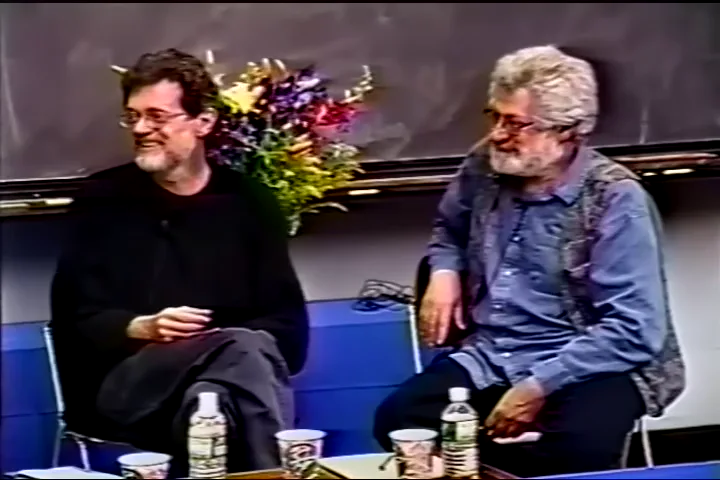
terence mckenna, ralph abraham, and rupert sheldrake's 1998 trialogue on evolutionary psychology, consciousness, and the mind's development through human prehistory.

a 1998 trialogue between terence mckenna, rupert sheldrake, and ralph abraham. three perspectives on the evolution of consciousness and the evolutionary mind.

terence mckenna, ralph abraham, and rupert sheldrake recorded in santa cruz in june 1998, discussing skepticism, epistemology, and the crisis of statistical methodology in modern s