Trialogue 1991
Recorded September 2, 1991, this is a private trialogue between the biologist Rupert Sheldrake, the mathematician Ralph Abraham, and Terence McKenna. The three discuss the institutional crisis in modern science - the rise of massive, centralized projects like the human genome initiative and physics accelerators that consume billions in research funding, and the squeeze this places on independent inquiry. They examine how grassroots scientists and citizen researchers might ask the questions that institutional science ignores. The audio quality is degraded, but the conversation captures three sharp minds wrestling with who controls the direction of knowledge and what alternatives might exist to the professional-institutional monopoly on research.
transcriptmachine-transcribed, unedited
Greetings from Cyberdelic Space, this is Lorenzo and I'm your host here in the Psychedelic
Salon.
Well, how are you doing today?
I don't know why, but for some strange reason I seem to get the blase before the holidays
rather than after them.
So I guess you could say that my energy level is a bit low today, but there really isn't
any good reason for that being the case, and so I've decided to put out another podcast
just to cheer myself up by joining you in the salon for a little visit.
I've had several programs lined up, well almost lined up, that I think you're really going
to enjoy, but not one of them has finally come together just yet from permission standpoints
and things like that.
And so I'm afraid that I've also been overloading you on Terence McKenna lectures lately, so
I decided to compromise and play another one of the trilogue tapes.
I think it was last October that I last played one of these three-way conversations between
the biologist Rupert Sheldrake, the mathematician Ralph Abraham, and, well, what shall I call
him?
The Bard McKenna, I guess.
The tape I'm going to play right now is a little different from some of the others I've been
playing.
First of all, the sound quality isn't all that great, and I've had several people take a look
at it, but the bottom line is that this particular flaw isn't an easy one to fix, and for what
it's worth, you know, I've got to put up with the bad sound too, and if I let it, it'll
drive me nuts, so I've actually had to think of parts of this recording as having had
sound effects added on purpose by some demented DJ, and then it seems okay, you know, at least
it doesn't bother me as much.
Actually, I gave serious thought to not even playing this particular recording because it
doesn't have all of the sizzle that we normally expect when Terence McKenna is involved, but
even if there's only one person who really grocks the message that Rupert is trying to get
across, it'll be worth all of our time, I think.
Even if becoming a grassroots scientist isn't something you find particularly fascinating,
well, just think about some young Ralph, Rupert, or Terence out there who hears this and says,
yes, I'm going to really look into this or that question that science has so far left unanswered,
and I'm going to figure it out for myself.
Who knows what might come from just one mind, young or old, taking a look at our world from
a slightly different direction, and even if you don't discover something big and important,
just adding to our knowledge of this fascinating universe seems worth the effort to me.
And so I've decided to play this along with the rest of the trilogue recordings that Ralph
gave me, and we'll just have to wait and see what comes from them in the months ahead.
When I first listened to this tape that I'm about to play, my initial thought was that
I should probably cut the first three and a half minutes out because, well, what they were
doing was more or less trying to just figure out how to begin.
But then it dawned on me that maybe this was a recording of a private trilogue, one without
an audience.
And if so, I reasoned, well, this would be sort of like the basement tapes that Dylan and
the band recorded that summer in Woodstock.
And so I've left the tape intact, and I'll let you decide for yourself if you want to fast
forward to where their trilogue actually begins.
But maybe you'll enjoy hearing these three great minds getting wound up for what sounds
like a private trilogue, just the three or maybe four of them.
So if you've ever wondered what these three amigos talked about when they were alone, well,
this may be just what you've been waiting for.
And as you will hear, this trilogue was recorded on September 2, 1991, and apparently there was
one person there other than the three of them, and that was the woman whose voice we hear
in the beginning.
And I'm not sure there's anything new here, to be honest, but I'm going to play this whole
series anyway, just in case there was something here in what is either a rehearsal or a recording
session that was possibly intended to be produced as a commercial venture.
All I know about the tapes are that they were in a batch of cassettes that Ralph Abraham loaned
to Bruce Dahmer and me to digitize in order to pass along here in the salon.
So let's listen to this old recording of a possibly private conversation between Rupert Sheldrake,
Ralph Abraham, and Terence McKenna.
It doesn't have to go to six, right?
No, no, no.
No.
I think that we're happy with an hour, about a half or two hours.
We can stop any time after an hour.
What happened a little bit in the past is that the patient one frequently tried to stop it
when it's not quite dark.
Yeah, I think it's good to have a time we shoot for, like quarter to six, you know,
because we found that we sort of faulted and we would have stopped and then we went on and it was right away.
It was better, yeah.
Yes.
This one's on grassroots sounds, so...
Can I hear it?
Yes.
Oh.
It's on...
I can hear a kind of echo.
Hmm?
I can hear a kind of echo.
Maybe...
Well, let's see.
I don't know where you can hear that from except from my headphones, yeah.
Maybe from the headphones, yeah.
Ignore it.
It's sometimes hard to.
Well, uh...
Mediated some.
Uh-huh.
So maybe we should have a mantra to do with knowledge, like whom.
September the 2nd, volume one, volume two, number one.
Nineteen ninety-one.
Um...
Grassroot science.
The organization of science, as we know it, has become increasingly professional and institutional.
And...
Big science is increasing in its scope and power, so that more of physics research gets directed into huge projects like the super accelerator.
A lot of physicists are very worried because this is drawing off billions of dollars in funding.
In biology, the conception of the human genome project, um, was brought about by a scientific politician who thought, well, if physics can have big science and military can, like Star Wars, why can't biology?
So this was a deliberate attempt to model biological research on these huge projects involving billions in funding.
And this project is going ahead, um, it's meant that there's even greater predominance of funding in the billions for molecular biology, gene sequencing, gene cloning, biotechnology, that kind of research.
And, inevitably, this, um, attracts funds, prestige, and, and manpower away from the more traditional low expense, low prestige branches of biology.
And this tendency towards big science and bigger centers, um, and the predominance of fewer centers of excellence, um, is going on, um, all the time.
And, um, the editor of Nature, um, told me last year when I met him, um, that there was a tendency, um, for papers now coming from smaller institutions to be rejected.
Because the peer review process meant that people would say, well, why didn't you do a mass spectrograph on that compound?
Why didn't you do this or that?
Um, requiring, as part of the routine production of papers, uh, the use of expensive equipment to which few have access.
And he said that, although the papers may have been of equal merit, the standards were changing in favor of large institutions and large laboratories.
And so I said, well, what happens if you raise this question with the people who insist on these standards?
Isn't it unfair on people in smaller institutions with lower access to big funds?
And he said, not really. He said, if they're any good, they'll move to a big institution.
So, there was this, uh, tendency for not only increasing specialization, but increasing predominance of a smaller number of institutions and, um, access to big money, um, is coming to dominate the whole structure of science as we know it.
And this is merely, um, a carrying further of the process of professionalization and institutionalization that's overtaken mainstream science, essentially in the present century.
In the 19th century, um, and in the 18th, and indeed, until the present century, the situation was very different.
In Darwin's, uh, case, for example, uh, he himself never held an academic post in any institution.
Um, and when one reads books like The Variation of Animals and Plants Under Domestication, the research base on which he was drawing was that of practical plant breeders,
animal husbandry people, hands-on animal breeders, animal trainers, uh, amateur pigeon fanciers, um, uh, colonial administrators who'd observed what native people did, um,
shipwrecked mariners who had stories about feral animals on remote islands, and so on.
In other words, there was a vast wealth of knowledge that fed into Darwin's kind of science, uh, hardly any of which came out of government-funded scientific institutions.
Most of it was low-cost, grassroots type of research.
Uh, that doesn't mean to say that the people didn't know what they were talking about.
These were true experts in the sense that they'd spent many years doing what they did,
and spoke from a wealth of experience.
Um, but we see a completely different picture there.
And what's happened, um, is that the amateur and the, um, non-professional base of science has become increasingly marginalised from the point of view of institutional science.
You can't do research till you've got a PhD, you can't do it unless you're in a big institution, you can't do it unless you've got a grant,
you can't publish it unless you can write and do the kind of thing that passes peer review committees, and so forth.
Well, the tendency has gone further and further in this direction.
So, the question is, do things have to be as they are now?
Or, um, is there a new model possible?
Well, I think a new model of science is not only possible, but desirable, and not only desirable, but necessary.
Um, because, on the one hand, there's a collapse of confidence in big science.
There's, uh, a decline in public support for massive scientific projects.
Genetic engineering is getting very bad press.
Um, embryo research and biotechnology excite more public fear than admiration.
And the same is true of nuclear research, particle physics research, Star Wars research, and many other aspects of big science.
Um, one of the results of this is that the public esteem for science is declining.
Um, people blame the environmental crisis, nuclear pollution, um, ecological depletion, agribusiness, factory farming, chemicals in food, pesticide residues, um, toxic wastes.
All these things are blamed, fairly or unfairly, on the scientific establishment.
And, so, the, the constituency that supports science declines as a political voice.
And, which means that governments seeking to make cuts, as they always do, as they have been for years in Britain now,
find it's quite easy to cut science budgets.
And it won't cause much loss of votes.
In fact, it may even cause a slight gain in votes.
Um, they've just axed Britain's main nuclear physics facility, the Dersbury Laboratory near Manchester, in which Britain led the world.
And the whole facility has just been axed.
And there was, apart from scientists themselves who worked there and other people in the scientific community, scarcely any ripple of protest.
They saved two million pounds a year.
Um, so, this, uh, protect, especially in Britain, this declining, uh, confidence in science and declining funding of science has led to a reduction in scientific morale.
Um, fewer and fewer people want to study science in schools or go into it as graduate students.
And, um, there's, uh, a declining interest in, in large-scale professional institutional science.
So the thing is entering a kind of crisis.
Many scientists are very, very demoralized.
And, uh, it looks as if the great golden days of the golden age of the sixties and seventies of endless expansion is, is over, perhaps forever.
Well, in this context, a possible new approach to science becomes more feasible, um, because it may be necessary for simply for economic and political reasons.
But I think it's desirable, even if it weren't for the fact that large-scale science is entering, um, a, a state of crisis.
And the reason I've been thinking about this is because of my own experience with morphic resonance research.
Um, since this is such an unorthodox theory, the theory of memory and nature, um, since it goes against the established paradigm or model of science, uh, funding has been very hard to come by.
And what's, in fact, become apparent is that holistic research of the kind that this involves is much cheaper than reductionist research.
If you study whole systems, you usually need relatively small funds.
But the smaller the thing you study, the bigger the apparatus and the more the funding.
So when you get down to the most evanescent of nuclear particles, you need the largest of apparatus, miles across, costing many billions of dollars.
So morphic resonance research has turned out to be cheap, indeed almost free in some cases, and much of the leading research has been done by students as projects.
Um, and this has made it clear to me that students who do every year tens of thousands of projects around the world are quite capable of doing leading-edge research.
They are actually doing it in the realm of morphic resonance.
Um, and that, but in no other sphere of mainstream science could one imagine students routinely or, uh, be it playing a major role in the, um, growth of knowledge in this way.
Um, it's also made me clear that, uh, has made it clear to me that a lot of really interesting and important research projects can be done on very small budgets by students or even by amateurs outside the framework of institutional science.
And the book I'm working on at the moment, which has made me think about these things, um, proposes eight experiments that any one of which could break our current paradigms, but which would be very cheap to do, and some could be done by almost anyone.
Um, for example, investigation of the sense of being stared at that we talked about previously, um, and which is, uh, uh, the discussion in our, in our book of trial logs.
So, I think the conditions are ripe for a new awakening, a new renaissance of research, uh, uh, a kind of more democratic kind of science where more people are empowered to take part.
And when you think about it, the kind of base that Darwin drew on exists today, and even more so.
There are tens of thousands of amateur plant breeders, there are amateur orchid growers, and, uh, people who lavish care, attention, and their own funding on breeding new kinds of orchids.
There are rose societies, there are bamboo societies, organized in societies where people swap specimens, have, uh, a great deal of experience and knowledge of their various species of plants.
And again, with animals, there are probably more pigeon fanciers, dog breeders, rabbit fanciers, and so on, than ever before.
These, the numbers run into the millions of people with a great deal of experience of breeding and raising these animals.
Um, there are people who train horses, dogs, there are falconers who train falcons, including new species, recently domesticated.
Building up a great wealth of knowledge, which is all available through amateur networks and societies.
There are anglers and hunters who get to know the species they hunt very well.
There are old-style naturalists still around.
There are amateurs tracking ecological change as a result of climatic and other factors, um, who can build up invaluable records.
There are hundreds of thousands of home computers giving statistical analysis power, um, previously the preserve of big institutions with big mainframe computers,
making this kind of sophisticated mathematical analysis available to almost anyone.
There are hundreds of thousands of science graduates with a training in the professional background,
not working as professional researchers, who could contribute to this.
Um, and there are already areas where almost all the research that goes on is, in fact, amateur.
These are some.
In addition, there are, there's the whole realm of psychedelic experience, where professional research is very limited in scope,
but amateur research has accumulated a wealth of knowledge and experience.
Um, there are amateur computer, um, experts who have developed an enormous amount of experience.
And I think that this base that already exists, the present almost completely disregarded by institutional science,
provides the basis already in place, costing governments nothing, requiring no external funding,
from which a new kind of grassroots science could arise.
One way would be through extension of existing networks, possible building up of regional research networks.
Um, and the way I'd see it developing is that this, um, other kind of science would not be seen as a rival to existing science,
but in the end, um, this could all be complementary to the professional science, the scientific establishment,
and these two systems could cross-fertilize and influence each other,
whereas now they proceed as if they, as if the other one hardly exists.
So that's my idea about, um, the possibility of a new kind of science.
Well, that's, uh, sounds wonderful and very promising, and if this could simply happen as you've described it,
and the decline of science could be reversed, clever young people could be attracted more and better information,
and understanding could be developed, and so on.
And I certainly think that's desirable, although I share with many ordinary people the decline of confidence in science
for the reasons you've described.
The, uh, acceptance of a new model of science, of grassroots science, of major developments,
unless they, given birth by amateur groups, and so on.
The acceptance of all this by the scientific establishment seems very unlikely, somehow.
The population of the scientific establishment would have to be totally swapped out,
with new young people coming in who had grown up in these new style groups,
and of course that's a possibility.
I'm worried, though, about how, I mean, this would have to evolve through a series of developments difficult to envision at this time.
But, um, I see a problem in the communication, the extension of the networks, and the sharing of the results,
and, uh, the replacement of the function of big science provided by publication in journals with peer review, and so on.
I hate the peer review process.
But, somehow, the very growth of population, the growth of civilization, the growth of the scientific establishment,
means there's this immense amount of data, that if it's not shared and made available, or archived in libraries, or something,
nobody can access it, then, um, it fails to achieve the goal of these discoveries.
That's, uh, the problem.
So, I, I think the key to this development of a new model would be the development of a new model of a communications system
for sharing the results of research would be necessary.
It would be possible for each group of, um, pigeon fanciers in South Birmingham, Vermont, or something,
to have a journal, a newsletter, or something, uh, like that, a regional newsletter,
that would be too many newsletters to read.
So, I, I think the, the secret key to empower the success of this new development is the communications aspect of the computer revolution,
the bulletin boards, the computer networks, and, um, developments not yet really visioned for the archiving and sharing
of this kind of information in, uh, central electronic libraries.
That would be the key.
And, uh, until everyone could have, could access the results of this research,
and easily sort of survey all what had been done in a certain area,
and find out about these new hybrids, and, and so on,
that, uh, the dream couldn't really become a reality.
Maybe it requires further development in the archiving and sharing of electronic information
in order to make this possible.
How, how will the regional networks, uh, be organized and communicate with each other?
Uh, it could be that the, the, the lack of a successful means of communication that way
is the very reason that these big laboratories and big science have actually evolved.
The governments have, have sensed, they have tried, they've experimented,
they may prove to this, to their own satisfaction that the investment of the bucks in a big laboratory
gives a bigger bang than in, uh, uh, granting smaller sums to a large number of small laboratories.
Certainly these groups will need grants. They'll need some support.
You have to have some equipment. Inexpensive science still does cost, right?
Well, I mean, the thing is that if you take, say, pigeon fanciers,
they already have journals, pigeon racing weekly and so on,
and there are several in England on newsstands.
They already have newsletters. None of them get grants.
They buy their own pigeons, race them, maintain them, breed them.
Um, there's a system of competitions or prizes for successful winners of races,
but the whole thing is completely self-financing.
Now, the idea I had in mind was, uh, in cooperation with these different communities of, um, researchers
or, or, or practitioners who already exist, one would pose certain questions,
like, how do racing pigeons home?
Now, I have my own ideas about how this can be tested.
Um, for example, by moving the loft from the pigeons, seeing if they can find the loft.
Um, this is one of the experiments in the book I'm writing.
Well, this kind of question, when formulated, put out there in the racing pigeon, uh,
new press and in the existing newsletters,
might engage a certain number of people in wanting to do these experiments.
The results would be fed in through these existing networks of information to others,
and there would be a debate and other people perhaps take part.
And the whole of this community could be engaged in certain kinds of research projects.
Now, in relation to, say, amateur naturalists, um, a project that I'm trying to get going in, in London,
where I live, in Hampstead, is that on Hampstead Heath, uh, there's several species of trees
of showing very advanced signs of die-back or actual death.
The London plane tree is dying off all over London,
which will totally affect the appearance of the city.
Um, willow trees are in a bad way.
Acacias are in a very bad way.
Some species, um, are not quite so bad.
Um, and opinions, most people have hardly noticed.
Um, but those who have noticed have different opinions as to why this is so.
We've had two or three years of drought.
There are certain fungus diseases around.
Um, there's an enormous increase in ozone and atmospheric pollution
due to increased car traffic in London, photochemical smogs.
Um, um, which of these are affecting it?
And as the greenhouse effect begins to bite, as the temperature changes,
what kinds of changes will occur in forest ecosystems?
There's nobody keeping records.
Um, the Heath authorities are busy rushing around mending the drains
and, and sort of clearing the rubbish.
Um, the preservation societies are busy trying to stop people cutting things down
and spoiling the Heath by building new police, um, radio tires on it,
and that kind of thing.
But there's nobody at present keeping a year-by-year record of what's happening.
So, the, posing the questions is part of it.
Um, and if amateur naturalist groups had clearly posed questions, like,
is there a year-by-year change in the bird population, the tree population,
which trees are suffering, which ones are doing better?
We would have an enormous
database gathered from different parts of the world which would be a practical value for example in
what do you do about global climate change if the greenhouse effect is really happening which it
seems to be if the climate of britain gets warmer and drier for example what kinds of trees should
be planted on hempstead heath now so that in 50 or 100 years time well within the lifetime of the
tree planted today there's a reasonable chance of them surviving rather than the whole place being
an ecological disaster zone um and this is a very small i mean i take this because it's a very small
example but there's a much bigger question what kind of crops would grow in changing climate what
what changes occur in existing forests and existing ecosystems um so it's not just a matter of enormous
accumulation of data without any any kind of that's happening already these amateur groups build
up enormous data banks which they share through networks and newsletters already in place but
for a larger picture and for the asking of specific questions um there could be a system whereby these
questions um are fed through these local networks or formulated with the help of people within them
and there could be a vastly greater research effort um going on than there is now and i don't think it
would necessarily require a big change in the present system some of them i'm sure are using computer
networks already others exist have existing systems of information exchange like newspapers journals
commercially produced magazines the rabbit fancier you know there's all these things incredible number
of specialized journals are actually published and are self-sustaining financially so i think it's
partly a question of formulating questions that are of a wider interest and that than the nuts and bolts
questions asked within these existing groups or within groups that could come into being and
into a larger picture and that i think is the way that these uh the research could be in
coordinated somehow through particular kinds of questions yes well if uh interesting questions
came along from a central authority or an interesting amateur as for example your book your forthcoming book
and this captured the attention the imagination of groups worldwide and then they accumulated their
data pertinent to the question in the standard form readable by other groups and so on then a bigger picture
uh regional or global picture of certain phenomenon like the death of plane trees could be developed
but it might need in order to synthesize all this information a really large map a computer graphic display or
something that would be um two steps beyond the budget of these small groups maybe there would be a secondary
network where the uh primary pigeon panseers and so when doing research with uh humming pigeons and moving the home
they would uh create their primary data stimulated by a certain question and then the secondary groups
would access the data from other centers and other countries and other continents and so on try to
test certain hypotheses about the rate of advance the strength of the morphogenetic field the
distant effect the speed of the effect and so on probably for all this to happen it would require a substantial
motivation because these uh amateur groups uh habits uh habits their habits of their 19th century groups their
survival of the grassroots science of the past and the some kind of broadcasting of their results to
central labs or secondary research groups trying to uh develop a larger picture a global picture that's not part of
their habit so to make this transformation from their habit to a new mode would require some kind of
compelling motivation and i think that this dimension of global environmental problems is touching on what
may very well be the powerful motivation that would incline these groups to attain to a higher level of
co-operativity among themselves on a global scale that's really what's needed is increasing the
connectivity between these groups as in a neural net you increase the connectivity and then global
patterns form so i think in the context of this idea that bad news is good news that the rapidly approaching
environmental environmental problems and personally i'm worried more about global cooling than global warming
but in any case a global change is going to simulate a global response i think it might be the way in
which the revival of grassroots science takes its strongest motivation what do you think terry well i'm as
interested in the next person as in the reform of big science my the way i would choose to react to rupert's
statement is rather than see it as actually a practical plan for the reform of science to see it more as a proposal
that can serve to show us what's wrong with science and how far off the track we've come
my questions would address four areas which all arise i think from the same problem that i see with it
um first of all instrumentality the grassroot science you called it 19th century ralph grassroot science can be done
with rather tangible problems but if you're interested in the neutrino output of the sun or something like
this instrumentalities of great cost are necessary and i think that science has not only moved from the easy
problems to the hard problems in its evolution over the past thousand years it's also moved from the cheap
problems to the expensive problems and that it is now wedded to uh instrumentalities of such
size and cost that even nations seem to need to band together for instance the super collider project
or the proposed joint soviet mars uh expedition i don't think there's any way for grassroots science
to finance and execute uh an expedition to mars so i've made three areas of concern
modern instrumentality meaning scientific instruments of great cost technology the fact that science is the
handmaiden of uh advanced product research is what has given it such overwhelming sway over most of our lives
science is not done in the spirit of greek curiosity about the order of nature science is done to make money on a vast scale
and i i i dare say no funding would be forthcoming if there was no anticipated payback from that funding so then that leads to
capitalism what is its role in the promotion of big science over small science and how can
the impulse to do pure science in the greek style or the grassroots style somehow be unlocked from the
demands of capitalism which distort that impulse so that we may spend hundreds of millions of dollars
discovering whether certain uh chemicals that will go into a facial soap or allergenic or not but we
wouldn't allocate a hundred thousand dollars to study a very basic and interesting question like how the
pigeons home and then fourthly and in along the same continuum science has been appropriated by the military
industrial complex and again this uh uh would be very hard to see how it could be disentangled from that
so i see your proposal as not so much a proposal for the reform of science but for the creation of a kind of parallel
institutional institution we could almost call it the people's science or or uh science hands-on science
how and i just like to hear you address all these things i mean i'm all for the idea but i think science
science has been vastly transformed from the simple impulse to understand the natural world around us
into a kind of hellish marriage with capitalism
capitalism technology enormous instruments and the military industrial complex and that i've probably
named some of the most overwhelming and monolithic forces in our society how can we rescue dame science
from the hands of such intractable uh foes of the greek and original impulse to simply understand and
appreciate the natural world well i think that part of the answer comes from the the um the shift in
paradigm which is happening for a variety of reasons independent or not independent but seemingly
independent of these political and economic ones namely the move towards a more holistic model of
science um and as i said earlier the holistic research where you look at whole systems is much
cheaper than analytical research where you look at smaller systems you see atomism which is the
philosophy that underlies reductionism puts the best greatest emphasis on the smallest possible things
hence the highest prestige attacks attaches to super conducting super colliders which are the biggest
pieces of apparatus you can make and because the smaller the thing the bigger the apparatus now if we um
as we are doing undergo a shifted model so that kind of science seems somewhat less interesting
um then the emphasis would become on studying the properties of molecules of crystals
at their own level of cells of organisms of ecosystems um that kind of science requiring enormous increase in
instrumentation which goes together with a reductionistic approach um would simply um become less
important less relevant less attractive and that would in part in itself help to take care of the
instrumental problem um you can see the same thing in medicine if you have um a medical research system
that we've got now entirely in the service of mechanistic medicine then the emphasis goes on
new methods of uh biochemical diagnosis you know genetic engineer diagnostic aids high-tech uh scanning
equipment and so on and no research money at all in most countries goes into looking at the effects of
other holistic methods which more of which meanwhile flourish in uh in even in small towns around
around the western world um all the different kinds of holistic approaches that go on there's not really
much effort to compare these approaches to see which works better than others um there are a few small
scale projects but um it's clear that the economics of the medical system which at present
is that escalating costs which mean the cost of insurance or the cost of socialized medicine and
countries with it like britain are constantly spiraling upwards and provoking a whole crisis in the
healthcare system now for political reasons alone in britain there's an increasing willingness of um
for economic reasons really of politicians to consider the possibility of holistic medicine simply because
it's cheaper and if you can cut down on the cost of heart transfers expensive scans and that kind of thing by people
doing more meditation they're taking a few um you know homeopathic pills and that kind of thing um have acupuncture
this kind of thing could lead to far cheaper medical insurance it could lead to a much cheaper and more
comprehensive health service in countries that have comprehensive health services um and it would lead
to a completely different kind of medical research i mean how in this context which would be very relevant
to medical insurance companies which already in some cases insure people with chiropractors osteopaths
acupunctures and so on um one way of going about this on the grassroots method i've
um suggested would be simply a survey method a systematic survey carried out by students or local
communities going around asking people what diseases they've had how they think they've been cured and
how they rate the effectiveness of the different systems they've had this is in fact the word of
mouth method is how one gets to know about things like acupuncture you hear somebody's had something
they say it's been cured by acupuncture you go to them someone's got a bad back it's a chiropractor
that cures it not going into an advanced surgical ward in some cases that works but for most people
these systems which are outside the purview of orthodox medicine and the ama um are what work
can you hear about them by word of mouth a more systematic approach you see would be systematically
to survey people's experience you have like a consumer report on these uh systems and this could be done
at any level of sophistication or depth and if it worked in the west then you could extend it to
india where these different systems ayurvedic the unani system of the muslims the homeopathic system the
western system traditional forms of spiritual healing all coexist and every indian i talked to
when i was living there had quite clear ideas about which one worked for which for jaundice you wouldn't
go to a western doctor because they were hopeless you'd go to an ayurvedic or a hakim a unani hakim
because they had good cures for jaundice for acute illnesses you'd go to western doctors and get
antibiotics for skin long-term chronic skilled skin complaints you go to homeopaths for mental diseases
you go to temples or to some kind of uh faith healing thing in a dugout a muslim shrine
um there's a wealth of knowledge there which is nowhere codified nowhere investigated uh past as
part of an ongoing continuously modified oral tradition and so in the realm of medical research
too i think this method could be applied quite cheaply and simply without instruments
it would in fact give one a method of estimating the effectiveness of instruments through high-tech
medicine so i think that when as soon as you begin to look holistically at things the need for
large instruments disappears and it may be that um if we think differently about the need for missions
to mars the need for star wars the need for the human genome project and the need for
large-scale exam nuclear physics projects in this new context may seem much less important and hence
the process you talked about the need for these instrument instrumentation would get less
less then when it comes to um you know the power of capitalism the military industrial complex again
the power of these things are changing the the the interests of health insurance companies
and the interests of national health systems are not working in favor necessarily of ever more
expensive medicine there are political forces working in different directions with the end of the cold
war the need for vast high-tech military spending projects is going to become harder to defend politically
um and so i think that the situation is changing quite rapidly in all these respect in all these respects
well what you seem to be advocating is the collection and correlation and study of data
as something which doesn't cost a lot of money and which can be done on home computers and
transferred among self-organized networks of people and i agree that probably the forward
rush of big science has ignored a lot of areas but um there are i mean what do you say to the uh
extraterrestrial uh geologist planetologists or to the astrophysicists or to the molecular biologists
it seems there are large areas of science which have become so wedded to the need for instrumentalities
of great cost that there is no way to do them without uh vast research programs and to
enormously expensive instruments so what you're really focusing on i think is
is not so much a downsizing of science as a refocusing of it on the biological medical and sociological domain
as opposed to highly warranted highly warranted but can this be done i mean it's extreme the inertia
of the other forms of science to tell the physicists that the exploration of matter will be halted
to tell the astrophysicists that the exploration of the galaxy will be halted
to tell the oceanographers that the exploration of the deep sea will be halted
uh is not entirely in the service of the original greek impulse to understand nature they're going
to be told that anyway they are being told already in britain i mean nuclear physics has been shut down
there's a budget crisis and even if popular support remained tremendous for sub-nuclear particle research
there would uh the the budget crisis would make it impossible to continue in that line even if everybody
wanted to meanwhile we have new crises you see this nuclear physics was um response to urgent need
in the military industrial complex as you pointed out they needed this defense against aggression and so
on now we have a new problem and the defense departments of the various nations are going to
have to do about face and reorient themselves toward the real enemy now well when you were talking for
instance about gathering uh and integrating temperatures on uh or climatological data on the die off of
trees in britain it occurred to me recently there's been a debate in the scientific community saying that all
ground-based temperature uh observations have to be thrown out of the model because only if you look down
from space on an environment do you actually get uh uh data which is not contaminated by local effects
so in some cases it seems uh there's going to have to be a continued reliance on all right we acknowledge
that big science is going to continue to exist but uh it's got to first of all economize secondly reorient
itself toward real problems not only to maintain popular support to maintain any support maintain any
population of scientists to do it and thirdly it's got to reintegrate with grassroots science because of
economies and also because the information on that level is needed i think that the new model for big
science is going to be data banks together with scientific visualization strategies based on computer
graphics which as you correctly implied is expensive the mission to planet earth the nasa proposal to monitor
the temperature everywhere from satellites will actually be very inexpensive compared to ground-based
methods of collecting the same data the problem is how to visualize it and there we see groups working
at the national laboratory level with enormous supercomputers that are really expensive trying to
devise ways to synthesize all this data and sort of get the picture so the i think the new challenge for
big science will be they'll still have maybe more moderate budgets but they will have to be focused in big
laboratories with big supercomputers and with huge discs holding all this accumulated data on the mission to
planet earth will be broadcasting down from these satellites terabytes terabytes per minute of information that has to go
somewhere and uh until that's figured out which will be expensive we can't have any i don't think we'll
really get the benefit from all this uh grassroots science either what exists today or what would be
developed in the future in response to some really exciting new questions uh proposed from a larger view of uh global planetary behavior
certainly the physical sciences have hogged more than their share of the national budgets for science
and as rupert pointed out at the beginning the growing tendency of biological science to imitate
this bad strategy of the physical scientists in putting all their eggs in one basket with giant machines and
fewer laboratories and journals and so on this is a bad direction because it's dead end street this
actually represents the devolution of science led at the most rapid possible rate by the physical
scientists the astronomers with their huge telescopes and and so on
the piece of the budget pie for science is shrinking even if it didn't it would have to be reorganized
so that a fair share went to medical biological and also social and environmental sciences then
everyone's budget is still going to be too small and to get the largest result from the fixed budget
i still think it'll be necessary to have some um big science big lab centers where the synthesis of all the information will be
and will be the largest problem of science in the future is just to manage this
enormous database and the fact that the physical scientists have got their
um unjustified piece of the pie so far is i think because within their big budgets which still aren't infinite
they've been able to produce a result because they don't have to deal with data banks that are
unmanageable size they're studying simple systems and within their budget they've been able to
deliver a product something that can be adapted by business for new uh high-tech commodities
use gadgets and uh consumer well maybe we should think of it as establishing a sort of parallel track
of re-humanized science uh but retain things like the human genome project which
promises a much deeper understanding of human disease and genetic defects and this sort of thing
um the other thing is in institutions expect to pay off on the investment they make in the people they train
and somehow they are going to have to be talked out of this uh payback because big science has been the
tent under which product development and that sort of thing has gone on which has then led
to the payback into the universities so that these laboratories could be endowed and so forth and so on
it's very hard to see how in the small science model it closes the loop and pays its own way
it has more the quality of the english squire or naturalist who carries out observations in his local
area that are very interesting but that only his private wealth allows him the luxury of doing this how will it
support itself how will it be other than uh something in the hands of of hobbyists and dilettantes
well um there are two things that could happen there one is that um well already amateurs do these
things on quite a large scale pigeon fanciers of whom there are about 500 000 in britain are mostly
working class and some of them are on social security the one i've worked with most closely
can't work he's got a disease he's on social security it's so cheap that you can do it on that level this
isn't just the province of squires maybe orchid growing is if you need greenhouses but there are
certain kinds of things which we live in a far more prosperous society than ever before
and so that this kind of expenditure of your own money on on what you really like is widely available
many many people take advantage of it even if it's only at the level of gardening
and it's one of the most popular of all hobbies um people don't need grants to buy plants for their
garden and they wouldn't need grants to graft different ones together or to to breed different
ones by crossing them using a camel hair brush to transfer the pollen from one to another so plant
breeding and things are so low budget they're actually within the capacity of hundreds of thousands
of even millions of people already um when it comes to um the need for additional funding for
data banks for things where you do need uh other other things i think that there could be a new system
of they could be regional research councils they could be i mean there's various structures you can
think of where a tiny fraction one percent point one percent of existing science budgets were put in
funding this grassroots science together with a series of competitions i in fact suggested one
to the editor of nature when he told me about this increasing complexity and cost of research as the
tendency i said well why not offer a ten thousand dollar prize every year the nature prize for the best
research conducted on a budget of less than a thousand pounds
and he said there's no point because no one would enter for it
and I said I would
and he said well then I don't think we'll offer the prize
but the possibility you see
I've found in my own experience
that prizes act as quite a strong motivation for people
in morphic resonance research
the most recent competition
results have just been announced
for student projects
there was a $5,000 prize
to be shared between three people
worldwide
this motivated some very interesting research
and so a tiny fraction of existing science or education budgets
devoted to funding this grassroots network
would be politically popular
because it would be far more politically popular
than the 99% devoted to big science
and existing projects
because it would touch far more people
and give more visible results
and because the kind of projects we're talking about are so small
a little amount of money would go a very long way
so I'm not saying it wouldn't need funding
but the amount of funding would be so small
compared with existing science budgets
you'd hardly notice it
this deflection of a tiny percentage of existing budgets
it's in this direction
yes that's right
well don't you think though
that the public support for science
is based on the expectation
that it will usher in new technologies
which the mass of people have a great faith
that these new technologies
will then deliver them into a somehow better world
and if you break that chain of expectations
and say no well we're now going to do science
in such a way that you can forget about new technologies
that the interest in science will decline to the level
of the interest in support of the tournament
or go or something
I'm thinking of the old model
just think of
I mean we were talking about the revolution of science
in the context of a major paradigm shift
in which it would be but one component
and one of the things we're anticipating in the future
are these global environmental problems
they are already here
so people I think in the future
are going to expect from science
from government
from religion
from themselves
the salvation from these serious problems
just as now from medical science
they want the cure of cancer and AIDS
solutions
they want a solution
they don't want products
no but they want solutions
we want solutions
and in order for this to be forthcoming
for the grassroots science
well for a science project
to participate in the solution of these problems
I think it wouldn't suffice
to develop a new and parallel scientific establishment
living on its own
and doing its best work on a low budget
or something
we would want to integrate that
with the new model for society
which would be emerging in order to
you know under the pressure
of the evolutionary pressure
of environmental problems
that means that the new science
grassroots science
would have to link up in an effective way
with journals
with glossy magazines
like Scientific American
and so on
presenting the progress that they do make
toward solutions and major problems
alongside the results of the big laboratories
and everybody else
it's not enough to offer
competitions and prizes
you must also offer
the possibility of publication
access to the publication
which can garner the public support
that nourishes amateur
as well as professional scientists
well take as a test case
and it's also a very real dilemma
the depletion of the ozone hole
to even study this
requires the cooperation of air forces
massive data acquisition
and analysis facilities
and when you move from studying it
to doing something about it
it may take a significant portion
of every dollar
the rest of
we all make
for the rest of our lives
and the fate of the planet
may hang in the balance
now how can
a grassroots science
make a contribution to that
because the ozone hole
was first observed
in a federal laboratory
which had collected data
that it neglected to study
so when amateur scientists
would have had
if amateur scientists
would have had access
to the data
sitting in this archive
then they might
and anyone might
anyone with that access
might have made the discovery
of the ozone hole
in fact the person
who discovered it
was the person
who collected the data
but it was several years later
also the ozone hole
was originally thought
to be totally isolated
over the poles
but now
they've discovered
this vortex mixing
that the ozone holes
of the poles
are gradually sucking ozone
from the temperate regions
so if amateur scientists
had ozone observers
which is a little telescope
simple device
look straight up
measure the ozone density
over their own home
then it's just like
the plane trees
the rate at which
the ozone depletion
is diffusing
over the population centuries
would then be observed
by amateur scientists
where it might
very well be overlooked
by the large laboratories
that exclusively devote
their research
to these high-flying
U2s that go over
the polar regions
and to do something
about it?
I could envision
a new model
in which
big science existed
as it does today
on a lower budget
grassroots science
existed
as it does today
on a larger budget
and the two
are coupled together
much more tightly
through information
sharing mechanisms
the National Science Foundation
for example
in the United States
might have as its main mission
the storage
and provision
of access
to this enormous data
so that people can come
with a new hypothesis
a new question
a small competition
stimulating high school students
who could then actually
obtain the data
that no one is looking at
about the ozone depletion
or something else
and win the prize
by making a phenomenal
new discovery
of data
which maybe is sitting around
and has been provided
by some very expensive instrument
that's the combination
So it seems to be
we keep returning
to this thing
that the big science
provides the data
or the data
is accessible
by non-expensive
local means
but somehow
the problem is
to acquire the data
and for many
many problems
I mean
I mentioned
the ozone hole
we could also talk
about the danger
of planetesimal impact
on the earth
things like
or analyzing
the effect
of the
Philippine
volcanic eruption
somehow
the acquisition
of this data
sounds like
it's going to keep
big science
in business
for a while
and I believe
I absolutely agree
with you
there should be
no such thing
as classified
scientific data
that's an obscene concept
but I wonder
if at least
at this stage
in the technological revolution
a MAC-2
is sufficient
to deal
with the data
collected
perhaps it is
but if not
then
the small scientist
remains
at a disadvantage
because number crunching
is a part
of the analysis
of the huge data stream
that is coming in
maybe the answer
is to concentrate
on dropping
the cost
of supercomputing
well that's happening
but that would require
an enormous
governmental project
costing billions
of dollars
and so forth
and so on
the very thing
we're trying
to get away from
here
I think
the computer evolution
is actually
the answer
to the main problem
the prices
are spontaneously
dropping
supercomputer
on the desk
the personal
supercomputer
is a reality
today
it'll be cheaper
tomorrow
the MAC-3
the MAC-4
and so on
let's take that
for granted
I still think
but it will be
brought to us
by Apple Corporation
one of the largest
corporate entities
in the American
capitalist mix
it won't be done
by two guys
in a garage
that era
is gone forever
not well
I mean
you're now
concentrating
on these huge
like the ozone hole
problem
and how can you
apply it
first of all
how the ozone hole
what do you do
about it
a lot more
was done
about that
in Britain
at least
by amateur
groups like
Greenpeace
and Friends
of the Earth
you know
people protesting
to corporations
about canisters
of this
and protests
about fridge
recycling
these things
they gather data
they don't need
huge number crunches
you need fairly
simple data
to turn doing
something about
into political
action
through existing
pressure groups
secondly
the question
of
well no
just leave it
at that
for the moment
about the ozone hole
the second question
about information
gathering
there isn't in fact
a glut of information
in some areas
there's a great shortage
Friends of the Earth
also
collect samples
downstream
from industrial
firms in rivers
and from drinking
water supplies
and find that
in 30% of Britain
they exceed
the nitrate levels
permitted by British
and EEC regulations
pesticide residue
levels are far too high
etc
data which
if it's collected
at all
by our government
is kept secret
and which
when revealed
and published
requiring no
great sophistication
of laboratories
no enormous
number crunches
can lead to
enormous political
knock-on effects
questions in parliament
letters in newspapers
public protests
that can actually
begin to do something
about these things
so the environmental
groups
have already used
fairly simple
analytical techniques
fairly simple
data processing
methods
to great effect
and
so the ozone hole
is
you know
that's why
I don't deny
there's a problem
at that level
but there are problems
at much lower levels
where an enormous
only greater amount
could be done
by amateur data
collection
crunches
and where the
translation
into political
effects
doing something
about it
much sooner
and quicker
than
dissolving
enormous global
climate problems
well so I think
we're left with
the conclusion
that there has
to be a
parallelism
that somehow
there's room
for both
of these approaches
that they address
different areas
of concern
and that when
they can make
common cause
that's all
well and good
but that they
are really
directed toward
in most cases
different ends
well not necessarily
you see
because coming
back to an earlier
point where you
said that what
people want
in science
is something
that gives
a product
or something
useful
or some
public good
that's not
really
always
true in some
cases
but think
of the things
that are some
of the most
popular things
in the whole
of science
that interest
even three
year olds
namely dinosaurs
science museums
draw millions
of people to
them if they
put on displays
of dinosaurs
Stephen Jay
Gould sells
millions of
copies of his
books which
are about
things like
dinosaurs
extinctions
and so on
the only form
of popular
science that
interests Merlin
age three
is dinosaurs
he goes to
halls of science
to see dinosaurs
and so
the interesting
thing is that
there's a kind
of science
here which
has an
enormous
grassroot
space
which has
nothing to
do with
a major
paleontological
project has
the character
of a major
dam
building
or excavation
project
I mean
it costs
millions
most of
these bones
were collected
in the last
century
by amateurs
for virtually
nothing
it may cost
millions
to build
these huge
plastic models
that emit
roaring noises
and are
engineered
to sort
of
well I'm
talking about
sinking a
fossil shaft
somewhere in
the Gobi
desert
and extracting
in a proper
scientific manner
the fossils
therein
over two years
requires maintaining
hundreds of people
in the field
from staff
scientists
down to
coolies
and the air
transport
about 50 cents
a day
when the air
transport of
hundreds of
tons of rock
back to
air transport
I mean
paleontology
was already
a well-established
science in the
19th century
on incredibly
low budgets
mostly funded
by amateurs
it's a wonderful
example
of low-cost
grass roots
and amateurs
like
Baron Guy
de Rothschild
but many others
there were
many amateurs
have played a part
in the development
of paleontology
and it's one
of the most
low-cost areas
of science
and it's one
with one
of the highest
public appeals
so
I don't have
that great
of miniarity
with paleontology
but I think
I do know
something about
archaeology
and it costs
a fortune
archaeology
to do it right
well a lot of its
traditions were
done on a very
low budget
for example
when Flinders
Wheatree
first went to
but I'm
talking about
today
when you go
into Guatemala
or the Yucatan
to excavate
a Mayan site
to keep
a team
in the rainforest
for six months
well Rupert
hasn't suggested
to slash
all budgets
to zero
and presumably
these
relatively expensive
projects
will continue
to be funded
according
to the degree
by which
they can
gain
public
support
they provide
exciting
results
solve
important
problems
and so on
they could
be funded
simultaneously
they could
be influenced
enormously
by discoveries
of the
grassroots
science
group
feeding
into
the determination
of how
this budget
is supposed
to be spent
and so on
we might stick
with archaeology
for a moment
here because
it's an interesting
science in that
it doesn't generate
new products
it doesn't
give us a sense
of progress
it doesn't feed
into the military
industrial complex
it seems almost
the model
of what we're
talking about
and yet
it's absolutely
famished
for money
for all those
reasons
and finds it
very difficult
to obtain
funding
an enormous
amount of
archaeology
is funded
by the
patronage
of wealthy
enthusiasts
and it's
not a happy
experience
to spend
an evening
with archaeologists
listening to them
discuss the
difficulties
they're having
funding
projects
that they are
in a few minutes
able to convince
you are very
very worthy
and interesting
archaeology
is almost
the paradigm
of the small
science
enterprise
that we're
talking about
and yet
it seems
beset
with difficulties
that may
show us
problems
that we can
anticipate
if we try
to expand
this model
well
I mean
at the moment
the archaeology
budget
I'm sure
is a tiny
fraction
of the 1%
of the budget
spent on
the genome
project
Star Wars
we're talking
the global
archaeology budget
must be
what
10 million
20 million
at most
something like that
50 million
dollars
I should imagine
and there's
peanuts
it will say
it is an
amateur
science
but it is
an amateur
science
a lot of it
is an
amateur
science
and then
it's got
this professional
end
where they have
to raise
funding
often from
private
concerns
and so on
or wealthy
donors
it is an
amateur
science
it has a
large
grassroots
component
even today
you know
people who
excavate
in an
amateur
manner
the
anglo-saxon
excavations
go on
in Britain
for example
using
students
and the
vacations
amateurs
and so on
with very
minimal
central
funding
from the
government
and so
archaeology
is actually
a case
in point
it's the
model
you've got
a large
grassroots
base
a large
grassroots
popular
interest
museums
which can
attract
lots of
people
to see
these
things
and even
the biggest
projects
are relatively
cheap
compared
with
large
scale
science
what's
happening
now
you see
is that
what
this
discussion
is
proposing
is not
that
100%
of
available
funding
should
go to
grassroots
science
and zero
to
existing
institutional
science
but rather
to change
the present
situation
where 100%
goes to
existing
institutional
science
and 0%
to
the more
grassroots
mode
a shift
in balance
from 99%
to institutional
science
and 1%
to grassroots
science
would totally
turn around
the situation
change the
popular base
of science
its popular
appeal
and I think
bring a whole
new vigour
and a whole
new spirit
into this
scientific
endeavour
one further
thing
which is
your particular
realm of
expertise
psychedelic
research
seems to me
a very important
component of
consciousness
research
we hear a lot
about the need
for consciousness
research
so little
about the
human mind
a lot
of funding
goes into
cognitive
psychology
particularly
if it
involves
computer
models
because
it
could feed
into
new
generations
of
computer
that's
where
why
the
funding
goes
into
that
area
relatively
low
funding
goes
into
psychological
research
that's
to do
with
psychotherapy
because
that's
most
of
the
province
of
practicing
psychotherapists
who
are
self-funding
or
rather
who are
funded
goes into
official
psychiatric
and drug
research
to do
with
centrally
active
drugs
but the
vast
majority
of
psychedelic
research
99.999%
at least
which has a lot
to say
as I
suppose
you would
agree
about
the nature
of
consciousness
the range
of the
imagination
the powers
of the
human
mind
etc
is not
funded
at all
by official
agencies
in fact
every effort
is made
to suppress
it
in spite
of official
discouragement
and suppression
where hundreds
of millions
of dollars
are spent
in trying
to stop
it
happening
rather
than
there's a wealth
of experience
built up
about
human
consciousness
which is
relevant
to the
larger
question
of the
nature
of our
minds
their
relation
to our
bodies
the relation
of consciousness
to the
biochemical
level
things which
are perfectly
compatible
with a lot
of mainstream
concerns
and certainly
of enormous
interest
in trying
to get
a better
understanding
of the
world
we live
in
and of
ourselves
and here's
an area
where
for legal
and other
reasons
virtually the
whole of the
research effort
is in the
amateur
and virtually
the whole
of it
is negatively
funded
rather than
by the
public domain
in the sense
that funds
are spent
trying to
stop it
here's an
area where
there's
the possibility
of networks
and of
coordinated
questions
being asked
which could
be of
enormous
value
starting
today
because
there's not
much prospect
of this
research being
taken up
officially
yet there's
I would have
thought
the formulation
of appropriate
questions
could lead
to
very
interesting
research
being
undertaken
by
explorers
of the
psychedelic
realm
yes I
quite agree
I mean this
would be
an obvious
area
where
the simple
codification
and making
available
of data
would have
a tremendous
impact
on the models
being developed
within the
field
as a related
area
as astrology
or the
so-called
pseudosciences
are together
these
are not
going to be
funded
any other
way than
by amateur
groups I
suppose
I think
that if
the means
existed
for sharing
the information
that already
is known
to result
in various
experiments
so do you
need to
get out
that a new
sense of the
pseudosciences
with the
regular sciences
would result
for example
if people
had the
computer program
that displayed
when they woke
up each morning
their natal
chart
and the positions
of the current
planets
noted any
transits
of the daily
planets
over the
sensitive points
on their natal
chart
and tried to
correlate that
with for
example
diseases
psychological
states
and so on
then there's
a tremendous
amount of
information
coming to
thousands of
people who
do believe
in astrology
could be
available for
high school
researchers
and so on
testing
hypotheses
posed
from some
other areas
such as
archaeology
paleontology
and big
science
of planetary
astronomy
for example
about
possible
impact
of
planetesimals
and so on
all of this
could be
synthesized
easily
using
computer
network
technology
according to
some wild
hypothesis
that came
in from
some
clever
high school
science
teacher
psychedelic
research
pseudosciences
other things
that are
totally rejected
by society
would have
cracks
in the
structure
through which
they could
reemerge
back into
the
mainstream
and making
that contribution
toward the
solution
of our
global
problems
yes
human
sexuality
would be
another area
where
data
is not
gathered
because of
institutional
biases
that are
conscious
or unconscious
but that
networks
of amateurs
could
organize
themselves
and this
is probably
largely
how it's
done
anyway
it's probably
one of the
least
organized
areas
of
social
research
that exists
and yet
it's central
to
the
you know
our psychological
health
and our
sense
of equilibrium
in the world
nutrition
is another
yes
there's a
wonderful
example
of nutrition
because
lots of
people pay
attention
to what
they eat
official
nutritional
studies
are on the
whole
pretty
crass
and I
went into
this
when I
was working
in India
looking at
the simple
question of
protein
requirements
it turned out
that the
whole of the
global
food
strategy
had been
based on
studies done
using American
college students
as average
people
you know
the protein
requirement
based on
heavy consumption
of hamburgers
something like
60 grams
of protein
a day
well this
as people
widened the
database
as people
looked at
what really
happened in
India
to poor
people
this has
been lowered
to about
20 grams
a day
and yet
the whole
world food
production
strategy
was distorted
for two
decades
by this
kind of
nutritional
study
real
nutritional
research
that looked
into
specialized
areas
like
allergies
and how
to deal
with them
had a large
number of
volunteers
bringing forth
information
research on
people who can
survive with
incredibly little
food
would have
enormous
implications
for the
world food
problem
by showing
that it
may be
possible
not only
to work
on increasing
the supply
but reducing
the demand
it may be
possible
as some
people
practice
doing
as part
of spiritual
disciplines
or otherwise
to survive
on incredibly
small amounts
there's huge
areas in
nutritional
research
where there's
a wealth
of information
that's totally
untapped
at the moment
the official
nutritional
journals
are based
on artificial
experiments
or nutritional
surveys
where people
go around
with clipboards
or sit around
observing people
eating and
noting what
and weighing
them every week
we carried
some out
in India
ourselves
of a completely
unrealistic
kind
and yet
nobody thought
of going
around
asking people
what they
thought about
nutrition
or
let me turn
the tape
well
we'll have
to catch up
with them
again next week
and see what
turns up
when they
turn the tape
over
although
what we
just heard
was
both sides
of a cassette
tape
from that
session
that was
simply
labeled
tape
one
and
is it
just me
or
did the
fact that
they didn't
have an
audience
to entertain
make this
conversation
fall a little
flat
or have
a low
energy
level
yet
I hope
you took
away
from
this talk
the fact
that
the possibility
for grass root
science
still does
exist
particularly
in the
psychedelic
community
where
government
sanctioned
research
is
extremely
difficult
to do
to say
the least
and when
you think
about it
there really
is no
area of
science
that should
be more
deeply
investigated
than the
vast area
of human
consciousness
and yet
you know
the most
promising
medicines
in this
field
are all
but
ignored
now
to give
you
a little
idea
of what
a
grass root
scientist
can
contribute
I remember
one week
in Palenque
many years
ago
when
a large
group
of us
tested
a new
psychoactive
chemical
for the
first
time
in all
I think
there
are
probably
a little
over 40
of us
who took
it
and
our
reactions
were
all over
the place
everywhere
from euphoria
to
one
near-death
experience
when
it was
discovered
that
this
particular
substance
doesn't
mix
with
a
certain
prescription
medicine
as it
turned out
there was
a budding
young
scientist
among us
who
had the
presence
of mind
to
create
and hand
out a
questionnaire
about the
experience
and
I think
most of
us
filled
it
out
and
the
result
of
this
little
impromptu
survey
all
anecdotal
evidence
still
it's all
we have
and
I'll
link
to the
online
report
of this
experiment
in the
program
notes
for this
podcast
which you
can find
at
psychedelics
salon
dot org
and
and so
grassroots
science
can make
a difference
even if
it's
just to
alert
someone
who
is
using
prescription
medicines
to
avoid
a
psychoactive
compound
that
big
science
hasn't
yet
had a
chance
to
come
into
existence
which
arrow
would
actually
did
some
four
years
after
this
trial
log
was
held
and
it
seems
after
listening
to
the
give
and
take
between
Rupert
Ralph
and
Terrence
just
now
that
maybe
a
good
starting
place
would
be
for
our
and
I
don't
know
what
the
answer
is
myself
but
I'm
sure
that
with
all
of
the
great
minds
we
have
here
in
the
psychedelic
community
that
answers
are
probably
already
growing
in
various
corners
of
cyberdelic
space
and
connections
being
made
information
exchanged
and
the
conscious
evolution
of
consciousness
is
perhaps
continuing
at
an
ever
accelerating
pace
or
at least
that
is
something
I
hope
is
going
on
and
from
the
on
our
blog
on
the
psychedelic
salon
forum
over
on
the
grow
report
dot
com
I
feel
quite
sure
that
the
collective
evolution
of
our
species
consciousness
is
on
schedule
and
under
budget
and
yes
I'm
aware
that
the
psychedelic
salon
page
over
on
my
space
has
been
deleted
but
let's
not
get
too
carried
away
with
ourselves
here
you
know
there
were
actually
a
lot
of
people
trying
to
post
some
pretty
unwanted
comments
on that page and maybe one of them got through the approval process and posted
one of their hateful messages there it's quite conceivable if that happened that
a bot would be looking for something like that and auto delete the page at
least that's the way I want to leave it and anyway as some of the comments have
pointed out do we really want to put so much of our personal information into a
database that's controlled by Rupert Murdoch you know I have to admit that if
the system couldn't be tinkered with it it does have some really interesting
potential for instance I did enjoy learning a little bit more about some of
our fellow salonners and I was still working my way through all of the great
new music our friends had posted so I'm sorry not to be able to do that anymore
but all in all it's probably best that we opt out of myspace and other databases so
for the time being I'll be posting and reading comments and posts on our notes
from the Psychedelic Salon blog at psychedelicsalon.org and over on our
forum at thegirlreport.com and and the other forums there too I also
participate in now since I control the first site and the Xandor's control the
other one I feel confident that we'll be around both of them for quite a long
time now as for our schedule here in the salon for the rest of the year I'm going
to take a little time off at the end of the year but there will be at least one
more podcast before the 26th and I'm still planning on podcasting my second
program in the matrixcast.com series as well so for sure you can count on the
matrixcast.com conversation between Ralph Abraham and William Irvin Thompson and the
continuation of today's trial log which will be the next program here in the salon
before I go I want to mention that this and all of the podcasts from the
psychedelic salon are protected under the creative commons attribution non
commercial share like 3.0 license and if you have any questions about that just
click on the creative commons link at the bottom of the psychedelic salon web page
and if you have any questions comments complaints or suggestions about these
podcasts please just add them as comments to the program notes on psychedelics salon
org blog so that our entire community can get involved in these discussions or you
can also post your thoughts on the psychedelic salon forum which you'll find
at the girl report comm where as I said I also spend some of my online surfing time
each week and for now this is Lorenzo signing off from cyber delic space be
well my friends
greetings from cyber delic space this is Lorenzo and I'm your host here in the
psychedelic salon as I said last week I'm not going to do any kind of year-end
program or anything like that right now in fact this will be my last podcast until
about the second week in January like some of my fellow podcasters I'm going to take
a little time off and just kick back and visit with friends and family for the next couple
of weeks and I know that a lot of you still have to go to work for most days during these
holidays but for us retired people and students well we appreciate all you do to keep the world
returning for us and we hope that you get to take some time off and relax as well and particularly
you moms out there you know give yourselves a break and take a few hours off and just do nothing
if you can I know it's hard this time of year but you know there's always that one more present or
one more card or one more box of cookies to take to a friend and nothing like a relaxing holiday season huh
but I just of course it is fun to reconnect with family and friends and even with the ones that
think you're the weird one when the truth is actually the other way around but speaking of
friends who are on your same wavelength I want to thank a friend of the salon Francis D who made a
very generous donation to help with the expenses of producing these podcasts so thank you Francis we all
really appreciate your help and I hope that you and yours all have a wonderful holiday season now getting on to
today's program as promised we'll pick up right where the last podcast ended with Rupert and Ralph discussing the
challenges facing big science versus today's grassroots science and once again I've left this recording intact
complete with a few long pauses when they were obviously trying to figure out what to say next and as I mentioned
last week these trial log recordings were made in September 1991 and apparently were recorded for their own use perhaps in
planning another public trial log or to gather information for one of their books in any event these quiet little recording
sessions are starting to grow on me and I hope you feel the same way so the next 14 minutes or so will be the conclusion of
their first session where they were discussing the relative merits of big science versus grassroots science then there's a brief pause in the tape and
right away they begin the second session and that begins with them discussing future books and trial logs some of which materialize later and some of which did not and once again they began their recording session by first chanting om which I find quite charming myself so let's join them now
Let's join them now
So one of the faults of big science is associated with the reductionist perspective I suppose is this gradual progressive never ending elimination trimming pruning off different things that are labeled as pseudosciences amateur fringe science and all subjective subjective all the paranormal all the nutritional all kind of alternative medical all these things
all these things that are rejected comprise all these things that are rejected comprise a daily growing group while the number of natural phenomenon studied by big science official science and establishment science is always shrinking so the one of the important gains of the new model for alternative science would be to open up cracks in the structure for the reintegration of all these different
reintegration of all these different threads which represents a kind of a holistic approach to the whole field of knowledge especially when you include archaeology history with social
science and so on what we're talking about is bigger than science really it's the reintegration of the entire intellectual sphere of research in general yes yes because there's a great
lot of amateur historical research goes on through local history societies and so on which is on the whole unintegrated with professional endeavors
um so that's one thing i think one one fight one further thing that is worth considering is the formulation of questions now i'm trying to do it in my book called eight experiments to say to change the world
um where i've formulated eight specific research areas with eight specific experiments that could be done on very low budgets any one of which would have a paradigm shattering effect taken together
uh would reduce our present model of the world to to rubble and require the adoption of a much larger and holistic view of reality these would be um they're all things that can be done for budgets of a hundred dollars or less
yes now i've spent some years trying to think out this kind of experiment and the ones i've finally come up with for this book are selected from about twenty or thirty that i've considered
but this is my own unaided efforts and it's a virgin field and i can't believe that i'm the only person capable of thinking of these things there must be many people
given the incentive who could think up really good questions um one thing that happened with morphic resonance research
uh was a competition run by the new scientist magazine for experimental designs for morphic resonance with prizes totaling only 250 pounds
which led to a considerable wave of creativity in experimental design
um in terms of large-scale questions the kind of um endeavor i've been engaged in thinking up simple experiments
is something which groups of people such as ourselves or or such as exist in many parts of the world could get together
and think of questions and not only think of the questions but think of ways in which they could be plausibly implemented
on low budgets by groups of amateurs actually work out questions and possible strategies that could be implemented
uh these would then be competitions one way uh a kind of forum for questions uh in which these questions were published
and uh you know the most interesting ones would be taken up by others and stimulated public debate is another
but this is an important component of it and this is something that costs nothing it just involves people
sitting around thinking and talking and um this i think is a very important component of it because
there are lots of people in place who can do the experiments but most people outside the scientific endeavor
have not um felt empowered to ask the kinds of questions which you can ask
and because my own background is in experimental science i don't have that particular inhibition
um but um most people once they get into the idea at least a lot of people when they get into the whole
mode of thinking up questions for themselves not feeling they can't ask them because they're not professional scientists
um um are quite capable of appreciating understanding and asking these sorts of questions so the realm of question formulation
formulation and experimental design in this context is a vast one uh which um is a wide open field
and which could lead to interesting debates publications letters it could be done through existing popular science journals
if new scientists or even nature had a page in each issue devoted to the discussion of less than a thousand dollar research projects
or things appropriate small science corner a question journal should have a question corner
that's right and then readers letters where people would write in and and say well that design
wouldn't work very well it'd be better to do it this way a whole debate could be started within
international science journals themselves and things like scientific american new scientist which would have a
uh a great reader attraction potential and and would cost virtually nothing and could exist within
within existence called core scientific american
well some journals already have a science a question corner i suppose like the journal of seriology i think they're
interested in posing questions that's right and they also have people's predictions for the year where people can
offer their predictions about what's going to happen next year's discoveries yes um well something of this kind
probably wouldn't survive actually as a separate journal but as an once this idea got more widespread
um within existing period even newspapers could run on their science pages and and and um there could be
sort of sections of this in schools and universities student societies and so on there could be
uh if there was some forum in which the questions could be aired if some means by which they could be
not merely sterile exercises and imagination but rather and have prizes or competitions that stimulate
this and give a personal reward to those who think them up and also some means by which the research
can be implemented implemented and fed into the amateur networks um then we'd have a completely different
model like in psychedelic research you see one could formulate particular questions which one could
ask of people who take mushrooms or cannabis or whatever um dmt and various psychedelics questions which would
be um which seem interesting or important to those experienced in the field which could be asked of many people
people people could write in to some address or through some newsletter networks or something this information could be collected
but formulating questions is an extremely important part of this whole vision and endeavor and fortunately that's the
cheapest part of the whole thing yes you know mathematics well it's not a science but it has this alternative structure already
it's always been very strongly influenced by questions and uh prize competitions and the bulletin of the
american mathematical society has a regular question corner and uh students and all kind of amateurs send in
their uh entries attempted answers of these uh problems so they weren't quite difficult
so there's an existing model up and running yes which uh it has a very strong stimulating effect on the whole
development of the subject and some of the best people are in charge of the question corner
yes well scientific american the amateur scientist section of that has run for years and some quite intricate
experiments are carried out for very little money yeah so we've already got models up and running yes
so how could all this be implemented well we have a uh uh sort of derived a uh workable alternative system
we're assuming that other paradigms in society would shift simultaneously then this would not really happen
i think the key for just for example on the integration of the different paradigm shifts
the the key for the transformation into this new model would be changes in the universities and high schools
we mentioned several times high school students responding to these surprise problems
and not so many times university students um universities have been one of the main institutions
supporting this uh restrictive peer review super professional uh and archaic model of science
if universities were reformed so that they had um departments of integration as it were uh interdisciplinary
programs and holistic approaches and they could play a tremendous role you see in preparing people
educating people to be amateur scientists for example interesting them in many of these problems and the
the the questions being proposed identified the uh question setters should become part of the curriculum in universities
for example as martin resonance research has penetrated universities a little bit at the university for example
there's a model that should be uh spread worldwide universities should be revitalized along with the uh revitalization of science
and the careers like in the physical education so-called some schools have team sports which these are of no use whatsoever to the amateur athlete
very few universities like my university the university of california at santa cruz had no team sports and only individual sports
because they wanted to prepare people for a new society it was formed in the 1960s when in the hip subculture
everybody gave up team sports and wanted only individual sports something that you could continue throughout your entire lifetime
that's a kind of change which is granted in universities in all their other structures so that uh holistic range of intellectual endeavor
including well what we call research is nothing more than participation the person who's going to participate in life in evolution in the future
of the planet and the species then among other things it's necessary to do research one should be an amateur athlete
an amateur scientist an amateur historian and so on everyone should throughout their lifetime if universities are preparing people
with a model of education of self-education which could be continued uh indefinitely then of course they would be teaching this
they would be teaching grassroots science where are the questions where to publish the answers how to use the computer to
how to do it in a sense the move in science teaching and other forms of teaching towards students doing projects
which has been something that's been going on for several years now is working in this direction
because now students are taught to do projects and a lot of the teaching is supposed to happen through projects
the only trouble is the projects they do are ones of the most utter banality and derivative kind for the most part
because it's not assumed that a student can really do a serious and interesting project of any wider interest
these are like juvenile training exercises for research rather than the real thing
and there's no doubt people need training in research methods but uh there's very few student projects
that i've ever come across are conceived on as being real research now the morphic resonance ones are real research
and there may be other areas where they do real research in student projects but um the direction of
training students to do projects is already in place this is mainstream it's just that taking seriously
what's already mainstream hasn't happened yet students are demanding more interesting problems we set them
and because they're not set them they abandon science and go to something else which is more interesting
and they have real problems that students can't address like the computer science
so the uh the creation of a new model for science for grassroots science would actually give universities
the opportunity to revitalize their science curriculum thereby attracting once more the better students who are talented
they're really for that giving them something to aim at in their lifetime of research without uh
uh live grants and working in big laboratories for the military industrial complex
so i i i think it's uh this this whole discussion which very good news for universities
good well i think we've solved the problems of science yes well one of the knock off
it's a quarter now yes on the money on the money on the money
it was good we didn't quit a couple of times when we thought of it because then um
oh it never entered my mind
you know if the future of intelligence is inadequate in the light of subsequent reading we can do that one again
and it'll be much better setting time
so i i don't see unless there's some other pressing reason i rather enjoy the trilogues
and i i think the concentrated form is better than once a month i think you get into gear and into the mood
it it flows better you know it's like instead of writing one chapter a few days of each month
i mean actually i feel it easier to get right in and keep working day after day
it may be a different style
yes you know i like the way of doing it i think if we had subjects in advance
they gave them some preparation would be better for example if we come here to give a workshop
then we cram a certain amount of homework a day or two in advance
and originally our fantasy for subsequent values was to go to rent a house in glastonbury
and to do a number of trials and then subject to that venture
um but i think today went well
yeah i don't think there's any problems so far why don't we just carry on
yes let's carry on
i mean
that we were allowing the fact that we get together so rarely to dictate that we then try to jam too much into these things
and that we might be better served in the end if we in an ideal situation did them more infrequently with more preparation
well i think we can take that approach for volume three but volume two is i mean we
the fact is that it's really difficult to get together and here we are we are together
yes we might as well do them and if we don't like what we've done we can throw it away
yes we're regarded as the roulette approach
we'll do six or seven maybe three or four of them will like it and we don't know which one
and if we can get together at other times it's all well and good but i mean it's hardly possible
this is the only time we come to the us
well for prague let's say we'll do one trilogue in prague we'll design the subject
yes
two three months in advance and do anybody who wants to do homework can do so
okay i must say volume three is a phrase i hoped never to hear
well the last delivery would be fun
yes
without doing this i assure you
it's getting worn down
it's getting worn down we'll have to bring back this
that may have to come terms
talking about it won't suffice
talking about it definitely won't suffice
okay well let's roll here
oh it's maybe warmer
do you want it warmer
well it's too hot in here
oh well then let it bleed heat
i don't mind
well we can always open the door
okay
we would get better light
i think this would go on over
about a period
maybe
well that shines straight in my eyes
yeah okay
because we're sitting
we may be getting into central light
it can also be dialed down
we
well try putting it off
clear off
that's right
i think that's quite adequate
all right
all right so we need a chant
i'm saving the world
can't try
we need to save the world chant
yeah
we'll see that
so what will it be
is that a home or a free
it would be an oma home
oma home
which moon
or an oma ha perhaps
mantra of north america
a particular trilogue
is
titled saving the world
and i thought it would be
interesting to discuss this theme
first of all because i think that
there's a great deal of pessimism
about the subject saving the world
that people feel that if they can
imagine a set of policies
or actions that might be taken
to save the world
that then somehow
these policies are unlikely to be realized
because the inertia of human bad habits
will somehow interfere with the best intentions
and that
hortatory ravings of the sermon on the mount variety
have clearly failed
if
mere speaking about saving the world
could do the job
it would have been saved quite some time ago
so what's needed then
is a notion or a set of notions
which will somehow not run counter
to the general flow of human needs
weaknesses and expectations
and yet create a radical change
change in the nature of our world
and as i look at the various factors
which seem to be pushing the world
toward ruin
the one that i come back to again and again
as being central to any social program
which would create a sane and caring future
for our children
and lessen the impact of human beings
on the environment
is the problem of overpopulation
all other social problems
can be seen as being driven
by the excess of human population
on the earth
which is in our own lifetimes
reached a criticality anticipated
by Malthus and other pessimistic thinkers
in the past
and yet even as we speak
there is no serious assault on this problem
population growth
and its handmaiden resource depletion
are running rampant over the surface of the planet
is there anything that could be done
to mitigate this situation
and buy us a little time
and i think the general feeling
the features of the planet
and i think the new people
and the new people
and their people
are even more focused on
and we're going to get a
profile of our radio
to be able torocratize the planet
so we don't see you
and we're going to have that
earlier
and we're going to ask you
the next question
to be honest
this is no there is not that because people enjoy sex because people enjoy
family life because people are not educated concerning birth control and
so forth that somehow this is a problem we just avert our gaze from in the hope
that perhaps war epidemic disease or some other natural catastrophe will
intervene and do the work that we as human planners have been unable to do
and I think this is a profoundly misguided and pessimistic position to
take I was once challenged in a workshop I gave someone said to me well you're
always talking to these entities in the higher dimensions why have you never asked
how to save the world and at first I took it as a kind of facetious challenge on
the part of someone who didn't really understand the protocols necessary for
dealing with these entities on the higher planes but then I thought more
about it and I thought if this is a legitimate source of information then
this would certainly be a legitimate question to pose to these entities that
profess such affection for humanity and so the next time I entered into dialogue
with the botanical logos I posed this question how can we save the world and with a lag time of
under a third of a second the reply was given each woman should bear only one natural child the
logo ghost told me I have to confess this was an idea that I had not given a great deal of thought to I
don't think very many people have and so I would just like to sketch for you the
consequences of this and some interesting facts that I've come upon in the process of
looking into it first of all let's just take it at face value each woman should bear
only one natural child and what would be the demographic consequences of this startlingly within 50
years the population of the earth would be cut in half without war epidemic forced migration
government programs of sterilization so forth and so on if a policy like this were adopted by
even a major percentage of the world's women of the impact would be immediate in the succeeding 50
years the earth's population would fall by half again if such a policy were in place for 150 years a
serious social debate would ensue on a subject inconceivable to us are there now enough people in the world
I took this idea and I began to look into the demographics of population and I made a very
interesting finding which I have not heard widely repeated in the media even among the people who are concerned
about the population problem and that's the following a child born to a woman in Malibu or the upper east side of
Manhattan or Berkeley or Hampstead Heath in other words a child born to a woman in a high-tech industrial society in the upper class of that society
will have between 800 and a thousand times greater negative impact on the resources and carrying capacity of this planet than a child born to a woman in Bangladesh or Zaire
this is something we are not often told when we think about the population problem we tend to think that it's little brown people on the other side of the world who just perversely refuse to stop having children but in fact this is not what is going on converting a woman in Malibu to the notion that she should limit
her reproductive life to one child is the equivalent to converting 900 to 1000 women to the same proposition in Bangladesh or Central Africa
if we were to go to the third world and meet a woman who told us that her ambition was to have 800 to 1000 children before she died we would imagine ourselves to be standing in the presence of a social criminal
a person so callous to the needs of the earth and the present state of humanity as to be almost beyond conceiving yet in fact this is the position held by any woman in a high-tech industrial society who chooses to have more than one child
one child there are a number of interesting factors about this first of all if we were seriously to propose this idea one woman one child traditionally among demographers population policies have been most difficult to sell in traditional societies
traditional agrarian societies because in those societies having large numbers of children is linked to centuries of religious and social tradition and so then great frustration spreads back among the advocates of population control because these traditional women are unwilling to make this commitment
in contrast to this think about the woman in Malibu or Hampstead or the upper east side of Manhattan she is college educated she has access to excellent medical information she is she should be an easy sell to this idea she's not burdened by
she is she is a modern secular progressive liberal person every woman of that type converted to this policy is the equivalent of converting 800 to 1000 women of the other type to this policy I mentioned at the beginning of this talk that it's important that the concerns and wishes of the individual be commiserate with
this large-scale social goal notice that you can say to this college educated upper-class woman how would you like to have more leisure time save a pile of money and be hailed as a political hero all you have to do is limit your reproductive activity to one child
Now to the obvious objection that people want large families and want more than one child you say the cities of this planet swarm with children without families we're not saying you can't have a house full of children we're simply asking that you address your unconscious genetic chauvinism and limit the expression of your own genetic
heritage to one child you may fill your house with unwanted children from other parts of the world in fact we encourage you to do so so this is a plan where the goals of the individual and I think most women of this class I'm talking about would do desire more leisure time and are not immune to the attraction of saving money
but they certainly like to think of themselves as behaving politically correctly
now another interesting thing about this proposal is it's the first plan I've ever heard for having an impact on the destiny of our species that does not depend on men
and claim that men run and ruin the world very well let women limit their reproductive activity to one natural child and save the world and increase their leisure time and wealth at the very same moment
Now several objections have been put forward to this idea the first is I've been told that I do not understand the nature of political power and that political power resides in numbers and that what I'm asking people to do is to diminish their political power by diminishing their numbers
I reject this idea because if political power resided in numbers China would be the most powerful nation on earth followed close behind by India
in fact these are they hardly place in the first five that's an archaic notion of what constitutes political power political power is constituted by money
the control of abstract resources this is a plan by which more money would accrue to people who were making this step
so I've asked myself why if our planet is truly threatened with extinction and social chaos by overpopulation we've heard nothing of a plan of this sort
and I think that after some thought on the matter that the reason for this is because capitalism is the system under whose aegis we are operating
and nobody knows how to make a buck in a situation of collapsing demographics
in other words capitalism unconsciously rests on the premise of an ever expanding population of workers and consumers of the goods which capitalism is set up to produce
I don't think that the preservation of capitalism is a sufficient reason to ruin the world and rob ourselves and our children of a sane future
so I would submit to you that this extraordinarily simple idea appealing to all the venal drives of the individual
could in fact be harnessed into a set of social policies which would very very quickly have a major impact on the planet
in fact I'm interested in seeing computer simulations run how many of these high-tech women would have to convert to this notion before there would be an enormous freeing up of resources
a very small percentage I mean I would suspect that if 10 or 15 percent of the women in the wealthy classes of high-tech societies were to do this
the impact on resource availability would be measurable almost immediately
it isn't the poor woman in Bangladesh who should be preached at to limit her reproductive activity
after all her children rest on the earth as lightly as moths or mayflies
it is the children in the high-tech societies that consume more plastic, glass, steel, petrol by-products and so forth
than whole villages of people in the third world
so I put this idea out not only that it be debated on its own merits but because I think it shows that in trying to solve problems
problems that we've come to think of as intractable we actually have fallen victim to a kind of failure of imagination
and that some of the problems which we tend to think of as insoluble are in fact quite soluble
if we will only make the imaginative leap necessary to think about them in these kinds of terms
it was stunning to me to realize that without migration, war, disease, coercion
you could cut the earth's population in half in 50 years
and make a whole bunch of people leisured and wealthy in the process
it seems to me astonishing that these kinds of things have been overlooked
well a provocative point of view to which firstly several objections immediately spring to mind
and secondly to which I have a counter-proposal or an additional one
good
the Sheldrake plan for saving the world
but before that first I should think that the incidence of single child families probably is 10-15% of the class of women
that you talk about already
it's a very common phenomenon
you know the number of children is inversely related to income as a general rule
and quite a lot of women already only have one child
secondly
the adoption plan doesn't seem to me to work
it would only work if the woman in Malibu adopted dozens of brown skinned little children
and then kept them living at a Bangladeshi level in her Malibu house
the studies of adopted children
adopted children in general
are usually raised in a similar manner to people's own children
and would immediately
very important point
immediately be promoted to the thousand-fold consumers
I know families who adopted children from Sri Lanka
and from Hong Kong and Vietnam and so on
and they're instantly promoted to the maximum consumption class
by the very act of adoption
so that point is I think quite invalid of course
the adoption thing won't work
so I think the principal objection to the scheme is
oh the third point
this is the very policy of the government of China
is trying to enforce for two or three decades now
each family to have only one child
so the scheme has actually been tried
and one has to say in the case of China
it's had some success
the birth rate is slower there than in India
but it hasn't been completely successful
because of the difficulty of enforcing it
now take your point
that it's easier to sell to women in Berkeley
than it is to women in Shanghai
but I think the biggest problem to overcome
is the prejudice against only children
since all of us have had two children each
if we ask ourselves why we had two children rather than one
we certainly didn't have them
because we thought we'd get more prosperous
by having two children
it must have been obvious before we did it
that we'd be poorer
it must have been obvious
that there'd be a smaller amount of available resources
to be spent on them
but there's a very strongly established feeling
that somehow there's something wrong
with being an only child
and that seems to be the most powerful psychological obstacle
that has to be overcome
for this plan to be put into operation
maybe I'll leave it there
and now I'll come later to my own patent scheme
for dealing with the demographic situation
yes
well
as I understand it Terence
you challenged the botanical logos
to provide a solution
and it came up with this plan
and then you derived these demographic consequences
which are startling to you and interesting
and if we were to achieve the gain that this plan proposes
we would then need a third step
which I guess hasn't been done yet
and that is to solve the problem
how this plan is to be implemented
so
although I agree
with Rupert
that not wanting to insult the entity
in fact as the plan is not very original
still I'm going to suggest that you go back to the entity
to ask how this would be implemented
because in your demographics
there is this
very big if
if every woman and so on
now for every family to have one child
let's say every woman to have one child
is not demographically different
from many families on the average
having one child
that's
different implementation of the same policy
and many countries
developed countries
now do have approximately zero population growth
which means their average is about two
right
so this one is less than two
and that's significantly less
and that's interesting
but as far as
people adopting this plan
putting this plan in force
persuading people
educating
here's the big if
how do you
what is step three
how do you implement this plan
and this is as a matter of fact
the real problem
in saving the world
and it's the one that we've been talking about
in several meetings in the past
do you use education
this is a common theory
the reason that developed countries have achieved zero population growth
is because of education
or
do you change the mythology
I mean
all of the possibilities
that we've discussed
for making a paradigm shift
a social transformation in general
all of them would be applicable
to this problem
but which
how
what
through education
youth
rewards
provoke
the phase shift in consciousness
which would result in people
feeling as their personal goal
to
get the population growth of their neighborhood
down to half
minus
fifty percent
well
you have to
point out this thing
that personal wealth and leisure time
will increase
if this policy is followed
in other words
people
will follow their own
best interests
so
you have to
you can't appeal
to
some higher
set of goals
you just have to say
wouldn't you like to
work less
and have more money
well I think
there might be a solution
to this problem
but I doubt that's it
I think that
Rupert is right
there's a
a preference
based on actual
experience
for two
not for two
for zero or two
what we would need
here
is to have more zeros
and still some twos
and what is really missing
I think
is for a large number of women
to accept
that they don't want to have
any children at all
that is the real problem
and of course
there already are many women
who don't plan to have
any children at all
but to increase the proportion
of women
who are choosing that
as their first preference
the number of children
they want to produce
their entire lifetime
is zero
I think that's the difficulty
yes
well
I think that celibacy
is a misplaced impulse
in this direction
celibacy
does
it's arguable
that it does
anybody
any good
but if it were
redefined
to be
thought
quite a nice
thing
for people
to make
the sacrifice
of having
no children
and such people
were honored
in society
in the way
that we now
honor celibate
priests
we recognize them
as a special class
if people knew
that by having
no children
they would
receive a certain
measure of
deference
in society
then large numbers
of people
might opt
for that
yes
I absolutely
reject the
connection between
sexual activity
and reproduction
I know
I've heard that
there is some kind
of connection
but
I think that
the women
politically correct
women in Berkeley
and Santa Monica
and so on
that we're talking
about
they are
mostly having
children
because they want
to
they've elected to
I mean there are
lesbian women
who have children
because they wanted
there are celibate
people who have children
because they wanted
to have a child
they changed that
pattern only because
they wanted to have
a child
that is
the cause
of reproduction
not
mysterious
and unsuspected
byproduct
of being
sexually active
so I think
we need
in order to resolve
this final problem
here
in the entity's suggestion
we need
to find some
educational
or mythogenetic
strategy
whereby
people would
really
yearn
to have
zero children
with or without
sexual activity
they have all kinds
of
well I think this could
be done
in all kinds of ways
through education
through tax
incentives
through direct payment
also
I'm not
I don't accept your
direct payment
I don't accept the premise
that
faced with
one's desire to have
two children
children
or
if that were
linked to
wrecking
the planet
I think people
would just have
one child
anyway
yes well that's a
possible breakthrough
and in fact
we don't know the
consequences of
having one child
if it were generally
accepted
I think a lot
of the one child
talk that goes
around
has to do with
the fact
of the myth
of the special character
of the single
child
and
daycares
all kinds of
social institutions
could be retooled
to
make sure that
these children
spend a lot of time
with other children
so I don't see that
as
a
tremendous barrier
I agree with you
I think we should
encourage people
one
to have no children
those people
should be given
special honors
otherwise to have one
and never to have two
and people should
accept that nuclear
families don't really
exist in this society
and so they're going to
be single parents
and that makes it more
attractive to have
just one
that's right
two single parents
each with one
combined in a house
then in fact
they'd have a sort of
nuclear family
with two children
except both the parents
would be female
and the other thing
is to start in these
high-tech societies
don't start in India
and Sri Lanka
that makes no sense
whatsoever
start in the areas
where you're likely
to make many converts
then
these third world societies
which always
which are tending to take
their value systems
from
by emulation
of the high-tech societies
would see the
positive feedback
of these policies
and would quite naturally
adopt them themselves
in due time
well I think
we do have a plan
here
this sort of rounded out
well
let's hear Rupert's
other plan
no let me just raise
one further objection
which has to be
overcome
first giving single children
and single child families
a better name
seems to me
the most important
and you think
the easiest aspect
of this plan
well that's
I mean
that seems very important
studies
I never saw the case
against
two children
until we'd already got to
when I read an article
in a newspaper
in Britain
the Guardian
which was
a fervent denunciation
of the two child norm
I'd never ever seen this before
I'd seen
plenty of things
about what's wrong
with only children
but this said
that having two children
is grossly abnormal
in the past
people had large families
we've had multiple children
multiple relationships
with two
you set up automatically
a dyadic relationship
of jealousy
possessiveness
and fighting
which creates
a one on one
competition
situation
which is
atypical of the whole
of human race
in the past
and that two children
in fact
may be a great deal
worse than one
now that was a strong argument
it was the only time
I'd ever seen an argument
put in favour
of a single child
as opposed to two
and it was a well put case
and it had quite an impact
on me
even influenced
my own thinking
on the subject
had I read it
before we'd had two
so
this
re-evaluation
of the role of two
versus one children
is something
that's a great deal
more attention
could be paid to
studies could be made
on the subject
it may well turn out
that this argument
can be validated
in all sorts of terms
and that the two child norm
can be discredited
in as a kind of myth
or ideal
in favour of the one
child norm
now that would be a highly
constructive act
together with
social policies
that would
deal better with the problem
of only children
and all the rest of it
somehow
ways of living
or where children spend their time
with other children
anyone with a single child
spends most of their time
ferrying the child around to other houses
so they can play with other children
this could be made easier
but
there's a serious political objection
to the whole thing
which is that
in a democratic society
of one person
one vote
the single most important thing
that influences people's thinking
about this question
is being outvoted by the others
in Northern Ireland
the great fear
is the Catholics
have more children
than the Protestants
and they'll take over
in the Soviet Union
the fear
many Russians have
is that
the Muslim republics
have enormous birth rates
compared with
European Russia
and that
in a democratic
Soviet Union
they'll take over
the fear
in the United States
surely must be
that
for the woman in Manaboo
or Santa Monica
that
within 5 years
maybe 10 years
Hispanics
will take over control
of Los Angeles
within 25 years
or 10 years
15 years
of California
and within
50 years
of the entire United States
and then
they'll change the rules
because
they believe in larger families
they won't want to go along
with this kind of norm
that's the kind of
objection
which I think
will strike
people very deeply
and raise tremendous fears
I think there's an answer
to that particular
objection
which is
by take over
what you mean
is
claim an unfair amount
of the wealth
of the society
political power
or the resources
or the political power
but notice
that
in a society
where this kind
of policy
was slowly
taking hold
all segments
of society
would grow
more wealthy
and there would be
a
diminished
of the
also
kind of
a
right
to
the
anxiety about resource availability because there would be an ever-expanding available
pool of resources.
In other words, if we're going to cut the earth's population in half, then there's going to
be twice as much land and wealth to go around.
And so people would see themselves progressively enriched, generally and specifically.
I mean, in the world where the population is dropping by 50 percent every 50 years, every
time you got your mail, you would learn that a distant cousin's line had died out and
that his estates and bank accounts had been ceded to you.
So you think a chain-letter principle is the one that we're going to do?
But that's the big hit again, because, Terence, you already accepted the fact that in Bangladesh
the population growth is not going to decrease, only in Santa Monica and Berkeley.
No, at first in those places.
I'm saying don't preach it in Bangladesh at first.
Demonstrate it in the high-tech societies, and everyone else will follow along.
And as a society becomes more wealthy, that means more educated, the case will make more
and more sense.
It's interesting that the burden of working this all out would fall on the women in the
high-tech societies who have claimed that they have never taken their due role in human
destiny, and here would be a chance for them to step forward and lead us all into a better
world by their demonstration.
Well, I think in the case of our own experience in our own families and co-parenting arrangements,
we had participated with our wives in a discussion about how many children to have, and so on.
And that probably would be the case in these high-tech developed countries and families and
so on.
It would be sort of a partnership in men and women that would have to come to this new
understanding.
But women would take clearly a flagship role in all this.
Yes.
Well, suppose that, yes, suppose that Rupert's idea that a reason for large families and anxiety
about the voting situation in democratic countries, and well, we could change the vote so that siblings
of the same mother would share one vote, that would take care of that.
I think there are cleaner ways to take care of that.
I mean, I see this objection, but I think it could be met that social planners, you could
put in place incentives.
I think it could be met.
People are anxious.
They don't want to lose power or wealth or land.
And the very notion of falling demographic reverses this pressure.
And everyone, even those for whom the policy is working least well, are still living in
a better situation than if the policy were not in place.
If the policy is not adopted or something like it, we all lose.
If the policy is adopted, most of us would gain.
Well, if we accepted, just for the sake of discussion, that the present population of
the planet is an okay number, then we don't have to seek a decrease, then zero population
growth on a planetary scale would be our goal.
Let's just, it's just a more gentle, no, it isn't true, but for the sake of discussion,
let's consider that.
Then we already have achieved our goal in developed nations, many of them, and not in the rest
of the world.
So according to your idea, if this would apply to the one child plan, that the success of
this plan would then diffuse over the underdeveloped countries, that we should see that already
happening, and yet we don't.
No, I think we do.
As standards of living rise, population rates slow.
This has been observed all over the world.
I know, but the standard of living is not rising because the population is growing and
outstripping the resources, and people have this enormous famine.
In Africa, their response to this famine is to have more and more children.
But for instance, in Thailand, South Korea, the emerging industrial countries of Southeast
Asia, the population is slowing, and it's generally accredited to the rising standard of living
and expansion of the industrial base.
Yes, I mean, there's one further point, perhaps not such a serious one, which is the thing
that terrifies people as well is not just being outvoted by the increase of one section
of the population relative to the other, you know, like Hispanics, but also the question
of immigration.
And in Vancouver, for example, within five years, there will probably be a majority of
Chinese, Hong Kong Chinese, are flooding in every day, great plane loads of them, just
buying up a lot of property in Vancouver.
Mexicans are flooding into the southern parts of the United States, this idea of people flooding
in, you know, the Germans are now getting worried that East Germans, they thought by unifying
the country they could decrease immigration from East Germany, in fact it's increased, and
now everyone in Czechoslovakia, Poland, Hungary, with any ambition and who's prepared to move
and who looks to Western Europe as the place to go.
Any moment, people in West Germany are really afraid.
If there really is a kind of European economic free zone that includes all of Europe, a free
movement of peoples, just what they've been claiming they want, for 30, 40 years they've
been claiming this is what they want, if that's what they get, a hundred million Russians will
probably want to move to West Germany.
You know, the problem of immigration becomes, is a very serious problem for a lot of people,
and this is another reason, as well as being outvoted by demographic increase within the
same country, the problem of immigration from others, you know, the yellow peril, these kinds
of things have been...
But these immigrations are fueled by population, uncontrolled growth of population.
Well, they're not, because Eastern Europe has had one of the lowest population growth rates
in the world in the last 30, 40 years, so times of the conditions being that the population
of Romania and other countries in Eastern Europe has actually been falling, much to the consternation
of their governments.
They've had the lowest population growth rates anyway, they've had negative growth rates.
The people aren't moving because there are so many they want, they're moving because
of jobs.
Well, it's just a problem.
We will always have problems.
What we're trying to do here is figure out how to save the world from extinction.
Well, we're here to chicken and egg problem because the logical consequence of your theory
is that we have to solve all the other problems of the world in order to solve the population
problems.
So, the preposition at the beginning of your introduction, which I concur, that the population
problem is the basic problem, that somehow that's not really so logistically, that you
have to, all nations have to be developed nations, people have to have education, they have to accept
this new idea, they have to be impressed by the success of this plan as it's applied to other
nations.
Like all, that implies the solution of all these problems.
So, the demographic shifts of a constant population, new locations would end because of inequalities
and resources and that this would have been solved.
Well, people will always migrate to where there are more jobs or better lives.
But if they are truly not migrating because of overpopulation in their homeland, then they
are emptying out their homeland.
And that means in the future there will be empty land to be reintegrated into the global economy.
The price Germany pays now by having millions of Poles move into Germany means that in the
next century, Poland will be a wonderful frontier for economic growth and a theater where people
can build very stable, happy lives.
Yes.
Well, I'm not completely convinced, I have to say, because I feel that these basic fears
about immigration pressure, outvoted, other people taking over are very, very deep-seated
and it would be extremely hard to remove those completely.
I think you would just pass a law, as we have in the United States, that being here doesn't
give you the right to vote.
And most countries have laws like that.
I don't know.
Are there countries where if you're just there you can vote?
Most countries make a very clear distinction between their citizens and recent immigrants.
You have to establish yourself and citizenship is not automatic.
No.
Well, nevertheless, the fact is that in Germany they have a problem that Turkish immigrants...
But it's not of being outvoted by them.
Not, no, that's not the problem, except in certain localised areas.
But there is this fear of kind of relative demographic increase.
Well, maybe these are problems that are going on anyway, but I mean, I think that these would
surface as soon as this policy of yours began to bite, I think that there'd be sort of nationalist
movements, sort of white Caucasian movements springing up, you know, save the Caucasian
race, and that kind of thing.
And I think one needs to have some kind of plan in place, in advance, to counteract this very
obvious reaction that would come up immediately.
Well, I think you're right, although these sorts of movements exist already.
What you would hope is that this was a solution, and that therefore the consequences flowing
from it would, in a fairly short amount of time, outweigh the negative aspects of it, and
that people would see that their standard of living was rising, there were more resources
to spread around, there was less a sense of encroachment, and so forth and so on.
I think if people could achieve zero population growth on a planetary scale, as we could regard
this as a halfway step, from there they could progress.
It could give them a period of several centuries to get to the idea that what is really needed
is a rapid reduction in the human population to 25% of its current strength.
Well, but see, the longer you wait, the more resources you're using up.
I mean, are there a couple of centuries worth of petroleum around?
Are there a couple of centuries worth of hydroelectric power?
Well, I think if zero population growth on a planetary scale were achieved in the very near future,
if we could achieve that, we could achieve anything.
Well, you would only achieve planetary ZPG if in large areas of the world you had less than ZPG,
because you would be taking up the slack in those laggard areas.
Yes, I know.
But whatever it is, it's easier to achieve than what you're proposing, because if people in Southern California, let us say,
are seeing that their sector of the population is going to decrease to half within 50 years,
in the same span of time that these other folks are going to be multiplied by four,
then it's obviously not going to go.
No one is going to accept that.
Why not? The people in Southern California will be twice as rich.
The people in the other area will be four times more impoverished.
We are talking about, let us say, another sector of the population in Southern California,
which is multiplying at a rapid rate with, let's say, 12% population growth per year,
so doubling the population in five years.
Through immigration and increasing.
Yeah, well, that's the birth rate in Mexico, right now, so it's increasing 12% per year.
It can't be 12%.
No?
Nowhere is more than about 3.5%.
Oh, excuse me.
Maybe I see this in a transcript.
Well, I'm not saying...
You're not going to save the planet with a snap of the finger.
It's too great a disturbance.
But since the other things on the table to solve this problem are thermonuclear wars,
synthetic viruses, pogroms, genocide, triage, and computer-directed mass starvation,
and this sounds to me like a pretty good idea.
Well, you haven't heard my plan yet.
Oh, and have at it.
This plan was conceived when I first went to India, and was published in Nature in 1974.
And the reason I had a slight, a weary attitude to plans for solving the world's population
is that having had one myself and promoting it vigorously in international circles,
including various sort of international aid agencies that I was working as part of one,
I had the air of people of influence and so on.
I was in a good position to do it.
The fact that nothing's come of it over, you know, the following seventeen years
has slightly discouraged me.
Anyway, the scheme, as it goes, is quite simple.
It's based on the perception that in third world countries and in advanced ones,
but largely in countries like India, where population growth is greatest,
people have lots of children not because they want to have lots of children,
acquire children, but because they want to have lots of sons.
Yes.
That point is, I think, quite clear.
You can talk to any Indian, any Chinese, what they want is sons.
They don't want daughters.
Yes, the Chinese throw the daughters in the river.
Yes, and so the Indians practice female infanticide in Rajput and other castes,
and what they go and pray, they spend good money on doing ceremonies in temples,
pujas, to try and have more sons than daughters.
Incidentally, this provides a test of the power of prayer of a statistical kind.
I checked out the male to female excess in the birth rate in India as opposed to other countries.
It's 106 to 100 males to females in live births in India.
So it is in Western countries where there's no such strong prejudice.
So one could in favour of sons.
So clearly, on a large scale, the magical and religious means used to try and promote the appearance of sons are not effective.
Statistically speaking, they may shift the balance in individual cases.
But anyway, the fact is they want sons.
Now, rather than trying to go against the tide, trying to persuade people to have less sons or less children,
you give them what they want.
Now, it was discovered in the early 70s that male sperm swim more strongly than female sperm.
And in vitro, in test tubes, if you put them in a viscous solution, any viscous substance will do.
And they have to swim through it.
There's a progressive enrichment of male sperm getting through the other side.
There are other ways of separating them that have been investigated by the artificial insemination industry,
because with cows, you know, you basically want to have females rather than males.
So there's some research gone into this.
Anyway, with human sperm, like many other species, male sperm swim stronger than female.
My proposal was a simple technical advance, whereby a capsule of a viscous substance like carboxymethyl cellulose,
very cheap, buffered at an appropriate pH, would be inserted before intercourse into the vagina.
The sperm would have to swim through it in order to fertilise the egg.
And this would give a preferential enrichment of male sperm.
Now, the thing may be only partially effective.
It may only increase the chances of 60-40 instead of 53-50, which is the present ratio.
However, even a slight increase, as long as it was perceived as being increasing the chances,
would lead to rapid adoption of this thing.
Even if it was banned by governments, a black market would spring up immediately.
The product would be extremely cheap to make, assuming that this technical problem could be overcome.
You know, you could make the product technically.
The result of this, let us assume that it could work with an efficiency, say, of promoting the chance of 75-25 in favour of sons.
A reasonable assumption.
It would be widely adopted.
The proportion of boys would increase.
The number of children required to achieve the right level, the desired number of sons, would go down.
So there would be a more adoption of birth control immediately.
But, of course, the main consequences would come within one generation time, which is about 15 years in India.
Since the average age of marriage for girls is about 14 in most parts of India.
Then, of course, the consequence would be that there would be a shortage of girls.
Not all these young men could get married to girls.
Or even if you had a system of polyandry developing, the rate limit, in fact, for population growth is the number of women.
So, you know, women couldn't increase childbearing beyond one child a year maximum,
however many men they were married to or had sex with or whatever.
So, there'd now be an immediate bottleneck on population growth.
Population growth would begin to plummet.
There'd, of course, be social consequences associated with this.
Most Westerners who had this plan said, well, of course, they'd all get militaristic, you'd have appalling wars.
That's not the reaction I heard from anyone in India.
The Indians don't have such a militaristic tradition.
What would probably happen there is that you'd get a rising age at which men could get married.
And instead of a diary system, which is what causes people to not want daughters,
there'd be the rapid development of a bride-price system,
as people would have to bid higher prices to get the available girls,
which would solve another problem, namely the low social status of women and the desire not to have daughters.
Within 30 years, the whole system would re-equilibrate because the desire to have sons rather than daughters would cease to have the same motivation.
The entire social pattern would adjust.
There would be social problems in between, but nothing like the social problems caused by the doubling of the population in the next 25 years.
This plan, which would go with the grain of what people want rather than against it, technically conceivable and probably achievable,
if enough research were devoted to it, none has been so far, is, I submit, another way of tackling this problem.
Although it doesn't address at all the impact on resources of children born in high-tech societies,
it's again a little brown people are the problem theory.
Well, little brown people are the problem in large parts of Africa and Bangladesh and so on.
Well, mostly, but on a global scale, it's the over-consumption that goes on in the high-tech society.
That's true. I read in the last week, and I've forgotten where, that the inhabitants of Orange County, California,
consume as much in terms of petroleum products, raw materials and energy as the entire population of the Indian subcontinent.
This gives you a notion of the disparities that we're talking about here.
Yes, yes, well, it's a separate issue, I think, the resource depletion, the factor of 800 to 1,000, that's questionable.
I think Rupert's plan, which does sound like it would create a global decrease in the rate of population growth,
this definitely would help save the world.
And furthermore, I think that we could go into business and make a fantastic profit by selling the product at reasonable rates in India and China.
So, let's do it.
Well, I'm not sure it would save the world.
The problem is resource depletion.
However it happens...
Well, we could just have rationing in Southern California, then that would cover it.
By a factor of...
We're going to cut people back by a factor of 800 to 1,000?
Well, it sounds difficult, but I think it's actually easier than affecting the population growth.
No, I...
Well, that idea of cutting back consumption in Orange County, California by a factor of 1,000,
seemed to even leave Terrence speechless, at least for the moment, until we get to the next tape.
And I hope you picked up on what Rupert was saying about three or four minutes into this trialogue,
the part where he was encouraging groups of people to get together and search out questions whose answers could actually be paradigm shattering.
You know, I know enough about a lot of our fellow Saloners to know that right here in our own little clan,
there are a significant number of people who are every bit as intelligent and as creative as are these great trialoguers.
So, even if it's just you and one other person, why don't you start asking the big questions the next time you're together?
You know, rather than let the mainstream media dictate what you talk about,
I bet you'd be surprised at how many people you know are thinking much like you are,
but who are just afraid to be the one to break the ice, so to speak.
You know, maybe it's time to stand up and be counted when it comes to the evolution of human consciousness,
because if our minds and our emotions don't soon catch up to our technical know-how,
well, I think we're possibly going to be the cause of our own extinction as a species,
which, of course, happens to unintelligent species, I might add.
And, hey, what do you think about Terence's proposal that every woman and every man,
I should note that he added in later years, but that each person should only have one biological child?
You know, at first I didn't buy into the idea, but when he said that in just 50 years,
that decision alone would reduce the Earth's human population by half,
well, he at least got my attention.
And what about the fact that a woman in the upper class of a high-tech society having just one child
has the same negative impact on the planet's resources as a third-world woman would have if she had 800 children?
Wow, you know, I'm not sure those numbers are valid.
It would be interesting to see where they come from.
But when you put it that way, assuming the numbers were valid,
well, then the decision to have children really becomes a lot more difficult.
And I have to admit that I'm glad that I'm now past the age where decisions like that aren't going to come my way again.
You know, I'm afraid that the way ahead isn't going to provide many easy choices.
And I don't really think that there's any person or any group with all the right answers.
So the best you can do, at least the way I see it, is to just make the best decisions you can about things like having children
and giving up red meat and buying mainly locally grown organic food.
You know, these decisions were once pretty simple, but now they're no longer just casual decisions,
but are decisions that could have an impact not just on you, but on your descendants and on the planet itself.
You know, in my humble opinion, we're very near a tipping point,
one that I have a hunch is going to tip us into a much better basin of consciousness.
But it's still a tipping point, and there's no better time than now to live as impeccably as you can.
You know, it's time to stand up and be counted, my friends, because the stars are entering a new alignment
and one that we aren't going to be able to ignore, I don't think.
But for the impeccable, well, this may be the beginning of the best of times.
And that's what it's going to be when these podcasts from the Psychedelic Salon return in a couple weeks.
If all goes even halfway according to plan, we're going to have some really interesting new talks and interviews,
as well as the continuation of the trial logs and as well as some contributions from our fellow salonners.
In all, I'm counting on having a wonderful time next year, and I wish the same for you.
Now, before I go, I want to mention that this and all of the podcasts from the Psychedelic Salon
are protected under the Creative Commons Attribution Non-Commercial ShareLike 3.0 License.
And if you have any questions about that, just click on the Creative Commons link
at the bottom of the Psychedelic Salon webpage, which you can find at psychedelicsalon.org.
And if you have any questions, comments, complaints, or suggestions about these podcasts,
just add them as comments to the program notes on the psychedelicsalon.org blog,
so that our entire community can get involved in these discussions.
Or you can also post your thoughts on the Psychedelic Salon forum,
which you'll find at thegrowreport.com, where I also spend some of my online surfing time each week.
And for now, this is Lorenzo, signing off from Cyberdelic Space.
Be well, my friends.
Greetings from Cyberdelic Space.
This is Lorenzo, and I'm your host here in the Psychedelic Salon.
Well, at least I'm getting this podcast out one day earlier than I did last week.
And at this rate, I should be back up to my early in the week release schedule before much longer.
It's really hard to believe that half of January is already gone this year.
I guess that old saying is right, that time really flies when you're having a good time.
I guess I must be having a ball.
But before I get too carried away with myself here,
first I want to thank two people who have made recent donations to the salon.
And they are Mona F.
Thank you, Mona.
And Victoria T., who has also made donations in the past.
Thank you both for helping to keep these podcasts going.
I deeply appreciate your support.
Well, as I was trying to decide what talk to play today,
it dawned on me that it was way back in November of 2006
that Ralph Abraham loaned me his big box of cassette tapes of the trilogues he held
with Terence McKenna and Rupert Sheldrake.
The plan at the time was to get them all digitized in online and podcast format as soon as possible.
Well, Bruce Dahmer and I got the digitizing done in just a few days and nights.
But I guess I've fallen down on my end of the bargain to get them all in podcast format.
Even though we've already listened to 29 of them here in the Psychedelic Salon,
there are still about 15 left to go.
So I've decided to play some more.
of the trilogue series we were listening to a couple of podcasts back. Like the previous two
trilogue podcasts, this one was recorded with only the recording engineer present, whose name
I believe was Paul. And the date of this recording is September of 1991, and it may have been made
partially for them to use while writing their 1992 book, Trilogues at the Edge of the West.
Now this particular trilogue may be out there on the net somewhere, but it's the first time I've
heard it myself, and I found it to be one of the most intimate and fascinating of them all so far.
The topic Terrence and his friends discuss in this session is cannabis, and my guess is that
you're going to find this trilogue both interesting and fun. So let's join them now.
Well, our subject this afternoon is cannabis, a subject which is of interest to large numbers
of people, though it's rarely discussed, and in fact seems to have attained the status of
somewhat of a taboo in polite society. My interest in it is intense and lifelong, I must say.
I remember when I first encountered it, within a few minutes of my first exposure to it, I realized
that I was going to be able to self-medicate myself to normalcy. I was, as an adolescent, what's called
a nervous child, a nervous child, and sort of had a personal style that was very hard-driving
and, I'm told, fairly abrasive. And it really came with the force of a revelation that the mere
smoking of a small amount of vegetable material could completely invert the structures of my personality
and socialize me and socialize me, as it were, into a reasonably functioning member of the community in which
I found myself. I first encountered cannabis in Berkeley in this Easter vacation of 1965,
and it took a couple or three exposures to it before I really sorted out what it was doing for me,
and I brought to it all the programming that my middle-class straight parents had given me
to me concerning the subject that this was the weed of death, that the road to hell was paved with this
particular substance. But I also had been exposed to some of the literature of the Beat Generation,
the writings of Alan Ginsberg, Jack Kerouac, and some of those people. And within just a few months,
I had integrated it into my lifestyle as really the central practice of my life. And it has remained so
up until just two or three months ago, when under the pressure of my apparently dissolving marriage,
I stopped smoking in order to see, really, what sort of effect it would have. I was in the sort of
absurd position of being in psychotherapy with a woman who I respected very much,
and who seemed to be a very skilled psychotherapist, except that she had no sophistication whatsoever
about cannabis. And the therapeutic process kept looping back to the issue of my cannabis ingestion.
And she would ask me, well, now, how many times a day do you do this? I would say,
10 to 14. And she would say, and how many years have you been doing this? Well, 25, 26, 27.
And finally, I saw that it was impeding the therapeutic process, not in its physical effects,
but in its effects on her attitude toward me. So I determined simply to stop in order to remove this
issue from the menu of issues that we were dealing with in this therapeutic process.
And I'm happy to report that though I was, at that time, the heaviest and most continuous cannabis user I
have ever known or heard of, it was no big deal. I simply stopped smoking it and took up reading in the
evenings. And it seemed to have no impact on my psychological organization at all, except that,
I must say, my dream life became considerably more interesting in the wake of that decision.
And over the years, in my traveling, when there have been times when, for just a few days,
my access to cannabis was interrupted, I noticed this same phenomenon, that in the absence of cannabis,
the dream life seems to become much richer. This causes me to sort of form a theory, just for my own
edification, that cannabis must, in some sense, thin the boundary between the conscious and
unconscious mind. And I sort of imagine the unconscious as a system under hydraulic pressure. And if you
smoke cannabis, the energy which would normally be channeled into dreams is instead manifest in the reveries
of the cannabis intoxication. The reason that I've smoked it so assiduously over the years is very
simply that it seems to dissolve a local and personalistic perspective. If I don't smoke cannabis,
I worry about balancing my checkbook, the state of my immediate short-term career concerns. In other words,
all the anxieties of the petty bourgeois pour in to claim my attention. If, on the other hand,
I avail myself of cannabis, I'm able to rove and scan through a vast intellectual world that is composed
of all the books I've ever read, all the people I've ever known, all the places I've ever been,
in no particular order. And what I really value about cannabis is the way in which it allows one to
be taken by surprise by unexpected ideas. In the absence of cannabis, my creativity is a kind of brick
by brick, linear extrapolation of certain concerns based on what I've just read or heard in conversation.
If, on the other hand, I smoke cannabis, I can go in one moment from thinking about
Goethe's color theory to, in the next moment, puzzling over a particular instance in Mayan historiography or,
well, the examples are endless. And I think that my experience is generalizable,
specifically by looking at the architectural and art historical motifs of areas of the world where
cannabis has been institutionalized for thousands of years. What we call Oriental extravagance is,
in fact, the patina of design motifs and literary conventions that have been laid over ordinary
experience in places like Bengal, the Punjab, and across the Middle East. Islam is a civilization,
to my mind, largely, though perhaps unconsciously, under the influence of the visions and the attitudes
of cannabis imparted by hashish. When I attempt to analyze, in the broadest sense, what the influence
that cannabis has on myself and on large groups of people who use it, it is that it seems to exert
a kind of feminizing influence. It's a boundary dissolving drug, but a very gentle boundary dissolving
drug. It doesn't dissolve boundaries in the spectacular way that the mega-halucinogens do.
Of all the drugs that have been used by mankind over the centuries, I would venture to argue
that cannabis is the most benign. Certainly, more money has been spent trying to find something wrong
with cannabis than has ever been spent on any other drug, and the findings are woeful.
Well, there's just no support for the idea that cannabis is anything other than as benign as a drug can
be when you consider that it has to be smoked. So there is the issue of the generation of tars. Now,
it is true that in India, charas, which is what is smoked as the equivalent of hashish,
is actually a much more complex material. Charas often contains opium,
nearly always contains detura parts of the detura plant, which contain tropane alkaloids,
and it usually is held together by resin binders from various varieties of pine trees.
Nevertheless, apparently, the smoking of charas in India is also an extremely non-destructive habit.
Alcohol, on the other hand, is demonstrably one of the most destructive of all social habits.
I mean, I think what a bright world it would be if every alcoholic were a pothead. What a bright world
it would be if every user and abuser of speed and caffeine were a pothead. It seems to be a plant which
has evolved in a very intimate association with human beings from a very early time. And hence, whatever
deleterious effects it has, we have managed to accommodate ourselves to them very well.
One of the most interesting things about cannabis as a cultural phenomenon, I think,
is first of all, notice how cannabis is the resin product of the hemp plant. The hemp plant is,
since the Neolithic forward, the preferred source of fiber and cordage. And I think it's interesting to
note how the language of story and the technical language of weaving are very, very similar. In other words,
we untangle a narrative. We weave a story. Lies are made of whole cloth. All of these words,
which describe the use of fibrous materials, are also the words that we use for storytelling and narrative. And I
think it's because probably these two concerns, weaving and storytelling and linguistic facility,
go back and find themselves in congruence in the hemp plant.
The other thing that's interesting is that in the cultivation of hemp for resin purposes,
for drug production purposes, all the emphasis falls upon the female plant. The male plant does not
produce a usable drug material. And in fact, female plants, if in the presence of male plants,
become contaminated with male pollen and then produce an inferior drug product. So hemp, it literally
demands the honoring of the female. Now, I'm not suggesting that this was consciously in the minds of
primitive people, because the female hemp plant does not particularly appear female in any way that can be
associated to human femaleness. But it is nevertheless true that hemp plants come in two very distinct forms.
And we now know that one of these forms is the expression of the male plant. The other is the expression of the female plant.
So waves of Guilanic resurgence that have been coming and going since the Neolithic seem to
me in many cases to carry along as one of the appurtenances of the Guilanic sensibility, devotion to
this particular drug and this particular plant above all others. Anybody want to jump in here?
Well, only a small question to start with. Since the leaves of the male plant do have a pharmacological effect,
I just wondered if you had anything to say on your experience of comparing the effects of the two.
In that, if it has a pharmacological effect, it's orders of magnitude more weakened than the female.
One thing I might say, we in the 20th century tend to smoke our cannabis. I mean, aside for the occasional
holiday cannabis cookie, cannabis for us is something that is smoked. On the other hand,
for the 19th century and for all of European civilization, cannabis was something that was eaten
in the form of various sugared confections that were prepared. And this method of ingestion
changes cannabis into an extremely powerful psychedelic experience. I mean, if you read the accounts of
people like Theodore Gautier or Baudelaire or Fitzhugh Ludlow written in the mid 19th century, they are
describing experiences that obviously were for them as powerful as a 500 microgram dose of LSD
LSD proved in our own lifetimes. And we forget this. We tend to think of it as a social,
as a social drug and a kind of a minor drug on a par with smoking a cigarette or having a cognac or something
like that. But in fact, for the serious eater of Ashish, it is the portal into a true artificial paradise
whose length and breadth is equal to that of any of the artificial paradises that we've discovered in modern
psychedelic pharmacology. To my mind, the whole of Oriental, by Oriental, I mean Indian and Middle Eastern
civilization is steeped in the ambiance of hashish. I mean, the mosque of Omar, for example, is a beautiful
example of the aesthetic of hashish at work or Jama Masjid in Delhi or the interiors of the mosques of
Isfahan. This ideal of sensual beauty, of the richness of abstract design and vaulting spaces and
uh vast concourses of uh polished marble and travertine. These seem to be uh the motifs of hashish
uh in the same way that the gothic vision of black ocean waters sucking at haunted islands is a part of
the repertoire of the repertoire of the opium vision that's so entranced uh the romantic poets. Hashish
cannabis has an ambiance of its own. It has a morphogenetic field and if you enter into that morphogenetic
field you enter into a a an androgynous softened abstract colorful extraordinarily beautiful
world. And in our own time it seems to me the uh intense hatred and of hashish and the efforts to
eradicate it that reach hysterical proportions in our own country have nothing to do with the
pharmacological impact of the drug or any deleterious effect that it might be perceived to have
but rather it is sensed as the carrier of a different set of cultural values which i would broadly describe
as uh Guyan or Guilanic or feminizing or androgynous and that this is what really brings the opprobrium of the
dominator society upon it. It is profoundly disloyal to the values of uh modern industrialism where for
instance a drug like caffeine exemplified in coffee and tea has been made very welcome in those same
societies. I mean no other drug other than caffeine has ever been written into the industrial contracts of
workers as an inalienable right and yet in the coffee break we encounter uh contractually uh uh
defined rights to drug use that seem to work in favor of both manager and worker cannabis is very different
it promotes a dreaminess it promotes an abiding in the imagination that is uh the the stuff of romantic
poetry rather than the stuff of the modern assembly line and i've used it that way as a tool for creativity
i mean it's incredible how just a few puffs of cannabis can carry you over uh uh a creative problem or a
block in seeing a particular problem so that suddenly the perspective shifts and what was previously occluded
becomes patently obvious so i think that there's a great argument for um above and beyond the well-known
and familiar arguments for legalizing this drug that it would provide revenue for governments that it
would decriminalize a class of people who if it weren't for their devotion to cannabis products would be
seen to be among the most law-abiding of all classes within society these arguments are familiar and have
been made very eloquently by other people but behind that there's a deeper issue which is the the right
geist if you will of cannabis which carries a certain uh implied danger to establishment values which
puts such a premium on clear-eyed hard work and presbyterian rectitude oh i think it's interesting that
in countries like egypt and india where cannabis has been used for millennia and accepted as part of
society that now both under the influence of united states foreign policy and of industrialism there's no
attempt to suppress or stamp it out countries like malaya where it's accepted as part of campon
life for many many generations now there are strict laws draconian attempts to stop people smoking it
death penalty even death penalties so it's true that there's a shift in valuation taking place imposed
by the west going together with industrialism which is happening and it's clear that this is something to
do with this change in consciousness um it's also clear that the um in the 19th century there was a very
different attitude on behalf of western powers and cannabis was not illegal in western countries and
indeed in india the british government in india operated a cannabis monopoly the cannabis trade was the
monopoly of the monopoly of the government and this continued in parts of um india like united united
uta pradesh and in pakistan until quite recently maybe it still goes on but when i was last in lahore
in the bazaar there there's a little shop which says over the door government opium shop and the shop deals in
cannabis and um opium and is still or was still part of the government monopoly so different attitudes
have prevailed at different times but it's clear that the modern industrial consciousness is alien to
cannabis and i suppose it's clear that the growth of what you'd call gaian consciousness from the 1960s
onwards um is closely linked to it most people i know um whose smoke it has started in the 1960s or
subsequently i know very few who were familiar with its use before then there must always have been some
but it was presumably uh the 1960s was closely associated with the explosion of cannabis and other psychedelics
well given all these facts and given the strong case you make for its benevolent effects what i'm
interested in is why ralph who was also present on the scene in the 1960s is no uh enemy of
It was an important crop in Mino and Crete,
an ingredient in the Dionysian rebels before alcohol took over.
It was the secret and most important ingredient in the maintenance
of the dynamic partnership societies of the prehistoric past.
The tremendous concern for writing books is a great aid to concentration,
partly because, as Terence says, it makes it possible to enter a state
where these become things of importance,
and the everyday concerns about checkbooks, banks, secondary importance.
So it may be partly by removing the niggling preoccupations of mundane existence.
The secondary effect of two places, two sacred places, two temples, cathedrals and so on,
that it gives an enormous enhancement of the sense of connection,
which is otherwise normally filtered out by this chattering internal dialogue
of the banal kind, which goes on much of the time.
So that, I suppose, would fit with what Terence says about the dissolution of boundaries.
It has a much greater sense of connectedness.
Two other things that come in and train with this.
One, as Terence noted, a suppression of dreams.
Whenever I'm not the kind that you...
There's also an effect which I think is a negative effect of cannabis,
and which is one of the reasons why governments and industrial civilisations try to suppress it,
which is that, because it produces a kind of physical relaxation,
which allows the mind to expand and journey and around the psyche to connect and so on.
This, I think, the other side of that coin, is that there's a kind of toning down
and tuning down of the whole springs of action of the body.
Someone's perfectly content to sit around doing not very much.
It doesn't produce a tremendous urge to go and enter the dustbin or be identified,
which is the reason for its bad reputation in countries where it's habitually used.
And in Kashmir, for example, I was staying in Srinagar at one stage,
and I had an agricultural project in Srinagar,
and I was staying with a friend who was studying Kashmiri Shaivism.
So, you know, I had my job, and then I was staying with this fellow,
and we were talking about this.
And he said, well, have you ever been to one of these shrines where,
Sufi shrines, dergas, where cannabis smoking was tolerated
as part of the standard pattern of society,
but where you see why there is a negative image of this hashish smoking in such societies,
which you also get in Egypt and so on.
I mean, some of the middle-class image of cannabis smoking in India and in Malaya and elsewhere
is a bit like the middle-class image of wine owners and methylated spirit drinkers and so on in the West.
We went to the shrine, which was the shrine of a Sufi saint,
and attached to it was a smoking room,
and this room was full of people smoking hashish sitting around the walls,
and there was a place there where you could buy it.
So we sat down and had a puff, and it was a dreadful revelation to me
when the man sitting next to me spoke to me in Udu,
and he'd got bleary eyes, he'd got several days' growth of stubble,
he was in ragged, smelly clothes.
He pulled out a picture of himself, a kind of identity card thing,
himself smart in a uniform, and said,
I used to be a bus driver until I started smoking.
Now look at me, that's what it's done to me, he said.
I've lost my family, I've lost everything.
And so there was a kind of a negative, the shadow side of it,
which I saw then more clearly than ever before or since,
which certainly fitted with what rather prim middle-class people in Malaya and India
and in other oriental countries have told me about its habitual usages,
which made it clear how it could accumulate this negative image,
how it could cause alarm in people who don't want the habit to spread
in modern, efficient industrial societies.
And this is certainly associated with my own experience
with the fact that the mental expansion is bought at the price of a certain physical lethargy.
So I wonder if that's been your experience?
Actually it hasn't.
I'm interested in the question.
It has to be said that cannabis is chemically complicated.
It's not simply one cannabinol.
There are a number of these cannabinoids
and various strains have various ratios and proportions of these things.
But, for instance, I find when I'm writing books
that I can only write for about three hours.
Either that I'm ready to go two hours more at it,
and I can do that twice in a day.
If I judiciously control my intake of cannabis,
it like gives me a second wind and a third wind to go forward with creative activity.
Now, if you just sit down and smoke into stupor,
you're not going to be able to do this.
But if you just stop this now tiresome and boring activity
and have a couple of puffs,
and then you sit and you have a few interesting thoughts,
and you feel completely revitalized and able to go back to it.
And I've noticed this not only with creative work, but with physical work.
For instance, if I'm stacking wood, I'll stack half a cord of wood,
and then I'll either think, well, I'll finish stacking it tomorrow,
and then I'll go in and smoke some cannabis.
And a half hour later, I'll say, well, I'll wait till tomorrow.
I'll just go and finish it right now.
I think you all know Paul Bowles' book or the statement that
the other thing to this, it can turn you into the loutish person.
On the other hand, it can allow you to do very hard work for very long periods of time.
So you sort of have to manage it.
And I think a lot of people don't learn to manage it.
One of the things that's always put against the marijuana
is that it destroys short-term, or it destroys your memory.
Well, I dare say I have a prodigious memory,
and I'm the heaviest smoker I've ever known.
And my memory for dates, names of painters, writers,
literary and scientific minutiae, odd vocabularies in specialized areas,
is very great, and I don't credit cannabis with that,
but I certainly can't believe that it has damaged my ability to do this.
Now, it is true that sometimes in a conversation you will lose your thread,
but on the other hand, it gives you an equal power to brilliantly fake the situation
and to pick up the thread and re-stitch together the narrative.
The other point I might make that we haven't mentioned yet,
or two points actually, is that I think it gives an extraordinary verbal facility.
And this is actually what won me to it in the first place.
My reputation as a public speaker is based on my supposedly dazzling oratorical abilities.
But I come out of a peer group, a caress in Berkeley,
where everyone was able to do what I do.
Everyone seemed to be able to hold forth for hours on the most arcane subjects.
And in fact, when I got into cannabis, the style of doing it that I enjoyed most
was I ran a kind of cannabis salon, as it were.
And people came, and they smoked, and they talked, and talked.
This is all we did, was talk.
And I know recordings exist of that era, but I believe that the conversation was brilliant.
Wide-ranging, prescient, to the point, and extraordinarily smashing.
And I was a great fan of Herman Melville at that time.
And my friend and I smoked some cannabis and then called on some young women at a dormitory
that we were courting at that time.
And we went into the visitor's room of the dormitory.
And I was able to hold forth for an hour in a pseudo-created, on the spot, without hesitation,
a short stole of Herman Melville that was dazzling, apparently, to my hearers.
Well, this is a verbal facility of an extraordinary sort.
The other area where I think it has an important role to play that we haven't talked about
is in sexual performance and sexual status.
The problem of many young men, simply because they have so much juice going,
were ejaculation.
All my sexual encounters were haunted by that possibility,
simply because I was just so hyped up over the idea of having intercourse with someone.
Well, I discovered that smoking hashish gave me an incredible ability to control my ejaculation
and also my sexual stamina.
So these were invaluable social skills.
It gave me verbal facility, sexual stamina, control over my ejaculation,
beautiful visions, a prodigious memory.
It did everything but suppress appetite, which it certainly did not do.
The munchies, regardless of what pharmacologists tell us about how this is an illusion,
the munchies seem to be a very real part of cannabis use, meaning that 40 minutes or an hour after smoking cannabis,
one does find oneself rummaging through the cupboard looking for chocolate chip cookies.
This is hardly grounds for hanging, which is the current legal response in Malaysia.
My impression, Terence, is that your experience is not typical,
and most of the things you've described, I would say, are typical of my experience personally.
I certainly feel much more at the center of novelty when I'm in Germany,
where, by the way, people smoke cannabis in restaurants quite openly.
The United States seems to be on a kind of fundamentalist religious bender
that carry in its attitude toward women's reproductive rights and drugs and all these things
that is making us the kind of pariah in the first,
which are incomprehensible to educated Europeans.
One thing that occurs to me that I'm sure Rupert would have enthusiasm for,
because it involves his grassroots science thing,
this question of, does it make you lazy?
Does it give you energy?
Does it destroy your memory?
Does it enhance your memory?
Because I've smoked so many years,
so many different kinds of dope, of cannabis,
I've come to hold pretty strong opinions about its various forms.
And I think that, number one,
charas is a debilitating drug.
It has opium in it, it has detura in it,
and it has various additives and binders that are not good.
It's a vegetable material,
so that you are getting pesticide residues,
carbon monoxide,
tars,
all of these things are complicating the question of,
what does cannabis do?
To my mind, the true test of whether or not cannabis is,
what the pharmacological...
...discopressed resin,
the Arab,
what I prefer be a different drug from both Mexican marijuana
and Pakistani or Indian hashish.
Those things do carry qualities that are not present in the pure,
for instance,
Three Lion or so-called Red Lebanese hashish.
That's the cannabis product that I would feel
is the one that everyone should smoke before they judge
or form a strong opinion about what cannabis can do.
In spite of the...
Slight.
Punnage?
Yeah, they claim so.
Still, it's sufficiently widespread that a certain amount of grassroots scientific experimentation
could be going on if there was a way to share the results of the experiments.
Yes, this is something that grassroots, no pun intended, grassroots science could tell
us, is the relative benignity of various forms of hashish or of cannabis.
Indeed, yes.
I mean, this could be a fairly easy project to carry out.
I mean, assuming people had access to supplies of which they could compare.
There's not the case.
There's not the case available.
I don't know if there still are on the streets in Berkeley or San Francisco, for example.
You could take your specimen of hashish and find out if it was opiated or not.
Yes, that is a simple test, but questions about tars, pesticide residues, carbon monoxide
output, various methods of smoking.
You'd have to have a revival of kitchen chemistry, as it were.
Right.
But I think that the pure resin of the cannabis plant, you would be hard pressed to design a
drug with as many laudable qualities as that one.
So then perhaps we should consider what would happen if the trend that's happening in Europe
anyway continues, if cannabis is actually legalized, which is, as I say, it's already de facto legalized
in parts of Germany, Switzerland, Italy, even to the extent in Britain.
So what would happen?
I mean, it's not a prospect I actually ever relished.
Because I then imagine, you know, Philip Morris.
Yes.
A corporation moving into this area.
You know, there's no doubt the restrictions on their commercials.
But the idea that this could then be a mass marketed product, large scale international
corporations would be in on it, BCCI.
Well, the main high street banks and so on would then be financing these deals rather than they'd
take over the role of BCCI quite legally.
Yes.
I'm not sure I'd particularly relish that.
And the other issue, which we haven't talked about, which is no doubt of some concern to
you, Terence, is, you know, at what age children might be permitted or encouraged to
experiment with cannabis.
And would we want this to be going on in the gazebo here at Aslan, in nursery schools,
you know, junior high school?
No.
If it's legalized and much more readily available, the same questions would arise as arise already,
but more so, because it would be more available.
Well, I prefer decriminalization rather than legalization.
I don't think we need to simply say that any entrepreneur can invest in land, plant cannabis, patent
a brand name, and begin to sell it on the open market.
It would be much better simply to decriminalize it so that, and say something like, each person
could possess ten plants, but that the transport and sale of it would be discouraged in some way.
So that it isn't...
You see, we seem to have the attitude that something is either illegal or we can just go gung-ho with it
and turn it into the product of a multi-million dollar corporation.
It would be much better to just say that the possession of small amounts of cannabis for personal use
pose no threat to society and leave it at that.
So how are you going to get your red Lebanese then?
Well, you would find a way, just as one finds a way today.
It would be easier if there was a government half-stop.
Yes, although I don't find it difficult to get red Lebanese.
The only thing I would hope is that we might get a price break if it were decriminalized.
It's currently being sold because it's an illegal commodity.
It's being sold at an enormous market for what it costs to produce it.
And this might be something...
Well...
Why...
We have legal alcohol and some of the other things.
Why not simply legal...
So there can be shops, there can be huge industries, and there can be methods and...
Like wine, you mean.
Like wine.
Exactly.
Well, but then you have these problems which Rupert is pointing out.
That once more it's handed over to Madison Avenue to be turned into something where they
can't simply say it's available to those who want it.
Well, people living in downtown New York City are not going to be able to grow eight
or ten plants themselves.
I was recently in downtown New York City, and I examined a pot garden that would have been
the envy of any resident of Humboldt County.
Real estate is expensive.
Well...
Spam that drug with raw light bulbs.
That's all right.
But I think why not legalization?
What are the problems?
Well, probably this would come.
And then it would be, as far as the question of children, it would be available, you know,
it would be restricted to people below age 18 or something.
Right.
No, I think ultimately what we're going to have to do is legalize all drugs.
Now, a hidden aspect of this is that governments make enormous profits out of the fact that these
drugs are illegal.
A harmless drug like cannabis, the interdiction, eradication, and the mafias which move it are all spun into government policy.
I mean, governments have always been and continue to this day to be the major purveyors of drugs worldwide.
So, really, another factor mitigating the drive to legalize cannabis is where then would the CIA obtain...
It would eat into its ability to finance the various rebel armies, front organizations...
What other way?
Yes, but what other way?
I mean, for instance, when the Mullahs took over in Iran and gained control of the Iranian opium trade,
the CIA turned to cocaine and brought on the crack epidemic of the 1980s.
So, governments will turn to...
Would the government then create new synthetic drugs like ice and then peddle them to the public?
Without doubt.
Well, this is just something to realize that governments, you see,
...wrap themselves in a mantle of righteousness and tell us, just say no.
But, in fact, governments are making millions off the illicit, billions off the illicit drug trade.
The entire Mujahideen resistance to the Soviet occupation of Afghanistan was financed with the connivance of the CIA.
Hashish was being unloaded on the docks of San Francisco in broad daylight by the metric ton at the height of the Afghan war.
We've never been able to get Afghani hash of such quality as we were able to get during the period when the CIA was keen that we'd buy it
so that they could finance the armed resistance to the Soviet occupation.
And the day the Russians left, the hashish market in Northern California collapsed catastrophically
and has never been able to build itself back to previous levels.
Missing in your life?
The drug of choice of the chic young set, this is not what we want.
That would perhaps not be worse than what we've thought now.
I think that I feel as badly about tobacco as I do of many of these other things.
Personally, I had a very negative experience with fruit-based cocaine.
I found this material to be...
...heroin and full to your health.
...to be very addicting after a single experience.
The drug issue brings up the question of whether societies should organize themselves
along the assumption that citizens are adults or children.
And if you view citizens as children, well then you have to keep various things out of their hands.
If you believe citizens are adults, then you have to believe that certain checks and balances
will keep any negative practice from simply sweeping through society and destroying it.
I believe that.
I believe that if heroin were legalized, a very small number of people would destroy themselves with it.
And that's their business.
And society can absorb the cost of their slow suicide in the same way that we absorb the cost of the slow suicide
that people undergo with tobacco and alcohol.
So here are some more questions for...
Yes, well in this drug area, grassroots science could do amazing things.
It's just that the questions are never asked by big science
because it really doesn't want the answers to some of these questions.
To my mind, the life, liberty and pursuit of happiness clause of the United States Bill of Rights,
if it means anything, it must mean the right to experiment with psychoactive drugs as you personally see fit.
What does pursuit of happiness mean otherwise?
Nevertheless, these enormous and growing problems of cocaine and heroin abuse are problems that no one seems to have an answer to
and which seems to be far worse than problems in the past.
Well, I think it's a red herring.
I think that if governments would stop dealing these drugs, these problems would disappear.
I mean, the entire...
I think it's so unlikely.
The Mafia and the General Noriegos and the Medellin cartels of this world, I think it'd carry on perfectly well without the help of the CIA.
Yes.
I think if the CIA told them that they would be highly at risk if they disobeyed orders
and that a directive had just come down from the top that this was no longer going to be tolerated.
I mean, much of the American cocaine comes in on Air Force planes.
If you simply deny them the use of the American Air Force, it would pose a major problem to them in moving their...
It's not a suitable one.
They've got other methods.
Boats, trucks across the Mexican border, all sorts of things.
Well, you're not going to wipe it out, but you don't have to grease the slides for it.
This is what the CIA is doing.
But I think the experiments going on now with the heroin, which is similar to crack cocaine, I think, in its addictive power,
they are very encouraging.
And other than legal restriction, could be successful.
Well, for instance, take the tropanes.
I mean, these are powerful, mind-altering drugs, cause visions, so forth and so on.
The entire Western United States is a range for the jimson weed plant.
And it poses no social problem whatsoever to anyone.
And it's as powerful as any drug which exists.
And no, it just is not a problem.
So it's something about focus and glamor, glamorization of habits.
There are a number of examples like this where, well, opium poppies.
The garden here at Esalen has a wonderful stand of opium poppies.
This is not doing anybody any harm.
And I don't see people availing themselves of the raw opium, which is being shed copiously just three steps off the path as you walk to the dining room.
It's actually the legal restraint that raises the price that creates this...
...crop in this country up until the 1930s.
And it was not discontinued because of the drug potential,
but because it posed problems for those corporate entities,
which had huge holdings in forest timber that they planned to turn into paper.
And the DuPont Chemical Corporation wanted lubricants and high petrol distillates to come from petroleum rather than from a biological source.
So it's simply the glamorization and restriction of these things which creates artificial markets.
I mean, airplane glue is an excellent example here.
Airplane glue costs $1.29 a tube.
Powerful drug.
Hallucinogenic drug.
Enhances sex.
Great drug.
Only mad people avail themselves of airplane glue.
If you were to drop the price of crack cocaine to $1.29 a gram,
you wouldn't see people driving around in their Maseratis with crack cocaine crumbs in their...
I mean, with airplane glue in their beards.
No.
It would be viewed as so déclasse that no respectable person would get near it.
Well, now that we've got the legalization of cannabis and probably other things,
and the resurrection of the hemp industry worldwide,
you bring this to a conclusion.
Well, I think you just did, Ralph.
There you have it.
That part of the pursuit of human freedom, part of citizenship and responsible adulthood
and responsible government means live and let live.
This is a philosophy of which we hear far too little.
Somebody is always trying to mess with somebody else's life, their sex life, their drug habits,
their political stances, so forth and so on.
Long live orthism.
Hear, hear.
Okay, gang.
You're listening to The Psychedelic Salon,
where people are changing their lives one thought at a time.
Okay, gang.
Well, what did you think about that one?
I really enjoyed it myself,
even though a lot has changed in the world since that recording was made.
For one thing, there was only talk about smoking cannabis,
most likely because in 1991 vaporizer technology was still a little primitive,
at least when compared to the volcano,
which is about as fine a piece of kit, as my friends in the UK say,
as fine a piece of kit as you can get.
Another thing that came to mind when I was listening to this trialogue just now,
was that you can now find a wide range of information about cannabis from places like ASA,
Americans for Safe Access,
which you can find at www.safeaccessnow.org.
I've seen some of the pamphlets that they have written,
like cannabis and cancer, cannabis and aging, etc.
And I highly recommend them as sources of information that you can pass on to friends,
relatives, and neighbors who are still ignorant about the vast amount of medical benefits available from the cannabis plant.
In the talk we just now listened to, Terrence mentions the brilliant cannabis-fueled salons that he participated in during his Berkeley years in the 60s.
And that brought to mind some late night conversations that I've had with friends over the years.
Not that my friends and I were in the same intellectual league as our three married trialoguers.
We nonetheless made a point every now and then that sparked other thoughts and spurred us on to greater heights.
And my guess is that you've been involved in similar groups, which finally leads me to the point I'd like to make,
and that is that you might want to think about hosting and recording your own dialogues, trialogues, and other group conversations just to see where they lead.
Who knows, maybe one of our fellow salonners will discover the next great bard among us.
In any event, even if you can only find one other person nearby that you can get together with and discuss some of the things we talk about here in the Psychedelic Salon,
I think you'll find that the time you spend in the company of other like-minded people will probably do more for your attitude than ten years of therapy.
It's really amazing when you think about it, how little discussion there is about psychedelics in our everyday conversation.
Once you've experienced these sacred medicines a few times, I think you'll agree that the experience is by far the most profound experience you can imagine,
and yet we're afraid to discuss it in public.
In fact, I was a little surprised just now when I heard Ralph say that ten years earlier,
he felt more free to reveal his personal psychedelic history to his students than he did at the time of the recording.
So if you do the math, it was easier to talk about drugs in 1981 than it is today, or at least in 1991.
In other words, here in this great republic, this supposed baston of free speech,
even university professors have to be careful about what they're saying about psychedelic medicines.
Which means that, ultimately, even with the vast resources now available on the internet,
there is mainly widespread misunderstanding and ignorance about what I believe to be the most important physical materials that we know about.
Which brings me to an interesting question that I received from Trey.
Here's what he said,
I fear that the psychedelic community is surrounded by the danger of becoming dogmatic in its thinking due to its isolation.
Do you have any podcasts that involve a psychedelic thinker versus a non-psychedelic thinker?
What I have in mind is the kind of debate that people such as Sam Harris or Richard Dawkins go through.
Putting aside whether one agrees with their beliefs or not,
they're at least willing to put them on the line against others.
So again, do you have any podcasts that involve a psychedelic proponent versus a psychedelic opponent?
Well, Trey, that's an interesting thought.
But after thinking about it for a while,
I've decided that a conversation like that might work on the evening news,
but I'm not going to spend the time on it myself here in the salon.
And here's why.
First of all, I've never heard of an anti-psychedelic person who's actually used psychedelics in the past.
So any opinions that they might have would have to be without much value since they would be basing their opinions on what others have told them,
not on their own personal experience.
The other thing that bothers me about the idea is that it reminds me too much of why I've quit watching the television news.
And that is their constant, and I think phony, attempt to always present their view of a balanced picture.
Yet one side may have 90% of the people in agreement, and by giving the other side equal time,
the audience comes away thinking the world is equally divided on the topic when that really isn't the case.
Of course, this opens me up to people saying that I must be afraid of the outcome if such a debate were held.
But that simply isn't the case.
For my part, I just don't have any time to listen to the rantings of these religious people
who think that anything that gives one pleasure is to be avoided.
Hey, besides all of the great intellectual insights that can be gained from using these substances,
they also provide a significant amount of pleasure.
And we all know that the powers that be don't want the minions to receive too much pleasure,
particularly if they aren't spending money and using oil in the process.
So I'm a bit jaded about hosting a debate between a psychedelic intellectual and someone who is still groping in the dark.
But I'll tell you what may be more interesting and actually spark a lively debate.
And that is to raise the question as to whether psychedelics should be available for the masses,
or if they should be held back for only the intellectual elite to use.
Now, before you get too excited about such an exclusive way to treat these substances,
I should remind you that no less a psychedelic and intellectual luminary than Aldous Huxley
talked about restricting the use of psychoactive substances to select individuals.
I'm not sure I agree with that, but I think the topic is something worth talking about.
Now that I'm thinking about it, Trey, maybe what we should do is get several fully psychedelic people to take opposite sides on that question,
the question of whether psychedelics should be restricted to highly trained individuals,
or if they should be made freely available to anyone who wants to try them.
Maybe some of our fellow salonners will add to this discussion on our blog at psychedelicsalon.org
or on our forum at thegrillreport.com.
But thanks for raising the question, Trey, and I look forward to hearing any other thoughts
some of our other salonners might have about this as well.
And before I go, I want to mention that this and all of the podcasts from the Psychedelic Salon
are protected under the Creative Commons Attribution Non-Commercial Sharealike 3.0 License,
which basically means you can use the content of this podcast as you wish.
And if you have any questions about that, you just click on the Creative Commons link
at the bottom of the Psychedelic Salon webpage.
And for now, this is Lorenzo signing off from Cyberdelic Space.
Be well, my friends.
.
terence mckenna's 1991 mannheim lecture on radical freedom, psychedelics and direct experience. argues that psychedelic consciousness dissolves ego and empowers individuals to resi
terence mckenna examines history as a psychedelic experience, tracing the collapse of centralized structures toward bioregional and planetary consciousness.
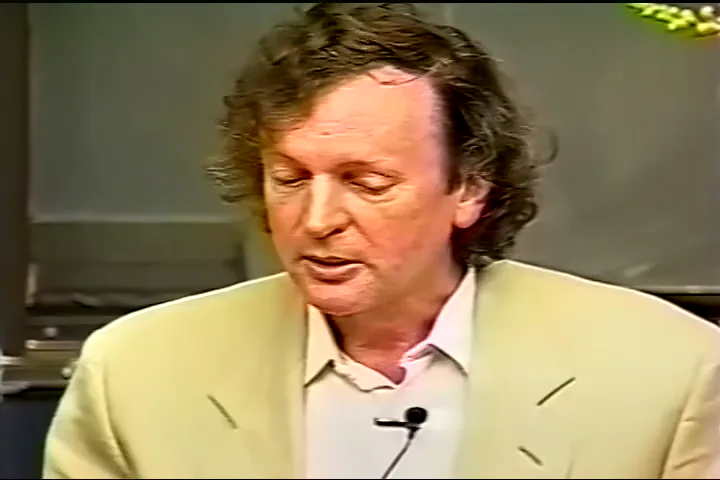
terence mckenna, ralph abraham, and rupert sheldrake's 1998 trialogue on evolutionary psychology, consciousness, and the mind's development through human prehistory.
a 1998 trialogue between terence mckenna, rupert sheldrake, and ralph abraham. three perspectives on the evolution of consciousness and the evolutionary mind.
terence mckenna, ralph abraham, and rupert sheldrake recorded in santa cruz in june 1998, discussing skepticism, epistemology, and the crisis of statistical methodology in modern s