Light Of Nature Day 2

Recorded as a benefit lecture for Botanical Dimensions and KPFK radio, McKenna explores the DMT experience, encounters with non-human intelligence in altered states, and his theory that psychedelic plants drive human consciousness and cultural evolution. He traces his personal quest from his 1967 DMT encounter - where he met machine elf entities entirely absent from historical art - through Tibetan shamanism and Indonesian rainforests, arguing that nature itself is a linguistic system in which consciousness emerges. McKenna contends that shamanism represents humanity's earliest science of interdimensional contact and that plants mediate the transformation of human culture, not merely personal transcendence. Throughout, he sketches a vision of post-human civilization where direct feeling replaces mediated hierarchy and consciousness becomes the frontier worth exploring. This is foundational listening for anyone serious about the genealogy of psychedelic thought and its implications for human evolution.
transcriptmachine-transcribed, unedited
So we are organically meeting together and going to absorb some information from the other world,
and I'm real proud to introduce Terence McKenna.
I do want to mention this is a benefit for Botanical Dimensions and KPFK.
If you didn't see the promotional material at the back of the room,
you might look at it during the intermission.
Botanical Dimensions is the real world kind of real politic response to all the issues that we deal with
that Kat and I hammered out over the last 11 years, really.
And what it boils down to is a plant rescue project built around a 20-acre botanical garden in Hawaii.
And what we're doing there is trying to bring in plants that are threatened in the warm tropics.
Either the extinction of the species is threatened or the knowledge of its medicinal or herbal or shamanic use is in danger of being lost.
There are a lot of fancy organizations, World Wildlife Fund, Earth Watch, Earth First, that are saving the rainforest or at least fighting that battle legally
and by getting huge tracts of forest in the tropics made into reserves.
Nobody really even cognizes or is focused on saving ethnobotanical lore.
In other words, the very subtle relationship between Aboriginal people and botanical resources in their environment.
So that's something we're doing.
What was touched on last night and which is sort of one of the centerpiece themes of this point of view
is the felt presence of some kind of alien intelligence
that is somehow cotangent to the human experience
for different people in different ways
with varying degrees of intensity in different times and places.
And though, you know, at the bedrock of my take on things is the notion that there is really finally a mystery
wrapped in an enigma, that there is no resolution.
Nevertheless, as you close distance with this mystery,
there are a series of analogical metaphors
that don't really suggest themselves
but that are communicated to you by the other.
And one of these analogical metaphors
is the presence of this alien intellect,
this organized other
that is folklorically present in tradition
as fairies, gnomes, elves, djinns, afrites, sprites, tree spirits, that sort of thing
and anecdotally present
in rural cultures throughout the world
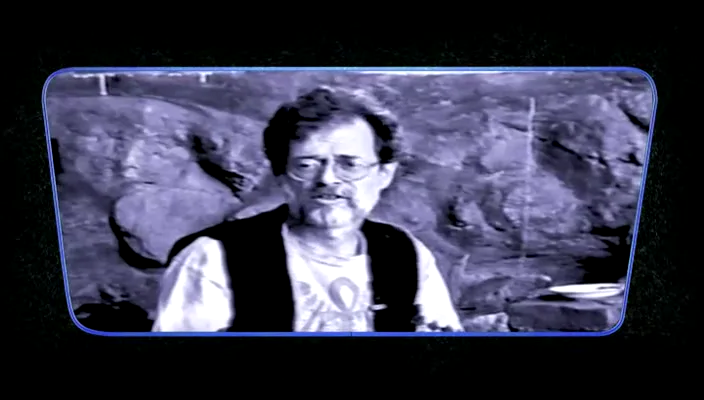
as the poltergeist and the milk-souring fairy
and the thing seems to reside in a curious area
that is not epistemically clearly defined for the culture.
In other words, the question of is it real or not
is thought to be sort of tasteless.
I mean, you would intuitively sense
if you were drinking in an Irish pub, I think,
and people began to spin leprechaun stories
that the question, is it real, is a real bring-down.
You know, it isn't really like that
because the question, is it real,
is ultimately can be shown to be infantile in any situation.
I mean, is the Bank of America real?
What are, you know, immediately you realize
that there are just assumptions skating over the mystery.
But this felt presence of the other
I choose to talk about so much
because it was for me
such an astonishing personal surprise.
My, I was raised Roman Catholic
and indulged in the kind of theological fiddle-faddle
that that involves
and then grew out of that
into atheism, into agnosticism
and by the time I got to college
I was reading Jean-Paul Sartre
and Husserl and these people
and pretty much the main, had followed
my intellectual ontogeny
had followed historical philogeny
and I had arrived in the 20th century.
And then, having thought I had absorbed
the lessons of LSD
which seemed to me to be
to reinforce and confirm
the theories of Freud
concerning the dynamics of the psyche
that it was about repressed memory
repressed desire
sexual neurosis
parental, you know,
follow-ups in the projection
of the parental energy patterns
and this kind of thing
and then someone came to me
one rainy February evening in 1967
and really a mad person
a kind of a social menace
an intellectual criminal
this guy had said to me
only months before
we must live as if the apocalypse
has already happened
and here he was on my doorstep
and he wore these little black suits
that he buttoned up to the throat
anyway
he came in and he said
something that you might be interested in
and brought out
a sample of dimethyltryptamine
that he had somehow come into contact with
and I said
well
what is it?
and he said
well
it's this short acting
it's a flash
he said
and I said
how long does it last?
that was my first mistake
he said
oh it doesn't last long
so I said
okay
we'll do it
and we did it
and
I discovered
I had
I guess it's called
a peak experience
or a core revelation
or being born again
or having your third eye opened
or something
which was
it was a revelation
of an alien dimension
of a brightly lit
inhabited
non-three-dimensional
self-contorting
sustained
organic
linguistically intending
modality
that couldn't be stopped
or held back
or denied
I mean
I sank
to the floor
I couldn't move
and
this
disystolic
hallucination
of tumbling forward
into these fractal
geometric spaces
made of light
and then I found myself
in the
sort of
auric equivalent
of the Pope's
private chapel
and
and there were
insect elf machines
proffering
strange
little tablets
with strange writing
on them
and I was
aghast
completely
appalled
because
the transition
had been
a matter
of seconds
and
my
entire
expectation
of the nature
of the world
was just being
shredded
in front of me
I've never
actually
gotten over it
and
you know
it all went on
I mean
they were
speaking
in some
kind
there were
these
self-transforming
machine elf
creatures
were speaking
in some kind
of colored
language
which
condensed
into these
rotating
machines
that were
like
Fabergé
eggs
but crafted
out of
luminescence
superconducting
ceramics
and
liquid crystal
gels
and all
this stuff
was just
so
weird
and so
alien
and so
unenglishable
that I felt
like it was
some
a complete
shock
I mean
the literal
turning
inside out
of the
intellectual
universe
and I
had
come to
this
fair
I thought
fairly
intellectually
prepared
you know
I mean
a kid
but nevertheless
double Scorpio
art history
major
Hieronymus Bosch
fan
Moby Dick
William Burroughs
you know
and
and it was
as I came
down
and this
this went
on for
like two
or three
minutes
this
situation
of
discontinent
orthogonal
dimensions
to reality
just
engulfing
me
and then
as I
came
out of
it
and the
room
sort of
reassembled
itself
I said
I can't
believe it
it's
impossible
it's
impossible
that
I mean
to call
that a
drug
is
ridiculous
I mean
it just
means
that you
just
don't
know
you
just
don't
have
a
word
for
it
and
so
you
putter
around
and
you
come
upon
this
very
sloppy
concept
of
something
goes
into
your
body
and
there's
a
chain
it's
not
like
that
it's
like
being
struck
by
noetic
lightning
and
the
other
thing
about
it
which
astonished
me
was
there
is
no
clue
in
this
world
you
know
in
the
carpets
of
central
asia
in
the
myths
of
the
maya
in
the
visions
of
an
archembelo
or a
frangelico
or a
bosch
there
is not
a hint
not
a clue
not
an
atom
of
the
presence
of
this
thing
and
when
you
look
at the
religious
hierophanies
of the
human
species
it
doesn't
have
the
same
vibe
it
doesn't
have
the
same
charge
religion
is
all
about
dissolving
into
unitary
states
of
love
and
translinguistic
oceanic
unity
and this
sort of
thing
this
was not
like
that
this
was
more
multiplistic
than
the
universe
that
we
share
with
each
other
it
was
almost
like
the
victory
of
neoplatonic
metaphysics
everything
had become
made
out of
a
fourth
dimensional
tesseractual
mosaic
of
energy
so
I
was
just
quite
knocked
off
my
goal
of
understanding
this
there
was
really
no
choice
you
see
and
I
don't
know
how
it
hits
other
people
I
mean
there
is
there
are
many
things
that
can
be
said
about
introducing
a
chemical
into
your
body
they've
shown
that
certain
people
are
fifty
thousand
times
more
sensitive
to
the
us
are
our
complement
of
synaptic
receptors
for
psychoactive
alkaloids
so
that
you
know
there
may
be
something
to
the
notion
that
the
Celts
tend
to
be
poets
the
you
know
certain
people
certain
peoples
tend
to be
expressive
in
certain
artistic
modes
or
certain
senses
seem
to be
accentuated
for
certain
human
subgroups
but
whatever
the
explanation
for
how
it
hit
me
I
felt
that
it
was
like
a
call
there
was
no
turning
back
from
trying
to
understand
that
because
there
is
no
place
for
it
in
our
world
and
yet
it
is
overwhelmingly
existentially
real
you see
and
easily
accessed
I'm
not
peddling
that
you
have
to
go
to
some
place
in
India
with
poor
sanitation
and
put
yourself
at
somebody's
feet
for a
dozen
years
or
something
like
that
the
enunciation
of
the
presence
of
this
dimension
should
inspire
some
kind
of
coming
to
terms
with
it
I
mean
it's
preposterous
that
and
prop
up
all
these
reductionist
guys
and
trot
them
out
to
give
the
statistics
on
the
distribution
of
G-type
stars
and
all
this
sort
of
thing
because
the fact
is
what
blinds
us
to the
presence
of
alien
intelligence
is
linguistic
and cultural
bias
operating
on
ourselves
the
world
which
we
perceive
is
a
tiny
fraction
of
the
world
which
we
can
perceive
which
is
a
tiny
fraction
of
the
perceivable
world
you
see
so
we
operate
on a
very
narrow
slice
based
on
cultural
conventions
so
the
important
thing
if
synergizing
progress
is the
notion
to be
maximized
and I
think
it's
the
notion
to be
maximized
is to
try and
locate
the
blind
spot
in
the
culture
the
place
where
the
culture
isn't
looking
because
it
dare
not
because
if
it
were
to
look
there
its
previous
values
would
dissolve
you
see
and
I
think
that
place
is
the
psychedelic
experience
as it
emerges
out
of
nature
and
as
human
societies
interact
with the
psychedelic
experience
in
nature
they
inevitably
secrete
the institution
of
shamanism
like a
pearl
around
this
umbilicus
or this
nexus
point
or this
loci
of
interdimensional
data
flow
which is
really
what it
is
it's
the
point
that
under
certain
conditions
which
have to
do
with
these
molecules
that
have
evolved
in
these
species
which
have
this
weirdly
quasi
symbiotic
relationship
to our
species
you
punch
through
the
veil
you
know
Melville
said
if you
would
strike
through
the mask
and that's
what's
done
you
strike
through
the mask
of the
coordinates
of apparent
reality
and then
this thing
is there
which
to me
is a
miracle
it
transcended
any miracle
I could ever
ask for
because it
not only
had the
quality
of a
miracle
as I
imagined
it
it had
the quality
of a
miracle
as I
could not
have
imagined
it
was
entirely
charged
with
the energy
of the
other
it
had the
ambiguity
of a
pun
a kind
of
zany
impossible
improbable
hysterical
revelation
of the
joke
the
self
contradiction
the
provisional
nature
of it
all
but it
really is
a Marx
Brothers
movie
in some
sense
so I
pursued it
first
to
Nepal
and
involvement
with
pre-Buddhist
shamanism
in Tibet
because I
first
the thing
that puzzled
me most
I guess
because I
was an
art historian
was this
absence of
the theme
in the
artistic
productions
of humankind
and I
felt that
maybe there
was a trace
of it
in the
artistic
conceptions
of the
old
pantheon
of Tibetan
shamanism
and that
central Asian
Tibetan
shamanism
had actually
created
astronauts
of inner
space
that had
gotten
good
recon
on this
same
area
you know
the
Dharma
Palas
the
guardians
of
the
Dharma
are
not
Buddhist
deities
per se
they are
autothenous
Tibetan
folk
demons
that
protect
the
Dharma
by virtue
of the
fact
of having
been
overcome
in
magical
battles
by
great
Buddhist
saints
who
came
to
Tibet
in fact
there
are
or
were
before
the
Chinese
occupation
monasteries
in Tibet
where the
vow of
fealty
to the
Dharma
on the
part
of the
Dharma
Pala
had to
be
renewed
by the
monks
every
hours
or
the
thing
would
be
on
its
own
and
bust
up
the
countryside
I'm
just
telling
you
what
they
told
me
so
it
seemed
to me
that
this
raw
sense
of the
shamanically
accessed
demonic
realm
was
there
and
I
also
saw
traces
in
Hellenistic
Gnosticism
and
alchemy
but
such
thin
traces
so
I
went to
Nepal
immersed
myself
in that
and
decided
ultimately
that
it was
inaccessible
I wasn't
sure whether
it was
there or
not
and
then
I
placed
myself
in the
context
of
nature
by
moving
my
sphere
of
operations
to
eastern
Indonesia
to
the
climaxed
continental
rainforests
of the
ancient
continent
of
Sundaland
you see
Indonesia
was a
continent
until as
recently as
120,000
years ago
and then
with the
melting of
the glaciers
and the
subsidence
of this
continent
it became
a vast
group
of islands
and I
think
that
it was
my
good
fortune
or the
fortune
of my
fate
because
it was
prudent
for me
at that
time
in the
late
60s
to remain
outside
the
United
States
and so
I sort
of had
to become
the hero
I had
pretended
to my
friends
that I
was
which
I wasn't
I had
an around
the world
air ticket
and was
entirely
a preppy
poseur
but
suddenly
return
was not
a possibility
and so
I became
and my
apologies
to Buddhists
in the
audience
a professional
butterfly
collector
and I
pursued this
blood sport
for many
months
in these
remote
montane
jungles
of eastern
Indonesia
and that
was
where the
the missing
link in
the quest
for the
resolution
of the
meaning of
DMT
and spirit
fell into
place
because I
saw
what most
of us only
see on
National
Geographic
specials
which is
the real
fact of
the rainforest
the real
fact of
organic nature
and how
nature
is
communication
not only
are the
species
that comprise
the biota
linked by
pheromones
and
acoustical
signals
and
color
signals
and all
of these
various
methods
by which
communication
is seeping
around
in fact
nature
ultimately
resolves itself
into
a self
reflecting
syntactical
metasystem
and
you can
pursue this
right down
to the
DNA
working as
it does
with
nucleotide
sequences
that code
code
right
that means
arbitrarily
assigned
code
for certain
amino acids
it means
that
organic
objects
are
essentially
utterances
in
three
dimensional
some kind
of universally
distributed
linguistic
intent
this is what
it means
when it says
in the beginning
was the word
nature
is that
word
this
infinitely
self
adumbrating
fractal
syntactical
hallucination
that
has an
infinite
number
of facets
for
potential
regarding
and self
regarding
and
then
you know
might
invoke
here
Gödel's
incompleteness
theorem
which as
I'm sure
many of
you know
was
Kurt Gödel's
brilliant
contribution
to
theoretical
mathematics
where he
showed
that
the
possible
set
of
true
formal
statements
generated
by any
formal
system
was
exceeded
or
exceeded
the
possible
set
of true
formal
statements
which
the rules
of that
system
allowed
he showed
this for
simple
arithmetic
showed
that
and what
this
means
friends
is that
what was
called
truth
up until
the beginning
of the
20th
century
is
absolutely
impossible
that's
what
Gödel's
incompleteness
theorem
secures
it shows
that there
is no
ultimate
closure
in an
effort
to
describe
and
so
in a
way
my
take
on
nature
and
culture
and
man
is
that
human
language
is
a
meta
linguistic
system
generated
out of
the
necessary
formal
incompleteness
of nature
you see
it's that
nature
is a
self-describing
genetic
language
and yet
out of it
arises
something
which is
not
formally
predicted
by its
constraints
and rules
there's a
symmetry
break
there
and a
so-called
emergent
property
comes into
view
this
emergent
property
is
our
unique
ability
to
provisionally
code
sound
to meaning
so that
we then
can freely
command
and reconstruct
the world
we imagine
that we
do this
for our
own
purposes
of
communication
the
analysis
that I'm
suggesting
would
seem to
indicate
that
actually
we do
it
because
we are
complicated
enzyme
systems
that are
moving
linguistic
charge
around
inside
some
kind
of
meta
system
very
important
for
the
emergence
of
new
order
out
of
nature
you see
and I
talked about
this a little
last night
the fact
that it
is
contrived
provisional
is very
interesting
it
it doesn't
arise
out of
the
gene
structure
rather
it is
agreed
upon
by
individuals
who are
living
at the
time
that
the
linguistic
structure
whatever
it is
emerges
into
consciousness
well
since
individuals
are
replaced
the
thing
is
much
more
in
genetic
component
of
an
organism
is
a
physical
structure
stabilized
by
atomic
bonds
possibly
stabilized
by
a
phenomenon
like
room
temperature
superconductivity
in
the
way
nature
works
is
to
conserve
the
genes
and
so
molecular
machinery
has
been
created
to
do
that
but
there
is
no
mechanism
in
nature
with
the
same
kind
of
binding
force
that
conserves
meaning
is
some
kind
of
freely
commandable
open-ended
self-evolving
system
the
rules
are
that
there
are
no
rules
meaning
consequently
addresses
itself
to
a
much
larger
potential
modality
of
expression
than
the
genes
the
genes
basically
repeat
themselves
over
and
over
almost
like
homeric
poetry
where
the
idea
is
that
it
be
memorized
and
repeated
and
that's
what
sexuality
is
about
is
memorizing
and
repeating
gene
structures
handing
on
parts
of
the
story
but
the
epigenetic
the
creation
of
linguistic
systems
where
meaning
can be
freely
commanded
allows
very
rapid
evolution
of
cultural
norms
and
what
I
suggested
last
night
and
want
to
say
more
about
tonight
is
that
this
process
is
mediated
by
plants
it
is
synergized
in
human
beings
by
plants
of
all
sorts
I
mean
we
are
obsessed
with
drugs
and
short
term
spectacular
effects
but
think
about
the
effect
on
a
culture
of
the
presence
or
absence
of
say
sugar
or
the
presence
or
absence
of
coffee
what
human
culture
can
essentially
be
seen
to
be
is
a
series
of
plant
established
developmental
creodes
for
a
higher
mammal
the
first
fact that we are omnivorous lays us open for the formation of these weird relationships to things
in our food chain. Everybody is taught in school that the renaissance, the close of the middle
ages, the rise of urban culture all had to do with the search for spices, right? Bringing spices
back to Europe. Well, why was it so important, you know, that a drive to simply broaden the palette
of Europe is given credit for the redefining of post-medieval civilization? Very strange.
Hoffman and Ruck and Wasson showed that the Eleusinian Mysteries, which were the philosophical
and experiential linchpin of the ancient world's cosmology, the Hellenistic cosmology, was a cult
of ergotized beer. There, every September at Eleusis, this mystery was carried out, and everyone
who was anyone participated in it, and you only got to do it once in your life, so you had only one
take. The point is clear. As you look at human culture in all times and places, the way in which
our cultural institutions have been molded by these so-called tertiary compounds in plants is very
suggestive. It seems to me that the felt presence of the other, the alien intelligence, the being from
outer space, is actually co-present with us on this earth, and that the problem is not the finding
of it, but the recognizing of it when it is seen, in the same way that I think in the present cultural
crisis, everyone is crying, answers, answers. We have to have answers. The fact is, we have the answers.
The question is to face the answers. You know, the answer to self-empowerment lies in the psychedelic
experience. The answer to dissolving the hierarchically imposed set of mythical conventions that disempower
us lies in the psychedelic experience. Because what is really happening is a return to the primacy
of feeling. And feeling is not something you can convey to people the way you convey facts to them.
Facts can be handed down every week through Time magazine and the latest issue of Science News and Nature.
But feelings will not lend themselves to that marketable, hierarchically distributed system. And consequently,
feelings represent a backwash against that. Yet feeling is the modality in which we all operate.
So as long as we are under the umbrella of the print-created linear post-medieval institutions that promote the myth
of the public, the notion of the atomic individual, the notion that we are all alike, basically, then we are going to be
unempowered. The amazing thing to me about the psychedelic experience is that it can be kept under wraps.
That people don't insist. That somehow we are leaving it to experts to figure it out. But did you know that the experts are not allowed to work it out?
That in this particular area, the entire human race has been relegated to an infantile status.
It is not professionally possible to do work with these things. Nevertheless, our cultural crisis is deepening. Deepening mainly because we have very poor connections
connections between our fragmented and autonomous psychic structures within ourselves as individuals and within ourselves as a society.
Our whole problem is that we can't communicate with each other. We can't express intention.
The psychedelics are sitting there waiting to unify us, to introduce us to the trans-linguistic intention, to carry us forward into a realm of appropriate cultural activity, which is, to my mind, the realm beyond history.
Beyond history lies effortless and appropriate cultural activity. And nature has preceded us, as it always does, by laying out models that can be followed to realize this.
As an example, and by request, I'll point out that the 19th century had a titular animal. Its titular animal was the horse, idealized as the steam engine, the iron horse.
And Marx talked about the locomotive of history, and there was this whole focusing on the horse archetype, which in the 20th century gave way to the titular animal, the raptor, the bird of prey, as exemplified by high-performance fighter aircraft as the kind of ultimate union of man and machine in some kind of glorification of the completion of the
of a certain set of cultural ideals of a certain set of cultural ideals, you see.
Well, in thinking about this, and in thinking about how language is the cultural frontier of our species, I went to nature looking for models of how we might move beyond the bird of prey, which when you think about it, it is the American symbol.
It was also the symbol of the Third Reich. And a lot of creepy scenes have actually been into birds of prey. When Alaric the Visigoth, not even birds of prey, when Alaric the Visigoth burned Eleusis, it was the crow fluttered on his battle standard as the greasy smoke swept by.
So these dark birds have been with us. Anyway, in looking for a new titular animal and drawing the conclusion of what it would mean, I was drawn to look strangely enough at cephalopods, octopi, because I felt that, first of all, they are extremely alien.
The break between our line of development in the phylogenetic tree and the mollusca, which is what a cephalopod is, is about 700 million years ago.
Nevertheless, and many of you who are students of evolution know that when they talk about parallel evolution, they always drag out the example of the optical system of the octopi.
Because, isn't this astonishing, it's very much like the human eye, and yet it developed entirely independently, and this shows how the same set of external factors impinging on a raw gene pool will inevitably sculpt the same organ to the same end, and so forth and so on.
Well, the optical capacity of octopi is one thing. What interested me was their linguistic organization.
They are virtually entirely nervous system. First of all, they have eight arms in the case of the octopods, and ten arms in the case of the squid, the decapods.
And so, coordinating all these organs of manipulation has given them a very evolved nervous system.
Then they have this highly evolved ocular system. But what is really interesting about them is that they communicate with each other by changing the color and texture of their skin and their physical shape.
You may have known that octopi could change colors, but you may have thought it was camouflage or something very passive like that.
It isn't that. It isn't that at all. They have a vast repertoire of traveling bars, dots, blushes, merging pastels, herringbone patterns, tweeds,
mottled this and that, can blush from apricot through puce into dove gray and on to olive, do all of these things, communicating to each other.
That is what this enlarged optical system is for, is to be able to see each other.
The other thing which they can do, besides having these chromatophores on the surface of their skin,
is they can change the texture of the skin's surface, can make it rugose, populate, smooth, lobed, rubbery, runnled, so forth and so on.
And then, of course, being shell-less mollusks, they can hide arms and display certain parts of themselves and carry on a dance.
Well, when you analyze what is going on here, what at first seems like merely fascinating facts from natural history,
begins to take on a more profound aspect, because it is an ontological transformation of language that is going on in front of you.
Note that, by being able to communicate visually, they have no need of a conventionalized, culturally reinforced dictionary.
Rather, they experience pure intent of each other without ambiguity,
because each octopod can see what is meant.
This is very important, can see what is meant.
And I think that this heralds, or could be made to herald,
a transformation in our own definitions of language and communication.
What we need is to see what we mean.
It's not without consequence or implication that when we try to communicate the notion of clarity of speech,
we always shift into visual metaphors.
I see what you mean.
He painted a picture.
His description was very colorful.
It means that when we intend to indicate a lack of ambiguity in communication,
we shift to visual analogies.
This can, in fact, be actualized.
And, in fact, this is what is happening in the psychedelic experience,
is that we discover, just under the surface of human biological organization,
the next level in the organization of language.
It's the ability to generate some kind of acoustical hologram
that is manipulated by linguistic intent.
Now, don't ask me how this happens,
because nobody knows how it happens.
At this point, it's magic.
Nevertheless, the fact is, it does happen.
You can have this experience.
It represents a synesthesia in the presence of ongoing communication.
It is, in fact, telepathy.
It is not what we thought telepathy would be,
which, I suppose, if you're like me,
you imagine telepathy would be hearing what other people think.
It isn't that.
It's seeing what other people mean.
And them also seeing what they mean.
So that once something has been communicated,
both parties can walk around it and look at it,
the way you study a Brancusi or a Giacometti in an art gallery.
By eliminating the ambiguity of the audio signal
and substituting the concreteness of the visual image,
the membrane of separation that allows the fiction of our individuality
can be temporarily overcome, you see.
And the temporary overcoming of the illusion of individuality
is a much richer notion of ego death
than the kind of white light, null states that it has imagined to be.
Because the overcoming of the illusion of individuality
has a political consequence.
Political consequences.
The political consequences are
that one can love one's neighbor, you see.
Because the commonality of being is felt.
Felt.
Not reasoned toward or propagandized into
or behaviorally reinforced, but felt.
This is why there is this persistent notion
which tracks these psychedelic compounds
of a new political order based on love,
which is, you know, I mean, it was a hard thing to say in the panhandle in 1965.
It's not easy to say in heavy metal L.A. in 1987.
But it seems to be the fact of the matter
that love, which poets have celebrated for eons as ineffable,
may in fact have certain ineffable dimensions attached to it.
But it may in fact be more effable than we had previously cared to imagine.
And it's the invoking of the effability of love
has to do with discovering the shared birthright,
the atemporal dimension that is co-present with this reality,
and that is a vast reservoir of anchoring,
existential anchoring for each and all of us in our lives.
So my response to feeling the political pull of this,
feeling the power to transform language
that resided in these things,
was to go to the people who I thought would know most about it,
the shamans for whom hallucinogenic shamanism
has never been an issue,
for whom the notion that you're supposed to do it on the natch
is a patent absurdity.
I mean, if you're serious about doing it on the natch,
I suggest you eliminate all food
because this notion of the pristine self
somehow riding above the muck of the world
carrying on a spiritual evolution
is absolute foolishness.
I mean, we are made of the stuff of the world.
people who do not confront the presence of the hallucinogenic possibility
are turning their back on their birthright
in the same way that if you do not experience sex
throughout your life,
you are turning your back on your birthright.
I mean, after all, we could argue that
to allow another person to touch you
is to not do it on the natch, right?
But, dear friends, we're slicing too close to the bone here
to take that approach.
It's much better, I think, to open to the world.
The world is communication.
Nature is the great teacher.
All human gurus are simply distillations
of the wave of nature that is coming at you.
So, you can just short-circuit the whole human boil down
and go straight to the executive suite
by putting yourself under a tree in the wilderness.
I mean, they all have said this,
but they need to be taken more seriously
on the subject of their own expendability.
Me too.
Going to the Amazon with these kinds of notions
and looking at what had been achieved there,
I came to have a vision then
of the future that could be.
That we are sort of hurling ourselves
into a new stone age
where the fruits of the prodigal wandering
that I discussed in such detail last night
can be used to infuse new meaning
into that paradise.
The imagination of man and woman
is so incomparably rich
and exerts such an attraction on us
as the builder monkey
that we have to honor that.
We cannot demonize that
and preach a kind of naturalism
that if actually put in place
would cause the starvation
of tens of millions of people.
We have passed the point
where some kind of Luddite reform
can save us.
It's only, I think,
very self-indulgent elites
that can preach voluntary simplicity
because a lot of people
are experiencing involuntary simplicity
and unless you're one of them
it rings rather hollow
to be told that Zen values are best.
So, I think that reinserting ourselves
into nature
is inspiration for cultural design.
That's what it is.
It's not flight from the design process
but a reinvigoration of it
and some of you may be aware
of the concept of nanotechnology
where everything is built
at the molecular level.
We, by studying the mechanisms
of the cell
and the immune system
and DNA
we begin to have a picture
of how molecules and atoms
are the machine parts
of a microcosmic world
that if we were elf chemists
we could make our way into
and create anything
that we could imagine.
I mean, I can foresee a world
where all machines
will be made by DNA-like polymers
that will code base materials
into larger and larger aggregates.
The miniaturization
of our world
is a great frontier.
As culture
becomes more enveloping
its physical manifestation
should become less material.
So the ultimate notion
is of the world
turned back
to the form it held
let's say
35,000 years ago
where people live
in an environment
of entirely climaxed
natural perfection.
However,
behind their eyelids
lies
a culturally
and consensually
validated
data phase space
that is culture
civilization
turn each of us
into a telepathic aquarium
that has a direct pipeline
to the general ocean
of mind and being.
This is possible.
In fact,
it's not only possible
it may be
the only
decent solution
to download ourselves
into another dimension.
And I want to note
in passing
the collapse
of Max Headroom
and what a tragedy
I think that is
that his last show
was last night.
This was
a weird
force
for cultural transformation
but to be applauded
if anybody here tonight
has anything
to do with it
I wish them luck.
But this sort of notion
you know
people
the Max Headroom people
and the William Gibson people
have a very high tech
take on this
because they're interested
in accentuating
this tight
blue jeans
cyberpunk
kind of notion.
But in fact
the worlds
that they describe
will have many
many
different
social
subgroups
and social
ecosystems
forming in them
what the future
really means
is
choice
to become
who we are
to flower out
to find
our own way
McLuhan saw
all this
twenty years ago
he said
that the
rise of global
electronic feudalism
would create
an atomistic
fragmentation
of culture
it may well
be that within
fifty years
the largest
organizational entity
on the planet
will be
corporations
with a few
million
loyal employees
and all
larger
social institutions
will have
disappeared
because they
don't command
loyalty
in a
social
environment
where direct
experience
has become
empowered
and this
empowering
of direct
experience
this return
to the
feminine
this
legitimizing
of the
presence
of the
vaster
regions
of the
unconscious
these are
all
aspects
of this
emerging
paradigm
of the
spirit
understanding
and
imagination
in the
light
of nature
which is
what this
two night
party
has been
called
is
a
definition
of the
spirit
understanding
and imagination
in the
light of
nature
in other
words
true
understanding
poetic
imagination
standing
as a
mirror
before
nature
as
object
will
cause
the
hologrammatic
presence
of the
spirit
to
magically
appear
it
will
be
then
seen
to be
a
kind
of
emergent
quality
of the
situation
that was
previously
masked
simply
because the
elements
had not
fallen
into the
correct
arrangement
and I
think
you know
as we
move
forward
through
time
over the
next
twenty-five
years
there
will
be
many
profits
of the
transcendental
object
at the
end of
time
many
takes
the
important
thing
I think
is to
recall
Gödel's
incompleteness
theorem
and to
always
recognize
the
provisional
nature
of the
metaphysical
goods
that you're
going to
be sold
nobody
has the
faintest
notion
of what's
going on
it's important
to keep
that in
mind
if you
have that
in mind
everything
else
then the
game
proceeds
much
more
cleanly
what is
ahead of
us
the
essence
of
it
is
its
unknowability
its
promise
is
transformation
its
theater
of
occurrence
is
the
here
and
now
we
are
not
waiting
for it
to
begin
it
has
already
happened
for
us
and
our
job
is
to
understand
how
that
can
be
so
Plato
said
time
is
the
moving
image
of
eternity
my
notion
of
shamanism
is
it
is
that
state
of
mind
which
accrues
to
those
who
have
seen
the
end
by
cultivating
this
notion
of
closure
with
hyperspace
imaged
as
the
archaic
return
to
the
world
of
the
pre-cultural
ambiance
we
can
have
an
anticipation
of
the
still
in
Eden
it
is
we
who
have
undergone
the
fall
and
the
recurso
and
now
the
laden
prodigal
returns
to
beat
at the
doors
of
the
manorial
home
the
birthright
and
within
I
think
lies
the
beginnings
of
true
civilization
we
are
the
forerunners
of
a
truly
moral
and
ethical
human
society
the
deepest
aspirations
however
badly
mangled
and
mishandled
by our
traditions
nevertheless
still
have
the
potential
for
archetypal
fruition
within
them
the
torch
that
has
been
passed
from
generation
to
generation
ad
infinitum
back
into
the
distant
past
is
alive
and
by
some
strange
quirk
of
the
metaphysical
machinery
it's
our
great
privilege
to
live
through
this
symmetry
break
this
revelation
of the
next
level
of the
open
ended
mystery
and
I
think
that
the
to
it
with
an
open
mind
a
sense
of
caring
a
sense
of
wonder
and
a
sense
of
real
grounded
intellectually
firm
hope
so
that's
all
I
want
to
say
this
evening
I
think
we'll
break
for
about
minutes
and
then
we'll
have
questions
thank you
very much
okay
well now
comes
my
favorite
part
of
these
things
which
is
the
period
where
there's
interaction
because
I
think
you know they're really this is really a group process every one of you to some
degree has taken upon yourself the role of the Magellan in the living room and
probably every one in this room has at some time or another gazed upon things
no other human eye has ever beheld and you know the psychedelic dimension is
not yet a science we're more like explorers comparing our crudely drawn
maps and hastily scrawled journal notes to try and together get a picture of
this new continent in the imagination so I'm yours sir you have said in your
book about the that the mushroom was genetically engineered for producing
cytosine by telling intelligent what do you think now about the possibility of
us making that a game within those genes producing cytosine in other kind of
organisms like fungial plants I don't know about animals oh well interesting
question I think it's in the question was I've described the mushroom as
genetically engineered by some other agency for the production of psilocybin what
do I think about the possibility of human beings being able to genetically
manipulate organisms to produce psychedelic compounds I think that the
technology and theory has reached the stage where if there's an enterprising
graduate student within the sound of my voice the way to go is to locate the gene
for psilocybin in the mushroom genome and to translate it via standard
techniques to E coli to Escherichia coli and then you would have a easily grown
bacterium which would be a chemical factory for pouring out psilocybin so if any of you
are aspiring genetic pharmacologists this this would be a fine thing I might
elaborate on the answer some of you who are not familiar with the premise the
reason I suggested that the mushroom might have been engineered and be in fact an
artifact of an alien intelligence was number one of course the informational
content of the trip but number two the fact that psilocybin is for phosphoryloxy and
and dimethyltryptamine the only for phosphorylated indole known to occur in nature you
know out of thousands and thousands of compounds and organisms only one for
phosphorylated compound is known so this suggests that it is artificial or at least
highly unusual you know they're all every week the science magazines are full of
the talk of strategies for locating and identifying extraterrestrial life well a very obvious practical and
scientifically reasonable way to proceed would be to look at the DNA of various life forms on
earth and see if there are any where there is a wild statistical departure from the norm
and whenever you get an organism which is producing or has genes that no other
organism has this is highly suggestive you know because evolutionary types evolve
incrementally out of each other so you would expect that there would be a relative
smoothness in the expression of genetic products that one fungus would be rather
like its taxonomic near relatives one a menasperm or member of the ruby AC would be chemically similar to another in fact of course we do find subtle chemical variations but the presence of a four phosphorylated indole in a fungus like that is very suggestive and what one of the there's an interesting book by
by Cyril Purnampurama called perspectives on the problem of extraterrestrial communication and he outlines there what he believes would be a general strategy for extraterrestrial contact that any kind of species would have to operate against if it were to seriously conduct a search through space and the
model has a ship which at a certain distance from its origin planet it must replicate itself and then at a certain distance replicate again and then again in order to keep the density of ships constant as the sphere of the area being explored expands there have to be more and more of these ships and these ships could be as small as a human's
as an animal cell they don't have to be thought of as Star Trek type ships but the point is this ship contains a message that you have to read and call in because there are so many planets and star systems to be surveyed that the only way such a survey could be conducted is if there were a message in the
in the ship qua organism such that in the gene swarm of an alien planet it would eventually be read by an organism on this planet and that organism would act to do the things necessary to call the central switchboard and then they would say aha we have contact in sector alpha sub n 362
a logical world that we assume to be natural may in fact be the artifacts of a much higher intelligence
intelligence here yes would you speak on the timeline a little oh what a what a kind question there to lead me to my favorite subject well it has to do with why you know people do this for different reasons why people take psychedelic plants and and what lies behind it always and what always lay behind it for me from that very first DMT trip
to you at the beginning was the notion my god this stuff has historical significance it's really important or nobody knows about this carrying with it the notion we are discovering it if we could bring it back somehow it would change the world perhaps people are bringing it back
some sort of fashions or fashions or fashioning mathematical descriptions of reality
I never had that aspiration I just simply defined myself as more humbly than that as a consumer
of ideology as an intellectual who would learn what has been said and done and proposed but
After the DMT experience, I realized that there is unclaimed stuff out in those dimensions.
You know, James Joyce says in Finnegan's Wake,
Up in the end, prospector, you sprout all your worth and woof your wings.
Well, the key word is prospector.
A prospector is a rock hunter.
I wanted to prospect for the alchemical stones.
For the lapis philosophorum, and I conceived it as an idea.
And the timeline, I mean, I think it would come differently for each of us.
For me, it was this incredibly formal, aesthetically symmetrical,
and therefore satisfying idea about what time is.
That the Tao is something which could be mathematically described as a flux of a quality in time.
A quality that I named novelty.
And once I had enunciated it for myself, I saw that that was the part of the world that we have no description for.
We have, science gives us descriptions for what is possible.
But we have no descriptions for what, out of the set of the possible, undergoes the actual formality of occurring.
Why are certain things selected to come to be?
And I saw then the notion of the Tao, which is generally presented as a kind of intuitive notion.
You're not supposed to demand too much hard-edged clarity.
You say, just flow with it, man.
You know, flow with it.
Well, when someone says flow to me, I think of equations which would describe flow.
Flow as a dynamical system, which therefore can be mathematically modeled.
And what the timeline is, is a seeing that the very largest patterns which describe the whole birth, evolution, and death of the universe
are repeated at successively shorter and shorter spans of time.
And down into the quantum mechanically and micro-electronically cognizable realms of time.
The realm of the nano and the picoseconds.
And studying the Ching, which I saw then as a kind of phenomenological description of time
produced by the Oriental mind, completely unencumbered by our particular set of cultural conventions.
I mean, certainly having its own set of peculiar conventions, but not ours.
That there is a pattern in nature, not in three-dimensional space, but in time.
A pattern in time on many levels that reproduces itself and can be known, can be formally described.
And once known, can be seen to control the ebb and flow of connectedness.
Or the forward and backward surge of novelty.
And I thought that this was a great insight.
Since it was the only one I had, I could hardly sell it short.
And what pleased me most about it was, you know, a rap is a rap.
It's as good as the rapper.
But here was a mathematically formal idea that could stand on its own,
be examined in the absence of the rapper,
be examined by critics who were as hostile as they cared to be.
It's a tool.
It's in a long line of tools that stretches back toward the first chipped flint
and stretches forward toward the soul made manifest as starship
and alchemical transformation.
But it was the tool that I came upon.
And what is always put against the psychedelic experience is they say,
well, big deal, what's ever come out of it?
So I was pleased that here was a concrete notion that came out of it.
Richard.
Yes, along the line of this time wave,
can you give us a reading of our current time in the not-too-distant future?
I would be only too happy.
The question is, would I care to prophesy based on this timeline?
Yes, one of the assumptions built into the theory is that time is a series of nested resonances
and that each time is composed of resonance with previous and future times on varying levels.
The time we are living through, I call the Roman twilight,
simply because we are living through a period that is in resonance with the time of the last Roman emperors.
And I think if you look at it carefully,
you can begin to see the way this theory proposes to be analogical
and yet formal at the same time.
What was happening in the decades immediately preceding the fall of Rome?
A progressively weakened series of self-indulgent propagandists ruled the greatest empire on earth
with a more and more shaky hand
as they succumb to gonorrhea, mercuric poisoning,
various occult pursuits, millenarian obsessions, and so forth.
Meanwhile, in the East, in Byzantium, a new civilization was unleashing itself.
And if you think of those events which unfolded over a few hundred years as telescoped into a few years in our own era,
you see that with the rise of Gorbachev and the continued mismanagement of the American empire
under the crypto-fascist series of rotating bimbos and buffoons
that we have suffered through.
But what is happening is an empire is being betrayed into eclipse
by self-indulgence and stupidity and bad management,
and its cultural adversary is in ascendancy.
Now, Byzantium never conquered Rome.
It doesn't happen like that.
But what ended was the Roman world of indulgent, cohesive imperialism.
And what it was replaced with was a rise in religious fundamentalism,
a stricter and more Puritan kind of morality,
the rise of epidemic diseases,
and a vast economic retrenchment which initiated what we call the Dark Ages.
Now, in the present situation of the 20th century,
these themes are being recapitulated at an extremely rapid rate.
So their Dark Age is for us a tough three or four years, fortunately.
You know, it's said history occurs first as tragedy, then as farce.
We are the heirs of the vast tragedy of extended history
who live through the curiously mediaized and dehumanized farce of the recapitulation of these themes,
so that, you know, because the very notion that the last ten Roman emperors could be symbolized by someone like the present chief executive
cannot fail to bring a small smile to any open mind, I think.
So what I see happening between, or over the next 24 years, really, is first this retrenchment,
which, hell, it may be upon us, judging by the market's performance Thursday and Friday.
I may not be doing prophecy at all.
This may be recap at this point.
But whether that is a technical move or the actual beginning of the unraveling of the overbought Western capitalistic system,
I can't say, but I will say that by 1989, by mid-1989, by the time the next presidential ritual has been enacted,
it will be clear, I think, that we have entered into a whole new kind of temporal domain,
a kind of temporal domain that will appear superficially to be fairly bleak,
because what it will be, it will be highly chaotic, highly novel, and tending to oscillate wildly around the mean.
So, in other words, there will be no clear trend visible.
There will appear to be progressive surges and then losing of ground,
and then progressive surges and losing of ground.
And this will go on through, till the mid-90s.
Around 1996, 97, the resonance pattern will have shifted,
and we will be occupying a relationship to the late-high middle ages
and the emergence of the new social forms created by the emergence of the mercantile class and the bourgeois.
In other words, private wealth, cities, end of cultural insularity,
a restarting of the economic machinery, and a kind of new flowering,
but still under the shadow of these fundamentalist forces
that will have come into ascendancy in the previous Dark Age.
Then, in 1998, we come into that area,
which is in resonance with the period of the discovery of the new world,
1492, in other words,
and the exploration of the new world and its subjugation over about 150 years,
which followed from that,
will be what will be going on as we close out the millennium.
What the discovery of the new world will mean
in terms of our reenactment of these great themes
is anybody's guess.
It could be the vindication of my style of rap,
a nearby inhabited dimension filled with alien intelligence,
or it may be the vindication of a more orthodox sort of expectation
of extraterrestrial contact,
or perhaps, ultimately, the launching of large telescopes into orbit,
which will confirm for us the existence of oxygen-rich, water-heavy worlds
around nearby stars.
I mean, that alone would make an intellectual revolution
that would leave our world unrecognizable to itself.
We have to recall that as recently as 500 years ago,
the continent that we're inhabiting was unknown.
It was something talked of by wild-eyed dreamers.
You know, it was an impossibility, a psychedelic dimension.
Everyone knew that when you sailed west far enough,
there'd be monsters, and that was the end of it.
It was literally the unconscious.
Now, you know, we deal in the real estate of that unconscious,
and there is no reason why our children should not deal
in the real estate of the psychedelic dimension
that we are discovering and confirming
over the next 10 years or so.
Let me carry this through to the end,
because the good part comes at the end.
After the turn of the century,
the acceleration of the unfolding of these resonances
becomes more and more intense,
and eventually we reach the super-compression of modern times.
This is why I proposed to you last night
the term compressionist for this school of thought
that myself and Sheldrake and Frank Barr
and Ralph Abraham represent,
because we all are talking about
the dense nesting of concrescent systems,
and ultimately, in my own point of view,
the emergence of a transcendental object
at the end of time.
And the end of time is not far off,
as Joyce says in The Wake.
It may not be as far off as ye wish to be congealed.
It is, I think, within the lifetimes of all of us,
there will be an ontological transformation
of the human mode.
So I think the transcendental object is emerging.
Once it has emerged,
there will be no big deal about it,
in the same way that we look back
at the emergence of language,
and nobody jumps around or gets excited about it,
or only a few philosophers do.
And yet the fact that we possess language
is the thumbprint of God upon our species.
It's an impossible break
with previous animal organization.
You can talk all you want
about Coco the talking gorilla
and this and that,
but then you turn to a poem by Andrew Marvel
and you realize, you know,
there is an ontological break here.
There is not an even progress.
So, as we anticipate this thing,
it could be anything.
It could be the visible language
that I indicated as a possibility
earlier this evening.
It could be emergence
in an extraterrestrial mind.
It could be the transcendental emergence
of all and everything.
The Tao made flesh,
the actual collapse of the state vector
into some kind of mysterious completion.
But it's much more rational
to place this kind of singularity
at the end of a complex evolutionary process
like the life of the universe
than at the beginning,
which is the scientific approach
to just say,
well, everything sprang from nothing
for no reason in a single instant,
and please don't ask questions about that
because our map begins
one ten trillionth of a picosecond
after that happened.
We don't talk about that.
Well, isn't this somewhat begging the question
for an intellectual enterprise
that purports to offer an explanation
of how things came to be?
So, the transcendental object,
which suggests to me
a negative Kazuestry,
a purpose in the universe
that is focusing and drawing everything toward it.
And in fact, I've said,
history is the shockwave of eschatology.
History, which lasts 10,000 years,
is this microsecond
of ultra-complex experience
where the penetration of the natural world
by the transcendental object
each exists cotemporaneous with the other
for a historical or geological microsecond.
And then the two terms are merged
and all opposites are dissolved
and somehow the gift is claimed,
the pearl is restored,
and the project is ended.
We are living through that moment,
a 10,000-year rush
from chipping of stone flint
to walking through the violet doorway
of a self-generated hyper-dimensional vehicle
that carries us to our true home.
No wonder it leaves an explosive set of eddies in its wake.
I said last night,
this is what happens
when a culture prepares to depart for the stars.
This is not business as usual.
This is something else entirely.
And it's the intellectual adventure
and challenge of our time
for each of us to understand this
in terms relevant to ourselves
and the people immediately around us.
And so this is the inspiration
for time wave zero.
This is what it maps.
This is the odd thing in the map
that when the time map came through,
it wasn't only a map of historical process,
but there was the transcendental object mapped into it
and all of its sub-reflections could be seen.
This is what Christ was about.
This is what Buddha was about.
This is what your most enlightened moment was about.
You, each of you, and me.
It is, you know,
the hyper-dimensional, particulate reflection of Godhead
scattered back through the flatter plane
of this lower-dimensional slice of experience.
I mean, it's hard to say it any clearer than that.
Here.
Something is happening.

john steele's kpfk radio talk on memory, the kali yuga, and how temporal density shapes consciousness through the lens of eastern philosophy and buddhist concepts of vasana

terence mckenna's philosophical research society lecture. understanding consciousness, psychedelics, and shamanism as keys to human and planetary transformation beyond scientific m
terence mckenna explores the origin of consciousness and why humans emerged from millions of years of simpler biology
terence mckenna presents his theory that psilocybin mushrooms catalyzed human evolution by enhancing visual acuity for hunting, increasing sexual arousal to boost reproduction, and
mike kawitzky's 2009 documentary. some twenty thinkers, framed by terence mckenna's archive recordings, on five questions about evolution, consciousness, god, science and death.