Trialogue Hazelwood
Three pioneering thinkers, Terence McKenna, Ralph Abraham, and Rupert Sheldrake, gathered for their first public trilogue outside California, a weekend-long discussion recorded in 1993 at Hazelhurst in England. The conversation spans consciousness, evolution, time, quantum biology, and unexplained animal phenomena, with extensive focus on how pigeons navigate and on Sheldrake's theory of morphogenetic fields. McKenna brings historical vision and visionary scope on consciousness, Abraham contributes mathematical models of complex dynamics, and Sheldrake challenges mechanistic biology through careful observation and theoretical heresy. Their trilogue format enables genuine dialogue across disciplines, each responding to and building on the others' ideas about the fundamental nature of life and mind.
transcriptmachine-transcribed, unedited
Greetings from Cyberdelic Space.
This is Lorenzo, and I'm your host here in the Psychedelic Salon.
Well, even though it's been less than a week since the last time we got together here in the Salon,
I just couldn't stay away.
There are at least a dozen pressing matters at hand right now,
like all the things I put off doing before my holiday.
But to tell the truth, all I actually feel like doing is listening to some trilogues I've not heard before.
So I guess this is sort of my way of goofing off by listening to Terrence McKenna,
Ralph Abraham, and Rupert Sheldrake hold their first public trilogue outside of California.
The conversation we're about to hear was actually held sometime in 1993,
at Hazelhurst in England.
And their weekend-long trilogue was captured on four cassette tapes that Ralph Abraham loaned to me
for the use in these podcasts.
And each of these tapes is 90 minutes long,
but rather than break them into two programs, as I've done in the past,
I've decided that since we don't have the commercial constraints of radio,
well, why am I conforming to a one-hour format anyway?
You obviously can just pause your player whenever you want.
You know, it's not like turning off a radio program and missing something.
So from now on, I just plan on keeping these tapes, side A and side B, all in one podcast.
And since I did this once before in the past and solicited comments about it,
I'm sure that this will be agreeable with most of you,
because the email I received was essentially all in support of the longer format.
And by the way, I want to express my thanks to all of you who wrote to me about that.
I really do appreciate your comments, and I apologize for not getting back to all of you personally.
But rest assured, I'm thinking about you,
and now that I've got some of your faces in mind after meeting you at Burning Man,
well, you're all becoming much more clear in my mind.
It's really nice to be here in this cyberdelic space with you,
and I hope that you can feel the energy of this mind storm that we're all setting in motion here.
I just don't have any better idea than you do right now about what seems to be bubbling up from inside of us,
but whatever it is, I'm sure that in the end, everything is going to be all right.
As Terrence said in a dream to a dear friend of mine one time.
Okay, that's enough romanticizing for now.
Let's get on with the program and begin with Ralph telling Terrence how much he thinks of him,
but doing so with a lot of humor and back and forth teasing among the three of them.
I really like the way this trilogue begins.
It sounds as if they were actually having a good time together, way back in 1993.
So let's join them now.
A long time ago, for more than 10 years, we are doing this, but primarily in private.
And out of this ongoing process for more than a decade,
we have to become, I think, a kind of a unit or a triad.
And that's why we've been going to introduce ourselves individually, but by this other trick.
So later on, during the weekend, we'll speak more about the process of triloguing,
and of course you'll see it in action.
But to introduce ourselves, this is not a trilogue, but just a trick.
But we will describe each other as we appear to ourselves in the context of this process, triloguing.
So I'll start by describing Terence to himself from ourself.
So Terence seems to be known, better and better known,
and whenever we walk anywhere, someone will come up and recognize him.
And as it says in our program, ethno-pharmacologist.
Well, as a pharmacologist, he's sort of an herbal doctor or something.
But this kind of pharmacology is important to us also in our process.
But for me, Terence is a special person because of the breadth of his knowledge
and the evidence of a phenomenal integrity within it.
First of all, when we first met, Terence was a person asking me about mathematics,
kind of mathematics that I was interested in at that time that nobody else had even heard about.
And as our relationship developed, I saw that he had this philosophy of time, let's say,
or maybe even a mathematical model for the structure of time.
That is an odd thing for a person to be obsessed with.
And from this obsession, he had to learn a great deal about history.
So in our process of triloguing, we find it very much enriched by Terence's phenomenal knowledge of history.
And not only that, but his special way of saying it is sort of a, you're familiar with this here,
a bardic skill so that whatever he says will have more effect than it actually deserves.
Because of his phenomenal apparent conviction in it.
Is he Irish?
Yes.
That's a cooperative process.
What seems to inform or maintain the integrity of his total presentation is some kind of spiritual belief.
I don't know exactly the right word for this, but I can tell that in any way.
And this spiritual belief is outside of any organized system, so we can most easily understand it
in the connection of the archaic revival or pagan spirituality or shamanism.
Anyway, this aspect of Terence, every person is a spectrum of all kinds of things.
And here are just a few of Terence's things that I think are the most obvious in our process of interaction.
The primitive spirituality, which always speaks against any church guru or leader.
I'm almost done.
I'm squirming there.
Finally, besides this information-based personal style and integrity,
there is something else which I think is very important to us,
and that's the adventurer.
That's the willingness to risk going to some kind of edge.
And also the propulsion to talk about it upon me coming back,
fulfilling some kind of responsibility to the community,
which is beyond, which risks more than simply individual development.
It's too long.
Yes.
That's it.
Good.
Well, so it falls to me to share with you my view of Rupert,
who I'm not sure, when I first became aware,
probably it was the nature review,
which I think Rupert should certainly be very grateful to nature,
because in their perverse way,
they saved him perhaps from obscurantism
by calling for the burning of his book.
And my intellectual method has always been to seek out the heretical.
And so when I heard that nature had called for the burning of a book,
I burned up my tires on the way to the store
to see if I couldn't obtain a copy.
And it was very interesting.
And I added it to the slow-rising intellectual edifice
that I had been building for years
in the area of theoretical biology.
I was very interested in Dries and Kemmerer
and the school of vitalism
that refused to genuflect to the idea
that life could be reduced simply to physics and chemistry.
That seemed to me inadequate.
But nevertheless, after reading Sheldrake's book,
it just seemed like an intellectual war
being well fought in a distant land
by someone I was probably not likely to have cross my path.
And I discussed it with other people.
And I was amazed at the animosity
that rained down upon what seemed to me
a fundamentally interesting and not easily dismissed concept.
I can remember one person telling me,
you have only to heft the book in your hand
to tell that it's bogus.
Well, I thought they must have an intuition
into the nature of scientific theory far beyond my own
because I couldn't make the judgment at that stage.
And then Rupert, I believe it was through Ralph,
contacted me and came by bus to see me.
I live in the wine country north of San Francisco.
And I didn't know what I expected.
I was mentored by Eric Janj,
who some of you may know.
And so my vision of the European academic
was of a corpulent, elderly, animated person.
And I projected that and expected that.
And when Rupert arrived,
and Ralph vectored in for that first meeting as well,
isn't that interesting?
That's right.
And there he was.
And I thought I immediately fell under the spell
of his personality, his spirit.
Scientists, I don't know if you spend a lot of time with them,
but they tend to be pretentious boors, most of them.
And the higher they rise,
the more this quality seems exacerbated in their personality.
And I have found Rupert to be
an incredibly generous, intelligent, forgiving person.
I feel very privileged to be in the presence of these people.
I'm sure you all know the cliché
when Newton was asked how he did it.
He said, I stood on the shoulders of giants.
That's how it was done.
And to whatever degree the mathematics of Ralph
and the theoretical constructs of Rupert
have supported my own work.
And not only my work,
but the building and maintaining of a personal vision,
I felt that I've stood on the shoulders of giants.
It's hard to say what the fate of morphogenetic fields
will be in the history of ideas.
But I am convinced that given even a halfway level playing field,
the best ideas always win.
And so I'm very keen to stand close to this man
because I'm absolutely convinced
that the light of glory will fall upon him.
Mechanistic biology has failed
and for 20 years has been involved in the cover-up
of the catastrophic failure of its program
of reducing life to physics and chemistry.
It will not happen soon.
It will not happen ever.
And when the history of biology is written,
I'm convinced that Rupert's work will stand at the turning point
because the key problem in biology is form.
And the ideas that have been put forth in the past
have been inadequate.
And I think the last thing I would like to say
is I'm tremendously admiring of Rupert's simplicity.
And what I mean by that are two things.
Number one, his unwillingness to submit himself
to the hegemony of scientific,
well, the mafia of scientific correctness, essentially.
He is not an academic.
He feeds at the trough of no corporation or university
that I'm aware of.
He is a true independent thinker.
And finally, he brought back and revivified for me
something my mother was very keen to inculcate
into me as a child,
which is the primacy of observation,
the importance of going to the field,
the importance of facing the phenomenon
unaided by apparatus or even mathematics,
the importance of the existential confrontation
with the thing one wishes to understand.
And if you know Rupert,
to stroll with him through an art gallery or a forest
is to feel the mystery of life
and the immediacy of that mystery
and to have a very strong sense of its accessibility.
And that's very important.
I don't want a Gnostic god
that resides outside the imperium.
I want a kind of pantheistic richness
that is right there on the surface.
So I enjoy playing Byron to Rupert's Shelley
and hope to do so this weekend.
Happy Valentine's Day.
Now I'm going to introduce Ralph.
I met Ralph and Terence,
as Terence has described,
when I got off the bus at Sonoma.
Was it Sonoma?
Santa Rosa.
Having been sent by a friend in San Francisco
to meet him.
This was in 1982.
And Ralph was there too.
So I met Terence and Ralph together.
And that's when we found
we had this way of relating together,
which for us has been very helpful.
Well, Ralph is a mathematician,
a chaos mathematician.
But he's much more than that.
Most mathematicians are peculiar,
and he's no exception.
He's peculiar in a very interesting,
accessible way.
One of the things that he's done,
which some of you may be aware of,
is made mathematics accessible
to ordinary people like ourselves
who haven't studied it.
The secret of maths is that
for those who are skilled practitioners,
it's in fact a kind of inner landscape
that they see,
some of them at least,
have an amazing visual intuition.
They're seeing internal pictures.
It's a visual and aesthetic experience.
Things can go into this landscape,
balls roll along,
answers come out,
and they don't quite know how it happened.
Something that's hard to imagine.
But this is what it's all about.
And then they write the thing down
in symbols, in a notation.
And when you look at these symbols,
which is what we see when we look at maths,
it's like music,
as if you've never heard a symphony,
all you've seen is the score.
And if you've only seen the score of the symphony,
the notes on paper,
it doesn't mean much.
It's alienating.
It seems somehow a dry abstract.
But what Ralph has done,
among other things,
has made this mathematical,
the visual intuitions
that lie behind maths
accessible to everybody.
And this is partly because
computers have made it possible to do this.
And he's at the leading edge
of computer graphics.
He's at the University of California
at Santa Cruz,
which is right next to Silicon Valley.
And partly through simple diagrams,
his books on visual dynamics,
visual mathematics,
have no equations in them, whatever.
And introduce you through pictures,
through diagrams,
seen in or imagined in three dimensions,
to the fundamental principles,
not only of classical dynamics,
but of chaotic dynamics.
And for me,
this was the first time
anyone had unveiled
the inner mysteries
of what's going on in maths
and made it
something that
we could grasp intuitively.
It's rather like
having spent all one's life
just seeing musical scores.
You suddenly hear the music.
And this is one of Ralph's gifts
to be able to do this.
His ability to visualize mathematics,
I'm sure, is innate.
But I think it was enhanced
in the late 60s and early 70s
by certain inner experiences
which would fall into the category
of what Terence calls
hands-on pharmacology.
And these he took.
Ralph is,
he doesn't look like it,
but he's an extremist.
And when he does something,
he takes it to extremes.
For the last 20 years,
he's been taking moderation
to extremes.
But when he felt
that the secret
to understanding
the deeper parts
of the mathematical landscape
were substances like DMT,
he took that to extremes too.
And he's also traveled in India.
One of the things
the three of us have in common
is that we've all spent
quite a long time in India.
So Ralph has been in India.
He took that to extremes as well.
He's also studied here in England.
He was at Warwick for a while,
Warwick University.
He lives in Santa Cruz
in the Midson Woods
in a very beautiful place
with wonderful woodland
and a little valley
down beside his house.
Deer and wild animals
groves around.
He observes the stars.
He's got the most agreeable system
for observing the stars
of him that I know,
namely a hot tub
located outside his house.
And you can sit
in wonderful hot water
gazing at this clear star
and brilliant stars.
So he knows the stars
from many hours
spent observing him
in the most comfortable
of circumstances.
He eats,
in the most spartan way,
simple vegan food
with chopsticks.
This is what I mean
by taking moderation
to extremes.
He's a total abstainer
from all known
noxious substances
and leads this
almost monastic life
which I think
is part of the
spirit of mathematics.
But he's also
a very sociable creature
and although he's always saying
I never go anywhere
and I never meet anyone
it's amazing
how often you meet him
in all sorts of places.
He also has a great gift
for dialogue
and a great ability
to summarize things briefly
and a great ability
to empathize
with people
of all different kinds.
He's one of the few people
I know
who's totally unshockable.
What happens next?
Oh yes.
It all seems so simple
back in the era.
We're not done.
We're only half done.
Now I'm going to
introduce Rupert.
He's into nature
and into the spirit.
And in nature
he's into it
as a scientist.
A lot of people
hate the science
and I must confess
I feel very ambivalent
about it myself.
But Rupert is a scientist
as a scientist
should be
as opposed to
how most scientists
actually are.
And in science
he's really a biologist
so that he's fascinated
by life
although he likes
the stars.
The mysteries of life
seem to really absorb him.
And as a biologist
he's really a botanist.
In fact
he is so into plants
that I think
when Rupert speaks
you're hearing
the leafy green
speaking through
his mouth.
And like Terence
he has a phenomenal
ability to stand up
after seeing
a subject
printed on a flashcard
and carry on
for an hour or two
as if
he'd written books
on the subject
of his life.
And this
gift
seems to be
pointed at
communicating
on behalf
of
mute
biosphere
the planets
of the garden
and the world.
And
in Rupert
like Terence
is a special
kind
of spirituality
which also
probably comes
from plants
but in Rupert's
case
this
spirituality
is expressed
in a Christian
form.
So
unlike Terence
who's a
pagan
for me
certainly
not a
Christian
there's
in Rupert's
integrity
a kind
of living
proof
for us
a constant
reminder
of the fact
that
the ordinary
and familiar
spiritual paths
actually
work.
So
with
the voice
of the
leafy green
and this
integrity
of a true
spiritual
connection
from
the other
realms
has come
this
heretical
posture
of the
scientist
who
cannot
say
other
than
what
is
obvious
from
plants
about
nature
and
to say
that
I mean
you would
have a
choice
if you
perceive
this
either
to say
it or
not
so
here's
another
aspect
of
Rupert
that I
think
is
singular
and
maybe
for him
unfortunate
and that
is
the
courage
the
adventure
the
dedication
the
responsibility
to
report
on the
weaknesses
of
science
and
you know
it's very
expensive
to be a
heretic
if you
had a
choice
you
wouldn't
be one
and
the
reason
for
being
one
is
a
kind
of
unyielding
integrity
which
it would
be
easier
not to
have
as part
of our
group
this is
a
kind
of a
skeletal
structure
we
can never
waver
too far
into a
speculation
which is
not based
on
the integrity
of our
direct observation
of a certain
something
it has to
come back
to
reason for
risking it
all
which is
the obligation
to tell
the truth
now
rupert
will
introduce
terence
no
now
i will
introduce
you
or
would
you
rather
do
me
ross
worked
out
a
mathematical
system
very
well
i was
on my
way
to
which i
listened
to
on
the
bus
i
think
it's
the only
time
i've
ever
listened
to
one
of
those
tape
things
and
earphones
on
your
ears
and
i heard
this
extraordinary
lecture
about
the
effects
of
dmt
a
powerful
hallucinogen
and
an
entire
family
of
hallucinogen
derivatives
and
i was
amazed
that
subjects
such
as
this
was
being
discussed
in
such
a
fascinating
interesting
and
coherent
way
since
previously
i'd
associated
this
subject
with
total
incoherence
when i
met
him
i
found
that
really
he's
a kind
of
naturalist
um
fraser
hello
welcome
we must
find
you a
seat
um
so
this
is
fraser
clark
we'll
ask
you
to
introduce
yourself
to
my
we're
just
completing
the
process
of
introduction
where
everyone's
introduced
themselves
and we're
introducing
each other
so i was
just talking
about
terence
once told
me that
as a
child
he
lived
in
colorado
near a
jam
factory
or a
fruit
bottling
plant
i forget
which
and
at night
he'd go
there
and
out of
the night
sky
there was
all this
fruit
being
made
into
in
sheds
and
out
of
the
night
sky
out
of
the
darkness
would
appear
moths
of every
different
description
attracted
by the
bright lights
of the
bottling
plants
and the
delicious
fruit
jam
or whatever
they were
making
and how
he used
to go
and watch
those
out of
the
darkness
colored
moths
just
flew in
from the
sky
and it
seemed
to me
a wonderful
image
of what
he does
I mean
partly
he's
known for
his
visionary
qualities
looking
for visions
which come
out of
the
darkness
of the
mind
that
so
that
what
the
started
coming
to
the
wind
your
mine
amen
if you like. But also he's quite literally a naturalist. He's spent years traveling through
Indonesia with his butterfly net, collecting butterflies of various species. And he's spent
a long time exploring the jungles of the Amazon. And so he's a kind of naturalist of the mind
and of nature. He has an extraordinary knowledge of biological subjects, including surprising
ones like octopuses. And at the same time, he's got a curious reductionistic streak in
his thinking, which can come out under certain conditions. He turns into another person and
can become a savage critic of speculative thought of anything that doesn't reduce everything
to the biochemical or molecular level, of hallucinatory belief systems, of false beliefs of every kind.
And I haven't quite worked out what conditions bring about this phase change in Terence's
example. But you'll probably see examples of it over the weekend. So he takes on many
different personae. But all of them, as Ralph has already indicated, come out with this gift
of the gap, which comes from his Irish ancestry and also from his Welsh ancestry. He's a mixture
of Irish and Welsh. Anyway, it's always a great stimulation to talk to Terence. And you never
quite know where it's going to take you, except that sooner or later, it takes you to the 21st
of December 2012, when it's his fixed belief that the world as we know it will come to an end. So part of
him is a millenarian prophet. Part of him is a Dominican. He professes to be a pagan, but his
Catholic upbringing, his Dominican reasoning, and his experience as an altar boy have never left him.
And in his vision of the end of the world in 2012, and of the entire historical process throughout the
whole evolutionary history, being drawn towards some culminating point, namely 2012, he has
a vision of the end, which exceeds in zeal and further that of a great many professional preachers
of this sort of belief. And although he appears at times to be reasonable, at other times to be open
to new ideas and so on, there's one point which is fixed in all this, which is it's all going to come
to an end in 2012. Sometimes this apocalyptic view is tempered by a utopian view, that it wouldn't all
come to an end in 2012, or at least it needn't if people all started taking DMT.
But then it turns out that if you actually try to envisage what would happen in the total change
of consciousness and human beings in the entire cosmos in 2012, it would be just like everyone
taking DMT. So these themes weave together, but they always come to the same conclusion. But it's
put forward in such an extraordinarily varied set of ways, in kaleidoscopic forms, that one's always
amazed at how many different ways there can be of putting over a simple, single idea.
I will forswear the desire to rebut.
Yes, I'll yield to the momentum of the program.
I think I first heard of Ralph years before I met him, and it had nothing to do with his professional,
mathematical accomplishments, which are many. But a person who had made a great contribution to the
sixties youth rebellion in the United States had come upon such bad times that he was essentially living
on the street, a brilliant Princeton biochemist. And in inquiring after his fate, and knowing that
he had become an indigent person, I learned that a mathematician in Santa Cruz had invited him into
his home and taken care of him like a child or a son for several years. And that fact, and an infamous photograph
taken at the height of the sixties youth revolt, which was published far and wide in the United States,
inflamed and outraged the population because this photograph showed a full professor of mathematics
leading the charge at the barricades of the revolution, attired in a flag made of the
flag of the United States of America. And as, if you follow American politics, you know,
we hang for flag desecration. So, uh, it was an extraordinary thing, a member of the establishment
to, to be caught out in this kind of behavior. And then a few years later in 1972, a person I went to
high school with came to me and said, um, there's someone you absolutely must meet.
Well, usually when I hear these words, I make an automatic inner decision to, at all costs,
to avoid meeting whatever is being offered because experience is a hard teacher. But, uh,
but this friend of mine persisted and eventually Ralph came to see me. I was living in Berkeley
in Berkeley at the time. And, uh, it's impossible not to fall in love with the man. He's the teddy bear
of advanced mathematics. And, um, a person of extraordinary history and accomplishment. He grew up in Vermont,
which is one of the poorest and least populated of the American states. It is truly a remote area.
And, uh, there he gained a love of skiing. He, uh, I don't really recall the early details of his career,
but I remember I was extraordinarily impressed by the news that he had been a fellow of the Princeton
Institute of Advanced Studies, uh, where the only other person I was aware of who ever held that title
was Albert Einstein. Uh, no, Ralph didn't get Einstein's office, but I think he got his, uh, bicycle
stand as a consolation prize. And Ralph was such a maverick, such a chance taker that the tremendously
comfortable world of East Coast, uh, collegiate mathematics held no, uh, sway over him when an
opportunity arose to go to California, where the University of California was establishing an
experimental campus with where all kinds of educational, uh, advanced experimental educational
ideas would be tried out. Uh, Ralph was there either in the first year of its operation or very shortly
after he, uh, I hope it's all right to tell this Ralph because it impressed me before he eventually he had
tenure, but he was so loathed by the administration for his political activism that I think for 35 years,
they gave him no raise. They couldn't fire him, but they could make life hell. And he stuck with it
until now. I think even the most hardcore of the administration recognized that in Ralph,
they have a real gem, one of the major thinkers and contributors to what may seem like an arcane field,
research mathematics. But in fact, mathematics rules the world from far, far behind the throne.
Ralph estimated to me at one time that there are only about 2,500 people in the world making a living
as research mathematicians. And, uh, Ralph's work has always been forward-thinking, extraordinarily, uh,
creative in the abstract realm, but never without a human dimension. And mathematicians are extraordinary
asthese. This is not a quality in your work that is respected in mathematics. The more abstruse,
the more incomprehensible, the more removed from the human world, the more kudos your colleagues will
shower upon you. Ralph has made major contributions in the area of model building for natural phenomena,
everything from, uh, population theory, to models that prove the impossibility of monogamy,
to models of the functioning of anorexia nervosa, and, and so forth. An extraordinary,
rich and varied career, uh, Indian musician, student of the magical systems of the Renaissance,
and of Dr. D. Founding member of the John D. Society, uh, founder of the Institute for Global Analysis,
the author of several books on, uh, uh, dynamics that have brought dynamics from the closet of obscurity
into, uh, a field that many, many people are conversant with, largely through Ralph's books and the
illustrations of them by Chris Shaw. He is not simply a worker on the fringes of advanced mathematics.
He is author of Foundations of Mechanics, and I dare say anybody who's written a book titled The Foundations
of Anything, uh, gets a lot of respect from me. Ralph has, uh, been an extraordinary friend over the years.
We see each other as often as our busy lives permit, and, uh, I go to him not for insight into advanced
mathematics, which, other than my own narrow interests in the field, remains arcane, but for his insight into
the human condition. He is, uh, better than five psychotherapists rolled into one. He always has
very insightful advice, and, uh, he is, uh, above all, an extraordinary human being.
So there you have it. Three white guys on a roll.
It's crazy into the dusk. Do you want me to do something about the lights, which will be good for a time?
Yes, yes. I think maybe we'd better have the lights. I wanted to ask for a consensus on this question,
but it's impossible in the dark. It's just ten.
Someone's getting to sleep. It's just ten.
Whoa!
No, that's fine.
That's good.
No, the other is better.
All right. There are people in the room.
It was beginning to sound like an induction.
We've never done that before, and we'll never do it again.
Hear, hear.
But I'm glad we did it once. It's very interesting, to us at least.
You might be curious to know what we're going to do next, et cetera, et cetera.
And we have a scheduled plan for tomorrow. I think it's best if I share it with you.
We want to meet three times tomorrow for sessions.
We've had, as we said, private trialogues over a decade.
We've had public trialogues twice before. This will be the third.
And so, basically, we are following the plan of the other two, because they were more or less successful.
But, on the other hand, they were in California. So, it's not an entirely inappropriate plan.
However, we can start with this.
Yes, science.
And the focus of this book is on areas of research which have been either completely
or largely neglected, because they simply don't fit in to the present view of the world.
And because they've been so neglected by orthodox institutional science,
there are quite simple experiments to open up these fields that could be done,
in many cases for budgets of less than ten pounds.
And, as soon as one realizes that important research can be cheap, then the terrible Stalinist
restrictions that institutional science has, you can't do it unless you've got approval,
peer reviews, grants, committees, and so on. Terrible stranglehold of orthodoxy.
But if you can do things cheaply, you're completely free, because the only control they have is through
money, giving out funds. And if you don't need the funds, you can do what you like.
And science in the past grew out of a fertile field of amateur research, even as eminent a
scientist as Charles Darwin. Never had a government grant or an academic post. He lived as a private
man, a gentleman, in his own house, and did most of his research in the garden with his son Francis.
Well, he also kept pigeons. Now, homing pigeons are kept by 200,000 people in Britain. It's largely
a working class sport. It doesn't cost much. It does cost more than ten pounds. This experiment would
cost about 350 pounds, the one I'm going to talk about. But this is one of the experiments in the book.
It's the one with which the book opens, or almost opens. And the reason I wanted to talk about it today
is because I haven't yet discussed this with Ralph and Terence. And the present state of play,
which I'm going to summarize now, shows that there have been investigations of homing pigeons.
It's one of the few areas where research has been done. And it's led to the conclusion that we really
do not know. We haven't a clue how they do it. And in this state of the utterly unknown,
I don't know how they do it either. So I was hoping that by talking about it with Ralph and Terence,
it might become clearer, or possibly even more obscure. At any rate, it's something that
I really want to discuss with them. And this is the opportunity to do it. And I hope you'll all find
this of interest, too, because the situation we're in is one of an acknowledged fact. Pigeons can home
from huge distances. You can take a pigeon, a homing pigeon, 700 miles from its loft and release it,
and it'll be home that evening if it's a fast-flying bird. Pigeon racing enthusiasts do this regularly.
Every Saturday, today for example, in the spring and the summer, people are racing pigeons. Sometimes
pigeon racing clubs have been released in northern Spain. Sometimes they take them to the north of
Scotland. Sometimes they're released in other parts of the continent. And they're taken away,
they're taken in baskets on trains or on lorries. They're released. The baskets are opened. The
pigeons circle around, and they fly straight home. And then the people whose pigeons come back
fastest, they have a little time clock, and there's a thing on the leg of the pigeon they stamp.
Then they calculate the exact distance to that owner's loft and work out the speed. The ones
that come first win the prize. It's a very competitive sport. They win cups, there are cash prizes,
good racing birds can sell for as much as five thousand pounds for breeding. Ordinary ones cost about five
pounds. Anyway, here's a phenomenon. Everyone agrees they can do it. And moreover, it's part of
a much wider phenomenon. Dogs and cats can home if you live a long way away from home. Even cows can
home. Thousands of other species of birds and animals can home. It's very widespread. It's just the
pigeons that pigeons are the best known example. Now, how do they do it? Well, Charles Darwin was one of
the first to put forward a theory. He said, well, maybe they do it by remembering all the twists and
turns of the outward journey. This theory was tested. And to test it, people anesthetized pigeons,
put them in rotating drums, and drove them in vans, sealed, closed vans, by very devious routes,
to the point of release. And when the pigeons came round from the anesthetic and overcame the ill
effects of this treatment on the way out, when they were released, they circled around and flew
straight home. So nobody any longer believes that's possible. They can't remember the twists and turns
of the upward journey. This experiment has been done many times, sometimes with slow rotating drums,
sometimes with drums rotating so fast that the poor birds are centrifuged against the edges of the
drum. And despite these appalling maltreatments, the pigeons go straight home. So that's theory
number one. That's not how they do it. Second theory, that they do it by smell,
that they sniff the air and sniff their home. This, of course, smell is usually what people propose
when animals show uncanny powers that can't be explained. They usually say, well, it must be an
extraordinarily good sense of smell. Well, this has been tested too. First of all, it's not very
plausible. If you release a bird in Spain and it flies to England and the home is downwind from the
point where you release it rather than upwind. In other words, it's flying with the wind. There's no way
smells could blow from its loft in England to Spain against the wind. So this theory is inherently
implausible. Nevertheless, because everything else has failed, it's believed impassionately by some
researchers in the field, particularly the Italians. So anyway, this has been tested too. People have
blocked up their nostrils with sealing wax. They still get home. They've severed their olfactory nerves,
poor birds. They still get home. And they've anesthetized their nasal mucosa with xylocaine or
other local anesthetics. And they still set off straight away in the home direction and get home.
So it's not smell. Next theory, they do it by the sun, somehow calculating the latitude and longitude
from the sun's position. Well, pigeons can home on cloudy days. And they can also be trained to home at night.
So they don't need to see the sun or even the stars. But if they can see the sun, then they use the sun as
a kind of rough compass, more or less as we would, if you want to keep your bearings, keep the sun on your
right, that kind of thing. And if you shift their time sense by raising them so they're shifted by six
hours, they think it's six hours early. You switch on lights early in the morning. You cover their cage
or loft later at six hours early in the sunset. You can make them think the time's been shifted by six
hours. When you release them on a sunny day, they set off 90 degrees in the wrong direction. So they use
the sun as a compass. But after a mile or two, they realize they're going the wrong way. They change
course and go home. Landmarks are inherently unfeasible because if you release the birds
hundreds of miles from anywhere they've been before, landmarks couldn't possibly explain it. Although
they undoubtedly use landmarks on their way when they're close to their home, just the final bit.
Anyway, this theory also has been tested to destruction. And this was tested by equipping
the pigeons with frosted glass contact lenses, which meant they couldn't see anything at all,
and or any of the vaguest blur of shapes when they were very close. And pigeons with frosted glass
contact lenses can't fly very normally. They take off and the whole bird points upwards. They're not
under ideal conditions for flying. But nevertheless, such birds can be released up to a hundred miles
away or more. And some of them get picked off by sparrowhawks who immediately see that they're
flying in a peculiar way. But others can get within two or three hundred yards of the loft. They crash into
trees or telegraph posts or flop down on the ground within a hundred yards of the loft in some cases.
They need to see for the last hundred yards. But it's incredible that they can actually get
so close. Sometimes they overfly the loft and then within a mile or two realize they've gone too far,
turned around and come back. So it's not landmarks. And that leaves only magnetism.
And this again is something, until the seventies, most scientists were very reluctant to consider,
because previously magnetism as an animal sense has been associated with animal magnetism, mesmerism,
and a whole range of fringe subjects they didn't want to mess with. Plus the fact it seems so unlikely
that pigeons could detect a field as weak as the earth's magnetic field. Well, it's been shown that
some migratory birds can detect the earth's magnetic field. They can tell where north and south are
from the magnetic field. They do seem to have a kind of inherent compass. But magnetism can't explain how
they get home. Because even if they could measure the dip of the compass, i.e. the angle towards dips down,
at the north pole it points straight down at the equator, it's parallel. If they could measure the dip,
they could tell how far north or south they've been taken. But if you took pigeons due east or west,
the dip would be exactly the same as at home. It wouldn't give them any information on whether they
were east, west or west. And pigeons can home equally well from all compass points. So even in principle,
the magnet won't explain it. They do seem to have a kind of vague magnetic compass sense. But this
wouldn't explain homing. If you had a magnetic compass in your pocket and you were parachuted into
a strange place and said, all right, get home, here's a compass, you wouldn't be able to do it
because you'd know where north and south were, but you wouldn't know where home was. A compass alone
can't get you home. Anyway, to disrupt the magnetic sense, pigeons have been treated experimentally
in two ways. Firstly, they've had magnets strapped to them which would, as they flap their wings,
these moving magnets would totally overwhelm the magnetic sense. And secondly, they've been
degaussed by being put in extremely strong magnetic fields that would demagnetize any magnetically
sensitive parts within them. Well, these demagnetized pigeons and pigeons with magnets strapped to them
to confuse their magnetic sense or with magnetic coils over their heads still get home particularly
all right. Well, that's the current state of play. Every hypothesis has been tested to destruction.
They've all failed. And the remaining ones, the only one that you occasionally hear is, well,
maybe they hear their home from hundreds of miles away because of extremely sensitive hearing.
Even that one won't work because pigeons that can't hear can still get home. So everything has been tried.
Everything within the last 10 years has finally, the most rigorous tests have been done in the last 10 years.
All these theories have failed. Nobody has a clue how they do it. And pigeon homing is the tip of the
iceberg of a vast range of unexplained biological phenomena which include the migration of swallows,
how they come back to Hazelwood every year having flown to southern Africa in the winter,
the migration of cuckoos, the migration of salmon, eels, and so on. These are usually explained in terms of smell as the fish runs,
but which only works really within a few miles of the home river. It doesn't explain how they can get
thousands of miles through the oceans to the right place. So there's a huge number of phenomena to do with
migratory and homing senses in animals which are unexplained. And human beings probably have similar powers too.
Not very well developed in modern urban people. Although even some urban people have quite a good sense of
direction. But extremely well developed in nomadic people like Australian Aborigines, South African
Bushmen, and also the Polynesian Navigators. Now they probably use ordinary senses as well, but this is a
whole range of unsolved problems which is hardly touched by science, which leads to the idea that animals and probably we too
may have senses or powers undreamt of within existing science. So that's the present state of play and the experiment
that I'm proposing is very simple. I can outline it briefly. I think that the evidence suggests there must
be some unknown sense force or power connecting the pigeons to their home. Now what it is I don't know.
My image of it is of a kind of invisible elastic band, taken away, stretched and may tend to be pulled back.
It gives them a kind of directional sense. I'm not bothering at the moment about the possible physical
basis of this, whether it's part of existing physics, whether it's an extension of non-locality
and quantum physics, whether it requires a new field. That question is open. But with this simple
model of an invisible connection, the experiment I'm proposing is the converse of those done so far.
If the pigeon's connected to its home, then the usual experiments involve taking the pigeon from the
home and it comes back. My experiment involves taking the home from the pigeons. This involves the use of
a mobile pigeon loft, which is essentially a simple pigeon shed mounted on a farm trailer on wheels
that can be moved around. And I've actually done this experiment, first in Ireland and secondly in
Suffolk. So far I haven't been able to carry it past the first phase, the training phase. I found,
however, it's possible to train pigeons to home to a mobile loft. They don't expect their home to move
any more than we do. And the first time you take them out of it, you move their home just a hundred
yards the first time. And when you release them, they can see perfectly well that it's not where it
was before. But they go on flying around the place where it was before. It takes them hours before
they go into the loft in its new position. That's how we'd behave if we went home after being here at
Hazelwood and found our home a hundred yards down the street. Most of us wouldn't just go straight in
and settle down to it in our letters and so on. We'd probably go round and round in circles around
the place where it was before and look awfully puzzled. Well, that's what pigeons do. But if you
keep doing this after three or four times, they just get . . . .
used to it. They realize they're sort of nomads or gypsies now. And they go straight in. They'll
find the home up to two or three miles away within ten minutes and go straight in. You
can do this. And in the First World War, the Belgian, German and British military pigeon
corps had mobile lofts. The British had 200 mobile lofts and converted London buses by
the end of the First World War. And there is still a mobile pigeon loft research project
going on in Europe. The Swiss Army is the last army in Europe to have a home in pigeons.
And the head of the officer commanding pigeons, Dr. Hans-Peter Lipp, I'm now in correspondence
with. He's at the University of Zurich. And he's carrying out a fascinating research program
on military uses of mobile lofts in Switzerland at the moment. He and I are exchanging notes
on the subject. That's the only other research project going on of this kind. His objectives
are quite different, though. They're to find ways of carrying messages more effectively.
Anyway, the key experiment is you move the mobile loft 50 miles, let's say, after you've
trained the boat and see if they can find it. If you move it downwind from the point of release
so they couldn't smell it. And if the pigeons can find it quite quickly, fly straight there,
then this would suggest there's an invisible connection between them and their home.
The next question is, is it between the loft itself for them and the loft itself or the
other pigeons? You leave some of their nearest and dearest in the loft. And you can do further
experiments then by taking the nearest and dearest somewhere else and seeing whether they find
the physical structure of the loft. Anyway, this research is relatively cheap. I mean,
£500 would cover the entire project. It's well within the capacity of the five million
pigeon panseers worldwide who keep pigeons and are well experienced in dealing with them.
How the experiment will turn out, I don't know. But here is a profound mystery, the tip of the iceberg
of a whole series of biological mysteries, which have been more or less neglected. And if there is
a new power, force or sense involved, what might it imply? What might it tell us? And where would we
go from there? And that's the question I wanted to raise with Ralph and Terence.
Well, thanks for the question. Maybe I could ask you for just a couple of little details first.
When they race the pigeons and then the winner is the pigeon returning to the home loft first.
Yes. But these home lofts are all in different cities, different streets and so on. So how does it work?
The wife of the pigeon racer is at home and when the mate comes then pulls out the cellular telephone
and calls headquarters. No, the pigeon, the racing pigeon has a little thing on its leg, a rear for the race,
with its number and the race number. They all have those when they're released. When it gets into
the loft, it actually enters the loft. The pigeon fancier is waiting there. He captures the bird,
takes this ring off its leg. He has a sealed time clock issued by the local racing pigeon federation.
He stamps this thing with the time it's come home. And then they all send in these tags with the
time and stamped by these sealed clocks. And they then calculate from the point of release.
Say it's wick in Scotland. They then calculate the distance, straight line distance to each of these
houses, divide the distance by the time, and they get the average speed.
So there's no account for difficulties and anomalous obstacles encountered along the way?
No. Like sparrowhawks. No, no. Well, if they're killed by a sparrowhawk, they don't win the race.
One more question about the nearest and dearest. Now, the home loft that they're racing to,
which is still at home, that has family members in it or not? Yes.
There's a whole bunch of pigeons in the loft and only one of them or two of them are racing.
There's two ways that several racing systems used. They have to have a motive to get home. If you race
them in the winter, they don't home very well. But if you race them, they usually race them in the
spring and summer, either when they've got eggs and young, so they have an incentive to get back to
their family. Or there's another system called the jealousy system, widely practiced, where pigeons
are monogamous. They form pairs, at least for the year. And it's a kind of limited monogamy,
but at least for that year. So they wait until they've paired up. Then they show, if, say,
they're racing the cockbird, they then hold the cockbird and put another cockbird with its mate,
so that the two start billing. Disgusting.
And then they take it in its basket to the north of Scotland and release it. And it gets home real fun.
This competitive spirit will stop at nothing. And does the pigeon home to an empty lot? I mean,
it requires it to be populated with nearest and dearness. I'm thinking of Bell's theorem.
I don't know. No pigeon racer would normally home to an empty lot. I've home it.
What about Dr. Hans-Peter Lipp of the Swiss Army?
Yes, he's done it to an empty lot. And I've done it to an empty lot. But not over long distances.
Well, I...
Yes.
Have you ever seen it yet been down over all the distances?
To empty lofts? I don't know. I've only done it over short distances.
But probably they could... But the thing is, they're not very...
But the... Certainly the practical experience... Pigeon racers have been doing this for a hundred years.
It's been a competitive sport. They've found a long experience. The way to run races is to have this
easy to understand personal motivation, as it were.
The stronger the motivation, the...
Stronger the motivation.
...the tighter the elastic band.
Yes.
Now I'm getting the elastic band theory down. Well...
All right. I'm... I'm ready to...
risk an answer to the question...
Terence is getting ready to bite.
So first of all, I think we could wish for a...
a homing pigeon or a monarch butterfly or something that... that spoke.
Then we could ask them the question you're posing, and... and they'd answer.
But actually, I wouldn't trust the answer. Because this homing pigeon might also have
a theory that, like mine, is much too elaborate and unnecessary, when actually there's some
simpler explanation, but they don't know it. For example, the Polynesian navigators.
If you ask them how they do it. In fact, there was... there was an English navigator who...
who went to the South Pacific and apprenticed himself to a native navigator.
You know, they go over a hundred miles to the nearest island and... and... and get it dead on...
without compass and... on cloudy days and so on. So they have... they have a theory,
but I don't believe it. So we'll just have to make up our own.
So this is... this is my fantasy that... well, first of all,
I'm accepting the premise that ordinary fields don't do. So it's a kind of an ESP.
And then we want to learn from doing experiments like you proposed on the phenomenon to get an
idea of what it is or how it works. And so this is just a... a fantasy about that.
Yes. Well, I don't know. I'll try talking a little louder and see if that helps.
So I'm thinking of bats now, which have been studied in a room just like this one with wires,
just like that. And in the daytime, of course, the bat will fly around missing the wires and not flying
into the wall using vision primarily, we suppose. And then at night, they do the same thing without
vision because of sonar. So in this case, there is another field explanation and it's well established
that it's sonar. So I suppose, uh, based on bats that the, uh, the brain and the mind are able to
image the results of sonar experiments in a kind of image, which is the same kind of image that the
eyes form. In other words, that instead of hearing, oh, there's a sound over there and trying to
compute that's an echo and so on, that bat sees the room with its ears in exactly the same
representation, the three-dimensional visual representation that's dynamic, that it can fly
through its own sonar receptions and that the representations are the same. Then if somebody
suddenly turned the lights on, the bat would not hesitate and fall to the ground because it has to
switch from system A to system B, that the visual representation of the room would exactly overlay
precisely the same image as the sonar image of the room. Similarly, dolphins, they have this
melon. It's called a huge sensory organ and receives, uh, sonar waves and they form a visual type. This is
just a speculation. And, uh, in both in the case of bats and dolphins, the visual representation is
three-dimensional more than ours, which gives them in a way a kind of a higher IQ. Then, um, that's
a way of seeing. In other words, for bats and dolphins, in the case of dolphins and whales, they can see
almost the entire planet as a three-dimensional object with its curvature and, and so on.
So if there were a sixth sense that homing pigeons and monarch butterflies have, and maybe we do
two to a degree, then I would suppose that, uh, that it works like that. So after the
pigeon is rotated, doped, transported 4,000 miles and released, then with its sixth sense,
it's seeing a very detailed three-dimensional roadmap of the entire planet essentially,
which is there in this field somehow, just as we consult the roadmap. First of all, it has to orient
the roadmap, the holographic, three-dimensional images of its world, where the visual world, when it
looks after it's like sort of rotate things around and get them aligned. And after that first step,
it can then fly in the map. And then things like smells, which are smells, the sun, the magnetic field,
these things are factors, and they would be kind of labeled on the map by the road association. And
so this still doesn't explain how to get home, though, because you have to know where home is
marked. Like how many times have you parked your car in the three-level structure and then you come
out of the department store after too much shopping, you can't remember where the car is, but you know
the map of the three-dimensional garage. It has three floors, they're square, they're labeled,
there's north, south, east, and west, and you can navigate anywhere to a known position in the garage.
However, the position of your own home is unknown. Therefore, you don't know how to find the car.
So given the sixth sense with a complete roadmap of the world as a three-dimensional object containing
smells, containing trees, containing magnetic fields, containing the sun in the motion of the zodiac and the
celestial, the polar constellations, and so on, there still, there must be some kind of
beacon where the home is supposed to be. So even in the sixth field, the sixth sense theory,
that's still a mystery. Now we've got to the point where you could speak to the pigeon and ask,
how is home represented on this map? And the pull of a rubber band is one idea, but I have a feeling that
if there is an obstacle, a serious obstacle between the pigeon and the loft, then it will find a way
around. It does. It does. See, so it's better to have a map than a rubber band. I think the rubber band
theory is too simple. Also, the rubber band, well, considering jealousy and so on, I don't know, but
the rubber band, the longer it's pulled, the tighter it is. And that's the opposite of most fields that we
know, where the farther you get away from home, the weaker is the pull. So I would think that it more or less
appears as a beacon, that part of this field. And the question would be, how is the physical information of a location,
especially a recently moved location, inserted into the field? That would be sort of a final mystery in this picture?
What do I think? Well, not that.
It seems to me, if I can download this into language, that the problem is not with the pigeon,
the problem is with the experiment that we know from studying quantum mechanics, that things are not
simply located in space and time. This is what Whitehead called the fallacy of misplaced concreteness.
And it seems I've always felt that what biology is, is a strategy, a chemical strategy for amplifying quantum
mechanical indeterminacy into macro physical systems called living organisms. And that living organisms
somehow work their magic by opening a doorway to the quantum realm through which indeterminacy can come.
And I imagine that all nature
works like this, with the single exception of human beings who have been poisoned by language.
And that language has inculcated in us the very strong illusion of an unknown future. But that, in fact,
the future is not unknowable, if you can decondition yourself from the assumption of spatial concreteness.
Yes. So the answer to how the pigeon finds its way home is that a portion of the pigeon's mind is already home,
and never left home. And that we, gazing at this, assume that pigeons, monarch butterflies,
so forth, are simpler systems than ourselves. But in fact, our assumption of the unknowability of the future
creates a problem here where there is no problem. And that it's only in the domain of language,
and perhaps only in the domain of certain languages, that this can become a problem.
To put it simply, I assume that if you are a pigeon,
we speak here of asking the pigeon, if you had the consciousness of a pigeon, you would not have
a diminutive form of human consciousness. You would have a consciousness that we can obviously,
based on this discussion, barely conceive of. Because the consciousness of the pigeon
is a continual awareness extending from egg to death. And the particular moment in space and time
in which an English-speaking person confronts a pigeon is, for the pigeon, not noticeably distinct
from all the other serial moments of its life. So the problem is in our, in the way the question is asked,
and in the way human beings interpret the data that is deployed in front of them. After all,
in the animal world, the future is always rather like the past, because novelty is rather suppressed in the animal world. Most things that happen have happened before and will happen again.
So my expectation would simply be that what we're, what we're seeing when we confront these kinds of edge phenomenon in biology is the beginning of a set of phenomena, which when correctly interpreted, will bring the idea of quantum mechanical biology out of the realm of charge transfer and intercellular and subcellular activity.
And into the domain of the whole organism. I'm not sure this is the solution, but it does cause the problem to disappear.
Exactly. It's not the solution, but it causes the question to go away. I wish I could say that Rupert and I had got together last night and try to predict what you would say, then I would have bet on that. But still, you exceeded my worst expectations.
Are you saying, are you saying, have I got this right, that the entire life history of the pigeon is more or less determined at the outset, including the trip away from the loft and the trip back? So, as a matter of fact...
It never went anywhere.
Yes.
It's only when you have a three-dimensional grid imposed by language laid over this, that there appears to be a problem. In other words, there is some kind of a totality about it, but we section it and deny it and then we come up with a dilemma.
What about the pigeons that get picked off by sparrowhawks on the way home?
Really?
That was predetermined as well.
They doubtless saw that as well.
They were born under Scorpio. What can you say?
Well, I mean, I offer, it's not entirely facetious. The real question I'm raising is, to what degree does language create the assumption of an unknown future?
To what degree does it somehow dampen a sense of the future that I imagine is very highly evolved in the absence of language?
I still can't grasp it. Do you mean that when the pigeon's released, part of its mind is still at home, its return home is in the future, and in some sense that helps it to get home?
Yes, you and I have talked about this before. You've always said the morphogenetic fields drive push from behind.
No, I've always said they pull from in front.
Ah, well, so then, yes, so they're attractors. Well, so this is partly that, and partly that the consciousness of the organism is distributed in time,
in a way that makes it capable of doing miracles from our point of view, but from its own point of view, there's nothing unusual going on here at all.
Well, you wouldn't be at all surprised, then, if, as a matter of fact, the race was won by the clever pigeon that actually vanished at the point of release,
and simultaneously appeared back in the law.
Well, if you're suggesting some kind of virtual tunneling as an amplified quantum mechanical effect,
perhaps we have the solution to spontaneous combustion here, well in hand, or something like that.
But I still think it's different whether the future is totally determined or if the consciousness of the future includes several alternatives.
And in case it contains several alternatives, then sooner or later the pigeon will be presented by a fork in the road and have to decide which way to go.
Furthermore, the pigeon, if it had control of all physical levels, would not have to fly.
But here we see poor guy is lumbering along, gets tired and stops for food, and so on.
We imagine this is at least the fundamental assumption for our discussion that pigeon flight is subject to our own concept of the world,
including the laws of physics and so on, much as we feel they should be extended and want to extend them by studying pigeons and doing these experiments.
The idea is to somehow modify our view of the world by engulfing the pigeon view of the world for our greater benefit.
So I think there is still missing here some kind of mechanism for the pigeon to follow this line,
this stretched rubber band of its own consciousness that occupies an extended region of space and time to follow it
so that its ordinary physical body ends up back where its consciousness is.
How does it do it?
Well, an analogy would be when you run a cartoon or a film backwards, there is a spectacle of wild confusion,
but miraculously everything manages to end up in the right place.
So what we have, it isn't that there really aren't choices.
For a pigeon, when it comes into awareness, it comes into all the awareness it will ever have.
It's like getting your memories at the moment of birth, your deathbed memories handed to you at the moment of birth.
So then essentially, for the pigeon, it's a kind of play.
It knows what's going to happen.
It doesn't even know that it knows what's going to happen because that's the nature of its perception,
a complete spectrum of understanding of its entire life.
And then it goes through it and it unfolds as anticipated, although the pigeon doesn't have the concept anticipated.
We, looking at it, have that concept.
And we alone, I think, are tormented by the anxiety of the unknowable future.
And it's an artifact I maintain of culture and language.
And so it has given us, and we impute it to the rest of nature.
But in fact, things like monarch butterflies, pigeon homing, and some of these other phenomena,
are clues to us that imputing our consciousness into nature creates problems like the one we're discussing here.
And I don't know exactly why you resist this because I think it's simply a more elegant statement of the rubber band theory.
Well, that means that except for our ignorance caused by the power of language,
that we would have the consciousness of a pigeon and therefore see our entire lifetime.
So, according to this view, the baby pigeon check upon pecking out of the shell is like waking from a dream,
looking around and realizing that, oh damn, I'm the one that's going to have to race three years from now
and they're going to put this other jerk in there with my mate.
Well, but you see, you use language to portray the state of mind of the pigeon.
That immediately collapses its four-dimensional vector into three dimensions,
and then it becomes no longer a pigeon, but a person talking like a pigeon.
Is the pigeon then aware or unaware of its entire history from birth to death?
It's aware, but it's not aware that it's a history.
It's just one timeless moment.
One timeless moment.
We could go further with this and say this explains our own curious relationship to the prophetic and the anticipated.
Instead of like the pigeon having a 95% clear view of the full spectrum of its existence,
by opting into language, we have perhaps a 5% view of the future.
So we're tormented by Messiah's prophecies.
We lean toward astrology and computer modeling.
And all of these advanced tools then give us a very weak and wavering math of the future,
which we nevertheless pay great credence to and worry a great deal about.
I'm suggesting that theoretically, if we could step away from language,
and perhaps this is what Zen anchorites and people like that do,
that isn't this what they teach?
That you fall into a timeless realm where there is no threat,
threat and all things are seen with a kind of great leveling and anxiety leaves the circuit.
So I'm suggesting, you know, one more version of the fall,
that from the fourth dimensional world of nature complete in time,
we fell into the limited world of language and an unclear future and hence great anxiety about that
and hence conundrums like, how do the pigeons find their way home?
Well, this suggests that we should stop talking and writing books and just hum.
I've always felt that.
Rather like a pigeon, I think.
Does this imply, I mean, is this, as I suspect, a polite way of saying that Rupert's current book
and the homing pigeon experiment is a total waste of time
and even if it only costs ten pounds, it's a shame?
Well, that's a wider issue, but you know very well that I think experiment,
as currently understood, is futile because all experiments,
including I assume all the experiments in Rupert's book,
make the assumption that time is invariant and I don't believe that time is invariant.
So we're now going to, I mean, I didn't intend to open this up as a general frontal attack
on the epistemic methods of modern science, but in fact,
the idea that time is invariant is entirely contradicted by our own experience
and it's merely an assumption science makes in order to do its business.
I believe that we have a case here of multiple personality in action
and now I'm going to undertake to prove it.
So it's supposed that Rupert had in his book an eighth chapter,
an experiment with homeopathic medicine, and this experiment was done
and the outcome of it was that flower power was discovered,
which absolutely and instantly cures hay fever.
then you would be interested in the result of the experiment or not?
Sure.
I rest my case.
Well, as a practical matter,
I don't think we should confuse our ideologies with our sinuses.
No, you see, I would like to redefine science.
Science has the study of those phenomena so crude that the time in which they are embedded is without consequence.
You've really got to love Terence McKenna, don't you?
He can think those great lofty thoughts and then when it suits him, he can say something like,
As a practical matter, I don't think we should confuse our ideologies with our sinuses.
Sometimes when I listen to Terence, I think he's actually reciting from Alice in Wonderland, the way he can whiplash my mind with those sudden idea shifts.
And I guess I probably should have warned you that Rupert was going to go on what I thought was an insufferably long riff about all of the ways scientists have tried to uncover how homing pigeons find their way home.
But after thinking about it, I now understand why he took so much time on that topic.
And he just said, hey, we've done every kind of experiment we can think of and we still don't know how they do it.
Well, if that was all he had to say about it, I doubt if it would have finally struck me that, hey, what he's talking about here is a scientific principle, an important one that we still don't have a clue about.
And that, my friends, is really big news when you think about it that way.
In a way, it's like we're still living in a world that doesn't understand something as fundamental as gravity or electromagnetism.
My guess is that we still haven't even come close to the most basic understanding about this universe.
Maybe we'll learn more about it by listening to the rest of the Hazelhurst Trilogues.
And that's my plan.
In fact, if all goes well, I'll have the next installment of these Trilogues out by the end of this coming weekend.
And after I get all three of these out, three remaining tapes, then we'll get back to the Plilogues that were recorded at Burning Man this year.
And before I go, I want to thank our fellow Saloners who have searched out and then forwarded information that may be of help to Sasha Shulgin in his battle with dry macular degeneration.
All of your suggestions and comments have been passed along to the Shulgins now.
And Ann asked me to thank all of you for your good wishes and your help.
Like me, they're still unpacking from their trip to Burning Man.
But they sound like they weathered all the storms on the Playa quite well and they're in really good spirits.
So that's about it for today.
But I want to mention that this and all of the podcasts from the Psychedelic Salon are protected under the Creative Commons Attribution Non-Commercial Share-Alike 2.5 License.
And if you have any questions about that, just click on the Creative Commons link at the bottom of the Psychedelic Salon webpage, which may be found at psychedelicsalon.org.
And if you have any questions, comments, complaints, or suggestions about these podcasts, well, just send them to lorenzo at matrixmasters.com.
And Jacques Cordell and Wells, sometimes known as Chateau Hayouk, thanks again for letting me use your music here in the Salon.
Also, a big thank you goes out to Ralph Abraham for letting us play his trilogue tapes here in the Salon.
And to Bruce Dahmer, who not only made the arrangements with Ralph, but who also stayed up for several days and nights digitizing the box of old cassette tapes Ralph had loaned us.
And thank you for joining us here in the Salon again today.
I hope to see you back here again real soon.
For now, this is Lorenzo, signing off from Cyberdelic Space.
Be well, my friends.
Greetings from Cyberdelic Space.
This is Lorenzo, and I'm your host here in the Psychedelic Salon.
As I mentioned in my previous podcast, I'm going to try and keep my own chatter to a minimum for a few podcasts now while I get back in the groove again.
And so I'm going to continue playing the recordings of the Hazelwood trilogues that I began a couple of days ago.
Basically, I've left this conversation unedited.
However, there were several sections where people in the audience made long statements,
but the microphones were so far away from them that I couldn't make out what they were saying,
even by enhancing those sections of the audio.
So I did cut out a few parts of this section of the trilogue.
So now we'll pick up where the last podcast left off,
with Terrence McKenna on a riff about redefining what he means by science.
And then they will finish their discussion of the unknown force field,
or whatever it is that homing pigeons use to find their way home.
And at about the halfway point, which will be the beginning of Side B of this tape,
Terrence McKenna introduces a new topic, time.
So now let's join Terrence McKenna, Ralph Abraham, and Rupert Sheldrake at Hazelwood House in England,
sometime in 1993, as they conduct their first trilogue held outside of California.
Redefined science as the study of those phenomena so crude that the time in which they are embedded
is without consequence.
And I suppose all bearings rolling down slopes and things like this fall into that category.
But the things which interest us, love affairs, the fall of empires,
the formation of political movements,
these things always happen in different ways.
There is no theory for much of what happens in the human world.
And I maintain it's because in the human world,
the invariance of time forces itself upon us.
And so we create categories of human knowledge outside science,
like psychology, or that's sort of a fence-sitter,
but advertising and political theory and this sort of thing.
So that addresses the invariant time or the, yes,
the variable time that we experience.
And then we hypothesize a theoretical kind of time that is invariant.
And that's where we do all this science that has led us
into these incredibly alienating abstractions.
This goes back to Newton.
Newton said time is pure duration.
He visualized time as an absolutely featureless surface.
Well, now notice, Ralph,
Aristotle's effort to describe nature with perfect mathematical solids
has been abandoned long ago
because nowhere do we meet perfect mathematical forms in nature.
The only perfect mathematical form that has been retained in modern scientific theory
is the utterly unsupported belief that time,
no matter at what scale you magnify,
will be found to be utterly featureless.
There is absolutely no reason to think this
and considerable evidence to the contrary.
The problem is if we were to ever admit that time is a variable medium,
a thousand years of scientific experiment would be swept away
and we would be back to Zed.
So it's just simply a house of cards
and better left where it stands, I think.
But the fact of the matter is there is no reason to believe
that time is invariant.
And experience argues the contrary.
No, but...
The thing is, the invariability...
I mean, this seems to go a little bit beyond the problem of pigeon-hanging.
Well, it addresses the problem of experiment as a notion.
But I don't think it actually touches it, you see,
because I think what you've been saying,
if we take it down to the level of the pigeons again,
it does, as you yourself say,
it would turn out to be an elaborate version of the rubber band theory,
the rubber filigree, or something like that.
Anyway, the rubber band theory would say
that they'd be drawn back to the loft.
And the experiment of moving the loft
and seeing if they can find the moved loft,
let's say they can do that, there's an experiment.
It would show something that goes beyond anything
contemporary science would expect.
It might or might not fit with your all-time theory.
It does fit.
But nevertheless, here we have an experiment,
crude though it is,
which would show that the existing scientific models are inadequate.
We need something that goes beyond them.
We need something that shows how the pigeon can be linked to the home.
The rubber band theory does involve
a kind of attraction to the home,
and in that sense involves a pull in time.
So it does raise all these questions, perhaps.
Well, do you have a theory about how this works?
I mean, I don't see how morphogenetic fields
are particularly helpful here,
unless we, or if they are helpful,
then in the boil down, it's the same thing I'm saying.
Yes, I think the morphogen,
if there's a field that includes both the pigeon and its loft,
so here's the pigeon, here's its loft,
normally they're together, it's normally the home,
you separate them,
you can either do it by moving the loft,
or you can do it by moving the pigeon,
but either way they're separated,
they're part of a single system,
because the pigeon's world includes its loft,
its home, its mates, and all the rest of it.
You move them,
they're now separated parts of a single system,
they're linked by a field,
and the pigeon is attracted within this field,
back towards the home,
which functions as the attractor.
This is another,
this is where we and Ralph have this different view of attractors.
In dynamics,
things are drawn towards attractors,
and if the loft is an attractor,
within the field,
then the pigeon is, as it were, pulled,
that will feel,
it doesn't need an AA road map of the whole of Britain,
that's irrelevant,
it just feels a pull in a particular direction.
And so the trouble with the map theory,
you see, is it has all this information,
the whole of Britain,
you know, star rising,
all these kind of features of this road map,
it doesn't need that,
you don't need that,
you only need to,
you're trying to work out
where you're going to go
by some method of rationing.
Oh, well, this is the angel theory,
that when I come to the fork in the road,
a guardian angel appears from behind a tree
and tells me which way to go.
Roughly speaking, yes.
Well, you just feel a pull
in a particular direction,
you just feel,
you don't even think about it,
you just feel that's the way to go,
and you're drawn that way.
I think that's how the pigeon does it,
subjectively.
I don't think it necessarily needs
to see the whole of its future
from ape to grave.
I think it feels a pull
towards where its home is
by this kind of invisible rubber band,
which is actually,
if you like,
a gradient within the field
towards an attractor,
which is its home.
I mean, that's how you could model it mathematically.
Yes.
But you wouldn't need to bring in
the whole of the rest of Britain
and a road map.
Now, if you did need a road map
for the whole of the rest of Britain
and all the rest of the world,
then we'd have the question,
how would it get it?
Well, I've got a theory
how it could get it,
but I think it might tune in
to the collective memory
of all the other pigeons
that have ever gone
and homing races.
All of them see the ground
they're flying over.
If a pigeon could access
the collective pigeon psyche
or take it further,
even the collective memory
of other species,
not just pigeons,
if all birds could link up
to what all other birds have seen,
then they would indeed
have a global map of the world.
They could gain access to it.
But I think that's possibly
going further than we need
for this rather limited case.
It may be more relevant
in the case of migrations,
where you have birds migrating
over thousands of miles
in the case of cuckoos,
young cuckoos,
migrating to South Africa
independent of their parents
that leave in July from England.
The young cuckoos leave in August.
They've never met their parents
because they're cuckoos.
And their parents, in any case,
push off before the young
ones are ready to fly.
They go all that way.
And I think that in that case,
they must be tuning in
at least to a kind of
collective cuckoo memory
that includes features
of the landscape
over which they fly.
But the rubber band theory
wouldn't necessitate even that.
You see, it would necessitate
maybe some degree
of collective memory,
but it would essentially
have this kind of pull,
directional pull.
Well, there still seems to me
some kind of problem,
either a mathematical
or cognitive problem.
When the loft is moved,
then the dynamical system,
which extends essentially
over the whole of the planet,
wherever this pigeon may be released,
and all the way back,
has to receive the feeling
which direction to go
from the guardian angel
or whatever.
And that directional field
all over the planet
has changed
when the loft was moved.
So the question arises,
how does the attractor,
the loft,
extend its field
and directional instruction
all over the planet?
And I don't think
that the idea
of morphic resonance
helps here
because no other pigeon
has flown
to that particular loft.
No, I'm not talking
about morphic resonance,
I'm talking about
the field itself.
Morphic resonance
is a memory
of how to do it.
If you have a magnet,
say you have a magnet,
a pile of iron findings here,
and you have a magnet
over here,
and you put the iron magnet there,
these iron findings
will be drawn towards it
and you'll see lines
of force moving towards it.
If you then move
the magnet over here,
you don't have to,
there's an immediate
adjustment to the loft.
The loft itself,
yes,
simply functions
as a magnet,
as it were,
in another field
which is not
an electromagnetic field,
but it's sort of
an emotional field.
Yes.
And the loft's
like a magnet,
and so you move the loft
and it's just like
moving a magnet
automatically.
Now the iron fans
or whatever
will go there.
That's basically
the model I suggest.
And the reason
that I can't find my car
in the parking garage
is because
I'm not emotionally
attached to it
and I've never been
in love with it.
I could get
an Italian car.
Well,
it's a thing about
I mean,
in the human realm
it could apply
to finding people.
And Jill does
an experiment,
well,
she doesn't call
this an experiment
in her workshops
where people
form pairs
and they can
first find each other
by humming
with their eyes closed
and fly across
and then after
they've got good
at that
you can then
find your partner
with your eyes closed
so you can't see
just by feeling
where they are
and heading
in that direction.
And now
that's an example
of this possible
magnetic pulling
in the human realm.
I've tried
doing this experiment
with my children
on grounds
that it ought
to be particularly
strong
with children
and it turned out
Merlin was extremely
good at finding me
and then I discovered
he was peeping.
so I'm afraid
this experiment
he couldn't quite
see the value
of totally objective
utterly controlled
scientific study.
So I mean
it may be
you see
that the bonds
between pigeons
and their home
are comparable
to the bonds
between people
and other people
and indeed
they may be
related to the
kind of social
that which
holds societies
together.
When we say
there's a bond
between people
we may mean
something more
than a mere
metaphor.
It may be
that there is
an actual
connection
between them
and so
we have many
examples
from the human realm
someone falls
a child falls
ill
hundreds of miles
away
and their mother
immediately starts
worrying
and rings up
on the telephone.
This may be
another manifestation
of the same
kind of thing.
It may be
part of the
social bonding
I mean
the motive
of the pigeon
to go home
is social
it's not
merely geographical
if it hasn't
got mates
and so on
it doesn't bother
if you try
racing in the
winter
when they've
got no social
motivation
they hang out
wherever they
can
they join into
other people's
lofts and so on
and it may well
be that the pigeon
who spent such
a pleasant
ten days here
at Hazelwood
like most of us
discovered this
is a really nice
place to be
and it didn't
have a sufficiently
strong motivation
to get home
so we may be
looking here
at something
that's essentially
a social bond
but which because
our social
we're never in
exactly the same
place as
somebody else
we can't
two bodies
can't exist
we're always
separated to
some degree
however small
from those
we're bonded
to and often
in the case
of birds that
fly foraging
for food
in the case
of migratory
birds
in the case
of all animals
that have to
go out
bees
that have to
forage out
from their
hives
and then come
back
find the
home group
in the case
of wolves
there are these
cases reported
by naturalists
of packs of
wolves that
go out hunting
a wolf may
be injured
sometimes they're
injured
and then they
stay behind
in a kind of
lair
while the
whole pack
goes hunting
and there's
this book
by W.J.
Long
called
How I Must Talk
about his
tracking of
wolves
through the
in Canada
in the snow
the pack
would go
out hunting
about 20
miles
and went
around
and then killed
an animal
quite silently
no baying
they do it
quietly
and then
from the
tracks
he found
that the
wounded wolf
had taken
the shortest
line from
where it was
to the place
where they
had this
and joined
the rest
of the pack
and got
them in
and the
track
showed
it was
on a straight
line
not followed
the centre
of where they
were
and he
showed
it couldn't
just be
sound
and it
couldn't
be smelling
because
the wind
was blowing
a long way
so
this kind
of social
bond
this kind
of linkage
may be
utterly
fundamental
to the
social
field
in some
sense
and its
extension
over the
geographical
realm
well I'm
sensing a
kind of
convergence
here
where
even
Terence
could find
something
to agree
with
that
there is
a sixth
sense
it is
a field
phenomenon
like
the quantum
field
it's a
social
field
it's
involved
with
the
flocking
of
birds
the
schooling
of
fish
and
with
herds
of
animals
and packs
of
wolves
you had a
question
you started
us off
what would
this
teach us
or what
would that
mean to us
in terms
of our
future
and
it could
be that
humans
are somehow
divorced
from
the
significance
of this
field
so whenever
the guardian
angel speaks
they always
do the
opposite
or something
and
if we
wanted
to
understand
the
population
explosion
the demise
of the
planet
and all
these
wars
and the
manifestation
of hatred
and sources
of evil
and so on
a candidate
for the
disharmony
in the human
species
would be
its
disconnection
with this
field
and
here's
where
Terence
comes in
that
somehow
it's
the
implication
of
language
is
to
submit
to it
is to
lose
your
connection
with
the
field
so
we
all
have
done
experiments
in
not
speaking
for
example
meditation
for
example
dreaming
where
the
antithesis
of
language
has
an
opportunity
to
come
forward
and
to
attempt
to
reconnect
us
to
this
field
a
harmonizing
influence
that
entrains
us
but not
for
long
especially
for
people
like
Americans
who
watch
television
for
seven
hours
a
day
there
is
somehow
not
enough
time
away
from
language
but
notice
that
I
think
that
supports
my
point
that
we
have
lost
connection
with
a
kind
of
fourth
dimensional
perception
that
for
the
rest
of
nature
is
absolutely
a
given
I
think
it's a
given
on the rest
of nature
I mean
I don't
still see
why you
need to
have
a pigeon
knowing
whole
of its
future
well
because
you
have
many
cases
of
this
kind
of
thing
animals
that
are
put
in
the
pound
by
owners
who
are
moving
and
then
the
owners
move
miles
and
the
animal
escapes
from
the
pound
and
it
doesn't
return
to
the
ancestral
home
it
returns
to
the
future
doesn't
have
this
occluded
character
that
it
has
for
us
as
a
result
of
our
acquiescence
in
the
language
behavior
it
seems
to
me
it's
the
most
time
it's
the
space
you
could say
they
know
they're
going to
wind up
at the
new
home
but
still
you've
got
the
problem
how
they
know
which
way
to
go
and
I
don't
see
them
they
see
themselves
at
every
point
in
their
life
not
just
the
high
or
low
points
in
the
minute
in
the
future
so
they
just
go
that
way
in
other
words
they
can
always
see
it
from
where
they
are
it's
always
ahead
of
them
in
the
same
way
that
we
navigate
through
space
I
speculation
and
hypotheses
and
so
forth
and
so
on
but
I
mean
why
should
nature
imprison
itself
within
a
temporal
domain
clearly
for us
it's
an
artifact
of
language
I
mean
we
talk
about
future
tenses
past
tenses
those
aren't
descriptive
of the
future
and the
past
they
create
it
that's
why
I
put
in
the
possible
exception
of
perhaps
there
are
human
languages
where
this
is
not
happening
and
therefore
they
are
much
closer
to
animal
perception
the
mysterious
quote
unquote
mysterious
behavior
of the
Australian
Aborigines
the
Hopi
these
peoples
they
seem
capable
of
things
that
to
us
are
like
magic
but
the
magic
is
all
done
by
knowing
what's
going
to
happen
so
if
they
simply
imbibe
that
animal
understanding
then to
them
it's
trivial
that
seems
to me
the
most
elegant
explanation
and
it
doesn't
require
new
undetected
fields
or
any
of
these
other
somewhat
cobbled
together
mechanisms
just
another
dimension
well
we
know
it's
there
there's
no
debate
about
that
so
here
an
example
again
to carry
that
forward
I've
always
felt
that
the
role
of
shamans
in
Aboriginal
society
especially
the ones
that were
using
psychoactive
plants
that all
the magic
that they
do
suddenly
becomes
not so
mysterious
if you
simply
assume
that
by
perturbing
the
ordinary
brain
states
and
ordinary
language
states
they
then
let in
this
hyper
dimensional
understanding
because look
at what
shamans
do
really
they
predict
weather
that's
classical
that
demands
the
knowledge
of the
future
they
tell
the
tribe
where
the
game
has
gone
also
requiring
a
knowledge
of
the
future
and
they
rarely
lose
a
patient
that
means
they
know
who's
going
to
make
it
and
who
isn't
and
they
refuse
all
cases
perceived
to be
fatal
so
here
are
three
examples
of
shamanic
magic
all
easily
explained
by the
simple
assumption
that
they
can
perceive
to
some
degree
the
future
which
is
occluded
to
ordinary
people
locked
in
brain
states
q
e
d
do
the
pigeons
do
a
ritual
then
to
get
in
touch
with
it
no
animals
are
in
this
place
to
begin
with
you
see
look at
the
shaman
to
push
this
point
in
state
with
ordeals
or
drugs
or
something
like
this
but
the
very
close
association
of
the
shaman
to
the
animal
mind
suggests
that
that's
the
clue
to
entering
this
atemporal
or
4D
perceptual
sphere
and
as
Joe
mentioned
at the
beginning
in the
christian
tradition
the
principle
symbol
of the
holy
spirit
which
is
that
which
gives
inspired
prophecy
shamanic
type
gifts
of
healing
all
the
gifts
of
the
spirit
including
speaking
tongues
prophecy
healing
and
so
forth
discernments
and intuitions
of various
kinds
are symbolized
by the
pigeon
so
there's
some
curious
way
which
the
dove
well
known
at the
biblical
times
for its
homing
powers
the
Egyptians
had a
homing
pigeon
service
in ancient
Egypt
so
the
choice
of the
pigeon
was
not just
plucked out
of nowhere
Noah's Ark
was the first
biblical story
of the pigeon
where the pigeon
is sent off
and comes
back
with the
homes
with an
olive
twig
so
right from
the beginning
the pigeon
is seen
as a
messenger
that can
find out
things
in
distant
places
and come
home
and bring
back
the
information
so
you could
to the
whole
western
tradition
this
shamanic
thing
of becoming
like an
animal
in this
case
somehow
entering
the mind
of a
pigeon
or
somehow
in some
way
assimilating
to the
state
of a
pigeon
is the
basis
of the
gift
of
knowledge
prophecy
and
spiritual
power
it
to
i'd like
to ask
a question
do we
suggest
that if
we
spend
our
language
alive
in our
minds
that we
have
it
i'm
told you
that
going to
a room
and
you
feel
of
no way
and
you
feel
constantly
like
they
essentially yes I mean I think it might take some time but I think as a strategy for expanded
awareness that's how it would present itself experientially trappist monasteries do this
all Aboriginal peoples sequester the young men and women often by themselves for a period of
silence somehow language is a strategy for holding at bay a much more complex world that if we can by any means
remove the language-forming capacity, even...
What is the trouble of it?
The trouble is to complete contradiction with everything you're saying.
You need the language to...
Well, who was it said?
I contradict myself?
I contradict myself.
The obsession with intellectual closure
is inappropriate to talking monkeys
because nowhere is it writ large that talking monkeys
should be able to achieve a complete understanding of reality.
I think part of what we have to do is live with unsolved mysteries
that are, in principle, insoluble.
They're not simply unsolved problems.
They are, in principle, mysterious.
All would agree that the highest understanding resides in silence,
but it's the death of conversation.
Hardly to speak, but weekend workshops!
Sir, if language is a deterrent of pages,
and the principle of the survival of the fittest,
why do you think it developed?
Well, maybe it's a maladaptive trait.
Many maladaptive traits develop.
I'm not willing to say that.
I think it has...
For us, it's a substitute for other forms of cohesion,
like pheromones, which are a kind of language
that knit together insect societies.
Originally, we were possibly fairly unsocial creatures.
In other words, human beings may have paired
and reared their children in secret.
We've created societies of billions of people,
and the linkage is language,
and it's an unsteady linkage, as we can see.
I mean, I don't have an answer for why language evolved.
What can we do with little pack animals, like wolves or horses?
Pack animals are the animals that produce complex signalling systems
to coordinate themselves in space,
with barks and yips and yells.
They coordinate hunting activity and this sort of thing.
It may be that that relatively benign adaptation,
carried further, becomes something else.
What we do, I think, that no other animal does,
is we carry out symbolic activity.
And it's this symbolic activity that has closed us off
from the reality of what lies outside the symbol system.
Can you give an example of that?
Symbolic activity?
Everything we do, I mean, for instance,
to think of a child lying in a crib with an open window,
and a hummingbird comes through the room.
Well, this is like a miracle.
It's all light and iridescence and whirring sound,
and the child is sucked into the presence of a miracle.
And then its nurse or its mother comes into the room and says,
it's a bird, baby, bird.
Suddenly, the miracle is collapsed into a lexeme.
And by the time you are five years old,
the entirety of reality has been very carefully mosaiced over with words.
And to burst through that to whatever reality lies beyond
is the task of a mystic or a shaman.
And it's extraordinarily difficult.
That's what I mean by trading in the world for symbolic signification.
But we think in words.
And I've got children who speak of language,
where they thought of words, of communication, of easement,
because we think in words.
And the words that we are thinking in are,
as you said, communicated to us by our parents,
because of communication, to maintain the mood,
and what would happen,
how would we develop our thinking processes
in alternatives to words?
Well, I question whether we actually think in words
or to what degree we do.
What you notice when you experiment with these shamanic tools,
such as psychoactive plants,
is that as the intoxications deepen,
thought becomes vision.
And one thinks in images.
And I imagine that this is the aboriginal thought style.
And we must have thought in images for a long time
before we downloaded into words.
To the degree that people think in images,
I think they are a different sort of person
than the word-oriented person.
I think thinking in words may be an artifact of writing and print
and may have been most intensified in the last thousand years.
I mean, sensory ratios are incredibly subject to cultural modification.
As an example of what I mean by that,
Saint Augustine, to prove his piety,
they would open a book of scripture in front of him,
and without making a sound,
he would examine it for a few minutes,
and then they would close the book and question him,
and he was able to discuss what was written there on the page.
He was the only man in Europe, in other words,
who could read silently.
And it was thought a miracle.
Well, we all read silently and think nothing of it.
So I think the mind is very malleable
and the imprint of culture very deep.
You know, McLuhan suggested that the concept of the citizen,
the concept of the industrial assembly line,
were both artifacts of print
and would have been incomprehensible in a manuscript culture.
This is an area where we are very naive
of how our languages affect our view of the world.
We are part of a continuum in nature
that animals know us from different types of consciousness.
They don't have to make moral choices.
They are not running around killing each other in Bosnia.
They are preying on each other for food.
They are limited, you know.
All the people in this room are probably concerned about the world.
And I think one of the things I would like you gentlemen
to address in some way
to feel that things might be moving in some place,
which is better.
And I think to try and bring things into some notion
that we, the animals, have some better place,
is not helpful.
Well, I didn't mean to suggest they are in a better place.
As I hear what you are saying,
you are saying the glory of our humanness is our free will.
No, I am not saying not about the words of our glory.
I am not putting emotional context on this.
I am trying to keep it going.
But, in fact, you are right.
The decisions that we make form us as individuals,
not as a species.
And so, in an animal situation,
the individual animal, I think, is not,
that is not what is of interest there.
We differentiate ourselves from each other
by the choices that we make,
and that requires this unknowable future dimension.
Well, you just poo-pooed it.
We don't need it.
It's an illusion.
Well, I didn't poo-poo it.
I said animals don't have it.
Clearly, we are of a different order.
I am not a pro-animal, anti-human sort.
I mean, I think the human world is definitely
the most interesting world.
But, I think, maybe you've put your finger on it.
That, without this illusion of an unknowable future,
we would not differentiate as individuals.
So, it's a happy flaw.
O Felix culpa.
Right?
And some people have always been afraid of prophecy.
But, that you have the moral of it never.
Well, it raises real questions about free will.
That's for sure.
I mean, one can suppose,
it raises real questions.
I mean, if one can,
if a prophecy comes true,
does that mean then that, in principle,
all of the future is determined?
You see, we have to avoid determinism here.
Because, a true determinism means thinking is pointless.
Because, in a rigid determinism,
you think what you think,
because you couldn't think anything else.
So, the concept of truth is utterly without meaning,
in a rigid determinism.
So, perhaps, in the pursuit of truth,
the unknown future is a necessity.
And, it allows our individuation from each other.
And, that is the particular hallmark of our species,
is that we are a population of individuals,
not a population that is defined genetically.
So, this is a challenge, isn't it?
These language structures are very provisional.
Every culture assumes that it is building an edifice of eternal truth.
But, every culture has all other cultures as examples before it,
of parochiality, provincialism, and limited understanding.
Why we then should assume that our culture is any more provisional than any other,
is simply a matter of hubris and historical momentum.
I don't think the meaning of human existence lies in culture.
It lies in the individual.
And, to become, to access that meaning,
a certain amount of deconditioning, i.e. alienation,
has to take place from a culture.
If you're just a cheerful representative of your culture,
you're the kind of mindless boar,
whether you represent Japanese culture, Indonesian culture, or whatever.
We require distance between ourselves and the object of our contemplation,
in order to define ourselves.
And, I think, to go on with this,
Terence earlier pointed out that the animal state is true language,
but the state advocated by mystics and all great religions
is to go beyond language.
None of them, none of the great religious or spiritual traditions,
say human culture is the end.
It's where it's at.
All of them point beyond it.
And, all of them point to states of contemplation,
mystical insight, prayer, intuition,
which go beyond the limitations of language.
So, I don't think, I didn't take down what Terence was saying
to be a denigration of all human culture and all language,
but pointing out its limitations,
which were agreed on by the greatest traditions we have.
I think these, in a sense, all these animals can be our teachers, you see.
I think that the, part of my interest in the home of pigeons,
and indeed the other experiments that I've been thinking about lately,
is to help to see if there's much more to the natural world,
and certainly much more to the animal world,
than current models allow.
The current models of biology, of institutional biology,
say all animals and plants are pure machines,
totally explainable in terms of A-level physics.
I mean, they don't even take quantum physics into it.
If you do, then you get weird phenomena like non-locality,
which would mean pigeon-hemming might not be such a mystery.
So, the attempt to reduce all animals and the whole of nature
has been going on for a long time,
and it's part of the triumphalist culture we have.
Our culture is based on the agenda of conquering nature.
You can conquer the whole of nature.
And now we've told every other culture in the world,
that's where it's at.
Development programs, logging operations, and so on.
So, the ecological crisis is a result of working out
this particular way of thinking about nature and other species.
I think that recovering a sense of,
I don't think that anybody here is saying,
we've got to say animals are better than us,
and denigrate the whole human race.
But to recognize that there are astonishing powers,
in the animal and the other realms of nature,
which we've just simply been blind to.
We're blind to them if we think in terms of institutional science.
People who actually know animals well,
people who train horses, who keep dogs and cats,
and who actually observe their behavior,
know for all well that they have very often uncanny
or seemingly uncanny powers of learning,
which go beyond what we would expect
on the basis of textbook biology.
So, I think these are ways of learning more
about the world in which we live,
and more about the biological context of our lives.
And when we come to dolphins,
then indeed, if we take big brains
to be the criterion of our superiority
to the rest of the animal kingdom,
then we have to face the fact that whales
and several other animals have bigger brains than us.
What are they doing with all that cerebral capacity?
They're certainly not building media empires
and constructing television programs and so on.
And so I think that this interest in dolphins and whales
as having a different kind of consciousness,
and possibly a more harmonious and telepathic consciousness,
is another way in which people are trying to learn
from the animal kingdom.
But, I mean, it creates a kind of humility in ourselves,
doesn't it?
To realize that here are these astonishing social forms
based on kinds of consciousness
quite different from our own,
possibly more advanced in certain ways.
And all we regard them in it,
at least all the Japanese fishermen,
regard the dolphins as nuisances
for getting in the way of their drift nets,
and the whales are simply a resource to be exploited,
and the Norwegians want to resume it
because it's good for the...
to save job losses in northern Norway,
that kind of thing.
There's a clash of value systems here,
and I think the whole of our modern civilization
is in a crisis because of this clash of value systems.
of what's really going on in the rest of nature.
Rediscovering what's happening is very important,
because it does have wider consequences
for our future as a species and a civilization.
These are not mere questions of idle curiosity.
I find this a little dissatisfying,
somehow, to start on this point,
to resolve what I think is the basic question
about the homing pigeon,
especially in connection with its significance for ourselves.
Because here we have a couple of divergent views.
Even if we concede that the loft radiates a field,
that the homing pigeon follows this field
by a process of clairvoyance,
in which it has a precognition of its position to moment hence,
and just goes in that direction.
There's still, I think, the fundamental question
has to do with the utter determinism of this,
and whether the homing pigeon sees a variety of future positions
and has to test them out by some process
to determine which one is the most connected
to the loved one or to whom,
or whether there is only one vision and it just follows it.
That's the fundamental question,
because thinking of our species as the homing pigeon,
and we're hoping to get home.
If the future is totally determined,
then probably the likeliest outcome
is the demise of the entire species,
if not the biosphere itself.
And, of course, there's no trouble for chance,
having expected that.
But most people, I think,
are seeing a variety of possible outcomes
and seeking a way to ennoble their own life
by philosophical position of empowerment,
in which what you do, which choice you make,
by what criteria you prioritize the possible futures,
would actually lead in one direction instead of the other one.
Thus, in the context of free will
for the homing trajectory of the entire species,
life obtains a moral meaning.
If it matters what we do, that's one thing.
If it doesn't matter what we do, that's another.
Therefore, it sort of matters,
whether it matters or not, if you do what I mean.
I think Bell's theorem in quantum theory
says there's this principle
that if things have been part of the same system
and they're separated,
they retain an instantaneous correlation,
even if they're miles apart,
even if they're going apart at the speed of light.
Now, this is part of quantum theory,
and it's totally unlike anything in conventional physics.
And so the pigeon is separated from its home
or from its loved ones,
and if Bell's theorem applies at the larger scale,
then you could say they're part of the same system.
They retain a non-local or non-separable connection.
This could be the basis of the rubber band
or the homing system or whatever.
You could say that.
The trouble is that physicists don't...
They don't know whether Bell's theorem
applies in the larger scale or not.
Most of them want an easy life,
and so they say,
well, Bell's theorem's fine
if you're dealing with these microscopic systems.
It doesn't seem to have any effects anywhere else.
We're just regarded as a peculiar feature
of microscopic physics.
It could be that there are other physicists,
including Ralph's friend, Nick Herbert,
who's spent years puzzling and wrestling
with the consequences of Bell's theorem,
thinking it must or may have implications
of the larger scale realm.
And you see, homing pigeons may indeed, I think,
come to be seen as a large scale manifestation
of the same principle.
I mean, I myself think that's quite a likely possibility.
But Ralph knows Nick Batten has talked about these things more.
So what do you think about that, Ralph?
Well, what I think is that quantum mechanics
applies to a different realm,
and it provides us with metaphors,
and Bell's theorem is a stimulating metaphor
to understand this phenomenon of bonding.
But to take this model too seriously
seems to me ridiculous.
Why?
Taking into consideration
how complex life is,
you know,
that one gravitates towards certain people
who are terribly important.
It's like one is part of a certain group of people.
You know, the fact that I'm a big friend,
and it just came from where I checked on
and it ends up knowing the people that I do know.
It's quite frightening.
What is that for?
I mean, it's quite a conscious way
towards certain people.
It's a little bit maybe
we're a part of it,
because maybe we share a vision.
I mean, there are other levels of this.
It's just sort of human talent.
And also the thing about the pigeons
that seem to me,
they always be undervalued.
Animals,
they're not seen as having consciousness.
So therefore people say,
oh, they're just animals
who've got a plan going on
how to move on.
You know,
it seems very peculiar.
But in fact,
there is this vision consciousness.
They don't want to accept that
the vision has this talent.
You know,
there are many talents
that happen to explain
a great piano,
happen to explain
many great talents.
This is an animal talent.
It's the talent that they have
it's God's given.
It's innate.
It's what they do.
It's what they're very good at.
And it's kind of beyond,
it's beyond our comprehension.
I don't think many things
beyond our comprehension.
I don't think many things
beyond our comprehension.
I mean,
how...
What?
Yeah,
there's probably many of them.
The only thing
is a monkey pigeon
is doing trouble.
Yeah.
I just want to ask
do they do anything else?
I mean,
this is a thing we always hear
about family pigeons
about the pigeons thing.
Well,
this is the thing
that they've been trained to do.
And if you think about it,
you see,
under normal conditions,
no bird or animal
would ever do this.
In a homeless family,
the pigeon is captured
by the owner getting,
grabbing it,
putting it inside a basket,
and it's transported
on the train or a lorry
for hundreds of miles.
Well,
in nature,
that doesn't happen
to animals very much.
If they go away from home,
they usually go under
their own steam.
In the normal circumstances,
the pigeons range
out from Trafalgar Square
or wherever they live,
and they forage.
In Trafalgar Square,
they don't have to go far usually
because all these tories
feed them there.
But normally,
pigeons live on buildings
or on rocks.
The original habitat
of the homing pigeon
is,
it's a rock pigeon,
lives on rocks,
on cliffs.
That's why they like buildings,
like buildings in London,
because they like cliffs.
And they,
they go out and forage,
and they find their way home.
That's the biological basis,
and they've somehow
got this to a very high degree,
and they've been selected
over many generations.
But they have all the normal
bird life as well.
It's a talism a bit like that,
as well,
isn't it?
It turns off to a home
within slightly of
strange circumstances.
Yes.
And these,
these pigeons have also
been selected very strongly
over many generations.
Pigeons that aren't very
good at homing,
don't make it back from races,
and they don't get bred from
in the next generation.
So,
there's been tremendously
strong selection.
Anyway,
yes,
I think that these,
how this relates to
human affinities,
and so on,
comes back to this question
of the social bonding
being the underlying
basis for all these
forms of behaviour,
and what forms of
affinity or bonding
are involved.
We don't know much.
I thought we love,
you could say,
you know,
mother,
yes,
but that's another subject.
I think maybe,
well maybe it's,
well maybe it isn't,
but it's a bond
which draws through
unrighteous people together.
Yes.
I remember,
and it's a bond
which takes it back
to its children,
eggs and men.
Well,
some people would find
that an unflattering
comparison,
because we like to think
human love different.
But I think that would
But we're harming
from now on.
It's an alcohol!
We've,
could pass to our point
at which we should be
breaking up and joking.
The subject
for tonight's
trialogue
is a subject
near and dear
to my heart.
You might even say
it has my initials
on it.
I had decided
to talk about time
and then
there was a request
to do so,
so that must be
the general drift
of our interest
and intent
as far as
what I can contribute.
I'm very interested
in time.
I'm very interested
in the largest
frames
into which
phenomena
can be
fitted
and
sort of
the
various ways
in which
we view
our humanness
if we change
the way
we look at
time.
and I think
that it's
sufficiently
unsecured
by science
that we
need
feel
no
trepidation
about
doing this.
what I mean
what I mean by
that is
examine
or recall
to yourself
for a moment
what it is
that orthodoxy
teaches
about
time.
It teaches
that
for
reasons
impossible
to conceive
the universe
sprang
from
utter
nothingness
in a single
moment.
Now
whatever you might
think about that
idea
notice that it is
the limit test
for credulity.
In other words
if you believe that
you could believe
anything.
It's impossible
to conceive
of something
more unlikely.
Yet
this is where
science
begins
its supposed
rational
tale
of the unfolding
of the
phenomenal
universe.
almost as if
science is saying
give us
one free
miracle
and from there
the entire
thing will
proceed
with a seamless
causal
explanation.
But
there is
an aspect
to the
phenomenal
universe
that I think
impinges
on anyone
who undertakes
to examine it
that is
not
given
any weight
whatsoever
by science.
and that
is
that when we
look at the
span of time
which stretches
from the big bang
to the present
moment
it's very clear
I think
that complexity
has aggregated
towards the
nether end
of this process
in the
dimensions
in which we
find ourselves.
ourselves
and
for example
the
early universe
was very
hot
and only
a kind of
electron plasma
could exist
hence there were
no
there was no
atomic physics
no
molecular
chemistry
only
only the
physics of
plasma.
by cooling
complexity
appears
this is
not
argued
but what
interests
me is
that each
successive
advance
into complexity
occurred
much faster
than the
stage
which preceded it
so
the first
billion years
of the life
of the universe
was an extraordinarily
boring
and empty
period
basically
atomic systems
were forming
the simplest
elements
were aggregating
into stars
this
permitted
fusion
the cooking out
of heavier elements
and after
some long period
of time
carbon appeared
and of course
four valent
carbon
then permits
a whole
new
set
of
properties
to emerge
including
ultimately
life
and i'm moving
through this
very quickly
because what i want
to concentrate on
is
what i call
the short
epoch
and my
terminology
here
is largely
drawn
from Alfred North
Whitehead
i think is the great
unsung
hero
of british
20th century
philosophy
and he had
a notion
of
a progression
of epochs
and
leading
toward
what he called
concrescence
and
i've taken
this notion
of
concrescence
and attempted
to construct
the temporal
cosmology
that
literally
stands on its
head
the explanation
of
science
because i don't believe
the universe
is pushed
outward
into
universe
is being
pulled
and
shaped
into an
ever
more complexified and compressent entity that is in fact a transcendental attractor transcendental
in in the sense of residing in a higher dimension than ordinary space and transcendental in the
feeling tone sense in which we ordinarily use that now this idea is basically just uh catholicism
with the chrome stripped off unless uh or you know chelvard de chardonism of a certain sort the idea
of the omega point the idea of a telos attracting and drawing history into itself but what i'm
interested to consider is uh that most delicate of all questions in prophetic systems of this sort
and that is when when science evades this issue by setting us down somewhere between the big bang
and the heat death of the universe imagined millions of years in the future science notice also completely
marginalizes human experience we are told that we live on a typical planet around the typical
star at the edge of a typical galaxy and that we are animals of a of a complex type but easily
identified to more typical forms my notion is to take seriously the apparent
vectoring in of universal intent on the human world
and try and keeping away from the pitfalls of religion to try and talk about why that might be happening
and i think it might be happening for the following reason that history is actually the shock wave of
eschatology and that this is a concept that we have not sufficiently entertained but which we are going to be
forced to entertain as the planetary crisis created by modernity of builds toward some kind of come
some kind of climax what i mean by that history is the shock wave of eschatology is something like this
animal uh if this planet were a planet of hummingbirds woodchucks giraffes and grasslands then darwinian
mechanics as modified by molecular biology would be sufficient to explain what's going on
the fly in the ointment of that simple schema is ourselves we represent some other order of existence we this
afternoon talked about language my notion is that out of the broad moving stream of animal evolution
a species was selected fell victim to the terminology can vary but a higher animal fell under the influence of an attractor
pulling us in the direction of symbolic activity and this is what we have been involved in through theater
dance poetry chant magic religion science politics cognitive and symbolic activity and it's only occupied
for all practical purposes outside the dreary world of chipping flint and picking fleas
less than 25 000 years it's a blink of an eye on the cosmic scale it is the shock wave which precedes
eschatology an analogy would be think of the undisturbed surface of a pond if the pond begins to boil
it indicates that some enormous protein and form is moving beneath the surface and is about to in fact
make its presence visible this is what history is on the surface of nature it's a boiling anticipation
of the emergence of the emergence of the compressence or the transcendental object at the end of time
and it has been anathema to discuss this in secular society even new age secularism because this has
always been the province of beastly priests and their hideously hierarchical and constipated religions
so that decent people have tended to turn away from it but in fact this is some kind of primary intuition
about our circumstance and the reason it's important is because we now are in a situation of planetary crisis
where you don't have to be an enthusiast for whiteheadian metaphysics or psilocybin or the more arcane
metaphors of terence mckenna to realize that we are approaching our limits it's inconceivable to speak of 500
years in the human future history is a self-consuming process and all we need do at this point is extrapolate
any of a number of curves here are some of my favorites uh the spread of epidemic sexually transmitted
diseases the proliferation of thermonuclear weapons the dissolution of the atmospheric ozone
the rise in world population when these curves are extrapolated it's very clear that we have
taken business as usual off the menu and i would prefer rather than imagine that this is a situation driven by
the momentum of bad historical decisions and therefore our responsibility the wrecking of the planet and so
forth i would rather prefer to believe that what we're witnessing is something like a birth and that it is
built into the laws of physics what we're witnessing that we are literally on a collision course with an
object that we cannot exactly discern it lies below the event horizon of rational apprehendability at this
point but the east is streaked with the blush of rosy dawn for sure and what it what it portends
is i think is uh an end to our fall an end to our sojourn in matter and an end to our separateness
and it lies now so close to us in historical time by virtue of our having collapsed our options in three-dimensional
space but you need only close your eyes have a dream take a shamanic hallucinogen practice yoga and there you will see it
it's an attractor which has been working on the species at least a million years and i maintain that this is
actually somehow a universal attractor and we represent a compressence of complexity that is truly transcendental
you know james joyce said uh uh if you want to be phoenixed you've got to be parked up in the end
prospector you sprout all your worth and woof your wings uh he said the end is nearer than you might wish
to be congealed and i'm essentially carrying this same uh notion because i think that otherwise we're going
to be victimized by an enormous pessimism arising out of the bankruptcy of science positivism ordinary
politics so forth and so on the ride to the end of history is going to be a white knuckle experience
and i offer this metaphor in the hope that it may make the trip to the transcendental object glittering
at the end of time uh an easier rhyme uh an easier rhyme gentlemen
well let me fill in the footnotes s it refers to the last things the final things the eschaton the
eschaton is a kind of a neutral way of saying what some people call the buddha matreya what some people
call the flying saucer at the end of history the second coming um it's the last thing the eschaton and
i see it as a kind of what i think is happening is that all boundaries are dissolving and the boundaries
between men and women between society and nature and ultimately the boundaries between life and death
and we are going truly beyond ambiguity beyond syntax we have been trapped in a kind of demonic simulacrum
for 25 000 years created out of language and now uh somehow this accelerating process of involuted
connectedness that characterizes this white hedian progression of epochs toward the compressence
is in fact uh being fulfilled and it's uh i think quite uh quite extraordinary well this i think uh
terence is it it sounds a little more optimistic than i've heard you before i'm not mistaken that
that although in this model you accepted the one miracle of science the big bang fantasy for your
creation myth and then you reflected it into a similar event coming in the near future about which you're
concerned with the wind that i think you spared us and didn't mention the date this time yes i thought
it should be a sort of a generalized discussion of the assumptions that come out of this kind of thinking
but when the forthcoming event that the optimistic part is that i think for the first time i've heard you
describe it as a birth um the optimistic event is interpreted by you as an eschaton this is i think
um a myth made real like a christmas tree where the events of history are kind of pasted on it and as
this tree sort of shapes to a point at the top you've uh drawn history around it in an ascending spiral that
just ends at that point where they put the star now i think this is is a myth and that history can be wound
on the form in in a lot of different ways and only by starting with an assumption which to me is
very symmetric and identical to the big birth of the universe that uh for which you make fun of science i
agree with you there that far we're together but this um it puts me in mind of the history of history
where the concept of time in different cultures suits different models of which there are but few
there's the bang to bang model which you share with tellier de chardin there's the infinite linear
progress model which is pretty much discredited now by everyone there's the reflection model where
a cyclic is is completed and then uh repeats at the beginning and uh four more epochs or five or ten
in um a cycle of epochs which might be never ending there's um the kurt goodle model in which time
goes uh forward and closes on itself without reflection by going around a torus and and coming
back many ancient societies share this one where it was understood that this is something like your theory
of the homing pigeon that uh every action we are doing today will be repeated again another day i i think
also that these different models for history which are essentially mythical structures that is no pseudo
scientific evidence could be given to distinguish one from another they start on the basis of belief and
then it is thought that what follows from this particular belief of a certain model of history
is the actual evolution of that culture into some shape which is to a degree determined by the model
and which has been analyzed in the different cultures comparing the different evolutions of the culture
with the creation myth and model for historical time in each one eric vogelin for example then it's also
thought that well now that we have archaeology cultural history and so on we know this much we know
there's different models of time historically that they fit into a certain pattern and by and large
it's thought that they guide give guidance to the evolution of that culture itself in other words
if it's not true that tomorrow is already determined and we just have to good do a good job to follow our
dream if it's possible that what we do uh think or say affects the future then it's important which
historical model we choose because the myth itself guides action determines evolution
at least influences to a degree the outcome i'm not saying that belief in an eschaton guarantees an eschaton
because i don't think the influence of our belief is that seriously important
i don't see though even accepting the christmas tree in the point with the star i don't see why it
would be a birth or a death or anything other than a simple cultural transformation which is more or
less timed by presaged by announced by the shock wave at the end of well this epoch why not just a
simple social transformation like the renaissance well because they're the planet can't bring forth
further societies uh we've come to the end of our road in newtonian space and that's what i wanted to
say i mean wouldn't you agree ralph that when we look back over the whole history of uh life as known to us
what it appears to be is some kind of strategy for the conquest of dimensionality in other words the
earliest forms of life were fixed slimes of some sort and then you get uh very early motility
but no sense organs the being literally feels its way from one point of perception to another
then you get sequestering of of light sensitive pigment on the cell and the notion of a gradient
of here and there appears and then for a long long time it's the coordination of you know
backbones skeletons binocular vision so forth and so on then with us some fundamental
uh boundary is crossed because we are beginning not the apparently the conquest of terrestrial space
ended with the cheetah or something but in us what begins is the conquest of time first through memory and
strategic triangulation of data out of memory and then with the invention of epigenetic coding writing
electronic databases and ever more deep and thorough um spreading out into time and so this eschatonic
transition that i'm talking about essentially all that's happening is that the deployed um world of
three-dimensional space shrinks to the point where all points are cotangent
and it literally goes into hyperspace it's no longer a metaphorical hyperspace and so what we're saying here
is you're right it's no big deal and yet what it actually will come to be seen to be is a transition from one
dimension of existence to another and but a continuation of this universal program of self expansion and
transcendence that can be traced back to the earliest and most primitive kind of protoplasm isn't this a fancy
way of saying we're running out of time yes time is speeding up there isn't much left you know someone
said time is god's way of keeping everything from happening all at once well my notion is that we are
caught that think of the transcendental attractor as a kind of black hole into which we have fallen into
its basin of attraction and now we're circling ever faster ever deeper as we approximate an approach to
this singularity the eschaton is simply a singularity it exceeds rational apprehendability somehow intrinsically in
principle it lies outside the framework of possible description we have we're on a collision course with
you know the unspeakable and that explains why we are not groveling around like groundhogs and
other animals we have been selected out for this very very peculiar
metamorphosis via information and the conquest of dimensions to become something completely other a new
ontological order of being as we represent now a new ontological order of being when contrasted to animal
life now we're apparently about to take one more stand but it's too early to tell let me just respond
for one minute then we'll we'll see what rupert thinks of this i'm afraid i'm basically um so pessimistic
i can't really dispute this or or go on nevertheless for the sake of theory let me say that this pessimism is
just a matter of faith because using these historical arguments and timings you've just described we have
sort of uh mixed here together the good and the bad everything is accelerating on the one hand we have
the population explosion itself the destruction of the biosphere and so on the complexity the rate the
seriousness of all this the irreversibility the finality the eschatology of this is as a matter of fact climaxing meanwhile
we have language as you say if it's 25 000 euro or or 60 000 or even at most 100 000 as some people think
that is really recent on the timescale we're talking about
and then we have such things as uh agriculture and the urban revolution and now we have automobiles
and airplanes and computer and you spoke about memory computer memory has somehow increased our
intelligence by an enormous amount so on the good side we have all this increase in the complexity in
the fractal dimension of life is more or less to our benefit so we have as it were a race between two
processes both of which growing faster exponentially but we don't know for sure which one is growing more
and furthermore the possibility of a miracle can be ruled out due to the fact that we wouldn't even have
got this far without a whole series of without a series of miracles for example the miraculous of
appearance of oxygen in the atmosphere so if there is a race
it's a it's a subtle matter i think the way in which the myth of the eschaton could intervene in
this race between the two accelerating processes that's all i wanted to say what do you think group
well i think um i mean i agree with you this is a cultural pattern the the judeo-christian tradition
takes further tendencies already there in early civilizations a sense of movement towards some end
apocalyptic prophecy the last book of the bible the book of the apocalypse speaks of things not unlike
those that terence does it's very similar and the i mean as he's well aware this this um apocalyptic
nature of his thinking is a transform of a vision which appears in christianity and in jewish messianic
and apocalyptic literature so the question is to what extent is the pattern of acceleration you see in
our culture a product of the fact our culture is based on this myth of history or to what extent do
these visions reflect some true perception of a cosmic process something far beyond history that's not easy to
decide because although there's a self-fulfilling prophecy built into these cultural patterns we're
now seeing these dreams coming true in many ways these things that have led to emphasizing novelty
innovation change moving faster and faster these are both prophesied and believed in and and coming
true and makes it easier to believe in them so it's all self-fulfilling but we've now spread it to the
rest of the world so it seems pretty global does it go beyond this for me this is the big question
is there a real in this prophetic vision a real influence of something beyond humanity beyond
history which terence thinks there is namely the transcendental object the attractor or as tile
the shadow would put it the omega point or is there not and if there is how limited is it in its range of
application are we talking as terence sometimes seems to be about something just happening on earth
i mean i have the same problem with um christian apocalyptic speculation tire de chardin for example he
talks of the narrow sphere around the earth and this growing emergence of consciousness here is he talking
about the transformation of this planet and of humanity or is he talking transformation of the entire
universe and you have the same ambiguity in the new testament when saint paul writes the whole creation
groaneth in travel and the idea of the whole universe groaning in travel for the coming of a new
birth of a new age so this is the real question i have to turn to tonight is how provincial is this vision
um are we talking about the future of human culture on this planet or are we talking about the future of the solar
system the galaxy or even the entire cosmos because if we're talking about this planet a lot of these
accelerating changes graphs extrapolations look pretty plausible if we're talking about the solar system
or the galaxy i don't think astronomers in the last few years or decades have suddenly noticed
curves rushing off to some extreme point where we can expect stars all over the galaxy to turn into
supernovae planets all over the solar system to collapse crumble or otherwise undergo dramatic alteration
the the history that we're so preoccupied with here on earth human history and the effects of human
activities doesn't as far as we know seem to be mirrored in changes going on anywhere else in the solar
solar system the galaxy or the cosmos so just the question really is how limited is this vision and are we just
talking about the destiny of a small planet which has come on to the uh some for some reason under some
planetary attractor whether it's human made or human making we can leave aside for the moment um and what's your view on that
well i'm not intentionally cutting this trial log off right here it's just where this tape ran out
and i'll i'll get the next one in this series out to you uh early next week as soon as i can and i i
want to thank those of you who wrote to say that they don't mind the longer format particularly uh
those of you who are funny about it like this one i got from uh tom barbillet tom by the way is the host of
the noble eight podcast and the uh biota podcast and i'll uh put links to those in the program notes
here and also on our psychedelic salon web page uh you can hear interviews with people like bruce damer
and a whole lot of other really fascinating people over there anyway here's what tom said a quick note to
say i like the new entire format the only problem i have found is in hitting pause when the trial logs were
divided by sides you had taken on the responsibility to create a division and there was little that could
be done bar to wait for the next installment giving the listener the power to pause means i am sure
more exercise will be had more people will stay in their cars to listen to the end and people will
travel to the end of their train lines rather than stopping the flow
i found this problem myself this morning although i was able to hit pause eventually
i did feel some guilt however
well uh for sure i don't want to make anybody feel guilty so uh sorry about that
and so that i don't feel guilty about forgetting to say this i sure want to send my thanks to
steven b and michael m both of whom made donations this week and michael you'll probably remember
better as a dime short who's also been a regular contributor here to the salon so uh thank you
both for your kind donations and uh rest assured i plan on seeing that yours and all of the donations
to the psychedelic salon are put to good use directly in the service of these podcasts before i go i should
mention that this and all of the podcasts from the psychedelic salon are protected under the creative
commons attribution non-commercial share alike 2.5 license and if you have any questions about that
just click on the creative commons link at the bottom of the psychedelic salon webpage which may
be found at psychedelicsalon.org and if you have any questions comments complaints or suggestions about
these podcasts well just uh send them to lorenzo at matrixmasters.com chateau hayuk thanks again for
letting me use your music here in the salon and thanks again to ralph rupert and terence for
uh holding these fascinating conversations and to bruce damer
for obtaining the recordings for us to listen to here in the salon.
Well, that's about it for today,
but I'll be back soon with installment three of the Hazelwood Trilogues.
I'll see you then.
For now, this is Lorenzo signing off from Cyberdelic Space.
Be well, my friends.
Greetings from Cyberdelic Space.
This is Lorenzo, and I'm your host here in the Psychedelic Salon.
And before I get into today's program,
I need to apologize to those who downloaded the previous podcast
in the first 12 hours after it was posted.
It seems that I mislabeled the MP3 tag,
and it'll show up in your menu as a second number 107 program.
So if you have two podcast 107s,
take a close look,
and you'll see that one should say Part 1 and the other Part 2.
I've fixed that problem now,
but of course that won't help you if you're on automatic download,
because there are a lot of those that take place
in the first few hours after I post a new program.
So even though it's a small inconvenience for you,
well, maybe you can just think of it as having a collector's item.
Of course, I don't think there's much of a hot trading market
for collectible files right now.
I don't know if there is such a thing.
Well, since this is a somewhat long podcast,
I want to begin by thanking a few people now
so that my thank yous don't get missed if I put them at the end.
First of all, I think we'd all like to thank Ralph Abraham and Bruce Dahmer
for making these tapes of these trilogues available
for me to play here in the Psychedelic Salon.
And I also want to acknowledge those who have made donations of all kinds
to help get these messages out to a wider audience.
I know that many of our fellow salonners are students,
young parents, and even old guys like me
who are living on Social Security.
And to even make a small donation is really out of the question.
Well, I'm in the same boat,
so I want you to know that you shouldn't feel guilty about not donating.
Just simply taking some of your time to listen to these podcasts
is more than enough payment for me.
And then if you tell a friend about the show,
or blog a comment somewhere,
or make a CD of your favorite program and pass it along,
all of those things,
including spending the time you're using right now to listen to this,
all of these things, I think, go into our larger salon,
Holon, and we're all the richer for it.
And finding myself now older than I planned on getting
and living on a fixed income,
well, I have to tell you that when donations do come in
to help with the expenses of these podcasts,
it's like having my wildest dreams come true.
Here I am having fun listening to all these great talks
and also getting to mess around with a little technology here and there.
In short, I'm having the best time of my life.
And then to top it all off,
this week the salon received donations from Viple P.
Hey, Viple, how are you?
And thanks for yet another donation.
That's really nice of you.
And I also want to thank Mona F.,
who also made a very generous donation.
Thank you both.
And I want to make a special mention for Elena,
who started to make a donation,
but in the process helped me unwind some buggy code
that kept her from making a payment.
But by telling me about the problem,
she provided a very valuable service for the salon.
And so thank you, Elena,
who after all her problems persisted
until her donation made it through.
I probably would have given up myself.
So thank you so very much for hanging in there.
Well, there's some other things I want to mention today,
but first we better get into the trilogue.
As I was thinking about how to introduce today's program,
I was trying to figure out how best to recapitulate
the end of the last tape in this series.
But when I began playing tape three,
which you're about to hear right now,
I discovered that there was a disconnect between the two.
I'm not sure how much of the trilogue, if any, was lost,
or what led up to the part we're about to hear.
But what you're hearing with me is exactly as it came off
the four cassette tapes that Ralph Abraham loaned to me
to play here in the Psychedelic Salon.
But hey, being psychedelic doesn't mean that you're strung out on drugs.
It means having the ability to think outside the box
and to change mental directions without getting psychic whiplash.
So it shouldn't be too hard for you to get right up to speed
as Rupert Sheldrake asks a question that leads to a discussion
of stellar pathology, among other cosmic topics,
in a trilogue with Terence McKenna and Ralph Abraham
that was held at Hazelwood House in England sometime in 1993.
So just the question really is how limited is this vision?
I mean, are we just talking about the destiny of this new planet
that we've come under some, for some reason,
under some planetary attractor?
Whether it's human-made or human-making,
we can leave aside for a moment.
And what's your view on that?
Well, I've thought a lot about it.
It's a difficult question.
If we extend the search for a universal crisis beyond the Earth,
the only evidence that has been offered by anybody
is there is some kind of problem between nuclear theory,
which has been very well established for 40 years,
and the neutrino output of the sun.
And in trying to account for this,
your choice is either that nuclear theory requires serious modification,
which doesn't seem likely,
since it's worked in all of the cases up till now.
Or there is, in fact, something wrong with our star.
Searching for pathology beyond the solar system
in the cosmic environment
is outside the present reach of our technical ability.
I tend to think,
though the time waves that I've elaborated
can be extended back into the pre-biological domain,
I tend to think that this is a phenomenon of biology
that I'm talking about,
and that it is just one small planet,
and that biology is a process of conquering dimensions,
which once it starts,
as a primal slime,
it accelerates,
and it bootstraps itself to higher and higher levels
at tighter and tighter turns of the spiral,
and that we are now in the process of seeing it
essentially exhaust and abandoning the planet,
and carry itself into this other dimension.
So it's a phenomenon of biology.
That's why all these metaphors of Gaia
and Gaian interaction seem cogent to me.
But the whole point about biology
is that the earliest forms of light and the plants
are related to the light of the sun.
And the whole of biology,
the whole of the sun kingdom,
the whole of the transformation
of the atmosphere of the planet
is dependent not on merely terrestrial events,
but on our relation to the sun
and the wider cosmic environment,
since the elements of carbon
and so on produce dead,
the dust of supernovae of exploding stars.
So biology on earth is rooted in a much larger ecology.
And so first of all,
I don't think the evolution of life on earth
can be regarded as merely terrestrial
or merely biological in that sense.
And secondly,
every human culture that's talked about
some light pulling it from ahead,
some vision that's gone,
has tended to talk in terms of images
of celestial influences of one kind or another.
Sky, planets, stars,
heavenly influences of one sort or another,
which suggests to me
that if we're to take them literally,
and you take most of these things
quite literally, really,
that we have to look for influences
from outside the earth working on us.
The transimensional object
may be located or channeled through
the sun, other stars, planets, constellations,
something to do with the astronomical environment.
Well, if it is truly a higher dimensional object,
then it is in some sense everywhere
in this universe.
And so all routes of evolutionary progress
may lead into this.
It's a kind of universal hologram
of time and space
into which we enter into
some kind of, I suppose,
galactic community of intelligence
or something.
In other words, biology,
I understand what you were implying
in the early part of your statement.
I agree, yes, that spores or viruses
or bacterium probably percolate
and permeate through the physical universe.
And wherever they come upon
a planetary environment
in which they can work their magic,
then life takes hold.
And from then on, life,
it's a battle in which life attempts
to modify the abiotic environment
and control it
and keep it at equilibrium
sufficiently for the program of bios
to be put into place.
And that program is to go from
this essentially,
this initial seed
to a return
to the higher hidden source
of all outside
the pleroma
of three-dimensional space.
It's a kind of Gnostic return idea.
It's an idea of
alchemical sublimation
and rarefaction
that I see the cosmos
as a distillery for novelty.
And the transcendental object
is the novelty of novelties.
And when we formally define that,
we discover
we are getting something
like a Leibnizian plenum,
a monad of some sort,
a tiny thing
which has everything
enfolded within it.
And that means
that you are in another dimension
where all points in this universe
have been collapsed
into cotangency.
And it is an apotheosis.
It is an apocatastasis.
There is something else in Greek.
I'm not sure what.
Pure poetry.
While trying to listen to this,
did I not observe a consensus
that as a matter of fact
it's provincial?
Is that right?
That I'm suggesting...
We have a biological catastrophe
on planet Earth
while the Earth...
Yes, the Earth is giving birth
to a hyperdimensional being.
In spite of the fact
that the eschaton
permeates
as a higher dimensional object
the entire universe,
as a matter of fact,
it's got a special
sub-eschaton
with a more accelerated program
of just for us.
salvation proceeds
on many schedules,
my son.
The fact that the galaxy
is spiraled
suggests to me
that in the interest
of modesty
we should probably
confine this supposition
to the notion
that it is
it's happening
within the galaxy.
It's perhaps
what spiral galaxies
are about.
Well, the sun
is burning out.
People believe that.
A mere
half billion years
to go.
Well...
It's a little bit longer
than the 18 and a half years
that...
Well, but excuse me.
If there is a problem
with the neutrino output
of the sun,
the orthodox interpretation
of that is
that that means
the sun has stopped
and gone off
the fusion boil
and is in fact
just sitting there
and the amount of time
it would take
for evidence
of this
having gone off
the boil
to percolate
to the surface
is about
25,000 years
and the moment
that it happens
eight minutes later
the radiant energy
reaching the earth
will drop
60%.
I'll accept
your lower bound
of 25,000 years
without further discussion
letting me know.
Just to shock you
and let me take
a position
much more pessimistic
than yours
there have been
several close calls
lately
with comments
and some people
William Whiston
for example
or Emmanuel
Velikovsky
felt that
the beginning
of our planet
the Big Bang
as a matter of fact
was a collision
with a comet
and in the last
couple of years
there have been
several close calls
in fact
the closest call
in history
is only three
or four years back
it seems to me
especially
after a good look
at the sun
with it without glasses
that is quite likely
we would get hit
by a comet
and even pretty soon
sooner than
25,000 years
maybe sooner than
18 and a half years
now suppose
that this happened
and then we had
an extinction
such as
we saw
65 million years back
when Jurassic Park
vanished into the ocean
then
all of this
biological miracle
accelerating
to its own
omega point
anyway
according to
a schedule
with exponential
condensation
to the
compressence
of the eschaton
and the shockwave
from the
transcendental object
at the end of time
would
be rendered
totally insignificant
because
the cause
came by
a car crash
on the highway
of the solar system
totally independent
of the progress
of biology
on planet earth
no I don't
you don't get it
it's entirely
it's entirely possible
I didn't want
to bring it up
because it's a little
Halloween-ish
but
it's entirely possible
that the
transcendental object
at the end of time
is
nothing more
than
a five kilometer
wide
carbonaceous
chondritic asteroid
that in a
single moment
will stand
us all
at the gates
of paradise
and that
that is
what it means
to
destroy my argument
by appropriating it
didn't I say
didn't
didn't I say
that
the dissolving
of boundaries
would eventually
mean the dissolving
of the boundaries
between life
and death
itself
well why then
if the eschaton
is a comet
rapidly approaching
New York City
why is it necessary
to have this
increase of
complexity
the population
explosion
the destruction
of the ozone layer
well you know
it's very interesting
did you know
that
immediately
preceding
by immediately
preceding
I mean
in the million
years
preceding
the
impact
that killed
the dinosaurs
some enormous
extinction
was underway
that they
can't
figure it out
it's like
the earth
knew
or
something like
that
there was
an extinction
underway
when that cometary
impact hit
and so
what I'm suggesting
Ralph
is that
biology knows
this is back
to this morning's
discussion
about the
homing pigeons
biology has
a complete
four dimensional
five dimensional
map
of the planet's
history
what the hell
the comet's
on the way
let's get it on
the comet
the planet
said
the comet's
on the way
let's get
these monkeys
moving
toward
the production
of
sufficient
complexity
that when
this impact
event occurs
it will have
a transcendental
rather than
simply
an opportunity
to escape
into another
dimension
yes
so all
of
all of
history
is this
curious
relationship
with this
intuition
that nobody
wants to face
but nobody
can quite
get rid of
and so here
we're sacrificing
goats
and we're
doing this
and we're
doing that
because we
have this
very restless
feeling
that all
is not
well
in three
dimensional
space
and time
and you
know
history
keeps
bearing
it out
and now
it's
upon us
it's
who don't
quite
make
the
extinct
of the
moment
well
the
instruction
well
you know
here's
the idea
Jorge Luis Borges
the Argentine
surrealist
he had an
interesting idea
he felt
that
a species
could not
enter
hyperspace
whatever
that means
until the
last member
of that
species
perished
and so
what is
happening
here is
that
vast numbers
of souls
are accumulating
in some
dimension
waiting for us
to decently
depart
this mortal
coil
so that
the human
family
in a
body
can
find itself
at play
in the
fields
of the
Lord
what I
want
to do
to think
this
through
a bit
further
given
that
there'll
be
this
we used
to think
that this
great
transformation
of humanity
a kind
of collective
near-death
experience
except it
would be
an actual
death
experience
would be
brought about
by a
nuclear
cataclysm
well
although the
bonds
are still
there
that
model
has gone
out of
fashion
for some
reason
and it
could easily
come back
I mean
but currently
currently
we're now
more into
ecological
I mean
your list
apart from
nuclear
proliferation
have the
ecological
apocalypses
anyway
we've got
all these
models
let's assume
that it
happens
that this
happens
there's this
sudden new
transformation
of humanity
and dogs
and cats
and everything
else
into this
new
they're taken
up into
the transcendental
attractor
now what
effect does
this have
on the rest
of the
universe
that's my
question
and leave
aside the
details
on that
well I
think it's
not an
answerable
question
but it
is in
fact
what we
will then
set out
to understand
that we
are literally
packing up
and preparing
to decamp
from Newtonian
space and
time for the
high road
of hyper
dimensional
existence
and we may
find ourselves
you know
the least
in the
grand councils
of the
who knows
what
or we
may find
something
I imagine
entirely
unsuspected
I mean
in fairness
to the
audience
I should
say
these things
don't
spring
de novo
for me
I mean
I talked
this morning
about
shamanism
anticipating
the future
and that
that was
how that
magic
was worked
well
the
if you
pursue
these
psychedelic
shamanic
plants
there is
inevitably
this
conclusion
scenario
or this
apocalyptic
intuition
and I
think
that
shamans
have always
seen
the end
that the
human
enterprise
in
three
dimensional
space
has always
been
finite
and
in the
same way
that ontogeny
recapitulates
phylogeny
as we
look back
into the
past
it seems
reasonable
then to
assume
that death
which we
have spent
a thousand
years
turning into
a materialist
vacuum
is in fact
not that
at all
and that
there is
an enormous
mystery
that hovers
over our
existence
and that it
is only
unraveled
beyond the
grave
and I
would never
in my
life
have thought
that I
would have
been pushed
to this
kind of a
position
I mean I
spent the
first half
of my life
getting away
from this
but the
evidence
of these
shamanic
hallucinogens
is in fact
that shamans
have always
done what
they do
via ancestor
magic and
higher dimensional
perception
and that
death is
not what
naive
positivism in
the last
500 years
has attempted
to say
that it is
and I
realize that
it's incredible
to suppose
that here
at the apex
of materialist
positivist
scientific
civilization
we're going
to make
an orthogonal
turn
into
an understanding
of what lies
beyond the
grave
but in
fact
I think
this is
probably
the paradigm
shattering
world
condensing
event
that is
bearing
down on
that
conversion
in progress
well
given all
that
I want
to
I want
to know
whether this
has happened
somewhere else
because
if it could
happen
on our
planet
change
the entire
conditions
of dimensionality
throughout the
galaxy
or let us
perhaps
cosmos
there's no
what makes you
think that our
planet's the
curse
no I don't
think that
ah well if
it's happened
elsewhere
what effects
will it
elsewhere in
the galaxy
on planets
elsewhere in
the galaxy
what effect
do you expect
it to have
had on us
already
well it
seems to be
the content
of it
when you
explore it
when you explore
the adimbrations
of the
transcendental
object
and you see
all this
transhuman
alien
data
that is
the
that is
essentially
what it has
become
in its past
history
it wears upon
itself
the imprint
because see
all life
is finding
its way
back
to some
kind of
source
that is
in a
higher
plane
and that's
why it
has this
alien
presentation
civilization
because it
has maybe
a thousand
civilizations
poured into
it
or ten
thousand
or fifty
million
who can
know
the universe
is old
already
but it
is
you know
it pervades
the universe
like a gas
in a higher
dimensional
space
what I can't
work out
though
is whether
we're talking
here about
some
planetary
virus
that gets
hold of
civilization
after civilization
or planet
after planet
and causes
them to
auto-destruct
in this particular
way
or whether
we're talking
about some
cosmic process
because whatever
it is
it seems to be
pretty local
to planets
it seems to me
it's just a
continuation of
life's program
of conquering
whatever dimension
it's up against
that it has not
yet conquered
and probably that
process is endless
that's what life
is
it's a chemical
strategy
for the conquest
of dimensionality
and it carries
out this program
come hell or high
water
it's just like
striking a match
you mean
biology comes to
a planet
and then
the flame
leaps up
and then pretty
soon
it burns out
through the
exhaustion of
resources
and the
arrival of the
shockwave of
the eschaton
for that
particular planet
biology there
is extinguished
once again
and what is
left in the
ashes
is the
alchemical
lapis
the sothic
hydrolith
the one
thing
right
yes
yes well
i wouldn't expect
you to buy
into it
whole hog
but it's
interesting
because it
provides a way
of imaging
what is happening
that doesn't
fall
to some
of the
dualisms
that haunt
either a
reductionist
view
or an
out
and out
gung
ho
no questions
asked
religious
conversion
view
and let me
say one
more thing
while we're
on this
subject
because it
shouldn't be
left unsaid
there are
orthodox
cosmologies
that support
my contention
of the
possibility
of a
universal
collapse
Hans
Altven
of the
Swedish
Academy
of Sciences
has suggested
that the
universe is
what's called
a vacuum
fluctuation
now a
vacuum
fluctuation
is a
situation
where
it happens
in quantum
mechanics
where
a
group
of
particles
and
antiparticles
spring
into
existence
and then
annihilate
each other
and because
parity
is conserved
this
creation
ex nihilo
of matter
is allowed
by quantum
physics
but an
interesting
aspect
of these
vacuum
fluctuations
is that
quantum
theory
sets
no upper
limit
on their
theoretical
size
it merely
says that
the larger
they are
the more
improbable
they are
well
the universe
itself
could be
a vacuum
fluctuation
of some
ten high
sixty-eight
particles
which sprang
into being
completely
according
and allowed
by quantum
physics
separated
into
higher
dimensional
space
and are
in fact
eventually
at some
point
in the
future
going
to
reconnect
and
conserve
parity
and
Alphen
says
that
in this
kind
of a
higher
dimensional
collision
all points
in both
systems
would
appear
to an
observer
to become
cotangent
instantly
and what
that would
mean
is
he's
saying
that
the
material
universe
potentially
could
disappear
in a
single
moment
across
mega
parsecs
of space
and time
and all
that would
be left
Alphen
says
then
is light
because
light does
not have
an
antiparticle
it is
different
it is
the exception
and no
one knows
what the
physics
of light
a universe
made only
of light
would be
light
and I
suggest
to you
that
the many
myths
and intuitions
that link
light
to the
process
of spiritual
advancement
and talk
about the
generation
of the
light
body
and so
forth
may anticipate
something
like this
so even
within the
toolbox
of ordinary
quantum
astrophysics
there are
incredibly
optimistic
transcendental
and
psychedelic
scenarios
there is
no way
to personally
leap into
the dimensions
of hyperspace
in the
birth event
of the
eschaton
not in
quantum
physics
I suppose
we are
talking about
a different
kind of
thing
what about
the
timetable
I don't
know
but
I'm
a
little
about
doing
a
thing
I don't
know
I don't
even
I don't
know
you
I don't
know
what about
the
I don't
know
what I
yeah
I don't
know
Terence, so far it seems like your idea is pretty similar to Tellyard de Chardin, except
you said he didn't give us a timetable.
So assuming we have sunshine for 25,000 years ...
When do I think it will occur?
Yeah.
Well, it's sort of weird to talk about that because it rests on a formal argument
where you have to look at a lot of historical data.
What I did was I produced curves that I felt were reflective of the ebb and flow of novelty
in time.
Then by fitting these curves to historical data, and granted, history is not a quantified entity,
but nevertheless, there's general agreement, for example, that the Greek Renaissance was
a novel time, the 20th century was a novel time.
So by doing this, I slowly refined down a prediction based on a spiral closure, which makes it happen
much faster than you would expect, of the winter solstice of 2012 A.D. After I had made that
calculation, I discovered, to my amazement, that the Mayan civilization had a very complex
cyclical and recursive calendar, and it too indicated that same date.
And then I think if you take these World Bank, United Nations, strict objective data curves,
and put in the fudge factor of the unexpected, it seems pretty reasonable to suppose that at
least there is there a nexus of prophetistic intensity of some sort that has caused a number
of traditions, for some reason, to get focused on the late months of 2012 A.D. When I attempted
to understand objectively what could be going on there using computer simulations of the star
fields, a program called Voyager that lets you see any place in the solar system 10,000 years
in the past or 10,000 years in the future, it turns out that there is something unique about
this December 21st, 2012 solstice. It's a solstice which will occur at the helical rising of the galaxy.
What that means is once every 26,000 years in the precession of the great year, there will
be a winter solstice sunrise that catches 28 degrees Sagittarius on the plane of the galactic ecliptic.
What does that mean? Who knows? Certainly not me. In Hamlet's Mill by Giorgio de Santillana and Helge von Dechend, who were both very well respected historians of science,
they suggested that for ancient peoples, these were somehow galactic gates or way stations of some sort through which souls
had to transit to make their way back to their higher and hidden home. This is not compelling stuff to me. I find it a little too mediumistic or something.
But nevertheless, it is an objective fact that the heliacal rising of the galaxy, which occurs once in 26,000 years, will occur on this date I chose, and that I did not know that at the time, nor did I know the light.
Well, that's interesting. I agree. But let's look at this. We have here the coincidence of three different things. One is what you did looking at historical data, which I think we could fairly describe as novel and very interesting.
Very interesting and fancy kind of mathematical extrapolation of historical data that does sort of culminate in a point. We grant you that.
The other two things, the Mayan calendar and the greatest astronomical conjunction in 26,000 years, these are both periodic phenomena. The Mayan calendar repeats a cycle in 26,000 years,
and the greatest conjunction in the galaxy from our perspective in the galaxy recurs every 26,000 years. So they could be expected to recur once more before the sun gives its last gasp and biology must extinct.
So if we would weigh these things equally, it would kind of suggest that your mathematical extrapolation, which is good, I like it, but it's not the same as the reportage of a shamanic clairvoyance that you were talking about of a hyper-dimensional investigation.
This is more like academic scholarship with huge database of history and this imaginative curve used to extrapolate data. So this suggests that your extrapolation curve could actually be reversed.
Like you take it like this, it ends here, you take it out and rotate it around and put it back there. Then you have a completely different model which must necessarily without a doubt equally well or poorly fit the historical data up to now and yet it has a future but only for 26,000 more years.
So in spite of this, it's not an ironclad extrapolation and it's not a coincidence with two other disparate eschatological predictions, then I think the case for this actually being the omega point is weak.
It's weak. You should think about this. It's an important day. It's some kind of transformation. As far as the transition from all of us into the fifth dimension, I don't see a case for it.
Well, you'd have to go into, we'd have to look at it because what it comes down to then is a very fine-tuned argument looking at a particular curve, looking at a story.
Look at the curve, reflect it around and put it on the other side. What's to contradict this? History sort of starts running backwards from the point of view.
I'm not sure if I can explain, but there is an answer and I'll try. It's something like this. It's a damped oscillation. It actually does run down.
It isn't elegant to try to make it one cycle within a larger or extrapolated set of larger cycles because it has a built-in spin-down factor in it that makes it pretty clear that it is a single, it's many cycles embedded within many other cycles, but on its highest level it actually has a beginning and it actually has an end.
It just seems to you looking at this radically implausible that there would be any future after this point.
Well, I've thought of many, many ways of thinking about this that would make it not so catastrophically radical.
And here's a very simple way that makes everybody feel a little better.
I suppose that what happens on December 21st, 2012 is physicists who have been laboring for some time toward the technology of time travel actually succeed.
Well, then suddenly the wave is fulfilled and yet the heavens do not fall and angels don't appear to lift us into paradise.
It simply shows that the reason history ended at that date was because after the invention of time travel, the notion of a seriality of events ceases to have any meaning.
And so everybody agrees, well, history ended yesterday and it did end and we now live in the post-historical atemporal bubble where you not only tell where you live but when you live.
And everything would be very nicely fulfilled and then people would say, well, the people who saw it coming got highly agitated because they didn't realize what it was that was coming.
Now we know what was coming. It turns out to be just like the invention of the steam engine or power flight or anything like that.
There are, you see, we needn't assume these cosmic dimensions to the transformation.
You've given this up or this is?
But we must assume the transformation.
There are still some alternatives?
Oh, there are other alternatives. Here's a good one.
How about this one? December 21st, 2012 AD, I dropped dead.
Then everyone says, well, how peculiar. It was only about him.
That's really controversial.
It was just we were all swept along for 45 years in some bizarre mathematical hallucination that this very glib Irishman was able to foist off and it's totally fulfilled.
And yet, again, the heavens don't fall nor the oceans boil.
So, but I'm telling you, Ralph, there's something out there.
There's something out there.
And I'll know it when I see it.
And I expect you at my elbow.
Well, I'm sort of a bad person to try this all out.
And I'm kind of an unfortunate bearer of this message because if you knew me, you would know that I'm actually not a very pleasant or nice person.
And I'm very hard on, there's nothing, believe it or not, I hate unanchored speculation.
And yet I find myself in the position of leading the charge and the greatest unanchored speculation in the history of crackpot thinking.
So it bothers me.
See, my method, which I can't really go into tonight, but it's very formal.
What I say is it's very easy to predict the future because who the hell can say you're wrong?
You know, it's just fire-free zone.
Predicting the past, on the other hand, is very, very difficult because it's happened.
So if you're wrong, everyone will know.
So what I have done is made a career out of predicting the past with a wave which proceeds right past the present moment into the future.
And my argument to my skeptics is my wave has correctly predicted any past moment that you can conceive of.
Therefore, there is a certain intellectual obligation to at least take seriously the contention that it predicts the part of history that has not yet undergone the formality of actually occurring, as Whitehead would say.
And, you know, under different circumstances, I would demonstrate this wave because it gets down to a very, very finely-grained argument about the vicissitudes of history and where the great changes lie.
And without that, it's a sort of arm-waving at this point.
Terence, I've just got one final question I want to ask you about this, which is that other people who tell us the end is at hand, as in placards, the end is at hand, prepare to meet thy doom, suggest that this requires some kind of special moral preparation on our part.
Now, does yours come willy-nilly, no need to get ready for it in any particular way.
Would you recommend some special kind of preparation?
Well, this is a very difficult question for me because much of what I was involved in many years ago was political activism, political struggle.
And yet, when I go to my sources on this matter, they assure me that it's a done deal and that possibly one might spend one's time reassuring other people.
But only if you felt like it.
The walls are now so high, the creote so deep, the momentum so tremendous, that I really don't think anything could swerve or divert us from what we are being drawn into.
I wasn't thinking in terms of more recycling and so on.
I was thinking in terms of moral preparation or conscious preparation.
Well, conscious preparation.
I think people should drive out and take a look at the eschaton at the end of the road of history.
What that means is psychedelic self-experimentation.
I don't know of any other way to do it.
But if you drive out to the end of the road and take a look at the eschaton and kick the tires and so forth,
then you will be able to come back here and take your place in this society and be a source of moral support and exemplary behavior for other people.
Because I think that as we approach the eschaton, remember I call history its shockwave, literally the Q forces, as engineers call them, the vibrational forces that will rip the wings off an airplane as it approaches hypersonic speed.
History is good.
That s what I meant when I said it will be a white knuckle ride.
There is an outlandish amount of vibration in the next 19 years.
It s going to look good, then bad, then worse, then good, then bad.
And if you haven't driven out to the end of the road and taken a look at what's waiting, it will just drive you nuts what the next 20 years are going to be like.
Because all the resonances of all past time are now in the close packing phase as the thing is squeezed down and the contradictions are rubbing up against each other.
Boundaries are dissolving all around us.
The Soviet Union?
Gone.
Yugoslavia?
Gone.
America is a great power?
Gone.
Good taste?
Gone.
Boundaries dissolving all around us.
This is going to happen faster and faster and faster.
And governments now, all they are doing is managing a spreading wildfire of uncontrolled catastrophes
and trying to keep us in the dark about how bad things really are.
And so it s good to go out and take a look and reassure yourself that it s there.
Can we just stop it in trouble tomorrow?
It s a possibility.
It is a possibility.
I think we could discuss it now.
Or do you have another point now?
No, we ve reached the time to open it up.
Terence, you sound to me like a psychedelic version of Karl Marx.
Well, Marx was the last great millenarian theoretician in Western civilization.
That s right.
He was convinced that history was the result of interplay of conflicting classes.
And once that conflict has been removed, history itself would cease.
And I hear a similar story, except the players are not the classes in society, but these various
forms of global problems that we have.
And it could be that it s a kind of test arranged by this attractor down the end of the road there
that s leering at us and saying, let s see if you guys can get yourselves together enough
to get around this one and show us that you can reach a higher stage of evolution.
If you don t make it, you don t survive.
If you do make it, then you go to the next step.
It s an initiation ritual.
A sort of, yes.
I shouldn t put in this kind of crazyology.
A series of hurdles to be leaped as we approach the end.
It s all kind of language.
It s not something I don t exactly express it, but it s a fun way of talking about it.
So it might not be the end.
It might just be like, you know, entering the Masons or something like that, you know.
Yes, well, it s impossible to say.
But you re right, certainly, that all of these factors are coming together.
I don t see it as class war.
I see it as a kind of universal Manichaean struggle between habit and novelty.
And, you know, habit is forever dragging novelty back down to its level.
And novelty is forever conniving new ways to escape the control of habit.
But the good news is, over vast spans of time, novelty always wins.
And what we re simply seeing is novelty crossing a particularly significant milestone in its infinite
journey outward towards self-expression.
What about all these people that say we re merely crossing from the Piscean Age to the
Aquarian Age?
And the emergence of high-speed electronic communications, et cetera, et cetera, is the typical symptom of
the Aquarian Age.
And it s high-speed communication.
I m an astrologer.
You know, and all this turbulence is because we re right at the point where we re crossing.
Well, see, I think that as we approach this eschatological object, the number of interpretations
of what it is will just proliferate exponentially.
I mean, false prophets of all sorts and thousands of variants will arise because everyone can feel
it and yet everyone has a unique perspective on it that then distorts their description of
it.
I mean, I think that all the messiahs and mystics of human history can be seen in this light.
They were, you could almost have the geometric theory of messiahhood and just say, if you
were in the big league, the Buddha, Christ, Mohammed, Manai, Mahavira league, then you just
caught a very bright reflection from the distant spinning eschaton.
And then you embodied it and became a microcosm of that distant macrocosm.
And religions are set marching by this means.
Well, then the guy parading down at Hyde Park with the sign, the only difference between him and the big
leaguers is he got a smaller scintilla of the noetic energy.
And so then with each of us, we each have a perspective on the eschaton.
And to the degree that we cultivate and fan that flame, we get an insight through the filter of our
personal circumstance, the infinite interprets itself to us.
Something like that.
So we're all little bits of noetic thought.
Fall in.
We're all carrying a tiny piece of the whole.
And at the end of time, each person will make their contribution.
Yes.
We're like moats being drawn in to this.
Leaf mulching ants.
In other words, we're all aspects impossible.
Yes, although I think God is a contaminated term.
But we're all aspects of the transcendental other.
And our deployment in three-dimensional space in time is just one aspect of its being.
And we are in the process of finding our way to a nodal point of transition into a different dimension of its self-expression.
Creativity, complexity, density of connectedness.
And one reason I love this notion, you see, is because even the positivists agree that the most densely ramified physical material known in the universe is the human neo-cortex.
So suddenly, no longer are we observers of the cosmic drama.
It turns out it was our opera all along.
And the universal drama of the production and preservation of complexity is met in us.
We represent the most precious distillation of this four, five, six billion year process of the production and the conservation of novelty.
It returns us to the center of the cosmic drama and ennobles the human condition thereby.
Well, so now there are new technical salvations being offered.
The possibilities, no one knows, well not, some people think they know, but it is assumed possible to perhaps migrate into some kind of dimension of electronic microstorage or something.
We are all going to live in a gold Iterbium supercooled cube buried a thousand feet beneath Copernicus and abandon the earth to animal life.
That is not very attractive to me.
On the other hand, I have never been downloaded into a chip, so I suppose one should not knock it until they have tried it.
But the virtual realities that I have seen have been hideously sterile and cartoon-like.
On the other hand, you know, predicting the pace of technological innovation, especially with these new technologies, is very, very tricky.
Human, as the study of neural networks, parallel arrays, they are pushing out in directions where there could be unexpected breakthroughs in the imaging of human intelligence.
Or take the cold fusion thing a couple of years ago.
It turned out not to be so, but for a moment the whole thing hung in the balance there, you see.
There could be more of this kind of thing.
No one is directing or controlling the creative energies of this species.
It is being driven by thousands of micro-units called companies, all pursuing agendas they won't discuss with anybody who hasn't signed a non-disclosure agreement.
So, God knows what they are doing out there, and they are fiddling with life and mind and intelligence and micro-dimensions and, you know, you name it.
So, given the past history of technological development, I certainly wouldn't rule out breakthroughs that could make the timetable of my scenario even seem conservative.
Even less than a miracle could, as a matter of fact, sort of turning round, push it to a new phase, like cold fusion.
Yes, or, you know, superconducting thinking machines, or any of a number of things.
So, what's going to be the future?
It's the future we're living in.
Hollywood creates it, and we have to swallow it, until something better comes along, or until we get sick enough of that system to do something about it.
Like what?
Well, the design process of human civilization has been left to Bauhaus brass with their eye on their checkbook.
That has created this international airport style of human coral reef that is absolutely abiotic and toxic.
So, art, I think here in the final moments of human history, we should push the art pedal to the floor and attempt to pour as much beauty into the human design process as we possibly can.
Too long have we wandered from the notion that the good, the true, and the beautiful are somehow inextricably linked, and modernity teaches otherwise, but modernity has failed.
Well, a revivified shamanism, which would be the culmination of this program of art that I'm suggesting.
Essentially, on one level, shamanism is the art of gaining a familiarity with death.
And this is what we must do, I think, because we've become so alienated from it.
So, part of what I talk about is a neo-archaeism, that what we are, by leaving history, we're returning to the values that preceded history.
Where there was a great de-emphasis on material culture and a great emphasis on human bonding, feelings, cognition, that sort of thing.
We have to re-empower our senses self.
We have accepted our place in a very rigid hierarchy as consumers of images, products, and ideas.
And as everything dissolves, responsibility will flow inward to the individual,
and we will be more and more held responsible for ourselves, our actions, our presentation.
And no more can we say, well, I'm white, or I'm American, or I'm, it won't work.
We're entering into a domain of such freedom that the responsibility will be contemplative.
And this is a beautiful thing.
This is what all the struggle was about, human unfoldment.
This is why all those kings were hung and all those enemies of the demon spirit turned back and defeated.
So each individual must die to be collected, reborn to the collectivity.
Yes.
That sounds right.
Yes.
Well, somehow the modalities of both must be preserved in a higher union.
This is the union of opposites, the coincidencia positorum, that Jung and alchemy is all about.
Well, I really see, I mean, now that we're onto this metaphor, what I've really been saying
here this evening is that history is an alchemical process.
This novelty that I'm talking about being conserved.
We might as well have been talking about the Sothic waters or something.
It's history is the act of calling in.
existence the perfect tool which is discovered to be the self itself but in
a sense what history is is a process of turning ourselves inside out so that the
soul becomes visibly manifest in three-dimensional space and the body
becomes an object freely commanded in the imagination you know the patristic
father Justinian taught that the resurrection body would be spiritual just
to the joy of even controversialists I might add because it made him so open to
attack but it's an incredibly modern anticipation of ourselves going into a
kind of quasi union with our technology what is it
Yates says in sailing to Byzantium the part about how I would be a thing of gold and
golden once out of nature I would be a thing of gold and gold enameling set upon
a branch to sing of what has been and what will be that is the idea that we
change ourselves into an eternal golden superconducting perfected object that
transcends death transcends space and time and has no apparent connection to our
physical images as animals it's the alchemical sublimation all alchemical
processes are like fractal anticipations of this final rendering of the stone itself
no no it is the alchemical idea is not that one goes against nature but that one a
it's it's
but it's one aids nature and catalyzes it and it's very explicit in alchemical contingent that what one does
is the alchemical idea is not that one goes against nature but that one aids nature and
catalyzes it and it's very explicit in alchemical thinking that what one does is one makes it happen
faster one uh accelerates catalyzes natural processes and so this is what we would be doing
it would essentially be uh by make it by transforming ourselves in this way we bring ever closer the the
final the final apocatastrophe um
speaks about that in life it's given out of time it's in beyond causes which seems to be a personal
not a collective thing yeah but that time the world is time it's uh has kind of but it's a different
one has stepped from the mortal coil yes plato said time is the moving image of eternity
and so eternity is is outside the wheel and that is what i mean by this higher dimension of
completeness it is eternity and all time rests within it
but if it happens in the individual then it's a property of the species ontogeny recapitulates
phylogeny and vice versa we are there are only these fractal adumbrations of the transformative
process on every level yes that's what i mean well we're past time i see thank you for your indulgence
and thank you again for your indulgence
i have to admit that after listening with you to the first tape in this four tape series from hazel
woodhouse i was a little disappointed in it i guess they kind of lost me with the long discussion
about homing pigeons but by the time they got going with the tape we just heard i thought they were
back in the best of form in particular i was taken by some things terence said about the
transcendental object at the end of time that i hadn't heard before if i understood him right
it could be anything from a comet impact to a revelation about what happens after bodily death
and that that thought has opened a whole new door for me it isn't all that difficult for me to
envision what our planetary state of mind would be if we knew that a comet impact was imminent
but what if just what if every human on the planet suddenly knew with absolute certainty exactly
what is going to happen to them after their body dies now if you already have a preconceived idea of
what that means try to put it aside for a moment and think about having absolutely no doubt at all
about the revelation that you and everyone else on the planet just had about life and death
as terence said that would definitely qualify as a world condensing event now i know that i'm not
talking to everybody here in the salon right now but i'm sure that there are a few others besides myself
who've experienced one of those world condensing events for me two of them came during ayahuasca
ceremonies and there have been others but if you've been there you know what i'm talking about
unfortunately such experiences are truly ineffable you know they they can't be put into human words
but what you can take away from these experiences rare though they are is an absolute certainty that
in the end everything is just going to turn out just fine i can't even tell you why i feel this way but
we are really getting close to something completely new and unexpected in the realm of consciousness
at least that's my hunch now if you think back to where terence was just now talking about a
revivified shamanism or archaic revival and the form of human consciousness back before what we now
think of as human history well just stop for a moment and consider the possibility even if it's
only a very remote possibility but what if as the yuga cycle says there once truly was a great golden age
and that we are finally on our way back up to do it again well if that actually is the case
then what terence is talking about isn't just some form of primitive live in the jungle existence
if he's talking about some form of consciousness that either can exist or maybe even once did exist
in some past age well then finally i think i'm beginning to understand what he means by an archaic
revival i guess i'm maybe a a little slow on this but uh reading terence for me is sometimes like
uh when i read emerson they they both seem to make sense to me but i find it difficult to explain
to somebody else what they're saying i guess i'm rambling now so i better wrap this up
but one last thing about the trialogue we just heard if you remember at one point terence mckenna put
down on cold fusion technology as being uh not real or a hoax or something and i think it's important
to note that while that was a case presented by the mainstream media back in 1993 the facts since then
have borne out the fact that this is a very real technology and one that is now being widely
investigated in many places around the world so i guess that's the uh at least one thing terence would
have been happy to learn had he stuck around a while longer okay now how about a little podcasting news
the other day i was listening to kmo's sea realm podcast and heard him read an email from two of
the salonters who i met at burning man and in it they told him a shared vision they had for a moment
on the playa i remember them telling me about that just before one of the playa logs and it sounded like
one of those extremely rare experiences that lets you know that we haven't even seen the tip of the
consciousness iceberg yet and i noticed that the burning man stories camo was relaying came in
basically two flavors the first time burner experience and the somewhat jaded long time burner experience
right now i've been there just enough times to begin developing a somewhat jaded edge about that event
but i'm still new enough to the experience that i'll probably go back a few more times
in a few weeks i'll be playing dale pendle's plialogue in which he discusses the changes that
have taken place at burning man in the last few years in fact dale has even written a follow-up essay
on the topic and i think you'll find the entire discussion quite interesting even if you've never even
been to an event like that another news item is that thanks to sandor and a helper or two there is now a
psychedelic salon forum on the grow report dot org and if you go to that site and click on the link
for the forums you'll find quite a wide range of discussions taking place all of the podcasters on
the cannabis podcast network have their own forums there and i try to stop by there a couple times each
week maybe i'll catch you in their chat room one day actually uh i tried the chat feature which i think
is coming from dopefiend.co.uk which is the network's home and i found queer ninja and wink in there to
chat with for a bit and they tell me that around two o'clock saturday pacific time is when a bunch
of people from the eu are in the chat room there so i might try to stop by and catch some of you there
too and while i'm talking about dopefiend.co.uk i should mention that in just two more days
they're going to be adding yet another program to their already stellar lineup of podcasts
i think that the program is going to be called bb's lounge or something like that but it
it'll definitely feature black beauty the lovely voiced lady from down under who you can already
hear in various places on the network but now she'll have her very own program and we're all
looking forward to that so welcome black beauty it's good to have you here with us if you've been to
the psychedelicsalon.org blog recently you'll probably notice that on the home page i'm only
showing the complete contents of the most recent post the main reason for this is to keep google
from thinking we're trying to cheat on them by having two copies of all the posts online so
now after that first post you'll have to click on the continue reading link or just click on the
title of the post and you'll be taken to the full article on its own page now realize this may confuse you
at first because it looks like the download links don't work so i'll try to figure out a hack that'll
make it a little bit more clear and in case you haven't visited that blog to view the program notes
for these podcasts you might want to stop by and check out some of the sidebar links that'll take you to
all kinds of current news topics that i suspect you'll be interested in and the comments section under
each of these podcast listings now is starting to grow too and some very interesting discussions going on
there when i get back to podcasting some of the ply logs we recorded at burning man this year i'll
also be talking more about this year's event but right now i want to bring you up to date on three
intrepid slaughters who you last heard of as they left the uk and made their way to black rock city
well martin and his two traveling companions spent some time hanging out with us and talking about
their travel plans which were quite ambitious i might add and so now it's uh exciting for me to
yesterday have received an email from martin part of which i'll read for you right now lorenzo it was good
seeing you at the burn being there really blew me away it was bigger better and much more profound
than i expected but most of all the presence of real magic after the burn we flew down to lima and we've
now spent three weeks traveling around the andes the highlight so far is clearly cusco once the center
of the inca empire this beautiful city is surrounded by old ruins and is also an obligatory stop on the
way to machu picchu at the moment there's a real buzz happening here shamanism is everywhere with both
ayahuasca and san pedro fully legal and a huge western interest you see it and hear it all over the place
there's loads of companies organizing treks up to and around machu picchu they've been doing this for
decades but now there's something else on the menu psychedelics and it's not cheap kicks it seems to be
done with responsibility and integrity we had the opportunity to do a san pedro session up in the hills
overlooking cusco a truly amazing day with this gentle and bright plant ally the rocks came alive and
at points in the ruins the energy became so strong and intense that it was almost overwhelming well
you know martin you're bringing back memory of a time i had down at the ruins in palenque under similar
circumstances and what you say about the energy is is really amazing you can actually see it
continuing with this email now tonight we're off to bolivia where we've got just over two weeks of
traveling before we've got to make our way back up to peru and out into the amazon for our six week
ayahuasca retreat i'm very excited but also a bit nervous i've been speaking to lots of people here
with lots of experience and i know that this is sure no walk in the park real hard work with real issues
but also i hope euphoric ecstasy i hope everything is well with you and mary c send my love to her and
everyone else i had the pleasure to meet on the playa i'll keep you posted lots of love and light martin
well martin we'll be waiting for your next report and if you get a chance to post some pictures of
your travels please let me know and i'll pass the link on to your friends here in the psychedelic salon
as you'll hear a few podcasts from now i've got some mixed emotions about the burning man festival
but there is one thing that became very clear to me this year no matter what i think about the
festival or how it's changing the real point of the event at least for me is to reunite with old
friends and to make some connections with new ones i have to admit that i was really blown away at how
many people came up to mary c and me at the burn this year and said that they were regulars here in
the salon it's so good to be able to put some faces to the names that i've read in emails i can't
say that i've got all of your names and faces correctly sorted out but i can tell you that your faces are
permanently etched in my mind so even though i might be a little grumpy about burning man right now
i'll most likely return again next year just to be able to spend some more time with brooke and la
john darren mark all the rest of the wonderful people in the pod cluster it really felt like family and
uh i want to feel that way again so there's a good chance i'll be back again next year but to be honest
i'm uh also hoping that john hannah will produce another mind states conference before then so
i can get back together with all of you uh without so much dust in the air
gosh here i go on about burning man again it just won't let me alone today
well before i go i want to mention that this and all of the podcasts from the psychedelic salon
are protected under the creative commons attribution non-commercial share like 2.5 license
and if you have any questions about that just click the creative commons link at the bottom of
the psychedelic salon webpage which is at psychedelicsalon.org and if you have any questions comments
complaints or suggestions about these podcasts well just send them to lorenzo at matrixmasters.com
and i guess i should mention that matrixmasters.com is also my personal website i know that some of you
might have become a little confused and clicking around on the psychedelicsalon.org blog because you
often wind up on matrixmasters.com now that's because before i started podcasting the matrix
masters site was where i spent most of my online time but since i started doing these podcasts i
really haven't added a lot of new material to that site however many of my essays are there along with
a brief resume or cv for those who are interested in those kind of things and also i want to thank
jacques cordell and wells my friends who make music under the name chateau hayuk thanks again for the
use of your music here in the salon you guys really appreciate it and for now this is lorenzo
signing off from cyberdelic space be well my friends greetings from cyberdelic space this is lorenzo and
i'm your host here in the psychedelic salon so how's it going for you today personally i've had a hard
time getting going this week if you've been following these podcasts for the last couple
of months you'll probably remember that sometime in june i started whining about how much work it
was taking to get ready for burning man and then after i got back i complained that i was out of
energy and had to recover from burning man well now it's october and i seem to have run out of excuses
so it looks like my lack of get up and go is primarily due to the aging process coupled with my
own inherent lethargy which can make things difficult to get up the energy once in a while
but then i check my email and find it full of comments suggestions and thank yous from so many
of our fellow salonners that my energy level shoots back up to the max and well here we go again getting
ready to listen to the end of the hazelwood house trialog and again today's program will be a bit longer
than the one hour i like to keep them to and so i want to be sure to get my thank yous in before you
get lost in the thicket of thoughts that our merry trialoggers create and in addition to ralph rupert
terence bruce and chateau hayuk whose music you hear in the background right now i also want to thank
three people whose financial donations to the salon have been significant so thank you very much elliot k
jim and my fellow grandfather robert oh and how's your little granddaughter doing robert i'm sure she's
bringing you as much joy as my grandchildren are bringing me they really make my life worthwhile and
i'll bet it's the same with you anyway uh thank you all for your support of these podcasts i couldn't
do it without all of your help love and support and it's deeply appreciated well for today's program
we'll be picking up where we last left the hazelwood house trialog that was held between rupert sheldrake
terence mckenna and ralph abraham back in 1993 and we'll begin with ralph's tale that he calls fractals
on my mind now as i've been listening to these trialogues with you over the past couple of years
i've come to expect to hear new insights about our physical world coming from rupert and over-the-edge
metaphysical ideas coming from terence but uh throughout them all it's been ralph who quite
often provides the steadiness or ballast or rudder or whatever you want to call it that gets their
cargo of new ideas safely ashore you know i've got a good friend like that myself and believe me he's
saved me from a lot of embarrassment on more than one occasion by forcing me to think through some
outlandish statement that i'm about to make and his advice is often the first i seek because i know
he won't cut me any intellectual slack in the realms we all seem to enjoy talking about it it really
pays big dividends to have a well-grounded friend covering your back and that's one of the roles i see
ralph playing here and that is sort of the wise elder guiding a couple of precocious young friends
so it was uh kind of interesting for me that uh in the talk we're about to hear i guess maybe about
10 minutes into it is when rupert points out the fact that we're actually uh listening to a lecture
on mathematics in his tale of fractals well i couldn't believe it at first so i went back and
listened to ralph's talk again from the beginning and was blown away when i began to think of myself
sitting in a college classroom and listening to a teacher who could actually inspire me to
dig deeper into the beauty of mathematics in order to better understand how math directly impacts my
everyday thinking even my metaphysical thinking and by the way my undergraduate degree is in electrical
engineering so i had a lot of math along the way but never was i taught by a poet who also happened to
be a mathematician just listen with me right now and i think you'll hear what i mean
trap tools on my mind an epic in four parts part one the sandy beach the three boys put on their
wellies they ran down the field they swung on the swain they rolled down the corn circle
they came to the river they sat on the edge dangling their feet over the stream
look said roof a sandy beach sure enough they saw there was no tiny beach of sand
terence said the land reaches down into the water and rupert said no the water reaches up into the land
well then it's both water and sand it's the sandy beach it's a fractal object
they stood then they walked in the stream
look said turns it circles to the left
no said rupert it circles to the right it's turbulent flow said ralph it's a mathematical object
it's chaos on the other side of the stream there was no beach there was a concrete wall
it was not a practical object rupert said
it's a straight line terence said it's a bow house excrescent of post-linguistic humanoids
thinking of peanut butter sandwiches then they walked back up the slope rupert said nature has given
us a lesson nature is our teacher and we have learned about the sandy beach the sun had set
ralph pointed to the sky look he said they looked and saw there was a silver stripe in the sky shining
there they hadn't noticed it before it girdled the entire celestial vault it sprung from two legs to the
south that way they saw that uh it's two legs pierced the zodiacal belt it sprung across the mid heaven going
somewhere near the polar constellations rupert said i think those constellations over there those are all
watery that's the pisces the fish this is biology projected on the sky parents said the the chaldean
astrologers call that the celestial sea and and ralph said it's it's a sandy beach in the sky
the group said father sky is our teacher too
ralph said well there's a sphere above the sky with the sandy beach in it and a kind of astral projection
imprints its shadow on the celestial sphere and on the terrestrial disc as well
they went back to the kitchen and tugged off their wellies
and looked for peanut butter in the fridge part one the sandy beach
uh part two is is called uh
two roads diverged in a yellow wood
uh bird flight
so we have to recall that pigeons live in a loft and the loft radiates the field throughout the
atmosphere of the planet earth all the way around and this is a field of intuitive flying instruction
wherever a pigeon might be released you can consult its intuition in its heart and see
a snapshot of itself a moment later in a certain direction and by following itself it gets the
instruction to fly in a certain direction which even though it's not a straight line will eventually
lead back to the loft which is the attractor of the dynamical system or intuitive field of directions
and uh we'll assume this for the sake of discussion this is the morphogenetic field of the loft and uh
now we have to put ourselves in the position of someone reading rupert's book soon when it's published and trying to do the experiment with the movable loft
so this first we dispose of uh monotheism leave that behind now we have two lofts the two lofts each
radiates morphogenetic field instructions wherever the pigeon might be that's the fixed loft at home and
the movable one just taken off the truck or out of the boat or whatever it is the pigeon has spent time
in each loft and then trained and feels the impulse of morphogenetic field of each in a congo combination
averaged by mathematical functions built into the heart of the bird the result is that after flying
the bird will arrive either at the fixed loft or at the movable loft depending on where it starts
this is sort of a mathematical fact but i hope that experimentalists will try this out that would mean
training a whole bunch of pigeons in the same fixed loft in the same movable loft and then releasing
not all of them a certain proportion of them from different locations sort of neighboring in a region
and later on marking the starting points in that region with the color red for all the starting points of
birds that flew to the fixed loft and green for all the birds that ended up in the movable loft then we
end up with this region is painted park red and part
So these colored regions in dynamical systems theory are called basins.
The basins might be particularly important if you were of the gambling sort and were
betting on a certain pigeon whether it would go to the one loft or the other.
You could certainly win your bet if you knew this colored map from successive experiments
with the same two lofts as lots of birds.
Yes, I am talking about you and so it's important to know where the green and red regions are
and it could be all red over there sort of toward the home loft which is in the south and all
green over there for the movable loft which is in the north but it could be much more complicated
because during flight there are all these hills you have to go around and there are certain
nests of sparrowhawks that have to be avoided by a wide detour and one possibility is that
between the red and the green regions there is a sharp line like that Bauhaus concrete wall
on the other side of the river.
And another possibility is that the red and green have been stirred and mixed like colors on this
carpet into a pattern with the boundary as a practical object as a sandy beach.
A sandy beach in the multi-genetic field so that the separation between the red and green which
might mean life and death might be the red eschaton and the green eschaton is a fractal and that means
that whatever you would be in the supposed boundary like wherever you are on the sandy beach if you
are a pinhead you might be either in water or on land and even the tiniest puff of wind could blow you from
land to water or vice versa so unless it was an entirely windless day you couldn't even predict whether you're
going to end up in the home roost or the movable roost in life or death in the good or the bad eschaton it's
the fractal boundary the sandy beach which destroys determinism the Milky Way is as a mythological object
is Chama is the early Assyrian goddess of chaos and her mate Apsu are those two branches of rivers which is
the projection of the Tigris and the Euphrates the identification of chaos and Milky Way and Chama and
indeterminacy and the creative source of all form is traditional at least for six thousand years I
didn't make up this fable that's the end of part two two roads diverge in the yellow wood these two roads are
the red and green you might as well toss a coin because you can't get where you're going on purpose
that's down at the river and uh that's the homing pigeons we're pigeons and the Eschaton is our home
Terence would say and uh now let's take a deep breath we've survived two lessons of mathematics without the
despicable frightening word being mentioned and uh now on to apply the concepts in the context of a single
individual mind so we have in mind different parts which are somehow dynamical objects where there's a
cycling about or roving over that repeats a pattern or follows a track for a long time until we get out of that track into
another one this could be an entire paradigm whatever that is let's say a paradigm is a bunch of basins like
instead of the red and the green we could have a hundred different colors all of them kind of mixed up
practically like this rug and each of these colored regions might be
a group of basins but between the basins are thicker boundaries
that make it more difficult to go through reflect you from the boundary so that it takes a bigger
perturbation in the world of thought in order to change that we could call them paradigms or
personalities or cubby holes in the mind for example when language came over us i don't mean 25 000 years
ago well this process started 25 000 years ago but in the in the history of a single individual
then at the age of one or two or three or something when speech is beginning what was going on before that
presumably that was what everyone was doing before speech came all together if there ever was such a
time and that childhood paradigm is not vaporized and replaced when the linguistic phase arrives instead
it's like covered over and it just makes another one of these bases so that's an example of we could call it
multiple personality and these regions in the mind um normally should be uh the boundaries should be
fractal that is to say more like the sandy beach than like the bauhaus concrete wall in the case
that some training influence creates instead of the natural sandy beach a concrete wall then
it becomes very difficult to get from one to another when there would be fractal beaches everywhere
then the slightest perturbation a strange idea coming on the radio would bop you just that millimeter
sorry fraction of an inch to get from the water to the sand from the one paradigm to another in
in a normal day in the life with a lot of perturbations one would rapidly be visiting them all of the
different regions or multiple personalities making up the south so noise in the environment is sufficient to
integrate the personality but if there are iron curtains here and there then it's it takes a very
big perturbation to get out of one paradigm into another and then you would see an individual manifesting
the multiple uh personality syndrome so since this difficulty at this in this model which is inspired
by kurt levin the founder of social psychology he had the kind of mathematical model for a mind uh
individual or social that uh the basis of his invention of social psychology in this model the
healthier state has these sandy beaches and the bases the colors are all um mixed up
the pathological state has too much order like after toilet training or something with these concrete walls
iron curtains so these iron curtains i call them this chaos so replacing the order disorder binary with
this chaos and chaos binary because we need more sandy beaches so i wouldn't call this as they do
the multiple personality disorder i call it the multiple personality disorder i call it the multiple personality dis chaos
so that's a sandy beach model of a mind which if we were into clinical psychology we could try developing
inventing inventing a therapeutic strategy to increase chaos uh for example visiting the river listening to the
sound or walking in nature as opposed to listening to the radio and watching the tv
watching tv would be good if they somehow put word song on there chanting um so well there are many applications of
this um that i will go into now um i'll just mention a possible application we could come back to
some day just you know to point uh to some possibilities for individual psychology before i go on to
the fourth and final lap of this course and this has to do with the question
why do people believe in ufos or why do people want to believe in uh corn circles or this is in in quite
independent of whether ufos are real or imaginary it hardly matters and not not to put down ufos and uh why
they would want to believe in god or monotheism or there is one god and and so on i think that the uh
multiple personality this chaos phenomenon is pretty universal in our culture and there are heavily walled
off regions walls were built at different stages in in life and and uh
um the the the the child part was sealed when there was uh an authoritarian trustworthy emotional
environment that had the illusion of absolute truth or something so that part is sitting there
yearning for some validation from from the outside world something like that would uh if you
wanted to wanted to try experiments or you could write a book recommending experiments in social
psychology in which uh the tendency of people to believe in god you could try to affect it by playing
music music therapy for dis chaotic religious belief
and in case of success then restore pantheism which is maybe badly needed at this time
instead of going on with applications uh
to fractals in the individual mind
i'd like to just uh go on to the collective mind to our social sphere
and uh in this fourth and final part and then i'll end with a couple of questions for you guys
based on this idea well i wouldn't have thought of this exactly but uh i think parents suggested that i
was guilty of making a mathematical model for monogamy and since that's true i might as well share it with you
the business and and this is it in fact we we are there so this is uh
about uh the sandy beach in the collective mind and well we could get to this collective mind stepwise
as in the uh Zhuangzi one from nothing comes one and then two and then three he says
after three any mathematician can make infinity so we've got one now we can just step to two and
what what would be then the application of the sandy beach model to a social system consisting of two
people now you have the two people and there's some kind of mathematical model for the psyche not to be
taken too seriously but this is just what psychology does makes uh kurt levine type models for the psyche
and now you've got like two of them and then they start talking to each other uh touching cooking and
eating together or something like that and then these two systems are coupled in to one and of course
the behavior of the coupled system is much more complicated than the behavior of the parts and the
behavior of the coupled up complex system can be predicted or even guessed at from the full knowledge of
behavior of the two parts and besides you would only know one of the parts if you were involved in this
to a degree um this system then also has this dynamical system i mean the model is not the people
and in the model this complex system has uh attractors that is say roost lofts the movable loft the fixed
loft and so on and the bases colored red green and all the other things and the boundaries in between
either iron curtains or sandy beaches and i suppose that
um monogamy means a contract uh or behavioral ethic phenomenon in which some of the boundaries between
the parts are heavily walled off so that it is as a matter of fact a situation unstable situation of
this chaos i'm not saying that order is always bad but uh cosmos and chaos just have to be balanced
i wouldn't elevate uh payoff above the cosmos or vice versa but systems probably could be healthy they
need a certain balance and understanding uh monogamy as an iron curtain then to make it stable would
require a balancing chaos elsewhere something that's the idea otherwise this multiple personality that's
the system of the two people would have the multiple personality this chaos and out of balance uh situation
in the direction of order which like the concrete wall doing its best to hold up the bank for life is uh
highly unstable that's one application then i won't go into details but considering two nations instead of two
individuals one also gets a model of this sort in which the stability of the complex system would require
adequate balance of chaos and order so those are the four parts and uh
uh let me just end with these uh questions for group and care so rupert this model suggests that you have
to consider experiments with multiple loss and even with a single law have to consider experiments with multiple
pigeons and uh anyway that's a consequence of your idea your model of what is going on and so i wonder what
what you think the results maybe you already know of results of this uh that have been tried it could uh for the uh ancient
egyptian government of course mean the success or failure in the war with the pixels and uh
for terence i think um i just wonder what would this do to your idea to consider
uh multiple attractors at the end of time two three or more eschatons nothing in what you said seem to me
prohibited this other than a misplaced iron curtain of the monotheistic type that perhaps filtered the uh
uh the speech of the mushroom that came through your lips i see there you have it
can i just try and summarize ralph what i think you said because i'm not sure i've got it okay
one element seems to be that personalities and of course social relationships and international relations
and the behavior of different groups of pigeons fall into different basins and we can visualize that
like being a landscape with different values in it and um so sometimes in a particular region
of the ball will roll down in particular values another region of rolling from another one and
each of these basins represents a different kind of sub personality um within a marriage or a relationship
then each of the basins represents what we normally call the personality each of which has sub-personalities
within it um these are the different basins and you seem to be pointing out that personalities are
made up of different sub-personalities a very fashionable view everybody's talking about sub-personalities
James Hillman says the polytheistic psychology where you have all the different dogs and goddesses
not only representing the archetypes that we all go through all these different ones
we're possessed by different gods or goddesses at different times and we move from one to another
and we're not a single personality with different functions but we're a kind of emotion of all these
different personalities then there's the multiple personality craze in America where people are
fascinated not just by serial killers but by people with multiple personalities and people do
both you know multiple personalities with serial killers um anyway there's a fascination with multiple
personality there's the hillman thing with the computer model Minsky and the MIT um multiple module
Daniel Dennett the materialist's master has the multiple graph theory of consciousness so everywhere
we find these multiple models of which yours is one and all of them seem to be saying that to get
away from monotheism which is reflected in psychology that by the idea of a central ego a dominating
ego you've got to get away from that too to these more uh democratic models where you have
grinded grassroots democracy all these different personalities that seems to be one drift in what
you're saying and that's another one discussion is whether or not a polytheistic model is possible
or whether indeed there have been many because in India which is frequently called polytheistic and you
have many gods but you have all through all Indian traditions the idea of some state beyond all this
Brahman or Atman and and in every system where you actually have polytheism you have some sense of a
undifferentiated unity as well so that's one point to discuss the second point you'll seem to be making
is that the boundary between these different basins is not a straight line or a rigid wall but rather a
fractal boundary namely one that has many spins and outs and curves and filigrees and patterns and therefore
moving with that kind of boundary moving from one to the other is very easy because you never quite know
where you are and you could cross the boundary without realizing it whereas if it's a rigid wall
it's difficult to get from one to the other is this so correct right um well i'm not sure which points to take up first i think i'll lead pigeons aside
um but i think that the idea of the plurality of models i mean i'm sure you're right terence's model is
monotheistic in that he has a single eschaton um and this takes us immediately to the plurality
into the polytheism versus monotheism argument my view of polytheism is that polytheism in all its
actual functional forms even in its catholic form catholicism is in a sense a kind of polytheism
you have all the angels you have all the saints you go into the cathedral there's all those side
chapels and shrines it's just like a henry temple you go into a henry temple there's the goddess of this
then there's the god of the planets the god planet gods and then the biggest goddess and this local god
and then there's ganesh and then there's various other gods and that there'll be a central shrine
so shiva or bishmi which would represent the central unifying principle so most forms of polytheism are
not radical polytheism they're a thoroughness with some however vaguely defined overarching unity behind
so the first point is are you denying an overarching unity no no a radical polytheism my uh i see i think
my main message is what you described as the second point it has to do with the rigidity of boundaries
in between i think that everybody uh would agree that there's plurality in uh in religion in life in the
mind in the stream in the sky and and so on and uh it i think it's more important the rigidity of the
boundaries in between do you worship in the shiva temple and then you go to ram is that okay or
uh you do you have to be faithful to one and never admit the existence of others and so on it's more the
denial of what obviously children seems to exist that brings about a disintegration of the personality
through excessively rigid boundaries rather than in fact our boundaries between so it's easy to go
from one to the other yes they're porous to the point of i mean when you're in the stream it's much
more watery than when you're on land but the job of getting into the stream doesn't really have a
shock of cold water in it because it's like a permeable membrane i guess between basins and uh i think
in this religious or mythological context it's appropriate to think of shiva and uh concepts of
that sort of attractors and then there's multiple attractors everybody knows considering the population
of the planet to all times at large and there's zillions of attractors and some people have visited one
and other people have visited two or three and and so on and this uh openness i guess i would say
to all attractors is some kind of prerequisite for stability for the longevity of the culture or the
health of an individual and this idea is based on the cosmology in which the stream has the same
morphology as the heavens which has the same morphology as some abstract mathematical object
therefore under the ambience of of this idea our experience of nature is that these rigid walls are
very uh unstable but they're not that unstable if you look at nature if you look at a plant for example
there's little membranes around its leaves and although they have invagination stenature and the
air can go in the surface of our skin has pores in it and is not absolutely smooth but nevertheless
these are clear functional boundaries and everywhere you look in biology you find clear functional
boundaries there's a cell membrane around each cell which may have within the lipid structure the fatty
structure some kind of fractal nature but it's not an infinite or poundable boundary it has a it's
pandable to a point well it'll have little holes and it was pumps which are designed for particular
things in the environment so the uh permeability is as it were structured in in the way that's rigidly
connected with that species but uh if these holes were plugged up with uh chewed down or or or or something
then of course the cell would instantly die but boundaries you're you're you're not denying the importance
of boundaries of course your whole model is based on boundaries isn't it that's right it has to do with
their crookedness and their crookedness is your mathematical model for their family abilities
yes okay we've got it straight now but i want to hear how to prove how it is
yes well uh it seems i think the hay fever medication must be cutting in it seems extraordinarily arcane
uh nature is fractal and this is the new discovery and it's a very powerful insight but it doesn't wipe out
some of the previous accomplishments uh i'm thinking of all the work that was done to show that it's also
hierarchical so without tossing the baby out with the bath water it might be better to say
it's fractal and hierarchical so that uh in the case of your suggestion to me that the eschaton could be many
i think the eschaton is defined as one and so the the many that you're suggesting are sort of subsets of
the approach and then what i'm hearing is that because of the interdimensionality of the fractal the boundary
transition is uh it's as philo judaeus said of the more perfect logos you can never tell the moment when it
crosses over from being heard to be seen that's another one of these fractal boundaries that you're talking about
well if if that were all there were to say about it then no boundary would be defined or noticed as such
so we're sort of back to whitehead's notion of certain stubborn facts that are i suppose like raisins of
resistance embedded in this fractal ocean of infinite permeability um i don't have any problem with this
um but nevertheless i think above all these cycles boundaries membrane there is ultimately a frame
that is all inclusive and defined as far as my you know whether this is simply because i can find some
form of monotheism on the side possibly the form that i've probably fallen under the sway of is some
kind of neoplatonic pyramid of ever-ascending abstract hypostatizations that lead into the one
i mean if what we mean by the eschaton is the absence of boundaries then what we're saying is that the
fractalization of reality occurs ultimately on such fine scale that from the point of view of the perceiver
the boundary has dissolved completely or the boundary and the thing bound have become so homogenized
that it no longer makes sense to speak of boundary and medium you can only speak of this um
I picture it as a kind of extremely marbleized liquid or surface where every domain can be found to be lying next to a mutually exclusive other domain and they're sort of like the kinds of diagrams that you get when you carry out four color mapping problems to fourth and fifth stages of resolution.
Then you have these extraordinarily complicated structures where every point lies next to the boundary that separates it from points that have been somehow defined as others.
I'm not sure that we have no disagreement here.
Well, we do.
What is it?
Well, I think what we've got here in your description is a speculation built upon a speculation built upon a speculation and coming eventually from some kind of absolute and pure faith.
My usual man faith.
The one to Plotinus was something that you could explore toward to not actually arrive at.
So we have to understand then on the testimony of those early experts that one is an article of faith in our experience.
Even the best traveling shaman has only been so far.
And the assumption of one beyond that is, as a matter of fact, pure, faithful monotheism at its best.
It's even called the one.
God is called the one to make sure that you don't think perhaps is two.
Now, I agree with your idea that the cosmos is hierarchical.
That's fine with me.
And even I don't care if it has a finite number of layers or an infinite number.
But however far you would go that the wildest shaman has traveled has seen only another image, maybe more complex, of what we see in ordinary reality and nature.
And that is, there are multiple basins.
There are fractal boundaries.
There are many possibilities.
There are different regions.
The complexity where harmony is hierarchically organized, we have never got to the top.
Therefore, to say it's one or it's two or it's three could only be an article of faith.
It cannot be any kind of extrapolation from observation, normal or arcane observation.
We're talking about pure faith here.
When you get to the top frame, I don't see any reason why it shouldn't have two basins, and they're separated by a fractal.
And that means that the shaman who comes back and says he knows which one it is, is lying.
Well, my understanding of fractals is that they are a kind of homogenization of levels, not present, domains, distance.
And that, in fact, the idea is if you have a sufficient sample of the fractal, not very large, you can, in fact, extrapolate the contours of the entire system.
So that it isn't necessary to send a shaman or a mathematician for a total overview, that the sample can be, isn't this what the cosmological principle is, that based on local measurement and local physics, it is allowed to extrapolate?
There's another monotheistic religion, which is yours in reverse, which says instead of an eschaton, it's got a birth at the beginning.
Without an article of faith, you can't get a cosmological principle.
We don't have any evidence from the boundaries of space.
Well, isn't the idea that fractals are a kind of holographic plan, that the pattern recurs on many, many levels,
but it's always the same pattern.
So if you have ten levels and you know the pattern on two through seven, you know the pattern on one, eight, nine, and ten.
No, few fractals in nature have that property, which is a special property of special fractals, which are self-similar fractals,
which are, as it were, like integers within the field of all real numbers.
They are exceptional, self-similar fractals, mostly.
It just means you have the two basins, red and green, and their boundary is kind of stirred up so that it has the following property.
Wherever you are in it, you're within one millimeter of each side, or even a tenth of a millimeter of each side.
Like in a map.
Like in a cantor set.
Uh-huh.
Well, I guess I somehow have limited my marble building to the use of self-similar...
Just like Pythagoras.
Is this so terrible?
I'm not sure if we allowed you self-similarity in the eschaton, if that would still establish everyone's satisfaction.
There's only one.
Well, in my model of the eschaton, it is, at the mathematical level, it is self-similar.
Well, there's this...
Let me tell you about the Wada principle.
If you had three basins, fractally entwined, then not only, wherever you are in the sandy beach, you're within one millimeter of the red and green, but the yellow one is there also.
That means, if you travel as a shaman, and then you see this pattern at the end of time, if there would be any jitter in your travel, any blur in your vision, anything slightly human remaining in your travel,
then you would see it as one, even though it isn't.
You just mistakenly see it as a blur of the three colors into a kind of a gray eschaton.
Well, in some circles, this is known as the mystery of the Holy Trinity.
The theological attempts to deal with this problem have led to a variety of models where you have the idea that the ultimate is not an undifferentiated unity,
but rather a pattern of relationships, which, in the Chinese model, you have the yin and the yang,
you have the kind of fractal model between them, and the circle containing the two is the whole that unifies them.
And in the model of the Holy Trinity, there's a lot of different ways of dealing with it,
but one way is the Father is the source of the Word and the Spirit.
And the Word is the primary model, is the spoken Word.
The Spirit is the breath on which you speak the Word.
You breathe out, and as you speak, the Word can happen.
Of course, the spoken Word, not the written Word.
And this, as Jill would tell us, is a pattern of vibrations with harmonics and so on.
It's probably some kind of fractal pattern in time.
And it would be hard to say which is the breath and which is the sound,
and how you can separate the vibration from the sound and so on.
There would seem to be the kind of model in another very different form that you have in mind.
But the principle of unity is not there so much.
It's partly, I suppose, a kind of experience people report,
but it's also the sense that all these things are related or hold together.
The unity comes from the sense of interrelationship,
rather than perceiving some kind of undifferentiated sphere.
Because all these models of an ultimate unity are models of a relationship with it,
which, you know, something holds them together.
Now, your model seems to be similar,
because the hidden agenda behind your model
is that, although these fractals set these boundaries,
and although you can have any number of boundaries,
and although you can't see unity within these boundaries,
the hidden unity behind all this is the equation governing the fractals.
And for mathematicians, the equation governing the fractals,
because, you see, as a mathematical object,
mathematicians have this representation.
You can look on a computer screen for fractal patterns,
but behind that fractal pattern is a program,
and behind that program is an equation.
And when it comes to equations,
mathematicians would certainly admit there can be many different equations,
many mathematical functions.
But for this given fractal pattern,
there's presumably one equation governing it,
and that contains different elements,
but they're related together by the equals sign of the equation,
and by the whole structure of the equation
as a kind of unity containing diversity,
as a mathematical object,
which, for most mathematicians,
exists in some kind of platonic realm
beyond space and time.
Even if this platonic realm is only in the imagination of mathematicians,
there's some kind of hidden unity
containing the diversity
that generates this entire thing you've been talking about.
So I would say unity is implicit
in any mathematical model,
in the hidden mathematical object
behind the manifested pattern.
Well, that's true,
but it still makes a difference
if you fly to the home boost
where your mate is,
or you fly to the mobile loft
where there's just this army captain
waiting to give you your food.
I think that my point is not so much
about the multiplicity or unity.
I agree that everything is unified in one thing,
at least the better if it is.
The point is more about the boundaries,
that if you have the dynamical system
with the different basins,
and they have factual boundaries
with the water property,
then, as a matter of fact,
no matter how you perceive it,
no matter what experiment you do,
you will perceive unity.
When you don't perceive unity
is in the pathological case
when you have the iron curtains.
If you have iron curtains,
then unity essentially has been defeated
by a disease of this chaos.
And, therefore, when we see this
in nature, in history,
in social systems,
and in ourselves,
we have to beware
about these iron curtains
because they create, as it were,
an unnecessarily multiple situation,
which is the multiple personality syndrome,
which is a real problem
for some people
and is a problem to some extent
for all people.
As we have, for example, here,
expressed a yearning
for a peaceful state beyond language,
then I'm calling that
one of these boundaries.
And if you practice chanting,
meditation, and so on,
then you are intentionally increasing
the fractality of the boundary
and, therefore,
the integration of the parts
into unity.
If unity is your goal,
then you have to examine
the fractal width
of all your boundaries
and die against things
that are too thin.
So how do you fractalize
your boundaries?
Can you give a personal example?
Well,
in the emerging science
of neural nets,
this is called annealing.
one thing you can do
is take a psychedelic.
Another thing you can do
is go to a different culture,
which is really, really different
and stay there for seven years
on a farm or something.
And,
um,
Just need to do a lot.
Well,
if you have,
Thanks for courage,
have a mate
of any gender,
then you're certainly
in a more chaotic situation
than,
but these
two-person units
do definitely have diseases.
We know that.
And a few of them survive.
And I'm making a suggestion here
as to what's the trouble,
which might not be validated
by further study,
but to the degree that it was,
it would suggest a strategy,
a kind of a therapeutic technique.
And people are tying out,
by the way,
this idea
for therapy
in relationships.
Can you give an example
of how it would work
in the therapy
in a relationship?
The fractalization
of boundaries.
not in the model,
but I mean
in a kind of therapeutic
personal way.
Well,
people,
um,
first of all,
there's a diagnostic phase
in which the therapist
is trained in chaos theory
instead of Freudian theory.
And
when a boundary
has been detected
with a pathologically
low dimension
or thickness,
then
a therapy
has to be devised
specially for it
and that would
consist of some
carefully,
some safeguarded
experiments
in the
violation of the boundary
and the mixing
of the boundaries.
One
common strategy
involves
play in a sandbox.
You've seen this.
Therapist's office
has all these toys
that returns
to a pre-verbal
mode of expression
and,
well,
people are clever
at therapies.
I'm not a therapist,
but I think that
an advance in theory
is helpful
in devising therapies.
what's happening
with this
fad of multiples
in the United States
is that people
who suffer this
are getting together
in a small group
for self-therapy
because they feel
that the therapist
not having
multiple personality
with chaos
has no idea
really what's going wrong.
So the theory
coming from the therapist
can't possibly be right.
So these groups
are studying chaos theory
and the therapy
that they've devised
is a psychodrama
which they write,
direct,
and perform in public
in sort of street theaters
in cities around
the United States.
There's a network
of these
that base their approach
on my paper
on the multiple,
what is it called,
personality dischaos,
it's called.
So we'll see,
I can give you
a report next year
how these experiments
work out.
Some therapists
believe that
they may be fatal
and I should be imprisoned.
But the patients
themselves
are very enthusiastic.
They're really
having such a wonderful time.
It applies to bipolarity.
You know,
depression is
a really serious condition.
If you're depressed,
I mean,
you are so unhappy,
life is so painful,
you can't really go on.
And if a therapy
was devised
that cured
bipolar
personality
dischaos
without drugs,
then a lot of people
would be helped.
This is,
it's not a fad,
it's a really serious disease.
So just chaos,
the psychodrama
is designed to
break down boundaries,
rigid boundaries.
Yes,
to increase
their fractal dimension.
What do you do
with people
whose boundaries
are too low already?
There are certain people,
for example,
in conversation
who run from one
attractor
or creod
or basin
to another.
So they jump
from subject
to subject
with alarming rapidity
and you can barely
keep up.
Now,
these seem to be
people who have
highly,
fractals of high dimension
in their mental
attractor structure.
What do you do
with them
to reduce
the dimensions
of their fractal?
Well,
I'd start with
beer or maybe
a shandy
and then go on
to wine.
So,
Ralph,
given what you've
said about
the goals
of this therapy,
wouldn't it just
be simpler
to give these people
psychedelics?
Well,
personally,
I've had good results
with psychedelics.
I'm not sure
everyone would.
And maybe
there,
well,
it'd be nice
if we had
several alternative
strategies,
some of which
could be done
on a Sunday
evening
where you still
feel okay
about going
to work
on Monday morning.
Well,
since you have
such good luck
with psychedelics,
why are you
so reluctant
to advocate?
Well,
I do.
I have been
advocating
psychedelics
in public
or at least
if not
advocating
confessing
that for me
there have been
very good results.
I've had a certain
amount
but quite recently
of hostile mail
and telephone calls
and even people
coming to the
university
to hasten
my demise
they seem
to think
they're drugs
that psychedelics
are drugs
and
there's also
the aspect
of legality
where many people
are in jail
with 20,
30,
and 40
year jail sentences
so I think
that the atmosphere
of paranoia
in the world
today
might even
make them
much less
effective
as medicine
for dischaos
and psychodrama
and therapy
because of the
paranoia
the legal status
but if that
barrier
were removed
and it sounds
like you're
advocating
something
fairly close
to what
Salvador Roquette
and that school
settled into
is that
I don't know
Salvador Roquette
while he was
a psychotherapist
who worked
in Mexico
for many years
and gives
people psychedelics
but he also
then assaults
them with
Auschwitz footage
and all of
the very
highly charged
emotional material
the idea
being to
just reduce
them to
some absolutely
basic
jelly
of
dissolved
boundaries
and psychics
sounds disgusting
to me
I agree
I'm trying to
find out
how
what you're
advocating
is different
oh it takes
only very subtle
medicine
to decrease
rigid walls
even the very
idea of it
may be enough
as a matter of
fact
well that's
anyway
the therapy
idea
once your
consciousness
is adjusted
so that your
sensitivity
to your own
process
actually observes
these things
and considers
them undesirable
then automatically
they
begin to
disappear
under the
self-creative
action
of one's
own psyche
after all
nature is
there
too
and
mathematical
necessity
reveals itself
in the milky way
in the sandy
beach
and in the
human psyche
as well
there is a
tendency
toward health
I think that
these
diseases
of the rigid
barriers
like other
diseases
consist primarily
of the rejection
of the cure
and the cure
can be found
within
unlike hay fever
and a lot
of things
this can actually
be treated
within
one has to
get the idea
thus
when people
suffer this
which is
essentially
universal
it is
an inheritance
from a culture
which has
the disease
itself
so
the cure
consists of
identifying
the difficulty
as essentially
a cultural
pattern
and then
disowning it
by becoming
more of an
ex-patriot
of your own
culture
that's why
visiting another
culture
and living there
even for three
months
is sometimes
enough
to liberate
people from
a rigid
pattern
so the
diagnosis
comes very
close to
the 19th
century
diagnosis
for most
difficulties
is
a few
months
at the
seashore
in Italy
preferably
in other
words
in both
cases
you want
to establish
this extra
environmental
attitude
through
distance
from cultural
values
either achieved
through
journeys
with drugs
or journeys
to
foreign
exotic
life
so it's
a search
for perspective
achieved
by distancing
it's a kind
of a
mathematical
perspective
yeah
well
is there
another
time
appropriate
because our
culture has
suffered this
particular disease
over a
mere span
of 6,000
years
that's all
we have
to recover
from
the particular
disease
being
boundary
anxiety
patriarchal
monotheistic
hierarchical
well
constipated
linear
toilet
train
etc
yes
but
is there
any culture
that has
managed
to avoid
this chaos
well
I
I think
so
but I
don't
have
exact
experience
of
aboriginal
cultures
the one
we live
in
has by now
covered
the entire
globe
and the
exceptions
are
near to
extinction
but there
are some
anthropologists
used to
go and
study wild
tribes
before
they were
contacted
by the
external
civilization
now
dominating
the entire
sphere
which
arrived
unfortunately
to them
in the
form of
this
anthropologist
which
was
the
kiss
of
death
for
that
culture
and
but what
you're
suggesting
Ralph
is that
archaic
lifestyles
were
more
boundaries
which is
a theme
near and
dear
to me
I mean
personally
in living
Amazon
cultures
one of
the hardest
things
to put
up with
when you're
there
is the
fact
that
there
are
no
boundaries
you know
that everybody
lives
in a
wall-less
grand
house
defecation
sexuality
death
domestic
hassling
disciplining
of children
everything
goes on
in the
presence of
everyone else
and no one
from age
six to
ninety
feels
any constraint
whatsoever
about making
comments
suggestions
and offering
free advice
it's a
hard thing
to embrace
even with
the knowledge
that
it's going
to be
good for
you
well there
are degrees
of boundaries
but I
think the
permeability
of the
boundaries
is
important
and our
culture
has
perhaps
excess
attention
devoted
to
the
walled
fortress
necessitated
by the
whatever the
violence of
these people
which some
would
associate
with the
patriarchy
and
so called
testosterone
poisoning
and whatever
it is
there has
been the
necessity
of
bow
house
concrete
walls
around
the
town
locks
on the
doors
of the
houses
electronic
motion
detectors
video
cameras
at the
bank
card
place
and
and so
on
our
culture
is
perhaps
there's
an increase
of complexity
as we
approach
the
eschaton
perhaps
there's
a decrease
in that
the
fractality
is
actually
vanishing
at
alarming
rate
that's
what
it
means
the
death
of
nature
but
Ralph
when I
last
visited
your
house
in
Santa
Cruz
I
noticed
a
rigid
straight
fence
dividing
your
property
from
your
very
undesirable
neighbors
who
have
motorcycle
scrambles
on their
land
and have
terrible
noise
yes
they're all
boys with
guns
that's
right
that's
right
well
what we
need
here
is
a new
product
the
fractile
fence
which
would
go
down
very
well
in
California
some
boundary
instead
of
old
style
posts
with
barbed
wire
excellent
sort
of
made
in
where
people
get
lost
well
then
just
for
the
slightest
low
gust
of
wind
or
chaotic
event
these
motorcycles
that
suddenly
zoom
past
your
we
have
these
gateways
like
cell
membrane
paths
that
nice
people
could
go
right
through
those
with
spirit
guides
have
we
reached
the
point
I
think
we
could
yes
it's
okay
yes
let's
have
some
questions
yes
well
yes
well
everyone
is
stuck
there
we
it's
Janus
we
have
our
individuality
perceived
according to
our own
paradigm
which is
a paradigm
of individuality
and then
there is
our
participation
in
a group
another group
in the
larger group
and so
on
which is
the
study
of
cultural
anthropology
or
sociology
and
we
don't
know
sometimes
if our
individuality
actually
exists
and other
times
we don't
know
if we
belong
to
any
network
at all
so
we
could
perhaps
think of
these as
two faces
as it
were
that
means
that
each
one
exists
simultaneously
within
us
the
individual
paradigm
where
my
neighbors
say
I
can
do
anything
I
want
on
my
own
property
and
including
smoking
tobacco
well
the other
one says
I exist
for the
group
or
the group
is punishing
me now
or
I better
get up
and cook
for the
group
and so
on
and a lot
of other
ones
and the
important
thing
is
that
this
view
of
the
self
or
individual
as
a
structure
which
like
all
of
these
levels
are
part
of
the
structure
and
that's
the
self
at least
from
the
point
of
view
of
a
single
point
in
it
if
you're
looking
from
a
single
point
which
is
probably
a
different
point
for
each
of
consist
on
logical
consistency
compatibility
harmony
between
all
these
different
individuals
then
you're
in
trouble
because
then
you're
trying
to
impose
a
structure
on
it
say
logical
consistency
which is
impossible
and
which
if
you're
obsessed
with
it
if
you're
insistent
upon
it
can
only
result
in
the
rejection
of the
consciousness
of those
certain
personalities
which
then
they
move
around
sort
of
controlling
the
show
without
any
supervision
so
this
is
I
think
a
really
important
aspect
of the
peculiarity
of our
culture
that
back
in those
neoplatonic
times
we had
Plato
and
Aristotle
they
argued
they had
completely
different
like one
is north
south
the other
is east
west
or something
together
they
give a
good
map
the
transmission
of
the
Greek
miracle
over
time
through
early
Christianity
and
early
Islam
gave
by means
of
some
historical
accident
a
phenomenal
imbalance
accentuation
to the
Aristotelian
that is
the
perspective
of formal
logic
that is
the
insistence
upon
absolute
truth
that is
the
perversity
of
modern
science
that's
the
Aristotelian
unfortunately
without
the
balance
of
the
platonic
when
this
Aristotelian
imbalance
at
aspect of our culture comes into our own psyche, we then may ask for, with our different parts,
some logical compatibility. And that's a very unhealthy state. So we can accept the
individual and the social without conflict, even though they're conflicting, just because
they are. And their partnership, too, is...
Yeah, it sounds great. And Terence was suggesting everybody take five grams of dried mushrooms,
maybe one of these little balls under the tongue would do. So I might take this opportunity
to just speak in defense about the image of mathematics that you projected. And I think
that this could be helpful to everyone, because I don't know how many people have come to me
and said, I hope it won't be too mathematical. Mathematics is not a science. It's sort of
the opposite of a science. Science is science. You know what that is, or we don't know. There's
a lot of different images, but somehow it has to do with an absolute truth observed about
nature by doing it a certain way with a discipline, which is miraculously good in terms of getting
rid of a lot of foggy stuff and giving all people on the planet a consensus about what's
going on. Not speaking down science, but the science is not mathematical and mathematics is
not science. Science is discovered about the world through the activity of people. Mathematics
is an inborn ability that everybody has, like breathing, pumping the blood, we don't know how it
works and so on. It is not an equation behind the picture you see in the book. The picture
that you see in the book, which you recognize and it immediately means something to you in
terms of what you're doing, that's the mathematics. Mathematics is an abstract vocabulary of space-time
patterns. That's all. If somebody figured out some cute way to stuff into an equation or a computer
diskette or something to find, but computer graphics has made visible mathematics, like a slide
projector put into Terence's head would project the shadow of the eschaton onto the wall.
So everybody can do it. The story I told about the three boys at the beach, that's mathematics.
I think once you understand what mathematics is, every single one of us, before lunch, could
invent a new branch of mathematics. Mathematics is simply the formal relationships between
defined sets. And you can define the sets. You know, they could be hexagrams, they could be
triangles, they could be groups of eleven dots. You set up the terms and then watch the system
run and derive the rules and that's a new branch of mathematics. It doesn't need language. It's
pre-linguistic. Children can do it. As soon as you've observed a similarity between the left
bank of the stream and the right bank, between the right bank and the Milky Way and so on,
you are performing mathematical functions and each... that's all there is to it, except that
somehow the subject has been misunderstood on such a massive scale within the school system that
everyone's been convinced incorrectly that they can't do mathematics. And that's everyone,
including Nobel Prize winning physicists and so on, have math anxiety because of the school system.
You know, chaos and there is no order. Chaos is a kind of order. And order is a kind of chaos.
So, I think, I know this sounds like double talk, but the whole idea is just to somehow disabuse
yourself of the habit of overemphasizing something by perceiving the value in the other. You know,
Jung psychoanalyzed God. This was bold. I think it was the last book before he died. Answer to Job.
He psychoanalyzed God. He psychoanalyzed Yahweh. And he found a fractal mixture of two basins,
good and evil, that can't exist without. That is, in other words, the ultimate model behind all the
mathematical models for all the dichotomies before construction or after deconstruction. That is, the red and green
fractally mixed. They're still red. They're still green. But they're so close together. That's, anyway,
Jung's deconstruction of Yahweh. Yes. Well, this is, I think, what Rupert was suggesting at one point.
They're the idea about the sacred trinity or the original tripartite structure of the goddess.
Each part is present in every part. And there, in other words, no distinction between the divine world
and the mundane world and the mundane world. And if there is a distinction where a culture has made a distinction,
then that distinction is, as it were, creating dis-ease in the culture by setting aside divinity from something else,
ordinary reality, family, life. And then you've got a temple with a thick concrete wall around it,
and the divinity within and outside, and so on. And then there's the progressive parturation of, like, unzipping a zipper,
where one thing after another is desacralized. And now we live in a world which is totally desacralized.
And the resacralization of the world could be as simple as zipping up this zipper again,
but we don't know exactly where the handle is. We can't recover the aboriginal state of consciousness
because it's extinct, I guess.
But we're trying.
But we're trying to find that in this, the multiple personality idea then suggests that it's there.
It's still there in each person, under the wall.
The aboriginal state of consciousness involves, as far as we know, taboos.
In other words, boundaries of what's restricted. It's not without boundaries at all.
All the early books on anthropology, like James Fraser and all those kind of people, were fascinated by taboo structures.
As soon as anthropologists arrived anywhere, they found systems of taboos.
And that's why early 20th century anthropology, Freud wrote a book on totem and taboo.
I mean, they invested in this question. And taboo means that which is forbidden.
And the idea that there are these boundaries set up by culture seems utterly fundamental to all cultures.
Well, but don't you think they were projecting a lot of that?
After all, people like James Fraser and Freud came from the most taboo-ruled societies that have ever existed on earth.
Victorian England and fin de siècle Vienna were so taboo-obsessed, so constipated, so hidden from themselves
that they very probably carried that into their work as a projection.
But not just that. I mean, like among Australian aborigines, the idea that there are certain initiation rites that boys go through,
when they're shown certain objects which can only be seen by initiated men, not by women, not by boys beneath the age of initiation.
And this kind of pattern, presumably, wasn't just made up by anthropologists.
These things are found everywhere. Things of that general kind.
And the idea of boundaries seems fundamental to human culture.
And the boundaries in so-called primitive societies are much more rigid than in our own, in many ways.
And like in India, for example, with the boundary between the left and the right hand.
You use your left hand for wiping your bottom after it goes to the artery,
and it's considered unclean and pure, and so on, with an actual daily reinforcement of that reality.
You use your right hand for eating, and if you give someone a present, you must give it with the right hand.
I was always having to tell my guests in India, for heaven's sake, don't give people things in your left hand.
They're in the shop. Pay with the money. You just don't do that.
And you have to learn all these cultural divisions when you go and live in another culture.
It's not just that we're obsessed with boundaries, we're in fact in our culture many of them have been broken down.
So I think there's something extremely important about these boundaries, that your fractal model...
Well, I never spoke against the boundaries, I think that...
No, they're not even fractal. In traditional cultures, they seem, the ones I've encountered,
haven't had a kind of fractal, permeable quality. They've had a quality of extreme authority to them.
Well, this suggestion, I think, about Aboriginal society has to do with the presence of the divine throughout the world,
the view you share had more. And that's one particular boundary that we have that those traditional societies didn't have,
even though they had other ones. So maybe there's a law of the conservation of boundaries,
or the maintenance of a certain degree of complexity of structure that you find in all societies.
And these boundaries have to be put somewhere. And we just have to see that they're more left in the appropriate places.
And I don't think they're weaker or stronger. The taboos we overthrow are the weak ones, but we're ruled by incredibly strong taboos.
I was visited once in Hawaii by a bunch of Germans, and I took them down to the beach, and this woman immediately whipped her top off.
And she knew that you can't do that in America, but she didn't believe it, because it was so inconceivable to her.
While I could not conceive of doing it any other way, and realized that wave upon wave of social disruption would flow from this absurdly trivial act,
because a taboo had been violated that was just one just doesn't do that. So we choose.
So you told us to go to Hong Kong. Absolutely. Instantly. Public beach in Hawaii.
The main thing is quite an interesting one. In traditional cultures, it's mainly used for certain.
It's very, very highly specified. And like in traditional Japan, there were whole-hearted men who, in the former ones,
you've actually got down to less and less boundaries. And in England, you know, you told your husband's home here in India to do that.
But nowadays, even that's what I mean, you've called it by the kind of Christian name,
it's happening, it's happening. And in those times, the boundaries have got more and more flingy between people.
Well, the boundaries move. That's right. But wherever they are sitting at any given moment,
they are incredibly rigidly maintained, again, for all reasons. I mean, I remember when I lived in Benares,
my houseboat was anchored near the bathing gath, and you could watch a thousand women wading into the Ganges,
in soaking wet like rats in their saris. You could watch a thousand women bathing and never see a nipple
or so much as a thigh. And it seemed perfectly reasonable to them to walk into the river fully clothed
in order to preserve a sense of modesty. It did not seem to them silly, irrational, or preposterous.
And yet, wasn't it? And isn't it absurd for American women to keep their tops on at the beach?
Yes, but it goes without saying. It's beyond question.
And then the taboos that are negotiable change over time, but they usually don't address the central concerns of the society.
I mean, for instance, this thing about topless beaches. All the beaches of France and Italy are topless. That means nothing in America.
It will never change. I cannot conceive of it changing. The situation with cannabis is similar.
Everyone knows that cannabis is trivial and harmless, but that doesn't mean that we're on the brink of changing the social taboos about it.
It feels to me as though they will never change.
Those taboos are denial of the text and the text.
Yes, I agree. Speaking of all these divisions, one of the strongest divisions is the division between the sacred and the profane.
They seem to be like oil and water. And once a profane domain is established, it will struggle with all of its resources to resist a re-sacralizing of that space.
That's what has made Western civilization so toxic, is the fact that it is a continuous and spreading profanation,
apparently to be carried on until the extinction of the planet, unless those few heretical voices that dare to oppose the imposition of this boundary are heard.
So you're suggesting there are pathological taboos and taboos which actually maintain health.
Yes.
I mean, the taboo about the hand that Rupert mentioned is probably a health-based taboo.
You don't want to be transmitting amoebas to your friends or yourself.
Well, we don't want to eat poisonous plants. We don't want to eat...
But poison, it becomes a word, this is a word so fraught with cultural...
We're talking about amanita varna or something.
Well, your first shot of the scotch. This doesn't convince you that this is a toxic substance.
But no, it turns out to be the basis of an entire culture lifestyle and philosophy.
In taking a shower in the Ganges, I would let my little bucket off the front of my houseboat,
was it's pure, there's no turd larger than a thumb in it.
So this is how India deals with the sacred river Ganges.
This is where the bodies are being dumped, this is where the garbage is going.
They don't seem to perceive any contradiction there.
So why they should be so hoity-toity about taking a shower, it doesn't make any sense.
They're not honouring the river by keeping themselves...
They do honour the river, but these particular acts that we're discussing,
I don't think they're viewed as honouring the river.
I don't know what the history of Indian prudence is.
I suspected what I was seeing was Victorian ethos run mad.
Thank you, that's exactly what I meant at the beginning,
where Jung's cycle in like God and found a fractal mixture of good and evil,
and then of course we see it everywhere in nature,
and the Ganges is not dirty water,
it's actually a fractal mixture of excrement and clean water.
And nature is a fractal and poisonous plants are growing intermixed with the food.
So that's just the way of it, this planet.
So when our societies are more like nature, maybe they have more longevity, or maybe not,
and maybe the mathematical model helps to look at it, or maybe not.
But in any case we succeeded to draw back from the eschaton and the homing pigeons,
and somehow arrive in the society that we live in.
So the boundary is a rigidification of habit.
Yes, the boundary is a kind of a materialization of habit, I guess.
And nature itself seems to have evolved, the structure came out of chaos,
in a process of creation in which order emerged and structure is made,
and matter materializes around habits and so on.
In our personal life, in our family, in our school and institutions and so on,
we have a lot of freedom, it seems, to behave this way or that.
And within some realm, we have choices.
And that's why I think it's good to have a mathematical view of all this,
because it does give you a way to extrapolate from nature,
to make analogies between nature and the structures we're living in.
And that's kind of diagnostic in itself.
Maybe we should stop here.
It feels like we've hit the moon boundary.
Since this has already been an overly long podcast,
I'll refrain from any comments on the trialogue we just heard,
other than to say that, once again, it seemed like it was Ralph Abraham
who had to gallop in and save the day from some of Terence's more ungrounded speculations.
But what great fun to listen to the three of these guys bounce such entertaining ideas off one another.
And there still are a few more of these trialogue tapes to go.
Today's conversation was the end of the Hazelwood House trialogues,
but there are still others that they held that I haven't had a chance to podcast yet.
So you can rest assured that over time you'll eventually hear the rest of them here in the salon, too.
Now, before I make a final comment, I want to mention, like I do every week,
that this and all of the podcasts from the Psychedelic Salon
are protected under the Creative Commons Attribution Non-Commercial Share-Like 2.5 License,
which basically means you can use parts or all of this program if you want.
Just go to the creativecommons.org site and you can read all about it.
Or if you have any questions, comments, or suggestions about these podcasts,
just send them to me, Lorenzo at matrixmasters.com.
And as a final note, I want to mention the passing of my friend Bud Wilkinson.
Bud had just turned 91 years old shortly before he died,
quite peacefully, I'm told, and with most of his children by his side.
And while I realize that the chances are slim that you knew Bud,
one of the reasons I want to mention him now is to point out how just being a nice person
can help to make the world a little bit better for all of us.
I only met Bud a couple of years ago when a mutual friend introduced us at the gym
we both use several times a week.
And the image of him shuffling into the gym each morning is still quite vivid for me
because the few moments I spent visiting with him on those mornings made going to the gym
something that I actually looked forward to rather than dreaded.
It was his smile that got you first,
and I don't think I'll ever hear the word smile without first thinking of Bud.
He simply radiated vibrant energy and great joy.
As it turned out, we figured that way back in the 50s,
Bud had actually worked at some of the Chicago baseball games I attended as a boy.
So we spent a lot of time talking about Chicago and, of course, Notre Dame football,
which was one of his favorite topics.
Like my own dad, Bud hadn't attended Notre Dame but was part of the Subway alumni
that the Chicago sportswriters often talk about.
Now, why am I spending all this time talking about an old man that I just casually spoke with at the gym?
Well, first of all, it's because I miss him, and I want to thank him for his smile
and for helping to make this world just a little easier for me to make my way through each day.
And I guess that I wanted to point out to you that the next time you smile at a stranger,
you just may be making someone's terrible, horrible, no good, very bad day just a little more bearable.
And besides, I'm told that it takes fewer muscles to smile than to frown.
So, relax, be happy, and smile as often as you can.
For now, this is Lorenzo signing off from Cyberdelic Space.
Be well, my friends.
a 1991 trialogue between terence mckenna, ralph abraham and rupert sheldrake exploring connections between psychedelic experience and the computer revolution
mckenna, abraham and sheldrake in santa cruz. trialogue from audience questions on consciousness, morphogenetic fields, novelty theory, and the shape of human evolution.
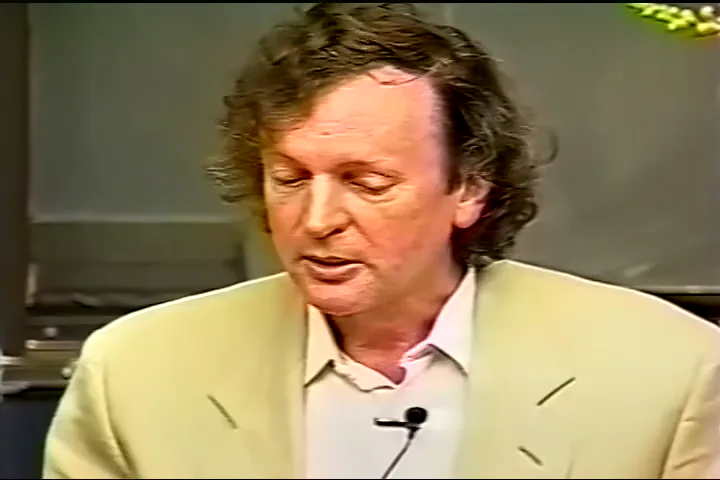
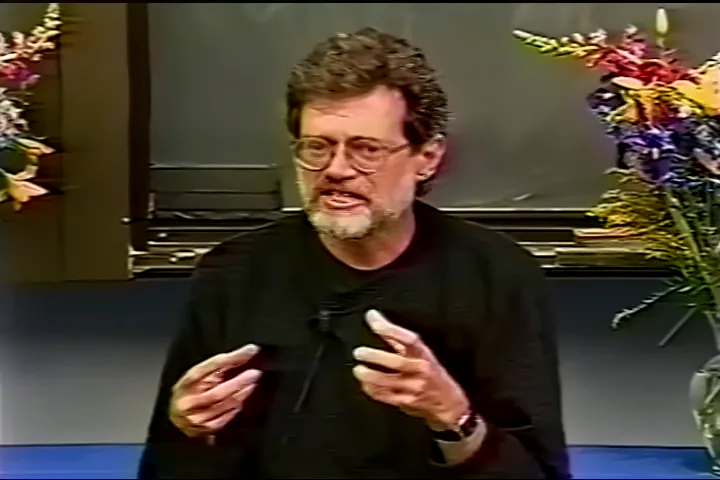
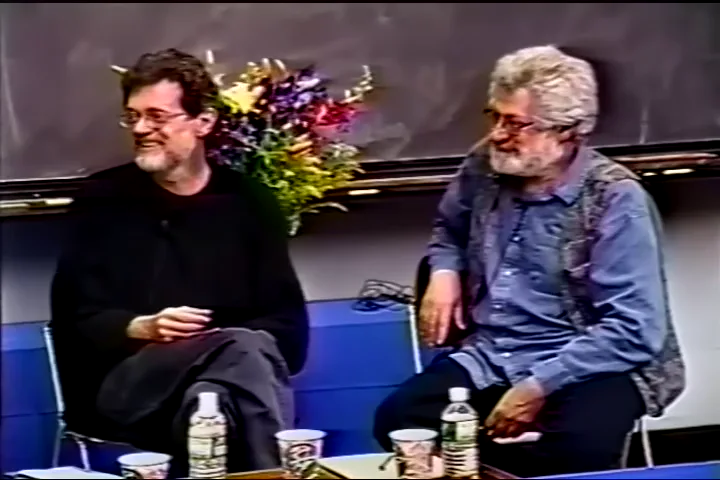
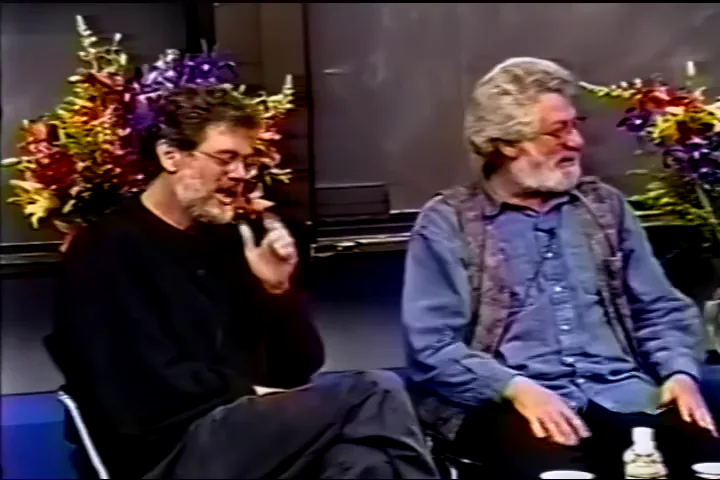
terence mckenna, ralph abraham, and rupert sheldrake's 1998 trialogue on evolutionary psychology, consciousness, and the mind's development through human prehistory.
a 1998 trialogue between terence mckenna, rupert sheldrake, and ralph abraham. three perspectives on the evolution of consciousness and the evolutionary mind.
terence mckenna, ralph abraham, and rupert sheldrake recorded in santa cruz in june 1998, discussing skepticism, epistemology, and the crisis of statistical methodology in modern s