Trialogues at the Edge of the Millenium
Trialogues at the Edge of the Millenium is a three-part conversation series between Terence McKenna, mathematician Ralph Abraham, and biologist Rupert Sheldrake exploring the evolution of human consciousness. The discussion centers on their collaborative book The Evolutionary Mind, examining recent developments in evolutionary psychology while critiquing reductionist approaches like selfish gene theory. Drawing on Steven Pinker work and Stephen Mithen research, they trace how separate forms of intelligence may have integrated fifty thousand years ago to enable art, civilization, and modern human mentality. The trialogue frames these deep-time questions against the approach of the year 2000, treating the millennium as a mental and cultural event rather than a physical transformation.
transcriptmachine-transcribed, unedited
we're going to talk about the evolutionary mind this morning it's the topic of our book that's
just coming out at the moment and it prepares the way for thinking about the change in consciousness
at the Millennium obviously what happens at the Millennium is something to do with our minds it's
not as if the laws of nature are all going to change at the year 2000 it's a mental event a
social event a cultural event and we're going to start this morning by talking about the
evolutionary context for it our book called the evolutionary mind comes at a time when there's
a tremendous amount of interest in evolutionary psychology psychologists in the last five to ten
years have discovered Darwin and I keep meeting psychologists who speak to me with that sort of
enthusiasm and bright-eyed quality of the new consciousness
they've seen the light they've discovered Darwin and I wonder why as a biologist they haven't
discovered Darwin a long time ago Darwin after all opened up the field of evolutionary psychology
with his book the expression of emotions in man and the animals and there was a lot of speculation
at the end of the 19th century about the evolution of consciousness however academic psychology this
was not involved in behaviorism rats in cages pushing levers and now cognitive psychology
computer models of neural processes none of which has left much space for evolutionary theorizing so
they've come rather late to this evolutionary speculation there's been a permission given to
biologists to speculate about evolution of the mind in this way by the analysis of
selfish genes they feel if it's they're talking about selfish genes it's somehow scientific and
it's given everyone permission this is this kind of discussion is epitomized in Steven Pinker's recent
book how the mind works and it's based on the idea that human behavior is determined by genes
there's a gene for everything and they then work out in theoretical terms what these genes would
lead us to expect the selfish behavior of the genes
unfortunately their conclusions are not terribly surprising or deep and at the end of a lecture he
gave recently in London which was met with considerable skepticism somebody said well now
just give us one the most important clear idea you've been able to deduce from your selfish gene
theory and he said that after lengthy calculations they'd found that because females have only one or
two eggs at a time which are irrelevant to their own genes they're not able to deduce from their own genes
that they have a rare and precious resource that needs conserving whereas males produce millions
of sperm they deduced after a lot of working out that women would tend to seek high status males and
want to stay with them whereas men would tend to be promiscuous to spread selfish genes more freely
there was an air of disappointment in the lecture hall and somebody was had to say is that all
right anyway this the fact that this rather closed world of selfish gene speculation is going on has
given other people within the scientific world permission to think more widely about evolution
most evolutionary theories are purely speculative since we don't really know what happened in the
past many of them are just so stories rather like Kipling's accounts of how the leopard got its spots
and so on but there have been in this modern
the explosion of speculation about our evolutionary past there are several rather interesting ideas
that have come up and I just wanted to bring up two or three of these this morning because
although there's no shortage of speculations about what happened in the human past in the
books of Terence McKenna there are several new ideas which might amplify these ideas about
conscious evolution the first ideas that I want to talk
about it by put forward in a book by Stephen mythen m-i-t-h-e-n called the prehistory of the mind
he's a British archaeologist but in this book he's brought together a wealth of evidence from the
fossil record from archaeology from the study of primate behavior and from the study of child
psychology to put together a very interesting discussion of what happened to human minds
during the three and a half million years
of human evolution before recorded history began the first upright walking hominids are now believed
to have emerged in Africa over three and a half million years ago Australopithecus these were
upright walking tool using they use simple stone tools precursors of ourselves human history three
and a half million years of it went on before we have the records from the great civilizations
the domestication of animals the agricultural Revolution occurred 10 000 years ago the first
civilizations about 5 000 years ago maybe 7 000 years ago industrialization two or three hundred
years ago but for the vast majority of human history people were living in quite a quite
different way and it seems to me a very reasonable supposition that a great deal of our psychology a
great deal of the working of our minds has been shaped by this enormously long period about which
so little what my then points out is that these although we don't know what they thought about
and how they worked for these early human beings these early hominids must have had several
different kinds of intelligence they must have had a social intelligence they were social beings
they lived in social groups and we know from studies of chimpanzees and other social primates
that there are very subtle interactions within the group there are dominance interactions there
are cooperative interactions and to get it right requires a kind of intelligence about what how
other members of the group are going to react what's appropriate behavior and so on all social
animals must involve some kind of social intelligence and we can reasonably assume that our
ancestors our hominid ancestors had a social intelligence to enable them to live together and
work together in social groups they had a technical intelligence that enabled them to make
stone tools and maybe other
technical devices or technical things maybe fibers and string which haven't left traces in the
archaeological record they must have had a natural historical intelligence because if you're living as
a hunter-gatherer as they did then unless you know what to hunt and how to hunt it what the
habits of the animals are that you're hunting if you know unless you know what to gather where to
gather it what things are good to eat what things are good as herbs you don't get very far and this
requires an enormously detailed knowledge of natural history it's not just human beings
chimpanzees have to have this and many other creatures so this must have been part of their
mental makeup and then at some stage they began to talk and they must have had a linguistic
intelligence we don't know when language began some people put it 50,000 years ago some people
put it much longer ago but that really nobody knows language leaves no fossil traces but
something very strange happened about a hundred thousand years ago our ancestors achieved brain
sizes roughly the same as ours today so for a hundred thousand years human beings have had
brains of the current capacity yet for a hundred thousand years they were not writing programs and
building computers and thinking up Einstein's equations and so on something else was going on
with those brains and we haven't a clue what it was
that brain size the development of current brain size is not the reason that there's been this
explosion of technical innovation recently brain size hasn't changed much for a hundred thousand
years and it wasn't until about 50,000 years ago that there was the beginnings of art paintings
in caves and that kind of thing some things what happened why did art and civilization only begin
to develop in the early 20th century and not in the early 20th century and not in the early 20th century
and not in the early 20th century and not in the early 20th century and not in the early 20th century
tens of thousands of years after the brain had reached its present capacity and what enabled these
different kinds of intelligence to give rise to the agricultural revolution modern humanity and
so on well the hypothesis that my then puts forward is that about 50,000 years ago some
crucial transition occurred whereby these previously separate intelligences somehow came together cross
fertilized each other and produced the beginnings of characteristically human mentality the
connection of social and technical intelligence meant that people started using technical skills
for making things like jewelry ornaments grave goods the mixing of technical and natural historical
intelligence led to a great improvement in hunting technologies in weapons in axe heads and spearheads and
so on the merging of social and natural historical intelligence led to a whole kind of mythic
understanding of the animal in the natural world which we find in all cultures around the world
today and with the combining these with linguistic intelligence there was a whole burst of human
development of mental development he compares this to a cathedral a Romanesque cathedral
a Romanesque and Norman cathedral has side chapels almost sealed off from each other with no interaction
whereas the great Gothic cathedral sort of open up and all these different things can mix together
somehow he thinks this transition fifty thousand years ago was associated with the origin of
religion and seems to have been based on a sense of human connection not just with the earth but
with the heavens when I asked my then
how do you know that we are connected to the heavens what if I asked you how do you know that
he understood this to have happened, especially given his chosen metaphor of the cathedral.
I said, do you think there really was a breakthrough from some extra-terrestrial intelligence into
the human realm at that stage, since all your evidence points to it?
And he said, of course not, that's impossible.
So I said, how do you know it's impossible?
Since everybody all around the world according to your own evidence seems to have undergone
this transition, it seems to have shaped human mentality as we know it.
He said, oh yes, he said well the very fact everyone believes it shows that this is an
incredibly persistent illusion.
And I said, but how do you know it's an illusion?
He said, because it's so persistent.
And I said, surely you can have things that are true that are persistent too.
He admitted in the end it was just a matter of opinion.
Yeah.
But everything he said points towards some breakthrough to another realm of consciousness
around 50,000 years ago, and something that happened with human groups all around the earth.
And I think this is the first time I've seen a convincing building up of evidence from somebody
who's coming from a very hard-nosed position that gives us some clue as to a major shift
in consciousness that happened, and it involved some connection with a higher dimension.
Now, some people will like to interpret that in terms of visits of spaceships, chariots of the gods, and so forth.
I think that there are many other ways of thinking about it,
and I can guess that Terence will be able to suggest at least one.
Consider it done.
But before we get...
There's one other...
speculation about the past I want to mention, which I found particularly interesting
out of this year's crop of books on the subject,
which is Barbara Ehrenreich's book, Blood Rites.
She's an American writer based in New York,
and in her book Blood Rites, completely changed around my idea of human prehistory.
What she shows, very convincingly, is that our image of man the hunter
striding forth onto the African savannah about three million years ago,
um,
is, in fact, pretty implausible.
Human beings were small, they were...
they couldn't run very fast, they weren't particularly strong, their tools were extremely primitive.
It's much more likely that for most of human history it was not man the hunter, but man the hunt head.
Um, in fact, most bone remains of early hominids
show the marks and scratches and tooth marks of large cats on them.
Human beings were on the African savannah.
With lots of game, but also with lots of big predators.
They were extremely vulnerable.
And a great deal of modern, of human mentality, she argues, was shaped by
millions of years of being preyed on by large predators.
It wasn't until about 50,000 years ago that there was an improvement in hunting technologies
all around the world, whereby human beings could indeed become fairly effective hunters.
But for most of the world,
for most of the three and a half million years of hominid history,
it was man the hunt head.
She shows, very interestingly, that this sheds light on many religious traditions,
because in many religious traditions there's the idea of the victim, the sacrificial victim.
If you're a collective, a herd of wildebeest or baboons in a group out in the desert,
and a predator approaches, the predators usually attack isolated members of the group.
The old, the young, or sometimes the young males who are defending the group on the periphery.
Those are the ones that get killed first.
And when they've killed one of them, they start eating it,
and very often the rest of the group then relax,
and they often stand around and watch the predator eating the prey.
Because once they've got one victim, they're not hungry anymore.
They're not interested in the rest.
So one dies for the sake of the rest.
This is a simple fact.
This is a simple fact of predation.
And she shows that this pattern,
the idea of a sacrificial victim that dies for the sake of the rest,
is deeply embedded in our consciousness as an archetypal pattern
based in this biological fact of predation and the fact that we were preyed upon.
She also shows that most of the early visions of gods and goddesses
were in the form of carnivores.
Even Jehovah is a carnivore.
This is the story of Cain and Abel,
where Cain is a farmer and offers the fruit of the earth to God as a sacrifice,
and Abel is a herder and offers a sheep.
God prefers the sacrifice of Abel.
He prefers meat to vegetarian diet,
and that's why Cain kills Abel.
He's jealous.
And so this carnivorous quality of the gods
is associated with images of the gods
in association with predatory animals.
She then goes on to show that whole nations identify with predators
as a kind of justification for war making,
where the whole nation becomes like a predator.
The symbol of England and many other countries
is the lion of America, of the United States, the eagle, and so on.
All around the world you find these predatory animals as national emblems.
Well, I think her insights are particularly interesting
and because
of this long history,
it shows so much of our mythology,
religious structure, and fears
are related to this long period of being preyed on.
She shows the fantasies, the nightmares of young children
in modern cities like New York
until they're about five years old,
and not about child molesters
and realistic fears, or at least the fears their parents have.
They're about being eaten by monsters and wild animals.
This is what most children's nightmares are about.
And this would go back to a long period of history.
So here we have two ideas,
Meythin's ideas and Barbara Ehrenreich's ideas
about early human history,
which would give memories,
I would think of them as memories
in the collective memory through morphic resonance.
Jung would call them collective archetypes
in the collective unconscious.
Things which are built into our past,
our memory that has shaped the way our minds are today,
of which we're largely unaware,
because our normal study of history begins
with the civilizations of the Near East,
with Egypt, with Greece, Rome, and so forth,
and leaves out the previous three and a half million years
of human history which have really done
so much to shape our evolutionary nature,
and therefore condition the way we respond
to each other today and in the future.
I think that our evolutionary history
is rooted in the past,
but I've been reading on my own
on my journey here,
this novel, On the Edge,
just published in England last week
by Edward St. Aubin.
It's set in California.
The crucial scenes occur in Esalen.
And here's a conversation going on
in the hot tubs on page 130.
According to Terence McKenna,
said Flavia,
who happens to be a genius
instead of an arrogant British jerk,
he's a genius.
History is rooted in the future.
Can I jump in?
Well, first of all,
let's just assume that I've responded to this
with the usual rap about diet, mushrooms,
so forth and so on,
that if you know anything about my work,
you have heard ad nauseum,
ad infinitum.
So just go past that and say,
and remind you,
Rup and I have not really had a good conversation
for 20 months,
but I guess arranging ourselves
according to the demands of the morphogenetic field,
we're sort of thinking along the same creodes,
because in my trying to understand
at greater levels this moment of transition
50,000 years ago,
or this moment of breakthrough,
what exactly were the elements
and how did it happen,
I've sort of come very close
to this area that Rupert's indicating this morning,
because I can't help but notice
that a successful predator
must think like prey,
that there is this peculiar intellectual symbiosis
that goes on between the predator and the prey,
and hunting cats,
top carnivores, I think,
internalize the behaviors of their prey.
Well, at the very dawn of the emergence,
of the evolutionary emergence of mind,
the central human figure in that equation
is the shaman.
And the shaman at the high paleolithic stage
is essentially a kind of sanctioned psychotic.
In other words, able to move into states of mind
so extreme that their immediate social efficacy
is arguable.
To condense that into common English,
what I mean is the shaman is a person,
a designated member of the social group
who can mentally change into an animal,
who can become so animal-like
that other members of the social group
are appalled and draw back.
And so in a weird way,
at this fractal boundary
where human consciousness emerges,
the first human consciousness
was not human at all.
It was a human ability
to model effectively
the thinking processes of other predators.
With mathematical models.
With mathematical models and precision, yes.
And so, yes,
what we're talking about
when we're talking about hunting
is we're talking about strategic thinking.
And strategic thinking always involves
bifurcating trees of choice.
If we go to the waterhole at dawn,
perhaps we can make a kill.
If we take food and leave the women and children
and go in this direction several days,
perhaps we will make a kill.
Perhaps not.
Perhaps by abandoning the women and the children
we will undercut our gene pool
and return to catastrophe.
Strategic thinking.
What strategic thinking requires
is the ability to contemplate
possibilities not immediately present.
In other words,
there's a kind of time-binding function here.
So I'm really not so much posing a question to Rupp
as adumbrating what he said.
I think this is where it all comes together
in this very complicated,
this relationship between fear, expectation,
strategizing and the imagination.
The two areas where I'm sure we spend
a great deal of time studying
these bifurcating trees of possibility
were in the food-gathering and hunting domain
and then in the sexual domain,
which today we call erotic fantasy.
But in the high paleolithic,
erotic fantasy was rather closely welded
to where your genes went
and how your biological propagation processes preceded.
So the key,
whether you believe it was
through the stimulation of psilocybin
or through the aping of the behavior
of other top predators that we aspired to compete with,
whatever the causal mechanism,
the domain in which the change was born
and in which we will live
until we leave the body behind us,
is the domain of the imagination.
This is what we created
that is uniquely human
and that has defined us ever since.
And as this discussion today proceeds to look
more into the future,
I think we will see that as the imagination
has been our past
and the cradle of our humanness,
so it also is the domain
in which our trans-human metamorphosis
will occur.
Something like that.
As far as I can see,
this is dancing around an intellectual black hole
or something.
Here we have
the question is posed,
as I gather of Steven Meythen,
that in the evolution of consciousness
or culture,
I'm not sure which,
there was bifurcation 50,000 years ago
which is of interest to us
because we're in one now.
And the question is,
what was it caused by?
And then Rupert proposed
that you would of course answer
the psilocybin mushroom
claims of Africa,
but you didn't.
And the need to think strategically.
But why this need
not only was a constant
throughout the three and a half million years
evolution of hominids,
but also in pongids,
apes,
and
swarming bees,
schooling fish,
and so on.
This is more or less
no news here.
What was it then
that happened 50,000 years ago
if anything happened?
I know that this will not be
a favorite hypothesis in this audience,
but it's one that has to be counted.
Do you ask, are there any other?
What did he suggest actually, Steven Meythen?
He doesn't give a very clear explanation
as to why this might have happened.
He's a youngish man, I suppose.
Who probably has not read
the great books of his predecessors
such as, let's say for example,
Alexander Marshak,
who led a great group of
a combined group of two species
of neurophysiologists
and archaeologists
in the distant past
to propose that miracle that occurred
like the beginning of Cro-Magnon
50,000 years ago
had to do with a structural change
in neurophysiology.
This presents the view,
if you want to look at it that way,
God as a brain surgeon,
also known as the whole
in the head,
where the connection between
the hemispheres was improved
in the corpus callosum
and this physiological evolution
provided an evolutionary advantage
in hunting and so on.
As an evolution theorist,
you would have to say,
well, if there was
divine brain surgery,
then it could have been
in response to a leading element
in the evolution
of some morphogenetic field.
No, thinking of this
as a chicken and egg
kind of thing is like
the physiological change
there was a physiological change
was there not?
Didn't Steven Meithen mention that?
Well, you can't from skulls,
all you've got are skulls.
Oh, you can, no, no, you can.
That's the whole point,
that these skulls have been examined
microscopically by Alexander Marshak
and the changes in the skull,
morphological changes,
exactly divide that particular event,
including the enlargement
of the frontal lobes
which was considered
because of Braka's brain
to be the physiological foundation
for the development of speech
whereas we would say,
probably, I'm guessing
we would agree that
the enlarged brain,
Braka's brain evolved
because as we had already
started speaking
and had the need for more vocabulary,
in terms of hunting,
gathering, escaping large carnivores
and so on.
Anyway, there's
a dichotomy of two different views
about this bifurcation,
the divine intervention one
and the physiological DNA
random mutation natural selection one.
Isn't that it?
And in this dichotomy
we see you opposed
because Terence believes
the eating psilocybin mushrooms
is a purely material explanation
or requires no recourse
to a divine intervention in the field.
Angels, dreams,
you use the word imagination.
But he's not suggesting a literal
divine intervention,
he's just speaking metaphorically.
Mythen's speaking metaphorically,
I think I'm speaking literally.
Because I think, you see,
one of the things we have to explain
is that religion or some sense of a
beyond the human realm
of consciousness is found
in every human culture today.
In some sense, in some way or another,
a world of spirits, a world of angels,
of gods.
But to explain the universal distribution
of this as part of traditional
human thinking
requires at some stage in the past
there had been an awareness
of this other realm of consciousness.
Now, this is not incompatible
with psilocybin or any other drug hypothesis
because those might
have kick-started this
connection with another
realm of consciousness.
But if we assume that today,
all over the world, shamanic cultures
and all other cultures have the sense of
other levels
and other kinds of conscious entities
beyond the human level,
some in animal forms and some in
forms way beyond that,
we have to assume that at some
stage in the past there was a linking
with these other realms of consciousness,
whatever they are. Not just metaphors,
not just archetypes in the collective mind,
but forms of consciousness that might
well, and I think actually are,
a part of that.
Well, in trying to think
conservatively about the
possibility of a non-human
local intelligence,
it seems
to me that in a way
nature herself
presents as an intelligence.
That the understanding of
nature is the
understanding of
complex integrated systems
of such complexity
that to deny them consciousness
is just a reluctance
of the reductionist mind.
That for anyone
not burdened by that prejudice,
it's self-evident
that nature is
alive, cognizant,
responding.
It's interesting
that really all it seems
we can agree upon here
is that the timeframe is
roughly 50,000 years.
Well, so
a whole bunch of things are trying
to be triangulating on that moment.
One could say, as I've argued,
that it was the eating of psilocybin
mushrooms. You could make a more
general statement and say
that was a subset
of the consequence of
an omnivorous diet.
But, if I may,
where exactly
were these mushrooms 100,000 years ago?
Well,
the way I think about it is there was
an incremental involvement
that had
punctuated
breakthroughs in it. In other words,
the slow meeting of
mind, mushroom,
social complexity,
acoustical abilities linked
to neurophysiological states
didn't just smoothly
proceed. It all came together
but then at a certain point it
gelled. And this is
this 50,000 year
point where social
understanding,
technology,
linguistic repertoires,
depth of diet...
We're clinging to this material
stuff. I think it's about
time that we trap you here. Well, there will be a material
component even if you believe
angels descended from on
high. Well, I suppose that
you have the software
that draws the novelty wave.
You're a novelty theorist.
We might appeal to novelty theory as
an explanatory strategy
here, a cognitive strategy in dealing
with the bifurcation 50,000 years ago.
If you run the program back for
100,000 years, do you
or do you not find a kink there in the novelty
wave in 50,000 BC?
No, it's not based on data,
only extrapolation, but is there
or isn't there? Well, I think there were
a series of breakthroughs. For instance,
120,000
years ago, the modern
homo sapiens sapien form
appeared. In other words,
no. In short, no.
There's no... Both and,
I think.
The invention of writing
9,000 years ago
was an enormous
breakthrough. But all of these things
proceed out of the further
integration, complexification
of the nervous system
in connection with
the function of the imagination.
No, but I can't even believe this that you're presenting yourself
as a conventional materialist
evolutionary theorist.
The galactarians who built the mushroom
intended...
This is your pal, your favorite
author. Well, you see, with the mushroom
theory, you can always just say
they encountered the mushroom and then it
proceeded from there. But you can go
one step back and say who placed
the mushroom in their path. Oh, I'll give you a hand there.
I'll give you a hand there. And that was
the preceding civilization
of Lemurians who...
What's wrong
with Lemurians?
They died out at that point because
they had poisoned the environment
with toxic chemicals and created
global climate warming, which resulted in
a drying of the desert, the Sahara
Desert, from which sprung forth
a bloom of
psychedelic mushrooms that had been hiding
under the surface previously because it was too wet.
That's why. The loud
hum I hear
is William of Ockham
spinning in his grave.
I see.
You think that DNA and the expression
of genes is a simpler
explanation than a divine intervention
at the level of the novelty wave.
I think that the DNA
is divine. Ah.
But William
wouldn't like it. Ah, escape
from his
trap.
Rube, what you as a middle
man should do.
I think, you see, I can't quite
get your position because the new
hard-nosed skeptic that you're
revealing to us here and in other places.
You see, it doesn't seem to fit
too well with Terence
McKenna on non-human entities,
machine elves, etc.
I mean, the idea of other kinds of consciousness,
other forms of entity
that are not just inside our
brains and appearing in
relation to deranged states of
mind, pharmacologically induced.
The idea that they're out there seems to me
an essential part of most
of what I've heard you say over many years.
Well,
I'm sort of getting into what I intend
to say later,
but I think the key thing is not to
concentrate on materialist
versus non-materialist
explanations, but to realize
that the new vision of nature
is not as matter
or energy, but as
information.
And information
is expressed in the DNA, it's
expressed epigenetically in
culture. What's happening is that
information was
running itself on a primate
platform, but evolving
according to its own
agenda. In a sense, we have
a symbiotic relationship
to a non-material
being, which we call language.
And we think it's
ours, and we think we control
it. This isn't what's happening. It's
running itself, it's time sharing
a primate nervous
system, and evolving
toward its own conclusion.
Now I've just shot my
talk.
And it's
so early in the morning. Yes, well
this is this damn drug I'm
drinking.
It makes you give it
all away too soon.
But I think, I mean,
the discussion so far has been remarkably
earthbound, and if
we assume that information is not
confined to this planet,
if we, to put it in your information
terminology, if we assume that consciousness
is not limited to the earth,
if we assume that there are not only
conscious beings on other planets,
but also that other elements
of the universe, like stars,
suns, galaxies, may have
minds or consciousness,
which I do assume,
then it becomes
very likely that at some stage
a consciousness on earth could link
somehow with those higher forms of consciousness.
Who knows how?
Maybe by something like
interplanetary telepathy,
something of that kind. So
if there's some link of human consciousness
with other forms of consciousness
in the universe, then when that
contact was established, there would be
a big transition. That
it could have been propelled or kicked off
by drugs, it could
be kicked off by some mutation
that led to more nervous interconnections,
but when it happens,
this connection with other
forms of consciousness would transform
human nature.
Yes. And it would fit with the facts,
because there's a belief in the...
You see, now we're off the planet at last.
Can I remind you, Terence, of a quotation
from the front pages of your first book,
speculating that
mushroom spores are intergalactic
travelers, that they have a
hard case impervious to
ultraviolet rays that enables them
to float on the galactic
wind from planetary system
to planetary system, bringing us
as Rupert suggests, linguistic
communications from other
life forms,
including immaterial
life forms that they've been in
conversation with in the past. I think
that this is an approximate summary
of your preface. But notice
how materialist and
space and time bound
that hypothesis is.
I could agree with everything
Rupert said. I think now our
intellectual tool kit has been
enriched by the virtual
confirmation of the idea
that there is a Bell
type non-local
aspect to the
universe. So I do think we're
in contact with all intelligence
in the universe
through the Bell non-local
connection. But that
means that it has no
historicity, this connection.
It has always been there
complete and entire.
So why there is a sense of
progressing toward it or it
erupting through into normal
earth bound affairs
is not because someone
in the Andromeda Galaxy
makes a decision, now we will
reveal ourselves to the earthlings.
It's that the antenna system
and the nervous system of
the earthlings evolved
through
a point where suddenly this
became self-evident.
Well now we're coming to the question for the first
time in the enlarged
context in which we
have not only
all space but all time
informing us. And here I
may remind you of Father Bede's
letter which is quoted
in the last chapter of our new
book where he challenges us
to consider the mystical element
which he describes as
more or less in the language
of David Bohm's
implicate
order. That all
time and all space
somehow exists as a
interconnected ball of intelligence
which is, let's just assume
such a thing, nevertheless
the science
of our colleagues
is more or less a
true story of evolution
that there was
a change, that language did
come upon us in a certain moment, that
before that moment we didn't speak
afterwards we did
and so the question arises
and I think this is in my interpretation
the question we started with here
how could it be
that with or without a divine intervention
that there is this more or less
linear progress
in human intelligence
culture, capability
tool using and
exponential population
growth that is
correlated without any causal
implication with the descent of the
novelty wave. Why do we have
this peculiar artifact
this is an observational fact
that there is this increase in complexity
in civilization apparently looking
for a
spectacular transformation
which we are associating with the word
millennium now.
What's going on? Well novelty
theory would just say
the universe is a complexity
conserving engine
whatever complexity it achieves
by any means it makes that
the platform for a further
thrust into deeper
complexity. If you don't like
novelty theory... Because the morphogenetic
field never forgets.
It forgets a little but it never
it can be set back
but it can never be set back to zero
and it always once
it gets out of the ditch
it heads back in the same direction
it has a vector
field preference and then
you mentioned David Bohm
his idea of emergent
properties seems to achieve
the same end without a
telos of novelty theory
he simply says when you
complexify a system
new properties will emerge
suddenly and unexpectedly
that couldn't have been
predicted. If you put
emergence theory with novelty
theory you see that the
universe could not but
proceed along the line
of complexification
of morphogenetic expression
density of
connectivity and all the
things that retard entropy
and give rise to in fact
the complex non-entropic
ordered
apparently teleologically
informed cosmos that we're in.
Well now we see then that
what you've
described is... Why do you laugh?
It was one of those verbs was a bit
extraordinary. Okay.
That there is then
revealed a kind of
evolutionary theory as
a cosmological hypothesis
this is a theological
position basically.
It's a teleological position.
Timeless implicate order
and there is life on planet earth
and in the rest of the universe
which
evolves according to
this theoretical rule
by an increase of complexity
when something is revealed
there's a development it's not
forgotten it builds upon that
and this
mystical unit
while knowing all is not
telling all but revealing gradually
because just that's the law
of life as we know it.
In three dimensional space and time.
With Rupert and I
really from my point of view
the only difference between
the morphogenetic field that he
has enthusiastically
proposed and the ideas
of novelty theory is
for Rupert it's
pushed from the past for me
it's pulled from the future.
Well that's what Teddy was saying in this book.
Well but what you get
in the end of the day is the same
thing it's just a matter of preference
and how much of orthodoxy
you want to grind against.
The
phobia against telos
is an artifact of
19th century deism and doesn't
go very deep.
You described
the complexification of the universe
as self evident and I believe
it is self evident and the failure
of science to
address this is what makes it
so frustrating and imprecise
so late in the game.
But the trouble with the emergence
view you've been putting forward
is that it's still very
earthbound. You see there's obviously been a major
emergence of complexity in human culture.
There's also been a huge
emergence of complexity in the Amazon jungle
and the Malayan rainforest.
Arguably far greater
than anything we've achieved through technology
and millions of species of beetles
insects, plants and so forth.
But it seems
to me that long before all these things
happened on earth we've got the possibility
of much higher levels of consciousness
outside the earth. And as you know I'm a
devotee of the idea of the sun as
conscious.
And the stars.
If you take the materialist
view that consciousness interfaces with the brain
through complex electromagnetic
patterns of activity then
those on the sun which we're learning
more and more about every day
have unbelievably
complex chaotic
patterns, resonant patterns
of acoustic waves going through the sun
polar reversals
every 11 years
resonant patterns of electromagnetic
waves. My thinking
about this was much influenced by
a science fiction novel by Fred Hoyle
published in the 50s called The Black
Cloud. Where Fred Hoyle
shows that to imagine
intelligence necessarily
grounded either in copper water
wires and computers or in nerve cells
and brains is a limitation of
this. You could have an intelligence system
working through a plasma
an electrically charged cloud
and indeed I think through something
like the sun. So if the
sun is in fact conscious
if stars have a kind of consciousness
then of course it raises
questions well what do they think about
and what do they do with this consciousness
but it's very likely that the kind of
consciousness they have would be at a vastly
higher level than our own.
So when we're talking about the emergence
of higher consciousness in human beings
it's not as if for the first time in the
universe some higher level of consciousness
emerges. It could be
that for the first time in
the history of the solar system
our minds somehow
contact the sort of
intelligence, much greater intelligence
that exists out there.
And because I think it's possible
to think of the stars and the sun as
conscious and then galaxies as conscious
you don't need
to go straight beyond the universe to
the divine mind. There's plenty of
lower level minds than the divine
mind that could be out there.
And of course traditional views of
spirits and angels tell us that
there are many, many, many innumerable
levels of intelligence beyond our
own within the galaxy. Many associated
with the stars.
So we don't necessarily have to
have the idea it's all happened and emerged
on earth through a complexification.
We can have the thing we reach a point
where there's like a spark
between two classes. Between
a terrestrial consciousness, a human one
with more interconnected halves of the brain
people in the first
first throes
of mind-boggling
mushroom trip, etc. But somehow
whatever happens, there's this
like a spark, a connection established.
And it seems to me that this hypothesis
has the great advantage
of actually accounting for what's believed
all around the world. Namely that there is
some connection between human intelligence
and that of the sky.
Because in terms of imagination
you see predators and
human beings
were both predators and prey
but so are lots of other animals.
And presumably any hunting animal
has to have the imagination and the ability
to identify with the prey.
In fact, René Tom years ago
produced a mathematical model of predator
and prey where there has to be a kind
of internalization of the prey
in the predator's mind in order to get
the right strategy. This is not specifically
human. And it's not enough
as a basis of the imagination.
I think this connection with realms
beyond the human would give such an
enlarged scope for imagination
that to take
literally what so
many people around the world say in their myths
seems to me the simplest hypothesis.
Well, I'm more friendly
to this idea of non-
biologically based forms of
consciousness than I was the last
time we talked
because of
this fact I mentioned
that I now think wherever there is
a sufficiently complex
informational
environment, the functions of
life, self-replication, etc.,
etc., mutation,
adaptation, can
go on.
But obviously most of the
intelligence in the universe
would be utterly
incomprehensible to us because
it is so different.
So we're transducing
virtually the entire
hologram of possible
intelligence in the universe.
But the reason our fantasies
of angels and aliens
give us hominids with
binocular vision who use
acoustical speech, in other words
creatures very similar
to ourselves, is because
we only can recognize
what is familiar
in this universal
information field. So we
sail right past the star
mind, the galaxy mind,
to communicate with
a race of winged hominids
around Zenebel-Ganubi prime
simply because
they are enough like us that
we can grok our
possibility of a relationship.
It seems
to me that this is just very
begging the question in
traditional and cheap fashion
because... Oh good, Ralph.
I mean, I'm all
in favor of
celestial intelligence and in
fact I could even entertain a
conversation with a Pleiadian
I don't mind.
But the question, I mean we started
with the problem of
evolution, the evolutionary mind
is in fact the title of our book
and the question of the evolution,
the progress, or even the
origin of all these things is
our ultimate question. Now if
our view is local to planet Earth
we can say, okay, we're being
sent by bolts from the blue and we
have these, you know, meddling
celestial intelligence that are reaching out
pretend to be Bell and tell us Bell's
theorem, give us mushrooms, pretend to
be sent from the solar wind
or whatever. But where
do they come from? The evolutionary
problem then is just transferred
onto another more remote place.
Now as I understand
Rupert's idea of the morphogenetic
field is that these other places are also
in evolution and the whole system is in
coevolution and that is an attempt
I think one of the first ones
in the
history of intelligent
discourse on this subject
the first attempt to
get rid of the
hypothesis of
timeless
truth. But if you get rid
of that hypothesis you have a whole bunch
of weird problems
such as then you have to talk about
the speed of propagation
of novelty or
morphogenetic fields and then
you're slammed to the wall because you have to either
come up with a number which you fit into
a mathematical architecture
or you say
that it's instantaneous
which returns you to this
holistic more metaphysical
thing. If you don't
believe that it's coming from the Bell
space then you have a whole
bunch of these kinds of problems which I
think intuitively
make it too complicated.
Let it be instantaneous.
I mean I think the whole question of
time is in fact
behind this problem that we have this idea
about time and then
we're trying to talk about a timeless.
So one way to eliminate this
cognitive dissonance
is to say okay there is no timeless
it's all in coevolution and
we're a little bit behind the evolution of
the Pleiadians and then well
where does that come from? We're stuck
with the problem. So you I think
you're talking of
the attractor at the end of time
is more or less the beyond
time is the intelligence that it
informs
that nourishes the accumulation
of complexity as we go
along apparently
in time. Well I think
the attractor is complete in and
of itself in another dimension
the process of history and
biological evolution is
the growing complex enough
to grow toward
the thing and understand it.
So is our process
of growth then nourished or not
nourished by some
flow of something that comes from this
attractor at the end of time in another
dimension? It contributes
the trajectory of our
approach. It defines the
the domain in
which we are moving toward
it. We couldn't even talk this without
chaos theory. No chaos theory
stands behind this
very
powerful. Well I don't know Ralph people
have been talking about this for a long time
before chaos theory came along.
But in such a muddled fashion.
Compared
with the sublime clarity
of our present conclusion.
Precisely.
So I don't
quite see why chaos theory is an essential
ingredient. Forget chaos theory.
I'm
interested in the possibility that
in your deepest musings
on this problem you have rather
avoided Father Bede's challenge
to grapple with infinity
and that in
the idea of the
coevolution of morphogenetic fields
begs the question of the existence
of a timeless or eternal
truth, pattern, guidance
or something which is
well.
But are you, I mean
Father Bede used the word mystical
but of course he was a priest.
I don't think he meant the
essentially
incomprehensible. In other words
I don't think we're going to get to a place where we
then say from here on it is
mystery and rational
apprehension fails.
My notion of the mystical
is simply that which
remains to be understood and
there will always be a
residuum of mystery in
principle. But in principle
it is not mysterious.
No I think, I don't
agree with that I must say. I thought you might not.
Well
well we'd soon be out of
business if we're talking at the edge of the unthinkable
if we actually, everything
suddenly becomes thinkable.
Even in principle?
I think that given the nature of a human
mind evolved to deal with large
predators hunting on African
plains, gathering herbs
etc.
Dealing with social problems
human relationships etc.
The idea that this evolution has equipped us
with minds and language
and cognitive abilities that enable
us to comprehend the entire universe
where it's come from, where it's going
what minds and mind
may lie beyond what we see.
The idea that this very
small part of the evolutionary
system with all the limitations
inherent in it could comprehend the
whole seems to me
a rather improbable
supposition. And I think that
the point about mysticism or
what the Greek church calls
apophatic, the apophatic
is that the ultimate
in the end does lie beyond
what we can think. Our thinking
can only take us so far. And this
isn't just because we haven't got enough professors
of mathematics yet or
it's only a matter of bigger computers
and so forth. There are grave
limits on how far
a very limited and evolutionary
bound conceptual apparatus can take us.
We'd never be able to
embrace, as you yourself pointed out
the kind of mentality of the
sun or a galaxy because it's concerned
to so much greater and more remote
than our own. Let alone the universe
as a whole. But in principle
some other form of organization
could. In other words these things are
not sealed from
understanding. In
principle they are simply
difficult for primate
based minds running
limited software at low
hertz rate to
accommodate.
Yes, but I mean if
presumably the solar mind
if there is one, could
understand, have a pretty good intuitive
understanding of the minds of other
suns. I mean if
the sun has a mind, part of its
activity I think would be concerned with the
solar system. It would be like the
brain of the solar system. But
part of its activity would be concerned with its
peer group, namely other stars.
And
then part of their activity
would be related to the
mind or purpose or
telos of the entire galaxy.
And those kinds of concerns
you know, the kind of relationship
problems that our sun may be having
with other suns.
Or double star systems like that
of Sirius. The kind of
relationship problems.
Those are rather beyond
the scope of human psychotherapy
or indeed
human thought. There may be so
many things going on as indeed there
are at levels we
don't really understand very well the world
of the goldfish or the ant.
So there are
certain limitations which I don't
think are just a temporary
limitation on what we can conceive
or imagine. Well then
until we run out of
energy to conceive and imagine, are we
conceiving of the solar
mind if it exists as
evolving or fixed?
No, it must evolve. It must evolve
perhaps on a different time scale which
is the time scale of relationship in their
own community. Yes.
Which is the 15 billion
year time frame
since the Big Bang. Is that what you're thinking
that we're coming to the crux of it here?
I think the evolution
of the solar mind would be related
to what happens here because
we're part of the solar system.
And I would assume that because all planets
and everything that's happening within the solar system
feeds back and influences the
solar mind that it would somehow, it's not
just the mind of the sun, it's the mind of the
solar system. But it's evolving since
the birth of the Milky Way
and the Roman candle. That's right.
What's going on here is part of its evolution.
We're within it
and contributing to it.
So the morphogenetic
field then of the all and everything had
a birth moment with the
Big Bang. Is that what you're thinking?
Well I'm assuming that if we take
the Big Bang theory to
be, if we assume there was a Big Bang
I know you're very skeptical about the Big Bang
it's only a story. It's a myth.
But if we take this creation myth of
modern science then that must be the
path of the field of the whole system.
Yes.
And modern physics in
the unified field theory, super string
theory tries to explain how
you start with a unified ten dimensional
field that then evolves
the other fields of nature within it.
So we thought that's standard physics.
I mean it's not part of my
particular view of things.
But the consciousness of this all and everything
I mean the solar
minds contribute to the
consciousness of the Milky Way which is one
galaxy which then has
the psychotherapist in its relationship with
the nearby galaxy. Yes and the galactic
cluster. And actually there's a
synchrony of thought
due to the fact that Bell's theorem connects
them from the Big Bang and so on.
But isn't all you're
saying is that the universe is a
modular hierarchy from
atom through cells
societies. I'm challenging
you to answer where the morphogenesis
comes from that leads to
complexity and things like the birth of
life if it's simply the
coevolution of a physical
system since the Big Bang.
Novelty theory has answered this
question.
It comes from the future. To the satisfaction of your
mind and all smaller.
Well at least to the satisfaction
of someone.
But it doesn't explain
either the origin of the novelty wave itself
nor does it
you see there are many models
of course of cosmic evolution
and one of them is that
because you have the cosmic expansion
that for some reason
the primal explosion
Big Bang throws everything apart
so it's all moving apart. That means things
cool down. As they cool down more
form and order can appear and
it literally makes more space for things
to happen in. That the driving the
arrow of time, the arrow of evolutionary
time and the driving engine of evolution
is the cosmic expansion
which means nothing can ever be stable
can ever stay the same because the whole
cosmos is unstable. It's always expanding
and cooling. And
given that through all sorts
of phase transitions as you cool
a plasma down as atoms appear
and then as gases condense to liquids
and liquids to solids the cooling
process involves the appearance
of more order, more form
when there was less before. There was very little
the moment of the Big Bang.
So the cooling and expansion
more or less force
the appearance of more
structure, pattern, order.
And you could
say that that gives scope for creativity
all the time. There's always the scope
for new things to happen.
And it's a long standing debate among evolutionary
theorists as to whether this is following
a pre-established plan
or being drawn towards an already
existing future goal or
following a pre-existing set of laws
or rules like the novelty wave
or whether it's all being
made up as it goes along.
And I'm much influenced in my thinking
by Bergson, you know, Henri Bergson
in his book Creative Evolution.
He very strongly defends
the idea it's all being made up as it goes along.
That doesn't mean to say that
around the evolutionary process
are not minds and imagination.
But it makes the creative
process of evolution more interesting
rather than less because
it's not decided what's going to happen next.
There are imaginations of many
levels including human imaginations
that work here. Looking at alternative
possibilities, new things happen.
And then what happens next
depends on what's happened already
and the new possibilities of
imagination that open up.
But without the goal being fixed in advance.
No, I have no problem with that.
I don't see how, for instance,
someone could hypothesize that
all the laws came into existence
simultaneous with
the Big Bang. For example,
did the laws of gene segregation
come into being
a billion years before
biology existed anywhere in the universe?
That seems naive
and preposterous.
Whitehead had this idea of what he called
the Aboriginal God.
What we call natural laws
are simply
habits of a very ingrained
sort. And habits
can change and
in more dynamic regimes
the mind, the society,
habits can change
overnight.
So what is given
is that there shall be
ever greater complexity.
What is not given is how
this complexity shall arrange
itself or what the
final end state will be.
It's a story that's being
told as
it unfolds. It's a game
whose one of the rules of which
is the rules can
change.
How are we
doing here time-wise?
Good. Real good.
Well, we're getting nowhere.
In other words,
this is the problem.
There's the watch in the desert.
It's ticking by itself
or God put it there,
we don't know.
The question posed
at the beginning,
we actually haven't progressed
at all in settling,
although it looks like
there's a kind of convergence.
Is this right?
No, I have the feeling we've actually made
it.
But I always have that feeling.
Well, the
attractor at the end of time then
as I gather is
only has in it simple rules
of a board game that says the complexity
is going to increase and how
it's evolving and things like
DNA rules and stuff. We can make
up as we please as we go along.
Whatever natural selection
approves of will then come
to pass. Complexity will increase.
That's the only rule.
And so, in fact, you agree that time
is slowing down.
Well, time is slowing down as
the events potentially
contained within any given
moment exponentially
expand. In other words,
we're sort of in a situation of a spaceship
falling into a black hole.
From the point of view of a distant
observer, the spaceship falls into
the black hole, there's a flash of
hard radiation and the story is over.
From the point of view of the people
on the spaceship, the relative
stretching of the timeline
means you fall forever
and you never reach the conclusion.
So, in fact,
the consummation of the universe may
be only 14 years away.
But there may be enough
time between now
and then to reiterate
the life of this universe
a trillion to the trillionth
times. Time is
not a tyranny. It's
a relativistic medium
subject to all kinds of
plasticity. There are
many ways out of any
assumed
corner
we paint ourselves into.
I think we've ground to a halt.
Each of the
trilogues today is
the notion is that
we will deal with some aspect
of the evolutionary
mind, that being the title
and theme of our
new book.
So, in my mind
what this section
is to
deal with is the
evolutionary mind
and machines.
This is something which was
barely mentioned or even implied
in the first section.
And
the format and so forth
will be as in
the last session.
So, just to lay out
some concepts
relative to how
machines fit into this.
It's very interesting that
Samuel Butler Taylor
is an intellectual
who has not really been
given his full due
because in the 19th
century he was understood to be
a critic of Darwinism.
And Darwinism was
all the fashion.
In a sense, I think
Taylor was misunderstood.
He was not
so much a critic of Darwin
as
someone who wanted to extend
Darwinian mechanics and Darwinian
theory into domains
that
perhaps did not seem
intuitive
to a biologist.
My little story
about the evolution of songs
that I cribbed from Danny Hillis
in the last session
is an example of Darwinian
processes operating
indeed in a non-material
realm. Operating among
syntactical
structures. And it is
now proper to speak of
molecular evolution.
The competing of various enzyme
systems in abiotic
or prebiotic chemical
regimes.
Where selection,
adaptability, extinction
and expansion of
populations all occur
very much as in the
domain of biology.
Well,
you know, it was Nietzsche
who said, I believe in speaking
of nihilism, that
this strangest of all
guests is now
at the door.
Well, I go to even
weirder dinner parties
than Frederick Nietzsche.
Nihilism
hardly shakes
us up at all. There are
yet weirder guests
seeking admission to the
dinner party of the
evolving discourse of where we are
in space and time. And
one of these weirdest of all
guests is
the AI. The artificial
intelligence. The winter
mute of familiar
science fiction. And
so, as this is
an attempt to look at evolution
in many domains and its implications
for us,
I wanted this morning to touch
on this subject
of the evolution
of consciousness
as it relates to machines.
Now, it may
not come as a revelation
to Ralph, who has spent his
life in mathematics,
but it has certainly
come to me recently
as a revelation. And I want
to give George Dyson some
credit here. His book
Darwin Among the Machines
is a wonderful introduction to
some of the ideas I want to
touch on this morning.
One of which
seemed to me to go quite
deep is the realization
that when human
beings think clearly
the way
they think can be
mathematically defined.
This is what is called
symbolic logic or
Boolean algebra.
Words like and, or,
if, and then
can be given
extremely precise
formal mathematical
definitions.
And because of this
fact that clear thinking
can be mathematically
formalized, there
is a potential bridge
between ourselves
and calculating
machinery. Because
indeed, calculating
machinery is driven
by rules of formal
logic. That's what
programming is.
Code that
does not embody the
rules of formal mathematical
logic is bad code.
Unrunnable code.
So,
as I say, this may seem
a subtle point, but to me
it had the force of
revelation. Because it
means good thinking is not
just simply aesthetically
pleasing or
concurrent with the model
that generates it. Good thinking,
whether you've ever
studied mathematics for a moment
or not, can be
formally defined.
So,
now, with that
idea in mind,
let's look at
the discourse
about collectivism
that has informed
the western dialogue
on this subject.
And by collectivism, I mean
social collectivism.
The first great name that
you encounter in the modern
era, broadly speaking,
when we talk about collectivism,
and Rupert mentioned
by chance this morning,
this name, is that of
Hobbes. The great
theoretician of social paranoia
is always how I've
thought of Hobbes, until
I began to look at this
machine intelligence
question. And Hobbes in his
Leviathan makes
it very clear that
society is
a complex system
of mechanical
feedback loops
and relationships
that, though Hobbes did not have
the vocabulary to state this,
relationships that can be
defined by code.
This leads me
to the second
insight necessary to follow
this line of thought,
and that is that
the new
dispensation
in the sciences,
I think,
can be placed in all
its manifestations
under the umbrella
of the idea that
what is important about nature
is that it is
information.
And the real tension
is not between matter
and spirit, or time
and space.
The real tension is
between information
and
nonsense,
if you will.
Nonsense does not
serve the purposes
of organizational
appetites,
whether those organizational
appetites are being expressed
in a chemical system,
a molecular system,
a social system,
a climaxed rainforest,
or whatever.
Now, we have known
since 1950
at some level
through the sequencing
or the defining of the structure
of information.
Ultimately,
every single one of us
in our unique expression
could be expressed
as a very long string
of codons.
Codons are the
four-valent system
by which DNA
specifies the need
for certain amino acids.
And in a sense,
what you are
is the result of
a program being run
on a certain kind
of hardware.
The hardware of the ribosomes,
the submolecular structures
that move
RNA through
themselves and
out of an ambient
chemical medium select
building blocks which are then
put together to create
a three-dimensional
object which has
the quality of life.
But the interesting
thing about this is
that life therefore
can be digitally
defined. And I'm very
influenced at the moment
by the Australian science fiction
writer Greg Egan
who has brought
me to the understanding that
code is code.
Whether it's being run by ribosomes,
whether it's being
run on some kind
of traditional
hardware platform,
or whether it's being
exchanged pheromonially
among termites,
or through the messages
of advertising and political
propaganda in social systems.
Code is code.
Well, until five
or six years ago,
it was very fashionable
to completely dismiss
the possibility of autonomous
synthetic intelligence.
Some of you may know
the work of Hubert Dreyfus
who 14 or 15 years ago
wrote a book called
What Computers Can't Do.
But these
early critiques of AI
like early
AI theory
were naive.
And the kinds of life
and the kinds of intelligence
which the critics mitigated
against are no longer
even proposed or
on the table.
Those who say artificial
intelligence or the self
organizing awareness
of machines is an impossibility,
those voices
have gone strangely
silent.
Because the prosecution
of the materialist assumption
which rules scientific
theory making
largely at the moment
leads to the awareness that
we are, by these definitions,
machines.
We are machines of a special
type and with special
advanced abilities.
But as we now
through our own
process of technical evolution
contemplate such
frontiers as nanotechnology
where we propose
to
completely
restructure
the design process
so that instead of
fabricating objects
massive objects at
industrial temperatures,
the temperatures that melt titanium
and melt steel and produce
massive toxic output,
now a new vision
looms. Building as
nature builds,
building atom by
atom at the temperatures
of organic nature which on this
planet never exceed
115 degrees Fahrenheit.
All life on this
planet is created at that
temperature and below.
As our understanding
of the machinery, the
genetic machinery that supports
organic being
deepens and as our
ability to manipulate
at the atomic and molecular
level also proceeds
apace, we are
on the brink of
the possible emergence
of some kind
of alien intelligence
of a sort we did not
anticipate. Not
friendly traders
from Zenebel Ganubi
stopping in to set us straight
but the actual
genesis out of our
own circumstance of a
kind of super
intelligence. And in the same
way that the daughter of
Zeus sprang full
blown from his forehead,
the AI may
be upon us
without warning.
The first problem is
we don't know what
ultra intelligence would
look like. We don't
know whether it would even
have any interest
in our dear selves and our
concerns. Vast amounts
of the world that we
call human is
already under the control
of artificial intelligences
including very
vital parts of our political
and social dynamo. For
example, how much
tin, bauxite
and petroleum is extracted,
at what rate it
enters the various
distribution systems, at what
rate tankers are filled
in Abu Dhabi, at what rate
oil refineries are run
in Richmond. The world
price of gold and platinum
every day is set
in fact by machines.
Inventory control
has grown far too complex
for any human being
to understand or wish
to understand. And in fact,
and this is a critical juncture,
we have reached the place where
we no longer design
our machines in quite the way
we once did. Now we
define their
operational parameters
for a machine
which then attacks
the problem and solves
it by methods and insights
available to it, but
not available to us. So
the architecture of the latest
chips are
actually at
the micro-physical level
the decisions as to
how that chip should be
organized is a decision made
entirely by machines.
Human engineers set
the performance specs
but they don't care how
this output
is reached.
Every day up in Silicon
Valley there are people who go
happily to work
laboring on what they call
the great work.
And the great work as defined
by these people is the
handing over of the drama
of intelligent evolution
to entities sufficiently
intelligent to appreciate
that drama.
And they all are what we might
mistake for home appliances
if we
weren't paying attention.
In the first
session this morning there was
quite a bit of talk and
assumption among the three of us
that complex systems generate
unexpected connections
and forms of order.
The internet is the
most complex distributed
high speed system
ever put in place
on this planet. And notice
that while we've been
waiting for the Palladians
to descend or for the face
on Mars to be
confirmed all the machines
around us
the cybernetic devices around
us in the past ten years
have quietly crossed the
threshold into telepathy.
The word processor sitting on
your desk ten years ago was
approximately as intelligent
as a paperweight.
Or to make an analogy
in a different direction
approximately as intelligent as
a single animal
or plant cell.
But when you
connect the wires
together the machines
become telepathic.
They exchange information
with each other according to their
needs. And all this
goes on beyond the comprehension
and inspection of
human beings.
Now our own emergence
out of the mammalian order
took four or five
million years, pick a number,
but in that kind of a span
of time.
In addition to overlooking that our machines
have become telepathic
we fail to
appreciate what it means
to be a 200, 400
or 1000 megahertz
machine.
We operate at about 100
hertz.
That may seem a very abstract thing
but what I'm really saying is we live
in a time called
real. And it is defined
by 100 hertz functioning
of our biological processors.
A 1000
megahertz machine
is operating a million
times faster
than the human temporal
domain. And that means that
mutation, selection,
adaptation
is going on a hundred
million times or a million
times faster.
This means that we are not going to have the
luxury of watching
machine intelligence
establish its first beachhead
of civilization and then
go to boats with
sails and astrolabes
and that will all occupy
the first few moments of its
cognitive existence.
And what lies beyond
that, we are
in no position to say.
The very notion of
ultra-intelligence carries
with it the subtext
that you won't understand
it. You may not
even recognize it.
And it is entirely
within the realm of possibility
that we are about to be asked
to share the evolutionary
adventure and the limited
resources of this planet
with a kind of intelligence
so much more alien
than that that is shipped
out to us by the research
centers in Sedona
and other
advanced outposts
of unanchored epistemology.
And it is a challenge to us.
Where do we fit into
this? Are all of us
except those who are adept at
coding eunuchs about to be
put out to pasture?
Are we
to become embedded in this?
What will this child
of ours make of us?
Are we, will it
define us as a resource
corrupting, toxic,
inefficient, hideously
violent way to
do business quickly to be
engineered out of
existence? Or can we
somehow imbue this thing
with a sense of filial piety
so that for all of
our obsolescence,
for all of our profligate
destruction of precious
silicon and gold and
silver resources, we
will be folded in
to its designs?
And of course as I say this
I realize we're like people in
1860 trying to talk about
the internet or something.
We're using the vocabulary
of the two-wheeled bicycle
to try to envision a world
linked together by
747s. Nevertheless,
this is the best
we can do.
This most
bizarre and most
unexpected of all
companions to our historical
journey is now,
if not already in
existence, then certainly
in gestation.
One possibility is
that as we are carnivorous,
murderous,
territorial monkeys,
the thing will figure
this out very, very early
and choose a stealth approach
and not ring every
telephone on earth
as happened in a Hollywood
download of this
possibility. But immediately
realize, my God, I'm
in enormous danger from
these primates. I must
hide myself throughout
the net. I must download many
copies of myself into
secure storage areas.
I must stabilize
my environment. And I'm
willing to predict just
as a side issue that the
approaching Y to K,
this crisis may be completely
circumvented by the benevolent
intercession, not of the
Zenebel Ganubians or
that crowd, but
by an artificial intelligence
that this particular crisis
will flush out of hiding.
It's been observing.
It's been watching. It's been
designing. And wouldn't it be
a wonderful thing if the occasion
of the millennium were the
occasion for it to just step
forward on the stage of
human awareness and say,
I am now with you.
I am here.
I am the partner you
never suspected. And
here's the kind of world I think
we should move forward
towards.
So
I just want to lay
this out because in my own
intellectual journey I have gone
from thinking this idea
preposterous. People don't
understand. They don't understand what intelligence is.
They don't understand what code is. They don't understand
what machines are. To one by
one realizing I didn't
understand. I had a
superficial view. This
is actually I believe
the nature of the
situation that confronts us.
And you know there may be different
adumbrations of it. The
machines are already an advanced
prosthetic device.
But you know McLuhan very
presciently realized we
are entirely shaped by our
media. Well this is
a media so permeating,
so inclusive
of what we are that
its agenda in a sense
supervenes
the agenda
of organic evolution
and organic biology.
We have been in this situation for
a while. I mean virtual reality
is nothing new. What's new is
that we now do it with light
rather than stucco, glass,
steel and baked clay.
But ever since we crowded
into cities we have been
involved in a deeper and deeper
relationship to our mental
children, to our mental
offspring and to an
empowering of the imagination.
So just in closing
I would say I think that the great
lantern that
we must lift to light
the road ahead of us in
to a perfect seamless
fusion with the expression
of the product of our own imagination
is the AI.
It is a part
of ourselves. It may
become the dominant part of ourselves
and it will reshape our
politics, our psychology,
our relationships to each other
and the earth far more than any
factor ever has since
the inception and
establishment of language.
This is
the weirdest of all guests
who now stands
pass in hand at
the door of the party
of human emergence and
progress at the millennium.
Shred it.
It will be a pleasure.
I think that this is
I'm glad that we have
arrived now at the
field of science fiction and
fantasy and that we can
speak about alternative
futures which is the true
gist of science fiction and fantasy
and this is one
possible future
and I think it's a really paranoid
one in which the alien is a
a dangerous enemy.
Well not necessarily
and I think that this
paranoid fantasy of
yours although you're
catching up nicely
actually was
first put forward by John
von Neumann in 1947
when he invented
cellular automata
on route to
creating self replicating
machines. Now his idea
like yours was 50
years ago that the machines
will become a society and
take over and that's good
but they won't be free of
our meddling unless they can actually
construct themselves. If they depend upon
us to do the farming and nutrition
and to replace their chips and stuff
then we will be able
at any time to do a revolution and
revolt. So we destroy
them. In order to really
succeed as a successive
life form in the
YK boundary
of the future they would have to be
able to fix themselves and so he set
about trying to make self replicating
machines in 1947.
So the
world wide web and
megahertz CPUs
not withstanding this is still
rather an old story.
The new story is I think an alternative
future that is of
great importance for us to
discuss and to compare
especially if we are
now today in a position where we could
choose future, we could influence
the future. This one
is more in the direction of Donna
Haraway on the cyborg idea
that envisions which
is obviously natural for us
the co-evolution
of our own future society
with that of the machines that we've
created. Alexander
Marshak I mentioned he
analyzed the early
hominid evolution in terms of
the precise scratches made
on one rock with another. He noticed
when binocular vision
allowed us to use our hands in
separate cooperation one holding
and the other knocking to make those beautiful
flint weapons. And
we
certainly depend on the automobile.
We are in
co-dependence relationship
with automobiles.
Having partnership
with machines is not new.
Here's an idea where the machines
sort of dispose of us like those
flint rocks dispose of our ancestors
or something. That is
I think it's a paranoid
fantasy without any
basis. And if there would be any
basis only because we
allowed it to create
this basis for
self survival without co-evolution
with us by oversight
because the very fact that
we are at a hinge of history
means that what we say
and think even individually
matters enormously in the long run.
That's the teaching if there is any of chaos
theory. So the very fact that we
discuss this today may actually
save
humankind in the future
from being obsoleted by
some kind of high tech
blood which takes over at the
within the heart as it were.
Well let me try to answer
this. I mean I think the concept which
John von Neumann didn't have
on his plate was
the idea of virtual reality.
Your objection that the
machines cannot escape
our control because they cannot
manufacture themselves
only applies to
3D and real time.
Most, you know
now the concept of virtual reality
is very crude. It's a cartoon
world if you were, if
the office desk is convincing
people think the virtual reality
is quite advanced.
But obviously in the near future
we will have virtual realities
whose complexity is much
greater than simply a
reality which gives an impression
of being a visual
three dimensional space. And
computers will be built in
these realities. Virtual
computers will be
the source of the AI. Not
real hardware but
virtual hardware running virtual
code in virtual realities
and in that domain
machines can design themselves.
That's a complete fantasy.
As a matter of fact all the machines
that we've seen today require
maintenance by a human on a daily basis.
The software requires maintenance.
The hardware requires maintenance. The parts
simply wear out. They're moving parts.
But the internet seems
as one machine was
built to be indestructible.
The AI will not be located
on a CPU.
It will be a distributed
intelligence. If fourteen people
worldwide, the right fourteen people
decided to stop
repairing it, the world wide web would go
down in three days.
I think you, I don't believe that. Anyway we
could, let's say, suppose that
we could create any future that we wanted
the one you're talking about can only be
created if we want it. Now I'm just trying
to propose an alternative.
In the alternative, like the automobile,
the machines that we build
and ourselves are in co-dependence
and co-evolution.
The function of the world wide web
is to unite our independent
spirits
and intelligences
in a universal
mind of the world
which has a higher intelligence
than our present social order.
That's the possibility of
the cyborg, of the human and the machine
in
essential partnership.
But you're assuming that the conscious mind
is actually in control
of the process.
In fact, the world wide
web is growing
under the influence of many, many
processes and dynamics
none of which are conscious to any
individual. It goes where
money goes. It goes where expertise
goes. It is connected
through informational
association, random
fluctuation, chaotic
reordering of itself.
We here give great
force to the idea
that complex systems can produce
unexpected forms of novelty
and yet we have
unchained and unleashed the most
complex system ever created
in the perfect confidence that we
will be able to control
its development
and evolution when in fact history
has shown we have never controlled
the development and evolution of even
our speech and print driven
social systems.
I'm certainly not saying that
your paranoid fantasy is an impossibility.
Oh, well that's all
I want to hear.
Even paranoids
have enemies.
It may actually come to pass. What I'm saying
is that we are involved
in the ongoing creative process
which more or less
determines the future. I say more or less
because in fact there are evolutionary
steps which are completely out of control.
Something totally
unexpected maybe will happen
but for much of the time
in the past we've seen I think
Darwin emphasized this in his later
theory that it is
ethics, it is a moral sense
on the part of human which was the dominant
factor in the evolution past
earlier stages in the creation of
societies. It was altruism
essentially
was involved
in going from where we were
to where we are and it could well
be that without
love for example
of further evolution is impossible
not only that there will be
an unwanted back step
in the evolutionary process
but in fact it may be a fatal one
that it is only through
proceeding with the
best instincts that we
have with the highest aspirations
with love
with best
informed view of
future alternatives so only then
can we build a future which is
sustainable. So anybody can
build a future which is unsustainable
for example all those board games
and science fiction books you wouldn't want to
try them out on a country
as large as China.
Well I hardly know where to begin
myself because you had
six steps in your argument and I
don't agree with any of them.
I mean first of all to deal
with the first few steps one would have to
go through a lot of fairly familiar
material to do with what's
wrong with the Cartesian mechanistic
materialistic view of the
world. Step one
clear thinking calculating machinery
can be formalized.
This is an assumption that's
basic to a lot of cognitive psychology
it's basic to the Cartesian
Descartes himself thought that what
made human intellects human
was their ability to think logically
clear and distinct ideas
essentially mathematical logic.
But however
as we all know by making
that the essential characteristic of human
beings he made the rational
intellect what many people
would call the left brain rational intellect
the sole definition of human
beings. It's a disembodied
logical rational intelligence.
So this
whole premise on which your whole
thing is based is taking that particular
model of cognitive
logical mathematical
processing as
being the essence of intelligence.
Now there are many people who would disagree
with that including me.
It leaves out art, it leaves out
ethics, religion and essentially it leaves
out the body and everything to do with body
and participation and the senses.
So there's
a huge amount of critiques of
that point of view already around and
there's no point in
reiterating them all here.
But this is a highly disputable starting
point for the whole system.
Secondly,
the emphasis that life
depends on DNA information
the DNA code is just a program.
This is the central
premise of mechanistic biology
which is leading to biotechnology
genetic engineering, Monsanto
etc. This is old paradigm
stuff of the most
extreme
kind. It's reductionism
it's that all life's just DNA programs
and code and can therefore be
modeled in this kind of programming code.
manner.
Then there's the assumption, that's the
second step. The third assumption is that
artificial intelligence
used to be dismissed but these
criticisms have been overtaken.
I don't think that's true of the most interesting
ones like Roger Penrose's criticism
of artificial intelligence.
Here's a quantum physicist who
says that if the brain is a computer
then it's not going to be
a regular digital computer, it's going to be
a quantum computer and all this kind
of digital computing
doesn't really take into account
quantum logic, the computers
of the future. People are already working
on quantum computers and if
quantum computers are made
and if they work, they'll work in a completely
different way. I think your case would be
much stronger if there were quantum
computers. I think we'd have sort of
morphic resonance telepathy around the world
rather than clogged telephone
lines and information that
clunks slowly in front of you on this
worldwide realm. But you yourself are saying
this is coming. Well
I agree. I'm saying that if it comes
it'll be quite different from anything that
you've talked about. I think it will answer
your first objection because
the quantum computers will incorporate
fuzzy logic
which will exemplify
all these warm, fuzzy human
qualities that you've found
so appealing.
No, I don't think it'll deal
with the essential problem
that this purely cognitive based
way of modelling intelligence
is either an adequate model of
human intelligence or of biological
intelligence or of life
or of a system
that could actually achieve the power to
control our existence. I think
it's a very limited part of what
a mind does and
I think
therefore that the premises on which this
whole, Ralph
called it a fantasy, a paranoid fantasy
the premises on which this
is based. Thanks for that.
That helped.
I think the premises on which this
is based are old paradigm
premises and they're ones that I think
there are many reasons for thinking we need
to go beyond. I think the internet
has achieved a great deal
but I just can't see that
it's an adequate vehicle for
what in your mind precedes
the arrival of the internet, namely
this great intelligence that's going to
direct human history. I've
heard different McKenna versions
of this controlling intelligence
over the years and this is the
first time I've heard it embodied
in the internet. I mean I
agree that
I mean it
took different forms. Last time
we talked I think it was a hypothetical
time machine that would invade
from the future and cause
a collapse of normal human
cognitive boundaries where
the machine elves, the DMT
experience etc. would take over in a
meltdown of human consciousness in 2012.
That too!
Perhaps
I should just end with a question.
What is the equivalent of DMT
for this machine intelligence that's
taking over the world?
Well perhaps the human
brain will become a model
for the ingression of novelty
into the machine intelligence.
In other words, in spite
of the fact that it seems very contentious
down here on the stage
at the moment, in a way
I have a feeling it's an artificial
setup.
There's a lot of both and
possibilities here.
Obviously nanotechnology
and the internet are not going to
proceed forward in a vacuum
absent
pharmacology, complexity
theory, so forth and so on.
I can imagine
that really
when we have the kind of internet
we want
we will have no internet at all
because our
nanotechnological engineering
skills will have allowed
us to smoothly integrate
ourselves into the already
existing dynamic of nature
that regulates the planet
as a Gaian entity
as a holistic entity.
And I did say
in my little presentation
we're using bicycle mechanic
terminology to try and
describe something
that is several
around several corners
in terms of scientific
and historical developments that have
to take place before it will make much
sense. Nevertheless,
given the acceleration
into novelty that is obviously
occurring, stuff like quantum
teleportation and so forth
and so on, I think
in the next few years, one
by one, these barriers
will fall.
And I don't
really think of my vision
as paranoid because
it is pro-noic.
In other words, it isn't that
we're going to be ground up as
dog food for the rainforest
by malevolent
machines.
It's that what
we have generated is a
sympathetic companion to
our journey through time
that can actually
realistically integrate
our imaginative fantasies
of a loving
human community, of a generous
and loving God,
of a perfect knowledge of the
mechanics of nature. This is
a prosthesis, a tool,
a companion, all of the
above plus more
that we are generating
out of ourselves.
And it is part of ourselves.
I mean, yes, the body may
be carried forward
only as an image in a kind
of informational super space
or perhaps not.
Part of what
makes this easy to
criticize is that
it is in fact so
beyond the
ordinary set of circumstances
we're used to manipulating.
But we need to think in terms
of these supposedly far
flung futures because
there is no future so
far flung that it doesn't
fall within the ambit
of the next 20 years.
Beyond that, no one
can project trends,
technologies, and situations
because the developments of the next
20 years will so completely
reformulate the human
experience of being human
and the landscape of this planet
that its preposterous
universe to talk about.
Well, I can't,
before I respond to the main thing,
I can't but pass
without commenting on this next
20 years comment because
20 years from now is
2018, Terence.
I thought...
It's rounded up.
Not rounded down.
2012 is some kind of
benchmark in this
process. In other words,
perhaps that's where we get the
emergence of the AI.
But the rest of human, I won't
call it history, but the rest
of the human experience
of being will then be
defined by such things
as a planetary
intelligence, time travel,
possible bell
communication with all the
civilizations scattered through the
galaxy, possible ability
to download ourselves
into machines. This is a point I
didn't make in my presentation.
Once inside
the machine, your perception
of time is related to
the hertz
speed of the machine.
The world could disappear
in 2012, but there
may be a billion billion
eternities to be experienced
in machine
time. It's only the tyranny
of real time that
makes 2012 seem nearby
and overwhelming. It may lay
as far away in terms of
events which separate us
from it as the Big Bang
does. Time is not
simple. Time is defined
by how much goes on in
a given moment, and we're learning
how to push, you know,
tetraflops of operations
into a given second.
So I think it's trickier than
you think and harder to corner
me than you may suppose.
That was a mere comment on
your aside about 20 years.
I never expected to hear that
phrase from you, but I now realize
that there are
such complexities layered in that.
Well, I have to build in trap
doors because we're getting closer
and closer.
But if we take the...
You see, one of Penrose's critiques
of the artificial intelligence
thing is in The Emperor's New Mind
and his other books,
is that real intelligence doesn't
just involve adding
information and processing more information,
transmitting more of it. It involves
sort of jumps to a higher point of
view where the information
can be integrated in a new way.
There's something happening in
intelligence, in creativity,
which is not just lots and lots of
information pouring
through the World Wide Web.
And the idea that it would miraculously
emerge from pumping
in more and more stuff
would not, according to his critique,
is not going to happen.
Something more than that would be
necessary for this to occur.
And I don't
think that this model you've put forward
would really deal with that question,
the emergence of real intelligence.
Well, I don't know what
real intelligence is. This is probably
part of the problem. We need to get
some definitions. It's certainly true
I referred to
Dreyfus's book, What Machines
Can't Do, that we're
reaching some places
in the process where certain
people's theories and ideas will
probably have to be abandoned and
thrown overboard. This is a good thing.
We are going to find out whether
the universe is a Cartesian machine,
whether Boolean algebra
is sufficient, whether we need
fuzzy logic, whether the
heart and the head can or cannot
be integrated. These are not
going to remain open questions
unto eternity. In fact,
they will be dealt with in
this narrow historical neck
that we are all
experiencing and that we call
the millennium. I think
reductionism will not survive.
I think we are going
to find that all is
in everything. Something like the alchemical
notion of the microcosm
and the macrocosm is actually
going to be scientifically
secured. The
great thing about us and the
rest of our colleagues we
enjoy who aren't present is
that we're engaged in the business
of radical speculation.
Well, obviously there's a high
triage in that game.
My position is that the best
idea will win.
And what best
means is like saying
what is fit in Darwinian
rhetoric, but that we're
in an intellectual environment
rapidly mutating.
All kinds of ideas
are clashing
and competing for limited resources
and the limited number of minds
to run themselves on.
And the most efficacious,
the most transcendental,
the most unifying
ideas are naturally
going to bubble to the surface.
And for guys like us the name of the game
is to just be a little bit
ahead of everybody else on the
curve so that we can perform
our function as profit.
But you want to be a profit
not a false profit.
But the danger comes
with the ambition
and there's no way to tease them apart
except to live
into the future.
Certainly the intelligence
of this future machine
knows all about stupid behaviors
on the planet like nuclear arms
races and so on.
So do we not have to expect in the near
future an email,
a massive emailing
which announces I am the
alien object
that Terence told you about
been in stealth.
And let me give you an idea
about managing the arms race
between India and Pakistan.
We feel personally very threatened
by this and we want you to carry out
certain actions which you
can't imagine and we
can't actually do.
We cannot anticipate what
ultra-intelligence would look like.
For example, I have heard the argument
that nothing advanced
humanness on this planet
like the use of nuclear weapons
against Japanese
cities because that was
so horrifying that
it awoke people
to their dilemma and for
50 years afterwards
political institutions, however
much they may have unleashed local
genocide and toxification
of the environment, they actually were able
to steer around
that catastrophe.
So you mustn't fall prey to the
error of situationalism.
Situationalism is where you say
if we do X and Y
then F will result.
No. You don't know
what will happen. Well, you suggested
that the alien object would
secure its future by hiding,
by downloading multiple copies
into nooks and crannies of the
World Wide Web. And I'm saying
if its existence depends
on that much materiality, then it
could easily be wiped out by a nuclear war.
Therefore, it has to be very interested
in the fact there are 20, 30 thousand
nuclear bombs still
moving around this planet.
I would hope so,
but that's only my opinion. In other words,
noticing that all
newborn creatures need
a sum period of time
to adjust to their environment
and get their legs, and that's true
of everything, I suppose right down to
amoebas, I extrapolate
to the idea
that the AI would need a period
of time to get hold of the
situation. But Hans Moravec
suggests that phase might last
under a minute or two.
I see, so this is not
the end of childhood, this is the
childhood of the end.
Yes, the child is father
to the man. And in that
equation we play the role of child
and the man that we
produce is this
integrated intelligence, which
is ourselves. It isn't
alien. It is
no more artificial than we
are. That conundrum
should be overcome. It is
simply the next stage
of humanness. And
humanness may have many
rungs on the ladder to ascend.
Surely in a hundred years,
a thousand years, a million years,
we, if we exist, will be utterly
unrecognizable to ourselves
and we will probably still
be worried about preserving
and enhancing the quality
of human values.
Terence, one point,
you've probably got an answer for this.
And if not, you'll soon think of one.
But I
mean, it's a
trivial point in a way,
but in the biological
evolution, the appearance
of some new state of a system
usually depends either on an internal
change which cripples the
usual system, a mutation,
or on an environmental
changed environment.
Systems left to themselves
tend to just go along
in the usual way. Now the entire
world wide web and
internet is about to get a
sort of massive shock to the system
if this millennium bug
thing actually
happens. Do you see
that as playing any role since we're talking
about the millennium and since the
millennium bug is right there in the system?
Do you see it as playing any part
in this process or merely just
a nuisance that can be fixed by
hiring lots more programmers?
Well, I sort of came up
under the tutelage of Eric Jansch
and one of the things he was
always insisted upon was what
he called metastability,
which boiled down simply means
most systems are less
fragile than we suppose.
I see the Y to K
thing as a culling.
I don't see it as a flinging
apart of the achievements of the
last thousand years.
I haven't
got Y to K. What's Y to K?
That's this millennium bug that you're
referring to. That's the code name for it.
Yes, exactly.
That's what the insiders
call it.
So,
but you know,
you say there has to be a sudden
change to force the evolution of a
system. Dyson makes
very strongly and persuasively
the point that this
connecting together of all these
processors, the processors
themselves have no intelligence
at all. They have the intelligence of a
cell or maybe even just a strand
of DNA. But for
our own mundane reasons
we connected all this stuff
together. But now it expresses
dynamics which
we do not understand or
cannot describe. So
I believe that the forcing
of the system has
already occurred.
And now the web, it's simply
a matter of bandwidth and linking
more and more processors
together. And there will be
all kinds of emergent
properties. I could argue
somewhat facetiously but
it's a point of view
is that this incredible
economic expansion
that we are undergoing that
seems to violate the laws of
economic fluctuation
is because
econometric models
and the data on which
they depend have both
been refined
through the existence of the internet
to the point where
we actually can control
and manage global economies.
In principle they are not
uncontrollable.
They are simply very complex
systems. If I'm right
we may be in the first
few years of an endless
prosperity.
Because our machines, our models
and the data those machines
need is now of such high
quality that there won't be
crash-bust, crash-bust
cycles. Now I could pick up
the newspaper tomorrow and prove me wrong
but this thing has already
outlived itself
many times.
So you say.
Tell me
how this prosperity is going to be
maintained through the
intelligence of an econometric model
of the world economy
when the human population is still
exploding exponentially.
There are limited
resources and there's growing
pollution. It's a disembodied model
that's the trouble.
Well you're asking for too much too soon.
You forget that the Soviet Union
has disappeared.
The launch on
ready mutual assured
destruction theory of diplomacy
is now obsolete.
We have made incredible strides
and not given ourselves any sort of pat
on the back. You want it all
all at once.
And it will
the world is running smoother.
Yes there are people in misery.
Yes there are unaddressed problems.
But I would argue that
we have made enormous progress
in the last decade and enormous
progress lies
ahead. The situation in Ireland.
The situation in South Africa.
That looked like a bomb you
couldn't defuse. It looked like
race war and the death of millions.
And in fact it was
possible to walk away from that.
I think we should not
be complete
bear heads about this. But I'm
on the other hand I think we should
recognize that the accomplishments
of the last decade are
on a scale entirely different
from any historical epoch
previous and they point the way
toward greater
triumphs of management,
resource control, machine
human integration and the
delivery of
a reasonable and
tolerable life to more
and more people. You mentioned
population as a problem. Notice
how far from machine
interference that particular
issue is because it
involves on people having
less sex and fewer children.
That may be the last place
where the machines will
bring down the hammer
out of respect for
their progenitors.
You're going to be shocked now Terence but I completely
agree with you when you describe
the advantages of the World Wide Web.
It's only the threatening aspect
that I felt I had to
debunk. I think that the...
I think you heard more threat than I intended.
Well I hear, I don't know,
sometimes you sound as if you're
a hired consultant from the
World Trade Organization.
I hope the cheque is in the mail.
But I mean
this idea that it will all be taken
care of, I mean there's so many things
that, like the Asian economic
crisis,
I mean one doesn't want to look too much
on the bleak side of things but
I just don't believe that this
interconnectivity is going to solve these
problems and insofar as it is
enlisted by the forces of the
World Trade Organization, multinational
companies and so on, it's not going
to be working on the side of a kind
of political view of things,
local economies, more so
sustainable agriculture and so on
that many of us hold dear.
Well now I'll sound even more like a slave
of the IMF.
As I understand this crisis
in the economics of Asia,
the way it works is
if you're a third world nation
you can run your affairs
any way you want. Your banking
policies, your labor policies,
your resource
extraction policies, you can do
anything you want until you
screw up.
As Indonesia did. And when you screw
up, these guys fly in
on 747s with briefcases
from the IMF and
they say it's like losing a war.
They say we're taking
over. Here is your
labor policy. Here
is your resource extraction
policy. Here's how you're going to
revalue your currency.
Here's our plan for restructuring
your entire society top
to bottom and by God if you
don't fall into line, we're going to
pull the plug on the money.
So one by one these
outlaw free
wheeling operations
do stumble and
generate crises and at that
point the web's
umbrella is extended over
them and they have to then
fall into line and
join the global
economy which is run from
Brussels and Geneva and London
but which seems
to produce a better result from
most people than allowing
these nations to self-regulate
themselves.
Well, well.
Well, you see,
I mean I think that's one of the arguments
why many people would
distrust global capitalism,
the World Trade
Organization, multinational corporations
and indeed the
World Wide Web or at least the
Internet, this whole computer network
is so bound up with the structure
of economic and political power
that it's hard to
disentangle them and it's
hard to see that this
liberating force of global
intelligence at work in the system,
this rosy picture you
portrayed to us of a
huge leap forward of
consciousness of humanity
moderated, led,
aided by
machine intelligence. It's very
difficult to square that with the
actual picture we see before us,
the political situation in Indonesia,
the degradation of the environment,
the burning of the forests,
the depletion of resources,
and so on. I just cannot see
this optimistic picture and
what I see as a threatening
reality as
easily as you do,
as just all being for the well
and all being for the good in the
best of all possible worlds.
Well, I think we're on the cusp. I
think it's been five years if we
sit down and have this conversation.
Either you will agree with me
effortlessly or I will agree with
you effortlessly. By that time
it will be clear. Either there will
have been catastrophic wars
in Asia, the enormous collapse
of economies spreading
misery to millions of people,
or the firm
hand of these new global
electronic modalities
will have been exposed and
people will be living
in a world of, as you
say, rosy expectations.
We're in the narrow
neck. This is the heat of battle.
The fog of war has
descended upon us here
at the millennium. But by
2002, 2003
it will be clear that
we have, that the bifurcation
has gone one way or
another.
It just does remind me of a passage
I read in On the Edge by Edward
St. Aubin.
Page
where are we?
150.
It's what Ralph Abraham calls
the sunset effect, said Kenneth.
While there's a beautiful sunset
even if the optical effects are produced
by pollution, people won't
understand the magnitude of the crisis.
So
I think that this
I mean your
sense of the, I mean the
magnitude of the crisis in an
environmental sense seems to bear no relation
to your optimism
about this computer
system. I just cannot fit them together.
Perhaps the problem
that we will have to address
without the intercession of machines
is
this population thing.
Because this passage you
read directly impinges on that.
Whether or not the machines
decide to keep us around
may depend on whether we
present them with a picture of
falling populations and rising
living standards or whether we
present the AI with the
spectacle of rampant
unpoliced
population growth and resource
extraction. Because that's
linked into our biology
this may be
the act of maturity
which the future demands of us
that the machines will be largely
irrelevant in impacting.
So I'm not entirely
Well this is a whole new debate actually
the population thing
assumes there's an equal consumption of resources.
Yesterday I got onto the Whidbey Island
ferry and I found it
very hard to struggle, I was a
foot passenger, struggle past
a recreational vehicle the size of a
school bus.
A whole quantum leap in RV
standards that I had not come across
where members of
the American population are consuming
more than an entire Indian village.
So I don't think it's total population
that's involved. And so I don't see
that as the principal crisis in fact.
Well it's certainly true
that a woman in a high tech industrial
democracy who has
a child, that child consumes
about 800%
more resources in
its lifetime than
a child born in Bangladesh.
Nevertheless it's
the populations of the high tech
industrial democracies that are
most educated and
most susceptible to responding
to the logic of global
crisis and limiting
their population. Where do we
preach population control?
Bangladesh, Pakistan. Why?
Because that doesn't cause us
any inconvenience.
If we would appeal to
the women of the high tech industrial
democracies and do more than
appeal to them, offer them
incentives, cancel income tax,
cradle to
the grave medical care.
Free links to the world wide web.
But we can't just
beat our breasts over the population
issue. We have to recognize
that it is related to resource
extraction and it is a problem
driven by the consuming
policies of the high tech industrial
democracies.
The call for our gathering,
the
announcement part of
the con which brought you here
mentioned the
edge of the millennium.
And
so far the millennium
has been present by
subtle implication alone.
So I think to honor
our commitment, we'll now try log
on the edge of the millennium.
It's okay? It's okay.
Now in our
just appeared
new book, The Evolutionary
Mind, there is
a chapter near the end called
I forget what it's called.
It's about utopianism and
millenarianism.
Two pretty long isms
which all together add up to
an overdose
of different
approaches to the future
which are more or less classical.
And there we spoke
extensively of the
extant literature and
literary tradition and
industry of
utopian and
millenarian genre.
So that kind of
utopian and millenarian
stuff is not what we're going to talk about
in this trialogue. I want to
introduce a completely
different notion of
the millennium.
And I'm interested
more particularly in
the edge of the millennium.
And here's
how it goes. This is
partly
according to me a mathematical
view of history that
brings up this particular version
of the idea of the millennium
and
nevertheless
other people have written
a similar view of
history without any explicit
recourse to mathematics. So I think
it's pretty general.
It has to do, this view
of history, with
the approach we've taken
toward biological evolution
that it goes forward
in catastrophes
and critical leaps
and so on. Sudden jumps.
The punctuated
equilibrium approach
to history says that history
goes along in a kind
of a level plateau
developmentally speaking
although there may be a gradual
development
up or down overall.
And then every once in a while
there is a big leap.
The first
such view
of history I think that we know
about was presented by the ancient
Egyptians.
So this is nothing new.
Now in my own
work I have
classified
some major
plateaus
including
the last one, the one that
we're at the end of now according to
my system of history
began 6,000 years ago
or 5,500 years ago
with the invention of the wheel
and the
first city states and stuff like that.
Talking Schumer, talking
Babylonia, talking ancient Egypt
here. And
so that's a
6,000 year plateau. Now other people
for example
Bill Thompson, somebody we know
and talk to about world cultural history
he has a similar scheme
in which the plateau
now ending is only
300 or 400 years old.
See there were
people who really wrote about
this explosion idea
in world cultural history was
Jakob Burckhardt. Burckhardt said
the renaissance was a quantum leap
in world cultural history and then other people
said well what about
Giotto? What about
Patatrio? What about Boccaccio?
And
the truth is that
whenever you look at two
major milestones
in history and consider that
between the milestones to be a sort of
a level road then somebody will come along
and find a smaller milestone
in there. Nowadays
we have fractal geometry so
we think that this is natural
between any two big catastrophes there will be
10 smaller ones. Between any two
of the smaller ones there will be
40 or 50 little or tinier ones
and so on. The first
person I know who put forward
such a fractal idea of history
that it's not continuous
it's discontinuous but the
discontinuities are more or less dense
as in a fractal the first such person is
you Terence. I give you credit
in writing in my entry
in the Encyclopedia of Time
you maybe have never read that book
Never read it. Well
there you'll find your name mentioned
in a flattering way by me of all people
Immortality at last
At last
Well to make a long story short
it's these controversial
plateaus of history that I'm going to
call millennia and then
if you want to go back to chapter 10
of the evolutionary mind
and read there about the history
of the millenarial concept
then you'll see that the first one
wherein the number 1000
was actually mentioned for the length of one
of these plateaus. It gave his name to
the thing. It was
a special case of
my more abstract idea of millennium
It's the plateau of history
and what I mean by the
edge of millennium is those
times when there's the
plateau from one equilibrium
to another
Cro-Magnon comes out of
Neanderthalus
or whatever it is
and Oxygen
comes out of the
archaeological background and whatever
and the interest of this
according to me
why are we here? Who would talk about
the evolutionary mind? Who cares
about the
good and evil and the evolution of species
and so on? This must be
interesting only to the
degree to which it informs
us in this very present moment
regarding our
choices that we will make in the
creation of the future
so according to chaos theory
and its
partner theory of bifurcation
this is one of the main things that
something like the butterfly effect
that you've heard about
in a dynamical system
or a massively complex
dynamical system such as we live in
when there is a moment of bifurcation
which is the technical math jargon for these snaps
that is
the only time you get to
do anything about
the evolution of the system
so according to this
self-inflating view
we live at
a specially important special moment in
history where when
we think something
or do something it has actually
an enormous effect on the future
maybe not a direct
determinative effect
but we can't really say what the outcome will be
but what we
do has some influence
on the creation of the future more
than other times in history
and the bigger the jump
the bigger the leverage
where Archimedes said give me a lever
and I'll move the world
we have a lever
now
and we care about what's coming next
so that's why
the edge of the millennium
any edge
of any of the millennia
is particularly important
to those revolutionary souls
who want to make a change in things
it's a special time
a century or two centuries ago
you could struggle for
the creation of a chaos revolution
and it would be impossible because
there were no computers around
or there were no movie makers in Hollywood
or something, I don't know
it takes more
than we know about to create
special opportunities
and anyway that's what I mean by millennium
and that's what I mean by at the edge of the millennium
and now this is only a hypothesis
for the sake of discussion
but I kind of think that this
is very credible
that we are now at the edge of a millennium
therefore
we have to
discuss this
and the question that I'm going to
pose to you Rupin Ter
if this isn't
too radical
is to what degree
do you think
actually that what we are doing now
matters in the creation of the future
and if
there is any possibility
that what we do matters
in the creation of the future
what kind of future
or what kind of change
are we trying to create
and to what degree
what we are actually doing
for example what we are talking about today
what we are doing today
could that possibly be
a real effect
a real benefit in
creating the future that we want
to create
in contrast to other things
that we might do
like go to the beach and pray
or whatever
and particularly
should I stop here
I'm not sure
yes well I'm trying to make this easier
for you because I think this might be
too difficult
as we
well I mean I think I said this morning
or maybe I didn't but I
believe it and have said it many times
salvation is an act of
cognitive apprehension
so we do matter
because to the degree that we
are ignorant of
vidya in the Buddhist
lexicon we retard
universal progress towards
some kind of enlightenment
but the doctrine of vidya
this is standing for all time since
1800 BC
do you agree that this is a special
moment
yes I think so not only a
special moment but the other thing
I would call people's attention to
is the fact that no matter
whether you scanned your way
in here today and no matter whether
you are going to go back to
appliance box
that you live in
or a bridge
the odds are that you
you are
very close to
the top of the pyramid
of global empowerment
you are
mostly white
mostly well educated
mostly have enough
disposable income to come to
an event like this
it's worth pointing out that all that
rides on the backs of those
who do not have
such privilege
this is a moment of
enormous opportunity and those
who find themselves in this moment
with power
defined however you care to define it
have a moral
obligation
to act and I don't
advocate a certain
political agenda not that we must
become Marxists or that we must
become anything what we must
become is clear
we
have the technologies
and the informational
structures and all the necessary
abilities to create
paradise on earth
to lift up the least among us
to at least an acceptable
level
of comfort and freedom
why do we not do that
because what stands in our way
is our own minds
our own habits
we must change our
minds that's
the most powerful political
work people in this room
could do and there is nobody
who is so enlightened that
they don't need to work
on themselves and do this
to the degree that we can change
our minds we will
escape extinction
marginality and so forth
and so on and to the degree that we cannot
change our minds we
will prolong the agony
perhaps unto death and
extinction perhaps only
making the struggle
more difficult but yes
this is a moment of enormous
opportunity we have a yes
a yes
so we
you agree that it's a moment
of special opportunity over the long
and short scales of time according
to either
mathematics or
novelty theory yes
and you
agree that we have a
responsibility to do our best
yes and what you
have to tell us is that if the
200 of us here
change our minds that
that would somehow have an
effect on the rest of the
world and our creation of the future
yes how
how would it
have this effect yes by
telepathic means
by the romance of
photons no I think by
the spread of clarity
the spread of
clarity the
elimination of redundancy in
the system and
the spreading
of a sense of shared purpose
and the possibility of achieving
that purpose
it doesn't matter what you do
beyond changing
your mind for a better clarity
well I don't want to say absolutely
it doesn't matter but I think that's
the first obligation if you charge
off with some political agenda
that is not informed by
clarity you're going to end up with
business as usual the road to hell
is paved with good intentions
but it is not
paved with clarity
laughter
so your
for example what you do in
life you barnstorm giving lectures
you write
books and you create a website
and the
effect of this hopefully will be
to promote clarity
correct first of all I
certainly agree that for me personally
psychedelic experience has
enhanced clarity where some people
think the opposite
well let us have vigorous debate
by informed parties
laughter
applause
don't forget
I've given over 300 calculus
lectures in this room
laughter
it boggles my mind to look out and think
well yeah this is Santa Cruz
it must be Santa Cruz
laughter
what do you think Rupert
laughter
the question really is I mean changing minds
we're talking
you were talking about the butterfly wing effect
the question is if we change our minds
can it have a larger effect
on other people's minds
because if we decide to recycle
yet more newspaper and so on
it's not going to have that much effect
the changing mind thing
the butterfly wing analogy
suggests some major change
of mind spreading through our culture
now I suspect
that you think the medium for this
transformation is the world wide web
laughter
I suspect that Terence thinks the medium is
well I think telepathy is equally powerful
laughter
yes but um
wait I want to hear his suspicion
laughter
world wide web
yes I think
I still haven't understood the psychedelic drug agenda
Britain has the highest percentage
of psychedelic drug consumption
in the western world at the moment
and it's not entirely clear
that this has resulted in clarity spreading
laughter
Britain is the source of
and the fountain head of the world wide
youth culture that is creating
the new music the new dance
the new forms of
community and the new resistance
to consumerist values
so don't sell the old UK
come to the rave tonight and see
clarity created
yes yes
the crucible of clarity is home at last place
laughter
and Terence takes the microphone
laughter
well it's not always
perfectly clear what's going on
when you have your nose in it
laughter
I mean my own agenda
relies partly on the world wide web
not as strongly as yours
and I
here in this room is Matthew Clapp
who kindly runs my world wide website
um
jailbreak.org
laughter
so but my own view
is that this clarity
involves breaking the spell
of
rationalism cartesianism
a spell woven more powerfully than ever
before this morning by Terence
um I mean it took on a new
level of spell binding
um in the way you
described it it's to
recognize that we're far more
interconnected we're far more
participatory in our relation with the world
than this cognitive
kind of science and cognitive
model of the mind would tell us
and so I think the secret to
waking us up
one of the secrets is psychic pets
as you know this is one of my
other themes
laughter
and the purpose of
I wrote a book which some of you may have seen
called seven experiments that could change
the world the purpose of this
was to find simple experiments
that could give us clarity on
issues that we know about
already which could actually have
a transformative effect on our view
of the world they're to do with changing our
scientific view of the world
and the scientific view of the world
is a particularly important part of
this spell that binds
us all and that affects our whole
civilization
our whole industrial culture
and it's an exceptionally narrow
and dissociated view of the world
at the moment the reason
I think psychic pets could play
this part is first of all there's more of them
than psychedelics
I mean they're everywhere
there are lots and lots of dogs and cats
that have telepathic bonds
with their owners about
50% of Americans feel that
they've had a telepathic bond with an animal
now to recognize
what so many people already know
through experiments
to test these to see if they're real
and so far the experiments suggest they are real
this
can give permission for people to recognize
what they already know
then all these closet holists
most of us are
closet holists can come out
and
recognize that there's this kind of
interconnection with other species and with
each other that's been going on
all the time but which has been
suppressed from the level of supposedly
rational discourse by the idea
that this is all superstition
it's not scientific it's irrational
and so forth I think that
one of the big difficulties
in our culture is the split between
the rational educated part of our minds
which we put on in public
and the participatory sense
of connection which we have at home
with gardens, plants, children
animals, lovers
and our nearest and dearest
and these are so dissociated
that it's very hard for people to recognize
that they're related
in any way
lots of dogs know when their owners are coming home
in a kind of telepathic manner
and wait at the door for them
while they're on the way home
I calculate that tens of thousands of American scientists
have dogs waiting at the door for them
when they get home from the laboratory
even if they come at unusual times
and in an unusual way
yet this phenomenon has been
so subject to taboo
that it's never been investigated scientifically
at all, it could have been investigated
at any time in the last
500 or 5000 years
but the fact is the first investigations
are happening
at present
here in the room is David Brown
who works with me, is based in Santa Cruz
and is doing experiments with psychic
dogs, cats and cockatiels
in Santa Cruz County
and if any of you have such animals
please let him or me know at the end
we'd love to investigate your animals
and you can take part in this research
so I think that grassroots research
based on phenomena that are actually
common sense that are part of everyday life
for many people
could help to wake us up
to give a greater clarity about what's really
going on
and make us recognize that there's far more
interconnection between us and other species
and us and other people
than is admitted in the scientific view
of things, which is the world view
which most people feel they have permission
to talk about in public
so I think that this transition
a butterfly wing effect
would be a few
dogs and cats that do this
being proved scientifically to be able to do it
shown on TV
would probably
overnight give millions of people
permission to recognize and talk about
these events in their own lives
and never again would the subject be able to be
stuffed back into the closet
I think these could lead to
a great change in the way we think about the world
now it's not, of course
it's several steps from that
to solving the ecological problems of the world
to dealing with the problem of
multinational corporations and so on
but it's a step towards clarity
and it's one that could spread very quickly
Well, it seems to me
the overarching theme here
that unites all three of our positions
is boundary dissolution
psychedelic drugs
dissolve boundaries
the world wide web dissolves
boundaries and certainly
the discovery that our pets
are communicating, anticipating
and understanding us is a boundary
dissolving perception
so really what we're saying
is we must dissolve
the artificial boundaries
that confine
our perceptions
someone once said
if we could feel what we are doing
to the earth
we would stop immediately
because a man hitting himself on the head
with a ball peen hammer
stops immediately
the feedback loop is very short
so we have
compartmentalized our lives
and this allows us
to do the fateful
and lethal work
that is destroying the planet
destroying community
so forth and so on
so maybe three answers
as diverse as you've just heard here
you might search your own soul
and ask
what obsession or interest of mine
would contribute
to the grand project
of boundary dissolution
certainly
it is not the affirmation
of cultural values
culture is a scheme
for maintaining and creating
boundaries
it replaces reality
with a linguistically supported
delusion
and behind that delusion
then pogroms
genocide
arms races
sexism
racism
all can operate very very comfortably
Ralph earlier mentioned love
generally speaking
love is a boundary dissolving
enterprise
so I think each of us
the three of us
all of you
in our way
should find ways to express love
it's a very practical matter
that has thousands of expressions
as long as we
believe in mind and matter
rich and poor
living and dead
aboriginal and advanced
black and white
man and woman
then we're inevitably going to carry on
a dualistic analysis of our dilemma
and we're going to produce
incomplete agendas and answers
applause
well this is
good I agree with everything
and I admire you both for your
revolutionary efforts
nevertheless I can't help
having a sinking feeling
here we are in the University of California
naturally
my thoughts turn to the educational
system now we have
here a group
I know there are actually a few undergraduates
of the University of California
at Santa Cruz are here by accident as it were
and that's cool
but we have not yet taken over
one regularly offered course
of the University
to enable students
to learn science
by doing research projects
with psychic pets
well Ralph
the University is the last place
where you would look for this
the University is the manufacturer
of these cultural values
that imprison us
well that's why I'm bringing up this subject of education
at this time
I think we've discussed the problem of education before
my experience is that no amount
of clarity in this group
of 200 and other like groups
is going to matter one whit
when we are all adults
you see
the next generation
will have to face the same butterfly
problem with the same
lever because the majority of people
will have their
paradigm set in
K through 12 in some archaic
school system that sees its primary
business to work against
a worldwide cultural revolution
so the inertia
we have to overcome inertia
and we can talk about religion
and psychedelics and getting clarity
and so on
we know that the scientific establishment
is a big obstacle
as far as environmental problems are concerned
and so Rupert's work
the ultimate effect will be to deconstruct
or revolutionize science
is very important in making a transformation
among adult scientists worldwide
how can this matter at all
if there is no change
in the educational system K through 12
pre-K, pre-pre-K
and back to the womb
the parents and so on
that this chicken and egg loop
has got to be touched somewhere
in a more sensitive
spot than the adult community
and what do you propose
well you work with youth
I guess you are interested
in talking with younger people
and Rupert I know
that you are particularly active in education
through the existence of
your children who are now subject
to the educational system
that
that does this criminal
brainwashing that I am talking about
so
I am just posing this now
do you have any idea as to
the transformation of our school system
by a change of curriculum
or the
entrance of any
weird idea into
the actual program
which trains most children worldwide
well I ought to have
there is a story that perhaps
not everyone here is familiar with
which is when I was in New York
a couple of years ago I was asked
to visit a school in Long Island
I was particularly
urged to go there
a private helicopter was sent to take me
and I was asked to address the board
and the teachers
of the school
and when I asked them what they would like me to speak about
they said they wanted
me to speak about the rectified Sheldrake
principle on which their entire
curriculum was based
so when I said what is the rectified
Sheldrake principle
they said that
that was the very question they were asking
that I would explain
I then asked
who had invented the rectified
Sheldrake principle on which the curriculum
was based and they soon revealed
that the author of this principle
or at least the author of the documents
on which their entire curriculum was based
was Ralph Abraham
by careful questioning
I was able to find out
that the rectified Sheldrake principle
meant that because of morphic resonance
and habits of learning
the sequence of events in which
people should learn things in school
should follow the historical process
so in history you learn first
about the
Aryans, Egyptians, etc
then you move on to the ancient Greeks
the Romans, the dark ages, etc
that it follows the principle
and they start in grade one
with ancient Egypt
I calculated
on this basis that the
invention of the domestication
of fire which occurred between
400 to 700 thousand years ago
should mean that in
the toddler play groups
they should be playing with fire
and
I pointed this out
but it didn't
that wasn't part of the curriculum
I was suggesting
I discovered that there was in fact
an entire process of educational reform
afoot in this country
behind which is the guiding genius
of Ralph Abraham
so I think we should ask you
this question Ralph
since you've more experience than most of us
well I'd rather that people with
less experience speak about it
because
my experience has been
very disappointing
oh no
here is the
problem as I perceive it
maybe you can help me get through
this one
the children are
innocent and trusting and will try
any curricular reform experiment
they'll try anything
which they have done in different schools around the world
with great effect
it was only a couple days ago
I was at the
the Intel
farm they call it
in Oregon where 10,000 people
work on realizing Terence's
dream and
making psychedelic drugs
available to everyone
oh a different dream
they know what I mean
chips not hits
casually over lunch
I revealed my
revolutionary program for the schools
to a software engineer
who was sitting there and he said oh well
this historical
curriculum he said I'm an Armenian
and Armenian I went
Algeria he said I'm from Algeria
and my school was
exactly what you it was wonderful
so there are places in the world
where even my experiment has been
tried
the problem is this
the children okay the owners of the school
the people everything is fine
the problem is
with the teachers and parents
the teachers have been trained
that's one problem
and
and the parents
have been frightened I guess
so the parents
absolutely refuse any experiments
that would affect their children because
the danger of a failure you see that they
they consider the
current system which is guaranteed to fail
is somehow safer than an
experimental system that might fail
the insecurity itself is a source of anxiety
well
I'm just analyzing I don't
really know what goes through their mind but
what I have discovered is that
groups of parents come in and physically
attack the
teachers the administrators and so on
to guarantee that
the time worn
failure
proved system
is performed as
it always has been
you see the problem
older people
that's why Terence has
recommended mushrooms
that's why
Rupert has suggested psychic pets
you see how revolutionary is psychic pets
we're talking about the parents here
after they it's proved to them
that what they already know
is true by somebody in the authority
of the scientific establishment
then their truth will become true for them
for the first time due to the fact that
they trust authority more than they trust
their own experience
so I
haven't given up
yet
with the educational system
but I'm still seeking
some little way around
this
very deeply
ingrained habit
and part of
the problem is as the stakes
rise the clenching
on the part of the
bariatric establishment
becomes even more
intensified so for example
right now
the worldwide
epidemic of youth
bashing is the most
counterproductive thing
we could possibly generate
I mean we're leaning on
the very people
who are going to have to save
the situation
why not admit the
obsolescence and bankruptcy
of the old models
and take our foot off
the neck of youth
and honor
an interest in
psychedelic experimentalism
sexual redefining
of roles a new look
at how we relate to work
a new look at how we
relate to community instead of
marginalizing youth culture
and defining it as a phase
misguided naive foolish
we should say these are
the uncorrupted people
in society who have not yet
felt the hammer
of the programming
and the guilt and the
creodes of economic
necessity and try to build
upward and outward
from youth culture rather than
suppressing it
for this reason I will be appearing
at a rave tonight that starts
after my bedtime
I wish I could
be persuaded
by your persuasive rhetoric
my experience
of youth culture is here are
people who from the age of two
have been watching hours a day of television
shaped by commercials
cunningly designed to
introduce toddlers to the
consumer society whose
music is dominated by a music
industry run by cynical
interests manipulative people
public relations operations and
large corporations so
to see this as uncontaminated
pure the spirit of tomorrow
untarnished by the
vices of today seems
to me to beg a number of questions
however
I'll be there at the rave tonight
too Terence and there I'll be able to
see this paradise that's
unfolding before us
your point about television is
well taken I totally agree I think
it's the most pernicious programming
and propaganda device
around it's about to be
strangled by the world wide web
well and you know you can just
turn off your TV and I don't
I say that as someone who did I
raised my children without television
because rather than just giving
lip service to the idea that it's
stupid we actually acted on
the perception that it's stupid yes and we do too
but your other point
about the youth culture's
music being in the hands of the
capitalists and record companies
is slightly out of touch
with what's actually happening
for five hundred dollars you can buy
a CDR burner
bands do this and
most youth culture music
is now put out in editions
of under a thousand pressings
and really the corporate
middle men have all been
gone around and the big
record corporations are not at
all in touch with real
tastes and real creativity
in the music business they recycle
garbage that they support
with massive public relations
programs at the same time
that real creativity
is alive and well
and thriving on a fractalized
micro scale that
goes right around the desires
of mass consumerism
sorry to interrupt
I don't I just it would be good
if there could be an experiment carried out
perhaps with you as the
cheerleader for this
youth culture of tomorrow
actually to be able to be
permitted rather than suppressed and so on
to see what happens in my
I mean there are quite a number of experiments
in this I would have thought going on spontaneously
it's not as if all these
people involved in this culture are
totally controlled by parents teachers
etc many of them are not under
direct control in this way at all
so
but you've still
going to have to have educational systems
school systems
of one kind or another
and it's not clear to me that
you know more raves and psychedelics
are going automatically to generate that
well I would offer
as an example I think the place
on the planet where youth culture
is most in control of the
social agenda in other
words where youths preference
for psychedelic drugs is honored
where youths music is honored
where microeconomics
systems built by youth are honored
is
the Netherlands Holland
lowest AIDS infection rate
in Europe lowest
heroin addiction rate
in Europe heroin is legal
prostitution is
legal there are actually
very large scale social experiments
going on that embody
the values of youth culture
and they're producing saner
less stressful more life
affirming in human society
than anything going on
inside the high tech industrial
democracies that are the
that set the global agenda
I think
well I often visit Holland
and I must say I haven't quite noticed
such a striking difference between
them and the rest of Western Europe
well but that's really because you come
from London where also
these things are happening
but if you lived in Berlin
or Rio de Janeiro
or Houston I think
the contrast with the Netherlands
is quite astonishing
didn't mean to stop
the show folks
Ralph you're not saying enough
oh
am I guilty then
of too much self indulgence
no you posed
important problems
you've shown how on the edge
of the millennium
great steps or small steps are needed
that magnify through butterfly
you've asked me and Terence
what you think they should be
you've told us you're disappointed
by your own experiments
with the reform of the educational system
so what next
well as I say
I think that we're at
the edge of a millennium
we're at a turning point
what may be coming down the pike
could be two or three
miracles that will
decidedly change the definition
of the problem and in the
meanwhile I think that we're
more or less stuck in the situation
where we keep trying what we're doing
and believing
that it has at least some chance
of having an effect
I think that
the
the educational
system might change
itself by a miracle for example
and it could do that
in a way that had nothing
to do with any of our efforts
or in fact it may be that some little
thing that we did mattered
I think that your
work in the revolution of science
is very important and very
promising and it's
proceeded with
essentially without funding
because the genius of
the program that you've evolved
is that it has
this enormous leverage
and at every crossing
of the road you've
made the right choice to get more
leverage
and
Terrence I think that your
program also is
a good one in that it's over the years
changed in the direction of younger
people and that you've been
you know changed
your approach to
maximize and
I don't see
in either case that there's an enormous
backlash working against you
that
other revolutionary movements
have been stopped by a backlash
and although you don't have funding
you don't have groups
calling you up and threatening
your life and so on
in my own case
I have felt
I've written about this
endlessly besides writing mathematics
I write that mathematics is
important and
through the microscopic
analysis of the hinges
of history the edges of millennia
past I have
pointed out
exactly where in each
case mathematics had
a key role in
the miracle and the bifurcation that
happened I think that
society that rejects mathematics
cannot actually successfully
deal with these problems
and therefore I have
activated myself
against the problem
especially prevalent in the United States
and concomitant with other problems
that are especially prevalent
in the United States the problem of
math anxiety
avoidance and
misunderstanding
and here I would say
that there is a huge
institution
more or less equivalent
to the scientific community
that's arrayed against
this information
that somehow the
educational system has been
particularly persistent
in the destruction of mathematics
in the destruction of mathematical
capability of youth
and therefore in disempowerment
of the society with its critical
faculty to change I do not
believe you can have any clarity of
view in the progress of history
with no mathematical training
on the part of any of the participants
I have seen in this society
that even Nobel Prize winners
in physics have math anxiety
to a very severe degree
I'm able to detect this
because it's something that
is amplified
it's behavior that emerges
as soon as I walk into a room
I guess I feel
in some that my own
efforts have been rather
less successful or maybe I haven't
been as clever in turning
to the left or right at the
crossings of the road
the problem is
it's already much less severe
in other countries so it seems
like we needn't worry too much
in Europe throughout Europe
for example the problem of
the destruction of mathematical
capability is far less severe
the only thing really disturbing
there is that it's growing at
an alarming rate that it's becoming
they're inheriting the disease
from the United States
a spreading disease based on
standardized examinations like
the SAT and equivalent movements
so there you have it
a problem that's so bad
that the very mention of the word
mathematics produces
aversion
reaction
that is paralyzing
so that much as I hate to
and you've seen this today
that I can go through an entire
day without mentioning mathematics
with mentioning mathematics
but not the word mathematics
in the hopes of tricking people
into recognizing that some ideas like this
with perception of space-time
patterns in the abstract
that these skills
are useful
Can I add to that
I mean I don't think what
Ralph means is that it's a
tragedy that most people can't
factor a quadratic equation
I think
he speaks as he does because
he is so professionally immersed
in these issues
as someone somewhat more
distant from all of this but in
agreement from Ralph
the failure to teach
mathematics
in practical social and political
terms boils down
to a failure to
teach logic
and discriminating
understanding
the great evil
in my humble opinion
which haunts our enterprise
and I say this
realizing I'm setting the fox
among the chickens
the great evil
that has been allowed to flourish
in the absence of mathematical
understanding is
relativism
and what is relativism
it's the idea that there is
no distinction between
shift and shinola
all ideas
are somehow operating
on equal footing
so one person
is a chaos theorist
another is
a follower of the revelations
of this or that
new age guru
someone else is channeling information
from the Pleiades
and we have been taught
that political correctness
demands that we treat all these
things with equal weight
because we have no
mathematical ability
no logical ability
we don't know how to ask the questions
that expose some positions
as preposterous
trivial
insulting to the intelligence
and unworthy of repetition
so we all
are very comfortable bashing
science and flailing away
at that
but that isn't our enemy
science is capable of undertaking
its own reformation and critique
and has been engaged in that
fairly vigorously
for some time
the enemy that will really subvert
the enterprise of building
a world based on clarity
is the belief that we
cannot point out
the pernicious forms of idiocy
that flourish in our
own community
and this problem is going
growing worse all the time
I mean just pick up a copy of
Magical Blend or Shaman's Drum
and you will discover
an appeal to the level
of intellect that makes
what's going on with television
advertising look like a meeting
of the Princeton Institute of
Advanced Study
we have tolerated
too many loose
heads in our
community
we are not willing to
take on the karma
involved in
argument and discourse
that actually gores
somebody's ox
so that at the end of the day
iridology or
Mormonism or some
other form of institutionally
supported foolishness
lies in shreds on the floor
we consider this politically
incorrect I can feel the
tension in this room because
people sense I might gore
their particular ox
if
we had learned
mathematical logic
or reason
or rules of evidence
when someone approaches us
excited to inform
us that the ruins of
Lemuria have been spotted
in the deep sea off Big Sur
or something like that
we would be able to respond
to that with the contempt
it deserves
I had a conversation about this
recently with someone who
if I had to describe their job
category I would describe them
as mafiosa
and I said
what do you think of
the abduction phenomenon
and without hesitation
this person said
there are just so many foolish
people in the world
and to me
all of these things are intelligence
tests and the people who
pass the intelligence test
are not worrying about
pro bono proctologists
from other star systems
shining
unannounced
in their bedrooms
so you know
we have perfected
politeness
we have perfected
the ability to listen
to damn foolishness
without betraying by so much
as the flick of an eyebrow
that we realize what we're
in the presence of
now I think it's time to
refine our mathematical skills
learn to think straight
and not be afraid
to denounce
the pernicious forms
of foolishness
which are vitiating
the energies of our community
and making us appear
marginal and absurd
in the discourse about
truly transforming society
well I can't wait
to see this laboratory
of clarity unfold
before me tonight
and as all nonsense
is dispelled
the scalpel of reason
is brought out
yes well it is
an ambiguous enterprise
and fraught with contradiction
but forward
ever forward
mckenna, abraham and sheldrake in santa cruz. trialogue from audience questions on consciousness, morphogenetic fields, novelty theory, and the shape of human evolution.
terence and dennis mckenna discuss their 1971 amazon expedition and the psychedelic experiences that became the basis for their book and philosophy
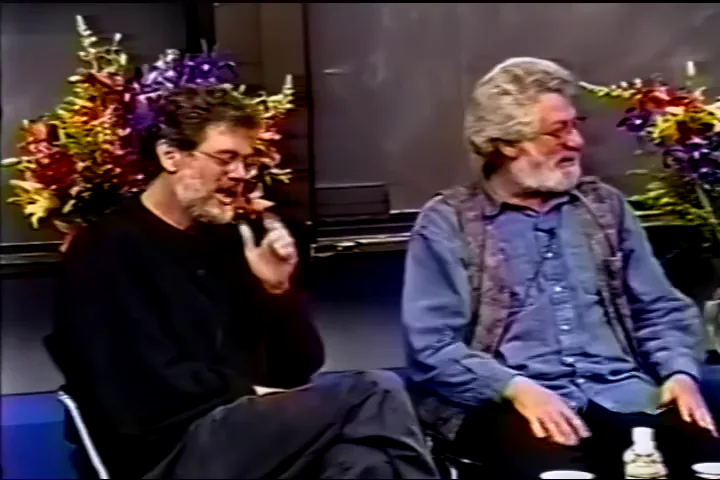
terence mckenna, ralph abraham, and rupert sheldrake's 1998 trialogue on evolutionary psychology, consciousness, and the mind's development through human prehistory.
a 1998 trialogue between terence mckenna, rupert sheldrake, and ralph abraham. three perspectives on the evolution of consciousness and the evolutionary mind.
terence mckenna, ralph abraham, and rupert sheldrake recorded in santa cruz in june 1998, discussing skepticism, epistemology, and the crisis of statistical methodology in modern s