Alan Watts-the Silent Mind-kqed-1959
This is an episode of Alan Watts' 1959 KQED series Eastern Wisdom and Modern Life, in which he explains eastern meditation as a shift in how the mind uses attention rather than an exercise in effort. He opens with the Chinese character guan, illustrated by a heron watching still water, to describe a quiet, receptive kind of observation, contrasted with the strained, effortful looking and listening that most people are conditioned into from childhood. Watts argues that thought itself introduces further strain because it is linear and abstract, one word after another, cutting the living richness of experience down to symbols the mind can grasp, so that a life lived entirely in thought becomes arid, like trying to eat a menu instead of dinner or subsist on dollar bills instead of goods. He then demonstrates the meditation posture, lotus position, relaxed breath emphasizing the exhale, eyes lowered but open, explaining that the aim is not to blank the senses but to stop the inner talking that normally intervenes between experience and the self. As the interval between knower and known dissolves, he says, the sense of a separate ego watching from behind experience fades and one begins to feel the world as oneself, the same absorption felt when fully caught up in music or dance. He extends this into the old tree falling in a forest puzzle, arguing that mind and world are inseparable, like the two ends of a single object, since qualities such as hardness, light, and sound only exist in relation to an observing organism. The talk closes with Watts reading a passage from Lafcadio Hearn on the serenity of buddha faces as an image of the peace this non thinking, unified awareness produces.
transcriptmachine-transcribed, unedited
eastern wisdom and modern life with alan w watts produced by kqed san francisco
for the educational television and radio center helen watts is a scholar lecturer and the author
of many widely read books on comparative philosophy and religion this is not the figure
of a strange pagan god it is the figure of a man an awakened man a buddha and i expect you may have
wondered why almost all figures of buddha or of many other eastern sages that you see
are seated like this this figure of buddha is in the posture of meditation
and the way in which he is seated and the whole cast of his features and of his expression
symbolize a certain attitude to life a certain way of looking things
which in indian and chinese philosophy is considered essential to sanity
perhaps i can give you some idea of the meaning of this attitude
by demonstrating it with a chinese character a word which represents this whole attitude to life
most of you probably know that chinese characters are originally picture writing
and in this particular character this half of the character
is said originally to have represented some water bird perhaps a stalk or a heron
and this other part of the character is first of all a sign meaning the human eye
and then you put legs on it the activity of the eye and that means seeing and the whole character
is pronounced guan and it means a certain kind of observation a certain way of looking at things
which might be typified by the image of a heron standing at the edge of the water as in this painting
which is by the great japanese artist kano motonobu there is the heron standing quietly and serenely
watching the water and so
the whole meaning of this attitude to life is what is summed up in the entire eastern idea of meditation
typified in these buddha figures and i want to try today to explain to you something of the meaning
of this attitude to life for fundamentally meditation is not so much an exercise
as it is a certain way of using one's mind or one's consciousness
because normally most human beings when they use their eyes or their ears
are constantly and chronically straining to see and to hear and when you come to think of it that's
very odd because our eyes don't work by effort they don't have to go out and get the light
the light comes to them and in the same way sound comes to our ears and even the sensor of touch
comes to our fingertips we don't for example have to press a thing hard if i want in the dark
i'm trying to fumble and feel what this is i don't have to press very hard to feel it
because the sensation simply of the hard object comes to the nerve ends in my skin
and so it's strange isn't it that we have acquired the habit of a constant and chronic effort
to see clearly and to hear clearly i think part of it comes from school you know when children are
listening to a teacher in class they're always fidgeting or doing something like this you know and
looking around and twisting and jiggling and the teacher says pay attention and the children
immediately to ingratiate the teacher are able to sort of ham or act what paying attention is like
and paying attention of course is staring at the teacher yes they're very interested in what you
say and sometimes to get their concentration uh clear they curl up their legs around the
legs of the chair and go into all these strained attitudes so that the teacher knows they really
are trying very hard to attend and it is through such conditioning as that through being taught
that we must try to see and try to hear in order to have clear sight and clear hearing that we learn
constantly to strain our senses in their use but as a matter of fact this impedes the clarity of our
senses because if you will try staring hard at a book in front of you or staring very hard at the tv
screen you're looking at right now you'll find that it becomes fuzzy also in the same way if you're
trying to listen say to a telephone conversation while the children are running all over the house
and screaming if you try to listen to the telephone you'll get very angry and you'll have to stop to
yell at the children to make them be quiet but on the other hand if you just let the sound come to
your ears you'll have no difficulty at all in hearing it so you remember then that heron i showed you
when that heron was watching the fish it wasn't sort of going like this looking all over the place
for what fish here fish here no heron was just quiet and as it were the whole area of vision is simply
coming to the heron's eyes and the moment it sees a ripple in the water it darts down and gets the fish
now i don't think it's only that we have been taught by teachers and parents and so on
to try to see and try to hear clearly there are other factors in the problem
and one of them is that while we are seeing hearing we are trying to make sense of our world
by thinking about it and the act of thinking also introduces an element of strain into the use of
our minds and i think the reason for this is perhaps you will remember how i showed you on a previous
program that thought is linear you know it goes one word after another it's strung out in a line we think
thought thought thought thought thought thought in a line like this one after another whereas when we
see we see to what is going on entirely we take in a volume when we see we take in a great area nature is
a volume rather than something strung out in a line but when we think we get one thought after another
and so the process of thought is much slower than the process of seeing and using our consciousness or
our mind as a whole and this then requires a certain effort to make thought keep up with what we are
seeing or what we are hearing also you see thought works by abstraction what do i mean by abstraction
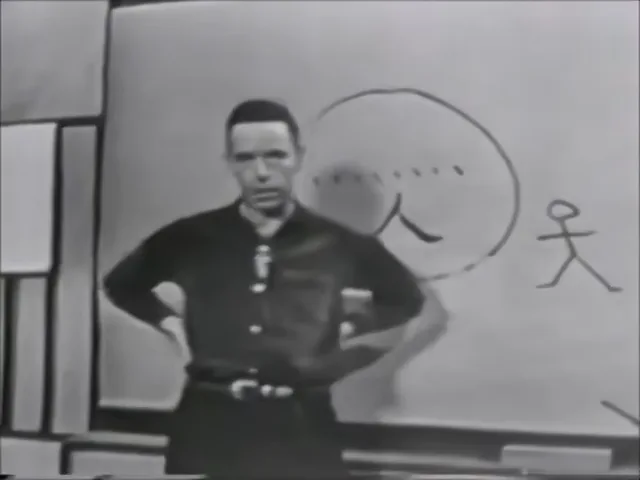
well a lot of chinese characters are abstractions if we take for example the chinese character for man
it is written this way now that was originally the head and legs of a human figure something you know
like this when we draw an abstract figure of a man everybody knows that's a man but as a matter of
fact it cuts out a great deal of man this figure cuts out all the details and gives us a simple image
which we can grasp all at once and we have to do that in order to think so that we can use a series
of very simple images or grasps of the world and these are abstractions and it is fundamentally
in terms of abstractions that we think now thought as i said is slower because it goes in a line thought
after thought and also thought is abstract that is to say it lacks the full living quality of real life
just as this figure here is just a sort of skeleton ball on top of sticks and therefore it lacks the vitality
the aliveness of a real man now the more we tend to live in a world of thought the more we tend to
live in an abstract world that is removed from and has a gap between it and the real world of nature
and as a result of this we tend to live in a world that is in some ways unsatisfying lacking in vitality and
life and also people tend to think all the time this becomes for every civilized community every
civilized person a sort of habit which is like constantly talking to yourself now of course when
you meet me here on the tv screen i'm always talking or almost always but i assure you i'm not always
talking i'm often silent because after all we have to be silent some of the time don't we in order to
hear what other people have to say and therefore to have something to talk about
in just the same way our minds have to be silent some of the time if we are really to have anything
to think about except thoughts you know there is a popular proverb which says that talking to yourself
is the first sign of madness and there's some truth in this because constant thinking as distinct from
simply experiencing through our senses constant thinking about our experiences coding our experiences
into words into signs into the symbols of thought is a buzz that goes on day in and day out inside our
heads except when we are sleeping and as a result of that we begin to live in a world increasingly
divorced from reality and that is why in those oriental cultures in india and china and japan it has
always been considered important for everybody to spend some of his time by no means all of his time
but some of it not thinking but simply in the attitude which was represented by that chinese
character which i drew at the beginning pronounced one or quiet observation remember this point it's
important this is not saying that thinking is a disturbance is a thing that human beings shouldn't do
on the contrary it's a highly important acquisition of man but thinking is of no real value to us unless
we also can practice non-thinking unless we can have our mind silent and make immediate contact with the
real world as distinct from the world of pure abstraction and so this leads to a very common practice
in asia among hindus among buddhists among daoists called meditation and i want to try and show you something
about it by sitting in the posture of meditation which is commonly used and is done approximately like
this one sits upon a firm cushion usually a big city telephone directory is about the right thickness
and ordinarily among oriental peoples they sit in what is called lotus posture or half lotus posture as
i'm sitting now which means that the right foot is lifted up onto the left thigh you will find of course
that that's an extraordinarily uncomfortable position if you're not used to it but one of the reasons for
sitting that way is that it locks your legs together so that you don't easily fall over if you should go to sleep
and also that this position gives you a sense of being very very firmly rooted to the ground
and then the hands are laid like this and one then turns attention to letting oneself breathe you don't do a
breathing exercises taking deep inhalations and exhalations you simply let your breath come as it wants to
but you if anything let the out breath you know the breath that goes with a sigh of relief you let that
be the emphasized breath rather than the in breath you don't close your eyes you usually drop them a little
on the floor in front of you because the object is not to cut out all the things that you might be
experiencing through your eyes and through your ears through your nose and your nerve ends on the skin
the object is simply to let one's mind alone to experience but not to try to catch hold of one's
experience in thoughts simply to think to no i wouldn't say think that's a word we use
very ambiguously when i use the word think i mean talk to yourself or bring a lot of images before
your mind which have nothing to do with what's right in front of you
so the function of this exercise this posture is to let the whole world come to you
without interfering with it in any way just sitting like that you may say oh that's a great waste of
time there are all sorts of interesting things in life to do why just spend some hours sitting
and the reason though as i tried to explain is that it is through this that one comes to have
a contact no longer with a world of abstractions no longer with a world of thought but with the world
that actually is now as you do this you begin to notice a rather curious change in your general feeling
of life you notice that there ceases to be what i would call an interruption or an interval between
your experience and yourself
you see in our ordinary way of using our minds the chronic sense of strain
the chronic attempt to think about and make sense of what we are feeling is what we call our ego
if you say i experience my own existence i am aware constantly of a knower
behind and receiving all that is known
then you get this chronic sensation of there being an i a self who has all these experiences and that i or
self is what we call the ego and this chronic sense of strain is our we might call it our psychological
blocking against our experience the thing that seems to divide us from an external world
from the whole universe but when in this way the interval begins to diminish we begin to experience
our world as ourselves there is no interval there is no interruption between the knower and the known
just as when we are completely absorbed listening to music or dancing to music
we are not aware of our separation from it we go right with it
and so in the same way when the mind responds instantly to what the senses bring
it seems almost as if the mind and what it experiences were one and the same
now in a way of course this is actually true we can understand this theoretically but we don't
ordinarily really feel it for example you know the old saying if a tree falls in a forest with nobody
listening to it will there be any noise perhaps you know the limericks in which this problem is
posed there was a young man who said god i find it exceedingly odd that a tree as a tree
simply ceases to be when there's no one around in the quad and the answer was young man your
astonishment's odd i'm always around in the quad so the tree as a tree never ceases to be since
observed by yours faithfully god but this is a great philosophical puzzle for the western world
does what we know depend on their being a knower now in a way obviously it does because when a tree
falls in the forest it certainly makes vibrations in the air but those vibrations in the air do not
become noise unless they vibrate an eardrum so in the same way the light from the sun does not become
light unless it falls on an eye an eyeball and two uh we could say the the external world is full of hard
things but nothing is hard except in relation to the soft surface of the human skin nothing is heavy
except in relation to human muscles so if there is not a human organism
the world does not appear to us at all as having any of the characteristics which we attach to an
external world in other words we could say the sun is light but only because of eyes rocks are hard but
only because of soft fingers falling rocks are noisy but only because of sensitive human ears
we cannot form any idea at all of what the world would be like without an observing mind even such
things as duration the span of time depend upon the human mind to appreciate space depends on a human
mind to observe the world from a particular position and so know that there are things which are distant from
without this mind there could not be any world that we could think about or conceive or imagine in any way
whatsoever and so this shows in a very clear way that our mind and the external world go together
they are inseparable differences you remember in a recent program how i tried to illustrate the idea of
inseparable differences by taking a coin or an object here like a cigar which has two distinct ends but
you cannot separate those ends this is very important it's worth repeating because it's quite fundamental
if i would want to take one of these ends off and break the thing and throw it away it would still
have another end there would still be two ends there i could never get rid of the situation of it having
two ends so you see that although the two ends are different there is just one object and so in the same
way although there is a difference in a way between the knower and the known between man and the world
nevertheless these two go together and they are fundamentally inseparable and therefore when our
consciousness is responding instantly without any interval or interruption without any shall we say
stopping to think about it then we have a situation in which
we are actually realizing we are actually feeling the true physical relationship which exists between man
and this we could call the experience of oneness or unity with the universe which is the function of meditation
now i think it's not difficult to see some very obvious values because well if we live entirely
in a world of thought all the things that we pursue in life tend in a way to become arid and unsatisfactory
because we are living in an abstract world in other words nobody in his senses is going to eat a menu instead of dinner
nobody nobody in his senses is going to try and get a satisfactory diet of dollar bills
and yet you see dollar bills and menus stand in the same relation on the one hand to wealth on the other
hand to dinner the same relation in which thought stands to reality they re-present it they symbolize
reality but they are in no sense substitutions for it yes you can do a great deal of things if you
have a lot of dollar bills but unless you exchange those dollar bills into real concrete worth they
are of no value to you and so in the same way if we try to live in the world of pure thought
we begin to feel a strange unsatisfactory quality to the world and this living in pure thought is not
something that is only done by you know professors and intellectuals and thinking people perfectly
ordinary people often live in the world of pure thought as for example when we pursue certain goals
in life when we say i want to be successful i want to be happy these are really abstractions
because supposing you become enormously wealthy and you're able to afford three cars and six houses
you can't drive in three cars at once you can't live in six houses at once you have a symbol which we
call prestige of your status but that is an abstract symbol you can't really you can't eat prestige you
can't eat success and so to overcome that kind of beguilement by the fantasies of thought
not thinking is an important adjunct to thought to be able every so often to cease the hubbub going
on inside one's head and to let talking to oneself stop and come to stillness you needn't of course
sit in the meditation posture like this to do it this is simply the way it's done by buddhists hindus
you can walk you can sit in the ordinary way you can lie in the bathtub and do it you can lie on your
back in bed before you get up in the morning and do it just let your mind alone and stop trying to make
sense of the world so then there is really something to think about other than thought itself
like if we wrote books about nothing but books this is i'm afraid what a great deal of scholarship is
books about books about books so in this way through meditation we come to that kind of profound peace
which is exhibited in the faces of the buddhists i remember particularly some words by lafcadio hearn
in which he gives a marvelous description of the whole attitude which these faces represent
each eidolon shaped by human faith remains the shell of a truth eternally divine
and even the shell itself may hold a ghostly power the soft serenity the passionless tenderness of these
buddha faces might yet give peace of soul to a west weary of creeds transformed into conventions
eager for the coming of another teacher to proclaim i have the same feeling for the high as for the low
for the moral as for the immoral for the depraved as for the virtuous for those holding sectarian views
and false opinions as for those whose beliefs are good and true
a talk given to the tahoe institute in which watts argues the anxious "quaking mess" we find on self examination cannot be transformed away, only watched.

a lecture on meditation using the chinese character for quiet observation to contrast linear, abstract thought with direct sensory experience of the world.

an audio recording in which alan watts teaches practical meditation techniques including breathing, chanting, and listening exercises, framing meditation as effortless presence in

a guided meditation on the sound om that identifies the listener's inner self with brahman and traces the hindu cosmological cycle of kalpas, yugas, and shiva's dance of destructio

a talk introducing a contemplative ritual built around silence and wordless mantra rather than sermon, followed by an extended chanted musical ritual with bells and drumming.