Evolving Times
This is a recording of Terence McKenna's 1995 talk in Sacramento, California, where he presents his alternative theory of human evolution. McKenna critiques orthodox evolutionary explanations for human consciousness, particularly the theory that tool use and throwing behavior drove brain expansion. He examines the rapid development of the human brain and discusses the uniqueness of human language, mathematics, and culture compared to animal behavior. The talk explores fundamental questions about the origins of consciousness and their implications for how we understand human development. Attachments below include the original video file, an audio-only version, a full machine-generated transcript, and timed subtitles.
transcriptmachine-transcribed, unedited
Can you hear? Everybody can hear? Good. Well, I like to lead with good news, so let me assure
you that at no point this evening will I read from or quote the poet Rumi. It's a pleasure
to be in Sacramento. It's a pleasure to be in California. I lived here for about 30 years
before moving out about eight months ago. Lived over in Occidental, so I sort of feel
like this is a hometown congregation. You may have seen the story in the bee this morning.
It was a reasonable detailing of my theory of evolution. I noticed that one expert wouldn't
even give his name to allow his no comment to have attribution.
Gentlemen, this is no way to behave in the face of an ideological revolution. Anyway,
and plus it isn't even my weirdest idea, but that was left unmentioned, thankfully, in
the article. But since the article dealt so specifically
with evolution, I'm going to read it to you.
Okay.
And because that probably is my best candidate for entree into any kind of respectability,
something I crave intensely in every atom of my body, I thought I would discuss it
with you this evening and try and make it seem a little less absurd than my critics
might make it seem.
First of all,
let me lay out for you the nature of the problem. Right now, the nature of the problem
is finding the damn phone and shutting it off.
No, the nature of the problem is that evolutionary theory tells us that we are some kind of advanced
animal of some sort, and science has waged a noble struggle to find the damn phone. And
the fact that this is the case is simply the moral of the directorial thought.
The different kind of people we know about będą we have a certain set of human beings
that are not completely human. They do this sort of thing. They discard the idea of the
human being. There is a topic which is very interesting in the medical field, the cross-neurological
field, and that is that human beings can, through the power of science, free themselves from
the power of science.
Mutually, they can be as ordinary as they can be, and they can be believed to be
under such mental control.
It is as if they are the only human being in the world that is not under such kind
of spiritual control as humans are, in the sense that someone who is an individual
being, but is not an individual being, is in fact a child, but is not an individual.
And yet, there is, after it's all said and done, the sense that if we are an animal, we are a very, very peculiar sort of animal.
Indeed, a unique animal, an animal capable of language and coordinated planning, an animal not bound to a particular social or sexual style.
We have monogamous human societies, polygamous societies. This is very different from animals.
We have poetry, we have mathematics, we have drama, a whole spectrum of effects that is far from anything that we find in animal organization.
And this problem has fascinated me for a long, long time, as it's fascinated a lot of people.
Because...
Because, obviously, it's a great embarrassment to the theory of evolution that it can't account for human consciousness.
Because, after all, human consciousness produced the theory of evolution.
So you see, it's a significant failure there.
So, obviously, if you accept the basic rules of the evolution,
then it will cause some kind of neural
But you also have this idea of the un-ideal, that you can do it, and you can do it.
Yes, you can do it.
And so, then you have this idea of the secondary game,
which are that there is random mutation.
Which means gene drift, mixing of genes through sexual reproduction.
Cosmic rays which cause birth defects and mutations, this sort of thing.
And natural selection.
And these two factors,
account for praying mantises, chipmunks, tropical rainforests, but not us.
And the reason is that we emerge too quickly from the background of the rest of ordinary
nature.
In the space of about two billion years, the human brain doubled in size.
And Lumholtz, who is an orthodox evolutionary biologist, calls this the most dramatic transformation
of a major organ of a higher animal in the entire history of life.
And it happened to us.
It happened to that very organ that is responsible for the theory of evolution.
So what extraordinary confluence of...
.
...factors could have come together there to take essentially an arboreal monkey, an
ape of some sort, that had been at an evolutionary climax in the canopy of the rainforest for
a couple of million years.
What extraordinary set of factors could then set that creature marching down the road
toward Elvis.
Elvis, the internet, Bill Clinton, and all the rest of it.
Well, you would imagine, or I imagined when I first started thinking about this,
that there must be some huge edifice of established theory
that we have to go up in there and blow up.
Surely somebody has staked out this ground
and made some kind of an argument about human consciousness.
Well, in terms of science, not, or almost not.
I mean, in terms of religion, it's simple.
I mean, God made us from the clay of the earth.
In terms of science, the best shot is pretty weak soup from my point of view.
Here's what science is telling us.
That when you throw something, you have to plan.
Because once you let go of whatever it is you're throwing,
you can no longer control it.
And so because we were small and weak and hunted in packs,
we learned to throw like hell
at very large, onrushing, woolly fellow mammals of various sorts.
And you had to plan your throw.
Consequently, we developed brain capacity.
We had the ability to do this, and had enough left over
to invent quantum physics, paint the Mona Lisa,
invent the phonetic alphabet, philosophy, religion,
and all the rest of it.
In other words, it was the coordination of the hand
and the eye to the throwing arm,
this is what the orthodox folks tell us,
that gave us this extra brain capacity that we sort
of then managed into human civilization.
Well, notice this.
That this would make the pinnacle
of the evolutionary ladder the gum-chewing,
big league baseball pitcher.
Because, you know, he can put that pill right across the plate
at high speed time after time.
As somebody who learned everything they know
about sadomasochism in PE class, I'm not really ready
to embrace that.
I'm not ready to embrace this theory.
It definitely runs against my paradigm.
So I've built another story.
And it, to my mind, meets the objections, answers the question,
where did consciousness come from?
But instead of doing it very nicely and neatly, it raises,
in the very act of answering this question, other questions.
Maybe more closer to home.
Questions that reflect on our social organization, our politics,
how we treat each other in the here and now.
Even with implications for the future.
But we'll get to that.
For the moment, let me just run through this for you.
There's a sort of a basic situation that all theories
of evolution have to come to terms with.
And this is that our remote proto-hominid, primate, ape ancestors lived and developed in Africa.
If you have a non-African theory of human origin, and there are such things, but the evidence is strongly against you.
If it were stock, I'd sell. The evidence is pretty strong that whatever happened that brought us out of the animal body, it happened in Africa.
Well, all animals tend to, and plants for that matter, tend to reach evolutionary climax and occupy a niche and stabilize in that niche.
Cockroaches, ants achieve this.
Hundreds of millions of years ago, and have not changed greatly since.
Most of biology is this iterative occupation of a climaxed niche.
Very little of biology is the pushing forward into radical new forms, new species, still rarer, new genera.
For that, there has to be disruption.
There is this prosperity of some sort of the environment.
And it can be the meandering of a river, or an asteroid strike, or the retreat of a glacier, something which creates open land.
Well, for many, for five, six million years now, the African continent has been slowly drying.
And 3 million years ago, it was covered by rainforest.
At the equator.
And in the interstate.
from east to west, and that was the environment of the human ancestor types.
They were canopy-dwelling, they were fruit-eating, they ate some percentage of insects, composed
their diet.
They had a pack signaling repertoire that was fairly complicated by animal standards.
And there they were, happily living in the canopy.
But Africa began to dry up, and they came under nutritional pressure.
Now simpler animals, insects for example, when their food source is withdrawn, they
usually buy the farm.
They don't have much flexibility of diet.
If you've ever tried to raise caterpillars into butterflies for your children, you know
that if you give the caterpillars the wrong leaves, they just can't make any sense out
of it, and they die.
More advanced animals, when confronted with dietary pressure or disappearance of ordinary
food supplies, before they give up the ghost, they will...
...
... experiment with other food sources in the environment.
Now the reason this isn't normally done is thought, the reason animals are conservative
in their food choices, it's thought to be a way of avoiding mutational influences in
the form of tertiary chemicals, toxins, viruses, and things like this, that would be in the
food, in unusual foods.
One of the things that accompanies our acquisition of consciousness is gastronomy.
The appreciation of flavor.
The approach to food that makes it an art.
Animals don't do this.
They're just trying to get enough protein to keep the old engines running.
The notion of flavoring is counterintuitive to animals.
And flavoring's probably...
... probably, in part, a mutagenic influence to our diet.
When our remote ancestors came under environmental pressure, their environment was shrinking,
the rainforest was being replaced by grasslands, and nutritional pressure, their ordinary diet
of fruit and insects was being restricted, they began exploring this new environment
of the grasslands.
and this is the era of knuckle walking
turning into bipedalism
it's the era of the coordination of binocular vision
so forth and so on
there was a paper published recently
which anticipates my point
but I can't wait to hit you with it
a paper published recently
about canopy dwelling monkeys
who only leave the canopy
for the acquisition of one particular food
and the food they will come to the ground for
and risk predation is mushrooms
so it seems perfectly reasonable
to suggest that our remote ancestors
exploring the new environment of the grasslands
would have encountered
as you would if you were to go to the tropics
psilocybin containing mushrooms
growing in the desert
dung of cattle
many dung growing so-called coprophytic
coprolitic mushrooms
produce psilocybin
among them stropharia cubensis
which is one of the largest
and pandemically distributed
of these mushrooms
I'm sure that our early ancestors
also tested other kinds of food
they were testing everything
they were digging for corms
with pointed sticks
and I'm sure there were many
ecological and medical disasters
as a consequence of this
for instance
the birth control steroids
in modern birth control pills
are produced by diascoria vines
grown on plantations in Mexico
well diascoria is the family of sweet potatoes
imagine a hungry band of primates
that come upon a patch of sweet potatoes
that are heavy in these steroids
it would raise holy havoc
with their reproductive cycle
it would interfere with menstruation
ovulation
lactation
fertility
and human genetic history
is the story of many such encounters
with mutagenic influences in the environment.
Most of them catastrophic, detrimental, lethal.
But in some few cases, there would have been solitary results,
advantages conferred upon the animals that accept these new foods into their food chain.
And I want to particularly emphasize psilocybin because I believe it's the key.
You see, we're looking for some kind of factor which could have exploded the human brain size
at a rate ten times faster than evolution normally takes place.
So it's going to be an unusual situation.
Perhaps the need to throw a boulder a distance accurately,
or perhaps contact with an unusual food item or drug-containing plant.
But.
It was something unusual.
If it weren't unusual, it wouldn't have taken this planet a billion and a half years
to bring forth its first intelligent species.
Well, so let's look at psilocybin then in a little more detail.
It has a number of properties not specifically related to its psychoactivity
that make it an ideal candidate for a catalyst
for the emergence of consciousness in an advanced animal.
First of all, and at the early stage of human invasion of this new grassland environment,
proto-hominid invasion, I should say, we were testing foods.
We would certainly have tested this food.
I've seen these things the size of dinner plates in the Amazon after a rain, and they are silvery
with blue and purple shadows.
They are the most dramatic thing in the environment,
whether you know anything about them as psychoactive agents or not.
Certainly, they would have been tested for food.
I've seen baboons in Kenya investigating cow pies and flipping them over
because beetle grubs nestle underneath them, so cow pies are a natural vector for hungry baboons.
So that everything is in place.
It's trivial to suggest otherwise, I would maintain.
Okay, the first quality of psilocybin, which isn't specifically related to its psychoactivity,
is that in small doses, doses that are the kind you might obtain if you were just sort of eating it along with
little roots, grass roots, small bugs, you know, so forth and so on,
visual acuity is improved.
Specifically, edge detection is improved.
Well now, it seems to me you don't have to be a rocket scientist to figure out that if you're in a highly competitive evolutionary environment
in grassland, an environment characterized by large predators hunting cats, and also characterized by small ungulate prey,
an environment characterized by large predators hunting cats, and also characterized by small ungulate prey,
that having an increased sensitivity to edge movement might make the difference between whether or not you live to tell the tale,
or you become somebody's dinner, or it would certainly make the difference between going home empty handed
and taking dinner home with you.
So a factor which enhanced edge detection on those animals accepting that food supply
and then putting itself into their plate types,
that's an easy pass I would recommend,
is fidgeting, Romanian turtle diving,וט
chain, they would have a slightly increased chance of evolutionary success as opposed
to the non-silocybin members of their group.
And this increased hunting success would tend to outbreed the non-silocybin-using members
of the group.
At slightly higher doses, in highly-sexed animals like primates, all alkaloids are what
are called CNS stimulants, central nervous system stimulants.
That means that they produce arousal.
And in sexually extremely active animals like primates, arousal means erection, usually
from sexual activity.
In the male, usually followed by hanky-panky, what anthropologists and primatologists call
successful instances of copulation.
Well, again, what is this?
It's a second factor tending to outbreed the non-silocybin-using members of the population.
They're now definitely moving to the rear of the parade.
They don't have as much hunting success.
They don't have as much food for themselves and their offspring.
They're not having as much sex, so they're not having as many offspring.
And in terms of rising and falling numbers, those that have some allergy, prejudice, or
fear of the mushroom are just being shunted out of the breeding population.
Well, at still higher doses, approaching effective doses.
In other words, 4 grams dried and up, or 45 grams wet and up, hunting is out of the
question.
Sex is something you can consider, but it's out of the question.
And you are basically nailed to the ground in a state of mind which we, for all of our
sophistication, our logical positivism, our superconducting, supercolliders, and
all the rest of it, haven't a clue as to what it is, what it means, what its implications
are.
The full-blown psychedelic experience of which we can only speak in terms of religious
hierophany, epiphany, apocatastasis, and all those other great Greek words, ataraxia,
you know.
In other words, we like it, but we don't understand it, and it is, therefore, the
basis for religion.
Well, so right there, you have a three-step process driven by nothing more than hunger
and curiosity that leads remote primate ancestors to a confrontation with what Rudolf Otto called
the holy other, the holy, the non-holy.
And who is the reason for all of that?
Well, the of this is the transcendent, the powerful and the natural, and the luminous,
the transcendental.
And you know, this is on slightly less firm ground, but in my own personal experience,
and having collected psychedelic experiences lifelong, I feel confident in saying that
meaning. Speaking in tongues is what Christian fundamentalists call it, but they don't have
monopoly on it. It's ancient. It occurs in all cultures. It's shamanic. And what it is,
is it's a kind of neurological seizure where linguistic organization spontaneously is verbalized.
No animal does this. It must have something to do with the acquisition of language by human
beings. And what I think is going on is that probably language was entertainment long before
it was meaning. That it's a kind of tuneless singing. And that having discovered that we
could make an almost endless repertoire of small mouth noises,
we did this for each other, for amusement, for to pass the time. I mean, God knows there was a lot of
it. And it probably was very late in the evolution of this ability that some very tight assed,
rational type said, you know, we could attach a specific meaning to a specific sound. And then
every time I made the sound, I made the sound. And then every time I made the sound, I made the
sound. And then every time I made the sound, I made the sound. And then every time I made the
sound. And then every time I made the sound, I made the sound. And then every time I made that sound,
you'd know what I meant and then you could go and get it for me.
You see?
It's the sort of, it's the as long as you're up, get me a grant theory of language.
So that's the basic idea. And I really believe that some time in the last 50,000 years,
before 12,000 years ago, a kind of paradise came into existence.
A situation in which men and women, parents and children, people and animals,
human institutions and the land, all were in dynamic balance.
And not in any primitive sense at all.
Language was fully developed.
Poetry may have been at its climax.
Dance, magic, poetics, altruism, philosophy.
There's no reason to think that these things were not practiced as adroitly as we practice them today.
And it was under the aegis of the boundary-dissolving influence of psilocybin.
We were nomadic.
We were breeders and caretakers of cattle.
We worshipped a great goddess.
We followed a yearly round in a vast grassland cut by crystal streams
that were washing down out of the higher altitudes.
And we were probably black as your hat.
For that matter.
And it was great.
Well, if it was so great, what happened?
Well, the very forces which created this situation, and you will recall what it was.
It was the drying of the African continent.
Forcing us out of the trees.
Forcing us to change our diet.
Forcing us to accept a dung growing mushroom.
And there were other factors forcing us into consciousness as well.
When we became omnivorous, the first form of consciousness is having the point of view of your prey.
Predatory animals have the highest form of animal consciousness.
Big cats.
But it's a consciousness of the exterior world.
Psilocybin forced us beyond that.
Into consciousness of the imaginal world.
The world of the imagination inside our heads.
What happened was the mushroom faded.
The climate changed.
What had been everywhere became seasonal.
Moved into the rain shadows of mountains.
Became the prerogative of a special class of people called shamans.
Who were like the designated hitters.
For dealing with the hyperspace of the mythos.
In other words, over millennia, the connection went from available to everyone all the time.
To ever more tenuous, ever more tenuous.
Finally faded out entirely.
It's even more complicated than that.
Because surely people would have, as they saw this happening.
Make attempts to preserve the mushroom.
And in a world without refrigeration.
The only effective way to do this is preservation in honey.
You can dry mushrooms.
But in a world without hermetically sealed peanut butter jars.
Drying is a very short term strategy for preservation.
The only thing which will really work is preservation in honey.
The problem there is.
That honey itself.
Especially aboriginal honeys.
Which have a lot more water in them.
Than what you get in those little plastic bears at the A&P.
Aboriginal honeys are very runny.
And so what do they do?
They themselves have the capacity for turning into a psychoactive substance.
Alcohol.
But alcohol promotes a completely different set of cultural values.
And attitudes than psilocybin.
Psilocybin is a boundary dissolving hallucinogen.
Mead alcohol gives an enhanced sense of verbal acuity.
In the presence of lowered sensitivity to social cues.
In other words.
One can make an ass of oneself.
But now I want to backtrack for a minute.
I will return to this thing about the loss of the mushroom.
But there's something that I want to go over with you.
That's really important in all this to me.
And that is.
This isn't simply the story of how an intoxicant promoted consciousness.
And then we fell into history by losing that intoxicant.
And went on to other intoxicants.
With consequences to be evaluated.
It's that.
But it's more.
Because psilocybin had a very, very peculiar effect.
Over and above what I've mentioned so far.
And it is this over and above effect.
That makes my theory so controversial.
And academics, I think, so phobic of it.
Because it rips open a whole can of worms.
And this is the problem.
All primates clear back to squirrel monkeys and old world monkeys.
All primates form dominance hierarchies.
This means that the sharp fanged hard bodied young males control everybody else.
The women.
The elderly.
The sick.
The children.
The intellectuals.
Everybody finds their place somewhere in this dominance hierarchy run by these dominant alpha males.
We are no different.
We also, as we sit here this evening, operate under this kind of a social organization.
I mean we complain about it.
We analyze it.
We are aware of it.
But we live under it.
It's how it is.
So here is my suggestion.
That what psilocybin did was it changed behavior.
It interfered with primate behavior.
Specifically, it interfered with this tendency to form monogamous pairs and dominance hierarchies.
And so the ordinary tendency of the primates to organize.
To organize themselves that way was interrupted.
Medicated out of existence if you like.
Vaccinated against if you like.
By the presence of psilocybin in the diet.
And this over emphasizing or chemical accentuation of sexuality occasioned by the arousal.
Of the psilocybin.
Was sufficient to dissolve the ordinary tendency toward monogamy.
And replace it with an orgiastic sexual style.
Or they coexisted simultaneously.
I mean who knows.
We weren't there.
It's sort of the way I imagine it.
Is that at every new and full moon.
There were group mushroom parties.
Which basically simply got out of hand.
Regularly.
And so the monogamous pair bond would be under pressure.
If not completely eliminated.
Many cultures have this even to this day.
I mean in a sense Mardi Gras is a festival where the rules are dissolved.
And nobody is supposed to go to their spouse the Monday after.
And say you know was that you I saw dressed as Marie Antoinette.
And because you know the rules are there is permission to break the rules.
And many societies do this.
The result of an orgiastic style like that.
Is men cannot trace lines of male paternity.
And so there is a tremendous social glue.
A tremendous force for the cohesion of community.
Men don't then think in terms of my children.
They think in terms of our children.
The children of the group.
And under the aegis of this group.
This polymorphic sexual style.
Group child care and extended family rearing.
We produced everything that we think of as human.
That we value.
Our art.
Our music.
Our philosophy.
Our sense of each other's worth.
Body painting.
Tattooing.
Piercing.
All the accoutrements that distinguish us from animal existence.
Were put in place when we had a different kind of mind.
Than we have now.
We didn't have a mind that favored role specialization.
And male dominance.
And anxiety.
And sobriety.
Over female sexual activity.
Related to feelings of male ownership.
That all came later.
We became human beings in this other world of values.
And psychological attitudes.
Problem is.
That as I say.
The mushroom faded.
But by the time it had faded.
We were no longer the wordless symbiotes.
Of cattles.
The barely sentient hunters of the African plain.
By the time we were finished with the mushrooms.
We had language.
We had social institutions.
But what we began to lose.
Was you know.
You can get as wet eyed as you want about it.
But respect for each other.
A sense of each other's individuality.
A sense of love.
A sense of community.
And it must have been.
Though it happened over a long period of time.
Very much like what we're living through now.
A sense that people are you know.
No damn good.
And getting worse.
A sense that you know.
Why can't we be as we once were.
Where is our sense of each other.
Where is our ability to care for each other.
So forth and so on.
I wrote a book called.
The Food of the Gods.
In which I tell this story.
In the first third of the book.
That I've just told you.
And then I show.
That what history is essentially.
Is a careening.
Out of control effort.
To find our way back.
To this state of primordial balance.
One of the things that marks us as humans.
That is unique.
Is our obsessions with drugs.
Our ability to addict.
We addict.
Not only to substances.
We addict to each other.
We addict to ideologies.
Marxism.
Christianity.
Skinkism.
As practiced in Washington.
Whatever.
And we addict.
To each other.
You know.
I mean.
I am a romantic.
With the best of them.
But I can't help noticing.
That a broken heart.
And heroin withdrawal.
Show very similar presentations.
Really.
Insomnia.
Sweating.
Sense of diminished self esteem.
Hysteria.
You know.
It's very very similar.
We.
A psychologist.
Looking at a person.
With an addictive syndrome.
Will say.
Well you were damaged.
In childhood.
There is some trauma there.
That you're.
You're trying to.
Compensate.
You're trying to compensate.
Well I'm not that keen.
On all this.
Psychologizing.
But I do think.
That.
We could apply this model.
To ourselves.
On a grand scale.
We were essentially.
Torn.
From.
Our lives.
From.
Our lives.
From.
Our lives.
From.
Our lives.
We were essentially.
Torn.
From.
The.
Gaian.
Womb.
Thrust.
Into.
The.
Birth.
Canal.
Of.
History.
And expelled.
Sometime.
Around.
The.
Fall.
Of.
The.
Roman.
Empire.
Into.
The.
Cold.
Hard.
World.
Of.
Modern.
Science.
And.
There.
Are.
Things.
Out.
There.
You.
Know.
Alcohol.
The.
Whole.
Morphine.
Family.
So.
Forth.
And.
So.
But.
These.
Things.
Always.
Have.
Con.
Sequences.
There's.
A.
Price.
To.
Be.
Paid.
Charles.
Johnson.
Watson.
Went.
In.
The.
Early.
1950s.
And.
Found.
These.
Mushrooms.
And.
Brought.
Them.
Out.
And.
Then.
Albert.
Hoffman.
Who.
Had.
Earlier.
Discovered.
LSD.
Synthesize.
The.
Compound.
And.
mowed this field and moved on it's that science has never really been here we
haven't looked at the implications of diet on early human evolution we don't
have a theory for the evolution of consciousness of any consequence and yet
you know the factors I've laid out for you increased visual acuity and impact
on sexual and social behaviors a triggering of glossolalia like phenomena
in the presence of a boundary dissolving psychedelic experience these are
catalysts sufficiently dramatic that inculcated into a cultural style I think
they explain a great deal about where we came from and who we are now the the
irony of all of this is that we don't
live in a society that has made all practically any discussion of this
illegal certainly if I were to end this lecture by handing out doses of
psilocybin I would be gently taken by the elbow and led away forever the
Western mind is particularly phobic of this of this subject
I mean we have bent our laws so that people
can jump out of airplanes in the pursuit of thrills so that they can bungee
cord off major highway bridges and freeway overpass is so concerned are
we to fulfill society's need for thrills but this is something else it wonderful
b fallait
vent from thisром
mundo
us
see you
believe unfairly. I think that when you examine the situation, it's possible to understand very
clearly why this is such a social issue. Because what these things do, if you look, and now I'm
slightly broadening my wrap to include other psychedelics besides psilocybin, but psilocybin is
certainly true in all cases. What these things do, if you had to generalize 100,000 psychedelic
experiences, the ones where people thought they were God, the ones where people had to be taken
to the ER room and have their stomach pumps, all of them, if you generalized, what these
substances do is they dissolve boundaries. They dissolve boundaries. If you love it, you'll love
it.
If you hate it, you'll hate it. But that's what they do. They dissolve boundaries. Now, the reason
this provokes a lot of social anxiety is because all societies are about the maintenance of
boundaries. It doesn't matter whether you're, you know, a stockbroker in New York, a Zen monk in
Kyoto, a Hasid in Jerusalem, your society is held together by boundaries.
And definitions and anything which dissolves those boundaries and introduces relativity into
cultural modeling is felt to be threatening because we like to believe that our reality is
somehow sanctioned, that this is how it should be. But in fact, you know, that's just a cultural
judgment. All cultures think that their culture represents a sanctioned reality.
It doesn't. It just represents the current download of the, their linguistic enterprise.
The, at the core of the Western anxiety about boundaries is something that we are very proud of,
that we believe we invented. We call it the ego. Sometimes we call it the democratic individual.
We, we, we, we, we, we, we, we, we, we, we, we, we, we, we, we, we, we, we, we, we, we, we, we, we, we, we, we, we, we, we, we,
we, we, we, we, we, we, we, we, we, we, we, we, we, we, we we, we, we, we, we, we, we, we, we, we, we, we, we, we, got broke from copied truths and
world dividedness with a packet of Two Locals .
It turns out it wasn't.
inaire 14.
?One minute break.
the citizen, the individual.
We want nothing of tribalism, still less of collectivism,
and God forbid, nothing whatsoever
to do with communism.
See, all these things set us going.
But in fact, the ego is appropriate only
to a certain point.
I mean, yes, we need egos so that when
you take someone to dinner at a reasonable restaurant,
you place food in your mouth, not their mouth.
This is what the ego is for.
It tells you who pays.
But in fact, what the ego is is the return
to consciousness of this psychic structure related
to the patterns of dominance.
And the way I think of the ego is it's like a cyst,
or a calcareous growth, or a tumor that
gets going in the personality.
And if not treated, it becomes chronic.
And then there is no cure.
There can only be a certain amount of maintenance
and medication of it.
But it's incurable, except unless we resort
to not only non-prescription drugs,
but drugs currently illegal.
In other words, the psychedelics,
through this boundary dissolving function,
dissolve that boundary as well.
And so they promote a larger sense of the world
than the values of capitalism, competitiveness, object
fetishism, property acquisition.
And the bottom line, empower.
So the issue, as was always sensed since the 60s forward,
I think, is not simply an issue of religious freedom,
or an issue of an eccentric minority social practice being
tolerated by the majority the way they tolerate handing out
pamphlets.
it's in airports or something like that. The issue is, in fact, what kind of people shall
we be? And then what kind of society shall we put in place? And that's why my theory
of evolution is not simply a dry footnote on an issue that involves anthropologists,
primatologists, and biologists, but it turns into a political issue. Because our unhappy,
addicted, ego-driven condition has become not simply the source of our own unhappiness,
that was bad enough, but now it's the source of great discomfort and dislocation for all
life and human society.
We are out of control. We are, basically, severely addicted to things, and cannot stop
ourselves. And we know, or we should know, that there is not enough petroleum, heavy
metal, and so forth and so on, in the planet to give all the thing-addicts, to give all
the things-addicts, to give all the things-addicts, to give all the things-addicts, to give
all the things-addicts, to give all the things-addicts, all the things that we know
they must have in order to be happy. We have spread this intellectual virus from
pole to pole, to Turkmenistan and Barneo, to the upper Amazon and to the Tajiks. Everybody
wants kids. Everybody wants the pause that refreshes. What are we going to do about
this?
Well, so far, we've been treating it like an endless garden party. There's no serious
plan on the table to deal with this at all.
I think that the momentum of human history is pushing us inexorably toward some kind
of day of reckoning, in which we are either going to have to turn consciously toward brutality
and selfishness, and say, well, let India go. Let Bangladesh go. Triage costs too much.
Can't possibly fix the problem. In order to maintain our locked compounds and our fifty
channels of television and the endless availability of arugula, we have to let India go.
We're going to have to turn that way. In other words, each consciously participate in a
choice to brutalise the human enterprise, or we're going to have to seriously talk about
very major restructurings of our society. I don't really know how we do that. I was
living in Northern California a couple of years ago, when they wanted to close an air
base near here, and the newspapers were filled with weeks for weeks with announcements they
were being blamed for. They were saying, we ought to go to the playoffs, we ought to
analysis of whether Western civilization could absorb this hammer blow at the very heart
of its institutions of closing one friggin' air base, for crying out loud.
That's not my idea of major change, you know?
We may have to give up some of our pretty things.
We may have to discipline some of the irresponsible social philosophies that run amok among us.
And no, I don't mean the advocacy of psychedelic plants.
I mean the Roman Catholic Church's position on population control in the Third World.
The Germans take quite a knock for the Holocaust, but the Catholic Church manages to push
away.
They push more people into death, disease, and degradation every year than the Holocaust
managed in its entire show.
And it's thought rather crass to even mention the fact.
It seems to me as long as these Catholic bishops can show their face in public that we are
in complicity with mass murder.
It's not pleasant news, but what are you going to do about it?
Islamic fundamentalism, another bunch of knotheads with an anti-human agenda.
What are we going to do about this?
Are we going to go gently into that good night of planetary chaos, extreme distortion
of class structure, defense of what we have at any cost against those who have nothing?
There doesn't seem to be any other plan on the horizon.
Arthur Kessler, who probably never thought he would be quoted by Terence McKenna, a very
conservative character.
You'll recall he was a Marxist who turned on Marxism and led a very interesting intellectual
life.
He wrote a book 30 years ago called The Ghost in the Machine.
And he made a case similar to mine but a little simpler.
He observed, human beings are hardwired for homicide.
This is what we do best because this was something we had to do, apparently, at some point in
our past, at least in Kessler's view.
He didn't believe in a mushroom paradise.
But he reached the same conclusion that I have, which is, we need a pharmacological
intervention on antisocial behavior, or we are not going to get hold of our dilemma.
There have been dystopias based on drug intervention on aggressive behavior.
You all remember Brave New World, where every time anybody raised their voice, they were
given a gram of Soma and told,
A gram is better than a gram.
And so nobody ever had a thought in their head, well, that's a terrible drug.
Let's not introduce that.
Uh-oh.
The bad news is, we've had it for decades.
It's called television.
We have millions of people in larval, low-awareness lives in their little condominium apartments,
just ladling this garbage into their minds.
The average American would not be able to do that.
The average American watches five and a half hours of TV a day, so imagine how much time
these people watch.
I mean, to think of that as human at all.
If that were a drug, we'd be up in arms.
If people were loaded at home with that level of mental condition, day after day after day,
we would do something about it.
So my, I don't have, I can't.
I don't want to propose a grand solution, but I do think that it is pregnant with implication
that here at the end of the 20th century, with all of these problems hammering down
on us, the news comes from the rainforests and the deserts that these aboriginal people,
while we made the descent into history and got the top quark and planted the flag on
the moon and all that, they kept the faith.
And they have a materia medica, a tool box, that can carry us back into a connection with
the planet.
Now, the question might be asked, why do you have such overwhelming faith in what is
after all a substance, a drug?
I mean, don't psychedelics just cause you to see pretty...
pictures and patterns and tally up your gains and losses and then you come down
and that's it and the answer is no what is mysterious here and I mentioned it in
the early part of my talk what is mysterious here is this thing we call
the psychedelic experience those people nailed to the ground around the
campfires 50,000 years ago they didn't know what it was and when we go in there
armed with our Heidegger and our Husserl and our Wittgenstein and our
Merleau-Ponty we don't know what it is either there has been no progress in
60,000 years in reducing the psychedelic experience to a known quantity it is as
terrifying as awesome as ecstatic as
irreducible to us as it was to them well what is that as secular people we
rarely experience religious awe especially of the uncontrollable sort I
believe that what makes the psychedelic experience so central is that it is a
connection into a larger
modality of organization on the planet which is a fancy way of saying it
connects you up to the mind of nature herself the planet is not just a
hodgepodge of competing species that's the old evolutionary model that's been
obsolete for decades the new evolutionary model is that where we see
species nature sees only a gene swarm genes moving at various speeds being
transferred around a large percentage of them by sexual propagation but a
large percentage of them by asexual and vegetative propagation and still others
by more exotic methods of propagation such as go on in the fungi and the
bacteria
The world is a gene swarm, and people like Lynn Margolis and James Lovelock
have been suggesting for years that the Earth is a kind of thermostatic self-regulator.
Well, if you carry that idea far enough,
thermostatic self-regulator is a way of saying a kind of computational engine,
a kind of computer, a kind of mind, a kind of mind, the Gaian mind.
The reason those mushroom-eating, orgiastically behaving people worshipped a great horned goddess,
the reason they imaged the numinous other as feminine,
was because they had a connection into a kind of overarching intelligence
that they instinctively and intuitively felt to be feminine.
And we retain this in our languages as the idea of Mother Nature
and the femininity of the land and so forth and so on,
but it's just become a distant metaphor to us.
I think our intelligence is a source of toxicity to nature
and discomfort to ourselves.
Unless our values are based on planetary values,
are linked to the values of the rest of nature.
And that means we need to fit ourselves more appropriately into the scheme of things
by limiting our numbers,
by limiting our extraction of natural resources,
and by limiting our consumption.
And that's the way we're going to do it.
And toxification of the environment.
We need to realize that there is a hegemony of life on the planet,
not necessarily a hegemony of intelligence.
Intelligence is not a license to trample.
The proper role of intelligence in a planetary ecology
is that of gardener,
caregiver, and maintainer of balance.
Well, so where do we go?
And what do psychedelics have to say about that?
Well, I believe that psychedelics show us something
which capitalist, consumer, fetish-oriented society
doesn't want us to know.
What psychedelics show us is the incredible richness
of our minds, that you, little you,
can produce more art in a 20-minute burst
of hallucinatory intoxication than the Western mind
has produced in the last 500 years.
Our socially created space is incredibly important.
We have Picasso's contribution and Pollock's contribution
and everybody's contribution, but it altogether is as nothing
compared to the richness that resides in each one of us
a half inch behind your eyebrows.
We are told, you know, oh, well, if you want beauty,
you have to own a Lexus.
Or, you know, if you want a sense of satisfaction,
then you need a triple car.
Or, you know, if you want to be in a garage,
then you need a garage, on and on.
This is absolutely not true.
These are substitute addictions that will never satisfy
for the genuine article, and the genuine article
is a connection into the Gaian mind.
Well, I don't believe or expect for a moment that ever again,
naked, tattooed, and joyous, we will herd our cattle
to America.
I mean, there are six million of us.
That chance has been blown.
But what can we do to ameliorate our situation?
Well, I have always been an optimist.
I'm more optimistic right now than I have been for a long time
because sometimes when you're an optimist,
you're an optimist simply on principle.
You believe it's going to turn out all right.
But you don't see how it possibly could.
I'm beginning to see how it possibly could turn out all right.
And my notion is, first of all, I follow in my thinking
about shamanism, and I follow the great historian of religion,
Mersi Eliade, who got it almost all right except that he never embraced
psychedelics.
He thought they were decadent.
But that was just his French-European education,
and he came too early.
But anyway, Eliade wrote a book called Shamanism,
and then he subtitled it The Archaic Techniques of Ecstasy.
Now, he wrote the book in French.
In French, technique has a connotation that it doesn't have in English.
It means both a way to do things,
and it means technology.
Later, the French sociologist Jacques Ellul wrote a book called Propaganda.
And the little banner under which his book flew,
which is printed right on the frontispiece,
is he says there are no political solutions,
only technological ones.
The rest is propaganda.
And then he spends 200 pages explaining what he means
by political solutions, technological solutions, and propaganda.
By Ellul's understanding, I agree.
I think ideology is toxic.
All ideology.
It's not that there are good ones and bad ones.
All ideology is toxic.
Because ideology is a kind of insult to the gift of human free thinking.
I mean, if you adopt some ideology,
Christianism, Mormonism, it doesn't matter,
then you have all the answers.
You just go and look in the catechism.
Well, I don't know why they issued you a brain.
They could have just given you the catechism.
Technology, as the counterpoint to ideology,
is a very different animal.
Now, right now, we're going through a technophobic phase,
because people think technology means exploding nuclear power plants
and irradiated food and TV.
But all technology really means, in the McLuhan sense,
is the extensions of man.
The extensions of man.
And so language is a technology.
Shamanism is a technology.
Psilocybin is a technology.
And certainly the internet is a technology.
It's slowly, I think, dawning on a number of people
that if we're talking about how lisinogen says consciousness expanding drugs,
then the only difference between a drug and a computer
is that one is slightly too large to swallow.
And our best people are working on that problem.
Even as we speak,
the drugs of the future will be much more like computers.
The computers of the future will be much more like drugs.
And I think what we have to recognize
is that we are in a very brief and low-energy technical phase in technology.
Basically, we're at the tail end of the petrochemical steam era.
And where we are headed
is toward the solid-state, fiber-optic, global community of the internet.
And when I was in San Francisco two weeks ago,
the buzz was all about VRML,
the virtual reality markup language
whose protocols are being set now
so that we will be able to build websites on the net
that you can put on your helmet
and walk around in.
Sun Microsystems is about to introduce something called Hot Java,
which will let you build and interact with your website
without going through your server.
Bandwidth is broadening as we speak.
The whole world is being brought into the domain of electricity.
And you may not know it,
but Marshall McLuhan thought that this was the descent
of the Holy Ghost.
As a convert to Catholicism,
he sort of went the opposite direction of me.
As a convert to Catholicism,
he decided that the descent of the third person of the Trinity
and the worldwide spread of electricity
were the same event.
So, I think that what we have to do
is dematerialize culture
in every way possible.
And that means pharmacologize culture,
computerize culture,
network culture,
virtualize culture,
and make of it, thereby,
a tool for the production of our poetic flights,
a technology for the putting in place
of our dreams as exhibits
that we can show each other.
This is what it is.
This is what technology can be
in the service of boundary dissolution.
In the service of boundary maintenance,
you get hydrogen bombs and sarin.
In the surface of boundary dissolution,
you get psychoactive substances
and the internet
and sexual experimentation.
In the surface of boundary dissolution,
you get virtual experimentalism,
social justice,
tolerance,
and community.
And the choice is to be made
on an individual level
by each and every one of us.
I don't advocate a mass outbreak
of psychedelic use.
I think these things are a private matter.
The only thing comparable to them
in our human experience is our sexuality.
This is a private matter.
How we define it,
how we express it,
how we act it out,
who we do it with,
what we think about it,
and what we choose to say in public about it
is all in our hands.
I do not think that the government,
under the guise of some phony,
alarmist, pseudo-scientific rhetoric,
should attempt to control
the evolution of consciousness.
After all,
if these things truly are consciousness expanding,
it doesn't take too much intelligence
to realize that it is the absence of consciousness
that is causing our flirtation
with extinction and planetary disaster.
If there is any way to raise consciousness,
diet, drug, machine, sexual practice,
mantra, yantra,
whatever it is,
we should be furiously exploring and applying it.
Because if we should fumble the ball,
if we should actually,
where our ancestors over thousands of generations
did not fail,
if we are to fail,
the magnitude of the tragedy will be immense
because failure is not inevitable.
It is not inevitable
that we should fail.
There are ideas, personalities, technologies
available right now
which, if honestly explored and implemented,
could rescue the human enterprise
from the disgrace that hovers over us.
We don't want this to end in a toxified garbage pit
ruled by Nazis,
which is the way we may well be headed.
The Gaian mind has always been there.
Nature originally,
through the plants and shamanism,
provided the tools for us to access
this incredible natural database.
Through the vicissitudes of history,
previous generations lost the key
in Western society.
Since the 1960s,
the key has been refound.
It's a matter of great social controversy.
It's a matter of great risk
to those who take it,
how they will be viewed by their peers.
But there is no longer,
ignorance is no longer an excuse.
Anthropology in the last hundred years
has laid at our doorstep
the tools necessary
for an archaic reconstruction
of society
and human values
within that society.
It's inconceivable
that Western industrial capitalism
could run on another five hundred
or a thousand years.
It will not continue as it has.
It will deteriorate
under the pressure of recent
resource scarcity.
And what few democratic values
we have obtained,
what little space
for reasoned discourse
has been created,
will be the first
to be swept away.
So it's very, very important
that people take back their minds
and that people analyze our dilemma
in the context of the entire human story.
From the descent
onto the grassland
to our potential destiny
as citizens of the galaxy
and the universe.
We are at a critical turning point.
And as I say,
the tools,
the data
that holds the potential
for our salvation
is now known.
It is available.
It is among us.
But it is misrepresented
It is slandered.
It is litigated against.
And it's up to each one of us
to relate to this situation
in a fashion that will allow us
to answer the question
that will surely be put to us
at some point in the future.
Which is,
what did you do
to help save the world?
Well, I'll knock off now.
I'll sign books.
We'll take like a ten minute break
and then we'll come back
and do questions.
Thank you very much
for your attention, Pastor.
And that in fact,
what we're involved in here
at the end of the 20th century
is some kind of accelerated
forward escape
into transformation.
And I,
when I lecture that subject,
I more or less imply
that it's inevitable.
In other words,
it's not that we have to do
X, Y, or Z,
that it's on track.
I think it is on track,
but I also think there's
a place for the kind of politics
we discussed this evening.
Because as the world
gets crazier and crazier,
a lot of people are going to get
very, very anxious.
This thing in Oklahoma City
is an example of people
getting anxious.
So what needs to be done
is to spread the idea
that anxiety is inappropriate.
It's sort of like
we who are psychedelic
have to function as sitters
for society.
Because society is going to thrash
and resist
and think it's dying
and be deluded
and regurgitate
unconscious material
and so forth and so on.
And the goal
and the role then
for psychedelic people I think
is to try and spread calm.
I'm very convinced
that things are going to get
a lot nuttier than they are
and they're a lot nuttier now
than they have been for a while.
But it isn't,
it doesn't mean the bad people
are winning
or that we're going to fumble
the ball or anything.
The mushroom said to me once,
it said,
this is what it's like
when a species departs
for the stars.
It's a birth thing.
It's complicated.
If you had never seen
a human birth
and you came around
the corner of a building
in your daily round
and it was happening,
it vibrates medical emergency.
I mean, blood is being shed,
tissues stretched,
it doesn't,
you really have to have
your chops together
to step back and say,
how wonderful,
new life,
new life coming into the world.
Because, you know,
that's not the vibe of it.
And I think that's the circumstance
that we're in.
This is the birth canal
to a new order.
And at the moment,
it looks like suffocation,
constriction,
limitation,
possible death.
But we need to inform ourselves
and get a big perspective.
And there's no way
to get a big perspective
like education
and psychedelic experiences.
If we can see history
for what it is,
it's a 25,000-year
nearly instantaneous transition
from one state of being
to another.
And yes,
there are 1,500 generations
of people
who live in that
paper-thin transition time.
But when it's over,
it's over.
And we will leave history behind
the way you dump
a used placenta,
I'm sure.
Yeah?
I wonder,
is there any reliable information
on the relationship
between psychedelics
and early Christianity?
Reliable information
on psychedelic use
in early Christianity?
The answer is no.
I mean,
there is a book
by John Allegro
called
The Sacred Mushroom
and the Cross.
He was a very respected
Dead Sea scholar
till he wrote that book.
And that basically finished
his career as a classicist.
He says some incredibly
provocative things
in that book.
To judge whether he's right
or wrong,
you would have to be
an Assyrian philologist.
About which I know nothing.
So to the lay person,
it seemed to be
quite an impressive book.
But apparently,
to his specialist colleagues,
it was sloppy thinking
and a travesty
and reason to deny tenure.
Saint Augustine
was a Montanist
before he,
no, he was a Manichean.
Before he converted
to Christianity.
And he mentions
that Manicheans
forbade the use
of mushrooms,
the eating of mushrooms.
It doesn't say
the use of mushrooms.
But the ancient Middle East,
we don't know very much
about psychedelic sacramentalism.
It may have been there.
It may not have been there.
Absence of reference
is not proof of absence
because of cult secrecy
and other factors like that.
We do know that the,
or we feel
we're on firmer ground
in saying
that the Greek mystery religions
emphatically probably were psychedelic,
especially the Eleusinian mysteries,
the mysteries which were practiced
on the plain outside of Athens
every year for over 2,000 years.
And everybody who was anybody
in the ancient world
made the journey to Eleusis
to celebrate the greater mysteries
which were celebrated in September.
Interesting approach
to psychedelics there.
You could only
legitimately participate
in the mystery at Eleusis
once in your life.
So imagine if you
had a single high-dose
psychedelic experience
under ideal conditions,
in other words,
in darkness,
under the care of experts,
and then the rest of your life
you had to sort it all out
based on what happened
that one evening.
It was extraordinarily powerful
for the ancient world.
Eventually it was destroyed.
Alaric the Visigoth,
who was a barbarian,
but that didn't stop him
from being a convert to Christianity.
Alaric the Visigoth,
burned Eleusis
on his way to North Africa
to burn other things.
Yeah?
I was wondering, Terrence,
if you had a chance to read
The Emperor's New Mind
by Roger Penrose, I think.
It's an argument against the idea
of AI, artificial intelligence.
And whether you were able
to follow his argument,
because I would take it
that you'd probably be opposed
to his argument.
I haven't read the book,
I like Roger Penrose's early work.
He's saying artificial intelligence
is impossible.
Yeah, based on,
and he goes through the Turing,
and I heard you bring it up once.
The Turing test.
The Turing test
for artificial intelligence,
and he also brings in
the incompleteness theorem.
Oh, Gödel's
incommensurability thing.
Maybe a little on that.
A little Gödel's
incompleteness theorem.
Gödel, please.
In two-four time.
Well, I don't have
a particularly strong opinion
one way or another on AI.
I certainly think computers
can be a lot more intelligent
than they are
before we settle the question
of whether they can pass
the Turing test.
You all know the Turing test
is this test.
Alan Turing was a mathematician.
He figured it out during World War II,
and it's basically
if you call X on a telephone
and you can't tell whether X
is a person or a machine,
then X passes the Turing test.
And every year,
they have Turing tests
where judges converse
by telephone with computers
and people
and try and decide
which are the computers
and which are the people.
And it's still pretty easy
because the people
exhibit exasperation,
incorrect information,
misinterpret the question,
and so forth and so on.
There are some wild thinkers
out there, far wilder than me,
of, you know,
if you want to read a wild book,
read Hans Moravec's book,
Mind Children,
The Future of Human
and Artificial Intelligence.
There's a book.
And I'm having a memory lapse here.
Help me out, Tipler.
I said help me out
with a memory lapse.
You don't have to read my mind,
for God's sake.
Yes.
Thank you, Creon.
Tipler's book is,
the end of all speculation
where artificial intelligence
is concerned.
I think machine-human interfacing
is very important.
I think that the debate
about whether a computer
can think like a human being
is kind of not very interesting.
Computers think like computers.
Already, vast amounts
of what we call human society
are entirely run
by machines,
including very important
financial sectors,
market decisions,
resource extraction decisions,
inventory resupply decisions
that feed clear back
from the warehouse to the mine.
In other words, machines say
how much tin should be extracted
and at what rate,
and therefore to a certain degree
say who should come to work
and who shouldn't
on certain days.
A lot of design work of circuitry,
engineers will simply tell a computer
what the circuit should do
and leave the actual architecture
of the circuitry to machine decision.
This means, you know,
more and more parts of the human world
are being over,
given over to machines to design.
But when you see how much of the world
looks like the arrival concourse
of an international airport,
having computers design the world
might not be a bad idea.
Definitely computers figure in our future.
I mean, I wasn't joking when I said
drugs and computers are migrating
toward each other.
I can imagine a world,
and this is not the ultimate world
by any means,
a world five, six, seven years
in the future
where the equivalent of today's
advanced Macintosh
would be something you glue
on your thumbnail
and communicate with that way.
And, you know, beyond that lie,
you know, enormous computational
and data-accessing abilities
that may be accessed through implants.
We're going to have to decide, you know,
how much of the monkey
we want to take with us into the future.
We don't want to take the homicidal killer.
We don't want to take the male dominator.
But we, it would probably be a mistake
to leave the body entirely behind.
After all, the body gives us
our orientation in the world
and our sense of ourselves
as somehow coextensive with animal life.
But how much of what we call human
is really human
is going to be a major topic
for discussion
from here to the end of time.
Yeah, in the back.
Two questions on ecstasy.
Number one, what's your take on MDMA
and what's the optimum grams to take
to achieve sexual ecstasy?
Sexual ecstasy on ecstasy?
No, sexual ecstasy on mushrooms.
Oh, on mushrooms.
Oh, I see.
Well, first about MDMA.
Well, there is no doubt
that from here to the end of time,
whether it be 18 years
or a thousand years away,
science is going to produce
more and more psychoactive drugs.
There are psychoactive drugs on the shelf now
waiting for human testing
and government approval around the world.
We cannot explore the brain,
we cannot explore neurochemistry
without these drugs being
a natural consequence
of this program of research.
MDMA is a cyclicized amphetamine
like MDA, like mescaline,
which is a naturally occurring
compound of this type.
In the hands of a skilled doctor,
a skilled psychotherapist,
MDMA leads to conflict resolution,
insights into relationships,
this sort of thing.
I'm not entirely convinced
that it's the silver bullet
for these conditions.
Every drug that has made its way
onto the alternative culture scene
has first billed itself as a love drug.
That's an unfailing market ploy
to get a drug to the forefront
of public attention.
Cannabis was sold to us as a love drug.
LSD, psilocybin,
ibogaine, MDMA
is no different.
MDMA does promote
a certain kind of empathy,
not a whole lot of
vigorous sexual activity.
In terms of what dose of psilocybin
leads you into a sexual
rather than a visually acute
or visionarily ecstatified situation,
I would say for a 145 pound person,
probably two to three grams
is this agitated, sexually active,
or if no sex is happening,
maybe dancing and drumming
in other words,
thoroughly aroused, busy, active dose.
As the dose rises,
you know, activity slows
and finally you just want to sit down
and then finally you just want to lay down
and then you're into the other phase.
Behind you there was another question.
Yeah, I was going to say that
John Lilly has an interesting
kind of speculation about the future
possibilities of solid state entities
in his autobiography The Scientist.
But I was really curious
if you have anything to say
or know about the credibility
of the author William Cooper
who wrote a book called
Behold a Pale Horse.
Do you know that book?
This is the flying saucer debunker.
And isn't he the one who said
that he was the CIA guy
for a long time?
Well, this is slightly off the track
or might seem to some people
to be slightly off the track.
I don't know William Cooper's book.
I regard that whole flying saucer thing
as a civil war in a leper colony.
But I do think having been,
like probably most of you,
very interested in flying saucers
from the time I was a kid
and I grew up when it was all happening,
a couple of years ago
I accepted an invitation
for the first time to go to a flying saucer
conference.
If you've never been to one
and you're interested in flying saucers,
go.
You will have more insights
into the phenomenon
in a conference like that
than in ten years of studying it
because what's perfectly clear
is that these people are
self-selected for gullibility.
And it's not their fault.
It's just that the ticket
through the front door
is, you know,
would you believe this?
Would you believe this?
I think probably what happened,
historically speaking,
is that, you know,
in 1947 when the first UFOs were seen,
it was a weird world.
The explosion of the atom bomb,
the work toward the hydrogen bomb,
people didn't know.
Einstein and Truman and all this,
they didn't know
what it really meant.
They thought that it is conceivable
that the solar system is monitored
and it is conceivable
that this is the switch
which turns on the monitor
and brings attention.
I mean, they were in awe
of the atom bomb
and they realized
they were tampering
with cosmic forces.
And then at this moment
of cosmic awe
and realization of tampering,
they begin to get reports
of spacecraft,
entering the skies of Earth
and interacting with human beings.
Well, what they did,
the CIA had just been founded in 48
and so forth and so on.
What they did
is they put a lot of time and effort
into infiltrating all these groups
that claimed knowledge
of what was going on.
And as a survivor of the new left,
I can tell you
when the government gets interested
in infiltrating,
I mean,
there were,
two out of every three members of SDS
was a government informant
at the height of its membership.
So I believe that what happened
was these flying saucer groups
were massively infiltrated
by the government
in the course of its
pursuing its constitutional obligation
to maintain the public welfare.
And by 54 or 55,
the government was put
in a position
that was perfectly convinced
that whatever flying saucers were,
they did not pose a threat
to the integrity of the air defenses
of North America.
And that was their real concern.
But bureaucracies are weird creatures.
They really exist
only to perpetuate themselves.
So at some point
inside these agencies,
they must have had to face the fact
that they had massively infiltrated
a bunch of very flaky people.
And now their choice
was to either end the program,
tell the budget people
that no,
they wouldn't be needing
that 10 million dollars this year,
or keep going with it
because they now had a group of people
self-selected for gullibility.
And that group of people
became the victims
of every chemical experiment,
weird technology,
propaganda,
experiment,
and so forth and so on,
because their friends and relatives
had already written them off
as completely untrustworthy.
Who would believe them
no matter what story they told?
So I really felt
I was among severely damaged people.
And it wasn't their fault.
It's that they had become
part of something
that had become part of something
that had become part of something.
And they never really
had a fighting chance.
Do strange lights
haunt the skies of Earth?
You bet their booties they do.
But the flying saucer cults
are a social phenomenon
and largely unrelated
to whatever this anomaly is.
Yeah?
Dr. Buckminster Fuller
often spoke of the
femoralization of technology.
Do you think there will come a time
when we are going to see
something indistinguishable
from our technology?
And would that be
sort of apotheosis
that you speak about
in your books?
No, I think it would go
the other way,
that we're moving toward a time
when our technology
is indistinguishable from us.
In other words,
I don't want us to all turn into
7,180 AV.
That doesn't seem like a good idea.
But on the other hand,
I could imagine
as a hopeful scenario
a future world
of, let's say,
500 or a billion
healthy, happy, well-fed people
of all races, political persuasions,
gender preferences,
and so forth and so on.
And those people would
essentially live
as our archaic ancestors did,
very little material culture,
very nomadic,
but if you could transport yourself
into the body of one of these people,
you would discover that
when they close their eyes,
there are menus hanging in space.
In other words,
the computer that was
on the back of the thumbnail,
five years later,
that computer moves into being
a kind of an implant,
a black contact lens
that is sewn into your eyelids
at age six,
so that when you close your eyes,
you're actually looking
at an interface.
And the entire database
of the culture
could be placed there.
You see, really,
what computers are doing
is they're making what we call
the collective unconscious
conscious.
All data,
all images
are potentially accessible
through
the network.
And, you know,
I'm still getting used
to the idea of the network myself.
Like, I keep thinking,
oh, I have this timeline,
I could get somebody's chronology
and put it at my website,
and then I remember,
no, no,
all I have to do is point
to their website.
I don't have to copy or move anything.
If there is one list
that's all the world needs,
anybody else who needs that list
can point to it
from their website.
So the speed
at which new structures
can be created
is astonishing.
I mean, almost literally overnight,
you can build a website
and begin to point
at other websites
and bring resources
into yours.
This is a technology
which is going to turn out
to not be what people think it is.
It's going to be a technology
for showing each other
the inside of our heads,
for showing each other our dreams.
You know, one thing I didn't talk about
in the main part of the lecture
is that psychedelics
are catalysts for language.
They speed up and catalyze
the language formation process.
And a culture cannot evolve
any faster
than its language evolves.
And it cannot be
any more glued together
than the bandwidth
that its languages will tolerate.
And so what this technology
that is putting in place
is going to mean
is the way in which
it will dissolve boundaries
is by making us transparent
to each other.
I mean, I can imagine
a child of the future.
We all bring home
our drawings
to stick on refrigerators
and things like that.
In the future,
we won't stick them
on refrigerators.
We will stick them
in our website.
And everything
will go into our website.
And by the time
we're 25 or something,
our website will be the size
of the American Museum
of Natural History.
And you can wander through it.
And as a gesture of intimacy,
you can invite someone else
to wander through it.
Well, that's who you are.
It's your imagination.
And I think, in a sense,
I've said at times
that the cultural enterprise
is an effort to turn ourselves
inside out.
We want to put the body
into the imagination.
And we want the imagination
to replace the laws of physics.
With these technologies,
we can probably do that.
But it'll have to run
on psychedelic design principles
or it's certain to be a mess.
Yeah?
Yes, what could you tell us
about the problems
that some people experience
with the digestibility
of the mushrooms
and how it can lead to pain
and some discomfort
and sometimes to like
a nightmarish type experience?
Well, first of all,
let me say this.
There are several mushrooms
which contain psilocybin
which grow in cow dung.
What I urge people to do
if you're serious about this
is to grow your own.
This is moderately self-serving
because I wrote a book
about how to grow
your own mushrooms.
But there are many such books.
You don't have to buy mine.
You only need it
if you want the best one.
But you see here,
and Stamets' book is excellent.
And if you want to go large scale,
Stamets' book is the one.
But let me say something then.
After the brain,
the stomach is the most heavily
innervated organ in the body.
And anxiety has a way
of cropping up as a stomach ache.
So it's, a lot of people
have anxiety in the first hour
of taking mushrooms.
And they believe that something
in the mushroom is giving them
gastric distress.
It really isn't.
It's more like a case of butterflies
on an empty stomach.
Because you should take mushrooms
on an empty stomach.
You can try a suppository.
You can try another drug
if you want.
But there is,
in this psychedelic business,
something to be said
for simply disciplining
your hind brain.
Also, you can suppress
nausea with cannabis.
So, you know, a mixture
of self-discipline,
pharmacological steering,
so forth and so on.
If you have a severe reaction
to the mushroom,
you probably shouldn't take it.
I mean, after all, it is a fungus.
And as mammals,
we have developed
some pretty strong
allergenic reactions
to fungi, some of us.
And certain reactions
to psilocybin are not
psychedelic reactions,
like enormous sweating
or something like that.
That's more an indication
of an allergy.
If you're going to get
into psychedelics,
one of the things you have to do
is learn your way around.
Psychedelic sophistication
doesn't mean you took
everything there is
in combination with everything
else there is
at high doses
with your friends
at rock concerts.
It means that you figured out
what worked for you
and then really put the pedal
to the metal.
You know?
Yeah?
I recently came across
David Tennyson's work
on forwardly rearranged
monatomic elements.
And you found that these
monatomic heavy metals
conduct active superconductors,
conduct light and force
through our nervous system.
Are you familiar with
his work at all?
No.
You've stumped the star.
I mean, I'm interested
in organic superconductivity
and room temperature
superconductivity.
But I don't know his work,
so I can't comment on it.
You said he's going to be
coming out with a book
in six to nine months
called Ormes,
O-R-M-E-S,
Ormes,
which is orderly rearranged
monatomic elements.
I'm sure it will find its way
to my desk.
Now all these hands.
Oh, he should be the guy,
you tell me.
All right.
How much of our consensus reality
do you think is based on
inexorable physical laws
and things that aren't
of our own creation?
And how much, if any,
is subject to change without notice
simply based on a consensus belief
of what should be
or what is going to be?
Well, I mean,
this is sort of where I'm at.
I mean, as you were
asking the question,
I was, my tendency would be
to say none,
that none of our reality
is based on inexorable physical law.
But I only want
that to be true.
I'm not sure it is true.
Whitehead used to,
he had this thing about
what he called stubborn facts.
And he said,
there are some stubborn facts,
and you can cut your philosophy
any way you want,
but if you don't take account
of the stubborn facts,
you'll have a problem.
A lot of reality
is made of language.
How much?
I'm not sure.
But my hope is
that a great deal
is made of language.
Rupert Sheldrick,
who's a good friend of mine,
and we sort of think
along the same lines,
he believes that there are not
inexorable physical laws,
that there are just
very old habits.
He would think of
the speed of light
as a very old habit.
These physical constants
may be changing.
We don't know.
I mean, take the speed of light.
We've measured it
on one planet since 1906,
and cheerfully extrapolate it
to every corner
of the known universe
with no sense that there might be
a problem there at all.
Yet, you know,
if you're a critic of this,
you can look at the speed of light
as measured from 1906,
and you will notice
that the values
have been slowly going up.
It's apparently going slightly faster
than it was a century ago.
Well, people just dump on that
and say,
no, no, you poor moron,
you don't understand.
It's that the instrumentality
has become more precise,
and so the measurement
may have changed slightly.
Oh, yeah?
Well, it seems to me
in that case,
the points should cluster.
How come the more recent ones
are faster than the earlier ones
consistently?
In other words,
it's not that we're getting measurements
which cluster around a value,
it's that we're getting measurements
which are going out this way,
toward faster.
I think language is the key
to making reality.
I think our language
is a very weak language.
Computer languages
may be more powerful.
You know, VRML
or mathematics
but I believe the world
is made of language.
That's the magical belief,
but then the challenge
to that belief is,
okay, wise guy,
so how come the world
isn't the way you say it is?
Well, that's ungenerous.
I think because
it doesn't work quite like that.
Consensus is set by societies,
by millions of people.
Reality is a phenomenon
of many linguistically operating subsystems.
Maybe if you and I
were stranded on a desert island,
we could get a reality going.
We probably could,
but it would surely be shattered
when somebody showed up
to take us home again.
Over here.
Why were findings the only ones
that used the mushrooms?
And secondly,
is there any written documentation
of this mushroom?
The documentation,
well, there wouldn't be
anything written, of course.
It's earlier than that,
but the documentation,
it is well known
that the Sahara was wetter
in the past.
Even as recently as Roman times,
Pliny called it
the breadbasket of Rome.
And we know that human populations
were out there.
We, in the Tesselli,
in the plateau of southern Algeria,
there are rock paintings,
ruprestris paintings,
that show shamans
with mushrooms
sprouting out of their bodies
and in their hands.
So we have mushroom use,
we have evidence of mushroom use
at the era of the great horned
Paleolithic goddess.
The presence or absence
of monogamy and polygamy
is debatable.
So I, however,
the archaeology of this area
has not been well studied
and won't be soon.
Thanks to Islamic fundamentalism,
Algeria is no place
to do archaeology right now.
Now, to the first part
of your question,
why was it human beings
who ate the mushrooms?
Well, the question is,
why did they eat the mushrooms?
Well, to use the mushrooms
as a doorway to higher intelligence,
you would have had to already come
a certain distance down the path
of higher animal organization.
We were bipedal.
We had a pack signaling repertoire.
We had binocular vision.
And the reason we used the mushrooms
was because we were under
nutritional pressure.
There may have been other animals
under nutritional pressure,
but they may have been more tightly
bound to their original diet,
or they may simply have had
behavioral organization
that the mushroom couldn't
dissolve or break through.
There has been talk among
evolutionary biologists about
if there were no primates
on this planet,
what order of animals
might occupy the conscious niche
or be able to come in there.
And interestingly,
raccoons are candidates.
Raccoons have well positioned eyes.
They have a very complex hand.
And years and years ago,
I used to grow mushrooms
and I grew them by my own method,
naturally.
In jars.
And I would have waste rye
infected with jars.
I mean, jars infected with
mycelium permeated rye.
And I would put it out on the back porch
at night, or I did once.
And I awoke in the middle of the night
to this terrific racket.
And there were raccoons
on the back porch.
They could smell the rye
infested with the psilocybin
containing mycelium.
They could unscrew
the lids and
plunge their mitts
into this stuff.
And as I turned on the lights,
I saw these little bandit
faces with this
mycelial crumbs
on their little
upturned muzzles.
And they didn't,
they wouldn't back off.
They would,
the other thing was they were standing up
on their hind legs.
So they were standing on their hind legs,
holding a jar,
holding the stuff,
and tottering toward me.
So,
I just took
one look and backed
off.
And for the rest of
the evening,
you could tell that they were
approaching the orgiastic
boundary.
Because the carrying on
the sexual squeaking
and squealing and
thumping and pounding
going on in the back yard
was just incredible.
So,
you know,
they might be interesting
test animals
to put through this.
Yeah?
Male Speaker 1 John
Millay based his
passport to Macedonia largely on
the very great Celtic countries,
which you obviously are familiar with.
I wanted to
have your comments
on the numinous nature
of the UFO phenomenon
with regard to the Celtic faith,
the Greek fairy faith,
and the role that this phenomenon,
which I think you referred to
as the other earlier in your talk,
has in the transformation
that you're describing
in the future.
John Millay Yes,
Jacques Vallée was a UFO researcher
and the book that was mentioned,
Passport to Magonia,
he talks on the subject.
He's gone through a lot of changes
about it.
The numinous,
I think what's going on
is that
in a sense
there is leakage
from the future.
This is a broad subject
and it's late in the evening,
so I'll give it to you
in headlines.
But basically,
science takes the position
that nature is without purpose.
In other words,
nature has no goal.
Nature proceeds forward
according to the unfolding
of chance and necessity.
But I don't believe this.
I think nature is an engine
for the conservation
of novelty
and that nature's purpose
is to generate
ever greater novelty.
And that in fact
history
is the dawning
realization that we are about
to descend down
a very steep novelty
sink, as it were,
into immense
amounts of novelty.
And this is why we image
the other in the 20th century
as the extraterrestrial.
Because out of the unconscious
comes this image
of the other
as the extraterrestrial.
I think we are
in the presence
of what I call
the transcendental object
at the end of time.
And that religions call it
the messiah
or the matreya.
Secularists call it
utopia.
Millenarians call it
something else.
Mushroom enthusiasts
something else.
But that we are in the presence
of the transcendental object
back through history.
Especially recent history.
But any person
encountering
this backward moving
shadow of the transcendental
object will attempt
to interpret it in
cultural terms that they
can relate to.
So if they happen to be a French peasant
in the 11th century
they will assume
that it's the Virgin Mary.
If they're a sexual
scientific rationalist
in the 20th century
they will assume
it's a spacecraft
of some sort.
The Celts
and their relationship
to little people
and an invisible world
this is a generally held
belief that they are
exemplifying that is worldwide.
Which is that the dead
are somehow co-present
in the space of the living
except to those
who have the gift
of second sight
or are magically empowered
or shamanically
adept.
The last thought
I should leave you with this
and it's an adumbration
of this question
but it also has deeper implications.
The model that you're usually
given of the psychedelic experience
is a religious model.
That the mysteries
of religion
Hindu, Buddhist or something
are somehow illuminated
by this boundary dissolving
experience.
My model is a little different
a little cooler
and I think a little more
formal and it's this
that consciousness
is an omnidirectional
threat detection response.
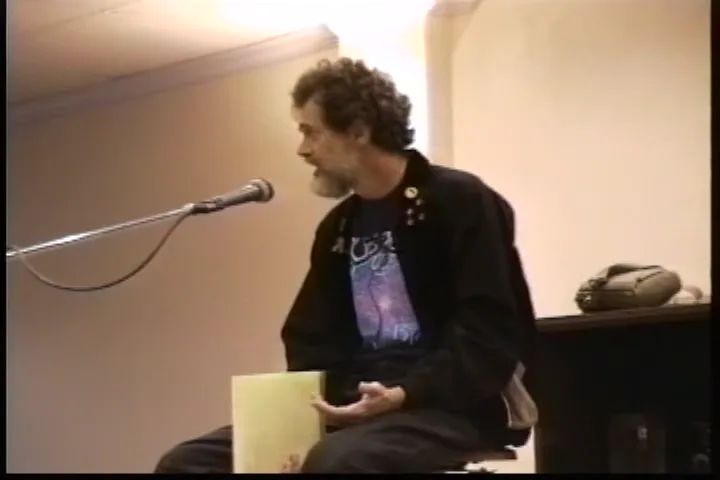
terence mckenna's 1996 canyon walk with friends through what appears to be the karoo landscape. conversation wanders through geology, indigenous burial practices, botanical identif
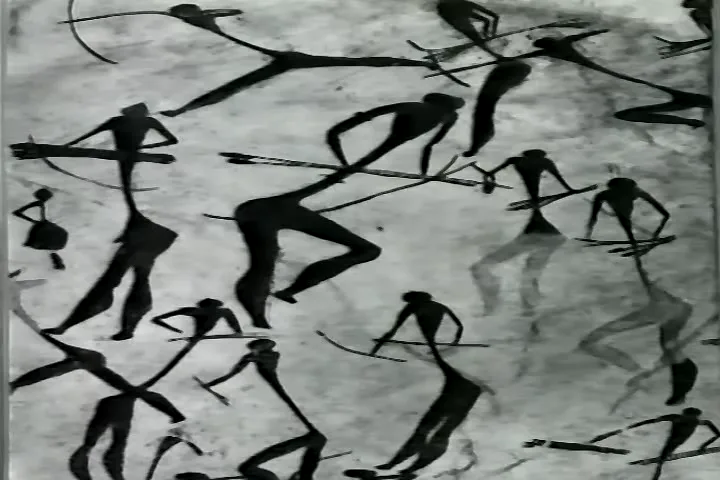
a 1995 trialogue at esalen institute with terence mckenna, ralph abraham and rupert sheldrake on chaos theory, morphic resonance and the nature of reality
terence mckenna presents his theory that psilocybin mushrooms catalyzed human evolution by enhancing visual acuity for hunting, increasing sexual arousal to boost reproduction, and
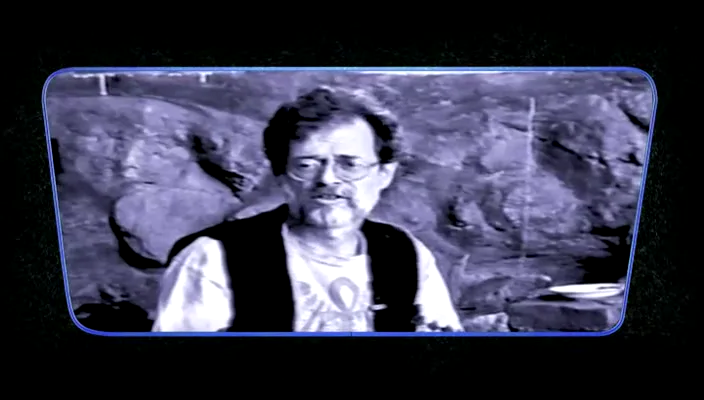
mike kawitzky's 2009 documentary. some twenty thinkers, framed by terence mckenna's archive recordings, on five questions about evolution, consciousness, god, science and death.

terence mckenna's 1999 lecture on linear societies and non-linear drugs. an exploration of psychedelics as philosophical tools and the role of consciousness in cosmic evolution.