Gaia's Midlife Crisis
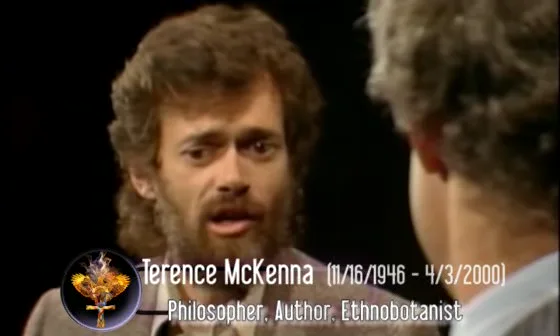
This 54-minute lecture by Terence McKenna maps the environmental and cultural crisis facing Gaia, arguing that Western civilization's dominator paradigm has exhausted its viable forms. He contends that indigenous shamanic knowledge and psychedelic plant consciousness hold the key to reimagining human society and evolution, drawing on the threatened expertise of Amazonian peoples and healers. The archaic revival - a return to pre-literate social organization grounded in the felt presence of experience rather than abstraction - emerges as humanity's only viable path. McKenna's conviction that consciousness itself may determine whether the planet becomes heaven or hell remains essential for our moment.
transcriptmachine-transcribed, unedited
Well, let's see here. I think what we have to do is think in terms of the exhaustion of our own cultural forms. I mean, that's what we're living through, is the global dying created by the exhaustion of our cultural forms and the vitality of the cultural forms that we see in these so-called primitive, I call them pre-literate people.
As Nicole pointed out, they have nothing, but what they seem to have that we cannot seem to get a grip on is a kind of dynamic equilibrium with their environment and peace of mind in the felt experience of the moment.
These are the two things we don't have. As a society, we cannot seem to make peace with nature. As human beings, as individuals, it's very hard for us to be at peace with ourselves.
Tremendous boon, as far as I can see. So I really think that there's a confluence here of themes and possibilities. It has this richly plotted texture that always lets you know that you're in the presence of a higher order of things.
It's that the shamans, whom we admire, who we idealize, are seen to be at the center of this environment, the warm jungle, the tropics, the warm tropics, that we find it necessary to destroy.
So it's a perfect image of us being at war, not only with ourselves, but with nature itself.
And, you know, you've heard all about how the Amazon and the Congo Basin and Eastern Indonesia are all being cleared and lumbered and turned into cattle ranches.
This is a tragedy, obviously. We understand and can perceive the dynamics of that.
But how to make sense of a situation where, as the World Bank and the IMF attempt to halt this kind of destruction, on the other side of the coin, the United States State Department and the DEA and these agencies propose and are planning to carry out the defoliation of the Waijaga Basin.
So there's a schizophrenia here that is not academic.
I mean, are we trying to get the patient well or are we pulling the plugs one by one?
We seem to be acting in both dimensions simultaneously.
And I think it's because we have not, in this culture, awakened to the depth of the crisis that surrounds us.
You know, there's a lot of kind of self-congratulatory back slapping going around these days over the fact that communists everywhere are in hot water and have to admit that they did it wrong.
And this gives a lot of satisfaction to people who feel that that means we did it right.
We didn't do it right.
They did it wrong and now admit they did it wrong.
We do it wrong and have yet to even raise the possibility of turning away from what we are doing.
The internal contradictions of Marxism were based on a false definition of what people are.
People do not respond to central planning, hortatory propaganda and stereotyping.
Neither do people respond to an ethos of self-denial or a view of human beings that denies the fact that we have certain itches which must be scratched.
So, you know, I think that the collapse of Marxism is only the collapse of the outer edge of the societal and civilizing assumptions that we have made.
After all, Marxism is nothing more than the millenarian retread of Christian millenarianism.
And so is modern science, yet another secular retread of Christian millenarianism.
So, our culture is in trouble.
Not trouble.
We are at a terminal crisis.
A bifurcation that can only go one of two ways.
Horror beyond your wildest imagination.
Or breakthrough to dignity, decency, community and caring beyond your wildest imagination.
Now, where do you look for models?
Where do you go?
The answer is so obvious.
You go to nature.
Nature has been playing this game for three billion years on this planet.
We have been playing the game, we, the apostles of Christian scientism, for about two thousand years.
Nature has an economy, an elegance, a style, that if we could but emulate it, we could rise out of the rubble that we are making of the planet.
You know, it was the geographer, Carl Sauer, who said, man found the planet, a climaxed primeval forest.
He, and notice the gender here, he will leave the planet, a weedy lot, a weedy lot.
Well, now this is a metaphor where you change climaxed rainforest for weeds, but it's also true.
By clearing land, we promote the kind of plant evolution that stresses very rapid seed production and annular cycles of growth.
In other words, weeds, and this tendency to find perfection and then to leave rubble in our wake has haunted us for the past three or four thousand years of our history.
Now, with the ozone shield disappearing, with acid rain falling on the earth that can melt blocks of marble, with the CO2 levels rising, with the levels of strontium and chlorofluorocarbons,
and you know the litany, we have now one last chance to fish or cut bait.
And the place where nature has provided the models for how to respond to this situation is the climaxed rainforest.
Only the climaxed tropical rainforest has the kind of complexity of signal transfer, movement of nutritional materials, movement of electromagnetic radiation that we find in the modern city.
It is a cliché of modernity that the city is a jungle.
The problem is it isn't jungle enough.
And I think it's the task of the new shamans to take the metaphor of the jungle, which is a metaphor of tremendous wealth,
tremendous variety, a tremendous outpouring of form and of energy and of potential fulfillment of various bifurcation patterns of flow to take that and enrich our own lives with it.
And the way this is done is by empowering the presence of experience.
The main thing that you get with these so-called primitive, preliterate people and with people like Nicole, who have spent time in this situation,
is they are in the moment, they know how to have fun, they know how to work, they know how to live.
And the reason they understand this is because they are focused within the confines of the felt presence of experience.
They do not live by abstraction.
And abstraction is the knife poised at our hearts.
We are so much the victims of abstraction that with the earth in flames, we can barely rouse ourselves to wander across the room and look at the thermostat.
That's the level of disimpassioning that abstraction has laid upon us.
Well, hopefully this weekend there will be passion.
There will be an effort wherever there is abstraction to drag it down into the felt presence of the moment.
I think basically what we are are a kind of green anarchy, an effort to revivify social forms that have been atrophied in the West,
at least since the destruction of the Lucis, probably in most places thousands of years before that.
This is our last chance.
I have done the best I could in terms of trying to sift through all these options
and as a communicator offer the best way out.
And, you know, I could only do my best.
And so that's what you get.
I can't preach scientism because I don't believe in it.
I can't preach Buddhism because I can't understand it.
The only thing I can preach is the felt presence of immediate experience,
which for me came through the psychedelics, which are not drugs, but plants.
It's a perversion of language to try and derail this thing into talk of drugs.
There are spirits in the natural world that come to us in this way.
And so far as I can tell, this is the only way that they come to us,
that is rapid enough for it to have an impact upon us as a global population.
This weekend will be different because we will be hewing close to the source.
Nicole is a priceless repository of information, more even than she knows.
If I could declare her a national treasure, I would.
Who knows what this woman knows?
Who knows how much human suffering, the alleviation of how much anxiety,
lies in the hands of perhaps half a dozen people of Nicole's caliber
who have paid their dues in these jungles.
This information is flowing through our fingers and disappearing.
In another 30 years, it will be all gone.
Every time I go to the Amazon, I can feel the way in which it's slipping away.
When my brother and I go off looking for these unusual hallucinogens,
often we have the experience where when we finally find the person who claims they know what we're after,
the line goes like this.
Well, I've never taken it, but as a child, I remember seeing my grandfather prepare it,
and I think I can do it.
If it weren't for us standing there asking that it be done,
it would never have even risen into the gentleman's mind as a possibility.
This is the knife edge upon which this knowledge is poised.
If it can be saved, it gives me hope that we can be saved.
If we can't save this kind of knowledge, we cannot save ourselves,
because this kind of knowledge is ourselves.
Culture is a garment which you put on.
Medical systems are pieces of jewelry which you wrap around your throat or neck.
Religious ideals are like objects which you push through pierced nostrils and ear lobes.
If we cannot come to terms with that which allows us to give birth with ease,
to die with dignity, and to live in health,
then what kind of a future do we have?
No future at all.
So this is not a meeting of obscurantists or enthusiasts for some private vista of transcendence.
This is a meeting of political activists,
people who are socially committed to themselves,
to each other, to the larger idea of community,
and who understand that when you talk about Gaia,
it's only an abstraction unless you talk about plants.
The division between the masculine and the feminine is only trivially a difference between men and women.
It is fundamentally a division between plants and animals.
Plants are the enveloping feminine matrix of control and refurbishment.
Animals are something invented by plants to move seeds around.
An extremely Yang solution to a peculiar problem which they faced.
So the Archaic Revival, if it means anything,
it means reconnecting the Gaian mind, which is a vegetable mind,
a feminine, enfolding, boundary-dissolving, planetary mind,
that is not an abstraction, not a stereotype,
not something used to create hortatory propaganda,
but a living, breathing reality,
a reality which is the only thing which stands between us and Armageddon.
History is a kind of horrified realization that something has been lost,
that there is an itch hard to scratch in the civilized context,
that we have out of fear really descended into patterns of domination of each other,
of the environment, of our children, of our social relations with exogamous groups.
We have descended into a dominator pattern that is basically based on clutching, on fear.
And I'm sure most of you have heard me argue that this is the consequence of ceasing basically to do enough halicinogens in the diet.
That, in fact, what human beings were flirting with over many, many tens of millennia,
let's say from 100,000 years ago to 15,000 years ago,
human beings were in a flirtatious situation with a symbiotic relationship with this mind resident in vegetable nature.
Now, you all know that what classic symbiosis is in biology.
It's where, let's take the example of the little fish who lives in the sea anemone and big fish don't bother it.
It gains protection.
The sea anemone gains access to larger prey which come to investigate the little fish.
That kind of symbiosis is genetically locked in.
And if you take the little fish away from the anemone and put it, let us say, in an aquarium without anemones,
it doesn't die.
It doesn't go into an immediate physiological crisis.
No, what happens is it simply has a low body weight and a short lifespan.
In other words, it is under stress.
And I believe, I hope I'm not deluding myself, but I believe that the lost secret of human emergence,
the undefined catalyst that took a very bright monkey and turned that species into a tormented, self-reflecting, poet-dreamer,
that catalyst has to be sought in these tertiary alkaloids in the food chain
that were catalyzing higher states of intellectual activity.
And I've pointed out to you, ad nauseum, I'm sure,
the reciprocal feedback relationship that was working there.
In the case of the mushroom, in the veldt situation in Africa,
it was promoting at low doses visual acuity,
which was feeding back into the hunting and gathering process,
making those animals with this increased visual acuity more adaptively successful,
hence more reproductively successful,
hence they're outbreeding their competitors.
At higher doses, psilocybin actually causes a generalized arousal,
which includes sexual arousal.
Again, it becomes a catalyst for increased reproductive success.
More instances of copulation in a situation like that
lead to more successful births of those into family structures
where the alkaloid has been accepted into the food chain.
Well, this would be only an obscure topic of interest to primatologists
were it not for the fact that it is a crisis in consciousness
which confronts us globally.
Consciousness is the commodity that if we do not have enough of it,
do not produce it fast enough,
then the momentum of the processes we set in motion in our ignorance
is going to sterilize the planet and do us all in.
So we have to have consciousness.
Well, then you look at the smorgasbord of ethnographic possibilities
and you discover this institution of shamanism.
It is the institution of planner,
of visionary,
of manager,
of large system coordinator.
That's what it's about.
You call it magic on one level.
You call it curing.
You call it folk psychiatry
or weather prediction.
Shamans have been involved in all of these things.
But as Nicole made so eloquently the point last night,
to these deep forest people,
it is ordinary.
It is ordinary.
They live in a different cultural dimension than we do.
Dimensions which to us are completely value dark
are to them completely transparent.
And dimensions which to us are extremely rich and complex,
the inner world of the nucleus of the atom, let us say,
are for them totally value dark.
They don't even cognize the possibility of asking the question.
But nevertheless,
the specialization in these various domains
is not something where one is as good as another.
Consciousness is the domain of immediate experience.
How are we going to save this planet?
How are we going to take the lethal cascade
of toxic, technological, and ignorance-producing habits
that are loose on this planet
and channel them toward some kind of a sane and livable world?
Well, the answer is emerging in culture
out of the collectivity of global consciousness.
It is what I call the archaic revival.
It is this very large turnover in the mass mind.
Some people call it a paradigm shift.
It is an effort to recover the sensory ratios,
the feelings,
and the attitudes
of 15,000 to 20,000 years ago
before fear,
before ego,
before male dominance,
before hierarchy,
hoarding,
warfare,
propaganda,
child abuse,
all of these things.
And the answer lies,
as was indicated last night,
in integration into the dynamics of nature.
Well, so far as my analysis gives it to me,
the only way you can abandon yourself
to the dynamics of nature
is to break through the language shell.
You must cut through the aura
of programming
and cultural assumptions
that surround us
from the moment we are able to speak.
The only way this can be done
is by dissolving the boundaries of ego.
Ego is a structure
that is erected
by a neurotic individual
who is a member of a neurotic culture
against the facts of the matter.
And culture,
which we put on like an overcoat,
culture is the collectivized consensus
about what sort of neurotic behaviors
are acceptable.
Now, I don't know,
so,
you see,
what I see going on
in the Amazon
is a very radical,
psycholytic therapy
where they are dissolving,
literally dissolving,
the boundaries of self,
culture,
and ego assumption.
And then what you discover
is not the white light
or what William James called
a blooming,
buzzing confusion,
although in the first few minutes
it can be like that.
But what you really discover
is sentient,
organized,
living,
loving nature.
that nature is a force,
nature is a mind,
a personality,
organized with intentionality,
organized with feeling,
humor,
grace,
and conviction.
Conviction.
And if you can get right
with that conviction,
then that's the secret
of dancing in the waterfall.
That's the secret
of the shaman's
apparent transcendence
of the rules
of mundane statistics.
Because that is what it is.
The shaman doesn't violate physics.
He just,
he or she
simply knows
how to push
the improbable
to its greatest extent.
And in Eastern philosophy,
this is called
the Tao,
you know,
abandonment to the flow,
fitting of the small pattern
into the larger pattern.
Well,
I think these things
are very important
because I think
that psychology,
psychiatry,
psychoanalysis,
it's a good idea,
but it will never
reach any kind
of operational effectiveness
until we look
to these native healers
all over the world
and study their methods.
And their methods
are chemical
and personal.
It's a combination
of care,
attention,
intention,
and chemistry
that allows consciousness
to be made malleable
and then recast
in other forms.
So,
I find myself
this weekend
explaining myself.
That's what I feel
like I'm doing.
Why does someone
who extols
the self-transforming
elf machines
of the DMT space
also claim
to be a conservationist,
also, you know,
have a mathematical
dog and poodle show?
Well,
it's because
all of these things
emerge out
of the concrescence
of consciousness,
its intention
toward its own
transformation.
Nature is the answer.
Not,
it's not enough
to be like
Wordsworth.
It's not enough
to,
this is not,
you know,
Mao Zedong said,
the revolution
is not a dinner party.
And certainly
the ecological revolution
is not a dinner party.
Poetic sensitivity
to the death
of the planet
is not what
we're striving for here.
What we're striving for
is to halt,
overturn,
and back out of
the impending
death of the planet.
It is very clear now
that consciousness
will decide
that the planet,
there are not
rosy futures
of suburban housing
and Ratatouille
to be extended
endlessly
into the future.
We are approaching
a bifurcation
where it is either
going to become
heaven or hell,
one or the other.
And I think
that this
archaic intuition,
which I see
reaching clear back
to the birth
of the 20th century
and the 19th century,
back to people
like Alfred Jarry
and Guillaume Apollonair
and the
paraphysicians,
the surrealists,
the physicists
around Einstein,
Freud,
modern art,
modern dance,
jazz,
all of this stuff
is an effort
to reclaim
the primitive,
to reclaim
the archaic,
to reject
all that
powdered wig
algebra
that comes down
through the French-English-German
tradition
of constipated
male dominance.
And instead,
you know,
intuit,
that's what it is
in Freud and Jung
and the New Age,
intuit our way out.
But now,
the intuition
is rising
to the surface.
We no longer
have to
operate
without
the presence
of the goal
firmly in hand.
The goal
can now
be stated.
What this is all about
is a return
to archaism
with the lessons
learned
in history.
That's where
we were happy.
The fall
was a fall
into a veil
of tears,
into a world
of
limitation
and pain
and suffering
and infectious
disease
and so forth
and so on.
It's
a prodigal journey
into a lower dimension
that can now
be ended
by a collective
cultural decision
to commit
to this
Taoist,
shamanistic,
feminized,
cybernetic,
caring,
aware,
present
kind of being.
is in our
very best
moments.
But we have
to extend
those very
best moments
to fill
whole lifetimes.
You know, think of the number of people who suffered and died that we could sit under this tree this morning.
I mean, in the last million years, nine times the glaciers have ground south from the poles,
freezing the world into ice and confining human populations to subtropical valleys and the warm tropics.
Nine times the interglacial periods have come and human populations have spread out over the earth.
They had, they didn't have radio, they didn't have antibiotics, contraception, statistical analysis or the partial differential equation.
And yet somehow they managed to get us here.
Are we then, as the heirs of that wave front, of the inheritors of a billion-year process,
are we in one generation to turn it into a massive pottage?
I think not. I certainly hope not.
I would like to believe that we could make that leap to conscious awareness that would allow us to take hold.
Now, the problem, it was easy the first ten years that I sat before you,
because what we were doing was getting to know each other,
to verify that we in fact existed,
that I wasn't crazy, you weren't crazy, so forth and so on.
Now, what looms ahead is the mess of politics.
And this, I'm sure you have no stomach for.
I certainly don't.
I'd rather be stoned and rocked in the arms of the goddess.
But as a matter of fact, this dominator thing is not going to be unhooked and put to bed without a struggle.
Everyone is going to have to be counted.
I've talked to you in recent months about memes, memes being the smallest potential units of ideas.
They're like genes.
We are the nucleus of a mutant meme, the meme of plant consciousness, hallucinogenic consciousness, shamanistic consciousness.
We have to refine this meme, replicate it through repetition, and spread it through society.
In the same way that a plant sheds seeds into an ecosystem, the idea will compete.
The idea is a good one.
It's adaptive, it's clever, it's tough, it's invasive, it can make use of many contexts to promote its own existence.
But it can't do any of that if we don't replicate it and get it out.
So I see these kinds of meetings as an opportunity for building community,
as an opportunity for people to look around themselves and connect with the other people who are here.
We cannot be told from the rest of the population unless we self-select and gather together at a single point in space and time.
When we do that, we recognize each other.
When this meeting is concluded, we will merge back into the larger stream of the body politic.
But carrying this meme of the Gaian resurgence, the Gaianic wave that must come.
I mean, people say it's so wonderful that you articulate these feminist ideas and so forth.
I do it because I don't want to be dead.
I do it because I don't want my children to have no world to live in.
There is no choice.
The walls are high and the current is moving very fast.
What we need to do is merely keep our spirits high and learn to sing the song.
My friend Ralph Abraham is a proponent of this school of mathematics called chaotic attractors or dynamics.
And this is the notion that many processes are not pushed from behind by the momentum of casuistry as in the ordinary Newtonian model of process,
but that there are what he calls attractors or basins of attraction.
And these are things which lead processes forward.
For instance, a somewhat trivial example would be if we had a large bowl and a marble.
And every time we released the marble up near the rim of the bowl,
we would notice that it unfailingly rolled to the bottom of the bowl and located itself somewhere near the center of the bottom of the bowl.
We could say that the bottom of the bowl acts as a basin of attraction for the marble.
In other words, the marble finds that its energy state is most at equilibrium when it locates itself in the trough of the bowl.
So there is a way of analyzing processes to see them as though they were led rather than pushed.
And I think it's fruitful to see human history this way.
You see, what we deny as a culture, as a culture of materialist, positivist, reductionists,
is the presence of spirit in the world, in ourselves, or in nature.
And so Western science is very concerned to deny what is called telos.
Telos is a Greek term for purpose.
The same idea as the attractor that I was trying.
If you have a target, if you're driving a car toward a goal, the goal is your telos.
It decides how you will steer the car.
Well, it has been for the past 150 years extremely fashionable in sociology and biology because of Darwin
to deny telos in nature, to say that, you know, any apparent order in nature is made up of the disorder of random mutation
meeting the disorder of natural selective processes.
And these two streams of converging disorder create a kind of apparent or virtual order, which is an illusion.
And when you take this Darwinism and put it into historical theory, theory of human processes in time,
you get the modern position in academic philosophy about history,
which is that it is, and the official phrase is, trendlessly fluctuating.
That's what we're asked to believe we are embedded in, a 10,000-year-old process of trendless fluctuation.
In mathematics, this is called a random walk.
It means you just go over here a few steps, and then you go this way, and then you go back.
You're like a drunk, lurching around in this face space.
And this is the highest vision of human purpose that the reductionist vision can offer.
Well, what the intuition of religion is, especially Western religion,
and I wouldn't even bother to mention it, except that it also is the strong intuition of a lot of psychedelic experience,
that there is some kind of attractor in the historical phase space.
There is something which is drawing everything toward it.
It's like a higher dimensional entity that casts an enormous shadow over the human landscape,
so that, you know, at sitting around campfires 50,000 years ago,
people felt this vague tug toward organization, order, cognitive activity, epigenetic activity.
Epigenetic activity means coding stuff not in your genes, but in dance, gesture, ritual,
and ultimately in clay and on paper and in electronic storage methods.
This proliferation of complexity is a response to and an anticipation of this transcendental object
at the end of historical process.
You see, if it weren't for our presence on this planet,
even modern science at its present primitive state could give a fairly good accounting of what's going on,
that out of complex polymers arose supercomplex polymers, which were self-replicating,
and that was life, and then you have an animal population.
But the fly in the ointment of this rational model of reality is ourselves.
We are clearly imbued with a higher dimension, which we call spirit,
in a way that ordinary matter, when imbued with a higher dimension, is called life.
In other words, we represent a different ontological level in the career of organization,
because we hope, we despair, we plan, we remember, and we misremember.
You know, we lie, we fabricate, we delude ourselves and other people.
All of these things are uniquely human functions.
Well, I think that shamanism, which is the focus of our concern here,
is a kind of anticipating of the whole pattern,
and that this is really the way to think about shamanism when thinking of it as a force
that can steady and complete an individual human life.
The shamanism are not in history in the same way that we are.
By having access to this higher dimension
that they go to in their trance states and their states of intoxication,
they gain a fractal overview on process, on life.
I mean, after all, isn't that what we mean by wisdom?
Is wisdom is understanding how things really work,
how they really work.
Love affairs, the raising of children, the managing of corporations,
the prosecution of wars.
How do these things really work?
Not the deluded and fumbling attempts of the proponents of this or that school,
but a Taoistic insight into the actual appropriate dynamics of everything.
Well, how do you gain that kind of an insight?
The answer is, you must have a superior model.
You must have a superior model.
Now, if you believe, you know, that the world is composed of three levels
and they are held up on the back of a woman
who sits on a giant tortoise who floats in space,
this is a model of the universe.
It can take you a certain distance.
But what model of the universe
can actually offer reassurance in all kinds of situations?
Well, strangely enough,
I think that these models come from the frontiers of mathematics,
that it is not mere coincidence
that the storms of visionary hallucination
that the shaman encounters
are very much like the storms of form and color
that are spewed out of a Cray-3 supercomputer
when it conducts a thousand iterations per second
inside the Julius set or the Mantlebroth set
or one of these other compound complex mathematical objects
that we are beginning to see.
You see, mathematics, up to this point,
has been a computational science
because mathematicians used pencils and blackboards and chalk
to describe their objects.
And consequently, an excruciatingly difficult vocabulary
kept most people from appreciating what mathematics was about.
Now, the computer is to modern mathematics
like the telescope was to 16th century astronomy.
The computer becomes a window
into domains of hyper-complex computability
that previously could barely even be conceived,
but that now, at a rate of millions
approaching billions of iterations per second,
Ralph works on the MMPP machine,
the multiple parallel processing machine
at Goddard Space Flight Center,
it does 800 mega-flops per second,
800 million floating-point decimal calculations per second.
Well, you can dream dreams with a machine like that,
and strangely enough,
at the edge of the super-technology
of the Dominator culture
at Goddard Space Flight Center
with guys, high priests,
standing around in white coats,
when you get it up and running,
what you see is what an ayahuasca shaman sees
on a Saturday night in the Amazon.
You see that you are navigating
through a complex, higher-dimensional phase space
where, by varying the inputs of amplitude and frequency,
in one case, using an electronic box,
in the other case, using the human voice,
you sing your way through a mathematical domain
which is a higher resonance of reality,
and you learn how the world really works,
how things happen.
Well, how the hell do they happen?
Well, on the simplest level,
they happen like this.
They have a beginning,
they have a middle,
and then they die away
as an oscillation,
a damped oscillation.
Now, this simple truth
to which we all nod, assent,
is in fact
the hardest thing,
the hardest swallow there is
for the Dominator ego
and the Dominator personality.
Because what this simple truth says,
things come into being,
they achieve their inflorescence
and they fade away,
is, as Heraclitus put it,
Pantithrae,
all flows.
Nothing lasts.
Nothing is saved.
And this is, you know,
our glory and our agony
that, you know,
the people we love
and the people we hate
are swept away by time.
Empires, dynasties,
continents are swept away by time.
And yet our search for security
is cast in the Dominator culture
as a search for permanence.
You know?
I want to buy a house.
I'd like to get my trust fund
functioning a little better.
I'd like to pay off
X, Y, and Z.
You know,
a search for permanence.
So what you do
when you do that
is you set yourself at war
against the cosmos,
which is a heroic stance
if you're trying to produce
Melvillian opera
out of your life.
You know,
Ahab says in Moby Dick,
he's talking to his first mate,
Starbuck,
who signifies Christian right reason.
And he says,
he's raving about
going after the whale.
And he says,
you know,
we'll chase it over both sides of earth
and round perdition's flame.
And,
and Starbuck says,
to seek revenge on a dumb brute
seems blasphemy.
And he says,
blasphemy, Starbuck,
speak not to me of blasphemy.
I would strike out the sun
if it insulted me.
For could it do that
than could I do the other
since there is ever
a sort of fair play?
Well,
you know,
this is locker room talk.
The notion
that there is
fair play
between
a man
and a nearby star
is
the finest expression
of the dominator ego
I can imagine.
And of course,
you know,
the story
of Moby Dick
can be read
on many levels.
But finally,
it is the story
of the submersion
of the male ego
in the oceans
of the unconscious
born
to its destruction
and transformation
by an encounter
with the maternal matrix
in the form
of the vagina dentata
of the sperm whale
and everything
that it symbolized.
So,
I don't think
we want to go that way.
I don't think
we want to set ourselves
up
as the crusaders
for permanence.
But that means
softening
to the fact
of the flow
and of the impermanence.
Nicole has made
the point
very eloquently
that these people
in the Amazon
have nothing.
The wonderful thing
about the Amazon
is
that
nothing lasts.
Nothing is worth having.
I mean,
a book?
Forget it.
Clothing?
Houses?
Everything is just
swept away
by the incessant
recycling of material.
So all that is permanent
are values,
personality,
strength,
honesty,
decency,
dignity.
These are things
which can be erected
against the flow
and have some
hope of permanence.
So,
I think
shamanism
is permission
to transcend
anxiety
by accepting
the transience
of all form.
And this is
a truth
of the universe
that cannot be ignored.
So once it is
integrated,
then
it's as though
resistance
in the electrical
circuits
that surround
your integration
into the world
begins to fall.
you accept
that the present
moment
is the richest
apex
of being
that on the
downside
back into the
past
it shades off
into memory
and its vagaries.
In the future
it shades off
into
a series
of adumbrations
and anticipations.
I think
that the
shamans
gain
this tremendous
authenticity
that you feel
in their presence
the good ones
because they
have seen
the end.
They have a
model
of how
process happens
and so they
don't push
and they
don't clutch
and then
energy
flows
through them
and our
civilization
has to
learn
this.
You know
I think
I said
at one
point
in this
weekend
only
Gorbachev
is taking
the position
that
we did
it wrong
and that
we need
to deconstruct
and yet
every society
did it
wrong.
We all
did it
wrong.
Capitalism
it's wonderful
that you
can get
a safety pin
at 4am
within a half
mile of
anywhere
in the
United States
and I'm
sure the
Russians
wish they
had it
so good
but is
that the
be all
and the
end all
of cultural
values
that you
can walk
the
fluorescent
lit
aisles
of Kmart
and congratulate
yourself
that whether
it be
gas can
sanitary
napkin
or whatever
it's there
waiting
for you
I don't
think so
I think
that we
have built
in the
termination
of our
world
just as
surely
as the
Marxist
world
built
in a
tripwire
into
its
social
mechanism
it's
just
that we're
going to
have to
pay
the
long
time
to
figure
out
all
the
angles
what
I
find
myself
more
and
more
leaning
to
is
sharing
the
meme
of
the
irrelevance
of
conservative
institutions
history
is not
a process
for which
you ask
permission
history
is just
something
you make
and then
other people
pick up
the pieces
Henry
David Thoreau
understood
this very
well
when he
wrote
his
famous
treatise
on
civil
disobedience
the
growth
of
culture
is
something
that
comes
out
of
the
animal
body
Rousseau
called
it
the
general
will
you
know
man
proposes
and
God
disposes
but
in
the
proposes
but
that's
all
and
now
what
we
are
involved
in
really
is
a
debate
about
human
nature
who
are
we
what
are
we
the
French
cartoonist
Mobius
put it
very well
in his
book
where he
asked
the
question
is
man
good
this
is
what
we're
going
to
find
out
and
my
feeling
is
that
it
isn't
decided
yet
that
it
is
you
know
H.G.
Wells
called
history
a race
between
education
and
disaster
well
you
know
they're
in
the
home
stretch
neck
and
neck
it's
clearly
going
to
be
a
photo
finish
but
there
is
a
responsibility
on
everyone
who
sees
this
to
communicate
it
for a copy
of this
recording
please
call
sound
photosynthesis
at
415-383-6712
or write
post office
box
mill valley
california
copyright
sound
photosynthesis

a brief fragment from terence mckenna on the mushroom experience as a feminine informational matrix

july 1998 gender talk radio show on psychedelics and consciousness, featuring terence mckenna in conversation with boston listeners

dennis mckenna explains ethnobotany and ethnopharmacology, the role of the shaman as a specialist in plant-induced altered states, and his critique of fundamentalist religion, in a
a 2009 documentary exploring shamanism and psychedelics as tools for accessing transpersonal realms through altered states of consciousness. covers ancient practices, sacred plants

dennis mckenna's 2008 talk at the fourth annual amazonian shamanism conference. speaking without prepared remarks, he explores ayahuasca as a planetary teacher, the scientific stud