Petaluma
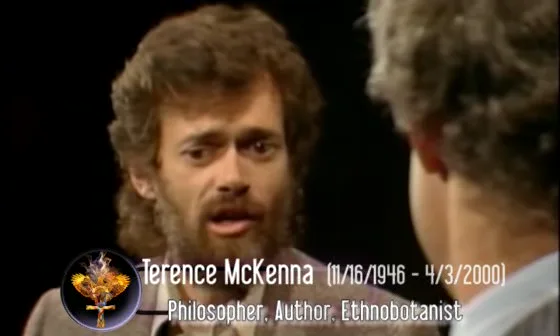
A 29-minute McKenna talk in two parts. He opens on the archaic revival: the 60s misunderstood psychedelics because they ignored the shamanic model of high-dose sensory isolation and the paleolithic religious roots of the practice. He then turns to language. Ordinary speech, he argues, falsifies reality by imposing subject-object distinctions, while on DMT and the tryptamines language becomes something beheld with the eyes, a kind of high-speed sculpture in light. This visible language is the frontier where virtual reality and human-machine interfacing could actually make progress, and it approaches telepathy because meaning goes public rather than staying locked in private interior dictionaries. He illustrates the idea with cephalopods: an octopus does not turn its intent into small mouth noises but changes its own color, texture, and form to become its meaning, with deep-sea species carrying out the same dance through bioluminescence. Psychedelics, he concludes, dissolve the cultural software of conditioned language and return the organism to a primal body-language beneath it, illustrated by the mother who names the bird and so tiles over a child's raw experience with words.
transcriptmachine-transcribed, unedited
psychedelic compounds is that the 60s entirely lacked any awareness of shamanism or the historical
role that these substances had played throughout human history and prehistory. The 60s believed
they were inventing this reality for the first time. Now that we have been able to compare
the psychedelic experience to the way it is done in the Amazon, in West Africa, in areas where these
things have been used and understood for a long time, we now have a model. And it's the model not
that you take low doses and go with your friends to a rock concert, but that you take high doses in
a situation of sensory isolation, such as a quiet, dark room, and make an inward journey into the self
that parallels the journey that shamans have always made to recover lost souls or to cure or to discover
the whereabouts of lost objects. So in a way, psychedelic exploration has gained power respectively
ability and legitimacy by discovering that its own roots were in a Paleolithic religion of great
power and wide distribution. In other words, psychedelic voyaging is not something new. This
is how religion was done for the first million years, not the last 2,000 years. This is really
the only exception to this rule. And I agree with what you also said about how vast this domain seems to be.
Serious psychedelic voyagers can agree, the further in you go to this realm, the larger it appears to be.
Really, what we are doing is we are discovering the inner richness of organism. That, you know, the richness of the human world is not in owning stuff. The richness of the human world lies in being able to access what is within us. Our minds are not blank slates or merely repositories of traumatic memory. Our minds are doorways.
Our minds are doorways. The borgesian library of infinite possibilities and we can choose to open these doorways in whatever sequence or fashion we wish.
Which is probably the closest thing to a miracle in the natural world. It's the major neurological manifestation of difference between ourselves and other animals and primates. And it's not a physiological difference. It's a difference in behavior.
That language represents the most complex behavior ever observed in any animal in certain human life.
It's the major neurological manifestation of difference between ourselves and other animals and primates.
And it's not a physiological difference. It's a difference in behavior.
That language represents the most complex behavior ever observed in any animal.
And certainly, it's the most complex thing any of us ever learns to do.
We're born into what William James calls a blooming, buzzing confusion.
But by the acquisition of words, we mosaic over various sectors of this blooming, buzzing confusion with words.
We replace the unknown with the known through the substitution of words.
And by the time a child is two or three, they have completely created a cultural mosaic of words that is interposed between them and reality.
Reality from that point on is only an unconfirmed rumor brought through the medium of language.
And every culture accentuates different parts of reality so that in a sense, every culture is a different reality.
Language is stuff of the world, not quarks or wave packets or neutrinos, but language.
But language. Everything is made of language.
All the constructs of science are actually interlocking constructs of syntax.
Well, so that's ordinary language, which seems to define reality through a kind of process of lying about it.
For instance, by creating subject-object distinctions, which are in fact not true to the matter, but somehow operationally necessary for us to navigate in the kind of lower dimensional space that we inhabit.
Then there is the phenomenon of non-ordinary visible language.
And this is very interesting to me.
This is where technology, virtual reality, cybernetics, human-machine interfacing can actually make an impact and explore a frontier.
Visual language is a transformation of the physiological impulse towards syntax into a final product, speech, which is not heard with the ears, but beheld with the eyes.
And it's very interesting that all our metaphors of clarity of speech are visual metaphors.
We say, I see what you mean. He spoke clearly.
This means that at the organismic level, we associate a higher signal clarity with visual input.
And on DMT and other tryptamine psychedelics, you actually experience the field of language, both heard and self-generated as something that is visibly beheld.
It's almost as though the project of communication becomes high-speed sculpture in a conceptual dimension made of light and intentionality.
Well, this would remain a kind of esoteric performance on the part of shamans at the height of intoxication if it were not for the fact that electronics eaters make it possible for us to actually create records of these higher linguistic modalities.
In other words, it's possible to imagine a virtual reality that was driven by a speech-operated synthesizer where the various parts of ordinary speech, adjectives, modifiers, subjects, and objects,
were interpreted by the scientific, by the cybernetic environment as topological manifolds of various shapes so that speech would then generate a visibly beheld,
it's possible to imagine a future world where in marriage, in other words, in areas where communication, clear communication, clear expression of intentionality was very important,
that people would actually go into the virtual reality to use the virtual language because its capacity for conveying intent would be much greater than ordinary spoken language.
In other words, it's not for nothing that Plato connected up the notion of the good, the true, and ultimately the beautiful three concepts is the primary concept because it is visibly beheld.
This is the great convincing power of the psychedelic experience that it ultimately appeals to us through the sense that we value most, that we existentially relate to as the most authentic, and that is the visual.
Visible language is a kind of telepathy, because you see, if I make a statement in visual language, and then you and I regard my statement, we are somehow in the act of regarding made one,
because meaning is not being created out of interiorized dictionaries, which we each consult in the privacy of our own mind, but rather meaning is a visible manifold in the public domain.
meaning goes public, and the differences between people then decline toward being insignificant.
It's a kind of final art galleries of the imagination.
You know, we won't build skyscrapers 120 stories high, we'll build them as high as we want.
Uh, roof height will no longer be in gravity, as will all the stuff of the psychedelic shamans have always known this.
Now the psychedelic underground art can mean this goal.
Extraction of cephalopods live in it.
Now many people know that octopi can change color, but they think this is not at all colors in a very large repertoire of stars.
Or of stripes, dots, blushes, traveling shades, and tonal shifts.
It's because this is, for them, a channel of linguistic communication.
In other words, they don't transduce their linguistic intentionality into small mouth noises like we do.
Small mouth noises which then move as sound across space in the form of vibrations of the air.
Rather, they actually change their appearance in accordance with their linguistic intent.
What this boils down to is, they physically become their meaning.
And one octopus observing another is watching the unfolding of internalized neurological states within the organism being reflected in color changes on the surface of the skin.
Now these octopi not only can change their color, because they're soft bodied creatures, they can also change the texture of their surface from smooth to rugose and folded.
They can also, because they are soft bodied, fold and unfold and reveal and conceal very rapidly different parts of their body.
So they are capable of a visual dance of communication that is an extremely dense kind of visual signal.
And in the so-called benthic octopi, the species that have evolved in very deep water where very little light reaches, they have evolved light-emitting phosphorescent organs, some of them with membranes like eyelids over them,
so that even in the darkness of the abyssal depths of the ocean, they can carry out this dance of light, self-enfoldment, color change, and surface texture that is their linguistic style.
In fact, the only way an octopus can experience a private thought is to release a cloud of ink into the water into it, which it can retreat briefly and hide its mental nakedness from its followers.
This kind of biologically intrinsic wiring into the potential of language is something that we may be able to achieve.
What psychedelics do is they dissolve cultural conditioning. Cultural conditioning is like software, but beneath the software is the hardware of brain and organism.
And by dissolving the cultural conditioning to speak English, German, Swahili, or whatever, then one returns to this ursprach, this primal language of the animal body,
and can explore the real dimension of feeling that a culture has a tendency to cut us off from.
Culture replaces authentic feeling with words. As an example of this, imagine an infant lying in its cradle, and the window is open, and into the room comes marvelous, mysterious, glittering, shedding light of many colors of movement.
The child is enthralled, and then the mother comes into the room, and that's a bird, baby, that's a bird.
Instantly, the complex wave of the angel, peacock, iridescent, transformative mystery is collapsed into the word.
The child learns that this is a bird, and by the time we're five or six years old, all the mystery of reality has been carefully tiled over with words.
This is a bird, this is a house, this is the sky, and we seal ourselves in within a linguistic shell of disempowered legacy and birthright of the organism.
If I was not yet, I will be the chiesten deepening side of the animal body.
This is theックlified procedure and that of the relationship as a B Terrorist.
That's it, I'm outta here!
terence mckenna on recent astrophysical discoveries, the cosmological constant, and what they reveal about novelty theory, consciousness, and the role of psychedelics in human evol
terence mckenna's 1988 talk on botanical conservation, travel as spiritual practice, and the role of psychedelics in recovering direct experience
dennis mckenna explains ethnobotany and ethnopharmacology, the role of the shaman as a specialist in plant-induced altered states, and his critique of fundamentalist religion, in a
a 2009 documentary exploring shamanism and psychedelics as tools for accessing transpersonal realms through altered states of consciousness. covers ancient practices, sacred plants
dennis mckenna's 2008 talk at the fourth annual amazonian shamanism conference. speaking without prepared remarks, he explores ayahuasca as a planetary teacher, the scientific stud