Sydney, Australia
A 1997 talk by Terence McKenna in Sydney, Australia. He presents his novelty theory, arguing that nature favors complexity and organization over entropy, making the universe a complexity-generating engine rather than a chance accident. McKenna describes the transcendental object at the end of time as an attractor pulling evolution forward, with human consciousness as the culmination of this process. He discusses how the psychedelic experience reveals this holographic nature of reality and how shamans access this dream time outside historical causality.
transcriptmachine-transcribed, unedited
A very important part of life, which has been ignored by science, and because this is a scientific society we're locked inside of, we've gotten a distorted view of it.
And that is, there's a quality to reality that everybody can feel, everybody experiences, we all know it, and yet we get no reinforcement for its existence from the models that our culture venerates.
And what I want to talk about is what I call novelty, or the appetite for...
for complexity that permeates nature, that is in fact as fundamental a law of nature, if not more fundamental, than the laws of thermodynamics themselves.
And this is the idea that nature loves complexity, and wherever it achieves complexity, in a membrane, in the center of a cell,
in a star, in an organism, in a breeding population of animals or plants, wherever it achieves complexity, it seeks to preserve it, and it seeks to use it as a platform for further complexity.
This is what the universe is, it's a complexity-generating engine of some sort, on all levels.
Not only in biology, but in physics, if you look backward in time, the universe becomes more simple.
A million years ago, there was no human civilization.
A hundred million years ago, there were very few mammals.
A billion years ago, life had yet to emerge onto the land.
Five billion years ago, the planet itself was there.
Five billion years ago, life was in the process of condensing.
If you go back to the domain of the Big Bang, you find a world, a universe of pure electron plasmas, not even atomic systems, still less, molecular systems, all that lies in the future.
So in a sense, as the universe ages, as it cools, it complexifies, it becomes more novel.
So in a sense, as the universe ages, as it cools, it becomes more novel.
Complexity on this planet is, finds its compressence in animal life, still more in ourselves.
The reason I mention this is because the scientific model of reality tells you that we are the chance-created witnesses of an essentially valueless universe.
Chance. Chance and necessity. This is the chance of science.
But looking at the record, it appears nature favors organization, favors complexity, and therefore favors ourselves.
Because we represent animal complexity plus culture, plus phonetic alphabets, plus high technology.
So,
the universe has put all of its eggs, or at least the processes of evolution on this planet, have placed all their bets in the human world.
But this raises the stakes, makes the situation far less existential, and makes what we do with our human freedom a matter of great import.
It turns out,
we count.
We are more than witnesses.
We are more than victims.
We are, in fact, co-creators of this universal tendency to complexification.
And in the psychedelic experience, we see the culmination of this process, a kind of anticipation of ultimate complexity,
where information is holographic.
Information is holographically embedded, and all things become possible.
All things are now possible in the human world.
Reductionist biologists have said of life itself, it's a kind of iridescence on matter.
Other people say mind, conscious mind, is a kind of iridescence on biology.
These are all sort of ways to dismiss what we experience as most fascinating and most beautiful.
You know, Plato linked the idea of the good, the true, and the beautiful.
But it's hard to tell what is good.
And it's hard to tell what is true.
But it's not hard to tell what is beautiful.
So if you follow beauty, I think you can be pretty clear that you're not going to fall too far from the path of righteousness.
That's sort of what the psychedelic path is.
It's the demand that things be more beautiful.
More strange.
More astonishing than they've ever been before.
As we approach this evening, the world not only becomes more complex, but it moves faster and faster.
You know the cliches.
More change in the last 25 years than in the previous hundred.
More change in the last hundred than in the last thousand.
In the last thousand, ten thousand.
Who can look at this process and assume it will ever stop?
But who has looked at this process and asked themselves what will happen if it doesn't stop?
Because if there has been more change in the last 20 years than in the previous hundred,
then in the next five there will be more change than in the last thousand.
And eventually you get to the notion of a universe.
That undergoes half of its evolutionary unfolding in the last hour and 35 minutes of its existence.
This is in fact the kind of universe we are living in.
What we have been told is that a process is pushed from behind by causal necessity.
Like a row of falling dominoes.
Cause precedes effect.
This is half the story.
Half of what you see going on is simply the unfolding of causal necessity.
But at a deeper level, the future is not simply empty space-time into which we are expanding.
The future is pulling us toward itself.
There is what I call the transcendental object at the end of time.
Or the eschaton, which means the last thing.
The last thing is like an enormous subtractor.
Which is pulling first biology and then human history.
And then the 20th century.
And all of our lives embedded in it.
Pulling us deeper and deeper into a relationship of self-reflection with it.
In other words, we are being shaped by something literally unimaginable.
That lies ahead of us in time.
That three, four million years ago gently took hold of the African primate line.
And began to sculpt it.
And move it along certain developmental pathways.
All toward self-reflection of this thing.
And now we are cosmic moments away from encountering this thing.
This is what the excitement of shamanism worldwide is now.
Shamans are people who can see
the end.
In some sense.
Not that the end is predetermined.
When you look into the future you don't see something like the past.
Except that it hasn't happened.
When you look into the future you see a storm of space-time vectors and probability matrices
that have not yet undergone the formality of actually occurring.
That's the business of the present moment.
To collapse that hyper-dimensional set of space-time vectors into a here and a now.
With a causal identity and a vector toward the future.
But we are now so close to this transcendental object that has molded the entire destiny of this planet.
We are now so close to it.
That all you have to do is smoke a bomber.
Close your eyes.
Take a walk in the bush.
Sit on the beach.
Pay attention to your dreams.
Watch your mind after orgasm.
And you will see this thing.
Peeping around the edges.
Creeping in at the side.
I mean, was it Williams Wordsworth who called it intimations of immortality?
Something like that.
Um.
We are not simply the victims of our past.
This is the false truth of materialism and positivism.
We are locked in an extremely mysterious relationship with something in another dimension.
A dimension which, for want of a better word, we call the future.
But in fact.
This other dimension completely surrounds and encloses human history.
This is what shamanism is about.
Shamanism is where people step out of cultural time.
Into what Marseilliat called Emilio Tempore.
The time before.
The sacred time.
The paradigmatic time.
Dream time, we call it down here.
It's the time which surrounds the smaller.
The smaller time of historical unfolding.
What's unnatural?
Nothing is unnatural except some things are less intelligent than others.
Everything has a design.
But elegance of design is still of worthwhile value.
Nature.
The interesting thing about nature is the risks that she's willing to take.
Like if you ask yourself, what does nature do best on this planet?
The surprising answer is it produces extinct species.
95% of all life that ever existed on this earth is extinct.
That's what happens to life.
What nature has been interested in is passing on complexification of form from species to species.
Genera to genera over very long periods of time.
And the fact that nature will tolerate our own dear selves as a part of the natural order
indicates that nature is a far more reckless gambler than we are.
Our impulse is to deny ourselves, hold back.
Nature's impulse, apparently, is to put the pedal of creativity to the metal by taking a primate
and pushing it to the ground.
Pushing it to the wall.
Boxing it in.
Raising the pressure.
And watching the entire planet bubble its way toward metamorphosis.
Psychedelics is to throw you back on your own experience.
It is not an ideology.
It is an experience.
It may spawn this or that ideological interpretation.
Marxists have something to say.
Freudians have something to say.
But it's not.
It's theirs.
It's yours.
It belongs to the animal body.
And why it's so important?
Why it's so important is because it is a pipeline back to the greater order of nature,
which I call the Gaian mind.
It is the pipeline back toward a dynamic, a way of doing things that is profoundly,
profoundly natural, profoundly appropriate.
This is why it was possible for human beings to live on this planet for 100,000, 200,000 years,
possessing language, theater, humor, so on and so on, everything we have,
but not fucking up.
Because they were embedded in, communicating with, aware of, and able to receive instruction from,
the Gaian intentionality.
The mushroom once said to me, I mean, maybe the mushroom, maybe the mushroom likes to
sit on its backside, but the mushroom once said to me, if it ain't simple, you haven't
thought about it long enough.
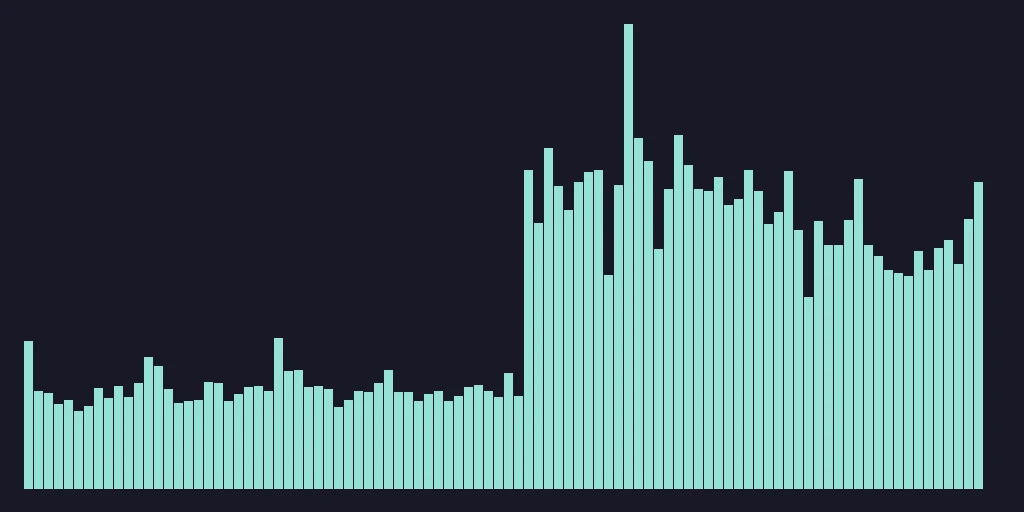
terence mckenna on coast to coast am in may 1997, discussing time as a fundamental force, the acceleration of novelty, and altered states as gateways to consciousness.
terence mckenna recorded at rustlers south africa in 1996 speaking about self-reliance exploration and psychedelic experience
terence mckenna on coast to coast am april 1 1999, discussing consciousness, technology and novelty theory as a pahrump valley blackout unfolds amid y2k tensions
terence mckenna's 1999 lecture on linear societies and non-linear drugs. an exploration of psychedelics as philosophical tools and the role of consciousness in cosmic evolution.
terence mckenna, ralph abraham, and rupert sheldrake recorded in santa cruz in june 1998, discussing skepticism, epistemology, and the crisis of statistical methodology in modern s