Seeking the Stone
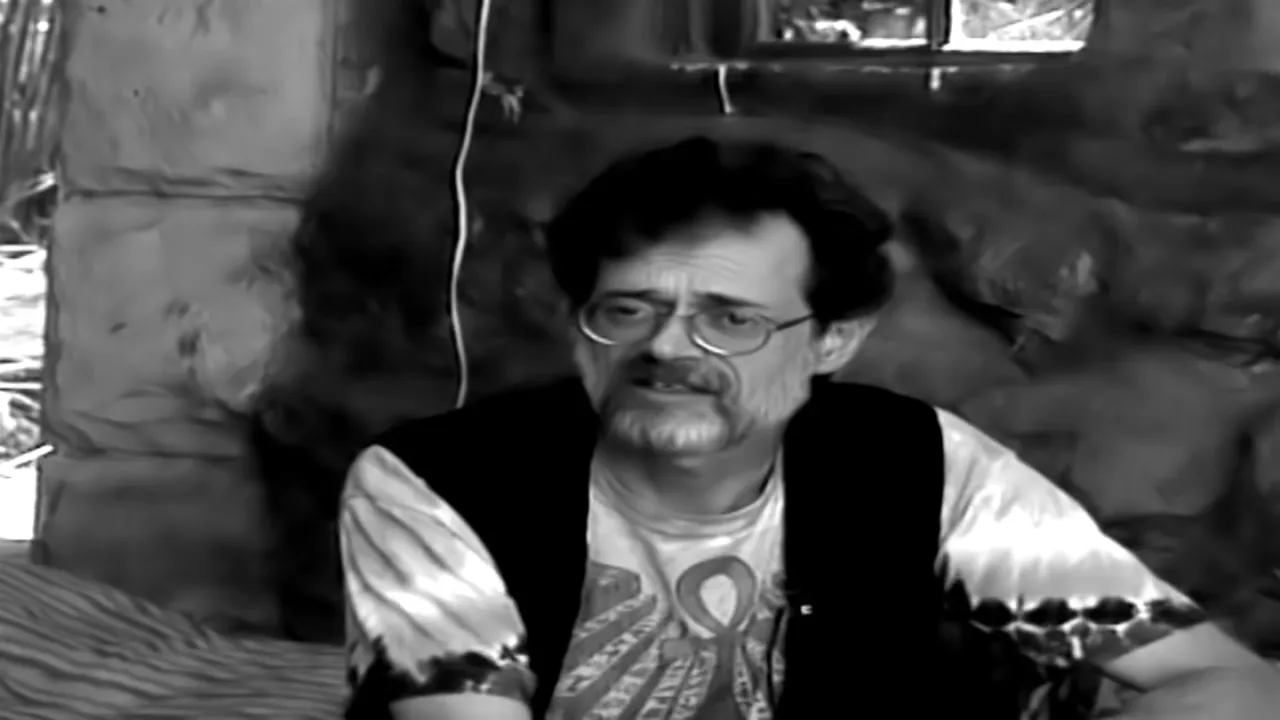
seeking the stone is a terence mckenna talk from 1991 where he distills thirty years of thinking about psychedelic experience into one comprehensive lecture. mckenna explores why the psychedelic question refuses to disappear from society despite three decades of suppression and what psychedelic shamanism means for people living in high-density electronic culture. he examines how western civilization has been built on denial of the psychedelic experience and discusses what this says about human connection to nature, the feminine, and our place in the world. the talk covers techniques for working with altered states and reflects on the relationship between psychedelic experience, sexuality, and what it means to be human. below are the source files.
transcriptmachine-transcribed, unedited
can hardly believe I'm here. I made it past the Camaro raffle. I survived the offer for
reconstructive cosmetic surgery. And I've had my smart drugs for this evening, so glad
to be here. Well, until a few minutes ago, I thought that this was a 45-minute gig, so
you get to see Grace under pressure this evening. Actually, I'm kidding. It doesn't matter how
long it goes. We could never get to the bottom of this stuff, nor would we wish to, I think.
By coincidence, merely, I became 45.
Yesterday. So, sort of a good moment to do some summing up. So, in thinking about this talk and
knowing, as I did, who would be here, I thought that I would sort of orient the theme toward
distilling the psychedelic mind, which is a way of talking about the psychedelic mind,
but also trying to
consider the amount of money you paid for this session, give you the entire schtick in one fell swoop,
so that you would never have to attend a Terence McKenna lecture or workshop again.
You could just move past that, turn the page on that kind of thing in your life.
.
Well, I think it's coming together for me. I don't know whether it's writing these books. It was a
very nice introduction here tonight, and the whammy in it was, after 25 years of being ignored by
straight publishers, or publishers of any sort for that matter, it appears that I'm on the brink of
entering the marketplace, if not the mainstream.
.
So, with your help and word-of-mouth advertising,
maybe I can continue to meet my mortgage obligations.
Okay, let's cut to the chase.
Enough of the obligatory clowning around.
The psychedelic question in the society
just seems to refuse to go away.
It sort of can't be swallowed and can't be spat up.
And so society just sort of runs around
knocking into walls and kicking its feet in the air.
And this has been the situation that we've been in
for at least 30 years now.
And as a person who has spent
a great deal of time and effort
and a great deal of time in the underground,
I've observed with amazement
the persistence of the counter-cultural agenda
to alter consciousness.
And like many of you, I came to it in the 60s
when the basic argument in favor of altered states of consciousness
were almost entirely narcissistic,
deep in self.
And I certainly think that this was a valid place to begin.
But after 30 years of having the psychedelic issue
on the social network,
on the social agenda,
at times hailed as a universal panacea,
at times demonized as a scourge from hell,
but never quite silenced,
never moved out of the public eye,
I've reached a number of conclusions about this.
And I thought it would be interesting tonight,
I guess because of my recent birthday or something,
to sort of try and,
to sort of try and distill all this and sum it up
and put it in front of you in terms of what is psychedelic shamanism?
Why should people like ourselves who live in high density
electronic culture, why should we care about this?
What does it say about our future?
What does it say about us as a group?
And what techniques are there that we each,
on our own, can bring to bear on this question?
So with your help,
hold me to the straight and narrow,
I'd like to make my way through this agenda this evening,
and talk about these various aspects of what,
to my mind, is the most astonishing facet of reality.
I mean, maybe sex is pressing hard in the second position,
but these two things run neck and neck
as aspects of the mystery of what it is to be human.
And believe me, human psychedelic experiences
and human sexual experiences are orders of magnitude
removed from anything going on in the animal realm.
These things are set apart.
They are not separate from the rest of being,
because what we bring to them is mind.
This is what we pour into the sexuality of human beings
that makes it unique.
This is what we pour in to the contemplation
of our own experience.
Mind is a focus that is lacking,
at least its expression in the unique form
that we experience it, is lacking.
It is lacking in the rest of nature.
And I believe that the persistence
of the psychedelic experience within the social agenda
has to do with the fact that it actually addresses
something basic in human beings.
I mean, it may seem like a radical proposition to say,
but it's not.
I don't say that to a white, high-tech,
industrial democracy audience,
because we are the people who have drifted furthest
from this birthright.
And I would like to suggest to you this evening
that much of the civilization that we have created
has been achieved based on a direct denial
of the psychedelic experience,
and all that it implies.
Our humanness, our connection to the rest of nature,
our connection into the feminine,
our place in nature.
Because for the Western mind,
we have no fixed place in nature.
Our place is ours to define.
We are, from the point of view of the cultural machinery
that empowers us,
completely free to become,
to be whatever we want to be.
Now, the problem with that prescription is
that in Western culture,
what that means is permission to express ego,
permission to profligately use and destroy resources,
permission to set aside the political agendas
of outclasses and outgroups.
This untrammeled expression of will
outside the context of nature
has turned us into a kind of Frankenstein's monster at best,
a toxic force in the body of the Gaian world soul at worst.
And I believe that our origin
and our future culmination,
and our present happiness,
all can be secured, understood, illuminated, and expanded
only if we're willing to look at our relationship,
not only to altered states of consciousness,
but to the mind behind nature.
Because that's really what this is all about, to my mind.
What these psychedelics do,
what these psychedelics do,
what these psychedelics are empowering,
or conveying, or revealing,
depending on, you know, how you come at it,
what they are showing us is that we are not alone upon this planet.
We are not alone in the universe of mind.
And I realize this is a soft audience to preach this in,
because there are probably people within the sound of my words
who sincerely believe they were once citizens of Zeta Reticuli.
You know, when the jar is so leaky,
it's hard to know where to put the water.
But I come to this as a show-me kind of guy.
And so, though my conclusions may sound as flaky,
as anybody else's,
it was hard for me to get this flaky.
I didn't embrace it.
I was forced to it.
And this method works, you see.
I mean, there are two ways to get flaky.
You can just get flaky,
which takes no effort at all, you know.
I mean, you just announce you're a walk-in,
start eating wheatgrass juice,
and, you know, tithe to Maitreya.
Or you can get flaky by testing the edges,
by stretching the envelope of being.
And this works for the most hard-headed among us.
The aerospace insurance adjuster mentality
is...
not only who I'm speaking to,
but who I feel I represent.
Because...
No kidding, really.
At age 18,
I was a Marxist,
an existentialist,
I had ambitions in the field of aeronautical engineering,
so forth and so on.
And I discovered,
that you can take that kind of a mentality
out into the theater of real experience,
and you can come back a space bunny
just like everybody else.
So what that means, then,
is that a straight person,
and I speak as someone from the 60s
with apologies to all our gay friends
who later appropriated that word,
because when I say straight,
I mean un-stoned.
A straight person is not a guardian
of truth or probity.
A straight person is simply
a frightened proto-flake.
You see?
I always think,
and most of you have heard me say this,
but when we get off on this subject,
I always think about the wonderful thing Tim Leary said,
years ago.
He said it so many years ago,
that when I told him
how much I admired him for saying it,
he didn't remember that he'd said it.
But the man once said,
wait till I give the wine,
LSD is a drug which causes,
occasionally causes psychotic behavior
in people who have not taken it.
You see?
And I certainly saw this.
I mean, I saw my parents become violently psychotic
from not taking LSD.
And so my point is,
and I make it in a forum like this,
because here we have so much permission for belief.
I mean, you want to believe in,
you know, channeling from beyond the grave?
Fine, no problem.
You want to believe in the healing power
of nematodes, hematodes, hematite,
you name it, we've got it all.
Really, I think that
the spirit of childlike, untrammeled curiosity
is what we're striving for.
Not the anal retentive rational person.
Not the I'll go for anything,
channeling flake.
But an attitude of,
we don't have to look far for miracles
because they're all around us.
Everything is astonishing.
The universe on its surface
is alive with mystery.
Well, how do we make our way toward that?
When we live in a culture,
practice a life,
practice a language,
embody a philosophy, scientific rationalism,
which is entirely designed
to suck wonder out of reality,
to turn everything into shades of gray,
to subvert all hope
that lies outside the realm of
career accomplishment and material possession.
Well, the way that we can overcome this
is through a personal acting out
of what I have been calling now
for several years,
the archaic revival.
And I want to talk about that
a little bit this evening
because I think it,
you know, however much we may kid around
about the new age,
it is an important aspect
of what is going on.
Its triviality is rooted in the side of it
which is ungrounded,
ephemeral,
and self-promoting.
But it springs from a fairly profound
and deep sense
that things are not all right
in this society.
I think that I first encountered
the phrase new age
in the writings of Helen Petrovna Blavatsky.
She wrote in the 20s.
I read her in the 50s.
The new age has been with us
for a long time,
so long that there's nothing new about it.
And in fact,
the reason I call it the archaic revival
is because I think we can understand
this movement
if instead of accentuating
what about it that is new,
novel,
and never before seen,
instead we emphasize
that this is a profoundly
conservative impulse.
A conservative impulse
that would set the hair of George Bush
and his skull and bones buddies
standing on end.
Because when we talk about conservative,
we're not talking about returning
to the era of Eisenhower.
We're talking about returning
to the era of Isis,
Asarte,
the great horned goddess
of the high paleolithic.
In other words,
this program
of material civilization,
exteriorization
of ideas into matter
through first alchemy and magic
and then science and industry.
This process is coming to an end.
One way or another.
We are either going to plant ourselves
and most of the rest of the life
on this planet
by blindly pursuing this cultural model
until we run it right over the edge
into the apocalypse
or from the genes,
from the bones,
from the oceans,
from the forests,
from the glaciers.
There is going to have to come
a turning point,
a change,
a revulsion so profound
that it allows us
by the tens of millions
to change how we think about reality,
to change how we live.
And I have ended up an advocate
for the psychedelic experience
not because I think it's easy,
not because I think it's surefire,
but because I think
it's the only game in town,
the only chance left.
If we had a thousand years,
if we had 500 years,
maybe propaganda,
messages on boxes of cereal,
photographs on cartons of milk,
I don't know,
something might do it.
But we don't have 500 years.
We must come to a screeching halt now
because we are barreling toward
the brink of ruin.
And the only thing
that I have ever seen
that turned anybody around
on the dime
was psychedelics.
You know?
The talking cures
invented by Freud and Jung
at the beginning of this century.
It takes years.
Sometimes it never happens.
The body work that came along behind that
with Wilhelm Reich and others,
Feldenkrais and so forth,
Ida Roth,
all of this brings it
into the theater of the body.
At least now we understand
it's a body-mind system.
It's not a disembodied voice
lying on a couch speaking.
You know?
But it seems so obvious.
What we're trying to do
is perturb the mind.
We want to perturb the mind
so that we can then
see it differently.
So that it may see
and be seen differently.
Well, the mind rests
on a foundation of chemical machinery.
We're not saying the mind
is chemical machinery.
We're saying the mind rests
on a foundation of chemical machinery.
So if you want to perturb the mind,
you don't go to the talking.
You don't go to the deep tissue.
All of this has efficacy.
But it is necessary
but not sufficient by itself.
For there to be a sufficiency of method,
there must be an initial perturbation
of the mind.
And this comes about
through the use
of psychedelic plants.
This is not something
that was discovered post-LSD
in Manhattan by psychiatrists
or in Prague or Berlin or at Esalen.
This is a truth 25,000, 50,000,
100,000 years old.
This is how it's always been done.
Only in the last 6,000 years
on the European continent
and those civilizations
that are the children of Europe
has there been any other approach
to these problems.
Well, and what the other approach,
linear thought,
the phonetic alphabet,
science, mathematical abstraction,
so forth and so on,
what these other approaches
have brought us is
toxicity, pollution,
mutation,
catastrophe,
revolution,
death,
and yes, friends,
even unhappiness.
It hasn't worked.
Western civilization
is now crowing over the fact
that the only opposition it ever had,
which was Marxism,
a pathetic weak sister,
has now collapsed upon itself.
Well, there should be
no congratulation in that,
because the contradictions
which undid Marxism
lie in wait to undo this society as well.
Both societies are materialistic.
Both societies define human beings
and treat them as things.
And the fact of the matter is
Western civilization at this moment
is a loaded gun
pointed at the head of this planet.
And we,
for all our pretensions
to a sensitivity
to the presence of vitamin C
or zinc in our diet
or all the rest of this malarkey,
we are the major
prevaricators
of this situation.
So a certain obligation
rests upon us.
And I think we're meeting
this obligation.
I wouldn't say we're doing a great job
or a terrible job.
I think we're functioning
at approximately a B plus level.
You see, I mean,
human life is so ephemeral.
I mean, a person,
a person who lives 70 or 80 years
is really as ephemeral
as a mayfly or something.
I mean, it's not long enough
to get the full picture.
For instance,
many of you,
by virtue of not having spent
a great deal of time
thinking about it,
probably don't realize
that this psychedelic
plant shamanism option,
this is not something
that Western civilization
has grappled with for centuries
and come to terms with
and found the proper pigeon hole for
and put aside.
Not at all, my friends.
The fact of the matter is
all of this information
about psychedelics
has arrived in Western society
in the last hundred years.
And we have to say hundred years
because we want to include
things like mescaline,
1895-98,
it began to be studied in Germany,
and things like ibogaine,
which was known toward the end
of the last century,
but which has had virtually
zilch impact on American
psychedelic populations.
So we have to say
the psychedelic option
has only been an object
of the Western mind's curiosity
for approximately a hundred years.
But really, 90% of that
occurred in the last 50 years.
As many of you know,
I am a great fan
and spokesman for psilocybin,
for the mushrooms.
The mushrooms that I am so stoked on
were discovered in 1953
by Gordon and Valentina Wasson
in Watla,
discovered in 53,
made absolutely schedule one
illegal in 1966.
15 years was the window
in which Western civilization
had to study this compound
and figure out what it was for.
And they were just beginning
to focus upon it
when it was made illegal.
LSD discovered in 37,
not brought into the scientific literature
until 48,
not generally available
even in the laboratory until 1950.
Made totally illegal in 1966.
16 year window.
Think about the fact
that when LSD was legal,
psychiatrists,
professional researchers
were consistently reporting
cures of chronic alcoholism
with one 500 gamma dose.
One dose.
Cure like a 50%
cure rate without recidivism
for chronic alcoholism.
Spectacular findings
were being reported.
When LSD swept through
the scientific community,
for pharmacologists,
psychotherapists,
psychiatrists,
it had the same kind of
excitement and feeling of breakthrough
that the splitting of the atom had
for the physicists,
for the physics community,
in the late 30s.
Well, science we are told
is this absolutely impartial
godlike body of knowledge
prosecuted by great men
and it will fearlessly send
its questing mind
into any situation
or environment.
This is a mental discipline
so dispassionate
that it sees nothing at all wrong
with strapping monkeys into apparatus
and hurling them into walls
at 70 miles an hour
to study traumatic injuries.
This is a discipline so unflinching
in its pursuit of truth
that it will design tiny television cameras
to be implanted in plastic penises
so that we can see the changes
in the color of the vaginal wall
as it approaches orgasm.
I mean, these guys are unstinting
in their devotion to truth
in any form.
And yet, and yet,
for 30 years,
science has accepted
government's refusal
to allow science to look
at the potential impact
of psychedelic plants and compounds
on human consciousness,
on chronic alcoholism,
on schizophrenia,
on depression,
on autism,
on learning disorders,
on dyslexias,
on memory enhancements,
so forth and so on.
This, to me, is obscene.
The future is mental.
Figure it out.
If the mind does not loom large
in the future history of this species,
then what the hell kind of future
is it going to be?
I mean, this is our crowning glory,
our aesthetic sensitivities,
our ability to create values
that are not simply based on
the next meal,
the next sexual encounter,
the next empowering social move,
but an ability to create social values
based on creating a model
of a viable future environment
for children,
creating a viable present environment
for the less fortunate among us,
creating a social safety net
so that the more maladaptive of us
are not reduced to living under bridges
and in abandoned automobiles.
I mean, these are the things
which set us above the apes.
These are the things which take us
out of the context of organic nature
and make it seem as though,
hey, there actually are
some transcendental values
being maximized here.
There actually is something going on
within the human family
that if it were to be lost,
fumbled away,
compromised or destroyed,
the universe would be a poorer,
truly a poorer place for it.
And I think we take our humanness
too much for granted.
I don't think we realize
how nasty, brutish and short
most of life has been
over the centuries
and how really only
within the confines of the 20th century
has a level of comfort
and food availability
and shelter
and basic creature needs
been met to the point where
most people can begin to lead
the philosophical life
that previously was the privilege
of emperors, kings, great courts.
Now we all indulge in
and challenge ourselves.
We all have the philosopher king's
point of view.
We all have a model of history,
a model of the future.
And we all feel capable of
stepping into the shoes of our leaders
and discharging that responsibility.
Well, in order to do that,
I think we need to overcome
our amnesia
about how we got to this place.
I don't see...
You see, what science would have you believe
and explicitly implies
is that we are an aberration.
Here over here you have nature,
the beautiful rainforests,
the wonderful coral reefs,
the cemetery of the hummingbird,
the sea urchin and the butterfly.
And here you have us,
grimy, tawdry, polluting, ugly,
driven, in equilibrium,
in disequilibrium, in denial.
I don't believe that.
I believe that this kind of thinking
that breaks humanity
away from the rest of nature
is the first of the great disempowering myths
by which the Western mind
has enslaved itself.
And we are not outside of nature.
We are not a runaway toxic process.
We are not a mutation.
We are in fact that part of nature
which has been deputized for a purpose.
We are the energy-gathering aspect
of the Gaian mind.
We are the language-forming capacity
of nature herself.
You may know the concept
of a catalyst in chemistry.
A catalyst is something which
when you stir it into a chemical reaction,
the reaction proceeds more quickly.
But the catalyst itself is not destroyed.
And this is what I think we are.
We are a strategy.
On the part of the Gaian mind
to produce an effect
that would otherwise take much, much longer
to produce.
The main effect
of the presence of human life
on this planet
has been to vastly accelerate
the speed at which nature
is able to creatively express herself.
And I would like to believe
that this fragile, fragile thing
which we call humanness,
which is nothing more than
a set of interlocking ideas
which we share.
Ideas about caring and responsibility
and generations yet unborn
and obligation to the integrity of the earth
and so forth and so on.
I would like to believe
that these things arose in us
in a very, very brief window of opportunity.
As you may or may not know,
there is a lot of talk about
the relationship between the masculine
and the feminine in human beings
and gender issues and so forth and so on.
Well, if you go back
into the primate line,
what you discover is
primates always have dominance hierarchies
occupied by males.
This is the bad news part of the thing.
You see, it isn't that we are a perversion
of the primate program.
At this point, we exemplify it
right down the line.
But clear back to square one,
you get squirrel monkeys.
You get male dominance hierarchies.
Why is this?
And why then is it even an issue for us?
Why don't we just blindly accept it?
I mean, there isn't a woman's liberation movement
among termite societies
or, you know, among reindeer herds.
So why are we so discomforted
by our attitudes toward each other?
Well, I believe it's because
we actually created,
at a certain point in our history,
a kind of paradise.
We actually solved all the problems
which now bedevil us
twenty to fifteen thousand years ago.
And how this happened,
and half of you, I hope, are amazed,
and the other half will groan
because you've heard it so many times before,
what happened is an evolutionary synergy
that occurred on the plains of Africa
sometime over the last hundred thousand years.
It's that as the African continent dried up,
our remote primate ancestors
were forced out of the trees
and onto the African grassland
where they were in an environment
completely different from the kind of environment
that our ancestors had been living in
for millions of years.
Gone were the fruit-filled bowers
of the climaxed canopy of the rainforest.
And instead, what there was
was a grassland
with very little vegetation
and little cover,
a very restricted flora and fauna,
and into that grassland
pour these hungry, displaced,
dispossessed, formerly fruititarian primates.
When a species gets under that kind of pressure,
it must make a choice
between extinction or dietary expansion.
Many, many species
choose extinction.
This is an interesting thing about animal species.
Most animal species eat one or two foods
that they are very tightly focused in on.
The reason for this,
if you're not an evolutionary biologist,
is it's a strategy for avoiding mutation.
You see, all plants produce,
have a tendency to protect themselves from predation
by producing toxins, mutagens, poisons,
is what we're talking about here.
So an animal species will evolve
a preference for just one or two food sources,
and then it can hold its exposure
to mutagenic agents to a minimum.
Now, our species,
when we moved into that African grassland situation,
were plastic enough
malleable enough
that we decided, no, by God,
we're not going to go to extinction
because of the absence of papayas in this situation.
We're going to test other foods.
And we began testing other foods in that environment,
and that immediately swelled
the number of mutant strains
in the human population.
Now, in this grassland environment,
the number of new foods to be tested
was somewhat limited,
and the most spectacular and obvious
of the unfamiliar food sources
in this environment
were the psilocybin mushrooms
seen to be growing in the cow pies
of the many different kinds of
cattle-like ungulate animals
growing up in that environment.
And if you've ever been to the tribes,
and seen the Stropharia cubensis mushroom
in its natural habitat,
you can't miss it.
It's the most spectacular thing going on.
I mean, you walk out into a Colombian pasture
after a few days of mist and rain,
and these mushrooms,
the size of dinner plates,
will be scattered across the environment.
Now, when I was in Kenya in the late 60s,
I observed baboon troops
and their food-gathering behavior,
and what they were into
was running around frantically
looking for cow flops
and then flipping them over,
looking for beetle grubs
or carrion beetles.
You see, they understood that the cow flop
great phrase, huh?
The fecal deposit
of the ungulate animal
was a vector for protein,
insect protein.
This was a likely place to find
carrion beetles, worms, and what have you,
and of course, the mushroom.
Well, when you observe how
primates react
when they're testing a food,
they're very careful
and they're very conscientious.
A baboon will take a suspect
potential food source,
take a leaf,
put it in their mouth,
just hold it there,
no chewing, no nothing,
put it in their mouth,
wait 30 seconds,
chew,
wait,
and then either spit it out
or swallow,
and if swallowed, then begin to eat.
Well, I believe that this encounter
with the psilocybin mushroom
and in the course of
this workshop,
maybe in the question and answer period,
we'll get to this,
but psilocybin has unique properties
which set us up
for a sudden,
enormous evolutionary
kick in the pants.
And we can talk among ourselves
about whether this was just blind coincidence,
good old chance,
and aren't we fortunate for it,
or whether benign extraterrestrials
operating from their
base on zeta reticuli were,
you know, we can save that for you.
We don't have to get rid of it.
Whether it was those
shifty zeta reticulites
or blind chance,
whatever the force was,
the exposure to psilocybin has
three reinforcing consequences
that are of tremendous importance
for understanding
human evolution.
And they are as follows.
Psilocybin in very low doses,
doses so low that if you had taken
this amount,
you would not feel it
or you would be just slightly antsy.
In other words,
very low doses of psilocybin
actually increase visual acuity.
It means it improves your vision
with this stuff.
Well, again,
you don't have to be a rocket scientist
or an evolutionary biologist
to figure out that if there's a plant
in the environment
and you're a hunting animal
and this plant improves vision,
you're going to be a better hunting animal
if you include this plant in your diet.
And this is precisely what happened.
Early human or proto-hominid hunters
accepted psilocybin into their diet.
It made them better hunters.
Being a better hunter means
being more successful at obtaining food.
Being more successful at obtaining food
means more of your children
reach reproductive age themselves.
And so you outbreed
the non-psilocybin-using portion
of the population.
Simple enough, right?
On the next level,
remember I said this was a three-step process
where each step reinforces the other.
At slightly higher doses of psilocybin,
you get what's called CNS arousal,
central nervous system arousal.
Well, now arousal is just what it sounds like.
It's not only restlessness and alertness,
but it's also a kind of horny,
diffuse energy.
It inclineth one's thoughts
to the boudoir,
is what I'm trying to say here.
And so you get what primatologists
and anthropologists charmingly describe
as more frequent instances
of successful copulation.
And so what successful copulation means is,
again, a factor feeding in
to more children of the psilocybin-using,
animals reaching reproductive age themselves.
And then finally and thirdly,
beyond visual acuity,
beyond sexual arousal,
is the full-blown psychedelic tremendum,
the full-blown religious revelation
that goes with the mushroom experience,
a revelation of such depth and breadth
that we, 20,000 years later,
with all our epistemic sophistication
and our parallel processing computers
and all this other malarkey,
are completely in awe of,
completely unable to come to terms with.
Well, this higher dose of psilocybin
was usually experienced in the context
of the middle-range dose of psilocybin,
so it went on in an atmosphere
of group religious ecstasy and orgy.
I mean, that's just how it happened, folks.
Orgy was a part of human sexuality
before the invention of agriculture.
I'm absolutely convinced of it.
You see, the growth of the human intellect
over evolutionary spans of time
is a kind of conquest of dimensionality.
And the conquest of dimensionality
that gave us agriculture
unfortunately gave us male dominance
and patriarchy.
And the reason for this is not far to seek.
A new intellectual horizon of cause and effect
was being explored.
Women, who were the gatherers
in the hunter-gatherer equation,
were realizing for the first time
the causal relationship that exists
between burying a half-eaten meal over here
and coming back a year later
on your annual nomadic peregrination
and discovering food plants,
growing where you buried
your uneaten meal of a year ago.
In other words,
women came to understand the relationship
between the act of planting
and the appearance of usable food plants
sometime later.
At the same time that this was going on,
men were making the connection
between the fact that the sex act
had something to do with the fact
that nine months later,
a woman would bear a child.
And in a way, this was the beginning
of the straight lockstep march into hell.
Because once men had this notion
of male paternity,
male paternity,
it became more important to know
who your children were
than it was to participate
in the orgiastic, group-minded bonding
that had previously occurred.
And once you have the notion
of my child, my child,
then it moves naturally to my woman,
my weapons, my food,
my hunting ground, my everything.
The recognition of male paternity
gave permission for the growth of ego.
And ego, and this was all a continuous thought,
those of you who doubted,
this was all a continuous thought.
Ego is our problem.
And we always had it
when we were squirrel monkeys,
howler monkeys, proboscis,
proboscis monkeys, and all that.
We only lost it
in that very brief window of opportunity,
maybe 20, maybe 30, 40 thousand years long,
when, as we evolved into the grassland,
we included in our diet
essentially a drug which corrected
our primate nature.
A drug which suppressed
the expression of male dominance.
A drug which promoted
an orgiastic sexual style
that promoted group values.
Because you see,
and this is the point to my mind
about psychedelics,
what they do,
not, you know, my trip or your trip,
which we could spend hours trading stories about,
but when you try and talk about
what is the effect of the psychedelic experience,
not one or two of them,
but a hundred thousand of them,
what generalizations can we make?
The generalization that I have found most powerful is
the psychedelic experience dissolves boundaries.
That's what it does.
And boundaries are what chain,
diminish, define,
and degrade us.
And we are always creating them.
And we are always struggling
with dissolving them.
And the ultimate boundary
is this belief
in the sanctity of the ego
versus everything else
in the cosmos.
And I believe that this,
that the ego arose
in a context of language,
culture, religion,
and so forth,
simply because
we evolved in the African grassland
and the climate itself
underwent changes
that eventually placed the mushroom out of reach.
And this is why
the fall into history.
This is what that Genesis story
about the,
that I call history's first drug bust,
this is what it's about.
I mean, isn't it a little peculiar
that the Ur myth of our culture
opens with a drug bust?
It's the story of a woman,
right, those bad women,
a woman who corrupts her roommate
and then they both get kicked out.
They break the lease, essentially,
and they both get kicked out.
And where they get kicked out of
is into history.
And I believe that the Genesis story
definitely told and created
at a time when patriarchy was on a roll
is a memory of this break
with this orgiastic,
goddess-centered,
nomadic,
cattle-oriented,
mushroom-using
form of human pastoralism.
Now, notice in this scenario
that there are no villains, per se,
the planet began to get dry,
and that's what broke up
this arboreal,
papaya-oriented paradise
in the treetops
where everybody was male-dominated
and mindless as a tomato
but having a good time.
The drying of the African continent
broke that party up,
created a mixed ecology
of forest and grassland
into which the primates then evolved
this fascinating relationship
with the cattle, you see.
And much of what I say here
is orthodox evolutionary theory.
It's just the part about psilocybin
that nobody else will touch
with a ten-foot pole.
But moving out into the grassland,
testing foods,
accepting psilocybin into the diet,
and then creating,
based on the interruption
of the natural, natural tendency
toward male dominance,
it was fixed 50,000 years ago.
A pharmacological intervention
on the entire species
created then a situation
of partnership.
The women were
the gatherers.
The men were the hunters.
This had to do with
promotion of different body types
that had already taken,
was already well established
in these primates.
I mean, you get this
throughout the primates.
The large male,
barrel-chested,
the more diminutive female,
and the females more,
largely more social than the male.
The males hunt.
And in the proto-hominid situation,
this was certainly true.
And hunting, as you know,
if you've ever done it,
places a great premium
on stoic waiting.
That's the hunter's job,
is to sit down
and keep your mouth shut
and watch silently
until it's time to make your move
and then move ruthlessly,
without question,
you know, with attention.
Women had a completely different set
of pressures and constraints on them.
As gatherers,
it was very important for women
to be able to communicate
extraordinarily subtle
aspects of the material world
to each other.
So that a woman
needs to be able to say
when she comes into camp
with the apron full of nuts,
I got these
near the waterfall
by the bush
with the small yellow leaves
with the waxy flowers
and the red berries
that has the dry grass underneath it.
In other words,
for a gatherer,
there is tremendous premium put
on being able to describe
your environment.
You must be able to communicate
because a woman
who makes a food find
can only bring back to camp
as much food as she can carry.
But if she can communicate
to her sisters
what is going on,
then no problem.
So language, I believe,
largely evolved
as a prerogative of women.
And this stoicism
and
ability to
tolerate uncomfortable conditions
was evolved by men.
All of this, I think,
would have been fine.
It could have gone on
for millions of years
in this climaxed situation.
The orgies were lunar,
meaning they probably occurred
every two weeks
or at most every 28 days.
That means every 28 days
every member of this society
was completely dissolving
any psychic structures
that may have arisen
in the previous 28 days.
And then everybody was
sitting on each other's bones
in a big heap.
And you can imagine
the boundary-dissolving impact
that something like that
would have.
Why then, if it was so wonderful,
didn't we just stick with it?
Why the descent into,
you know, the hell
of Pee Wee Herman,
and Richard Nixon,
and all of the stuff?
Well, the same culprit
that created that happy story
destroyed that happy scenario.
And that is the continued drying up
of the planet.
And that's what we get
in that Genesis story.
Remember at the end
of the Genesis story,
it says,
and God set an angel
at the eastern gate of Eden
with a flaming sword
so that Adam and his children
could not find their way back
into paradise.
That's the memory
of the Saharan sun
scorching off the African veldt
and forcing those mushroom-using
pastoralists to settle
in the Nile Valley
and set up permanent settlements
and begin thinking about kingship,
large-scale agricultural projects,
and so forth and so on.
And what happened,
it was not as simple
as that may have made it seem,
you see.
This is really the theme
of this book
that I wrote for Bantam,
is the theme that cultures
wear drugs like clothing,
and they're never aware of it.
They just feel naked
without their particular drug.
And the clothing may differ.
You know, one culture feels
fully dressed
in penis sheaths and war paint.
Another culture isn't fully dressed
unless the gown is by Dior.
So there are different styles
of clothing,
and there are different styles
of mental clothing
in the form of drugs.
And these drugs promote
different kinds of cultural values.
And what happened
in this African situation
was a tragedy that in a way
we have seen enacted
in microcosm
in our own society.
It was that at a certain point
everything was perfect.
The monthly orgies,
the suppression of ego,
the group values,
the recent invention of language
was making food gathering
easy for women,
the abundant game
was making hunting easy for men,
so forth.
And so on.
But this drying of the African continent
didn't halt there.
It continued.
And pretty soon
there were problems.
Less game.
Less to be gathered.
And most important for my theory,
fewer mushrooms.
And when there became fewer mushrooms,
then there were two possibilities.
You could have your mushroom
orgies less frequently.
Or you could create
some kind of technology
for preserving the mushrooms
so that when you found
a lot of them
you could save some of them
for dry spells.
Literally for dry spells.
Now the problem with this strategy
is that in a world
without refrigeration
the strategy
which aboriginal people
in Australia,
in the Amazon basin,
the strategy which aboriginal people
tend toward
when they want to preserve
some delicate food
is they invariably go for honey.
Honey.
This is why some of you may know
that the Romans ate
hummingbird's tongues
pickled in honey.
It isn't because honey
was the preferred medium
for pickling hummingbird's tongues.
It was because that's a way
of preserving delicate food.
The problem with honey
is honey itself
can ferment
into a psychoactive compound.
Honey changes into mead.
Mead is a form of crude alcohol.
The impact
on a goddess worshipping
orgiastic,
non-hierarchical,
non-male dominant culture
of switching over
to the use of alcohol
is absolutely devastating.
In the same way
that I told you
what psilocybin did,
improves visual acuity,
promotes sexual activity,
delivers a religious experience,
we can talk about
what alcohol does.
It lowers sensitivity
to social cueing.
At the same time
that it gives an empowered sense
of ego.
In other words,
it makes you into a jerk.
It gives you the courage
to say and do
what if you are a decent person
you would otherwise never say
and never do.
It turns each one of us
into a Clarence Thomas.
This is not what's needed.
Boo.
Yes.
No.
Who knows?
Who is Clarence Thomas?
And time and time again
in human history
these kinds of synergies
have been enacted.
Well,
I want to say more about it.
That isn't the whole story.
That could be the whole story.
I mean there's enough in that
for it to be the whole story.
In other words,
if it's true that the mushroom
you know, suppresses male dominance
if it in fact promotes communal values
and so forth
then what a wonderful thing it must be.
And we can leave it there.
But that's only a small part
of the story.
The real story is
what is so wonderful about it
since it's a mental experience.
What is so wonderful about it
that it could halt
the human tendency
to devolve
into these counterproductive forms
and lifestyles?
Well,
what is so great about it
is that it is nothing less than
half of the intellectual universe.
It is
what I call the connection
to the Gaian mind.
In other words,
to this point,
what I've said is
could be imputed to be
just talk about
a superb psychedelic drug.
And so they're saying,
oh well,
so this guy advocates
the use of a superb psychedelic drug.
Seems reasonable or unreasonable
depending on
where you went to church.
But it's not that paradigm challenging.
But what is paradigm challenging
is the content
of the experience.
The content of the experience
is completely mind-boggling,
completely befuddling.
I don't know what we're going to do
with the content of the experience
because fully gotten out
and fully discussed
and fully realized,
it's not going to leave
one brick upon another
in the cheerfully naive edifice
that our half-baked civilization
has erected as universal truth.
We're not going to...
It's not...
Science is not going to be able
to survive the encounter
with the psychedelic experience
because it is not an encounter
with the Freudian,
you know, the repressed memories
of your miserable and battered childhood
or whatever it is you went through.
And it isn't even an encounter
with the miserable memories
of the battered childhood
of the human species
that we all went through
a la Carl Jung.
That is all there.
But that's in the hallway
where you hang your hat
and the antechamber
where they take your coat.
The main event, folks,
doesn't even have anything to do
with the psychology of human beings.
The main event is another dimension.
A dimension so bizarre,
so titanically peculiar,
so strange,
so unanticipated by our language,
our history, our literature,
that it is literally
like the discovery of another world.
And there's life in that world.
Now, a funny thing
about discovering new worlds
is that you usually,
when you get the new world,
all mapped out,
you usually discover
that there's somebody living there.
And for them,
it's not the new world at all.
And, you know,
you haven't discovered anything.
You've just shown up
in the middle of their scene
with a distorted wrap,
sort of like Christopher Columbus.
And this is what we find
with the psychedelics.
And this is why shamanism
becomes, to my mind,
the bridge to understanding
what this archaic revival
is all about.
The shamanic hallucinogens
are the meat of the thing,
the pith essence,
the center of the mandala.
But the bridge into that
is the effects
that these things have.
The content,
the experiences
that we can language
and tell each other about.
And what we are discovering
through shamanism,
through looking at it,
not through the condescending eyes
of the white man
who is just impressed
by the incredibly droll quaintness
of whatever these brown-skinned people
have dreamed up.
Not that,
but through a realization
that we are sick
and no doctor
can cure us
because we are not
that kind of sick.
It's soul sickness.
I mean it has to be
soul sickness.
When you see stuff
like Chernobyl
or the Kuwaiti oil fields
or the Hanford nuclear
reservation in Washington,
when you realize
what this really means,
then you realize
this is a mad species.
This is a terminally depraved
species.
And what is required
is a return
to a model
that can heal.
And this is what shamanism
has always been about.
And we have not
recognized it
because the part
of the human being
which shamanism addresses,
which is the soul
and the spirit,
we have a 500 year old tradition
that denies
that there are such things.
So for us,
it's absurd shamanism.
It is, you know,
painted rattles,
guys dancing around
in the middle of the night,
blowing perfumed water around
and smoking too much tobacco.
That's shamanism for us
because we cannot see
with the eyes that understand.
When we do,
what we realize is
that half of our mind
has been taken away.
from us.
That yes,
the human body
protrudes into profane space
as 120 to 350 pounds of meat
somewhere in the universe.
But that isn't
the domain of humanness.
The true domain of humanness
is inclusive of that
and much, much more
because the true domain
of humanness
is a domain
that honors the mind
as self
and as landscape.
I mean,
you are a creature
loose in a landscape of meaning
and you are
that landscape of meaning.
And by losing contact with this,
we have become essentially
pathological,
very needy.
This is a typical pattern
in a person
with an abused childhood.
They become very, very needy,
very thing-oriented,
very security-conscious,
very anxious.
This is a picture
of us and our psychology.
And we have,
we are so deep in
to the historical nightmare
that we can't ever remember
any other way
of doing business.
And we know we're messed up.
We know we're unhappy.
But what's to be done?
You know, I mean,
we have a million minor fixes
and people peddling
all of these things.
I mean, you've just been
through the aisles.
You know what I'm talking about.
But somehow,
salvation itself becomes
an impediment to salvation.
I mean, once you see
500 forms of salvation
being sold at prices
you can't afford,
the very notion of salvation
becomes obscene.
You know, it becomes
one more layer
in the obscene layering
that takes meaning out of life
and disempowers us
and turns us into
a subscription customer.
That seems to be
how we always are being forced
to end up.
Well, the only way
out of this, I think,
is to...
It takes courage
because you have to turn
your back on your culture
in the most profound sense there is.
Because there are many ways
to turn your back on your culture.
I mean, if everyone's wearing gray,
you can wear green.
That's one way to turn your back
on a culture.
But another way
is to break its laws.
Now, that's a little more serious
and, you know,
brings in big philosophical issues.
But in fact,
the culture is an enormous arrow
pointing,
go this way.
And you know what lies that way?
Impoverishment,
madness,
degradation and death.
That's where the culture's pointing.
You can see it.
Just look where we're headed.
If everyone on Earth aspires
to the kind of lifestyle
that you people can enjoy
by virtue of having paid the money
to be at a scene like this,
there isn't enough glass, metal and plastic
in the planet
to make that many
celicas and jaguars
and bluebirds and snowbirds
and all the rest of this crap.
So what is needed is
an awakening
and a awakening.
Now, I mentioned earlier in this talk
that in the 50s,
before they interfered with LSD research,
they were curing chronic alcoholism
with a single 500 gamma dose of LSD.
Well now, for heaven's sake,
nobody is suggesting
that LSD is a cure for alcoholism.
That, to me, is absurd.
It's not a cure for alcoholism.
It's a cure for stupidity.
And a person who is killing themselves
by drinking themselves to death
takes 500 mics of LSD
and says,
what a stupid person I am.
I'm killing myself.
And so then they look at their behavior
and they cease that behavior.
And this is what has to be
done on a societal scale.
And it is not as difficult
as we may wish to be assured
by the establishment.
The whole falderal
and hoopty-doo
about the 1960s was
that the crypto-fascist
bullshit agenda
was damn near overthrown
by a bunch of 19 and 20 year olds
on campuses scattered around
the high-tech world.
The male-dominant agenda
is so fragile
that any competitor
is felt as a deadly foe.
And the fact that these ideas
will not die
in spite of the fact that,
you know, they've raised the price
of an ounce of weed from $15
to $500.
They've made the price
of a pinch for growing weed
from a slap on the wrist
to lose everything you ever owned
or dreamed of owning.
And they cannot push it
into extinction.
It's because it's so much older
than their con game.
They've invented their con game
post-Sphinx or something.
And we're talking about
a reality that reaches back
15, 25, 30,000 years.
And it's a reality.
So far, I've only spoken...
I keep trying to get to this subject,
but I won't let myself
for some reason.
So far, I've spoken of it
as boundary dissolving,
promoting group sexual activity,
this and that and the other thing.
But those are like generalizations.
What is really interesting
about the psychedelic experience
is it shows you a mental universe
that you not only never see,
suspected existed,
but that you could not have suspected existed.
I don't think there's another way to it.
I mean, I'm not ready to categorically say
there's no other way to it.
And occasionally,
especially at gatherings like this,
people grab me and assure me
there are other ways to it.
And they say, you know,
if you just...
I want you to meet Babaji.
He's as good as psilocybin.
Oh, really?
I want to meet this man.
Because...
I mean, I...
Let me say a little bit more about this.
I would like to believe
that in principle,
you could get to these places
on the natch.
Only in principle, however,
because if some people say,
well, you know,
these things you describe
on DMT and psilocybin,
I can show you
how to do that naturally.
No, thank you.
Are you kidding?
Thank God I have the drug
as a kind of marker
so that I know
when I'm getting close to that stuff.
If I woke up one morning
in that place
and I couldn't tell myself
I'd taken mushrooms,
I would define myself
as seriously discombobulated
and wait to see what happens.
You know?
And people say,
well, don't you think
you ought to be able
to do it by yourself?
And I love this question
because the answer is
you can't do it by yourself.
That's the entire message
of the last 10,000 years
of human history.
The self is insufficient.
The ego will not suffice.
The only way you're ever
going to get anywhere
is you must humble yourself
to the point where you admit
that you can't do it
unless you have help
from someone whose idea of home
is a cow flop.
If you're willing to humble yourself
to that degree,
then maybe we can get somewhere.
The content of the psychedelic experience
is, I believe,
relating to that
is the sum total
of our humanness.
And I think,
based on experience,
that there is a certain amount
of leakage from the future
backward into the past.
And that many of the phenomena
that are being interpreted
as past lives
and reincarnation
and channeling
and regression this
and clairvoyant that,
all this has to do with
a misunderstanding about
how causality actually works.
That all of the impressions
upon which people are building
these models, channeling,
and spirit guides
and reincarnation and so forth,
the material upon which
these models are being built
is real.
But the models that are being built
are tremendous compressions
of the reality of the situation.
I mean, when someone tells me
that they experienced
a past life regression
and that they were a butcher
in 13th century Florence,
I always think to myself,
but you were a butcher
in 13th century everywhere.
And you were a butcher
in 14th century everywhere.
I mean, once the connection
is opened,
the connection is not particular.
The connection is general.
It is all reality
is who you are.
All reality is where you are.
And where you've been.
And where you will be.
And two things,
two things are operating
in the hidden dimension
of the human mind.
One of them is what I call
the Gaian Mind.
And this is being imaged
in this society
as the rebirth
of a kind of goddess.
People are realizing
on different levels
and at different levels
of sophistication
that the energy of being
can be imaged
as a female entelechy,
an enclosing, nurturing,
caring, forgiving
kind of entelechy.
And this is what
psychedelic shamanism
has always been about.
It's about a connection
to the Gaian Mind.
And this gives you,
obviously,
a tremendous sense
of being embedded
in a larger coherency
than merely the coherency
of your own small life.
And that's very empowering.
But it's not the general
sense of things
that this Gaian Mind imparts
that is really, to me,
the interesting part.
It's that the Gaian Mind
is a real mind.
It has information.
It can tell you things
of the most specific
and personally important sort.
This is, it tells you
where the game has gone.
It tells you
who poisoned the well.
It tells you
who raped so-and-so.
It tells you
why person X
is ill and unable to get well.
In other words,
the Gaian Mind is
the database
that all shamans
seek to connect to
in the act of curing,
in the act of functioning
as doctors for their society.
They get a connection
to the Gaian Mind.
And again, at this point,
I feel like I have to remind you,
I come to this as a skeptic,
as a sneerer.
I mean, I have no time
for this stuff
unless it's real.
It happens to be real.
You have to take psilocybin,
as far as I can tell,
to encounter it,
at least if you have
the kind of lumpen neurophysiology
that I have.
I mean, I've never been with
the etheric crowd, you know.
But this Gaian empowerment
is what allowed these societies
to live without technology,
without modern medicine,
without remote sensing devices,
without any of the
appurtenances of technology
that we take for granted.
And we have lost
this connection.
We can't even imagine it.
If someone were to begin talking
about how the Earth
was speaking to them
and giving them messages
about how to live,
you instinctively can sense
this is something to be
very, very careful with.
You give that rap
to the wrong person
and they'll drop a net over you
and you'll find yourself
stuffing envelopes
for a convalescent home
or something.
Okay, so that's part of it.
The Gaian mind.
And it is this feminine,
nurturing, enfolding thing.
It's the mind of nature itself.
It is really our own mind,
but extending then away from
this possessive notion
of our mind
back into the general concept
of mind.
The mind itself.
And then the other pole
or the other motif
encountered in this situation
is trickier to envision.
I call it the transcendental object
at the end of time.
This, if we were, you know,
fanatically symmetrical model makers,
then we would assign
a kind of masculine value to this.
But I'm not particularly into that.
I just see it as the transcendental object
at the end of time.
But what it is,
is it's a kind of attractor.
And we're not accustomed to thinking
of the historical situation
as being under the influence
of an attractor.
We inherit our belief
that history is being pushed
rather than pulled.
We inherit this idea
from the 19th century
when the theory of evolution
was elaborated.
These 19th century British atheists
who were creating the theory of evolution
were so horrified
by the power of deism,
meaning the belief in God per se,
that they constructed
a theory of evolution
where everything is pushed
from behind.
In Darwinian evolution,
there is no purpose.
A good Darwinist
never lets the word purpose
cross his lips.
A good Darwinist knows
that things just happen randomly
and then natural selection
makes its selection
and then you get whatever you get.
And this is understandable
in the intellectual atmosphere
of the 19th century
that they would want
to get away from that.
The problem is
we have matured now
beyond the simple atheism
of the 19th century
and it is now very reasonable,
sanctioned by mathematics
and dynamics
and so forth and so on,
it is now very reasonable
to speak of an attractor.
And this is...
I'm also a little nervous
to talk about this
because part of what I do
is I popularize.
I tell you things
which you should know yourself
or which you could know yourself
if you would but go to
a decent medical library
and spend the time
to look up all this botanical
and pharmacological data.
So I'm like a clearing house.
But then there's another thing
which I do
which I'm a little more nervous
and touchy about
which is I tell you what I think.
And it's just what I think.
It has exactly that much weight
behind it which is like zip.
You know?
I mean you don't have to believe this.
Why should you?
But based on 25 years
of fiddling with this stuff
and then doing a lot of reading
and head scratching,
I've come to the conclusion
that there is a transcendental object
ahead of us in time.
You can call it God.
You can call it Jesus.
You can call it Her.
You can call it flying saucers
from Zeta Reticuli.
Or the Pleiades.
I want to get all factions here.
Or Zenebel Ganubi,
my favorite stellar origin point.
But whatever you call it,
it's an attractor.
It lies ahead of us
in the future.
And all of human history
is being channeled toward it.
Pulled toward it.
And I see the entire history
of the universe
as the history of a journey
across a landscape of energy
and matter toward union
with this transcendental object.
And I have a theory of history.
Not the mathematical one.
Don't bolt for the door.
No.
This will be a cocktail party version
of the theory of history.
I have a theory of history
which is the universe
is a novelty-producing
and conserving engine
of some sort.
That's what we're inside, folks.
A novelty-making machine.
Now, what do I mean by novelty?
People say,
you mean like little plastic bugs
and puzzles inside plastic capsules.
Is that what you mean by novelty?
No, you idiot.
Of course not.
By novelty,
I mean something that has never been seen before.
Something unique.
The new connection.
I always think of the symbolist poet
L'Entremont
who said,
I am fascinated
by the kind of beauty
that arises when a bicycle
meets a sewing machine
on an operating table.
Now that's novelty, folks.
Because you just don't get that every day.
So, the universe is a novelty-producing engine.
It not only produces novelty
but it then preserves it
and builds upon it.
So, if we now look at
the story which science tells us,
and it's an interesting story, by the way,
if you think I say things
which are highly unlikely,
notice that I do not ask you to believe
that the universe sprang from
a point of matter smaller than a proton
in a single instant.
This is the position of science.
This is the limit case for credibility.
I mean, if you can believe that,
what in the world would you balk at
for crying out loud?
I mean, that is the limit case for credibility.
So, science tells us
that the universe sprang from nothing
in a single instant
and that it was very hot.
Very hot.
So, there were no molecules
such as you and I are made out of.
There were no atoms
such as lead and gold and water
are made out of.
There was only a pure plasma
of electrons.
That was all.
And the physics of that universe
were incredibly simple.
There were the pure plasma physics
unhindered by any other fields of any sort.
Well, the universe then cooled.
And as it cooled,
lo and behold, at a certain point,
electrons were able to fall into stable orbits
around atomic nuclei.
And at that point,
atomic systems formed.
And a whole new kind of chemistry
comes into being.
Further cooling.
Millions of years pass.
Then we get the carbon molecule
cooked out of new stars.
It has a six-valent structure
so that we get organic molecules.
Well, then, quickly,
we get long-chain polymers.
Very quickly, then,
long-chain polymers that can copy themselves.
And that becomes primitive life.
And at that point,
you then get complex life.
And then, sexuality,
meaning gene mixing,
as opposed to the previous thing,
which was vegetated,
like making cuttings from plants.
Well, do you see what's happening?
At each successive stage,
the previous level of complexity
is not only retained,
but used to build upon
toward the next level of complexity.
Well, the wonderful thing about this cosmology is
that instead of human beings
being like mute witnesses
to the grandeur of Jehovah's creation
or some kind of trip like that,
instead, you discover,
aha, human beings are important.
We are more novel
than anything else in nature.
And we, 20th century human beings,
are more novel, more interconnected,
more complex and in possession
of more and different kinds of knowledge
than most, notice most,
of the people who preceded us.
So this growing toward complexity
seems to be what the universe is all about.
Now, it doesn't go on
for hundreds of millions of years
into the future,
because as you can see,
each successive stage
has preceded more quickly
than the stage before it.
So now,
we are in what I call
the short epochs.
We are in periods of time
where more change goes on
in a 10-year period
than went on in a million-year period
near the birth of the universe.
We are living in the complex,
novel end of things.
And that complexity
and that novelty,
which we experience
as tremendous stress in our lives,
ushers into the transcendental object
at the end of time,
not that far in the future.
And we,
as psychedelic people,
have an obligation upon ourselves
to anticipate
and to help realize
this future.
It is upon us.
Every messiah,
every religious ontology,
every manager
of every booth at this exhibit
is reflecting
a distorted scintilla
of the spiritual reality
of the transcendental object
at the end of time.
Every one of us
is a particularized
and distorted image
of this transcendental object
into which we are being dissolved.
Into which global culture
is being dissolved.
So...
Well, so what?
So we can cut into this cycle
at any point.
We can become aware of it.
We can become part of it.
We can deny it.
There is no loss
in the circuit.
There is no blame.
Becoming, then,
what psychedelic means is
it means
claiming this dimension
as your own.
You know, Plato said
time is the moving image
of eternity.
That moving image of eternity
can be beheld
in the silent darkness of the mind
on five grams of psilocybin.
And if you think
the universe is mundane,
if you think there are no more
frontiers to cross,
no more adventures to be had,
I'm telling you,
you can turn your living room
into the bridge of Magellan's ship
on a long Saturday evening
with five grams of psilocybin
in silent darkness.
We are living
in the most empowering age
in human history
because all of the energy
of the ancestors,
not only the human ancestors,
but our animal,
our primate ancestors,
all of that energy
pours into,
is focused into,
this moment.
We are the transition generation.
We have one foot in matter
and one foot in hyperspace.
And we can redeem
the trust
of thousands of years.
All of the horror
of history
can be redeemed
if we don't drop the ball.
Every pogrom,
every
every instance of racial,
sexual,
or minority persecution
can be redeemed
if we give
the human adventure meaning.
And we give it meaning
by discovering
the totality
within ourselves
and then exemplifying it
for each other.
And this dissolves boundaries,
empowers the weak,
uh,
enlightens the strong,
and brings hope to all.
And it can only be done
if we accept
the gifts which nature
has offered us.
Thank you very, very much.

a 1992 trialogue from the psychedelic salon, with terence mckenna and ralph abraham exploring psychedelics and mathematical vision.

terence mckenna's 1991 mannheim lecture on radical freedom, psychedelics and direct experience. argues that psychedelic consciousness dissolves ego and empowers individuals to resi
part 3 of 12 from terence mckenna's 2012 omnibus series where he argues culture is not your friend but an intrusion on identity that demands conformity in exchange for unsatisfying

dennis mckenna discusses ufos, psychedelic experiences and his research on dmt and psilocybin mushrooms on the paratopia podcast
a 2009 documentary exploring shamanism and psychedelics as tools for accessing transpersonal realms through altered states of consciousness. covers ancient practices, sacred plants