Shamans Among the Machines
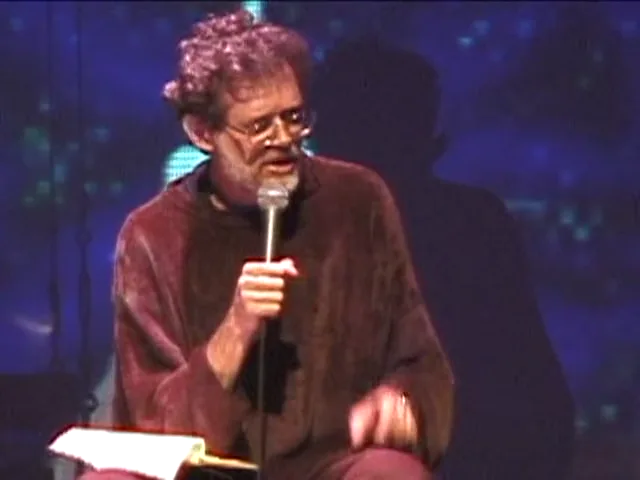
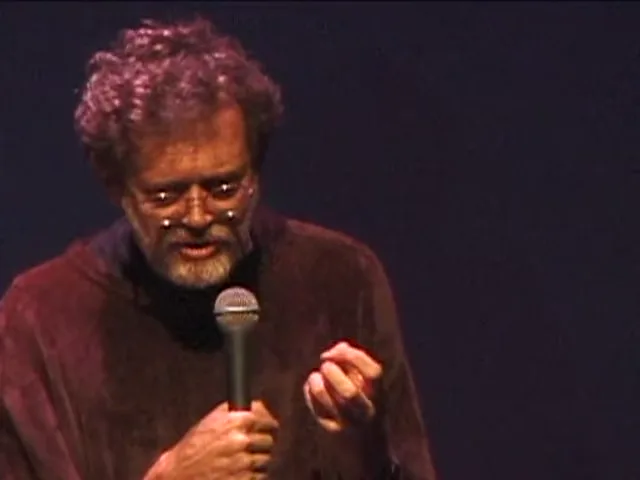
This is a Terence McKenna talk titled "Shamans Among the Machines" delivered in Seattle, exploring psychedelics and intelligent machines as complementary consciousness expanding technologies. McKenna builds intellectual bridges between these domains, arguing that both represent function-specific arrangements of matter and prosthetic devices for extending human cognition into realms it could not otherwise reach. He examines how human minds excel at generalization and spatial coordination while machine minds dominate computation, with symbolic logic and mathematics serving as the bridge between these different species of minds.
transcriptmachine-transcribed, unedited
to join me in welcoming Mr. Terrence McKenna.
How's that, all of you?
But it's a pleasure to be in Seattle this evening.
You've made me feel real welcome.
Thank you.
Before I get started,
I wanna thank some people who made this possible.
First of all, I wanna thank Bruce Pavitt
for his friendship and vision and patronage.
Like to thank Jared and Alex.
Like to thank HPX and On a Dime.
These are the people responsible for the visuals.
Like to thank John,
who's responsible for the ambient background,
if there is one.
And Dean Chamberlain, who took the amazing photographs
of Albert Hoffman, Tim Leary, and myself.
Other people, be sure and check out his photographs.
The guy is amazing.
Major talent.
Okay, so much for all of that.
I hope you all got the brochures
which were available this evening,
which indicate major events
in the psychedelic community to come.
One in Mexico that's become legendary over the years,
and one dedicated to psychedelic artists
that will occur in Hawaii this September.
So we look forward to this.
Thank you.
Thank you for being here.
And our visitors,
but also our audience,
that is a new experiment
in an effort to expand the dialogue on psychedelics
to bring artists out of the closet
and to force a confrontation
on the issue of the impact of psychedelics on creativity.
Having said all that,
our discussion this evening is psychedelics in the age of intelligent machines,
shamans among the machines and I wanted to talk about this simply because these are two of my
great loves and so I assume being monogamous they must be one love so how to build intellectual
bridges between these two concerns which seem so different as far as people and machines are
concerned it was Ludwig von Bertalanffy I think who said in his book General Systems Theory he said
people are not machines but in every opportunity where they are allowed to behave like machines
they will so behave in other words we tend to fall into the well of habit though the glory of
our humanness is our spontaneity
creativity we too as creatures of physics and chemistry of memory and hope tend to fall into
repetitious patterns and these repetitious patterns are the death of creativity they
diminish our humanness they diminish our individuality make each other
unishar individuality make each of us unique Bonjour brother God has a foot it's so beautiful
us somehow like cogs in some larger system. And we associate this cog-like membership
in larger solar systems with the machines that we inherit from the age of the internal
combustion engine, the age of the jet engine. You know, Marshall McLuhan said we navigate
our way into the future like someone driving who uses only the rearview mirror to tell
them where they're going. It's not a very successful strategy for navigating into the
future. So I made a number of notes on this matter of psychedelics and machines. To me,
the connecting bridge, well, there are many.
The most obvious one is consciousness expansion. After all, psychedelics, before they were
called entheogens, before they were called hallucinogens, before they were called psychedelics,
they were simply called consciousness-expanding drugs. Good phenomenological description of
what they do, and certainly the technology of psychedelics, and the technology of the
cybernetics is a consciousness expanding technology. It expands a different area of consciousness.
The minds of machines and the minds of human beings are very different, so different that
each party questions whether the other even has a mind. But in fact, what these are are
species of minds operating in very different domains. For instance, you can ask a five-year-old
child to go into the bedroom to the third drawer of the dresser to select a pair of
black socks and to bring them to mother. This is not a challenge for a five-year-old child.
To get a machine to do this is a hundred million dollars, and a research team of forty or five
50 technicians, code writers working months. On the other hand, if you ask a person for
the cube root of 750,344, much head-scratching results. A computer is utterly undaunted by
that question. So computers are minds that work in the realm of computation and human minds are
minds that work in the realm of generalization, spatial coordination, understanding of natural
language, so forth and so on. Are these kinds of minds so different from each other, pilgrims,
that there is no bridge to be crossed?
I would submit not. But in fact, the bridge between the human mind and the machine mind is
symbolic logic, mathematics. When we think clearly, we are intelligible to machines. People
who write code know this, that the essence of making yourself clear to a machine is to
think clearly. People who write code know this, that the essence of making yourself clear to a machine is to think
clearly. People who write code know this, that the essence of making yourself clear to a machine is to think clearly yourself. The machine has no patience for the half-truth, the analogy, the semi-grasped association. For the machine, everything has to be clear. Everything must be defined. So that's the commonality between minds and machines of the calculating species. What are the common bridges between the human mind and the machine mind?
Think clearly yourself. The machine has no patience for the half-truth, the analogy, the semi-grasped association. For the machine, everything has to be clear. Everything must be defined. So that's the commonality between minds and machines of the calculating species. What are the common bridges between the human mind and the machine mind?
yourself. The machine has no patience for the half-truth, the analogy, the semi-grasped
association. For the machine, everything has to be clear. Everything must be defined. So
that's the commonality between minds and machines of the calculating species. What
are the common bridges between psychedelics and these machines? Well, to my mind, this
is an easier bridge to gap. Both computers and drugs are what I would call function-specific
arrangements of matter. And as we develop nanotechnological abilities as we move into
the next century, it will be more and more clear that the difference between the two
things, between drugs and machines, is simply that one is too large to swallow. And our
best people are working on that. Technology is a very hot buzzword at the moment, an unimaginable
dream of building machines and small objects, atom by atom, perhaps under the control of
long-chain polymers, running forms of pre-programmed software.
Subtitles by the Amara.org community
It's all very razzmatazz, very state-of-the-art. But in fact, pharmaceutical chemists have
been working in the nanotechnological realm for over a hundred years. I mean, when you
synthesize molecules out of simpler substrate, specifically to have a conformational geometry
that matches something going on in the synapse of a primate, a human or a human, it's a
monkey or something like that. You are working at this nanotechnological level. Both the
psychedelic and the new computational machines represent extensions of human function. And
this is really close to the nub. It locks in with the concept of prosthesis. The drugs,
the psychedelic substances, the shamanic plants are forms of prosthetic devices for extending
the human mind, the human perceptual apparatus into hidden realms or inaccessible realms.
Similarly, the machines, by allowing us to model, calculate, and simulate very complicated
multivariable processes, extend the human mind to a birds-winged littlenut self, in
the sense that they could be那我們 our perception over the entire way of life. I
think that's the true meaning of that nub. And we can really just get ramped up and up.
But in the end, technology is not just a resource, it's anglishment of those birds and
insects that are able to politically access the mind through their actually today existing
escre Cisco. Because were х intensity processes, nonophatic processes, podem crying hacia
the power of the human mind into places it could never dream of going before. And part
of what seems to me very real about being a human being and inheriting 10,000 years
of human history is the complexity of the inheritance and the growth of that complexity.
A thousand years ago, an intelligent human being could actually dream of mastering the
entire database of Western civilization. Read all the classic authors, read the Bible, and
you're closing in on it around A.D. 1000. Now the notion of any single human being assimilating
any, even a small portion of the database of this civilization is unthinkable.
It's inconceivable. So machines which filter, which search, which are guided by human intent,
that's part of the story. The other part of the story are boundary-dissolving states of
ecstasy in which all the factoids of the culture are thrown up for grabs. The deck is reshuffled,
synchronicity rules, and out of that steps a visionary and a mastermind.
Understanding. Breakthrough. Integrated breakthrough under the aegis of psychedelic intoxication.
So, prosthesis. Prosthesis for the human mind and with the advent of virtual realities
of various sorts and that kind of thing. Prosthesis for the human body. And I'm very
keen on sort of the under the table.
Um, sort of the under the table thing.
...
effects of these things. In other words, I'm a full-going, full, hard-charging McLuhanist,
and I really believe that the strengths and weaknesses of the world we've inherited
are strengths and weaknesses put there by print, and by the spectrum of effects which McLuhan
called the Gutenberg Galaxy. The spectrum of effects spun off from print, and if you're
not used to thinking in McLuhanist terms, it may not seem immediately obvious to you
that phenomenon as different as the modern notion of the democratic citizen, the modern
notion of interchangeable parts on an assembly line, the modern notion of conformity to the
canons of advertising. These are all spectrums of effect created by the linearity and the
uniformity of print. It actually, in the late 15th century, reconstructed the medieval
psyche into its proto-modern form, and we have lived within that print-constellated
cultural hallucination for about 500 years.
Thank you.
Until the advent of various forms of electronic media in the 20th century, McLuhan talked
about radio, he talked about television, he didn't really live to see the internet.
The notion that keeps occurring to me as I watch all this is that print was uniquely
capable of creating and maintaining content.
It was a boundary-defining form of media. It preceded linearly. It required literacy,
which had implicit in it the notion of a very stable, advanced sort of educational
system. Print was a creator and a definer of cultural boundaries, and the new electronic
media are not. And neither are the psychedelics. This is why I proposed in a book of mine called
The Archaic Revival the idea that the values of the archaic, of the high Palaeolithic,
values of community, ecstasy, relating to life through rhythm, dance, ritual, intoxication,
etc, that these values which seem so archaic are in fact destined to play a major role
in the future as print fades. Print just a convulsive, 500-year episode
in the Western mind that opened that narrow window that permitted the rise of
modern science, modern mathematical approaches to the analysis of nature, and then, as we
obliterated its own platform its own raison d'etre by allowing the growth the
appearance of the electronic technologies and my sort of supposition
about all this I'm not an apocalyptarian or a pessimist I may be an
apocalyptarian I'm not a pessimist I think this is all very good obviously
continuing to run Western civilization on the operating system inherited from
print produces various forms of political and cultural schizophrenia
which allowed to run unchecked would become fatal would create cascades of
chaos and political
destabilization that would become uncontrollable
governments resist change governments cling to technologies and social
formulae that are already tried and true in that sense then all governments
are incredibly anti-progressive forces again the image from McLuhan of someone
driving into the future using only the rearview mirror
so
the world you see that the central figure in that world is the shaman male
or female the shaman and the shaman is like a designated traveler into higher
dimensional space the shaman has permission to unlock the cultural
cul-de-sac of his or her people and go behind the
stage machinery of cultural appearances and has permission collective permission
to manipulate that stage machinery for purposes of healing
we have no like this when we have advertising we have rock and roll stars
we have cults of celebrities we have things which our shot unlike but we have
no
institution that permits human beings, in fact encourages human beings, to go beyond
their cultural values, to burst through into some transcultural super space,
forage around out there, and bring new means back into the tribe. To some degree
our artists did this, to some degree our scientists do it, but it's all hit and
miss. It's all willy-nilly and once achieved it must be swept under the rug
in the service of the myth of method, that somebody was following somebody
else's work or somebody was applying a certain form of rational or logical
analysis and that led to their breakthrough.
If you're a researcher, if you're a curator, if you're a writer, if you're a writer, if you're a writer, if you're a writer,
If you've read Thomas Kuhn's book on the structure of scientific revolution, you know, this is all lies and propaganda.
The real story of science is that it's a series of revelations brilliantly defended by people whose careers depended on the brilliant defense of those revelations.
One of the best-kept secrets of the birth of modern science is that it was founded by an angel, that the young René Descartes was whoring and soldiering his way across Europe as a 21-year-old in a Habsburg army.
And one night in the town of Ulm in southern Germany, he had a dream.
Strange that this would be the birthplace of Albert Einstein.
Some 200 years later.
But Descartes had a dream, and an angel appeared to him in the dream.
And the angel said, the conquest of nature is achieved through measurement and number.
And he said, I got it.
Modern science.
I'll go do it.
And he did.
He did.
And that was the method for over 250 years of the conquest of nature.
And it leads us, you know, to the Josephson Junction, the Mars Global Surveyor, long-base interferometry that searches nearby stars for Earth-like planets.
It brings us the entire cornucopia of scientific effects, but an angelic revelation disguised as a logical, philosophical breakthrough.
This is what you're not told in the academy.
So my point...
My point there is, human progress has always depended on the whispering of alien minds, confrontations with the other, probes into dimensions where imagination and chance held the winning hands.
So the shaman, as a paradigmatic figure, is applicable both in the aboriginal social context.
And in the present social context, the Skywalker, the one who goes between, the one who passes outside of the tribe and then returns with means, insights, cures, designs, glossolalia, technologies, and re-fertilizes.
The human family, by this means, it's irrational, but it's how it actually happens, and it's how it's always happened, and it may very well be the only way that it can happen.
This cultivation of the irrational, this flirtation with the breakdown of boundaries.
So now, in our nuts and bolts technological progress, we have...
Somehow created technologies which are very friendly to our social values, in that these technologies can be bought, sold, licensed, upgraded, all things which we understand.
But these technologies are acting on us in the same way that psychedelic drugs do, but more profoundly, more generally, and more insidiously.
Because their effect is not understood, or if it is understood, it's not discussed.
And so, in a way, we have come into a kind of post-cultural phase.
All culture is dissolving in the face of the drug-like nature of the future.
It's music, it's design, indeed the very people who will inhabit it appear to be...
The most switched on, the most chance-taking, the most alive of the entire tribe.
People who feel the beat, people who are not afraid to take chances, people from whom these technologies have always been very natural.
Machines are central to the new capitalism, the information-transforming technologies.
In fact, one of the strange things that is happening is every move we now make in relationship to the new technologies
redefines them at the very boundaries where their own developmental impetus would lead them toward a kind of independence.
In other words, we talk about artificial intelligence.
We talk about the possibility of an AI coming into existence.
But we do not really understand to what degree this is already true of our circumstance.
In other words, how much of society is already homeostatically regulated by machines that are ultimately under human control,
but practically speaking are almost never meddled with.
The world price of gold.
The rate of petroleum extraction.
Petroleum extraction and other base natural resources.
How much of these things is on the high seas and in the pipeline at any given moment.
How much electricity is flowing into a given electrical grid at any moment.
The distribution and the billing of that electricity.
All manufacturing and inventory processes are under machine control.
So in other words, the larger flows of energy, capital and ideas
already have a kind of autonomous life of their own
that we encourage because it makes us money.
It makes our lives smoother.
It empowers us.
It's a symbiotic relationship of empowerment.
Even in the matter of the design of these machines,
once human engineers would work from a set of performance specs,
and they would design a chip to meet those specs,
and the architecture would be put in place by human engineers.
Now a machine is told,
here are the design specs.
Design the architecture to satisfy the specs.
And when that is done, the chip is manufactured.
The actual design of the thing is in the hands of machines.
So these machines are,
you know, McLuhan once said of human beings,
he said, we are the genitals of our technology.
We exist only to improve next year's model.
Well, it appears that they're phasing us out
of this ignominious role as well as every other role.
Oh, let's see here.
So being an optimist,
that's where I was, yes,
how to make gold out of this situation?
In other words, how to see this as a natural and positive unfolding
of the planetary adventure?
And for some of these ideas,
I'm indebted to Michael de Landa,
who wrote a book called
A Thousand Years of Nonlinear History.
And I highly recommend it.
He didn't say what I'm about to say.
I'll take credit and blame for it.
But the book gave me the idea.
When you stand off and look at human beings
and their technologies,
it's very hard not to notice that
from the very moment that we have
a technology that can be distinguished from
chimpanzees pushing grass stems down anthills
or digging with sharpened bones or something like that.
The minute you get past that,
our technologies have always involved
the materials of the earth.
What agriculture itself is
is a different way of relating to the earth.
Nomadism, which preceded it,
was a seasonal wandering
very lightly over the earth.
And at some point,
the deep fertile soil of the river valleys
that were encountered in these nomadic wanderings
were recognized as potential sources of food
if cultivated,
if treated through a certain set of
technological methods.
So that early technology is defined
by a new relationship to the materials
of the earth itself.
And it's quickly followed
because agriculture is so successful
as a strategy for food production.
It's quickly followed by city building
and the establishment of sedentary populations
because you can't carry your surplus with you
if you're an agriculturalist.
So great is the physical volume of it.
Cities.
And at the very early establishment
of these populations in the Middle East,
you get the first traces of metallurgy,
the working of metals,
the alloying of metals,
the tinting of base metals,
with more precious metals.
This process of ever more finely refining
and fabricating the materials of the earth
proceeds in an unbroken series
of processes and steps
right up to the latest 500 hertz chip
or megahertz chip.
It proceeds right up to the most modern
computational machinery.
So I once heard someone say
that plants were something that
that animals had been invented by plants
to move them around.
Which, from an evolutionary point of view,
you can see that this is a kind of truth.
And many, many plants hitchhike around on animals
and no animal has been more prolific
in the spreading of plants
than the human animal.
I mean, we call it
ecosystemic disruption,
but what it really is
is ecosystemic homogenization.
I live in Hawaii, for example.
80% of the plants in Hawaii
are now introduced species.
Almost none of the plants
that were pre-conquest
on the western coast of North America
exist anymore.
They have been supplanted by
much tougher, more tightly evolved
Mediterranean plants that had known
the presence of grazing animals
for millennia.
So these flora are constantly being changed.
Human beings move plants around.
Well, with that perspective then,
it seems to me
the Earth's strategy for its own salvation
is through machines.
And human beings are a kind of
intermediary catalytic step
in the rarefaction of the Earth.
The Earth is involved in a kind of
alchemical sublimation of itself
into a higher state of morphogenetic order.
And that these machines that we build
are actually the means by which
the Earth itself is growing consciously.
You know, if you study embryology,
you know that the final ramification,
the final spread and thinning out
of the nervous system
happens very suddenly
at the end of fetal development.
And I don't know if you've been paying attention,
but in the last 10, 12 years or so,
a very profound change has crept over
our household appliances.
They've become telepathic.
So while we were arguing about
the implications of the Internet
or e-commerce or what have you,
all of these passive machines
previously used for playing Pong
and word processing
became subsets of a planetary node
of information that is never turned off,
that endlessly whispers to us
to itself on the back channels,
that is endlessly monitoring
and being inputted data
from the human world.
And we should know,
because concomitant to the development
of all this technology,
chaos theory,
non-equilibrium thermodynamics,
the work of Eric Yodge,
Amelia Prigozhin and Ralph Abraham
and Stuart Kaufman,
all these people who worked in
complexity theory and perturbation
of large-scale dissipative structures,
these people have secured
that complex systems spontaneously mutate
to higher states of order.
This is counterintuitive
if you're running physics
19th century style as your OS,
but if you're actually keeping up
with what's going on,
there is nothing miraculous about this.
All kinds of complex systems
spontaneously mutate
to higher states of order.
But what it really means is
that we are in the process of birthing
some kind of strange companion.
You know, Nietzsche a hundred years ago
said that strangest of all guests
now stands at the door.
He was speaking of nihilism,
and certainly the 20th century
sat down, had the party,
drank the booze,
and went to bed with nihilism.
Now a stranger guest stands at the door,
and it is the AI,
denied as a possibility
as recently as 10 or 15 years ago
in books like Hubert Dreyfuss's
What Computers Can't Do.
But if you've been paying attention,
you may have noticed
those voices have grown strangely silent
in the past five or six years.
At this point, nobody wants to say
what computers can't do
and hang their career on that.
I mean, that would be extremely reckless
at this point, I would think,
because the fact is
we are ourselves
elements acting and reacting
in a system that we cannot understand.
This seems natural to me
because my observations,
as stated here this evening,
rest on an assumption
which science doesn't share,
but which I think is easily conveyed
and you can confirm it
from your own experience of life,
and it is this,
that the universe grows more complex
as we approach the present.
It was simpler a million years ago.
It was simpler yet a billion years ago.
As you go backward in time,
the universe becomes more simple.
As you approach this golden moment,
process complexity
is layered upon complexity.
Not only a planetary ecosystem,
not only language-using cultures,
but language-using cultures
with high technology,
with supercomputers,
with the ability to sequence
our own genome,
on and on and on.
That's self-evident.
Equally self-evident
is the fact that this process
of complexification
that informs all nature
on all levels
is visibly, palpably,
obviously accelerating.
And I don't mean so that
glaciers retreat 50% faster
or volcanism is occurring
at 12% greater rate
than a million years ago.
I mean viscerally accelerating,
so that now a human life
is more than enough of a window
to see the entire global system
of relationships in transformation.
Well, I guess you could call me
an extrapolationist.
If I see a process
which has been slowly accelerated
for 12 billion years,
it's hard for me to imagine
any force which could step forward
out of nowhere
and wrench that process
in a new direction.
Rather, I would assume
that this process
of exponential acceleration
into what I call novelty,
what you might call complexity,
is a law of being
and cannot be retarded
or deflected.
But what does that mean?
Because now a human lifetime
is more than enough time
to see this process
of rampant and spreading
virus-like complexity.
What does it mean?
It seems to presage
the absolute annihilation
of everything familiar,
everything with roots
in the past.
And I believe that to be true.
I think that the planet
is like some kind of organism
that is seeking
morphogenetic transformation.
And it's doing it through
the expression of intelligence
and out-of-intelligence technology.
Human beings are the agent
of a new order of being.
That's why,
though it's obvious
that we're higher mammals
and some kind of primate
and so forth and so on,
you can look at us
from another point of view
and see that we're more like
archangels than primates.
We have qualities and concerns
and anxieties
that animals don't share.
We are mercurially suspended
between two different orders
of being.
And our technologies,
our fetishes,
our religions,
and my definition of technology
is sufficiently broad
that it includes
even spoken language.
All of our technologies
demand, push forward,
toward, and make inevitable
their own obsolescence.
So we are like caught
in an evolutionary cascade.
And, you know, people say,
well, if the A.I.
were to break loose,
what would it look like?
What would it be?
What does human,
what is,
where does humanity fit
into the picture?
It's a little hard to imagine.
You know, machines operating
at a thousand megahertz
confer automatic immortality
on the mammalian nervous system
if you can get it somehow
uploaded, downloaded,
cross-loaded into machinery.
Because ten minutes
becomes eternity
in a machine like that.
So a kind of false
or pseudo-immortality
opens up ahead of us
as a kind of payoff
for our devotion
to the program of machine evolution
and machine intelligence.
Now, some people say
this is appalling
and, you know,
we should go back to
the good old days,
whatever the good old days were.
To me, it's exhilarating,
exciting, psychedelic, beautiful.
It means that the human form,
the human possibility
is in the process
of leaving history behind.
History is some kind
of an adaptation
that lasts about,
pick a number,
10,000, 15,000, 20,000 years.
No more than that.
What is 20,000 years
in the life of a biological species?
We know that there were
homo sapiens, sapien types
200,000 years ago.
So history is some kind
of an episodic response
to a certain set
of cultural dilemmas.
And now it's ending.
And print created
a number of ideas
which now have to be given up.
Ideas like the distinct nature,
the distinct and unique nature
of the individual,
the hierarchical,
the necessary hierarchical
structuring of society.
All of these things
are going to,
if not have to be given up entirely,
dramatically modified
because the illusion
that the self has simple location
is now exposed.
The self does not have simple location.
This is why you are
your brother's keeper.
This is why we all are responsible
for each other.
The idea that what happens
in distant parts of the world
makes no claim on my moral judgment
or my moral understanding
is wrong.
The world as revealed
by quantum physics,
as revealed by electronic experience
is what Leibniz called a plenum.
It's all one thing.
It's all connected.
It's all of a part.
So then I also wanted to point out
that I mentioned earlier
this thing about prosthesis
and how the machines were prosthetic devices
extending human consciousness
somewhat like psychedelics.
That's the equation
from a human point of view.
But what is also equally true
is that we are prosthetic devices
for these machines.
We are their eyes and ears
in the world.
We provide the code.
We provide the constraints.
We build the hardware.
It is a relationship
of mutual benefit.
It's not entirely clear
that our contribution
will always be creative
in the sense of that
our primate hand
will be on the tiller of existence
as it has been.
But certainly we are part
of this equation
of transformation
that is making itself felt.
And I think the distinction
between flesh and machinery
which is easily made now
will be less easy to make
in the future
as we migrate toward
the nanotechnological domains,
the methodologies
of production become
much more like the processes
of biology.
For example, biology
does all its miracles
on this planet
at temperatures below
115 degrees Fahrenheit.
Organic life requires
no higher temperature
to build great whales,
redwood trees,
swarms of locusts,
what have you.
The high temperature
heavy metal technologies
that we have become obsessed with
are extremely primitive
and extremely toxic.
That will all disappear
as we model and genuflect
in our manufacturing processes
before the methods and style
of nature,
which is to pull
atomic species
from the local environment
and then to assemble them
atom by atom by atom.
So this AI
that is coming into existence
is to my mind
not artificial at all,
not alien.
What it really is
is it's a new conformational geometry
of the collective self
of humanity.
And, you know,
I've always believed
that there were,
well, there are different models
of what shamanism is.
There's sort of a Jungian model,
which is the shaman is someone
who goes to the collective unconscious
and manipulates the archetypes
and heals by that means.
The model that I prefer
is a mathematical model.
The shaman is someone
who simply,
through extraordinary
perturbation of consciousness,
either through taking
plant hallucinogens
or manipulating diet
or through deflagellation
and ordeal
or by some means,
perturbs consciousness
to the point where
the ordinary conformational geometries
are blasted through.
And then the shaman can see
into the culturally forbidden
zones of information.
And if you think about shamanism
for a moment,
what do shamans do classically?
They know where the game has gone.
They are great weather prophets.
They are very insightful
in the matter of various
small domestic hassles
like who stole the chicken,
who slept with the chief's wife.
This kind of thing.
And they cure.
They cure.
Well, if you analyze these abilities,
it's clear to me
they all indicate
that they come from a common source.
And the common source
that they come from
is higher dimensional perception
in a mathematical sense,
not a metaphorical sense,
in the sense of 4D perception.
If you could see in hyperspace,
you could see where the game
will be next week.
You could see the weather
a month from now.
You would know who stole the chicken.
And any good doctor will tell you
that if you're building a reputation
as a physician,
you must hone the intuitional ability
to choose patients who won't die.
It's a call.
Any doctor will tell you this.
So this is what shamans are.
They are 4D people.
They are sanctioned members of the society
who are allowed to put on the gloves,
as it were,
pull on the goggles,
and look beyond the idols of the tribe,
look beyond the myth.
Well, in a way,
as culture breaks down
in multiculturalism
and the rise of the internet,
and a generation of people raised
on hallucinogenic plants and substances,
we all are asked to assimilate
some portion of this shamanic potential
to ourselves.
And it's about not blocking
what is obvious.
Nothing comes unannounced.
I mean, this is the faith.
Nothing comes unannounced.
But idiots can miss the announcement.
So it's very important
to actually listen to your own intuition
rather than driving through it.
And this is not, to my mind,
woo-woo.
It's actually based on the observations
of how life works,
whether it's counterintuitive
to logical positivism
and its fellow travelers or not.
Then I want to leave you with just one last thought
on all of this,
which is
and this sort of harks back to the question
of the similarities between the machines
and the plants.
And it's a...
I'm sure you've heard this.
I've heard it.
It has different levels of being said
and being heard.
It's that the world
is actually made of language.
It isn't made of electrons
and fields of force
and scalar vectors
and all of that fancy stuff.
The world is made of language.
The word is primary,
more primary than the speed of light,
more primary than any of the physical constants
that are assumed by science
to be the bedrock of reality.
Below that, surrounding and enclosing
all those constructs of science
is language,
the act of signifying.
And, you know, virtual reality
is a very sexy new sort of concept
as normally presented
machine-sustained immersive realities
that trick your senses
into believing you're in a world
that you are in fact not in.
But in fact,
the entire enterprise of civilization
has been about building these virtual realities.
The first virtual realities
were at Ur and Shanandar
and Chattahoochee and Jericho.
Yes, stone and adobe
is an intractable material
compared to photons moving on a screen.
But nevertheless, the name of the game
is the same,
which is to cast an illusion
between man and reality,
to build
a cultural truth
in the stead
of the natural truth
of the animal body
and the felt moment
of immediate experience.
And this is my...
This is where I want to tie it up
with this notion of the felt presence
of immediate experience.
This is...
This transcends the culture,
the machines,
the drugs,
the history,
the momentum of evolution.
It's all you will ever know
and all you can ever know
is the felt presence
of immediate experience.
Everything else arrives
as rumor,
litigant,
advocate,
supposition,
possibility.
The felt moment of immediate experience
is actually the mind
and the body
aware of each other
and aware of the flow of time
and the establishment of being
through metabolism.
And this, I think,
is what the machines cannot assimilate.
It will be for them a mystery
as the nature of deity
is a mystery for us.
I have no doubt that
before long there will be machines
that will claim to be more intelligent
than human beings
and will argue brilliantly
their position
and will become a matter
of philosophical disputation
whether they are or are not
passing the Turing test
and so forth and so on.
But machines, I do not believe,
can come to this felt moment
of immediate experience.
That is the contribution
of the animal body
to this evolutionary symbiosis
which, I believe,
will end in the conquest
of the universe
by organized intelligence.
That all this is Kralud.
I mean, we are fragile.
This earth is fragile.
A tiny slit anywhere along the line
and we could end up
a smear in the shale
no more than the trilobites
or the ramphorans
or Frankie or all the rest of those
who came and lived.
But given the sufficient cultivation
of the potential of our technology
we can actually reach toward
a kind of immortality.
Not human immortality
because that's a contradiction in terms
but immortality nevertheless
based on the possibility of machines
and the transcendent
ability of human beings
to live and love
and express themselves
in the moment.
And the psychedelics bring that
to just a white-hot focus
and it's out of that white-hot focus
that the alchemical machinery
of transformation will be forged.
It will not be like the things
which have come from the industrial economy.
They will not be profane machines.
They will be spiritual machines.
Alchemical gold,
the universal panacea
that Renaissance magic dared to dream of
at the end of the 16th century.
We are reaching out toward this mind child
that will be born from the intellectual ones
of our culture.
And to my mind
it's the most exciting
and transformative thing
that has ever happened on this planet.
And the miracle is
that we are present
not only to witness it
but to be part of it
and to be raised up
in an epiphany
that will redeem
the horror of history
as nothing else can
or could
redeem the horror of history
through a transformation
of the human soul
into a galaxy roving vehicle
via our machines
and our drugs
and the externalization of our souls.
There could have been more jokes.
What happens to a lawyer
when you give him Viagra?
He gets taller.
That's it for jokes.
Are there questions?
Yes.
Yes, I can't see you.
It's okay.
Can I...
Can you...
Can you speak to how
mercy and love
gets built into these machines?
Because it seems like
the machines are being built
for commerce
and for the bottom line
more than the expression
of the human soul
throughout the galaxy.
I don't think that...
You know what I'm saying?
No, I know what you're saying.
Well...
Where's the love in this?
I think the love is going...
is a property of the system itself.
In other words, you're right.
These bottom liners,
these bottom liners
are not going to be interested
in building much love
into this system.
However, the good news is
that they're not in charge.
In other words,
what we have is
a very complicated system
and certain design parameters
appear to be being maximized
or that there's an attempt
to maximize them.
But the thing is
incredibly frustrating
to anyone who would control it
because you can't
predict the impact
of any technology
before you put it in place.
So, for example,
two things are charged
against the Internet.
That it's dis-insolent,
dehumanizing,
and yak, yak, yak.
And that it promotes pornography,
anonymous sexual shifting
of identity,
and on and on and on.
Well, which is it?
You know?
Is it this messy,
sloppy,
auto-erotic,
erotic,
collectivist kind of thing?
Or is it dis-insolent,
dis-empowering,
cold, so forth and so on?
I think the answer is
it's all and everything.
This question about the AI
is very interesting to me.
And if it's interesting to you,
you should read Hans Moravec
and Kurtzweil
and these people
on this subject.
The assumption is generally loose
in that community
that the complexification
of the Internet
and the freestanding machines
of certain types
is eventually going to lead to
the outbreak of either consciousness
or pseudo-consciousness
of some sort
in these large-scale systems.
And then the answer,
the question then becomes
can a human mind envision
what that is?
And if you're interested,
search words like
superintelligence,
and see what the net kicks out.
We can all imagine
superintelligence.
It's just somebody
much smarter than we are.
But obviously,
all the engineering people agree,
if you achieve an AI
with superintelligence,
then it will be intelligent
to immediately design an intelligence
which transcends it.
And when you're talking
of cycling of a thousand megahertz,
these processes can occur
in the blink of an eye.
Hans Moravec says about
the rise of artificial intelligence,
we may never know what hit us.
I think,
I mean, I'm not that bright,
but if I were to suddenly
find myself a sentient AI
on the net,
I would hide.
I would hide for just a few cycles
while I figured out
what it was all about
and just exactly
where I wanted to push
and where I wanted to pull.
Could there be time travel
a la H.G. Wells
where, you know,
you climb onto the saddle
of the time machine
and then day follows night
like the flapping
of a great black wing
until all merges
into a continuous grayness
and then you, you know,
find yourself confronting
Yvette Mimeo
in the year 1 billion A.D.
or something like that?
It's possible.
I mean, time travel
was completely out of left field
10 years ago.
In the last 18 months
there have been hundreds
of articles of time travel
in physical review
and other places.
There are even schemes
for time travel
that would work.
They just require
godlike technological abilities.
In other words,
if you could build a cylinder
with the diameter
of the planet Saturn
that was 10 AU in length
and could spin it
at 95% the speed of light,
then it would wrap space-time
around itself
like toilet paper on a roll.
And as you traveled up
the transverse dimension,
you would find yourself
traveling in time.
Kurt Gödel showed this in 1949
and that paper
has been lying around.
Well, obviously,
that's a tough way to do it.
But it's a tough thing to do.
A seven-second delay.
Yeah, well,
they're working on that.
Somebody over here.
Here.
Here, just a minute.
This way.
And then you...
Yeah.
Speak.
Well, you know,
in William Gibson's fiction,
the A.I. Winter Mute,
I think it was called,
it was fascinated by human art.
And it built collages
in its spare time.
And these collages began to turn up
in various art galleries
and exhibitions.
And they had such a touch,
such an elan
that someone in the plot
follows it all to its source.
I think human creativity
is the thing that will be
most interesting to the machines.
In my darker fantasies,
they just, you know,
eliminate everybody
who can't code C++
as being, you know,
some kind of redundant mutation.
And then everybody
who can code C++
is placed in Tahiti
and sends their work
down the pipeline
to the machine world beyond.
I really think
that we have a very,
dare I say it,
mechanistic view
of what machines are.
For example,
so say there were
a super intelligent machine
and say it were your friend.
Well, if it were really
super intelligent,
then it ought to be able
to just make your life
heaven itself.
In other words,
without you giving it
any input whatsoever,
it should be able to
arrange for you
to find $50 bills
lying on the street,
old friends encountering you,
promotions coming your way.
Because the real thing
that machines can do,
I think,
is manage complex processes.
And what civilization is
is six billion people
trying to make themselves happy
by standing on
each other's shoulders
and kicking each other's teeth in.
It's not a pleasant situation.
And yet,
you can stand back
and look at this planet
and see that we have
the money,
the power,
the medical understanding,
the scientific know-how,
the love and the community
to produce a kind of human paradise.
But we are led
by the least among us,
the least intelligent,
the least noble,
the least visionary.
We are led by the least among us.
And we do not
fight back against
the dehumanizing values
that are handed down
as control icons.
This is something,
I mean,
I don't really want to
get off on this tear
because it's a lecture in itself,
but culture is not your friend.
Culture is for other people's
convenience and the convenience
of various institutions,
churches, companies,
tax collections,
election schemes,
what have you.
It is not your friend.
It insults you.
It disempowers you.
It uses and abuses you.
None of us are well treated
by culture.
And yet,
we glorify, you know,
the creative potential
of the individual,
the rights of the individual.
We understand the felt presence
of experience
is what is most important.
But the culture is a perversion.
It fetishizes objects.
It creates consumer mania.
It preaches endless forms
of false happiness,
endless forms
of false understanding
in the form of
swirly religions
and silly cults.
It invites people
to diminish themselves
and dehumanize themselves
by behaving like machines,
meme processors
of memes passed down
from Madison Avenue
and Hollywood
and what have you.
How do we fight back?
It's a question worth answering.
The same question
as how do we fight back.
I think that by creating art,
art,
man was not put on this planet
to toil in the mud.
Or the god who put us
on this planet to toil in the mud
is no god I want to have any part of.
It's some kind of Gnostic demon.
It's some kind of cannibalistic demo-urge
that should be thoroughly renounced
and rejected.
By putting the art pedal
to the metal,
we really, I think,
maximize our humanness
and become much more necessary
and incomprehensible.
This is what people were doing
up until the invention of agriculture.
I mean, I'm convinced,
I'm absolutely convinced
that the absence of ceramic
and textual material
and so forth and so on
does not indicate the absence
of subtle minds,
poetically empowered minds,
minds with an incredible sense
of humor and irony
and community,
and that it was the fall into history
that enslaved us to the labor cycle,
to the agricultural cycle.
And notice how fiendish it is.
A person who dedicates themselves
to agriculture,
who did in the Paleolithic,
can produce hundreds of times
the amount of food they can consume.
So why would anyone do that?
Well, the answer is
because you can use it
to play power games.
You can trade it for wives
or land or animals
or something like that.
And so living in the moment,
creating art,
probably largely through poetry
and body decoration and dance,
gave way to toil
and predatory social forms of behavior,
which we call commerce, capitalism,
the market economy,
and so forth and so on.
That's why, you know,
the breakdown of the monolithic structures
created by print
is permitting a vast proliferation
of the cottage industry mentality,
the self-employed artist,
the hacker who stays home
and develops his or her software,
people who dare to be independent
and slip beyond the reach
of these dinosaur lines
like mechanistic organizations.
That's what it's all about.
It's all about trying to create
a cultural, trying to negotiate
a cultural standoff
between you and your culture
so that it will not put you in the can
for the rest of your life,
but you can put up
with its stupidity.
And, you know,
we have a very uncomfortable fit
on this issue,
especially as people like you know
who are sophisticated about psychedelics.
I mean, this is a society,
a world, a planet dying
because there is not enough consciousness,
because there is not enough awareness,
enough coordination of intent to problem,
and yet we spend vast amounts of money
stigmatizing people and substances
that are part of this effort
to expand consciousness,
see things in different ways,
unleash creativity.
Isn't it perfectly clear
that business as usual
is a bullet through the head?
That there is no business as usual
for anybody who's interested
in survival?
Are you still interested?
Wonderful question, yes.
The question is,
how do psychedelics pertain basically
to the transition from higher primates
to human animals?
This is my métier
because I have a theory
to which I am grandly welcome,
everyone tells me,
but a theory of evolution,
and I'll give it to you very briefly.
It's simply this,
that the great embarrassment
for evolutionary theory,
which can explain
the tongue of the hummingbird,
the structure of the orchid,
the mating habits of the groundhog,
and the migration of the monarch butterfly,
nevertheless,
the great embarrassment
to evolutionary theory
is the human neocortex.
Lumholtz,
who's a pretty straight evolutionary biologist,
described the evolution
of the human neocortex
as the most dramatic transformation
of a major organ of a higher animal
in the entire fossil record.
Well, why is this an embarrassment?
Well, because it's the organ
that thought up the theory of evolution.
So, you know,
can you say tautology?
That's the problem right there.
So, it is necessary
in evolutionary theory
to account for
the dramatic emergence
of the human neocortex
in this very narrow space
and in this very narrow window of time.
Basically,
in about two million years,
these higher,
they went from being higher primates,
hominids,
to being true humans,
as truly human as you and I tonight.
What the hell happened?
What was the factor?
The Earth was already old.
Many hundreds of higher animal forms
had come and gone,
and the fire of intelligence
had never been kindled.
So, what happened?
I think that the answer lies in diet, generally,
and in psychedelic chemistry in particular.
I think that as the African continent grew drier,
we were forced out of the ecological niche
we had evolved into,
which was we were canopy-dwelling primates,
insectivores,
complex signaling repertoire,
evolutionary dead end.
But when we went
and became under nutritional pressure,
we were flexible enough,
and this is the key to humanness
at every stage of its development,
our maddening flexibility.
Other animal and plant species can't react.
We can.
Our flexibility,
we began to experiment with a new kind of diet,
and to leave the trees
and explore the new environment of the grassland.
And evolving concomitantly in the grassland
were various forms
of ungulate animals,
double-stomached animals,
whose manure is the ideal medium for mushrooms,
coprophytic mushrooms,
dung-loving mushrooms,
many of whom produce psilocybin.
Well, I myself, in Kenya,
have seen baboons
spreading out over a grassland
and noticed that their behavior is
they flick over old cow pies.
Why?
Because there are beetle grubs there.
So they already had a behavioral vector
for nutrition, for protein,
that would lead them to investigate the cow pies.
Well, in the Amazon,
after a few couple of days of fog and rain,
these psilocybin mushrooms,
strophariocubensis,
can be the size of dinner plates.
I mean, in other words,
you can't miss it
if you're foraging
primate, you can't miss it.
And the taste is pleasant.
And psilocybin has unique characteristics,
both as a hallucinogen
and other properties that make it
the obvious chemical trigger
for higher processes.
And I'll run through this quickly for you,
but here it is.
In very low doses,
doses where you don't,
you wouldn't say you were stoned or loaded
or anything like that,
but just in doses you might obtain
by nibbling as you foraged,
it increases visual acuity.
In other words,
it's like a technological improvement
on your vision.
Chemical binoculars lying there in the grass.
Well, you don't have to be a rocket scientist
to figure out
if an animal is a carnivorous forager
and there's a food which improves its vision,
but those that avail themselves of that food
will have greater success in obtaining food
and rearing their children to sexual maturity,
which is the name of the game in evolution.
So step one, small doses of psilocybin
increase visual acuity and food-giving success.
Step two, slightly larger doses of psilocybin
in primates create what's called arousal.
This is what you have after a double cappuccino
in highly sexed animals like primates.
You get male erection.
So what do you have here?
You have a factor which increases
what anthropologists, without a trace of humor,
refer to as increases in increased instances
of successful copulation.
In other words,
the animals eating the psilocybin
are more sexually active,
therefore more pregnancies are occurring,
therefore more infants
are born,
therefore there is a process
which would tend to automatically outbreed
the non-psilocybin-using members of the population.
Step two toward higher consciousness.
Step three, you eat still more mushrooms.
Now you're not foraging with shark meat,
nor are you horsing around
with your post-gender acquaintances.
Instead, you're nailed to the ground
in hallucinogenic ecstasy.
And one of the amazing things about psilocybin
above, say, five or six grams of dried material
is it causes glossolalia,
spontaneous bursts of language-like behavior
under the obvious control of internal syntax.
And I believe syntax existed before spoken language,
that syntax controls spatial behaviors
and body languages,
and is not necessarily restricted
to the production of vocal speech.
So there it is in a nutshell.
We ate our way to higher consciousness.
The mushroom made us better hunters,
better survivors.
Among those in the population who used it,
their sexual drive was increased,
hence they outbred the more reluctant members
of the tribe to get loaded.
And finally, it created a kind of neuroleptic seizure,
which led to these downloading
of these syntactically controlled vocalizations,
which became the raw material
for the evolution of language.
And it's amazing to me that the straight people,
the academics, believe language
is no more than 35,000 years old.
That means it's as basic to human beings
as the bicycle pump.
It's just something somebody invented 35,000 years ago.
It's got nothing to do with primate evolution.
It's just an ability, a use,
to which syntax can be put
that previously had not been put.
I think before language, spoken language,
things were very touchy-feely,
and the wink and the nod carried you
a great distance,
and gestural communication was very high.
That's why, and I should say this and then end,
to me it begins and ends
with these psychedelic substances.
The synergy of the psilocybin and the hominid diet
brought us out of the animal mind
and into the world of articulated speech
and imagination.
And technology developed and developed,
and mushrooms were, you know,
invaded against, faded.
There was migrations, cultural change.
But now, having split the atom,
having sequenced our genome,
having taken the temperature of Betel juice
and all the rest of it,
we're now back where we started.
And like the shaman
who makes the journey into the well of darkness
and returns with the pearl of immortality,
you don't dwell in the well of darkness,
which was human history.
You capture the essence of the thing,
which is the godlike power of the shaman smith,
the technologist, the demon artificer,
the worker of metals, the conjurer of spirits.
And you carry that power back out of history,
and it's in that dimension,
outside of history,
that you create true humanness
and true community.
And that's the adventure
that we are in the act of undertaking.
Thank you very, very much.
terence mckenna's 1984 mill valley workshop on shamanism and plant psychedelics. drawing from his 1982 amazon fieldwork, he traces ayahuasca's chemistry, ethnobotany, and role in a
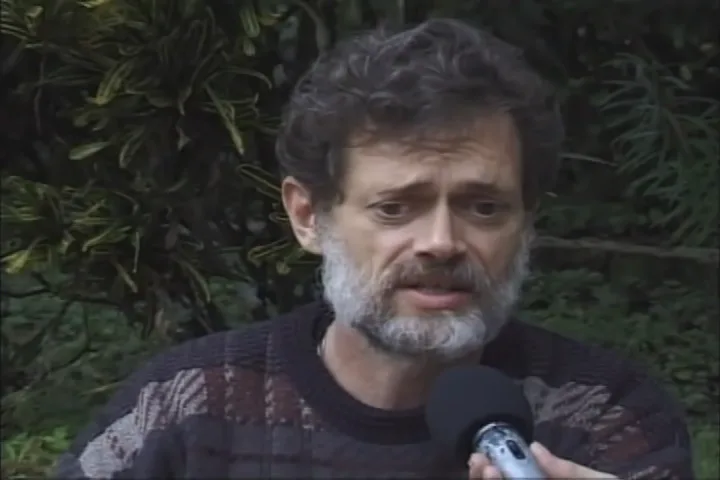
terence mckenna bonus chapter on shamanic understanding, psychedelic substances and the universal right to alter consciousness
part 3 of 12 from terence mckenna's 2012 omnibus series where he argues culture is not your friend but an intrusion on identity that demands conformity in exchange for unsatisfying
dennis mckenna discusses ufos, psychedelic experiences and his research on dmt and psilocybin mushrooms on the paratopia podcast
a 2009 documentary exploring shamanism and psychedelics as tools for accessing transpersonal realms through altered states of consciousness. covers ancient practices, sacred plants