The Psychedelic Society
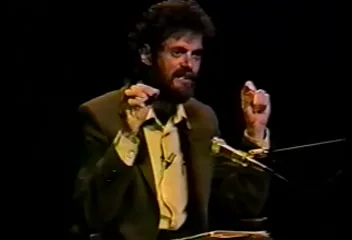
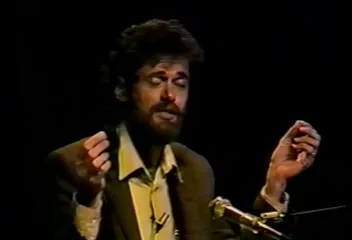
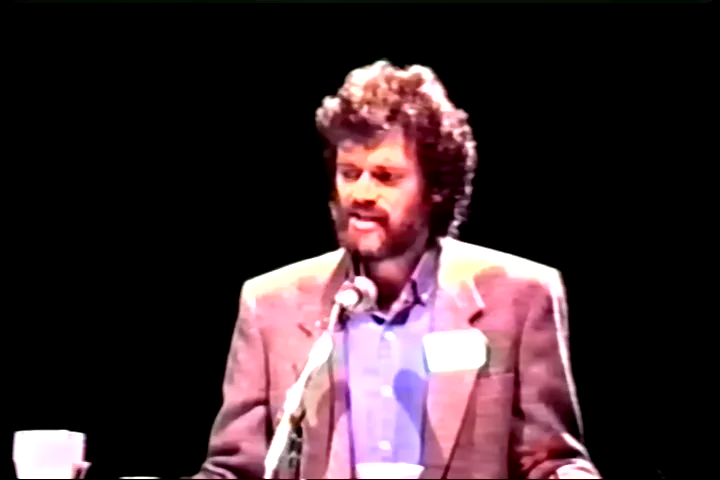
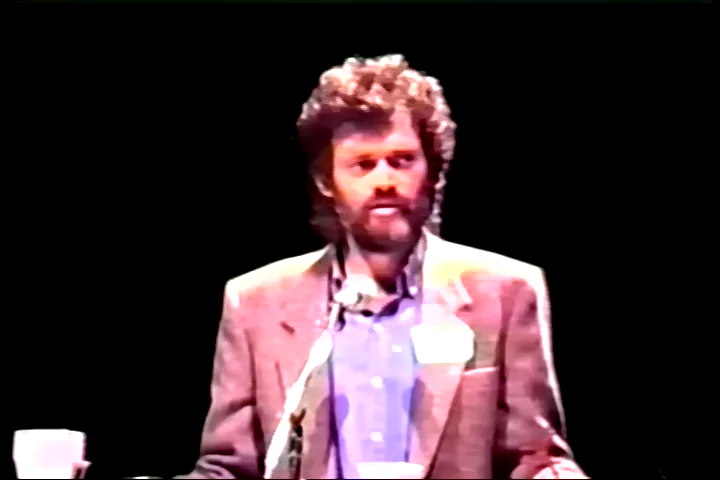
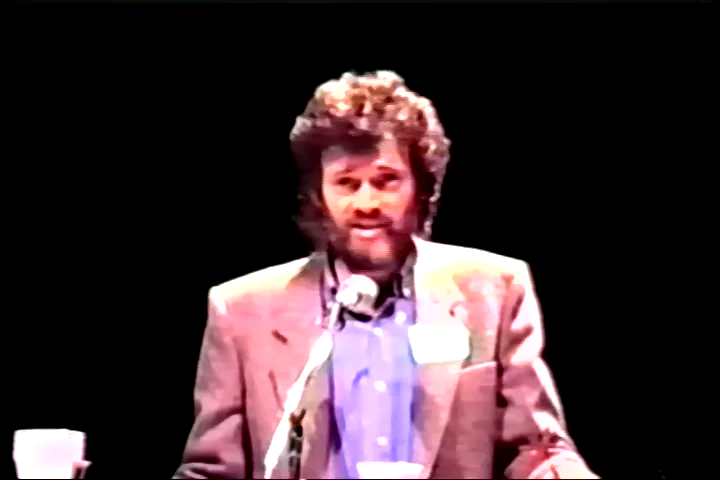
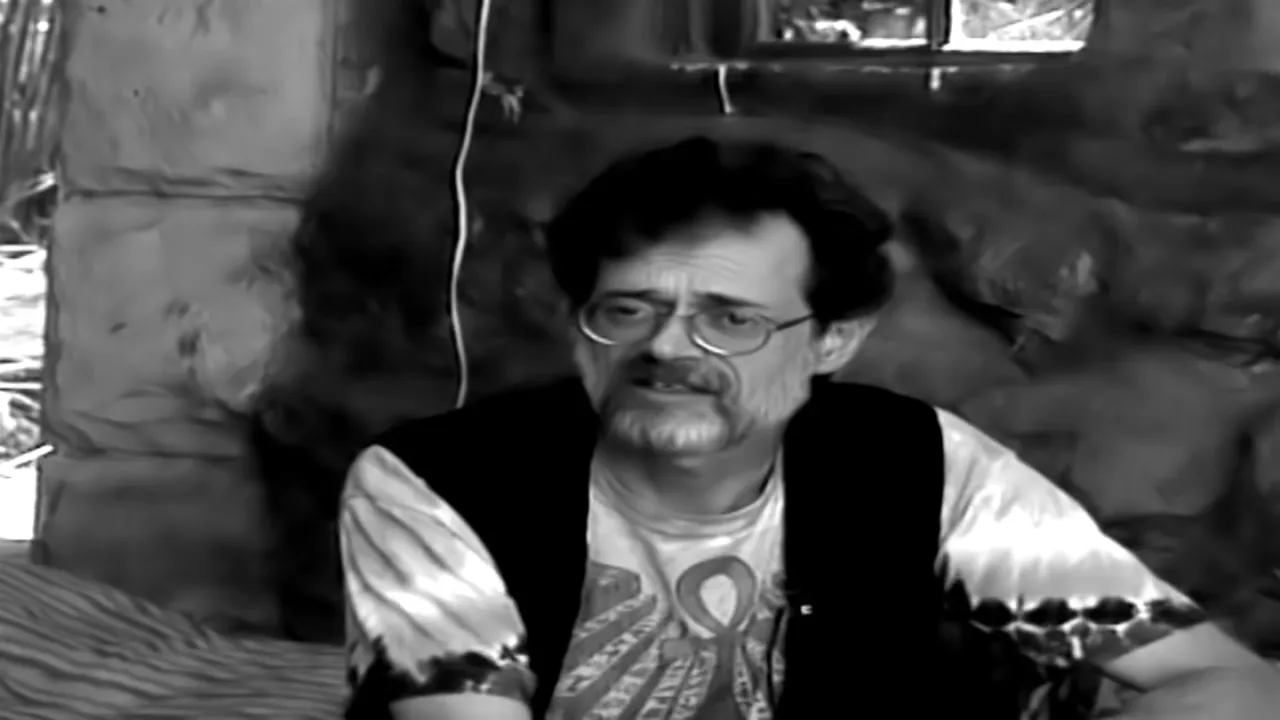
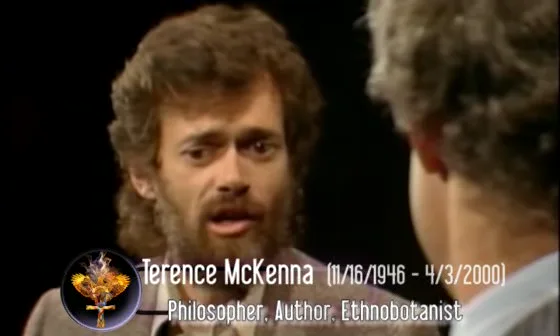
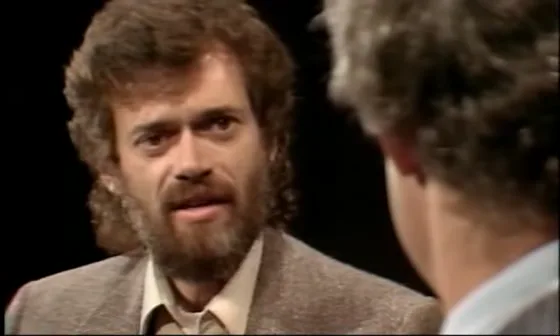
This is Terence McKennas 1987 talk introducing the concept of a psychedelic society that prioritizes direct experience over belief systems. McKenna critiques how civilizations become trapped by their own certainty and argues for what he calls intellectual anarchy where phenomenological cataloguing replaces rigid ideologies. He traces the shift from Freudian and Jungian models of the psychedelic experience to the shamanic model which sees special people probing hidden information fields to guide their societies. The talk connects computer networks and psychedelic drugs as tools that can create new alien information states if freed from ideological constraints. McKenna concludes that fundamental ontological conceptions about reality must be remade to address our civilizations crisis.
transcriptmachine-transcribed, unedited
And I want to thank all the women who support me.
I have wonderful support systems from women of all types
who seem dedicated to the notion that Terrence McKenna can always be improved.
And I'm extremely grateful for that.
The frontiers are enormous in that dimension.
Okay, what I want to talk about tonight is the notion or the idea of psychedelic society.
When I spoke at Santa Barbara at the psychedelics conference,
whenever it was, last May, a year ago,
my contact lenses failed me at a critical point in my lecture.
And I said,
I simply had to wing it.
And later, when I played this tape back,
I heard this phrase, psychedelic society.
And I had never used it consciously in a lecture.
But because I had said it,
and because there had been a ripple of resonance to it
from the crowd of people there,
I began to think about it.
And this evening, I will just generally assess
what it might mean for us.
I'm definitely a pioneer in this field.
I'm sure you're all familiar with the book Megatrends,
which is making quite an impression at the moment.
Well, Megatrends nowhere mentions the eminent transformation of human society
through the application of psychedelic drugs.
I don't know what they were thinking.
What I think a psychedelic society,
what that notion means or implies to me,
in terms of ideology,
is the idea of creating a society
which always lives in the light of the mystery of being.
In other words, that solutions should be displaced
from the central role that they have had in social organization.
And mysteries, irreducible mysteries,
should be put in their place.
The British enzymologist J.D.S. Haldane, in the 1920s,
in an essay, said,
the universe may not only be stranger than we suppose,
it may be stranger than we can suppose.
And I suggest to you that as we look back over human history,
every pinnacle of civilization,
whether it be Mayan or Greco-Roman or Sung dynasty,
has believed that it was in possession
of an accurate description of the cosmos
and of man's relationship to it.
This seems to go along with the full flowering of a civilization.
But from the point of view of our present civilization,
we regard all those conceptions as at worst quaint,
at best half-right,
and congratulate ourselves that our civilization
at last has its finger on the real description
of what is going on,
and that actually what blinds us
or what makes historical progress very difficult
is our lack of awareness of our ignorance
and that beliefs,
should be put aside,
and that a psychedelic society
would abandon belief systems
for direct experience.
And this is, I think,
much of the problem of the modern dilemma,
is that direct experience has been discounted
and in its place all kinds of belief systems have been erected.
I would prefer a kind of intellectual anarchy
where whatever was pragmatically applicable
was brought to bear on any situation,
but where belief was understood as a self-limiting function.
Because you see, if you believe something,
you're automatically precluded from believing its opposite,
which means that a degree of your human freedom
has been forfeited in the act of committing yourself
to this belief.
And I maintain that it's pointless to have beliefs,
in a sense,
because the universe really is stranger than we suppose.
And what we need is a return to what in the 16th century
was called the Baconian method,
which means not the elaboration of fantastic thought constructs
which explain,
but merely a phenomenological cataloguing of what we experience.
Computer networks and psychedelic drugs
and the increased availability of information in the world
have actually made possible the evolution
of new alien information states,
which never existed before.
And we are processing these things,
but at a very slow rate,
because we are hindered by ideology.
Now, I mentioned in an earlier workshop this afternoon
that Freudian models, Jungian models of the psychedelic experience,
which saw it as somehow a stripping away of resistance
and a revealing of complex and hidden emotions and motives
and belief systems,
has been replaced in the last five to ten years
with the shamanic model of hallucinogenic and shamanic experience.
This model holds that archaic peoples
have deputized special people
to probe hidden information fields using psychedelic drugs,
and that the information extracted from these information fields
is then used to guide and direct the society.
Now, I'm interested in this second model
and spent time in the Amazon
and am familiar with the operational mechanics of shamanism
and shamanic personalities and that sort of thing,
but I believe, actually,
that the psychedelic experience looms larger
than the institution of shamanism
and that we hold a unique opportunity
which is sort of the flip side of the culture crisis.
Our ability to destroy ourselves
is the mirror image of our ability to save ourselves,
and what is lacking is a clear vision of what should be done.
What should be done is certainly not the accumulation
of ever larger nuclear arsenals
and the promotion of all kinds of primate game playing
of the sort that Tim Leary is well versed in denouncing.
What needs to be done
is that fundamental ontological conceptions about reality
have to be remade.
We need a new language,
and in order to have a new language,
we must have a new reality.
It's almost a kind of Ouroboric equation
or a bootstrap situation.
A new reality will generate a new language.
A new language will fix a new reality
and make it part of this reality.
These psychedelic drugs are...
can be conceived of as points on an informational grid.
They provide new perspectives on reality,
and it is when you connect all points of perspective
that you have on reality
that a reasonably applicable model of it begins to appear.
And I think this reasonably applicable model,
what Wittgenstein called something which is true enough,
is what we're looking for.
The true enough mapping of experience onto theory
is what we're looking for.
But experience must be made primary.
The language of the self must be made primary.
And anarchy carries this responsibility
even when it's only political anarchy.
What I'm advocating is that we each take responsibility
for the cultural transformation
by realizing that it is not something
which will be disseminated from the top down.
It is something which each of us can contribute to
by attempting to live as far into the future as possible.
You know, we must get rid of the conceptions
of the 40s, the 50s, the 60s, the 70s,
the 80s, the 90s.
We must smear the historical past
into the historical moment
and become exemplars of the humanity of the end time.
And those of you who attended my lecture this afternoon
about time know that I believe that liberation
or let's even say decency as a human quality
is an actual resonance and anticipation
of this future perfected state of humanity
and we can will the perfect future into being
by becoming microcosms of the perfect future
and no longer casting blame outward on institutions
or hierarchies of responsibility and control
but by realizing that the opportunity is here,
the responsibility is here
and the two may never be congruent again
and the salvation of your immortal soul
may depend on what you do with the opportunity.
So what do you do with the opportunity?
What does it mean to say in operational terms
live as far into the future as you can live?
It means taking a position
vis-a-vis this emergent hyperdimensional reality.
It does not necessarily mean
becoming a psychedelic drug user yourself
but it means admitting to yourself the possibility
and if you feel the heroic potential within yourself
to be one of the experiencers
one of the pioneers
then you know what to do.
If on the other hand
you fear to be lost
in the abyss
you fear what William Blake called
falling into eternal death
fallen from the spiral of being
which connects one reincarnation to another
and falling into the realm of eternal death
then you orient yourself towards the psychedelic experience
towards the psychedelic phenomenon
as a source of information
a mirror image of the psychedelic experience
and the other is the psychedelic experience
that you experience in hardware
or computer networks.
Computer networks paradoxically enough
are a deeply feminizing influence on society
where in hardware
the unconscious is actually being created.
It's as though we took the platonic bon mot
about how if God did not exist
man would invent him
if the unconscious does not exist humanity will invent it in the form of
these vast networks able to transfer and transform information this is in fact
what we are caught up in is a transforming of information we have not
physically changed in the last 40,000 years the human type was established the
at the end of the last glaciation but change which was previously operable in
the biological realm is now operable in the realm of culture and we are shedding
cultural adumbrations of our vision of the Unitarian mystery at a faster and
faster rate as we try to accommodate ourselves and mirror ourselves to the
mystery which lies ahead of us in time
and which is throwing this vast shadow fatedness back over the entire
experience of human history for everyone who has lived in it and previous to our
own era the only control language which could be applied to this thing which was
bringing people together and causing birth and death and tearing down and
erecting civilizations was God and it was an
immaculate
imagined as a self-conscious force that was leaning into the world like a cat into a
fishbowl and making things happen now we have a different notion a notion of a
vector system where forces over a large area are oriented toward a very small
space and this is what history is
it's an inrush
towards what the Buddha is called the realm of the densely packed a transformational realm where the
opposites are unified and the way I characterize this union of opposites is to say it is that realm
where the body is finally interiorized the mind is finally exteriorized the way I think of the mind is
the fourth dimensional a fourth dimensional organ of your body you can't see it because it's in the
fourth dimension but you experience a sectioning of it in the phenomenon of consciousness but that
is only a partial sectioning of it the way a plane is a partial picture of a cone when it truncates
it the growth of information systems is only a mirroring in masculine hardware of what already
exists in nature as a fact and it is up to us to hone our intuitions and to become aware of this
pre-existent system of communication and wiring so that we can step away from the dualism of
which separate us from each other and from the world.
We need to realize that there is a gene swarm,
not a set of species on the earth,
that half the time when you think you're thinking,
you're actually listening,
and that ideas are remarkably slippery things
and they're very difficult to trace to their origins,
and that we really are one-on-one and all together
in a dimension that is not as accessible
as you might wish to be congealed,
as Finnegan's writing says.
The psychedelics are a red-hot social issue,
social issue, ethical issue,
whatever the term for it is,
and it is precisely because they are deconditioning agents.
They will cast doubt in you.
If you're a Hasidic rabbi,
a Marxist anthropologist,
or an altar boy,
because their business is to dissolve belief systems,
and they do this very well,
and then they leave you with the raw datum of experience,
what William James called, in talking of infants,
a blooming, buzzing confusion,
is what they leave you with,
the raw datum of experience,
and out of that,
you reconstruct a world,
and you need to understand
that it is a dialogue where your decisions,
the projection of your grammar
onto the intellectual space in front of you
is going to gel into a mode of being.
We actually all create our own universe
because we are all operating with our own private languages,
which are only very crudely,
translatable into any other person's language.
There's even a physical analog to this,
which will further reinforce this notion of alienation.
It is that your picture of the world impinging on your eyes
is made of photons.
Photons are tiny wave packets so closely circumscribed energetically
that they can be thought of particles,
thought of as particles.
That means that
every single photon which falls on the back of my eye
is different from every single photon
which falls on the back of any one of your eyes.
This means that I am using 100%
a different section of the world than any one of you is
to get a picture of the world.
And yet we are sitting here with the naive assumption
that our pictures of the world differ only by our perspective
within the space of the room.
And we have numerous extremely naive assumptions like this
built into our thinking.
And our most venerable explanatory engines such as science
happen also to be our oldest explanatory engines
and therefore they have built into them
the most naive and unexamined assumptions.
For instance, science.
We can demolish it in 30 seconds.
Science tells you that a set of conditions will create a given effect
and that every time that set of conditions is in place
that effect will be found to obtain.
Well the only place this happens is in laboratories.
In our experience it isn't like that.
A contact with a person is always different.
The experience of making love,
having a meal,
riding the bus,
these things are always different.
It is their uniqueness in fact
and the uniqueness that pervades all being
that makes it bearable at all.
Yet science is willing to tell you that the only things worth describing
are those phenomena that can be repeatedly triggered.
This is because these are the only phenomena science can describe
and that's the name of the game as far as they are concerned.
But we, to claim our freedom,
to take advantage of the tiny moment
between immense abysses of unknowability,
perhaps death, perhaps other reincarnations,
perhaps transitions into other life forms,
these things we don't know.
But in the moment of being human
we have a unique opportunity
to figure things out.
And I have the faith
that it is possible sometime, somewhere
to have a conversation
perhaps no progress would be made until the ninth hour
but to have a conversation
in which reality could be literally pulled to pieces
beyond the point of reconstructing.
I had a friend, I'm not sure if this is germane,
but I had a friend back in the sixties
who one day on LSD took a toothpick
and he sat for fourteen solid hours
with the toothpick and a large red brick
and he demolished it.
He reduced it to nothing
with this toothpick and his fingernail
long after the toothpick was gone.
And this is what we have to do
to the ideological concrete in which we are set.
We have to claim anarchy
and realize that systems
have a life of their own
that is anti-humanist.
There is definitely an anti-humanist tendency
in all systems.
Ludwig von Bertalanffy
who was the inventor of general systems theory
said, you know, people are not machines
but in every situation
where they are given the choice
they will behave like machines.
We all fall into patterns.
We all then hold those patterns
ever more tightly.
They cannot be violated
and this happens on the thought level.
And we are at the cresting wave
of the historical wave
of this kind of uptightness
that stretches back millennia.
And I think that we have now come
to the end of this phase.
Whether you buy into my own
peculiar apocalyptic
and transformative vision
involving 2012
or whether you just can tell
by looking around you
that the shit may soon hit the fan,
I think we can agree that we have come
to some kind of a pass.
And what is going to come out of it
is either going to be
a great deal of dislocation
in the biosphere,
the invalidation of intelligence
as an adaptation of biology
and our extinction
or we are going to become
as James Joyce dreamed we could
man-made dirigible
is how he put it.
In other words,
the exteriorization of the soul,
the interiorization of the body.
And in this process
everything is going to be
challenged.
The very notion of humanness
is going to be challenged
because we are on the brink
through genetic manipulation of DNA
of actually taking control
of the human form,
of being able to extend
the notion of art
inward into the human body and form.
Are we classicists?
Shall we each be an Adonis
and a Persephone?
Are we...
What are we?
Are we surrealists?
Shall I be a potato
and you a burning leopard?
These are decisions
which will have to be faced.
These are the important questions.
And this vertical game
which we see in the metaphors
that are applied to psychedelic drugs,
consciousness expansion,
getting high,
psychedelic tripping,
demonic flight,
all of these things
are being paralleled.
It's like the drugs
are the feminine software
formative leading edge
of what is happening.
Coming along behind that
is the hardware engineering
masculine mentality
that is processing all this stuff
into hardware.
And this will continue
until the leading edge
out distances
the engineering mentality
through breakthrough.
And this is what I think
the shamanic hope is.
That we can find a way
to use chemicals
in our bodies
and our voices
and our thoughts
and our hands upon ourselves
and each other
to transform ourselves
without technology
to move into the realm
of the imagination
on the natch as it were
with an interiorized
psychopharmacologically applied technology
that frees us in the imagination.
At the same time
that this is going on
the engineering mentality
is going to set human societies
in orbit around the earth
and the moon
and the near planets.
But there's a catch here
for the engineering mentality.
Which is that the very void
which surrounds the planet
exemplifies this enfolding
abyssal feminine element.
It is the mysterious mama matrix
of Finnegan's Wake.
The mysterious mama matrix
is the universe
and there is no escaping that fact.
So that I think
the engineering mentality
which will seek to change man
into his machines
will have to be counterpoised
by the psychedelic
earth-oriented
imagination-oriented
side of things
which will create then
the potential
for the spiritual marriage
that will be
the alchemical perfection
of a new form of humanity.
And this is not far away.
It can't be far away.
It must be now and soon.
And it is as I said
it is a personal responsibility
incumbent upon all of us
to act.
There is definitely
an obligation to examine
the possibility of action
and to think clearly
about self and other
language and world
past and future
because too much
we have lived
in the light of the idea
that your ideology
will be dictated to you
essentially by geography.
And if you are born in India
you will find out
that the cosmos is one way.
If you are born in Brooklyn
you find out
it is another way.
What we need to do
is transcend
these localized grids of fate
which make us
what we are
but don't want to be
because you claim
this higher level of freedom
by the simple act
of applying attention
the experience of being
the primacy of experience.
This is why I can get along
with these people in the Amazon
who do these drugs
because though my Spanish
is terrible
and often theirs is worse
because they are Indians.
La experiencia, Señor.
And yes, we understand.
We know.
And he says, you know,
because we are posing
usually as scientists
of some sort.
You are from this or that university.
You will return to this laboratory.
You show me this paper
which has the name
of my friend in it
because he helped you last year.
But I say to you,
experience is the thing.
And the only thing
you can say to that is
we know.
It is.
We must begin to send out
ideological
visions
rather than be
the consumers of them.
We need to turn off
the metaphorical televisions
which are hooking us in
to the network
of cultural assumptions
dictated from the Pentagon,
Madison Avenue,
and what have you.
We need instead
to turn on our terminals
and to begin to interact
with like-minded people
throughout the world
and establish
this new
intellectual order
which will be then
the salvation of mankind,
I firmly believe,
because it is a collectivity
and people will then feel
the interrelatedness
of their fates,
feel that interrelatedness
as a thing which transcends
national divisions,
ideological divisions,
feel the primacy
of being part
of the human family.
And I think that it
will not be done
without psychedelics
because we have drifted
so long without them.
Surely we are the culture
that has gone longest
without psychedelics
in any cultural situation
throughout the world.
It's been 2,000 years
since the mystery
was real at Eleusis
and in that 2,000 years
we have wandered
far, far into confusion.
But we are the prodigal sons.
We can redeem
the ideal of shamanism
from pre-technological
social stasis
and actually project it,
perfect it,
and send it out
to the stars.
And if we don't do this,
everything is lost.
There is no standing still.
There is only risk
and commitment
to these millennia-long
cultural goals
that will restore meaning
and direction
to our civilization
or we will fritter it away
into chaos and destruction
and the horrors
of the typical future scenario.
Thank you.
You mentioned the expression
gene swarm
and I'm not familiar with it.
Could you explain it?
Yes.
I talked about this
in the workshop this afternoon
pointing out
that the notion of species
is simply
a 17th century convention
of biological classification
begun by Linnaeus
because when you visually
look around
with no awareness
of geological time,
you do seem to see
distinct plants and animals.
But now that we are aware
of such things
as bacterial transfer
of genes from one organism
to another
and this sort of thing,
we realize
that the apparent fixity
of the species
is an illusion
and that actually
there is only a gene swarm
on the planet
and it coagulates
into centers,
the densest kind of center
it coagulates into
we call an organism
but it also coagulates
into more loosely bound systems
such as symbiotic relationships
or even
or yet more loosely bound relationships
ecotomes and biospheres
and that really
there are just
from any given biological center
there is just a series
of concentric shells
of influence
going both directions
outward
and that's a more true view
of the situation on the planet
than the notion
that there are distinct species.
So that you would see
the actual organisms
and all that
as being maybe
or the gene swarm
expressing itself
as an interaction
with the environment
at that particular moment
Yes, they are temporary
aggregates
of genetic material.
I've never heard that
and I find it very interesting.
Well, it turns out
when you start
I don't want to get
too deeply into it
because it's a sideline
but when you start looking
at the ways
that genetic material
is transferred around
there are all kinds of ways
there's even been
a kind of termite
found in Africa
where the mating activity
is so furious
that
and the sexual organ
of the male insects
so sharp
that they actually pierce
the body cavity
not only
of
females
but also
of other males
and by marking
the sperm
of these insects
and following it
you can discover
that some
male individuals
are transferring sperm
to females
that is not
their sperm
and that absolutely
violates
the central dogma
of Darwinian evolution
which is that
the genetic material
the transferability
and adaptability
of the genetic material
is directly linked
to the adaptability
of its carrier
but here you have
a situation
where the owner
of the sperm
may be dead
because he was
non-adaptive
but the sperm
because it's in the body
of a more adaptive insect
is actually
having an impact
on the expression
of the phenotype
so that's very technical
but anyway
genetic material
moves around
in all kinds
of ways
and I'm sure
there are more ways
soon to be discovered
the responsibility
always rests
on us
and you don't want
to go out
and immediately
form a movement
to change
those guys
or that bureau
I think
the thing
that should be done
is
people who are
involved
in psychedelics
should live lives
of such
exemplitude
and impeccability
that the notion
that there was anything
shady
or wrong
or curious
about this phenomenon
would be ludicrous
I've thought about it
see I didn't think
any other questions
then thank you
and thank you
very very
yes
I have a clearer vision
of how you would see
a psychedelic society
in that
if we were able
to demolish
a lot of the belief systems
that we do operate under
what would
how would we relate
to one another
how would you see
that vision unfolding
there was a French
sociologist
about 15 years ago
who had some
vogue
and then faded
I don't know
what his sin was
but his name
was Jacques Ellul
and he wrote a book
called
The Technological Society
and in there
he had an axiom
and the axiom was
there are no
political solutions
only technological ones
the rest is propaganda
what a psychedelic society
would do I think
is it would rationally
solve problems
the first thing to notice
is that
we could pave
the street
with gold
if we would just
eliminate defense spending
in other words
our limited energy resources
are not being allocated
in such a way
as to move us
towards survival
we have to begin
to solve
our problems
using solutions
that are present at hand
no matter
who they offend
so there would be
a value system
in operation then
a value system
a humanist value system
it's very interesting
that to me
that the
what do they call it
silent majority
that the way
in which they name
their enemies
is secular humanists
this is the only
intelligent thing
they ever say
it's the only
intelligent phrase
in their entire repertoire
but it's fascinating
we are secular humanists
that's precisely
what we are
we believe
that human beings
are to be the measure
of all things
that there is
no other standard
not a classless society
or god almighty
there is no other standard
but man
humanity
people
and this is
a renaissance idea
that was first denunciated
by Marcello Ficino
in 1510
but we have not acted
upon it
we have not up to this time
had a secular humanist society
we've had this curious mix
of medieval remnants
in the religious department
gangster capitalism
in the economic department
stasis seeking Marxism
as a counterpoise to that
we have never rationally
tried to solve our problems
and we have never
rationally tried to solve
our problems
on a personal level
until the advent
of
well
psychology
in the modern sense
people never examined
the center
they thought of the center
as a mirrored bead
and that this
you didn't ask questions
about the self
or motive
or the relationship
of your worldview
to trauma
expectation
class level
the
all of these things
we have become aware of
as we have steadily
retreated
from the illusion
of a world
deployed
in three-dimensional space
and we're only
at the beginning
of this process
for instance
I mean
I don't say this
to knock Esalen
I say it
as an example
I think Esalen
is definitely
one of the most
important
and most important
people
in the world
definitely
the cutting edge
of things
and has been
for some time
but isn't it
preposterous
that Esalen
operates
under the laws
of the United States
which make taking
these drugs
illegal
they must
do that
they must
do that
they have no choice
whatever their
private opinions
may be
and
all institutions
are in that
bind
there's no such
thing
as a revolutionary
institution
there are only
revolutionary
people
and this is
why
this de-emphasis
on belief
systems
and they
their
support
systems
which are
institutions
seems to
me
the essence
of this
psychedelic
message
it's
it says
be against
method
don't
be enslaved
to method
embrace
anarchy
and that's
a bad name
because in the
political arena
it's a weird
number
but in
philosophy
in science
in love
and in human
relations
generally
it seems to
me it is
the most
respectable
system
based on
its track
record
any
any others
yes
is there
any
kind of
a way
it is
to
like
this
well
this is
a game
you can
play
yes
I mean
his view
of it
was very
correct
there are
these lines
that can
be traced
back
gnosis
I didn't
use this
word
tonight
gnosis
nor did
I use
the word
logos
it's very
close to
the notion
of the
collectivity
of the
psychedelic
society
my idea
is that
we could
change
the logos
of the
mystery
religions
from a
religious
mystery
into a
social
reality
and that
would be
a social
transformation
because
it would
essentially
sacralize
the
of
we gotta
do it
and do
it
now
type of
thing
as far
as shamanism
is concerned
I couldn't
quite understand
why
I can't
sit back
in my
stupidity
and continue
this
you know
practice
is it
because
we're
coming to
man
can
destroy
and destroy
human
beings
that's
so
true
the
is
the
a
the
but there's only one game in town and if you want to be part of the adventure of being
you have to get your feet wet and that means you have to get committed in some way so it's not
done now it will be done in 100 years from now this is coming i mean this wave has been rolling
toward completion since before the breakup of pangea this is the big picture yes it's coming
the monkeys are going to the stars whether smoothly or not so smoothly is not clear but the
monkeys are going to the stars and they're going to take everyone with them and it can be a
relatively smooth birth with no tearing and no bleeding and everything just moving right along
or it can be holy hell and leave the earth the smoking cinder before it's over with but the monkey
thing the information creation
is definitely on its way to the stars i don't think anything can stop that
if you wanted to stop that you had to get back there before the pyramids
well thank you very much
terence mckenna's 1987 talk proposes ufo phenomena as a psychedelic monitoring mechanism arising from the collective human psyche when society develops in pathological directions

terence mckenna on psychedelics and mortality. a brief reflection on how decades of consciousness exploration reshape one's approach to death.
part 3 of 12 from terence mckenna's 2012 omnibus series where he argues culture is not your friend but an intrusion on identity that demands conformity in exchange for unsatisfying

dennis mckenna discusses ufos, psychedelic experiences and his research on dmt and psilocybin mushrooms on the paratopia podcast

a 2009 documentary exploring shamanism and psychedelics as tools for accessing transpersonal realms through altered states of consciousness. covers ancient practices, sacred plants