Tree Of Knowledge

A weekend workshop presented by Sounds True and recorded live in Boulder, Colorado. Terence McKenna examines shamanism, the psychedelic experience, and psilocybin's central role in human evolution and the development of human consciousness. The discussion spans the nature of time and language, the techniques of ecstasy in non-Western spiritual traditions, and the implications of psychoactive plants for understanding our species and our future. A foundational exploration of how spiritual transformation through shamanism and botanical science shaped what we are.
transcriptmachine-transcribed, unedited
Sounds True presents In Search of the Original Tree of Knowledge, a weekend workshop with Terence
McKenna. Researcher, author, and philosopher, Terence McKenna has spent 25 years studying the
foundations of shamanism and the ethno-pharmacology of spiritual transformation. His books include
Food of the Gods and the Magic Mushroom Grower's Guide, and most recently, The Archaic Revival.
He is also the founder of Botanical Dimensions, a non-profit botanical research project.
In this weekend workshop, Terence McKenna examines time and its mysteries, the nature of language,
and the techniques of ecstasy that have developed in non-Western societies to navigate to and
from invisible worlds. And now, recorded live in Boulder, Colorado, in search of the original
tree of knowledge, a weekend workshop with Terence McKenna.
How to slice into this pie, I try to never do it the same way because I don't want to get
bored, but that lays a sort of obligation on me that I'm not always able to meet. Two things,
I think, are going on inside this wrap as currently packaged. First of all, I'm very interested in
talking about the impact of psilocybin on human evolution and values and institutions.
And then, so that you don't think we've just fallen into fringe anthropology 101, I'm interested
in taking the insights from that discussion and trying to apply it to the modern, or post-modern,
as the case may be, dilemma. Trying to draw some implication from looking at human prehistory and the set of factors
that were in place at the moment of human emergence. And since I feel pretty much among friends and fringes here,
it doesn't trouble me to confess that my book, Food of the Gods, I really conceived of as a kind of intellectual Trojan horse.
It's written as though it were a scientific study, footnotes, bibliography, citations of impossible-to-obtain books, and so forth and so on.
But this is simply to assuage and calm the academic anthropologists. The idea is to leave this thing on their doorstep,
rather like an abandoned baby or a Trojan horse, and they will open their doors to it and take it inside,
only to discover that out of this very staid rational discourse, pour the self-transforming elf machines from hyperspace
with their own agenda. I feel like I should say this, it's more for my ease than yours,
that I've reached the conclusions that I now espouse through skepticism, reason, rationalism, and tough argument.
So it may sound ditzy, flaky, and soft-headed, but that's just because you're hearing it wrong.
The guiding input was experience. And in a way, what we're gathered here to talk about tonight is an experience,
which is not only rare, transformative, challenging, but also, for reasons which we'll probably get around to, illegal.
So, it's a very peculiar situation. Very few experiences are illegal.
And our models of the world are built up based on our experience.
So, if you make an experience illegal, you're essentially saying it is off-limits for model-building.
You can't include that in your model, because it isn't really there, in some sense.
And this is the situation in Western society, vis-a-vis the psychedelic experience.
To my mind, the psychedelic experience is as much a part of being human as sexuality,
personal independence, child-rearing.
Meaning, these are the things which are scripted into us as opportunities for exercising our peculiar situation,
vis-a-vis the phenomenon of being.
And a society which would deny that is a society whose secret, or maybe not so secret, agenda,
is the infantilization of its citizens.
I mean, if we are not capable of dealing with these things, then who is?
And are the people who made the rules, did they carefully, conscientiously, and at depth,
explore these dimensions, and decide they were unfit for human consumption?
Or was it done more hastily, more mindlessly, and with more fear?
I would submit to you that it's the latter.
Well, first of all, I want to talk about the impact of psychedelics,
especially, in this case, psilocybin, on humanness.
And then, if there's time, maybe we can talk a little bit about what is so great about it.
I had a philosophy professor once, Paul Feyerabend, some of you may know his books.
And he opened his Epistemology 101 course by saying,
I'm going to teach you what truth is, and then I'm going to teach you what's so great about it.
Well, I won't claim to teach what the psychedelic experience is.
That you will have to find out on your own.
But I think it is legitimate to discuss what's so great about it.
You know, are we, by any measurable index, superior or inferior to people who do not have this experience?
Because if not, then really, the psychedelic position is no more than a kind of cult.
To be lined up along with Roman Catholicism and all the other cults out there.
Speaking as a former member, of course.
Well, my notion of the way to legitimate the importance of psychedelics is by showing,
and I think one can show in fairly short order, that these things are not alien to the human experience,
or ancillary, or the province of uneducated little brown people down in the rain forest, or anything like that.
I submit to you that the psychedelic experience and the impact of psychedelic plants on human beings
is central to understanding who we are and how we got this way.
And if we can explore this issue and convince ourselves that there's some merit in this point of view,
then it will simply, it will do more than rewrite the annals of a staid science like anthropology.
It will actually change how we relate to each other and to the planet that we're in the process of grinding into pollution.
So, that's the raison d'etre for the politics behind it.
Now, here's the spiel.
Sometime in the last three million years,
the proto, our remote ancestors, the proto-hominids,
were disrupted in their evolutionary climax in the canopies of the great rain forests of Africa.
You see, most animal species evolve into a niche, tighter and tighter and tighter.
We see this with termites and cockroaches and most life forms.
This is what happens to them.
Only if the niche is somehow disrupted or destroyed,
does the game veer away from its tendency toward closure.
And this is what happened to us.
Our remote ancestors would have lived happily in the climaxed rainforests of Africa,
in the same way that primates to this day live happily in the climaxed rainforests of Indonesia and South America.
But for the fact that the dynamics of the planet,
and this ultimately is, if we're looking for a cause, or some people would say a villain,
then it's the climatological dynamics of the planet which began to limit these rainforest habitats.
And a new kind of habitat began to form in Africa, which was grassland.
It's very recent.
And under nutritional pressure,
and under a pressure that was the result of this retreating environment,
our remote ancestors descended from the trees
and began to adapt themselves to the new world of the grassland.
And they did this over a period of probably a couple of million years.
Now, I maintain, and if any of you are evolutionary biologists or anthropologists,
this is the nub of my position.
Here's what's new scientifically.
What they teach you about evolution is that it's caused by mutation,
which is a random process, which then meets another random process, which is natural selection.
And out of these two random processes, lo and behold, you get sea urchins, birds of paradise, grey whales, and human beings.
Now, when you inquire as to what is the source of this mutation,
you will be told it's cosmic rays, incident, incoming hard radiation, which can disrupt chromosomes,
and then most of these mutations are lethal, some huge percentage of them.
But a vanishingly small number of them actually confer adaptive advantage,
and they are then preserved in the genome and passed on.
Now, what I want to suggest, and I've never seen it thoroughly treated by evolutionary thinkers,
is that food is the unexamined source of evolutionary pressure.
It can be.
If you know anything about animal species, you know that most animals tend to specialize their diet.
Insects are famous for this.
If you find a caterpillar and you want to raise it in a jar,
you must give it the food plant you found it on, because they don't just eat leaves.
It doesn't work like that.
They have species-specific adaptations.
Now, why is this?
It's because it's a strategy to limit exposure to toxic and mutagenic chemicals
that other life forms are sequestering in their tissue to discourage predation, essentially.
Well, so then what happens when an animal population, such as our remote ancestors,
comes under pressure from a dwindling habitat or a limited availability of food?
Well, what happens, if you have any sense, is you start experimenting.
You start digging up roots you never thought about before and chewing on them.
You start eating leaves.
You start eating insect protein.
You experiment with the slaughter of small animals and so forth and so on.
And this is precisely what our remote ancestors did.
This is the much lamented transition from fruititarian holiness to predatory carnivorous messiness.
But had we not been willing to lower our gourmet standards,
we would have entered the fossil record at that point.
So, here we have these proto-hominids foraging into this new grassland environment,
beginning to beat on prairie dogs and stuff like that.
And, simultaneously, as we all know, evolving in this African belt environment,
were great herds of ungulate animals, proto-cattle, bison, wildebeest, antelopes,
many, many different kinds of animals.
And one of the curiosities of nature is that many mushrooms preferred the dung of ungulate animals
to just going out and making a deal with the raw natural environment.
They like the leavening that goes on with vegetable material
when it passes through the double stomach of an ungulate animal.
As a headline, what this means is mushrooms grow in manure.
And so, our remote ancestors, testing for insects and eating small animals,
would certainly have encountered the so-called coprophilic or coprophilic,
the dung-loving mushrooms.
And they would have tested them for food.
Years ago, when I was in Kenya, I observed baboon troops in this very environment we're discussing,
and their habit was they were very interested in cow pies
because they had learned from experience that if you rush over to a relatively old cow pie
and flip it over, there's a high probability of beetles or beetle grubs under there,
and so these were vectors for food-getting.
Well, in the Amazon, I did not observe mushrooms in Africa, but I observed mushrooms in the Amazon,
and they can attain the size of a dinner plate.
I've never seen them in cultivation quite that large.
But, you know, you come out after a hard rain,
and these things are landed like little flying saucers or frisbees in the meadows.
They would certainly have been tested for their nutritional potential.
And psilocybin, different from all other chemicals in nature,
including, as far as I can tell, all other hallucinogenic chemicals in nature,
psilocybin has a unique set of characteristics which implicated, to my mind, very strongly
in the catalyzing of the emergence of humanness out of proto-hominid and hominid organization.
And it works like this.
It's very relatively easy to understand as major scientific breakthroughs go.
At least you're not going to be asked to do any partial differential equations this evening.
psilocybin in very low doses, doses so low that if you were to take a dose this low,
you could conceivably forget you had done it and just go out and shop and fiddle around.
But at doses so low that they do not register as a psychedelic experience,
psilocybin imparts measurable improvement in visual acuity.
Roland Fisher did this work in the late 50s and early 60s.
And they built an experimental device where a person who could not be seen,
by turning a crank, there were two parallel bars.
And by turning a crank, this person could rotate one of the parallel bars so that it was no longer parallel.
And lacking talking rats, they went to the next preferred experimental animal,
which is graduate students.
And they would sit a graduate student down in front of this device,
give them a very low dose of psilocybin,
and then put a buzzer in their hand and say,
when the two bars are no longer parallel, push the buzzer.
And Fisher collected large amounts of data which showed that the people who had taken the psilocybin,
and the other people were given placebo, of course,
could detect this deformation long before the unstoned subjects were able to do so.
And Fisher, who was a totally straight European scientist, in fact, of Vienneser,
when I talked to him about this stuff, he was very cagey, and he was funny.
In fact, he said, well, you see, it's very interesting.
Apparently, here we have data which argues significantly that we are perceiving reality better with the drug than without the drug.
Yes, yes.
For him, that was a joke.
I mean, he never did anything with it.
It was just a throwaway line.
But it stuck with me.
And I don't think you have to be a rocket scientist to see that if you are a hunting animal in a situation of nutritional pressure,
as our remote ancestors were, and there is a food in that environment which will give you better vision,
then, by God, the animals which accept that item into their diet are going to be more successful hunters than the ones that do not.
And consequently, they will out-breed those members of the population that have some aversion to this exotic food.
Either they don't like the look of it, or they don't like that it grows in manure, or they don't like the taste of it.
But those who accept it as a dietary item will be more successful at getting food,
and consequently more successful at raising their offspring to sexual maturity.
And that's the name of the game in Darwinian evolution.
You must raise your offspring to sexual maturity.
Then the genes flow forward.
If you fail in that, you get an F in the evolution game.
Well, okay, so visual acuity, that's all very fine.
But psilocybin has other properties which build on that initial pharmacological peculiarity.
If you take slightly larger doses of psilocybin, and this is typical of many indoles,
you get, many of which are hallucinogens, you get what is called CNS arousal, central nervous system arousal.
You all know this feeling. It's the feeling of two double cappuccinos in short order.
It's that you do not sleep. You are very restless. You are very alert.
Your attention is scanning, scanning, scanning.
And in highly sexed animals, like primates, arousal means exactly what it sounds like.
It means erection in the male animal.
And, now, isn't that interesting?
That is a second factor feeding back into this increased success with offspring business.
Not only are you a better hunter, but you are a more highly sexed creature.
And you are having more of what straight anthropologists refer to as successful copulations.
An amazing phrase, actually.
Meaning, of course, that impregnation is a consequence of this sexual activity.
Now, the other thing that psilocybin does, at or slightly above this arousal level,
and this is very important for the argument, is it creates, it causes what I call boundary dissolution.
Or, and boundary dissolution in human beings, like you and me, means ego loss.
And I believe that this would have promoted a social and sexual style based not on monogamous pairing, but on orgy.
The scenario is fairly easy to imagine.
It's that these remote ancestors of ours would take these mushrooms,
and they, probably at the new and full moon,
the thinking is that ritual was originally lunar-timed.
And then they would, and these are, we are talking about nomadic groups of people,
probably no more than 80 to 100 people.
And then there would be group sexual activity.
Now, an interesting social consequence of orgyastic social styles,
besides a whole lot of fun, of course,
is it's impossible to trace lines of male paternity in that kind of a situation.
You see, women know whose children are whose,
because they see the child come out of their body, and they nurse the child.
But men do not, in that situation, have their children, my children.
What they have are our children, the tribal group.
And this boundary dissolving thing, let's dwell on this for a moment,
because this is central to my argument, and it has political consequences for our own lives.
All primates, clear back down into squirrel monkeys and lemurs,
all primates have what are called male dominance hierarchies.
And what this means is that the most, the males with the longest claws, the hardest muscles,
and the meanest dispositions, take control of everybody else.
Women, children, weaker males, everybody comes under the thumb of the alpha males of the pack.
This is true, as I said, of squirrel monkeys, howler monkeys, so forth and so on.
It is also true of us, sitting here in this room.
This is a male-dominant society.
I mean, there's a lot of complaining and hair-pulling about it,
and there's a political alternative in the form of the women's movement and feminist sensitivities.
But for most people, male dominance is the rule.
Well, I would like to suggest that our peculiarly discomforted relationship to reality
is a consequence of the fact that for a long period of time,
perhaps as short as 20,000 years,
perhaps as long as a million years,
as a species, and not consciously,
we accepted into our diet a drug
that had the consequences of suppressing male dominance.
That this was the social consequence of accepting psilocybin into the diet.
The ego is a structure that forms in the psyche like a calcareous tumor or a growth
if you do not have regular recourse to the cure.
And the cure is psilocybin and the boundary dissolving sexual and social style
which it carried in its wake.
So, the reason that we, as a people, are haunted by the idea of a lost paradise,
a perfect world sometime in the misty past,
is not, you know, Merci Alliade called it the nostalgia for paradise,
and thought it was a kind of a longing that had no basis.
But I think that it's entirely a memory of a period when male dominance was chemically suppressed,
ego was chemically suppressed.
And by male dominance and ego, I don't mean to lay this entirely on men.
I mean, I would wager probably everyone in this room has more ego than they need,
certainly starting with me.
And that's part of the paradox that you're supposed to enjoy in this.
You know, the ambiguity of me preaching the loss of ego.
So, essentially, you know, what happened was a chemically driven leap in evolution
as a consequence of the suppression of these behaviors that favored male dominance.
As a species, we would have continued with male dominance forever
had it not been for psilocybin in the diet.
And it established a situation in which, in less than two million years, the human brain size doubled.
This is, without contest, the greatest mystery in the whole of evolutionary theory.
Lumsden, who is a brilliant evolutionary biologist, called the doubling of the human brain size in two million years
the most spectacular transformation of a major organ of a higher animal in the entire fossil record.
Well, now, it would be spectacular enough if it were the liver of an otter
or the pancreas of an elephant.
But notice that it is the organ which created the theory of evolution itself
and all other theories.
So that we're getting a little tautological here, folks.
There's something fishy going on.
What was it that caused this explosive doubling in human brain size?
Well, I maintain that it was the new behaviors that emerged with the suppression of ego
and their reinforcement in this situation of nomadic pastoralism.
And that there was a period, let's call it from the melting of the last glaciers in Tel Çatalhöyük, 6500 B.C.,
there was a period when men and women were in balance with each other,
children and adults were at peace with each other,
and human beings and the planet were at peace with each other.
So that they can feel the root of the human being.
Right?
Well, that you've got it?
Well, that you can stress.
Well, I've got it that it may be the same thing.
Well, that's an old man, but your weapon doesn't matter.
But, you know?
For those who are exactly astuaries in Tel Çatalhöyük,
then you can see it in?
And that's what the reality is that we'll find.
It's a really cool thing.
You can see it.
and then it was lost
and we fell into history
you know, the long slog toward Armageddon
is what was initiated in its place
well now, if it was so wonderful
why would anybody ever let go of it?
why was it lost?
well, we have to go back to the very forces
which created this situation
remember, I said it was the climatological dynamics of the planet
created the grasslands in place of the rainforest
continuation of those processes
turned those grasslands into desert
and where there once were water holes
running rivers, grasslands
and vast herds of animals
and their human symbiotes
suddenly there was encroaching desert
fewer water holes
the mushrooms began to be seasonal
began to be located only in the rain shadows of mountains
the great mushroom festivals
which had been at the new and full moon
became solsticeal
and then equinoctial
and then, you know, biennial or something
anyway, you get the picture
it was fading
and I don't think people took this lying down
no pun again
I think that
there was great anxiety
about the fading of the mushroom
and the loss of the sacrament
and so, these people
searched for a strategy for preservation
well, in a world without refrigeration
there is only one
well, no, there are two strategies for preservation
of a delicate food like that
one is air drying
which is not terribly satisfying
because as soon as a rain cloud comes along
your dry stuff absorbs moisture out of the air
and turns yuck
and so the real
the only real option
is preservation in honey
and this was done
I'm sure
it's still done in Mexico to this day
in remote mushroom using villages
people preserve it in honey
now, the problem here
and this is a lot
my book goes
into this kind of thing a lot
because
food of the gods
because what food of the gods is really about
are the hidden
factors
that drugs lay upon us
that we are not even aware of
and if you are attempting to preserve
a hallucinogenic mushroom in honey
what you have to be aware of
is that honey itself
is potentially a psychoactive drug
honey
will turn into mead
it will ferment
into a crude
kind of honeyed alcohol
well, if the mushroom brings
suppression of ego
group sexual activity
and the formation of group values
what does alcohol bring?
alcohol
has two effects
primarily
it lowers
sensitivity
to social cuing
at the same time
that it confers
an exaggerated sense
of verbal facility
in other words
people turn into jerks
behind it
I mean
you only have to go
to a busy singles bar
somewhere here in Boulder
and you will see
the alcohol
ambiance
being acted out
right in front of you
so
and
you know
it's perhaps not so true
of our generation
but
I think probably
for a thousand years
nobody got laid
in western civilization
unless they were juiced
because Christianity
was laying
such a heavy trip
on everybody
and you know
people barely took
their clothes
in other words
you had to become
blindly intoxicated
to do
what comes naturally
and I think
up until very recently
how many women
have their first
sexual imprinting
in an atmosphere
of alcohol abuse
I mean
some huge percentage
I imagine
so
that
is the story
basically
of the fall
into history
the loss
of this mushroom
cult
happened
right at the time
that we were inventing
agriculture
and
agriculture
and the
suppression
of orgy
have something
in relationship
to each other
on two
unrelated levels
first of all
you suppress
orgy
because once you
have agriculture
it's no more
about
psyching yourself up
for the great hunt
it's all about
getting up
before dawn
and going out
and hoeing
the weeds
out of the crops
so it doesn't
promote
a party
mentality
the other thing
is
that as
human
mental
capacity
was evolving
remember that
exploding
brain size
as human
mental capacity
was evolving
women
in these
nomadic
groups
began to notice
a curious
fact
which was
every year
they would return
roughly to the same
places they had been
the year before
and in the discards
from last year's
camp
in the midden
they would discover
food plants
growing
and some
brilliant
woman
or group of women
put it together
and said
aha
we buried
food here
last year
and now
there is
food here
must be something
about putting
food into the ground
gets you food
in other words
they were able to
cognize
cause and effect
relationships
that were separated
over many months
of time
at the same time
that women
were putting this
together
men
were noticing
that
the act
of sex
had certain
consequences
nine months
later
the same
perception
had different
impacts
on both sexes
but it was an ability
to coordinate
a temporally
separated
cause and effect
well once
men got onto
the notion of
male paternity
they realized
that
these aren't
our children
some are mine
some are
somebody else's
and from that
notion
you go to
my child
to
my woman
to
my
hunting area
to
my
weapons
to
my
sib group
you get it all
you see
the ego
is born
and it is born
in an atmosphere
of complete paranoia
the first consequence
of agriculture
well it has a number
of consequences
but one consequence
is
it is a tremendously
efficient way
of producing food
that is obviously
why people
got into it
what does efficiency
mean?
surplus
what does surplus
mean?
haves and have nots
the most spectacular
architectural
edifice
of 10,000 B.C.
on this planet
was the grain tower
at Jericho
it was
had thick walls
to hold the grain
and it had high walls
so you could climb up
on top of it
and drop rocks
on the people
who were trying
to get into it
the surplus
makes nomadism impossible
because you can't drag
this huge amount
of grain
with you
so you get
sedentary
populations
and then
since the people
who want the grain
are killing your people
in fury
when they can't
get the grain
you decide to put a wall
around the whole encampment
now you have a small town
now you have urbanism
now you have the division
between nature
and secular society
you have classes
you've got it all
and I maintain
that this is
the long march
into hell
and
our particular
obsession
with drugs
as a species
I maintain
can be traced back
to this transition
that
you know
yes
elephants love
fermented papayas
and so do
butterflies
and so forth and so on
but this kind of
intoxication
is not
what we're about
we
addict
severely
to several dozen
substances
less severely
to
probably a hundred
more
and
we
addict
to
everything
you know
what we call
romantic love
shows a lot
of similarities
to
hard drug addiction
when you
separate
the lovers
you know
sleeplessness
suicidal
tendencies
bursting
into tears
hysteria
loss
of weight
whether this person
is getting off
heroin
or
has separated
from
their partner
well
if you take
an individual
who is
alcoholic
or
has some kind
of serious drug problem
current thinking
is
this can be traced
to traumatic abuse
in childhood
this
is
what happened
to us
traumatic abuse
in childhood
we were literally
torn out
of a symbiotic
relationship
to the earth
by the forces
of male dominance
agriculture
sedentary living
so forth
and so on
and we've been trying
to
scratch
an itch
that we can't find
ever since
and it has
you know
money doesn't
do it
power
doesn't do it
nothing seems to do it
we cannot
we seem to be
the unhappy monkey
and we take
this unhappiness
out on each other
with a vengeance
and
you see
what happened
was
when the mushroom
faded
the million years
of pharmacologically
interrupted
patterns
of male dominance
reasserted
themselves
but
it was
no more
a foraging monkey
with this
style
it was a creature
with language
tools
music
social organization
and suddenly
it got very ugly
and people
began fighting
over the women
so we don't want to have
orgies anymore
this woman
is my woman
touch her
you die
and so forth
and so on
and we are living out
the legacy
of this
well before I talk
about the
the social consequences
of it
for us
i want to go back
to the question
what was so great
about it
i mean we've talked
about orgy
but you can have orgy
without psilocybin
what was
so wonderful
about that
proto-historical mode
well
this is where
it becomes
slightly more
woo woo
because what we have to talk about
is what is
the psychedelic experience
anyway
and i maintain
that if we're talking about
psilocybin
and we're talking about
taking it in nature
as these people did
that you know
yes
first come
the dancing mice
the little candies
the colored grids
and so forth
and so on
but what eventually happens
quickly
like
ten minutes later
is
there is an entity
in the trance
in the vision
there is a mind
there
waiting
that speaks good english
and invites you up into its room
and once there
you
realize
that this is what all the hoopla
about the Gaian mind
and the rebirth
of the goddess
and all that
is about
it's not a metaphor folks
it's a headline
in biology
we are not
the only intelligent
minded species
occupying
this planet
we may be the only bipedal hairless mammal
with intelligence
on this planet
but there is something
out there
spread
through
the grasses
the forests
the rivers
and the oceans
uh...
our own emergence
into intelligence
took less than two million years
life
has been on this planet
for a billion and a half years
and we don't know
how many
strange
pathways
beckon
but at some point
a kind of mind
came into existence
and it is real
it's what lies behind
the religious impulse
in our species
uh... there really is
somebody else
sharing
the local
mind space
and i don't believe
we're talking
theology
here
in other words
this is not
you know
in milton's wonderful phrase
the god who hung the stars
like lamps
in heaven
it's not about that
for me
that's a big question mark
but it is
the god
goddess
of this earth
it is the biological mind
it is
that all
boundaries
are illusions
and that life
is a thinking
feeling
entelechy
of some sort
and we are just like
a little droplet
that has somehow
escaped
from the river
of cognition
and now imagine
that we're the only
water in the cosmos
not
so
it turns out
what
the reason the psychedelic
experience
is so baffling
and transformative
even as we sit here
with your heads full of
Heidegger and Husserl
and
I don't know
Wilson Phillips
and all this stuff
is because
in the face
in contact with that
we have no more
sophistication
than our
orgiastic
mushroom-munching ancestors
civilization doesn't
give you a leg up
on this stuff
in fact
it makes it harder
to figure out
what's going on
because
we have defined
nature as
dead
you know
atoms
screaming
through empty space
ruled by
tensor equations
of the third degree
that's our picture
of what nature is
that isn't
what it is
it's
a mind
of some sort
ok
what is the implication
of all this
is this just
some kind of
fringe
anthropological
revisionism
no
it isn't
because
the
the fall into history
and its consequences
is
at this point
a loaded gun
held
to the head
of the entire planet
we are
about
to
pull over
the soup cauldron
and
if we do this
then
two and a half
billion years
of
evolutionary
advance
will be shot
nobody else
ever dropped
the ball
so you know
we appear to be
vying
for
this peculiar
honor
if we do not
awaken
to
the consequences
of ego
then
we are going to
run this
system
right over the edge
the whole
thing
which characterizes
our dilemma
as a
global society
is
our inability
to feel
feel
the consequences
of what
we are doing
you know
we've got
the data
the ozone hole
is disappearing
the planktonic life
in the sea
will die
if it does
that will disrupt
the food chain
the world food supply
will drop
by 60%
everybody who isn't
white as a sheet
in that case
and
so forth
and so on
we actually toy
not only with our own
extinction
but with the extinction
of all life
on the planet
and with the extinction
of the idea of dignity
and decency
itself
well
I'm not in this
psychedelic game
because I think
it's easy
or
because
I think it's going
to be a cinch
I'm in it
because I think
it's the only game
in town
you know
if hortatory preaching
could have done the trick
then the sermon
on the mount
would have turned
the corner
if
cautionary data
flowing back
to ruling institutions
could do the trick
then sometime
after Thomas Malthus
people would have begun
to hit the brakes
nothing
seems to work
we're sick
we need
pharmacological
intervention
the
ego
is
permitting us
to
slowly
not so slowly
commit suicide
and
you know
the fact that
we cannot act
collectively
that we are
suspicious
of all forms
of collectivism
that we
really
are
all for one
and one for all
is not
our style
instead
what we have
going is a catfight
and
you know
no less
straight person
than Arthur Kessler
in a book called
The Ghost in the Machine
said
humans are
so wired
for beating
the brains
out of
woolly mastodons
that's what
evolution
has equipped us
to do
not negotiate
weapons
treaties
and destroy
bacteriological
factories
we have
to force
our evolution
we have
to
chemically
restructure
the primate brain
so that
we do not
commit suicide
and the only way
to do it
in the time left
is for
the psychedelic
community
to stand up
on its hind legs
and roar
and you know
maybe they'll
build camps
for us
the point being
I think there's
a moral imperative
to try
what works
I mean you know
in the 60's
psychedelics were
called
consciousness expanding
drugs
a good old
phenomenological
description
well
if
consciousness
does not
loom large
in the future
history of our
species
then what the hell
kind of future
is it going to be
no future at all
I maintain
so
if
there is even
the slightest
iota
of possibility
that these things
do what I'm
saying they do
then we need
to get Johnny Quick
on it
and check it out
because
we may be
beyond the point
of no return
right now
nobody knows
how bad
this ozone hole
thing is
or what's locked up
at Rocky Flats
or behind the Iron Curtain
or dumped
in the Arctic Ocean
we may be
past the fail safe
point
right now folks
there is no time
to lose
it is time
to
engage
the powers
that be
in a little more
serious dialogue
than the
just say no
horseship
that's been peddled
recently
because we're talking
about the survival
of life
on the only planet
that we are
certain
has life
on it
this may be
the site
a cosmic
experiment
with
universal
implications
and it
rests in our
hands
everybody
here
tonight
is here
because
a whole bunch
of people
didn't drop
the ball
and you know
you think you've
got problems
nine times
in the last
million years
the ice
has moved
south
from the poles
miles
thick
no antibiotics
no electronic
communication
nothing
and I'm sure these people were miserable
and they dragged through it and they lived and they passed
it on
now we're
it
and we will be judged
the lamest
of the lame
if we cannot
come to terms
with this
and begin to talk
about what is going on
this is not
obscure
as I said
I view
the psychedelic experience
as
central to
humanness
as
our sexuality
we cannot allow
dominator
institutions
to
infantile
infantilize
that
and to tell you
where your mind
can and cannot go
we even have a piece of paper
locked up in a vault
in Washington D.C.
that guarantees
life
liberty
and the pursuit
of happiness
well now
what
could the pursuit
of happiness
possibly mean
if it doesn't mean
the freedom
to
practice your own
relationship
to nature
and its gifts
so I think
we have been
entirely
too casual
about the importance
of the psychedelic
experience
this is
for one reason
because
we cannot publicly
get together
and discuss it
in detail
and one of the things
that I think
is very important
about get togethers
like this
is if you will
look around
you'll notice
that we cannot
really be distinguished
from the rest
of society
some of us live
under bridges
some of us
clip coupons
you know
there is a wide
spectrum of people
here
but
this
is your
affinity group
this
is your community
someone in this room
actually has
what you need
and
you know
I have acted
as a filter
so
out of millions
living along
the front range
here
we've gotten it
down to 200
I can't go
any further
than that
folks
the rest
is up to you
well
I guess
the last thing
I want to say
and then
we'll take a little
intermission
together
and
and then come back
and do questions
afterwards
which is my
favorite part
but
I want to just
for a minute
invoke
the psychedelic
experience
without regard
to
the evolutionary
forces that
created it
or the political
institutions
that suppress it
and so forth
and just say
in case there's
some soul
in this room
who's never had
this experience
that
this is
extraordinary
news
we are not
talking about
something like
a dream
it is not
like meditation
no
you can't
get there
by yourself
and Babaji
is equally
useless
because you
and Babaji
are starting
from the same
place
in this game
it requires
pharmacological
perturbation
of ordinary
neurochemistry
in order
to see
this mystery
and it is
a mystery
it is not
going to be
reduced
to the firing
synapses
or repressed
sexual desires
or day
residues
or anything
like that
it is
the very thing
which all
these religions
are yammering
about
it's there
it's real
I mean if you think
the world is empty
of adventure
then you just
haven't been
hanging out
with the right
crowd
I mean
on a Saturday
night
within the confines
of your own
apartment
on five grams
of psilocybin
mushrooms
in silent darkness
I guarantee
you
you will believe
that Ferdinand
Magellan
should take
second place
you will see
things
which no human
being
has ever seen
before
and
that no human
being will
ever see again
that's how
big
that
universe
is
the incredibly
constricted
space-time
locus
of the here and now
that evolution
has forced upon us
for survival purposes
is simply one point
in an apparently
infinite hologram
of explorable data
that is
the human world
I mean
the
you know
the entire world
of
every science fiction
novel and story
ever written
is
minuscule
compared
to the universes
of strangeness
and peculiarity
that are accessible
to any one of us
if you will
but
apply the method
and if you are not
willing to apply the method
then you know
you are going to sweep up
around the ashram
until hell freezes over
and
not
understand
what
is going on
I mean
I think
you know
I'm sorry to be
so hard
on religion
I think
it has
its place
is
the inspiration
of ethical
behavior
you know
religion should
teach
ethical behavior
but
it has
very very little
to say
about the mystery
of being
other than
that it's there
and that's not
practicing religion
is dancing
with the mystery
losing
and finding
yourself
in the mystery
and people
often say to me
you know
well
how does this relate
to other forms
of spiritual work
the answer is
maybe not at all
I mean
I've certainly
taken a lot of
psychedelics
and I think
there's no sign
of spiritual
attainment
or ethical
perfection
or anything
so
la-di-da
as that
I don't know
what this is
all about
but I do know
it's ours
it belongs
to us
we are the
creatures
of mind
and
95%
of what mind
is
lies
on the other side
of the psychedelic
boundary
ordinary consciousness
is just
like
keeping
the accounts
of life
but there's more
to life
than the account
books
I mean
everything else
is out there
the color
the affection
the humor
the terror
the mystery
the incredible
strangeness
of it all
this
is the domain
that we want
to claim and explore
and if we can find
the collective
institutional courage
I think this
current planetary
crisis
will be seen
for what it really
is
and what it is
is
it's not a dying
these are not
the last rites
for intelligence
this is a birth
process
I mean
if you were to
come around
if you've never seen
somebody give birth
and you came around
the corner
and it was in progress
you would be
thoroughly
profoundly alarmed
I mean
it looks like
an enormous tumor
making its way
out of somebody
and they are being
split in two
and blood is being
shed
and there's pleading
and screaming
and thrashing
it would be a real
leap of understanding
for you to say
oh how wonderful
new light
is emerging
this is the way
we do it
well
this is the way
we do it
I mean
we are in the birth canal
right now
of a planetary civilization
literally
the amniotic oceans
of 500 years ago
that's all gone
there is no frontier
there is no going back
the peace
of the fetal environment
is gone
and now
in transition
literally
the walls
are closing in
you can't breathe
you can't eat
you can't find your way
it appears to be the end
but there is light
at the end
of the tunnel
the problem is
that tunnel
is in the back
of your mind
and if you don't go
to the back side
of your mind
you will never
see the light
at the end
of the tunnel
and once you see it
then the task becomes
to empower it
in yourself
and other people
spread it
as a reality
God did not
retire
to the seventh heaven
God is some kind
of lost continent
in the human mind
and if we will
but explore the human mind
we can reclaim
these relationships
with our own authenticity
and shed the childishness
of historical existence
and gender politics
and all the rest of it
and move on
to the real business
of establishing
a real civilization
thank you very much
Does anyone want to ask a question, or is it all just perfectly clear, utterly convincing, of psilocybin?
Bad effects.
Somebody once said, what's wrong with DMT?
And I said, well, nothing unless you fear death by astonishment.
But your question is a good one.
First of all, you know, I talked a lot about how what we have to do is destroy and ablate ego.
However, there is a very small percentage of us who have a hard time creating any ego whatsoever.
And for these people, boundary dissolution is no problem.
Their boundaries are dissolving all the time on them.
I would say that they are at the contraindicated end of the spectrum.
That if you're fearful already and fighting to keep from being overwhelmed by confusion at what's going on in your life at the paper box factory or something,
probably tossing in mega doses of hallucinogens is not the way for you to do it.
Or if you do, if you're just bent on doing that, then I would say do it in the presence of some kind of professional.
And how you find a professional in this legal climate, you'll have to discuss with me privately.
I don't want to make it sound, though, I mean, it's a tricky thing.
I don't want to make it sound like it's absolutely riskless.
Physically, I think it's pretty safe unless you are awed in some way.
But you need to know, you know, you don't want to find out you're awed an hour and a half into it.
But the problem comes with the mind, you know.
If you are delicately balanced, if your whole life has been about not looking at that or that or that,
then this is not your game, you know.
You should go back to watching Jeopardy and...
The kind of person who is called to this is a person who has an exploring soul.
I mean, I am not a courageous person in the sense that you won't find me shooting white water.
You don't see me, you know, rappelling down the faces of cliffs.
But from the time I was the tiniest little kid, I was into the weird.
What's weird? Weird is the compass heading.
And if you keep your compass always pointed toward the peculiar, the ultra, the bizarre, the unspeakably alien,
then, you know, you'll find these places.
The people who think life is all cut and dried and are perfectly happy to have Carl Sagan and George Bush explain all of reality,
have never left the broad, swift stream of mundane thinking.
But, you know, off in the byways and tributaries, there's a wonderful alchemical saying, which I generally mangle.
But I think it goes something like this.
The tallest mountains, the oldest books, the widest deserts, there you will find the stone.
And what it is, is it's a prescription for exploring weirdness.
That's all.
It's not going to be on MTV.
It's not going to be in, God forbid, Esquire.
It's going to come from, you know, doing your homework, visiting strange people in strange lands, and checking it out.
And what I can't give you, to return to your question, is I can't give you a guarantee that it will be fun.
You know, the Rolling Stones have that wonderful line, you don't get what you want, you get what you need.
This stuff is ruthless.
And if there's something that you're trying not to look at, it's going to get you, for sure.
But ask the veterans.
Most people will tell you, you learn more from the bad trips than you do from the good ones.
The good ones are ecstatic and connect you up to nature and other people.
The bad ones show you your kinks and your limitations and your thought errors and that sort of thing.
It's not an easy row to hoe.
That's why I think there's a little bit of social confusion about it.
One of the things I should make clear is, I really advocate high doses rarely.
I think the worst thing you can do is get into a style of psychedelic diddling.
Where you know, you take half a gram every day.
All this is doing is giving you a tolerance to psilocybin.
You're not having the psilocybin experience, you're having the tolerance to psilocybin experience.
Really, the way to do these things is to do them rarely so that your whole system can reassert itself and come to equilibrium.
And then just slam it.
And this is amazing.
I mean, I think that this works for all these psychedelics.
I'm an inveterate cannabis user and I wish in a way that I could get a slightly better grip on my cannabis use.
Because I think the real way to do cannabis is like once a week, by yourself, in silent darkness,
with the strongest stuff you can get and then immense amounts of it.
And, you know, people call it a recreational drug and a this and a that.
Hey, done that way, it will catapult you into places where it's...
I love it.
The great place to get to on cannabis, and some people never in their whole life touch it,
is the place where you say, my God, I've done too much.
It's not easy, folks, but it's worth shooting for.
Basically, what you should do is, you know, do some homework, read some books, talk to your friends, and then hang on Hannah.
It's like, you know, it's very much like riding an enormous roller coaster.
You know, once that baby rolls out of the station, do not stand up.
Do not try to climb out of your car.
Shut up and hang on with the faith that most people have lived through this.
Somebody else.
Yeah.
Purple.
Well, having just heard that I'm a pothead, please ask them one at a time.
What is your first literary question?
Well, I don't mean to imply that people first used it in low doses and then middle and then higher over time.
What I mean, what I meant to imply, I think they were using low, middle and high doses from the very get-go,
but they were using low doses to hunt, middle range doses for orgy and ceremony,
and truly high doses for this boundary dissolving tremendum.
Second literary question.
Uh-huh.
Well, I'm not wedded to that.
First of all, Choctal Jiyuk, for those of you who haven't read the book or know about Choctal,
was this immensely sophisticated civilization that existed in the seventh millennium BC.
We're talking 6,000 years before zero, this civilization existed and was destroyed.
And the characteristic of it is shrines dedicated to cattle.
And in my book I argue that this was probably the last outpost of this partnership society.
But it was still, I think the real golden age of mushroom use was probably from about 30,000 years ago to about 15,000 years ago.
And by the time Choctal Jiyuk comes along, it's a fading or yearly or seasonal thing.
The important one.
One of the assertions that you made earlier was that these indole-based plant solution agents actually changed people to use them.
And the unfortunate thing that I observed is I can't agree with that assertion.
It seems that as many people, it seems like only a really few people are changed by it.
Only those who are predisposed to change.
And I'd like, one of the questions you ask, does it make us better?
Does it make us different?
And I'm just not convinced at all.
When I see people taking mushrooms and going around doing change things,
and just being jerky as they're worth.
Does it make us better work?
I mean, if you're down and you're down and you're judging,
there's nothing for us.
And, you know, I don't see it happening.
Well, I, my argument would be that people don't take it enough,
and they don't take it frequently enough.
That there are a lot of people who really would rather not get loaded,
but who feel they must take some psychedelic drug in order to keep membership in their peer group.
So, what they do, you know, you can always spot these people,
because their first question at the get-go is,
will I be able to drive?
I love this question.
Because, you know, it indicates you've got a real tough nut on your hand.
In every sense of the word, no, you will not be able to drive.
So, you know, one of the things that inspires me to do this is,
I want to get to the people who've taken three grams of mushrooms,
and the people who've taken 150 mikes of LSD,
and I want to convince those people that they never got close to what I'm talking about,
even though they had a life-transforming experience and saw things totally differently,
they never got close to what I'm talking about.
And so, what you have to do is convince people to take high doses,
and then that's to break them through,
and then frequently enough that they don't forget what the deal is.
So I think if you take a psychedelic population and divide it into those who have done five grams and above,
then you will see an exceptional slice.
But not the dabblers.
The dabblers don't count.
And we all can be, or at times, guilty of this, I think.
And then, is that your last question?
Does that do it for you?
Or do you want to be thought psychotic?
You choose.
Well, I'd love competition.
I mean, I...
The competition is terrible.
That's the entire basis of my success.
Yeah.
You.
Because you were before.
If you still wish.
Right.
Why?
I guess you take your way to...
Why?
Because...
I mean, I don't know if it's preferable.
But here's the thing.
People are going to think you're a nut
if you come down and say
that Johann Sebastian Bach or Jerry Garcia is God.
And this is what you will have to say
if you listen to the dead or the B minor math.
So, what I'm interested in is...
I want to know the thing in itself.
Not what it does to Bach.
Not what it does to a river flowing through a forested valley.
I want to see what it can do with darkness and silence.
And I think most people think it'll be boring.
Probably because they've been hanging out with these BDI gurus
is meditating.
And God knows there's nothing more boring on Earth
than most meditations.
However, psychedelic, sitting in a darkened room
on five draggrams of psilocybin mushrooms
is nothing like meditating.
And that's where it can get at you.
My relationship to it is always one of...
I want to know what it is.
And so, I think this sensory deprivation method
is the only way to get at that.
Other people might not like that.
People say, well, you mean you put down the whole thing
of going into nature?
Isn't nature the great affirmation in all this?
And the answer is, yeah, but it works for me sort of without the drugs.
Plus, and this is just maybe my own weirdness, but I'll share it with you.
I have noticed that these things are incredibly disruptive
of the ordinary flow of Kazuistry.
Do you all know the concept of synchronicity?
Well, if you don't stay in your room with the lights out and the phone unplugged,
the damnedest things will happen to you.
I mean, you couldn't pay me to go into an American city even mildly loaded,
because adventures beckon.
Now, some people like that, you know.
Some people say, you know, let's take 500 mics and go meet weird people.
Uh-uh, not this cookie.
Yeah.
It's going to be a statement about it.
What I find happens there is that you create an experience
where you are taking in other people's dogma.
You know, you're bringing in something that's already done,
and I feel like the key of the experience is going to create something new,
and something you express yourself from the death,
which is why I don't have to pay the darkness on that.
But one thing that I did learn is that the high doses are very, very interesting.
It would take me way far beyond the small doses.
And I understand that you could go homeopathy and, um,
now from those in the works, that's intensive as my own medicine.
But in turn, it's psychedelic.
And if you take that into...
And my question is coming next, of course.
If you take that into a situation where you remove the homeopathic pattern
that you do in a homeopathy,
do you think that there could be a more potent experience through that solution?
Are you asking me do I think a homeopathic preparation of a psychedelic would be effective?
It would be homeopathically effective.
I wouldn't expect it to be experientially effective.
That, since what we view out here is a direct creation of what we are in form,
that's the current that I'm understanding.
Um, that if you do change it in the same manner that you change the homeopathic,
which is changing the experience,
so that you then create the world from the spirit of thought,
that it would be even more potent and even more immediate,
that you believe in something other well.
But don't you think that if that were true,
and since in a high dilution like that,
no molecular trace of the original compound remains,
that you have then just found the solution to the legalization conundrum?
One thing that I'm noticing in the field of civil medicine now,
is that we're getting a lot of political flack for having medicines out there,
but homeopathy is seemingly cruel and scade as it happens in years.
And so...
Because in a materialist world, it's assumed to be bogus.
Right. Yeah.
Well, this seems to me not an abstract proposition at all.
Let the best homeopaths succuss the strongest hallucinogens and set them out,
and let's give it a whirl.
Over on this side. Yeah.
This question may be embarrassing if you answer, but...
Oh, I can hardly wait.
Why are you in jail?
Ah, why am I not in jail?
Hmm.
Well, that's an interesting question.
Um...
And I...
Number one, I don't know.
Here's what I've come up with.
Uh...
Notice that I use big words.
I don't boil...
I don't try to boil it down to a shoutable slogan.
Like, turn on, tune in, drop out.
Uh-uh.
That, that...
Then they come.
They come.
Uh...
So that's one possibility.
That simply, if you are defined in their eyes as an intellectual,
then they automatically put you in the harmless category and send resources elsewhere.
That's one possibility.
Now, the other possibility is slightly more disturbing.
But in the interest of thoroughness, let me raise it.
Uh...
Perhaps I'm sanctioned.
Perhaps they decided,
We don't really understand what this stuff is.
And we can't have a mass movement.
Let one guy just kind of keep the pilot light on in case we ever change our minds about this.
He will have kept the pilot light on.
Uh...
And the other possibility, which is probably too naive, but in the interest, again, of exhaustive thoroughness,
maybe they just haven't noticed yet.
You know, Tim Leary, who's a friend of mine, would address 25,000 people at a throw.
My crowds are...
You know, a couple of times a year they creep over a thousand.
And I think the key is to keep it low-key.
And we don't want to, you know, dodge your stadium filled and...
Or anything like that.
Uh...
It's very good to atomize it and spread it through.
Now, the other thing is, uh...
You know, I advocate plant hallucinogens.
And people always say,
Well, why...
What about LSD?
I mean, didn't LSD change your life?
Didn't it change all our lives?
Why aren't you into LSD?
And the answer is certainly yes and yes.
The reason I'm not into LSD is a...
A...
Uh...
Not having to do with the effects of LSD, which I think are marvelous,
but with the fact that, uh...
A couple of enterprising second year biochemistry students
can produce six or seven million hits in a long weekend.
Six or seven million hits of an illegal drug?
Suddenly, this is the realm of governments and criminal syndicates
and revolutionary disruption of populations.
My brother and I wrote Psilocybin, the Magic Mushroom Growers Guide.
If you work like a dog for six months, maybe you can produce, uh...
two or three thousand hits.
So, that's the thing.
LSD had chemical qualities that made it terrifying to the government.
I mean, anybody with, uh...
fifty thousand dollars worth of backing and, uh...
uh...
two years of biochemistry could turn themselves into a major threat
to, uh... political stability in this country.
So they slammed that.
They're not going to put up with that.
The thing I love about the mushrooms is, you know,
if you're a dedicated mushroom grower,
you produce this piddling amount,
and if they come and drag you away because it is illegal,
all they get is you.
No syndicate collapses, no pyramid disappears.
So, it's invasive and low-key and slowly spreading.
The other thing is, mushrooms are, this is a cultural thing,
mushrooms are inherently non-threatening.
They're absurd.
You know, they're...
They're what we...
They're what we put decals of on serving trays,
and, uh... bath towels bear mushrooms on them.
It's a kind of silly thing.
And, uh...
And so, I think that they don't really understand
what a powerful, hallucinogen this is.
Well, that's enough on why I'm not in the can.
This woman.
Yeah.
The, uh...
The evolutionary process and how it was preserved by the absence of the mushrooms,
so do you think that it would be a more creative and beneficial process
if we worked on evolving our minds without using an external drug?
What happens if the government does come in and they decide to completely light it up?
Absolutely, if we could do it.
I mean, I'm not yet convinced.
See?
I mean, you've got your gurus.
But if you ever get close to any of these people in these guru scenes,
close enough where you can just say to them,
Look.
Level with me.
Is this stuff as good as five grams in silent darkness?
And they say, huh?
Are you serious?
Uh...
The other possibility is technology.
On two fronts.
Mind machines.
The problem with mind machines is, you know,
you have to smoke a bomber to put up with it more than ten minutes.
I mean, you quickly satisfy yourself that this can't possibly be it,
because it is light, but it is contentless.
While the psychedelic experience is all content.
The other possibility, and I've put in some time in this beat,
is virtual reality.
And I have more hope for virtual reality,
because virtual reality is a technology for showing,
that would allow us to show each other the inside of our heads,
our dreams, our visions.
And I think that sufficiently perfected,
it might have the consequences of these psychedelics.
The problem is, it carries a huge amount of negative freight.
You know that it's not going to be a tool for us to show each other the inside of our minds.
It's going to be a tool to sell us crap that we don't want.
It's going to be a tool for yet more realistic, vicarious and gratuitous violence.
It's going to be a tool for more pornographic degradation of women.
So, it seems to me, while it holds out the possibility of a technically driven psychedelic,
it has a lot of negative freight.
I agree with your premise, but I'm driven by a tremendous sense of urgency.
I mean, why try to create a technical alternative to psilocybin,
when you've got psilocybin?
Like, I think that people should use mushrooms as a step.
And once you get there, you try and you keep going without that tool.
I mean, because what we want, I mean, we want to transcend this plane.
We want to be on a higher plane, a higher state of awareness.
You're not going to get to that plane ultimately if you have to keep coming back into the plane
to get the stuff, to get out of the plane again.
Well, how about this?
Maybe there's something wrong with that metaphor,
because notice it has to do with planes and transitions.
It's an inherently dualist metaphor.
This concludes tape one.
Our program continues with tape two.
How about this?
Maybe there's something wrong with that metaphor,
because notice it has to do with planes and transitions.
It's an inherently dualist metaphor.
How about if we say there is no inside and outside.
There is no with or without.
You just use what you've got.
Whatever works should be used.
I spent time in India and visited all these people and so forth and so on.
And I just became convinced that unless you were predisposed to believe in this stuff,
that it would never carry you where you wanted it to.
And one thing about psychedelics, you don't have to be predisposed.
It doesn't work for those who believe it works.
It works for those who think it doesn't work.
Then one last point and then we'll go on.
There's a story, maybe some of you know this story,
of a man who lived by the side of a river.
And he wanted to cross the river.
So he practiced a siddhi of levitation so that he could walk across the water.
And it took him 40 years to perfect this siddhi.
And finally he could cross the river.
And Buddha was preaching in the neighborhood.
And the guy came to him and he said,
Master, look what I've achieved.
I can walk on the water to cross the river.
And Buddha said,
Yeah, but the ferry costs a nickel.
And that's the thing.
I think we're not going to be able to replace this tool
without wasting so much time in the act of it.
replacing it that armageddon will catch up with us i think we have to humble ourselves so thoroughly
that you have to admit that you can't get where you want to go unless you form a partnership with
somebody whose idea of a good time is growing in a cow pie and if you're willing to partner up with
this humble humble member of the ecosystem then you and it can fly to glory have added
yeah i wouldn't recommend especially in the late stages of pregnancy doing anything that is going to
wildly perturb you and you know lsd was discovered in the act of trying to produce better drugs to
induce labor so that's excellent advice honor the fetus uh yeah as a biologist yeah
well the true and honest answer is how the hell can you find out when they won't let you do research
it's totally insidious we don't know we don't know because they will not allow uh the the
research to be done this is one of the reasons why i say that you should stick with uh shamanically
sanctioned plants because we know for instance that people have been taking psilocybin in the
sierra mazateca of central mexico for millennia they don't show blindness tumors miscarriage madness
cataracts whatever that's your human data for that but you go to let's talk for a minute about something like ketamine
nobody knows nobody has any data mdma seems to be tremendously effective in facilitating interpersonal
stuff that's a psychological issue chemically what kind of data do we have you know six years worth of
data gathered under duress so uh to be safe stick with the things that are sanctioned by human use
and then uh in some more enlightened future we will explore these synthetics and find out just what
the parameters are yeah finish up
no i'm not saying that i'm saying take things which have been sanctioned by human usage i mean how about
a plant like strychnos nox vomica i mean you're dead in a minute and a half and it's a beautiful
wonderful plant why did it kill you well because it's jammed with strychnine no it's nothing about uh
it's being a plant it's about having a repeated history of human usage that's what sanctifies it
yeah the lady in magenta
this is what i love to try to see the woman sitting right here these are such a position that many
times in my own search of continents i've wanted to uh not have to depend on the external catalyst to
catalyze my broken consequence but i propose that you think about one thing that is um i've spent
a lot of plants for the last 23 years planting another thing and what i noticed is that there is a
particular um co-evalidation that happens between a plant and a human and so what i i sent
dinner for granted at one point that the mushrooms are going to tabloid the same kind of consciousness
that they always have but not only do the biological climatic situations determine what is going to happen
that mushroom but i think that all species are changing consciousness at the same time so what
the generations of mushrooms might have different needs years ago when i was 15 years old that whole
species and the whole might be prepared to teach an entirely different more evolved lesson at this
point and so i'm just trying to talk a little that's really an interesting point i mean i i it never
occurred to me but somebody brought it up to me they said have you noticed that the trips are changing
and once you do ask yourself this question it does seem to be so and i don't know whether that what
i mean that's a deep assertion i'm not sure exactly what's going on there for instance this goddess
thing i don't think people gave the goddess a thought in the early 1970s late 1960s now
people have you know some of the least likely people report intense encounters with the goddess so is it
amplifying the general mindset of the society and so there's more goddess stuff there or i don't
really know it's a very interesting question there are more questions than answers i mean this is
definitely wide open stuff yeah yeah
that's our sense of health but you suggest the use of psychedelics of suicide as an antidote to that but i
have trouble uh seeing a cognitive-sex relationship as far as what our youth or moral-wise repute might lead to in terms of
we're trying to restore the uh relationship of ego to the other components of the psyche that existed as
recently as 12 000 years ago the ego has become a deadly growth in the historical societies exacerbated by the
phonetic alphabet monotheism modern science this is like you're getting sicker and sicker and sicker as
you lay these things on and so the idea is that if we could restore the original uh diminished role
of the ego that it had for that period however long it was that we could begin to solve our problems
because the problems which face us put very simply are going to demand sacrifice
and sacrifice is what the ego doesn't want to hear about and when you go to somebody and say look to save
this planet we're going to have to redistribute income radically that means everybody in this room
is going to have less we're going to have to honor a whole bunch of uh cultural positions that we
previously just were going to bulldoze over and so forth and so on so it's uh it's the diminishing
of ego uh by any means necessary that lies to getting any grip on our problems i mean if we continue as we
are i think we have probably less than 30 years before life is irreconcilably screwed up you know nobody
believes that the future is uh rosy and wonderful i mean if you go to the people at the world bank and the imf
and these people who are straight you know suits all of them they have a set of curves which would stand
your hair on end when they propagate the curve of population the curve of toxification of the
environment the curve related to the ozone hole disappear you see you know it's finished in sometime
in the next 50 years they don't talk about this because they don't want to panic the vast numbers of
people who just go to work and raise their kids and pray somebody smarter is doing something about all
this but they don't believe there is any kind of normal future and i don't either i think we're going
to that it's business as usual is not on the menu folks we're either going to go into a era of immense
resource scarcity regimentation governmental interference in our lives tremendous propagandistic efforts to
make us do one thing or another or we're going to pull the plug on scientism and its stooges and the
institutions which feed us feed it in capitalism is an interesting problem more easily discussed now that
communism is out of the picture capitalism is as anti-human a philosophy as you can possibly conceive
because at this very moment we should be consuming less manufacturing less selling less transporting
less and what's the battle cry free trade everywhere what does free trade mean it means my right to come
to your country and sell the most outlandish junk you've ever seen and you will have no right to turn
it away because in the name of free trade crapola has to go everywhere uh it's it's really see they try to tell
you that that capitalism and democracy are not at variance actually the whole marxist leninist socialist thing
was a side dish the real life and death struggle is between capitalism and democracy democracy says
everybody has an innate worth that must be honored capitalism says those who die with the most
toys win you cannot reconcile these two things and nobody wants to talk about this we're still having
the party over the fall of communism but you know you go to the soviet union or the former areas of the
soviet union and you see that what it was was it was a deep freeze for traditional culture
in kyrgyzia and turkministan people are basically camel husbandry is what's going on
now with communism on the rocks mcdonald's will be there in five years and kmart will be
following close behind so i think we're coming to a great crisis of fundamental uh our relation to our
own fundamental institutions i'm not anti-capitalist i think capitalism needs to sever its uh connection to
materialism this is again why virtual reality is interesting you sell things made of light
not made of beryllium metal brass steel and wood but light we've got all the light
we need but we have to stop making things out of stuff or we're not going to be around to tell the
tail
i don't disagree with but your model has been that everybody in the culture participated in this and
were able to shift their values simultaneously to cooperate are you suggesting is that the necessary outcome
no i think that you know revolutions are made by percentages uh if 15 or 20 percent changed then the
example would spread you see we are not uh psilocybin is the easy way to awaken you know take a take a
psychedelic plant and have an experience and get your act together but the future is full of sledgehammers
it's not going we're not going to it's not going to end with the whimper it's going to end with a
series of thuds and bangs it could begin almost any time i mean we could get a hot muggy day in mexico
city this summer and a million people would die this thing in los angeles is a wake-up call it is going
to get uglier and more chaotic and more crazy there is going to be more starvation more fascism more
dictatorship it's unless we do something until we do something and it can how bad is it going to have to
get before people say you know we're doing something wrong you know people dance on the russians but you've got to admire
people who have the guts to say we did it entirely wrong 100 percent i mean can you imagine in this country
to being able to do say you know i mean it may be coming it may be coming this character from austin
is a peculiar item in the mix you know i mean i i for years had a fantasy speech which i always imagined
that i would somehow end up giving but but it's it's the speech where you say my fellow americans you have
been lied to screwed and abused by these two criminal parties for a hundred years and your only hope
is to overthrow the republicrats and create a decent world to live in well no republican can make that
speech no democrat can make that speech and be credible it has to be somebody who wasn't in bed with
either of those forces so i'm not at all pleased by who apparently will bear the mantle but on the other
hand if change is what we need then it's it's probably not going to be a candidate that you and i can
embrace it's going to be some oddball so you know we have to recognize it when we see it coming
yeah
no we don't know what it is
try to place it into a kind of spatial mode and it seems to me that it's uh it serves us better to
leave the question open and have the experience so that's the experience to tell us uh what it's
about and where we need to go yeah the great thing about it is it can talk i'd like to ask a question
about time waste zero good for you maybe i believe and um i was fascinated by it and i watched it
closely but as it got to the end of the tape when i started getting getting interested in what the
significance of a zero cropping was the tape stopped so i'd like to uh i mean it seems to be a
decreasing function of time which meant that a zero cropping had some singular significance but i i
really wonder what in real terms uh a zero cropping is kind of a zero well probably half at least in the
room haven't the faintest idea what this question is about i've stayed away from this because this is
the personalistic stuff where i've created a certain model of reality based on a new way of looking at
time and i don't want to go into it too much tonight but i want to suggest something to you tonight
which is that you know uh at the very beginning of this talk we talked about mutation and natural
selection and that's the darwin's insight was vast and deep and what he offered was an explanation for how
rainbow trout come to be monarch butterflies redwood trees herds of elephants so forth and so on what it
doesn't address is us we are the weird bird on the block i mean yes we're some kind of monkey but when you
stand us next to our nearest relative it's very very clear that it is not a very near relative it doesn't look
like us much certainly doesn't act like us what's the deal with human beings and i think that um you know
how all these religions these western religions have built in this idea of the end of the world and
they're always running around expecting the messiah or something and this to the scientific mind is just
the final proof of the pudding that these people have water between the ears uh because science just says
you know that's just ridiculous i mean uh but i wonder i wonder i mentioned just a minute ago these curves
that when you propagate them into the future everything leads to the unimaginable and it's all
within the next 50 years so uh i sort of think as human beings as uh analogous to iron filings on a piece of
paper and you shake these iron filings out of a salt shaker or something and there they lie randomly arranged
in heaps well then you come underneath the paper with a very powerful magnet and lo and behold these
little iron filings coherently arrange themselves into this beautiful double mustache pattern which i'm sure
you've all seen well i think that there is a an enormous punchline to the historical process that very very few
people suspect and that what history is it's what happens to an animal who falls under the influence
of a kind of strange attractor and that we are being pulled into a well of transformative intentionality
history history is not pushed by the kaazuistry of war migration uh imperial dynastic families and stuff like
that history is pulled toward an unimaginable something which is continuously trying to mirror itself in us
this is why these egyptians said you know i don't know what it is but i just think we should really build a big
simple building and say i i don't know why but i'm gonna enslave 50 000 people and do it and don't ask me why
and this is and you know this is the same force that reared chart cathedral this is the same force
that created the space shuttle we are in a relationship to an unseen something which we keep trying to image
with our mythologies our religions our technologies our epiphanies and i think that uh it's not so far away
that it does it isn't 10 000 years in the future it is sometime in the next 50 years and that this is what
history was for you see history is an incredibly peculiar and brief phenomenon i mean viewed from the
point of view of biology it's less time than it takes for a new species to emerge i mean let's call history
25 000 years you know in in frame one you're chipping flint in frame two you're hurling an instrument
toward alpha centura like that this happened well what's happening it's that mind itself is being
pulled out of this creature and it's being given hands and languages and post symbolic systems in order
to image the unspeakable the unspeakable i call it the transcendental object at the end of time
it casts and it's in another dimension it's in a kind of super space and what it casts into history
is the enormous shadow of its eminence this is what straight people call god this is what all these
visionaries are raving it's about it's that when you sink beneath the surface of ordinary causality and
mundane ho-hum-ism what you discover is this enormous transcendental object which you could call it you
know the sacred heart of jesus or the flying saucer or the philosopher's stone it's all of those things
and much much more it's not only stranger than you suppose it's stranger than you can suppose and it has
called us out of animal organization over a twenty five thousand year period we hang in the balance
and then we meet it and we're going to meet it that's the light at the end of that birth canal of
transcendence that i referred to and now i see that our song is sung our time is done thank you very very much
for turning in thank you
yeah we'll dig into this deep in the interim uh i think that it's worth taking the time for everybody to
just make a very brief uh very very brief statement about you don't have to say who you are if you don't
want to but you can say what you're hoping for or why you're here or what your agenda is just so that if
it turns out we're eighty percent shrinks or you know eighty percent ceramicists or something then we turn it
that way and those of you who are undercover please stay undercover so you don't alarm anybody uh especially
me right uh so why don't we just start uh and go across in some reasonably logical fashion which yeah
well that tells you what you're worth doesn't matter
oh true no let's not record it so people and also i had at one point
uh thought i would be an art historian that was one of my real obsessions so i had had enough art
history to be trained in you know recognizing the evolution of motifs how one artist passes on
techniques and conceits to his students or his imitators and all this art historical stuff and i also
had been very interested in jung and and none of this seemed to explain the content of the psychedelic
experience i would get in there and say well how come i'm not seeing a archetypes and b
things which somebody else you know i don't know dali ensor caravaggio bosch somebody should have seen
this stuff and gotten it down and there didn't seem to be uh a trail through the history of western art
of the presence of this dimension so then i thought wow is it that nobody knew about all this i mean bosh
would have given his right arm for a sheet of uh blotter i would think uh so so it became for me like a
mystery what where is this stuff coming from and what does it say about our humanness yeah
well there are there's a lot of ink been spilled over bosch because he is such a startlingly radical
painter in the context of his time many of his conceits were picked up after his life
peter bruegel the elder being the foremost exponent of it he may have been an alchemical guinea pig
who let's see uh fraser i think wrote a book called the millennium of hieronymus bosch in which he
wanted to suggest that maybe datura use that there was a cult called the brotherhood of the free spirit
which practiced ritual nudity which begins to sound something like the orgies we talked about last
night it was a cult of printers and it may be that the garden of earthly delights was actually painted
as an altarpiece for a congregation of the brotherhood of the free spirit but this is all pretty murky stuff
it's hard to get back to bosch uh uh he didn't leave any written records we have his birth is recorded in
the parish church where of the village where he was born we know he was born sometime around 1450 died in
1516 but the details are pretty murky well not to belabor bosch so what i thought we would be a reasonable way to do this this morning
is to take the most extreme psychedelic case and experience and describe it and talk about it a little
and then see what issues that raises because my experience with this stuff has led me to the conclusion that
in a way it's um to be thought of this other dimension is to be thought of like a mandala
and different psychedelic compounds and generously different kinds of yoga and different kinds of
techniques of techniques of all sorts land you in different parts of this mandala but that what
you're always trying to do is get to the center of the mandala and it's simply my bias my opinion but i think the
center of the mandala is probably the dmt experience for a number of reasons and so i thought it would be
interesting to talk about it this morning first let me talk about it physically dmt is an indole halucinogen a beta no no a
tryptamine and it's produced endogenously in the human brain this is very interesting very few psychedelic compounds
are produced in the human brain we don't know what dmt is doing there but it means essentially that we all are
subject to a rest on a technicality because we all are holding a schedule one drug it's sort of the ultimate
catch-22 where if all else fails they just say well you were holding anyway
the interesting thing about dm another interesting thing about it is that it's incredibly uh rapid in
the difference in its onset and in the offense
uh disappearance
uh...
the whole trip lasts about 15 minutes
this makes it a tremendous tool with which to challenge the critics of our position
because if somebody wants to rise up in righteous wrath and condemn psychedelics
then you say, well, you have tried them, haven't you?
and of course they never have, it's like scientific denunciations of astrology
I mean, scientists love to denounce astrology, but find one who can cast a natal horoscope
and I'll give you a hen's tooth, you know
so, DMT overcomes this objection
the entire experience lasts 15 minutes
so you say to the critic, you know, you're not going to experience it
and yet you're going to carry on a pogrom against it
you won't invest 15 minutes to checking out what this is about
you know, what kind of scientist are you?
so it has that social efficacy
now, the fact that it is the strongest of all hallucinogens
at least if there are ones stronger, please keep them away from me
I mean, I don't think anybody needs to get higher than that
I certainly don't
I mean, I've at times come out of those places and said
this stuff is illegal
you know, it breaks cosmic law
of course then Tim Leary told me that cosmic laws are only local ordinances anyway
so it didn't really matter
okay
well, good question
yes
it's the commonest of all hallucinogens in nature
it occurs in many grasses
Phalaris tuberosa, Phalaris arundinaceae
it occurs in a number of leguminous plants
probably the most spectacular being Anadonanthra peregrina
this huge tropical locust-like tree
from which the snuff called Neopa or Epina is made
that's a tough way to get your DMT, let me tell you
because there's so much cellulose and other crap and corruption in the mix
that you have to do like a tablespoon up each nostril
and the technique
the technique is you get a bamboo tube or a hollow tube about this long
and you pour in this tablespoon of this stuff
and then you squat down on your haunches
and you get a friend
and you put the tube up your nostril
and then the friend blows with the full force of his breath
blows this stuff into your head
well, you fall
it's like being hit in the face with a 2x4
I mean, it's like you think he kicked you
and you fall over backwards
you scream
you salivate
you get back up on your haunches
and by this time he has refilled the tube
for the other nostril
so, and then, after...
yopo, epina, nipa, it depends on the language group
and the waika, yanomami
it's also called vilka in the Karib language
and then, after 10 minutes or so
it slowly begins to form up in your head
but, you know, God, your sinuses are in stat for sure
and it's not very pleasant
and the other thing is
it never reaches the blinding transformative intensity
that you can achieve with the chemically pure compound
no, no
good point
if you orally ingest it
it will be destroyed in your guts
it won't work
the Amazon Indians have encountered this problem
and created a very sophisticated pharmacological strategy
for dealing with this
you've all heard of ayahuasca
ayahuasca is DMT from one plant
combined with another plant
which contains a chemical
which is called an MAO inhibitor
MAO is monoamine oxidase
and your gut is full of MAO
and its job is to take monoamines
small molecules
and oxidize them
into a harmless byproduct
usually indolecidic acid
which can be shunted to the bladder
well, when you take DMT orally
these monoamines just
I mean these monoamine oxidase compounds
just grab onto it and destroy it
but if you take an MAO inhibitor
with it
and harmine
which occurs in banisteriopsis copy
is an MAO inhibitor
then
lo and behold
it isn't destroyed in your gut
instead
it passes into the blood stream
it passes through the blood brain barrier
which is a very tight chemical filter
that keeps the brain from being exposed to toxic materials
but these drugs can cross that barrier
and then
what the ayahuasca experience really is
is a slow release DMT trip
that instead of taking five minutes
takes about two and a half hours
and if you really know your psychedelics
and your breath control techniques
on ayahuasca
over an hour or so
you can work yourself to a place
where you say
Lordy me
it looks just like a DMT flash
and it does
but you've had to do some hard climbing to get there
with DMT itself
once you push the start button
there's no stopping it
and
I think it's worth describing it
how many people have had this experience?
well so they can somewhat anchor it
it's very subjective obviously
but I will describe what happens to me
and then we can work out from there
one point that I want to make about these things
is that the great strength of the psychedelic possibility
is it's democratic
you know
it isn't that people of great spiritual advancement
attain these states
or
people who have studied under some lineage
it's truly available
to everyone
and when I had my DMT experiences
I realized
you know
either I am
incredibly special
which doesn't
there's no other evidence to support that
or
this is something which can happen to anyone
and that's the more interesting possibility
after all
if it can only happen to very very special people
then that lets
most people out
but if it's generally available
then it's
big
news
about the human condition
how did they find DMT in the human brain
hmm
interesting question
no I think he means how did they find that it was endogenously produced
well I think they were studying the group that did this was at the University of Louisiana
Christian and his group
and they were studying fast reactions in the brain
and for fast reactions you have to look at chemicals that can go through some kind of cycle of structural change and return to their zero point very very quickly
their original thought was that DMT mediated attention
I mean I'm talking to you right now
suppose there were a loud noise over here
we would all
immediately project our mind onto the source of the sound
they thought that that was a neurological function mediated by DMT
could be I'm not sure I suspect it has more to do with the chemistry of dreaming
once they discovered DMT and began to track it
they discovered that there was a circadian rhythm
means a daily rhythm
in its production in the human organism and that it reaches its greatest concentration in the brain
around 3.30 a.m. in most people
well this is when the deep dreaming and the high rem states are really chugging
and I suspect
I mean lucid dreamers may want to argue with this
but I suspect that every night
we go deeper places than we can ever speak of
that ordinary dreams are right on the surface of consciousness
big lucid dreams are an inch deeper
but I think we go a hundred feet down every night
into places where you cannot say anything about it
yeah
I wanted to ask you about
about Melatonia DMT
for people who can't get back in
I've heard you talk about
some of these creatures
let's make that perspiration
well it's
it's hard as hell to find DMT
and this is a puzzle
because if you look it up in a standard work on organic chemistry
it presents it as a trivial synthesis
much more simple than LSD
which it always presents as quite a difficult synthesis
but when you actually talk to workbench chemists
it's tricky to make DMT
it's especially tricky to carry out the final crystallization
so what you're usually offered in the underground is some kind of muck
which looks sort of like maple syrup half gone to sugar
I wouldn't get near that actually
it means they they botched their synthesis
what you're hoping for is a white powder
however in 30 years of chasing this all over the world
I've only seen it as a white powder a couple of times
usually the synthesis has fallen slightly below that standard
and what you get is a pale yellow powder
sometimes a pale rose
or pink powder
and then the real rough trade
is orange
and this is what you if you've seen it
this is probably what you've seen
it looks like orange moth balls
and it has the smell of indole
this very sharp smell
which if you're not a chemist
and you've never smelled indole
when you reach in your mind
for what is this like
you'll say
well it's sort of like moth balls
not quite
but it has that same sharp chemical
you know
and this is what you're gonna smoke
see
so a lot of people beef about that
and say
well you know
it's like smoking burning plastic
eh
masomenos
but it is a little bit like that
the other objection to DMT that has been around
since the sixties
is people say
it destroys brain cells
there's no evidence
for or against this
but I would submit to you
as the people who are neurophysiologists
can argue with this
if they disagree
but I think an excellent index
for the low toxicity of a drug
is how fast it clears your system
and DMT clears your system
in about fifteen minutes
if you take some compound drug or whatever
and forty-eight hours later
you're still taking hot baths
and you know wishing you could have a massage
and sitting staring at the wall
then this drug is really sticking to your ribs
it means that your metabolic pathways
have no way of dealing with it
they can't grab it here
they can't grab it there
and it takes a long time
to leave your system
an example of this
in the pseudo-psychedelic domain
would be ketamine
you know ketamine
the experience lasts about forty-five minutes
but forty-eight hours later
you can feel your knees suddenly go rubbery
or you can have
what are technically called fugue states
strange states of disconnectedness
from what's going on around you
this is not a very good advertisement
for a drug
here this woman and then you
how much would you take with that
in the same sort of experience
well less
because
if you smoke DMT
the dose is approximately fifty milligrams
which is like the size of a kitchen match head
if you combine it with an MAO inhibitor
and take it orally
you can probably get away with about thirty-five milligrams
of DMT
and
oh I don't know
a hundred milligrams of harmoline
now harmoline itself
is sometimes described as a psychedelic drug
I really think this is sort of misleading
you will have hallucinations if you take pure harmine
but only at doses approaching the toxic dose
many compounds will give you hallucinations
approaching the toxic dose
bee venom
rattlesnake venom
stuff like this
that doesn't mean it's a hallucinogenic drug
it means you're dying
and you should take steps to correct the situation
now
yes
you said that there was a short transit time
but how long does the memory of that experience last
because that would indicate to me that there is still a presence
and perhaps the homeopathic dose at that point
in the mind
in the brain
well
DMT
one of the things that has caused me to think
that it must
that it might have a role in the chemistry of dreaming
is that one of the frustrating things about it
is
you have this experience
without doubt
the most bizarre appalling peculiar experience you could possibly have
that's at minute two
at minute five
you're raving about it
at minute seven
you can't remember it
and so it's literally like gold running through your fingers
you say
this is the most amazing thing
this is
what am I talking about
and you know how you can have a very engaging complex dream
and the alarm goes off
and by the time your feet hit the floor
you're grasping for it
and it's just
it's literally melting before your eyes
that's a very DMT like presentation
the way a dream melts away
is the way a DMT trip
melts away
at the same speed
well
over time
and using tricks
you can drag a certain amount of data
out of it
and what I'll do is
I'll describe the DMT trip
and it's
it's a composite
of maybe forty
of these trips
and
then you can see what you make of it
so this is
I'll just describe it
I'll be the
the graduate student
you be the guy with the clipboard
you're saying to me
so what happened?
okay here's what happened
I took
one takes
most people can get off
in about three to four hits
now there's a trick to it
hash smokers are greatly favored in this endeavor
because you really need leather lungs for this
the great problem is that people will cough
or not be able to hold it in
you take two hits
in a situation where your clothes have been loosened
and you can just flop backward
when you need to
you take two hits
now many people miss the point
because after two hits
you feel completely peculiar
you feel as though your body is undergoing some strange kind of anesthesia
all the air has been pumped out of the room
this is the visual acuity thing I talked about last night
the colors jump up
the edges sharpen
it's
and at that point
people say
whoa
wow
it's really coming on strong
and then what you have to do
is you have to take one more enormous hit
and this separates the intrepid from the casual
believe me
because most people
and the facilitator doesn't want to lean on the person
you say
you know
damn it
take the third hit
and they say
no
I feel completely weird
I know you feel weird
but take the third hit
well if you can coax somebody into that
then what happens
is
you close your eyes
and you see the ordinary
warm brown
back
you know
closed eyelid scenario
and then
these colors begin racing
together
and it forms this
mandalic
floral
slowly
rotating
thing
which I call the chrysanthemum
this is a
place
in the trip
that you want to see
as you go by it
the chrysanthemum forms
and you watch it
for like
fifteen seconds
if it doesn't
give way
then you didn't do enough
you have to
do
more
one more hit
usually will do it
well then
what happens is
it like
physically propels you
through
this chrysanthemum
like thing
and you
there is a sound
like a
saran wrap
bread wrapper
being crumpled up
and thrown away
you know
that crackle
a friend of mine
says
this is your radio
infilecki
leaving through the
anterior fontanelle
at the top of your head
I don't know
what it is
but
it's
something is
being
yeah right
that's what it is
and
then
there's this
very
defined
sense
of bursting
through something
a membrane
and
on the other side
and
this is now
remember
my experience
on the other side
as
as you break through
there's a cheer
there's a
a
whole bunch
of
entities
waiting
on the other side
and they
you know that Pink Floyd song
the gnomes have learned a new way
a new way
to say
hooray
well
it's that place
it's those gnomes
and
you burst into this space
and
they're saying
how
wonderful
that you're here
you come
so rarely
we're so delighted
to see you
and
the
one of the things about the empty
that's really
puzzling
is
in a sense
it doesn't affect your mind
in other words
you don't
change
for instance
if you take ketamine
the first thing you notice
the very first thing you notice
before the trip hits
is
you notice that you no longer are anxious
about having taken ketamine
you
just sort of anxiety leaves you
that means it's affecting your mind
it's doing something to the judgmental machinery
DMT doesn't lay a hand
on the judgmental machinery
you
you break through into that space
exactly who you were before breaking through
and the usual reaction of most people
is something like
you know
you think
god
heart beat
normal
pulse
normal
everything's normal
yeah everything's normal
oh god
because these things
are there
and they're
hammering at you
and they come forward
they're like
jeweled
self-dribbling
basketballs
and there
there are many of them
and they come
pounding toward you
and they will stop in front of you
and vibrate
but then
they do a very disconcerting thing
which is they jump into your body
they jump into your body
and then they jump back out again
and
the whole thing is going on
in this very high speed
mode
where
you're being presented with thousands of details
per second
and you can't
get a hold
on
you say
you know
my god
what's happening
and these things are saying
don't
abandon yourself
to amazement
which is exactly
what you want to do
you just want to go nuts
with how crazy this is
they say
don't do that
pay attention
to what we're doing
well what are they doing
is they're making objects
with their voices
they're singing
structures
into existence
these things are
and what they will do
is they'll
come toward you
and then
and you have to understand
they don't have arms
so we're kind of downloading this
into a lower dimension
to even describe it
but what they do is
they offer things to you
say
look at this
and as your attention
goes toward
these objects
you realize
that what you're being shown
is
impossible
it's impossible
it's not simply
intricate
beautiful
and hard
to manufacture
it's impossible
to make these things
the nearest analogy
would be to
the
Fabergé
eggs
or something like that
but these things
are like
the toys
that are scattered
around the nursery
inside a UFO
or something
celestial toys
and
they are
the toys
themselves
appear to be
somehow alive
the toys
themselves
can
sing
other objects
into existence
so
what's happening
is there's just this
proliferation of
elf gifts
and the elf gifts
are moving around
singing
and the whole
thing
is directed toward
they're saying
do
what we are
doing
and they're very
insistent
they say
do it
and you feel
like a bubble
or
and now this is
subjective
I mean only
you know
five percent report this
but it happens to me
you feel like
some kind of
bubble
inside your
body
that's beginning to
move up
toward your mouth
and when it
comes out
it isn't
sound
it's vision
you begin
to discover
that you can
pump
stuff
out of your mouth
by singing
and they're urging
you to do this
they say
that's it
keep doing it
the whole thing
is like
you know
we're now at minute
four point five
with this stuff
and
you speak
in a kind of
glossolalia
there's a
spontaneous
outpouring
of syntax
unaccompanied
by what is
normally
called
meaning
it's sort of
you know
and
this is accompanied
by
a
modality
something
seen
and they're saying
yes
do it
and then
after a minute or so
of this
the whole thing
begins to collapse
in on itself
and they literally
begin to physically
the final shot
is
they actually
wave
goodbye
and they say
deja vu
which makes no sense
at all
if you analyze it
so then you come down
and
you're now at
minute
six to seven
and you come down
and it's like being
more loaded
than you've ever been
it's like about a
seven hundred mic
acid trip
but you embrace it
as
totally down
you say
I'm totally down
I mean
you look
you look like a termite
from our tourists
and the room
is
decorated in Amish
quilts
but I'm completely
back
and
then
over a minute
or a minute and a half
or so
the room
just comes right back
together
and
four minutes after that
that
some people can give no
account of it
whatsoever
they just say
you know
I don't know
it was the weirdest thing
that ever happened to me
and I
I can't remember it now
and
so
that's the basic run-through
now
a lot of stuff
is going on in there
first of all
you know
what are these things
things
and
why
do they want you to do
this strange
activity
and
what's so great about it
well
hmm
well first of all
who are these things
we can
like
you know
be good scientists
and make a list
of the possibilities
and then
see what seems more likely
they could be
a
disincarnate
race
of
hyper-dimensional
dwellers
who live
in some kind of
parallel
continuum
just over
some kind of
energy
barrier
and they're there
all the time
you do have
the feeling
that they're there
all the time
that it's ongoing
that you have just
cut into their
scene
so that's one possibility
another possibility
is
that behind all these
psychedelics
and especially DMT
that this is not a drug
at all
but it is
essentially
a
pay telephone
of some sort
to
aliens
good old
National Enquirer
type aliens
who
have
are using this
as a
communication
domain
say you know
we can't land
on the White House lawn
that would create
panic and hysteria
so let's
create a drug
which
inside the drug
we will be able
to deal
with people
and
I was hoping
that John Mack
who's an expert
on
UFO abductions
would be here
this weekend
I expected him
because I think
this whole
abduction thing
is not going to
be illuminated
until they start
giving abductees
DMT
and saying
so is this
what happened
to you
was it like this
or was it completely
different
well
so then there
those are the two
possibilities
that I sort of
dealt with
over the first
ten or fifteen years
of thinking about this
and then recently
just one second
so
possibly that
experience
that people are
interpreting
as an abduction
is just the height of
production of
endogenous DMT
within the brain
it could be
what puzzles me
is that the
abduction thing
is so non-psychedelic
it's so cut and dried
and all this
anal
examination
and stuff
with
There's nothing comparable to that, I'm happy to report to you, going on in the DMT thing.
But it may be, you see...
Well, I'd be interested in looking at the possibility that DMT, under normal or abnormal conditions,
could be sequestered in the human brain,
and then some unusual stimulus or stress could cause it to suddenly be dumped.
I want to share that there have been some migraines that I've had where,
you know, what you've just described about the colors coming in,
and the chastasm has happened, and it's been so fascinating.
I've completely forgotten about the pain about it.
I've just watched it for hours.
Well, until I guess I fell asleep, but it sort of struck a note.
And I was always under a lot of stress when I got the headache in the first place,
and there seemed to be a lot of brain things going on with the migraine in the first place.
So I'm wondering if that...
Yeah, that's an interesting possibility.
I also have migraines, or the kind called cluster headaches.
And, yes, a lot of the...
The nice thing about DMT is that it's painless,
but the sense of being split open,
and of the traveling scatomata, as they call these hallucinations that migraine people see,
it's related in some way.
Yeah, yeah.
May I bring science to those a little bit?
Sure.
It involves a principle that is characterized called phasing,
but its basis is sort of what happens on a subatomic level between matter and energy.
It turns out there's no fundamental particle.
At that level, you have this dance between matter and energy.
You know, energy coalesces into a bit of matter, which then becomes energy.
And you can look at this matter-energy relationship as having a wavelength of frequency associated with it.
Now, granted, this happens on a subatomic level,
but if there's something comparable going on on a level of which we seem to exist in the physical form,
and it seems to me that there has to be something akin to it,
that it may be that we as beings are sort of tuned to a frequency range,
you know, in this particular form,
and that somehow it's possible to shift that, or expand it,
so that what we're actually experiencing is a broader range of frequencies,
or sort of a shift in wavelength.
And I think some of these experiences can be at least explored, you know, in that context.
There's so much that we don't know.
Ain't that the truth.
The nature of this cosmos.
But we can take, and we can extrapolate some degree,
at least we can use this to take journeys and explore possibilities
from what we do know in science, for example,
what happens in a subatomic around a quantum level.
I mean, for God's sake, the language of these people is sounding more like sorcerers,
these days, than science.
And we do seem to at least believe, from the evidence that we see,
that there is this matter-energy interchange on a very fundamental level.
Now, if something akin to that is going on on a natural level,
there may be this principle of phasing in which we either shift our tuning,
or we expand it to include a larger spectrum.
Yeah, I think, no, I think that that's a very interesting avenue to pursue,
this thing about frequency.
Somebody told me, one of the great things about this job is you hear a lot of weird stories.
And somebody told me a story recently about, it didn't involve DMT, it involved LSD,
but this guy and a friend of his took a quite large dose of LSD, larger than they intended,
and they went to a party.
And they were so loaded by the time they got to the party that they realized they could not function as party-goers.
So they just moved into a corner and sat with their backs to the wall,
and watched this party rage in front of them.
And after about 20 minutes of sitting there, they both simultaneously noticed,
it was a dance party, noticed that the music was sounding really strange,
and everybody was moving very slowly.
And as they watched, the thing came to an absolute halt,
and people were just frozen, and there was absolute silence.
And at that point, the door at the other end of the room swung open,
and an elf entered the room and moved among all these frozen people,
and then left by the door he came in.
And they both saw this, and they said that they could tell that it was,
that the people in the room didn't know it happened,
because for them it occupied a microsecond.
But this thing that was, you know, in Carlos Castaneda,
who God knows is not the world's most reliable reporter on these things.
Nevertheless, there is this thing about stopping the world.
So, maybe it's something like that, that there is, as you suggest, a frequency phase.
Yeah.
This sort of leads into the third possibility having to do with the origin of these things.
And, in a sense, this is the hardest one to swallow.
But, in another sense, this is the most conservative, in some crazy notion of conservative,
the most conservative explanation.
Because, you know, because we have no evidence, other than the tabloids,
that this world is being visited by friendly visitors from Zenebulganubi, or Zeta Reticuli, or the Pleiades, or anywhere else.
I mean, to my mind, the evidence that this is happening is vanishingly small and totally underwhelming.
The other possibility, that there is some kind of parallel dimension in which these things exist, is also somewhat poorly supported.
If we're talking about something which thinks, something which can communicate, something which is intelligent,
then we should look to ourselves as the source of it.
Because we are the only intelligent, communicating things we know within a certain narrow definition of these things.
So that, it's occurred to me with greater and greater force, and largely prompted by giving DMT occasionally to Tibetans and Amazonian shamans,
and when you say to them, you know, to the shamans in the Amazon, when you say to them,
what is happening with this stuff, and what are those little things in there?
They say, oh, well, those are ancestor spirits. Didn't you know? Haven't you heard?
Shamanism is about doing healing through the intercession of ancestor spirits.
Say, hmm, ancestor spirits. Let's get this straight.
Dead people is what you're talking about, right? These are dead people.
And, you know, maybe because I was raised Catholic, I resisted this, like, grim death.
But I'm beginning to think that what you actually break into in that place is something that we might call an ecology of souls.
That, uh, is it possible to entertain the notion that at death you actually don't just become worm food,
but that something survives in some other dimension, and that it has this bizarre character to it,
and that this explains their peculiar affection for humanity, and their involvement somehow in our, uh, fate.
Well, this is, to me, fairly mind-bending as a possibility.
If what is awaiting us at the end of the 20th century is the erasure of the boundary between the living and the dead,
then we've all been too conservative in our projections of what is, uh, going on. Yeah?
Isn't that one of the aspects of the original?
Yes, that there will be some kind of erasure of, uh, the boundary between the two.
Well, once I had this idea, you know, uh, I mentioned my Jungian and art historical proclivities,
and so that means you always look back through tradition and folklore to try and find something analogous to this.
Well, there ain't much, but there is one area that seems suggestive to me,
and that is, as you all know, the Irish are a fairy-haunted race.
They're also an intoxication-obsessed race, at least in stereotype.
Well, it turns out that, uh, you probably all are familiar with the notion of purgatory.
Purgatory is the place where you have to spend a lot of time before you get to heaven,
if you're not bad enough to go to hell.
So you put in a few calculiocasms of eternity in purgatory, and then you get led into heaven.
Well, I had always assumed that this dogma, I don't know, I hadn't really thought about it,
I just sort of assumed it arose with early Christianity.
But when I began looking into this, I discovered that the idea of purgatory was invented by St. Patrick.
And it was invented specifically to convert the pagan Irish, because the pagan Irish believed in the land of Fae.
They believed there was this nearby dimension full of the souls of the dead surrounding us all the time,
and that certain people with the gift of second sight could see this.
So, Patrick just said to them,
No, no, that isn't it.
It's purgatory.
And was able to push that on them so successfully,
that a later church council adopted it as general dogma for the church to use in converting the pagan Slavs as well.
So, it's an idea of a nearby dimension, inhabited by disincarnate souls,
that is apparently very old, but very alien to our tradition.
Yes.
There is another notion that comes to gross over-signification, but it's kind of related,
and it has to do with the quantum wave function, which is really kind of a dual wave.
It has two parts to it.
One part, and they both have a temporal or time-related aspect to them.
One part, which is called the ordinary part of the wave,
can be seen as a wave propagating forward in time,
and the other half of the wave, which is called the complex conjugate,
can be seen as propagating backward in time from some past state,
from future state, emitting waves which at some point interact,
and produce what is perceived or experienced as the present state,
which is really a dynamic process in itself.
There is no absolute present, because as soon as you get out of your mouth, it's past.
But, the interesting thing is that what that implies is that what we experience in the present,
whatever they may be, is somehow related to some future state and some past state.
but it also means that neither future or past are fixed,
and that we can sort of align ourselves with different tracks or vectors.
You know, and a slightly different vector, a slightly askew,
may produce something totally different than what our ordinary perception is.
Well, yeah, this could be. I mean, I've always felt that what biology is,
is some weird kind of chemical strategy for amplifying quantum mechanical indeterminacy.
That, you know, macro-physical objects are not subject to quantum mechanical indeterminacy,
but organisms apparently are, especially thinking organisms.
We don't know. That's our perception. Our perception is that objects on a macro scale, large scale,
are not subject to quantum fluctuations.
But that's only because of this probability with it in some sense,
in that there's a most probable state.
And if we happen to exist in that, our perception is that it's more fixed,
that there is no indeterminacy. It obeys certain laws that are rather linear in nature.
But we really don't know.
What you're sort of saying is that natural laws only apply some of the time,
which gives them a curious status as laws in that case.
Well, that's sort of broadening the notion of relativity.
I mean, what happens in a black hole, for example? What is a singularity?
It simply means that the laws that normally apply in everyday experience no longer are relevant.
Well, one of the problems cosmology is meeting is that there are so many large black holes in the universe
that you come up with, you know, ten high six singularities.
That's a few more singularities than a good theory would tolerate, I would think.
I mean, what kind of theory is it that hands you back ten to the ninth singularities,
which are exceptions to the theory?
That's true, but a lot of that's based on assumptions that are stretches.
Ain't that the truth?
Again, it gets back to a psychedelic experience.
You know, it's this whole lower dimensional language slice thing that we seem to have to operate in
in order to describe an experience that just does not fit in that slice.
You know, we do our best to do it, you know, and sometimes it comes across being very crude and naive.
Sometimes we kind of get close to the mark, but it's difficult to know.
I mean, the whole notion of black hole singularities is just the present attempt at explaining some experience
that is beyond ordinary experience.
None of us have encountered a black hole directly.
That's true.
It seems to me one of the embarrassments of science is that the Big Bang begins with a singularity,
and so then you have this whole vast interlocking schema of rational explanation,
except that it begins with a hard swallow.
You're asked to believe that the entire cosmos of space and time sprang from a point
no larger than a cross-section of a gnat's eyelash.
Whatever, whatever else one could say about that theory,
I think you'd agree it's the limit case for credulity.
Absolutely.
I mean, if you believe that, try to think of something that you would throw up your hands and say,
well, I'm not buying that.
It absolutely, it's sort of like when you join the Catholic Church, you make a declaration of faith.
Well, when you join science, you sort of make this declaration of faith,
but I do believe that the universe sprang in a single instant from an incredibly tiny, hot, dense dot.
Unlikely, but who knows?
I think there's something else.
As you two were dialoguing a bit, I was getting this visualization.
You have to look at the pond of reality, so to speak, as not only being the visual of someone throwing a pebble
from the top of the pond and creating the ripple effect or the wave effect,
but also from the bubbles coming from below.
And to me, the deep space that you were talking about is the air inside the bubble coming from below.
And so the dimensional reality of that picture is not a linear time perspective.
It's something coming from all directions that is, again, a center of a mandala effect.
Well, this is why I say that the psychedelic experience is a boundary-dissolving experience,
because it takes away past, present, cause, effect.
All of these things disappear.
Now, remember, I said ayahuasca is a kind of slow-release DMT trip.
And one of the really interesting things going on with ayahuasca,
to my mind perhaps the most interesting thing,
is that the style in the Amazon of taking ayahuasca is people get together in a darkened hut at night,
and they take it and they sing.
But the songs, they're selling them at the table back there.
The songs, when there's a break in the singing and you hear the people discussing the songs,
they don't discuss them like music.
They discuss them like sculpture and painting.
And they say to the shaman,
I like the part with the grey bars and the blue speckling,
but when you brought in the pink in combination with the beige and white,
I thought it was too much.
You say, what kind of a discussion is this about a song?
You realize then, when you take ayahuasca, they see the songs.
And now this is really interesting to me,
because you remember in the DMT flash,
they wanted you to use your voice to make objects.
Well then, in the ayahuasca trance,
you use your voice to control these colored modalities.
And the whole thing is done that way.
Well, so then what it must mean is that the neurophysiology of ayahuasca
somehow allows for the ordinary signal processing,
which is being shunted into the audio pathway in the brain,
is instead being shunted into the optical pathway.
This is what's called a synesthesia.
These things have been fascinating for hundreds of years to people.
But the synesthesia means that, you know,
color sounds are seen.
Well, now, is this anything other than a neurophysiological curiosity?
Well, I maintain it is,
because I think that a language which could be seen
would be a kind of telepathic language.
If you've thought much about telepathy,
you might have naively assumed that telepathy is
you hearing me think.
That isn't what it is, I think.
Telepathy is you seeing what I mean.
And it's not something which happens dramatically.
It is a function of eloquence.
You know, first you have the speaker who is boring you to death.
Then you have the speaker who at least holds your attention.
Then you have the speaker of whom it is said,
she paints a picture.
It means we're moving toward poetry.
Well, it's possible to imagine a transformation of the neural processing of language.
It may be a behavioral possibility.
It may not even require a gene shift,
where then we would see what we each mean.
You know, there's this persistent idea,
promulgated by Robert Graves in The White Goddess among other people,
that there was once what he calls an ursprach,
a primal language,
so emotionally intense,
that to be in the presence of poetry declaimed in this language,
is to see the poetry.
And that this is what the lost poetics of the High Paleolithic were about.
And probably it was pharmacologically assisted,
that you could gather people in the presence of a great bard or singer,
and that person could then create telepathic modalities.
And that telepathic modality,
that richer, more unifying language,
was the thing which was suppressing the formation of ego.
The ego speaks and hears through sound.
The superego projects images and is perceived as images.
Now, it's very interesting, at least to me,
that in the pineal gland of ordinary human beings,
there is a compound called a deneroglomerotropine,
which, when analyzed in inorganic,
or just in the normal nomenclature of organic chemistry,
turns out to be a beta-carbolene,
closely related to harmoline.
Well, is it possible that we are as close as a one gene mutation away
from a shift that would switch our processing of audio input into the visual field,
and that then we would cross over into a realm of beheld understanding,
and that this is the evolutionary leap that we're trying to make,
that it's in the body, not in the technology.
In the body, there is actually going to be a minor, a one gene click to another channel,
and then we will be able to see what we mean.
And I maintain that if you can see what somebody means,
you are that person.
Contrast it to ordinary communication.
Ordinary communication is achieved through small mouth noises.
As primates, we have a throat and voice box arrangement
that allows us to produce small mouth noises for hours, if necessary.
I'm the living proof of it.
But it's not a very efficient mode of communication,
because what happens is I have a thought.
I look in a culturally sanctioned dictionary which I have copied into my head.
I translate the thought into an acoustical signal using my mouth,
which moves across space, which enters your ears.
You rush to your interior dictionary,
and you construct my meaning out of your dictionary.
Now, notice that this process rests on a very shaky assumption.
It rests on the assumption that your dictionary and my dictionary
were published by the same folks in the same year.
If your dictionary is different from mine,
you will not correctly reconstruct my meaning,
and we will have what we call misunderstanding.
Notice how among us, as a species, one of the most bring-down things you can say to somebody is,
would you please explain to me what I just said?
Because it means, oh boy, here comes trouble.
Now you're going to find out that, you know, people didn't understand you,
they horribly misunderstood, and the communication is very provisional.
The amount of noise in the circuit is huge.
Well, then contrast this to, I utter something,
and it condenses as a sculpture in the air,
and you and I then become its observers.
And we rotate this syntactical object, and we look at it,
we regard it from many points of view.
This is not ambiguous, or it's certainly considerably less ambiguous
than this reconstruction from interiorized dictionaries.
So perhaps what all this is about is evolutionary pressure on our languages
to become visual, and therefore to become more unified and less riddled with noise,
which creates misunderstanding, which creates horrible social realities.
Yeah?
I'm just in the middle of reading a book called The Colorado University.
Oh, Michael Talbot's book.
Uh-huh.
He was talking about visual experiences being about 50% based on meaning and addition internally
to, you know, what's going to be visual.
So it sounds like you still have a transmission problem in translation.
Yes, although what you could do with a visible language would be very challenging.
I mean, we could do many things with it.
It's not an outlandish, it's not a completely outlandish idea.
In nature it occurs.
There's a wonderful phenomenon in nature which is worth talking about
to sort of legitimate such a far out notion,
which is, as you all probably know, octopi can change color.
This is one of those things you learn on those science specials on TV.
This concludes tape two.
Our program continues with tape three.
Octopi can change color.
Well, most people, I think, assume that they do this for camouflage.
That would be a reasonable assumption.
They don't do it for camouflage.
Let's talk about octopi for just a moment.
First of all, they're mollusks.
They divided from our evolutionary lines 700 million years ago.
They're related to escargot.
They have no backbone, for crying out loud.
They're not even vertebrates.
But what is always said in biology classes about octopi
is that they're a wonderful example of parallel evolution
because their optical system is very much like a mammalian optical system.
Well, why is this?
Well, it's because they evolved in an environment, the reef environment,
that is an environment as dense with signals as a rain forest is.
And an octopus is soft-bodied.
It can not only change color, but it can also change its surface
from smooth and rubbery to bumpy, pimply, rugose, ribbed, so forth and so on.
And also, because it is soft-bodied and in an aqueous environment,
it can fold and unfold and reveal and conceal parts of its body very, very quickly.
Well, all of these behaviors and physiological characteristics go together
to make the octopus an excellent visual communicator.
And the color changes, the blushes, traveling dots and bars that these creatures manifest
and the squids do it too, are language.
And if you're interested in this, there's a wonderful book by a guy named Monaghan called
Communication and Non-Communication Among the Cephalopoidea.
And he goes as far as creating a grammar for this stuff.
Well, so then, in a way, you know, if you pull back from the mundane assumptions about this,
what's happening is the octopus wears its mind on its skin.
It is dressed in its mental state.
One octopus encountering another can tell its mood, how recently it's eaten,
how recently it's had sex, whether it's ovulating,
all by looking.
And so the only way an octopus can have a private thought
is by squirting ink into the water and then hiding inside it.
This is essentially, it's correction fluid for misspoken octopi, you see.
So, in a sense, this is what I think we are being beckoned toward,
that we want to clothe ourselves in language.
We do it in a, to a degree, in a funny way.
I mean, if you want to think about virtual reality, this is a virtual reality.
All this stuff, these fixtures, the architecture, the infrastructure, the road, these are ideas.
It was an idea.
And it has then been summoned into matter by the allotment of funds, the spending.
The
of money, the hiring of craftsmen, so forth and so on. Our whole civilization is an excreted
set of interlocking ideas, agreements. We're like coral animals and we somewhere, you know,
there's this naked pulpy creature but, you know, clothed in denim, clothed in a harder
shell produced by Mercedes or Chevrolet, moving around inside a larger environment produced
by the state of Colorado and so forth and so on. So I think octopi offer an excellent
metaphoric example of what naked-mindedness would be. And some of these octopi, as I said,
they evolved in the coastal reef domain, but that's a very competitive domain. Everybody
in the ocean wants to be there because that's where the sunlight and the food is. So if you're
smart, you'll try and evolve into a more hostile niche. And some of these octopi have become
what are called benthic or abyssal. It means they exist in the parts of the ocean where light
never reaches. Yes. And they have retained this communication ability by switching over to interiorly generated
phosphorescence. So there are species of octopi which actually are studded with organs that have the equivalent
of eyelids over them, but they're flasher lights. So when you descend into the benthic depths of the ocean, you enter a domain
where all one octopus ever sees of another octopus is its linguistic productivity, because that's interior generated light that can be seen.
And I think, you know, if you want to set the compass of virtual reality towards something worth writing home about, then producing an
octopus environment so that we could experience this kind of thing would be a kind of proto-telepathic playpen of some sort.
Yeah?
Uh-huh. So you think that subterfuge answers here, too.
Yeah, that was my real question. My real question is, last night when you were discussing the role of psychedelics in
human evolution, and you were drawn by a strictly Darwinian theory. Right.
I assume since you're searching for people shelter in various endeavors that you've entertained other theories.
And if so, have you considered the possibility that psychedelics may, uh,
the evolution of human kind is very direct, like, in other words, uh, direct, have a direct attack on DNA, so that, you know,
you know, disflexion, uh, .
Well...
You want me to...
It's a central dogma of biology, that information can get out of the internet, but can't get back in directly.
In other words, it can only be, uh, selected for over a period of generations.
Have you ever played around this period of time?
Yeah, well...
Have you ever made some curiosities from that evolution there?
Well, you raise a lot of issues.
First of all, since the discovery of retroviruses, of which the HIV virus is one,
we now know that it is not always information transcripted from DNA to RNA to protein.
The retroviruses transcript from RNA to DNA.
Uh, so the central dogma, which is that the genome is not being altered by, uh, by the environment, is, uh, is sort of shaky at this point.
Uh, you bring up a very interesting point, which has never, to my mind, been really thrashed out in orthodox science,
which is, if you had a bunch of these psychedelic molecules, and we could raise them up to the size of loaves of bread, or something like that,
what you would notice about them is they're all what are called by chemists planar, meaning they tend to be flat.
They're not lumpy, they're flat.
Well, if you look at DMT, or harmine, uh, harmine is built off, uh, a, uh, pentexel group, and with two, uh, benzene rings off of it.
It is the perfect size to slip in between two nucleotides in DNA.
It can actually bond into the DNA there.
Now, many drugs do this.
Uh, this is called, these drugs are called dimers.
The usual problem with a dimer that will intercalate, this is the other term, intercalate, means slide between the rungs of the DNA,
is it usually deforms the DNA.
It, like, passes, uh, a bulge along it.
And then, uh, transcription is difficult.
But these indole hallucinogens can dimer with DNA without disrupting its structural integrity.
This is why I believe that this is the source of the visions.
That, and, you know, orthodox biologists just roll their eyes at this idea and say,
well, now you've made a very common error here.
You've confused genetic information with information.
Don't you understand that genetic information is just a sequence of codons coding for protein?
And, uh, you know, that has no relationship to your memory of Aunt Minnie's face.
However, by being so, uh, unwielding on that point, they create a huge problem in, uh, in, uh, for their brothers and sisters across the hall who are trying to understand memory.
Because the, the molecular theory of memory is a nightmare.
Here's the problem.
Every molecule in your body is changed every five to seven years, depending on who you talk to.
Uh, except neurons.
The nerves are generally the nerves you're born with or the nerves you die with.
But it's an absolute, uh, it's an absolute, uh, no-no to suggest that memory is lodged in the neurons.
Well, but if Aunt Minnie died forty-five years ago, and you can still remember the dear woman's face when she used to walk you in the park,
then every molecule of your body has been swapped out five times since she quit the plane.
How can you have this memory of Aunt Minnie?
If, and then they say, well, um, well, they don't say, actually, they just throw up their hands.
Now, the, to the people who say DNA can't store any kind of information other than, uh, codon sequences for proteins,
they have to explain why then ninety percent of the genome seems devoted to junk sequencing
that does not produce protein, that does in fact not do anything that anybody knows about.
It seems to me that we might as well just take the path of least resistance and say,
if the neurons are the only part of the body that persists throughout life,
if the memories persist throughout life, then you've got two choices.
Either the memories are in the neurons, or the memories were never stored in the body in the first place.
And if you believe that, well then the obligation to explain just where they were stored is hard upon you,
and the mechanism for retrieving them.
So, I think molecular biology, by being so reductionist, has made certain problems in, in neurophysiology
and higher cortical functioning almost insoluble.
Uh, you know, for years and years it was held that the, this was another one of these central dogmas of biology,
it was held that, uh, information could move from the nucleus of the neuron to the synapse,
but that there was no transport mechanism for moving any molecular species from the synapse back to the nucleus.
So, consequently, they said learning cannot take place in the nucleus of the neuron
because the, the materials for learning, which would be present in the synapse,
modifications through experience, there's no transport system.
Oh, and this was dogma until ten years ago.
Well then, they discovered what's called axioplasmic transport,
and they, by putting labeled compounds in the synapse,
they were able to locate these labeled compounds later, uh, complexed with nuclear material in the neuron,
proving to the most die-hard materialist that synaptic material was, in fact, moving backward to the neuron.
So, I think that, uh, you know, there's much that isn't understood about how all this, uh, works.
Uh, something worth pointing out, you know, science seeks closure and explanation, explanatory closure.
My brother, one time, made a little aphorism, which I think says it all on this subject.
He said to me once, actually on a mushroom trip, he said,
Have you ever noticed how, as the sphere of understanding grows ever larger,
necessarily the surface area of ignorance gets ever bigger?
Seems perfectly clear.
You know, a simple-minded way of saying that is,
the bigger you build the bonfire, the more darkness you will reveal.
Yeah.
And also, any progress really comes from, um, outside the context of the paradigm
Yes, well, some of you have probably read Thomas Kuhn's book, The Structure of Scientific Revolutions,
where he shows, you know, that it's never the way they tell it afterwards.
The after-telling is always about the primary insight, the careful experiment, the gathering of data, the correlation.
Actually, it doesn't work like that at all.
It's entirely, uh, psychic, piecemeal, ruled by synchronicity.
One of the most interesting things, I'll tell this story and then we can go to lunch,
because I think, you know, science has great pretensions about itself.
I mean, it basically regards itself as a meta-theory.
It regards itself as capable of passing judgment on all other theories.
They are supposed to submit themselves to science to be told whether they're real or not.
A religion.
Yeah, like a religion.
Well, how many people know, uh, the, you know, modern science was founded by Rene Descartes
in, uh, in the, uh, early 17th century.
What were the circumstances under which Descartes founded modern science?
Rene Descartes was a 19-year-old, uh, basically ne'er-do-well.
And he decided that he would go wenching and soldiering across Europe,
which was a thing that young men of certain class did at that time.
And so he joined a Habsburg army that was laying siege to Prague in the, in the summer of 1619.
And after they had taken care of the problem there in Prague,
this Habsburg army began to retreat across southern Germany.
And in the, on the evening of, uh, now there's a lot of arm wrestling about this,
that let's just say the 17th of August, 1619,
this army made camp near the little town of Ulm in southern Germany,
which synchronicity freaks pay attention.
Ulm will later be the birthplace of Albert Einstein.
Worth noting.
But that night Descartes, in the barracks, uh, had a dream.
And an angel appeared to him.
And the angel said, uh, the conquest of nature is to be achieved through number and measurement.
And he was thunderstruck.
He took that angelic revelation and turned it into modern science.
Modern science was founded by an angel.
You know, they don't tell you this at MIT.
Uh, you know, it's, it's astonishing, uh, how, how, uh, things which claim roots in rationalism
are actually among some of the most irrational productions, uh, in the historical continuum.
It's, it appears that our development, our history, our histories,
have always been, uh, created at the promptings of invisible voices.
I mean, Socrates, who is at the very center of what's called thinking,
by Western civilization,
Socrates had a demon.
D-E-A-M-O-N.
It was a little voice.
It was his crap detector.
It told him the difference between profound philosophical thinking and bullpucky.
And, uh, so, you know, the edifice of Western thinking, built on Platonism,
owes its debt to an invisible agency speaking from hyperspace.
So does modern science a la Descartes.
How much more of this?
I mean, we don't care if artists talk to angels because we've,
our definition of them is that they're screwballs.
Uh, but to, uh, uh, uh, to believe that, uh, uh, uh, uh, uh, uh, uh, enterprise-like modern science
has to trace its way back to the same ecstatic roots
is, i think, uh, uh, very suggestive
that the world is stranger than we can suppose
and that we need to open these channels of communication
to these invisible worlds. Probably the next great paradigm shift will be
enunciated by a mushroom, an angel,
an elf, an alien, what have you.
Yeah?
Repetition, yeah.
The first few times I did it I couldn't get any grip at all on it,
and by talking a lot and trying to describe it,
you slowly, slowly build up a map.
So, about the Logos.
The Logos is this phenomenon that was sort of the centerpiece
of Greco-Hellenic spirituality.
What it is, is it's a voice in the head
that people strove to attain for a thousand years.
This was the sine qua non of intellectual accomplishment in the Greco-Roman world.
And the Logos told you the right way to live.
And this is sort of what you get with psilocybin.
You get a voice that can confound you with the depth and brilliance of its answers.
And one of the great, you know, one of the puzzles of trying to understand Greco-Hellenic spirituality
is what were they talking about?
And if this ever was a general phenomenon, then what happened to it?
Why do we not experience this?
This is not well understood.
I mean, the rational scholars who have created our vision of Greece
basically just don't even want to talk about this.
They would rather gloss over it.
You know, one of the things that sort of relates to all this is
I think human beings are a lot more malleable
than we tend to imagine.
In other words, we imagine that people in the distant past
or in Greece or somewhere were just like us
except they were living in a different time and place.
There's no way to find out, of course, because they're all dead.
But there are certain episodes in the evolution of Western culture
that suggest that people may be much more plastic than we ordinarily suppose.
First example would be,
how can it be that in the middle 1500s perspective was discovered?
I mean, how do you discover perspective?
This is very hard, I think, for modern people to understand
because it's a given for us.
I mean, we see in perspective.
We accept it as a quality of the world
rather than a cultural artifact put in place at a certain moment.
But in fact, during the Renaissance, only the most inspired people could paint in perspective on the natch.
Most people, they had complex devices called perspectographs
that would project over the scene a receding grid
and then people would essentially fill in the lines.
Now, another example of this kind of thing that's not so well known
but that is an example that Marshall McLuhan makes a lot of
is Saint Augustine, the great father of the Christian Church.
He had a reputation for being a very holy man.
And the accounts of his contemporaries say that the way people would satisfy themselves
that Saint Augustine had a pipeline to God
is they would bring him scripture, the Bible essentially
and open it in front of him and let him look at it
and then they would close the book and question him about what was there
and he could always tell them.
And they were amazed.
As far as we can tell, Saint Augustine was the only man in Europe
who could read silently.
Nobody else could do it.
It was regarded as a miracle.
Now, we all read silently
and there may be a few unfortunate individuals among us
who move their lips while they read
that's the only vestigital trace we have of this previous cultural mode
where everyone to read meant to read aloud.
No one could conceive of any other way of doing it.
The Logos seems to me a kind of similar thing.
It was a mental behavior function
which for reasons which are probably complex and unknowable
slipped out of reach.
That's why it seems to me these psychedelics are very close
to being able to modify our behaviors along these kinds of lines
because there are a number of behavioral and experiential possibilities
that we suppress.
I mean, I think it's just as an example of how little we know about what's going on.
Look at the Gaffen...
Don't look at it, but conceive of the Gaffenberg spot.
The G spot.
Now, we all know what this is.
Clearly, people were looking for it for a long, long time.
How come they only discovered it twelve years ago?
I mean, if something that major can be overlooked,
then it's hard to imagine what might have been overlooked.
I mean, that's pretty central into the project of being a human being.
And apparently it was unknown until very, very recently.
So, yes, the Logos was probably what I call the Gaian mind.
And that at a certain point in cultural development, people just became so chuckle-headed
that the Gaian mind just said, what the hell with this?
And then the voice fell silent.
It fell silent right at the... around the time of the birth of Christ.
Right at the time of the G... of the shift of the zodiacal aeon, you know.
How it works with psilocybin?
Well, I mean, I take... when I take psilocybin, I take it on an empty stomach.
I don't fast or anything like that.
I just don't eat for six hours.
I don't call that fasting.
And then I take it in silent darkness.
That's, number one, very important.
The next thing is, weigh the dose.
You must weigh the dose, because five grams is what you want.
And I've had over and over the experience of showing somebody what five grams is,
and they're appalled.
And they say, my God, you can't be serious.
I mean, I take a fifth that much, a fourth that much.
Yeah, well, that's the problem.
That's why you don't have elves in the attic and bats in the belfry like I do, you know.
And so then you take it, and I take it on an empty stomach, and a lot of people don't like the taste.
I don't really understand that.
I just chew them up.
I sit with them, and I chew them up.
And then, huh?
Dried.
None of this mixing in applesauce or any of that malarkey.
I mean, what's that about?
Oh, well, fresh, 60 grams, 60 grams, because there's more than a, you know, there's a huge water loss there.
And then it takes, people sometimes say it came on within five minutes, or it came on within ten minutes.
I don't know what that could possibly be about.
First of all, it defies pharmacodynamics, to imagine that it could come on that fast.
For me, it comes on almost always at the one hour and twenty minute mark.
I think it can come on sooner than that.
I think I'm fairly resistant to these things.
After I take it, I sit, I roll bombers, and I carry out what all good Catholics know as an examination of conscience.
This means you think about all the bombers that you're afraid are going to jump out at you as soon as you get loaded.
If you will carry out the examination of conscience, you'll be so bored with that by the time the compound actually hits,
that you usually don't have to pay any dues, because you've, you know, faced the fact that you're a jerk fifty times in the preceding hours.
So, and then, the way I do it is at about the hour and twenty minute mark.
And I should say, in the time preceding that, you may have to go to the bathroom once, you may...
It makes your nose run, which is a funny thing.
It also makes you yawn.
These are definitely qualities of suicide, but not related to its psychoactivity.
And I think that it's very good to decide, before it hits, that once it begins, you will not alter the plan.
In other words, you decide ahead of time, I'm going to sit here and do this,
because at about the hour and fifteen minute mark, it will begin hitting you with stuff like,
you'd really be more comfortable downstairs.
Or, you know, it's awfully hot in here, why don't you get up and adjust the thermostat, all this stuff.
You say, no, no, no, no, we're holding the space, and sit there.
And then it begins to come on, and it comes, the image I have is like a jellyfish, or a silk scarf, or something like that.
It just kind of drifts down and surrounds you.
And at that point, I guess I pray, I say to it, you know, I'm completely in your hands, please don't hurt me.
You know, I'm yours, I'm completely committed, I've held nothing back, so don't burn me, please.
And then there is a kind of, it's hard to describe, a kind of potential begins to build up.
And you say, hmm, the rush hasn't begun.
But it's, you can almost close your eyes and see millions of little psilocybin molecules,
elbowing serotonin molecules out of the way, and fitting themselves into the receptor site,
and the electron spin resonance dynamics is beginning to shift, and the whole thing is going to, is about to take off.
At that point, I smoke furiously, and that usually is all it takes.
And it comes on, and it, the first rush is really astonishing.
I mean, sometimes it's more mind-boggling than others, but I can remember situations where we just see it coming and say,
Oh my God, you know, it's a hundred miles wide and ten miles high.
Where are you going to run to? You know, it's just, you say, good grief.
You know, I guess I'm not going to meet this one sitting up.
I think I'd better lay down.
And in about the time it takes to make and execute that decision, then it just hits.
And it's like a tidal wave.
I mean, I have the feeling when I'm doing it in California that everybody from Vancouver to Tijuana has just crawled under their desk,
because you can't imagine this is happening between my ears.
You know, it's more like an asteroid must have fallen in the Pacific Ocean and raised some enormous incoming wave.
It's what it's sort of like, it's like watching a thermonuclear explosion through 50 feet of crystal clear glass.
So, you know, you're perfectly calm.
It's not getting at you.
But the energy that is being released in your presence is awesome.
And then it, and sometimes in that first pass, you actually, the linguistic machinery is burned out.
You've probably seen these scenes where they will test a hydrogen bomb and they set up cameras a quarter mile from ground zero,
a half mile, a mile, two miles.
And then when they actually detonate the bomb, they get the view from the first camera.
And then they switch to the second camera as the first camera is blown to bits and vaporized.
And they keep pulling back as each successive instrument is destroyed.
Well, this is sort of the feeling you have as this thing spreads out toward you.
And then it does what it wants to do.
It tells you what it wants to tell you.
And it's highly unpredictable.
I mean, you cannot, people always say you should ask it a question.
This seems absurd to me.
I mean, I don't know.
Why?
Once, when my life was in turmoil, I did ask a question, I said, I wrote it down ahead of time, and the question was,
am I doing the right thing with my life?
And then when I got in there and I posed the question and the answer came back instantly, it was a rip-off from Lyndon Johnson.
What kind of a chicken-shit question is that to ask me?
He said, oh, sorry, I didn't mean to presume, you know.
He said, get your act together and then we'll have a conversation, but if that's what you want to talk about, you should have taken MDMA.
And then, you know, paralleling what we talked about this morning, and again, I'm just giving you my subjective take on it.
It's like I come into a place, it's hard to describe, it's a feeling, and the content of the feeling is,
now the elves are near, but they won't appear unless I invoke them.
And, you know, I wish I could tell you that I chant in Mandayan or something like that, but I don't.
I stole a line from an old, old I Love Lucy program where Ethel is talking to Lucy about UFOs,
and Lucy says she talks to the UFOs, and Ethel says, well, how can you talk to UFOs?
And Lucy said, well, it's simple, I just say, come in little green men, come in little green men, and that's what I do.
I say, come in little green men, and then there is a, and women, if there are any out there.
And then there is a, it's like a, it's like, it's like a marching band, it's like a Nepalese marching band is what it's like.
And it comes from a distance, like there's a place in my vision that's small, a little dancing light, and a, and a little faint sound.
And the light comes closer, and the sound gets louder, until finally, you know, they pick me up on their shoulders,
and with tubas blaring, and sack butt, and rebeck, and all of this stuff.
And then they carry me around, and talk to me, and it's, the whole thing is shot through with such a weird sense of zaniness,
Irishness, Joyce-ishness, I mean, it's almost unbearable, it's so, I don't know, not exactly Disney-esque,
because their humor tends to be a little more savage than that.
And then that is part of the first wave, and then the rest of the trip unfolds pretty much as you,
there's a kind of a pushing and pulling that goes on, you can direct it.
Each one of these plants does have a character of its own.
Sure.
One of the most puzzling things about these plants is that they have characters that seem irreducible.
For instance, psilocybin, it is the science fiction drug.
In other words, it says, you know, we have been denizens of this planet for 400 million years,
our original home planet is in the M5-83C system.
We are connected via hyperspace to all intelligent life forms in the galaxy.
It shows you enormous machines in orbit around alien planets.
It talks about the end of history and the collectivizing of humanity,
and it's this enormous, hortatory, salvational, dramatic, science fiction-type scenario.
Well, then you take ayahuasca, which in molecular terms is just a few nitrogens are moved around,
I mean, it's basically the same thing, and you get a completely different message.
You feel the energy of the rainforest and the rivers, and it's very feminine.
You think about childbirth, you think about the continuity of generations,
you think about the mystery of the meat, you think about tantric sexuality.
It's all redirected back into the human and natural world in some way.
And then, of course, DMT, which I described this morning,
which the DMT elves are not from outer space, or they don't present themselves that way.
In fact, one of the odd things about the DMT thing is that you have the feeling that this space that you break into,
even though it's large, some people even refer to the dome of DMT.
That tells you they really were there.
But wherever this huge vaulted space is, you have the feeling,
although it's hard to explain how you know this,
but you have the feeling that you're way, way, way underground,
which fits with the elf motif.
You're in the hall of the mountain king.
You're under the hills with the, you know, the little people who retreated under the hills.
The character of these things is one of the most puzzling things about them.
And how do you relate all these different species of gremlins to the Logos that chose the part of this one?
Well, that's a real question.
The Logos seems more...
First of all, it doesn't crack jokes and do quadruple entendre puns and stuff like that.
It's more like a wise and loving teacher.
These DMT things are, you know, it's a troop of maddened elves,
and they are just doing their own thing.
And then with ayahuasca, though some people claim they contact an entity,
it hasn't been like that for me.
It seems to me that on ayahuasca you become like a camera.
You just fly through a visual world.
I mean, after a good ayahuasca trip,
you just feel like your eyes are bugging out of your head.
I mean, it's like buying prints on Madison Avenue, you know,
and you've just been looking and looking and looking and you literally have to give your eyes a rest after an ayahuasca trip.
And the ayahuasca visions are more...
They seem to cover a broader spectrum.
The psilocybin hallucinations tend toward this highly polished, machine-like, insect-like, outer space bit.
And the ayahuasca hallucinations are wonderful pastels, laces, layering of colors.
And then one of the most interesting things to me about ayahuasca,
and I just cannot understand how this works.
If I could, I'd be Erte or somebody.
And that is that you, in the middle of the ayahuasca trip,
you can suggest motifs.
You can lead it.
So that, for instance, you can say to it,
Art Deco.
And suddenly there will be thousands of candy dishes,
cigarette lighters, champagne buckets, automobiles,
stained glass windows, doorknobs, silverware,
all rolling in black space in front of you.
All the perfect exemplification of this aesthetic,
the Art Deco aesthetic.
And then you can say to it,
OK, Italian Baroque.
And it's just like that.
Suddenly, altarpieces, madonnas, martyred saints,
and fantastic scroll work, and fleur-de-lis.
And you can say, well, surprise me.
And then you will get a coherent style, like Art Deco, like Italian Baroque,
except that nobody's ever bothered to realize it on this planet.
But it's as coherent.
It's like, you know, 20 years ago there was no such thing as Southwest, as a style.
You know, this weird thing coming out of Santa Fe that I notice has planted its roots deep here as well.
The turquoise and beige endlessness of feathers and hammered titanium and all that.
Well, that's an aesthetic that has cohered in the last 20 years and come into being.
There seem to be an infinite number of these things.
As different as the bronzes of the Han Dynasty are to a Dali or a Pollock or a Bosch.
And then you can say to it, going beyond the surprise me challenges,
what I always say to it is,
I want to see more of what you are for yourself.
And then it's like there's this low organ tone and it begins to lift the veils
and the temperature in the room drops about 20 degrees.
And after about 20 seconds of that, you just say,
enough of how you are for yourself.
Because you can tell what's happening is, it's starting to reveal something so peculiar and so untailored for the human mind or eye that you become afraid.
You say, you know, can we go back to dancing mice, Art Deco cigarette lighters and Baroque altarpieces, please?
This is turning into deep water as far as I'm concerned.
So, yes?
What happens on higher than, if anything, higher than 5g?
Oh, that's a good question.
Good question.
It requires a small detour into pharmacology.
The concept, which all pharmacologists are familiar with, and which you should be too, if you're going to deal in this realm, called LD50.
This is not a pretty notion, but a necessary one.
It stands for lethal dose 50.
What does this mean?
It means if we have 100 mice, how much psilocybin do we have to give each mouse to kill half of them?
Do you see?
LD50.
Half the sample dies at the LD50 dose level, whether it's graduate students or rats.
Now, when you're designing a drug, or when you're thinking about a drug,
what you want is a drug with an extremely high LD50, opposed to its effective dose.
So, say the effective dose of psilocybin is probably about 0.5 mg per kg.
And the LD50 is probably 200 mg per kg.
The LD50 of psilocybin is 400 times the effective dose.
This is a pharmacologist's way of saying this is very, very safe.
A pound wouldn't kill you.
I don't think.
It might be getting close, but you'd have to eat in that range to die.
Now, some drugs have horrendous LD50 to effective dose profiles.
Unfortunately, and I hope I don't rain on anybody's parade here, MDMA has a terrible LD50 profile.
The effective dose is 125 mg.
You can kill yourself with 1,000 mg.
So, that's not good at all.
Because, sure as hell, some street person or some depressed person or some maniac is going to take 1,000 mg.
And then you've got a stiff on your hands.
So, yeah?
Tom, I recently read some info on MDMA indicating that serotonin, depressed serotonin levels on MDMA,
the serotonin stays low in your body for about 1,000 mg.
Whereas some of the related subjects called E, the serotonin levels are depressed for only 2 hours.
And the researcher indicated that his conclusion was that he may have some physiological toxicity that he did not have,
and therefore it might be wise to avoid it for that reason.
Well, in fact, I've read an article that was destroying the serotonin receptor sites.
There was a difference.
Well, I think MDMA is, I don't want to trash MDMA.
It's changed a lot of people's lives and saved relationships and so forth and so on.
But to me, it's a perfect example of why you're better off taking plants.
Because here was this drug.
Somebody invented it.
They gave it to a few friends.
It seemed to be wonderful for solving personal problems.
So without any collection of human data, this thing becomes an item in the underground.
Well, and so then thousands of people take it.
The psychological effects seem completely benign.
It's a wonderful thing.
The physiological effects, it's a very disturbing profile.
It isn't exactly as you said.
It's not that it destroys the serotonin receptor site.
It's that nerves, neurons, are covered by these very delicate structures called dendritic spines.
Now, nobody knows what dendritic spines do, but every neuron in your body has them.
And when you take MDMA, it mows them down.
They just, they go away.
Now, so then you get two schools of thought.
One says, well, my God, anything impacting the physical brain that dramatically should be stayed away from.
And the other camp says, well, do you see any behavioral changes in people who take MDMA a lot?
Do you see any physical destruction, seizures, blindness, anything?
And the answer is no.
So they say, well, here we have histological evidence that this thing is making major physiological changes in the dendrites,
and no behavioral sequela to back up that this is of any consequence.
Well, my position, being basically a very conservative person, is in that case, wait.
You know, they're doing work on this in a dozen labs around the country.
They'll figure it out.
In the meantime, take psilocybin or mescaline or something else that has been sanctioned,
because you just do not want to insult the physical brain.
You know, that's the whole name of the game.
You have to keep the brain in good shape.
Yeah.
Could we go back to his question?
Once you're past the trigger dose, is it worthwhile to start to step up?
Oh, yeah.
That's why we started talking about LD50,
because I wanted to explain to you that taking a compound like psilocybin,
if the effective dose is 20 milligrams for somebody who weighs 135 pounds,
well, then, looking at the pharmacological data,
they should be able to take 2,000 milligrams without any trouble at all.
That's a hundred times more.
But, in fact, what happens as you raise the dose is that the psychological presentation becomes unbearable.
It becomes so strange that you fear for your sanity, in a good old Edgar Allan Poe-ish phrase.
You know?
It gets stranger and stranger.
And, you know, I've talked to pretty naive people who have overdosed.
Usually the way these overdose situations occur is people are gathering mushrooms in the wild,
and they start eating them, and then they just keep eating them,
and then they realize they've eaten 4 times more than the effective dose.
And this is where you get into places where you don't know what to say,
because if you tell people, they'll throw a net over you.
But you want to say, because you're so personally disturbed.
This is where the flying saucers land, and the rectal examinations begin,
and you're told that you're the messiah, and they, you know, it becomes quirkier and quirkier.
So, I think you have to, you know, I'm very admiring of people who can take very high doses,
but I find it quite challenging enough in the five to seven gram range.
A friend of mine says of psilocybin that every time he takes it,
he tries to stand more, meaning more of the vision,
because it is filtering itself.
It's definitely filtering itself.
This is why beginners almost never have bad trips,
because somebody in there looks at your clipboard and says,
oh, this guy has never done this before, so lay off the rough stuff.
Just, you know, bring them through the standard number.
It's the people who consider themselves experienced,
you know, who've done it 20, 30, 40 times.
He says, you know, we can take the gloves off with this guy.
And, you know, it always amazes me, I sometimes meet people who say,
you know, I've taken mushrooms 50 times and I've never had a bad trip.
And I think, you know, lucky soul, because when it goes left, it's hard.
You know, it's hard.
You have to really then, you know, do not your mantras bungle,
is the best advice I can give you, because you need to steer back towards the mainstream.
Now, maybe at this point, this is a good point at which to talk about,
what do you do when the going gets rough?
There are two things, at least, that you can do that are very effective.
The first is, and it's a very simple thing,
but people in our culture seem to be resistant to this,
is you sing.
You force air into your lungs and body and you chant.
You sing anything you want.
And it will radically alter the parameters.
There's a certain place in psilocybin that is my Bette Noire, which I call the meat locker.
And I don't like this place, you know, and meat locker is a mild term for it.
It's more like, you know, the morgue for the homicide unit or something.
Whenever I start drifting that way, I sing.
And then you can navigate through it.
The other thing you can do, although this is sometimes trickier, is smoke cannabis.
This is what those bombers are for, that you rolled in the first hour,
while you were waiting for it to come on.
As soon as it begins to press in, in some really invasive or alarming way,
just take a couple of hits of the good and chant,
and then you can bring it back on track.
And also talk to it.
Don't be afraid to say, you know, I don't like this.
Take it off me.
It's too peculiar.
I'm not ready for this.
It says, oh, sorry, you know, back to dancing mice.
Yeah.
Do different facets of mushrooms have wildly varied concentrations for the flexible body?
Well, there hasn't been a lot of work on this.
Michael Buickley at Evergreen College, years ago,
grew stropharia cubensis by the method that's described in my book,
the book I wrote with my brother.
And what they discovered, see, psilocybin is 4-phosphoroxy-NN-dimethyltryptamine.
That phosphorus group is removed as soon as it crosses the blood-brain barrier.
So really, what's active is a simpler compound called psilocin.
And psilocin lacks the phosphorus attachment.
And what they discovered was that in the early flushes,
the psilocybin ratio is high and the psilocin ratio is low.
And you all know what a flush is, right?
And in the later flushes, the psilocin level rises and the psilocybin level drops.
So really, the two together stay remarkably stable throughout the life of the organism.
Something worth mentioning, I suppose it's worth mentioning,
is when I was into my extraterrestrial phase,
when I was assuming that the mushroom was an extraterrestrial,
either the extraterrestrial itself or something designed by some kind of an extraterrestrial,
it was very interesting to me that psilocybin is, as I said, 4-phosphoroxy-NN-dimethyltryptamine.
It is the only 4-substituted indole in nature.
The only one.
Well, if you were to search for evidence of extraterrestrial tampering with the biome of this planet,
what you would look for is a unique compound occurring in one life form and no other.
Here it is, folks.
This phosphorus group is unique.
And I've never read any description or discussion of what the evolutionary history of that,
why it would appear in an organism like that and not in any other.
That's just an aside,
because I'm always searching for the thumbprint of the alien.
There may not be an alien thumbprint,
but the phosphorus group attached to psilocybin is a good candidate for it.
Yeah?
Pushing the subject only slightly,
the descriptions that you've given of all of these experiences,
although you have said that it varies widely,
there is a remarkable internal consistency of your descriptions,
because you're entering a world that seems to have boundaries and entities
that you consistently encounter again and again.
I've spoken to many medicals over the years,
some of whom I've known you a long time.
And nobody I've ever spoken to,
people who've taken high doses or low doses,
have ever had similar experiences.
Now, clearly you've got people who can.
But I'm wondering...
Maybe they were just being polite.
I'm wondering if you've ever experimented with your own experiences,
like what Lily describes in programming and metaprogramming,
and to see...
I mean, you described ways of provoking this energy,
which certainly could be put into the context of introducing programs into your experience.
True.
Have you worked with different presuppositions going into this
to see what the limits are?
Well, my original presupposition was to try to have no presupposition at all.
And then out of that came all of these assumptions.
You're right that nobody has trips exactly like mine.
Although, if you question people carefully, you can begin to see how it works.
For example, you know, I described this thing this morning,
the elves, the presentational thing, the high speed motion, the gifts, all that.
Well, sometimes people will take DMT and they will come back
and you'll realize that it's as though there is an archetype there
which has different levels in it.
And if I had to say what the archetype of DMT is,
it's the archetype of the circus.
And one time I saw a woman come out of DMT.
She was an anthropologist.
She had fairly high body weight
and I could tell that she had not gotten a complete hit.
Came down and said, okay, what was it?
She said, it was the saddest carnival in the world.
She said, the carnival was closed.
All the tents had their flaps rolled down
and there were just paper cups and candy wrappers
blowing in the aisles in between them.
And the Ferris wheel was stopped.
Well, she was just at the edge of this thing.
And if you think about the archetype of the circus,
it is an interesting one.
First of all, you have the three center rings
where wild and zany activity is continuously being presented.
Tiny cars keep arriving with 14 clowns in each one
and they keep climbing out, falling all over each other.
But it isn't all fun and games.
It has a strange erotic content.
And as a child, I think my first awareness of what I would really call Eros
was watching this beautiful long-haired woman in a tiny spangled costume
hang by her teeth 120 feet above the center ring doing acrobatics.
So you've got...
So you've got the clown
and you've got the lady in the tiny spangled costume
and then off from the center ring
you have these dark alleyways where the sideshows are.
The Siamese twins and the goat boy and all the rest of it, you know.
And it has a very weird vibe about it.
So it can land you in any of these places.
But if you try and correlate people's experiences,
it seems to me that it's pretty clear that through their own life history
and their own programming, nevertheless something is trying to poke through.
Now, my DMT experience seems pretty radically different from other people's,
although other people don't give any account at all.
I mean, it's amazing how inarticulate people are.
They come down, you say, how was it?
And you say, it was far out.
You say, you know, you don't get out of here with that rap.
You know, how was it?
And you say, well, they can't give a good account.
On psilocybin, I think most people experience something very much like what I describe.
Huge machines, a sense of danger to the earth, apocalyptic visions,
the idea that someone will come and help.
And I'm pretty resistant to all the flotsam and jetsam of the new age.
I mean, I don't spend a moment worrying about the exact physical location of Atlantis,
or stuff like that.
And I think people, it inflates their personal mythologies and intellectual misconceptions,
but there is something trying to get through.
That's why this exercise,
show me what you are for yourself, is really a good one.
And maybe my trips are so weird because I have always worshipped weirdness.
So I can go further down that road without being alarmed while somebody else would pull back.
One of the problems is that we don't have complete maps of these places.
At this stage in exploring that new world,
what we have essentially are the scribbled diaries of frightened explorers.
And we don't know if Explorer A is talking about the same river system as Explorer B,
or whether they were on opposite sides of the planet or the universe.
Building a coherent picture of the psychedelic dimension would be the first challenge to a rational approach to understanding it.
Have you ever read Five Journeys by Robert Monroe?
Is that the first book?
No, I read the first book.
Well, it actually is a map.
It talks about weird, which is one of the weirdest things you would ever read.
But it has an amazing ring of truth in it.
And in it he presents a map of all of the realms of beings that exist that he's visited.
It's just normal consciousness.
It's almost an anti-psychedelic description.
But it's pretty consistent with some of the things you were discussing this morning.
It's because this is where you go when you die.
And it's also where you go when you sleep.
In fact, he talks about classes you attend in university.
And he describes these levels upon levels of entities co-existence.
And he describes it like...
Well, I read the first book and I was puzzled by how much of it didn't seem familiar to me.
Like, I remember in the first book he talks about a world that's just like this world, except the cars are nine feet wide.
That would be a very puzzling, psychedelic experience to go to that world.
I knew someone who was very close to him.
And I don't want to set off any lawsuits here.
But I once cornered this person and said,
So what about it?
And he said,
Don't worry. You don't have to worry.
This is not getting close to your bailiwick at all.
Buddhism of the Mahayanas.
It has, you know, a tremendously complex system of levels and entities.
Wrathful Buddhas and Dharmapalas and peaceful entities.
And I think that that's pretty interesting as a phenomenological description of mind.
I reject the philosophical premise of Buddhism because I think it's, you know, an unbelievably uncompromising kind of nihilism.
But Buddhism, as it's pitched in America, soft-pedals that a lot.
You know, they don't present it as a form of nihilism.
But I think ultimately it is, in the most positive sense.
But still, I'm of the school that follows Alfred North Whitehead who said,
Say what you may, there are certain stubborn facts.
And, you know, that's not a very Buddhist point of view.
Yeah.
Do you have visions on cannabis too?
If I can control myself and not do it too often.
The problem is, cannabis does so many other wonderful things.
And I tend to use it for those other wonderful things.
But if I were totally dedicated to vision, then I would only smoke once a week.
Because then you completely come to equilibrium.
And then, you know, again, I think people do it not wrong, but not the way you should do it if you want visions.
You should do it the way you do all these other things.
Alone in silent darkness and at high doses.
Bursts of hallucination on cannabis are hard to control and predict.
But sometimes they're as intense as anything can be.
If you read 19th century descriptions of cannabis use by people like Fitzhugh Ludlow and the Club du Hashashin and that crowd,
where they were eating the hashish, it's very clear that it was the LSD of the 19th century.
I mean, nobody can read those descriptions without realizing these people were loaded for sure.
They were thoroughly and completely smashed to be able to write those kinds of accounts.
Yeah, go ahead.
So I was interested, you said you spoke a lot at the start of the mushroom trip.
I mean, I spoke a lot at the start of the trip.
It's kind of a real confused entry and then...
It has an effect which...
I mean, I'm not sure that's a good effect in terms of getting the learning to say...
Well, you didn't exactly make clear to me what the effect was.
It fuzzes you out going into...
It depends on what you do.
I suppose if you have a very top grade sense of me, it will be one thing.
If you smoke, go out and get another.
It's something totally different.
Well, what it does to me is it just slightly cuts my anxiety.
You know, I'm able to let the thing unfold of its own.
I don't know.
I mean, I have a very lifelong, intense relationship to cannabis.
And I basically make my living out of being able to do feats of memory.
And, you know, cannabis is supposed to trash your memory.
So I don't...
You know, maybe I'm different.
But I resist any maybe I'm different argument because it's malarkey.
Nobody's different enough that they can, you know...
In terms of your articulness and memory recall,
when you're at the peak of an attempt experience,
does it still, you know, speak as clearly then?
I mean, I'll give you a little tongue tongue.
No, more so.
My great dream is that as my powers of locution fade with old age,
that cannabis will be legalized.
Then I can sit in front of you and smoke
and my career can be pushed 20 years further into the future.
The way I use cannabis is to think.
And I do a lot of thinking.
I do a lot...
And I...
At night, before I go to bed,
I smoke and then I play the tapes of the day.
And then I understand what happened.
If I didn't have cannabis,
I don't think I would be sort of at sea or a kind of a space case
because I never get what somebody really meant,
really intended,
really had in mind,
till I play the tapes stoned
and then I see,
Aha!
That's what the agenda was.
That's what was going on.
Oh, yeah.
Yeah.
And if I don't smoke, then I'm insomniac.
Yeah.
I don't know how far you want to go with all this,
but I'm really interested in how you can have
the best ones
and all of your experiences together
as you talk about.
How do you think that?
Okay.
Well, LSD...
Again, remember,
I'm only speaking for myself
because there is no other way to approach it.
I found LSD very interesting
but ultimately kind of frustrating
because I wanted visions.
And to me, what LSD by itself does
is it does a lot of slippery and hard to name stuff.
It accelerates and changes the quality of thought.
It...
Hmm...
Well, basically that's it.
It does something to the quality of thought.
But I had been reading Aldous Huxley
and Havelock Ellis and those people
and I kept saying, you know,
where are the ruins of alien civilizations?
Where are the jeweled tapestries?
And then, fiddling around with LSD,
I discovered that if I would take it with mescaline,
then it became the psychedelic experience
that I was seeking.
But in and of itself,
it's kind of psychoanalytic.
It's sort of like cleaning up your act.
It often focuses you on your own personal stuff.
And, you know, I have to confess to you,
I'm not that interested in my own personal stuff
probably because it's so horrendous.
But I don't like personalized trips.
I like cosmic vision information trips.
And then mescaline...
Mescaline is...
You have to take a lot to get it to really do
what you want it to do.
And it being an amphetamine
has not a very good LD50 profile.
It's not like MDMA
where 10 times the effective dose
you're in real trouble.
But probably 40 times the effective dose
and you'd be sweating bullets.
So...
And then just the nature of my life.
I've not had as much to do with mescaline
as these other things.
I'm really a vision freak.
And people say, you know,
well, there's feeling and there's insight
and there's this and that.
But the reason I'm so fixated on vision
or the excuse I give...
Somebody said it's because you're a double Scorpio.
To me it's the proof that it's not coming from me.
I can come up with insights.
I can come up with funny ideas.
But I can't come up with objects
never before seen by the human eye or mind.
And so when the visions start
then I feel this is the transpersonal part of the trip.
This isn't my unconscious,
my memories, my fears, my hopes.
This is something else.
Yeah.
Last time you were talking about
boundary dissolution and ego reduction.
And what you described this morning.
How do they relate?
How do boundary dissolution and...
How do your descriptions of the trip this morning
relate particularly to ego reduction?
Well, I think in very practical terms
they show you that everything you know is wrong.
You know?
I mean, how can the ego survive that piece of information?
It just puts in your lap incontrovertible evidence
that everything you ever thought or believed is hokum.
And that's extraordinarily humbling.
And that word, humbling, means the feeling you have when your ego is reduced.
You know?
Humble yourself enough and you'll begin to feel humiliated.
And, you know, that's a deeper ego reduction.
I think they, aside from any magical chemical effect they might have on ego,
they're just simply showing you the true size of the universe and your place in it.
And, you know, in our downed personal lives,
every man, every woman, a king or a queen.
I mean, we build castles in the air.
Our career, our children, our whatever.
Well, then you get into those places.
You just say, you know, how preposterous.
This is a dangerous kind of question.
Is there any gender difference in these things?
For men and women?
Well, that's an interesting question.
I'm interested in that also in terms of the history.
Yeah.
You mean what we talked about last night.
You live in the, perhaps, a male period.
Well, I think women, by virtue of the fact that they menstruate and give birth,
are just inherently more chemically driven creatures than men.
Men are Apollonian in intent.
The idea is always some kind of abstract purity, clarity kind of thing.
And women know from the get-go that that's an illusion.
That the reality is the floor of the rainforest, the interconnected tissue, the levels, the trade-offs, and so forth and so on.
And this is why I think generally men tend to be more interested in these things than women.
And to also be more impacted by them.
For women it seems to sort of fit in and affirm what they knew.
For men it seems to come as a tremendous surprise that this is the way things are put together.
I think that if everybody gave birth and experienced menstruation,
probably we never would have launched ourselves into history.
In a way, you know, without going too far with it, men are the ancillary sex.
I mean, the original blastula in the embryonic development is female.
And I was listening to somebody the other night talk about this, saying no wonder men have the problems they have.
What a man is, is a woman who has been under incredible chemical assault for nine months in the womb.
And you just have been hammered, sculpted, shaped, and recast again and again.
And then you're born male.
A female fetus doesn't experience anything like that.
It starts out with a smooth shot at its end phylogenetic expression and then achieves it.
I don't think of the ego as particularly male, because I think we all have it to excessive degrees.
But men are able to express it.
A woman with an ego is frustrated.
A man with an ego is a menace to all concerned, you know.
Yeah.
How do you think about taking a trip with another or other people?
Do you think the question of energy and personality changes your trip?
I think it's a very major decision to do that.
That if you're going to take a high dose of psychedelics with somebody else, then you better be prepared to get all entangled with them.
Which can be great.
It can also be fairly confusing.
I don't like taking psychedelics.
This is not an issue of entanglement.
That's sort of what goes on between lovers or close friends.
But I get a lot of requests to sit for people.
And I don't do it, because I don't know whether it's my personality or what it is, but I am unable to contain my anxiety in the presence of another stoned person.
Especially if I'm stoned.
If I'm stoned and they're stoned and we're in a dark room, I cannot get off.
I listen to them breathe.
I worry.
I wonder if I should ask them if they're all right.
Then I go off on long trips about not interrupting them.
And then that loops back into, but I haven't heard them breathe for 20 minutes.
And I'm always afraid.
I don't know.
So really, people say, doesn't it take courage to do it alone?
For me, it takes more courage to do it with people, because inevitably, then you get tangled up into some kind of craziness.
And, you know, you can think you're having a telepathic experience.
And they've decided that they want to have sex or something.
And meanwhile, I've just had a revelation about that entry Moliere made in his diary when he was talking to his niece Agnes about the nature of the French comic theater.
And so you say, boy, you know, we've got too much on the menu here.
But I'm weird.
Remember that.
Yeah.
Okay.
Now, I've heard about the common vision shared by people living in Ayahuasca.
So, can you comment on this kind of thing in contrast to what you're talking about, which is the human idea of what you don't want to have?
You mean the group mind on Ayahuasca?
Yes.
And is that possible with you?
Oh, yeah.
No, it's very possible.
It's very possible.
I mean, you can sit with someone and play a little game where you will describe the hallucinations for 30 seconds.
Then they get to describe the hallucinations for 30 seconds.
And you can absolutely convince yourself that people are seeing the same, you know, that you're seeing the same thing.
And, you know, when you toss sex into the mix, it just goes over the top.
I mean, I've had the impression, I don't want to trot it out as a position of mine or something that I assert as true,
but I have had the impression, stoned on mushrooms, making love, that it's like perspiration forms on the surface of the skin,
and there's some kind of electrolytic thing that goes on, and the boundaries dissolve between the people.
I don't mean metaphorically.
I mean that you become one organism, and that's pretty amazing.
Yeah, yeah, yeah.
Now, after I just said I don't like taking psychedelics with people,
I guess what I should have said is I hate being responsible,
because I don't mind taking ayahuasca with 30 people, none of whom speak English, in a hut up some river.
But that's because I know that the old shamans are in charge, that I'm just a face in the crowd.
Nobody's going to turn to me for explanation or help.
I'll tell you an ayahuasca story just to give you an idea of the kind of stuff that goes on in these sessions.
Years ago, in 76, Kat and I, it was before we were married, were in Peru,
and we had found this shaman who was very good, and he had a following,
and we were, you know, apprenticing ourselves to him,
and he, the style of these Peruvian mestizo people is that, I mean, cultures handle this differently,
but they are never straight with each other.
It's an incredibly masked culture, almost like the Japanese, but without the formality.
In other words, if you think somebody's a jerk, you would never say that.
That's the last thing you would say, because that's your true opinion.
So, we got into a situation with these people where this elder shaman who was very respected,
beloved even, by these people.
He had a nephew, a sobrino, who was an absolute jerk.
I mean, this guy was into pimping a little on the side, and he was very ambitious to perfect his ayahuasca,
so he could go to Lima and charge yuppies a bunch of money for taking it, and so forth.
And he had this really awful habit, and I don't know what really had gone on before we got there,
but they would all get together to take ayahuasca, and these old, old guys, you know, 80, 85 years old,
the totally authentic dudes would sing these beautiful ayahuasca songs, and he would sing against them.
I mean, can you imagine a scene like this, where everybody's singing row, row, row your boat,
except one guy wants to sing five foot two, eyes of blue, and does.
And the level of social tension in these meetings would just rise and rise,
but nobody would ever say anything to this guy and tell him to bug out and can that crap.
So one night, this had happened two meetings in a row, it was the third meeting like this,
everybody hoped this guy wouldn't come, so then he showed up, so then we all dose, then we get loaded,
and the singing begins, and he begins his singing, and in the wave of hallucinations,
and Cat was sitting next to me, he was sitting up on his haunches, kind of rocking back and forth on his heels,
and I would look at him, and I could see he was going through these weird animal transformations.
First he would become like a jackal, then he would become like a monkey, and it was really intense,
and I mentioned it to Cat, and she could see it too.
Well, so then he kept, and we were also trying to tape these ayahuasca songs,
so it was a double irritation to us that this guy was so out of control.
So, after a particularly long song by the old guys, with him just hammering against them,
I could feel Cat, who has a real Irish temper, getting more and more pissed off at this guy.
And finally, at the end of this song, when the silence fell, she had been just staring at the floor,
and she looked across the room at Don Jose, and gave him a look of pure loathing.
And I saw these red things, these red triangular shaped things, come out of her eyes,
and go across the room, like...
And when it got to him, it knocked him off his feet.
He was thrown backwards from the impact of these things, literally.
And everything going on in the room stopped dead.
And the elder shaman said to the guy sitting next to him, he said,
Oh, the Gringus sends the ba-da-da-da-da-da.
And...
And, you know, then you realize, wow, we're in over our heads here.
You can't tell shit from Shinola in this scene.
This concludes tape three.
Our program continues with tape four.
So that's an example of, you know, magical power condensed onto the material plane.
Yeah.
Wait, wait, wait, wait.
We saw films, about two nights ago, of dolphins swimming,
and there were purple triangles coming from their heads.
It was a casual film.
Wow.
Clearly the same phenomenon.
Yeah.
First of all, I have to ask an inevitable question.
Did the man do the counter singing after that?
He actually didn't come back after that evening.
Then the other question, or actually a perspective is,
I've done extensive work with iridology to the point that I could understand
where the limitations in that science were blatantly obvious,
because it's not so much the physical characteristics of the iris of the eye.
It is what is transmitted from the mind through the pupil,
or the sensor of that filter that is really being accessed by someone who is discerning.
And that's what will give you the blueprint that you're looking for.
And so I feel that that power and that transmission of mind so many times
is carried from that energy that goes back and forth through the eye.
And I wondered if you had any more thoughts on that.
Well, it seems to imply that we are all potentially linked together
in many ways that civilization has suppressed.
We are no longer telepathic.
We are no longer able to reach out and tap somebody with a glance like that.
And, but somehow our perception of what's been going on is skewed.
We don't, you know, Rupert and I talked a lot about this.
He had the idea that, he said, you know, the search for a psychic,
the search for proof of psychic power has not been a very happy story
with card flipping and this sort of thing.
And Rupert had the genius to realize that what is the commonest psychic power
that we all believe exists and have experienced and so forth,
but which science is utterly unable to explain, that could be statistically studied.
Well, what it is, is the sense that someone is looking at you, you know.
And you could test this.
And in fact, we did tests where you would choose one person
and put them at the front of a room full of people.
And then you would tell people, either look at your lap
or look at the back of this person's head.
And they would be asked, are people looking at you?
Or are people looking at the back of, looking at their lap?
And certain people, you could quickly satisfy yourself,
were able to detect this a phenomenal amount of the time,
well beyond statistical, you know, the rules of probability.
So, I think we're surrounded by subliminal abilities that we can't really understand.
I mean, I, from years of traveling in Asia,
I have an amazing psychic power, which is,
I can tell when food shouldn't be eaten, you know.
And it will happen to me, you know, in very good restaurants.
And if I go against it, you know, I'll spend the evening over the toilet
because I couldn't believe that Shea so-and-so would serve poisoned food
because it was costing me so much money.
But then when I get back to the hotel room, sure enough,
by overriding my own instincts, I get into trouble.
I think psychic ability, well this is worth talking about,
that we cannot be, or how can I put it,
we cannot evolve beyond the confines of our language.
And if you have a language that makes telepathy impossible,
then telepathy will be impossible inside that culture.
You see, we all pay lip service to the idea that
that language and culture create each other.
But we actually act as though culture is real.
And it isn't.
I learned this, you know, in Peru very dramatically
because in the Peruvian Amazon there's a disease
which people are very, very concerned about called susto.
Have all of you heard of this?
Susto only affects Peruvians.
This is the first clue that something weird is going on.
And its major manifestation is bad luck.
But if you get it and you're a Peruvian, you prepare to cash in your chips.
You know, it's as horrible as melanoma.
You know, you're doomed if you have this stuff.
And you have to go to a shaman and get it taken care of or you're dead within six months.
But I can't get susto.
It's not, it's a linguistic disease of some sort.
It travels around inside the confines of Mestizo Spanish and nowhere else.
In the deep south of our country.
Well, people have these ideas, yeah.
And, you know, like people say, well, magic is accomplished
because the person the magic is being done to knows that it's happening
and therefore they unconsciously participate in their own demise.
But I've observed these shamans in the Amazon.
And they will go, if a shaman has decided to actually get somebody, then he will go to
incredible lengths to conceal what he's doing so that the person never knows and
never knows how to blame. So it isn't some kind of psychological co-option
that's happening. It's something a good deal more complex than that.
Yeah?
You know, a while back you were talking about a period of time where a man was walking inside out.
And that made me think about some of the things you've been saying.
For example, we have all these myths about fairies and elves and magic.
And perhaps at one time the world was like that, but it is not like that now.
Here you're talking about a social context that does not include telepathy,
generates a culture without people experiencing telepathy.
And yet we have all these myths. We have all the fairy tales.
And now that you're talking about self-transforming the machine elves, would you have a question?
Well, I'm not sure that you got it into a question that I can respond to. Try again.
Okay, so our culture then is very, like, science-oriented.
And the whole idea of magic, things like the existence of elves, thin corn,
people laugh at that unless they're on supposed princes.
Do you think that this kind of thing could come back?
Do you think that we will have, you know, like for our eyes, for example,
experiences with these kind of things?
Yes, sure, because what you have to do is you have to shift the locus.
I mean, it's kind of hard to explain, but every civilization has a locus.
And we have disempowered ourselves by shifting the locus to an imagined class of experts.
We have an incredibly peculiar version of how the universe is put together.
First of all, we rely a lot of the time on the notion of the insy-beinsy, genes, viruses, atoms, elementary particles.
These are the things which shape our world.
We tell each other.
And yet, who has ever seen any of these things?
I mean, a virus maybe a few people have seen.
A hydrogen atom is a pretty airy-fairy concept.
And when you start talking about the anti-New Mason and stuff like that,
where you can only approach it through an arcane mathematical language,
the reality, whatever that means, of these things becomes pretty questionable.
See, one of the things I think that psychedelics could do is give back to us what I call the immediacy of felt experience.
Since the rise of Cartesian analysis in the 17th century,
everything that we experience has been defined as what are called secondary characteristics.
Color, a secondary characteristic.
Feeling, and what's real is mass, momentum, charge, spin, stuff like this.
These are the primary qualities of the universe, whoever encounters or deals with them.
We need to model reality so that it is understandable to us.
I mean, that that statement should even have to be made shows how far off track we are.
Our current model of reality is excellent for describing the behavior of hydrogen at the center of stars or something like that.
Terrible for explaining to you how you're supposed to stay tuned to your girlfriend.
So, somehow, we have sold out to abstraction.
And this is something about science, you know, and the demonic power of numerical analysis and stuff like this.
I think that part of what the psychedelic revolution is and why it is so politically threatening
is because a psychedelic person does not believe anything they cannot confirm for themselves through thought, intuition, or feeling.
And a non-psychedelic person joins up with the quantum physicists or the Hasidic Jews
or some group of people who've already got it packaged and figured out.
I mean, the UFO thing is a good example.
Everybody's interested in UFOs and, you know, are there space people, are there not.
And I think most people think that the news will come, that the way you encounter a UFO,
the way most of us will encounter a UFO, is that the president will call a press conference
and say, you know, that the time has come to speak frankly about certain declassified material
and that, yes, in fact, it has been going on.
I mean, that's not how it's going to happen.
The way it's going to happen is on five grams in silent darkness in your living room.
And that's real.
You know, if flying saucers were to land on the south lawn of the White House tomorrow,
it would be minor news compared to what can happen to you a minute and a half after smoking DMT.
We don't realize that we are not real unless we are the center of our own private mandala.
And so we look to media, to experts.
You know, maybe the Dalai Lama can clarify it or Mother Teresa or Stephen Hawking.
Well, forget all that.
Those are just linguistic concepts as far as you're concerned.
The only thing that's real to you is yourself and your immediate surroundings.
And if we could empower that, you know, our political problems would disappear overnight.
We are infantile and we do love it.
We don't really try to claim our existential validity.
And those who do are called mad because they depart from the sanctioned paradigm.
Over here, somebody.
Yeah.
It just struck me that one of the things that you seem real good at is bringing that personal experience into the language and being able to communicate it,
which creates the same kind of reality that you appear to be in decline of a shared linguistic reality where we can discuss the experience that we've had.
Yes, well, it becomes real when we talk about it.
I mean, one of the most satisfying experiences that I have as a public speaker is sometimes after speaking to groups like last night,
somebody will come up afterward and say,
I thought I was crazy until I heard you speak.
Now I know there are at least two of us.
And the truth is, you know, there are more than two of us.
There are thousands.
If you, you know, it's a delusion if it happens to one person.
It's a cult if it happens to 20 people.
And it's true if it happens to 10,000 people.
Well, this is a strange way to have epistemological authenticity conferred upon something.
We vote on it, you know.
So I would like competition.
I mean, I feel pretty lonely out here.
I'm surprised nobody has followed me into this.
There must be other people who can articulate these things as well or better than I can.
But, boy, they don't seem to come forth.
And I really don't know why that is.
Because what I say is not all that exceptional.
It's just the sum total of it is kind of eerie.
But if we don't, that's why I was saying, you know,
we cannot evolve faster than we evolve our language.
Our language is like the collective skin of our culture.
So, you know, until you say the words,
self-transforming elf machines from hyperspace,
then there aren't such things.
Once you say it,
it has gained a certain kind of ontological currency.
So, weren't you arguing at the opposite point,
you know, when you talk about a quantum physicist or a spiritual view on the planet?
Well, see, people are buying other people's experience.
I mean, if you're not a quantum physicist,
why in the world should you take those people seriously?
They're talking gibberish.
What power does it have over you?
Except that it comes presented on the platter of science.
Say, you must believe this.
If you don't believe this,
you're not a well-educated, trendy, with it person.
We can just say, well, malarkey.
Didn't you people believe something completely different 15 years ago?
You say, yes, but now we've got it.
Say, well, am I supposed to take that assertion seriously?
You change your mind every six months.
But our experience during the psychedelic experience,
before we bring it to language,
is very frustrating once we lose it.
And, you know, we can't settle down until we bring it to language.
That's what they've done with their experience.
They brought it to language,
and they can kind of settle down and play with it.
So, we seem to be caught in this.
I mean, if we're having a true experience of pre-linguistic,
it's, you know, beyond time steps.
Once we conceptualize it,
it becomes not quite an experience,
but the experience really changes.
And it becomes something that we can then
self-manage and be asked to each other
and have a good social time with.
But, you know, we're missing it.
Well, every entity has a value-dark dimension.
I mean, surely only the most naive of quantum physicists
believe that the, you know,
the quantum electrodynamic description of the electron
is all there is to say about the electron,
because biology is made out of electrons.
And you can't reason from quantum electrodynamics
to the rainforest.
You know, obviously, other factors are present
which are escaping this particular linguistic model.
So, being able to talk about something
doesn't rob it of its mystery.
It merely is a sectioning through it
that gives you a kind of a lower-dimensional map of it.
But the mystery remains intact.
You know, Wittgenstein talks about what he called
the unspeakable.
And, you know, the unspeakable is the true domain of being.
And then, within that, there is a very small subset
of those things which can actually be captured in language.
But they're a vanishingly small set of the whole thing.
Mostly, it's all mystery.
I don't know why this is so surprising to people.
I mean, where is it writ large
that bipedal primates with binocular vision
are supposed to be carrying around in their heads
true models of the cosmos?
I mean, would you expect an apple tree
or a monarch butterfly
to have a true map of the cosmos inside them?
No more than that we should have.
So, I think all knowledge is provisional.
And I think the new science will honor this.
This is why the rise in the use of the word model,
they no longer believe
they're giving a complete explanation of phenomenon.
They just say, well, here's a model.
And next year, we'll get a better model.
And we'll keep modeling.
And our models will get better and better.
But they will never be more than crude approximations
to an unspeakable mystery.
No, I find it exhilarating.
I think part of the male
or part of the ego-dominator pathology
is to demand closure out of everything.
There is no closure.
You have to learn to sit with the messiness of the mystery.
You know, it's this thing we said this morning.
The bigger you build the bonfire of understanding,
the more darkness is revealed to your startled eye.
So, no, I think it's open-ended and exhilarating
and tremendously exciting
that that's the kind of universe we're living in.
Well, you know, this is not merely
the stoned ravings of the Psilocybin Brigade.
Do you all know or have you ever heard
of Gödel's incommensurability theorem?
This sounds daunting and disturbing.
Have you ever heard of this?
Does anybody have a clue what I'm talking about?
Okay, well, that in itself is a measure
of the kind of society we're living in
because to my mind,
more important than Einstein or Schrödinger
or any of those people
was Kurt Gödel, German mathematician.
He began by studying the calculus
and he had a very funny method.
What he did was he would number
every operation in a partial differential equation.
And these numbers are called Gödel numbers.
G-O-U-M-L-A-T-E-L.
Kurt Gödel.
And what he showed,
and I think this is maybe the most important
intellectual step taken in the 20th century,
he showed that any formal system
will produce true statements
which are not provable
within the confines of the formal system itself.
Now what this actually means is
that mathematics can fail.
It means that there is no closure.
He proved this logically,
showed that closure is impossible,
that everything,
he showed it for arithmetic,
the most secure of all intellectual edifices.
Essentially what he showed
was that 2 plus 2 equals 4
is a very strong tendency,
not a law.
And this incommensurability theorem
means that no program
of formal analysis
will ever completely exhaust its subject.
There will always be a residuum of mystery.
And we need to come to terms with this.
I mean it's taken us 80 years
to get Einstein under our belts.
And that's a simple notion
compared to what Gödel is saying.
Because what he's saying
is not about, you know,
the distortion of space-time
near massive objects,
but something which actually
affects our own lives
on a day-to-day basis.
And, you know,
if you live for closure,
you're beating your head
against a stone wall
and your head will wear out
long before the stone wall will.
There's a kind of an appreciation
for the mystery
needs to replace the attitude
that the mystery
is an unsolved problem.
Mysteries have no relationship
whatsoever to unsolved problems.
Yeah?
I'm just wondering
about the motivation
of the explorer
going into the dark continent
wanting to draw a map
of the river
so that he can eventually
go to the railroad,
et cetera, et cetera.
that you go through
a lot of pain,
a lot of difficulty
as a pioneer
to get the map back.
If your primary assumption
is that this map
will never be drawn,
where's the motivation?
What does it then do from?
You don't need
a complete map.
I mean,
I'm not such a fan
of Wittgenstein,
but he seems to have
raised his ugly head here.
Wittgenstein used to say,
we do not seek statements
which are true.
We seek statements
which are true enough.
That's this genuflection
to the incommensurability theorem.
That's as good as it gets, folks.
True enough.
Beyond that,
there's just, you know,
the airy realm of metaphysics
which will never be plumbed.
So what we're trying to do
is refine our model,
make it more responsive
to what we want
the model to tell us.
But you don't want
to confuse the model
with the phenomenon
being modeled
because it will always have
dimensions
which exceed the grasp
of the theory.
Yes, although I have
real problems
with probability theory
which we'll probably
get into tomorrow.
I think that in a sense
probability theory
has made it almost impossible
for us to think clearly
about anything
because it contains
certain insidious
built-in assumptions
that are purely assumptions.
For instance,
probability theory tells you
that when you flip a coin
the odds of it being
heads or tails
are 50-50.
If, in fact,
that were true
the coin would land
on its edge
every single time.
So what we need,
you see,
probability is not a theory
of what is possible.
That's science.
If you want to know
if something is possible,
you find a scientist
and they're always
perfectly happy
to fulfill this function
and tell you
whether this is possible
or not.
What we completely lack
as a civilization
is a theory
that explains to us
how it is
out of the vast class
of possible things
certain things
undergo
what Alfred North Whitehead
called
the formality
of actually occurring.
We have no theory.
I mean,
science can say
well,
it's probable
that it'll be this
but it's also
40% probable
that it'll be that.
Say,
well,
which will it be?
Say,
well,
I just told you
the probabilities.
Say,
I'm not,
that's not good enough.
I want to know.
Say,
we have no theory
of selecting
among the probabilities.
The other problem
that haunts
probability theory
is that it assumes
that time
is an absolute
flat plane.
It assumes
that
no physicist
tells you
in his lab notes,
please perform
my experiment
on Tuesdays,
Wednesdays,
and Saturdays
because it won't work
any other time.
In other words,
the assumption
is made
that the experiment
will produce
the data
predicted by theory
no matter when
the experiment
is performed.
In other words,
it's assumed
that the phenomena
is time independent.
But that's just
an assumption
that Newton
got into.
Proving
that phenomena
are time independent
is absolutely
beyond
our intellectual
reach.
It can't be done.
A curious thing
about probability
theory is
say you want
to know
how much current
is flowing
through a wire.
Here's how
probability theory
finds out.
It measures
the current
flowing
through the wire
with a meter.
it measures
it a thousand
times.
It takes
those values
and adds
them together.
Then it divides
by one thousand.
Then it tells
you this is
how much current
is flowing
through the wire.
You look
at the value
they've given
you and you
say but
we took a thousand
measurements
and we never
got this number.
Say well
that's because
you know
you didn't
average
the probability
and well
if we took
a thousand
measurements
and not
one
is the value
you're offering
why should
we believe
that this
is the amount
of current
flowing through
the wire.
Well then
there's a bunch
of hand
waving
and epistemic
foot stamping
and so forth.
Science is
an incredibly
fragile edifice
which if it
weren't for
its ability
to hand
its findings
on to
technologists
who make
pretty things
it would have
accupressure
something like
that.
In other words
it is not
a meta
theory
it has not
got truth
by the jugular
it has a bunch
of fishy
mathematical
formula
which it's
flailing you
with
but I don't
think
I think
that
serious
revision
of probability
theory
is going
to have
to take
place.
I think
you've given
probability
theory much
more than
it's already
there.
Inherently
what it's
all about
is simply
acknowledging
the fact
that there
are variables
in anything
that we
can't know
and we don't
know.
It's really
nothing more
than that.
Which brings
you back
to just
the access
of the moment.
Well
but for instance
if the odds
that the coin
comes up
heads or tails
are 50-50
why doesn't
it land
on its edge
every single
time.
I don't
see how
it's related
to the land
man's edge.
It's simply
what happens
with the coin
where it ends
up lying
basically
whether it's
faced up
or dying.
Right?
Well
you know
another thing
probability
theory says
is the chance
has no
memory.
And so
they always
in first
year statistics
they say
if you flip
a coin
and it
comes up
heads
49 times
what are
the odds
that will
come up
heads
the 50th
time
the answer
is
50-50
but any
gambler
would tell
you
that
you know
if it comes
up heads
five times
in a row
bet on
heads
for crying
out loud
so
there's
something
I'm not
an acolyte
of probability
or statistics
because I think
a lot
is done
or inferred
from them
it just
doesn't
exist
I agree
at the same
time
really
all it's
at the
basis
is the
notion
that there
are
things going
on here
that we
can't know
even though
that's not
acknowledged
by most
people who
are practicing
it
that's the
reality
but don't
you think
the other
assumption
is that
time
is a
non
inputting
it's not
variable
you know
that
you don't
say
the odds
of the
coin
coming up
heads
or tails
are
50-50
in Canada
but
48-52
in Bolivia
that's one
of the
variables
that's
sort of
smeared
out
simply
because
it
can't
be
characterized
the way
people
who are
doing that
like to
tend to
characterize
things
but
underline
the whole
thing
is still
the notion
that
you're
dealing
with
unknowables
and
I'm not
saying
that
those
who
are
deeply
immersed
in
practicing
probability
and statistics
hold this
view
but
the reality
is
underlying
the
sort of
underpinning
the whole
thing
is the
notion
that
there
are
things
going
on
here
with
such
a
vengeance
it's
because
you
know
thanks
to
William
of
Ockham
there
is
this
notion
called
Ockham's
Razor
which
is
this
idea
that
is
most
simply
stated
as
hypotheses
should
not
be
multiplied
without
necessity
so
since
the
idea
that
time
is
contained
that
you
know
science
has
in
certain
areas
been
very
slow
to
make
progress
in
the
social
domain
in
econometrics
in
the
you
know
multiple
body
problems
and
stuff
like
that
well
I
think
this
is
because
this
simple
assumption
that
time
is
an
invariant
has
to
be
re-examined
I
would
almost
read
I
science
is
that
field
of
human
endeavor
which
studies
phenomenons
so
crude
that
they
are
time
invariant
you
know
the
hydrogen
atom
cleaves
from
the
oxygen
atom
the
same
way
every
time
but
love
affairs
don't
come
apart
the
same
way
every
time
bankruptcies
don't
occur
the
same
way
every
time
these
are
complex
compound
phenomena
that
are
then
influenced
by
the
temporal
variables
and
the
variables
embedded
in
the
environment
around
them
now
the
problem
is
these
are
the
things
we're
interested
in
love
affairs
bankruptcies
and
the
establishment
of
empires
very
few
people
have
a
passionate
interest
in
the
dynamics
of
the
water
molecule
now
I
know
I
have you
on the
run
because
this
is
a
but
it
makes
pretty
things
arguments
but
not
the
arbiter
of
truth
there
are
no
arbiters
of
truth
the
truth
of
the
tarot
the
truth
of
quantum
physics
these
are
truths
in the
supermarket
of truth
but
there's
no
there's
no
top
end
to
that
process
there
may
not
even
be
one
truth
in
a
given
situation
if
you're
flipping
coins
probability
theory
is
probably
a
good
guide
you
wouldn't
want
to
run
your
love
affair
on
probability
theory
so
you
have
to
choose
the
domain
you
have
to
tools
for
whatever
domain
you're
looking
at
well
you're
allowed
to
be
a
heretic
you
just
don't
get
paid
well
that's
the
price
you
pay
for
that
still
yeah
kind of
time
what
you were
talking
about
last
night
about
how
messed
up
everything
is
since
our
ancestors
got
away
you
were
saying
that
we
are
tied
into
time
and
we're
being
pulled
towards
a
certain
something
like
this
dimension
being
destroyed
or
we're
not
really
being
able
to
live
and
I'm
wondering
is
that
it
seemed
like
you
looked
at
that
as
bad
and
then
on
different
perspectives
it's
good
because
we're
discovering
that
we're
being
pulled
towards
something
that
may
be
bigger
and
more
wonderful
how
does
that
tie
in
are
you
saying
that
this
is
bad
what
we're
discovering
so
we
need
to
hang
on
to
our
past
or
you
think
no
I
don't
think
it's
bad
I
I'm
entirely
in
support
of
whatever
the
universe
is
in
the
process
of
perturbation
of
the
system
and
that
we
can
anchor
ourselves
through
this
chaostrophy
or
whatever
it is
by
going
back
to
archaic
models
but
I
think
that
and
you
this is what we'll talk about tomorrow when we get the computer
because I don't merely talk about it, even though I've been flailing the mathematicians
ultimately I too come to rest with a fishy formula
I think that the universe is some kind...
I think that there's something that has been overlooked by science
called, and I'll name it, it's called novelty
the universe is a novelty conserving engine of some sort
from the very first nanoseconds after the Big Bang
novelty has been conserving itself
and building newer and deeper levels of novelty
on novelty already achieved
so that, you know, in the first few...
I mean, you have the Big Bang
you have this era called the pre-physical era
it's brief
it lasts the amount of time it takes light to cross a distance equivalent to the diameter of the proton
electron
something dinky for sure
that's called the era before physics
then physics begins, one jiffy after that
and the original universe was so hot
that it was a plasma of free electrons
so since it was a plasma
there was nothing that you could call atomic physics
because the ambient temperature was so high
that electrons could not settle down into stable orbitals around nuclei
as the temperature of the universe fell
atomic systems crystallized out of that plasmic environment
well then, further cooling of the universe leads to more complex kinds of bonds
and the cooking out of complex elements from stars
the original universe was made entirely of hydrogen
this hydrogen aggregated into masses so dense, so large
that at their centers there was actually
and if you think I'm not nervous doing this in front of you, you're crazy
these aggregates of hydrogen
at the center
it was so massive in temperature and pressure
that fusion could actually begin
and fusion cooked out heavier elements
iron, sulfur, and eventually carbon
well when you get four-valent carbon
this throws open the doorway to tremendous new novelty
you get now for the first time
not atomic systems, but molecular systems
these molecular systems lead into proto-biological systems
proto-biological systems lead into prokaryotes
then eukaryotes
then true higher multicellular animals
then mammals
then human beings
then electronic culture
then the big surprise
now the thing to notice about all this
is that novelty
keeps building on novelty
already achieved
it crosses biological lines
atomic lines
molecular lines
it is a law of the universe
I'm proposing
that novelty is conserved
and so then what we represent
is the kind of ultimate nexus of novelty
and I believe that, you know, we are being wound
tighter and tighter and tighter
into a confrontation with
the equivalent of the singularity at the center of a black hole
but it isn't a gravitational singularity that I'm talking about
it's a novelty singularity
and so, you know, the universe is growing toward some kind of ultimate state of boundaryless hyper-connectivity
and when that is achieved
the process will cease to be describable in the locus of ordinary space, time and energy
now science has no notion of this concept of novelty
in the East
there is such a concept
it's called Dao
and Dao builds things up and pulls them down according to its own mysterious laws
tomorrow I will argue
when we get the computer
that its laws are not in fact entirely mysterious
and that we can discover
the nature of the novelty constant
and instead of treating space-time as an absolutely featureless plane
we can take that zero value
which is how that shows up in the Newtonian mechanics
and substitute instead
a fractal dimension number
which will be some kind of decimal fraction between one and two
and then this will allow us to do things previously inconceivable
like predict the future
and stuff like that
see, one thing I guess I should say
since we sort of drifted into this fairly rappy place
is the idea that the universe is growing toward itself
it's not moving outward from its origin
it's moving toward its completion
and this is called teleology
it's very unwelcome in most scientific modeling
but that's a legacy from the 19th century
where they were so concerned to get God out of the picture
that they wanted everything to happen through one random process
colliding with another random process
and flipping out mule deer elephants and redwood trees
but in principle we don't have to believe in God
to believe in an attractor at the end of the process
we see many kinds of attractors in the natural world
one way that I think of the psychedelic experience
is, you know, you've heard me talk about hyperspace, superspace
this kind of thing
it really does seem to me
that reality is some kind of a very complex geometric object of some sort
and you know how they teach you in trigonometry
that all possible ellipses can be obtained by sectioning a cone
and that if you take the infinite set of ellipses and reconstruct them
you can reconstruct the cone
well, the way I think of psychedelics and psychedelic tripping
is you are sectioning a hyper-dimensional object
and what you're coming back with
is a lower dimensional map of this higher dimensional object
well, everybody has a different map
in the same way that there are an infinite number of elliptical sections of a cone
but they're all generated by the same object
and if it's a mystery to you
how a simple finite object like a cone
can generate an infinite number of elliptical sections
then it's going to be hard for you to understand
how everybody can have a different psychedelic trip
and yet be actually dealing with the same reality in hyperspace
yeah
talking about the universe being attracted towards
I'm not trying to trick up the semantics and things like that
but would it also be moving towards its own closure at that point?
you mean its completion closure?
yeah
well, what does closure mean to you?
well, I would relate you back to what we were talking before
about closure not really existing
well, maybe what we should say is
there's only one closure
and all others are false closure
closure isn't really the word I would use
I steal shamelessly from Alfred North Whitehead
and probably others as well
but I'm willing to cop to that
he has this notion called concrescence
which I think is a great idea
he says everything grows toward a nexus of concrescence
so complexification is at the service of concrescence
we can see how this planet is caught in a concrescent process
a hundred years ago
you know, it took three months to go around the world
now it takes a third of a second
a hundred years ago a newspaper carried local news
now local news means the news of this planet
we can telephone Prague or Shanghai by just going outside to the phone booth
we are being knitted more and more tightly together
now most people think this is a human world phenomenon
and it will stop at some point
with everybody connected to everybody else I guess
I don't think it is a process of the human world
I think we're embedded in a collapse of physical law
this is a fairly pathological notion from the point of view of most scientists
because they believe that the universe will exist for
you know, millennia or millions of years into the future
but I think our presence on this planet indicates
that we're deep into act three of the cosmic drama
yeah
well, if you were to have used as a session for souls
that the intelligence evolved back to the Godhead
when all this souls and intelligence evolved whatever they are
that must take
then would you have to consider
any need for a
yes, I mean in a way the problem is not the
you know, the problem is not the end of the universe
but why it existed in the first place
what happened to flaw the original nothingness
to contort itself into this fantastic cascade of interconnected complexity
it's very, very tricky this stuff
I mean, you know, well
without dragging that in, it's tricky enough
so let's leave it at that, yes
the philosophy in the top times is pretty interesting
because I really came here to learn more about
using the misogynics
oh, well, ask a question
seize the tiller
everything you described
you've taken a full dose all along
is that
is that the best way to do it
I mean, sometimes I've taken
four exams and start
and then three more later
oh, I see what you're asking
should you boost it?
I don't like doing that
simply because I like to get
I think the real action is in the flash
and the flash comes by getting as much of the material
to the synapses
in as coherent a wave front as possible
so I tend not to do that
but to take an initial large dose
of course, if you take an initial dose
and it doesn't do anything
then you could follow it up
you mean just to discuss it generally?
do you all know what Ibogaine is?
it's a psychedelic
it's an interesting one
one of the things interesting about it
is how little people are aware of its existence
it comes
it's the root scrapings of an African
small tree or bush
called Tabernanza Iboga
and interestingly enough
it's a true aphrodisiac
perhaps the only real aphrodisiac in the world
because what are called aphrodisiacs
are usually either just stimulants
or things which cause genital itching
but Ibogaine actually seems to be
works on the psychology of sexual drive in some way
it's a powerful hallucinogen
one of the puzzling things about Ibogaine
is that we can't confirm its use by human beings
before 1850
and you know the Portuguese were into the areas of Africa
where this is happening
they've been in there since the 1430s
so it probably is a new pattern of drug use
that has arisen
and it's a major force
among the Fang people of Zaire and Gabon
holding back Christianity and mission culture
and it's a visionary hallucinogen without doubt
I-B-O-G-A-I-N-E
probably in the future
eventually society will get around to exploiting
this particular one
just like it does
everything else
the drug is Ibogaine
the plant it comes from
is Tabernanza Iboga
yeah
you mentioned combining the DMT with homo
what is the experience
what is the change in this plant?
well that's what ayahuasca is
you see
the DMT is then not destroyed in your intestine
and so you have a slow release DMT trip by doing that
is that done with smoking DMT after adjusting hormones?
in theory
and probably in fact
that would be a tremendously successful way to get very loaded
the problem is it might be a too successful way
you want to be very careful with these MAO inhibitors
there are MAO inhibitors that drug companies have produced
where a single dose inhibits all the MAO in your body for up to a month
this would be murder if you got around some DMT on that
the nice thing about harmine is that it's fully reversible in four to six hours
so it's a gentle MAO inhibitor
but yes this is the strategy
this is why you could conceivably take the seeds of a plant like Pagamon harmola
which grows around here more or less
and contains harmine
and combine it with a plant like Desmantha solenoensis
which contains DMT
and come up with a North American pseudo ayahuasca of some sort
people are doing this
but you know
if you think it takes courage to just do these compounds naturally
imagine the kind of courage it takes to diddle with recipes
and to do your own bio-assay
which you must do
because the cook must taste the soup
Terence what was the first plant?
not the began but Pagamon?
Pagamon harmola
P-E-G-A-M-U-M
Pagamon harmola
in the Zygophilaceae
yeah
I was thinking it's really interesting
because I was wondering
if you and Dennis
ever tried the experiment again
it's not why
now and then it's going to be doing it
well we never tried the experiment again
because Dennis felt
that he'd really made the maximum contribution to the effort
there are many experiments though
which could be tried
which would put no human being in danger
you know
for instance
you could use square wave generators
which are acoustical generators
to try and drive these drug molecules into DNA
in vitro
in a test tube
you know
what you would do is
you would simply put the denatured DNA into solution
put some DMT into the solution
shake it furiously
ultracentrifuge the mix
to get the loose DMT out
and then weigh the DNA
and see if its weight had increased
by a number
which was magically divisible
by the molecular weight of the DMT molecule
these kinds of studies have been done
and show that DMT does intercalate
and locate itself into DNA
so yeah there are a lot of different things like that
things like that
that could be done
that wouldn't put anyone at risk
so Dennis really felt that he was at risk
in a very serious way
well
he doesn't remember it very clearly
he
his impression was that it lasted about five days
it actually lasted three weeks
so
the real stuff that would have alarmed him
he fortunately was too out of it to see or remember
but I was there throughout the whole thing and saw it
and
I think it would be nice to understand the parameters of the effect a little more clearly
before we charge off and try that particular trick again
yeah
well this is what's being referred to is
the
in true hallucinations
which is a tape set
which will be published as a book next year
it describes an expedition to the Amazon in 1971
which was really where we got the whammy
I mean it's still
I'm still running on what happened from
you know the 28th of February 1971
to the 21st of March
the rest of my life is pretty much throw away
but
what
he
I don't know
it was weirder than flying saucer
abduction
because that now
there's a whole form for it
it was hard to say
something was waiting for us
down in the Amazon
and as soon as we started taking these mushrooms
it began making suggestions about how you could use the mushroom
and your voice
and certain other materials present at hand in that environment
to essentially
well there aren't even words to say what it was
condense the soul into three-dimensional space
or create the philosopher's stone inside your body
and then give birth to it
or in other words
some
radical transformation
of the ontology of being human
was held out as a possibility
and it all came down to an experiment
that he wanted to perform
that seemed to me so unlikely
to have any effect whatsoever
that I felt it was perfectly alright
to let this experiment go forward
because I would have bet dollars to donuts
that nothing would happen
instead
all hell broke loose
at the conclusion of this experiment
and
you know
he claimed at the time
that what he had done
was bonded into my DNA
enough psilocybin
in a superconducting kind of bond
which if you know how superconductivity works
the superconductive bond is very hard to disrupt
it's not like an ordinary chemical bond
and he felt that you could do what he called bell the cat
that you could actually hang a transceiver around the neck of the logos itself
and from then on it would talk to you constantly in the confines of your own mind
and it just seemed so wildly improbable to me
that it went forward
but in fact at the conclusion of the experiment
something changed in me
and I essentially became who I now appear to be
but before that I wasn't
I was sort of a wastrel
and undirected person of some sort
and then tomorrow you will see
when we get the computer
what the bottom line of this is
because what was eventually revealed
was a kind of mathematical mandala
of space and time
that rested on it
for its veracity
on the fact that it allowed
that it made prediction of the future possible
and tomorrow afternoon I will display this thing for you
and you can judge for yourself
whether this is the product of a pathological incident
or in fact an intellectual leap comparable to Newton's laws of motion
or something like that
I think in principle all this is possible
I think transforming
part of what human history's conclusion will be
is what I call turning the human body inside out
we want the soul to become visible
we want the body to become an idea
freely commanded in the imagination
and then at that point as James Joyce said
man will be dirigible
that was as close as he could get in 1939
to saying you'll turn into a flying saucer
you know he knew it was an airship
he knew it was oblate
but he thought it was a dirigible
anyway enough about La Charrera
maybe we'll get into that tomorrow
yeah
I just have a matter of presentation about the ayahuasca
uh-huh
you said that it has the DMT
against the harminella
yes
the vine
the vine has that?
no
good point
the vine contains the harmin
another plant contains the DMT
this makes ayahuasca unique among these shamanic tools
because you see all the rest of them
peyote
mushrooms
san pedro
ibogaine
morning glories
and whatever else
cannabis
are simply plants
which you ingest
ayahuasca
is a drug
a product
something made by pharmacologists
I mean pharmacologists who wear penis sheaves
but pharmacologists nevertheless
you see
so suddenly
the human dimension enters into it
not all ayahuasca is alike
ayahuasca depends on the personality of the person who made it
so it's not about a relationship between you and a plant
when you take ayahuasca between you and the plants
there stands a human being
and you know if you're headed down there to seriously get into this
don't
don't give up in a hurry
you will drink a lot of swill
before you find someone who is conscientious enough
honest enough
and cares about you enough
to not short change you
in some way
how many do you speak of telepathine?
telepathine
yes
ayahuasca was discovered by Richard Spruce
in 1853
and then in the early years of the 20th century
the German ethnographer Theodor Koch-Grundberg
brought a lot of it back to Berlin
and Lewis Lewin and his group
characterized an alkaloid
which they named telepathine
but it was not realized then until I think 1957
by the chemists Hochstein and Paradis
that
harmine
or
that telepathine
was exactly the same compound as an earlier compound
isolated from the Syrian roux
named harmine
and since the rules of chemical nomenclature are that the first compound
the first name takes precedent
telepathine had to be dropped and harmine substituted
but it tells you how convinced these early ethnographers were
that this stuff was, you know, exciting paranormal mental abilities
Are they taking the PMT or are they taking it by celluline?
The harmine?
Oh, well, no, no.
See, what happened was
that what, what, what,
Grunberg took back to Berlin
was the liana, the vine,
the Banisteriopsis copy
the, the other active ingredient in ayahuasca
was not isolated chemically until 1956
But the guys who took the vine back
before the plant was the vine
The vine doesn't contain DMT
But the harmine and harmine itself
are both, well, yes, has an effect
at high doses it can cause hallucination by itself
the, the plant which contains the DMT
normally, there are a couple of possible substitutes
but normally what's used in the Amazon
is Socotria viridis
and this is a little coffee-like plant
that contains DMT, DMT in the roots
One of the great mysteries of ayahuasca
is how out of 475,000 species of plants in the Amazon
these people figured out that you pound the vine
and combine it with the leaves
and then go through this elaborate boiling
and concentrating
and then you get this fantastic visionary beverage
that, if you ask them how they figured it out
they say the plants told us
which is so far the best answer anybody has come up with
in 1962, Melvin Bristol
who was a graduate student of Richard Evans Schulte's at Harvard
was studying ayahuasca among the Sibundoy Indians
and he took ayahuasca
and during the trip
a plant was revealed to him
and he was told that it would be alkaloid positive
and it was alkaloid positive
well this is now anecdotally embedded in the literature
was it dumb luck
was it synchronicity
or was it that plants tell you about other plants
the way ayahuasca is used by research pharmacologists
in these Amazon tribes
is they brew a standard brew
and then if they have a plant
that they for some reason
suspect might have some medical usage
they will put a little bit of that plant into the ayahuasca
and then the ayahuasca will give them a readout on it
and explain what it is
I had one of the longest evenings I've ever put in
where I took half a dose of ayahuasca
and half a dose of mushrooms
and it was absolutely God awful
it was different than any bad trip I've ever had
it didn't seem to be about my personality
it seemed to be about core processes
there was a little Pac-Man thing
and I could see it moving through my memory
just chew chew chew chew chew
and I didn't know
you know that horrifying scene in 2001
where the guy is outside the spaceship
and he says
open the pod doors Hal
well that's how I felt
I felt
I could almost see the molecular machinery had jammed
and I said oh my God
it's not going to de-animate or de-alkylate
it's somehow caught in some kind of a loop
and I sweated bullets for an hour and a half with it
it was really horrible
and then it finally released
and let me go
but as I sat in that chair
I said you know if I can't pull out of this place
then there's a room in a back ward somewhere
and they will just sit me there
and look in on me every twelve or fourteen hours
and that will be my story
yeah
you said earlier
you were surprised that you had no competitors
right
and you understand that we have a political climate
that's not congenial for exploring
true
so why are you surprised?
because I don't feel particularly courageous
I don't feel that this is unusual what we're doing here
am I crazy?
could be
it seems to me perfect
it would seem to me
But me knowing what I know, which is no more than a thousand other people know,
I couldn't live with myself if I didn't talk about these things.
Because our problem is we're disempowered, unhappy, and disconnected from ourselves and each other.
Here's the solution.
It's a political obligation or it's a moral obligation to try and at least inform people.
They don't have to take it, but they should at least have the facts of the matter in front of them as they live their lives.
So I just do it because I couldn't do it any other way.
And I'm puzzled that nobody else feels this imperative because the people I talk to,
you know, a thousand people have told me psychedelics were the most important thing that ever happened to them.
But not one of those thousand people ever said,
and I've scheduled a speaking tour to do the same thing that you're doing.
So I don't know.
You know, there's fear and paranoia.
I hear there are people who are afraid to come to this for revealing their interests.
Wow.
Well, either I'm crazy or they are.
I don't know.
See, I think that, you know how if you confront certain, well, butterflies or deer,
there are certain kinds of animals that if you move slowly enough they can't tell you're there,
because they're set up for edge detection.
And if you move slowly enough they don't register the edge transiting.
So you can actually walk right up to them and grab them if you know how to do it.
Lizards are like this, cats.
So I think that by moving with stealth rather than going to Harvard or Berkeley
and inviting the freshman class to pour into the street and smash bank windows,
that we can actually slip this thing along.
I think that eventually such desperation is going to strike straight institutions
that they will come to us and ask.
They're going to try everything when the going gets rough.
And when they finally decide to drop all their pretension, we'll be perfectly willing to have a dialogue.
I'm sorry to hear that people felt that paranoid about it.
I don't think the political climate is that repressive.
I think people are doing the work of the man for the man by being that paranoid.
Well, counter-pressure, this book was banned in Florida, but for crying out loud, look at the Russians.
They were able to toss out the Communist Party.
Well, now that's a pretty scary thing to go up against.
We don't have anything comparable to that in terms of its depth of penetration into our lives.
And yet they were able to do that.
I think, you know, there's more to life than hiding out.
You've got to make the grand gesture at a certain point and then let the chips fall where they may.
Brave words, oh boy.
Do you have something for your audiences, an organization,
or something that they can support in raising consciousness and changing legislation?
Basically, I think people should see these kinds of meetings as a tremendous opportunity to form local alliances.
The last thing on earth we want here is a Terence McKenna cult.
That would just be the stupidest resolution of the whole thing.
The whole message is you don't need me or Tim or anybody else.
Just, you know, take a little metaphysical responsibility upon yourself.
Realize you are the microcosm of the macrocosm.
And then get with like-minded people and proceed.
I mean, this is how political revolutions are made is by people just ignoring as irrelevant, outmoded social forms and structures and insisting on their own authenticity.
So, mentioning maps or the Hoffman foundations would help?
Oh, it might help people.
I mean, how would it help?
Strength in numbers.
Well, I think people should support psychedelic communities, archival projects, legalization moves.
Yes, but mainly I think what we all need to do is get more loaded.
You know, deeper trips, higher doses.
You see, it's not that we want to convert the entire planet to taking mushrooms.
It's that we just want to be left alone to do what we want to do.
The mushroom, if it's as great as I say it is, then it doesn't need a mob clearing the way for it.
It's perfectly able to advance its own agenda.
The thing is just not to yield to fear.
Because, as I said, if you yield to fear, you do the man's work for the man.
And that makes you the man.
So, what you have to do is just say, well, you know, this is what we do and eventually it will change.
I mean, gay people is a good example.
I mean, in our own lifetimes we've seen this go from, you know, an unspeakable crime against nature,
which decent people took care to not even be informed of,
to, you know, a political subculture with its own agenda and its own press and its own political clout.
Well, we are not as under the thumb as gay people were, say, in the early 50s or something.
If they can do it, we can do it.
If black people can go from slavery to a legitimate claim on full social integration into the body politic,
then we can do it too.
In America, nobody gets nothing unless they demand it.
So, as long as we bow our heads and hide our stash and are looking over our shoulder,
well, then they've got us on the run.
But we just have to say, look, this is it.
This is who I am.
If this doesn't jive with your political agenda, adjust your political agenda.
Because this is who we are.
Well, now let's knock off and regroup for tomorrow on that point.
Thanks very much.
Well, before we get into this morning's rigid agenda,
where were we yesterday?
And is there, I recall there were hands up.
Do the people who belong to those hands still have the concerns that went with them?
Talk about forming local alliances in psychedelic communities?
Well, I think, you know, as I said, this is your affinity group.
You can't recognize psychedelic people walking around on the street
because our victory in the area of fashion has been so total that now even creeps look like freaks.
So, yeah, I've been in a number of places where people organized, I don't know what you would call them,
discussion groups, affinity groups in the wake of it.
It's something you sort of have to self-organize.
Maybe in the period after the close this afternoon, the people who are into that should exchange names and get something going.
I mean, obviously, it's a delicate thing, but on the other hand, mm-hmm.
Do you mention the words in what role that is played?
For me?
Well, a lot of people feel more secure doing journeys if they have some kind of ground control.
And in the most casual form, that can just be your best friend who doesn't do it, but you do.
Or if you suspect that fairly deep and charged issues are going to arise out of it,
why you want it to be someone with some psychotherapeutic experience.
But on the other hand, you know, you're in such a vulnerable state in that dimension that you really want to choose the facilitator carefully.
I mean, and have some kind of set of agreements worked out before.
I mean, the psychedelic trip doesn't always take the direction you want it to.
I mean, you write down before you take it that you want to deal with some episode of childhood trauma or abandonment.
Then you get loaded and it seems so preposterous that, you know, you can hardly contemplate the notion without laughing aloud.
And the facilitator has this, keeps trying to bring you back.
Say, well, you're not doing the work. We're here to do the work.
Well, then you say, well, you know, having a knock-down, drag-out fight while somebody's loaded isn't exactly the way to go either.
You sort of have to feel into that issue.
As I said yesterday, I can't get where I want to go in the presence of somebody else because they hold me to the surface.
If I were to have, my idea of the perfect facilitator's situation is that they're two rooms away and you have something equivalent of a beeper.
And then, you know, you can beep them and they'll come in and pat you on the head and tell you that it's all right if you need that.
But otherwise, they stay completely out of it.
It's really nice to follow your own thought, you know.
And I think we change in the presence of another person, you know.
We create a persona.
And it takes a lot of energy to maintain the persona.
And in that situation, there's no reason, so why do it?
Yeah.
I'm wondering...
I was going to be coming through as a psychedelic.
Have you been in a situation where you live without them?
I don't know if you're retired or maybe you're going to tell them.
Well, not exactly.
I mean, people always say, can you do it on the natch?
I sort of feel like if I could do it on the natch, I'd be alarmed enough to check myself in for some serious mental health care.
It's too radical.
You don't want to be able to do that on the natch.
It's a wonderful control on it to know that it won't happen unless you take the stuff.
You know, because it's not a mood shift or a subtle refocusing from foreground to background.
It's an absolutely ontology-appealing breakthrough.
You can't mentally change the body chemistry to actually go to that stage.
It's not like dogs.
In principle, I agree with that.
And I'm fascinated to try anything anybody has in mind.
But you have to be very demanding.
And I think too many people are not demanding at all.
I mean, you sit people down in a room and tell them we're going to repeat OM AH HUM 500 times.
And at the end of it, they come to you with tears of joy in their eyes and tell you it was the most profound thing that's ever happened to them.
I don't understand where those people could be coming from, you know?
I mean, I can sit down and like think about being stoned on DMT and I can give myself the butterflies with that exercise, but not much else.
That's as far as I get, you know?
Persistently, these various traditions claim that they can deliver the goods.
But when you look at the art, which is the paper trail that they leave, it doesn't look like what I'm talking about.
You know, I mean, I went through...
I once, for a while, I was a professional art buyer for Tibetan art, thongkas and that kind of thing.
And I interiorized all of that iconography.
But it isn't very much like what we're seeing.
And, you know, there are a number of highly idiosyncratic artists scattered through the history of art.
Gustave Moreau, James Ensor, we mentioned Hieronymus Bosch,
well, Mati Klarlein, but I'm trying to think of older ones.
But these seem to be unique visions, but not exactly the vision that seems to come out of this stuff.
Part of what's so interesting to me is how alien it is.
How if art is the... if the artist is supposed to be the antenna of society anticipating the visions which will later become the paradigms,
then they're not doing the job very well in this psychedelic domain.
Yeah?
Or you wanted... did you have a follow-up?
There's other ways, but it takes a lot of gifts.
And if you do get to that level, it's kind of like you sculpted your present moment,
but you're at that level, and you've stayed at us.
Whereas, I don't know, I see a way, sometimes, as you're going in and you come back,
you're going in and you come back, you're going in and you come back,
and that's where you started.
Well, but this is where the action is.
You know, it has to make sense in the world.
Now, I don't want to suggest... I mean, I think, like in the case of psilocybin,
I have no doubt whatsoever that if you take five grams of psilocybin every four days,
for, let's say, forty days,
then you will have nothing whatsoever to say to the rest of us.
You know, if what you see...
See, the thing is, in the spiritual quest, all these methods, yoga and mantra,
and then, you know, all the new versions of this,
the whole stance of the spiritual quester is accelerator to the floor all the time.
When you switch over to this method, it's the brake pads that are going to get the work out.
We don't... we, psychedelic people, do not strenuously exert ourselves to attain peculiar states of mind.
We strenuously exert ourselves to keep the states of mind from becoming too peculiar.
Why?
Because it can become so peculiar that... that... that... I don't know what...
Yes, that's it. It can become so peculiar that it is unspeakable.
And if it's unspeakable, it's just dropped out of the social contract, you know.
So, really, the reason to maintain it is so that you can get back into the sociological state and communicate.
But what I'm thinking is that I'm sure that there are people who have pursued it to the point that they just walked out of existence and didn't come back.
Yes, well, that's what I wanted to say. If you want to be the guy on Cold Mountain, who is covered with hair, who the village people occasionally see when the mist clears, when he descends to the lower levels to cut wood, you can become that Taoist immortal.
You know, what I like to say about psychedelics is once you get to this, it's no longer about seeking the answer.
It's now a tougher go. Now you have to face the answer.
And it's so easy to seek, you know, this Rishi, that Roshi, that Geshe, that Guru and all the wonderful people and the gossip and hijinks around the ashram
and all that malarkey. But once you get to this and it's just you and it, you know, it's a whole different ball game.
Well, we're talking there are two things, the experience and the wisdom and maturity that comes from the experience.
You don't have to keep dosing to do that, but to attain, maintain and work out the implications of that.
But you have to keep dosing to keep encountering the unspeakable thing that is the source of all that maturation and so forth.
My gosh, everybody's agitated here, yeah.
I wondered if in your experience in the Amazon or otherwise with Shimon, if you found that they were able to do this without drugs or whether they were using it?
No, largely not. In the Amazon, I mean, I discussed this with people and they said, no, you know, you must, the plant is the teacher.
I mentioned, or maybe I didn't, but there's an interesting book called Hauma and Harmeline by Flattery and Schwartz.
And it discusses the ambiance of the religious attitudes of early Zoroastrianism.
And they believed in what they called the Minang existence.
And we're talking, you know, 2000 B.C. here.
And they believed there was no possible way of accessing the spiritual dimension except drugs.
That was the entire way to do it.
And I think it's a kind of pharmacological and energy barrier.
It's good that these things are isolated from ordinary experience by the formality of having to take the compound.
If they weren't, it would be flooding in upon us all the time and we would have a hard time indeed.
Yeah.
Well, you just think about people taking the psychedelics from that.
And then there are these other people, like, for example, Ms. Jackson,
that tend to practice meditation.
I read somewhere recently that when the people in the Amazon, I watched it,
it was recommended that there was an initial effect to come on that they practiced mind control.
And what I haven't seen very much is the combination of, like, you know, mental practices
so as to end the combination of that, plus taking me to do it, like psychedelics or psilocybin.
And you talked a little bit about this, about what you do in preparation for the experience.
This concludes Tape 4. Our program continues with Tape 5.
Why is there no talk of the combining of the techniques with psychedelic?
Well, I don't know exactly. I mean, I would certainly agree.
See, I think that all religion is based on the experience of ecstasy.
And a religion like Hinduism represents, to my mind, an extreme case.
The roots of Hinduism are in the Soma rite.
For 3,000 years, this is what Hindu religiosity was about.
It was an intoxicant.
And without the intoxicant, there was no connection to the mystery.
Well, then, for some reason, it became tremendously hierarchically structured,
and constipated, and dogmatic, and, well, certainly dominator, if not outright fascism.
And so, I think all these religions have their roots in this irrational experience,
but they constantly want to turn it into a real estate operation.
And they do. And they do. And so, but in answer to your question,
all these techniques work with psychedelics.
You know, mantra, yantra, magical invocation, raising the Kundalini,
all of these things which seem so totally obscure from this level of consciousness.
It just becomes an, of course, of course it works.
So, it seems to me, the lost ingredient is the psychedelic.
I mean, you know, if you go to India, and you have any illusions about sadhus,
I mean, sadhus are hash heads with a line of patter, that's all.
I mean, the main concern in any community of sadhus is,
how many chillums can you make and smoke before you fall asleep?
And I've never seen a yoga text that came clean about this,
and said, you know, this is basically a how-to-use cannabis technique.
So, it's good to go to the actual place and see how it's being handled.
What's going on in the Amazon is the shamans cure, they chant,
they provide an exemplar for their society,
but when you get seriously loaded with them and talk to them,
their attitude is more like scientists.
They will agree that they can cure and find lost objects
and predict the weather and all that,
but they don't understand how this works.
They're very eager to admit that it's all a big mystery,
and that beyond the cheerful set of shamanic techniques
that they, the Witoto, the Warani, whoever they are,
beyond the cheerful power of the conjuration of these techniques
lies the absolute unknown, and they're aware of that.
There's no closure in shamanism, so it sort of keeps you humble.
Yeah?
The subject of, you know, from Friday night on into today,
the subject of naturally altered states,
you have things that keep coming up.
And I've come to the understanding that your question is for vision,
and not the feeling.
Right.
I mean, one of the most interesting things about psychedelic experience
for me, and my drug of preference of large LHP,
is the feeling part of the experience.
And it seems to tapping into a psychic level of information
that's not available for you normally.
My question is, what do you think about the phenomenon that I experienced,
and I don't know whether it's because of my programming
or because I'm a good receptor of a contact high?
Where, when you're around people who are tricking you,
you don't get the depth of their experience,
but you definitely feel like you're in an older experience.
Oh, I think contact highs are very real.
Not only contact highs, but there are also contact lows,
which are very noticeable.
You know, there's a phenomenon called allophrenia.
Do you know what allophrenia is?
Allophrenia is when your friend is put in the hospital for schizophrenia,
and you go to visit him,
and you begin acting so peculiar that they don't let you out.
This is a common phenomenon, misbehavior by people who have come to visit people
who have been hospitalized for schizophrenia or psychosis.
The best theory is that it's pheromonal.
You know, there's one theory of what schizophrenia is,
that schizophrenia is a pheromonal disorder,
and what happens is your pheromone system goes haywire.
So then you don't smell right.
So then the people around you begin frowning at you, avoiding you,
turning their back on you when you approach.
Then you begin thinking,
there's something wrong with me.
I'm weird.
Then you secrete more of this weird pheromone,
and people get more,
and a dissonance begins to happen
until finally you have to be plucked out of the situation.
There are psychiatrists who swear that they can diagnose schizophrenia by a sniff test.
You know, they just walk over and take a hit off the side of your neck,
and then say, you know, lock this one up, put this one on.
Yeah.
I assume that you've seen Huichol art,
and I'm wondering whether or not you see in any of that anything close to what schizophrenia is.
And I realize it's from a different point, but...
No, the problem is one of...
the question is, is there in Huichol art a trace of this psychedelic dimension?
I guess there's a trace.
The problem is twofold.
The problem is one of material,
that with wood and beads and pitch,
it's very hard to get the...
to contort that into the object scene.
And then the other thing is conceptually,
you know, that it's very hard to grab and hold these very weird images.
The other thing is, that's happening in most traditional societies,
is that you operate within a canon.
You know, if you're a Huichol,
you have a very limited vocabulary of expression
within the iconography of Huichol art.
If you're a Tibetan Tonka painter, similarly,
it's all laid out for you.
The walls of tradition are very high.
The channel is very narrow.
That's why it's so interesting when an artist can transcend
the momentum of their cultural position
to really produce something unique.
I don't see...
I mean, I think...
You know, the reason I like talking to artists
is because all the art of the past 20,000 years
is like a teacup dipped into the ocean.
And yet any one of us,
not particularly self-defined as artists,
most of us, can access the ocean,
can swim in the ocean.
And so you say, you know,
we all can touch the same source that these great artists must have touched.
Their skill was that they were able to bring out a thimble full of this material,
and the rest of us can only look at it in wonder,
and then it passes by.
Yeah?
I was wondering, yesterday I made a reference to when I was into the extraterrestrial reference to psychedelics.
I was wondering if you don't hold that position anymore?
No, I'm not sure exactly.
I mean, the funny thing about the extraterrestrial position is
that it depends on how long it's been since you've taken mushrooms,
how creditable it seems.
If it's recent, it seems the only possible explanation.
If you wait a few months,
then skepticism and reason begins to level the landscape,
and you say,
well, no, it couldn't possibly really be.
I can't believe it.
Yeah.
But it could really be.
I can't believe it,
but it's just to be a really big joke.
I've never been asked for it.
I can't believe it.
I can't believe it's just to be a greatạnher.
Oh, my God.
That's all.
So far it's just to be a big-serve.
but, I think, you know, I think that we hardly have an inkling as to the real nature of the world
and the real history of life on this planet
and, you know, we don't know how narrowly channeled the manifestation of organic intelligence is
does it always have to be in a body, does it always have to be in a body that stands upright with binocular vision
I think the real task with dealing with extraterrestrials is to know when you've got one
it's completely silly to search the galaxy with radio telescopes for a radio civilization
I mean, to my mind, that is as chuckle-headed as deciding you're going to search the galaxy for a decent Italian restaurant
I mean, it doesn't work like that
you know, if you think about the mushroom, try to think about it objectively
it looks to me very much like a good candidate for an extraterrestrial
first of all, you know, DNA has been known to us only since 1950
less than a century
and we're already involved in this thing called the Human Genome Project
well, what that means is we are taking control of the scripts that write human beings
it seems to me anything we would recognize as intelligence
would pass through a phase of self-analysis
where it would realize that it was made out of DNA
and would then sequence itself
we're about to do this ourselves
well, that means that most extraterrestrials
will be the product of their own reflexive design process
in other words, an extraterrestrial that can cross the gulf between the stars
must surely then be able to control its own form
well then, if you look at the mushroom
it's a curious combination of artifact and entity
it looks sort of manufactured
there's very little fat on that system
I mean, first of all
fungi are primary decomposers
this means that they are at the very bottom of the food chain
this makes the kind of vegetarianism espoused by Buddhists
look like an orgy of slaughter
you know
because if you're at the very bottom of the food chain
that is the only place that is absolutely karma-free
so there's the mushroom
and occupying the karma-free position in the food chain
well then, it's
you know, we've been reading about these huge mycelial clones
spread under acres of soil in Michigan and Wyoming
well, those things
what that is, is that's a cobweb-like network
and in the case of a psilocybin species
filled with neurotransmitter-like compounds
can you imagine how many synaptic clamps there must be
in a 1500-acre mushroom clone?
if brain size is any relationship to intelligence
then hang on, Hannah
because it means that this thing
spread through the forests of the Midwest
has, you know, a brain approximate in weight
to a couple of dozen grey whales
the other thing is then the spore
looks perfectly designed to sustain itself in outer space
if you want to store spores for longevity
you create conditions as close to the conditions in outer space
as you possibly can
high vacuum, very low temperature
the casing of a spore
is one of the most electron-dense organic materials in nature
so electron-dense that it approximates a metal
well, global currents can form on the quasi-metallic surface
of an airborne spore
and they act as a further repellent for hard radiation
so, and, you know, percolating through the galaxy
at an ordinary rate
typical of stellar material
a mushroom species could percolate
from one side of the galaxy to the other
in under 400,000 years
well, that's lightning speed
compared to the size and age of the universe
if we were to gain the power to design ourselves
I think after a whole bunch of, you know, Madonna and Robert Redford clones
we would probably move on
to becoming something very much like a mushroom
it's, you know, mild, it's non-invasive
it's at the bottom of the food chain
it's virtually immortal
it's laden with neurotransmitters
and it's living in the imagination
and this, you know, brings me to a favorite subject of mine
this is where we have to go
we have to enter into the Blakean divine imagination
that's where our future lies
at this point, our relationship to this planet
we have to be parted from the Mother
to save the Mother
and to save us
and there are not that many possibilities
where are we going to go?
the political geniuses who run this planet
have made migration to the stars virtually impossible
I mean, don't kid yourself
it isn't only a matter of announcing a program
our short stubby fingers couldn't assemble something like a Saturn V moon rocket
that was made by a generation of people now deceased
Americans in this era are, you know, rather dull-witted people
who have a good deal of trouble even running a third world economy
so we're not going to the stars
you can forget that
so then where are we going?
well, nanotech
is that a possibility?
can we download everybody into a super-cooled cube of gold
dyterbium alloy buried 500 feet deep in the center of Copernicus
and then we'll go there and leave the Earth
and dance forever in the hallways of the astral imagination
that's one possibility
another possibility is
is there a way to diffuse consciousness into the environment?
can we become dolphins, caterpillars, grey whales and mosquitoes
and just sort of defocus ourselves
I mean, all of these are of course wildly radical notions
but on the other hand, we're headed straight toward a brick wall
at about 5,000 miles an hour
we have to figure out something pretty astonishing in a hurry
yeah?
yes, another thing about the function of the grinding
unless you'll notice that it takes nice and blurry entry
into the atmosphere
the heat shield
yes, precisely
yes
can you have a jump start on evolution from your conception of the evolution?
that's a funny question
I...
I don't know
because it's so hard to tease apart genetics and environment
I mean, they certainly have had a jump start on evolution by virtue of hanging out
in the space that our lives have created
you know, I think children need lots of attention
lots of nurturing, physical and spiritual
I guess I would say so
certainly they haven't been programmed with the fear and misunderstanding
that is in the society
we just got through anti-dope week at our school
which is an incredibly painful experience at this particular school
because I don't think there's a person associated with it who believes it for a moment
but it's like we all have to study fascism
because we live in a fascist state
a teacher made a statement that LSD caused brain damage
and my son dared to challenge this
and the guy said
well who told you it doesn't cause brain damage?
my daddy
no, not my daddy
he said
well Albert Hoffman told me it doesn't cause brain damage
end of discussion
yeah
how do you feel like the presence of your child
sometimes going on your psychotropic experiences
because I've had that before
especially when you were really young
yes, well when children are very young
you know, all kinds of psychic phenomenon happen
and you know, I think mothers, nursing mothers
and their relationship to their children is intensely telepathic
I remember when my daughter was not very old
she must have been like about three and a half
and I had a dream
and it was a very unusual dream for me
and very highly realized
and I dreamed of an orrery
do you know what an orrery is?
it's a model of the solar system made of gears
and you crank it
and there's the sun in the center
and the planets go around it
but this was a huge orrery
I dreamed I walked down a hall
and I opened a door
and I walked into this room
and there was this orrery
and these planets were circling around the sun
inside this room
and then
and I was awakened by my daughter
crying
and I went downstairs
and she said
there were planets circling around
inside my bedroom
and you know, that's a very specific and rare image
for an adult or a child to have
so yes, I think that our chuckle-headedness
is the main barrier to our encountering
all kinds of special abilities
that move around us all the time
we are truly the prisoners
of our limited conceptions
yeah
well, that's sort of exciting
what you're saying
and also back to
some of the questions
about why you don't want to
take it every day
for forty days in a row
and it's more on a psychological level
that what causes
I've worked with someone
who has done drug therapies in Mexico
and also I have a little story about Jung
and many of the people who have gotten into a situation of psychosis
are people who have used drugs
and the general principle behind that
is that people have experienced something
that they cannot integrate back
into their psyche or whatever
even if it's the ability to say
well that was then
and this is now
and therefore you get psychosis
so
not to say these things to alarm people
but just for respect
that there has to be
this ability to come back
and not be far out there
and there are a lot of different parameters to this
one is your own ego strength
another one is the society you live in
if you're a shaman
and you can say these things
and have them be accepted
then you're fine
and it doesn't have to be drugs
Jung used to
when he was older
he used to sit in a chair
and just go inside
and when he came back
he would have this litany of things
that he would say
so that he could come back and function
he would say
you know
I'm Carl Gustav Jung
my wife is so-and-so
my children
I have this many children
this many grandchildren
meet you
yeah
he would just do all this
uh-huh
the reconnect affirmation
yeah
the re-entry
yeah well I think that's not a bad idea
could I just follow up on that
I wanted to ask you
how do you see the role of rituals
specifically in your life
if you want to see the study
in your traditions
well I don't have a very popular position on ritual
and I blame it on the mushroom
because I just quote the mushroom
and the mushroom
I said what about ritual
and it said that's fine
if you don't know what you're doing
and I think that that
you know
it's really not an anti-ritualist position
because that is what ritual is
that's what you do if you don't know what you're doing
none of us
but you know
the purpose
you can tell when ritual works
because it makes itself obsolete
that's the
it's
yeah
well you know even in the most ritualistic context
there's always a footnote made for the crazy wisdom
I mean every great teacher has said that what he's saying is malarkey
a teacher who doesn't tell you that what he or she is saying is malarkey
is not to be taken seriously
so
you know it's the
if you meet the Buddha on the road
kill him
style of thinking
or
I was just reading
this guru
who's coming on strong
uh
is his name
Poojaji
dogs
no no not dogs
but anyway
somebody
this guy said
don't do practice
practice is only distraction
he said
we have to keep thinking up
he said
you know running an ashram isn't easy
these students they expect so much of us
we have to continually keep inventing stuff to keep them happy
and
send them off on these crazy quests
and
and you know endless fasts
and all this stuff because they want that
but you know
the guru is
pretty much content to kick back with the latest rolling stone
yeah
um
well
are you all familiar with rupert sheldrake's work
sheldrake is a british biologist
uh... who's
written a number of books his first book was called a new science of life
and it
was catapulted to fame by virtue of a review in nature which
it should be burned
and then he wrote a book called the presence of the past
sheldrake has an extraordinarily simple
interesting
revolutionary idea that just drives scientists straight up a tree
his idea is
that
um
once something happens
it's easier for it to happen the next time
yes
simple
but it takes then forms which drive people crazy
because he asserts based on that
that
if you teach rats to run a new kind of maze in Australia
then rats in Massachusetts should be able to run this maze faster
than if the rats in Australia hadn't learned it
because once something has been has occurred
then it has a momentum in time
he calls this the theory of formative causation
or morphogenesis
and it explains a lot of things which are otherwise very difficult for biology to explain
but it raises also a bunch of issues that are pretty tricky
and so Rupert and I have been close friends for years
and
even longer
I've been tight
with a mathematician in Santa Cruz
named Ralph Abraham
who's a chaos dynamicist
and Ralph and Rupert and I
did a book together
called Trialogues at the Edge of the West
which will be out at the end of the summer from Bear
and we'll all get together at Esalen the end of August
and do a bunch more of these public three-way dialogues
which are pretty spirited
because we are very different people from each other
but all psychedelic
and all interested in paradigm recasting
so that's what it's about
and it'll be out in midsummer
end of August for that Esalen thing
anybody else?
yeah
what do you think?
when you see the plants in places you've gone
uh-huh
and how the people that live there experience and
and they really appreciate the impact
and your thing is
you're sort of indeed
that feminism is related to
but it's necessary for special people
well feminism is a necessary thing for a successful future
because the archaic world was so dominated by
well that's a bad choice of words isn't it
was so characterized by an awareness of
of the feminine and the boundary dissolving
and the organic
the whole problem with the world
uh-huh
is that we cannot feel
the consequences of what we are doing
you know I mean recently we had paraded in front of us
the figure of Jeffrey Dahmer
as who you don't want to be like
and yet Jeffrey Dahmer to me was an absolute paradigm
of global civilization
because his problem was that he didn't
he couldn't feel the consequences of his actions
and this is what we are doing
I mean we are lacerating ourselves
by cutting down the rainforests and poisoning the oceans
this is not some airy fairy
save the redwoods kind of mentality
that protests against this
this is our own atmosphere
our own environment that we are destroying
it's a slow suicide
not so slow at the rate that we are carrying it out
well somehow we have to reactivate
the maternal nurturing caring circuitry
that kept the tendencies that have evolved in this fatal direction
at bay for a long long time
and you know you can call it ego
you can call it male dominance
you can call it the phonetic alphabet
whatever it is it has to be stopped
because the planet is imperiled by it
and I my analysis of it is that the only way to do it
is to dissolve the boundaries that culture
and language and tradition
have allowed us to create
and they are largely boundaries that suppress women
not because men hate women
but because men hate the feminine
and they want to control and hold it back
it's threatening
it's devouring
I mean the fact that the French refer to orgasm
as the little death
tells you you know what a weird kind of ambivalence
haunts our relationship to anything which dissolves us
out of the knot that we have tied ourselves into
so I you know I'm a kind of non-feminist feminist
I mean I think most feminists are feminist
because they think women have gotten a raw deal
I'm a feminist because I think mankind is headed for suicide
if we don't return to a more intense expression of the feminine
so it's not a political agenda for me to liberate an oppressed group of people
it's a collectivist agenda necessary to save everybody and everything on the planet
yeah
one of the things that's implicit in your general work
is that there exists allies
allies in the form of the planet
and when we look at the drop from partnership to dominator society
in my mind one of the things that would become implicit with Eucasus
would be that they are not only allies but there are malevolent entities out there
the kind of demonator force becomes so powerful
and then when I get into that line of thought
I get into this whole deni-urge
clash of the titans
kind of notion
and
sometimes the allies notion is very attractive
but in my mind it always implies there's malevolent forces out there
just as there are benevolent ones
well
no I mean there are malevolent and benevolent forces in there
and out there
but the
I don't see the world really as a struggle between good and evil
in some kind of Manichaean situation
it seems to me
that
we confer value
that you know nature is neither good nor evil
and that must then include all these allies
it's just that we confer judgment
this is because
when you begin to get down toward the bottom line
we don't know what the bottom line is
for instance we're headed toward a great historical bifurcation
where we're going to have to make some really hard choices
and most of the time in the so-called new age
they try to fuzz all the distinctions
and make you think you're never going to be slammed to the wall
and have to make a choice
but the choice that's coming up for us
is fundamental
it is
are we
to become
the care givers
the nurturers
and the gardeners of the earth
or is the earth
you know
I put it this way to somebody the other night
the question was
is the earth our mother
therefore to be cared for into her old age
nurtured, revered, and loved
or is the earth our placenta
therefore to be examined for signs of toxin
and then buried under the apple tree
in other words
what is the true nature of human beings?
are we to be integrated into nature
to celebrate it
or is nature a demonic and titanic force
that is imprisoning spirit
and holding it back from its full unfolding
in worlds of alien light and higher dimension
so far from here
that it's a miracle that even rumor reached us
of the possibility of salvation
this is a tough choice
because one path leads to
radical renunciation of technology
radical pairing of population
and an attempt to come to terms
with this small liquid planet
on which we find ourselves
and the other direction
says you know
forget it
it's the husk of a seed
and it is utterly meaningless
in the cosmic drama
and the real destiny lies out there
half way to the Nebuchadnezzar
or Zeta Reticuli
or some other exotic port of...
I don't see how you can have that
both ways
Yes, and most stars
have lives shorter than the amount of time
that biology has been on this planet
we are fortunate enough
to be around a very slow burning stable star
there are a lot of mysteries
I haven't forgotten your second question Raven
there are a lot of mysteries
in our cosmic neighborhood
that we rarely hear addressed
for example
I mean just as an example
if our destiny lies out in the great universe
it's a hell of a technological barrier
to cross to the stars
I mean it may be insurmountable
however
isn't it interesting
that the most Earth-like star
within seventy light years
is the nearest star
not technically the nearest star
which is a glowing red clinker
called Alpha Centauri
right?
but Beta Centauri
is 1.1 solar masses
1.1 solar masses
no star within seventy light years
is as Earth-like
I mean as Sun-like
as that star
from the point of view of the galaxy
Beta Centauri and our Sun
almost look like lightly bounded binaries
if this is an accident
it's a tremendously fortuitous accident for us
because it may well mean
that there is an Earth-like planet
at an incredibly short distance away from us
in terms of the cosmic neighborhood
in fact
probably within the next ten years
telescopes of sufficient resolving power will be created
that if there is a water-heavy oxygen-rich world out there
it's going to show up
well then that is going to become a tremendous attractor
in the historical matrix
because it will be hailed as the answer
I mean can you imagine?
because there will then be two possibilities
that there is intelligence next door
not likely
or that there is
but likely
how do you assess it?
how many water-heavy oxygen-rich planets have we examined
for crying out loud?
and the other possibility is
that it's empty real estate
in either case
it will excite keen interest
throughout society
so, you know, that's a little oddness
in our cosmic neighborhood
that is rarely mentioned
or taken account of
yes?
yes, although I leave that
to the Jeremiah Sitchins of the world
to work out the details
there is, after all, a fossil record
that is pretty clear
in spite of the ravings and rantings
of these Christers
the fossil record is pretty clear
that we emerged out of
the proto-hominids
who emerged out of
the Pongid radiation
that emerged out of
and so forth and so on
I don't...
I think that...
but there may be mysteries
I mean, one question
that I'm surprised nobody ever seems to ask
in these weekends
when I tell the cheerful story
of the...
the descent from the trees, the ape encounter with the mushrooms, and so forth, and so on,
is nobody ever asks,
well, but who put the mushrooms in the path of these binocular, bipedal, evolving primates?
I mean, is this just the story of nature's happiest accident?
Or did someone say, you know, tweak the planet,
start the retraction of the rainforest,
move the spores into the grasslands, and watch what happens?
Because then we come down out of the trees, brainless as a wombat,
and begin testing food sources, and lo and behold,
here are these things which are obviously designed to be seen.
I mean, mushrooms are a form of display.
They're designed to be seen.
They demand to be eaten.
And the consequences of that, you know, are to lead a species to the brink of star flight.
Well, is that just a coincidence?
Or is there a mind behind all of this?
See, I think that mind, the problem I have with all the extraterrestrial scenarios,
and all the channeling, and all the abducting, and all the stuff that goes on,
is it's all too B-movie.
It's all too simple, too straightforward.
That's what troubles me about the Sitchin scenario,
is that it's perfectly understandable to us.
If it's understandable to us, you can bet your booties it's the wrong answer.
I mean, it's going to be weirder than that.
It's not about mineral extraction or even diplomatic goodwill.
I had a professor years ago.
His cosmology went like this.
You know how there are bacteria which you can introduce into gold slurry
in low-grade gold ore,
and the bacteria will concentrate the gold,
and then you just wash the gold out of the bacteria,
and it's a mining technique that's very efficient for poor-yielding gold ore.
So this guy's idea was that someday UFOs would appear over every major city on Earth,
and they would just load up all the plutonium and fissionable material,
and take it away, and say,
thank you very much.
This mining operation is now concluded.
You people can go back to hurling shit at each other in the treetops,
as far as we're concerned.
We have real application for this fissionable material.
You people were going to use it to blow each other up.
What a bunch of dummies.
And farewell and good luck.
So that's one possibility.
Yes, then I insist on getting to these plants.
You mentioned a book called Something in Harmony by Fletcher?
No, Haoma, H-A-O-M-A, Haoma and Harmony by Flattery and Schwartz,
and it's published by the University of California Press,
Near Eastern Studies Division, publication number 23.
Yeah, isn't that a grabber?
Well, what I thought we should talk about this morning,
since we seem to range wide and free,
is the practicum of all this,
which is, you know, how many of these vision plants are there,
and where are they, and how do you obtain them,
and how do you use them once you obtain them?
So I thought, how many of you have ever seen...
Can you all... Here, let me get with it.
This is a poster, which I don't even know if it's still available.
It may be out of print. It is still available.
And it's a very good ethnobotanical course in hallucinogens on one sheet of paper.
What it's divided into, basically, is this is the old world, and this is the new.
Immediately, you notice that there are a lot more hallucinogens in the new world than the old.
This is one of the great puzzles of evolutionary botany,
because nobody can offer a reasonable explanation
as to why there should be nearly three times as many hallucinogenic plants in the new world as in the old.
I mean, other than that's where the flying saucers planted them,
nobody has come up with a good explanation.
Major hallucinogenic plant complexes that I've had experience with and can address
are... Well, let's do a little quick geographical tour.
First of all, North America, for reasons not well understood,
is quite poor in native hallucinogens.
There are no major North American hallucinogens.
Peyote is... Well, yes, it's North American.
The funny thing about peyote... I mean, you can feed me questions as long as we stick to the subject.
The thing about peyote is, you know, we have this tremendous respect for it.
We imagine that it's tremendously ancient, and it apparently isn't.
There is no archaeological evidence of peyote use any earlier than 500 years ago.
It's almost a phenomenon of the conquest.
What you find in the old graves, in the peyote cultural area,
are the seeds of sephora secundifolia, which is an ordeal poison, strychnine.
And often, often, drug, human-plant symbiotic relationships evolve over time.
It may be that the use of hallucinogens is still in fairly dynamic evolution all over the planet.
Peyote is a major hallucinogen, should have been used for the past 50,000 years.
If it has only been used for the past 500 years, that's pretty peculiar, alright.
And yet, that appears to be the evidence.
Ibogaine, not only a visionary hallucinogen, but an aphrodisiac as well.
No evidence of any use before 1850.
And yet, in an area where the Portuguese had been trading for the past 500 years
and writing cultural descriptions and interviewing the people,
if it was there, it would have been mentioned.
So, this is a puzzle.
You know, ayahuasca use, we assume, is millennia old.
But, on the other hand, archaeology is a real miserable proposition in the Amazon
because the climate is so degradative.
So, we can't really know.
But, aside from peyote and whatever its history,
North America seems to have only minor hallucinogens that have been utilized shamanically.
A puzzle, another puzzle about culture and attitudes is,
as you all know, the Northwest Coast Indians,
the Kwakutal, Shimsham, and Tlingit language groups,
have an extraordinarily evolved shamanism.
And, were the people who developed that x-ray vision style of art,
well, their cultural area has the densest number of psilocybin mushrooms of any place in the world.
No cultural evidence of psilocybin use.
No evidence that these people even knew these things were there.
I mean, I know this challenges the tradition of the all-knowing Aboriginal.
But, you know, this is what the data seems to imply.
Now, in Southern California, and across portions of the Southwest,
there have been de Tura religions, which are very old, apparently.
The so-called Tulaach religion.
I don't recommend de Tura.
I don't know what astrological sign you have to be to make your peace with that stuff.
But I find it really peculiar and menacing.
It's about magic, which is about power and control,
and usually sexuality in some invasive and dominator application.
I've taken de Tura a number of times.
And it's been interesting, but it feels watery and dark and dangerous to me.
There was a period when I lived in Nepal,
when I became aware that these sadhus,
not content with their superior meditation techniques
and their endless smoking of hashish,
were also availing themselves of the seeds of de Tura metal,
which is conspecific to what we call Jimson weed in this country.
And so I thought, well, I should take this, too, and find out what it's about.
Well, it was a very odd trip.
It was, I sat in my room in Bodanath,
and I would sit and say, hmm, nothing is happening, nothing is happening.
Well, you can only think that so many times.
Then my mind would drift into a kind of twilight state,
and then these wraith-like entities.
I mean, they were like Victorian ghosts.
You know, they were like women in shredded damask gowns or something,
would fly into my window carrying newspaper sheets in their outstretched arms,
and they would let these sheets of newspaper flutter down onto my lap,
and I would, like, begin to read.
And I would begin, and I would be so astonished by what I was reading,
that it would jerk me out of it.
And I'd say, what's happening?
Nothing is happening, nothing is happening.
And then my attention would drift, and this would happen again.
Well, then after about a half an hour of that,
as the stuff began to build up, I began to, like I would undergo these very brief periods of unconsciousness,
and when I came out of them, I would discover that my leg had been thrown up around behind my head,
and my arm shot through, and I was, like, all knotted up.
Then I would very carefully unfold myself and lay back down.
And I remember thinking, I'm certainly glad there's nobody else here,
because this is the kind of thing just designed to drive a sitter into a conniption fit of alarm.
And, you know, about six times over the next hour and a half, I went into these convulsive spasms.
And, you know, then on another night, these English people shared a suite of rooms off of mine,
and I had to get to the bathroom, I had to go through this one guy's room.
So, this one night, I hadn't taken de Tura, but this fellow had taken de Tura,
and at one point, I had to go to the John's,
so I debated for a long time about how this was going to disturb his trip,
and maybe I should piss out the window, but no, that wouldn't seem,
although in India, it's perfectly all right.
And so, finally, I decided I would just walk through the room.
So then, as I was tiptoeing through the room, I saw that he was actually having sex with this girl
that we knew from Kathmandu, and it had a slight emotional tinge for me,
because I had actually had my eye on her, although I had never said anything about it to anybody.
So then, the next morning, I mentioned this, and he said that, yes, it had been his impression as well,
but that, in fact, she wasn't there.
And so, it was like, you know, I saw somebody else's hallucination,
and then what finally decided me that de Tura was too peculiar,
was I had another English friend who lived a couple of houses away,
and one day, I was in the market buying potatoes, and this guy came along, and we were just talking,
and in the course of this conversation, he was telling me how he'd been taking a lot of de Tura,
and in the course of this conversation, I became aware that he thought that I was visiting him in his apartment,
and I decided, that's too fucked up, you know, to not know whether you're entertaining someone
in the confines of your apartment, or buying vegetables in the market,
means that you have become too disengaged from the modalities of the real.
And, of course, it creates tremendous drying, and it's a deliriant, is what the literature calls it.
It's a deliriant, but these, you know, I think that people all over the world utilize plants for bizarre experiences.
Time and time again, I've run up against this.
One, you know, there's a very rare drug in South America called Ukuhei, Ukuhei.
It's made by the Witoto, and the Bora, and the Muinani, in this very circumscribed area.
And what fascinated us about it was that it was an orally active DMT drug,
and we couldn't, as pharmacologists, understand how an orally active DMT drug was possible,
because the DMT should be destroyed in your gut.
So we wanted to get a sample of this stuff.
And it's made from the resin of Varola trees.
The inner bark of the Varola sheds a red resin.
And we eventually, in 1981, my brother and I, and Wade Davis, the guy who wrote The Serpent and the Rainbow,
we all launched an expedition up the Rio Yaguas Yasu, and where there was this stuff.
And we would do what we called bioassays, which means somebody has to test this stuff,
because we would get samples from these shamans, and we would draw straws for who got to do the bioassay.
Well, taking this ukuhei was appalling.
I mean, your heart rate goes up to about three times normal.
You shed water by the gallon.
Your blood pressure shoots up.
I mean, it felt like a pre-coronary to me.
And then we come down and say to this shaman, you know, Lorenzia, what's the story?
And he said, yeah, it takes getting used to, doesn't it?
And so then I, and then when you look at it, when you look at this ukuhei chemically,
you see, well, yes, there's DMT in there, and there's 5-MAO DMT in there.
But then, when you do the gas chromatogram, you see that marching along behind those spots
are all these other spots of various tryptamine compounds, some of which are cardio-regulators,
some of which nobody knows what they do.
And so then you realize that it's a dirty drug.
There's too much junk in there.
What you want is something that has a very clean signature.
So ukuhei didn't exactly seem the way to go.
I think that this is the real situation with Amanita Muscaria,
probably the most discussed, uninteresting drug in the world,
because so many people have tried to hang so much on it.
And, you know, it's a horrible experience most of the time.
It's one that has a toxic level real close to this.
Yeah, yeah.
And occasionally you'll meet someone who says,
well, you're just wrong. It's wonderful.
I've taken it for years. I love it.
And I, you know, don't know.
First of all, it's genetically variable.
It's geographically variable.
It's seasonally variable.
And it fluctuates at various times in its process of maturation.
So what must be going on with Amanita Muscaria
is you have to learn how to take it in your area
from people who know where to collect it, when to collect it,
how much to collect and how to prepare it.
But if you just go out and find one and chow down,
I guarantee you it'll turn you every way but loose.
And then it'll turn you loose.
So...
But have you done it by drinking urine?
No, that's what they always say.
They say, have you drunk your urine recently?
I got a letter last week.
No, I understand.
But do you all understand the basis of the question?
Why does urine come into it?
Because in Siberia they have discovered,
which is where this Amanita thing originates,
that the active principle is not destroyed inside your body,
that it is excreted in the urine.
And the true aficionados of this stuff
believe that the so-called second pass
is better than the first pass.
And so you have to, you know, they drink the urine.
One of the great hazards of Siberian shamanism
is stepping outside of the yurt on a snowy night to take a leak
and being pitched head-first into the snow by frantic reindeer
who will butt you out of the way to try to get to the yellow snow
because they're so completely hooked on Amanita
that nothing stands in their way of this stuff.
I thought you were going to say it's your students.
Oh, your students pushing you out of them.
Well, I've never hung out with the Yakuts.
Maybe they are a pretty wild-eyed gang.
An example of how a very ancient folk way
can be incorporated into our culture
without us even realizing it
and is provided by discussing Amanita muscaria.
If you go to the Encyclopedia Britannica
and you look up Santa Claus,
they'll tell you that it has to do with Saint Nicholas
and it got started in the 11th century
but when you look at the Santa Claus story
it's a perfect mythologian
to analyze from this point of view
because look what's going on with Santa Claus.
First of all, Santa Claus's colors are red and white.
The colors of the Amanita muscaria, for sure.
Santa Claus lives at the North Pole.
What does this mean?
It means that Santa Claus lives at the Axis Mundi
where Yggdrasil, the magic world ash of Welch mythology
has taken root.
Santa Claus flies.
This is what shamans do.
Santa Claus is the master of the reindeer,
the animal most associated with the Amanita muscaria.
Santa Claus is aided in his work by troops of elves.
And what is the work of Santa Claus?
To build toys for children.
Remember the DMT thing saying,
look at this, look at this.
Well, those were off-duty elves, clearly.
And so here are all the motifs.
And I believe that for children in our culture,
that all the Christer stuff is not what Christmas is about.
Christmas is about standing in front of the tree on Christmas morning
with the gifts arrayed and the twinkling lights on.
Well, that tree is the tree that the Amanita muscaria forms its symbiotic relationship to.
It's always spruce or pine that it has a mycorrhizal relationship to.
So, the number of motifs relating Santa Claus to a cult of Amanita muscaria,
there's almost nothing but relational motifs there.
And yet, if you suggest this to people, they just back away in horror, you know.
Well, these hallucinogenic plants seem clustered in the New World in two areas.
The first area is the Sierra Mazateca of Central Mexico and related areas.
And there you have a number of things overlapping.
You have a mushroom area of multiple species
where, unlike the Coahuatl, Ximsham, Tlingit language area,
in this Central Mexican area, they absolutely did use and discover these mushrooms.
And we have these things called mushroom stones that go 2500 B.C.
So, the mushroom religion is truly archaic in Mexico.
In the same cultural area, you have the morning glory seeds
that come from Ipamea purpura and related hybrids.
Are you all familiar with these?
This is a psychedelic plant that you can grow yourself and take.
Don't buy the packages of seeds and take them
because a benevolent government has made sure that they are soaked in horrendous poison
so that you can't get loaded on them.
But you can grow a crop out of them that will be toxin-free.
And this is a tremendous visionary intoxicant.
It takes a couple of hundred of these seeds.
But in that same area, strangely enough, there is another morning glory, Turbina Coriombosa.
It used to be called Rivia Coriombosa.
That as few as thirteen seeds will flatten you.
Now, it's interesting, as long as we're talking about morning glory seeds,
to note that per unit volume, by weight,
probably the strongest plant hallucinogen in the world is Hawaiian Baby Woodrose.
And yet there is no record of any culture ever utilizing that.
There are thirteen species of Argyria.
It's called Hawaiian Baby Woodrose, but it has nothing to do with Hawaii.
It's native to India.
There are thirteen species of Argyria scattered from southern India out to Fiji.
And all contain ergot-like, LSD-like compounds, like Chinook Levine and so forth.
These, I got started on morning glory seeds because they were available.
But don't sell this stuff short, folks.
I mean, it'll give you a ride that you'll never forget.
And the Baby Woodrose, even more so, be very careful with the Hawaiian Baby Woodrose,
because it contains cardio-active glycosides.
And, you know, if you, you know, maybe six seeds will do you.
Twelve seeds might well plant you.
And twelve seeds will fit on a tablespoon.
So this is nothing to start choking down in large amounts, yeah.
Yes, and could be extracted in a fairly simple filtration system.
Yeah, good point.
Yeah.
Do you grind them up?
Well, they are dry.
They're little crescent-shaped dry things.
Yeah, grind them in a brawn grinder.
And applesauce is the favorite carrier for these disgusting things, or milkshakes.
But it would be good to look into doing a little chemistry.
The emetic in the morning glories is estercoumarone.
Not the cardio-active glycoside in Argyria nervosa, but in Ipomaea purpura, it's estercoumarone.
And you could devise a simple chemical system for removing that.
And I think LSD, you know, have you ever had what's called Woodrose LSD?
Well, it's wonderful.
It's unlike LSD, it's more like psilocybin, because it is highly visionary.
And one of the things about these morning glories is, you know,
I don't know whether we have to talk about Rupert's theory or what,
but it is just an archive of Mayan and Toltec imagery.
I mean, you take this stuff, and you're there, in the pyramidal complex,
on the day of Venus's heliacal rising, when they do their thing.
I mean, it's pretty amazing.
It's a close relative.
It's active, not in the microgram range, but in the milligram range.
And there are several active compounds.
You're right, and I think Chinoclavine is psychoactive, and Ergonovine,
all these occur there.
So do you grind them into a powder, and then just take, capsule them.
It's a lot of capsules.
It's like half a cup of this horrible, whitish meal with a strange smell.
But, yeah, basically, about 200 seeds.
You may want to go higher, but start with that.
Yeah.
Well, now, supposedly, in the Massatech area,
the Reveacaragosus seeds are ground up, and then they are put into a cold water
to make the cold water infusion.
And then the solids are removed, so that there's only a few water-soluble fractions in the water.
And then that is round.
Well, no, but if what you're saying is true, that's where the glycoside would reside.
That's not my understanding, actually, what...
I just remember a picture of a woman doing that, in a book like White Schultz or something like that.
Well, maybe the caption got mislabeled or something, because the way they do it, where I've seen it,
is they take the little seeds, and they grind them on a matate to powder.
Then they put it in water, as you said, and they shake it, and leave it, and come back an hour later, and shake it again,
and do that for a while, and then the stuff precipitates to the bottom, the matter,
and the liquid fraction is poured off and discarded, and they take the solid matter,
and they let it dry in the sun until it's no longer runny,
but it's a kind of like the consistency of oatmeal or Play-Doh or something like that,
and then they make a little tiny tortilla, which they then toast on a metal griddle,
and so you get this thing which looks slightly smaller than a Ritz cracker,
and is a toasted Morning Glory seed wafer, and you eat that, and that is the thing which is active.
That's how I've seen it done. Apparently not. They toast it lightly.
They don't, it's not blackened, it's just sort of golden.
No, it's one species of Morning Glory, Turbina, previously called Rivia coriombosa.
The other one, the Morning Glory that you have to take a couple of hundred seeds for,
is used in that area as a hallucinogen, but it's also used to induce labor,
and has a whole role in midwifery, and like that.
No, that's the Hawaiian Woodrose, and it has no history of human usage, so you're on your own.
It's worth talking about maybe for a minute that, you know, there are...
hallucinogens are like hotel rooms. Some are occupied and some are not.
And it's always interesting to fiddle with the unoccupied ones, because if you believe Sheldrake, then it's an empty field.
You know, one way of thinking of these things is when you take a plant, it takes you.
So, when you take mushrooms, for instance, what the trip is, is all the mushroom trips that anybody ever had.
And you leave, you know, you make a tiny contribution, too.
You leave a piece of your trip in the trip.
And so, the trip is slowly evolving over time, as those who take the plant each leaves a brick, or an offering, or a little architectural motif on this vast edifice.
Well, then, if you come, that was why, you know, a plant like Hawaiian Woodrose, or to some degree, Stroferia Cubensis,
because it is not the preferred mushroom among the Mexican traditionalists, then it's unoccupied.
You can make of it what you want. It can be sort of your vehicle.
This is why, you know, a drug like ketamine, which is a new drug, a drug without a thousand years of input,
my impression of where you go on ketamine is, it's like visiting a new office building, that nobody has rented offices yet.
I mean, all the water coolers work, and there are these recessional distances with fluorescent lighting,
but, you know, there are no hurrying secretaries in crowded offices and chatter around the water fountains.
It's just empty. It's empty because not enough people have left their initials on the walls, yeah.
What is the variety that's common, a mushroom that's common in the Yucatan, in the Mayan area?
Well, if you mean growing on manure, yeah, that's Stroferia Cubensis.
See, there are about 30 species of mushrooms that grow in that Mexican area,
and most of them are what are called, well, not most, some are ephemeral mushrooms,
meaning they're very small and they can be almost anywhere.
And then there are some larger ones, too, that can be almost anywhere.
Stroferia Cubensis is the only one of the good ones that locates on cow dung.
Now, there are other mushrooms which grow on cow dung that contain psilocybin,
but they also are more sickening.
There are species of Paneolus and species of Coprinus.
If you collect a mushroom off dung and you want to know whether it's a Paneolus or a Coprinus or a Stroferia,
just keep it around for a few hours.
If it's a Stroferia, it will just sort of be around.
If it's a Coprinus or a Paneolus, it will do what's called auto-digest.
It will turn into a slimy mess.
Can you tell from the sporeprin?
No, you can't tell from the sporeprin, but you can tell from the macromorphology of it if you know mushrooms.
They're easy to tell apart.
I think the sporeprin has to have mushrooms.
Yeah, well, that's tricky.
You need somebody who really knows their stuff.
Can you clarify one more question?
Mm-hmm.
Were you implying that there was a way to, like, a similar water process for the land?
Woodrows, seeds, remove and stuff?
It was more speculative, but I think it would be worth trying.
Yeah, yeah.
But I thought that the urge you now put in the water is fine.
Some are and some aren't.
But it's the one that is the water-soluble that are the Paneolus.
I'm not sure about that.
I've read some more about synthesizing honesty, and it's fairly hard to get to the starting points.
I heard if you get a bunch more in the water states, it's still kind of lighter fluid.
It's not hard.
I can't see a pathway there.
Yeah, that sounds right.
Pet ether is a good one.
So is chloroform.
Have any of you read The Road to Eleusis?
Yes.
Oh, yes.
That's about the Eleusinian Mysteries, and argues, it's by Wasson and Hoffman and Ruck,
and argues that the mystery at Eleusis was a kind of ergotized beer.
That they were gathering ergot off Paspalum, and making an ergotized beer.
And the only way they could have done that for 2,000 years, stoning thousands of people each September at this cult site,
without the thing getting a reputation for being toxic or causing convulsions,
is if they had some way that was very efficient of separating the dangerous alkaloids from the hallucinogenic ones.
So that may have been a water fractionation technique as well.
Or, you know, the whole theory may be wrong, and whatever was drunk at Eleusis may not have been ergotized beer.
It could have been a mushroom of some sort.
This is what Robert Graves thought, that it was a mushroom.
Do you think the second print here?
The road to Eleusis?
Probably not, because Wasson is now dead, and the estate is kind of funny about that kind of thing.
Yeah?
I have two questions.
One, could you talk more about the emetic in Morning Glory, and how to get rid of that?
The emetic is Esther Coumarone.
If you're not a chemist and used to dealing with high molecular weight solvents,
then you should do some kind of a water, you know, dissolve it in water,
and then try to separate out the fractions.
This would be, I mean, I think a lot of work needs to be done.
I think in the underground there are publications which have circulated that are, you know,
the wizard's workbook for mushroom rec... or for Morning Glory reclamation, and stuff like this.
It's a... you pay your dues with Morning Glories, but it's usually worth the price of admission.
It's just nausea, after all, for crying out loud.
Yeah?
The question had to do with what you were saying about different hallucinogens in hotel rooms.
I got the impression that the implication is that somehow consciousness creates the reality
that's put, you know, that's out there, depending on whether, how often consciousness has used
these different hallucinogens, is that...
Yeah, I think so.
I mean, that we leave our fingerprints upon the drugs we take,
and drugs that have been taken for thousands of years have a lot of fingerprints on them,
and you join up with that.
You enter into the field, you know.
One way of thinking, since somebody talked about Sheldrake earlier,
one way of thinking about psychedelics, in trying to define what do they do,
is that they are amplifiers of the morphogenetic field.
That, you know, the past of objects somehow becomes present.
This would fit in with my notion that when you take a psychedelic,
you are rising into some kind of super space that can be mathematically described,
because having the past be co-present with the present,
is a way of saying that you have shift your dimensional relationship to the data field,
and now it all appears to be one coherent thing.
Yeah?
What is the plant that grows in the southwest that has Harmelina?
Pagaman Harmelina, the giant Syrian rue.
Its original range is from Morocco to Manchuria,
but at some time in the 19th century it was brought into this country as a range fodder for goats.
I mean, it's a pretty rasty plant.
It has small yellow flowers, and it's a kind of...
It has succulent leaves, sort of water-holding leaves,
and it looks like a form of sagebrush.
And when you cut into it with a knife or a machete, it's brilliant yellow inside.
And that brilliant yellow is the harming.
Pound it up with a sledge hammer to separate the fibers,
and do a hot water wash on it,
and then, you know, do a second hot water wash,
then get rid of the physical stuff, combine the two mother liquors,
and drive it down to a reasonable volume,
and it'll do the trick.
Yeah?
You're probably familiar with a couple of different...
John Allegro and Andresa Puharic, yeah?
Yeah, I mean, what's your assessment?
Do you think there's any value that there is in you?
Well, not to rain on anybody's parade.
Andresa Puharic is a very mercurial person.
Is that what we want to say?
Recall that he was the guy who pushed Yuri Geller for a long time,
and they were forever tromping into the Negev
and coming out with blank cassettes that had held the wisdom of the galaxy,
but the aliens erased them before they let them return.
That could happen here.
So that's Andresa Puharic.
He's been around for a long time.
I mean, you have to...
These people are such eccentrics.
I mean, you have to just respect people's persistence and survival power.
But I think, you know, his scholarship and his notion of the rules of evidence
is fairly divergent even from my fairly loose canon.
So, Allegro is a little different case.
Do you all know the book, The Sacred Mushroom and the Cross?
He managed to hypothesize one of the most radical theories ever to come down the pike.
I don't know how true it is, but his theory is that Jesus was a mushroom.
And, you know, this would not probably have cut too much mustard,
except that the guy was a Dead Sea Scroll scholar of world renown,
had a scholar's grasp of Aramaic and Akkadian,
and was fully licensed to be one of the people who tell us
what the primary documents of Christianity really mean.
The problem was, when Allegro got a hold of them, he said,
well, what they really mean is that a sacramental mushroom
was being grown in caves by Nabataeans down around Qumram,
and they called it Jesus in order to befuddle the Roman authorities
and created the cheerful theory of the friendly carpenter
who tells us to render unto Caesar that which is Caesar's.
And this was all a publicity stunt just to keep the Roman authorities guessing.
And he claims he has textual support for this.
The problem is you have to be an Aramaic philologist to follow the argument.
I mean, the argument is unbelievably tortured.
There is a lot of question.
There is a peculiar opaqueness about the early history of Christianity.
I mean, if we are to try and take it seriously and understand what happened there,
then it must be that, first of all, if we believe Christ was a real person,
then he must have been born in 6 B.C.
because there was a coniunctio maxima of Jupiter and Saturn at that time,
which is a good astrological event to hang the nativity on,
which means then that the crucifixion would have occurred in 27.
Well, why is it then that there are no mentions?
No mention of Christ can be pushed back later than earlier than A.D. 69.
What was going on between 27 and 69?
The Gospels are not contemporaneous.
And the mention in 69 is not even a sure thing.
It is in Suetonius.
And he says,
Jews have recently come to Rome agitating in the name of their leader Crespus.
And that is the reference.
And, you know, it's puzzling.
Because take a figure as minor as Mani.
Mani is the founder of Manicheanism.
He was born in Seleucia, Ctesiphon in the 700s.
Well, God, we have Mani's laundry bills.
I mean, we know how much he paid in taxes,
the nickname he had for his dog.
I mean, we have a lot of data on Mani.
And so why a figure like Christ should be so peculiarly swathed in ambiguity
if it was a real person with these people eager to chronicle it is a little hard to figure out.
Yeah, I mean, Mani got right with it.
I mean, he cultivated the court.
He knew how to get his thing going.
Yeah.
If any of you are interested in these kinds of questions and like your data in novel form,
read The Transmigration of Timothy Archer by Philip K. Dick,
which is a wonderful intellectual romp through all of these issues.
It's essentially the fictional telling of the story of James Pike,
who you may remember was the Episcopal Bishop of San Francisco and a great enthusiast for LSD.
And he died in the Negev under very mysterious conditions.
He parked his car and with a roadside map and a bottle of Coca-Cola in 115 degree heat,
started walking toward the Dead Sea and dehydrated and died.
And he was very close to John Allegro.
You know, I'm not given to conspiracy theory,
but you must have been following this whole hassle about the Dead Sea Scrolls.
Well, a lot of people think it's because what is written there is incommensurate with Christianity
as it has existed for 1700 years.
And nobody knows what to do with this stuff.
I mean, it's the equivalent of what do you do with the doctrine of the resurrection
if somebody comes up with the mummy of Christ.
Well, that's the kind of situation that these Dead Sea Scrolls may place Christian hermeneutics in.
John Allegro's book?
No, John Allegro died recently.
Sacred Mushroom?
Oh, no, the book by Philip K. Dick is called
The Transmigration of Timothy Archer.
Are you aware of Edmund Bordozeki's translation?
Oh, yes, he's another one.
His really tweaking volume is called How the Great Hand Died.
Right.
And it was an expose of Jesus Barabbas versus this,
as opposed to Jesus.
Yes, well, the empire never died, which is Philip K. Dick's motto.
The Gnostic temperament is alive and well.
In fact, there hasn't been a century as friendly to Gnosticism as the twentieth since the fourth.
So, there you have it.
I've heard a little bit of Revelations, and this sounds like a description of a burger poisoning.
Well, this has been suggested.
What you need to, you know, to put the Gospel of John in, or I mean, yes,
to put the Gospel of John in context, get to Charles' book,
The Apocrypha and Pseudepigrapha of the New Testament.
This concludes Tape 5.
Our program continues with Tape 6.
With Tape 6.
And then you see everything that the Church Fathers tossed out.
Because, you see, the canon, the New Testament, is a group of accounts
that were able to survive the sorting process of the Council of Nicaea.
And there was a huge literature which was just tossed out as being too weird.
I mean, read the Gospel of Philip, the Gospel of Thomas.
Have you all looked at the Nag Hammadi Library?
Do you know what this is?
The Nag Hammadi Library is forty-two texts
which were dug up in Upper Egypt in 1948
at a Coptic Monastery called Chenoboskion.
Forty-two texts that went into the ground A.D. 220.
means nobody has been able to put a finger on them since A.D. 220.
It's like a fossil of Christianity in the third century.
Well, my God!
You can barely map it on to the cheerful religion that we inherit as Christianity.
I mean, it is an exotic and complicated situation.
It's very well worth reading.
Can you go to research?
Oh, I'm sure the Metaphysical Bookstore in Berkeley, I mean in Boulder, will sell you.
James M. Robinson is the editor and it's called the Nag Hammadi Library.
Forty-two texts reflecting early Christianity, Gnosticism and so forth and so on.
Oh, Hans Jonas.
Hans Jonas is a brilliant, his book, Gnosticism, The Message of the Alien God to Infant Christianity.
If that's not a title to die for.
Huh?
Oh, The Apocrypha and Pseudepigrapha of the New Testament by Charles.
And that weighs in at about 35 pounds.
But theological libraries will have it, but it's in the locked case.
You don't want seminarians mucking around with this kind of stuff.
And if I mention the Arantia Book too, which has about 2,000 pages on the Life of Christ,
and covers those years after 30 years after 20 years.
That's right.
The Arantia Book is a very spectacular and early example of channeling,
before it was even named, and very interesting.
Of all the channeled material, the Arantia Book, for pure grandiosity, puts everybody else to shame.
Right?
Can they talk about seeding the planet?
Yeah.
Well, these are persistent themes, you know.
I mean, all of Gnosticism is the perception that we don't belong here.
That we are creatures of another realm.
Beings of light, who because of some horrible cosmic mistake, have been trapped in the world of matter.
And the Gnostics take the Pentatech, the first five books of Moses, and turn it into a nightmare story.
And say that, you know, the God of this world, which in Jewish tradition is called Yahweh,
who is the creator of the world, for the Gnostics, he is not the real God at all.
He's the Demurge.
He's a kind of mad God, who has entrapped the light.
And the task of salvation is to gather the light and then release it back to its hidden higher source,
beyond the machinery of cosmic fate.
Well, that's good. It's sort of like, you know, the Manduki Upanishad?
It's my favorite Upanishad, because it's the shortest.
It's only a page and a half long, which, you know, others should have been so similarly inspired to brevity.
But it's the breath of Brahman.
It traces, it's the description of one exhalation-inhalation cycle.
Yeah.
Well, you're not even supposed to say it, if you're orthodox.
G-D.
Yeah.
I'm fascinated by the Rastafarian comfort,
in relation to Yahweh,
the abbreviation of Yahweh,
the same phrase, Hallelujah,
was supposed to be that.
What is your understanding of that connection?
Well, I don't know too much about Rastafarianism.
It was founded by Marcus Garvey and had this notion of return to Africa.
You know, syncretism is always with us.
Gnosticism was characterized by syncretism.
The whole late Hellenic religious efflorescence was largely syncretic.
And certainly, that's what we have now.
I mean, you know, the New Age, you go to these fairs,
and the people who are talking to the Pleiades,
have the booth next to the people who are talking to Zinebel Genubi,
and both have world plans from the Saucerian All Fathers,
and the two plans are different, and you just,
you know.
You know.
No, I agree.
There are two sentiments loose in the world,
and you're going to not get through this life without taking sides.
You know, do you believe that our destiny is in another dimension,
made of light on the other side of the universe?
Or do you believe that we should, you know,
clean up the rainforests and save the planet?
You want to be very careful with your political agenda.
One of my sub-interests,
which sort of has a relationship to this, but it's oblique,
is asteroidal impacts.
I think asteroidal impacts are one of the great undiscussed factors in evolution,
that every solid body in the solar system is heavily cratered with impacts by infalling bodies.
There's this thing down in Arizona that only happened 50,000 years ago.
It was a piss-ant sized object,
and everything within 800 miles of the impact point died instantly.
It dug a whole half a mile into the ground.
It was a nothing burger.
This thing which came down 65 million years ago,
they now think on the Yucatan,
that it killed everything on the earth larger than a chicken died.
You know?
I mean, you want to talk about ecotastrophe.
I mean, we have never...
You can't even conceive of what it's like when something like that happens to a planet.
They estimate that at the velocity this thing must have been traveling,
it was five miles into the planet in the first second and a half.
It raised a wall of rock 6,000 feet high that moved outward at Mach 7.
I mean, yeah.
And the planet rang for a million years, you know?
And it was...
But if it hadn't been for that,
there would be no flowering plants,
no triumph of the mammals,
no Whitney Houston, no...
But sperm entering egg.
Well, but suppose, you know,
there's all this tumult in our psyche
about the great change that's supposed to happen
and where are we supposed to put our political energies
and what are we supposed to be doing?
Well, it would be pretty ironic
if we, you know, beat ourselves over the head
and save the rain forest and all this malarkey,
and then this something came down
and just turned the whole thing into hash.
Then people would say,
My God!
How could we have been so stupid?
We should have been extracting and sequestering U-235 and plutonium.
We should have been building starships the size of Montana.
We should have been sparing no effort.
And what did we do?
We replanted rain forests?
And now look, the whole thing...
So you have to...
You know, good intentions are not sufficient.
You have to locate where the threat is coming from
and act accordingly.
There are no points for good intentions in the game of evolution.
So mind...
And we have to decide, you know, what does life want?
Is it that life at its most basic level senses the finite duration of the star's life?
And so it wants to use this moment of sunshine to build something that could carry us out into the mainstream of the galaxy,
to the denser star fields?
Or, you know, is that some kind of titanic, Apollonian, male-dominated, techno-fascist, materialist trip?
And what we need to do is cultivate gentleness and attention to the bugs and the grasses and the water.
I don't have an answer to that.
I think it's a real dilemma.
I think people who think they do have answers haven't really connected with how ambiguous the situation really is.
How can you do both?
What says the mushrooms?
Well, no, some people can do...
Well, what the mushroom says is it's a total apocalyptarian.
I mean, it says, rouse your camels, pack your tents, we're moving out.
This has been fine for a while, but ahead lie worlds of unimaginable challenge at great distance.
But, of course, the mushroom sounds like a techno-fascist, hortatory, male-dominator when it talks like that.
You take ayahuasca, and it says, clean up the rivers, care for the children, replant the forest.
Well...
But then you have to look at the mushroom, possibly being the universal traveler that it is.
It has that urge. It's got the wanderlust.
That's right. It has nomadic ethics, so it pushes nomadic solutions, where the ayahuasca, an enormous jungle plant, a flowering plant, a creature born out of the last catastrophe, just like we are, has a different agenda.
No, the demons are of many kinds. Some are made of ions, some of mind. The ones of DMT, you'll find, stutter often and are blind.
It means, you know, just because somebody once said of channeling, just because somebody's dead doesn't mean they're smart.
So, it could be, you know. Everybody has their own agenda.
Well, why don't we break... Yeah, question. Last question.
Speaking of pathological effects, are you aware of Fred Hoyle's work?
On the steady state or something?
On the virus system.
Oh, yeah. Mm-hmm. The panspermia theory.
And, again, that urge is strongly for high tech. Even the Asian men have come out of 40 years.
but it may actually have come out of space
and Coyle has an impressive array of statistics
that link commentary presence
in their orbit to viral disease.
Yeah, well I think that the next revolution in biology
is so obvious that you can be
totally radical and completely confident you're on safe ground
and say the next great revolution in biology is the realization
that space is not a barrier to life
and that technology is only one method
for traversing between the stars. If in fact
planets are regularly pulverized by cosmic catastrophes
then they must be like bursting seed pods
and everything is subjected to a tremendous
evolutionary hammering
but spores, viruses, stuff like that
particulate matter
it just drifts out between the stars
and then when it finds another suitable environment
it breaks out
we don't know what the constraints on life are
you know, the oceans of Europa
could harbor life
you know, these hot vent, sulfur vent organisms
that we find
in the deep oceans
here, they could survive
in the oceans of Europa
if there were hot sulfur vents
at the bottom of those oceans
those organisms wouldn't
bat an eye
Europa is covered with ice
but underneath the ice is water
and there are fractures
and
you know
the exotic chemistries
and pressures and temperatures
of the Jovian environment
could produce life
we don't know
what the constraints are
if cometary environments
are a better place for life to arise
than a warm pond
on a newly condensed planet
well then all bets are off
as to what, you know
planetary surfaces may be
unlikely places for life
to get going
it's hard to say
that's right
we don't know
you could have life
pressures
where we couldn't exist
for a microsecond
like at the bottom
of the Jovian atmosphere
something like that
no, there's more mystery
than anything else
it's
ok, the notion here is
I've always felt that
the psychedelic experience
should be good for something
in a very practical sense
and I always felt that
there was something
that wanted
that you should be able to learn
that was very hard
to bring out
and we talked a little bit yesterday
about this strange episode
that happened in the Amazon
where instead of an ordinary trip
it was locked in
for weeks and weeks
and then people differed
as to whether it was a transformative incident
or what exactly it was
but what happened was
or what I think
wants to happen
in every psychedelic experience
is that there is a totality symbol
you know, Jung
tried to get his patients
to make mandalas
because he said they were totality symbols
well, eventually the totality symbol
is more than a symbol
it actually becomes
a true map
of the totality
and I
what this boils down to
is a kind of very strange revelation
about the nature of the I Ching
that takes very seriously
the idea that the I Ching
is a tool
for studying time
but then takes the idea
much further
it's hard to give this lecture
it's hard to listen to this lecture
the learning curve is steep
and you just have to stick with it
for a while
and then there will be pay dirt
but it's
you have to
bear with me
and I had to bear with the entity
which was revealing
this stuff to me
because it took the form
of a
are you all familiar with the idea of a koan
this is something that your guru
a little saying
or something that your guru
gives you
that if you can figure it out
then you move on
to the next stage
well, so the koan
that I was presented with
had to do with the I Ching
which I was not that passionately fascinated by
and I was wildly interested in it
like a lot of other freaks
and I was not at all mathematically inclined
I mean
that I am the author of a theory
of pure mathematics
is as astonishing to me
as it is to anybody else, I'm sure
basically
as you know
but let me review it
the I Ching is a Chinese system
of divination
that uses 64 structures
called hexagrams
and hexagrams are made of
broken and unbroken lines
stacked one above another
and they are
the sum total
of the possible set
of such structures is 64
and it's been remarked
by a number of people
that the I Ching has peculiar structural affinities
with the DNA
but nobody has ever really known
what to make of that
well this dialogue
with this mushroom entity
began by posing
a very simple question
which is
as you know
most of you
the I Ching hexagrams occur
in a sequence
which is called the King Wen sequence
which is very old
in fact portions of the King Wen sequence
are scratched on shoulder scapula
that are 3500
years old
it's possible to argue
that the King Wen sequence
of the I Ching is the oldest abstract sequence
in the world
the question is
or what the koan was
was
is the King Wen sequence
a sequence
or is it simply a jumble of hexagrams
that over time
has become traditionally sanctioned
as the sequence
in other words
if it's a sequence
you should be able to write the rules
that generate
that sequence
and no other
so
let me dig into this here
the first hexagram
can you see this colored chalk
we have two other choices
we have the orange and blue
here we'll do the visual test
ooh
is this the stuff?
okay
why is this so
half-acid
as they say
uh
so here's the first hexagram
it's called the creative
and it's made of six lines
this is no news to anybody I hope
here's the second hexagram
it's called the receptive
the yellow
okay let me do these this way
and then I'll switch
so
when I started looking at this question
of
of the order in the I Ching
um
the first thing I saw
it only took me about ten minutes
of just looking at it
and I noticed
and I'm not the first person to have noticed this
that it isn't 64 hexagrams
it's 32 pairs of hexagrams
and the second member of each pair
is formed by turning the first member upside down
do you see?
so that only took ten minutes
that was no problem
now
there are eight cases in the I Ching
where inverting the first hexagram causes no change
because of the nature of its structure
you meet the first case here
obviously if you turn this thing upside down
it's still six unbroken lines
so in the eight cases where inverting a hexagram causes no change
a second rule is generated
the second rule is
if inverting the first hexagram causes no change
then all lines change
very straightforward
right?
but now
um
the problem
the koan has changed
and the question is
what are the ordering
what rules order the 32 pairs?
and this was much trickier
much trickier
and
after a while
the prompting voice said
look at the first order of difference
this is just a fancy way of saying
count how many lines change
as you go from one hexagram to another
if
if you go from this hexagram to this hexagram
how many lines change?
six
so the first order of difference is six
between these two hexagrams
similarly
we can go from two
to three
and there will be another first order of difference
now logic should tell you
that the values of the first order of difference
are going to be whole numbers one through six
right?
what I did was
I went through the I Ching
and actually checked on these
and I discovered it again
immediately
what jumped out at me
was there were no fives
so we wrote computer programs
to randomly arrange hexagrams
and check for fives
and we discovered fives are as common as any other number
the exclusion of fives in the King Wen sequence
was a human decision
someone didn't want fives
to show up in the first order of difference
ok
so then I
looked at these values
and what I discovered was
when you inside the pairs
when you invert one to get the other
the first order of difference
is always an even number
so within the pairs
you have no freedom
it's going to be an even number
between the pairs
you can arrange them
so that you get odd numbers
or even numbers
and what I discovered was
between the pairs
half are odd
and half are even
again human agency did this
we wrote computer programs
to randomly throw hexagram sequences
and test
for this quality
and we found that
only one in every 7,500 times
could you expect to get a sequence
which would be
25% odd
75% even
which is what this enforces
so I was very excited by this
because I said
wow there's all this hidden stuff
in the I Ching
that I've never
why is this thing
inching up on me?
this thing?
okay
so I thought
how weird
that all this structure
is in there
and I'd read all of
Wilhelm's commentaries
and
Lama Govinda
and these people
and
it didn't seem
that they had noticed
this kind of stuff
so I was very excited
I thought
that I was really on to something
and I made a graph
of the first order of difference
and it looks something like this
of course it has
one
two
three
four
five
six
on this axis
blue
and
one
two
three
four
to 64
this way
because there are 64 hexagrams
and then I drew the first order of difference
now notice
remember this was six
so
up here we put a point
and
the next one is something else
and
the next one is something else
and then we connect
the points
and
what you get
is the structure
which looks
like this
roughly
in other words
it looks stochastic
it looks random
it doesn't look like you're on the track of any kind of order here
except that
I noticed a really funny thing
about this
what I noticed was
that this section
and this section
are mirror images of each other
so imagine for a moment that you have a copy of this
right here
what you're then able to do
is rotate the copy
180 degrees within the plane
and
you'll discover that it fits perfectly in here
it dovetails at the beginning and at the end
but nowhere in between
this is
this is again a product of human decision
someone made it
so that it would do this
and the question is
why
why would anyone
want to do that
and when it works
you have hexagram one
across from
hexagram
sixty-three
and
hexagram two
across
from
sixty-two
in other words
these always
sum to sixty-four
when it's in the right position
so I just thought that I was uncovering
some kind of
like
you know
the equivalent of Chinese Kabbalism
some kind of lost intellectual system
and
but the voice said to me
it said
this is a picture of time
and I couldn't understand what exactly was meant by that
it seemed to me a fairly esoteric thing to assert
that it was a picture of time
now remember there are sixty-four hexagrams in the I Ching and they have six lines each
six times sixty-four is three eighty-four
when it told me that this was a picture of time
I began to entertain the idea that this was somehow could be used as a calendar
so then I said
well what it is
is it's the whole I Ching running one way
and the whole I Ching running backwards the other way
combined into this peculiar structure
which has three hundred and eighty-four data points in it
which are the lines or so called Yao of the I Ching
now three hundred and eighty-four is nineteen days longer than the solar year length
so if you had a calendar of three hundred and eighty-four days
it would precess
against
the equinoxes
nineteen days
every year
so it doesn't seem a good candidate
for a calendar if you're trying to keep solar dynamics central
but I discovered something weird about this number
three eighty-four days
now think of it as days
and that is that peculiar things happen when you multiply this number
by numbers that are inherent to the structure of the I Ching
when you multiply this number by sixty-four
you get a day number
which when you break it down into years
is sixty-seven years one oh four point two five days
now what's interesting about that number
is that it is six sunspot cycles of eleven plus years
there's also a major sunspot cycle of thirty-three years
so it meant each line in a super hexagram made by multiplying this number
will be associated with one sunspot cycle
and the trigrams inside the hexagram will be associated with the major sunspot cycle
well when you take sixty-seven years one oh four point two five days
again by sixty-four
you get four thousand three hundred and six years plus some days
this number
is very close to twice the amount of time
that it takes for a zodiacal era
such as the age of Pisces or the age of Aquarius
they last roughly this long
well if you take this number by six
six not sixty-four but six which is a legitimate number because it's built into the I Ching
you get twenty-five thousand years roughly
this is the procession of the great year or the equinoctial year as it's called
so I thought wow this is really far out
it's some kind of multi-leveled resonance calendar
oh and I forgot to say about three hundred and eighty-four days
this was central excuse me
that this is thirteen lunations
a lunation is twenty-five is twenty-nine point something days
and when you multiply that number by thirteen you get three eighty-three point eight nine
so I said aha what this thing is is it keeps track of the moon on this level
it keeps track of the sunspots on this level
and it keeps track of the great year of the zodiac on this level
all naked eye astronomical phenomenon
not hypothesizing any advanced technology
but hypothesizing an advanced intellectual point of view
well
so I thought I was finished
and that somehow it wanted to tell me about a Neolithic calendar in ancient China
for some reason
but there was more
Popeye had spinach
I have this
the prompting voice said
this structure which you have created
and by the way some of you who are scholars of the I Ching
remember in the second half of the Wilhelm Bains translation
there are a whole bunch of very ancient sayings
that nobody knows what they're talking about
they're so esoteric
and the most mysterious of these sayings
is the saying which says
the forward running numbers refer to the future
the backward running numbers refer to the past
well in the I Ching there are no forward or backward running numbers
unless you do something like this
and then look what you get
1, 2, 3, 63, 62, 61, 60, 59
you get forward and backward running numbers
so I said wow
you know we're digging this thing out
the I Ching is not an oracle as it's been done at country fairs for three millennia
the I Ching as we possess it is a piece of broken machinery
it's as though you had you know the main gear out of a machine
and you're trying by archaeological reconstruction
to rebuild that machine
so I was sort of stuck at this point
and the prompting voice turned on
and said this structure which you've made
which is the entire I Ching running forward and backward against itself
which would place it then at the top of a hierarchy
should be placed at the bottom of a hierarchy
treat this thing as a single line
it said
and I was calling this at that point the simple wave
it said treat the simple wave as a line in a hexagram
well when you do that
bear with me folks
remember I said the learning curve was steep
however it's not long
oh yeah
what color?
yellow
let me see
okay well so if we treat this module as the bottom of a hierarchy
then we want to treat it like a line
so what do you do with lines in I Ching land
you stack six of them on top of each other
so I'm going to symbolize this thing with an S
okay?
so here's what I did
I made
I took one of them
and another one
and I said did I do good?
and it said sort of
but a hexagram is more than six lines isn't it
and I said well what more is it than six lines
and said well it's two trigrams
I said oh okay
so then I went like this
do you see how I superimposed the thing over the six
two larger ones which were superimposed over three
so then I said
it's alright
it said yes except you forgot one thing
a hexagram has an identity as a whole
as a hexagram
said okay
good
it said yes good
now what are you going to do with it
and I'll show this to you
just so you can get the idea
I don't know how visible this will be
this is what you get if you do that
and what it looks like
is exactly what it looks like
which is a hodgepodge of crazy lines
running everywhere on three levels
and the thing said to me
it said this is a map of time
and I went
I made the mistake of saying to my friends and acquaintances
this is a map of time
and they said you know we're very concerned
apparently you didn't get better
even though you claimed you got better
and now you know you run around showing this thing to people
and notice it has everything is in closure up here
and then everything attains closure down here
and then there are sub closures
six on one level two on another
and the final one on this one
and finally my friend Ralph Abraham
took pity on me
and he said the problem with this thing is
that it's an occult dogma
nobody can understand this thing except you
you are necessary for its interpretation
and I said
so what am I what do I do
and he said you must learn how to change this
into a more orthodox mathematical object
that mathematicians can then discuss with you
and I was completely stuck
and I sat with it for two years
because it just seemed
I'm not a mathematician
I had no clue as to how to do that
and finally one afternoon
the pot was good enough
for the stars moved into position
or something
and in a single instant
I saw how to carry out
the mathematical reduction
of this wave
and I did it
on this?
well if you look at it closely
you'll see that because they are at different scales
it isn't that one side is exactly like the other side
yeah there are dissimilarities
so I finally figured out
how to mathematize
and conserve
all the qualities of that wave
and I put it into an ordinary Cartesian object
which I doubt you can see
but you don't really have to see it anyway
all this is
see what that is?
it's just a one level
it's an ordinary graph of some sort
huh?
it's the sum of certain qualities
there was skew
parallelism
angle of approach
crossover
there were about five things
that I felt were important
and I figured out
how to mathematize them all
so that this
which is an ordinary Cartesian graph
is in fact
a topological equivalent
of my occult diagram
and
yeah
right
uh huh
so
then
uh...
and then I started saying to people
this is a map of time
and they said
is it
haha
well where are we?
and I said well
um...
uh...
we uh...
hmm...
in order to know where we are
we would have to know where the end point is
if you have a wave you have a wavelength
so we have to find the end point
so
then I began
collecting historical data
and
fitting
curves
to it
trying to define the end point
now remember yesterday
at the close of the day
or in the afternoon
we got off on what appeared to some people to be
a tangent about
novelty
and science
and time
and whether
it was
uh...
whether
it should be viewed as a flat plane
or a fractal
or something like that
well
what the thing was telling me was
that novelty
is
uh...
something which can be charted in time
and that these waves
were actually pictures
of
uh...
of
um...
the ebb and flow of novelty
that this wasn't charting stock prices
or
population
rise
or
average temperatures
it was charting
the ebb and flow
of novelty
through time
and that
como
novelty
is
uh...
how about
density of connection
as opposed
you know
if complexity
can be
quantified
then you say
complexity
ebbs and flows
I mean if we had a device
which measured complexity
and we measured this point
right here
as opposed
to
this point
an inch
behind my finger
I'm hoping it would tell us
that an inch
behind my finger
is a more complex environment
than this point
right here
so space
and time
is
then
seen to be
a medium
with
uh...
density
uh...
com...
densification of complexity
embedded in it
like raisins
or something
yeah
well
until you scale it
against time
you don't have to
I mean
I think
well
I think
what your
I think if I understand
your question
right
that's both lines
they're running
that's both sides
of the graph
they're perfectly
superimposed over each other. At this point, they cease to be superimposed.
One goes that way and one goes that way, and then you start getting this kind of stuff,
and then when you come down to the end, they fall into closure again.
Yes, it's a thing of fate. Exactly. You got it. Okay.
So what would be the beginning of that? Is that some fall from the Garden of Eden where we...
Well, to this point, we haven't discussed this thing scaled against calendrical time.
We're just trying to look at it as a mathematical object.
Then what I realized was, if these are part...
If this thing has 384 points in it, and this has six,
then what the thing was telling me was, you have to map the wave back over itself.
So you take all 384 points, and you cram them into this space, wandering up this hill.
Then you go to this space, and you cram all 384 points in here,
and you create a fractal infinite regress. Do you understand?
Say you understand. You will understand.
Okay, so then that was the time. That was the time map.
It was saying novelty can be described by an infinite fractal regress that is contained in the I Ching.
Now, the main objection that I was meeting from people who wanted to lock me up
was they were saying, now, let's get this straight.
You want to revise modern physics based on a pattern which you found in an ancient Chinese book of divination.
Is that correct?
And I could feel the force of that criticism, because that's how I think, you know,
where somebody from some nut piece of data then wants to build castles in the air.
And so I created a metaphor, which is satisfying to me.
I hope it's satisfying to somebody else, trying to explain why we should seek a law of physics
inside the structure of the I Ching.
And here's the metaphor.
Think of sand dunes.
Picture them in your mind.
Since this is the New Age, you may even close your eyes if it helps.
Picture sand dunes.
Now, notice that sand dunes look like wind.
Sand dunes look like wind.
And sand dunes are made by wind.
So now let's analyze the situation.
Let's think of wind as input.
And let's think of sand grains as bits inside a computer.
So when the wind blows, the program runs.
And the bits rearrange themselves.
And they arrange themselves into a lower dimensional slice of wind.
Essentially, wind, which is a pressure variant phenomenon, variable in time,
turns into a pictorial phenomenon, variant across the pictorial surface.
Do you see how that works?
Well, now, sand dunes created by wind bear the impression of wind.
Lines of foam and beach detritus deposited by the incoming tide bear the form of waves.
So what it was telling me was, it was telling me that things formed in time bear the impression of the forces which created them.
And I said, well, then what is the equivalent of sand dunes or waves of beach detritus in the real world?
And it said, and it said, human beings.
Genes, not grains of sand.
Genes are moved by time.
And we, as hyperdimensional objects, we, human beings and other animals, we bear the impression of the forces that created us.
And if novelty truly does ebb and flow the way wind speed ebbs and flows over a landscape,
then the creatures that have arisen in time will bear the imprint of this ebb and flow.
And I believe that what was going on with the people who created the Ching was that they were practicing some kind of yoga or some kind of psychedelic plus yoga thing.
And they were stilling their macro-physical functions and they were descending deep into organism.
And there they were seeing the ebb and flow of variables of some sort.
And they watched, who knows how long, centuries maybe.
And they said, you know, in the organism there is the ebb and flow of variables.
And then they asked questions like, how many variables are there?
Are there an infinite number?
And they began to create notation systems for these variables.
And finally they came to the conclusion, no, there are not an infinite number.
There are 64 of these temporal variables.
And think of them as elements.
In the same way that the entire world of physical manifestation can be created out of 104 physical elements,
the entire world of temporal manifestation can be created out of 64 elements.
And so the way I think of reality, having survived this experience,
is you have hexagrams moving on many levels.
Let's say you have a hexagram which rules this 10,000 year period.
For 10,000 years this hexagram will rule.
And then on the next level, the hexagrams are changing every 100 years.
And then on the next level, every 10 minutes.
And on the next level, every 15 seconds.
Well, what any point in the matrix called now is,
is the perspective you have when you look through the moving film of these temporal elements,
moving on many, many levels, you see.
They create a unique juxtaposition with each other in every single moment.
And that is what the unique felt presence of immediate reality is all about.
Well, by this time, yeah, question?
No.
So you're saying that becomes a membrane of a huge,
the inside membrane of the reality.
What?
That position, where they all hung together.
And I go, that's the place where you can access both.
See, I look at that and always look at the symbol,
the teaching symbol, as the guiding symbol of this plane of reality,
bound by time.
So you're talking about the exact membrane that is between time and non-time.
Is that true?
Yeah, pretty much.
I mean, you know, Plato said,
time is the moving image of eternity.
It's a wave front.
And it's an interference pattern.
Yes, it's a kind of hologram
and a set of resonances and interference patterns
that are created when these waves,
moving at many levels of expression,
superimpose and collide with each other.
And through the use of small computers,
we can explore various places in the wave
and we can position it against time.
Because what it's saying is that novelty comes and goes.
You know, yesterday was wonderful,
tomorrow could be dog shit.
Same for last year and next year.
Time undergoes changes on many scales.
I mean, from moment to moment,
if you watch your mind,
you're going up, you're going down,
and then on the daily scale, up, down,
yearly scale, up, down,
and then on all scales,
there is ebb and flow of novelty.
And all these scales
can be mathematically collapsed into one wave.
And then with a computer,
you can not only predict the future,
which is fairly trivial,
because who can gainsay it,
but you can also predict the past,
which is very tricky,
because most people have a good deal more information
about the past
than they do about the future.
Yeah?
That's right.
Well, no,
you've got the whole concept correct,
except you don't need an infinite number,
because look what happens.
If you start with 384 days,
and you start multiplying upward by 64,
remember I said the first one was 67 years,
we only have to carry out about six of these
till you have 72 billion years,
more time than is necessary
for the universe to have birthed itself
and reached its present state.
Similarly,
if you start dividing,
you only have to divide 11 times
to reach the realm of Planck's constant,
6.55 times 10 to the minus 23rd erg seconds,
in technical parlance,
known as a jiffy.
Beyond the jiffy,
there is no need to continue the divisions,
because the jiffy defines the grain of the canvas
on which reality is projected.
So what we have are,
you know,
a cosmology of roughly 22 levels.
At the highest level,
it's 72 billion years.
At the lowest level,
it's in the realm of Planck's constant.
And we are somewhere suspended in between.
And these things are coming and going
on every level.
Yeah?
Well,
the way that you arrived at these conclusions
doesn't,
I don't follow it all,
to say the least.
However,
it seems to me
that you'd be able
to use this model.
You see some difference
in the wavefronts around
Planck's shadow highest
compared to the third right.
Absolutely.
Do you see differences like that?
Yes.
I'm hurrying us
toward the more fun part of this,
and I think that
we'll do it now.
What we're going to do now
is look at the wave
placed against history
with my end date,
December 22, 2012,
although
the machine will accept
any end date.
And the idea
that you should be asking yourself
is,
you know,
this clown claims
that this thing describes
the ebb and flow
of novelty,
but does it in fact
fit my intuition
of the ebb and flow
of novelty?
Now,
here's the good news.
The next part of the lecture
does not depend
on anything
that's been said
in the first part.
You don't have to understand
anything I've said
in the last half hour
to appreciate
the neatness
of the next level.
Lucky for us,
eh?
That's fine,
I think.
So now,
because, you know,
some people
aren't interested
in this,
you tell them
you can predict
the future
and they say,
well, predict it.
And then you predict
it correctly
and then they say,
great.
It never enters
their mind
to ask the question,
how did you predict it?
Which is what I,
out of obligation
to intellectual fairness,
feel that I should
expose you to.
Now, let's look
at the wave.
F.
Now, let me explain
the rules
of the game here.
There are six billion years
currently on screen.
Today
is over here
at 98.8%.
This is the last six billion years
and let me explain to you
how you interpret the wave
and if you want to take a moment
and rearrange yourselves,
the rest of it
is going to be fairly close focus
on this thing.
So don't be shy
and don't make yourself uncomfortable.
The end date.
I got it
by fitting historical data
to the wave
and seeing
I had certain intuitions.
I mean, for instance,
I said,
well, if I have a wave
which describes
historical novelty,
by God,
it better do well
on the Italian Renaissance.
It should do well
on the 20th century
and it should do well
on the golden age of Greece.
If a theory of novelty
incorrectly predicts
those episodes,
it's a pretty worthless
theory of novelty.
Once I had chosen
an end date
and I chose
December 22nd, 2012,
I got a lot of support
for that
by realizing
that the Mayan calendar
chose the same end date.
Now, the only thing
I had in common
with the ancient Maya
is that we both
take psychedelic mushrooms.
Now, is it conceivable
that there is a message
in the mushroom
as specific
as no matter where
in space and time
you are
and you take
these mushrooms
it says
December 22nd, 2012 A.D.
It appears so
because the Mayans,
their civilization
rose and fell
at a very uninteresting
part of their own
calendrical machinery.
They predicted
the end of the world
a thousand years
after their own eclipse
and they predicted
the birth of their
calendar,
they set the birth
of their calendar
a thousand years
preceding the emergence
of their civilization.
Yeah.
So, now this year 2012,
is this what the Mayan
has as a completion
of a large cycle
or is it what
they are believing
is the completion
of all their cycles?
It depends on
who you talk to.
The Mayan calendar
is built up
of nested cycles
some 20 years in length
some 240
and there are
13 baktuns
which I think
a baktun
is 396 years
in duration
and most Mayanists
believe
that a set
of 13 baktuns
is the complete
calendrical set.
there is a minority
of Mayanists
who want to argue
that there are
greater cycles
than that.
In any case
baktun 13
will come to an end
December 22nd, 2012
so, you know,
it was good enough
for me.
Could you say
just a little bit more
about the property
of novelty?
Is it synonymous
with complexity?
Well, you know,
since this is
a push-pull theory
and we have novelty
versus something
the opposite
of novelty
is habit.
Rupert insisted
on that.
I was calling it
entropy
and conservatism
and recidivism
and he said
no, no
it's a war
between habit
and novelty.
Habit means
a reversion
to a traditional
and already
established pattern.
Novelty means
a breaking out
into a previous
untested domain
of new connections
and new possibilities.
Serendipity
is affected
in it at all?
You mean as in
something dark
and surprising you?
Yes.
The unexpected
is built into it
because when you come
around some of these curves
there are unexpected
things going on.
What about the
chaos order
sounds like that
a little bit?
how novelty
should be defined
because if you know
anything about
information theory
you know that
they've had a hell
of a time
getting a definition
of complexity
together over there.
They also are interested
in mathematical
definitions of complexity
but they haven't
made too much progress.
This concludes
Tape 6.
Our program continues
with Tape 7.
Our program continues
with Tape 7.
Let me explain to you
how to read
the graph
because it's the exact
opposite psychologically
of a stock market graph.
I think when you look
at a stock market
most of us want it
to go up
not down.
In this game
we want it to go down.
The higher states
of novelty
occur as you approach
zero.
So this is the most
novel point
on the screen.
This is the most
habit
impacted
moment
on the screen
and what you see
is habit
and novelty
are at war
with each other.
Now here's how
I interpret
this particular
screen
and it is
a basis
for interpreting
all the rest.
This is a turning
point.
After a long
period of habit
consolidation
and recidivism
whatever that means
that 4.7 billion
years ago
something very novel
happened along
this descent.
I maintain
that it's actually
the stabilization
of the surface
of the earth
itself
that what we're
seeing here
is the earth
changing into a
stable planetary
body
and then
the earliest
forms of life
the proto-life
appears right here
and undergoes
a series
then
of fluctuations
then
there is
some kind
of a problem
some impediment
to what would
otherwise be
the rather
straight shot
toward novelty
by this
spike here
well
evolutionary
biologists
say that
in the early
history of the
earth
there was
a crisis
having to do
with the
production of
oxygen
as a waste
gas
life arose
in a
non-reducing
atmosphere
the first
pollution
crisis
in the history
of the earth
was pollution
by oxygen
and organisms
had to develop
complex
membranes
and mechanisms
for dealing
with this
and that's
what happened
along here
and
once that
was achieved
then
the pace
of novelty
quickened
and the
descent
continued
and we
our entire
civilization
in fact
you know
the last
million years
as a matter
of fact
is lost
down here
in this
stochastic
fluctuation
near the
zero point
in other words
relative to
these places
in the wave
we're so
near the
maximum
of novelty
that it's
practically
punching in
through the
walls
and in fact
human civilization
correctly mirrors
that
I mean
where you would
expect to find
the civilization
on this graph
is somewhere
down in here
well now
if everything
is working
right
you have to
98.8%
is the
target
date
of today
now
what I'm
going to do
is
there's a
zoom
function
here
and we're
going to start
flying toward
the present
and every time
a screen
changes
we're going
to see
half as much
time
on the screen
we have
six billion
years up
we'll go
to three
then one
and a half
then .75
and so forth
this seems
to be an
excellent
computer
with a fast
chip
so
we're going to
see
the right hand
yeah
and we're
going to
get greater
and greater
detail
and
your attitude
toward this
should be
I'm
asserting
that this
is true
you have
a notion
of where
the high
points
in evolutionary
and human
history
have occurred
you should
be asking
yourself
whether
this
fits
your
intuition
now
obviously
it's pretty
vague
stuff
when we're
looking at
six billion
years
but on the
other hand
we can
take this
thing down
to three
days
if necessary
and
we know
where the
great changes
have come
in the last
thousand years
it's not
that ambiguous
so let's
test the
zoom
function
zoom
it asks
me
yes
I reply
seek
minimum
it asks
me
no
I reply
approach
factor
it asks
me
and I'm
going to
tell it
two
in order
to have
the screen
each time
it would
accept
any number
but two
seems
rational
for demonstration
purposes
no
it's going
to slice
the time
it's going
to slice
it each
time
and rescale
I'm just
coming up
with minute
and hour
and day
instead of
year
so is the
origin of
time here
also like
the origin
of the universe
you would
presume so
the big bang
would be
no the big bang
would be
very high
because
there's no
life
there's no
atomic
systems
there's no
molecules
it's a very
low complexity
situation
at the birth
of the universe
yeah
no
yes
that's right
the big bang
is somewhere
up here
ok now
before I do
this
let me
locate
escape
ok
this is
such a
pleasure
to do
it
with
fast
machines
ok
there's
3 billion
see how
detail
is coming
up
as time
is lost
and
if anybody
wants me
to stop
it
there's
the history
of life
on earth
and in fact
of higher life
I'm sorry
you know
organisms
not
multicellular life
this is the history
of multicellular life
and what you see is
there was a steep descent
into novelty
until about
300 million years ago
and then there
are a series of oscillations
close to zero
until
about 65 million years ago
and then there's a sudden plunge
deeper
into novelty
immediately preceding
the concrescence
which occurs
at dawn
Greenwich Mean Time
December 22nd
one thing about this theory
it's not vague
and it
notice that it doesn't hedge on predictions either
it fills
every screen is full of prediction
two
approach factor
yeah
ok
we've got 750 million years
on the screen
375 million years
on the screen
now I want to talk about this
for a minute
now this
is a screen
full of dramatic predictions
these are tremendously
punctuated
and temporally defined
plunges
into novelty
and
we don't have
tremendous
paleontological
records
for what's going on
275 million years ago
but from
studying
these low points
and talking to
geochronologists
about them
I've decided
that these
are
planetesimal impacts
on the earth
now you know
that the last one
was 65 million years ago
that's this one
right there
but there were others
there was one
this one
220 million years ago
can you define
oh
asteroid strikes
on the earth
but I think you said
there was one
that caused it
65 million years ago
oh well there was a little
tiny one in Arizona
those happen
all the time
in cosmic terms
every
hundred thousand years
or so
but this thing that happened
65 million years ago
was a planet shatter
and
they're rare
okay
so
so I'm suggesting
that these
are
asteroid impacts
which then
evolution
has to restart
reclaim
its territory
and then
there is something
else happening
they may not all be
asteroid impacts
they could be
you know
enormous episodes
of volcanism
on the earth
such as the Deccan traps
in India
or something like that
now let's start
the thing again
and that was how many
million
what we're looking at now
seek minimum
no
approach factor
go for it
that's 187 million years
there's the impact
65 million years ago
now let's look at this
this is the last
93 million years
ah yes
it looks like the thing
we started out with
somebody's paying attention
right on
yes
see
what happens
is
a fractal
is a nested
data set
and
every time
you pass
through a whole
number
the pattern
repeats
this
sets up
a very interesting
um
uh
set of circumstances
inside the wave
which is
that we can talk
about temporal resonance
we can talk about
how the third Reich
is a resonance
of ancient Egypt
we can talk about
Saddam Hussein
as a resonance
of
Mohammed
because
when we look at the way
these things are lined up
historically
we see that
directly above
Saddam Hussein
and in a
relationship
of parallelism
is
the career
of the prophet
prophet
and so
what is being
suggested here
is that every day
every moment
is in fact
an interference
pattern
created by
other times
and places
this is not
this is a fairly
challenging
and peculiar
idea
not something
the linear western mind
would have ever
come up with
so for instance
if you should
find yourself
having lunch
in a place
called
Hadrian's Hamburger Stand
this has
something
to do
with the emperor
Hadrian
and his four-year
military campaign
in Scotland
is a direct
causal
influence
on your being
at Hadrian's Hamburger Stand
for lunch
I like to say
Rome
falls
nine times
an hour
and you have
to be
perceptive
you have to be paying attention
to the ebb and flow
of your own
inner
thoughts
but if you are
you feel
the fall of Rome
you also feel
the age of exploration
of the birth of Buddha
the
the fall of Carthage
it all happens
nine times an hour
it also happens
twice a day
and once a year
yeah
sometimes
yeah
it is very similar
that's right
yeah
there's
we've never tried
to do it
scientifically
you know
where you would
actually keep track
but
major astrological
conjunctions
are often
reflected in
major
ingressions
into novelty
Terence
interestingly
have
you or
anyone else
that's aware
of this
ever tried to
convolve
with
let's say
Einstein
you know
because I'm not
smart enough
to do that
I think it would
be a fascinating
thing to do
because what you're
doing is your input
using as one of the
variables
this entire system
that's right
and what it would
produce would be
fascinating
I think God has
chosen you
for this work
your father
about Saddam Hussein
just makes me ask
what
Remember the historical antecedents of Reagan and Bush?
Oh, well, Ronald Reagan, his historical antecedents were the last six Roman emperors
before the fall of Rome in 475.
And Bush's antecedent is...
No, I think Bush gets to be Justinian.
Remember somebody said history always occurs twice, first as tragedy, then as farce?
That person had a good intuitive...
So now, let's go into this a little more.
How much time do we have? Oh, 93 million years.
Okay, so here's the asteroid impact.
And dead on, I mean, 65 million years is right there to the degree that we can date these two events.
It's a bullseye.
And, you know, it was a huge setback for organic life.
As I said this morning, nothing larger than a chicken survived it.
The mammals began their radiation, and these are, you know, just different vicissitudes.
I'm not sure what to make of this spike here, but I haven't really spent a lot of time on that period
from 40 to 36 million years ago.
Somebody else may have a notion as to what this represents.
In fact, the recovery bill was fairly rapid.
Which it was.
Evolutionary biologists say, you know, that forms quickly reoccupied all the niches.
And remember, if this hadn't happened, we wouldn't be the planetary rulers that we are.
We'd still be little furry creatures trying to steal eggs out of the nests of the Saurian masters who ruled the planet.
Why?
Because all the dinosaurs were killed in this impact, and that allowed these little egg-stealing rodent-like furry creatures
to undergo an explosive evolutionary radiation leading directly to our own vast superiority over the rest of nature.
Yeah? Yeah? No? Yeah?
Oh, that's a whole different scale.
You see, the dinosaurs died off 65 million years ago.
The Ice Ages are a phenomenon of the last 5 million years.
And we'll see the Ice Ages, but not there.
Right now, those Ice Ages are down in here, somewhere lost in the detail.
Let's go back to our Zoom.
Oh, yeah, we'll get there.
I'm waiting for you to get to my writing slot.
Don't worry.
No, we don't want to seek the minimum.
The approach factor should be 2.
Okay, 93 million years on the screen.
46 million years on the screen.
23 million.
11 million.
5 million.
5 million years on the screen.
Now, here are your Ice Ages.
Here they are.
You see, when the ice is in place, species are bottled up and gene transfer is impeded.
This constitutes a non-novel situation.
Then when the ice melts, these gene pools re-encounter each other and you get proliferation of form.
We're getting excellent agreement here.
This is the melting of the last glacier.
Maybe.
The last glacier was about 15,000 years ago.
Yeah, I think it's actually over here.
Still lost in detail.
But these are...
You know how evolution is described as punctuated?
How it isn't that evolution proceeds smoothly, but there will be a climaxed stasis,
and then suddenly many new species.
Well, these are the punctuated evolution.
This is actually a picture of punctuated evolution,
and the high numbers of species are down in these troughs,
and the low numbers of species are on these ascents close to the changeover points.
So, again, the paleontological data isn't that clear,
but at this scale of resolution we're getting good agreement between data and theory.
Are these different nests identical in both amplitude and phase?
Do you know?
In other words, can you take the section that you're looking at,
superimpose it over the other nests,
and have it overlaid identically?
Well, they are topologically equivalent, but not numerically equivalent.
Amplitude is going to be different.
Yeah.
The whole wave is actually degenerated.
That's right.
It's a damped oscillation, is really what we're saying.
I just wondered if there's any other phase shifts,
because that's one of the things that an FFT could...
I mean, this is an ideal wave for an FFT,
and it's relatively easy to do.
Yeah, well, I hope you'll be on it by Monday afternoon.
Okay, let me restart the zoom.
No, I'm restarting the zoom.
Zoom, yeah.
I have a question about magnetic poles.
Yes, these could very well be magnetic reversals.
Yeah, they very well could be magnetic reversals.
And what we're looking at is I'm suggesting they're ice ages.
It was suggested that they're geomagnetic reversals.
Geomagnetic reversals in ice ages may even have links to each other.
Do we see anything that might indicate the increase of human constructs right?
Well, we see that over here a steep descent into novelty going deeper than we've ever gone before,
and that would probably indicate that an animal or an organ has appeared of a density of complexity greater than anything which preceded it.
So I would say yes.
Well, how is that?
Well, let me start the zoom and we'll get over in here on a big scale, and then you can see.
Okay, we're going to go from five million down to two million.
So now let's discuss this, because this is the domain in which we evolved.
Our story is on screen at this point.
It's said that a hundred thousand years ago at the Colossus Cave river mouth in South Africa,
where there were homo sapiens indistinguishable from the people sitting in this room.
The oldest homo sapiens skeletons are from there.
That's clear over here.
This is the pangida radiation, meaning the proliferation of these primate forms.
And that's about 900, a million years ago.
This is the whole period in which the primates were breaking away from the rest of nature.
And this is, I think, probably where the mushrooms begin to come into the picture.
And see how the whole system is propelled into lower levels of novelty than anything which preceded it.
Higher levels of novelty.
When the wave moves down, novelty is increasing.
That's one way of saying it, or increased density of connection,
or it means something happening which has never happened before,
which allows novelty to build upon itself.
We talked about this a little bit yesterday, about how the early universe was very simple,
and then came ordinary chemistry, and then organic chemistry,
and then life, and then complex life, and then higher animals,
and then primitive human beings, and then language, and culture,
and then computers, and particle accelerators,
and all of this representing steeper and steeper descents into novelty,
headed toward a confrontation with novelty at infinite density.
Not millennia or millennia in the future, but twenty years from now.
It's not only that something's being created that was never created before,
but it's being stored or entered into the entire system.
Conserved is the word I use, but yes, that's right.
And how does it relate to the fact that the last twenty years of the calendar ended in June 28th,
and that we're entering the supposedly last twenty years of the calendar?
Is that ever correct?
That's right.
Well, when we get to the present, you'll be able to see, you know,
the past few months, the next few months, the next few years.
We approach it this way because I want to convince you
that there's something sort of woo-woo about this thing.
It does seem to have an uncanny predictive ability.
Now, the most commonly met objection to this, and it may be forming in your mind,
is that this guy just doesn't understand patterns,
and that every pattern can be used to describe a different pattern.
But I resist this because notice that this whole set of correlations
is dependent upon this zero date which we inputted.
If we shift the zero date, then all the other predictions would be thrown off.
Well, now, naturally, if we shift the zero date fifty years,
it's not going to have a hell of an effect on an event 175 million years ago.
But if we move the date fifty years and we look at 1492, you know, it's all screwed up.
You have to be right on the money when you get into the historical data field
because the historical data field can vary over a 24-hour period.
I mean, John F. Kennedy dead, John F. Kennedy alive, the difference is ten minutes.
So it can be very, it can be very highly quantified, specific, yeah.
Okay, enter.
That's two million, roughly three million years on the screen.
One and a half million years on the screen.
Seven hundred thousand.
Let's look at this for a minute.
This is the last million years.
And the last hundred thousand years are right there.
This is the emergence of modern human types.
And it sets off the last cascade, at least at this scale.
So all of this is evolutionary advance and climatological flux and so forth.
And then from the time the modern human type emerges, it's a straight shot down in there.
Now, obviously, we all know more about time as we get closer to the present.
This is 366,000 years, it's 100,000 years up there.
There's the last 200,000 years.
There's the last 100,000 years.
This is the environment in which we were shaped.
These are climatological fluctuations here.
This is the last glaciation.
Oh, I forgot.
It's shipped to the computer.
Sorry.
Is it dying or is it having a good time?
It's an...
It's...
I forgot it does that.
Anyway.
It's a very happy computer.
Why didn't you have to wait?
What are you doing this evening?
When Harry met Sally, remember that orgasm in the restaurant?
Remember the orgasm in the restaurant when Harry met Sally?
Vaguely.
Okay, this is the last 91,000 years.
The glaciers melt here.
The glacial melt begins around 19,000 years ago.
And as you see, it's just a straight fall from there to the moon flight and to H. Ross Perot and to all the rest of it.
And these are, again, episodes probably of glaciation or flux in the incidents of incoming cosmic radiation.
It's hard to say what it is.
Have you spoken about in the last three or four days only?
Oh, yeah.
We can go down.
We can take it down to very small.
I mean, understand that the program does many wonderful things which we're not doing.
I'm just doing a simple demo.
But obviously all this stuff has got to be about something.
Now we're getting into the area where people have real data.
That's 45,000 years.
22,000 years on the screen.
Let's look at this for a minute.
This is worth talking about.
Now the pressure begins to come on.
It's all very well to predict interglacials that may or may not have occurred.
The predicting assassinations of dynastic families is a little trickier.
Here's the glacial melt begins.
And species, this is the descent.
This is where the mushroom paradise existed in its fullest expression.
From about 17,000 years ago to about 10,000 years ago.
Well, now what is this sudden interruption of the descent into novelty here?
I maintain, based on the archaeological record,
that it's what is called the Tanged Point Technocomplex.
Do you all know what that is?
Does anybody know what it is?
Tanged Point Technocomplex means that before this,
when an arrowhead is found,
you find one.
It means it was lost by somebody who was hunting.
Around 10,000 B.C.
you begin to find large numbers of arrowheads all in one place
without chipping fragments.
This was not an arrowhead factory.
This was the site of a battle between human populations.
War is invented here because agriculture is invented here.
You're looking at the end of the partnership paradise.
The era of orgy gives way to the era of anxious monogamy,
warfare, agriculture, you know, ego-hood is born.
Now, somebody asked about...
Who asked about chatalhyayuk?
Somebody.
Chatalhyayuk.
Bottom of this stab here.
The fire that burned through chatal level 5A occurred in 6500 B.C.
We know this from charcoal dating.
It's right there.
It's on the money.
See, somehow this whole Tang Point techno-complex bummer was overcome
and there was a steep descent into novelty.
And chatalhyayuk was the product of that.
But then it was destroyed and there was a rebound into chuckle-headedness for a while.
And then right down here in the bottom of this thing is where the Great Pyramid is sitting.
You know, the Great Pyramid was finished in September of 2970 B.C.
Why this should be so controversial, I do not understand.
Because there are grains of charcoal between the unmoved stones.
That charcoal has not been anywhere since the day that stone was set in place.
And it's 2790 B.C.
These people who want to push it back and say it's 10,000 years old.
Well, the obligation to prove is on them because the carbon radiological data argues.
You see, there's some tendency in the New Age, which I don't understand very well,
that wants to make everything older than it is.
You know, the pyramids are 50,000 years old.
Atlantis rose and fell 100,000 years old.
The miracle is how new everything is.
The pyramids were built day before yesterday.
Charlemagne was king of France early this morning.
It's all very, very recent.
I mean, the emergence of mind out of non-mind is an event practically on top of us.
Now, let's start it up and we'll get really down to the...
Well, yes, in a sense.
Because, you see, what happens is when you...
It's a built-in mathematical property of this wave that when you get to the end of a big wave,
there's...
When you get to the end on any scale, there's a sudden drop to the next scale.
And then it goes along to the end, and then there's a sudden drop.
So if what we're saying is that a universe is made like...
A universe that actually had this structure that I outlined for you,
of 26 levels where each level was 1 64th smaller than the level which preceded it,
a universe built on that kind of architectonics would only be halfway through its life an hour and 35 minutes before the end.
Do you see how that would work?
That in the last hour and 35 minutes it's going to go through as much development as it went through in the previous 72 billion years.
So, yes, time is accelerating, accelerating into...
You know, we've gone from barely moving to approaching a staggering speed.
And I maintain, you know, that in 2012, the last six days preceding the approach to concrescence will be the jackpot.
I mean, the laws of physics will break down.
Everything will be in a state of visible, motile transformation.
This isn't happening in the human world.
It isn't happening in our minds.
It's a crisis in the structure of physical law itself.
And that's why people...
That's why this theory will be hard to disprove or prove until so close to the end date
that you'll barely have time to make a telephone call to say whether it's true or not
before, if it is true, your telephone call becomes totally irrelevant, you know.
It's essentially saying that the fabric based on itself is being contorted, twisted and involved...
Yeah, that's right.
No, that's right.
And if that seems unlikely to you, let's always...
Let's never forget what the orthodox guys are peddling.
They're peddling the Big Bang Theory, which says the universe sprang from nothing in a single instant.
I would prefer what I call the big surprise cosmology.
Because it seems to me, if you have to have a singularity, the least likely place to find a singularity would be in a featureless high vacuum.
If you want to find a singularity, look in a corner of the universe where there are planets, stars, elements, organisms, alphabets, civilizations, minds.
In other words, look in a complex domain if you want to find a singularity.
That's where you might have some chance of finding it.
But finding it in an unflawed nothingness is a strange place to look, even.
One of the arguments maybe being proposed by those on the fringe is that, in fact, it's a very complex universe that's been pushed through a membrane into the singularity,
which then creates another entire...
Well, one possibility is that it's a wraparound, that we're just not whistling Dixie when we talk about the archaic revival.
What history is, is a finger reaching for the reset button.
And when you finally touch it, you find yourself at the moment of the Big Bang.
You know, you've actually sent it screaming back to the first moment.
So this is an exercise in holographics, in a sense.
That final six days is a very pertinent, potent holographic description of the whole day.
That's right.
And every cycle is a holographic description of the cycles that preceded it.
That we've just seen.
Right.
So in 1945, when the bomb flickers into existence over Hiroshima, this is the resonance of the Big Bang.
It's being caused by the Big Bang.
And the entire life of the universe is then somehow reenacted in the remaining 67 years.
In the same way, remember, there was a 4,306 year cycle.
We are reenacting that cycle in the present 67 year cycle.
We have reached AD 700 right now.
I mean, if you wonder why things are so benighted, it's because we're in the heart of the dark ages.
You wonder why you can't understand the nature of the collapse of the state vector.
Well, it's because you have an AD 700 intellectual machine looking at it.
My God, the calculus hasn't been invented.
Algebra hasn't been invented.
The new world hasn't been discovered.
These things will all happen ahead of us.
Right now, we are in the heart of the dark ages.
By the late 90s, we'll be closing distance with the Renaissance.
Clearly, we have to put up with a bunch of Christ or fundamentalism, epidemic diseases,
and general not-headedness until we get to that point.
But then, after the turn of the century, we can expect the equivalent of the Renaissance,
the Industrial Reformation, the rise of Napoleon, the Civil War, Adolf Hitler.
It'll just be coming quick, quick, quick, quick.
And finally, you know, it just pulls you in and everything happens at once.
One way of thinking of this is that the entire rest of the future history of the universe
is being compressed into the next 20 years.
Yeah.
But, in other words, the heat death of the universe is 20 years away, essentially,
is what is being suggested, because time is beginning to accelerate at such a rate
that this compression factor is enormous.
Okay, now, let me see, what have we got?
We've got 22,000 years on the screen, and we talked about it, so let me shift here.
Oh, no, zoom, yes.
Is that minimum? No.
Do you see the acceleration of time?
Yes, I think, you know, Jeremy Rifkin wrote a book.
Anybody read it? What was it called?
Nobody read it. It was called...
Anyway, the premise of the book was that time is accelerating,
but he thought of it as social time, cultural time.
I don't. I think it's embedded in the fabric of space-time itself.
Yes, I think in a few... You see, you can only react to crises that you understand.
So, if I tell you the ozone hole is disappearing, you're alarmed.
If I tell you an asteroid is going to strike the Earth, you're alarmed.
But if I tell you that the Earth is about to collide with a hyper-dimensional knot in the nexus of space-time,
you know, but that's what's happening.
Ahead of us is an enormous speed bump.
We are colliding...
We're about to collide with something that we can barely cognize.
So, it's hard to know what to think about it.
Yeah?
This may be a little la-la and a bit simplistic, but consider this...
You know, we all have experienced this sort of shifting of time and just the experience of one lifetime.
You know, as a two- or three-year-old, the moment as we experienced it seems to last a longer period of time.
I mean, by God, summer has lasted forever and whatnot.
We don't have that.
And it's sort of...
Well, that's what happens over the course of a lifetime.
What happens if consciousness shifts out to infinity?
What happens to the moment then?
It becomes vanishingly small.
Small.
Or, in terms of the frequency...
It stops.
Yeah, well, see...
Before it stops, it's speeding up.
In other words, the fan is becoming shorter and shorter.
Say, if you take a second, the seconds will become shorter.
That means, in effect, that the whole process is speeding up until it collapses.
Yes, it's possible that dying takes forever.
Right.
You see.
That's an extremist singularity.
And so, you know, you start to die and then you die and die and then you realize you're going to die forever and never approach it.
Because the seconds become stretched into millions of years.
It's something like that.
It's about...
And I think psychedelics are about the fabric of time.
When you strip away the hallucinations and the personal reference and the craziness, the bare bones of it are...
It's about time.
It illuminates what time is.
Yeah.
I mean, see, part of the problem with perceiving what's going on is...
that we're like mayflies or something.
I mean, we live so briefly that to us it looks like the world is standing still.
But, in fact, staggering amounts of change are going on.
I mean, the automobile is a hundred years old, for crying out loud.
We can't conceive of a reality without the automobile.
So, and just in my lifetime, you know, I've seen immense change.
So, and this is going to accelerate eventually to the point where I believe they'll hold conferences on the acceleration of time.
And people will... boards will be appointed to try and figure out if anything can be done about it.
And stuff like that.
I know you have a distaste for quantum physics.
But there was a conference, apparently, last spring in Spain.
Actually, it was a conference of astrophysics, I believe, because I heard some of the reports on it.
And a serious topic of discussion was the fact that...
trying to attempt to answer the question, does time exist?
I mean, this was being serious on the agenda at some astrophysics conference.
Yeah, time is the great misunderstood or un-understood quantity in our lives, for sure.
Terrence?
Yep?
You refer to the, those orthodox guys and their big bang theory.
Right.
So you reject the big bang theory.
I don't necessarily reject it.
I just think they shouldn't sneer at me when their theory is so cockamamie.
I mean, in other words, I haven't proposed anything weirder than the big bang.
Saying that a universe can condense itself faster and faster down into a super-novel object
sounds to me like a considerably more conservative statement
than to say that a universe can spring from nothing for no reason in a single instant.
They've cornered the market on the unlikely approach to cosmology.
Do you mean the book to refer to as an alternative to that?
To their theory? No, but I'm going to write one.
There's actually been a serious debate on the whole topic.
I mean, there was a book recently published in the last year.
Did the Big Bang happen? It was written by another cosmologist.
Well, the Big Bang looked like it was in real trouble as recently as six months ago,
but the new data from this, is it OGOS-3 or one of these satellites,
finally actually found irregularities in the microwave background.
And until they found some irregularities, they were in a real mess,
because they couldn't figure out how you get from the super smooth initial conditions
to the clumpy present situation.
Now this new data appears to have pulled their chestnuts out of the fire.
But I think the Big Bang may be in need of serious revision.
I mean, you have the inflationary, the super inflationary cosmology
as an attempt to fix some of those problems, but it gets, you know, there are problems.
Yeah.
Well, of course, if it's true that this derivation of the change of the fly,
then you would expect a small fluctuation to be backward radiation
because it's affecting the nature of what you're talking about.
That's right.
In the very beginning.
Also, in the style that you mentioned, in the Bible, Jesus said that things would be speeded up.
What did he say exactly?
I can't remember the exact quote, but he connected it or meant it would be speeded up.
Yeah, that's absolutely right.
If we get a little deeper into this, we can even discuss maybe why he would have said such a thing,
because I think we can illuminate it.
Here, let's do a little more.
We've got 22,000 years on the screen, 11,000 years on the screen, 5,000 and some.
This is, in a way, my favorite screen, because this book I want to write, I'm going to call History's Fractal Mountain.
And there it is, folks. History's Fractal Mountain.
Chatalyuk is over here in the bottom of this.
Along this descending gradient here, like pearls on a string, you get the great ancient civilizations.
Ur, Chaldea, Babylon, and Egypt.
And this actually, the graph actually confirms the intuition of the theosophical mentality
that Egypt did achieve some level of advance that was not surpassed until late Roman times.
That there was a tremendous breakthrough on the part of these civilizations.
This negative habitual or recidivist upward curve is studded with a whole bunch of warlike male dominator civilizations.
The Hittites, the Mitanni, the Assyrians, and up here at the top, Mycenaean pirates overwhelm the last outpost of the goddess culture on Minoan Crete.
This is Homer, right there. Homer sings his song.
And if that, that to me fits, because I had a professor who once said to me,
You want to know where it went wrong? I'll tell you where it went wrong.
When these Greeks pulled their boats up on the shore and stopped being fishermen and started talking philosophy, the shit hit the fan.
And that's precisely what happened. There it is. You see this steep, steep descent into novelty.
And then, after the fall of Rome, oscillation around a mean where it's sort of up, it's sort of down.
But there's no real progress until the Industrial Reformation, I mean, in the Industrial Revolution of the 1740s.
Well, that makes sense, because any kind of attempted descendant in the novelty or ascended in the novelty
would have been suppressed by the emerging church at the time.
That's right. Well, of course, this isn't Eurocentric. It's global.
Oh, you mean, where is the birth of Christ? Roughly, it's right here.
There's a little kind of a choke, and then a very steep fall right afterwards.
That's the birth of Christianity, of the Roman Empire versus the Republic, and so forth.
I read the dates here. I mean, these are all the BC numbers, 36 and BC.
You're right about in there.
Yeah, it's sort of...
Yeah, right about there.
Well, let's see. We may get it on the next pass.
I mean, this novelty has now gone to...
Yeah, yeah, it's bad, it's meanable.
And the model is falling apart.
Why does the biology of those verses, and why is it human?
Well, it wasn't... At first, it was physical.
It was that...
It was that atomic physics gave way to chemistry, which gave way to molecular biology,
which gave way to life.
It keeps moving, it keeps being active at the front of the wave, but it leaves a residuum behind it of these previously created structures.
Right now, the wave is clearly lodged in our species, while everything else is under the aegis of Darwinian mechanics.
We're apparently under the aegis of cultural mechanics.
Well, absolutely. It depends on the intensity of the prominent feature.
You know, if a meteor came in, in the middle of some of this, it would obliterate what you're seeing there,
and another feature would stand out more.
Yeah, that's right.
It's not really being dominant or dictated by human life, but it just so happens that it was more...
Well...
It's like the quantity being measured and changed here.
How so?
What?
The source.
It seems like, first we heard cosmological, now we're in traffic.
And you know, I'm really...
This is very speculative stuff.
It keeps condensing toward...
It keeps...
It builds on complexity.
Wherever there is complexity, you will get more complexity.
It doesn't build on simplicity.
It builds on the last, most complex achievement, see.
So intelligence rests on animal organization, which rests on cellular biology, which rests on molecular biology, which rests on...
You got it.
Okay.
Two.
Clarify that.
Now, pretty soon we're...
Now, there is the descent.
Here, let's stop and look.
The crucifixion is right there.
And it's interesting, you know, Christ was an absolute contemporary of Caesar Augustus.
So you get this great religious reformer at the same time that you get the great reformer of Roman polity.
So two of the most important personalities who ever lived are alive at that point.
That, strangely enough, does not win the prize.
See this deep little chip here?
If we were to blow that up and look at the bottom of that trough, there was a moment when you could have had a dinner party.
When Lao Tzu, Confucius, Mencius, Pythagoras, and Ezekiel could have all gotten drunk together had they been able to find each other.
Right back there in the immediately preceding the Greek Renaissance.
Now, the fall of Rome is in 475, right there.
And you see how the time after the fall of Rome is all of a certain general character clear up to 1700.
And then certain technologies and mathematical techniques propel to an even deeper level of novelty.
Now, the next screen is the one that I think is probably where we either win or lose you.
Look at the overall shape of that wave.
It's clear that there's an overlying principle at work here.
I mean, the birth and death of Christ is practically noise on that curve.
I mean, there's a deep, strong move into novelty, and those superpositions of those events are relatively mild.
That's true.
Maybe Christ was a what?
Well, it just points out that it's not being driven by what we would perceive as these great personalities.
No, it's not being driven by these great personalities.
They are being driven by it.
I'm sure that if you could have stepped into Christ's mind while he was undergoing the Passion,
the main question he was asking himself was,
what is going on?
You know, why do I say what I do?
Why do I do what I do?
I don't seem to be my own person.
You know, I seem to be a puppet of some cosmic force.
Because he was a puppet of some cosmic force.
You see, the transcendental object at the end of time is like one of those reflecto balls that hang in discos, you know?
And as it turns and spins, it sends off distorted reflections of itself which ricochet into the past.
And if you are correctly situated, it'll turn you into a Christ, or a Buddha, or a Lao Tzu.
If you are not quite correctly situated, it turns you into a modern Blavatsky, a Meister Eck, in other words, second stringers.
If you just get a little of it, well then you are a person with strange insights and great personal charisma,
and the people around you love you.
We all are very close to this thing.
Every night when you dream, you come into the presence of the transcendental object at the end of time.
We are all distorted reflections of the last thing.
And as we get closer and closer to the eschaton, the last thing, the distortion begins to leave.
And you say, my God, it's like watching a photograph from an SX-70 develop.
First it's just murk, and then you say, oh, there's a person there, and it's getting clearer and clearer.
You know, we are actually being pulled into the attractor.
The veils are being parted.
The truth is becoming more and more and more eminent.
And in the final confrontation with it, you know, it's the apotheosis.
It's the apocalypse, the apotheosis, the apocatastasis, a whole bunch of Greek words beginning with A.
No.
Well, that wasn't the things we were really worried about, it's Christmas.
Okay.
Did you enter a time span in it?
Well, no, it picked up the time span that we had.
See, it just accepted the correction.
Thank you very much.
Good thinking.
Now, is it all right?
Yes.
Okay, now, this is the screen upon which the theory will stand or fall.
Because this is the screen that is filled with the history that we know.
We're not talking fossil records or chatalyayuk or any of that.
We're talking very precise dates.
It's saying that there was a very steep descent into novelty around 948 A.D.
What is this?
What is it set to again?
1400 years.
And this first steep descent into novelty is the intellectual flowering of Islam within the confines of the Umayyid and Abbasid Caliphate
and the invention of algebra.
An intellectual tool that sets the stage for modern science.
Essentially, this is the birth of modern science.
And you see how steep, sudden, and precipitous it was.
Okay, then you go over to this next one.
And let me try something here since this is such a fast machine.
See, I'm moving the little pointer and it's telling me exactly what I'm pointing at.
I haven't done this for you before, but this is very good for checking these things.
Oh, to know exactly the date.
To know exactly.
Yes, we're pointing at the exact date.
And I want to get it over here to the bottom of this sucker.
1121, the first crusade, the collapse of fortress Europe.
This is the beginning of the globalization of the European mind.
We're dead on here.
Okay, now the next steep descent into novelty is this one, obviously.
Let's go over there and see what it is.
There it is.
1430...
Oh no, 1358.
I'm sorry, just a minute here.
Let me get my ducks in a row.
Okay.
Do we all agree it's pointing at the bottom of the thing?
Yes.
It's just the end of the novel, not the beginning of the novel.
No, that's the densest point of the novelty.
It's 1354.
What happened in 1354?
That's right.
One third of the population of Europe dies in an 18 month period beginning in late 1354.
The greatest demographic collapse that Europe has ever experienced.
It's an absolute hit.
Dead on.
Now let's go over here to this.
Now notice though that the recovery is quick.
There's a steep descent into novelty and an almost immediate reversion back up to the same level of habit, exactly, business as usual.
But this next one is different.
It's a steep descent into novelty and then it really stays down for a long time and explores this.
So let's go over to the turning point, which is up at the top.
It's global, but having said that, you have to notice that the world is now dominated by European values and culture.
So while we can chart the ebb and flow of the Han dynasty, at this point European culture is moving to the fore because European culture is beginning to put its imprint on all of world history.
This concludes tape 7.
Our program continues with tape 8.
...continues with tape 8.
But you also can't forget this is a superposition of many different factors.
That's right. This is a picture of a resonance pattern, an interference pattern of many times and places.
Now up here at the top of this thing, at the very top, it's 1455.
What happened in 1455? Does anyone know?
What? Columbus was born? Thanks for playing.
In 1455, Constantinople fell to the Ottoman Turk, making European access to the Far East impossible.
Therefore, the age of exploration begins and you get Vasco da Gama and all those people.
This was a tremendously shattering event for European civilization to lose Constantinople to the Ottoman Turk.
Now let's go over to, or wait, back, I mean, to this place.
This is another very seminal event which combined with this Constantinople loss sets the stage for this descent into novelty.
Even though it's way up here in habit, there's a little chip out as there's a novel invention of some sort that happened in 1540.
1440, I'm sorry. The invention is the invention of printing in Mainz in 1440.
That did it, friends, as far as most people are concerned.
Enlarge it one seth now? Good idea.
Yeah, let's do one zoom.
I think I have to move it over clear all the way before we do that zoom or there'll be some kind of a screw up.
Right, let me...
Well, I'm glad you like it because it's my best trick.
Not bad.
I do, I do.
Oh, you do, you do?
It's just we haven't written the manual yet.
Oh.
How much are we going to do?
Oh, hard to say.
Okay, now it's pointing at today.
Now let's do our zoom.
Approach factor two.
Strange that it didn't ask for the seek minimum, isn't it?
Okay.
Now we're seeing the same thing again.
We're just seeing it in higher detail.
But what I'll fudge by telling you that up here, 1455, down here, 1492.
Along this screaming descent into novelty are all the painters of the Quattrocento.
This is the Italian Renaissance, this descent into novelty.
And this is the era of exploration, 1492.
Good, huh?
Good, good.
The absolute thing is in 1485.
And all the painters of the Italian Renaissance are along this thing.
Now, notice that in 1492, there isn't an instant rebound.
There's 1492.
But instead, because this lost half of the planet has been discovered,
this sets off the age of discovery.
And habit is unable to reassert itself because too much peculiar data is flowing in.
Too many new lands, peoples, materials, philosophies, alphabets, languages, sexual styles, cuisines.
And it's like they're overwhelmed.
However, after a while, they get their act together and manage to turn it into hell itself.
Right there, right what that is, what ends the era of discovery and optimism and psychedelic exotica is the Thirty Years' War.
The Thirty Years' War begins in 1619.
It ends in 1648.
It begins with Europe medieval.
It ends with Europe modern.
Parliaments have replaced popes and kings.
The whole name of the game has been changed.
Now, the Thirty Years' War lasts, as I said, until 1648.
Sorry.
1648.
At the bottom of this cut in here, which is in a situation of rising habit, there nevertheless is a strong tendency toward novelty, reaching a culmination in 1677.
Newton publishes the Principia.
The celestial mechanics are put on a firm basis.
The calculus has been invented.
The world of modern science is now completely in place.
And aside from the Thirty Years' War, what Europe is exporting to the rest of the world on this hellish upswing is slavery, the patron system, forced labor, brutal return to habitual methods of the past.
You may not know that slavery died with the fall of the Roman Empire.
If you owned a slave during the medieval period, you owned one slave.
It was a house slave.
And it proved your ownership of this person proved that you were a person of immense wealth.
It would be like owning a beach bonanza today.
It's beyond owning a Rolls Royce.
But the need for a drug, strangely enough, the drug being sugar, reversed this.
And in the 1440s, they began buying Africans and taking them to the Canary Islands to work sugar.
So, you know, the moral power of Western civilization could not stand in the way of the reestablishment of slavery and the sugar trade.
Now, up here at the top of this thing, there is a steep, there is a twist, a turn right there, in 1739.
This is the European Enlightenment.
The European Enlightenment was the great intellectual step that set the stage for secular civilization.
People like Voltaire.
And out of that came two revolutions.
Well, the Inquisition would have been, I presume, a fairly un-novel thing,
since what it was was a power group torturing the helpless,
which there's nothing new in that, for heaven's sake.
It went on for a long time, too.
It went on for a long time, but actually it was a Spanish phenomenon.
It was confined geographically to a number, to a very small number of places.
Right there, August 1st, 1776, the American Revolution takes place as a consequence of this steep descent into novelty
at the beginning of the European Enlightenment.
Well, as you know, the American Revolution is generally thought to have had a happy conclusion.
The French Revolution, not so happy.
And if you explode that area and look, you can see that they're happening on different slopes of this thing.
Then the restoration of Louis Napoleon in 1803 is there.
This bump is the American Civil War and the Franco-Prussian War,
which were the first modern wars and completely distorted the demographics of the United States and Europe.
And now I want to...
What year was that?
The Franco-Prussian War began in 1848, I think, and the Civil War was 1865.
Let's... I want to go over here to...
I think you're right. I didn't feel right about saying that.
And that would...
1848 was the year of revolution, but the Franco-Prussian War was at the same time as the American Civil War.
You're right.
Okay, there's today's date.
Now let's do the approach.
Approach factor 2.
Okay, that's 357 years on the screen.
You see the American and French Revolutions.
The Franco-Prussian War and the American Civil War, the 20th century.
Now let's look at the 20th century.
And this is...
Remember how I said that the Great Pyramids were at the bottom of this trough at a higher level?
And now we're seeing the same pattern again.
What we get at the bottom of this trough here is the Third Reich.
And to show you how the resonances work, think about the Third Reich in relationship to Ancient Egypt.
First of all, probably the word Führer can be traced to the word Pharaoh.
This is the same concept of a master leader.
In addition, the Third Reich and Ancient Egypt shared an obsession with large-scale tasteless architecture.
In addition, both civilizations had a real tendency to lean on the Jews.
So, you see, you get this strange kind of microscope on a historian.
I mean, most people, I think, would not associate Ancient Egypt to the Third Reich.
And yet, when you begin listing the similarities, you see, in a way, one is a reflection of the other.
Okay, within the 20th century, this is somewhere like 1903.
The invention, you know, Einstein was in 1905, the general theory, I think.
Which came first, the general or the special?
The special came first in 1905 and the general came slightly later.
Down here, in the bottom of this trough, let me show you, right there.
Hitler becomes Chancellor of Germany.
And then all of World War II is fought in the bottom of that trench.
Here's 39, here's August 39.
That's June, that's September.
So, that's when it begins.
And see how, even though it's a novel situation, because it's a war, it's a recursion to habit.
So, at the bottom of a trough of novelty, you get a little upward pimple of recursion to habit.
Then, let's look at, there it is.
That's Hiroshima, right there, and Nagasaki, right there.
The war ends, and novelty is left behind.
And remember that the psychology of the post-war mind was everybody wanted things to just get back to normal.
I mean, certainly the Europeans wanted things to get back to normal.
Their whole scene had been bombed into the Stone Age.
And in this country, people just wanted to get their place in the suburbs, and marry the girl next door, and have a slew of kids, and buy a Chevrolet, and forget about, you know, thousand year millennial plans, and all the rest of it.
And so, this is the post-war, Cold War era.
And it lasts, let's look, oh, there's 1952, here's the launching of Sputnik.
And now, we know that I'm Pris.
And we've got to know that Fleurlet made in the early hours of 10-14 days.
So we've got to see that.
So we'll be looking for some of the new ones as we're doing today.
And then we'll be looking for some of the new ones.
Let's see.
This is a new one.
No, no, October 1st, 1957.
A day graven on my mind till they lower my box.
The first American satellite was launched right around there, Explorer 1.
Give me the date.
Okay, there's the assassination of John Kennedy, as close as I can get it, at this resolution.
If I go back one, I'm before it.
So you see it's right at the bottom of that steep stab that takes place against this other thing.
What turned it around?
You mean what's the turning point?
I thought you'd never ask.
Oh, I'm about to get it for you.
There it is, August 1967.
It's the summer of love.
Not only does this thing illuminate history, it also fulfills my deepest inner delusion.
And remember I said when we were looking at history's fractal mountain that this was Homer up here?
So then you can see that the freak thing, the hippies, were like the pre-Hellenic Greeks.
I mean all those, you know, all that bra-lessness and loose fitting clothes and tambourines and ecstatic,
Bacchanalian, with a philosophical undertone, I mean it was a Greek mentality that broke out in 1967.
Well then here's the long descent into, you know, the dreary present moment.
And, um, uh, what can I show you here?
Richard Nixon getting the axe.
Yeah.
Now we're into the Reagan era, down here.
Yeah.
Yeah, I'm gonna cut it.
I'm just trying to get back to today.
There it is.
Uh, okay.
Cut it.
Zoom, yes.
Approach factor two.
Enter.
Uh, well it's gonna be...
There it is.
That's the hippie thing and then the descent.
Now that's in the, that's the eight, the seventies and the eighties.
That's the last eleven years.
Uh, I wanna stop it here.
Now, now, see how tight it has to be to work.
Remember that we've been looking at this thing from, we've descended from six billion years to eleven years.
We have predicted asteroid impacts, glaciations, speciations, the rise and fall of empires.
Now we're down to the short and curly, I would think.
Uh, let's take a look here at what we've got.
Who, who, I suppose, now we're all experts on this phase of things, cause we've all just lived through.
Uh, I don't see anyone here under eleven.
So, we've just lived through all of this.
So, let's take a look at what it is.
Uh, now let's see, when was George Bush elected president?
88.
So, it would have been November 88.
That's October.
That's November.
Now, what is the resonance to that moment?
I don't think of it so much as, as Bush being elected as Reagan leaving office.
The resonance here is the fall of Rome.
Rome falls right there.
Well then, then, see, we have a series of, of high and low points, which we should be able to correlate to, uh, recent catastrophic or world changing events.
So, let's play the game.
What's happening down here, for the thirty days preceding that day, is a million people are camping out in Tiananmen Square.
At the very bottom of the trough is the night that they had the most people in the square.
And then it turns upward, as you can see, because the constipated fascist oligarchs in charge of that society were preparing to do murder.
And there's nothing novel or new about murder.
It's the oldest game in the book.
So, that went on there.
Then, remember the Romanian, uh, no, no.
Let's go over here.
The next steep descent into novelty is right there.
Right?
That's too far.
No, no, no.
That's right.
Okay, right there.
Who knows what happened very close to 11-11-89?
The Berlin Wall fell down.
Germany is unified right there.
So, Tiananmen, Germany, then a bummer of some sort.
And what is that bummer?
It's the Romanian Revolution, which, as you'll recall, was handled in the messier style,
where you hurl, put people up against walls, and machine gun them, and so forth and so on.
There's a harmonic convergence, though, that's August 87.
August 87?
It's also sort of the building of the reaction of the Soviet Union to what Bob Chopper's doing as well.
Okay.
Along that line.
Well, then let's go over to here.
I want to see the harmonic convergence.
Oh, you want to see the harmonic convergence?
Give me the date.
August 87.
887?
In judging this, you have to ask yourself,
was the harmonic...
That's 88.
That's the first anniversary.
That's the Iran-Iraq war ending, right there.
Wait.
We'll go back to 87.
Don't you want to go back to 87?
Oh, yeah.
Yeah.
Interesting payment of harmonic convergence is on the anniversary every year.
Something interesting happens in the sixth month.
Well, maybe it's not.
Oh, okay.
August what?
17th, 19th.
There it's as close as we can get.
What it shows is that a long descent into novelty that had previously been impeded,
but there isn't anything particularly special about that date,
but it does fall in the domain of going over this hump.
Over here, you'll recall the Gulf War and all that.
Here's how that looks.
Okay, now, look here.
August 3rd, 1990.
There's where Saddam Hussein invades Kuwait.
It's also where Muhammad is born, one level up.
I can get higher and lower resonances simply by touching eye here.
We haven't done that, but it's possible.
Now, remember how after he invaded, then there was a lot of breast beating
and armies being moved into position and so forth.
That goes on until there.
Now, there...
No, no.
There is where the 30-day ultimatum from the Security Council is issued.
The war begins, the air war, on the 17th of January, right there.
And the land war...
Well, you can see that there's a steep descent into novelty
which then is slightly moderated and at the kink is where the war begins.
Now, the next steep descent into novelty...
So, lining people up and machine gunning happens during periods
returning to...
To habit. That's the usual habit.
And I read war happens during novelty.
Well, wars can have... War is a kind of ambiguous thing.
War is a habitual activity.
But it does cause novelty, especially technological novelty.
So, you know, that's why it's nice that you can blow up these waves
and see the variations within the theme.
Now, this point...
The coup in the Soviet Union.
That's it.
There it is, the coup in the Soviet Union.
Right at the bottom of this one.
And now, the next one is really intriguing to me.
And I'll show you why.
There it is.
It's February 21st of this year.
And it's the lowest point of novelty for this year.
Now, I was really puzzled by this because I watched very carefully that week
and there didn't seem to be anything very novel going on.
My book did come out.
You're right.
But I was modest enough not to place that in a context of world history.
It's a little bit more important than the drug summit.
Well, you know what happened?
And this leads us to the slippery edge of prophecy.
There was an event which happened, not on the 21st of February, but on the 20th,
which may be trivial and forgettable and absolutely not worth talking about,
or may be one of the most important events in the history of the 20th century.
Do you know what it was?
No, no.
Ross Perot goes on Larry King and offers a suggestion about his availability for the presidency.
Now, if the guy fades and becomes a nothing burger, it doesn't count.
But he does have the wave blowing at his back.
That's for sure.
So that's basically it.
And if you want to see, let's see...
No, no, no, no.
No, well, let's look at the future.
Let me get the shmiggy somewhere roughly into the middle, and then we'll do it.
You really want to sell software and not show people in the future.
Oh, no, no, because we can play with it.
Okay, now let's see if I can figure out how to do this.
Let's specify target date, C.
Target date, month, let's do today.
Today is the fifth month, the 31st day of 1992.
We don't want to add days.
Okay, we want to move that over to 50%.
Yes, that's where the cursor pops up.
Now let's choose the time span, E.
Let's do ten years.
Plus months, zero.
Plus days, zero.
Now let's graph the wave.
Yes.
It's pointing at today.
What time span?
Ten years.
The last five, the next five.
And what it shows is that we are actually, as if you didn't know, exploring a very deep trough of novelty.
It will last until August of next year.
And then there will be some kind of return to habit with a vengeance.
Now, the November election is...
Now, wait a minute.
There's something wrong here.
Let me see.
No, I want to point at it today.
You can see what they are right there, right?
Yeah.
Okay, that's as close to today as we can get.
We're getting ready to go down into creative.
Yeah, we're definitely getting ready to go down into novelty.
Now, how long is that space of that next little novelty space?
You mean clear to here?
Yeah, yeah.
Okay, well, it's all going to last until...
August 93.
The thing to keep your eye on is this,
which is such a spectacular drop.
I mean, look how much weirdness we've been through,
but it's taken us this much time to do it.
This sucker is going to do it in a three-month period in early 96.
You know, this is where doing FFTs could really be a value,
because do you know what FFTs actually do?
I am the faintest.
They break down this waveform into a very large to infinite series of sine and cosine waves
at varying amplitudes and phases.
So if you could correlate a certain frequency of sine waves and phase shift
with a phenomenon, say medical phenomenon or political phenomenon,
you could really zero in on the nature of the changes that are likely to take place.
Well, I hope you'll do this.
I think it should be done.
Here, I'll show you a function you haven't seen.
Instead of zooming in, we'll zoom out.
Oh, so you're going to go back to its last Dr. Residence?
Well, no.
I'll just instead of ten years on the screen, we'll see 20.
Oh, I see.
Now, it's still pointing...
Well, no.
Wait a minute.
Okay.
There you see it.
Yeah, we're at this little peak.
Yeah, right.
Right.
And there's the whole thing.
So, that's the idea.
Now, the notion is that...
Remember how I kept talking about how a cone contains all possible ellipses and you section it?
What the psychedelic experience is, is a sectioning of eternity.
And you can build up a picture of the cone by sectioning eternity sufficiently that you get a map like this.
I mean, I'm convinced by this that time is fractal.
That instead of treating time as a zero quantity, as the Newtonian equations do,
or as a very gentle curvature, as the Einstein equations do,
that we have to sub in this fractal dimension.
And that this will make possible a science as more powerful relatively to present science
as present science is through the power of the calculus to Greek science.
Time, about which we previously knew next to nothing except that it seemed to keep happening,
can actually be described in the same way that energy and other factors in the universe can be described.
Now, the last thought I want to leave you with is,
I don't think anybody could make this up.
Certainly not me, a person with no training in mathematics, no interest in this kind of thing.
I was told this stuff.
And you know, most, God forbid, channeling is of the horrible variety which tells you to, you know,
eat brown rice and love your neighbor.
You don't need channels to tell you that.
You have channels in your own head which tell you that.
This is a mathematical equation.
I mean, it's embedded in a lot of rap.
But the real channel is an equation for the description of time which makes assertions,
makes predictions, is willing to be held to mathematical analysis.
All the things scientists are always screaming that occultists never will provide them with their theories,
this provides.
So I'm willing, since it's only one person, one person's life,
I'm willing to preach this a little bit,
because I'm not, maybe I can't believe, see the choice here is pretty stark,
either I'm nuts or I'm Newton.
There's no in-between.
There is no in-between.
Yeah, it's definitely, it's right.
I'm the greatest intellectual synthesizer in the history of man.
If I'm wrong, it's just horseshit.
So then the question is, which is it?
Now, what is the corollary?
Say you are the channel for the next step of our understanding of this reality in that sense.
What is your resonant corollary from this time?
You mean, who am I the resonance of?
Yeah.
A question I've never asked.
Well, okay.
When did this stop?
When did you first have...
I figured this out, there were many, it took a long time,
but from 1971 to 73 is when I figured it out.
Okay, so what was happening at that time?
Here.
About here.
Here, too.
Let's see.
Let's go back.
Let's go there and see.
Every 1973 had your...
The reason I said is because basically that's an inscription of the fabric of space-time.
You know, if doing that shows things like supernova and whatnot that we can document...
Then you would have it.
Okay, let's see.
You had finished developing this before your life-changing experience in 1971?
No, the life-changing experience was in 1971.
Well, let's point it at this little dip here giving me the benefit of the doubt
and say that it was January, February, March, April 26, 73.
I'm sure that had you visited me in April 26, 73, you would have found me hunched over graph paper and working furiously.
Now, let's see what the resonance of that is.
I is the resonance call.
It asks higher or lower.
We answer higher.
That means earlier.
Higher.
Major or trigrammatic resonance.
Forget that.
Major is the answer.
Which point?
1st, 2nd, 3rd, 99th?
I have no idea what that means.
Let's answer first.
526 B.C.
Oh, it's the Greek Renaissance.
It's Plato, Pythagoras, Ezekiel, Confucius, Lao Tzu.
Hey, I think it's time to knock off.
You should quit when you're ahead, you know?
Yes.
I'm just with redundancy.
I'm thinking of calculus.
I'm thinking of how it's done.
They're usually developed in parallel, several sites I've heard.
It's not just an observation.
There's no parallel, isn't there?
Well, in a sense there...
No, no, wait a minute.
In a sense there is.
This is a fractal.
It was invented or channeled by me
before fractals became the absolute obsession of frontier mathematics.
Now everybody wants to talk about fractals
and everybody says, you know, population growth, river mouths,
everything can be modeled by fractals,
but nobody has said time can be modeled by a fractal.
So I think probably the rise of fractal mathematics
is indicative of this.
The other thing is,
this could never have been brought to the public
without small personal computers.
I developed this, finished it in 75,
and in 77 they began selling small computers.
So it's a weirdness.
It's a hallucination.
That's what it is.
My dream has always been to bring something here from there.
And apparently the only things which travel well from there to here are ideas.
And I'm not an artist, so I couldn't paint.
So this is a psychedelic idea.
I think there are millions of these kinds of ideas swimming in the psychedelic ocean.
Yeah?
The second thing that strikes me about this,
what good doesn't do us, and if it's true, I don't want to know it.
I would like to hide from this if you're anywhere near correct.
Well, that's because we really haven't talked about the nature of the concrescence.
You know, this all argues for an impossible conclusion,
that the world is going to disappear up its own wazoo at dawn December 22nd, 2012.
Can we see it on the screen?
What?
2012.
Oh, you want to see the last day?
Well, here, let me...
Yeah, I'll show you, I'll show you the final thing.
We're running over here, but anybody who wants to leave has my blessing and my sympathy.
Well, we are going to let you leave.
Okay, let's change the date of interest.
Where is the date of interest?
Well, they don't get date specific.
Why don't I see...
Oh, there it is, see.
Target date, oh, let's look at January 1st, 2010.
On a time span...
Oh, wait a minute.
Do you wish to add a number of days?
No.
Well, rather, if you didn't have that calendar, there would be no place to...
That's right.
Time span.
Specify time span.
E.
Years.
Uh, 2010.
Years?
Uh, no.
Twelve.
Twelve years.
Plus months.
Zip.
Plus days.
Zip.
Okay, the pointer will be pointing at Jan 1, 2010.
But you see, there it is.
Uh, it runs down.
He don't go no more.
That's the end.
Now, I have created one way out that preserves the theory and the rational universe.
And it is simply this, that what happens on December 22nd, 2012, is that time travel is invented.
And because it is invented, it is no longer possible to portray historical data on a linear graph.
So that's all.
It's just, it was a thing about technology and eventually a technology was created which made the three-dimensional space-time matrix itself obsolete.
It's just a dimensional octave jump.
Yes.
Dimensional octave jump.
What is the transcendental object?
The transcendental object is the despair of description.
It cannot be known.
It can only be approximated.
It's the sacred heart of Jesus.
It's the flying saucer.
It's the philosopher's stone.
It's tantric union.
It's good LSD.
It's all of these things and more.
It cannot, it transcends language and understanding.
But the closer we get to it, the more it will be revealed.
And the reason the 20th century is so peculiar is because we're so close to the zero point.
We're so close to the transcendental object that, you know, take a hit.
There it is.
Close your eyes and daydream.
There it is.
Have an orgasm.
There it is.
It's trying to break through.
It's almost upon us.
We've been sailing toward this thing for 72 billion years and we are now 22 years from impact.
The walls are so steep.
The acceleration is so great.
We are there for all practical purposes.
And then what spiritual life and headdom and all that means is realize that we are there.
So that anxiety drains from your life, body and world view.
And then you just ride the wave.
And when people talk of catastrophe, revelation, salvation and destruction,
you just smile a small smile knowing that it will be all that and more and more and more.
It's something, I think it's to reassure us.
You see, I think the world is going to get hip to the fact that we are actually caught in a whirlpool in time that is sucking us into another dimension.
Without something like time wave zero, a notion like that could get fairly alarming and spread a lot of panic.
With time wave zero, you just say, look, we have a map of what's going on.
We'll check off the milestones.
As long as the wave keeps working, nobody should freak out.
Just settle in, hang on, and we'll navigate through this.
So it's a vital piece of knowledge necessary to face the eschaton without panic.
Because these crazy religions want to tell you that you're going to be judged and damned and fired and roasted.
No, no, that's not it. They got the story wrong.
We're just being sucked into hyperspace.
And hyperspace is the human imagination, the human heart, the human soul.
It's the domain of our dreams.
Our imagination is a flickering image of what it will be.
But what it really will be is the despair of prose.
What it will really be can only be approached in silent darkness on five grams.
And then you can't tell anybody about it.
Thank you very much.
This concludes In Search of the Original Tree of Knowledge, a weekend workshop with Terence McKenna.
If you would like additional copies of this recording, or a complete catalog of transformational audio tapes,
please call Sounds True, 1-800-333-9185, or write Sounds True, 735 Walnut Street, Boulder, Colorado, 80302.

terence mckenna on kqed-fm's forum, march 1999. psychedelics, shamanism, plant medicine, consciousness, language, and the nature of reality across a call-in radio discussion.

a 1991 private trialogue between ralph abraham, rupert sheldrake, and terence mckenna debating crop circles in english fields, their origins, and their implications for science and

dennis mckenna explains ethnobotany and ethnopharmacology, the role of the shaman as a specialist in plant-induced altered states, and his critique of fundamentalist religion, in a
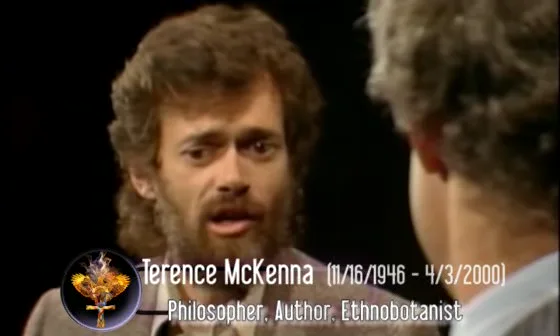
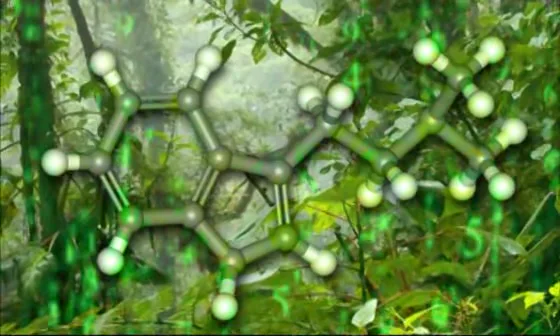
a 2009 documentary exploring shamanism and psychedelics as tools for accessing transpersonal realms through altered states of consciousness. covers ancient practices, sacred plants

dennis mckenna's 2008 talk at the fourth annual amazonian shamanism conference. speaking without prepared remarks, he explores ayahuasca as a planetary teacher, the scientific stud